
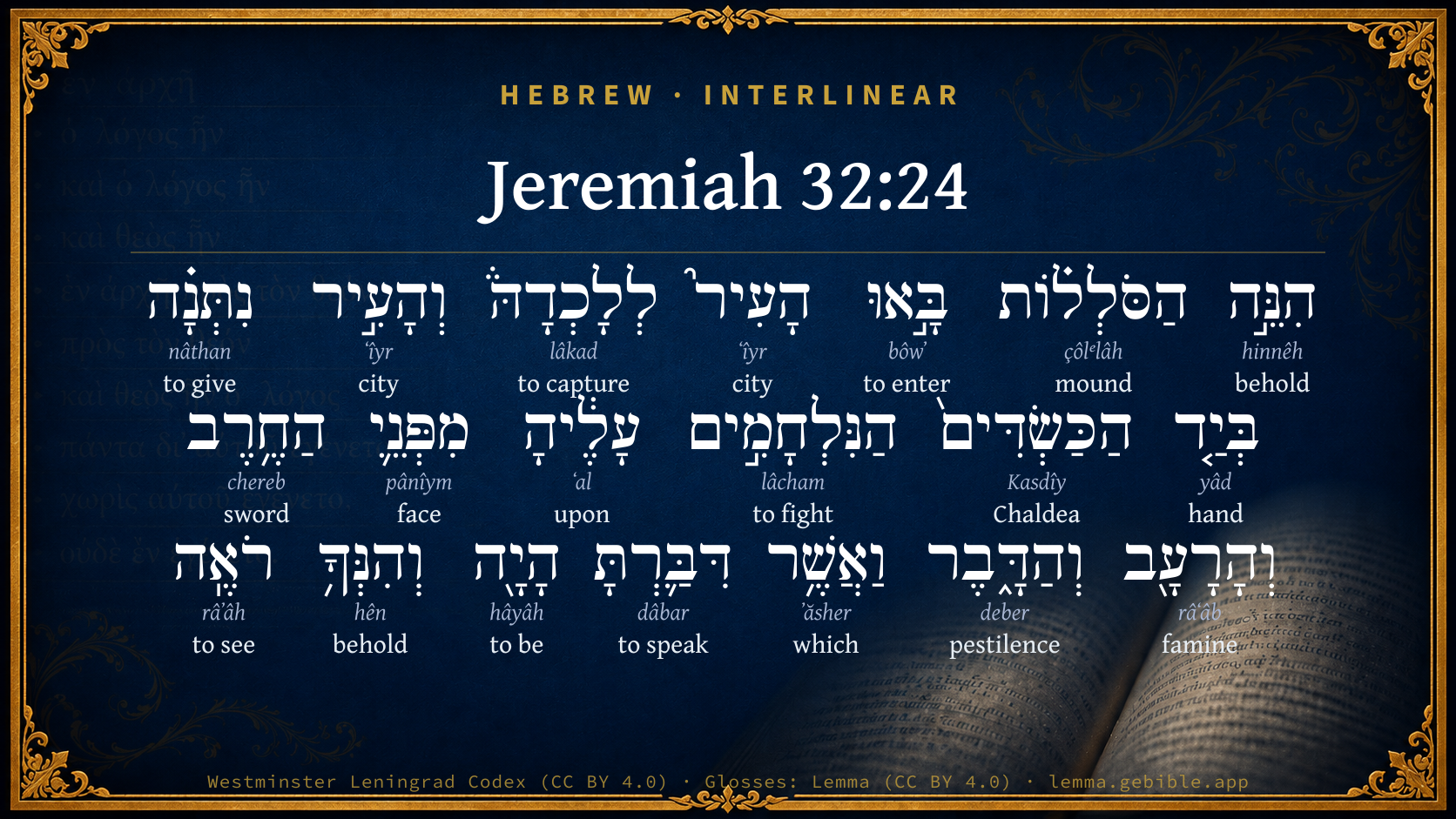
Jeremiah 32:24

Hebrew (Westminster Leningrad Codex) Jeremiah 32:24 appears in the Hebrew Old Testament. The text above is from the Westminster Leningrad Codex. Each word links to its Strong’s number, a concise gloss, and parsing drawn from the Open Scriptures Hebrew Bible morphology. Click any word for its full Brown-Driver-Briggs (BDB) entry.
Download image
Cite this verse

Jeremiah 32:24 (World English Bible). Public Domain. Lemma interlinear Bible study tool, https://lemma.gebible.app/v/jeremiah/32/24.

Show BibTeX & RIS
BibTeX
RIS
English Translation
Behold, the mounds, they are come to the city to take it; and the city is given into the hand of the Chaldeans who fight against it, because of the sword, and of the famine, and of the pestilence; and what you have spoken has happened; and, behold, you see it.
World English Bible · Public Domain
Download a study sheet

One document with this verse’s original text, its word-by-word gloss line, the meaning frame, cross-references with their text, attributed commentary, and full source and license credits — printable, and it pastes into notes with its structure intact.

This verse Autodidact and up

Study sheet (.html) Plain text (.txt)

A passage Seminary Student

Up to 50 verses in one chapter. A passage sheet keeps up to 6 commentary sources and 12 cross-references per verse, in the order this page ranks them, and says so on the sheet whenever that leaves anything out. Ask for a single verse and you get the Autodidact verse sheet above.

Everything on this page stays free to read, with no account — the sheet is a download of what is already on screen, not access to it.

Want to remove ads? Support Godless Engineer
Compare translations 3

The same verse in 3 English versions, stacked beneath the original-language interlinear above. Click any original word for its lexicon entry.

Each is an independent rendering of the whole verse — the interlinear is not word-aligned to these translations.

Highlighted words mark where these versions differ — a whole-verse word diff, not a word-by-word alignment.

  • World English Bible Public Domain
    Behold, the mounds, they are come to the city to take it; and the city is given into the hand of the Chaldeans who fight against it, because of the sword, and of the famine, and of the pestilence; and what you have spoken has happened; and, behold, you see it.
  • King James Version Public Domain
    Behold the mounts, they are come unto the city to take it; and the city is given into the hand of the Chaldeans, that fight against it, because of the sword, and of the famine, and of the pestilence: and what thou hast spoken is come to pass; and, behold, thou seest it.
  • unfoldingWord Literal Text CC BY-SA 4.0
    Look! The siege mounds have reached up to the city to capture it. For because of sword, famine, and plague, the city has been given into the hand of the Chaldeans who are fighting against it. For what you have said would happen is happening, and see, you are watching.

unfoldingWord Literal Text — © unfoldingWord, licensed CC BY-SA 4.0. Word-aligned USFM3 via Door43 (git.door43.org/unfoldingWord/en_ult).

Versions to compare (up to 4)

3 of 4 selected

Show all 18 translations

Every available English version of this verse, each an independent rendering of the whole verse.

  • World English Bible Public Domain
    Behold, the mounds, they are come to the city to take it; and the city is given into the hand of the Chaldeans who fight against it, because of the sword, and of the famine, and of the pestilence; and what you have spoken has happened; and, behold, you see it.
  • Berean Standard Bible Public Domain
    See how the siege ramps are mounted against the city to capture it. And by sword and famine and plague, the city has been given into the hands of the Chaldeans who are fighting against it. What You have spoken has happened, as You now see!
  • Majority Standard Bible Public Domain
    See how the siege ramps are mounted against the city to capture it. And by sword and famine and plague, the city has been given into the hands of the Chaldeans who are fighting against it. What You have spoken has happened, as You now see!
  • King James Version Public Domain
    Behold the mounts, they are come unto the city to take it; and the city is given into the hand of the Chaldeans, that fight against it, because of the sword, and of the famine, and of the pestilence: and what thou hast spoken is come to pass; and, behold, thou seest it.
  • American Standard Version (1901) Public Domain
    Behold, the mounds, they are come unto the city to take it; and the city is given into the hand of the Chaldeans that fight against it, because of the sword, and of the famine, and of the pestilence; and what thou hast spoken is come to pass; and, behold, thou seest it.
  • Revised Version (1885) Public Domain
    Behold the mounts, they are come unto the city to take it; and the city is given into the hand of the Chaldeans that fight against it, because of the sword, and of the famine, and of the pestilence: and what thou hast spoken is come to pass; and, behold, thou seest it.
  • Geneva Bible (1599) Public Domain
    Beholde, the mounts, they are come into the citie to take it, and the citie is giuen into the hande of the Caldeans, that fight against it by meanes of the sword, and of the famine, and of the pestilence, and what thou hast spoken, is come to passe, and beholde, thou seest it.
  • Douay-Rheims (1899) Public Domain
    Behold works are built up against the city to take it: and the city is given into the hands of the Chaldeans, who fight against it, by the sword, and the famine, and the pestilence: and what thou hast spoken, is all come to pass, as thou thyself seest.
  • Young's Literal Translation Public Domain
    `Lo, the mounts -- they have come in to the city to capture it, and the city hath been given into the hand of the Chaldeans who are fighting against it, because of the sword, and the famine, and the pestilence; and that which Thou hast spoken hath come to pass, and lo, Thou art seeing;
  • Literal Standard Version CC BY-SA 4.0
    Behold, the [siege] mounds have come to the city to capture it, and the city has been given into the hand of the Chaldeans who are fighting against it, because of the sword, and the famine, and the pestilence; and that which You have spoken has come to pass, and behold, You are seeing.
  • Unlocked Literal Bible CC BY-SA 4.0
    Look! The siege mounds have reached up to the city to capture it. For because of sword, famine, and plague, the city has been given into the hand of the Chaldeans who are fighting against it. For what you have said would happen is happening, and see, you are watching.
  • unfoldingWord Literal Text CC BY-SA 4.0
    Look! The siege mounds have reached up to the city to capture it. For because of sword, famine, and plague, the city has been given into the hand of the Chaldeans who are fighting against it. For what you have said would happen is happening, and see, you are watching.
  • Darby Bible Public Domain
    Behold the mounds, they are come unto the city for taking it; and the city is given over into the hand of the Chaldeans, that fight against it, by the sword, and the famine, and the pestilence: and what thou hast spoken is come to pass; and behold, thou seest [it].
  • World Messianic Bible Public Domain
    “Behold, siege ramps have been built against the city to take it. The city is given into the hand of the Kasdim who fight against it, because of the sword, of the famine, and of the pestilence. What you have spoken has happened. Behold, you see it.
  • Webster's Bible Public Domain
    Behold the mounts, they are come to the city to take it; and the city is given into the hand of the Chaldeans, that fight against it, because of the sword, and of the famine, and of the pestilence: and what thou hast spoken is come to pass; and behold, thou seest it.
  • Free Bible Version CC BY-SA 4.0
    Look at the siege ramps piled up against the city to capture it! Through war and famine and disease, the city will be taken by the Babylonians who are attacking it. You can see that everything you said would happen has happened.
  • Bible in Basic English Public Domain
    See, they have made earthworks against the town to take it; and the town is given into the hands of the Chaldaeans who are fighting against it, because of the sword and need of food and disease: and what you have said has taken place, and truly you see it.
  • JPS Tanakh (1917) Public Domain
    behold the mounds, they are come unto the city to take it; and the city is given into the hand of the Chaldeans that fight against it, because of the sword, and of the famine, and of the pestilence; and what Thou hast spoken is come to pass; and, behold, Thou seest it.

Literal Standard Version (2020), Covenant Press — licensed CC BY-SA 4.0. Text via the HelloAO Bible API (eBible.org). Unlocked Literal Bible (unfoldingWord) — licensed CC BY-SA 4.0. Text via the HelloAO Bible API (eBible.org). unfoldingWord Literal Text — © unfoldingWord, licensed CC BY-SA 4.0. Word-aligned USFM3 via Door43 (git.door43.org/unfoldingWord/en_ult). Free Bible Version, Dr. Jonathan Gallagher — licensed CC BY-SA 4.0. Text via the HelloAO Bible API (eBible.org).

Word by word

More ways to search: Search by grammar → Find every occurrence → Compare this word →

Practice this passage: Drill this verse → Learn its vocabulary →

הַסֹּלְל֗וֹת
çôlᵉlâh
H5550
“the · mounds”
Particle, Definite Article + Noun, Common, Feminine, Plural, Absolute
Part of Speech
Particle + Noun
Type
Common
Gender
Feminine
Number
Plural
State
Absolute
Full BDB Definition

Origin: from H5549 , but used passively

TWOT: 1506b

mound
  1. הִנֵּ֣ה hinnêh H2009 “behold” Particle, Demonstrative
  2. בָּ֣אוּ bôwʼ H935 “to enter” Verb, Qal, Perfect, 3rd Person, Common, Plural
  3. הָעִיר֮ ʻîyr H5892 “the · city” Particle, Definite Article + Noun, Common, Feminine, Singular, Absolute
  4. לְלָכְדָהּ֒ lâkad H3920 “to capture · her” Preposition + Verb, Qal, Infinitive Construct + Suffix, Personal, 3rd Person, Feminine, Singular
  5. וְהָעִ֣יר ʻîyr H5892 “and · the · city” Conjunction + Particle, Definite Article + Noun, Common, Feminine, Singular, Absolute
  6. נִתְּנָ֗ה nâthan H5414 “to give” Verb, Niphal, Perfect, 3rd Person, Feminine, Singular
  7. בְּיַ֤ד yâd H3027 “in/at · hand of” Preposition + Noun, Common, Both, Singular, Construct
  8. הַכַּשְׂדִּים֙ Kasdîy H3778 “the · Chaldea” Particle, Definite Article + Noun, Proper
  9. הַנִּלְחָמִ֣ים lâcham H3898 “the · fighting” Particle, Definite Article + Verb, Niphal, Participle Active, Masculine, Plural, Absolute
  10. עָלֶ֔יהָ ʻal H5921 “upon · her” Preposition + Suffix, Personal, 3rd Person, Feminine, Singular
  11. מִפְּנֵ֛י pânîym H6440 “from · face(s) of” Preposition + Noun, Common, Both, Plural, Construct
  12. הַחֶ֥רֶב chereb H2719 “the · sword” Particle, Definite Article + Noun, Common, Feminine, Singular, Absolute
  13. וְהָרָעָ֖ב râʻâb H7458 “and · the · famine” Conjunction + Particle, Definite Article + Noun, Common, Masculine, Singular, Absolute
  14. וְהַדָּ֑בֶר deber H1698 “and · the · pestilence” Conjunction + Particle, Definite Article + Noun, Common, Masculine, Singular, Absolute
  15. וַאֲשֶׁ֥ר ʼăsher H834 “and · which” Conjunction + Particle, Relative
  16. דִּבַּ֛רְתָּ dâbar H1696 “to speak” Verb, Piel, Perfect, 2nd Person, Masculine, Singular
  17. הָיָ֖ה hâyâh H1961 “to be” Verb, Qal, Perfect, 3rd Person, Masculine, Singular
  18. וְהִנְּךָ֥ hên H2005 “and · behold · you” Conjunction + Particle, Interjection + Suffix, Personal, 2nd Person, Masculine, Singular
  19. רֹאֶֽה râʼâh H7200 “seeing” Verb, Qal, Participle Active, Masculine, Singular, Absolute

About this verse

These counts appear in no published source. They are computed here, from the morphology-tagged text and Lemma’s own curated glosses. What Lemma adds →

20
words
19
distinct lemmas
Prophets
section

Notable vocabulary

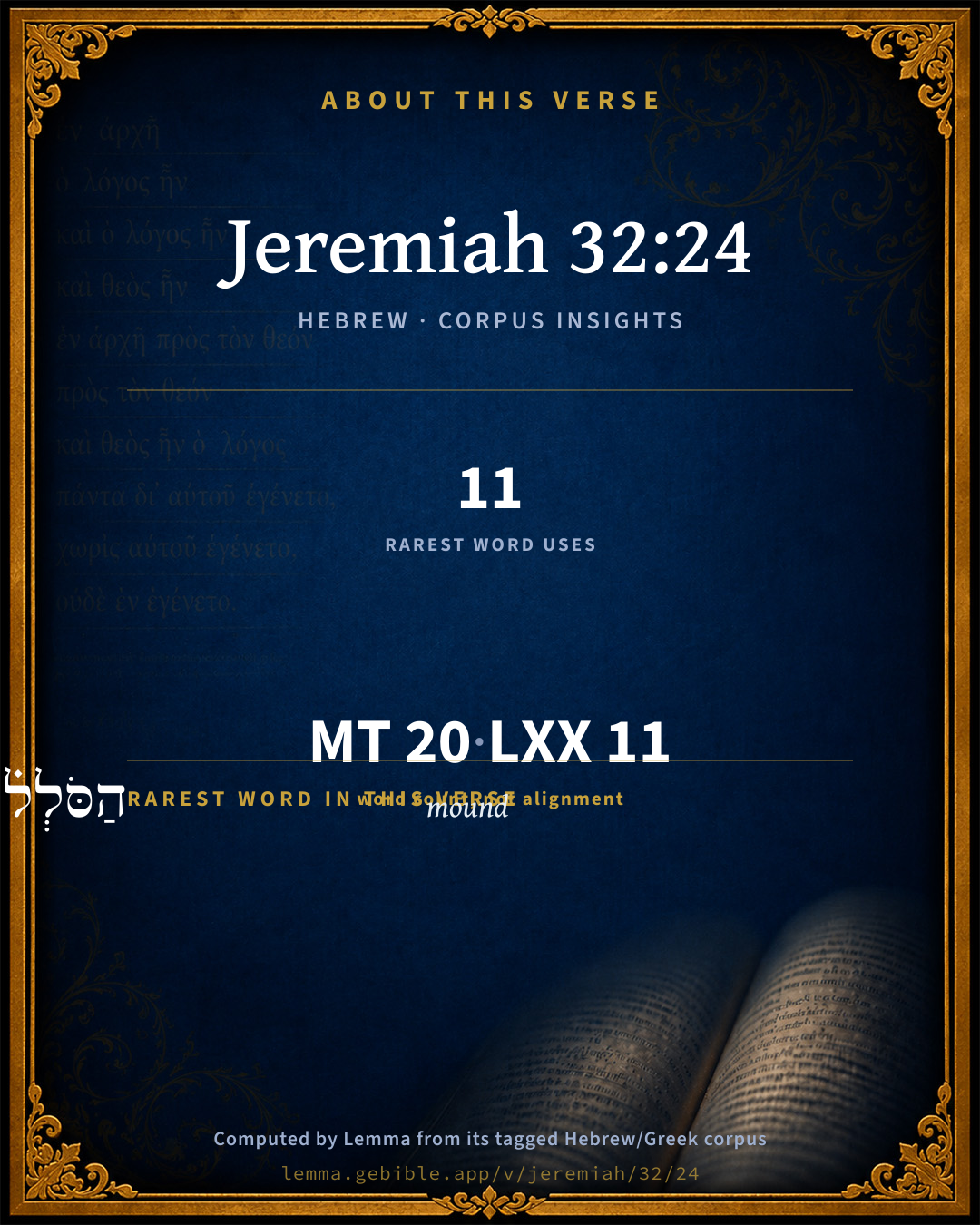
The rarest word here is הַסֹּלְל֗וֹת mound H5550 — appearing just 11 times in the whole Hebrew Bible.

Shared distinctive vocabulary

הַסֹּלְל֗וֹת mound H5550 occurs in 11 verses of the Hebrew Bible. Also found in:

Grammatical profile

  • 7 verbs
  • 9 nouns
  • 1 preposition
  • 3 particles

Verb forms

  • בָּ֣אוּ Qal · Perfect
  • לְלָכְדָהּ֒ Qal · Infinitive Construct
  • נִתְּנָ֗ה Niphal · Perfect
  • הַנִּלְחָמִ֣ים Niphal · Participle Active
  • דִּבַּ֛רְתָּ Piel · Perfect
  • הָיָ֖ה Qal · Perfect
  • רֹאֶֽה Qal · Participle Active

Repetition

A word recurs within this verse — often emphatic in Hebrew:

  • הָעִיר֮ city H5892 ×2

Hebrew & Septuagint length

In the original languages it is 20 Hebrew tokens and 11 Greek tokens — but the two are counted differently (Hebrew bundles its prefixes and suffixes into one token; the Greek is in lemma form), so that isn’t a like-for-like length.

Cross-references

22

Topical passages linked to Jeremiah 32:24 in the Treasury of Scripture Knowledge — connected by theme and wording, ordered by reader-vote popularity; previews shown in the World English Bible.

  • Deuteronomy 4:26 I call heaven and earth to witness against you this day, that you shall soon utterly perish from off the land whereunto you go over the Jordan to possess it; you shall not prolong your days on it, but shall utterly be destroyed.
  • Joshua 23:15–16 It shall happen, that as all the good things are come on you of which Yahweh your God spoke to you, so will Yahweh bring on you all the evil things, until he have destroyed you from off this good land which Yahweh your God has given you.
  • Jeremiah 32:36 Now therefore thus says Yahweh, the God of Israel, concerning this city, about which you say, It is given into the hand of the king of Babylon by the sword, and by the famine, and by the pestilence:
  • Jeremiah 33:4 For thus says Yahweh, the God of Israel, concerning the houses of this city, and concerning the houses of the kings of Judah, which are broken down [to make a defense] against the mounds and against the sword;
  • Jeremiah 21:4–7 Thus says Yahweh, the God of Israel, Behold, I will turn back the weapons of war that are in your hands, with which you fight against the king of Babylon, and against the Chaldeans who besiege you, without the walls; and I will gather them into the midst of this city.
  • Jeremiah 32:3 For Zedekiah king of Judah had shut him up, saying, Why do you prophesy, and say, Thus says Yahweh, Behold, I will give this city into the hand of the king of Babylon, and he shall take it;
  • Ezekiel 14:21 For thus says the Lord Yahweh: How much more when I send my four sore judgments on Jerusalem, the sword, and the famine, and the evil animals, and the pestilence, to cut off from it man and animal!
  • Ezekiel 21:22 In his right hand was the divination [for] Jerusalem, to set battering rams, to open the mouth in the slaughter, to lift up the voice with shouting, to set battering rams against the gates, to cast up mounds, to build forts.
  • Zechariah 1:6 But my words and my decrees, which I commanded my servants the prophets, didn't they overtake your fathers? "Then they repented and said, 'Just as Yahweh of Hosts determined to do to us, according to our ways, and according to our practices, so he has dealt with us.'"
  • Deuteronomy 31:16–17 Yahweh said to Moses, Behold, you shall sleep with your fathers; and this people will rise up, and play the prostitute after the strange gods of the land, where they go to be among them, and will forsake me, and break my covenant which I have made with them.
  • Deuteronomy 32:24–25 [They shall be] wasted with hunger, and devoured with burning heat Bitter destruction; The teeth of animals will I send on them, With the poison of crawling things of the dust.
  • 2 Samuel 20:15 They came and besieged him in Abel of Beth Maacah, and they cast up a mound against the city, and it stood against the rampart; and all the people who were with Joab battered the wall, to throw it down.
  • Jeremiah 14:12–15 When they fast, I will not hear their cry; and when they offer burnt offering and meal-offering, I will not accept them; but I will consume them by the sword, and by the famine, and by the pestilence.
  • Jeremiah 15:1–3 Then said Yahweh to me, Though Moses and Samuel stood before me, yet my mind would not be toward this people: cast them out of my sight, and let them go forth.
  • Jeremiah 16:4 They shall die grievous deaths: they shall not be lamented, neither shall they be buried; they shall be as dung on the surface of the ground; and they shall be consumed by the sword, and by famine; and their dead bodies shall be food for the birds of the sky, and for the animals of the earth.
  • Jeremiah 24:10 I will send the sword, the famine, and the pestilence, among them, until they be consumed from off the land that I gave to them and to their fathers.
  • Jeremiah 32:25 You have said to me, Lord Yahweh, Buy you the field for money, and call witnesses; whereas the city is given into the hand of the Chaldeans.
  • Jeremiah 37:6–10 Then came the word of Yahweh to the prophet Jeremiah, saying,
  • Jeremiah 52:6 In the fourth month, in the ninth day of the month, the famine was sore in the city, so that there was no bread for the people of the land.
  • Lamentations 2:21–22 The youth and the old man lie on the ground in the streets; My virgins and my young men are fallen by the sword: You have killed them in the day of your anger; you have slaughtered, [and] not pitied.
  • Lamentations 4:3–10 Even the jackals draw out the breast, they give suck to their young ones: The daughter of my people is become cruel, like the ostriches in the wilderness.
  • Matthew 24:35 Heaven and earth will pass away, but my words will not pass away.

Cross-references courtesy of OpenBible.info (CC BY 4.0).

Hebrew and Greek witnesses Masoretic Hebrew ↔ Greek Septuagint

The same verse in the two great witnesses to the Old Testament, shown verse-for-verse.

These are two independent witnesses, not word-aligned to each other, and the Septuagint is shown in lemma (dictionary) form.

Hebrew Jeremiah 32:24 Masoretic · Westminster Leningrad Codex

הִנֵּ֣ה הַסֹּלְל֗וֹת בָּ֣אוּ הָעִיר֮ לְלָכְדָהּ֒ וְהָעִ֣יר נִתְּנָ֗ה בְּיַ֤ד הַכַּשְׂדִּים֙ הַנִּלְחָמִ֣ים עָלֶ֔יהָ מִפְּנֵ֛י הַחֶ֥רֶב וְהָרָעָ֖ב וְהַדָּ֑בֶר וַאֲשֶׁ֥ר דִּבַּ֛רְתָּ הָיָ֖ה וְהִנְּךָ֥ רֹאֶֽה

Behold, the mounds, they are come to the city to take it; and the city is given into the hand of the Chaldeans who fight against it, because of the sword, and of the famine, and of the pestilence; and what you have spoken has happened; and, behold, you see it.

World English Bible · Public Domain

Greek LXX Structure differs

In the Septuagint, Jeremiah is about an eighth shorter than the Hebrew and arranges its material differently — the Oracles Against the Nations (Hebrew chapters 46–51) appear in the middle of the Greek book, after 25:13. Because the chapter and verse boundaries do not line up, a verse-for-verse comparison with the Hebrew is not shown.

A verse-for-verse comparison isn’t shown here because the chapters and verses don’t line up. Switch to the LXX edition with the MT / LXX toggle above to read the Greek directly.

Hebrew: Westminster Leningrad Codex (CC BY 4.0). Greek: Septuagint (public domain); English from a public-domain English Septuagint. How the Septuagint differs from the Hebrew →

Targum (Aramaic paraphrase)

1

The Targum is the ancient Jewish Aramaic paraphrase of the Hebrew Scriptures — an interpretive translation, not the Hebrew text itself. Onkelos (literal) and Pseudo-Jonathan (expansive) render the Torah, and Jonathan the Prophets. Coverage is partial: where no permissively-licensed English translation exists for a verse, only the Aramaic is shown. This is verse-level text, not a word-by-word alignment to the Hebrew.

  1. Targum Jonathan Prophets (Joshua–Malachi)
    הָא מַלְיָתָא עָלוּ עַל קַרְתָּא לְמִכְבְּשָׁהּ וְקַרְתָּא אִתְמְסָרַת בִּידָא דְכַסְדָאֵי דְמַגִיחִין קְרָבָא עֲלָהּ מִן קֳדָם דְקַטְלִין בְּחַרְבָּא וְכַפְנָא וּמוֹתָא וּדְמַלֵילְתָּא הֲוָה וּקְדָמָךְ גְלֵי:

    (no public-domain English translation for this verse)

    Targum Jonathan — Aramaic: “Mikraot Gedolot” (public domain). English: “Sefaria Community Translation” (CC0 1.0 (public-domain dedication)); “London "Chaldee Paraphrase," 1871” (public domain). Text via Sefaria.

Commentary

Notes on Jeremiah 32:24 from classic Christian and Jewish commentators (each source and its license shown beneath its notes). The classic Christian expositions comment on the surrounding passage and are grouped to its opening verse, so a note may address several verses; the Jewish commentaries on the Tanakh (Rashi and others) are per-verse, so they appear only where the commentator wrote on this verse.

Lemma curates 59 commentaries, every one of them public domain or Creative Commons licensed, each selected and text-cleaned for this edition rather than reprinted as found. About our sources →

Trapp's Complete Commentary

John Trapp

Jer 32:24 Behold the mounts, they are come unto the city to take it; and the city is given into the hand of the Chaldeans, that fight against it, because of the sword, and of the famine, and of the pestilence: and what thou hast spoken is come to pass; and, behold, thou seest [it].

Ver. 24. Behold the mounts.] Raised by the enemies as high as the walls, that they might fight with the besieged upon even ground.

John Trapp, A Commentary or Exposition upon All the Books of the Old and New Testament (1647–1656) — public domain. Text from a community e-Sword module.

Tyndale Open Study Notes

Tyndale Open Resources

32:24 Jeremiah was amazed at the skill of the attacking Babylonians. They used ramps to lay siege to the walled city. Within Jerusalem, he saw the horrors of war, famine, and disease. It was obvious that the Babylonians would conquer the city. A sense of awe swept through Jeremiah as he realized that he was seeing the fulfillment of everything the Lord had said.

Tyndale Open Study Notes — © Tyndale Open Resources, licensed CC BY-SA 4.0. Text via the HelloAO Bible API.

Geneva Bible (1599)

Geneva Bible translators

The word signifieth anything that is cast up, as a mount or rampart, and is also used for engines of war, which were laid on an high place to shoot into a city before that guns were in use.

Geneva Bible (1599) marginal notes — public domain. Text via Bolls.life.

Jamieson, Fausset & Brown

Robert Jamieson, A. R. Fausset & David Brown

mounts--mounds of earth raised as breastworks by the besieging army, behind which they employed their engines, and which they gradually pushed forward to the walls of the city.

behold, thou seest it--connected with Jer 32:25. Thou seest all this with Thine own eyes, and yet (what seems inconsistent with it) Thou commandest me to buy a field.

Jamieson, Fausset & Brown — Commentary Critical and Explanatory on the Whole Bible (1871) — public domain (CC PDM 1.0). Text via the HelloAO Bible API.

Adam Clarke's Commentary

Verse 24. Behold the mounts] The huge terraces raised up to plant their engines on, that they might throw darts, stones, c., into the city.

Because of the sword, and of the famine, and of the pestilence] The city was now reduced to extreme necessity and from the siege continuing nearly a year longer, we may conclude that the besieged made a noble defense.

Adam Clarke's Commentary on the Bible (1810–1826) — public domain. Text from a community e-Sword/MySword module.

John Calvin's Commentaries

Here then at length the Prophet discovers his own perplexity. We have already stated the reason why he made so long an introduction before he came to the main thing: it was necessary for him to put on as it were a bridle; for except we restrain our thoughts, we shall become petulant against God, and there will be no moderation. The Prophet then, that he might not peevishly expostulate with God, set before himself his immeasurable power, and then he added that nothing happens except through his righteous vengeance. He now however asks, how it was, that he was bidden to buy the field when the city and the whole country were delivered up into their enemies. He then mentions here this inconsistency, and confesses that his mind was embarrassed, for he could not discover why God had bidden him to buy the field, and yet had determined to drive the people into exile and to scatter them into remote lands. But we have said that the Prophet was fully persuaded of God’s truth; and hence it was that he was so willing and ready to obey; for he made no delay in buying the field; and he afterwards laid up with Baruch the writings of the purchase. But after having performed all this, he brought a complaint against God; and as the thing appeared unreasonable, he desired this knot to be untied.

He then says, Behold the mounts, or, the warlike engines, for the word may mean either. The word סללות sallut, often means mounts; but as mention is made here of a siege, the Prophet seems to refer, as we have said in the sixth chapter, to warlike engines or battering rams. And there were engines to beat down walls; great stones or a number of stones were also cast. I am therefore inclined to the opinion of those who consider that they were either engines to shoot stones and darts, or battering rams. Behold, then, he says, there are moved to the city battering rams to take it, and the city is delivered up to the Chaldeans It was, it seems, the tenth year of Zedekiah, and at the beginning of the eleventh month the city was taken. But the Prophet is the best interpreter of his own words, and what he means may be easily gathered from the context, for he says that the city was taken by the sword, by famine, and by pestilence; as though he had said, that though the enemies had not as yet entered into the city, yet it was all over with it, that there was no hope remaining, because it was not only assailed by arms and a powerful force, but it had also enemies within, which pressed hard on it, even famine and the pestilence As then a great number had already been consumed by pestilence and famine, the Prophet says, that though, the enemies should cease to assail it, and make no forcible entrance into it, yet it was all over with it, because the pestilence and famine had so prevailed, that there was no hope of deliverance. By these words he intimates an extremity of despair; and hence also arose the thought which tormented the mind of the Prophet, that it appeared wholly unreasonable that God should bid him to buy the field when the city had been already delivered up into the power of enemies.

He adds, and what thou hast spoken is come to pass; and, behold, thou seest it He confirms what he had just said, even that the destruction of the city did not otherwise happen than through God’s judgment. And he confirms it, because whatever then happened, had already been testified during the time of the Prophet himself. And it hence appeared, that the city was not distressed through chance, because God had foretold nothing by his servants but what he had decreed and resolved to do. Then the ruin of Jerusalem was the work of God, of which he had foretold by his servants. For these two things ought to be joined together — the mouth of God and the hand of God. Nor is it lawful to imagine such a thing as some fanatics do, that God sees from heaven whatever is done on earth, and yet continues in an idle state. But he decrees what is right, and then when it is necessary, he testifies it by his servants the Prophets. However, the mouth of God ought not to be separated from his hand. The Prophet then shews that the destruction of the city was the righteous judgment of God, because the Prophets had previously spoken of it.

The words, thou seest it, refer to the preceding sentence, or to that which immediately follows, even because it seemed inconsistent or unreasonable that the Prophet should buy the field as God commanded, and yet that God knew that the land was possessed by enemies, and that the people were to be driven into exile. Since then God had resolved to cast out the people from the land, how was it that he had bidden his servant to buy the field? Had all this been unknown to God, the inconsistency would not have been so evident But when God perfectly knew that what he had so often proclaimed as to the exile by his Prophets could not be changed, what could be his purpose in bidding the field to be bought and the purchase to be confirmed by witnesses, when yet the city was delivered up to enemies? Jeremiah, after having mentioned the substance of his prayer, now adds the answer he received from God, in which is seen the fruit of his prayer, even that he had been taught what had regard to the deliverance and return of the people, in order that the faithful might entertain hope, and also that they, relying on the promise, might cheerfully bear their exile until the prefixed time came. The words are these, —

John Calvin's Commentaries (1540-1563) — public domain. Text from the Calvin Translation Society English edition (1840s-50s) via the Christian Classics Ethereal Library (ccel.org). Calvin's coverage is partial (roughly two-thirds of the Bible); uncommented books and verses are honest gaps, never fabricated. The 19th-century editor's footnotes and remarks are omitted so the notes are faithfully Calvin's own voice.

Ellicott's Commentary for English Readers

(24) Behold the mounts . . .—The mounts (better, mounds) are (as in Jer_6:6, where see Note) the banks or towers of wood which formed the chief part of ancient siege operations. What the prophet had then predicted had now come to pass, and Jerusalem was now exposed to the sword, the famine, and the pestilence, which were its inevitable accompaniments. And it was at such a time as this, when the darkness was thickest, that a ray of hope for the future was given by the command to buy the field at Anathoth. And yet the command was so strange, and the hope so apparently against all probabilities, that the prophet ends his prayer by leaving the whole matter in the hands of Jehovah.

A Bible Commentary for English Readers, edited by Charles John Ellicott (1878–1897) — public domain. Text from a community e-Sword module.

The Cambridge Bible for Schools and Colleges

gen. ed. J. J. S. Perowne

24. the mounts] See on ch. Jer_6:6.

are come unto the city] The enemy have pushed them forward so that they already reach to the walls.

is given] The thing is virtually done, there being a complete blockade, and no hope of rescue for the starving population within.

The Cambridge Bible for Schools and Colleges (gen. ed. J. J. S. Perowne; Cambridge University Press, 1878–1918) — public domain. Text from a community e-Sword module.

John Gill's Exposition

And thou hast said to me, O Lord God,.... Or, "O Lord God, yet thou hast said to me" (b); notwithstanding this is the case, the country all around is in the hand of the enemy, and the city is as good as delivered up to them, yet thou hast given me such orders, as follows:

buy thee a field for money, and take witnesses; for though these words were not expressly said to him by the Lord; yet inasmuch as he told him that his uncle's son would come to him, and propose the selling of his field to him; and accordingly did come, agreeably to the word of the Lord; Jeremiah understood it as the will of the Lord, that he should buy it before witnesses; which he did, as before related:

for the city is given into the hand of the Chaldeans; or rather, "though the city is given" (c), &c. yet thou hast said so: now by this the prophet suggests, that though he had obeyed the divine order, as he ought to have done, yet there was some difficulty upon his mind; or there were some objections Started, by the Jews that were with him, how these things could be reconciled; that he should be ordered to buy a field at such a time as this, and thereby signify that fields and vineyards should be bought and possessed in the land, and yet the city just going to be surrendered into the hands of the Chaldeans.

(b) "tu vero nihilominus dicis mihi", Piscator; "tu tamen dixisti ad me, Domime Jehovah", Schmidt. (c) "cum tamen urbs tradenda sit", Schmidt; "quum tamen futurum sit", Piscator; "quum civitas ipsa traditur", Junius & Tremellius; "cum tamen urbs tradita sit", Cocceius.

John Gill's Exposition of the Whole Bible (1746–1763) — public domain (CC PDM 1.0). Text via the HelloAO Bible API.

Albert Barnes' Notes on the Bible

The mounts - See Jer 6:6 note.

Albert Barnes' Notes on the Bible (1834–1885) — public domain. Text from a community e-Sword/MySword module.

Haydock's Catholic Bible Commentary

By. Literally, "at the presence of the sword," or by its force, Psalm lix. 6. (Worthington)

George Leo Haydock (1774–1849), Haydock's Catholic Family Bible and Commentary, 1859 edition — public domain. Excludes Psalms (Douay-Rheims chapter numbering differs from Protestant) and Deuterocanonical books (Catholic canon only).

Matthew Poole's English Annotations

Mounts; the word signifies ramparts, or rather battering rams, engines of war, which those nations used to batter walls, or to shoot great stones into places besieged.

They are come unto the city to take it; they are already besieging Jerusalem, and have been for some time; and the city is even ready to be taken, and cannot hold out; so many daily are killed, either with the sword of the enemy, or by famine for want of provision, or by the pestilence;

and what thou hast spoken is come to pass; thou art just and righteous in all this, and hast done but according to what thou threatenedst to do to a sinful people that would not obey thy voice.

Matthew Poole's English Annotations on the Holy Bible (1683–1685) — public domain. Text from a community e-Sword/MySword module.

Whedon's Commentary on the Bible

Daniel D. Whedon

24. Mounts — The ramparts of the besieging army.

Is given — Not merely a prophetic present, as implying God’s purpose, but rhetorical present, implying a certainty because it was as good as done.

Daniel D. Whedon (gen. ed.), Commentary on the Old and New Testaments (1874–1909) — public domain. Text from a community e-Sword module.

The Pulpit Commentary

Behold the mounts. (see as Jer_6:6) Is given. Resistance being hopeless, Jerusalem was virtually in the hands of its besiegers.

The Pulpit Commentary (1880–1919), ed. H.D.M. Spence-Jones & Joseph S. Exell — public domain. Text from a community e-Sword module.

John Wesley's Explanatory Notes

The mounts - Rather engines of war with which those nations used to batter walls, or to shoot great stones into places besieged.

John Wesley, Explanatory Notes Upon the Whole Bible (1754–1765) — public domain. Text via the GEBible commentary corpus.

Scofield Reference Notes

C. I. Scofield

mounts

Or, engines of shot.

The Scofield Reference Bible (1917 edition), notes by C. I. Scofield — public domain. Text from a community e-Sword module.

unfoldingWord translationNotes

Door43 World Missions Community

General Information:

Jeremiah continues praying to Yahweh.

The siege mounds have reached up to the city to capture it

The large piles of dirt and rocks that the enemy built around the city so they could stand on them and attack it are spoken of as if they were the attackers themselves reaching out to capture the city. AT: "The enemy's seige mounds are so close to the city that the enemy will be able to capture the city" (See: Metaphor)

because of sword

The word "sword" is a metonym for war, where soldiers use swords. AT: "because soldiers will attack" (See: Metonymy)

famine, and plague

These abstract nouns can be translated with verbal phrases. AT: "people have no food to eat, and everyone is weak from being ill" (See: Abstract Nouns)

the city has been given into the hand of the Chaldeans

Here "hand" means power or control. This can be translated in active form. AT: "you have given Jerusalem to the Chaldean army" (See: Metonymy and Active or Passive)

happening, and see, you are watching

"happening, as you can see very well"

have witnesses witness it

"have people watch you purchase the land so they can tell others that you have purchased the land"

this city is being given

This can be translated in active form. AT: "I am giving this city" (See: Active or Passive)

translationWords

siege

sword

famine

plague

hand

Chaldea

silver

testimony

unfoldingWord translationNotes — © Distant Shores Media and the Door43 World Missions Community, licensed CC BY-SA 4.0. Source: git.door43.org/Door43/en_tn.

Rashi

Rabbi Shlomo Yitzchaki (Rashi)

and what You have proclaimed Evil upon it has come to pass (lit., has been and has come).

Rashi on the Tanakh — English translations: “The Judaica Press complete Tanach with Rashi, translated by A. J. Rosenberg” (CC BY 4.0); “Pentateuch with Rashi's commentary by M. Rosenbaum and A.M. Silbermann, 1929-1934” (public domain); “The Metsudah Tanach series, Lakewood, N.J” (CC BY 4.0); and “The Book of Joshua, Metsudah Publications, 1997” (CC BY 4.0). Text via Sefaria.

Lesson kit

Teaching starters — assembled from the data on this page, not authored interpretation. Every prompt links to the verse data it draws on. Edit before teaching.

Jeremiah, in the Prophets, opens this verse with 20 words (19 distinct Hebrew lemmas). Its most distinctive word is çôlᵉlâh (“mound”). A historical commentator’s framing appears above. Read the whole chapter for the surrounding context.

Discussion questions

  1. The word çôlᵉlâh carries the sense “mound.” How does it shape the verse?
  2. 2 Samuel 20:15 shares the word «mound» with this verse. How do the two illuminate each other?
  3. “city” occurs 2× in this one verse. What is the effect of the repetition?
  4. These translations render this verse differently; the difference is in the English rendering, not the original. What questions does that raise?
  5. The verb «בָּ֣אוּ» is Qal Perfect. How does its form color the action?
  6. Reading how Trapp's Complete Commentary and Tyndale Open Study Notes read this verse, where do the two commentators agree and where do they part?

Things to notice

Reading settings

Reading text

Shown beneath each verse's original-language words.

Old Testament
Old Testament edition

Read the OT as the Masoretic Hebrew (MT) or the Greek Septuagint (LXX).

English shown for the Greek Septuagint (in the Hebrew ↔ Greek comparison).

Comparing translations? Open the Compare panel on any verse page to stack up to four side by side.