Jeremiah 20:12

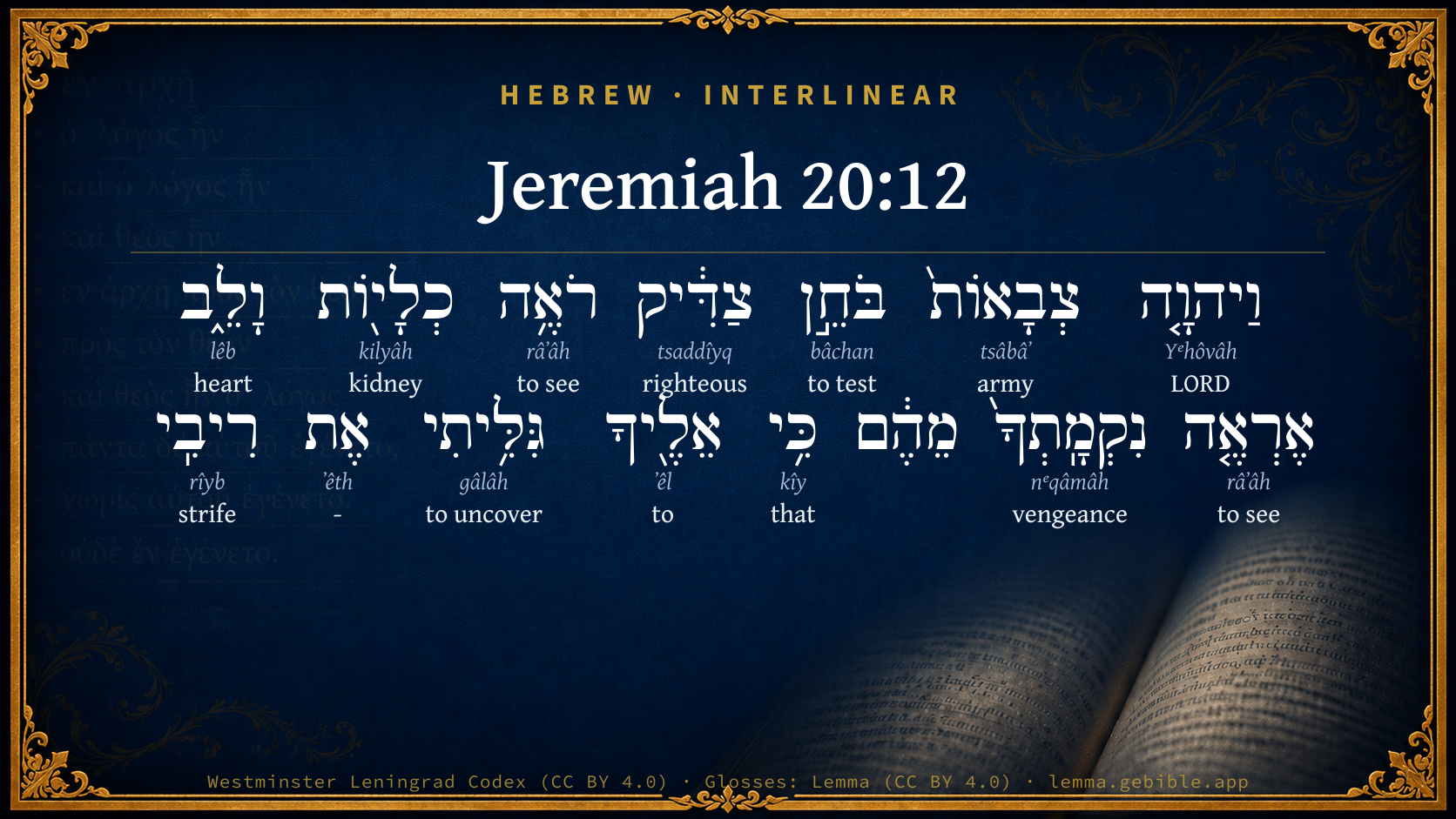
Hebrew (Westminster Leningrad Codex) Jeremiah 20:12 appears in the Hebrew Old Testament. The text above is from the Westminster Leningrad Codex. Each word links to its Strong’s number, a concise gloss, and parsing drawn from the Open Scriptures Hebrew Bible morphology. Click any word for its full Brown-Driver-Briggs (BDB) entry.
Download image
Cite this verse

Jeremiah 20:12 (World English Bible). Public Domain. Lemma interlinear Bible study tool, https://lemma.gebible.app/v/jeremiah/20/12.

Show BibTeX & RIS
BibTeX
RIS
English Translation
But, Yahweh of Hosts, who tests the righteous, who sees the heart and the mind, let me see your vengeance on them; for to you have I revealed my cause.
World English Bible · Public Domain
Download a study sheet

One document with this verse’s original text, its word-by-word gloss line, the meaning frame, cross-references with their text, attributed commentary, and full source and license credits — printable, and it pastes into notes with its structure intact.

This verse Autodidact and up

Study sheet (.html) Plain text (.txt)

A passage Seminary Student

Up to 50 verses in one chapter. A passage sheet keeps up to 6 commentary sources and 12 cross-references per verse, in the order this page ranks them, and says so on the sheet whenever that leaves anything out. Ask for a single verse and you get the Autodidact verse sheet above.

Everything on this page stays free to read, with no account — the sheet is a download of what is already on screen, not access to it.

Want to remove ads? Support Godless Engineer
Compare translations 3

The same verse in 3 English versions, stacked beneath the original-language interlinear above. Click any original word for its lexicon entry.

Each is an independent rendering of the whole verse — the interlinear is not word-aligned to these translations.

Highlighted words mark where these versions differ — a whole-verse word diff, not a word-by-word alignment.

  • World English Bible Public Domain
    But, Yahweh of Hosts, who tests the righteous, who sees the heart and the mind, let me see your vengeance on them; for to you have I revealed my cause.
  • King James Version Public Domain
    But, O LORD of hosts, that triest the righteous, and seest the reins and the heart, let me see thy vengeance on them: for unto thee have I opened my cause.
  • unfoldingWord Literal Text CC BY-SA 4.0
    And Yahweh of Armies, the one testing the righteous, seeing the kidneys and the heart— let me see your vengeance on them, for to you I have made known my cause.

unfoldingWord Literal Text — © unfoldingWord, licensed CC BY-SA 4.0. Word-aligned USFM3 via Door43 (git.door43.org/unfoldingWord/en_ult).

Versions to compare (up to 4)

3 of 4 selected

Show all 18 translations

Every available English version of this verse, each an independent rendering of the whole verse.

  • World English Bible Public Domain
    But, Yahweh of Hosts, who tests the righteous, who sees the heart and the mind, let me see your vengeance on them; for to you have I revealed my cause.
  • Berean Standard Bible Public Domain
    O LORD of Hosts, who examines the righteous, who sees the heart and mind, let me see Your vengeance upon them, for to You I have committed my cause.
  • Majority Standard Bible Public Domain
    O LORD of Hosts, who examines the righteous, who sees the heart and mind, let me see Your vengeance upon them, for to You I have committed my cause.
  • King James Version Public Domain
    But, O LORD of hosts, that triest the righteous, and seest the reins and the heart, let me see thy vengeance on them: for unto thee have I opened my cause.
  • American Standard Version (1901) Public Domain
    But, O Jehovah of hosts, that triest the righteous, that seest the heart and the mind, let me see thy vengeance on them; for unto thee have I revealed my cause.
  • Revised Version (1885) Public Domain
    But, O LORD of hosts, that triest the righteous, that seest the reins and the heart, let me see thy vengeance on them; for unto thee have I revealed my cause.
  • Geneva Bible (1599) Public Domain
    But, O Lord of hostes, that tryest the righteous, and seest the reines and the heart, let me see thy vengeance on them: for vnto thee haue I opened my cause.
  • Douay-Rheims (1899) Public Domain
    And thou, O Lord of hosts, prover of the just, who seest the reins and the heart: let me see, I beseech thee, thy vengeance on them: for to thee I have laid open my cause.
  • Young's Literal Translation Public Domain
    And, O Jehovah of Hosts, trier of the righteous, Beholder of reins and heart, I do see Thy vengeance out of them, For unto Thee I have revealed my cause.
  • Literal Standard Version CC BY-SA 4.0
    And, O YHWH of Hosts, trier of the righteous, || Beholder of reins and heart, || I see Your vengeance on them, || For I have revealed my cause to you.
  • Unlocked Literal Bible CC BY-SA 4.0
    But Yahweh of hosts, you examine the righteous and see the mind and the heart. Let me see your vengeance on them for I have committed my cause to you.
  • unfoldingWord Literal Text CC BY-SA 4.0
    And Yahweh of Armies, the one testing the righteous, seeing the kidneys and the heart— let me see your vengeance on them, for to you I have made known my cause.
  • Darby Bible Public Domain
    And thou, Jehovah of hosts, who triest the righteous, who seest the reins and the heart, let me see thy vengeance on them; for unto thee have I revealed my cause.
  • World Messianic Bible Public Domain
    But the LORD of Hosts, who tests the righteous, who sees the heart and the mind, let me see your vengeance on them, for I have revealed my cause to you.
  • Webster's Bible Public Domain
    But, O LORD of hosts, that triest the righteous, and seest the reins and the heart, let me see thy vengeance on them: for to thee have I opened my cause.
  • Free Bible Version CC BY-SA 4.0
    Lord Almighty, you know without question who is living right. You examine people's thoughts and feelings. So let me see your punishment fall on them, because I've trusted you to judge my case.
  • Bible in Basic English Public Domain
    But, O Lord of armies, testing the upright and seeing the thoughts and the heart, let me see your punishment come on them; for I have put my cause before you.
  • JPS Tanakh (1917) Public Domain
    But, O LORD of hosts, that triest the righteous, that seest the reins and the heart, let me see Thy vengeance on them; for unto Thee have I revealed my cause.

Literal Standard Version (2020), Covenant Press — licensed CC BY-SA 4.0. Text via the HelloAO Bible API (eBible.org). Unlocked Literal Bible (unfoldingWord) — licensed CC BY-SA 4.0. Text via the HelloAO Bible API (eBible.org). unfoldingWord Literal Text — © unfoldingWord, licensed CC BY-SA 4.0. Word-aligned USFM3 via Door43 (git.door43.org/unfoldingWord/en_ult). Free Bible Version, Dr. Jonathan Gallagher — licensed CC BY-SA 4.0. Text via the HelloAO Bible API (eBible.org).

Word by word

More ways to search: Search by grammar → Find every occurrence → Compare this word →

Practice this passage: Drill this verse → Learn its vocabulary →

נִקְמָֽתְךָ֙
nᵉqâmâh
H5360
“vengeance · your”
Noun, Common, Feminine, Singular, Construct + Suffix, Personal, 2nd Person, Masculine, Singular
Part of Speech
Noun
Type
Common
Gender
Feminine
Number
Singular
State
Construct
Full BDB Definition

Origin: from H5359

TWOT: 1413b

vengeance - vengeance (by God, by Israel, by enemies of Israel)
  1. וַיהוָ֤ה Yᵉhôvâh H3068 “and · LORD” Conjunction + Noun, Proper
  2. צְבָאוֹת֙ tsâbâʼ H6635 “armies” Noun, Common, Both, Plural, Absolute
  3. בֹּחֵ֣ן bâchan H974 “testing” Verb, Qal, Participle Active, Masculine, Singular, Absolute
  4. צַדִּ֔יק tsaddîyq H6662 “righteous” Adjective, Adjective, Masculine, Singular, Absolute
  5. רֹאֶ֥ה râʼâh H7200 “seeing” Verb, Qal, Participle Active, Masculine, Singular, Absolute
  6. כְלָי֖וֹת kilyâh H3629 “kidneys” Noun, Common, Feminine, Plural, Absolute
  7. וָלֵ֑ב lêb H3820 “and · heart” Conjunction + Noun, Common, Masculine, Singular, Absolute
  8. אֶרְאֶ֤ה râʼâh H7200 “to see” Verb, Qal, Cohortative, 1st Person, Common, Singular
  9. כִּ֥י kîy H3588 “that” Conjunction
  10. אֵלֶ֖יךָ ʼêl H413 “to · you” Preposition + Suffix, Personal, 2nd Person, Masculine, Singular
  11. גִּלִּ֥יתִי gâlâh H1540 “to uncover” Verb, Piel, Perfect, 1st Person, Common, Singular
  12. אֶת ʼêth H853 “-” Particle, Direct Object
  13. רִיבִֽי rîyb H7379 “strife · my” Noun, Common, Both, Singular, Construct + Suffix, Personal, 1st Person, Common, Singular

About this verse

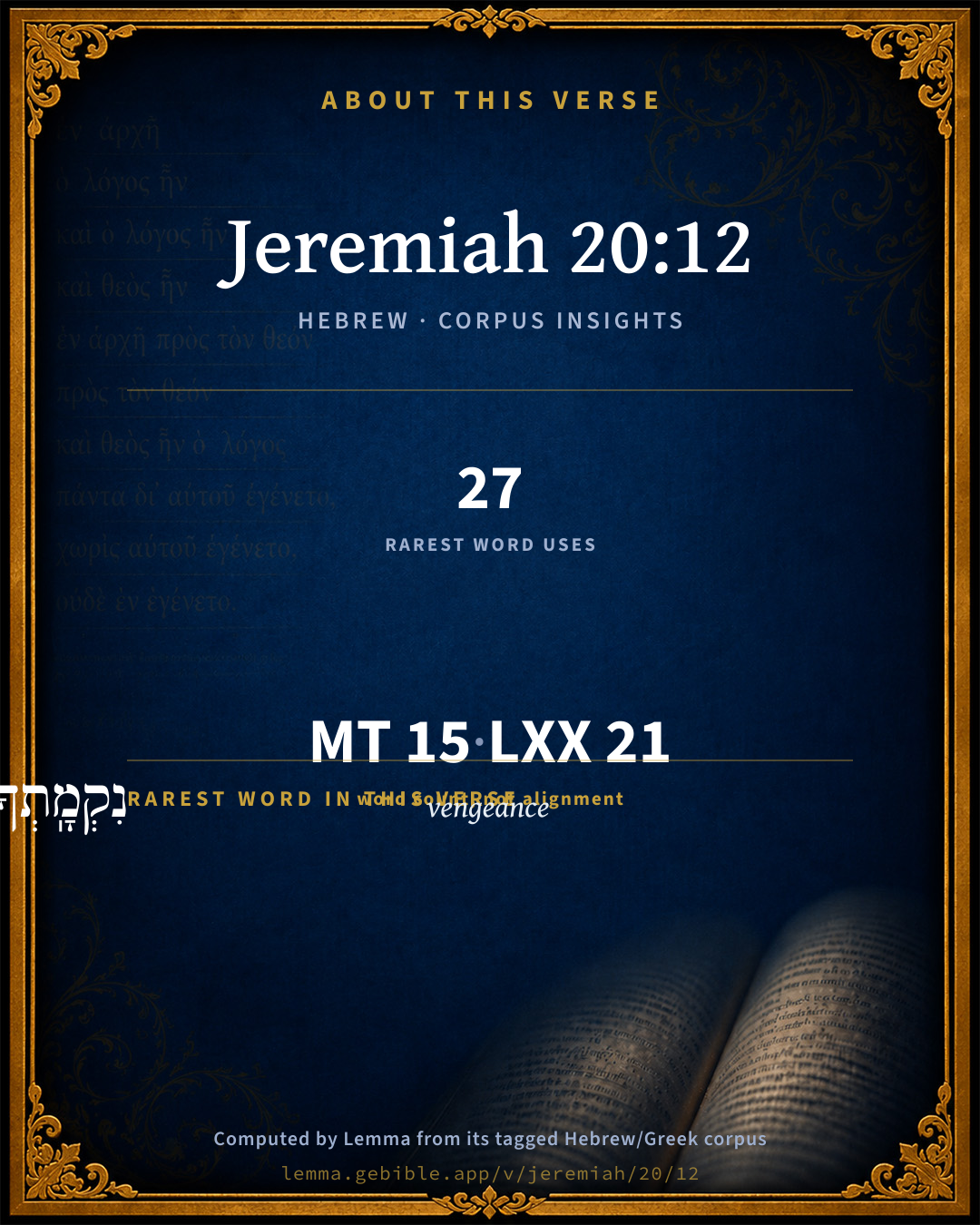
These counts appear in no published source. They are computed here, from the morphology-tagged text and Lemma’s own curated glosses. What Lemma adds →

15
words
13
distinct lemmas
Prophets
section

Shared distinctive vocabulary

נִקְמָֽתְךָ֙ vengeance H5360 occurs in 22 verses of the Hebrew Bible. Also found in:

Grammatical profile

  • 4 verbs
  • 6 nouns
  • 1 adjective
  • 2 prepositions
  • 1 conjunction
  • 1 particle

Verb forms

  • בֹּחֵ֣ן Qal · Participle Active
  • רֹאֶ֥ה Qal · Participle Active
  • אֶרְאֶ֤ה Qal · Cohortative
  • גִּלִּ֥יתִי Piel · Perfect

Repetition

A word recurs within this verse — often emphatic in Hebrew:

  • רֹאֶ֥ה to see H7200 ×2

Hebrew & Septuagint length

In the original languages it is 15 Hebrew tokens and 21 Greek tokens — but the two are counted differently (Hebrew bundles its prefixes and suffixes into one token; the Greek is in lemma form), so that isn’t a like-for-like length.

Cross-references

25

Topical passages linked to Jeremiah 20:12 in the Treasury of Scripture Knowledge — connected by theme and wording, ordered by reader-vote popularity; previews shown in the World English Bible.

  • Psalms 62:8 Trust in him at all times, you people. Pour out your heart before him. God is a refuge for us. Selah.
  • Jeremiah 11:20 But, Yahweh of Hosts, who judge righteously, who try the heart and the mind, I shall see your vengeance on them; for to you have I revealed my cause.
  • Psalms 54:7 For he has delivered me out of all trouble. My eye has seen triumph over my enemies.
  • Psalms 59:10 My God will go before me with his loving kindness. God will let me look at my enemies in triumph.
  • Jeremiah 17:10 I, Yahweh, search the mind, I try the heart, even to give every man according to his ways, according to the fruit of his doings.
  • Psalms 7:9 Oh let the wickedness of the wicked come to an end, But establish the righteous; Their minds and hearts are searched by the righteous God.
  • Psalms 26:2–3 Examine me, Yahweh, and prove me. Try my heart and my mind.
  • Psalms 139:23 Search me, God, and know my heart. Try me, and know my thoughts.
  • Psalms 11:5 Yahweh examines the righteous, But the wicked and him who loves violence his soul hates.
  • Psalms 17:3 You have proved my heart; you have visited me in the night; You have tried me, and found nothing; I have resolved that my mouth shall not disobey.
  • Isaiah 37:14 Hezekiah received the letter from the hand of the messengers, and read it; and Hezekiah went up to the house of Yahweh, and spread it before Yahweh.
  • Jeremiah 17:18 Let them be disappointed who persecute me, but let not me be disappointed; let them be dismayed, but don't let me be dismayed; bring on them the day of evil, and destroy them with double destruction.
  • Jeremiah 18:19–23 Give heed to me, Yahweh, and listen to the voice of those who contend with me.
  • 1 Samuel 1:15 Hannah answered, No, my lord, I am a woman of a sorrowful spirit: I have drunk neither wine nor strong drink, but I poured out my soul before Yahweh.
  • 2 Chronicles 24:22 Thus Joash the king didn't remember the kindness which Jehoiada his father had done to him, but killed his son. When he died, he said, Yahweh look on it, and require it.
  • Psalms 86:4 Bring joy to the soul of your servant, For to you, Lord, do I lift up my soul.
  • Psalms 109:6–20 Set a wicked man over him. Let an adversary stand at his right hand.
  • Isaiah 38:14 Like a swallow [or] a crane, so did I chatter; I did moan as a dove; my eyes fail [with looking] upward: Lord, I am oppressed, be my collateral.
  • Jeremiah 12:8 My heritage is become to me as a lion in the forest: she has uttered her voice against me; therefore I have hated her.
  • 1 Peter 2:23 Who, when he was cursed, didn't curse back. When he suffered, didn't threaten, but committed himself to him who judges righteously;
  • 1 Peter 4:19 Therefore let them also who suffer according to the will of God in doing good entrust their souls to him, as to a faithful Creator.
  • Revelation 2:23 I will kill her children with Death, and all the assemblies will know that I am he who searches the minds and hearts. I will give to each one of you according to your deeds.
  • Revelation 6:10 They cried with a loud voice, saying, "How long, Master, the holy and true, until you judge and avenge our blood on those who dwell on the earth?"
  • Revelation 18:20 Rejoice over her, O heaven, you saints, apostles, and prophets; for God has judged your judgment on her."
  • Revelation 19:2–3 for true and righteous are his judgments. For he has judged the great prostitute, who corrupted the earth with her sexual immorality, and he has avenged the blood of his servants at her hand."

Cross-references courtesy of OpenBible.info (CC BY 4.0).

Hebrew and Greek witnesses Masoretic Hebrew ↔ Greek Septuagint

The same verse in the two great witnesses to the Old Testament, shown verse-for-verse.

These are two independent witnesses, not word-aligned to each other, and the Septuagint is shown in lemma (dictionary) form.

Hebrew Jeremiah 20:12 Masoretic · Westminster Leningrad Codex

וַיהוָ֤ה צְבָאוֹת֙ בֹּחֵ֣ן צַדִּ֔יק רֹאֶ֥ה כְלָי֖וֹת וָלֵ֑ב אֶרְאֶ֤ה נִקְמָֽתְךָ֙ מֵהֶ֔ם כִּ֥י אֵלֶ֖יךָ גִּלִּ֥יתִי אֶת רִיבִֽי

But, Yahweh of Hosts, who tests the righteous, who sees the heart and the mind, let me see your vengeance on them; for to you have I revealed my cause.

World English Bible · Public Domain

Greek LXX Structure differs

In the Septuagint, Jeremiah is about an eighth shorter than the Hebrew and arranges its material differently — the Oracles Against the Nations (Hebrew chapters 46–51) appear in the middle of the Greek book, after 25:13. Because the chapter and verse boundaries do not line up, a verse-for-verse comparison with the Hebrew is not shown.

A verse-for-verse comparison isn’t shown here because the chapters and verses don’t line up. Switch to the LXX edition with the MT / LXX toggle above to read the Greek directly.

Hebrew: Westminster Leningrad Codex (CC BY 4.0). Greek: Septuagint (public domain); English from a public-domain English Septuagint. How the Septuagint differs from the Hebrew →

Targum (Aramaic paraphrase)

1

The Targum is the ancient Jewish Aramaic paraphrase of the Hebrew Scriptures — an interpretive translation, not the Hebrew text itself. Onkelos (literal) and Pseudo-Jonathan (expansive) render the Torah, and Jonathan the Prophets. Coverage is partial: where no permissively-licensed English translation exists for a verse, only the Aramaic is shown. This is verse-level text, not a word-by-word alignment to the Hebrew.

  1. Targum Jonathan Prophets (Joshua–Malachi)
    וַיָי צְבָאוֹת בְּהַר קְשׁוֹט גַלְיָן קֳדָמוֹהִי כּוּלְיָן וְלֵב אֶחְזֵי פּוּרְעֲנוּת דִינָךְ מִנְהוֹן אֲרֵי קָדָמָךְ אֲמָרֵית יַת עוּלְבָּנִי:

    (no public-domain English translation for this verse)

    Targum Jonathan — Aramaic: “Mikraot Gedolot” (public domain). English: “Sefaria Community Translation” (CC0 1.0 (public-domain dedication)); “London "Chaldee Paraphrase," 1871” (public domain). Text via Sefaria.

Commentary

Notes on Jeremiah 20:12 from classic Christian and Jewish commentators (each source and its license shown beneath its notes). The classic Christian expositions comment on the surrounding passage and are grouped to its opening verse, so a note may address several verses; the Jewish commentaries on the Tanakh (Rashi and others) are per-verse, so they appear only where the commentator wrote on this verse.

Lemma curates 59 commentaries, every one of them public domain or Creative Commons licensed, each selected and text-cleaned for this edition rather than reprinted as found. About our sources →

Trapp's Complete Commentary

John Trapp

Jer 20:12 But, O LORD of hosts, that triest the righteous, [and] seest the reins and the heart, let me see thy vengeance on them: for unto thee have I opened my cause.

Ver. 12. But, O Lord of hosts.] See Jer 11:20; Jer 17:10.

Let me see thy vengeance on them.] Some pert and pride themselves over the ministry as if it were a dead Alexander’s nose, which they might wring off, and not fear to be called to account therefor; but the visible vengeance of God will seize such one day, as it did Pharaoh, Ahab, Herod, Julian.

For unto thee have I opened my cause.] Prayer is an opening of the soul’s causes and cases to the Lord. The same word for opened here is in another conjugation used for uncovering, making bare and naked. {Gen 9:21} God’s people in prayer do or should nakedly present their souls’ causes without all cover shames, or so much as a rag of self or flesh cleaving to them.

John Trapp, A Commentary or Exposition upon All the Books of the Old and New Testament (1647–1656) — public domain. Text from a community e-Sword module.

Joseph Benson's Commentary

Jer 20:12-13. But, O Lord, that triest the righteous — That triest their faith and patience, in order to the farther purification of their souls, and the increase of these and all their other graces; or, who takest cognizance of them, and of every cause in which they are interested; and who dost not judge in their favour with partiality, but searchest the reins and the heart; let me see thy vengeance on them — See note on Jer 11:20. For unto thee have I opened my cause — As to a just judge, who wilt not fail to do me justice. Sing unto the Lord — The prophet here rises higher, from prayer to praise. The clouds of darkness and doubt which enveloped his mind are dispersed, and his complaints silenced and turned into thanksgivings. He has now an entire confidence in that God whom (Jer 20:7) he was distrusting, and stirs up himself to praise that name which he had almost resolved (Jer 20:9) no more to make mention of. And it was the lively exercise of faith in the word and promise of God that made this happy change in his mind, that scattered the gloom which surrounded it, and turned his sorrow into joy. For he hath delivered the soul of the poor, &c. — He means especially himself, his own poor soul: he hath delivered me formerly when I was in distress, and now of late out of the hand of Pashur; and he will continue to deliver, 2Co 1:10; from the hand of evil-doers — So that they have not yet gained, and will not be able to gain, their ends.

Joseph Benson's Commentary on the Old and New Testaments (1811–1818) — public domain. Text from a community e-Sword module.

Tyndale Open Study Notes

Tyndale Open Resources

20:12 Jeremiah placed his complete trust in the Lord of Heaven’s Armies (see 5:14), who alone could carry out the vengeance due to the prophet’s enemies.

Tyndale Open Study Notes — © Tyndale Open Resources, licensed CC BY-SA 4.0. Text via the HelloAO Bible API.

Jamieson, Fausset & Brown

Robert Jamieson, A. R. Fausset & David Brown

triest the righteous--in latent contrast to the hasty judgments of men (Jer 11:20; Jer 17:10).

opened--that is, committed (compare Kg2 19:14; Psa 35:1).

Jamieson, Fausset & Brown — Commentary Critical and Explanatory on the Whole Bible (1871) — public domain (CC PDM 1.0). Text via the HelloAO Bible API.

John Calvin's Commentaries

The Prophet shews here briefly how he dared to allege God’s name and help against his enemies; for hypocrites often boast that God is their helper, but they falsely pretend his name. The proof, then, by which the Prophet shews that he did not falsely or presumptuously pretend what he had stated, — that God was to him like a strong giant, who could easily lay prostrate all the wicked, ought to be well weighed; and it was this — that he dared to make God the witness and judge of his integrity. Hence if we desire to have God’s name to plead for the purpose of repelling all those artifices which are contrived against us by the devil, we must learn to offer ourselves to be tried by him, so that he may really examine our thoughts and feelings.

Now, in the first place, let us bear in mind what the Prophet teaches, — that nothing is hid from God; for hypocrites will not hesitate to go so far as to offer themselves to be tried by God; but they do not yet duly consider what is said here, that nothing is hid from him. There are many recesses in the heart of man, and we know that all things there have many wrappings and coverings; but God in the meantime is a heart-discerner, (καρδιογνώστης,) who proves the heart and reins. Under the word reins, the Hebrews include all the hidden thoughts and feelings. We must then remember this as the first thing, that the Prophet acknowledges that there can be no disguise as to God, and that men gain nothing by acting fallaciously, for he penetrates into the inmost thoughts and discerns between the thoughts and the feelings.

He adds that the righteous are tried by God. There is to be understood here a contrast, because men’s judgment is commonly superficial; for when there is an appearance of integrity, there is an immediate acquittal, though the heart may be deceitful and full of all perfidy. The Prophet then means, that when we come to God’s tribunal no one is there acquitted but he who brings a pure heart and real integrity. He then rises to a higher confidence, and says, that he should see the vengeance of God.

We now see whence the Prophet derived his confidence, even because he had thoroughly examined himself, and that before God; he had not appealed to earthly witnesses only, nor had he, as it were, ascended a public theater to solicit the favor of the people; but he knew that he was approved by God, because he was sincere and honest.

And then he justly adds, at the same time, that he had made known his cause or his complaint to God. There is to be understood here again a contrast; for they who are carried away by the popular breath do not acquiesce in God’s judgment. Ambition, like a violent wind, always carries men along so that they cannot stop themselves; hence it is that neither the testimony of conscience nor the judgment of God has much weight with them. But the Prophet says, that he had made known his cause to God.

If any one objects and says, that hypocrites do the same, to this I answer, that though some imitation may appear in them, there is nothing real or genuine; for though they may boast that God is their witness, and that he approves of their cause, it is only what they speak vainly before men; for there is not one of them who deals thus privately with God. As long, then, as they are given to ostentation, they do not make known their cause to God, however they may appeal to him, refer to his tribunal, and declare that they have no other end in view but to promote his glory. They, then, who boastingly sound forth these things before the world for their own advantage, do not yet make known their cause to God, but by frivolous and vain boasting pretend his name.

What, then, is it to make known our cause to God? It is to do this when no one is witness, and when God alone appears before us. When we dare in our prayers to address God thus, — “O Lord, thou knowest my integrity, thou knowest that there is nothing hid which I do now lay before thee,” then it is that we truly make known our cause to God; for in this case there is no regard had for men, but we are satisfied with the judgment of God alone. This was the case with the Prophet when he said, that he had made known his cause to God; and it must have been so, for we have seen that all ranks of men were opposed to him. As then he was under the necessity of fleeing to the only true God, he justly says, that he had referred his cause to him.

By saying that he should see the vengeance of God, he alludes to that wished-for revenge before mentioned, for his enemies had said, “Let us take our revenge on him.” The Prophet says, “I shall see thy vengeance, O Lord.” By saying that he should see it, he speaks as though he had his hands tied; for thus the faithful, of their own accord, restrain themselves, because they know that they are forbidden by God’s command to revenge themselves on their enemies. As, then, there is a difference between doing and seeing, the Prophet here makes a distinction between himself and the audaciously wicked; for he would not himself take vengeance according to the violence of his wrath, but that he should only see it; and then he calls it the vengeance of God, for men rob God of his right whenever they revenge themselves according to their own will. Paul says,

“Give place to wrath.” (Romans 12:19)

While exhorting the faithful to forbearance, he uses this reason, that otherwise no place is given to God’s judgment; for whenever we take revenge, we anticipate God, as though every one of us ascended God’s tribunal, and arrogated to ourselves his office. We now, then, perceive what this mode of speaking means.

But we must at the same time notice, that God’s vengeance is not to be imprecated, except on the reprobate and irreclaimable. For the Prophet no doubt pitied his enemies, and wished, if they were reclaimable, that God would be propitious and merciful to them, according to what we have before seen. What, then, the revenge intimates of which he speaks is, that he knew by the prophetic spirit that they were wholly irreclaimable; and as his mind was under the influence of right zeal, he could imprecate on them the vengeance of God. If any one now, after the example of the Prophet, should wish all his enemies destroyed, and would have God armed against them, he would act very presumptuously, for it does not belong to us to determine before the time who the reprobate and the irreclaimable are; until this be found out by us, we ought to pray for all without exception, and every one ought also to consider by what zeal he is influenced, lest we should be under the power of turbulent feelings, as is commonly the case, and lest also our zeal be hasty and inconsiderate. In short, except it be certain to us that our zeal is guided by the spirit of uprightness and wisdom, we should never pray for vengeance on our enemies. He afterwards adds, —

John Calvin's Commentaries (1540-1563) — public domain. Text from the Calvin Translation Society English edition (1840s-50s) via the Christian Classics Ethereal Library (ccel.org). Calvin's coverage is partial (roughly two-thirds of the Bible); uncommented books and verses are honest gaps, never fabricated. The 19th-century editor's footnotes and remarks are omitted so the notes are faithfully Calvin's own voice.

Ellicott's Commentary for English Readers

(12) But, O Lord of hosts . . .—The verse is almost verbally identical with Jer_11:20, where see Note.

A Bible Commentary for English Readers, edited by Charles John Ellicott (1878–1897) — public domain. Text from a community e-Sword module.

The Cambridge Bible for Schools and Colleges

gen. ed. J. J. S. Perowne

12. Virtually identical with Jer_11:20 and therefore here perhaps an insertion from the margin of a Hebrew MS.

The Cambridge Bible for Schools and Colleges (gen. ed. J. J. S. Perowne; Cambridge University Press, 1878–1918) — public domain. Text from a community e-Sword module.

John Gill's Exposition

But, O Lord, that triest the righteous, and seest the reins and the heart,.... That tries the cause of the righteous, and vindicates them, rights their wrongs, and does them justice; being the omniscient God, the seer and searcher of the hearts and reins; who knows the uprightness of their hearts, as well as their ways, and the sincerity of their affections: or that tries the faith and patience of the righteous, their constancy and integrity; and upon trial finds that their affections are real, and their souls sincere;

let me see thy vengeance on them; his enemies and persecutors; he does not seek vengeance himself, but desires it of the Lord; he does not ask to see his vengeance, but the Lord's vengeance on them, what he thought was just and proper to inflict on them; he knew that vengeance belonged to the Lord, and therefore left it with him, and prayed for it from him. The Targum is,

"let me see the vengeance of thy judgments on them;''

for unto thee have I opened my cause; or "revealed", or "made it manifest" (k); this he did in prayer, at this time, when he laid before the Lord his whole case, and appealed and applied to him for justice, who judgeth righteous persons, and judgeth righteously.

(k) "revelavi causam meam", Junius & Tremellius, Piscator. So Schmidt.

John Gill's Exposition of the Whole Bible (1746–1763) — public domain (CC PDM 1.0). Text via the HelloAO Bible API.

Haydock's Catholic Bible Commentary

Let me see, &c. This prayer proceeded not from hatred or ill-will, but zeal of justice. (Challoner) --- He expresses in a human manner a future punishment.

George Leo Haydock (1774–1849), Haydock's Catholic Family Bible and Commentary, 1859 edition — public domain. Excludes Psalms (Douay-Rheims chapter numbering differs from Protestant) and Deuterocanonical books (Catholic canon only).

Matthew Poole's English Annotations

Seest the reins and the heart: the prophet had, Jer 17:10, spoken unto God under this notion; here he appealeth to him as such, who therefore must needs see as well the prophet’s sincerity as his enemies’ malice.

Let me see thy vengeance on them: for his prayer against his enemies, it is of the same nature with what we met with Jer 11:20, indeed this whole verse is the same with that. David, Psa 58:10, prophesieth that the righteous should rejoice when they see the vengeance which God brings on his enemies. But yet the prophet seems in this petition to have showed himself a man (as the apostle speaks of Elijah) subject to like passions with other men; for although God sometimes by his providence causeth vengeance to come upon his and his people’s enemies in their sight, yet whether they may absolutely pray for it is a question. See Poole "Jer 11:20".

Matthew Poole's English Annotations on the Holy Bible (1683–1685) — public domain. Text from a community e-Sword/MySword module.

The Pulpit Commentary

Repeated, with slight variations, from Jer_11:20.

The Pulpit Commentary (1880–1919), ed. H.D.M. Spence-Jones & Joseph S. Exell — public domain. Text from a community e-Sword module.

unfoldingWord translationNotes

Door43 World Missions Community

see the mind and the heart

The word "mind" is a metonym for what a person thinks and decides, and the word "heart" is a metonym for what a person feels and desires. AT: "know every person's thoughts and feelings" (See: Metonymy)

those who are oppressed from the hand of evildoers

Here the word "hand" represents power. This can be stated in active form. AT: "those whom evildoers oppress with their power" (See: Metonymy and Active or Passive)

translationWords

Yahweh of hosts

righteous

mind

heart

praise

oppress

hand

evildoer

unfoldingWord translationNotes — © Distant Shores Media and the Door43 World Missions Community, licensed CC BY-SA 4.0. Source: git.door43.org/Door43/en_tn.

Lesson kit

Teaching starters — assembled from the data on this page, not authored interpretation. Every prompt links to the verse data it draws on. Edit before teaching.

Jeremiah, in the Prophets, opens this verse with 15 words (13 distinct Hebrew lemmas). Its most distinctive word is nᵉqâmâh (“vengeance”). A historical commentator’s framing appears above. Read the whole chapter for the surrounding context.

Discussion questions

  1. The word nᵉqâmâh carries the sense “vengeance.” How does it shape the verse?
  2. Numbers 31:2 shares the word «vengeance» with this verse. How do the two illuminate each other?
  3. “to see” occurs 2× in this one verse. What is the effect of the repetition?
  4. These translations render this verse differently; the difference is in the English rendering, not the original. What questions does that raise?
  5. The verb «בֹּחֵ֣ן» is Qal Participle Active. How does its form color the action?
  6. Reading how Trapp's Complete Commentary and Joseph Benson's Commentary read this verse, where do the two commentators agree and where do they part?

Things to notice

Reading settings

Reading text

Shown beneath each verse's original-language words.

Old Testament
Old Testament edition

Read the OT as the Masoretic Hebrew (MT) or the Greek Septuagint (LXX).

English shown for the Greek Septuagint (in the Hebrew ↔ Greek comparison).

Comparing translations? Open the Compare panel on any verse page to stack up to four side by side.