Jeremiah 51:61

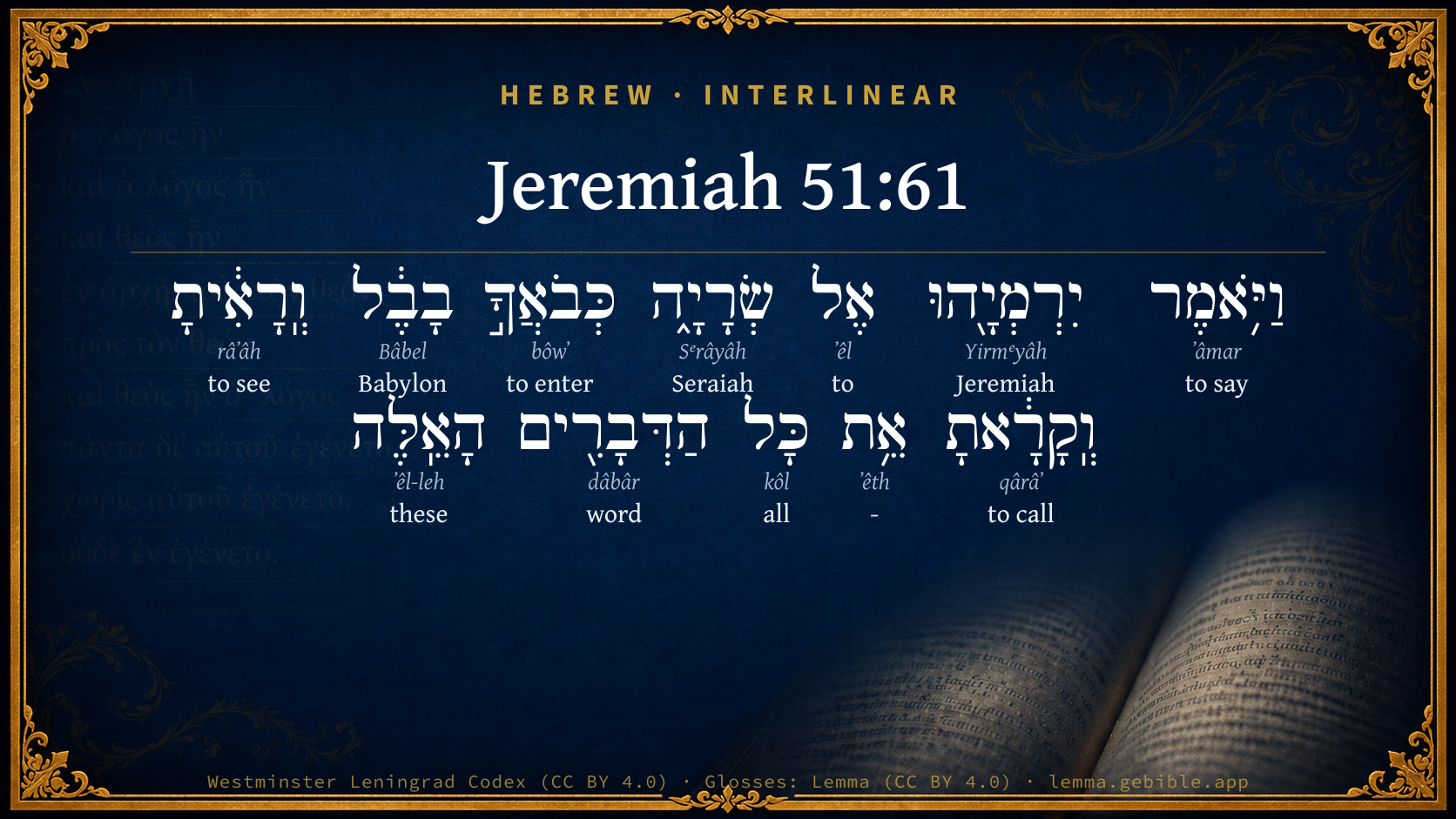
Hebrew (Westminster Leningrad Codex) Jeremiah 51:61 appears in the Hebrew Old Testament. The text above is from the Westminster Leningrad Codex. Each word links to its Strong’s number, a concise gloss, and parsing drawn from the Open Scriptures Hebrew Bible morphology. Click any word for its full Brown-Driver-Briggs (BDB) entry.
Download image
Cite this verse

Jeremiah 51:61 (World English Bible). Public Domain. Lemma interlinear Bible study tool, https://lemma.gebible.app/v/jeremiah/51/61.

Show BibTeX & RIS
BibTeX
RIS
English Translation
Jeremiah said to Seraiah, When you come to Babylon, then see that you read all these words,
World English Bible · Public Domain
Download a study sheet

One document with this verse’s original text, its word-by-word gloss line, the meaning frame, cross-references with their text, attributed commentary, and full source and license credits — printable, and it pastes into notes with its structure intact.

This verse Autodidact and up

Study sheet (.html) Plain text (.txt)

A passage Seminary Student

Up to 50 verses in one chapter. A passage sheet keeps up to 6 commentary sources and 12 cross-references per verse, in the order this page ranks them, and says so on the sheet whenever that leaves anything out. Ask for a single verse and you get the Autodidact verse sheet above.

Everything on this page stays free to read, with no account — the sheet is a download of what is already on screen, not access to it.

Want to remove ads? Support Godless Engineer
Compare translations 3

The same verse in 3 English versions, stacked beneath the original-language interlinear above. Click any original word for its lexicon entry.

Each is an independent rendering of the whole verse — the interlinear is not word-aligned to these translations.

Highlighted words mark where these versions differ — a whole-verse word diff, not a word-by-word alignment.

  • World English Bible Public Domain
    Jeremiah said to Seraiah, When you come to Babylon, then see that you read all these words,
  • King James Version Public Domain
    And Jeremiah said to Seraiah, When thou comest to Babylon, and shalt see, and shalt read all these words;
  • unfoldingWord Literal Text CC BY-SA 4.0
    Jeremiah said to Seraiah, “When you go to Babylon, then you will see and you will read these words aloud.

unfoldingWord Literal Text — © unfoldingWord, licensed CC BY-SA 4.0. Word-aligned USFM3 via Door43 (git.door43.org/unfoldingWord/en_ult).

Versions to compare (up to 4)

3 of 4 selected

Show all 18 translations

Every available English version of this verse, each an independent rendering of the whole verse.

  • World English Bible Public Domain
    Jeremiah said to Seraiah, When you come to Babylon, then see that you read all these words,
  • Berean Standard Bible Public Domain
    And Jeremiah said to Seraiah, “When you get to Babylon, see that you read all these words aloud,
  • Majority Standard Bible Public Domain
    And Jeremiah said to Seraiah, “When you get to Babylon, see that you read all these words aloud,
  • King James Version Public Domain
    And Jeremiah said to Seraiah, When thou comest to Babylon, and shalt see, and shalt read all these words;
  • American Standard Version (1901) Public Domain
    And Jeremiah said to Seraiah, When thou comest to Babylon, then see that thou read all these words,
  • Revised Version (1885) Public Domain
    And Jeremiah said to Seraiah, When thou comest to Babylon, then see that thou read all these words,
  • Geneva Bible (1599) Public Domain
    And Ieremiah sayd to Sheraiah, Whe thou commest vnto Babel, and shalt see, and shalt reade all these wordes,
  • Douay-Rheims (1899) Public Domain
    And Jeremias said to Saraias: When thou shalt come into Babylon, and shalt see, and shalt read all these words,
  • Young's Literal Translation Public Domain
    And Jeremiah saith unto Seraiah, `When thou dost enter Babylon, then thou hast seen, and hast read all these words,
  • Literal Standard Version CC BY-SA 4.0
    And Jeremiah says to Seraiah, “When you enter Babylon, then you have seen, and have read all these words,
  • Unlocked Literal Bible CC BY-SA 4.0
    Jeremiah said to Seraiah, “When you go to Babylon, then you will see and you will read these words aloud.
  • unfoldingWord Literal Text CC BY-SA 4.0
    Jeremiah said to Seraiah, “When you go to Babylon, then you will see and you will read these words aloud.
  • Darby Bible Public Domain
    And Jeremiah said to Seraiah, When thou comest to Babylon, see that thou read all these words;
  • World Messianic Bible Public Domain
    Jeremiah said to Seraiah, “When you come to Babylon, then see that you read all these words,
  • Webster's Bible Public Domain
    And Jeremiah said to Seraiah, When thou shalt come to Babylon, and shalt see, and shalt read all these words;
  • Free Bible Version CC BY-SA 4.0
    Jeremiah told Seraiah, “When you arrive in Babylon, make sure you read out loud everything written here,
  • Bible in Basic English Public Domain
    And Jeremiah said to Seraiah, When you come to Babylon, see that you give them all these words;
  • JPS Tanakh (1917) Public Domain
    And Jeremiah said to Seraiah: 'When thou comest to Babylon, then see that thou read all these words,

Literal Standard Version (2020), Covenant Press — licensed CC BY-SA 4.0. Text via the HelloAO Bible API (eBible.org). Unlocked Literal Bible (unfoldingWord) — licensed CC BY-SA 4.0. Text via the HelloAO Bible API (eBible.org). unfoldingWord Literal Text — © unfoldingWord, licensed CC BY-SA 4.0. Word-aligned USFM3 via Door43 (git.door43.org/unfoldingWord/en_ult). Free Bible Version, Dr. Jonathan Gallagher — licensed CC BY-SA 4.0. Text via the HelloAO Bible API (eBible.org).

Word by word

More ways to search: Search by grammar → Find every occurrence → Compare this word →

Practice this passage: Drill this verse → Learn its vocabulary →

שְׂרָיָ֑ה
Sᵉrâyâh
H8304
“Seraiah”
Noun, Proper
Part of Speech
Noun
Type
Proper
Full BDB Definition

Origin: from H8280 and H3050

TWOT: None

Seraiah = "Jehovah is ruler" - the scribe or secretary of David - son of Azariah, father of Jehozadak, and the chief priest in the reign of king Zedekiah of Judah and at the time of the capture of Jerusalem - son of Tanhumeth the Netophathite and one of the men who went to Gedaliah, the governor over Judah appointed by Nebuchadnezzar, and gave their oath to serve the king of Babylon - a Judaite, son of Kenaz, brother of Othniel, and father of Joab - a Simeonite, father of Josibiah and grandfather of Jehu - a people of the province who returned from exile with Zerubbabel - maybe the same as 10 - son of Azariah and father of Ezra the priest and scribe - a priest who sealed the covenant with Nehemiah - a priest, son of Hilkiah in the time of Nehemiah - a priest or Levite who returned from exile with Zerubbabel - probably a priest and the head of a family of priests after - son of Meraiah and messenger sent by the prophet Jeremiah to Babylon with a book of his writings - son of Azriel and one of the 3 men commanded by king Jehoiakim of Judah to seize Jeremiah and Baruch
  1. וַיֹּ֥אמֶר ʼâmar H559 “and · to say” Conjunction + Verb, Qal, Sequential Imperfect, 3rd Person, Masculine, Singular
  2. יִרְמְיָ֖הוּ Yirmᵉyâh H3414 “Jeremiah” Noun, Proper
  3. אֶל ʼêl H413 “to” Preposition
  4. כְּבֹאֲךָ֣ bôwʼ H935 “like/as · to enter · you” Preposition + Verb, Qal, Infinitive Construct + Suffix, Personal, 2nd Person, Masculine, Singular
  5. בָבֶ֔ל Bâbel H894 “Babylon” Noun, Proper
  6. וְֽרָאִ֔יתָ râʼâh H7200 “and · to see” Conjunction + Verb, Qal, Sequential Perfect, 2nd Person, Masculine, Singular
  7. וְֽקָרָ֔אתָ qârâʼ H7121 “and · to call” Conjunction + Verb, Qal, Sequential Perfect, 2nd Person, Masculine, Singular
  8. אֵ֥ת ʼêth H853 “-” Particle, Direct Object
  9. כָּל kôl H3605 “all of” Noun, Common, Masculine, Singular, Construct
  10. הַדְּבָרִ֖ים dâbâr H1697 “the · words” Particle, Definite Article + Noun, Common, Masculine, Plural, Absolute
  11. הָאֵֽלֶּה ʼêl-leh H428 “the · these” Particle, Definite Article + Pronoun, Demonstrative, Common, Plural

About this verse

These counts appear in no published source. They are computed here, from the morphology-tagged text and Lemma’s own curated glosses. What Lemma adds →

12
words
12
distinct lemmas
Prophets
section

Notable vocabulary

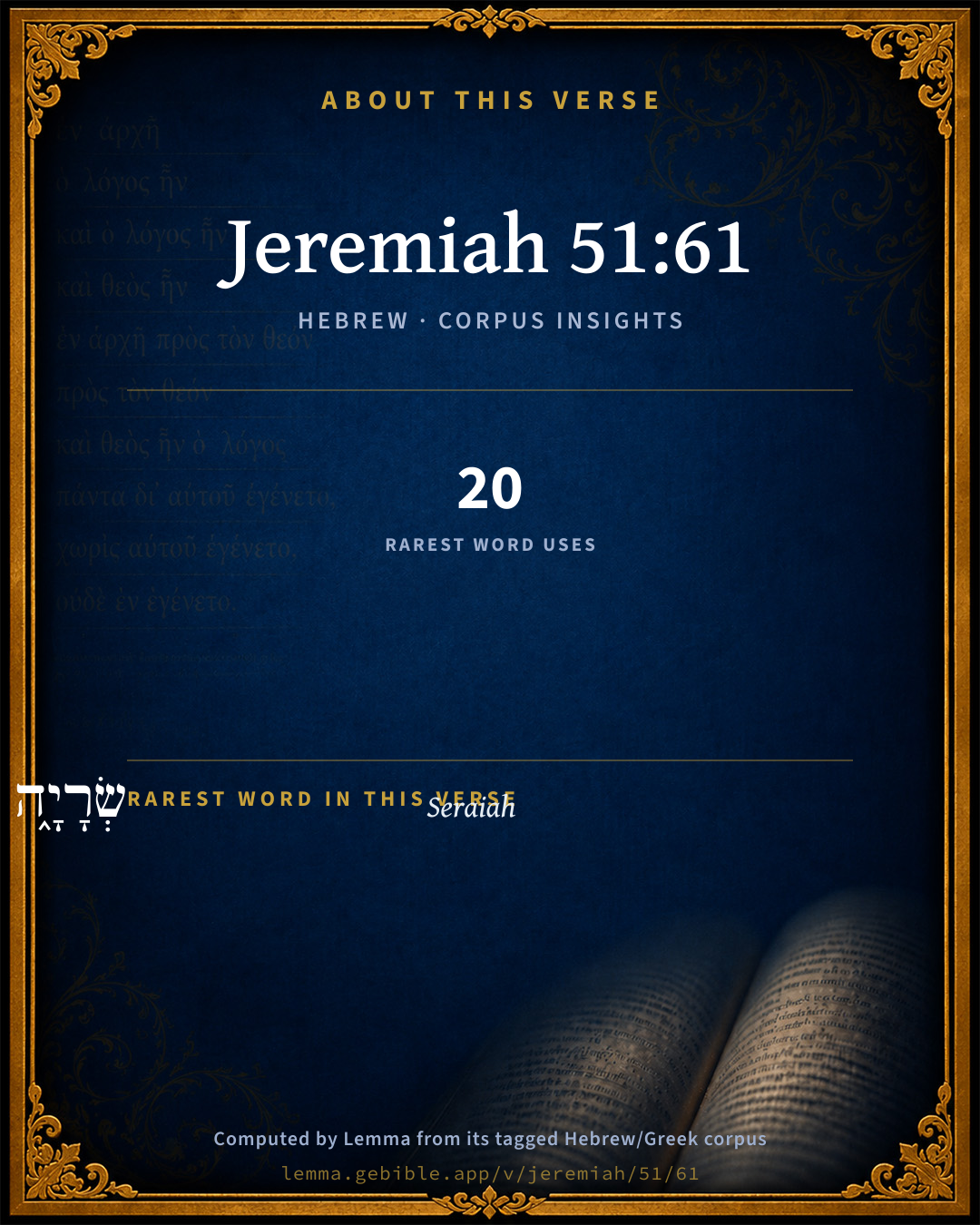
The rarest word here is שְׂרָיָ֑ה Seraiah H8304 — appearing just 20 times in the whole Hebrew Bible.

Shared distinctive vocabulary

שְׂרָיָ֑ה Seraiah H8304 occurs in 18 verses of the Hebrew Bible. Also found in:

Grammatical profile

  • 4 verbs
  • 5 nouns
  • 1 pronoun
  • 1 preposition
  • 1 particle

Verb forms

  • וַיֹּ֥אמֶר Qal · Sequential Imperfect
  • כְּבֹאֲךָ֣ Qal · Infinitive Construct
  • וְֽרָאִ֔יתָ Qal · Sequential Perfect
  • וְֽקָרָ֔אתָ Qal · Sequential Perfect

Cross-references

7

Topical passages linked to Jeremiah 51:61 in the Treasury of Scripture Knowledge — connected by theme and wording, ordered by reader-vote popularity; previews shown in the World English Bible.

  • Mark 13:1 As he went out of the temple, one of his disciples said to him, "Teacher, see what kind of stones and what kind of buildings!"
  • Jeremiah 29:1–2 Now these are the words of the letter that Jeremiah the prophet sent from Jerusalem to the residue of the elders of the captivity, and to the priests, and to the prophets, and to all the people, whom Nebuchadnezzar had carried away captive from Jerusalem to Babylon,
  • Matthew 24:1 Jesus went out from the temple, and was going on his way. His disciples came to him to show him the buildings of the temple.
  • Colossians 4:16 When this letter has been read among you, cause it to be read also in the assembly of the Laodiceans; and that you also read the letter from Laodicea.
  • 1 Thessalonians 4:18 Therefore comfort one another with these words.
  • 1 Thessalonians 5:27 I solemnly charge you by the Lord that this letter be read to all the holy brothers.
  • Revelation 1:3 Blessed is he who reads and those who hear the words of the prophecy, and keep the things that are written in it, for the time is at hand.

Cross-references courtesy of OpenBible.info (CC BY 4.0).

Hebrew and Greek witnesses Masoretic Hebrew ↔ Greek Septuagint

The same verse in the two great witnesses to the Old Testament, shown verse-for-verse.

These are two independent witnesses, not word-aligned to each other, and the Septuagint is shown in lemma (dictionary) form.

Hebrew Jeremiah 51:61 Masoretic · Westminster Leningrad Codex

וַיֹּ֥אמֶר יִרְמְיָ֖הוּ אֶל שְׂרָיָ֑ה כְּבֹאֲךָ֣ בָבֶ֔ל וְֽרָאִ֔יתָ וְֽקָרָ֔אתָ אֵ֥ת כָּל הַדְּבָרִ֖ים הָאֵֽלֶּה

Jeremiah said to Seraiah, When you come to Babylon, then see that you read all these words,

World English Bible · Public Domain

Greek LXX Structure differs

In the Septuagint, Jeremiah is about an eighth shorter than the Hebrew and arranges its material differently — the Oracles Against the Nations (Hebrew chapters 46–51) appear in the middle of the Greek book, after 25:13. Because the chapter and verse boundaries do not line up, a verse-for-verse comparison with the Hebrew is not shown.

A verse-for-verse comparison isn’t shown here because the chapters and verses don’t line up. Switch to the LXX edition with the MT / LXX toggle above to read the Greek directly.

Hebrew: Westminster Leningrad Codex (CC BY 4.0). Greek: Septuagint (public domain); English from a public-domain English Septuagint. How the Septuagint differs from the Hebrew →

Targum (Aramaic paraphrase)

1

The Targum is the ancient Jewish Aramaic paraphrase of the Hebrew Scriptures — an interpretive translation, not the Hebrew text itself. Onkelos (literal) and Pseudo-Jonathan (expansive) render the Torah, and Jonathan the Prophets. Coverage is partial: where no permissively-licensed English translation exists for a verse, only the Aramaic is shown. This is verse-level text, not a word-by-word alignment to the Hebrew.

  1. Targum Jonathan Prophets (Joshua–Malachi)
    וַאֲמַר יִרְמְיָה לִשְׂרָיָה כְּמֵיתָךְ לְבָבֶל וְתֶחֱזֵי וְתִקְרֵי יַת כָּל פִּתְגָמַיָא הָאִלֵין:

    (no public-domain English translation for this verse)

    Targum Jonathan — Aramaic: “Mikraot Gedolot” (public domain). English: “Sefaria Community Translation” (CC0 1.0 (public-domain dedication)); “London "Chaldee Paraphrase," 1871” (public domain). Text via Sefaria.

Commentary

Notes on Jeremiah 51:61 from classic Christian and Jewish commentators (each source and its license shown beneath its notes). The classic Christian expositions comment on the surrounding passage and are grouped to its opening verse, so a note may address several verses; the Jewish commentaries on the Tanakh (Rashi and others) are per-verse, so they appear only where the commentator wrote on this verse.

Lemma curates 59 commentaries, every one of them public domain or Creative Commons licensed, each selected and text-cleaned for this edition rather than reprinted as found. About our sources →

Trapp's Complete Commentary

John Trapp

Jer 51:61 And Jeremiah said to Seraiah, When thou comest to Babylon, and shalt see, and shalt read all these words;

Ver. 61. When thou comest to Babylon, and shalt see,] sc., The sinfulness as well as the stateliness of that city.

And shalt read all these words.] Or, Then shalt thou read all these words. They who hold he did it publicly, extol the authority of the prophet, the boldness of Seraiah, and the mildness of the King of Babylon, somewhat like that of the King of Nineveh; {Jon 3:6-9} but the most think he read it privately, yet not in some closet apart by himself, but in some private house to his countrymen who came unto him.

John Trapp, A Commentary or Exposition upon All the Books of the Old and New Testament (1647–1656) — public domain. Text from a community e-Sword module.

Jamieson, Fausset & Brown

Robert Jamieson, A. R. Fausset & David Brown

read--not in public, for the Chaldeans would not have understood Hebrew; but in private, as is to be inferred from his addressing himself altogether to God (Jer 51:62) [CALVIN].

Jamieson, Fausset & Brown — Commentary Critical and Explanatory on the Whole Bible (1871) — public domain (CC PDM 1.0). Text via the HelloAO Bible API.

John Calvin's Commentaries

Jeremiah, then, wrote in a book all the evil which was to come on Babylon, even all those words, (he refers to the prophecies which we have seen;) and Jeremiah said to Seraiah, etc. Here the boldness of Jeremiah comes to view, that he hesitated not to command Seraiah to read this book when he came to Babylon and had seen it. To see it, is not mentioned here without reason, for the splendor of that city might have astonished Seraiah. Then the Prophet here seasonably meets the difficulty, and bids him to disregard the height of the walls and towers; and that however Babylon might dazzle the eyes of others, yet he was to look down, as from on high, on all that pomp and pride: When thou enterest the city, and hast seen it, then read this book The verb קרא, kora, means to call, to proclaim, and also to read. Then Seraiah must have read this book by himself; nor do I doubt but that the words ought to be so understood, as we shall see. It was not then necessary for Seraiah to have a pulpit, or in a public way to read the book to an assembled people; but it was sufficient to read it privately by himself, without any witnesses; and this may be gathered from the context.

John Calvin's Commentaries (1540-1563) — public domain. Text from the Calvin Translation Society English edition (1840s-50s) via the Christian Classics Ethereal Library (ccel.org). Calvin's coverage is partial (roughly two-thirds of the Bible); uncommented books and verses are honest gaps, never fabricated. The 19th-century editor's footnotes and remarks are omitted so the notes are faithfully Calvin's own voice.

Ellicott's Commentary for English Readers

(61) When thou comest to Babylon, and shalt see, and shalt read . . .—The meaning of the Hebrew would be better expressed by, thou shalt see to it and read, or see to it and read. The English version, as it is, leaves it doubtful who or what is to be seen. The verb for “read” implies reading aloud. Saraiah was to read the prophecy to those whom it concerned, probably to a chosen few among his own countrymen. The idea that it was to be read to the Babylonians is in the highest degree improbable.

A Bible Commentary for English Readers, edited by Charles John Ellicott (1878–1897) — public domain. Text from a community e-Sword module.

The Cambridge Bible for Schools and Colleges

gen. ed. J. J. S. Perowne

61, 62. then see … and say] From “and say” to the end of Jer_51:62 is probably the addition of a compiler; it is a needless interruption to the close connexion of the preceding words with Jer_51:63.

The Cambridge Bible for Schools and Colleges (gen. ed. J. J. S. Perowne; Cambridge University Press, 1878–1918) — public domain. Text from a community e-Sword module.

John Gill's Exposition

And it shall be, when thou hast made an end of reading this book,.... To the captive Jews; and having also said the above words by way of prayer and approbation:

that thou shalt bind a stone to it, and cast it into the midst of Euphrates; a river by which Babylon was situated. The book, being read, was to be rolled up again, and then a stone tied to it, and cast into the middle of the river, where the waters were deepest, and from whence it could not be taken up; and this was a sign confirming the above prophecy; compare with this what was done by a mighty angel concerning mystical Babylon, in which there is an allusion to this, Rev 18:21.

John Gill's Exposition of the Whole Bible (1746–1763) — public domain (CC PDM 1.0). Text via the HelloAO Bible API.

Matthew Poole's English Annotations

Not to the Chaldeans, nor possibly is it to be understood of a mere private reading of them to himself, but to the Jews that were in Babylon, acquainting them with what God had spoken against Babylon by the prophet.

Matthew Poole's English Annotations on the Holy Bible (1683–1685) — public domain. Text from a community e-Sword/MySword module.

Whedon's Commentary on the Bible

Daniel D. Whedon

61. And shalt see, and shalt read — Better, see that thou read. Not for the purpose of warning the Babylonians, but as part of a proclamation that the Jews might understand.

Daniel D. Whedon (gen. ed.), Commentary on the Old and New Testaments (1874–1909) — public domain. Text from a community e-Sword module.

The Pulpit Commentary

(Comp. Jer_50:3 Jer_51:26) And shalt see, and shalt read; rather, See that thou read.

The Pulpit Commentary (1880–1919), ed. H.D.M. Spence-Jones & Joseph S. Exell — public domain. Text from a community e-Sword module.

John Wesley's Explanatory Notes

Shalt read - Probably to the Jews, that were in Babylon.

John Wesley, Explanatory Notes Upon the Whole Bible (1754–1765) — public domain. Text via the GEBible commentary corpus.

unfoldingWord translationNotes

Door43 World Missions Community

animal

If your language has a word for animals that normally live with people, you might want to use it here, because Jeremiah 51:37 states that Babylon will be inhabited by wild animals.

translationWords

Babylon

Yahweh

declare

desolate

unfoldingWord translationNotes — © Distant Shores Media and the Door43 World Missions Community, licensed CC BY-SA 4.0. Source: git.door43.org/Door43/en_tn.

Lesson kit

Teaching starters — assembled from the data on this page, not authored interpretation. Every prompt links to the verse data it draws on. Edit before teaching.

Jeremiah, in the Prophets, opens this verse with 12 words (12 distinct Hebrew lemmas). Its most distinctive word is Sᵉrâyâh (“Seraiah”). A historical commentator’s framing appears above. Read the whole chapter for the surrounding context.

Discussion questions

  1. How does “Seraiah” (Sᵉrâyâh) shape what this verse is saying?
  2. 2 Samuel 8:17 shares the word «Seraiah» with this verse. How do the two illuminate each other?
  3. These translations render this verse differently. What is at stake in choosing one wording over another?
  4. The verb «וַיֹּ֥אמֶר» is Qal Sequential Imperfect. How does its form color the action?
  5. Reading how Trapp's Complete Commentary and Jamieson, Fausset & Brown read this verse, where do the two commentators agree and where do they part?

Things to notice

Reading settings

Reading text

Shown beneath each verse's original-language words.

Old Testament
Old Testament edition

Read the OT as the Masoretic Hebrew (MT) or the Greek Septuagint (LXX).

English shown for the Greek Septuagint (in the Hebrew ↔ Greek comparison).

Comparing translations? Open the Compare panel on any verse page to stack up to four side by side.