
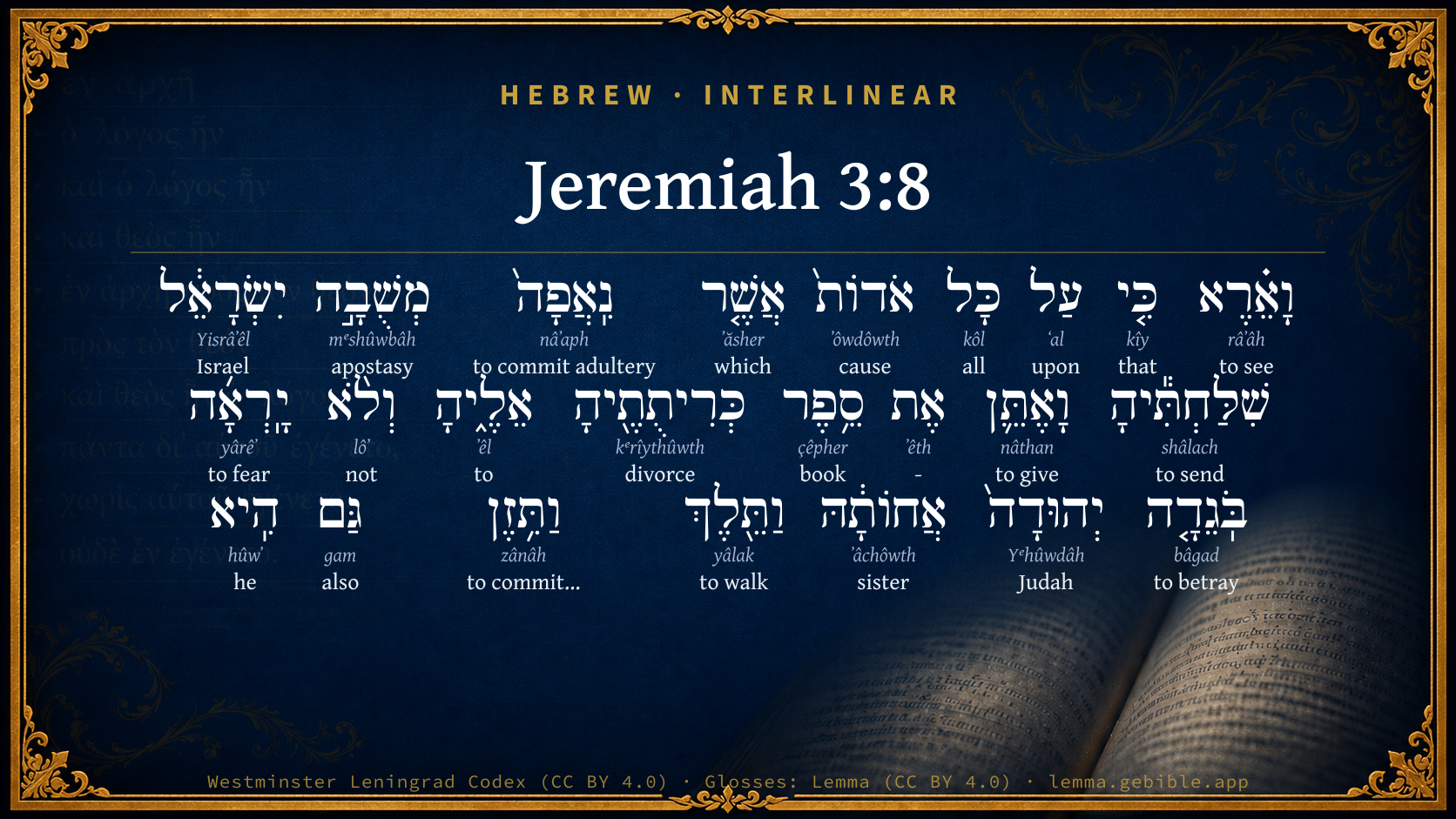
Jeremiah 3:8

Hebrew (Westminster Leningrad Codex) Jeremiah 3:8 appears in the Hebrew Old Testament. The text above is from the Westminster Leningrad Codex. Each word links to its Strong’s number, a concise gloss, and parsing drawn from the Open Scriptures Hebrew Bible morphology. Click any word for its full Brown-Driver-Briggs (BDB) entry.
Download image
Cite this verse

Jeremiah 3:8 (World English Bible). Public Domain. Lemma interlinear Bible study tool, https://lemma.gebible.app/v/jeremiah/3/8.

Show BibTeX & RIS
BibTeX
RIS
English Translation
I saw, when, for this very cause that backsliding Israel had committed adultery, I had put her away and given her a bill of divorce, yet treacherous Judah, her sister, didn't fear; but she also went and played the prostitute.
World English Bible · Public Domain
Download a study sheet

One document with this verse’s original text, its word-by-word gloss line, the meaning frame, cross-references with their text, attributed commentary, and full source and license credits — printable, and it pastes into notes with its structure intact.

This verse Autodidact and up

Study sheet (.html) Plain text (.txt)

A passage Seminary Student

Up to 50 verses in one chapter. A passage sheet keeps up to 6 commentary sources and 12 cross-references per verse, in the order this page ranks them, and says so on the sheet whenever that leaves anything out. Ask for a single verse and you get the Autodidact verse sheet above.

Everything on this page stays free to read, with no account — the sheet is a download of what is already on screen, not access to it.

Want to remove ads? Support Godless Engineer
Compare translations 3

The same verse in 3 English versions, stacked beneath the original-language interlinear above. Click any original word for its lexicon entry.

Each is an independent rendering of the whole verse — the interlinear is not word-aligned to these translations.

Highlighted words mark where these versions differ — a whole-verse word diff, not a word-by-word alignment.

  • World English Bible Public Domain
    I saw, when, for this very cause that backsliding Israel had committed adultery, I had put her away and given her a bill of divorce, yet treacherous Judah, her sister, didn't fear; but she also went and played the prostitute.
  • King James Version Public Domain
    And I saw, when for all the causes whereby backsliding Israel committed adultery I had put her away, and given her a bill of divorce; yet her treacherous sister Judah feared not, but went and played the harlot also.
  • unfoldingWord Literal Text CC BY-SA 4.0
    So I saw that for the very reason that apostate Israel had committed adultery, I had sent her away and had given a scroll of her divorce to her. But her sister Judah, acting treacherously, did not fear, and she went out, and she herself also prostituted.

unfoldingWord Literal Text — © unfoldingWord, licensed CC BY-SA 4.0. Word-aligned USFM3 via Door43 (git.door43.org/unfoldingWord/en_ult).

Versions to compare (up to 4)

3 of 4 selected

Show all 18 translations

Every available English version of this verse, each an independent rendering of the whole verse.

  • World English Bible Public Domain
    I saw, when, for this very cause that backsliding Israel had committed adultery, I had put her away and given her a bill of divorce, yet treacherous Judah, her sister, didn't fear; but she also went and played the prostitute.
  • Berean Standard Bible Public Domain
    She saw that because faithless Israel had committed adultery, I gave her a certificate of divorce and sent her away. Yet that unfaithful sister Judah had no fear and prostituted herself as well.
  • Majority Standard Bible Public Domain
    She saw that because faithless Israel had committed adultery, I gave her a certificate of divorce and sent her away. Yet that unfaithful sister Judah had no fear and prostituted herself as well.
  • King James Version Public Domain
    And I saw, when for all the causes whereby backsliding Israel committed adultery I had put her away, and given her a bill of divorce; yet her treacherous sister Judah feared not, but went and played the harlot also.
  • American Standard Version (1901) Public Domain
    And I saw, when, for this very cause that backsliding Israel had committed adultery, I had put her away and given her a bill of divorcement, yet treacherous Judah her sister feared not; but she also went and played the harlot.
  • Revised Version (1885) Public Domain
    And I saw, when, for this very cause that backsliding Israel had committed adultery, I had put her away and given her a bill of divorcement, yet treacherous Judah her sister feared not; but she also went and played the harlot.
  • Geneva Bible (1599) Public Domain
    When I sawe, howe that by all occasions rebellious Israel had plaied the harlot, I cast her away, and gaue her a bill of diuorcement: yet her rebellious sister Iudah was not afraied, but shee went also, and plaied the harlot.
  • Douay-Rheims (1899) Public Domain
    That because the rebellious Israel had played the harlot, I had put her away, and had given her a bill of divorce: yet her treacherous sister Juda was not afraid, but went and played the harlot also herself.
  • Young's Literal Translation Public Domain
    And I see when (for all the causes whereby backsliding Israel committed adultery) I have sent her away, and I give the bill of her divorce unto her, that treacherous Judah her sister hath not feared, and goeth and committeth fornication -- she also.
  • Literal Standard Version CC BY-SA 4.0
    And I see that for all the causes whereby backsliding Israel committed adultery, I have sent her away, and I give the bill of her divorce to her; and her treacherous sister Judah has not feared, and goes and commits fornication—she also.
  • Unlocked Literal Bible CC BY-SA 4.0
    So I saw that, in the same way that faithless Israel had committed adultery and I had sent her away and had given a bill of divorce against her, her faithless sister Judah did not fear; she also went out and acted like a prostitute.
  • unfoldingWord Literal Text CC BY-SA 4.0
    So I saw that for the very reason that apostate Israel had committed adultery, I had sent her away and had given a scroll of her divorce to her. But her sister Judah, acting treacherously, did not fear, and she went out, and she herself also prostituted.
  • Darby Bible Public Domain
    And I saw that when for all the causes wherein backsliding Israel committed adultery I had put her away, and given her a bill of divorce, yet the treacherous Judah, her sister, feared not, but went and committed fornication also.
  • World Messianic Bible Public Domain
    I saw when, for this very cause, that backsliding Israel had committed adultery, I had put her away and given her a certificate of divorce, yet treacherous Judah, her sister, had no fear, but she also went and played the prostitute.
  • Webster's Bible Public Domain
    And I saw, when for all the causes by which backsliding Israel committed adultery I had put her away, and given her a bill of divorce; yet her treacherous sister Judah feared not, but went and played the harlot also.
  • Free Bible Version CC BY-SA 4.0
    She saw that because of everything unfaithful Israel had done on committing adultery, I sent her away, giving her a certificate of divorce. But her unfaithful sister Judah wasn't afraid and prostituted herself too.
  • Bible in Basic English Public Domain
    And though she saw that, because Israel, turning away from me, had been untrue to me, I had put her away and given her a statement in writing ending the relation between us, still Judah, her false sister, had no fear, but went and did the same.
  • JPS Tanakh (1917) Public Domain
    And I saw, when, forasmuch as backsliding Israel had committed adultery, I had put her away and given her a bill of divorcement, that yet treacherous Judah her sister feared not; but she also went and played the harlot;

Literal Standard Version (2020), Covenant Press — licensed CC BY-SA 4.0. Text via the HelloAO Bible API (eBible.org). Unlocked Literal Bible (unfoldingWord) — licensed CC BY-SA 4.0. Text via the HelloAO Bible API (eBible.org). unfoldingWord Literal Text — © unfoldingWord, licensed CC BY-SA 4.0. Word-aligned USFM3 via Door43 (git.door43.org/unfoldingWord/en_ult). Free Bible Version, Dr. Jonathan Gallagher — licensed CC BY-SA 4.0. Text via the HelloAO Bible API (eBible.org).

Word by word

More ways to search: Search by grammar → Find every occurrence → Compare this word →

Practice this passage: Drill this verse → Learn its vocabulary →

כְּרִיתֻתֶ֖יהָ
kᵉrîythûwth
H3748
“divorce · her”
Noun, Common, Feminine, Plural, Construct + Suffix, Personal, 3rd Person, Feminine, Singular
Part of Speech
Noun
Type
Common
Gender
Feminine
Number
Plural
State
Construct
Full BDB Definition

Origin: from H3772

TWOT: 1048a

divorce, dismissal, divorcement
  1. וָאֵ֗רֶא râʼâh H7200 “and · to see” Conjunction + Verb, Qal, Sequential Imperfect, 1st Person, Common, Singular
  2. כִּ֤י kîy H3588 “that” Conjunction
  3. עַל ʻal H5921 “upon” Preposition
  4. כָּל kôl H3605 “all of” Noun, Common, Masculine, Singular, Construct
  5. אֹדוֹת֙ ʼôwdôwth H182 “cause” Noun, Common, Feminine, Plural, Absolute
  6. אֲשֶׁ֤ר ʼăsher H834 “which” Particle, Relative
  7. נִֽאֲפָה֙ nâʼaph H5003 “to commit adultery” Verb, Piel, Perfect, 3rd Person, Feminine, Singular
  8. מְשֻׁבָ֣ה mᵉshûwbâh H4878 “apostasy” Noun, Common, Feminine, Singular, Absolute
  9. יִשְׂרָאֵ֔ל Yisrâʼêl H3478 “Israel” Noun, Proper
  10. שִׁלַּחְתִּ֕יהָ shâlach H7971 “to send · her” Verb, Piel, Perfect, 1st Person, Common, Singular + Suffix, Personal, 3rd Person, Feminine, Singular
  11. וָאֶתֵּ֛ן nâthan H5414 “and · to give” Conjunction + Verb, Qal, Sequential Imperfect, 1st Person, Common, Singular
  12. אֶת ʼêth H853 “-” Particle, Direct Object
  13. סֵ֥פֶר çêpher H5612 “book of” Noun, Common, Masculine, Singular, Construct
  14. אֵלֶ֑יהָ ʼêl H413 “to · her” Preposition + Suffix, Personal, 3rd Person, Feminine, Singular
  15. וְלֹ֨א lôʼ H3808 “and · not” Conjunction + Particle, Negative
  16. יָֽרְאָ֜ה yârêʼ H3372 “to fear” Verb, Qal, Perfect, 3rd Person, Feminine, Singular
  17. בֹּֽגֵדָ֤ה bâgad H898 “betraying” Verb, Qal, Participle Active, Feminine, Singular, Absolute
  18. יְהוּדָה֙ Yᵉhûwdâh H3063 “Judah” Noun, Proper
  19. אֲחוֹתָ֔הּ ʼâchôwth H269 “sister · her” Noun, Common, Feminine, Singular, Construct + Suffix, Personal, 3rd Person, Feminine, Singular
  20. וַתֵּ֖לֶךְ yâlak H3212 “and · to walk” Conjunction + Verb, Qal, Sequential Imperfect, 3rd Person, Feminine, Singular
  21. וַתִּ֥זֶן zânâh H2181 “and · to commit fornication” Conjunction + Verb, Qal, Sequential Imperfect, 3rd Person, Feminine, Singular
  22. גַּם gam H1571 “also” Particle, Accusative
  23. הִֽיא hûwʼ H1931 “he” Pronoun, Personal, 3rd Person, Feminine, Singular

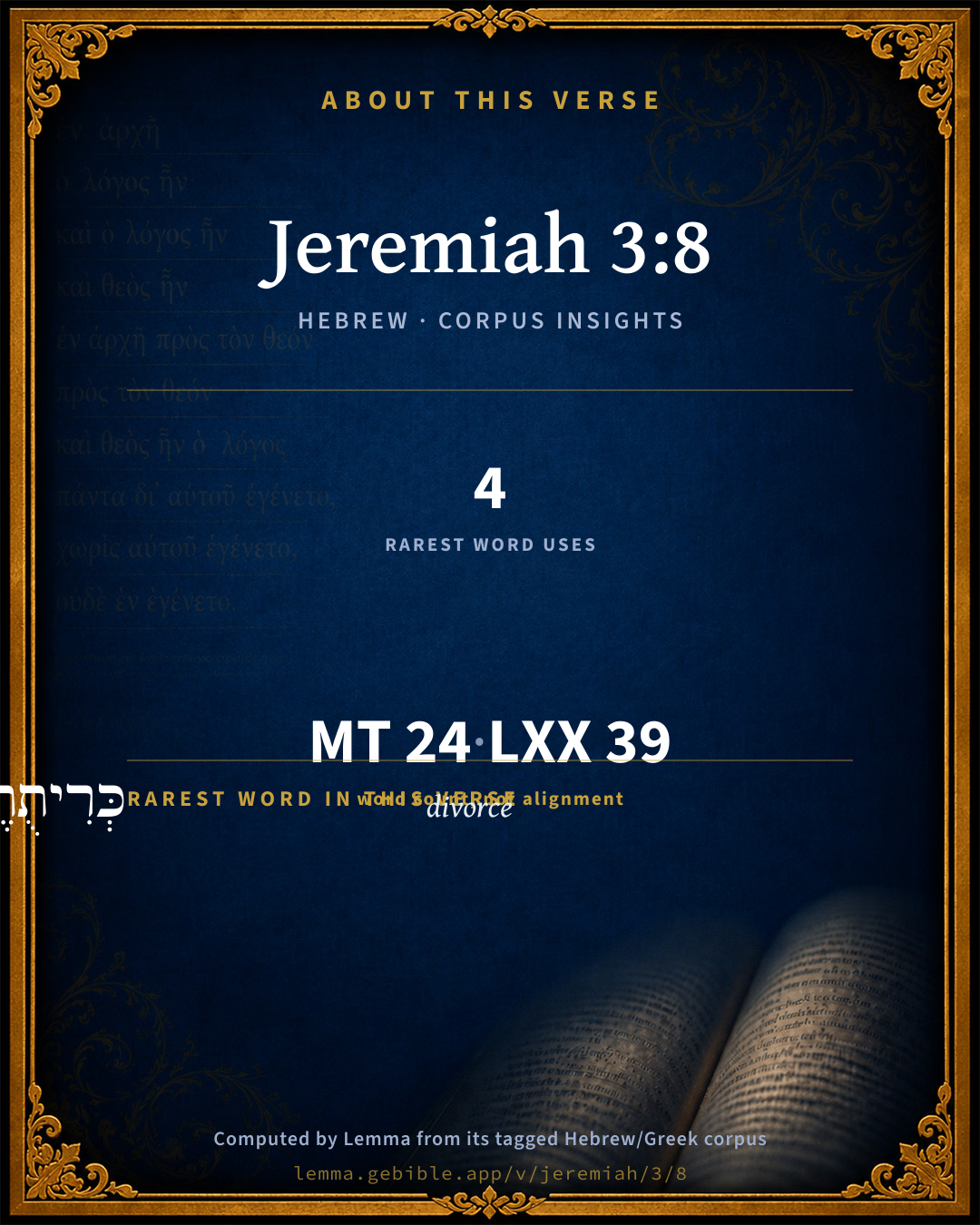
About this verse

These counts appear in no published source. They are computed here, from the morphology-tagged text and Lemma’s own curated glosses. What Lemma adds →

24
words
24
distinct lemmas
Prophets
section

Notable vocabulary

The rarest word here is כְּרִיתֻתֶ֖יהָ divorce H3748 — appearing just 4 times in the whole Hebrew Bible.

Shared distinctive vocabulary

כְּרִיתֻתֶ֖יהָ divorce H3748 occurs in 4 verses of the Hebrew Bible. Also found in:

Grammatical profile

  • 8 verbs
  • 8 nouns
  • 1 pronoun
  • 2 prepositions
  • 1 conjunction
  • 4 particles

Verb forms

  • וָאֵ֗רֶא Qal · Sequential Imperfect
  • נִֽאֲפָה֙ Piel · Perfect
  • שִׁלַּחְתִּ֕יהָ Piel · Perfect
  • וָאֶתֵּ֛ן Qal · Sequential Imperfect
  • יָֽרְאָ֜ה Qal · Perfect
  • בֹּֽגֵדָ֤ה Qal · Participle Active
  • וַתֵּ֖לֶךְ Qal · Sequential Imperfect
  • וַתִּ֥זֶן Qal · Sequential Imperfect

Hebrew & Septuagint length

In the original languages it is 24 Hebrew tokens and 39 Greek tokens — but the two are counted differently (Hebrew bundles its prefixes and suffixes into one token; the Greek is in lemma form), so that isn’t a like-for-like length.

Cross-references

13

Topical passages linked to Jeremiah 3:8 in the Treasury of Scripture Knowledge — connected by theme and wording, ordered by reader-vote popularity; previews shown in the World English Bible.

  • Deuteronomy 24:1 When a man takes a wife, and marries her, then it shall be, if she find no favor in his eyes, because he has found some unseemly thing in her, that he shall write her a bill of divorce, and give it in her hand, and send her out of his house.
  • 2 Kings 18:9–11 It happened in the fourth year of king Hezekiah, which was the seventh year of Hoshea son of Elah king of Israel, that Shalmaneser king of Assyria came up against Samaria, and besieged it.
  • Isaiah 50:1 Thus says Yahweh, Where is the bill of your mother's divorce, with which I have put her away? or which of my creditors is it to whom I have sold you? Behold, for your iniquities were you sold, and for your transgressions was your mother put away.
  • Hosea 2:2–3 Contend with your mother! Contend, for she is not my wife, Neither am I her husband; And let her put away her prostitution from her face, And her adulteries from between her breasts;
  • Hosea 3:4 For the children of Israel shall abide many days without king, and without prince, and without sacrifice, and without sacred stone, and without ephod or idols.
  • Hosea 4:15–17 "Though you, Israel, play the prostitute, Yet don't let Judah offend; And don't come to Gilgal, Neither go up to Beth Aven, Nor swear, 'As Yahweh lives.'
  • Deuteronomy 24:3 If the latter husband hate her, and write her a bill of divorce, and give it in her hand, and send her out of his house; or if the latter husband die, who took her to be his wife;
  • 2 Kings 17:6–19 In the ninth year of Hoshea the king of Assyria took Samaria, and carried Israel away to Assyria, and placed them in Halah, and on the Habor, the river of Gozan, and in the cities of the Medes.
  • Jeremiah 3:1 They say, If a man put away his wife, and she go from him, and become another man's, will he return to her again? Won't that land be greatly polluted? But you have played the prostitute with many lovers; yet return again to me, says Yahweh.
  • Ezekiel 16:47 Yet have you not walked in their ways, nor done after their abominations; but, as [if that were] a very little [thing], you were more corrupt than they in all your ways.
  • Ezekiel 23:9 Therefore I delivered her into the hand of her lovers, into the hand of the Assyrians, on whom she doted.
  • Ezekiel 23:11–21 Her sister Oholibah saw this, yet was she more corrupt in her doting than she, and in her prostitution which were more than the prostitution of her sister.
  • Hosea 9:15–17 "All their wickedness is in Gilgal; For there I hated them. Because of the wickedness of their deeds I will drive them out of my house! I will love them no more. All their princes are rebels.

Cross-references courtesy of OpenBible.info (CC BY 4.0).

Hebrew and Greek witnesses Masoretic Hebrew ↔ Greek Septuagint

The same verse in the two great witnesses to the Old Testament, shown verse-for-verse.

These are two independent witnesses, not word-aligned to each other, and the Septuagint is shown in lemma (dictionary) form.

Hebrew Jeremiah 3:8 Masoretic · Westminster Leningrad Codex

וָאֵ֗רֶא כִּ֤י עַל כָּל אֹדוֹת֙ אֲשֶׁ֤ר נִֽאֲפָה֙ מְשֻׁבָ֣ה יִשְׂרָאֵ֔ל שִׁלַּחְתִּ֕יהָ וָאֶתֵּ֛ן אֶת סֵ֥פֶר כְּרִיתֻתֶ֖יהָ אֵלֶ֑יהָ וְלֹ֨א יָֽרְאָ֜ה בֹּֽגֵדָ֤ה יְהוּדָה֙ אֲחוֹתָ֔הּ וַתֵּ֖לֶךְ וַתִּ֥זֶן גַּם הִֽיא

I saw, when, for this very cause that backsliding Israel had committed adultery, I had put her away and given her a bill of divorce, yet treacherous Judah, her sister, didn't fear; but she also went and played the prostitute.

World English Bible · Public Domain

Greek LXX Structure differs

In the Septuagint, Jeremiah is about an eighth shorter than the Hebrew and arranges its material differently — the Oracles Against the Nations (Hebrew chapters 46–51) appear in the middle of the Greek book, after 25:13. Because the chapter and verse boundaries do not line up, a verse-for-verse comparison with the Hebrew is not shown.

A verse-for-verse comparison isn’t shown here because the chapters and verses don’t line up. Switch to the LXX edition with the MT / LXX toggle above to read the Greek directly.

On this verse, The Pulpit Commentary discusses the Septuagint’s reading. Read the note in Commentary ↓

Hebrew: Westminster Leningrad Codex (CC BY 4.0). Greek: Septuagint (public domain); English from a public-domain English Septuagint. How the Septuagint differs from the Hebrew →

Targum (Aramaic paraphrase)

1

The Targum is the ancient Jewish Aramaic paraphrase of the Hebrew Scriptures — an interpretive translation, not the Hebrew text itself. Onkelos (literal) and Pseudo-Jonathan (expansive) render the Torah, and Jonathan the Prophets. Coverage is partial: where no permissively-licensed English translation exists for a verse, only the Aramaic is shown. This is verse-level text, not a word-by-word alignment to the Hebrew.

  1. Targum Jonathan Prophets (Joshua–Malachi)
    וּגְלֵי קֳדָמַי אֲרֵי עַל כָּל עֵיסַק דִטְעוֹ דְמִתְחַסְנִין לְמֵיתַב לְפוּלְחָנִי דְבֵית יִשְׂרָאֵל אַגְלֵיתִינוּן כְּמָה דְיָהֲבִין אִגֶרֶת גֵט פִּטוּרִין וּמְשַׁלְחִין וְלָא דְחִילוּ מִשִׁקְרַיָא דְבֵית יְהוּדָה אֲחֵיהוֹן וַאֲזָלוּ וּטְעוֹ אַף אִינוּן:

    (no public-domain English translation for this verse)

    Targum Jonathan — Aramaic: “Mikraot Gedolot” (public domain). English: “Sefaria Community Translation” (CC0 1.0 (public-domain dedication)); “London "Chaldee Paraphrase," 1871” (public domain). Text via Sefaria.

Commentary

Notes on Jeremiah 3:8 from classic Christian and Jewish commentators (each source and its license shown beneath its notes). The classic Christian expositions comment on the surrounding passage and are grouped to its opening verse, so a note may address several verses; the Jewish commentaries on the Tanakh (Rashi and others) are per-verse, so they appear only where the commentator wrote on this verse.

Lemma curates 59 commentaries, every one of them public domain or Creative Commons licensed, each selected and text-cleaned for this edition rather than reprinted as found. About our sources →

Trapp's Complete Commentary

John Trapp

Jer 3:8 And I saw, when for all the causes whereby backsliding Israel committed adultery I had put her away, and given her a bill of divorce; yet her treacherous sister Judah feared not, but went and played the harlot also.

Ver. 8. And I saw.] That which others could not so easily discern - viz., their hypocrisy and hollow heartedness, their incorrigibleness also, and refusing to be warned by what had befallen their brethren. God looked that Israel’s corrections should have been Jerusalem’s instructions, and that by their lashes she should have been lessoned, which because she was not he is highly displeased, and speaks of it here in a very angry dialect.

Yet her treacherous sister Judah feared not.] But slighted the kindness of such a caution, and despised the counsel that was written to her in her sister’s blood.

But went and played the harlot also.] Being therefore the worse, because she should have been the better of the two.

John Trapp, A Commentary or Exposition upon All the Books of the Old and New Testament (1647–1656) — public domain. Text from a community e-Sword module.

Joseph Benson's Commentary

Jer 3:8. And I saw — As if he had said, That which others discerned not, I saw perfectly; namely, both her hypocrisy and her incorrigibleness, notwithstanding what had befallen Israel, whose correction should have instructed and reformed her. When for all the causes — The various idolatries and other sins, for which I had given her — That is, Israel; a bill of divorce — Delivered her up into the hands of the Assyrians, and thereby taken from her the title of being my church; yet her sister Judah feared not — Was neither afraid of giving me offence, nor of the like punishment; but went and played the harlot also — Was forward enough to worship any idol that was introduced, and to join in any idolatrous usage, although she had seen the judgment of God executed upon Israel before her eyes.

Joseph Benson's Commentary on the Old and New Testaments (1811–1818) — public domain. Text from a community e-Sword module.

Tyndale Open Study Notes

Tyndale Open Resources

3:8 divorced: See 2 Kgs 17:23.

Tyndale Open Study Notes — © Tyndale Open Resources, licensed CC BY-SA 4.0. Text via the HelloAO Bible API.

Geneva Bible (1599)

Geneva Bible translators

And gave her into the hands of the Assyrians.

Geneva Bible (1599) marginal notes — public domain. Text via Bolls.life.

Jamieson, Fausset & Brown

Robert Jamieson, A. R. Fausset & David Brown

I saw that, though (whereas) it was for this very reason (namely), because backsliding (apostate) Israel had committed adultery I had put her away (Kg2 17:6, Kg2 17:18), and given her a bill of divorce, yet Judah, &c. (Eze 23:11, &c.).

bill of divorce--literally, "a writing of cuttings off." The plural implies the completeness of the severance. The use of this metaphor here, as in the former discourse (Jer 3:1), implies a close connection between the discourses. The epithets are characteristic; Israel "apostate" (as the Hebrew for "backsliding" is better rendered); Judah, not as yet utterly apostate, but treacherous or faithless.

also--herself also, like Israel.

Jamieson, Fausset & Brown — Commentary Critical and Explanatory on the Whole Bible (1871) — public domain (CC PDM 1.0). Text via the HelloAO Bible API.

Adam Clarke's Commentary

Verse 8. I had put her away] Given them up into the hands of the Assyrians.

Adam Clarke's Commentary on the Bible (1810–1826) — public domain. Text from a community e-Sword/MySword module.

John Calvin's Commentaries

He then says, And I saw As he had said that the kingdom of Judah had seen what happened to Israel, so he now says, that he had seen both, See then did I Now, what does he declare that he had seen? Even that Judah had played the harlot; for he now speaks of Judah as of a woman. Then God says, that it was not a thing hid from him that Judah had surpassed the crimes of her sister, not through ignorance or deception, but through deliberate wickedness: See, he says, did I, that notwithstanding all these things, she played the harlot He thus explains more fully what he had briefly touched upon before. He had said, that Judah had seen, but this on account of its brevity might have appeared ambiguous: he therefore explains it more at large; “See did Judah that I gave a bill of divorcement to her sister, because she had played the harlot; and yet she feared not;” that. is, she thought not of repenting, when she had such a striking example of vengeance set before her eyes.

But it may be here asked, how could it be said that a bill of divorce had been given to the Israelites, when he denies by the Prophet Isaiah that he had given it? (Isaiah 50:1.) But the Prophet here takes another view of the subject; for he does not speak here of the bills of divorce, such as were usually given, when a husband repudiated a wife who had been chaste and faithful; but he speaks of that lawful divorce, when a woman, convicted of adultery, is liable to a capital punishment. God then by his prophet Isaiah denies that he had given a bill of divorcement; but he says here that he had given it, because he had repudiated an adulterous woman. It was not indeed at that time customary among the Jews to divorce an adulteress, for she was led to execution. But we have seen at the beginning of the chapter that there is a difference between God and husbands. As then God did not deal, as he might have justly done, with the Israelites, and did not execute a capital punishment, as he might rightly have done, and what was usually done, he says that he had given a bill of divorce, that is, that he had repudiated that people. But by the bill of divorce he means exile; for when the ten tribes were banished, it was the same as though God openly shewed that he had no connection with that people: as long as they continued in the holy land and in the promised inheritance, some kind of union remained; but when they were dispersed here and there, and every sort of worship had ceased among them, and also when the very kingdom of Israel had no longer an existence, God had then divorced them.

See then did her sister Judah, and she feared not It was indeed an instance of great insensibility, not to learn wisdom at the expense of others; and it is a complaint found everywhere in the prophets, — that the Jews were not stimulated to repentance, while God spared them, and at the same time set before them examples which ought in all reason to have terrified them. For what ought they to have considered, but that God would punish those many transgressions by which they provoked his wrath, since he had not spared their brethren? They saw that the kingdom of Israel had been abolished, and yet all of them derived their origin from the same father, even Abraham: how was it then that they so heedlessly despised God’s judgment, which had been for a long time before their eyes? Hence he complains that they feared not It now follows —

John Calvin's Commentaries (1540-1563) — public domain. Text from the Calvin Translation Society English edition (1840s-50s) via the Christian Classics Ethereal Library (ccel.org). Calvin's coverage is partial (roughly two-thirds of the Bible); uncommented books and verses are honest gaps, never fabricated. The 19th-century editor's footnotes and remarks are omitted so the notes are faithfully Calvin's own voice.

Ellicott's Commentary for English Readers

(8) And I saw, when for all the causes.—Better, perhaps (following a conjectural emendation, which gives a much better sense), And she saw that for all the causes. The technical fulness of the words suggests the thought that they were actually the customary formula with which every writing of divorcement began, recapitulating the offences which were alleged by the husband against the wife. The actual repudiation consisted, of course, in the bitter exile and loss of national life, which Hosea (Hos_2:1-13) had predicted under a like figure. Judah had witnessed the sin and the punishment, and yet was following in the same path.

A Bible Commentary for English Readers, edited by Charles John Ellicott (1878–1897) — public domain. Text from a community e-Sword module.

The Cambridge Bible for Schools and Colleges

gen. ed. J. J. S. Perowne

8. I saw] rather (as mg.) she (Judah) saw that etc., thus harmonizing with the similar passage, Eze_23:11.

The Cambridge Bible for Schools and Colleges (gen. ed. J. J. S. Perowne; Cambridge University Press, 1878–1918) — public domain. Text from a community e-Sword module.

John Gill's Exposition

And I saw, when for all the causes, whereby backsliding Israel committed adultery,.... Not only Judah saw, but God, who sees all things, saw the idolatry of the ten tribes which apostatized from him, and all the springs, causes, reasons, and occasions of it, and its consequences; and also the treachery, hardness, and idolatry of Judah:

I had put her away, and given her a bill of divorce; as men did, when they put away their wives, as they might lawfully do in case of adultery; and here being that which answered to it, spiritual adultery or idolatry, the Lord, who was married to this people, put them away from him, and caused them to be carried captive out of their own land into another, Kg2 17:6 which is meant by the bill of divorce; so the Targum,

"I caused them to go into captivity, as those that give a bill of divorce (to their wives) and dismiss them:''

yet her treacherous sister Judah feared not; to commit idolatry and offend the Lord, nor stood in awe of his righteous judgments; had no reverence of God, nor fear of punishment; so hardened and daring was she: but went and played the harlot; committed idolatry, as the ten tribes did, taking no warning by what befell them.

John Gill's Exposition of the Whole Bible (1746–1763) — public domain (CC PDM 1.0). Text via the HelloAO Bible API.

Albert Barnes' Notes on the Bible

Rather, “And I saw” that because apostate “Israel” had “committed adultery, I had put her away, and given her” the writing of her divorcement, “yet” false “Judah her sister feared not.”...The expression, “For all the causes whereby,” is probably the actual formula with which writings of divorcement commenced.

Albert Barnes' Notes on the Bible (1834–1885) — public domain. Text from a community e-Sword/MySword module.

Matthew Poole's English Annotations

I saw: q.d. That which others discern not I saw well enough, viz. both her hypocrisy and dissimulation, and her incorrigibleness notwithstanding what had befallen Israel, whose correction should have been her instruction; thus God speaks of the notice he took of both, Jer 23:13,14. Israel is said to be backsliding, but Judah

treacherous, because she retained the worship of God, though she did often privately and closely embrace idols. and sometimes publicly, under Manasseh, and Ahaz, and other wicked kings:

When for all the causes; or notwithstanding all the ground and reason I had to deal so with Israel in regard of her adulteries, as to put her away.

Given her a bill of divorce; delivered her up into the hands of the Assyrian, where God took from her the title of being his church, 2Ki 17:5,6, &c., which he calls here a bill of divorce; not such a one as the Jews were allowed to give upon every slight ground, (for such a one God denies that ever he gave them, and challengeth them to produce it, Isa 1:1) but upon just and great occasion, viz. her playing the adulteress against him in her idolatries. Feared not, i.e. was neither afraid of giving me offence, nor of the like punishment. But went and played the harlot also; although she had seen the judgment of God executed upon Israel before her eyes, which made it the more stupendous, that she would take no warning by her sister’s sufferings, Pro 28:14, yet she went on still, Eze 23:11,12, &c.

Matthew Poole's English Annotations on the Holy Bible (1683–1685) — public domain. Text from a community e-Sword/MySword module.

Whedon's Commentary on the Bible

Daniel D. Whedon

8. A bill of divorce — How fearful a thing is a bill of divorce from the Almighty! A withdrawal of the divine support and protection carries with it all dark and dreadful possibilities. The pall of desolation which for twenty-five centuries has covered this land is a fit but feeble expression of the fearfulness of abandonment by God!

Daniel D. Whedon (gen. ed.), Commentary on the Old and New Testaments (1874–1909) — public domain. Text from a community e-Sword module.

The Pulpit Commentary

And I saw, when for all the causes, etc.; rather, and I saw that even because apostate Israel had, etc. But this is exceedingly strange in this connection. The preceding words seem to compel us either (with the Vulgate) to omit "and I saw" altogether, or (with Ewald) to read the first letter of the verb differently, and render "and she saw," taking up the statement of ver. 7 ("saw; yea, she saw," etc.). The latter view is favored by a phrase in ver. 10 (see note below). The same corruption of the text (which is palaeographically an easy one) occurs probably in Eze_23:13. The error must, however, be a very ancient one, for the Septuagint already has kai eidon .

The Pulpit Commentary (1880–1919), ed. H.D.M. Spence-Jones & Joseph S. Exell — public domain. Text from a community e-Sword module.

John Wesley's Explanatory Notes

Given a bill - Delivered her up into the hands of the Assyrian, where God took from her the title of being his church, 2 Kings xvii, 5, 6.

John Wesley, Explanatory Notes Upon the Whole Bible (1754–1765) — public domain. Text via the GEBible commentary corpus.

unfoldingWord translationNotes

Door43 World Missions Community

General Information:

Yahweh continues to speak of Israel and Judah being unfaithful to him as if they were two sisters who were unfaithful wives.

bill of divorce

Something that a man writes to certify that he has divorced his wife.

Her prostitution was nothing to her

Here prostitution being "nothing" represents Judah not caring about it. AT: "She did not care about her prostitution" or "She was not ashamed of her prostitution"

she defiled the land

Here "defiled" represents making the land unacceptable to God. They did this by sinning against him there when they worshiped idols. AT: "she made my land no good" (See: Metaphor)

she committed adultery with stones and trees

Here "stones" and "trees" represent the stone and wood material that was used to create idols. The people's idol worship is spoken of as if they were committing adultery. (See: Metonymy and Metaphor)

this is Yahweh's declaration

Yahweh speaks of himself by name to express the certainty of what he is declaring. See how you translated this in Jeremiah 1:8. AT: "this is what Yahweh has declared" or "this is what I, Yahweh, have declared" (See: First, Second, or Third Person)

translationWords

adultery

divorce

fear

prostitute

defile

heart

unfoldingWord translationNotes — © Distant Shores Media and the Door43 World Missions Community, licensed CC BY-SA 4.0. Source: git.door43.org/Door43/en_tn.

Rashi

Rabbi Shlomo Yitzchaki (Rashi)

And I saw, because of all that backsliding Israel had committed adultery The signs of the intonation of this verse teach us its explanation. ישראל is punctuated with a ‘zakef-katan,’ separated from שלחתיה, I sent her away. שלחתיה, I sent her away, is punctuated with a ‘zakef-gadol’ by itself. And this is its explanation: I saw; i.e., I contemplated her to exact punishment upon her. And why? Because of all that backsliding Israel had committed adultery. And what was My vengeance? I sent her away from before Me. And treacherous Judah did not fear when she saw the retribution of Samaria, to set her heart to repent.

Rashi on the Tanakh — English translations: “The Judaica Press complete Tanach with Rashi, translated by A. J. Rosenberg” (CC BY 4.0); “Pentateuch with Rashi's commentary by M. Rosenbaum and A.M. Silbermann, 1929-1934” (public domain); “The Metsudah Tanach series, Lakewood, N.J” (CC BY 4.0); and “The Book of Joshua, Metsudah Publications, 1997” (CC BY 4.0). Text via Sefaria.

Lesson kit

Teaching starters — assembled from the data on this page, not authored interpretation. Every prompt links to the verse data it draws on. Edit before teaching.

Jeremiah, in the Prophets, opens this verse with 24 words (24 distinct Hebrew lemmas). Its most distinctive word is kᵉrîythûwth (“divorce”). A historical commentator’s framing appears above. Read the whole chapter for the surrounding context.

Discussion questions

  1. How does “divorce” (kᵉrîythûwth) shape what this verse is saying?
  2. Deuteronomy 24:1 shares the word «divorce» with this verse. How do the two illuminate each other?
  3. These translations render this verse differently. What is at stake in choosing one wording over another?
  4. The verb «וָאֵ֗רֶא» is Qal Sequential Imperfect. How does its form color the action?
  5. Reading how Trapp's Complete Commentary and Joseph Benson's Commentary read this verse, where do the two commentators agree and where do they part?

Things to notice

Reading settings

Reading text

Shown beneath each verse's original-language words.

Old Testament
Old Testament edition

Read the OT as the Masoretic Hebrew (MT) or the Greek Septuagint (LXX).

English shown for the Greek Septuagint (in the Hebrew ↔ Greek comparison).

Comparing translations? Open the Compare panel on any verse page to stack up to four side by side.