
Jeremiah 1:12

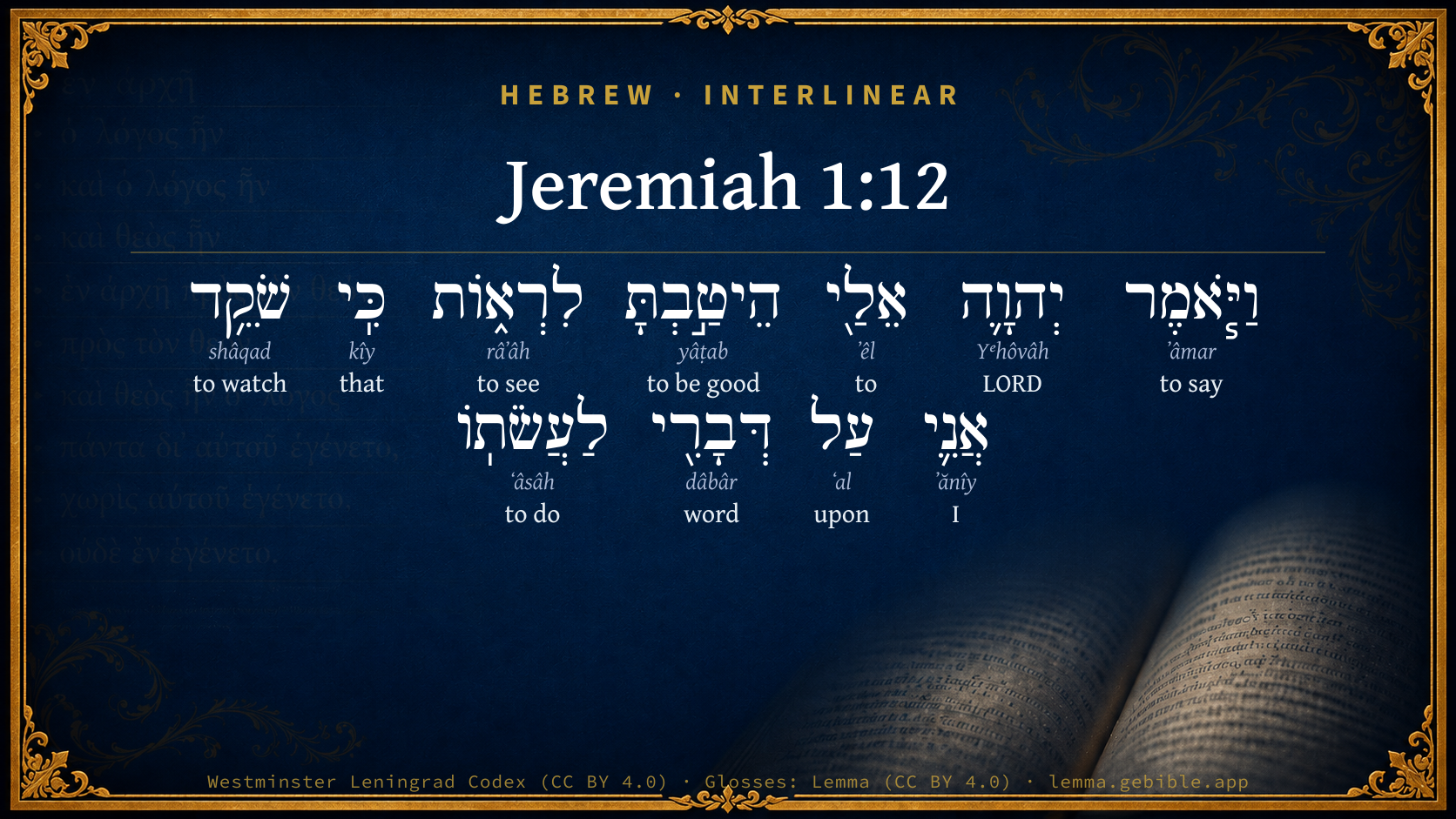
Hebrew (Westminster Leningrad Codex) Jeremiah 1:12 appears in the Hebrew Old Testament. The text above is from the Westminster Leningrad Codex. Each word links to its Strong’s number, a concise gloss, and parsing drawn from the Open Scriptures Hebrew Bible morphology. Click any word for its full Brown-Driver-Briggs (BDB) entry.
Download image
Cite this verse

Jeremiah 1:12 (World English Bible). Public Domain. Lemma interlinear Bible study tool, https://lemma.gebible.app/v/jeremiah/1/12.

Show BibTeX & RIS
BibTeX
RIS
English Translation
Then said Yahweh to me, You have well seen: for I watch over my word to perform it.
World English Bible · Public Domain
Download a study sheet

One document with this verse’s original text, its word-by-word gloss line, the meaning frame, cross-references with their text, attributed commentary, and full source and license credits — printable, and it pastes into notes with its structure intact.

This verse Autodidact and up

Study sheet (.html) Plain text (.txt)

A passage Seminary Student

Up to 50 verses in one chapter. A passage sheet keeps up to 6 commentary sources and 12 cross-references per verse, in the order this page ranks them, and says so on the sheet whenever that leaves anything out. Ask for a single verse and you get the Autodidact verse sheet above.

Everything on this page stays free to read, with no account — the sheet is a download of what is already on screen, not access to it.

Want to remove ads? Support Godless Engineer
Compare translations 3

The same verse in 3 English versions, stacked beneath the original-language interlinear above. Click any original word for its lexicon entry.

Each is an independent rendering of the whole verse — the interlinear is not word-aligned to these translations.

Highlighted words mark where these versions differ — a whole-verse word diff, not a word-by-word alignment.

  • World English Bible Public Domain
    Then said Yahweh to me, You have well seen: for I watch over my word to perform it.
  • King James Version Public Domain
    Then said the LORD unto me, Thou hast well seen: for I will hasten my word to perform it.
  • unfoldingWord Literal Text CC BY-SA 4.0
    And Yahweh said to me, “You have seen well, for I am watching over my word to do it.”

unfoldingWord Literal Text — © unfoldingWord, licensed CC BY-SA 4.0. Word-aligned USFM3 via Door43 (git.door43.org/unfoldingWord/en_ult).

Versions to compare (up to 4)

3 of 4 selected

Show all 18 translations

Every available English version of this verse, each an independent rendering of the whole verse.

  • World English Bible Public Domain
    Then said Yahweh to me, You have well seen: for I watch over my word to perform it.
  • Berean Standard Bible Public Domain
    “You have observed correctly,” said the LORD, “for I am watching over My word to accomplish it.”
  • Majority Standard Bible Public Domain
    “You have observed correctly,” said the LORD, “for I am watching over My word to accomplish it.”
  • King James Version Public Domain
    Then said the LORD unto me, Thou hast well seen: for I will hasten my word to perform it.
  • American Standard Version (1901) Public Domain
    Then said Jehovah unto me, Thou hast well seen: for I watch over my word to perform it.
  • Revised Version (1885) Public Domain
    Then said the LORD unto me, Thou hast well seen: for I watch over my word to perform it.
  • Geneva Bible (1599) Public Domain
    Then saide the Lord vnto me, Thou hast seene aright: for I will hasten my worde to performe it.
  • Douay-Rheims (1899) Public Domain
    And the Lord said to me: Thou hast seen well: for I will watch over my word to perform it.
  • Young's Literal Translation Public Domain
    And Jehovah saith unto me, `Thou hast well seen: for I am watching over My word to do it.'
  • Literal Standard Version CC BY-SA 4.0
    And YHWH says to me, “You have seen well: for I am watching over My word to do it.”
  • Unlocked Literal Bible CC BY-SA 4.0
    Yahweh said to me, “You have seen well, for I am watching over my word to carry it out.”
  • unfoldingWord Literal Text CC BY-SA 4.0
    And Yahweh said to me, “You have seen well, for I am watching over my word to do it.”
  • Darby Bible Public Domain
    And Jehovah said unto me, Thou hast well seen; for I am watchful over my word to perform it.
  • World Messianic Bible Public Domain
    Then the LORD said to me, “You have seen well; for I watch over my word to perform it.”
  • Webster's Bible Public Domain
    Then said the LORD to me, Thou hast well seen: for I will hasten my word to perform it.
  • Free Bible Version CC BY-SA 4.0
    “That's right, because I am watching to make sure what I say happens,” the Lord said.
  • Bible in Basic English Public Domain
    Then the Lord said to me, You have seen well: for I keep watch over my word to give effect to it.
  • JPS Tanakh (1917) Public Domain
    Then said the LORD unto me: 'Thou hast well seen; for I watch over My word to perform it.'

Literal Standard Version (2020), Covenant Press — licensed CC BY-SA 4.0. Text via the HelloAO Bible API (eBible.org). Unlocked Literal Bible (unfoldingWord) — licensed CC BY-SA 4.0. Text via the HelloAO Bible API (eBible.org). unfoldingWord Literal Text — © unfoldingWord, licensed CC BY-SA 4.0. Word-aligned USFM3 via Door43 (git.door43.org/unfoldingWord/en_ult). Free Bible Version, Dr. Jonathan Gallagher — licensed CC BY-SA 4.0. Text via the HelloAO Bible API (eBible.org).

Word by word

More ways to search: Search by grammar → Find every occurrence → Compare this word →

Practice this passage: Drill this verse → Learn its vocabulary →

שֹׁקֵ֥ד
shâqad
H8245
“watching”
Verb, Qal, Participle Active, Masculine, Singular, Absolute
Part of Speech
Verb
Stem
Qal
Form
Participle Active
Gender
Masculine
Number
Singular
State
Absolute
Full BDB Definition

Origin: a primitive root

TWOT: 2451

to wake, watch, awake, be alert - (Qal) - to keep watch of, be wakeful over - to be wakeful, wake (as mourner or sufferer)
  1. וַיֹּ֧אמֶר ʼâmar H559 “and · to say” Conjunction + Verb, Qal, Sequential Imperfect, 3rd Person, Masculine, Singular
  2. יְהוָ֛ה Yᵉhôvâh H3068 “LORD” Noun, Proper
  3. אֵלַ֖י ʼêl H413 “to · me” Preposition + Suffix, Personal, 1st Person, Common, Singular
  4. הֵיטַ֣בְתָּ yâṭab H3190 “to be good” Verb, Hiphil, Perfect, 2nd Person, Masculine, Singular
  5. לִרְא֑וֹת râʼâh H7200 “to see” Preposition + Verb, Qal, Infinitive Construct
  6. כִּֽי kîy H3588 “that” Conjunction
  7. אֲנִ֛י ʼănîy H589 “I” Pronoun, Personal, 1st Person, Common, Singular
  8. עַל ʻal H5921 “upon” Preposition
  9. דְּבָרִ֖י dâbâr H1697 “word · my” Noun, Common, Masculine, Singular, Construct + Suffix, Personal, 1st Person, Common, Singular
  10. לַעֲשֹׂתֽוֹ ʻâsâh H6213 “to do · him” Preposition + Verb, Qal, Infinitive Construct + Suffix, Personal, 3rd Person, Masculine, Singular

About this verse

These counts appear in no published source. They are computed here, from the morphology-tagged text and Lemma’s own curated glosses. What Lemma adds →

11
words
11
distinct lemmas
Prophets
section

Notable vocabulary

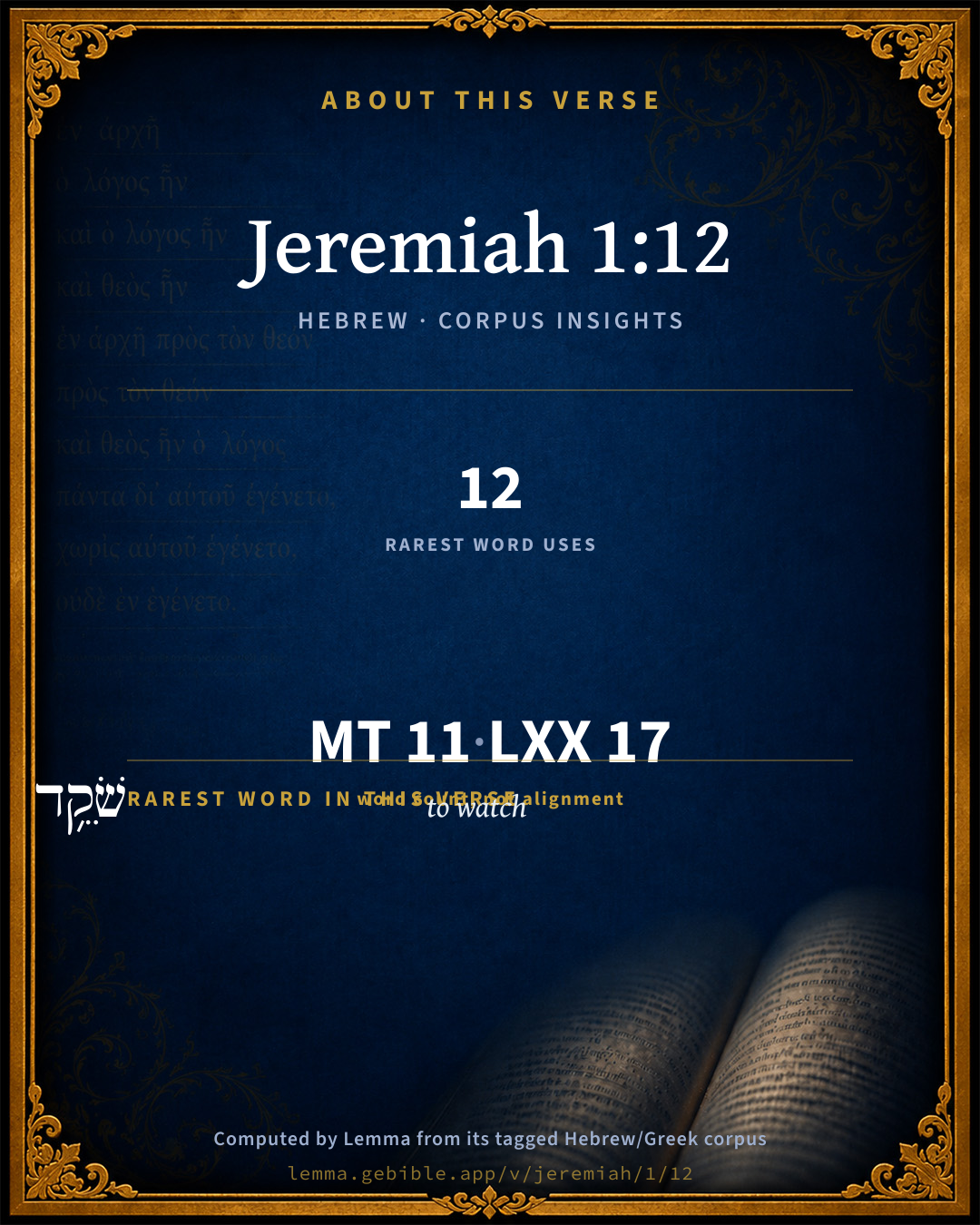
The rarest word here is שֹׁקֵ֥ד to watch H8245 — appearing just 12 times in the whole Hebrew Bible.

Shared distinctive vocabulary

שֹׁקֵ֥ד to watch H8245 occurs in 11 verses of the Hebrew Bible. Also found in:

Grammatical profile

  • 5 verbs
  • 2 nouns
  • 1 pronoun
  • 2 prepositions
  • 1 conjunction

Verb forms

  • וַיֹּ֧אמֶר Qal · Sequential Imperfect
  • הֵיטַ֣בְתָּ Hiphil · Perfect
  • לִרְא֑וֹת Qal · Infinitive Construct
  • שֹׁקֵ֥ד Qal · Participle Active
  • לַעֲשֹׂתֽוֹ Qal · Infinitive Construct

Hebrew & Septuagint length

In the original languages it is 11 Hebrew tokens and 17 Greek tokens — but the two are counted differently (Hebrew bundles its prefixes and suffixes into one token; the Greek is in lemma form), so that isn’t a like-for-like length.

Cross-references

9

Topical passages linked to Jeremiah 1:12 in the Treasury of Scripture Knowledge — connected by theme and wording, ordered by reader-vote popularity; previews shown in the World English Bible.

  • Ezekiel 12:28 Therefore tell them, Thus says the Lord Yahweh: There shall none of my words be deferred any more, but the word which I shall speak shall be performed, says the Lord Yahweh.
  • Ezekiel 12:25 For I am Yahweh; I will speak, and the word that I shall speak shall be performed; it shall be no more deferred: for in your days, rebellious house, will I speak the word, and will perform it, says the Lord Yahweh.
  • Ezekiel 12:22–23 Son of man, what is this proverb that you have in the land of Israel, saying, The days are prolonged, and every vision fails?
  • Luke 10:28 He said to him, "You have answered correctly. Do this, and you will live."
  • Deuteronomy 5:28 Yahweh heard the voice of your words, when you spoke to me; and Yahweh said to me, I have heard the voice of the words of this people, which they have spoken to you: they have well said all that they have spoken.
  • Amos 8:2 He said, "Amos, what do you see?" I said, "A basket of summer fruit." Then Yahweh said to me, "The end has come on my people Israel. I will not again pass by them any more.
  • Deuteronomy 18:17 Yahweh said to me, They have well said that which they have spoken.
  • Deuteronomy 32:35 Vengeance is mine, and recompense, At the time when their foot shall slide: For the day of their calamity is at hand, The things that are to come on them shall make haste.
  • Jeremiah 52:1–34 Zedekiah was twenty-one years old when he began to reign; and he reigned eleven years in Jerusalem: and his mother's name was Hamutal the daughter of Jeremiah of Libnah.

Cross-references courtesy of OpenBible.info (CC BY 4.0).

Hebrew and Greek witnesses Masoretic Hebrew ↔ Greek Septuagint

The same verse in the two great witnesses to the Old Testament, shown verse-for-verse.

These are two independent witnesses, not word-aligned to each other, and the Septuagint is shown in lemma (dictionary) form.

Hebrew Jeremiah 1:12 Masoretic · Westminster Leningrad Codex

וַיֹּ֧אמֶר יְהוָ֛ה אֵלַ֖י הֵיטַ֣בְתָּ לִרְא֑וֹת כִּֽי שֹׁקֵ֥ד אֲנִ֛י עַל דְּבָרִ֖י לַעֲשֹׂתֽוֹ

Then said Yahweh to me, You have well seen: for I watch over my word to perform it.

World English Bible · Public Domain

Greek LXX Structure differs

In the Septuagint, Jeremiah is about an eighth shorter than the Hebrew and arranges its material differently — the Oracles Against the Nations (Hebrew chapters 46–51) appear in the middle of the Greek book, after 25:13. Because the chapter and verse boundaries do not line up, a verse-for-verse comparison with the Hebrew is not shown.

A verse-for-verse comparison isn’t shown here because the chapters and verses don’t line up. Switch to the LXX edition with the MT / LXX toggle above to read the Greek directly.

Hebrew: Westminster Leningrad Codex (CC BY 4.0). Greek: Septuagint (public domain); English from a public-domain English Septuagint. How the Septuagint differs from the Hebrew →

Targum (Aramaic paraphrase)

1

The Targum is the ancient Jewish Aramaic paraphrase of the Hebrew Scriptures — an interpretive translation, not the Hebrew text itself. Onkelos (literal) and Pseudo-Jonathan (expansive) render the Torah, and Jonathan the Prophets. Coverage is partial: where no permissively-licensed English translation exists for a verse, only the Aramaic is shown. This is verse-level text, not a word-by-word alignment to the Hebrew.

  1. Targum Jonathan Prophets (Joshua–Malachi)
    וַאֲמַר יְיָ לִי יָאוּת חֲזֵיתָא אֲרֵי מוֹחֵי אֲנָא עַל פִּתְגְמֵי לְמֶעְבְּדֵיהּ:

    (no public-domain English translation for this verse)

    Targum Jonathan — Aramaic: “Mikraot Gedolot” (public domain). English: “Sefaria Community Translation” (CC0 1.0 (public-domain dedication)); “London "Chaldee Paraphrase," 1871” (public domain). Text via Sefaria.

Commentary

Notes on Jeremiah 1:12 from classic Christian and Jewish commentators (each source and its license shown beneath its notes). The classic Christian expositions comment on the surrounding passage and are grouped to its opening verse, so a note may address several verses; the Jewish commentaries on the Tanakh (Rashi and others) are per-verse, so they appear only where the commentator wrote on this verse.

Lemma curates 59 commentaries, every one of them public domain or Creative Commons licensed, each selected and text-cleaned for this edition rather than reprinted as found. About our sources →

Trapp's Complete Commentary

John Trapp

Jer 1:12 Then said the LORD unto me, Thou hast well seen: for I will hasten my word to perform it.

Ver. 12. Thou hast well seen.] Heb., Thou hast done well to see, i.e., so to see.

For I will hasten my word.] Heb., Amigdalaturns sum, I am watching upon the evil, to bring in the Chaldeans, as I have threatened. See the like elegant allusion, Amo 8:1-2. Nemesis a tergo; punishment is at the heels of sin.

John Trapp, A Commentary or Exposition upon All the Books of the Old and New Testament (1647–1656) — public domain. Text from a community e-Sword module.

Jamieson, Fausset & Brown

Robert Jamieson, A. R. Fausset & David Brown

hasten--rather, "I will be wakeful as to My word," &c.; alluding to Jer 1:11, "the wakeful tree" [MAURER].

Jamieson, Fausset & Brown — Commentary Critical and Explanatory on the Whole Bible (1871) — public domain (CC PDM 1.0). Text via the HelloAO Bible API.

Adam Clarke's Commentary

Verse 12. I will hasten my word] Here is a paronomasia. What dost thou see? I see שקד shaked, "an almond," the hastening tree: that which first awakes. Thou hast well seen, for (שקד shoked) I will hasten my word. I will awake, or watch over my word for the first opportunity to inflict the judgments which I threaten. The judgment shall come speedily; it shall soon flourish, and come to maturity.

Adam Clarke's Commentary on the Bible (1810–1826) — public domain. Text from a community e-Sword/MySword module.

John Calvin's Commentaries

God then caused his servant to see the staff of a watcher. For what purpose? The answer is given: Thou hast rightly seen the staff of a watcher, because I watch over my word to execute (or, fulfill) it Interpreters seem to have unwisely confined this to the punishments afterwards mentioned: they think that what is intimated is, that the threatenings which the Prophet announced would not be without effect, because God was prepared to inflict whatever he would denounce. But this, as I think, is too restricted a view; for God, I have no doubt, extols here his own word, and speaks of its accomplishment; as though he had said, that he spoke not by his servants, that what they said might vanish into air, or fall to the ground, but that power would accompany it, according to what is said in Isaiah,

“Not return shall my word to me empty, but shall prosper in all things,” (Isaiah 55:11)

that is, “I will cause the prophetic doctrine to take effect, that the whole world may know that I have not spoken in vain, and that my word is not an empty sound, but that it has real power, which in due time will appear.”

Hence I have said that these verses ought to be connected with the last, in which God said, that he sent his Prophet to root up and to plant, to demolish and to build. He then gives a proof of this in other words, and says that he would watch over his word, that he might execute whatever he had announced by his servants; as though he had said, “I indeed allot their parts (so to speak) to the prophets; but as they speak from my mouth, I am present with them to fulfill whatever I command them.” In short, God intimates that the might and the power of his hand would be connected with the word, of which the prophets were ministers among men. Thus it is a general declaration which refers not only to punishments, but also to promises. Rightly, then, hast thou seen, he says; for I am watching.

God does not here resign his own office to Jeremiah, though he employs him as his teacher; for he shews that the power to accomplish what the Prophet would declare remained with him. God indeed does not here ascribe to Jeremiah anything as his own, or apart from himself, but sets forth only the power of his word; as though he had said, “Provided thou be my faithful minister, I will not frustrate thy hope, nor the hope of those who shall obey thee; for I will fulfill whatever thou and they may justly hope for: nor shall they escape unpunished who shall resist thee; for I will in due time bring on them the punishment they deserve.”

He therefore uses the word to watch, or to hasten, in order to shew that he stood ready to give effect to his word at the appointed time. The effect does not indeed always appear to us: it is on this account said by Habakkuk, that if prophecy delays, we are to wait;

“for it will not be,” he says, “beyond its time; but coming it will come.” (Habakkuk. 2:3)

God then bids us with quiet minds to wait for the accomplishment of his word; but he afterwards adds, in order to modify what he had said, “coming it will come;” that is, “I will accomplish and really perform whatever my prophets have spoken by my command.” So there shall be no delay, for the suitable time depends on God’s will, and not on the judgment of men. It then follows, — but as the clock strikes, I cannot proceed farther today.

John Calvin's Commentaries (1540-1563) — public domain. Text from the Calvin Translation Society English edition (1840s-50s) via the Christian Classics Ethereal Library (ccel.org). Calvin's coverage is partial (roughly two-thirds of the Bible); uncommented books and verses are honest gaps, never fabricated. The 19th-century editor's footnotes and remarks are omitted so the notes are faithfully Calvin's own voice.

Ellicott's Commentary for English Readers

(12) I will hasten.—The Hebrew, by using a participle formed from the same root (shôkêd), presents a play upon the name of the “almond,” as the watcher, which it is impossible to reproduce; literally, I, too, am watching over my word to perform it.

A Bible Commentary for English Readers, edited by Charles John Ellicott (1878–1897) — public domain. Text from a community e-Sword module.

The Cambridge Bible for Schools and Colleges

gen. ed. J. J. S. Perowne

12. I watch over] The Hebrew word recurs in Jer_5:6, Jer_31:28, Jer_44:27. Here the sense is, The Lord is rousing Himself. The period of trial is rapidly approaching its end, and the punishment so long delayed is about to be at last inflicted.

The Cambridge Bible for Schools and Colleges (gen. ed. J. J. S. Perowne; Cambridge University Press, 1878–1918) — public domain. Text from a community e-Sword module.

John Gill's Exposition

Then said the Lord unto me, thou hast well seen,.... The thing seen is a very proper emblem of what I am about to do, and the quick dispatch that will be made therein:

for l will hasten my word to perform it; the words , "shoked ani", "I will hasten", or "I am hastening", are in allusion to "shoked", the name of the almond tree in Hebrew; which is so called because it is quick and early, and, as it were, hastens to bring forth its flowers, leaves, and fruit; in like manner the Lord says he would hasten to perform what he had said or should say by him concerning the destruction of Jerusalem, and the captivity of the people, and every thing else he should give him in commission to say. Jarchi and Abendana make mention of an ancient Midrash, or exposition, to this sense; that from the time of the almond tree's putting forth, until its fruit is ripe, are one and twenty days, according to the number of days which were between the seventeenth of Tammuz, in which the city was broken up, and the ninth of Ab, in which the temple was burnt; but though the almond tree is the first of trees, and is very early in putting forth, yet there is a greater time than this between its putting forth and its fruit being ripe; for Pliny (s) says, that the almond tree first of all flowers in January, and its fruit is ripe in March.

(s) Nat. Hist. l. 16. c. 25.

John Gill's Exposition of the Whole Bible (1746–1763) — public domain (CC PDM 1.0). Text via the HelloAO Bible API.

Albert Barnes' Notes on the Bible

Hasten - Rather, I watch over “my word to perform it.”

Albert Barnes' Notes on the Bible (1834–1885) — public domain. Text from a community e-Sword/MySword module.

Matthew Poole's English Annotations

Thou hast well seen; or, Thou hast seen and judged right; or, as the Hebrew,

Thou hast done well to see, i.e. in seeing so.

I will hasten; word for word,

I will almond-tree it, i.e. I will be upon them speedily, in a short time, and suddenly, ere they are aware; or, I will watch, and be ready to accomplish this in due time.

My word, i.e. my word of threatening against Judah and its inhabitants.

Matthew Poole's English Annotations on the Holy Bible (1683–1685) — public domain. Text from a community e-Sword/MySword module.

Whedon's Commentary on the Bible

Daniel D. Whedon

12. I will hasten — Better, I will be watchful over.

My word to perform it — In winter the reign of death over the vegetable kingdom is well nigh universal. The almond wakes to life as a visible token and proof of the mindfulness of God and the sure return of life’s resistless dominion. So now God gives to Jeremiah this token of an activity which will assert his power, and call the nation out of its sinful sleep. But that this watchfulness of God was not for purposes of judgment only is clearly stated in the parallel passage in Jer_31:28.

Daniel D. Whedon (gen. ed.), Commentary on the Old and New Testaments (1874–1909) — public domain. Text from a community e-Sword module.

The Pulpit Commentary

I will hasten my word; literally, I am wakeful over my word; alluding to the meaning of the Hebrew word for almond.

Vers. 12-16. Hastening ills.

For the first fig, cf. Mat_24:32. The vision of the prophet is twofold, viz. a wakeful almond rod, and a boiling pot. They are symbols of quick accomplishment and violent invasion. As the almond rod is wakeful or ready to sprout when planted, and "first to wake from the sleep of winter," so the evils prepared by God will be quickly brought to pass. The boiling pot would seem to be the Chaldeans, who invaded Israel from the north. As swiftly and violently as the pot boils over, so will God make the wrath of men to praise him. The ills are swiftly approaching, but they are self-produced by Israel. When we compare this statement with the forgiving character of God, we must feel how great the sin and the provocation that could so move him. Yet on the very edge of his destroying vengeance he remembers mercy, and will have his people repent. Notice

I SINNERS MUST NOT CONCLUDE THAT THEY ARE SAFE BECAUSE OF PRESENT IMMUNITY. Jeremiah was as the eye of Israel just opened to the impending dangers. Many would even now reject his message; but the warning is given:

1. Through an intensely sensitive mind, that it may produce a vivid impression upon the imagination and heart of those who hear the prophet.

2. Seasonably, that although but a short time remains, there may be opportunity of repentance and reform.

II GOD BEGINS THE CHASTISEMENT OF HIS PEOPLE GENTLY, BUT IF THEY REPENT NOT HE WILL INCREASE AND HASTEN HIS JUDGMENTS UNTIL THE EVIL IS WHOLLY AT AN END. The first emblem is one of rapid yet natural development; it is otherwise indefinite. The second is more suggestive of punishment and destruction. The first speaks only of such punishment as may be needed from time to time, and of the unceasing vigilance of the offended God; the second is sudden, overwhelming, and beyond all reckoning or measurement.

III IDOLATRY IS THE SIN OF WHICH GOD IS MOST INTOLERANT. It is the transfer of affection and trust to an unworthy object, and an insult to God and degrading to themselves. They who indulge in it are warned that their punishment will be constant and rapidly successive; and that they are on the brink of signal, terrible manifestation of Divine wrath. M.

The Pulpit Commentary (1880–1919), ed. H.D.M. Spence-Jones & Joseph S. Exell — public domain. Text from a community e-Sword module.

John Wesley's Explanatory Notes

Well seen - Or thou hast seen and judged right. Hasten - Word for word, I will almond-tree it, that is, I will be upon them speedily, in a short time. My word - My threatening against Judah and its inhabitants.

John Wesley, Explanatory Notes Upon the Whole Bible (1754–1765) — public domain. Text via the GEBible commentary corpus.

Rashi

Rabbi Shlomo Yitzchaki (Rashi)

You have seen well This almond tree hastens to blossom before all other trees. I, too, hasten to perform My word. And the Midrash Aggadah (Ecc. Rabbah 12:8) explains: An almond tree takes twenty-one days from its blossoming until it is completely ripe, as the number of days between the seventeenth of Tammuz, when the city was broken into, until the ninth of Ab, when the Temple was burnt.

Rashi on the Tanakh — English translations: “The Judaica Press complete Tanach with Rashi, translated by A. J. Rosenberg” (CC BY 4.0); “Pentateuch with Rashi's commentary by M. Rosenbaum and A.M. Silbermann, 1929-1934” (public domain); “The Metsudah Tanach series, Lakewood, N.J” (CC BY 4.0); and “The Book of Joshua, Metsudah Publications, 1997” (CC BY 4.0). Text via Sefaria.

Lesson kit

Teaching starters — assembled from the data on this page, not authored interpretation. Every prompt links to the verse data it draws on. Edit before teaching.

Jeremiah, in the Prophets, opens this verse with 11 words (11 distinct Hebrew lemmas). Its most distinctive word is shâqad (“to watch”). A historical commentator’s framing appears above. Read the whole chapter for the surrounding context.

Discussion questions

  1. What does “to watch” (shâqad) contribute to the verse as a whole?
  2. How does Ezra 8:29, which shares the word «to watch», read alongside this verse?
  3. The translations on this page render this verse differently — a whole-verse word diff, not a word-by-word alignment. What might account for the different wordings?
  4. «וַיֹּ֧אמֶר» is a Qal Sequential Imperfect verb. How does that grammatical form shape the action described?
  5. Compare how Trapp's Complete Commentary and Jamieson, Fausset & Brown read this verse. Where do they agree or differ?

Things to notice

Reading settings

Reading text

Shown beneath each verse's original-language words.

Old Testament
Old Testament edition

Read the OT as the Masoretic Hebrew (MT) or the Greek Septuagint (LXX).

English shown for the Greek Septuagint (in the Hebrew ↔ Greek comparison).

Comparing translations? Open the Compare panel on any verse page to stack up to four side by side.