Jeremiah 18:17

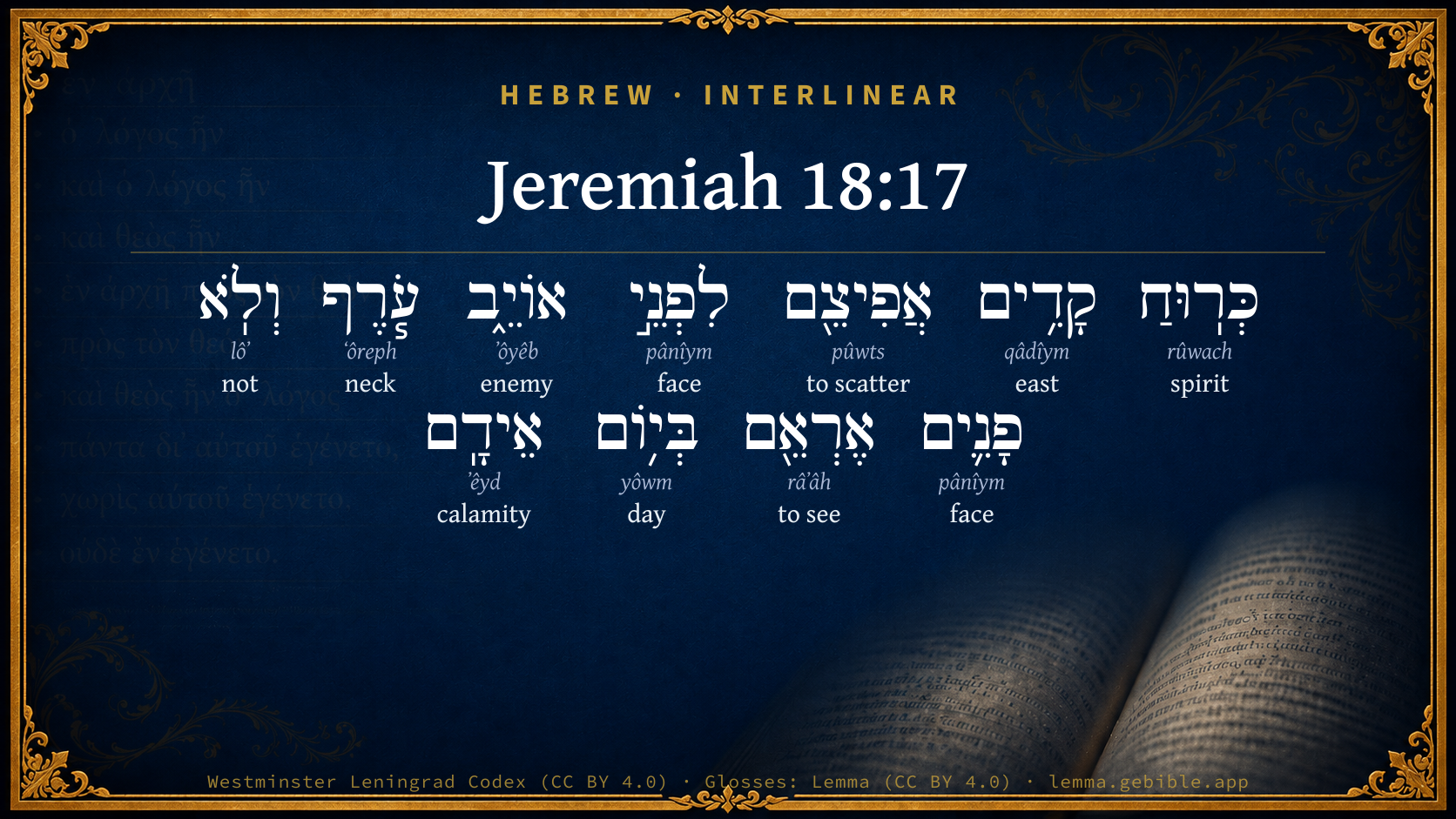
Hebrew (Westminster Leningrad Codex) Jeremiah 18:17 appears in the Hebrew Old Testament. The text above is from the Westminster Leningrad Codex. Each word links to its Strong’s number, a concise gloss, and parsing drawn from the Open Scriptures Hebrew Bible morphology. Click any word for its full Brown-Driver-Briggs (BDB) entry.
Download image
Cite this verse

Jeremiah 18:17 (World English Bible). Public Domain. Lemma interlinear Bible study tool, https://lemma.gebible.app/v/jeremiah/18/17.

Show BibTeX & RIS
BibTeX
RIS
English Translation
I will scatter them as with an east wind before the enemy; I will show them the back, and not the face, in the day of their calamity.
World English Bible · Public Domain
Download a study sheet

One document with this verse’s original text, its word-by-word gloss line, the meaning frame, cross-references with their text, attributed commentary, and full source and license credits — printable, and it pastes into notes with its structure intact.

This verse Autodidact and up

Study sheet (.html) Plain text (.txt)

A passage Seminary Student

Up to 50 verses in one chapter. A passage sheet keeps up to 6 commentary sources and 12 cross-references per verse, in the order this page ranks them, and says so on the sheet whenever that leaves anything out. Ask for a single verse and you get the Autodidact verse sheet above.

Everything on this page stays free to read, with no account — the sheet is a download of what is already on screen, not access to it.

Want to remove ads? Support Godless Engineer
Compare translations 3

The same verse in 3 English versions, stacked beneath the original-language interlinear above. Click any original word for its lexicon entry.

Each is an independent rendering of the whole verse — the interlinear is not word-aligned to these translations.

Highlighted words mark where these versions differ — a whole-verse word diff, not a word-by-word alignment.

  • World English Bible Public Domain
    I will scatter them as with an east wind before the enemy; I will show them the back, and not the face, in the day of their calamity.
  • King James Version Public Domain
    I will scatter them as with an east wind before the enemy; I will shew them the back, and not the face, in the day of their calamity.
  • unfoldingWord Literal Text CC BY-SA 4.0
    Like a wind of the east I will scatter them to the face of the enemy. The neck and not the face I will show them on the day of their calamity.”

unfoldingWord Literal Text — © unfoldingWord, licensed CC BY-SA 4.0. Word-aligned USFM3 via Door43 (git.door43.org/unfoldingWord/en_ult).

Versions to compare (up to 4)

3 of 4 selected

Show all 18 translations

Every available English version of this verse, each an independent rendering of the whole verse.

  • World English Bible Public Domain
    I will scatter them as with an east wind before the enemy; I will show them the back, and not the face, in the day of their calamity.
  • Berean Standard Bible Public Domain
    I will scatter them before the enemy like the east wind. I will show them My back and not My face in the day of their calamity.”
  • Majority Standard Bible Public Domain
    I will scatter them before the enemy like the east wind. I will show them My back and not My face in the day of their calamity.”
  • King James Version Public Domain
    I will scatter them as with an east wind before the enemy; I will shew them the back, and not the face, in the day of their calamity.
  • American Standard Version (1901) Public Domain
    I will scatter them as with an east wind before the enemy; I will show them the back, and not the face, in the day of their calamity.
  • Revised Version (1885) Public Domain
    I will scatter them as with an east wind before the enemy; I will look upon their back, and not their face, in the day of their calamity.
  • Geneva Bible (1599) Public Domain
    I will scatter them with an East winde before the enemie: I will shewe them the backe, and not the face in the day of their destruction.
  • Douay-Rheims (1899) Public Domain
    As a burning will I scatter them before the enemy: I will shew them the back, and not the face, in the day of their destruction.
  • Young's Literal Translation Public Domain
    As an east wind I scatter them before an enemy, The neck, and not the face, I shew them, In the day of their calamity.'
  • Literal Standard Version CC BY-SA 4.0
    I scatter them before an enemy as with an east wind, || I show them the neck and not the face, || In the day of their calamity.”
  • Unlocked Literal Bible CC BY-SA 4.0
    I will scatter them before their enemies like an eastern wind. I will show them my back, and not my face, on the day of their disaster.'”
  • unfoldingWord Literal Text CC BY-SA 4.0
    Like a wind of the east I will scatter them to the face of the enemy. The neck and not the face I will show them on the day of their calamity.”
  • Darby Bible Public Domain
    As with an east wind will I scatter them before the enemy; I will shew them the back, and not the face, in the day of their calamity.
  • World Messianic Bible Public Domain
    I will scatter them as with an east wind before the enemy. I will show them the back, and not the face, in the day of their calamity.
  • Webster's Bible Public Domain
    I will scatter them as with an east wind before the enemy; I will show them the back, and not the face, in the day of their calamity.
  • Free Bible Version CC BY-SA 4.0
    Like a strong wind from the east I will scatter them before the enemy. I will turn my back on them and not look at them when their time of trouble comes.
  • Bible in Basic English Public Domain
    I will send them in flight, as from an east wind, before the attacker; I will let them see my back and not my face on the day of their downfall.
  • JPS Tanakh (1917) Public Domain
    I will scatter them as with an east wind before the enemy; I will look upon their back, and not their face, in the day of their calamity.

Literal Standard Version (2020), Covenant Press — licensed CC BY-SA 4.0. Text via the HelloAO Bible API (eBible.org). Unlocked Literal Bible (unfoldingWord) — licensed CC BY-SA 4.0. Text via the HelloAO Bible API (eBible.org). unfoldingWord Literal Text — © unfoldingWord, licensed CC BY-SA 4.0. Word-aligned USFM3 via Door43 (git.door43.org/unfoldingWord/en_ult). Free Bible Version, Dr. Jonathan Gallagher — licensed CC BY-SA 4.0. Text via the HelloAO Bible API (eBible.org).

Word by word

More ways to search: Search by grammar → Find every occurrence → Compare this word →

Practice this passage: Drill this verse → Learn its vocabulary →

אֵידָֽם
ʼêyd
H343
“calamity · their”
Noun, Common, Masculine, Singular, Construct + Suffix, Personal, 3rd Person, Masculine, Plural
Part of Speech
Noun
Type
Common
Gender
Masculine
Number
Singular
State
Construct
Full BDB Definition

Origin: from the same as H181 (in the sense of bending down)

TWOT: 38c

distress, burden, calamity - burden (of the righteous) - calamity (of nation) - disaster (of wicked) - day of calamity
  1. כְּרֽוּחַ rûwach H7307 “like/as · spirit of” Preposition + Noun, Common, Both, Singular, Construct
  2. קָדִ֥ים qâdîym H6921 “east” Noun, Common, Masculine, Singular, Absolute
  3. אֲפִיצֵ֖ם pûwts H6327 “to scatter · them” Verb, Hiphil, Imperfect, 1st Person, Common, Singular + Suffix, Personal, 3rd Person, Masculine, Plural
  4. לִפְנֵ֣י pânîym H6440 “to/for · face(s) of” Preposition + Noun, Common, Both, Plural, Construct
  5. אוֹיֵ֑ב ʼôyêb H341 “enemy” Verb, Qal, Participle Active, Masculine, Singular, Absolute
  6. עֹ֧רֶף ʻôreph H6203 “neck” Noun, Common, Masculine, Singular, Absolute
  7. וְלֹֽא lôʼ H3808 “and · not” Conjunction + Particle, Negative
  8. פָנִ֛ים pânîym H6440 “face(s)” Noun, Common, Both, Plural, Absolute
  9. אֶרְאֵ֖ם râʼâh H7200 “to see · them” Verb, Qal, Imperfect, 1st Person, Common, Singular + Suffix, Personal, 3rd Person, Masculine, Plural
  10. בְּי֥וֹם yôwm H3117 “in/at · day of” Preposition + Noun, Common, Masculine, Singular, Construct

About this verse

These counts appear in no published source. They are computed here, from the morphology-tagged text and Lemma’s own curated glosses. What Lemma adds →

11
words
10
distinct lemmas
Prophets
section

Notable vocabulary

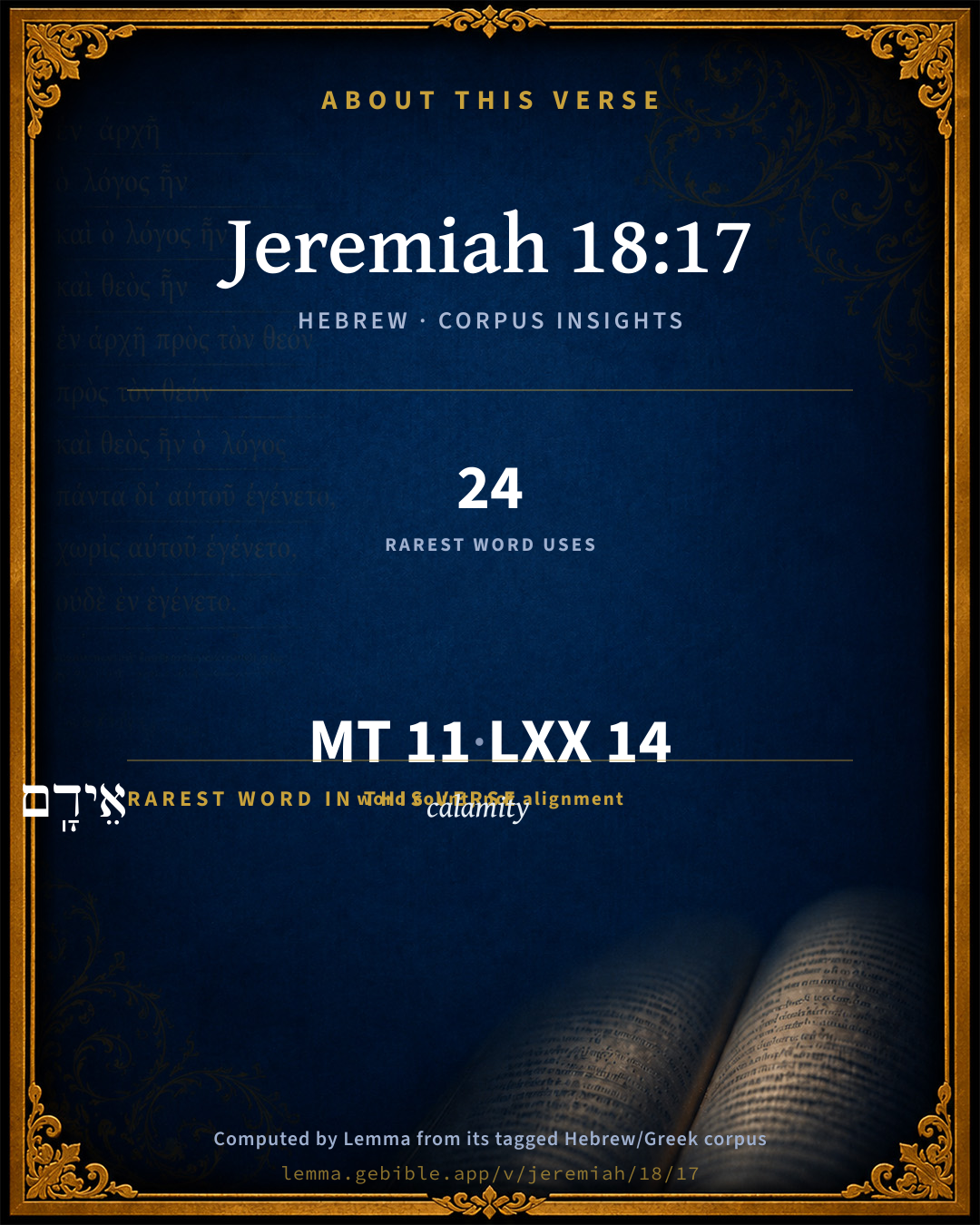
The rarest word here is אֵידָֽם calamity H343 — appearing just 24 times in the whole Hebrew Bible.

Shared distinctive vocabulary

אֵידָֽם calamity H343 occurs in 22 verses of the Hebrew Bible. Also found in:

Grammatical profile

  • 3 verbs
  • 7 nouns
  • 1 particle

Verb forms

  • אֲפִיצֵ֖ם Hiphil · Imperfect
  • אוֹיֵ֑ב Qal · Participle Active
  • אֶרְאֵ֖ם Qal · Imperfect

Repetition

A word recurs within this verse — often emphatic in Hebrew:

  • לִפְנֵ֣י face H6440 ×2

Hebrew & Septuagint length

In the original languages it is 11 Hebrew tokens and 14 Greek tokens — but the two are counted differently (Hebrew bundles its prefixes and suffixes into one token; the Greek is in lemma form), so that isn’t a like-for-like length.

Cross-references

13

Topical passages linked to Jeremiah 18:17 in the Treasury of Scripture Knowledge — connected by theme and wording, ordered by reader-vote popularity; previews shown in the World English Bible.

  • Jeremiah 13:24 Therefore will I scatter them, as the stubble that passes away, by the wind of the wilderness.
  • Jeremiah 2:27 who tell a stock, You are my father; and to a stone, You have brought me forth: for they have turned their back to me, and not their face; but in the time of their trouble they will say, Arise, and save us.
  • Job 27:21 The east wind carries him away, and he departs; It sweeps him out of his place.
  • Psalms 48:7 With the east wind, you break the ships of Tarshish.
  • Hosea 13:15 Though he is fruitful among his brothers, an east wind will come, The breath of Yahweh coming up from the wilderness; And his spring will become dry, And his fountain will be dried up. He will plunder the storehouse of treasure.
  • Jeremiah 32:33 They have turned to me the back, and not the face: and though I taught them, rising up early and teaching them, yet they have not listened to receive instruction.
  • Jeremiah 46:21 Also her hired men in the midst of her are like calves of the stall; for they also are turned back, they are fled away together, they didn't stand: for the day of their calamity is come on them, the time of their visitation.
  • Deuteronomy 28:25 Yahweh will cause you to be struck before your enemies; you shall go out one way against them, and shall flee seven ways before them: and you shall be tossed back and forth among all the kingdoms of the earth.
  • Deuteronomy 28:64 Yahweh will scatter you among all peoples, from the one end of the earth even to the other end of the earth; and there you shall serve other gods, which you have not known, you nor your fathers, even wood and stone.
  • Deuteronomy 31:17 Then my anger shall be kindled against them in that day, and I will forsake them, and I will hide my face from them, and they shall be devoured, and many evils and troubles shall come on them; so that they will say in that day, Haven't these evils come on us because our God is not among us?
  • Deuteronomy 32:35 Vengeance is mine, and recompense, At the time when their foot shall slide: For the day of their calamity is at hand, The things that are to come on them shall make haste.
  • Judges 10:13–14 Yet you have forsaken me, and served other gods: therefore I will save you no more.
  • Proverbs 7:25–26 Don't let your heart turn to her ways. Don't go astray in her paths,

Cross-references courtesy of OpenBible.info (CC BY 4.0).

Hebrew and Greek witnesses Masoretic Hebrew ↔ Greek Septuagint

The same verse in the two great witnesses to the Old Testament, shown verse-for-verse.

These are two independent witnesses, not word-aligned to each other, and the Septuagint is shown in lemma (dictionary) form.

Hebrew Jeremiah 18:17 Masoretic · Westminster Leningrad Codex

כְּרֽוּחַ קָדִ֥ים אֲפִיצֵ֖ם לִפְנֵ֣י אוֹיֵ֑ב עֹ֧רֶף וְלֹֽא פָנִ֛ים אֶרְאֵ֖ם בְּי֥וֹם אֵידָֽם

I will scatter them as with an east wind before the enemy; I will show them the back, and not the face, in the day of their calamity.

World English Bible · Public Domain

Greek LXX Structure differs

In the Septuagint, Jeremiah is about an eighth shorter than the Hebrew and arranges its material differently — the Oracles Against the Nations (Hebrew chapters 46–51) appear in the middle of the Greek book, after 25:13. Because the chapter and verse boundaries do not line up, a verse-for-verse comparison with the Hebrew is not shown.

A verse-for-verse comparison isn’t shown here because the chapters and verses don’t line up. Switch to the LXX edition with the MT / LXX toggle above to read the Greek directly.

Hebrew: Westminster Leningrad Codex (CC BY 4.0). Greek: Septuagint (public domain); English from a public-domain English Septuagint. How the Septuagint differs from the Hebrew →

Targum (Aramaic paraphrase)

1

The Targum is the ancient Jewish Aramaic paraphrase of the Hebrew Scriptures — an interpretive translation, not the Hebrew text itself. Onkelos (literal) and Pseudo-Jonathan (expansive) render the Torah, and Jonathan the Prophets. Coverage is partial: where no permissively-licensed English translation exists for a verse, only the Aramaic is shown. This is verse-level text, not a word-by-word alignment to the Hebrew.

  1. Targum Jonathan Prophets (Joshua–Malachi)
    כְּבִידוּר רוּחַ קִדוּמָא כֵּן אֲבַדְרִינוּן קֳדָם בַּעֲלֵי דְבָבֵיהוֹן קְדַל וְלָא אַפִּיל אַחְזִינוּן בְּיוֹם תְּבָרֵיהוֹן:

    (no public-domain English translation for this verse)

    Targum Jonathan — Aramaic: “Mikraot Gedolot” (public domain). English: “Sefaria Community Translation” (CC0 1.0 (public-domain dedication)); “London "Chaldee Paraphrase," 1871” (public domain). Text via Sefaria.

Commentary

Notes on Jeremiah 18:17 from classic Christian and Jewish commentators (each source and its license shown beneath its notes). The classic Christian expositions comment on the surrounding passage and are grouped to its opening verse, so a note may address several verses; the Jewish commentaries on the Tanakh (Rashi and others) are per-verse, so they appear only where the commentator wrote on this verse.

Lemma curates 59 commentaries, every one of them public domain or Creative Commons licensed, each selected and text-cleaned for this edition rather than reprinted as found. About our sources →

Trapp's Complete Commentary

John Trapp

Jer 18:17 I will scatter them as with an east wind before the enemy; I will shew them the back, and not the face, in the day of their calamity.

Ver. 17. I will scatter them.] Whirry and whirl them up and down, as chaff before the force of the enemy.

I will skew them the back, and not the face.] This was woeful, but just upon them for their unworthy dealing in like sort with the Lord. {2Ch 29:6 Jer 2:27; Jer 32:33 Eze 8:16} Every transgression and disobedience hath a just recompense of reward. {Heb 2:2}

John Trapp, A Commentary or Exposition upon All the Books of the Old and New Testament (1647–1656) — public domain. Text from a community e-Sword module.

The Biblical Illustrator

Joseph S. Exell

Jer_18:17

I win scatter them;. . . I will shew them the back.

The sinners doom

I. The cause of the evil threatened.

1. Rejecting the Divine government.

2. Guilty of idolatry.

3. Rejecting the mercy of God.

4. Conduct characterised by the greatest folly.

5. A manifestation of basest ingratitude.

II. The nature of the evil threatened.

1. God sometimes shows His back in a way of mercy (Exo_33:23; Job_25:2).

2. But this threat is expressive of Divine wrath.

3. The wrath of God is retributive.

4. A final departure.

III. The time when the evil shall be inflicted.

1. In the time of adversity.

2. In sickness.

3. When deserted by friends.

4. In old age.

5. In hour of death.

6. At last day. (Helps for the Pulpit.)

East winds

The east winds referred to by the prophets appear to be a violent form of sirocco. It was the east wind which brought the plague of locusts upon the Egyptians. It was by an east wind that the ships of Tarshish were broken (Psa_48:7), and the ships of Tyre (Eze_27:26). Jeremiah takes an east wind as the symbol of Jehovahs punishment of His people, while references to its withering and scorching properties are numerous; from the seven thin ears of wheat of Pharaohs vision in Egypt to the sultry blast which helped to afflict Jonah outside the walls of Nineveh. The east wind still breaks at times with terrific violence upon the coasts of Palestine, and the records of victims tell of tents that have been blown away by its fury. (H. B. Freeman, M. A.)

The Biblical Illustrator, edited by Joseph S. Exell (c. 1880s–1900s) — public domain. Text from a community e-Sword module.

Geneva Bible (1599)

Geneva Bible translators

I will show mine anger and not my favor toward them.

Geneva Bible (1599) marginal notes — public domain. Text via Bolls.life.

Jamieson, Fausset & Brown

Robert Jamieson, A. R. Fausset & David Brown

as with an east wind--literally, "I will scatter them, as an east wind (scatters all before it)": a most violent wind (Job 27:21; Psa 48:7; Isa 27:8). Thirty-two manuscripts read (without as), "with an east wind."

I will show them the back . . . not . . . face--just retribution: as "they turned their back unto Me . . . not their face" (Jer 2:27).

Jamieson, Fausset & Brown — Commentary Critical and Explanatory on the Whole Bible (1871) — public domain (CC PDM 1.0). Text via the HelloAO Bible API.

Adam Clarke's Commentary

Verse 17. I will scatter them as with an east wind] It is the property of this wind, almost every where, to parch up, blast, and destroy grain and trees, and even cattle and men suffer from it. Hence the old metrical proverb: -

"When the wind blows from the east,

'Tis good for neither man nor beast."

Adam Clarke's Commentary on the Bible (1810–1826) — public domain. Text from a community e-Sword/MySword module.

John Calvin's Commentaries

Though no word of comparison is expressed, if we read ב, beth, and not כ, caph, yet the Prophet employs a comparison, for God did not drive away the Jews by an eastern wind, but as the force of that wind is violent in Judea, the eastern wind often means a storm or a whirlwind, as though he had said, “As by a whirlwind or a storm will I cast them out.” I will disperse or dissipate them, he says, before the face of the enemy. He means that enemies would come to exterminate the Jews from the land; and he adds another thing, that these enemies would be full of terror, for God would give them the force of a whirlwind or a storm to disperse and scatter the Jews, for being terrified by God they would not dare to withstand.

Then follows a commination, that God would turn to them the neck, or the back, and not the face in the day of calamity. It sometimes happens that we are severely chastised by God, he thus often tries his faithful people when he subjects them to the will of the ungodly; but yet all remedy is not taken away from them, as they find consolation in God’s mercy, for as he casts down so he raises up, as he puts to death so he gives life, according to what is said in 1 Samuel 2:6. But God here denounces a punishment without any prospect of pardon or alleviation, I will scatter them, he says, as by an east wind before their enemies. Then he adds, “In vain shall they flee to me and seek my mercy, though otherwise it is offered to all, yet then they shall implore it in vain, for it is decreed not to pardon them. I will shew to them my back, (or neck, for ערף, oreph, is the hinder part of the head, but here it means the back,) they shall then find that I am turned away from them, so that they shall not be set before my eyes.” For it is an invaluable consolation when God is pleased to look on our miseries, but he deprives the Jews of this hope, for he would turn to them his back in the day of slaughter. I cannot proceed farther now.

John Calvin's Commentaries (1540-1563) — public domain. Text from the Calvin Translation Society English edition (1840s-50s) via the Christian Classics Ethereal Library (ccel.org). Calvin's coverage is partial (roughly two-thirds of the Bible); uncommented books and verses are honest gaps, never fabricated. The 19th-century editor's footnotes and remarks are omitted so the notes are faithfully Calvin's own voice.

Ellicott's Commentary for English Readers

(17) With an east wind.—MSS. vary, some giving “with” and some “as an east wind.” The difference does not much affect the meaning. The east wind blowing from the desert was the wind of storms, tempests, and parching heat (Jon_4:8; Psa_48:7; Isa_27:8). I will shew them the back, and not the face.—The figure is boldly anthropomorphic. The light of God’s countenance is the fulness of joy (Num_6:25). To turn away that light was to leave the people to the darkness of their misery. What was thus done by Jehovah was but a righteous retribution on the people who had “turned their back” and “not their face” to Him (Jer_2:27).

A Bible Commentary for English Readers, edited by Charles John Ellicott (1878–1897) — public domain. Text from a community e-Sword module.

The Cambridge Bible for Schools and Colleges

gen. ed. J. J. S. Perowne

17. as with an east wind] better, perhaps, as an east wind.

look upon … their face] mg. shew them the back, and not the face, in answer to the people’s own behaviour towards Him. See ch. Jer_2:27. They shall flee for shelter from the enemy as from the sirocco, the scorching wind in Palestine which springs suddenly from the desert in the E. or S.E. Cp. Gen_41:6 (“blasted”) and see on Amo_4:9 in C.B.

The Cambridge Bible for Schools and Colleges (gen. ed. J. J. S. Perowne; Cambridge University Press, 1878–1918) — public domain. Text from a community e-Sword module.

John Gill's Exposition

Give heed to me, O Lord,.... To his prayer, since his enemies would not give heed to his prophecies; and God does give heed to the cries and complaints of his ministers, when men will not give heed to their words and doctrines; they have a God to go to, who will hear them, when men despise them:

and hearken to the voice of them that contend with me; hear their reproaches and rantings, their blasphemies and evil speakings, their lies and falsehoods, and judge between me and them; let it appear who is in the right; vindicate my cause, and plead with them that plead against me.

John Gill's Exposition of the Whole Bible (1746–1763) — public domain (CC PDM 1.0). Text via the HelloAO Bible API.

Albert Barnes' Notes on the Bible

I will shew them the back - The hiding of God’s face is the sure sign of His displeasure Isa 1:15; Isa 59:2.

Albert Barnes' Notes on the Bible (1834–1885) — public domain. Text from a community e-Sword/MySword module.

Haydock's Catholic Bible Commentary

Burning. Hebrew kadim, "eastern," (Haydock) coming from Desert Arabia, Exodus x. 13. (Calmet) --- Back. Thus the Lord now treats the synagogue. (St. Jerome)

George Leo Haydock (1774–1849), Haydock's Catholic Family Bible and Commentary, 1859 edition — public domain. Excludes Psalms (Douay-Rheims chapter numbering differs from Protestant) and Deuterocanonical books (Catholic canon only).

Matthew Poole's English Annotations

The east wind is (or was at least in those parts) the fiercest wind. As the east wind scatters the chaff, so, saith God, I will scatter them. And when they shall be in great calamity and misery, I will not hearken to them, I will not turn my face to them, or show them my face; but I will turn my back upon them, I will not regard them crying, nor hear their prayers.

Matthew Poole's English Annotations on the Holy Bible (1683–1685) — public domain. Text from a community e-Sword/MySword module.

The Pulpit Commentary

As with an east wind. The east was a stormy wind. (Job_27:21) I wilt show them the back; as they have done to Jehovah. (Jer_2:27 Jer_32:33)

The Pulpit Commentary (1880–1919), ed. H.D.M. Spence-Jones & Joseph S. Exell — public domain. Text from a community e-Sword module.

John Wesley's Explanatory Notes

East wind - The east wind was in those parts the fiercest wind. As the east-wind scatters the chaff, so saith God, I will scatter them. In their calamity - And when they shall be in great calamity, I will turn my back upon them, I will not regard their prayers.

John Wesley, Explanatory Notes Upon the Whole Bible (1754–1765) — public domain. Text via the GEBible commentary corpus.

Rashi

Rabbi Shlomo Yitzchaki (Rashi)

upon their back and not their face when they flee from before the enemy.

I will look but I will not save them.

Rashi on the Tanakh — English translations: “The Judaica Press complete Tanach with Rashi, translated by A. J. Rosenberg” (CC BY 4.0); “Pentateuch with Rashi's commentary by M. Rosenbaum and A.M. Silbermann, 1929-1934” (public domain); “The Metsudah Tanach series, Lakewood, N.J” (CC BY 4.0); and “The Book of Joshua, Metsudah Publications, 1997” (CC BY 4.0). Text via Sefaria.

Lesson kit

Teaching starters — assembled from the data on this page, not authored interpretation. Every prompt links to the verse data it draws on. Edit before teaching.

Jeremiah, in the Prophets, opens this verse with 11 words (10 distinct Hebrew lemmas). Its most distinctive word is ʼêyd (“calamity”). A historical commentator’s framing appears above. Read the whole chapter for the surrounding context.

Discussion questions

  1. What does “calamity” (ʼêyd) contribute to the verse as a whole?
  2. Deuteronomy 32:35 shares the word «calamity» with this verse. How do the two illuminate each other?
  3. “face” occurs 2× in this one verse. What is the effect of the repetition?
  4. These translations render this verse differently. What is at stake in choosing one wording over another?
  5. The verb «אֲפִיצֵ֖ם» is Hiphil Imperfect. How does its form color the action?
  6. Reading how Trapp's Complete Commentary and The Biblical Illustrator read this verse, where do the two commentators agree and where do they part?

Things to notice

Reading settings

Reading text

Shown beneath each verse's original-language words.

Old Testament
Old Testament edition

Read the OT as the Masoretic Hebrew (MT) or the Greek Septuagint (LXX).

English shown for the Greek Septuagint (in the Hebrew ↔ Greek comparison).

Comparing translations? Open the Compare panel on any verse page to stack up to four side by side.