
Jeremiah 13:27

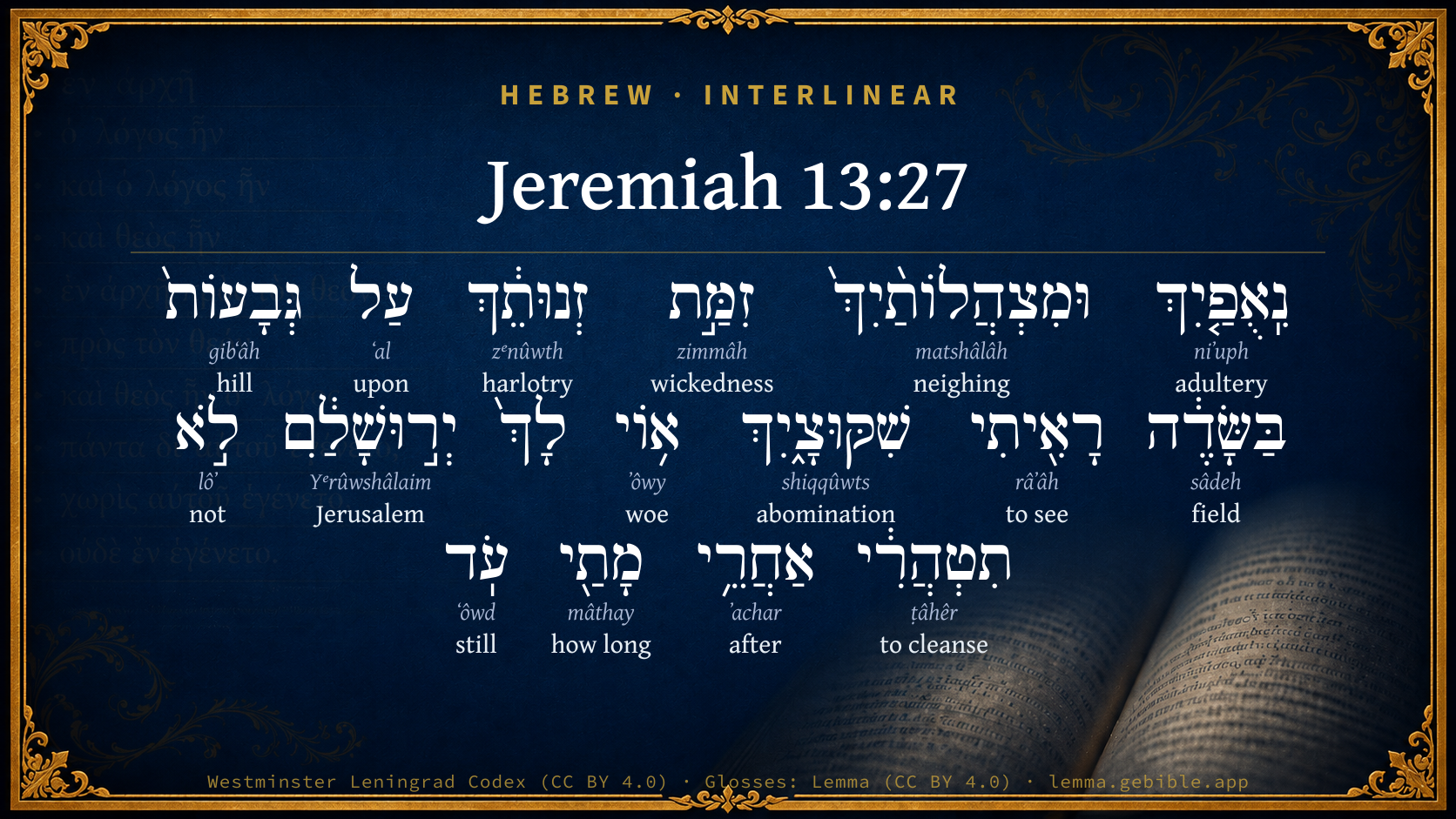
Hebrew (Westminster Leningrad Codex) Jeremiah 13:27 appears in the Hebrew Old Testament. The text above is from the Westminster Leningrad Codex. Each word links to its Strong’s number, a concise gloss, and parsing drawn from the Open Scriptures Hebrew Bible morphology. Click any word for its full Brown-Driver-Briggs (BDB) entry.
Download image
Cite this verse

Jeremiah 13:27 (World English Bible). Public Domain. Lemma interlinear Bible study tool, https://lemma.gebible.app/v/jeremiah/13/27.

Show BibTeX & RIS
BibTeX
RIS
English Translation
I have seen your abominations, even your adulteries, and your neighing, the lewdness of your prostitution, on the hills in the field. Woe to you, Jerusalem! you will not be made clean; how long shall it yet be?
World English Bible · Public Domain
Highlights
  • 1 first appearance in the Hebrew Bible
Full analysis ↓
Download a study sheet

One document with this verse’s original text, its word-by-word gloss line, the meaning frame, cross-references with their text, attributed commentary, and full source and license credits — printable, and it pastes into notes with its structure intact.

This verse Autodidact and up

Study sheet (.html) Plain text (.txt)

A passage Seminary Student

Up to 50 verses in one chapter. A passage sheet keeps up to 6 commentary sources and 12 cross-references per verse, in the order this page ranks them, and says so on the sheet whenever that leaves anything out. Ask for a single verse and you get the Autodidact verse sheet above.

Everything on this page stays free to read, with no account — the sheet is a download of what is already on screen, not access to it.

Want to remove ads? Support Godless Engineer
Compare translations 3

The same verse in 3 English versions, stacked beneath the original-language interlinear above. Click any original word for its lexicon entry.

Each is an independent rendering of the whole verse — the interlinear is not word-aligned to these translations.

Highlighted words mark where these versions differ — a whole-verse word diff, not a word-by-word alignment.

  • World English Bible Public Domain
    I have seen your abominations, even your adulteries, and your neighing, the lewdness of your prostitution, on the hills in the field. Woe to you, Jerusalem! you will not be made clean; how long shall it yet be?
  • King James Version Public Domain
    I have seen thine adulteries, and thy neighings, the lewdness of thy whoredom, and thine abominations on the hills in the fields. Woe unto thee, O Jerusalem! wilt thou not be made clean? when shall it once be?
  • unfoldingWord Literal Text CC BY-SA 4.0
    Your adulteries and your neighings, the lewdness of your harlotry, on the hills in the fields. I have seen your abominations. Woe to you, Jerusalem! How long will you not be clean?”

unfoldingWord Literal Text — © unfoldingWord, licensed CC BY-SA 4.0. Word-aligned USFM3 via Door43 (git.door43.org/unfoldingWord/en_ult).

Versions to compare (up to 4)

3 of 4 selected

Show all 18 translations

Every available English version of this verse, each an independent rendering of the whole verse.

  • World English Bible Public Domain
    I have seen your abominations, even your adulteries, and your neighing, the lewdness of your prostitution, on the hills in the field. Woe to you, Jerusalem! you will not be made clean; how long shall it yet be?
  • Berean Standard Bible Public Domain
    Your adulteries and lustful neighings, your shameless prostitution on the hills and in the fields—I have seen your detestable acts. Woe to you, O Jerusalem! How long will you remain unclean?”
  • Majority Standard Bible Public Domain
    Your adulteries and lustful neighings, your shameless prostitution on the hills and in the fields—I have seen your detestable acts. Woe to you, O Jerusalem! How long will you remain unclean?”
  • King James Version Public Domain
    I have seen thine adulteries, and thy neighings, the lewdness of thy whoredom, and thine abominations on the hills in the fields. Woe unto thee, O Jerusalem! wilt thou not be made clean? when shall it once be?
  • American Standard Version (1901) Public Domain
    I have seen thine abominations, even thine adulteries, and thy neighings, the lewdness of thy whoredom, on the hills in the field. Woe unto thee, O Jerusalem! thou wilt not be made clean; how long shall it yet be?
  • Revised Version (1885) Public Domain
    I have seen thine abominations, even thine adulteries, and thy neighings, the lewdness of thy whoredom, on the hills in the field. Woe unto thee, O Jerusalem! thou wilt not be made clean; how long shall it yet be?
  • Geneva Bible (1599) Public Domain
    I haue seene thine adulteries, and thy neiings, the filthinesse of thy whoredome on the hils in the fieldes, and thine abominations. Wo vnto thee, O Ierusalem: wilt thou not bee made cleane? when shall it once be?
  • Douay-Rheims (1899) Public Domain
    I have seen thy adulteries, and thy neighing, the wickedness of thy fornication: and thy abominations, upon the hills in the field. Woe to thee, Jerusalem, wilt thou not be made clean after me: how long yet?
  • Young's Literal Translation Public Domain
    Thine adulteries, and thy neighings, The wickedness of thy whoredom, on heights in a field, I have seen thine abominations. Wo to thee, O Jerusalem, Thou art not cleansed, after when `is it' again?
  • Literal Standard Version CC BY-SA 4.0
    Your adulteries, and your neighings, || The wickedness of your whoredom, on heights in a field, || I have seen your abominations. Woe to you, O Jerusalem, || You are not [yet] made clean—after when [will you be] again?”
  • Unlocked Literal Bible CC BY-SA 4.0
    I have seen your adultery and neighing, the wickedness of your prostitution on the hills and in the fields, and I have seen these detestable things! Woe to you, Jerusalem! How long until you are made clean again?”
  • unfoldingWord Literal Text CC BY-SA 4.0
    Your adulteries and your neighings, the lewdness of your harlotry, on the hills in the fields. I have seen your abominations. Woe to you, Jerusalem! How long will you not be clean?”
  • Darby Bible Public Domain
    Thine adulteries, and thy neighings, the lewdness of thy fornication, on the hills, in the fields, -- thine abominations, have I seen. Woe unto thee, Jerusalem! Wilt thou not be made clean? after how long a time yet?
  • World Messianic Bible Public Domain
    I have seen your abominations, even your adulteries and your neighing, the lewdness of your prostitution, on the hills in the field. Woe to you, Jerusalem! You will not be made clean. How long will it yet be?”
  • Webster's Bible Public Domain
    I have seen thy adulteries, and thy neighings, the enormity of thy lewdness, and thy abominations on the hills in the fields. Woe to thee O Jerusalem! wilt thou not be made clean? when shall it once be?
  • Free Bible Version CC BY-SA 4.0
    I watched your acts of adultery and lust, how you prostituted yourselves shamelessly, worshiping idols on the hills and in the fields. Yes, I saw the disgusting things you did. Disaster is coming to you, Jerusalem! How long are you going to remain unclean?
  • Bible in Basic English Public Domain
    I have seen your disgusting acts, even your false behaviour and your cries of desire and your loose ways on the hills in the field. Unhappy are you, O Jerusalem, you have no desire to be made clean; how long will you be in turning back to me?
  • JPS Tanakh (1917) Public Domain
    Thine adulteries, and thy neighings, the lewdness of thy harlotry, on the hills in the field have I seen thy detestable acts. Woe unto thee, O Jerusalem! thou wilt not be made clean! When shall it ever be?

Literal Standard Version (2020), Covenant Press — licensed CC BY-SA 4.0. Text via the HelloAO Bible API (eBible.org). Unlocked Literal Bible (unfoldingWord) — licensed CC BY-SA 4.0. Text via the HelloAO Bible API (eBible.org). unfoldingWord Literal Text — © unfoldingWord, licensed CC BY-SA 4.0. Word-aligned USFM3 via Door43 (git.door43.org/unfoldingWord/en_ult). Free Bible Version, Dr. Jonathan Gallagher — licensed CC BY-SA 4.0. Text via the HelloAO Bible API (eBible.org).

Word by word

More ways to search: Search by grammar → Find every occurrence → Compare this word →

Practice this passage: Drill this verse → Learn its vocabulary →

נִֽאֻפַ֤יִךְ
niʼuph
H5004
“adulteries · your”
Noun, Common, Masculine, Plural, Construct + Suffix, Personal, 2nd Person, Feminine, Singular
Part of Speech
Noun
Type
Common
Gender
Masculine
Number
Plural
State
Construct
Full BDB Definition

Origin: from H5003

TWOT: 1273a

adultery - idolatrous worship (figuratively)
  1. וּמִצְהֲלוֹתַ֨יִךְ֙ matshâlâh H4684 “and · neighings · your” Conjunction + Noun, Common, Feminine, Plural, Construct + Suffix, Personal, 2nd Person, Feminine, Singular
  2. זִמַּ֣ת zimmâh H2154 “wickedness of” Noun, Common, Feminine, Singular, Construct
  3. זְנוּתֵ֔ךְ zᵉnûwth H2184 “harlotry · your” Noun, Common, Feminine, Singular, Construct + Suffix, Personal, 2nd Person, Feminine, Singular
  4. עַל ʻal H5921 “upon” Preposition
  5. גְּבָעוֹת֙ gibʻâh H1389 “hills” Noun, Common, Feminine, Plural, Absolute
  6. בַּשָּׂדֶ֔ה sâdeh H7704 “in/at the · field” Preposition, Determined + Noun, Common, Masculine, Singular, Absolute
  7. רָאִ֖יתִי râʼâh H7200 “to see” Verb, Qal, Perfect, 1st Person, Common, Singular
  8. שִׁקּוּצָ֑יִךְ shiqqûwts H8251 “abominations · your” Noun, Common, Masculine, Plural, Construct + Suffix, Personal, 2nd Person, Feminine, Singular
  9. א֥וֹי ʼôwy H188 “woe” Particle, Interjection
  10. יְר֣וּשָׁלִַ֔ם Yᵉrûwshâlaim H3389 “Jerusalem” Noun, Proper
  11. לֹ֣א lôʼ H3808 “not” Particle, Negative
  12. תִטְהֲרִ֔י ṭâhêr H2891 “to cleanse” Verb, Qal, Imperfect, 2nd Person, Feminine, Singular
  13. אַחֲרֵ֥י ʼachar H310 “after” Preposition
  14. מָתַ֖י mâthay H4970 “how long” Particle, Interrogative
  15. עֹֽד ʻôwd H5750 “still” Adverb

About this verse

These counts appear in no published source. They are computed here, from the morphology-tagged text and Lemma’s own curated glosses. What Lemma adds →

17
words
16
distinct lemmas
Prophets
section

Notable vocabulary

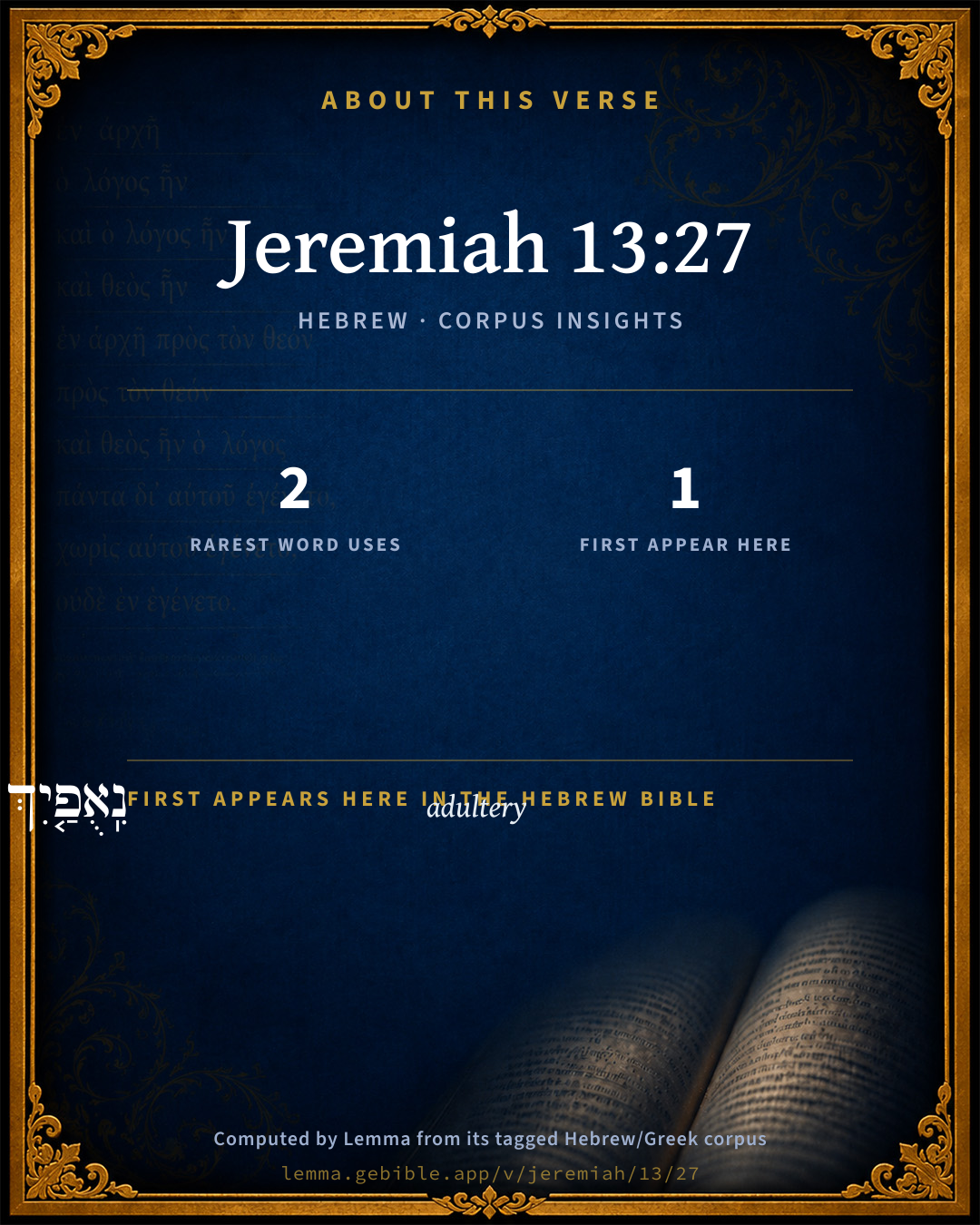
The rarest word here is נִֽאֻפַ֤יִךְ adultery H5004 — appearing just 2 times in the whole Hebrew Bible.

First appearance in Scripture

This word makes its first canonical appearance in the Hebrew Bible here:

  • נִֽאֻפַ֤יִךְ adultery H5004

Shared distinctive vocabulary

נִֽאֻפַ֤יִךְ adultery H5004 occurs in 2 verses of the Hebrew Bible. Also found in:

Grammatical profile

  • 2 verbs
  • 8 nouns
  • 3 prepositions
  • 1 adverb
  • 3 particles

Verb forms

  • רָאִ֖יתִי Qal · Perfect
  • תִטְהֲרִ֔י Qal · Imperfect

Cross-references

29

Topical passages linked to Jeremiah 13:27 in the Treasury of Scripture Knowledge — connected by theme and wording, ordered by reader-vote popularity; previews shown in the World English Bible.

  • Isaiah 65:7 your own iniquities, and the iniquities of your fathers together, says Yahweh, who have burned incense on the mountains, and blasphemed me on the hills; therefore will I first measure their work into their bosom.
  • Ezekiel 6:13 You shall know that I am Yahweh, when their slain men shall be among their idols round about their altars, on every high hill, on all the tops of the mountains, and under every green tree, and under every thick oak, the places where they offered sweet savor to all their idols.
  • Ezekiel 24:13 In your filthiness is lewdness: because I have cleansed you and you weren't cleansed, you shall not be cleansed from your filthiness any more, until I have caused my wrath toward you to rest.
  • Hosea 8:5 Let Samaria throw out his calf-idol! My anger burns against them! How long will it be before the are capable of purity?
  • Proverbs 1:22 "How long, you simple ones, will you love simplicity? How long will mockers delight themselves in mockery, And fools hate knowledge?
  • Jeremiah 2:20–24 For of old time I have broken your yoke, and burst your bonds; and you said, I will not serve; for on every high hill and under every green tree you did bow yourself, playing the prostitute.
  • Jeremiah 5:7–8 How can I pardon you? your children have forsaken me, and sworn by them that are no gods: when I had fed them to the full, they committed adultery, and assembled themselves in troops at the prostitutes' houses.
  • Ezekiel 36:37 Thus says the Lord Yahweh: For this, moreover, will I be inquired of by the house of Israel, to do it for them: I will increase them with men like a flock.
  • Hosea 4:2 There is cursing, lying, murder, stealing, and committing adultery; They break boundaries, and bloodshed causes bloodshed.
  • 2 Corinthians 7:1 Having therefore these promises, beloved, let us cleanse ourselves from all defilement of flesh and spirit, perfecting holiness in the fear of God.
  • 2 Corinthians 12:21 that again when I come my God would humble me before you, and I would mourn for many of those who have sinned before now, and not repented of the uncleanness and sexual immorality and lustfulness which they committed.
  • James 4:4 You adulterers and adulteresses, don't you know that friendship with the world is enmity with God? Whoever therefore wants to be a friend of the world makes himself an enemy of God.
  • Psalms 94:4 They pour out arrogant words. All the evil-doers boast.
  • Isaiah 57:7 On a high and lofty mountain have you set your bed; there also you went up to offer sacrifice.
  • Jeremiah 3:1–2 They say, If a man put away his wife, and she go from him, and become another man's, will he return to her again? Won't that land be greatly polluted? But you have played the prostitute with many lovers; yet return again to me, says Yahweh.
  • Jeremiah 4:13–14 Behold, he shall come up as clouds, and his chariots [shall be] as the whirlwind: his horses are swifter than eagles. Woe to us! for we are ruined.
  • Ezekiel 2:10 He spread it before me: and it was written within and without; and there were written therein lamentations, and mourning, and woe.
  • Ezekiel 16:15–22 But you did trust in your beauty, and played the prostitute because of your renown, and poured out your prostitution on everyone who passed by; his it was.
  • Ezekiel 20:28 For when I had brought them into the land, which I swore to give to them, then they saw every high hill, and every thick tree, and they offered there their sacrifices, and there they presented the provocation of their offering; there also they made their sweet savor, and they poured out there their drink-offerings.
  • Ezekiel 23:2–21 Son of man, there were two women, the daughters of one mother:
  • Ezekiel 24:6 Therefore thus says the Lord Yahweh: Woe to the bloody city, to the caldron whose rust is therein, and whose rust is not gone out of it! take out of it piece after piece; No lot is fallen on it.
  • Ezekiel 36:25 I will sprinkle clean water on you, and you shall be clean: from all your filthiness, and from all your idols, will I cleanse you.
  • Hosea 1:2 When Yahweh spoke at the first by Hosea, Yahweh said to Hosea, "Go, take for yourself a wife of prostitution and children of unfaithfulness; for the land commits great adultery against from Yahweh."
  • Zephaniah 3:1 Woe to her who is rebellious and polluted, the oppressing city!
  • Matthew 11:21 "Woe to you, Chorazin! Woe to you, Bethsaida! For if the mighty works had been done in Tyre and Sidon which were done in you, they would have repented long ago in sackcloth and ashes.
  • Revelation 8:13 I saw, and I heard an eagle, flying in mid heaven, saying with a loud voice, "Woe! Woe! Woe for those who dwell on the earth, because of the other voices of the trumpets of the three angels, who are yet to sound!"
  • Psalms 94:8 Consider, you senseless among the people; You fools, when will you be wise?
  • Jeremiah 3:6 Moreover Yahweh said to me in the days of Josiah the king, Have you seen that which backsliding Israel has done? she is gone up on every high mountain and under every green tree, and there has played the prostitute.
  • Luke 11:9–13 "I tell you, keep asking, and it will be given you. Keep seeking, and you will find. Keep knocking, and it will be opened to you.

Cross-references courtesy of OpenBible.info (CC BY 4.0).

Hebrew and Greek witnesses Masoretic Hebrew ↔ Greek Septuagint

The same verse in the two great witnesses to the Old Testament, shown verse-for-verse.

These are two independent witnesses, not word-aligned to each other, and the Septuagint is shown in lemma (dictionary) form.

Hebrew Jeremiah 13:27 Masoretic · Westminster Leningrad Codex

נִֽאֻפַ֤יִךְ וּמִצְהֲלוֹתַ֨יִךְ֙ זִמַּ֣ת זְנוּתֵ֔ךְ עַל גְּבָעוֹת֙ בַּשָּׂדֶ֔ה רָאִ֖יתִי שִׁקּוּצָ֑יִךְ א֥וֹי לָךְ֙ יְר֣וּשָׁלִַ֔ם לֹ֣א תִטְהֲרִ֔י אַחֲרֵ֥י מָתַ֖י עֹֽד

I have seen your abominations, even your adulteries, and your neighing, the lewdness of your prostitution, on the hills in the field. Woe to you, Jerusalem! you will not be made clean; how long shall it yet be?

World English Bible · Public Domain

Greek LXX Structure differs

In the Septuagint, Jeremiah is about an eighth shorter than the Hebrew and arranges its material differently — the Oracles Against the Nations (Hebrew chapters 46–51) appear in the middle of the Greek book, after 25:13. Because the chapter and verse boundaries do not line up, a verse-for-verse comparison with the Hebrew is not shown.

A verse-for-verse comparison isn’t shown here because the chapters and verses don’t line up. Switch to the LXX edition with the MT / LXX toggle above to read the Greek directly.

Hebrew: Westminster Leningrad Codex (CC BY 4.0). Greek: Septuagint (public domain); English from a public-domain English Septuagint. How the Septuagint differs from the Hebrew →

Targum (Aramaic paraphrase)

1

The Targum is the ancient Jewish Aramaic paraphrase of the Hebrew Scriptures — an interpretive translation, not the Hebrew text itself. Onkelos (literal) and Pseudo-Jonathan (expansive) render the Torah, and Jonathan the Prophets. Coverage is partial: where no permissively-licensed English translation exists for a verse, only the Aramaic is shown. This is verse-level text, not a word-by-word alignment to the Hebrew.

  1. Targum Jonathan Prophets (Joshua–Malachi)
    טַפְּשׁוּתִיךְ וּשְׁטוּתִיךְ וַעֲצַת חֶטְאֵי יַנְקוּתִיךְ עַל רָמָתָא בְּחַקְלָא גְלֵי קָדָמַי שִׁקוּצִיךְ וַי לִיךְ יְרוּשְׁלֵם לָא תִדְכִּין עַד כְּעַן לִיךְ אַרְכָא יוֹמִין סַגִיאִין:

    (no public-domain English translation for this verse)

    Targum Jonathan — Aramaic: “Mikraot Gedolot” (public domain). English: “Sefaria Community Translation” (CC0 1.0 (public-domain dedication)); “London "Chaldee Paraphrase," 1871” (public domain). Text via Sefaria.

Commentary

Notes on Jeremiah 13:27 from classic Christian and Jewish commentators (each source and its license shown beneath its notes). The classic Christian expositions comment on the surrounding passage and are grouped to its opening verse, so a note may address several verses; the Jewish commentaries on the Tanakh (Rashi and others) are per-verse, so they appear only where the commentator wrote on this verse.

Lemma curates 59 commentaries, every one of them public domain or Creative Commons licensed, each selected and text-cleaned for this edition rather than reprinted as found. About our sources →

Trapp's Complete Commentary

John Trapp

Jer 13:27 I have seen thine adulteries, and thy neighings, the lewdness of thy whoredom, [and] thine abominations on the hills in the fields. Woe unto thee, O Jerusalem! wilt thou not be made clean? when [shall it] once [be]?

Ver. 27. Woe unto thee, O Jerusalem! wilt thou not be made clean?] He closeth with this emphatic and most affectionate contestation, pressing them to hearty and speedy repentance, as he had done oft before, but with little good success. The cock crowed, though Peter still denied his Master. Peter knocked still, though Rhoda opened not to him. He launched out into the deep, though he had laboured all night for nothing. So did good Jeremiah here, in obedience to God, and goodwill to his unworthy countrymen.

John Trapp, A Commentary or Exposition upon All the Books of the Old and New Testament (1647–1656) — public domain. Text from a community e-Sword module.

The Biblical Illustrator

Joseph S. Exell

Jer_13:27

O Jerusalem I wilt thou not he made clean?

The necessity of holiness

I. The question.

1. It is of great importance to be cleansed from the filth of sin, and is what should be sought after with the utmost seriousness (Eze_36:25).

2. Cleansing the heart from sin is the work of God. He that cleanses from guilt, must also cleanse us from corruption; and Christ is made unto us sanctification, as well as righteousness and redemption (Tit_3:4-6).

3. God has much at heart the sanctification of His people (Isa_48:18).

4. Our own unwillingness is the great hindrance to our sanctification. When the will is gained, the man is gained; and those who will be made clean are in part made so already.

5. Yet the obstinacy of the will shall not prevent the purposes of grace: Gods design shall be accomplished, notwithstanding all.

II. The various answers which will be made.

1. Some are willing to be delivered from the punishment of sin, but not from its power. Those who would have the former without the latter, are likely to have neither.

2. Others would be cleansed outwardly, but not inwardly. No prayers, lastings, pilgrimages, penances, nor any other external performances, can supply the want of internal holiness. The sepulchre, however painted and adorned, is but a sepulchre still.

3. Some would be made partly clean, but not wholly so.

4. Some would be made clean, but they do not like Gods way of doing it, or the means He uses for this purpose.

5. There are some who would be made clean, but it must be hereafter. Like Saint Austin, who prayed to be delivered from his easily besetting sin, but added, Not yet, Lord!

6. More awful still: some speak out and say, they will not be cleansed at all. They prefer sin and hell to holiness and heaven.

7. Put this question to the real Christian, or the truly awakened sinner, whose conscience has been filled with remorse for his past transgressions, and who has found a compliance with the call of every lust to be the severest bondage Wilt thou be made clean? Yea, Lord, says he, with all my heart! When shall it once be? This very instant, if I might have my wish. It is what I pray for, wait for, and strive after; nor can I have a moments rest till I obtain it. (B. Beddome, M. A.)

God is desirous of saving men

I. The woes which impenitent sinners have reason to expect. The punishment that awaits sinners is most tremendous. The loss of heaven is one part of it: and who shall declare how great a loss this is?

II. How unwilling God is to inflict them. He complains of mens obstinacy in rejecting the overtures of His mercy. Long has He waited to no purpose: yet still He waiteth to be gracious unto us. He stands at the door of our hearts, and knocks. Address--

1. Those who imagine that they have no need of cleansing. Let none entertain such proud conceits. The best amongst us, no less than the worst, need to be washed in the blood of Christ and be renewed by His Spirit; and without this cleansing, must inevitably perish.

2. Those who are unwilling to be cleansed.

3. Those who desire the cleansing of their souls. It is the blood of Christ alone that can cleanse from the guilt of sin; and the Spirit of Christ alone that can cleanse from the power and pollution of sin. To apply these effectually, we must embrace the promises, and rest upon them, trusting in God to accomplish them to our souls. (Theological Sketchbook.)

Soul cleansing

1. The great need of the soul.

2. The great helplessness of the soul.

3. The great grace of God.

4. The great drawback on our part.

5. The great work of the ministry.

(1) To bring home the feeling of guilt.

(2) To ask the question of the text.

(3) To direct to the cleansing fount.

(4) To urge the importance of immediate application. (W. Whale.)

Gods desire to bless the sinner

I. Mans uncleanness--

1. In heart;

2. In life;

3. In religion.

II. Gods desire that he should be clean.

III. His expostulation with s.

IV. Our refusal.

V. Gods condemnation. (H. Bonar, D. D.)

A hopeful question

It would seem as if the prophet were speaking the language of despair; but a little rearrangement of the translation will show that the prophet is really not giving up all hope: Woe unto thee, O Jerusalem! wilt thou not be made clean? Shall there not at the very end be a vital change in thee? When the day is drawing to a close shalt thou not feel the power of the Holy One, and respond to it? Shalt thou not be born as a child at eventide? So the spirit of the Bible is a spirit of hopefulness. It will not lose any man so long as it can keep hold of him. It is a mother-like book, it is a most shepherdly book, it will not let men die if they can be kept alive. Here is the Gospel appeal: Wilt thou not be made clean? Here is no urging upon Jerusalem to clean herself, to work out her own regeneration, to throw off her own skin, and to cleanse her own characteristic spots and taints and stains. These words convey an offer, point to a process, preach a Gospel. Hear the answer from the leper: Lord, if Thou wilt, Thou canst make me clean. There is a river the streams whereof receive all our diseases, and still the river flows like crystal from the throne of God. We know what the great kind sea is. It receives all the nations, gives all the empires a tonic, and yet rolls round the world an untainted blessing. The question addressed to each heart is, Wilt thou not be made clean? when shall it once be? Shall it not be at once? Shall it not be at the very end? Shall not the angels have yet to report even concerning the worst, last of men, the festers of moral creation, Behold, he prayeth! The intelligence would vibrate throughout heaven, and give a new joy to eternity. (J. Parker, D. D.)

.

The Biblical Illustrator, edited by Joseph S. Exell (c. 1880s–1900s) — public domain. Text from a community e-Sword module.

Tyndale Open Study Notes

Tyndale Open Resources

13:27 Judah’s idol worship included ritual sex acts in the fields and on the hills. The Lord wanted his people to be spiritually and sexually pure in relation to him.

Tyndale Open Study Notes — © Tyndale Open Resources, licensed CC BY-SA 4.0. Text via the HelloAO Bible API.

Geneva Bible (1599)

Geneva Bible translators

He compareth idolaters to horses inflamed after mares.

There is no place so high nor low, whereas the marks and signs of thine idolatry appear not.

Geneva Bible (1599) marginal notes — public domain. Text via Bolls.life.

Jamieson, Fausset & Brown

Robert Jamieson, A. R. Fausset & David Brown

neighings-- (Jer 5:8), image from the lust of horses; the lust after idols degrades to the level of the brute.

hills--where, as being nearer heaven, sacrifices were thought most acceptable to the gods.

wilt thou not . . . ? when--literally, "thou wilt not be made clean after how long a time yet." (So Jer 13:23). Jeremiah denies the moral possibility of one so long hardened in sin becoming soon cleansed. But see Jer 32:17; Luk 18:27.

Next: Jeremiah Chapter 14

Jamieson, Fausset & Brown — Commentary Critical and Explanatory on the Whole Bible (1871) — public domain (CC PDM 1.0). Text via the HelloAO Bible API.

Adam Clarke's Commentary

Verse 27. I have seen thine adulteries] Thy idolatries of different kinds, practised in various ways; no doubt often accompanied with gross debauchery.

Wo unto thee, O Jerusalem wilt thou not be made clean?] We see from this, that though the thing was difficult, yet it was not impossible, for these Ethiopians to change their skin, for these leopards to change their spots. It was only their obstinate refusal of the grace of God that rendered it impossible. Man cannot change himself; but he may pray to God to do it, and come to him through Christ, that he may do it. To enable him to pray and believe, the power is still at hand. If he will not use it, he must perish.

Adam Clarke's Commentary on the Bible (1810–1826) — public domain. Text from a community e-Sword/MySword module.

John Calvin's Commentaries

Here the Prophet explains at large what I have before stated, — that the people were justly punished by God, though very grievously, because they had provoked God, not at one time only, but for a long time, and had obstinately persisted in their evil courses. Moreover, as their sins were various, the Prophet does not mention them all here; for we have seen elsewhere, that they were not only given to superstitions, but also to whoredoms, drunkenness, plunders, and outrages; but here he only speaks of their superstitions, — that having rejected God, they followed their own idols. For by adulteries he no doubt means idolatries; and he does not speak here of whoredom, which yet prevailed greatly among the people; but he only condemns them for having fallen away into ungodly and false forms of worship. To the same thing must be referred what follows, thy neighings; for by this comparison, we know, is set forth elsewhere, by way of reproach, that furious ardor with which the Jews followed their own inventions. The word indeed sometimes means exultation; for the verb צהל, tsel, is to exult; but here, as in Jeremiah 5 it signifies neighing.

He then says, Thy adulteries and thy neighings, etc. Now this is far more shameful than if he had said thy lusts, for by this comparison we know their crime was enhanced, because they were not merely inflamed by a violent natural lust, such as adulterers feel towards strumpets, but they were like horses or bulls: Thy adulteries then and thy neighings; and he adds, the thought of thy whoredom, etc. The word זמת, zamet, is to be taken here for thought, and this is its proper meaning. It is indeed taken sometimes in a bad sense; but the Prophet, I have no doubt, meant here to wipe off a color with which the Jews painted themselves; for they said that they intended to worship God, while they accumulated rites which were not. prescribed in the law. The Prophet therefore condemns them here as being within full of unchastity, as though he had said, “I do not only accuse you of open acts of wickedness, but ye burn also within with lust, for impiety has taken such hold on all your thoughts, that God has no place at all in you; ye are like an unchaste woman, who thinks of nothing but of her filthy lovers, and goes after her adulterers: ye are thus wholly given up to your whoredoms.

Some read the words by themselves and put them in the nominative case, “Thy adulteries and thy neighings, and the thought of thy whoredom on the mountains;” and then they add, “In the field have I seen thine abominations.” But I prefer to take the whole together, and thus to include all as being governed by the verb ראיתי, I have seen; “Thy adulteries and thy neighings, the thought of thy whoredom on the mountains in the field have I seen, even thy abominations.” The last word is to be taken in apposition with the former words. But the Prophet introduces God here as the speaker, that the Jews might not seek evasions and excuse themselves. He therefore shews that God, whose proper office it is to examine and search the hearts of men, is the fit Judge.

He mentions hills and field. Altars, we know, were then built on hills, for they thought that God would be better worshipped in groves; and hence there was no place, no wood, and even no tree, but that they imagined there was something divine in it. This is the reason why the Prophet says, that their abominations were seen by God on the hills as well as on the plains. And he adds fields, as though he had said, that the hills did not suffice them for their false worship, by which they profaned the true worship of God, but that the level fields were filled with their abominations.

We now then perceive the meaning of what is here said, that the Jews in vain tried to escape by evasions, since God declares that he had seen them; as though he had said, “Cease to produce your excuses, for I will allow nothing of what ye may bring forward, as the whole is already well known by me.” And he declares their doings to be abominations, and also adulteries and neighings.

At length he adds, Woe to thee, Jerusalem! The Prophet here confirms what we have before observed, that the Jews had no just ground of complaint, for they had provoked God extremely. Hence the particle woe intimates that they were now justly given up to destruction. And then he says, Will they never repent? But this last part is variously explained; and I know not whether it can today be fully expounded. I will however briefly glance at the meaning.

Jerome seems to have read אחרי, achri, “after me,” “Wilt thou not then return after me?” as though God here intended to exhort the Jews to return at length to him, as he was ready to be reconciled to them. But as it is simply אחרי, achri, and he may have read without the points, I do not wish to depart from what is commonly received. There is further a difficulty in the words which follow, for interpreters vary as to the import of the words מתי עד, mati od, “how long yet?” In whatever sense we may take the words, they are sufficient to confute the opinion of Jerome, which I had forgotten to mention, because the malediction in that case would be improper and without meaning, “Woe to thee, Jerusalem, wilt thou not be made clean after me?” for what can this mean? It is therefore necessary so to read as to include all the words in the sentence, “Wilt thou not hereafter or at length be made clean?” Some, however, read the words affirmatively, “Thou shalt not be cleansed hereafter,” as though it was said, “Thou shalt not be cleansed until I first drive thee into exile.” But this meaning is too refined, as I think. I therefore take the words in their simple form, Wilt thou not at length be made clean? how long yet? as though God again reproved the hardness of the people, as indeed he did reprove it. Hence he says, “Wilt thou not at length be made clean?” for I take אחרי, achri, as meaning “at length.” Then follows an amplification, מתיעד, mati od, “how long yet?” that is, “Wilt thou never make an end? and can I not at length obtain this from thee, since I have so often exhorted thee, and since thou seest that I make no end of exhorting thee? how long yet shall thy obstinacy continue, so that I cannot subdue thee by my salutary admonitions?” This is the meaning.

John Calvin's Commentaries (1540-1563) — public domain. Text from the Calvin Translation Society English edition (1840s-50s) via the Christian Classics Ethereal Library (ccel.org). Calvin's coverage is partial (roughly two-thirds of the Bible); uncommented books and verses are honest gaps, never fabricated. The 19th-century editor's footnotes and remarks are omitted so the notes are faithfully Calvin's own voice.

Ellicott's Commentary for English Readers

(27) Thine adulteries.—The words refer primarily to the spiritual adultery of the idolatries of Judah. The “neighings,” as in Jer_2:24; Jer_5:8, express the unbridled eagerness of animal passion transferred in this passage to the spiritual sin. The “abominations on the hills” are the orgiastic rites of the worship of the high places, which are further described as “in the field” to emphasise their publicity.

Wilt thou not be made clean?—Better, thou wilt not be cleansed; after how long yet? Sad as the last words are, they in some measure soften the idea of irretrievable finality, “Will the time ever come, and if so, when?” Like the cry addressed to God, “How long, O Lord . . .” (Rev_6:10), it implies a hope, though only just short of despair.

A Bible Commentary for English Readers, edited by Charles John Ellicott (1878–1897) — public domain. Text from a community e-Sword module.

The Cambridge Bible for Schools and Colleges

gen. ed. J. J. S. Perowne

27. thou wilt not, etc.] rather, How long will it be, ere thou be made clean?

The Cambridge Bible for Schools and Colleges (gen. ed. J. J. S. Perowne; Cambridge University Press, 1878–1918) — public domain. Text from a community e-Sword module.

Albert Barnes' Notes on the Bible

And thine abominations - “Even thy abominations.” The prophet sums up the three charges against Judah, namely, spiritual adultery, inordinate eagerness after idolatry (see the note at Jer 5:7 note), and shameless participation in pagan orgies.

In the fields - “in the field,” the open, unenclosed country (see Jer 6:25; Jer 12:4).

Wilt thou not ... once be? - “Or, how long yet ere thou be made clean!” These words explain the teaching of Jer 13:23. Repentance was not an actual, but a moral impossibility, and after a long time Judah was to be cleansed. It was to return from exile penitent and forgiven.

Albert Barnes' Notes on the Bible (1834–1885) — public domain. Text from a community e-Sword/MySword module.

Haydock's Catholic Bible Commentary

Me; to serve me. (Menochius)

George Leo Haydock (1774–1849), Haydock's Catholic Family Bible and Commentary, 1859 edition — public domain. Excludes Psalms (Douay-Rheims chapter numbering differs from Protestant) and Deuterocanonical books (Catholic canon only).

Matthew Poole's English Annotations

Some think the prophet here reflects upon them for their corporal adulteries, and their madness upon them, which he compareth to the

neighings of horses; but those words

on the hills in the fields in the next clause seem to inform us that he means here only their idolatries, which are in holy writ often compared to adulteries, which are the greatest sins in their kind, the greatest violations of the marriage covenant, and provocations of persons in conjugal relation, and the only cause of lawful divorce. He concludes with pathetical interrogations, intimating that yet there was hope if they would reform; and though. giving over their case almost as desperate, and not knowing what would not be, yet he leaves no means untried, but asks them if it was not yet time, or when such a thing might be hoped for at their hands.

Matthew Poole's English Annotations on the Holy Bible (1683–1685) — public domain. Text from a community e-Sword/MySword module.

The Pulpit Commentary

I have seen, etc. The Hebrew is again more forcible than the English. It runs, "Thine adulteries and thy neighings," etc. l (this is an exclamation as it were; then more reflectively)," I have seen thine abominations." Neighings; i.e. passionate craving for illegitimate objects of worship. (comp. Jer_2:24, 25 5:8) In the fields. The Hebrew has the singular. The "field," as usual, means the open country. Wilt thou not, etc.? rather, How long ere thou be made clean? In Ver. 23 the prophet had vehemently declared his people to be incorrigible. But, like the tender Hoses, he cannot continue to hold such gloomy thoughts; surely Israel, God"s people, must eventually be "made clean!" But this can only be as the result of judicial affliction, and these afflictions will be no slight or transient ones.

The one thing needful.

"Wilt thou not be made clean? When," etc.?

I MEN ARE SPIRITUALLY UNCLEAN. Like as the Lord looked down upon the occupants of the porches at Bethesda, and saw but a multitude of impotent folk (John 5); so now, as "his eyes behold the children of men," he sees a similar though a far more terrible sight the mass of mankind spiritually diseased. This is manifestly true of the heathen world. The abominations and the cruelties that are practiced there show the virulence of the soul"s malady amongst them. And if we look at the mass of those who profess and call themselves Christians, in how many of these is the profession only, a veneer of religious customs covering a corrupt and sin-loving heart. And if it be so with the professing Church, what must it be with those who reject all the means of grace which the Christian Church enjoys?

II BUT GOD GREATLY DESIRES THAT MEN SHOULD BE DELIVERED FROM THIS UNCLEANNESS. "He will have all men to be saved and to come to the knowledge of the truth." He desires this:

1. From his very nature. He himself is the most holy God. But all moral qualities ever strive to reproduce themselves in those around them. Let a man be characterized by orderliness, truthfulness, sobriety, purity, and in proportion as he is so the contact of those of opposite character will be painful to him, and he will endeavor to make them like himself. And so, because "good and upright is the Lord, therefore will he teach sinners in the way.

2. His righteousness also. The sense of outrage and wrong which sin must produce in the heart of God makes him angry with the wicked every day.

3. His compassion. Sin is sorrow. We wonder at the priests of Baal persisting in cutting and wounding themselves. But is not every sinner just such a one? And with this added sorrow that their wounds are for eternity, and not for the short lira here alone. On the other hand, to be "made whole" spiritually is to be made blessed forever.

III YET MEN WILL NOT. The tone of the question, the woe which precedes it, the comparison of the sinner with the Ethiopian and the leopard, etc. (Ver. 23), the half-despairing cry, "When shall it once be?" (Ver. 27), all this shows the prophet"s conviction of man"s persistent clinging to his sin. Were the question concerning bodily disease, it would be unnecessary. Who would not be delivered from that? But when it is spiritual healing, men will not. From the consequences of their sin they are willing to be delivered the punishment, the remorse, the shame, etc. but not from the sin itself. True, at times, in the first keen pangs of remorse, and under the vivid sense of shame, they would be willing then to be rid of the sin itself. But their return to their sin shows how momentary and superficial this feeling was. And men would be willing, perhaps, if by some one act the whole cure could be effected; if the being made whole was not so slow, so difficult, so self-denying a process. And, in fact, they do hope that by some one act a death-bed repentance the whole process will be accomplished.

IV BUT WITHOUT MAN"S OWN CONSENT HE CANNOT BE MADE WHOLE. God does not by a mere act of power make a man spiritually whole, as he makes one tree an oak, another an elm. The will must consent. We have this awful power of compelling Christ to "stand at the door and knock;" for the door of our hearts is opened from the inside. We must undo the bolts and remove the bars. No view of the Holy Sprat s influence which contradicts this can be a true view. We can, and alas! do, say "No" to God. But also we can, and he is ever pleading with us to, say "Yes" to his call.

V BUT ONE DAY IT SHALL BE GIVEN. My people shall be willing in the day of my power." Christ wept over Jerusalem, but yet he told them that when next he came they should say, "Blessed be he that cometh in the Name of the Lord; el. also the predicted repentance of the Jews, "They also which pierced him," etc.. (Zec 14) But oh, what "everlasting burnings," what awful scourgings, has Jerusalem had to go through before, like the prodigal, she came to herself! Let none abuse this doctrine. If we will say "Yes" to God now, and come to Christ in loving self-surrender, we shall find his yoke easy and his burden light; but if we will say "No," then we shall have to come to ourselves; and what may not that involve? Truly, "now is the accepted time," etc. C.

The Pulpit Commentary (1880–1919), ed. H.D.M. Spence-Jones & Joseph S. Exell — public domain. Text from a community e-Sword module.

John Wesley's Explanatory Notes

Thy whoredom - Thy idolatries.

John Wesley, Explanatory Notes Upon the Whole Bible (1754–1765) — public domain. Text via the GEBible commentary corpus.

Rashi

Rabbi Shlomo Yitzchaki (Rashi)

your neighings like the neighing of adulterous horses.

After when will you ever become purified?

Rashi on the Tanakh — English translations: “The Judaica Press complete Tanach with Rashi, translated by A. J. Rosenberg” (CC BY 4.0); “Pentateuch with Rashi's commentary by M. Rosenbaum and A.M. Silbermann, 1929-1934” (public domain); “The Metsudah Tanach series, Lakewood, N.J” (CC BY 4.0); and “The Book of Joshua, Metsudah Publications, 1997” (CC BY 4.0). Text via Sefaria.

Lesson kit

Teaching starters — assembled from the data on this page, not authored interpretation. Every prompt links to the verse data it draws on. Edit before teaching.

Jeremiah, in the Prophets, opens this verse with 17 words (16 distinct Hebrew lemmas). Its most distinctive word is niʼuph (“adultery”). A historical commentator’s framing appears above. Read the whole chapter for the surrounding context.

Discussion questions

  1. What does “adultery” (niʼuph) contribute to the verse as a whole?
  2. The word “adultery” first appears here in Scripture. What is being introduced at this debut?
  3. Ezekiel 23:43 shares the word «adultery» with this verse. How do the two illuminate each other?
  4. These translations render this verse differently; the difference is in the English rendering, not the original. What questions does that raise?
  5. The verb «רָאִ֖יתִי» is Qal Perfect. How does its form color the action?
  6. Reading how Trapp's Complete Commentary and The Biblical Illustrator read this verse, where do the two commentators agree and where do they part?

Things to notice

Reading settings

Reading text

Shown beneath each verse's original-language words.

Old Testament
Old Testament edition

Read the OT as the Masoretic Hebrew (MT) or the Greek Septuagint (LXX).

English shown for the Greek Septuagint (in the Hebrew ↔ Greek comparison).

Comparing translations? Open the Compare panel on any verse page to stack up to four side by side.