Jeremiah 23:13

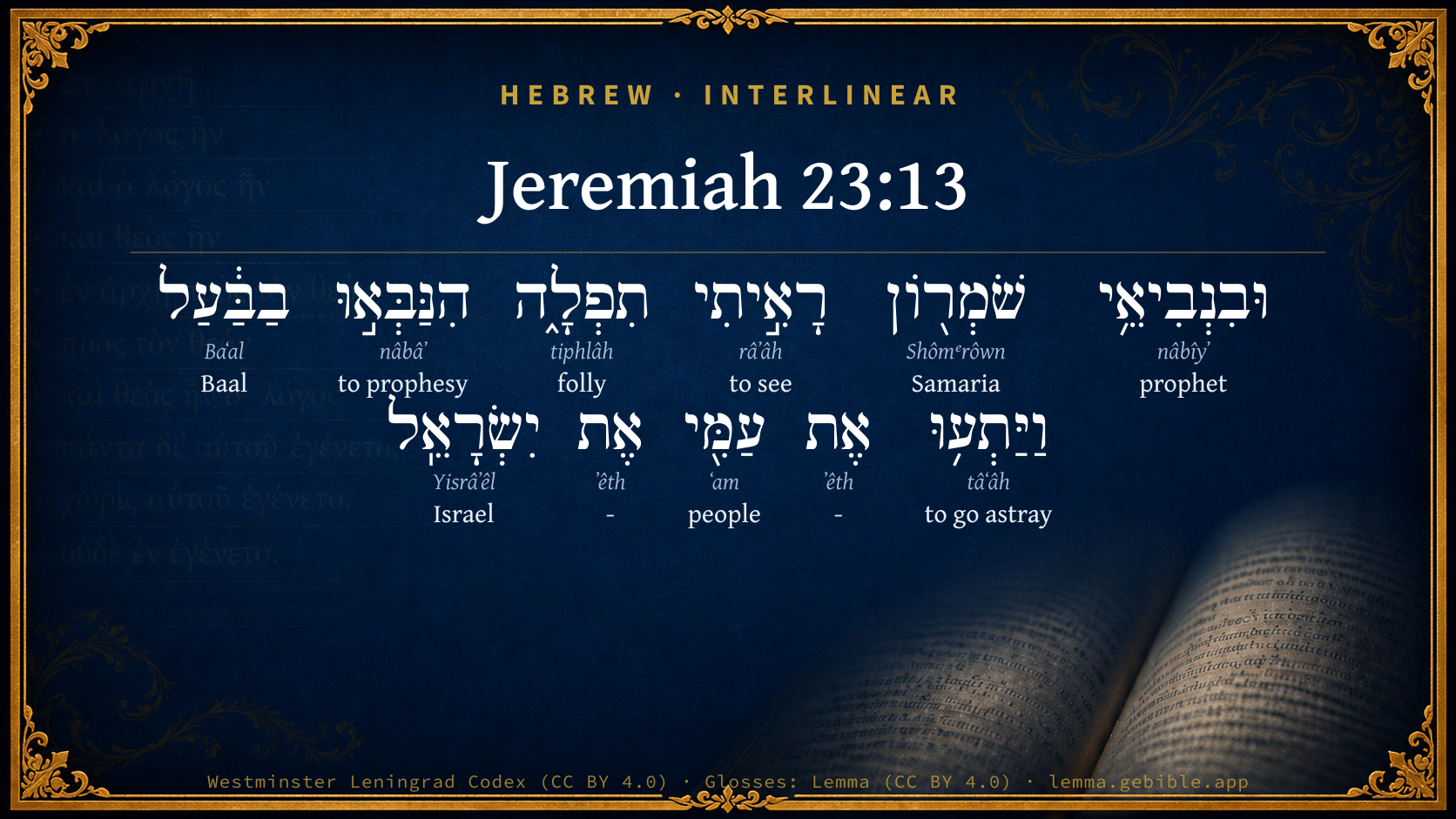
Hebrew (Westminster Leningrad Codex) Jeremiah 23:13 appears in the Hebrew Old Testament. The text above is from the Westminster Leningrad Codex. Each word links to its Strong’s number, a concise gloss, and parsing drawn from the Open Scriptures Hebrew Bible morphology. Click any word for its full Brown-Driver-Briggs (BDB) entry.
Download image
Cite this verse

Jeremiah 23:13 (World English Bible). Public Domain. Lemma interlinear Bible study tool, https://lemma.gebible.app/v/jeremiah/23/13.

Show BibTeX & RIS
BibTeX
RIS
English Translation
I have seen folly in the prophets of Samaria; they prophesied by Baal, and caused my people Israel to err.
World English Bible · Public Domain
Download a study sheet

One document with this verse’s original text, its word-by-word gloss line, the meaning frame, cross-references with their text, attributed commentary, and full source and license credits — printable, and it pastes into notes with its structure intact.

This verse Autodidact and up

Study sheet (.html) Plain text (.txt)

A passage Seminary Student

Up to 50 verses in one chapter. A passage sheet keeps up to 6 commentary sources and 12 cross-references per verse, in the order this page ranks them, and says so on the sheet whenever that leaves anything out. Ask for a single verse and you get the Autodidact verse sheet above.

Everything on this page stays free to read, with no account — the sheet is a download of what is already on screen, not access to it.

Want to remove ads? Support Godless Engineer
Compare translations 3

The same verse in 3 English versions, stacked beneath the original-language interlinear above. Click any original word for its lexicon entry.

Each is an independent rendering of the whole verse — the interlinear is not word-aligned to these translations.

Highlighted words mark where these versions differ — a whole-verse word diff, not a word-by-word alignment.

  • World English Bible Public Domain
    I have seen folly in the prophets of Samaria; they prophesied by Baal, and caused my people Israel to err.
  • King James Version Public Domain
    And I have seen folly in the prophets of Samaria; they prophesied in Baal, and caused my people Israel to err.
  • unfoldingWord Literal Text CC BY-SA 4.0
    “And among the prophets of Samaria I saw an impropriety: they prophesied by Baal and led my people Israel astray.

unfoldingWord Literal Text — © unfoldingWord, licensed CC BY-SA 4.0. Word-aligned USFM3 via Door43 (git.door43.org/unfoldingWord/en_ult).

Versions to compare (up to 4)

3 of 4 selected

Show all 18 translations

Every available English version of this verse, each an independent rendering of the whole verse.

  • World English Bible Public Domain
    I have seen folly in the prophets of Samaria; they prophesied by Baal, and caused my people Israel to err.
  • Berean Standard Bible Public Domain
    “Among the prophets of Samaria I saw an offensive thing: They prophesied by Baal and led My people Israel astray.
  • Majority Standard Bible Public Domain
    “Among the prophets of Samaria I saw an offensive thing: They prophesied by Baal and led My people Israel astray.
  • King James Version Public Domain
    And I have seen folly in the prophets of Samaria; they prophesied in Baal, and caused my people Israel to err.
  • American Standard Version (1901) Public Domain
    And I have seen folly in the prophets of Samaria; they prophesied by Baal, and caused my people Israel to err.
  • Revised Version (1885) Public Domain
    And I have seen folly in the prophets of Samaria; they prophesied by Baal, and caused my people Israel to err.
  • Geneva Bible (1599) Public Domain
    And I haue seene foolishnesse in the prophets of Samaria, that prophecied in Baal, and caused my people Israel to erre.
  • Douay-Rheims (1899) Public Domain
    And I have seen folly in the prophets of Samaria: they prophesied in Baal, and deceived my people Israel.
  • Young's Literal Translation Public Domain
    And in prophets of Samaria I have seen folly, They have prophesied by Baal, And cause my people -- Israel -- to err.
  • Literal Standard Version CC BY-SA 4.0
    “And I have seen folly in prophets of Samaria, || They have prophesied by Ba‘al, || And cause My people—Israel—to err.
  • Unlocked Literal Bible CC BY-SA 4.0
    For I have seen the prophets in Samaria doing what is repulsive: They prophesied by Baal and led my people Israel astray.
  • unfoldingWord Literal Text CC BY-SA 4.0
    “And among the prophets of Samaria I saw an impropriety: they prophesied by Baal and led my people Israel astray.
  • Darby Bible Public Domain
    And I have seen folly in the prophets of Samaria: they prophesied by Baal, and caused my people Israel to err.
  • World Messianic Bible Public Domain
    “I have seen folly in the prophets of Samaria. They prophesied by Baal, and caused my people Israel to err.
  • Webster's Bible Public Domain
    And I have seen folly in the prophets of Samaria; they prophesied in Baal, and caused my people Israel to err.
  • Free Bible Version CC BY-SA 4.0
    I saw the prophets of Samaria doing something really offensive: They prophesied in the name of Baal and led my people Israel to sin.
  • Bible in Basic English Public Domain
    And I have seen ways without sense in the prophets of Samaria; they became prophets of the Baal, causing my people Israel to go wrong.
  • JPS Tanakh (1917) Public Domain
    And I have seen unseemliness in the prophets of Samaria: they prophesied by Baal, and caused My people Israel to err.

Literal Standard Version (2020), Covenant Press — licensed CC BY-SA 4.0. Text via the HelloAO Bible API (eBible.org). Unlocked Literal Bible (unfoldingWord) — licensed CC BY-SA 4.0. Text via the HelloAO Bible API (eBible.org). unfoldingWord Literal Text — © unfoldingWord, licensed CC BY-SA 4.0. Word-aligned USFM3 via Door43 (git.door43.org/unfoldingWord/en_ult). Free Bible Version, Dr. Jonathan Gallagher — licensed CC BY-SA 4.0. Text via the HelloAO Bible API (eBible.org).

Word by word

More ways to search: Search by grammar → Find every occurrence → Compare this word →

Practice this passage: Drill this verse → Learn its vocabulary →

תִפְלָ֑ה
tiphlâh
H8604
“folly”
Noun, Common, Feminine, Singular, Absolute
Part of Speech
Noun
Type
Common
Gender
Feminine
Number
Singular
State
Absolute
Full BDB Definition

Origin: from the same as H8602

TWOT: 2534b

that which is empty, folly, silly, foolish - (BDB) unsavouriness, unseemliness (moral)
  1. וּבִנְבִיאֵ֥י nâbîyʼ H5030 “and · in/at · prophets of” Conjunction + Preposition + Noun, Common, Masculine, Plural, Construct
  2. שֹׁמְר֖וֹן Shômᵉrôwn H8111 “Samaria” Noun, Proper
  3. רָאִ֣יתִי râʼâh H7200 “to see” Verb, Qal, Perfect, 1st Person, Common, Singular
  4. הִנַּבְּא֣וּ nâbâʼ H5012 “to prophesy” Verb, Hithpael, Perfect, 3rd Person, Common, Plural
  5. בַבַּ֔עַל Baʻal H1168 “in/at the · Baal” Preposition, Determined + Noun, Proper
  6. וַיַּתְע֥וּ tâʻâh H8582 “and · to go astray” Conjunction + Verb, Hiphil, Sequential Imperfect, 3rd Person, Masculine, Plural
  7. אֶת ʼêth H853 “-” Particle, Direct Object
  8. עַמִּ֖י ʻam H5971 “people · my” Noun, Common, Masculine, Singular, Construct + Suffix, Personal, 1st Person, Common, Singular
  9. אֶת ʼêth H853 “-” Particle, Direct Object
  10. יִשְׂרָאֵֽל Yisrâʼêl H3478 “Israel” Noun, Proper

About this verse

These counts appear in no published source. They are computed here, from the morphology-tagged text and Lemma’s own curated glosses. What Lemma adds →

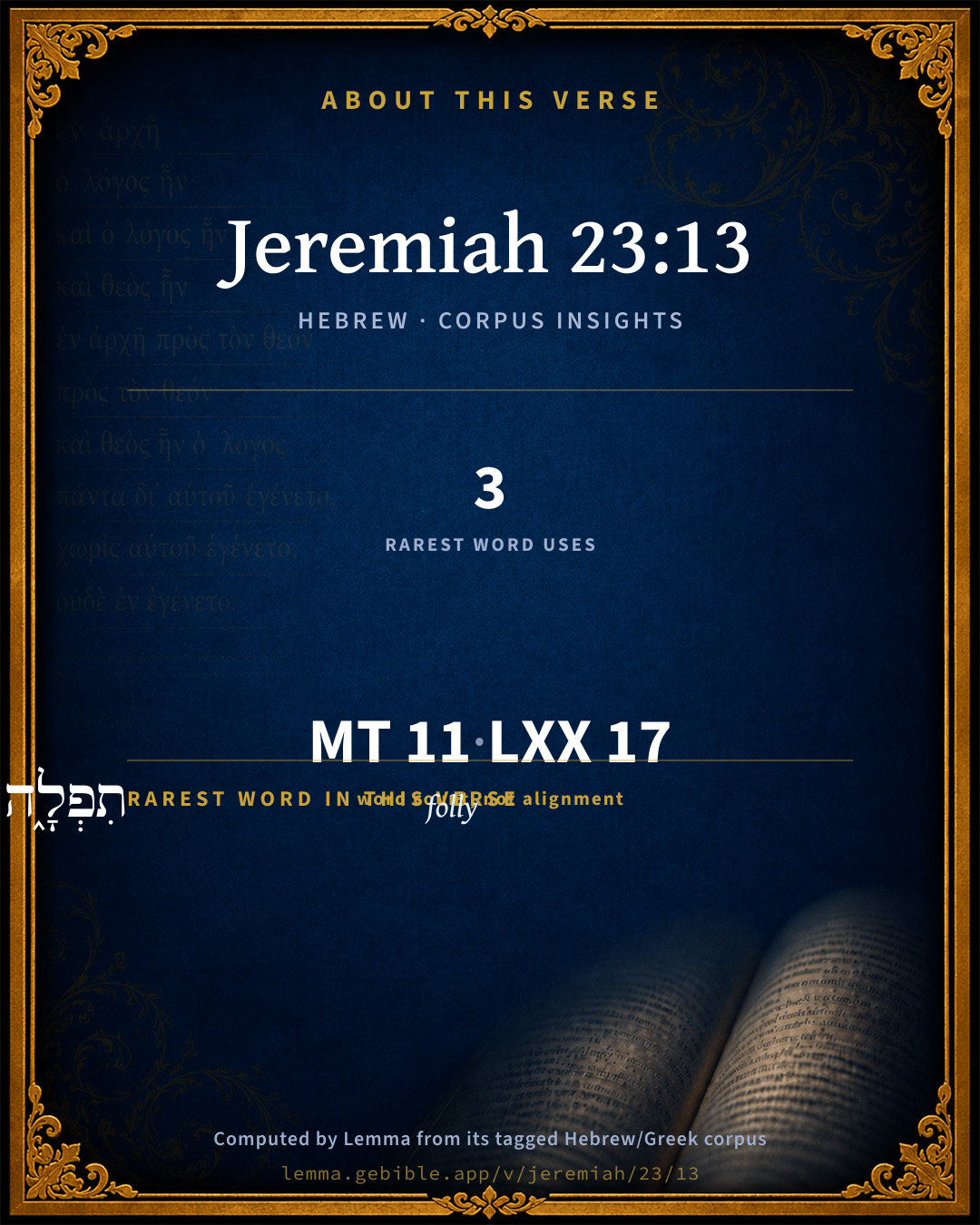
11
words
10
distinct lemmas
Prophets
section

Notable vocabulary

The rarest word here is תִפְלָ֑ה folly H8604 — appearing just 3 times in the whole Hebrew Bible.

Shared distinctive vocabulary

תִפְלָ֑ה folly H8604 occurs in 3 verses of the Hebrew Bible. Also found in:

Grammatical profile

  • 3 verbs
  • 6 nouns
  • 2 particles

Verb forms

  • רָאִ֣יתִי Qal · Perfect
  • הִנַּבְּא֣וּ Hithpael · Perfect
  • וַיַּתְע֥וּ Hiphil · Sequential Imperfect

Hebrew & Septuagint length

In the original languages it is 11 Hebrew tokens and 17 Greek tokens — but the two are counted differently (Hebrew bundles its prefixes and suffixes into one token; the Greek is in lemma form), so that isn’t a like-for-like length.

Cross-references

7

Topical passages linked to Jeremiah 23:13 in the Treasury of Scripture Knowledge — connected by theme and wording, ordered by reader-vote popularity; previews shown in the World English Bible.

  • Isaiah 9:16 For those who lead this people cause them to err; and those who are led of them are destroyed.
  • Jeremiah 2:8 The priests didn't say, Where is Yahweh? and those who handle the law didn't know me: the rulers also transgressed against me, and the prophets prophesied by Baal, and walked after things that do not profit.
  • 1 Kings 18:18–21 He answered, I have not troubled Israel; but you, and your father's house, in that you have forsaken the commandments of Yahweh, and you have followed the Baals.
  • Hosea 9:7–8 The days of visitation have come. The days of reckoning have come. Israel will consider the prophet to be a fool, And the man who is inspired to be insane, Because of the abundance of your sins, And because your hostility is great.
  • 2 Chronicles 33:9 Manasseh seduced Judah and the inhabitants of Jerusalem, so that they did evil more than did the nations whom Yahweh destroyed before the children of Israel.
  • 1 Kings 18:25–28 Elijah said to the prophets of Baal, "Choose one bull for yourselves, and dress it first; for you are many; and call on the name of your god, but put no fire under it."
  • 1 Kings 18:40 and Elijah said to them, Take the prophets of Baal; don't let one of them escape. They took them; and Elijah brought them down to the brook Kishon, and killed them there.

Cross-references courtesy of OpenBible.info (CC BY 4.0).

Hebrew and Greek witnesses Masoretic Hebrew ↔ Greek Septuagint

The same verse in the two great witnesses to the Old Testament, shown verse-for-verse.

These are two independent witnesses, not word-aligned to each other, and the Septuagint is shown in lemma (dictionary) form.

Hebrew Jeremiah 23:13 Masoretic · Westminster Leningrad Codex

וּבִנְבִיאֵ֥י שֹׁמְר֖וֹן רָאִ֣יתִי תִפְלָ֑ה הִנַּבְּא֣וּ בַבַּ֔עַל וַיַּתְע֥וּ אֶת עַמִּ֖י אֶת יִשְׂרָאֵֽל

I have seen folly in the prophets of Samaria; they prophesied by Baal, and caused my people Israel to err.

World English Bible · Public Domain

Greek LXX Structure differs

In the Septuagint, Jeremiah is about an eighth shorter than the Hebrew and arranges its material differently — the Oracles Against the Nations (Hebrew chapters 46–51) appear in the middle of the Greek book, after 25:13. Because the chapter and verse boundaries do not line up, a verse-for-verse comparison with the Hebrew is not shown.

A verse-for-verse comparison isn’t shown here because the chapters and verses don’t line up. Switch to the LXX edition with the MT / LXX toggle above to read the Greek directly.

On this verse, Joseph Benson's Commentary discusses the Septuagint’s reading. Read the note in Commentary ↓

Hebrew: Westminster Leningrad Codex (CC BY 4.0). Greek: Septuagint (public domain); English from a public-domain English Septuagint. How the Septuagint differs from the Hebrew →

Targum (Aramaic paraphrase)

1

The Targum is the ancient Jewish Aramaic paraphrase of the Hebrew Scriptures — an interpretive translation, not the Hebrew text itself. Onkelos (literal) and Pseudo-Jonathan (expansive) render the Torah, and Jonathan the Prophets. Coverage is partial: where no permissively-licensed English translation exists for a verse, only the Aramaic is shown. This is verse-level text, not a word-by-word alignment to the Hebrew.

  1. Targum Jonathan Prophets (Joshua–Malachi)
    וּבִנְבִיֵי שֹׁמְרוֹן חֲזֵיתִי רְשַׁע מִתְנַבָּן בְּשׁוּם טַעֲוָתָא וּמַטְעַן יַת עַמִי יַת יִשְׂרָאֵל:

    (no public-domain English translation for this verse)

    Targum Jonathan — Aramaic: “Mikraot Gedolot” (public domain). English: “Sefaria Community Translation” (CC0 1.0 (public-domain dedication)); “London "Chaldee Paraphrase," 1871” (public domain). Text via Sefaria.

Commentary

Notes on Jeremiah 23:13 from classic Christian and Jewish commentators (each source and its license shown beneath its notes). The classic Christian expositions comment on the surrounding passage and are grouped to its opening verse, so a note may address several verses; the Jewish commentaries on the Tanakh (Rashi and others) are per-verse, so they appear only where the commentator wrote on this verse.

Lemma curates 59 commentaries, every one of them public domain or Creative Commons licensed, each selected and text-cleaned for this edition rather than reprinted as found. About our sources →

Trapp's Complete Commentary

John Trapp

Jer 23:13 And I have seen folly in the prophets of Samaria; they prophesied in Baal, and caused my people Israel to err.

Ver. 13. And I have seen folly.] Heb., Insalsity. Folly is as unpleasant to the intelligent as unsavoury meat is to him that tasteth it.

They prophesied in Baal, and caused my people Israel to err.] They sold poison to the people, as Laertius {a} saith Aristotle did - Epicurus is his witness - having first wasted his estate.

{a} Lib. x. in Epic

John Trapp, A Commentary or Exposition upon All the Books of the Old and New Testament (1647–1656) — public domain. Text from a community e-Sword module.

Joseph Benson's Commentary

Jer 23:13-14. I have seen — Rather, I saw, namely, formerly, before I cast them out of their own land; folly — Hebrew, תפלה, stupidity, infatuation. The LXX. render it, ανομηματα, iniquities, or unlawful actions, and the Vulgate, fatuitatem, sottishness; in the prophets of Samaria — That is, in those that belonged to the ten tribes, whose chief city was Samaria. They prophesied in Baal — Pretending they had their relations from Baal, they caused the people of that kingdom to err — That is, they seduced them from the worship and service of the true God to idolatry. I have seen also in the prophets of Jerusalem a horrible thing — Hebrew, שׁערורה, a thing to be detested, an abomination. He compares the sins of the prophets of Samaria with those of the prophets of Jerusalem, and pronounces the sins of the latter to be more enormous, because they pronounced their false prophecies in the name of the true God, and pretended that he was the author of all their impostures: the wickedness of their lives also reflected great dishonour upon his name and religion. Compare Jer 3:11. They commit adultery — See Jer 29:23. And walk in lies — Utter what they themselves have feigned, and call their inventions divine visions, and use all manner of deceit and fraud. They strengthen also the hands of evil-doers — They confirm men in their evil ways, both by their own bad example, and by promising them peace and security, notwithstanding their wicked conduct and ungodly deeds. See Jer 23:17; and Eze 13:22. They are all of them unto me as Sodom — See Deu 32:32; Isa 1:10; Eze 16:46-48.

Joseph Benson's Commentary on the Old and New Testaments (1811–1818) — public domain. Text from a community e-Sword module.

Tyndale Open Study Notes

Tyndale Open Resources

23:13-14 Samaria, the capital of the northern kingdom of Israel, had been dominated by Baal worship supported by the government prophets (1 Kgs 18:19; see also Jer 16:12). The religious leaders of Judah were even worse. • Sodom and Gomorrah represented the worst of this kind of wickedness (Gen 18:20).

Tyndale Open Study Notes — © Tyndale Open Resources, licensed CC BY-SA 4.0. Text via the HelloAO Bible API.

Jamieson, Fausset & Brown

Robert Jamieson, A. R. Fausset & David Brown

folly--literally, "insipidity," "unsavouriness" (Job 6:6), not having the salt of godliness (Col 4:6).

in Baal--in the name of Baal; in connection with his worship (see Jer 2:8).

caused . . . to err-- (Isa 9:16).

Jamieson, Fausset & Brown — Commentary Critical and Explanatory on the Whole Bible (1871) — public domain (CC PDM 1.0). Text via the HelloAO Bible API.

Adam Clarke's Commentary

Verse 13. I have seen folly in the prophets of Samaria] This was not to be wondered at, for their religion was a system of corruption.

Adam Clarke's Commentary on the Bible (1810–1826) — public domain. Text from a community e-Sword/MySword module.

John Calvin's Commentaries

These two verses are to be read together; for there is no doubt but that the Prophet here compares the false prophets, who had corrupted God’s worship in the kingdom of Israel, with those in Jerusalem who wished to appear more holy and more perfect. And he thus compares them that he might set forth those who sought to be deemed God’s faithful ministers, as being by far the worst; for he says, that he had found fatuity in the prophets of Samaria, but depravity in the prophets of Jerusalem. They are, therefore, mistaken in my judgment who take also, תפלה, tephle, as meaning depravity; for they do not consider that he here enhances by comparison their wickedness who thought themselves the best, as they say, without exception.

As to the prophets of Samaria, they had been long ago condemned; nor was there any at Jerusalem who dared openly to defend them; for they had departed from the worship of God, and had led away the people from the only true Temple and altar. They were then held at that time in the kingdom of Judah as apostates, perfidious, and unprincipled. But the kingdom of Judah still wished to be deemed pure and blameless; and the prophets, who were there, boasted that they were uncorrupt and free from every spot. The Prophet therefore says, that fatuity had been found in the prophets of Samaria, that is, in those who had corrupted the ten tribes, and vitiated there the pure worship of God; but that there was more wickedness in the prophets of Jerusalem and of the kingdom of Judah, because they were not only foolish, but also designedly subverted all religion, and allowed liberty in all kinds of wickedness, so that they carried as it were a banner in approbation of every species of iniquity. We hence see that the object of Jeremiah was to shew, that the prophets of the kingdom of Judah surpassed in impiety those very prophets whom they proudly condemned; for they were not only fatuitous and foolish, but had designedly as it were conspired against God, and had become open enemies not only to religion but to all laws.

As to the words, that he found fatuity in the prophets of Samaria, he speaks in the person of God, who is the only fit judge. And he subjoins the cause of their senselessness, because they prophesied by Baal, and made the people of Israel to go astray Had Jeremiah spoken only of these, he would no doubt have used stronger terms in describing their sin; but as he was contrasting them with those who were worse, he was satisfied with the word fatuity; as though he had said, “Were any one to consider them by themselves, they were indeed very wicked, and deserved the most severe punishment; but if they be compared with the prophets of Judah, then they must be deemed only fatuitous and sottish.” Then the copulative is to be rendered thus, “I have, indeed, seen fatuity in the prophets of Samaria;” and then differently in the following clause, “but in the prophets of Judah I have seen depravity.” It is to be read adversatively in this verse, and concessively in the former. Then in the prophets of Jerusalem have I seen depravity

John Calvin's Commentaries (1540-1563) — public domain. Text from the Calvin Translation Society English edition (1840s-50s) via the Christian Classics Ethereal Library (ccel.org). Calvin's coverage is partial (roughly two-thirds of the Bible); uncommented books and verses are honest gaps, never fabricated. The 19th-century editor's footnotes and remarks are omitted so the notes are faithfully Calvin's own voice.

Ellicott's Commentary for English Readers

(13) I have seen folly . . .—Literally, as in Job_6:6, that which is unsavoury—i.e., insipid, and so, ethically, foolish. The guilt of the prophets of Samaria cannot be passed over, but it is noticed, as in Jer_3:6-10, only in order to compare it with the darker evils of those of Judah and Jerusalem.

They prophesied in Baal.—i.e., in the name and as if by the power of Baal. Comp. 1Ki_18:19; 1Ki_22:6-7.

A Bible Commentary for English Readers, edited by Charles John Ellicott (1878–1897) — public domain. Text from a community e-Sword module.

The Cambridge Bible for Schools and Colleges

gen. ed. J. J. S. Perowne

13. folly] lit. that which is tasteless, insipid (cp. cognate substantive in Job_6:6 rendered “that which hath no savour”), hence moral unsavouriness, unseemliness.

prophets of Samaria] They were simply idolaters, who made no secret of their belief or practice. The prophets of Jerusalem on the other hand were thoroughly immoral besides.

Baal] See on Jer_2:8.

The Cambridge Bible for Schools and Colleges (gen. ed. J. J. S. Perowne; Cambridge University Press, 1878–1918) — public domain. Text from a community e-Sword module.

John Gill's Exposition

And I have seen folly in the prophets of Samaria,.... The ten tribes of Israel, among whom, in Ahab's time there were many false prophets, Baal's prophets, even four hundred and fifty; whose "folly" the Lord had formerly taken notice of; even their idolatry and impiety for giving into which the ten tribes had been carried captive years ago. The word (r) here used signifies that which is "unsavoury": something very unsavoury in their doctrines, and in their lives; they were as salt which has lost its savour and is good for nothing; to which bad ministers are compared, Mat 5:13. These words are to be read in connection with the following, and may be rendered, "indeed I have seen folly in the prophets of Samaria"; of Israel in times past; "but I have seen in the prophets of Jerusalem" (s) that which is far worse; and therefore they must not expect to escape; or, as the Syriac version, "as I have seen in the prophets of Samaria--so have I seen in the prophets of Jerusalem", &c. so that here is a comparison run between them; and the latter are represented as worse than the former, though they were bad enough; as follows: for

they prophesied in Baal; in the name of Baal, whose prophets they were; so the Targum,

"they prophesied in the name of idols:''

or, "they prophesied by Baal", as the Septuagint version (t); they pretended to be inspired by him, and to receive their prophecies from him: or, "they prophesied concerning Baal"; what he would do for them, for those that worshipped him. The Arabic version is, "they prophesied in my name to Baal"; which seems to be foreign from the sense of the place:

and caused my people Israel to err; by following their directions and instructions, and worshipping Baal.

(r) "insulsitatem", Junius & Tremellius, Piscator, Schmidt; "intulsa", Pagninus; "insulsam rem", Munster, Vatablus; "insulsum", Montanus, Cocceius. (s) So Schmidt. (t) , Sept. "per Baalem", Schmidt. So Junius & Tremellius, Piscator.

John Gill's Exposition of the Whole Bible (1746–1763) — public domain (CC PDM 1.0). Text via the HelloAO Bible API.

Albert Barnes' Notes on the Bible

And I have seen folly ... - Rather, “Also I have seen.” The prophet contrasts the prophets of Samaria with those of Jerusalem. In the conduct of the former God saw folly (literally that which is insipid, as being unsalted). It was stupidity to prophesy by Baal, an idol.

In Baal - i. e., in the name of Baal.

Albert Barnes' Notes on the Bible (1834–1885) — public domain. Text from a community e-Sword/MySword module.

Matthew Poole's English Annotations

There was a time when I saw folly in the prophets that belonged to the ten tribes, whose chief city was Samaria. The word translated

folly signifies unsavoury, or an absurd thing. Our Saviour compareth wicked ministers to unsavoury salt, Mat 5:13, salt that is turned foolish (as the Greek word signifies). The ministers of God’s word are, or ought to be,

the salt of the earth, to season people with sound doctrine, and by the good example of a holy life; if they be corrupt in doctrine or manners, they become unsavoury, and the very worst of men. Such God says the prophets of the ten tribes were, before they were carried away captive.

They prophesied, pretending they had their instructions and revelations from Baal, and so

caused the ten tribes

to err, which after the division of the kingdom in Jeroboam’s time were called Israel, in contradistinction to the two tribes and half cleaving to the house of David, which were called Judah, after the name of their principal tribe.

Matthew Poole's English Annotations on the Holy Bible (1683–1685) — public domain. Text from a community e-Sword/MySword module.

Whedon's Commentary on the Bible

Daniel D. Whedon

13, 14. Prophets of Samaria — Here introduced to set off the greater folly of the prophets of Jerusalem. These last are represented as having come to the very climax of wickedness, even as Sodom and Gomorrah.

Daniel D. Whedon (gen. ed.), Commentary on the Old and New Testaments (1874–1909) — public domain. Text from a community e-Sword module.

The Pulpit Commentary

Vers. 13, 14. The prophets of Samaria were no doubt guilty enough, but their offences dwindled by the side of the "horrible" transgressions of those of the southern kingdom. The prophet apparently means, not only that the former, having fewer spiritual advantages, were less responsible than the latter, but also that they had not violated the moral code so conspicuously.

I have seen folly; rather, absurdity or unseemliness; literally, that which is unsavory. (comp. Job_6:6) The word occurs with a similar reference to Jehovah in Job_1:22 Job_24:12. To "prophesy by Baal" was "absurd," "unseemly," because Baal was a "non-entity" (Isaiah"s word for an idol). In Baal; rather, by, or by means of, Baal. (see on Jer_2:8)

The Pulpit Commentary (1880–1919), ed. H.D.M. Spence-Jones & Joseph S. Exell — public domain. Text from a community e-Sword module.

John Wesley's Explanatory Notes

They prophesied - Pretending they had their instructions from Baal, and so caused the ten tribes to err, which then were called Israel in contradistinction to Judah.

John Wesley, Explanatory Notes Upon the Whole Bible (1754–1765) — public domain. Text via the GEBible commentary corpus.

unfoldingWord translationNotes

Door43 World Missions Community

Connecting Statement:

Jeremiah continues to deliver Yahweh's message about the false prophets and priests that he began in Jeremiah 23:9.

led my people Israel astray

The deception of the people by the false prophets is spoken of as leading them down the wrong path. AT: "deceived my people, the Israelites" (See: Metaphor)

They commit adultery

Possible meanings are 1) they were literally unfaithful to their wives or 2) their worship of other gods is spoken of as spiritual adultery.

walk in deceit

This idiom means they lived a life of deceit. AT: "live in dishonesty" (See: Idiom)

They strengthen the hands of evildoers

Here "hands" refers to the whole person. AT: "They strengthen those who do evil" or "They encourage people who do evil" (See: Synecdoche)

no one turns back from his evildoing

This can be state in positive form. AT: "everyone continues in their sin"

All of them have become like Sodom ... like Gomorrah

Sodom and Gomorrah were cities that were so wicked that God destroyed them with fire from heaven. AT: "They all became as evil as Sodom ... as wicked as Gomorrah" (See: Simile)

Yahweh of hosts says this

Jeremiah often uses these words to introduce an important message from Yahweh. See how you translated this in Jeremiah 6:6.

Look

The word "look" here alerts the reader to pay attention to the important information that follows.

I am about to make them eat wormwood and drink poisonous water

Wormwood is a plant that is very bitter and unpleasant to eat. This phrase describes the punishment that Yahweh was going to bring about on the evil prophets. In the same way wormwood was bitter and the water was poisonous, so would Yaweh's judgment be on the evil prophets. (See: Metaphor)

I am about to

"I will soon"

pollution has gone out from the prophets

Here the evil teaching of the priests and false prophets is spoken of as if it were something filthy that ruined the land. AT: "evil has come from the prophets" (See: Metaphor)

pollution

dirty and unsafe things that spoil the air, water, or land where they are found

translationWords

Samaria

Baal

people of God

Jerusalem

walk

deceive

hand

turn

Sodom

Gomorrah

Yahweh of hosts

unfoldingWord translationNotes — © Distant Shores Media and the Door43 World Missions Community, licensed CC BY-SA 4.0. Source: git.door43.org/Door43/en_tn.

Rashi

Rabbi Shlomo Yitzchaki (Rashi)

And in the prophets of Samaria I saw unseemliness before they were exiled.

Rashi on the Tanakh — English translations: “The Judaica Press complete Tanach with Rashi, translated by A. J. Rosenberg” (CC BY 4.0); “Pentateuch with Rashi's commentary by M. Rosenbaum and A.M. Silbermann, 1929-1934” (public domain); “The Metsudah Tanach series, Lakewood, N.J” (CC BY 4.0); and “The Book of Joshua, Metsudah Publications, 1997” (CC BY 4.0). Text via Sefaria.

Lesson kit

Teaching starters — assembled from the data on this page, not authored interpretation. Every prompt links to the verse data it draws on. Edit before teaching.

Jeremiah, in the Prophets, opens this verse with 11 words (10 distinct Hebrew lemmas). Its most distinctive word is tiphlâh (“folly”). A historical commentator’s framing appears above. Read the whole chapter for the surrounding context.

Discussion questions

  1. How does “folly” (tiphlâh) shape what this verse is saying?
  2. Job 1:22 shares the word «folly» with this verse. How do the two illuminate each other?
  3. These translations render this verse differently; the difference is in the English rendering, not the original. What questions does that raise?
  4. The verb «רָאִ֣יתִי» is Qal Perfect. How does its form color the action?
  5. Reading how Trapp's Complete Commentary and Joseph Benson's Commentary read this verse, where do the two commentators agree and where do they part?

Things to notice

Reading settings

Reading text

Shown beneath each verse's original-language words.

Old Testament
Old Testament edition

Read the OT as the Masoretic Hebrew (MT) or the Greek Septuagint (LXX).

English shown for the Greek Septuagint (in the Hebrew ↔ Greek comparison).

Comparing translations? Open the Compare panel on any verse page to stack up to four side by side.