
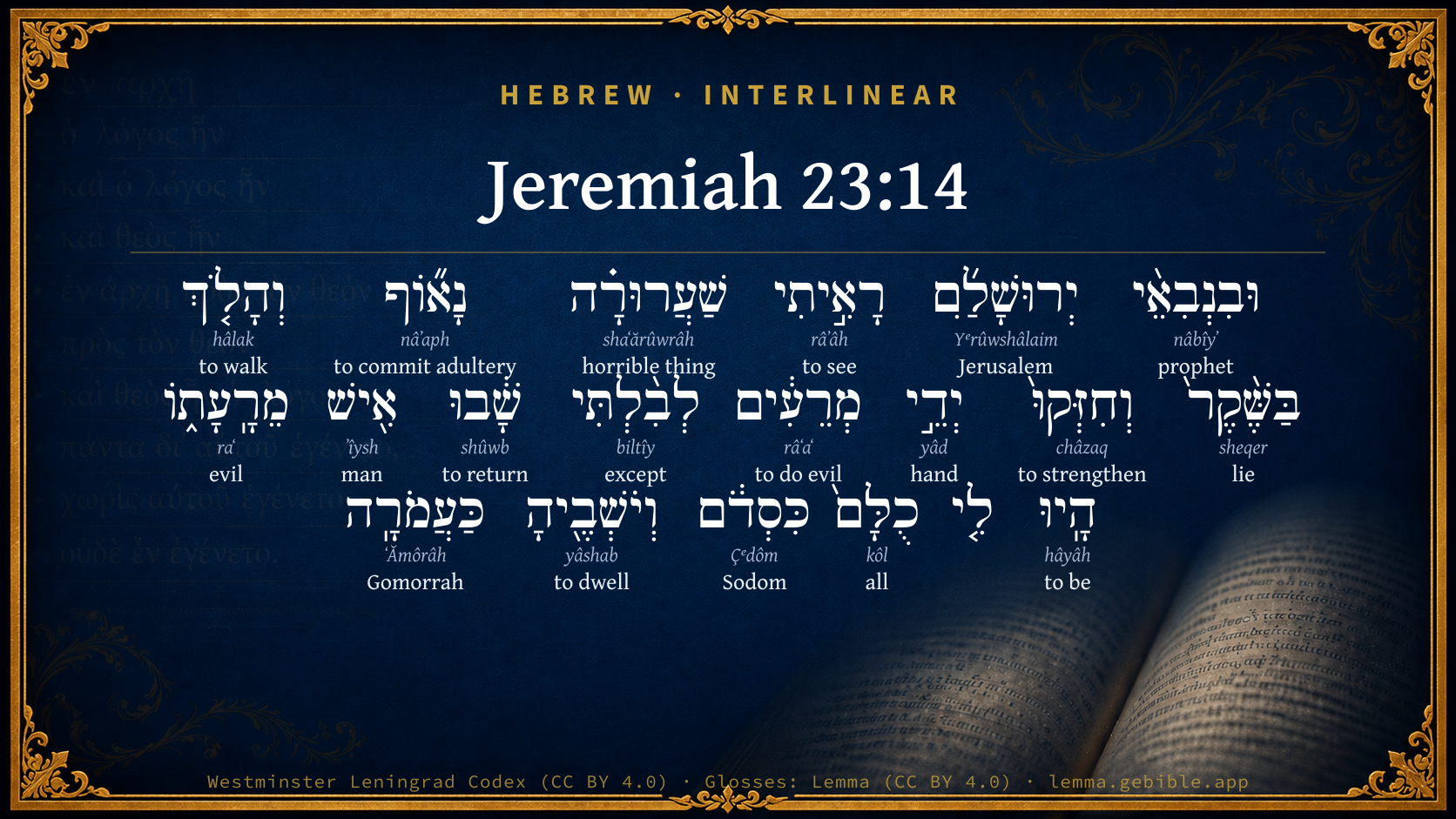
Jeremiah 23:14

Hebrew (Westminster Leningrad Codex) Jeremiah 23:14 appears in the Hebrew Old Testament. The text above is from the Westminster Leningrad Codex. Each word links to its Strong’s number, a concise gloss, and parsing drawn from the Open Scriptures Hebrew Bible morphology. Click any word for its full Brown-Driver-Briggs (BDB) entry.
Download image
Cite this verse

Jeremiah 23:14 (World English Bible). Public Domain. Lemma interlinear Bible study tool, https://lemma.gebible.app/v/jeremiah/23/14.

Show BibTeX & RIS
BibTeX
RIS
English Translation
In the prophets of Jerusalem also I have seen a horrible thing: they commit adultery, and walk in lies; and they strengthen the hands of evil-doers, so that none does return from his wickedness: they are all of them become to me as Sodom, and the inhabitants of it as Gomorrah.
World English Bible · Public Domain
Download a study sheet

One document with this verse’s original text, its word-by-word gloss line, the meaning frame, cross-references with their text, attributed commentary, and full source and license credits — printable, and it pastes into notes with its structure intact.

This verse Autodidact and up

Study sheet (.html) Plain text (.txt)

A passage Seminary Student

Up to 50 verses in one chapter. A passage sheet keeps up to 6 commentary sources and 12 cross-references per verse, in the order this page ranks them, and says so on the sheet whenever that leaves anything out. Ask for a single verse and you get the Autodidact verse sheet above.

Everything on this page stays free to read, with no account — the sheet is a download of what is already on screen, not access to it.

Want to remove ads? Support Godless Engineer
Compare translations 3

The same verse in 3 English versions, stacked beneath the original-language interlinear above. Click any original word for its lexicon entry.

Each is an independent rendering of the whole verse — the interlinear is not word-aligned to these translations.

Highlighted words mark where these versions differ — a whole-verse word diff, not a word-by-word alignment.

  • World English Bible Public Domain
    In the prophets of Jerusalem also I have seen a horrible thing: they commit adultery, and walk in lies; and they strengthen the hands of evil-doers, so that none does return from his wickedness: they are all of them become to me as Sodom, and the inhabitants of it as Gomorrah.
  • King James Version Public Domain
    I have seen also in the prophets of Jerusalem an horrible thing: they commit adultery, and walk in lies: they strengthen also the hands of evildoers, that none doth return from his wickedness; they are all of them unto me as Sodom, and the inhabitants thereof as Gomorrah.
  • unfoldingWord Literal Text CC BY-SA 4.0
    And among the prophets of Jerusalem I have seen a horrible thing: committing adultery and walking in falsehood. And they have strengthened the hands of evildoers, so that no man turns back from his evil. All of them have become to me like Sodom, and her inhabitants like Gomorrah.” p

unfoldingWord Literal Text — © unfoldingWord, licensed CC BY-SA 4.0. Word-aligned USFM3 via Door43 (git.door43.org/unfoldingWord/en_ult).

Versions to compare (up to 4)

3 of 4 selected

Show all 18 translations

Every available English version of this verse, each an independent rendering of the whole verse.

  • World English Bible Public Domain
    In the prophets of Jerusalem also I have seen a horrible thing: they commit adultery, and walk in lies; and they strengthen the hands of evil-doers, so that none does return from his wickedness: they are all of them become to me as Sodom, and the inhabitants of it as Gomorrah.
  • Berean Standard Bible Public Domain
    And among the prophets of Jerusalem I have seen a horrible thing: They commit adultery and walk in lies. They strengthen the hands of evildoers, so that no one turns his back on wickedness. They are all like Sodom to Me; the people of Jerusalem are like Gomorrah.”
  • Majority Standard Bible Public Domain
    And among the prophets of Jerusalem I have seen a horrible thing: They commit adultery and walk in lies. They strengthen the hands of evildoers, so that no one turns his back on wickedness. They are all like Sodom to Me; the people of Jerusalem are like Gomorrah.”
  • King James Version Public Domain
    I have seen also in the prophets of Jerusalem an horrible thing: they commit adultery, and walk in lies: they strengthen also the hands of evildoers, that none doth return from his wickedness; they are all of them unto me as Sodom, and the inhabitants thereof as Gomorrah.
  • American Standard Version (1901) Public Domain
    In the prophets of Jerusalem also I have seen a horrible thing: they commit adultery, and walk in lies; and they strengthen the hands of evil-doers, so that none doth return from his wickedness: they are all of them become unto me as Sodom, and the inhabitants thereof as Gomorrah.
  • Revised Version (1885) Public Domain
    In the prophets of Jerusalem also I have seen an horrible thing; they commit adultery, and walk in lies, and they strengthen the hands of evil-doers, that none doth return from his wickedness: they are all of them become unto me as Sodom, and the inhabitants thereof as Gomorrah.
  • Geneva Bible (1599) Public Domain
    I haue seene also in the prophets of Ierusalem filthines: they commit adulterie and walke in lies: they strengthen also the hands of the wicked that none can returne from his wickednesse: they are all vnto me as Sodom, and the inhabitants thereof as Gomorah.
  • Douay-Rheims (1899) Public Domain
    And I have seen the likeness of adulterers, and the way of lying in the peophets of Jerusalem: and they strengthened the hand of the wicked, that no man should return from his evil doings: that are all become unto me as Sodom, and the inhabitants thereof as Gamorrha.
  • Young's Literal Translation Public Domain
    And in prophets of Jerusalem I have seen a horrible thing, Committing adultery, and walking falsely, Yea, they strengthened the hands of evil doers, So that they have not turned back Each from his wickedness, They have been to me -- all of them -- as Sodom, And its inhabitants as Gomorrah.
  • Literal Standard Version CC BY-SA 4.0
    And I have seen a horrible thing in prophets of Jerusalem, || Committing adultery, and walking falsely, || Indeed, they strengthened the hands of evildoers, || So that they have not turned back, || Each from his wickedness, || All of them have been as Sodom to me, || And its inhabitants as Gomorrah.”
  • Unlocked Literal Bible CC BY-SA 4.0
    Among the prophets in Jerusalem I have seen horrible things: They commit adultery and walk in deceit. They strengthen the hands of evildoers; no one turns back from his evildoing. All of them have become like Sodom to me and its inhabitants like Gomorrah!”
  • unfoldingWord Literal Text CC BY-SA 4.0
    And among the prophets of Jerusalem I have seen a horrible thing: committing adultery and walking in falsehood. And they have strengthened the hands of evildoers, so that no man turns back from his evil. All of them have become to me like Sodom, and her inhabitants like Gomorrah.” p
  • Darby Bible Public Domain
    And in the prophets of Jerusalem have I seen a horrible thing: they commit adultery, and walk in falsehood, and strengthen the hands of evildoers, so that none doth return from his wickedness. They are all become unto me as Sodom, and the inhabitants thereof as Gomorrah.
  • World Messianic Bible Public Domain
    In the prophets of Jerusalem I have also seen a horrible thing: they commit adultery and walk in lies. They strengthen the hands of evildoers, so that no one returns from his wickedness. They have all become to me as Sodom, and its inhabitants as Gomorrah.”
  • Webster's Bible Public Domain
    I have seen also in the prophets of Jerusalem a horrible thing: they commit adultery, and walk in lies: they strengthen also the hands of evil-doers, that none doth return from his wickedness: they are all of them to me as Sodom, and the inhabitants of it as Gomorrah.
  • Free Bible Version CC BY-SA 4.0
    But now I see the prophets of Jerusalem doing something even more disgusting: They commit adultery and their lives are a lie. They support the wicked, so no one stops sinning. To me they're all like Sodom; the people of Jerusalem are like Gomorrah.
  • Bible in Basic English Public Domain
    And in the prophets of Jerusalem I have seen a shocking thing; they are untrue to their wives, walking in deceit, and they make strong the hands of evil-doers, so that a man may not be turned back from his evil-doing: they have all become like Sodom to me, and its people like Gomorrah.
  • JPS Tanakh (1917) Public Domain
    But in the prophets of Jerusalem I have seen a horrible thing: they commit adultery, and walk in lies, and they strengthen the hands of evil-doers, that none doth return from his wickedness; they are all of them become unto Me as Sodom, and the inhabitants thereof as Gomorrah.

Literal Standard Version (2020), Covenant Press — licensed CC BY-SA 4.0. Text via the HelloAO Bible API (eBible.org). Unlocked Literal Bible (unfoldingWord) — licensed CC BY-SA 4.0. Text via the HelloAO Bible API (eBible.org). unfoldingWord Literal Text — © unfoldingWord, licensed CC BY-SA 4.0. Word-aligned USFM3 via Door43 (git.door43.org/unfoldingWord/en_ult). Free Bible Version, Dr. Jonathan Gallagher — licensed CC BY-SA 4.0. Text via the HelloAO Bible API (eBible.org).

Word by word

More ways to search: Search by grammar → Find every occurrence → Compare this word →

Practice this passage: Drill this verse → Learn its vocabulary →

שַׁעֲרוּרָ֗ה
shaʻărûwrâh
H8186
“horrible thing”
Noun, Common, Feminine, Singular, Absolute
Part of Speech
Noun
Type
Common
Gender
Feminine
Number
Singular
State
Absolute
Full BDB Definition

Origin: from H8176 in the sense of H8175

TWOT: 2439b

horrible thing
  1. וּבִנְבִאֵ֨י nâbîyʼ H5030 “and · in/at · prophets of” Conjunction + Preposition + Noun, Common, Masculine, Plural, Construct
  2. יְרוּשָׁלִַ֜ם Yᵉrûwshâlaim H3389 “Jerusalem” Noun, Proper
  3. רָאִ֣יתִי râʼâh H7200 “to see” Verb, Qal, Perfect, 1st Person, Common, Singular
  4. נָא֞וֹף nâʼaph H5003 “to commit adultery” Verb, Qal, Infinitive Absolute
  5. וְהָלֹ֤ךְ hâlak H1980 “and · to walk” Conjunction + Verb, Qal, Infinitive Absolute
  6. בַּשֶּׁ֨קֶר֙ sheqer H8267 “in/at the · lie” Preposition, Determined + Noun, Common, Masculine, Singular, Absolute
  7. וְחִזְּקוּ֙ châzaq H2388 “and · to strengthen” Conjunction + Verb, Piel, Perfect, 3rd Person, Common, Plural
  8. יְדֵ֣י yâd H3027 “hands of” Noun, Common, Both, Dual, Construct
  9. מְרֵעִ֔ים râʻaʻ H7489 “doing evil” Verb, Hiphil, Participle Active, Masculine, Plural, Absolute
  10. לְבִ֨לְתִּי biltîy H1115 “to/for · except” Preposition + Conjunction
  11. שָׁ֔בוּ shûwb H7725 “to return” Verb, Qal, Perfect, 3rd Person, Common, Plural
  12. אִ֖ישׁ ʼîysh H376 “man” Noun, Common, Masculine, Singular, Absolute
  13. מֵרָֽעָת֑וֹ raʻ H7451 “from · evil · his” Preposition + Noun, Common, Feminine, Singular, Construct + Suffix, Personal, 3rd Person, Masculine, Singular
  14. הָֽיוּ hâyâh H1961 “to be” Verb, Qal, Perfect, 3rd Person, Common, Plural
  15. כֻלָּם֙ kôl H3605 “all · their” Noun, Common, Masculine, Singular, Construct + Suffix, Personal, 3rd Person, Masculine, Plural
  16. כִּסְדֹ֔ם Çᵉdôm H5467 “like/as · Sodom” Preposition + Noun, Proper
  17. וְיֹשְׁבֶ֖יהָ yâshab H3427 “and · dwelling · her” Conjunction + Verb, Qal, Participle Active, Masculine, Plural, Construct + Suffix, Personal, 3rd Person, Feminine, Singular
  18. כַּעֲמֹרָֽה ʻĂmôrâh H6017 “like/as · Gomorrah” Preposition + Noun, Proper

About this verse

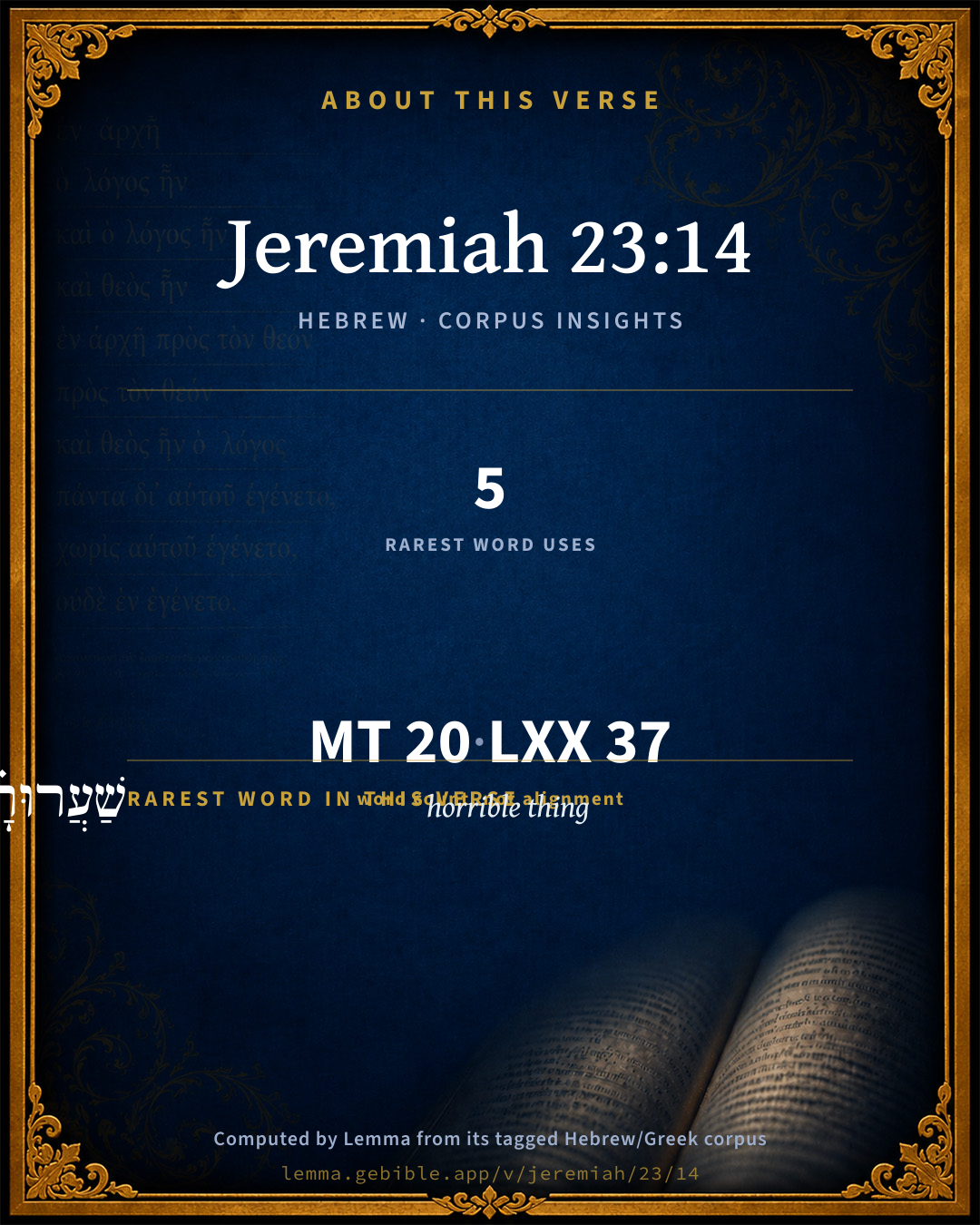
These counts appear in no published source. They are computed here, from the morphology-tagged text and Lemma’s own curated glosses. What Lemma adds →

20
words
19
distinct lemmas
Prophets
section

Notable vocabulary

The rarest word here is שַׁעֲרוּרָ֗ה horrible thing H8186 — appearing just 5 times in the whole Hebrew Bible.

Shared distinctive vocabulary

שַׁעֲרוּרָ֗ה horrible thing H8186 occurs in 4 verses of the Hebrew Bible. Also found in:

Grammatical profile

  • 8 verbs
  • 10 nouns
  • 1 preposition
  • 1 conjunction

Verb forms

  • רָאִ֣יתִי Qal · Perfect
  • נָא֞וֹף Qal · Infinitive Absolute
  • וְהָלֹ֤ךְ Qal · Infinitive Absolute
  • וְחִזְּקוּ֙ Piel · Perfect
  • מְרֵעִ֔ים Hiphil · Participle Active
  • שָׁ֔בוּ Qal · Perfect
  • הָֽיוּ Qal · Perfect
  • וְיֹשְׁבֶ֖יהָ Qal · Participle Active

Hebrew & Septuagint length

In the original languages it is 20 Hebrew tokens and 37 Greek tokens — but the two are counted differently (Hebrew bundles its prefixes and suffixes into one token; the Greek is in lemma form), so that isn’t a like-for-like length.

Cross-references

32

Topical passages linked to Jeremiah 23:14 in the Treasury of Scripture Knowledge — connected by theme and wording, ordered by reader-vote popularity; previews shown in the World English Bible.

  • Isaiah 1:9–10 Unless Yahweh of hosts had left to us a very small remnant, We would have been as Sodom; We would have been like Gomorrah.
  • Jeremiah 29:23 because they have worked folly in Israel, and have committed adultery with their neighbors' wives, and have spoken words in my name falsely, which I didn't command them; and I am he who knows, and am witness, says Yahweh.
  • Ezekiel 22:25 There is a conspiracy of her prophets in the midst of it, like a roaring lion ravening the prey: they have devoured souls; they take treasure and precious things; they have made her widows many in the midst of it.
  • Genesis 18:20 Yahweh said, "Because the cry of Sodom and Gomorrah is great, and because their sin is very grievous,
  • Deuteronomy 32:32 For their vine is of the vine of Sodom, Of the fields of Gomorrah: Their grapes are grapes of gall, Their clusters are bitter:
  • Jeremiah 14:14 Then Yahweh said to me, The prophets prophesy lies in my name; I didn't send them, neither have I commanded them, neither spoke I to them: they prophesy to you a lying vision, and divination, and a thing of nothing, and the deceit of their own heart.
  • Jeremiah 23:32 Behold, I am against those who prophesy lying dreams, says Yahweh, and do tell them, and cause my people to err by their lies, and by their vain boasting: yet I didn't send them, nor commanded them; neither do they profit this people at all, says Yahweh.
  • Ezekiel 13:22–23 Because with lies you have grieved the heart of the righteous, whom I have not made sad; and strengthened the hands of the wicked, that he should not return from his wicked way, and be saved alive:
  • Micah 3:11 Her leaders judge for bribes, And her priests teach for a price, And her prophets of it tell forturnes for money: Yet they lean on Yahweh, and say, Isn't Yahweh in the midst of us? No disaster will come on us.
  • Genesis 13:13 Now the men of Sodom were exceedingly wicked and sinners against Yahweh.
  • Isaiah 41:6–7 They help everyone his neighbor; and [every one] says to his brother, Be of good courage.
  • Jeremiah 5:30–31 A wonderful and horrible thing is happen in the land:
  • Jeremiah 20:16 Let that man be as the cities which Yahweh overthrew, and didn't repent: and let him hear a cry in the morning, and shouting at noontime;
  • Jeremiah 23:25–26 I have heard what the prophets have said, who prophesy lies in my name, saying, I have dreamed, I have dreamed.
  • Ezekiel 13:2–4 Son of man, prophesy against the prophets of Israel who prophesy, and say you to those who prophesy out of their own heart, Hear you the word of Yahweh:
  • Ezekiel 16:46–52 Your elder sister is Samaria, who dwells at your left hand, she and her daughters; and your younger sister, who dwells at your right hand, is Sodom and her daughters.
  • Zephaniah 3:4 Her prophets are arrogant and treacherous people. Her priests have profaned the sanctuary. They have done violence to the law.
  • Matthew 11:24 But I tell you that it will be more tolerable for the land of Sodom, on the day of judgment, than for you."
  • 2 Thessalonians 2:9–11 even he whose coming is according to the working of Satan with all power and signs and lying wonders,
  • 1 Timothy 4:2 through the hypocrisy of men who speak lies, branded in their own conscience as with a hot iron;
  • 2 Peter 2:1–2 But there also arose false prophets among the people, as among you also there will be false teachers, who will secretly bring in destructive heresies, denying even the Master who bought them, bringing on themselves swift destruction.
  • 2 Peter 2:6 and turning the cities of Sodom and Gomorrah into ashes, condemned them to destruction, having made them an example to those who would live ungodly;
  • 2 Peter 2:14–19 having eyes full of adultery, and who can't cease from sin; enticing unsettled souls; having a heart trained in greed; children of cursing;
  • Jude 1:7 Even as Sodom and Gomorrah, and the cities around them, having, in the same way as these, given themselves over to sexual immorality and gone after strange flesh, are set forth as an example, suffering the punishment of eternal fire.
  • Revelation 11:8 Their dead bodies will be in the street of the great city, which spiritually is called Sodom and Egypt, where also their Lord was crucified.
  • Revelation 19:20 The beast was taken, and with him the false prophet who worked the signs in his sight, with which he deceived those who had received the mark of the beast and those who worshiped his image. These two were thrown alive into the lake of fire that burns with sulfur.
  • Revelation 21:8 But for the cowardly, unbelieving, sinners, abominable, murderers, sexually immoral, sorcerers, idolaters, and all liars, their part is in the lake that burns with fire and sulfur, which is the second death."
  • Revelation 22:15 Outside are the dogs, the sorcerers, the sexually immoral, the murderers, the idolaters, and everyone who loves and practices falsehood.
  • Jeremiah 18:13 Therefore thus says Yahweh: Ask you now among the nations, who has heard such things; the virgin of Israel has done a very horrible thing.
  • Jeremiah 23:17 They say continually to those who despise me, Yahweh has said, You shall have peace; and to everyone who walks in the stubbornness of his own heart they say, No evil shall come on you.
  • Ezekiel 13:16 [to wit], the prophets of Israel who prophesy concerning Jerusalem, and who see visions of peace for her, and there is no peace, says the Lord Yahweh.
  • Malachi 1:1 An oracle: the word of Yahweh to Israel by Malachi.

Cross-references courtesy of OpenBible.info (CC BY 4.0).

Hebrew and Greek witnesses Masoretic Hebrew ↔ Greek Septuagint

The same verse in the two great witnesses to the Old Testament, shown verse-for-verse.

These are two independent witnesses, not word-aligned to each other, and the Septuagint is shown in lemma (dictionary) form.

Hebrew Jeremiah 23:14 Masoretic · Westminster Leningrad Codex

וּבִנְבִאֵ֨י יְרוּשָׁלִַ֜ם רָאִ֣יתִי שַׁעֲרוּרָ֗ה נָא֞וֹף וְהָלֹ֤ךְ בַּשֶּׁ֨קֶר֙ וְחִזְּקוּ֙ יְדֵ֣י מְרֵעִ֔ים לְבִ֨לְתִּי שָׁ֔בוּ אִ֖ישׁ מֵרָֽעָת֑וֹ הָֽיוּ לִ֤י כֻלָּם֙ כִּסְדֹ֔ם וְיֹשְׁבֶ֖יהָ כַּעֲמֹרָֽה

In the prophets of Jerusalem also I have seen a horrible thing: they commit adultery, and walk in lies; and they strengthen the hands of evil-doers, so that none does return from his wickedness: they are all of them become to me as Sodom, and the inhabitants of it as Gomorrah.

World English Bible · Public Domain

Greek LXX Structure differs

In the Septuagint, Jeremiah is about an eighth shorter than the Hebrew and arranges its material differently — the Oracles Against the Nations (Hebrew chapters 46–51) appear in the middle of the Greek book, after 25:13. Because the chapter and verse boundaries do not line up, a verse-for-verse comparison with the Hebrew is not shown.

A verse-for-verse comparison isn’t shown here because the chapters and verses don’t line up. Switch to the LXX edition with the MT / LXX toggle above to read the Greek directly.

Hebrew: Westminster Leningrad Codex (CC BY 4.0). Greek: Septuagint (public domain); English from a public-domain English Septuagint. How the Septuagint differs from the Hebrew →

Targum (Aramaic paraphrase)

1

The Targum is the ancient Jewish Aramaic paraphrase of the Hebrew Scriptures — an interpretive translation, not the Hebrew text itself. Onkelos (literal) and Pseudo-Jonathan (expansive) render the Torah, and Jonathan the Prophets. Coverage is partial: where no permissively-licensed English translation exists for a verse, only the Aramaic is shown. This is verse-level text, not a word-by-word alignment to the Hebrew.

  1. Targum Jonathan Prophets (Joshua–Malachi)
    וּבִנְבִיֵי יְרוּשְׁלֵם חֲזִיתֵי שְׁנוֹ זַנָאִין וּמְהַלְכִין בִּשְׁקַר וּמַתְקְפִין יַד מִבְאֲשִׁין בְּדִיל דְלָא לְמֵיתַב גְבַר מִן בִּישְׁתֵיהּ הֲווֹ קָדָמַי כּוּלְהוֹן כִּסְדוֹם וְיָתְבְהָא כַּעֲמוֹרָה:

    (no public-domain English translation for this verse)

    Targum Jonathan — Aramaic: “Mikraot Gedolot” (public domain). English: “Sefaria Community Translation” (CC0 1.0 (public-domain dedication)); “London "Chaldee Paraphrase," 1871” (public domain). Text via Sefaria.

Commentary

Notes on Jeremiah 23:14 from classic Christian and Jewish commentators (each source and its license shown beneath its notes). The classic Christian expositions comment on the surrounding passage and are grouped to its opening verse, so a note may address several verses; the Jewish commentaries on the Tanakh (Rashi and others) are per-verse, so they appear only where the commentator wrote on this verse.

Lemma curates 59 commentaries, every one of them public domain or Creative Commons licensed, each selected and text-cleaned for this edition rather than reprinted as found. About our sources →

Trapp's Complete Commentary

John Trapp

Jer 23:14 I have seen also in the prophets of Jerusalem an horrible thing: they commit adultery, and walk in lies: they strengthen also the hands of evildoers, that none doth return from his wickedness: they are all of them unto me as Sodom, and the inhabitants thereof as Gomorrah.

Ver. 14. I have seen also in the prophets of Jerusalem an horrible thing.] {a} Heb., Fedity, or fetidity; filthiness or stench, such as the devil himself, they say, leaveth behind him going out of a room. It must needs be a horrible thing when doctors turn devils, teaching such impieties, acsi ipse teterrimus Satan eas ore suo docuisset, as if the devil himself, with his own mouth, had taught the same. I would shun a heretic, saith one, as I would do a devil, for he is sent on his errand. Seducers certainly act the part of that horrid fiend, and, together with him, shall be "cast alive into the burning lake." {Rev 19:20}

They commit adultery.] As did Eli’s sons, and those two stinking goats, Jer 29:23.

And walk in lies.] Make a trade of it. It was not for nothing that Chrysostom {b} said of those of his time, Non arbitror inter sacerdotes, multos esse qui salvi fient.

They strengthen also the hands of evildoers.] Roborant manus malignatium; while knowing the judgment of God, that they which commit such things are worthy of death, they not only do the same, but, both by their false doctrine and loose living, they countenance those that do them. {Rom 1:32}

They are all become to me as Sodom,] i.e., Paucissimis exceptis, omnes conscelerati et inemendabiles; they are all stark naught.

{a} φρικτα. - Septuag.

{b} Hom. iii. in Act.

John Trapp, A Commentary or Exposition upon All the Books of the Old and New Testament (1647–1656) — public domain. Text from a community e-Sword module.

The Biblical Illustrator

Joseph S. Exell

Jer_23:14

They strengthen also the hands of evil-doers.

Strengthening the hands of the wicked

1. All sin is horrible in its nature, as being contrary to the character and will of God.

2. To strengthen the hands and hinder the repentance of sinners is to oppose the great plan of the Divine government.

3. It tends to the misery of mankind, and is the reverse of that benevolence which ought to govern us in all our conduct.

4. It is to operate with that evil spirit who works in the children of disobedience.

5. It is a horrible thing, because we thus become partakers of their sins.

6. It is directly contrary to Gods commands, and marked with His peculiar abhorrence. (J. Lathrop, D. D.)

The Biblical Illustrator, edited by Joseph S. Exell (c. 1880s–1900s) — public domain. Text from a community e-Sword module.

Geneva Bible (1599)

Geneva Bible translators

They which should have profited by my rods against Samaria, are become worse than they.

Though to the world they seem holy fathers, yet I detest them as I did these abominable cities.

Geneva Bible (1599) marginal notes — public domain. Text via Bolls.life.

Jamieson, Fausset & Brown

Robert Jamieson, A. R. Fausset & David Brown

"Jerusalem" and Judah were even worse than "Samaria" and the ten tribes; the greater were the privileges of the former, the greater was their guilt. They had the temple in their midst, which the ten tribes had not; yet in the temple itself they practised idolatry.

strengthen . . . hands of evildoers-- (Eze 13:22).

as Sodom-- (Deu 32:32; Isa 1:10).

Jamieson, Fausset & Brown — Commentary Critical and Explanatory on the Whole Bible (1871) — public domain (CC PDM 1.0). Text via the HelloAO Bible API.

Adam Clarke's Commentary

Verse 14. I have seen also in the prophets of Jerusalem] That is, the prophets of Jerusalem, while professing a pure faith, have followed the ways, and become as corrupt as the prophets of Samaria.

They are all of them unto me as Sodom] Incorrigible, brutish sinners, who will as surely be destroyed as Sodom and Gomorrah were.

Adam Clarke's Commentary on the Bible (1810–1826) — public domain. Text from a community e-Sword/MySword module.

John Calvin's Commentaries

It follows, They commit adultery, and walk in deception Expositors think that there is a change of number; but what if these words be applied to the people? as though Jeremiah had said, “When any one is an adulterer, when any one walks in deception, that is, when any one is fraudulent, they strengthen, the hands of the wicked.” And, doubtless, this sense seems here to be the most correct. Then Jeremiah shews how they surpassed other prophets in impiety, even because they dissimulated when they saw on one hand adulteries prevailing, and on the other frauds, plunders, and perjuries; and not only so, but they undertook the patronizing of the wicked, and strengthened the hands of the ungodly, and added audacity to their madness. For as fear weakens the hands, so does shame; as, then, these prophets removed shame as well as fear from the wicked and ungodly, so they strengthened their hands; that is, they gave them more confidence, so that they rushed headlong into every evil more freely and with greater liberty.

That they might not return, he says, every one from his wickedness This is added for the sake of explanation; for, as I have said, either the fear of God or shame from men might have checked their audacity; but when they were confirmed and countenanced, they broke out into all excesses, and hardened themselves in their obstinacy: That they might not return, every one from his wickedness.

In the last place he adds, They shall be to me all of them as Sodom, and its inhabitants as Gomorrah We see that the last clause is confined to the citizens of Jerusalem. Then God says, that these prophets would be like the Sodomites, and the citizens of Jerusalem like the citizens of Gomorrah. This is not to be understood only as to crimes, but also as to punishment; as though he had said, that there was no more hope of pardon for them than for the Sodomites, for they had provoked to the utmost the wrath of God, so that he could not now spare them. It then follows, —

John Calvin's Commentaries (1540-1563) — public domain. Text from the Calvin Translation Society English edition (1840s-50s) via the Christian Classics Ethereal Library (ccel.org). Calvin's coverage is partial (roughly two-thirds of the Bible); uncommented books and verses are honest gaps, never fabricated. The 19th-century editor's footnotes and remarks are omitted so the notes are faithfully Calvin's own voice.

Ellicott's Commentary for English Readers

(14) They commit adultery, and walk in lies . . .—The union of the claim to prophesy in the name of Jehovah with these flagrant breaches of His law was more hateful in the prophet’s eyes even than the open recognition of Baal. In the terrible language of Isaiah (Isa_1:10), prophets and people had become like the dwellers in the cities of the plain. Here, also, the language of Deuteronomy (Deu_29:23; Deu_32:32) probably influenced that of the prophet.

A Bible Commentary for English Readers, edited by Charles John Ellicott (1878–1897) — public domain. Text from a community e-Sword module.

The Cambridge Bible for Schools and Colleges

gen. ed. J. J. S. Perowne

14. all of them] the prophets and their hearers alike.

thereof] of Jerusalem.

The Cambridge Bible for Schools and Colleges (gen. ed. J. J. S. Perowne; Cambridge University Press, 1878–1918) — public domain. Text from a community e-Sword module.

John Gill's Exposition

I have seen also in the prophets of Jerusalem an horrible thing,.... Or "but", or "so have I seen", &c. as before observed; even in the prophets of Jerusalem, where the temple was, and where the pure worship of God was professed to be observed, and that now, at the present time; as he had formerly seen and observed what was foolish, ridiculous, and impious, in the prophets of the ten tribes, and had punished them for it; so now at this instant he sees that in the prophets of Judea which was enough to make a man's hair stand an end, as the word (u) signifies; or, as it may be derived from another root, what was "filthy" (w) and obscene; as follows:

they commit adultery; or, "in committing adultery" (x); with their neighbours' wives; for this rather than idolatry or spiritual adultery seems to be meant:

and walk in lies; or, "walking in lies" (y); constantly speaking lies in their common talk and conversation; so that they were not to be believed in anything they said; which was monstrous; and delivering out false doctrines in the name of the Lord, pretending they received them from him; which was worse than prophesying in the name of Baal:

they strengthen also the hands of evil doers, that none doth return from his wickedness; they hardened them in sin; partly by their false doctrines, extenuating their sins, putting a false gloss upon them, and promising them peace, though they lived in sin; and partly by their own wicked examples; the people concluding that what the prophets did they might do also; so that they never thought of repentance for their sins, or amendment of their lives; but went on in sin without remorse or reformation; not thinking anything about it, and not seeing any need of it; see Eze 13:22;

they are all of them unto me as Sodom, and the inhabitants thereof as Gomorrah; the prophets were all of them in God's account as the men of Sodom; who were exceeding great sinners before the Lord, daring and impudent in sinning; and the people, the inhabitants of Jerusalem, that were led by them into the same wicked sentiments and practices, were like unto Gomorrah; and as they were like to them in sinning, So they would be in punishment; or a like punishment would be inflicted upon the prophets and people of Jerusalem as were upon Sodom and Gomorrah; see Isa 1:9.

(u) a "pilus". (w) "Turpitudinem", Munster, Montanus. (x) "adulterando", Junius & Tremellius, Schmidt. (y) "et eundo in mendacio", Schmidt; "et ambulando in falsitate", Junius & Tremellius.

John Gill's Exposition of the Whole Bible (1746–1763) — public domain (CC PDM 1.0). Text via the HelloAO Bible API.

Albert Barnes' Notes on the Bible

Rather, “But in the prophets of Jerusalem” etc. Their conduct is more strongly condemned than that of the Baal-priests.

They strengthen ... - First by neglecting to warn and rebuke sinners: secondly by the direct influence of their bad example.

They are all of them - They have become, “all of them,” i. e., the people of Jerusalem, and not the prophets only.

Albert Barnes' Notes on the Bible (1834–1885) — public domain. Text from a community e-Sword/MySword module.

Haydock's Catholic Bible Commentary

Jerusalem. These were far worse, as they pretended to be inspired by God, whereas those of Samaria publicly adhered to Baal; so that the people must have been foolish to have been deceived by them. (Calmet)

George Leo Haydock (1774–1849), Haydock's Catholic Family Bible and Commentary, 1859 edition — public domain. Excludes Psalms (Douay-Rheims chapter numbering differs from Protestant) and Deuterocanonical books (Catholic canon only).

Matthew Poole's English Annotations

An horrible thing; the word signifies

filthiness, stench, or an abominable thing, things every whit as bad, in some kind worse, than what I saw in the prophets of the ten tribes.

They commit adultery; they commit not spiritual adultery only, but carnal adultery, they are whoremongers.

And walk in lies; and they make it their business to instil falsehoods into people, and entitle me to them; and this is their trade, not a single act, but their ordinary practice.

They strengthen also the hands of evil-doers, that none doth return from his wickedness: this is the great aggravation of the sin of those that occupy the place of spiritual guides, that they encourage profane men, either by their false doctrine, extenuating sin, and putting a fair gloss upon them; or at least by their mealy mouths fearing or forbearing to tell sinners of their wicked courses; or by their wicked examples, the most of people thinking they may do what their teachers do, by which means sinners, instead of being brought to a sense of their sins, and a repentance for them, are hardened in their wicked courses. By this means all of them, either of their prophets and priests, or all of the people, (the first seemeth chiefly here intended,) are become to me as contemptible and abominable as the people of Sodom and Gomorrah: though they were the sons of Aaron, and of the priestly order, yet living lewd lives, and acting quite contrary to the end of their holy calling, God declares himself to value them no more than as the vilest of men, such were the Sodomites. Or by those words God threatens that he would destroy them with as notorious a destruction as he destroyed Sodom and Gomorrah. Thus the comparison is used Isa 1:9, and consonant to this are the words in the next verse.

Matthew Poole's English Annotations on the Holy Bible (1683–1685) — public domain. Text from a community e-Sword/MySword module.

The Pulpit Commentary

I have seen also, etc.; rather, But in the prophets of Jerusalem I have seen. Horrible; as in Jer_5:30. They commit adultery, etc.; literally, the committing adultery and the walking in lies a much more forcible way of putting it. They are all of them; rather, They have become all of them; vie. either the prophets or the people in general. The inhabitants thereof; viz. of Jerusalem.

Prophets strengthening the hands of evildoers.

Jeremiah had much to say at different times on the unfaithfulness of the prophets how flatly opposed they were in all their conduct to that required by the duties of their office, how utterly negligent they were of the great opportunities of rebuke which were peculiarly their own. And there stands in this verse an expression which gives a climax to their evil-doings. A prophet shows himself most of all an evildoer when he upholds the hands of evildoers.

I THE PROPHET IS REQUIRED IN A SPECIAL MANNER TO DO WHAT HE CAN TO WEAKEN THE HANDS OF EVILDOERS. All who respect the will of God, and feel sympathy with what is right and trim and Divine, are bound to hinder bad men in their actions; but he who held the office of a prophet among the people of God was looked to as speaking with an authority higher than that of a private person. Officialism, with all its drawbacks and perils, with all its risk of self-assertion, has been of great advantage to practical religion. It is true, on the one hand, that to put a bad man into a holy office is to bring that office into contempt, but surely it is also true, on the other hand, that a good man in a holy office has his power for good much increased. Here in Israel at this time there was a multitude of evildoers, doing evil with both hands earnestly. At the same time, there were doubtless those who did evil with weak and uncertain hands. It is matter of thankfulness that evildoers are so often practically restrained in this way. Disposition is willing, but resolution is weak. There is the desire to do very bad things, but the courage is lacking. We have an instance of this in those enemies of our Lord who were so often hindered in their designs because they feared the people. If all the evil could be done that is desired to be done, society would become intolerable. Now, the peculiar mischief that these prophets did was in strengthening the hands of wicked men who were also weak. They spoke encouragingly, and perhaps drew them on by example. Hence evil was done openly that otherwise might have been done secretly. Conspiracies and alliances became more practicable. Evil was made to put on the aspect of good, and men did energetically with perverted consciences what otherwise they might have done with much hesitation, and therefore with diminished force. There are certain men always to whom evil doing becomes easy when it becomes respectable. Thus we see how great were the responsibilities and opportunities of the old Hebrew prophets.

II Hence we see something of what A DUTY AND OPPORTUNITY BELONG TO ALL CHRISTIAN PEOPLE. Are not all the Lord"s people prophets, if only they choose to regard their opportunities? With regard to evil men, it is especially laid on us to hinder their action by all wise and rightful means. The formation of their designs we cannot hinder; we cannot see beneath the surface, and prevent the germination of the poisonous growth; but when it appears above the surface, we may do our best to pluck it out. Under the specious guise of love for individual liberty we may tolerate the greatest evils till they grow beyond our control. The man who took a tiger"s cub for a pet found it become perilous long before he expected. We should do all we can to strengthen those who are the modern equivalents to the Hebrew prophets. Such men appear from time to time, and we should pray for insight that we may discern their mission and claims. Such men are sent to weaken, and ultimately to paralyze, the strong hands of the wicked. They are the representatives of great causes; and if through cowardice, self-indulgence, and fear of being thought peculiar, we neglect them, then we may do much harm.

III THE GREAT IMPORTANCE OF STRENGTHENING THE HANDS OF ALL WHO WANT TO BE GOOD. They are so often weak in action. "The spirit is willing, but the flesh is weak." They are hindered by strong temptations which come in their way, when they are striving to get nearer God"s ideal for them. They are in need of sympathy. They have to be helped in reaching encouraging views of Divine truth. They need to be remembered in prayer, and generally to have more heart and spirit put into them; then, having abundant life within, they will not lack force, steadiness, and persistency of hand. If we are actively engaged in strengthening the hands of the good, we are to this extent weakening the hands of the evil And, finally, it is very consoling to recollect that when those who profess to be good are found strengthening the hands of evildoers, this is precisely the time when God"s indignation is aroused and his opposition. most effective. "If God be for us, who can be against us? Y.

The Pulpit Commentary (1880–1919), ed. H.D.M. Spence-Jones & Joseph S. Exell — public domain. Text from a community e-Sword module.

Rashi

Rabbi Shlomo Yitzchaki (Rashi)

And in the prophets of Jerusalem I now see. a horrible thing a shameful thing.

and they encouraged evil doers They say to the wicked, “You shall have peace.”

that none returns So that the evildoers would not return each one from his evil.

Rashi on the Tanakh — English translations: “The Judaica Press complete Tanach with Rashi, translated by A. J. Rosenberg” (CC BY 4.0); “Pentateuch with Rashi's commentary by M. Rosenbaum and A.M. Silbermann, 1929-1934” (public domain); “The Metsudah Tanach series, Lakewood, N.J” (CC BY 4.0); and “The Book of Joshua, Metsudah Publications, 1997” (CC BY 4.0). Text via Sefaria.

Lesson kit

Teaching starters — assembled from the data on this page, not authored interpretation. Every prompt links to the verse data it draws on. Edit before teaching.

Jeremiah, in the Prophets, opens this verse with 20 words (19 distinct Hebrew lemmas). Its most distinctive word is shaʻărûwrâh (“horrible thing”). A historical commentator’s framing appears above. Read the whole chapter for the surrounding context.

Discussion questions

  1. The word shaʻărûwrâh carries the sense “horrible thing.” How does it shape the verse?
  2. How does Jeremiah 5:30, which shares the word «horrible thing», read alongside this verse?
  3. These translations render this verse differently. What is at stake in choosing one wording over another?
  4. «רָאִ֣יתִי» is a Qal Perfect verb. How does that grammatical form shape the action described?
  5. Compare how Trapp's Complete Commentary and The Biblical Illustrator read this verse. Where do they agree or differ?

Things to notice

Reading settings

Reading text

Shown beneath each verse's original-language words.

Old Testament
Old Testament edition

Read the OT as the Masoretic Hebrew (MT) or the Greek Septuagint (LXX).

English shown for the Greek Septuagint (in the Hebrew ↔ Greek comparison).

Comparing translations? Open the Compare panel on any verse page to stack up to four side by side.