Jeremiah 7:11

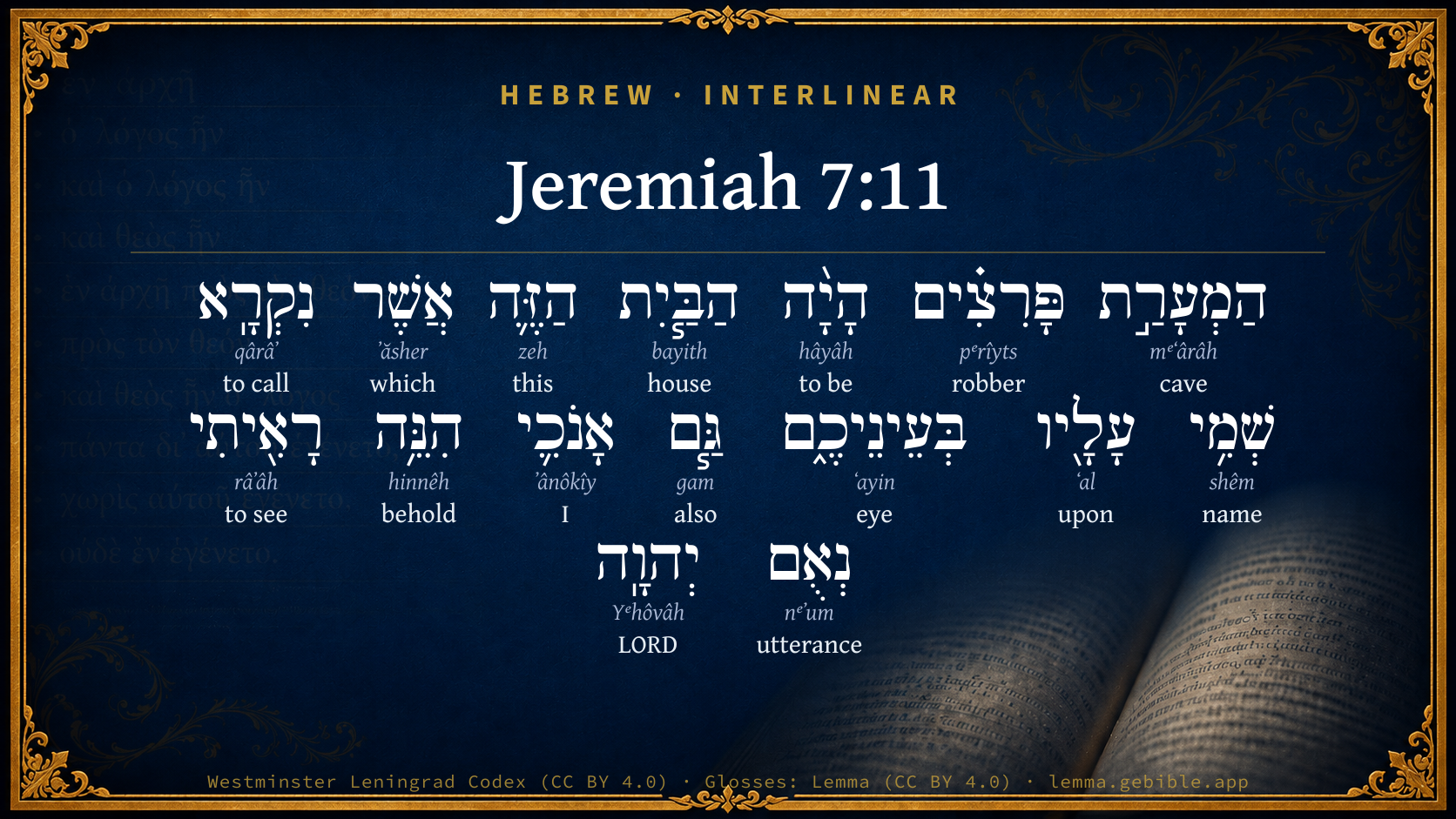
Hebrew (Westminster Leningrad Codex) Jeremiah 7:11 appears in the Hebrew Old Testament. The text above is from the Westminster Leningrad Codex. Each word links to its Strong’s number, a concise gloss, and parsing drawn from the Open Scriptures Hebrew Bible morphology. Click any word for its full Brown-Driver-Briggs (BDB) entry.
Download image
Cite this verse

Jeremiah 7:11 (World English Bible). Public Domain. Lemma interlinear Bible study tool, https://lemma.gebible.app/v/jeremiah/7/11.

Show BibTeX & RIS
BibTeX
RIS
English Translation
Is this house, which is called by my name, become a den of robbers in your eyes? Behold, I, even I, have seen it, says Yahweh.
World English Bible · Public Domain
Download a study sheet

One document with this verse’s original text, its word-by-word gloss line, the meaning frame, cross-references with their text, attributed commentary, and full source and license credits — printable, and it pastes into notes with its structure intact.

This verse Autodidact and up

Study sheet (.html) Plain text (.txt)

A passage Seminary Student

Up to 50 verses in one chapter. A passage sheet keeps up to 6 commentary sources and 12 cross-references per verse, in the order this page ranks them, and says so on the sheet whenever that leaves anything out. Ask for a single verse and you get the Autodidact verse sheet above.

Everything on this page stays free to read, with no account — the sheet is a download of what is already on screen, not access to it.

Want to remove ads? Support Godless Engineer
Compare translations 3

The same verse in 3 English versions, stacked beneath the original-language interlinear above. Click any original word for its lexicon entry.

Each is an independent rendering of the whole verse — the interlinear is not word-aligned to these translations.

Highlighted words mark where these versions differ — a whole-verse word diff, not a word-by-word alignment.

  • World English Bible Public Domain
    Is this house, which is called by my name, become a den of robbers in your eyes? Behold, I, even I, have seen it, says Yahweh.
  • King James Version Public Domain
    Is this house, which is called by my name, become a den of robbers in your eyes? Behold, even I have seen it, saith the LORD.
  • unfoldingWord Literal Text CC BY-SA 4.0
    Has this house, which is called by my name, become a cave of robbers in your eyes? Behold, I myself have also seen—the declaration of Yahweh.

unfoldingWord Literal Text — © unfoldingWord, licensed CC BY-SA 4.0. Word-aligned USFM3 via Door43 (git.door43.org/unfoldingWord/en_ult).

Versions to compare (up to 4)

3 of 4 selected

Show all 18 translations

Every available English version of this verse, each an independent rendering of the whole verse.

  • World English Bible Public Domain
    Is this house, which is called by my name, become a den of robbers in your eyes? Behold, I, even I, have seen it, says Yahweh.
  • Berean Standard Bible Public Domain
    Has this house, which bears My Name, become a den of robbers in your sight? Yes, I too have seen it, declares the LORD.
  • Majority Standard Bible Public Domain
    Has this house, which bears My Name, become a den of robbers in your sight? Yes, I too have seen it, declares the LORD.
  • King James Version Public Domain
    Is this house, which is called by my name, become a den of robbers in your eyes? Behold, even I have seen it, saith the LORD.
  • American Standard Version (1901) Public Domain
    Is this house, which is called by my name, become a den of robbers in your eyes? Behold, I, even I, have seen it, saith Jehovah.
  • Revised Version (1885) Public Domain
    Is this house, which is called by my name, become a den of robbers in your eyes? Behold, I, even I, have seen it, saith the LORD.
  • Geneva Bible (1599) Public Domain
    Is this House become a denne of theeues, whereupon my Name is called before your eyes? Beholde, euen I see it, sayeth the Lord.
  • Douay-Rheims (1899) Public Domain
    Is this house then, in which my name hath been called upon, in your eyes become a den of robbers? I, I am he: I have seen it, saith the Lord.
  • Young's Literal Translation Public Domain
    A den of burglars hath this house, On which My name is called, been in your eyes? Even I, lo, I have seen, an affirmation of Jehovah.
  • Literal Standard Version CC BY-SA 4.0
    Has this house, || On which My Name is called, || Been a den of burglars in your eyes? Even I, behold, have seen,” || A declaration of YHWH.
  • Unlocked Literal Bible CC BY-SA 4.0
    Is this house, which carries my name, a den of bandits in your eyes? But behold, I have seen it—this is Yahweh's declaration.'
  • unfoldingWord Literal Text CC BY-SA 4.0
    Has this house, which is called by my name, become a cave of robbers in your eyes? Behold, I myself have also seen—the declaration of Yahweh.
  • Darby Bible Public Domain
    Is this house, which is called by my name, a den of robbers in your eyes? Even I, behold, I have seen it, saith Jehovah.
  • World Messianic Bible Public Domain
    Has this house, which is called by my name, become a den of robbers in your eyes? Behold, I myself have seen it,” says the LORD.
  • Webster's Bible Public Domain
    Is this house, which is called by my name, become a den of robbers in your eyes? Behold, even I have seen it, saith the LORD.
  • Free Bible Version CC BY-SA 4.0
    Do you see this house, my own Temple, as a den of thieves? Well, that's what it looks like to me too, declares the Lord.
  • Bible in Basic English Public Domain
    Has this house, which is named by my name, become a hole of thieves to you? Truly I, even I, have seen it, says the Lord.
  • JPS Tanakh (1917) Public Domain
    Is this house, whereupon My name is called, become a den of robbers in your eyes? Behold, I, even I, have seen it, saith the LORD.

Literal Standard Version (2020), Covenant Press — licensed CC BY-SA 4.0. Text via the HelloAO Bible API (eBible.org). Unlocked Literal Bible (unfoldingWord) — licensed CC BY-SA 4.0. Text via the HelloAO Bible API (eBible.org). unfoldingWord Literal Text — © unfoldingWord, licensed CC BY-SA 4.0. Word-aligned USFM3 via Door43 (git.door43.org/unfoldingWord/en_ult). Free Bible Version, Dr. Jonathan Gallagher — licensed CC BY-SA 4.0. Text via the HelloAO Bible API (eBible.org).

Word by word

More ways to search: Search by grammar → Find every occurrence → Compare this word →

Practice this passage: Drill this verse → Learn its vocabulary →

פָּרִצִ֗ים
pᵉrîyts
H6530
“robbers”
Noun, Common, Masculine, Plural, Absolute
Part of Speech
Noun
Type
Common
Gender
Masculine
Number
Plural
State
Absolute
Full BDB Definition

Origin: from H6555

TWOT: 1826b

violent one, breaker - robber, murderer
  1. הַמְעָרַ֣ת mᵉʻârâh H4631 “cave of” Particle, Interrogative + Noun, Common, Feminine, Singular, Construct
  2. הָיָ֨ה hâyâh H1961 “to be” Verb, Qal, Perfect, 3rd Person, Masculine, Singular
  3. הַבַּ֧יִת bayith H1004 “the · house” Particle, Definite Article + Noun, Common, Masculine, Singular, Absolute
  4. הַזֶּ֛ה zeh H2088 “the · this” Particle, Definite Article + Pronoun, Demonstrative, Masculine, Singular
  5. אֲשֶׁר ʼăsher H834 “which” Particle, Relative
  6. נִקְרָֽא qârâʼ H7121 “to call” Verb, Niphal, Perfect, 3rd Person, Masculine, Singular
  7. שְׁמִ֥י shêm H8034 “name · my” Noun, Common, Masculine, Singular, Construct + Suffix, Personal, 1st Person, Common, Singular
  8. עָלָ֖יו ʻal H5921 “upon · him” Preposition + Suffix, Personal, 3rd Person, Masculine, Singular
  9. בְּעֵינֵיכֶ֑ם ʻayin H5869 “in/at · eyes · your” Preposition + Noun, Common, Both, Dual, Construct + Suffix, Personal, 2nd Person, Masculine, Plural
  10. גַּ֧ם gam H1571 “also” Particle, Accusative
  11. אָנֹכִ֛י ʼânôkîy H595 “I” Pronoun, Personal, 1st Person, Common, Singular
  12. הִנֵּ֥ה hinnêh H2009 “behold” Particle, Demonstrative
  13. רָאִ֖יתִי râʼâh H7200 “to see” Verb, Qal, Perfect, 1st Person, Common, Singular
  14. נְאֻם nᵉʼum H5002 “utterance of” Noun, Common, Masculine, Singular, Construct
  15. יְהוָֽה Yᵉhôvâh H3068 “LORD” Noun, Proper

About this verse

These counts appear in no published source. They are computed here, from the morphology-tagged text and Lemma’s own curated glosses. What Lemma adds →

16
words
16
distinct lemmas
Prophets
section

Notable vocabulary

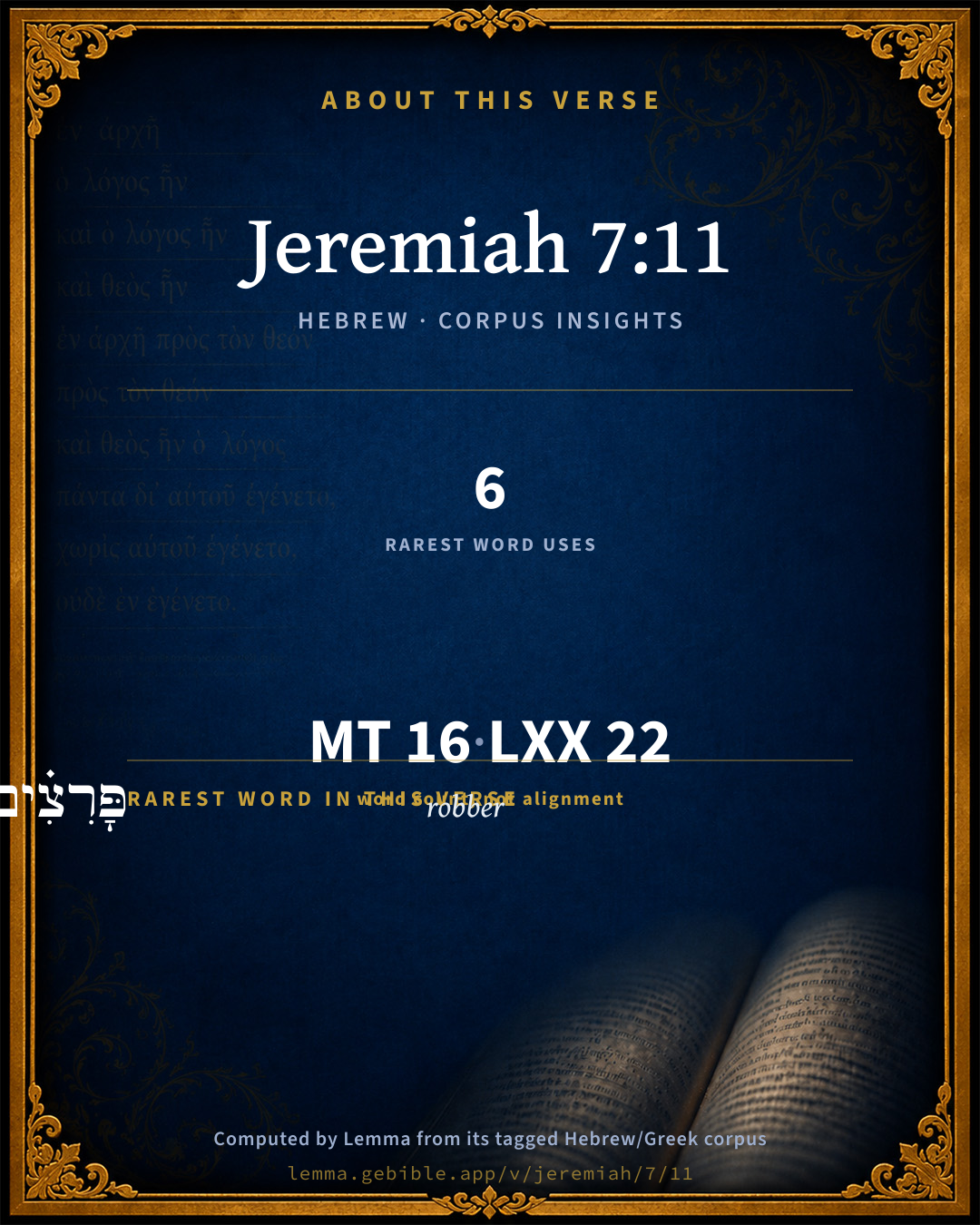
The rarest word here is פָּרִצִ֗ים robber H6530 — appearing just 6 times in the whole Hebrew Bible.

Shared distinctive vocabulary

פָּרִצִ֗ים robber H6530 occurs in 6 verses of the Hebrew Bible. Also found in:

Grammatical profile

  • 3 verbs
  • 7 nouns
  • 2 pronouns
  • 1 preposition
  • 3 particles

Verb forms

  • הָיָ֨ה Qal · Perfect
  • נִקְרָֽא Niphal · Perfect
  • רָאִ֖יתִי Qal · Perfect

Hebrew & Septuagint length

In the original languages it is 16 Hebrew tokens and 22 Greek tokens — but the two are counted differently (Hebrew bundles its prefixes and suffixes into one token; the Greek is in lemma form), so that isn’t a like-for-like length.

Cross-references

12

Topical passages linked to Jeremiah 7:11 in the Treasury of Scripture Knowledge — connected by theme and wording, ordered by reader-vote popularity; previews shown in the World English Bible.

  • Isaiah 56:7 even them will I bring to my holy mountain, and make them joyful in my house of prayer: their burnt offerings and their sacrifices shall be accepted on my altar; for my house shall be called a house of prayer for all peoples.
  • Luke 19:45–46 He entered into the temple, and began to drive out those who bought and sold in it,
  • Matthew 21:13 He said to them, "It is written, 'My house shall be called a house of prayer,' but you have made it a den of robbers!"
  • Mark 11:17 He taught, saying to them, "Isn't it written, 'My house will be called a house of prayer for all the nations?' But you have made it a den of robbers!"
  • 2 Chronicles 6:33 then hear from heaven, even from your dwelling-place, and do according to all that the foreigner calls to you for; that all the peoples of the earth may know your name, and fear you, as does your people Israel, and that they may know that this house which I have built is called by your name.
  • John 2:16 To those who sold the doves, he said, "Take these things out of here! Don't make my Father's house a marketplace!"
  • Jeremiah 23:24 Can any hide himself in secret places so that I shall not see him? says Yahweh. Don't I fill heaven and earth? says Yahweh.
  • Jeremiah 2:34 Also in your skirts is found the blood of the souls of the innocent poor: you did not find them breaking in; but it is because of all these things.
  • Jeremiah 16:16–17 Behold, I will send for many fishermen, says Yahweh, and they shall fish them up; and afterward I will send for many hunters, and they shall hunt them from every mountain, and from every hill, and out of the clefts of the rocks.
  • Jeremiah 29:23 because they have worked folly in Israel, and have committed adultery with their neighbors' wives, and have spoken words in my name falsely, which I didn't command them; and I am he who knows, and am witness, says Yahweh.
  • Hebrews 4:13 There is no creature that is hidden from his sight, but all things are naked and laid open before the eyes of him with whom we have to do.
  • Revelation 2:18–19 "To the angel of the assembly in Thyatira write: "The Son of God, who has his eyes like a flame of fire, and his feet are like burnished brass, says these things:

Cross-references courtesy of OpenBible.info (CC BY 4.0).

Hebrew and Greek witnesses Masoretic Hebrew ↔ Greek Septuagint

The same verse in the two great witnesses to the Old Testament, shown verse-for-verse.

These are two independent witnesses, not word-aligned to each other, and the Septuagint is shown in lemma (dictionary) form.

Hebrew Jeremiah 7:11 Masoretic · Westminster Leningrad Codex

הַמְעָרַ֣ת פָּרִצִ֗ים הָיָ֨ה הַבַּ֧יִת הַזֶּ֛ה אֲשֶׁר נִקְרָֽא שְׁמִ֥י עָלָ֖יו בְּעֵינֵיכֶ֑ם גַּ֧ם אָנֹכִ֛י הִנֵּ֥ה רָאִ֖יתִי נְאֻם יְהוָֽה

Is this house, which is called by my name, become a den of robbers in your eyes? Behold, I, even I, have seen it, says Yahweh.

World English Bible · Public Domain

Greek LXX Structure differs

In the Septuagint, Jeremiah is about an eighth shorter than the Hebrew and arranges its material differently — the Oracles Against the Nations (Hebrew chapters 46–51) appear in the middle of the Greek book, after 25:13. Because the chapter and verse boundaries do not line up, a verse-for-verse comparison with the Hebrew is not shown.

A verse-for-verse comparison isn’t shown here because the chapters and verses don’t line up. Switch to the LXX edition with the MT / LXX toggle above to read the Greek directly.

Hebrew: Westminster Leningrad Codex (CC BY 4.0). Greek: Septuagint (public domain); English from a public-domain English Septuagint. How the Septuagint differs from the Hebrew →

Targum (Aramaic paraphrase)

1

The Targum is the ancient Jewish Aramaic paraphrase of the Hebrew Scriptures — an interpretive translation, not the Hebrew text itself. Onkelos (literal) and Pseudo-Jonathan (expansive) render the Torah, and Jonathan the Prophets. Coverage is partial: where no permissively-licensed English translation exists for a verse, only the Aramaic is shown. This is verse-level text, not a word-by-word alignment to the Hebrew.

  1. Targum Jonathan Prophets (Joshua–Malachi)
    הַכְּבֵית כְּנִישַׁת רַשִׁיעִין הֲוָה בֵיתָא הָדֵין דְאִתְקְרֵי שְׁמִי עֲלוֹהִי בְּעֵינֵיכוֹן אַף קֳדָמֵי כֵּן גְלֵי אֲמַר יְיָ:

    (no public-domain English translation for this verse)

    Targum Jonathan — Aramaic: “Mikraot Gedolot” (public domain). English: “Sefaria Community Translation” (CC0 1.0 (public-domain dedication)); “London "Chaldee Paraphrase," 1871” (public domain). Text via Sefaria.

Commentary

Notes on Jeremiah 7:11 from classic Christian and Jewish commentators (each source and its license shown beneath its notes). The classic Christian expositions comment on the surrounding passage and are grouped to its opening verse, so a note may address several verses; the Jewish commentaries on the Tanakh (Rashi and others) are per-verse, so they appear only where the commentator wrote on this verse.

Lemma curates 59 commentaries, every one of them public domain or Creative Commons licensed, each selected and text-cleaned for this edition rather than reprinted as found. About our sources →

Trapp's Complete Commentary

John Trapp

Jer 7:11 Is this house, which is called by my name, become a den of robbers in your eyes? Behold, even I have seen [it], saith the LORD.

Ver. 11. Is this house, which is called by my name.] Is it become impiae gentis arcanum? as Florus afterwards spitefully called it; or a professed sanctuary of roguery? as the Papists maliciously say of Geneva; or a receptacle of all abominations? {a} as Pompey’s theatre in Rome was once said to be.

Become a den of robbers?] To such it should have been said by the porters, Gressus removete profani. In the mystical sacrifices of Ceres, no profane person was to be admitted, for the priest going before uttered these words, εκας εκας οστις αλιτρος - that is, be packing every wicked person. So the Roman priests had their procul, O procul este, profani.

{a} Arx omnium turpitudinum.

John Trapp, A Commentary or Exposition upon All the Books of the Old and New Testament (1647–1656) — public domain. Text from a community e-Sword module.

Tyndale Open Study Notes

Tyndale Open Resources

7:11 a den of thieves: See 5:29-31; Matt 21:13; Mark 11:17; Luke 19:46.

Tyndale Open Study Notes — © Tyndale Open Resources, licensed CC BY-SA 4.0. Text via the HelloAO Bible API.

Geneva Bible (1599)

Geneva Bible translators

As thieves hid in holes and dens think themselves safe, so when you are in my Temple, you think to be covered with the holiness thereof, and that I cannot see your wickedness, Matt. 21:13.

Geneva Bible (1599) marginal notes — public domain. Text via Bolls.life.

Jamieson, Fausset & Brown

Robert Jamieson, A. R. Fausset & David Brown

den of robbers--Do you regard My temple as being what robbers make their den, namely, an asylum wherein ye may obtain impunity for your abominations (Jer 7:10)?

seen it--namely, that ye treat My house as if it were a den of thieves. Jehovah implies more than is expressed, "I have seen and will punish it" (Isa 56:7; Mat 21:13).

Jamieson, Fausset & Brown — Commentary Critical and Explanatory on the Whole Bible (1871) — public domain (CC PDM 1.0). Text via the HelloAO Bible API.

John Calvin's Commentaries

He afterwards adds, Is this house, which is called by my name, a den of robbers? This is the conclusion of the passage, which contains an amplification of their vices. For the Prophet had allowed the Jews to form a judgment, as though he had been discussing an obscure or doubtful subject, “Behold, be ye yourselves judges in your own case; is it right for you to steal, to murder, and to commit adultery? and then to come into this Temple, and to boast that impunity is granted to you as to all your evils?” This indeed ought to have been enough; but as the obstinacy and stupor of the Jews were so great, that they would not have given way without being most fully and in various ways proved guilty, the Prophet adds this sentence, Is this house, which is called by my name, a den of robbers? that is, “Have I chosen this place for myself, that ye might worship me, in order that ye might be more licentious than if there was no religion? For what purpose is religion? Is it not that men may by this bridle restrain themselves, that they may not be libertines? For surely the worship and fear of God are the directors of equity and justice. Now, would it not be better to have no Temple and no sacrifices, than that men should take more liberty to sin by making their ceremonies as an excuse? Away then with your ceremonies: conscience shews that it is a wretched thing to oppress or injure a neighbor; all are constrained by common sense to own that adultery is a filthy and a detestable thing; and men think the same of rapines and murders. As to superstitions, when they are seen as such, all are constrained to allow the worship of God ought to be preserved in its purity. Well then, had there been no Temple among you, this truth must have been impressed on your minds, — that God ought to be worshipped in purity. Now, because the Temple has been built at Jerusalem, because ye offer sacrifices there, ye are thieves, ye are adulterers, ye are murderers; and ye think that I am in some sort blind, that I am no longer the avenger of so many and of such atrocious evils. A den of robbers then is my house become to you.” But this sentence is to be read interrogatively, “Can it be, that this Temple, this sanctuary, is become a den of robbers?”

But we must consider the import of the comparison: Robbers, though they are most audacious and wholly savage, do not yet dare openly to use their sword; they dare not kill helpless men. Why? they fear the punishment allotted to them by the laws; they are cautious. But when they seize on men in some hidden place, then they take more liberty in their robberies; they kill men, and then take their property. We hence see that dens and hidden places have in them more safety for robbers. The comparison then is most suitable, when the Prophet says that the Jews made the Temple of God the den of robbers: for had there been no Temple, some integrity might have remained, secured by the common feeling of men. But when they covered their baseness with sacrifices, they thought that they thus escaped all judgment.

And hence, Christ applied this prophecy to his time; for the Jews had even then profaned the Temple. Though they presumptuously and falsely called on God’s name, they yet sought the Temple as an asylum for impurity. This folly Christ exposed, as the Prophet had done.

He afterwards adds, Even I, behold I see, saith Jehovah Jeremiah here no doubt touches ironically on the false confidence with which the Jews deceived themselves: for hypocrites seem to themselves to know whatever is necessary. And hence also it is, that as they think themselves to be acute, they are bolder and more presumptuous in contriving deceitful schemes, by which they seek to delude God and men. And hence the Prophet here tauntingly touches them to the quick, by intimating that they wished to make God as it were blind, Even I, behold I see, he says. It would not yet be sufficiently evident how emphatical the phrase is, were it not for a similar passage in Isaiah 29:15,

“I also am wise.” The Prophet had said, “Woe to the crafty and the wise, who have dug pits for themselves.”

He there condemns ungodly men, who thought that they could somehow by their falsehoods deceive God; which seems to be and is monstrous: and yet it is an evil which commonly prevails among men. For hardly a man in a hundred can be found who does not seek coverings to hide himself from the eyes of God. This is the case especially with courtiers and clever men, who assume to themselves so much clear-sightedness, that God sees nothing in comparison with them. The Lord therefore, by Isaiah, gives this answer, “I also am wise: if ye are wise, allow me at least some portion of wisdom, and think not that I am altogether foolish.” So also in this place, “Before my eyes, this house is made a den of robbers;” that is, “If there be any sense in you, does it not appear evident that you have made a den of robbers of my Temple? and can I be yet blind? If you think that you are very clear-sighted, I also do see, saith the Lord.”

We hence see what force there is in the particle גם, gam, also, and in the pronoun אנכי, anoki, I, and in הנה, ene, behold; for these three words are heaped together, that God might shew that he was not unobservant, when the people so audaciously ran headlong into all kinds of vices, and sought by their falsehoods to cover his eyes, that he might not see anything.

John Calvin's Commentaries (1540-1563) — public domain. Text from the Calvin Translation Society English edition (1840s-50s) via the Christian Classics Ethereal Library (ccel.org). Calvin's coverage is partial (roughly two-thirds of the Bible); uncommented books and verses are honest gaps, never fabricated. The 19th-century editor's footnotes and remarks are omitted so the notes are faithfully Calvin's own voice.

Ellicott's Commentary for English Readers

(11) A den of robbers.—The words had a special force in a country like Palestine, where the limestone rocks presented many caves, which, like that of Adullam (1Sa_22:1-2), were the refuge of outlaws and robbers. Those who now flocked to the courts of the Temple, including even priests and prophets, were as such robbers, finding shelter there, and soothing their consciences by their worship, as the brigands of Italy do by their devotions at the shrine of some favourite Madonna. It had for them no higher sanctity than “a den of robbers.” The word for “robber” implies the more violent form of lawless plunder. The words are memorable, as having re-appeared in our Lord’s rebuke of the money-changers and traffickers in the Temple (Mat_21:13; Mar_11:17; Luk_19:46); and, taken together with the reference at the last Supper to the New Covenant of Jer_31:31, suggest the thought that our Lord was leading His disciples to see in the prophet’s work a foreshadowing of His own relation to the evils of His time, and more than a foreshadowing of the great remedy which He was to work out for them.

A Bible Commentary for English Readers, edited by Charles John Ellicott (1878–1897) — public domain. Text from a community e-Sword module.

The Cambridge Bible for Schools and Colleges

gen. ed. J. J. S. Perowne

11. den of robbers] a place of retreat in the intervals between acts of violence. Caves in Palestine were often used thus. This v. is alluded to in Mat_21:13, and the parallel passages (Mar_11:17 and Luk_19:46).

The Cambridge Bible for Schools and Colleges (gen. ed. J. J. S. Perowne; Cambridge University Press, 1878–1918) — public domain. Text from a community e-Sword module.

John Gill's Exposition

Is this house, which is called by my name,.... Meaning the temple:

become a den of robbers in your eyes? or do you look upon it, and make use of it, as thieves do of dens; who, when they have robbed and murdered men, betake themselves to them, not only to share their spoil, but to hide themselves? just so those thieves, murderers adulterers, perjurers, and idolaters, after they had committed such gross enormities, came into the temple and offered sacrifices; thinking hereby to cover their sins, and expiate the guilt of them, and to be looked upon as good men, and true worshippers of God, when they were no better than thieves and robbers; and such were the Pharisees in Christ's time, and such was the temple as made by them; see Mat 21:13,

behold, even I have seen it, saith the Lord; not only all the abominations committed by them, but the use they made of the temple and the worship of it; all the hypocrisy of their hearts, and the inward thoughts of them, and their views and intentions in their offerings and sacrifices; as well as what ruin and destruction the Lord designed to bring shortly upon them, and upon that house which they had made a den of robbers; as follows:

John Gill's Exposition of the Whole Bible (1746–1763) — public domain (CC PDM 1.0). Text via the HelloAO Bible API.

Albert Barnes' Notes on the Bible

Robbers - literally, tearers, those who rob with violence. The temple was the place which sheltered them. It had been consecrated to God. Now that it harbors miscreants, must it not as inevitably be destroyed as a den of robbers would be by any righteous ruler?

Albert Barnes' Notes on the Bible (1834–1885) — public domain. Text from a community e-Sword/MySword module.

Haydock's Catholic Bible Commentary

Robbers. Our Saviour alludes to this, Matthew xxi. 13. --- Seen. Think not to hide yourselves, as in a den. My temple shall not be an asylum for wretches. (Calmet)

George Leo Haydock (1774–1849), Haydock's Catholic Family Bible and Commentary, 1859 edition — public domain. Excludes Psalms (Douay-Rheims chapter numbering differs from Protestant) and Deuterocanonical books (Catholic canon only).

Matthew Poole's English Annotations

Robbers, Heb. breakers through. The word is taken in a large notion for all sorts of plunderers, whether in house, Eze 7:22, or field, highway-men, Dan 11:14. Do yon look upon this house as a sanctuary and refuge for robbers and murderers? do you esteem it so, and is it so in your eyes? so the phrase is used Num 13:33, &c.; hereby making me an abettor of all your lewdness, Mat 21:13; a metaphor taken from wild beasts and mischievous persons, that do both secure themselves and hide their prey in holes and caves of the earth, Psa 10:8,9.

I have seen it: q.d. As crafty as you are, you cannot hide these things from me, nor all those workings of your thoughts about them, Psa 10:11,13,14; Eze 18:12. He checks their foolish vain confidences, whereby they deceive themselves, Isa 29:15. God will not be blinded by all their vain oblations.

Matthew Poole's English Annotations on the Holy Bible (1683–1685) — public domain. Text from a community e-Sword/MySword module.

Whedon's Commentary on the Bible

Daniel D. Whedon

11. Den of robbers — In that limestone country, where caves abound, and where robbery has ever been the business of multitudes, this phrase had a force and expressiveness which we imperfectly feel; and hence the contrast with the glorious house of God is a startling role.

Daniel D. Whedon (gen. ed.), Commentary on the Old and New Testaments (1874–1909) — public domain. Text from a community e-Sword module.

The Pulpit Commentary

Even I have seen it; understand, "and I will therefore destroy the house which gives shelter to evil-doers."

The Pulpit Commentary (1880–1919), ed. H.D.M. Spence-Jones & Joseph S. Exell — public domain. Text from a community e-Sword module.

John Wesley's Explanatory Notes

A den - Do you look upon this house as a sanctuary for robbers and murderers.

John Wesley, Explanatory Notes Upon the Whole Bible (1754–1765) — public domain. Text via the GEBible commentary corpus.

Rashi

Rabbi Shlomo Yitzchaki (Rashi)

Has...a cave of profligate men? Was this house in your eyes? This is a question.

behold I have seen that it is so in your eyes.

Rashi on the Tanakh — English translations: “The Judaica Press complete Tanach with Rashi, translated by A. J. Rosenberg” (CC BY 4.0); “Pentateuch with Rashi's commentary by M. Rosenbaum and A.M. Silbermann, 1929-1934” (public domain); “The Metsudah Tanach series, Lakewood, N.J” (CC BY 4.0); and “The Book of Joshua, Metsudah Publications, 1997” (CC BY 4.0). Text via Sefaria.

Lesson kit

Teaching starters — assembled from the data on this page, not authored interpretation. Every prompt links to the verse data it draws on. Edit before teaching.

Jeremiah, in the Prophets, opens this verse with 16 words (16 distinct Hebrew lemmas). Its most distinctive word is pᵉrîyts (“robber”). A historical commentator’s framing appears above. Read the whole chapter for the surrounding context.

Discussion questions

  1. What does “robber” (pᵉrîyts) contribute to the verse as a whole?
  2. Psalms 17:4 shares the word «robber» with this verse. How do the two illuminate each other?
  3. The translations on this page render this verse differently — a whole-verse word diff, not a word-by-word alignment. What might account for the different wordings?
  4. The verb «הָיָ֨ה» is Qal Perfect. How does its form color the action?
  5. Reading how Trapp's Complete Commentary and Tyndale Open Study Notes read this verse, where do the two commentators agree and where do they part?

Things to notice

Reading settings

Reading text

Shown beneath each verse's original-language words.

Old Testament
Old Testament edition

Read the OT as the Masoretic Hebrew (MT) or the Greek Septuagint (LXX).

English shown for the Greek Septuagint (in the Hebrew ↔ Greek comparison).

Comparing translations? Open the Compare panel on any verse page to stack up to four side by side.