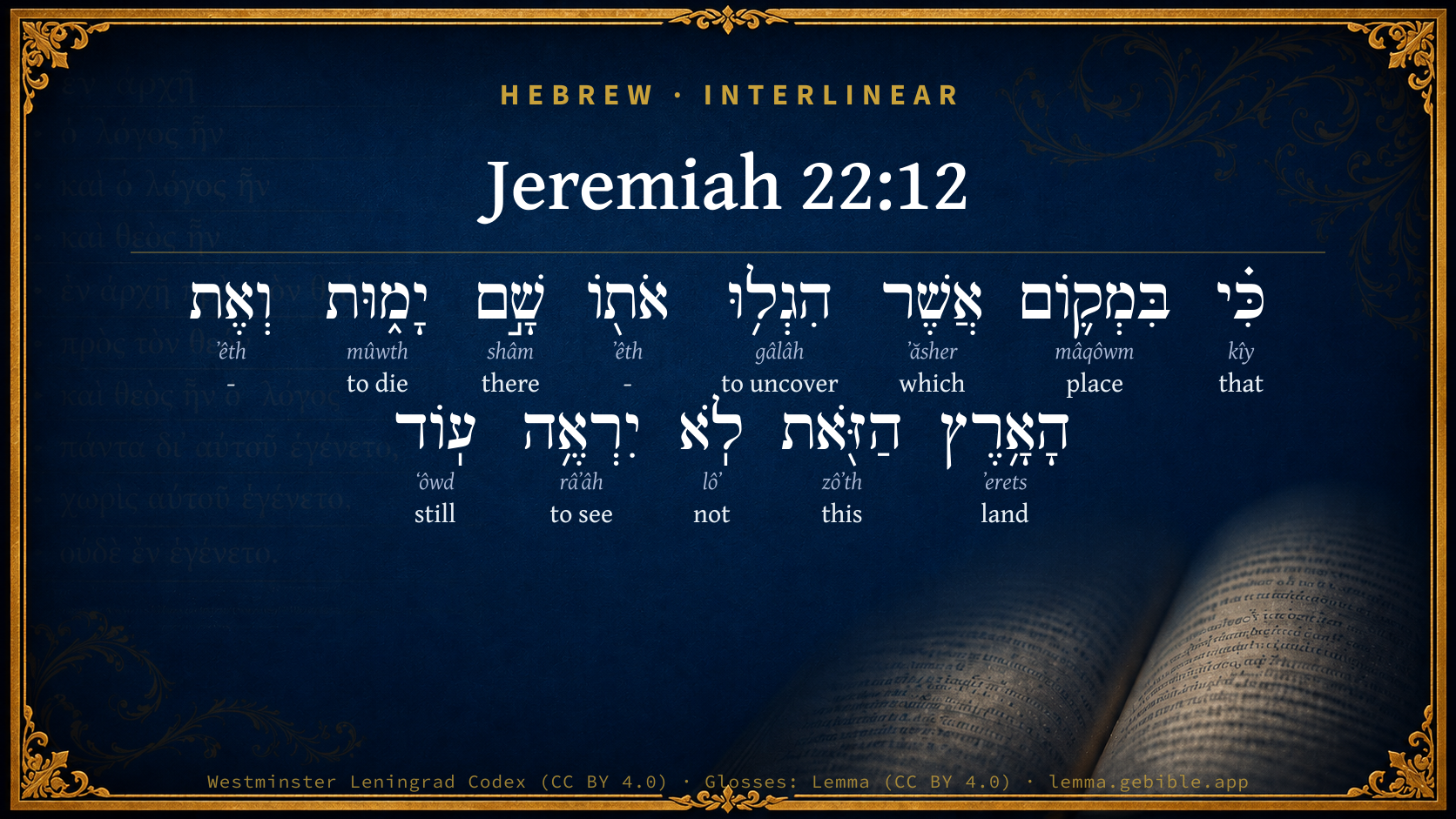
Jeremiah 22:12

Hebrew (Westminster Leningrad Codex) Jeremiah 22:12 appears in the Hebrew Old Testament. The text above is from the Westminster Leningrad Codex. Each word links to its Strong’s number, a concise gloss, and parsing drawn from the Open Scriptures Hebrew Bible morphology. Click any word for its full Brown-Driver-Briggs (BDB) entry.
Download image
Cite this verse

Jeremiah 22:12 (World English Bible). Public Domain. Lemma interlinear Bible study tool, https://lemma.gebible.app/v/jeremiah/22/12.

Show BibTeX & RIS
BibTeX
RIS
English Translation
But in the place where they have led him captive, there shall he die, and he shall see this land no more.
World English Bible · Public Domain
Download a study sheet

One document with this verse’s original text, its word-by-word gloss line, the meaning frame, cross-references with their text, attributed commentary, and full source and license credits — printable, and it pastes into notes with its structure intact.

This verse Autodidact and up

Study sheet (.html) Plain text (.txt)

A passage Seminary Student

Up to 50 verses in one chapter. A passage sheet keeps up to 6 commentary sources and 12 cross-references per verse, in the order this page ranks them, and says so on the sheet whenever that leaves anything out. Ask for a single verse and you get the Autodidact verse sheet above.

Everything on this page stays free to read, with no account — the sheet is a download of what is already on screen, not access to it.

Want to remove ads? Support Godless Engineer
Compare translations 3

The same verse in 3 English versions, stacked beneath the original-language interlinear above. Click any original word for its lexicon entry.

Each is an independent rendering of the whole verse — the interlinear is not word-aligned to these translations.

Highlighted words mark where these versions differ — a whole-verse word diff, not a word-by-word alignment.

  • World English Bible Public Domain
    But in the place where they have led him captive, there shall he die, and he shall see this land no more.
  • King James Version Public Domain
    But he shall die in the place whither they have led him captive, and shall see this land no more.
  • unfoldingWord Literal Text CC BY-SA 4.0
    But in the place where they exiled him, there he shall die, and he will not see this land again.”

unfoldingWord Literal Text — © unfoldingWord, licensed CC BY-SA 4.0. Word-aligned USFM3 via Door43 (git.door43.org/unfoldingWord/en_ult).

Versions to compare (up to 4)

3 of 4 selected

Show all 18 translations

Every available English version of this verse, each an independent rendering of the whole verse.

  • World English Bible Public Domain
    But in the place where they have led him captive, there shall he die, and he shall see this land no more.
  • Berean Standard Bible Public Domain
    but he will die in the place to which he was exiled; he will never see this land again.”
  • Majority Standard Bible Public Domain
    but he will die in the place to which he was exiled; he will never see this land again.”
  • King James Version Public Domain
    But he shall die in the place whither they have led him captive, and shall see this land no more.
  • American Standard Version (1901) Public Domain
    But in the place whither they have led him captive, there shall he die, and he shall see this land no more.
  • Revised Version (1885) Public Domain
    But in the place whither they have led him captive, there shall he die, and he shall see this land no more.
  • Geneva Bible (1599) Public Domain
    But he shall die in the place, whither they haue ledde him captiue, and shall see this lande no more.
  • Douay-Rheims (1899) Public Domain
    But in the place, to which I have removed him, there shall he die, and he shall not see this land any more.
  • Young's Literal Translation Public Domain
    For in the place whither they have removed him he dieth, And this land he doth not see again.
  • Literal Standard Version CC BY-SA 4.0
    For he dies in the place to where they have removed him, || And he does not see this land again.
  • Unlocked Literal Bible CC BY-SA 4.0
    He will die there in the place to where they have exiled him, and he will never again see this land.'
  • unfoldingWord Literal Text CC BY-SA 4.0
    But in the place where they exiled him, there he shall die, and he will not see this land again.”
  • Darby Bible Public Domain
    for he shall die in the place whither they have led him captive, and shall see this land no more.
  • World Messianic Bible Public Domain
    But he will die in the place where they have led him captive. He will see this land no more.”
  • Webster's Bible Public Domain
    But he shall die in the place whither they have led him captive, and shall see this land no more.
  • Free Bible Version CC BY-SA 4.0
    He will die in exile; he will never see this country again.
  • Bible in Basic English Public Domain
    But death will come to him in the place where they have taken him away prisoner, and he will never see this land again.
  • JPS Tanakh (1917) Public Domain
    but in the place whither they have led him captive, there shall he die, and he shall see this land no more.

Literal Standard Version (2020), Covenant Press — licensed CC BY-SA 4.0. Text via the HelloAO Bible API (eBible.org). Unlocked Literal Bible (unfoldingWord) — licensed CC BY-SA 4.0. Text via the HelloAO Bible API (eBible.org). unfoldingWord Literal Text — © unfoldingWord, licensed CC BY-SA 4.0. Word-aligned USFM3 via Door43 (git.door43.org/unfoldingWord/en_ult). Free Bible Version, Dr. Jonathan Gallagher — licensed CC BY-SA 4.0. Text via the HelloAO Bible API (eBible.org).

Word by word

More ways to search: Search by grammar → Find every occurrence → Compare this word →

Practice this passage: Drill this verse → Learn its vocabulary →

הִגְל֥וּ
gâlâh
H1540
“to uncover”
Verb, Hiphil, Perfect, 3rd Person, Common, Plural
Part of Speech
Verb
Stem
Hiphil
Form
Perfect
Person
3rd Person
Gender
Common
Number
Plural
Full BDB Definition

Origin: a primitive root

TWOT: 350

to uncover, remove - (Qal) - to uncover - to remove, depart - to go into exile - (Niphal) - (reflexive) - to uncover oneself - to discover or show oneself - to reveal himself (of God) - (passive) - to be uncovered - to be disclosed, be discovered - to be revealed - to be removed - (Piel) - to uncover (nakedness) - nakedness - general - to disclose, discover, lay bare - to make known, show, reveal - (Pual) to be uncovered - (Hiphil) to carry away into exile, take into exile - (Hophal) to be taken into exile - (Hithpael) - to be uncovered - to reveal oneself
  1. כִּ֗י kîy H3588 “that” Conjunction
  2. בִּמְק֛וֹם mâqôwm H4725 “in/at · place of” Preposition + Noun, Common, Masculine, Singular, Construct
  3. אֲשֶׁר ʼăsher H834 “which” Particle, Relative
  4. אֹת֖וֹ ʼêth H853 “- · him” Particle, Direct Object + Suffix, Personal, 3rd Person, Masculine, Singular
  5. שָׁ֣ם shâm H8033 “there” Adverb
  6. יָמ֑וּת mûwth H4191 “to die” Verb, Qal, Imperfect, 3rd Person, Masculine, Singular
  7. וְאֶת ʼêth H853 “and · -” Conjunction + Particle, Direct Object
  8. הָאָ֥רֶץ ʼerets H776 “the · land” Particle, Definite Article + Noun, Common, Both, Singular, Absolute
  9. הַזֹּ֖את zôʼth H2063 “the · this” Particle, Definite Article + Pronoun, Demonstrative, Feminine, Singular
  10. לֹֽא lôʼ H3808 “not” Particle, Negative
  11. יִרְאֶ֥ה râʼâh H7200 “to see” Verb, Qal, Imperfect, 3rd Person, Masculine, Singular
  12. עֽוֹד ʻôwd H5750 “still” Adverb

About this verse

These counts appear in no published source. They are computed here, from the morphology-tagged text and Lemma’s own curated glosses. What Lemma adds →

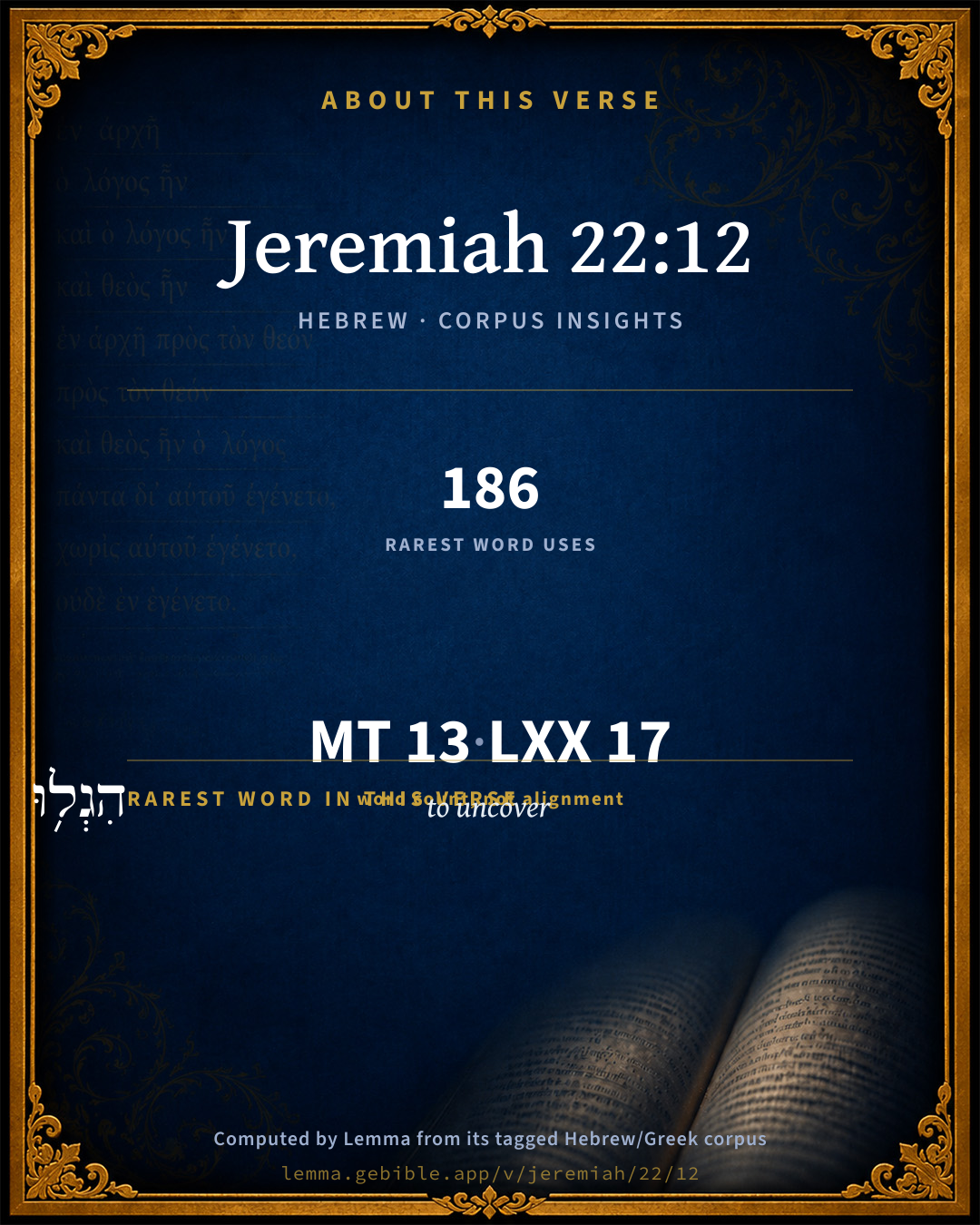
13
words
12
distinct lemmas
Prophets
section

Grammatical profile

  • 3 verbs
  • 2 nouns
  • 1 pronoun
  • 1 conjunction
  • 2 adverbs
  • 4 particles

Verb forms

  • הִגְל֥וּ Hiphil · Perfect
  • יָמ֑וּת Qal · Imperfect
  • יִרְאֶ֥ה Qal · Imperfect

Hebrew & Septuagint length

In the original languages it is 13 Hebrew tokens and 17 Greek tokens — but the two are counted differently (Hebrew bundles its prefixes and suffixes into one token; the Greek is in lemma form), so that isn’t a like-for-like length.

Cross-references

2

Topical passages linked to Jeremiah 22:12 in the Treasury of Scripture Knowledge — connected by theme and wording, ordered by reader-vote popularity; previews shown in the World English Bible.

  • 2 Kings 23:34 Pharaoh Necoh made Eliakim the son of Josiah king in the room of Josiah his father, and changed his name to Jehoiakim: but he took Jehoahaz away; and he came to Egypt, and died there.
  • Jeremiah 22:18 Therefore thus says Yahweh concerning Jehoiakim the son of Josiah, king of Judah: they shall not lament for him, [saying], Ah my brother! or, Ah sister! They shall not lament for him, [saying] Ah lord! or, Ah his glory!

Cross-references courtesy of OpenBible.info (CC BY 4.0).

Hebrew and Greek witnesses Masoretic Hebrew ↔ Greek Septuagint

The same verse in the two great witnesses to the Old Testament, shown verse-for-verse.

These are two independent witnesses, not word-aligned to each other, and the Septuagint is shown in lemma (dictionary) form.

Hebrew Jeremiah 22:12 Masoretic · Westminster Leningrad Codex

כִּ֗י בִּמְק֛וֹם אֲשֶׁר הִגְל֥וּ אֹת֖וֹ שָׁ֣ם יָמ֑וּת וְאֶת הָאָ֥רֶץ הַזֹּ֖את לֹֽא יִרְאֶ֥ה עֽוֹד

But in the place where they have led him captive, there shall he die, and he shall see this land no more.

World English Bible · Public Domain

Greek LXX Structure differs

In the Septuagint, Jeremiah is about an eighth shorter than the Hebrew and arranges its material differently — the Oracles Against the Nations (Hebrew chapters 46–51) appear in the middle of the Greek book, after 25:13. Because the chapter and verse boundaries do not line up, a verse-for-verse comparison with the Hebrew is not shown.

A verse-for-verse comparison isn’t shown here because the chapters and verses don’t line up. Switch to the LXX edition with the MT / LXX toggle above to read the Greek directly.

Hebrew: Westminster Leningrad Codex (CC BY 4.0). Greek: Septuagint (public domain); English from a public-domain English Septuagint. How the Septuagint differs from the Hebrew →

Targum (Aramaic paraphrase)

1

The Targum is the ancient Jewish Aramaic paraphrase of the Hebrew Scriptures — an interpretive translation, not the Hebrew text itself. Onkelos (literal) and Pseudo-Jonathan (expansive) render the Torah, and Jonathan the Prophets. Coverage is partial: where no permissively-licensed English translation exists for a verse, only the Aramaic is shown. This is verse-level text, not a word-by-word alignment to the Hebrew.

  1. Targum Jonathan Prophets (Joshua–Malachi)
    אֱלָהֵין בְּאַתְרָא דְאַגְלִיאוּ יָתֵיהּ תַּמָן יְמוּת וְיַת אַרְעָא הָדָא לָא יֶחְזֵי עוֹד:

    (no public-domain English translation for this verse)

    Targum Jonathan — Aramaic: “Mikraot Gedolot” (public domain). English: “Sefaria Community Translation” (CC0 1.0 (public-domain dedication)); “London "Chaldee Paraphrase," 1871” (public domain). Text via Sefaria.

Commentary

Notes on Jeremiah 22:12 from classic Christian and Jewish commentators (each source and its license shown beneath its notes). The classic Christian expositions comment on the surrounding passage and are grouped to its opening verse, so a note may address several verses; the Jewish commentaries on the Tanakh (Rashi and others) are per-verse, so they appear only where the commentator wrote on this verse.

Lemma curates 59 commentaries, every one of them public domain or Creative Commons licensed, each selected and text-cleaned for this edition rather than reprinted as found. About our sources →

Trapp's Complete Commentary

John Trapp

Jer 22:12 But he shall die in the place whither they have led him captive, and shall see this land no more.

Ver. 12. But he shall die in the place.] See on Jer 22:11.

John Trapp, A Commentary or Exposition upon All the Books of the Old and New Testament (1647–1656) — public domain. Text from a community e-Sword module.

Ellicott's Commentary for English Readers

(12) Shall see this land no more.—There is no record of the duration of the life of Shallum in his Egyptian exile, but the total absence of his name in the history that follows is presumptive evidence of the fulfilment of the prediction. There is no trace of his being alive when the prophet is dragged by his countrymen to Egypt (Jer_43:6-7).

A Bible Commentary for English Readers, edited by Charles John Ellicott (1878–1897) — public domain. Text from a community e-Sword module.

John Gill's Exposition

But he shall die in the place whither they have led him captive,.... Even in Egypt, where Pharaohnecho and his army carried him captive, as before observed:

and he shall see his land no more; the land of Judah, where he was born, and over which he had been king: this is repeated to show the certainty of it, and what reason there was for the above lamentation; since the people might have been in hopes of the return of him, but now they are assured they had no ground for it; who, though he was not a good prince, yet perhaps not so bad as his brother Jehoiakim, who succeeded him; who appears, by what follows, to have been a very unjust, tyrannical, and oppressive prince; and therefore there was great occasion for mourning on the account of Shallum, who very likely was more promising.

John Gill's Exposition of the Whole Bible (1746–1763) — public domain (CC PDM 1.0). Text via the HelloAO Bible API.

Matthew Poole's English Annotations

So as he returned no more to see his native country, as is there said. But others think this Shallum was Josiah’s fourth son, that Johanan died before his father, and the people made Shallum his youngest son king, calling him Jehoahaz, so as he reigned immediately after Josiah.

Matthew Poole's English Annotations on the Holy Bible (1683–1685) — public domain. Text from a community e-Sword/MySword module.

Lesson kit

Teaching starters — assembled from the data on this page, not authored interpretation. Every prompt links to the verse data it draws on. Edit before teaching.

Jeremiah, in the Prophets, opens this verse with 13 words (12 distinct Hebrew lemmas). Its most distinctive word is gâlâh (“to uncover”). A historical commentator’s framing appears above. Read the whole chapter for the surrounding context.

Discussion questions

  1. How does “to uncover” (gâlâh) shape what this verse is saying?
  2. 2 Kings 23:34 shares this passage’s theme. How do the two illuminate each other?
  3. These translations render this verse differently; the difference is in the English rendering, not the original. What questions does that raise?
  4. The verb «הִגְל֥וּ» is Hiphil Perfect. How does its form color the action?
  5. Reading how Trapp's Complete Commentary and Ellicott's Commentary for English Readers read this verse, where do the two commentators agree and where do they part?

Things to notice

Reading settings

Reading text

Shown beneath each verse's original-language words.

Old Testament
Old Testament edition

Read the OT as the Masoretic Hebrew (MT) or the Greek Septuagint (LXX).

English shown for the Greek Septuagint (in the Hebrew ↔ Greek comparison).

Comparing translations? Open the Compare panel on any verse page to stack up to four side by side.