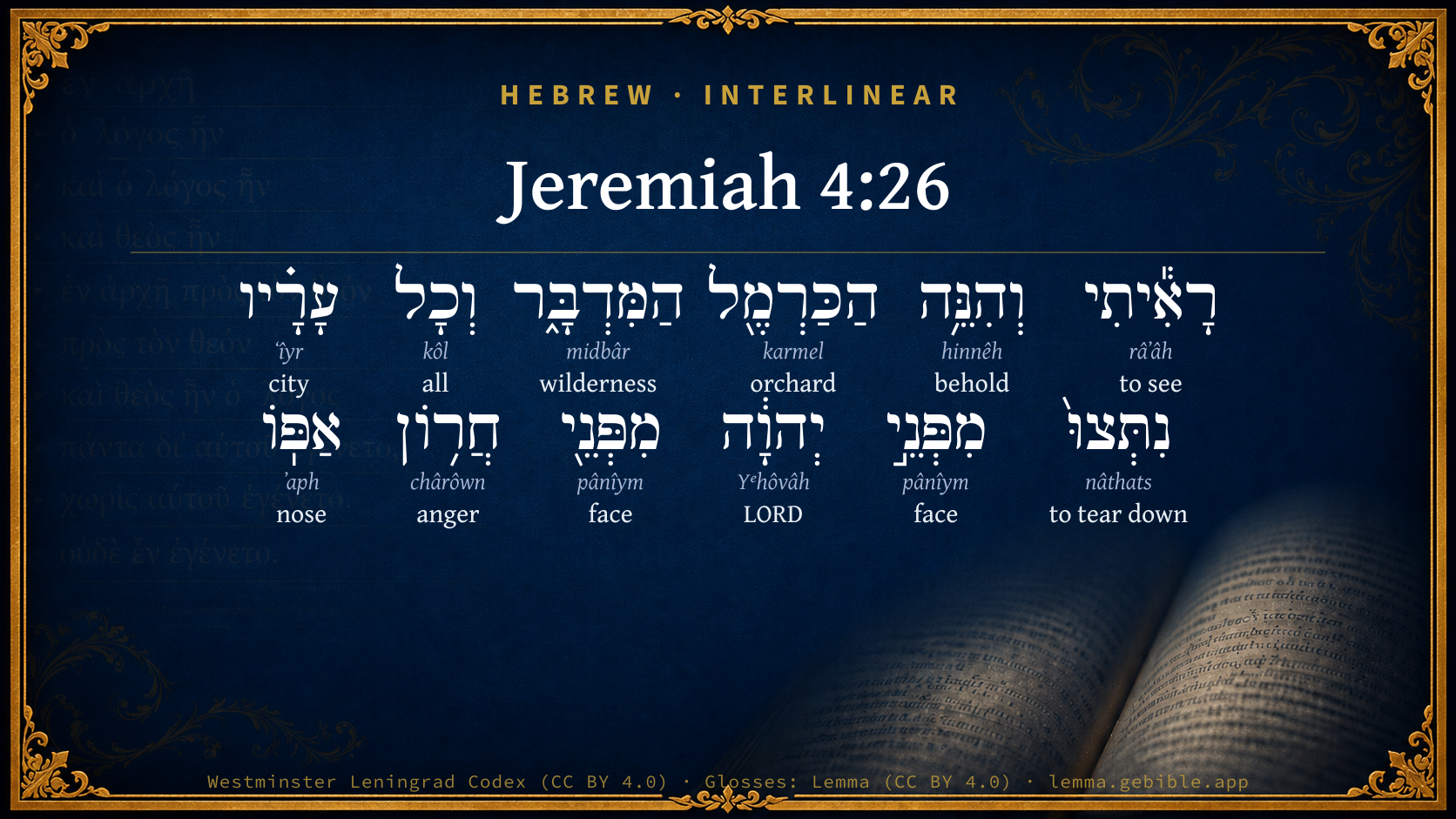
Jeremiah 4:26

Hebrew (Westminster Leningrad Codex) Jeremiah 4:26 appears in the Hebrew Old Testament. The text above is from the Westminster Leningrad Codex. Each word links to its Strong’s number, a concise gloss, and parsing drawn from the Open Scriptures Hebrew Bible morphology. Click any word for its full Brown-Driver-Briggs (BDB) entry.
Download image
Cite this verse

Jeremiah 4:26 (World English Bible). Public Domain. Lemma interlinear Bible study tool, https://lemma.gebible.app/v/jeremiah/4/26.

Show BibTeX & RIS
BibTeX
RIS
English Translation
I saw, and, behold, the fruitful field was a wilderness, and all the cities of it were broken down at the presence of Yahweh, [and] before his fierce anger.
World English Bible · Public Domain
Download a study sheet

One document with this verse’s original text, its word-by-word gloss line, the meaning frame, cross-references with their text, attributed commentary, and full source and license credits — printable, and it pastes into notes with its structure intact.

This verse Autodidact and up

Study sheet (.html) Plain text (.txt)

A passage Seminary Student

Up to 50 verses in one chapter. A passage sheet keeps up to 6 commentary sources and 12 cross-references per verse, in the order this page ranks them, and says so on the sheet whenever that leaves anything out. Ask for a single verse and you get the Autodidact verse sheet above.

Everything on this page stays free to read, with no account — the sheet is a download of what is already on screen, not access to it.

Want to remove ads? Support Godless Engineer
Compare translations 3

The same verse in 3 English versions, stacked beneath the original-language interlinear above. Click any original word for its lexicon entry.

Each is an independent rendering of the whole verse — the interlinear is not word-aligned to these translations.

Highlighted words mark where these versions differ — a whole-verse word diff, not a word-by-word alignment.

  • World English Bible Public Domain
    I saw, and, behold, the fruitful field was a wilderness, and all the cities of it were broken down at the presence of Yahweh, [and] before his fierce anger.
  • King James Version Public Domain
    I beheld, and, lo, the fruitful place was a wilderness, and all the cities thereof were broken down at the presence of the LORD, and by his fierce anger.
  • unfoldingWord Literal Text CC BY-SA 4.0
    I saw, and behold, the orchard the wilderness, and all the cities had been pulled down before the face of Yahweh, before the face of the fury of his nose.”

unfoldingWord Literal Text — © unfoldingWord, licensed CC BY-SA 4.0. Word-aligned USFM3 via Door43 (git.door43.org/unfoldingWord/en_ult).

Versions to compare (up to 4)

3 of 4 selected

Show all 18 translations

Every available English version of this verse, each an independent rendering of the whole verse.

  • World English Bible Public Domain
    I saw, and, behold, the fruitful field was a wilderness, and all the cities of it were broken down at the presence of Yahweh, [and] before his fierce anger.
  • Berean Standard Bible Public Domain
    I looked, and the fruitful land was a desert. All its cities were torn down before the LORD, before His fierce anger.
  • Majority Standard Bible Public Domain
    I looked, and the fruitful land was a desert. All its cities were torn down before the LORD, before His fierce anger.
  • King James Version Public Domain
    I beheld, and, lo, the fruitful place was a wilderness, and all the cities thereof were broken down at the presence of the LORD, and by his fierce anger.
  • American Standard Version (1901) Public Domain
    I beheld, and, lo, the fruitful field was a wilderness, and all the cities thereof were broken down at the presence of Jehovah, `and' before his fierce anger.
  • Revised Version (1885) Public Domain
    I beheld, and, lo, the fruitful field was a wilderness, and all the cities thereof were broken down at the presence of the LORD, and before his fierce anger.
  • Geneva Bible (1599) Public Domain
    I behelde, and loe, the fruitfull place was a wildernesse, and all the cities thereof were broken downe at the presence of the Lord, and by his fierce wrath.
  • Douay-Rheims (1899) Public Domain
    I looked, and behold Carmel was a wilderness: and all its cities were destroyed at the presence of the Lord, and at the presence of the wrath of his indignation.
  • Young's Literal Translation Public Domain
    I have looked, and lo, The fruitful place `is' a wilderness, And all its cities have been broken down, Because of Jehovah, Because of the fierceness of His anger.
  • Literal Standard Version CC BY-SA 4.0
    I have looked, and behold, || The fruitful place [is] a wilderness, || And all its cities have been broken down, || Because of YHWH, || Because of the fierceness of His anger.
  • Unlocked Literal Bible CC BY-SA 4.0
    I looked. Behold, the orchards were a wilderness and all the cities had been pulled down before Yahweh, before the fury of his wrath.”
  • unfoldingWord Literal Text CC BY-SA 4.0
    I saw, and behold, the orchard the wilderness, and all the cities had been pulled down before the face of Yahweh, before the face of the fury of his nose.”
  • Darby Bible Public Domain
    I beheld, and lo, the fruitful land was a wilderness, and all the cities thereof were broken down, before Jehovah, before his fierce anger.
  • World Messianic Bible Public Domain
    I saw, and behold, the fruitful field was a wilderness, and all its cities were broken down at the presence of the LORD, before his fierce anger.
  • Webster's Bible Public Domain
    I beheld, and lo, the fruitful place was a wilderness, and all its cities were broken down at the presence of the LORD, and by his fierce anger.
  • Free Bible Version CC BY-SA 4.0
    I looked, and the productive fields were a desert. All the towns were demolished because of the Lord's furious anger.
  • Bible in Basic English Public Domain
    Looking, I saw that the fertile field was a waste, and all its towns were broken down before the Lord and before his burning wrath.
  • JPS Tanakh (1917) Public Domain
    I beheld, and, lo, the fruitful field was a wilderness, and all the cities thereof were broken down at the presence of the LORD, and before His fierce anger.

Literal Standard Version (2020), Covenant Press — licensed CC BY-SA 4.0. Text via the HelloAO Bible API (eBible.org). Unlocked Literal Bible (unfoldingWord) — licensed CC BY-SA 4.0. Text via the HelloAO Bible API (eBible.org). unfoldingWord Literal Text — © unfoldingWord, licensed CC BY-SA 4.0. Word-aligned USFM3 via Door43 (git.door43.org/unfoldingWord/en_ult). Free Bible Version, Dr. Jonathan Gallagher — licensed CC BY-SA 4.0. Text via the HelloAO Bible API (eBible.org).

Word by word

More ways to search: Search by grammar → Find every occurrence → Compare this word →

Practice this passage: Drill this verse → Learn its vocabulary →

הַכַּרְמֶ֖ל
karmel
H3759
“the · orchard”
Particle, Definite Article + Noun, Common, Masculine, Singular, Absolute
Part of Speech
Particle + Noun
Type
Common
Gender
Masculine
Number
Singular
State
Absolute
Full BDB Definition

Origin: from H3754

TWOT: 1041

plantation, garden-land, orchard, fruit orchard - fruit, garden-growth (metonymy)
  1. רָאִ֕יתִי râʼâh H7200 “to see” Verb, Qal, Perfect, 1st Person, Common, Singular
  2. וְהִנֵּ֥ה hinnêh H2009 “and · behold” Conjunction + Particle, Demonstrative
  3. הַמִּדְבָּ֑ר midbâr H4057 “the · wilderness” Particle, Definite Article + Noun, Common, Masculine, Singular, Absolute
  4. וְכָל kôl H3605 “and · all of” Conjunction + Noun, Common, Masculine, Singular, Construct
  5. עָרָ֗יו ʻîyr H5892 “cities · his” Noun, Common, Feminine, Plural, Construct + Suffix, Personal, 3rd Person, Masculine, Singular
  6. נִתְּצוּ֙ nâthats H5422 “to tear down” Verb, Niphal, Perfect, 3rd Person, Common, Plural
  7. מִפְּנֵ֣י pânîym H6440 “from · face(s) of” Preposition + Noun, Common, Both, Plural, Construct
  8. יְהוָ֔ה Yᵉhôvâh H3068 “LORD” Noun, Proper
  9. מִפְּנֵ֖י pânîym H6440 “from · face(s) of” Preposition + Noun, Common, Both, Plural, Construct
  10. חֲר֥וֹן chârôwn H2740 “anger of” Noun, Common, Masculine, Singular, Construct
  11. אַפּֽוֹ ʼaph H639 “nose · his” Noun, Common, Masculine, Singular, Construct + Suffix, Personal, 3rd Person, Masculine, Singular

About this verse

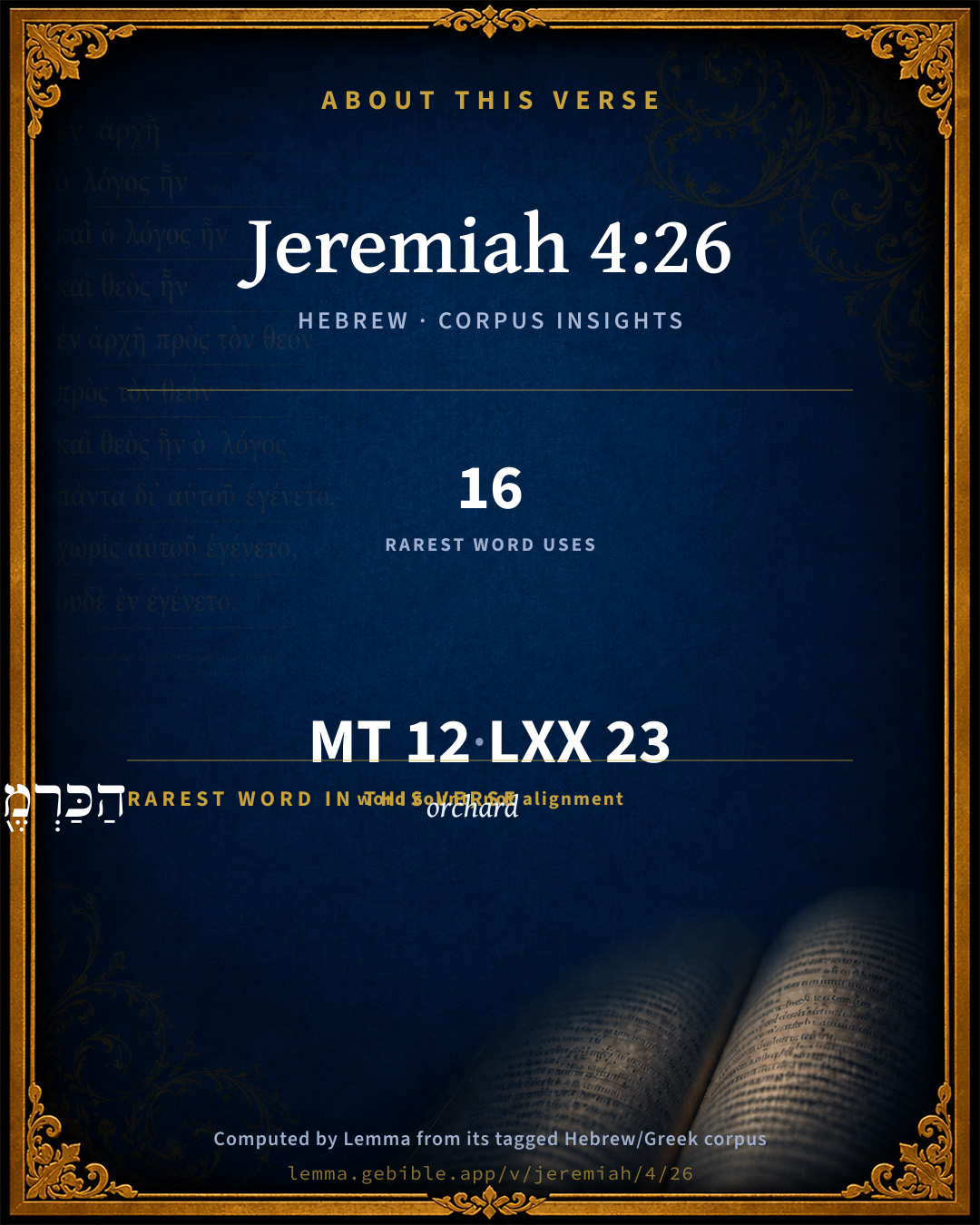
These counts appear in no published source. They are computed here, from the morphology-tagged text and Lemma’s own curated glosses. What Lemma adds →

12
words
11
distinct lemmas
Prophets
section

Notable vocabulary

The rarest word here is הַכַּרְמֶ֖ל orchard H3759 — appearing just 16 times in the whole Hebrew Bible.

Shared distinctive vocabulary

הַכַּרְמֶ֖ל orchard H3759 occurs in 13 verses of the Hebrew Bible. Also found in:

Grammatical profile

  • 2 verbs
  • 9 nouns
  • 1 particle

Verb forms

  • רָאִ֕יתִי Qal · Perfect
  • נִתְּצוּ֙ Niphal · Perfect

Repetition

A word recurs within this verse — often emphatic in Hebrew:

  • מִפְּנֵ֣י face H6440 ×2

Hebrew & Septuagint length

In the original languages it is 12 Hebrew tokens and 23 Greek tokens — but the two are counted differently (Hebrew bundles its prefixes and suffixes into one token; the Greek is in lemma form), so that isn’t a like-for-like length.

Cross-references

8

Topical passages linked to Jeremiah 4:26 in the Treasury of Scripture Knowledge — connected by theme and wording, ordered by reader-vote popularity; previews shown in the World English Bible.

  • Psalms 107:34 And a fruitful land into a salt waste, For the wickedness of those who dwell in it.
  • Deuteronomy 29:23–28 [and that] the whole land of it is sulfur, and salt, [and] a burning, [that] it is not sown, nor bears, nor any grass grows therein, like the overthrow of Sodom and Gomorrah, Admah and Zeboiim, which Yahweh overthrew in his anger, and in his wrath:
  • Psalms 76:7 You, even you, are to be feared. Who can stand in your sight when you are angry?
  • Isaiah 5:9–10 In my ears, Yahweh of Hosts says: "Surely many houses will be desolate, Even great and beautiful, unoccupied.
  • Isaiah 7:20–25 In that day the Lord will shave with a razor that is hired in the parts beyond the River, even with the king of Assyria, the head and the hair of the feet; and it shall also consume the beard.
  • Jeremiah 12:4 How long shall the land mourn, and the herbs of the whole country wither? for the wickedness of those who dwell therein, the animals are consumed, and the birds; because they said, He shall not see our latter end.
  • Jeremiah 14:2–6 Judah mourns, and the gates of it languish, they sit in black on the ground; and the cry of Jerusalem is gone up.
  • Micah 3:12 Therefore Zion for your sake will be plowed like a field, And Jerusalem will become heaps of rubble, And the mountain of the temple like the high places of a forest.

Cross-references courtesy of OpenBible.info (CC BY 4.0).

Hebrew and Greek witnesses Masoretic Hebrew ↔ Greek Septuagint

The same verse in the two great witnesses to the Old Testament, shown verse-for-verse.

These are two independent witnesses, not word-aligned to each other, and the Septuagint is shown in lemma (dictionary) form.

Hebrew Jeremiah 4:26 Masoretic · Westminster Leningrad Codex

רָאִ֕יתִי וְהִנֵּ֥ה הַכַּרְמֶ֖ל הַמִּדְבָּ֑ר וְכָל עָרָ֗יו נִתְּצוּ֙ מִפְּנֵ֣י יְהוָ֔ה מִפְּנֵ֖י חֲר֥וֹן אַפּֽוֹ

I saw, and, behold, the fruitful field was a wilderness, and all the cities of it were broken down at the presence of Yahweh, [and] before his fierce anger.

World English Bible · Public Domain

Greek LXX Structure differs

In the Septuagint, Jeremiah is about an eighth shorter than the Hebrew and arranges its material differently — the Oracles Against the Nations (Hebrew chapters 46–51) appear in the middle of the Greek book, after 25:13. Because the chapter and verse boundaries do not line up, a verse-for-verse comparison with the Hebrew is not shown.

A verse-for-verse comparison isn’t shown here because the chapters and verses don’t line up. Switch to the LXX edition with the MT / LXX toggle above to read the Greek directly.

Hebrew: Westminster Leningrad Codex (CC BY 4.0). Greek: Septuagint (public domain); English from a public-domain English Septuagint. How the Septuagint differs from the Hebrew →

Targum (Aramaic paraphrase)

1

The Targum is the ancient Jewish Aramaic paraphrase of the Hebrew Scriptures — an interpretive translation, not the Hebrew text itself. Onkelos (literal) and Pseudo-Jonathan (expansive) render the Torah, and Jonathan the Prophets. Coverage is partial: where no permissively-licensed English translation exists for a verse, only the Aramaic is shown. This is verse-level text, not a word-by-word alignment to the Hebrew.

  1. Targum Jonathan Prophets (Joshua–Malachi)
    חֲזֵיתִי וְהָא אַרְעָא דְיִשְׂרָאֵל דַהֲוָה מְנַצְבָא כְּכַרְמֶלָא תָּבַת לְמֶהֱוֵי בְּמַדְבְּרָא וְכָל קִרְוָהָא צָדִיאָה מִן קֳדָם יְיָ מִן קֳדָם תְּקוֹף רוּגְזֵיהּ:

    (no public-domain English translation for this verse)

    Targum Jonathan — Aramaic: “Mikraot Gedolot” (public domain). English: “Sefaria Community Translation” (CC0 1.0 (public-domain dedication)); “London "Chaldee Paraphrase," 1871” (public domain). Text via Sefaria.

Commentary

Notes on Jeremiah 4:26 from classic Christian and Jewish commentators (each source and its license shown beneath its notes). The classic Christian expositions comment on the surrounding passage and are grouped to its opening verse, so a note may address several verses; the Jewish commentaries on the Tanakh (Rashi and others) are per-verse, so they appear only where the commentator wrote on this verse.

Lemma curates 59 commentaries, every one of them public domain or Creative Commons licensed, each selected and text-cleaned for this edition rather than reprinted as found. About our sources →

Trapp's Complete Commentary

John Trapp

Jer 4:26 I beheld, and, lo, the fruitful place [was] a wilderness, and all the cities thereof were broken down at the presence of the LORD, [and] by his fierce anger.

Ver. 26. At the presence of the Lord, &c.] Who was the chief agent; as Titus the Roman emperor also acknowledged after be had destroyed Jerusalem: Non se id fecisse dixit, sed Deo iram suam declaranti manus suas accommodasse; { a} he said it was not he that had done it, but that he had only lent his hands to God, justly displeased at that nation.

{a} Suidas.

John Trapp, A Commentary or Exposition upon All the Books of the Old and New Testament (1647–1656) — public domain. Text from a community e-Sword module.

Jamieson, Fausset & Brown

Robert Jamieson, A. R. Fausset & David Brown

fruitful place--Hebrew, Carmel.

a wilderness--Hebrew, "the wilderness," in contrast to "the fruitful place"; the great desert, where Carmel was, there is now the desert of Arabia [MAURER].

cities--in contrast to the fruitful place or field.

Jamieson, Fausset & Brown — Commentary Critical and Explanatory on the Whole Bible (1871) — public domain (CC PDM 1.0). Text via the HelloAO Bible API.

John Calvin's Commentaries

What he saw the fourth time was this — that the fertile land was turned into a desert. I indeed think that Carmel is to be taken here as meaning the place. That part of the holy land, we know, received its name from its fertility: Carmel means any rich and fruitful spot of ground. But, as I have just said, the mount was so called because it abounded in all kinds of produce; for there were on it fruitful pastures and fertile fields, and every part of it was remarkably pleasant and delightful. I am therefore inclined to consider Carmel itself to be meant here; and my reason is, because he immediately adds, that its cities were destroyed; and this can be more fitly applied to Carmel than generally to all fruitful regions. As to myself, I think that the Prophet speaks of Carmel; and yet he alludes to what the word means. Even in this verse he mentions a part for the whole, as though he had said, that Carmel, which excelled in fertility, had become like a desert. When Isaiah speaks of the renovation of the Church, he says,

“The desert shall be as Carmel,“ (Isaiah 32:15)

as though he had said, that the blessing of God would be so abundant through the whole world, that deserts would bear fruit like Carmel, or those regions which are remarkable for their fertility. But Jeremiah, speaking here of a curse, says, that Carmel would be like the desert; and that all its cities would be demolished, even at the presence of Jehovah, and by the great heat of his wrath

Some render חרון, charun, fury: and this kind of language is not without its use; for men, as we have said, except God terrifies them as it were by thunders, will sleep and will not perceive his judgment, so that all threatenings become useless to them. This is the reason why Scripture speaks so often of the fury or of the great heat of God’s wrath. Either of the two words might indeed be sufficient; either חרון, charun, which means fury or great heat; or אף aph, which signifies anger or wrath. Why then are both mentioned? because it is necessary, as I have said, to tear in pieces our hardness as with hammers; for otherwise God could never turn us to fear him. This repetition then ought to avail for the purpose of subduing the perverseness of our nature; not that these turbulent feelings belong to God, as it is well known; but as we cannot otherwise conceive how dreadful his vengeance is, it is necessary that he should be set before us as one who is angry and burning with wrath: in a like manner, eternal death is described to us under the metaphor of fire.

Now, as to the sum of what is here said, the Jews at that time no doubt enjoyed great abundance and indulged their pleasures; in short, they were fully pleased with their condition. But the Prophet here declares that he saw at a distance what these blind Jews did not see, even God’s vengeance approaching, which would deprive them of that abundance, on account of which they were so swollen with pride, and which would reduce them all into such a state of desolation that nothing would remain above or below, but a disordered confusion, such as existed before nature was brought to order, when the earth was not separated from the heavens, and there was only a confused mass, including all the elements, and without any light. He afterwards adds —

John Calvin's Commentaries (1540-1563) — public domain. Text from the Calvin Translation Society English edition (1840s-50s) via the Christian Classics Ethereal Library (ccel.org). Calvin's coverage is partial (roughly two-thirds of the Bible); uncommented books and verses are honest gaps, never fabricated. The 19th-century editor's footnotes and remarks are omitted so the notes are faithfully Calvin's own voice.

Ellicott's Commentary for English Readers

(26) The fruitful place.—The Carmel, or vine-land, became as “the wilderness.” The Hebrew article points probably to the well-known desert of the wanderings.

At the presence of the Lord.—Literally, from before Jehovah, from before the heat of his anger. The original has the emphasis of repeating the preposition.

A Bible Commentary for English Readers, edited by Charles John Ellicott (1878–1897) — public domain. Text from a community e-Sword module.

The Cambridge Bible for Schools and Colleges

gen. ed. J. J. S. Perowne

26. the fruitful field] mg. Heb. Carmel (see Jer_2:7), but meaning here the most fruitful portions of the land in general.

The Cambridge Bible for Schools and Colleges (gen. ed. J. J. S. Perowne; Cambridge University Press, 1878–1918) — public domain. Text from a community e-Sword module.

John Gill's Exposition

I beheld, and, lo, the fruitful place was a wilderness,.... Or, "I beheld, and, lo, Carmel was a wilderness"; which was a particular part of the land of Israel, and was very fertile, and abounded in pastures and fruit trees, and yet this, as the rest, became desolate as a wilderness; see Isa 32:15 though it may be put for the whole land, which was very fruitful; and so the Targum,

"I saw, and, lo, the land of Israel, which was planted as Carmel, was turned to be as a wilderness:''

and all the cities thereof; not of Carmel only, but of the whole land:

were broken down at the presence of the Lord, and by his fierce anger; for though this was done by the Chaldeans, yet it was by the will and appointment of God, and as a token of his fierce anger against the people of the Jews, for their sins and transgressions. Jarchi cites a Midrash Agadah, or an allegorical exposition of this place, which interprets the "mountains", the Jewish fathers; the "hills", the mothers, and their merits; "no man", the worthiness of Moses, who was meeker than any man; and "Carmel", Elijah; without any manner of foundation.

John Gill's Exposition of the Whole Bible (1746–1763) — public domain (CC PDM 1.0). Text via the HelloAO Bible API.

Haydock's Catholic Bible Commentary

Carmel: the beautiful country of Palestine, (Haydock) Jerusalem, (Theodoret) or the mountain so called.

George Leo Haydock (1774–1849), Haydock's Catholic Family Bible and Commentary, 1859 edition — public domain. Excludes Psalms (Douay-Rheims chapter numbering differs from Protestant) and Deuterocanonical books (Catholic canon only).

Matthew Poole's English Annotations

The fruitful place, Heb. Carmel, either properly, for that part of the land so called for its fruitfulness; or rather appellatively, for not only their most pleasant, but most fruitful lands, that were kept dressed and occupied for food, both for necessity and delight, Jer 4:27; Isa 29:17; 33:9.

All the cities thereof were broken down; no place left for men to inhabit, Isa 1:7.

By his fierce anger; that which the enemy could not have done with all his fury and fierceness, had it not been for the anger of the Lord, which by their great provocation they had brought upon them. selves, 2Ki 24:3; Jer 9:12,13.

Matthew Poole's English Annotations on the Holy Bible (1683–1685) — public domain. Text from a community e-Sword/MySword module.

The Pulpit Commentary

The fruitful place; rather, the garden-land. (see on Jer_2:7) Not "the Carmel" (Keil, Payne Smith) for the context refers to the whole of the country, not to any single tract. The article before the two appellatives is the generic. At the presence of; rather, by reason of.

The Pulpit Commentary (1880–1919), ed. H.D.M. Spence-Jones & Joseph S. Exell — public domain. Text from a community e-Sword module.

Rashi

Rabbi Shlomo Yitzchaki (Rashi)

and behold, the fruitful field The land, planted with all good like a forest, has become like a desert. The Midrash Aggadah states: “I saw the mountains”These are the Patriarchs. “And all the hills”These are the Matriarchs. That is to say that their merit was depleted. “There were no people”This refers to Moses, about whom it is said: “humbler than all the people” (Num. 12:3). “And behold the Karmel”This is Elijah.

Rashi on the Tanakh — English translations: “The Judaica Press complete Tanach with Rashi, translated by A. J. Rosenberg” (CC BY 4.0); “Pentateuch with Rashi's commentary by M. Rosenbaum and A.M. Silbermann, 1929-1934” (public domain); “The Metsudah Tanach series, Lakewood, N.J” (CC BY 4.0); and “The Book of Joshua, Metsudah Publications, 1997” (CC BY 4.0). Text via Sefaria.

Lesson kit

Teaching starters — assembled from the data on this page, not authored interpretation. Every prompt links to the verse data it draws on. Edit before teaching.

Jeremiah, in the Prophets, opens this verse with 12 words (11 distinct Hebrew lemmas). Its most distinctive word is karmel (“orchard”). A historical commentator’s framing appears above. Read the whole chapter for the surrounding context.

Discussion questions

  1. How does “orchard” (karmel) shape what this verse is saying?
  2. How does Leviticus 2:14, which shares the word «orchard», read alongside this verse?
  3. What does the repetition of “face” (2× in this one verse) do in this verse?
  4. These translations render this verse differently. What is at stake in choosing one wording over another?
  5. «רָאִ֕יתִי» is a Qal Perfect verb. How does that grammatical form shape the action described?
  6. Compare how Trapp's Complete Commentary and Jamieson, Fausset & Brown read this verse. Where do they agree or differ?

Things to notice

Reading settings

Reading text

Shown beneath each verse's original-language words.

Old Testament
Old Testament edition

Read the OT as the Masoretic Hebrew (MT) or the Greek Septuagint (LXX).

English shown for the Greek Septuagint (in the Hebrew ↔ Greek comparison).

Comparing translations? Open the Compare panel on any verse page to stack up to four side by side.