
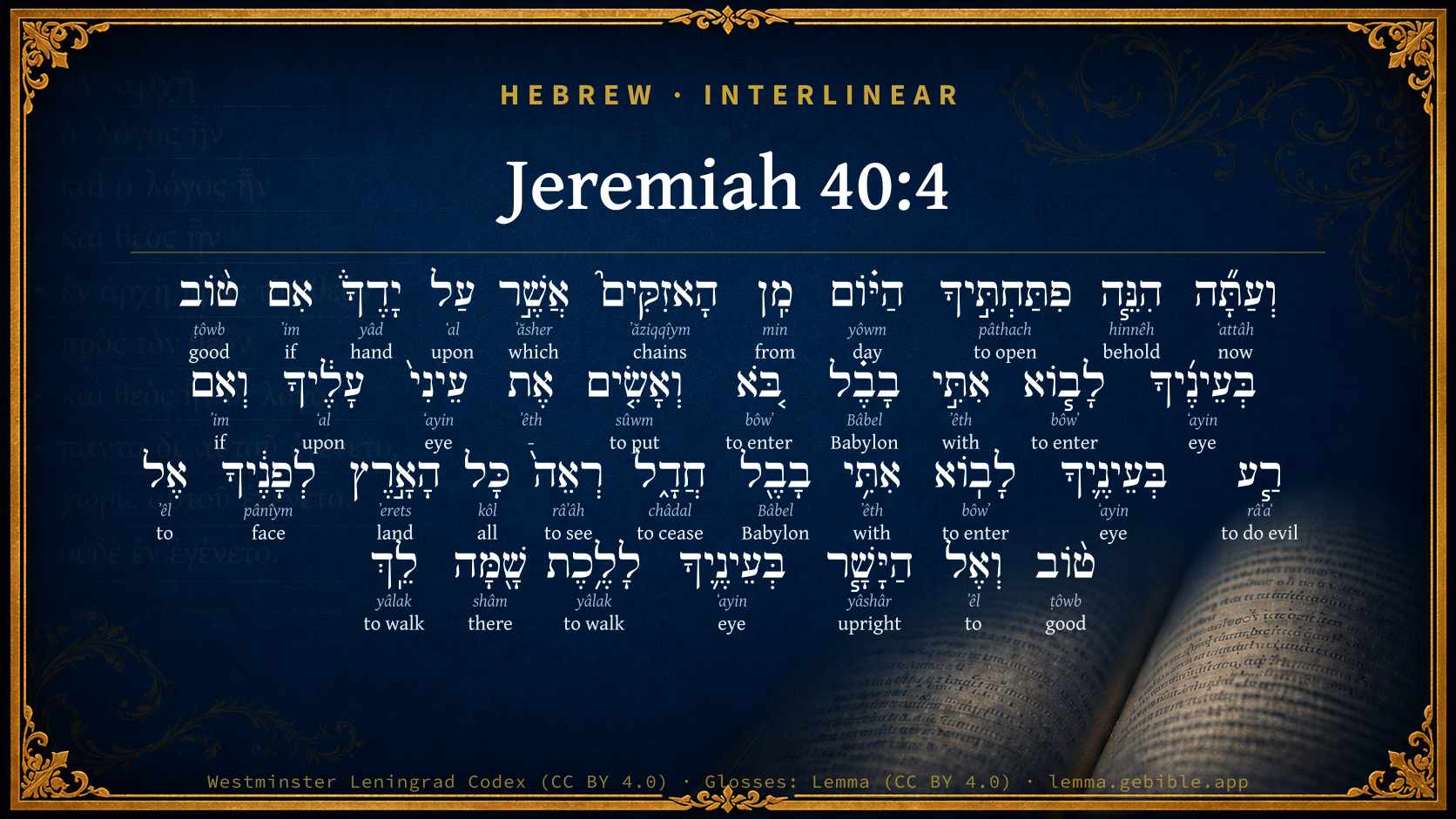
Jeremiah 40:4

Hebrew (Westminster Leningrad Codex) Jeremiah 40:4 appears in the Hebrew Old Testament. The text above is from the Westminster Leningrad Codex. Each word links to its Strong’s number, a concise gloss, and parsing drawn from the Open Scriptures Hebrew Bible morphology. Click any word for its full Brown-Driver-Briggs (BDB) entry.
Download image
Cite this verse

Jeremiah 40:4 (World English Bible). Public Domain. Lemma interlinear Bible study tool, https://lemma.gebible.app/v/jeremiah/40/4.

Show BibTeX & RIS
BibTeX
RIS
English Translation
Now, behold, I loose you this day from the chains which are on your hand. If it seem good to you to come with me into Babylon, come, and I will look well to you; but if it seem ill to you to come with me into Babylon, forbear: behold, all the land is before you; where it seems good and right to you to go, there go.
World English Bible · Public Domain
Download a study sheet

One document with this verse’s original text, its word-by-word gloss line, the meaning frame, cross-references with their text, attributed commentary, and full source and license credits — printable, and it pastes into notes with its structure intact.

This verse Autodidact and up

Study sheet (.html) Plain text (.txt)

A passage Seminary Student

Up to 50 verses in one chapter. A passage sheet keeps up to 6 commentary sources and 12 cross-references per verse, in the order this page ranks them, and says so on the sheet whenever that leaves anything out. Ask for a single verse and you get the Autodidact verse sheet above.

Everything on this page stays free to read, with no account — the sheet is a download of what is already on screen, not access to it.

Want to remove ads? Support Godless Engineer
Compare translations 3

The same verse in 3 English versions, stacked beneath the original-language interlinear above. Click any original word for its lexicon entry.

Each is an independent rendering of the whole verse — the interlinear is not word-aligned to these translations.

Highlighted words mark where these versions differ — a whole-verse word diff, not a word-by-word alignment.

  • World English Bible Public Domain
    Now, behold, I loose you this day from the chains which are on your hand. If it seem good to you to come with me into Babylon, come, and I will look well to you; but if it seem ill to you to come with me into Babylon, forbear: behold, all the land is before you; where it seems good and right to you to go, there go.
  • King James Version Public Domain
    And now, behold, I loose thee this day from the chains which were upon thine hand. If it seem good unto thee to come with me into Babylon, come; and I will look well unto thee: but if it seem ill unto thee to come with me into Babylon, forbear: behold, all the land is before thee: whither it seemeth good and convenient for thee to go, thither go.
  • unfoldingWord Literal Text CC BY-SA 4.0
    But now look! I have released you today from the chains that were on your hands. If it is good in your eyes to come with me to Babylon, come, and I will take care of you. But if it is not good in your eyes to come with me to Babylon, then do not do so. Look at all the land before you. Go where it is good and right in your eyes to go.”

unfoldingWord Literal Text — © unfoldingWord, licensed CC BY-SA 4.0. Word-aligned USFM3 via Door43 (git.door43.org/unfoldingWord/en_ult).

Versions to compare (up to 4)

3 of 4 selected

Show all 18 translations

Every available English version of this verse, each an independent rendering of the whole verse.

  • World English Bible Public Domain
    Now, behold, I loose you this day from the chains which are on your hand. If it seem good to you to come with me into Babylon, come, and I will look well to you; but if it seem ill to you to come with me into Babylon, forbear: behold, all the land is before you; where it seems good and right to you to go, there go.
  • Berean Standard Bible Public Domain
    But now, behold, I am freeing you today from the chains that were on your wrists. If it pleases you to come with me to Babylon, then come, and I will take care of you. But if it seems wrong to you to come with me to Babylon, go no farther. Look, the whole land is before you. Wherever it seems good and right to you, go there.”
  • Majority Standard Bible Public Domain
    But now, behold, I am freeing you today from the chains that were on your wrists. If it pleases you to come with me to Babylon, then come, and I will take care of you. But if it seems wrong to you to come with me to Babylon, go no farther. Look, the whole land is before you. Wherever it seems good and right to you, go there.”
  • King James Version Public Domain
    And now, behold, I loose thee this day from the chains which were upon thine hand. If it seem good unto thee to come with me into Babylon, come; and I will look well unto thee: but if it seem ill unto thee to come with me into Babylon, forbear: behold, all the land is before thee: whither it seemeth good and convenient for thee to go, thither go.
  • American Standard Version (1901) Public Domain
    And now, behold, I loose thee this day from the chains which are upon thy hand. If it seem good unto thee to come with me into Babylon, come, and I will look well unto thee; but if it seem ill unto thee to come with me into Babylon, forbear: behold, all the land is before thee; whither it seemeth good and right unto thee to go, thither go.
  • Revised Version (1885) Public Domain
    And now, behold, I loose thee this day from the chains which are upon thine hand. If it seem good unto thee to come with me into Babylon, come, and I will look well unto thee: but if it seem ill unto thee to come with me into Babylon, forbear: behold, all the land is before thee; whither it seemeth good and convenient unto thee to go, thither go.
  • Geneva Bible (1599) Public Domain
    And nowe beholde, I loose thee this day from the chaines which were on thine handes, if it please thee to come with me into Babel, come, and I will looke well vnto thee: but if it please thee not to come with mee into Babel, tarie still: beholde, all the lande is before thee: whither it seemeth good, and conuenient for thee to goe, thither goe.
  • Douay-Rheims (1899) Public Domain
    Now then behold I have loosed thee this day from the chains which were upon thy hands: if it please thee to come with me to Babylon, come: and I will set my eyes upon thee: but if it do not please thee to come with me to Babylon, stay here: behold all the land is before thee, as thou shalt choose, and whither it shall please thee to go, thither go.
  • Young's Literal Translation Public Domain
    `And now, lo, I have loosed thee to-day from the chains that `are' on thy hand; if good in thine eyes to come with me `to' Babylon, come, and I keep mine eye upon thee: and if evil in thine eyes to come with me to Babylon, forbear; see, all the land `is' before thee, whither `it be' good, and whither `it be' right in thine eyes to go -- go.' --
  • Literal Standard Version CC BY-SA 4.0
    And now, behold, I have loosed you today from the chains that [are] on your hand; if [it is] good in your eyes to come with me [to] Babylon, come, and I keep my eye on you: and if [it is] evil in your eyes to come with me to Babylon, refrain; see, all the land [is] before you, to where [it is] good, and to where [it is] right in your eyes to go—go.”
  • Unlocked Literal Bible CC BY-SA 4.0
    But now look! I have released you today from the chains that were on your hands. If it is good in your eyes to come with me to Babylon, come, and I will take care of you. But if it is not good in your eyes to come with me to Babylon, then do not do so. Look at all the land before you. Go where it is good and right in your eyes to go.”
  • unfoldingWord Literal Text CC BY-SA 4.0
    But now look! I have released you today from the chains that were on your hands. If it is good in your eyes to come with me to Babylon, come, and I will take care of you. But if it is not good in your eyes to come with me to Babylon, then do not do so. Look at all the land before you. Go where it is good and right in your eyes to go.”
  • Darby Bible Public Domain
    And now, behold, I loose thee this day from the chains that are upon thy hand. If it seem good in thy sight to come with me to Babylon, come, and I will keep mine eye upon thee; but if it seem ill unto thee to come with me to Babylon, forbear. See, all the land is before thee: whither it seemeth good and right in thy sight to go, thither go.
  • World Messianic Bible Public Domain
    Now, behold, I release you today from the chains which are on your hand. If it seems good to you to come with me into Babylon, come, and I will take care of you; but if it seems bad to you to come with me into Babylon, don’t. Behold, all the land is before you. Where it seems good and right to you to go, go there.”
  • Webster's Bible Public Domain
    And now, behold, I loose thee this day from the chains which were upon thy hand. If it seemeth good to thee to come with me into Babylon, come; and I will look well to thee: but if it seemeth ill to thee to come with me into Babylon, forbear: behold, all the land is before thee: whither it seemeth good and convenient for thee to go, thither go.
  • Free Bible Version CC BY-SA 4.0
    But notice that now I'm removing the chains from your wrists and releasing you. If you want to come with me to Babylon then you can come, and I will look after you. But if you think it's a bad idea to come with me to Babylon, you don't have to go any farther. Look, you're free to go anywhere in the country. Go wherever is good for you—do what you think is right.”
  • Bible in Basic English Public Domain
    Now see, this day I am freeing you from the chains which are on your hands. If it seems good to you to come with me to Babylon, then come, and I will keep an eye on you; but if it does not seem good to you to come with me to Babylon, then do not come: see, all the land is before you; if it seems good and right to you to go on living in the land,
  • JPS Tanakh (1917) Public Domain
    And now, behold, I loose thee this day from the chains which are upon thy hand. If it seem good unto thee to come with me into Babylon, come, and I will look well unto thee; but if it seem ill unto thee to come with me into Babylon, forbear; behold, all the land is before thee; whither it seemeth good and right unto thee to go, thither go. —

Literal Standard Version (2020), Covenant Press — licensed CC BY-SA 4.0. Text via the HelloAO Bible API (eBible.org). Unlocked Literal Bible (unfoldingWord) — licensed CC BY-SA 4.0. Text via the HelloAO Bible API (eBible.org). unfoldingWord Literal Text — © unfoldingWord, licensed CC BY-SA 4.0. Word-aligned USFM3 via Door43 (git.door43.org/unfoldingWord/en_ult). Free Bible Version, Dr. Jonathan Gallagher — licensed CC BY-SA 4.0. Text via the HelloAO Bible API (eBible.org).

Word by word

More ways to search: Search by grammar → Find every occurrence → Compare this word →

Practice this passage: Drill this verse → Learn its vocabulary →

הָאזִקִּים֮
ʼăziqqîym
H246
“the · chains”
Particle, Definite Article + Noun, Common, Masculine, Plural, Absolute
Part of Speech
Particle + Noun
Type
Common
Gender
Masculine
Number
Plural
State
Absolute
Full BDB Definition

Origin: a variation for H2131

TWOT: 577b

chains, manacles
  1. וְעַתָּ֞ה ʻattâh H6258 “and · now” Conjunction + Adverb
  2. הִנֵּ֧ה hinnêh H2009 “behold” Particle, Demonstrative
  3. פִתַּחְתִּ֣יךָ pâthach H6605 “to open · you” Verb, Piel, Perfect, 1st Person, Common, Singular + Suffix, Personal, 2nd Person, Masculine, Singular
  4. הַיּ֗וֹם yôwm H3117 “the · day” Particle, Definite Article + Noun, Common, Masculine, Singular, Absolute
  5. מִֽן min H4480 “from” Preposition
  6. אֲשֶׁ֣ר ʼăsher H834 “which” Particle, Relative
  7. עַל ʻal H5921 “upon” Preposition
  8. יָדֶךָ֒ yâd H3027 “hand · your” Noun, Common, Both, Singular, Construct + Suffix, Personal, 2nd Person, Masculine, Singular
  9. אִם ʼim H518 “if” Conjunction
  10. ט֨וֹב ṭôwb H2896 “good” Adjective, Adjective, Masculine, Singular, Absolute
  11. בְּעֵינֶ֜יךָ ʻayin H5869 “in/at · eyes · your” Preposition + Noun, Common, Both, Dual, Construct + Suffix, Personal, 2nd Person, Masculine, Singular
  12. לָב֧וֹא bôwʼ H935 “to enter” Preposition + Verb, Qal, Infinitive Construct
  13. אִתִּ֣י ʼêth H854 “with · me” Preposition + Suffix, Personal, 1st Person, Common, Singular
  14. בָבֶ֗ל Bâbel H894 “Babylon” Noun, Proper
  15. בֹּ֚א bôwʼ H935 “enter” Verb, Qal, Imperative, 2nd Person, Masculine, Singular
  16. וְאָשִׂ֤ים sûwm H7760 “and · to put” Conjunction + Verb, Qal, Imperfect, 1st Person, Common, Singular
  17. אֶת ʼêth H853 “-” Particle, Direct Object
  18. עֵינִי֙ ʻayin H5869 “eye · my” Noun, Common, Both, Singular, Construct + Suffix, Personal, 1st Person, Common, Singular
  19. עָלֶ֔יךָ ʻal H5921 “upon · you” Preposition + Suffix, Personal, 2nd Person, Masculine, Singular
  20. וְאִם ʼim H518 “and · if” Conjunction + Conjunction
  21. רַ֧ע râʻaʻ H7489 “to do evil” Verb, Qal, Perfect, 3rd Person, Masculine, Singular
  22. בְּעֵינֶ֛יךָ ʻayin H5869 “in/at · eyes · your” Preposition + Noun, Common, Both, Dual, Construct + Suffix, Personal, 2nd Person, Masculine, Singular
  23. לָבֽוֹא bôwʼ H935 “to enter” Preposition + Verb, Qal, Infinitive Construct
  24. אִתִּ֥י ʼêth H854 “with · me” Preposition + Suffix, Personal, 1st Person, Common, Singular
  25. בָבֶ֖ל Bâbel H894 “Babylon” Noun, Proper
  26. חֲדָ֑ל châdal H2308 “cease” Verb, Qal, Imperative, 2nd Person, Masculine, Singular
  27. רְאֵה֙ râʼâh H7200 “see” Verb, Qal, Imperative, 2nd Person, Masculine, Singular
  28. כָּל kôl H3605 “all of” Noun, Common, Masculine, Singular, Construct
  29. הָאָ֣רֶץ ʼerets H776 “the · land” Particle, Definite Article + Noun, Common, Both, Singular, Absolute
  30. לְפָנֶ֔יךָ pânîym H6440 “to/for · face(s) · your” Preposition + Noun, Common, Both, Plural, Construct + Suffix, Personal, 2nd Person, Masculine, Singular
  31. אֶל ʼêl H413 “to” Preposition
  32. ט֨וֹב ṭôwb H2896 “good” Adjective, Adjective, Masculine, Singular, Absolute
  33. וְאֶל ʼêl H413 “and · to” Conjunction + Preposition
  34. הַיָּשָׁ֧ר yâshâr H3477 “the · upright” Particle, Definite Article + Adjective, Adjective, Masculine, Singular, Absolute
  35. בְּעֵינֶ֛יךָ ʻayin H5869 “in/at · eyes · your” Preposition + Noun, Common, Both, Dual, Construct + Suffix, Personal, 2nd Person, Masculine, Singular
  36. לָלֶ֥כֶת yâlak H3212 “to walk” Preposition + Verb, Qal, Infinitive Construct
  37. שָׁ֖מָּה shâm H8033 “there · toward” Adverb + Suffix, Demonstrative
  38. לֵֽךְ yâlak H3212 “walk” Verb, Qal, Imperative, 2nd Person, Masculine, Singular

About this verse

These counts appear in no published source. They are computed here, from the morphology-tagged text and Lemma’s own curated glosses. What Lemma adds →

39
words
27
distinct lemmas
Prophets
section

Notable vocabulary

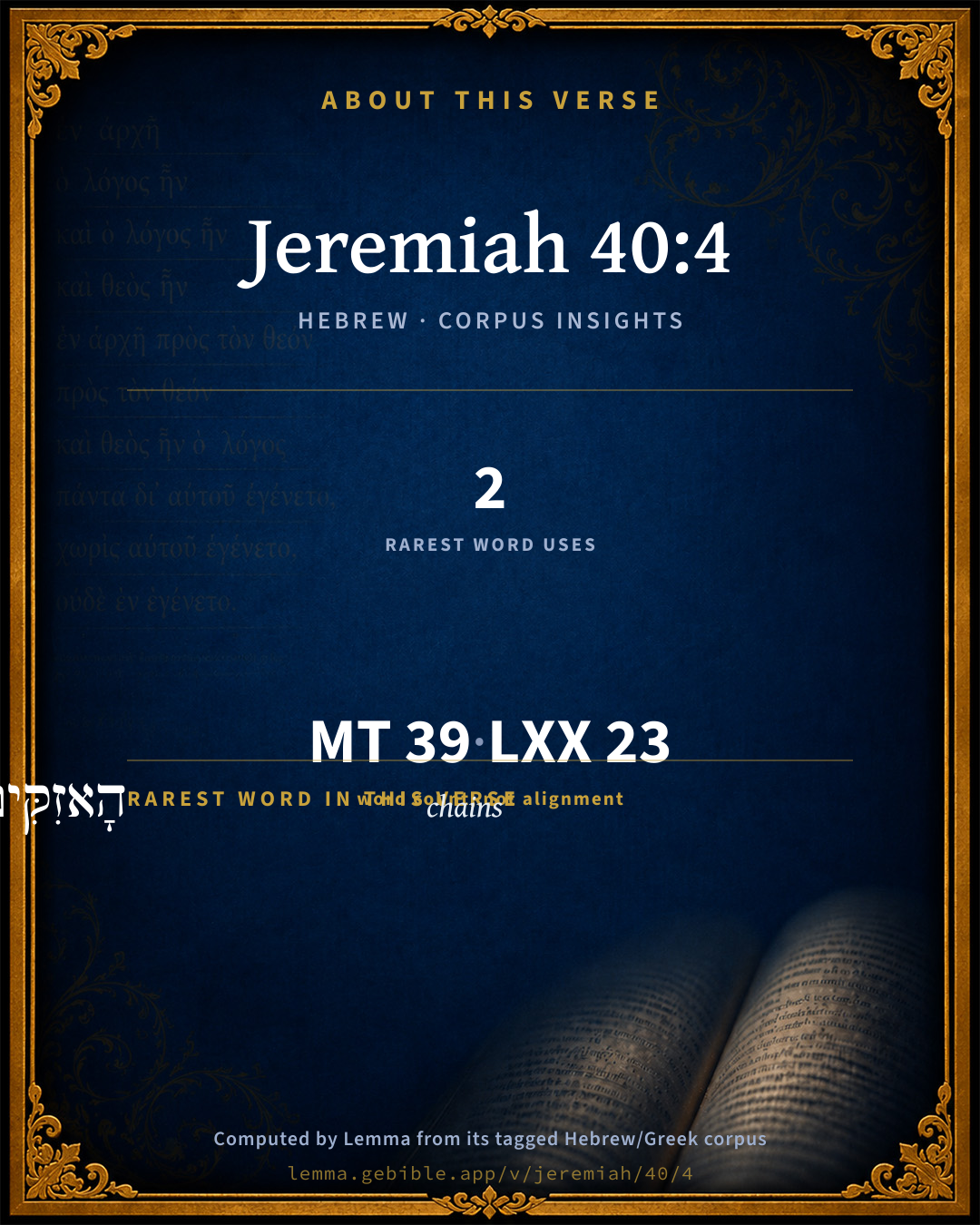
The rarest word here is הָאזִקִּים֮ chains H246 — appearing just 2 times in the whole Hebrew Bible.

Shared distinctive vocabulary

הָאזִקִּים֮ chains H246 occurs in 2 verses of the Hebrew Bible. Also found in:

Grammatical profile

  • 10 verbs
  • 12 nouns
  • 3 adjectives
  • 7 prepositions
  • 2 conjunctions
  • 2 adverbs
  • 3 particles

Verb forms

  • פִתַּחְתִּ֣יךָ Piel · Perfect
  • לָב֧וֹא Qal · Infinitive Construct
  • בֹּ֚א Qal · Imperative
  • וְאָשִׂ֤ים Qal · Imperfect
  • רַ֧ע Qal · Perfect
  • לָבֽוֹא Qal · Infinitive Construct
  • חֲדָ֑ל Qal · Imperative
  • רְאֵה֙ Qal · Imperative
  • לָלֶ֥כֶת Qal · Infinitive Construct
  • לֵֽךְ Qal · Imperative

Repetition

Words recur within this verse — often emphatic in Hebrew:

  • בְּעֵינֶ֜יךָ eye H5869 ×4
  • לָב֧וֹא to enter H935 ×3
  • עַל upon H5921 ×2
  • ט֨וֹב good H2896 ×2
  • בָבֶ֗ל Babylon H894 ×2
  • לָלֶ֥כֶת to walk H3212 ×2
  • אִם if H518 ×2
  • אִתִּ֣י with H854 ×2
  • אֶל to H413 ×2

Hebrew & Septuagint length

In the original languages it is 39 Hebrew tokens and 23 Greek tokens — but the two are counted differently (Hebrew bundles its prefixes and suffixes into one token; the Greek is in lemma form), so that isn’t a like-for-like length.

Cross-references

3

Topical passages linked to Jeremiah 40:4 in the Treasury of Scripture Knowledge — connected by theme and wording, ordered by reader-vote popularity; previews shown in the World English Bible.

  • Jeremiah 39:11–12 Now Nebuchadrezzar king of Babylon gave charge concerning Jeremiah to Nebuzaradan the captain of the guard, saying,
  • Genesis 20:15 Abimelech said, "Behold, my land is before you. Dwell where it pleases you."
  • Genesis 13:9 Isn't the whole land before you? Please separate yourself from me. If you go to the left hand, then I will go to the right. Or if you go to the right hand, then I will go to the left."

Cross-references courtesy of OpenBible.info (CC BY 4.0).

Hebrew and Greek witnesses Masoretic Hebrew ↔ Greek Septuagint

The same verse in the two great witnesses to the Old Testament, shown verse-for-verse.

These are two independent witnesses, not word-aligned to each other, and the Septuagint is shown in lemma (dictionary) form.

Hebrew Jeremiah 40:4 Masoretic · Westminster Leningrad Codex

וְעַתָּ֞ה הִנֵּ֧ה פִתַּחְתִּ֣יךָ הַיּ֗וֹם מִֽן הָאזִקִּים֮ אֲשֶׁ֣ר עַל יָדֶךָ֒ אִם ט֨וֹב בְּעֵינֶ֜יךָ לָב֧וֹא אִתִּ֣י בָבֶ֗ל בֹּ֚א וְאָשִׂ֤ים אֶת עֵינִי֙ עָלֶ֔יךָ וְאִם רַ֧ע בְּעֵינֶ֛יךָ לָבֽוֹא אִתִּ֥י בָבֶ֖ל חֲדָ֑ל רְאֵה֙ כָּל הָאָ֣רֶץ לְפָנֶ֔יךָ אֶל ט֨וֹב וְאֶל הַיָּשָׁ֧ר בְּעֵינֶ֛יךָ לָלֶ֥כֶת שָׁ֖מָּה לֵֽךְ

Now, behold, I loose you this day from the chains which are on your hand. If it seem good to you to come with me into Babylon, come, and I will look well to you; but if it seem ill to you to come with me into Babylon, forbear: behold, all the land is before you; where it seems good and right to you to go, there go.

World English Bible · Public Domain

Greek LXX Structure differs

In the Septuagint, Jeremiah is about an eighth shorter than the Hebrew and arranges its material differently — the Oracles Against the Nations (Hebrew chapters 46–51) appear in the middle of the Greek book, after 25:13. Because the chapter and verse boundaries do not line up, a verse-for-verse comparison with the Hebrew is not shown.

A verse-for-verse comparison isn’t shown here because the chapters and verses don’t line up. Switch to the LXX edition with the MT / LXX toggle above to read the Greek directly.

On this verse, The Cambridge Bible for Schools and Colleges discusses the Septuagint’s reading. Read the note in Commentary ↓

Hebrew: Westminster Leningrad Codex (CC BY 4.0). Greek: Septuagint (public domain); English from a public-domain English Septuagint. How the Septuagint differs from the Hebrew →

Targum (Aramaic paraphrase)

1

The Targum is the ancient Jewish Aramaic paraphrase of the Hebrew Scriptures — an interpretive translation, not the Hebrew text itself. Onkelos (literal) and Pseudo-Jonathan (expansive) render the Torah, and Jonathan the Prophets. Coverage is partial: where no permissively-licensed English translation exists for a verse, only the Aramaic is shown. This is verse-level text, not a word-by-word alignment to the Hebrew.

  1. Targum Jonathan Prophets (Joshua–Malachi)
    וּכְעַן הָא שְׁרִיתָךְ יוֹמָא דֵין מִן עִזְקַיָא דִי עַל יְדָךְ אִם תַּקִין בְעֵינָיךְ לְמֵיתָא עִמִי לְבָבֶל אֲתָא וַאֲשַׁוֵי יַת עֵינִי עֲלָךְ וְאִם בִּישׁ בְּעֵינָךְ לְמֵיתֵי עִמִי לְבָבֶל אִתְמְנַע חֲזֵי כָּל אַרְעָא קָדְמָךְ לִדְתַקִין וְלִדְכָשַׁר בְּעֵינָךְ לְמֵיזַל תַּמָן אֱזֵיל:

    (no public-domain English translation for this verse)

    Targum Jonathan — Aramaic: “Mikraot Gedolot” (public domain). English: “Sefaria Community Translation” (CC0 1.0 (public-domain dedication)); “London "Chaldee Paraphrase," 1871” (public domain). Text via Sefaria.

Commentary

Notes on Jeremiah 40:4 from classic Christian and Jewish commentators (each source and its license shown beneath its notes). The classic Christian expositions comment on the surrounding passage and are grouped to its opening verse, so a note may address several verses; the Jewish commentaries on the Tanakh (Rashi and others) are per-verse, so they appear only where the commentator wrote on this verse.

Lemma curates 59 commentaries, every one of them public domain or Creative Commons licensed, each selected and text-cleaned for this edition rather than reprinted as found. About our sources →

The Cambridge Bible for Schools and Colleges

gen. ed. J. J. S. Perowne

4. I will look well unto thee] See on Jer_39:12.

convenient] lit. as mg. right.

but if it seem ill … (5) Go back then, said he] The LXX have simply, “but, if not, depart, return,” and, as giving a much smoother sequence, preserve what is probably the original form. The latter part of Jer_40:4 in MT. may have been suggested by Gen_13:9, while the words “Now while … back” are also a gloss.

The Cambridge Bible for Schools and Colleges (gen. ed. J. J. S. Perowne; Cambridge University Press, 1878–1918) — public domain. Text from a community e-Sword module.

Trapp's Complete Commentary

John Trapp

Jer 40:4 And now, behold, I loose thee this day from the chains which [were] upon thine hand. If it seem good unto thee to come with me into Babylon, come; and I will look well unto thee: but if it seem ill unto thee to come with me into Babylon, forbear: behold, all the land [is] before thee: whither it seemeth good and convenient for thee to go, thither go.

Ver. 4. And now, behold, I loose thee.] I dismiss thee with all due honour, as a true prophet, however undervalued and afflicted by thine unworthy countrymen.

Come, and I will look well unto thee.] Heb., I will set mine eye upon thee, that is, I will give thee singular respect, and observe thee to the utmost.

Behold, all the land is before thee.] What could Pharaoh say more to Joseph? {Gen 47:6} or Abraham to Lot? {Gen 13:9}

John Trapp, A Commentary or Exposition upon All the Books of the Old and New Testament (1647–1656) — public domain. Text from a community e-Sword module.

Geneva Bible (1599)

Geneva Bible translators

Hebrew, cease.

Or, at thy commandment.

Geneva Bible (1599) marginal notes — public domain. Text via Bolls.life.

Jamieson, Fausset & Brown

Robert Jamieson, A. R. Fausset & David Brown

look well unto thee--the very words of Nebuchadnezzar's charge (Jer 39:12).

all the land is before thee . . . seemeth good-- (Gen 20:15, Margin). Jeremiah alone had the option given him of staying where he pleased, when all the rest were either carried off or forced to remain there.

Jamieson, Fausset & Brown — Commentary Critical and Explanatory on the Whole Bible (1871) — public domain (CC PDM 1.0). Text via the HelloAO Bible API.

Adam Clarke's Commentary

Verse 4. Come; and I will look well unto thee] Thou art now at full liberty to do as thou pleasest; either to come to Babylon or to stay in thy own land.

Adam Clarke's Commentary on the Bible (1810–1826) — public domain. Text from a community e-Sword/MySword module.

John Gill's Exposition

And now, behold, I loose thee this day from the chains which were upon thine hands,.... Or rather are; for, when he said these words, it is highly probable they were on him, though now ordered to be taken off; these were not what were put upon him by the Jews, when in the court of the prison; for rather his legs, than his hands, would have had fetters on them there; but what were put upon him by the Chaldeans, when he fell into their hands; though inadvertently done by the inferior officers, and without the knowledge of the princes, or of this captain, who loosed them; with these he came manacled to Ramah, with the rest of the captives, but now were loosed in the sight of them:

if it seem good unto thee to come with me unto Babylon, come, and one will look well unto thee; or, "I will set mine eyes upon thee" (r); as the king of Babylon had ordered him to do, Jer 39:12; would favour him, protect him, provide for him, and use him in the most kind and generous manner:

but if it seem ill unto thee to come with me to Babylon, forbear; if it was not agreeable to him to leave his native country, and to go into Babylon, he would not urge it, but leave him to his liberty; yea, would advise him to continue where he was, and not take one step out of it:

behold, all the land is before thee; the land of Judea, which was at the disposal of the king of Babylon; and Jeremiah has a grant from him, by his officer, to settle where he pleased:

whither it seemeth good and convenient for thee to go, thither go; he left him to take his own way, and do as he thought fit; and this agrees with his master's orders to him, Jer 39:12.

(r) "ponam oculos meos super te", Schmidt; "et ponam oculum meum super te", Pagninus, Montanus.

John Gill's Exposition of the Whole Bible (1746–1763) — public domain (CC PDM 1.0). Text via the HelloAO Bible API.

Haydock's Catholic Bible Commentary

Eyes, with all kindness, chap. xxxix. 12. (Haydock) --- Before thee. Thou hast liberty to choose, Genesis xiii. 9., and xx. 15., and xxiv. 51.

George Leo Haydock (1774–1849), Haydock's Catholic Family Bible and Commentary, 1859 edition — public domain. Excludes Psalms (Douay-Rheims chapter numbering differs from Protestant) and Deuterocanonical books (Catholic canon only).

Matthew Poole's English Annotations

Nebuzar-adan, like a faithful servant, remembers his master’s orders to him about the prophet, Jer 39:11, and offers Jeremiah greater favour than to any others of his prisoners; he determined others by his right of conquest to what they should do, but he giveth the prophet a liberty to choose whether he would go to Babylon, or stay at Jerusalem in his own country; he promised him that if he would go to Babylon, he would take a particular care of him.

Matthew Poole's English Annotations on the Holy Bible (1683–1685) — public domain. Text from a community e-Sword/MySword module.

The Pulpit Commentary

Vers. 4, 5. "A strait betwixt two.

St. Paul tells how he was in such strait. He was willing to stay, but ready to depart home to his eternal rest, which would be far better. And oftentimes we are in perplexities as to choice in the common events and circumstances of our lives. It is so difficult to see what we ought to do, what it would be best to do. Here we have an instance. The patriotic prophet had a perplexing choice put before him. Consider

I THE ALTERNATIVES PROPOSED.

1. He might go to Babylon, where, no doubt, the same favour that had shown him such consideration thus far would bring him to honour there.

2. He might stay amongst his own people. Amid their poverty, their displeasure, their disgrace.

3. Or he might go anywhere he pleased to Tarshish, as Jonah tried, if so he pleased.

II THE ARGUMENTS FOR AND AGAINST EACH.

1. For Babylon. Safety, wealth, honour, help to his countrymen there.

2. For staying in Israel. There he had been called; there he was yet needed; Ezekiel and Daniel were in Babylon. Against this, he had no command of God; the peril in which he would be placed.

III THE DECISION. He resolved to stay. This come to, not because the captain (ver. 5), who saw him lingering, bade him go back, but because the hardness of the duty seemed to declare it was his duty. In such cases choose what you like least. C.

The Pulpit Commentary (1880–1919), ed. H.D.M. Spence-Jones & Joseph S. Exell — public domain. Text from a community e-Sword module.

Rashi

Rabbi Shlomo Yitzchaki (Rashi)

I have released you Heb. פתחתיך, an expression related to “And he untied (ויפתח) the camels” (Gen. 24.32). And so did Jonathan render: Behold, now I have untied you. But Menahem (p. 147) interpreted all of them as an expression of actual opening (פתיחה).

Rashi on the Tanakh — English translations: “The Judaica Press complete Tanach with Rashi, translated by A. J. Rosenberg” (CC BY 4.0); “Pentateuch with Rashi's commentary by M. Rosenbaum and A.M. Silbermann, 1929-1934” (public domain); “The Metsudah Tanach series, Lakewood, N.J” (CC BY 4.0); and “The Book of Joshua, Metsudah Publications, 1997” (CC BY 4.0). Text via Sefaria.

Lesson kit

Teaching starters — assembled from the data on this page, not authored interpretation. Every prompt links to the verse data it draws on. Edit before teaching.

Jeremiah, in the Prophets, opens this verse with 39 words (27 distinct Hebrew lemmas). Its most distinctive word is ʼăziqqîym (“chains”). A historical commentator’s framing appears above. Read the whole chapter for the surrounding context.

Discussion questions

  1. The word ʼăziqqîym carries the sense “chains.” How does it shape the verse?
  2. How does Jeremiah 40:1, which shares the word «chains», read alongside this verse?
  3. What does the repetition of “eye” (4× in this one verse) do in this verse?
  4. These translations render this verse differently; the difference is in the English rendering, not the original. What questions does that raise?
  5. «פִתַּחְתִּ֣יךָ» is a Piel Perfect verb. How does that grammatical form shape the action described?
  6. Compare how The Cambridge Bible for Schools and Colleges and Trapp's Complete Commentary read this verse. Where do they agree or differ?

Things to notice

Reading settings

Reading text

Shown beneath each verse's original-language words.

Old Testament
Old Testament edition

Read the OT as the Masoretic Hebrew (MT) or the Greek Septuagint (LXX).

English shown for the Greek Septuagint (in the Hebrew ↔ Greek comparison).

Comparing translations? Open the Compare panel on any verse page to stack up to four side by side.