
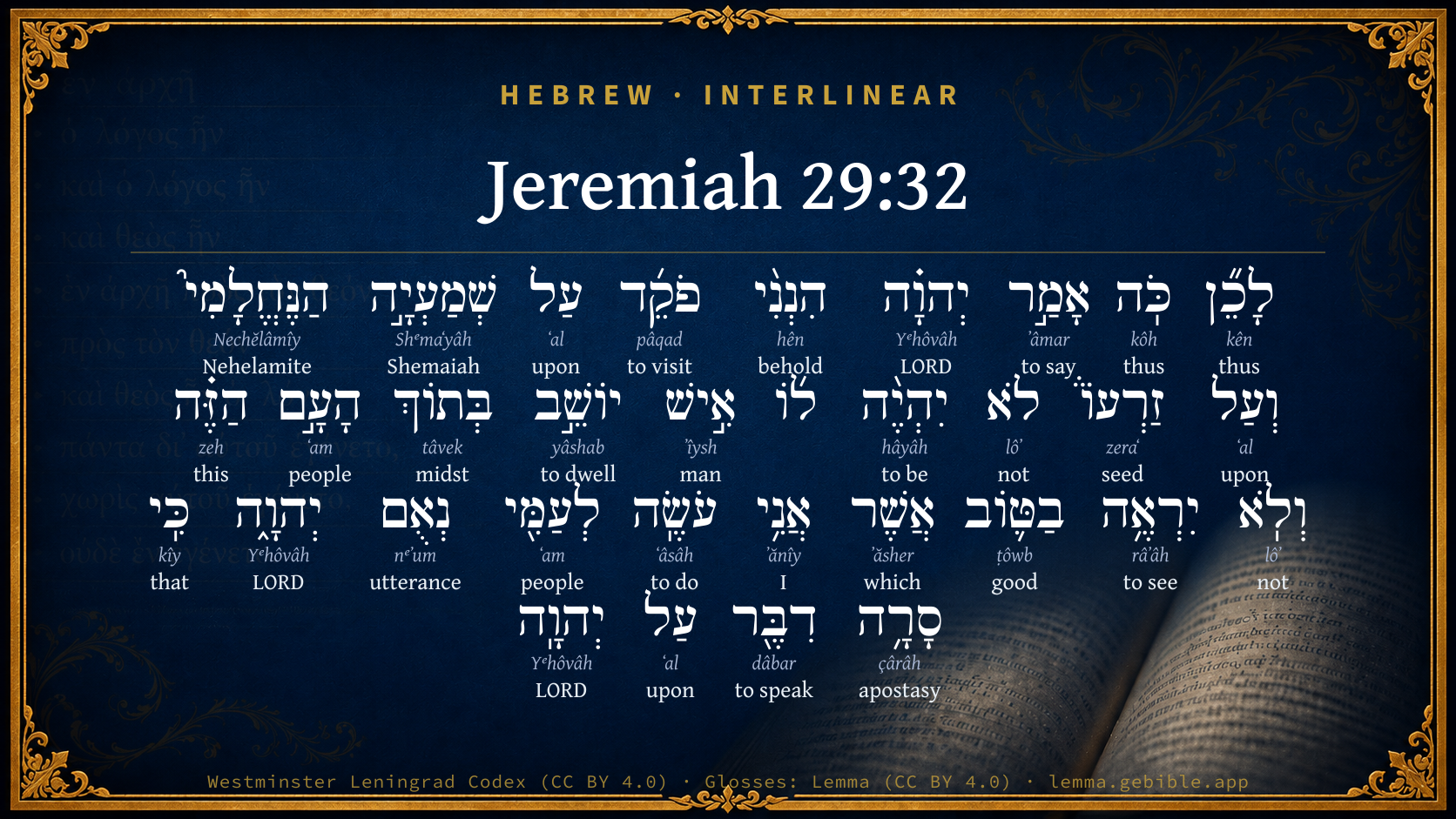
Jeremiah 29:32

Hebrew (Westminster Leningrad Codex) Jeremiah 29:32 appears in the Hebrew Old Testament. The text above is from the Westminster Leningrad Codex. Each word links to its Strong’s number, a concise gloss, and parsing drawn from the Open Scriptures Hebrew Bible morphology. Click any word for its full Brown-Driver-Briggs (BDB) entry.
Download image
Cite this verse

Jeremiah 29:32 (World English Bible). Public Domain. Lemma interlinear Bible study tool, https://lemma.gebible.app/v/jeremiah/29/32.

Show BibTeX & RIS
BibTeX
RIS
English Translation
therefore thus says Yahweh, Behold, I will punish Shemaiah the Nehelamite, and his seed; he shall not have a man to dwell among this people, neither shall he see the good that I will do to my people, says Yahweh, because he has spoken rebellion against Yahweh.
World English Bible · Public Domain
Download a study sheet

One document with this verse’s original text, its word-by-word gloss line, the meaning frame, cross-references with their text, attributed commentary, and full source and license credits — printable, and it pastes into notes with its structure intact.

This verse Autodidact and up

Study sheet (.html) Plain text (.txt)

A passage Seminary Student

Up to 50 verses in one chapter. A passage sheet keeps up to 6 commentary sources and 12 cross-references per verse, in the order this page ranks them, and says so on the sheet whenever that leaves anything out. Ask for a single verse and you get the Autodidact verse sheet above.

Everything on this page stays free to read, with no account — the sheet is a download of what is already on screen, not access to it.

Want to remove ads? Support Godless Engineer
Compare translations 3

The same verse in 3 English versions, stacked beneath the original-language interlinear above. Click any original word for its lexicon entry.

Each is an independent rendering of the whole verse — the interlinear is not word-aligned to these translations.

Highlighted words mark where these versions differ — a whole-verse word diff, not a word-by-word alignment.

  • World English Bible Public Domain
    therefore thus says Yahweh, Behold, I will punish Shemaiah the Nehelamite, and his seed; he shall not have a man to dwell among this people, neither shall he see the good that I will do to my people, says Yahweh, because he has spoken rebellion against Yahweh.
  • King James Version Public Domain
    Therefore thus saith the LORD; Behold, I will punish Shemaiah the Nehelamite, and his seed: he shall not have a man to dwell among this people; neither shall he behold the good that I will do for my people, saith the LORD; because he hath taught rebellion against the LORD.
  • unfoldingWord Literal Text CC BY-SA 4.0
    therefore Yahweh says this: Look, I am about to punish Shemaiah the Nehelamite and his descendants. There will not be a man for him to stay among this people. He will not see the good that I will do for my people—this is Yahweh’s declaration—for he has proclaimed rebellion against Yahweh.’”

unfoldingWord Literal Text — © unfoldingWord, licensed CC BY-SA 4.0. Word-aligned USFM3 via Door43 (git.door43.org/unfoldingWord/en_ult).

Versions to compare (up to 4)

3 of 4 selected

Show all 18 translations

Every available English version of this verse, each an independent rendering of the whole verse.

  • World English Bible Public Domain
    therefore thus says Yahweh, Behold, I will punish Shemaiah the Nehelamite, and his seed; he shall not have a man to dwell among this people, neither shall he see the good that I will do to my people, says Yahweh, because he has spoken rebellion against Yahweh.
  • Berean Standard Bible Public Domain
    this is what the LORD says: ‘I will surely punish Shemaiah the Nehelamite and his descendants. He will have no one left among this people, nor will he see the good that I will bring to My people, declares the LORD, for he has preached rebellion against the LORD.’”
  • Majority Standard Bible Public Domain
    this is what the LORD says: ‘I will surely punish Shemaiah the Nehelamite and his descendants. He will have no one left among this people, nor will he see the good that I will bring to My people, declares the LORD, for he has preached rebellion against the LORD.’”
  • King James Version Public Domain
    Therefore thus saith the LORD; Behold, I will punish Shemaiah the Nehelamite, and his seed: he shall not have a man to dwell among this people; neither shall he behold the good that I will do for my people, saith the LORD; because he hath taught rebellion against the LORD.
  • American Standard Version (1901) Public Domain
    therefore thus saith Jehovah, Behold, I will punish Shemaiah the Nehelamite, and his seed; he shall not have a man to dwell among this people, neither shall he behold the good that I will do unto my people, saith Jehovah, because he hath spoken rebellion against Jehovah.
  • Revised Version (1885) Public Domain
    therefore thus saith the LORD, Behold, I will punish Shemaiah the Nehelamite, and his seed; he shall not have a man to dwell among this people, neither shall he behold the good that I will do unto my people, saith the LORD: because he hath spoken rebellion against the LORD.
  • Geneva Bible (1599) Public Domain
    Therefore thus saieth the Lord, Behold, I wil visite Shemaiah the Nehelamite, and his seede: hee shall not haue a man to dwell among this people, neither shall he beholde the good, that I will doe for my people, sayth the Lord, because he hath spoken rebelliously against the Lord.
  • Douay-Rheims (1899) Public Domain
    Therefore thus saith the Lord: behold I will visit upon Semeias the Nehelamite, and upon his seed: he shall not have a man to sit in the midst of this people, and he shall not see the good that I will do to my people, saith the Lord: because he hath spoken treason against the Lord.
  • Young's Literal Translation Public Domain
    Therefore, thus said Jehovah, Lo, I am seeing after Shemaiah the Nehelamite, and after his seed, he hath none dwelling in the midst of this people, nor doth he look on the good that I am doing to My people -- an affirmation of Jehovah -- for apostacy he hath spoken against Jehovah.'
  • Literal Standard Version CC BY-SA 4.0
    therefore, thus said YHWH: Behold, I am seeing after Shemaiah the Nehelamite, and after his seed, he has none dwelling in the midst of this people, nor does he look on the good that I am doing to My people,” a declaration of YHWH, “for he has spoken apostasy against YHWH.”
  • Unlocked Literal Bible CC BY-SA 4.0
    therefore Yahweh says this: Look, I am about to punish Shemaiah the Nehelamite and his descendants. There will not be a man for him to stay among this people. He will not see the good that I will do for my people—this is Yahweh's declaration—for he has proclaimed rebellion against Yahweh.'”
  • unfoldingWord Literal Text CC BY-SA 4.0
    therefore Yahweh says this: Look, I am about to punish Shemaiah the Nehelamite and his descendants. There will not be a man for him to stay among this people. He will not see the good that I will do for my people—this is Yahweh’s declaration—for he has proclaimed rebellion against Yahweh.’”
  • Darby Bible Public Domain
    therefore thus saith Jehovah: Behold, I will punish Shemaiah the Nehelamite, and his seed: he shall not have a man to dwell among this people; neither shall he see the good that I will do for my people, saith Jehovah; because he hath spoken revolt against Jehovah.
  • World Messianic Bible Public Domain
    therefore the LORD says, “Behold, I will punish Shemaiah the Nehelamite and his offspring. He will not have a man to dwell among this people. He won’t see the good that I will do to my people,” says the LORD, “because he has spoken rebellion against the LORD.”’”
  • Webster's Bible Public Domain
    Therefore thus saith the LORD; Behold, I will punish Shemaiah the Nehelamite, and his seed: he shall not have a man to dwell among this people; neither shall he behold the good that I will do for my people, saith the LORD; because he hath taught rebellion against the LORD.
  • Free Bible Version CC BY-SA 4.0
    this is what the Lord says: I'm going to punish Shemaiah the Nehelamite and his descendants. He won't have any family left among this people, and he won't experience the good things that I'm going to do for my people, declares the Lord, for he has promoted rebellion against the Lord.
  • Bible in Basic English Public Domain
    For this cause the Lord has said, Truly I will send punishment on Shemaiah and on his seed; not a man of his family will have a place among this people, and he will not see the good which I am going to do to my people, says the Lord: because he has said words against the Lord.
  • JPS Tanakh (1917) Public Domain
    therefore thus saith the LORD: Behold, I will punish Shemaiah the Nehelamite, and his seed; he shall not have a man to dwell among this people, neither shall he behold the good that I will do unto My people, saith the LORD; because he hath spoken perversion against the LORD.

Literal Standard Version (2020), Covenant Press — licensed CC BY-SA 4.0. Text via the HelloAO Bible API (eBible.org). Unlocked Literal Bible (unfoldingWord) — licensed CC BY-SA 4.0. Text via the HelloAO Bible API (eBible.org). unfoldingWord Literal Text — © unfoldingWord, licensed CC BY-SA 4.0. Word-aligned USFM3 via Door43 (git.door43.org/unfoldingWord/en_ult). Free Bible Version, Dr. Jonathan Gallagher — licensed CC BY-SA 4.0. Text via the HelloAO Bible API (eBible.org).

Word by word

More ways to search: Search by grammar → Find every occurrence → Compare this word →

Practice this passage: Drill this verse → Learn its vocabulary →

הַנֶּחֱלָמִי֮
Nechĕlâmîy
H5161
“the · Nehelamite”
Particle, Definite Article + Noun, Gentilic, Masculine, Singular, Absolute
Part of Speech
Particle + Noun
Type
Gentilic
Gender
Masculine
Number
Singular
State
Absolute
Full BDB Definition

Origin: apparently a patronymic from an unused name (apparently pass. participle of H2492 )

TWOT: None

Nehelamite = "he of the dream" - the designation of a false prophet Shemaiah taken into captivity to Babylon; name is formed from his native place or his progenitor
  1. לָכֵ֞ן kên H3651 “to/for · thus” Preposition + Adverb
  2. כֹּֽה kôh H3541 “thus” Adverb
  3. אָמַ֣ר ʼâmar H559 “to say” Verb, Qal, Perfect, 3rd Person, Masculine, Singular
  4. יְהוָ֗ה Yᵉhôvâh H3068 “LORD” Noun, Proper
  5. הִנְנִ֨י hên H2005 “behold · me” Particle, Demonstrative + Suffix, Personal, 1st Person, Common, Singular
  6. פֹקֵ֜ד pâqad H6485 “visiting” Verb, Qal, Participle Active, Masculine, Singular, Absolute
  7. עַל ʻal H5921 “upon” Preposition
  8. שְׁמַעְיָ֣ה Shᵉmaʻyâh H8098 “Shemaiah” Noun, Proper
  9. וְעַל ʻal H5921 “and · upon” Conjunction + Preposition
  10. זַרְעוֹ֒ zeraʻ H2233 “seed · his” Noun, Common, Masculine, Singular, Construct + Suffix, Personal, 3rd Person, Masculine, Singular
  11. לֹא lôʼ H3808 “not” Particle, Negative
  12. יִהְיֶ֨ה hâyâh H1961 “to be” Verb, Qal, Imperfect, 3rd Person, Masculine, Singular
  13. אִ֣ישׁ ʼîysh H376 “man” Noun, Common, Masculine, Singular, Absolute
  14. יוֹשֵׁ֣ב yâshab H3427 “dwelling” Verb, Qal, Participle Active, Masculine, Singular, Absolute
  15. בְּתוֹךְ tâvek H8432 “in/at · midst of” Preposition + Noun, Common, Masculine, Singular, Construct
  16. הָעָ֣ם ʻam H5971 “the · people” Particle, Definite Article + Noun, Common, Masculine, Singular, Absolute
  17. הַזֶּ֗ה zeh H2088 “the · this” Particle, Definite Article + Pronoun, Demonstrative, Masculine, Singular
  18. וְלֹֽא lôʼ H3808 “and · not” Conjunction + Particle, Negative
  19. יִרְאֶ֥ה râʼâh H7200 “to see” Verb, Qal, Imperfect, 3rd Person, Masculine, Singular
  20. בַטּ֛וֹב ṭôwb H2896 “in/at the · good” Preposition, Determined + Adjective, Adjective, Masculine, Singular, Absolute
  21. אֲשֶׁר ʼăsher H834 “which” Particle, Relative
  22. אֲנִ֥י ʼănîy H589 “I” Pronoun, Personal, 1st Person, Common, Singular
  23. עֹשֶֽׂה ʻâsâh H6213 “doing” Verb, Qal, Participle Active, Masculine, Singular, Absolute
  24. לְעַמִּ֖י ʻam H5971 “to/for · people · my” Preposition + Noun, Common, Masculine, Singular, Construct + Suffix, Personal, 1st Person, Common, Singular
  25. נְאֻם nᵉʼum H5002 “utterance of” Noun, Common, Masculine, Singular, Construct
  26. יְהוָ֑ה Yᵉhôvâh H3068 “LORD” Noun, Proper
  27. כִּֽי kîy H3588 “that” Conjunction
  28. סָרָ֥ה çârâh H5627 “apostasy” Noun, Common, Feminine, Singular, Absolute
  29. דִבֶּ֖ר dâbar H1696 “to speak” Verb, Piel, Perfect, 3rd Person, Masculine, Singular
  30. עַל ʻal H5921 “upon” Preposition
  31. יְהוָֽה Yᵉhôvâh H3068 “LORD” Noun, Proper

About this verse

These counts appear in no published source. They are computed here, from the morphology-tagged text and Lemma’s own curated glosses. What Lemma adds →

33
words
26
distinct lemmas
Prophets
section

Notable vocabulary

The rarest word here is הַנֶּחֱלָמִי֮ Nehelamite H5161 — appearing just 3 times in the whole Hebrew Bible.

Shared distinctive vocabulary

הַנֶּחֱלָמִי֮ Nehelamite H5161 occurs in 3 verses of the Hebrew Bible. Also found in:

Grammatical profile

  • 7 verbs
  • 12 nouns
  • 1 adjective
  • 2 pronouns
  • 4 prepositions
  • 1 conjunction
  • 2 adverbs
  • 4 particles

Verb forms

  • אָמַ֣ר Qal · Perfect
  • פֹקֵ֜ד Qal · Participle Active
  • יִהְיֶ֨ה Qal · Imperfect
  • יוֹשֵׁ֣ב Qal · Participle Active
  • יִרְאֶ֥ה Qal · Imperfect
  • עֹשֶֽׂה Qal · Participle Active
  • דִבֶּ֖ר Piel · Perfect

Repetition

Words recur within this verse — often emphatic in Hebrew:

  • יְהוָ֗ה LORD H3068 ×3
  • עַל upon H5921 ×3
  • הָעָ֣ם people H5971 ×2
  • לֹא not H3808 ×2

Cross-references

17

Topical passages linked to Jeremiah 29:32 in the Treasury of Scripture Knowledge — connected by theme and wording, ordered by reader-vote popularity; previews shown in the World English Bible.

  • Jeremiah 28:16 Therefore thus says Yahweh, Behold, I will send you away from off the surface of the earth: this year you shall die, because you have spoken rebellion against Yahweh.
  • 2 Kings 7:19–20 and that captain answered the man of God, and said, Now, behold, if Yahweh should make windows in heaven, might such a thing be? and he said, Behold, you shall see it with your eyes, but shall not eat of it:
  • Jeremiah 17:6 For he shall be like the heath in the desert, and shall not see when good comes, but shall inhabit the parched places in the wilderness, a salt land and not inhabited.
  • 1 Samuel 2:30–34 Therefore Yahweh, the God of Israel, says, I said indeed that your house, and the house of your father, should walk before me forever: but now Yahweh says, Be it far from me; for those who honor me I will honor, and those who despise me shall be lightly esteemed.
  • 2 Kings 7:2 Then the captain on whose hand the king leaned answered the man of God, and said, Behold, if Yahweh should make windows in heaven, might this thing be? He said, Behold, you shall see it with your eyes, but shall not eat of it.
  • Jeremiah 22:30 Thus says Yahweh, Write you this man childless, a man who shall not prosper in his days; for no more shall a man of his seed prosper, sitting on the throne of David, and ruling in Judah.
  • Exodus 20:5 you shall not bow yourself down to them, nor serve them, for I, Yahweh your God, am a jealous God, visiting the iniquity of the fathers on the children, on the third and on the fourth generation of those who hate me,
  • Numbers 16:27–33 So they got them up from the tent of Korah, Dathan, and Abiram, on every side: and Dathan and Abiram came out, and stood at the door of their tents, and their wives, and their sons, and their little ones.
  • Joshua 7:24–25 Joshua, and all Israel with him, took Achan the son of Zerah, and the silver, and the mantle, and the wedge of gold, and his sons, and his daughters, and his oxen, and his donkeys, and his sheep, and his tent, and all that he had: and they brought them up to the valley of Achor.
  • 2 Kings 5:27 The leprosy therefore of Naaman shall cleave to you, and to your seed forever. He went out from his presence a leper [as white] as snow.
  • Psalms 109:8–15 Let his days be few. Let another take his office.
  • Isaiah 14:20 You shall not be joined with them in burial, because you have destroyed your land, you have killed your people; the seed of evil-doers shall not be named forever.
  • Isaiah 14:22 I will rise up against them, says Yahweh of Hosts, and cut off from Babylon name and remnant, and son and son's son, says Yahweh.
  • Jeremiah 20:6 You, Pashhur, and all who dwell in your house shall go into captivity; and you shall come to Babylon, and there you shall die, and there shall you be buried, you, and all your friends, to whom you have prophesied falsely.
  • Jeremiah 29:10–14 For thus says Yahweh, After seventy years are accomplished for Babylon, I will visit you, and perform my good word toward you, in causing you to return to this place.
  • Jeremiah 35:19 therefore thus says Yahweh of Hosts, the God of Israel: Jonadab the son of Rechab shall not want a man to stand before me forever.
  • Amos 7:17 Therefore thus says Yahweh: 'Your wife shall be a prostitute in the city, and your sons and your daughters shall fall by the sword, and your land shall be divided by line; and you yourself shall die in a land that is unclean, and Israel shall surely be led away captive out of his land.'"

Cross-references courtesy of OpenBible.info (CC BY 4.0).

Hebrew and Greek witnesses Masoretic Hebrew ↔ Greek Septuagint

The same verse in the two great witnesses to the Old Testament, shown verse-for-verse.

These are two independent witnesses, not word-aligned to each other, and the Septuagint is shown in lemma (dictionary) form.

Hebrew Jeremiah 29:32 Masoretic · Westminster Leningrad Codex

לָכֵ֞ן כֹּֽה אָמַ֣ר יְהוָ֗ה הִנְנִ֨י פֹקֵ֜ד עַל שְׁמַעְיָ֣ה הַנֶּחֱלָמִי֮ וְעַל זַרְעוֹ֒ לֹא יִהְיֶ֨ה ל֜וֹ אִ֣ישׁ יוֹשֵׁ֣ב בְּתוֹךְ הָעָ֣ם הַזֶּ֗ה וְלֹֽא יִרְאֶ֥ה בַטּ֛וֹב אֲשֶׁר אֲנִ֥י עֹשֶֽׂה לְעַמִּ֖י נְאֻם יְהוָ֑ה כִּֽי סָרָ֥ה דִבֶּ֖ר עַל יְהוָֽה

therefore thus says Yahweh, Behold, I will punish Shemaiah the Nehelamite, and his seed; he shall not have a man to dwell among this people, neither shall he see the good that I will do to my people, says Yahweh, because he has spoken rebellion against Yahweh.

World English Bible · Public Domain

Greek LXX Structure differs

In the Septuagint, Jeremiah is about an eighth shorter than the Hebrew and arranges its material differently — the Oracles Against the Nations (Hebrew chapters 46–51) appear in the middle of the Greek book, after 25:13. Because the chapter and verse boundaries do not line up, a verse-for-verse comparison with the Hebrew is not shown.

A verse-for-verse comparison isn’t shown here because the chapters and verses don’t line up. Switch to the LXX edition with the MT / LXX toggle above to read the Greek directly.

On this verse, The Cambridge Bible for Schools and Colleges discusses the Septuagint’s reading. Read the note in Commentary ↓

Hebrew: Westminster Leningrad Codex (CC BY 4.0). Greek: Septuagint (public domain); English from a public-domain English Septuagint. How the Septuagint differs from the Hebrew →

Targum (Aramaic paraphrase)

1

The Targum is the ancient Jewish Aramaic paraphrase of the Hebrew Scriptures — an interpretive translation, not the Hebrew text itself. Onkelos (literal) and Pseudo-Jonathan (expansive) render the Torah, and Jonathan the Prophets. Coverage is partial: where no permissively-licensed English translation exists for a verse, only the Aramaic is shown. This is verse-level text, not a word-by-word alignment to the Hebrew.

  1. Targum Jonathan Prophets (Joshua–Malachi)
    בְּכֵן כִּדְנַן אֲמַר יְיָ הָא אֲנָא מַסְעַר עַל שְׁמַעְיָה דְמִן חֲלַם וְעַל בְּנוֹהִי לָא יְהֵי לֵיהּ גְבַר יָתֵיב בְּגוֹ עַמָא הָדֵין וְלָא יֶחֱזֵי בְטוּבָא דַאֲנָא עָבֵיד לְעַמִי אֲמַר יְיָ אֲרֵי סַטְיָא מַלֵיל קָדָם יְיָ:

    (no public-domain English translation for this verse)

    Targum Jonathan — Aramaic: “Mikraot Gedolot” (public domain). English: “Sefaria Community Translation” (CC0 1.0 (public-domain dedication)); “London "Chaldee Paraphrase," 1871” (public domain). Text via Sefaria.

Commentary

Notes on Jeremiah 29:32 from classic Christian and Jewish commentators (each source and its license shown beneath its notes). The classic Christian expositions comment on the surrounding passage and are grouped to its opening verse, so a note may address several verses; the Jewish commentaries on the Tanakh (Rashi and others) are per-verse, so they appear only where the commentator wrote on this verse.

Lemma curates 59 commentaries, every one of them public domain or Creative Commons licensed, each selected and text-cleaned for this edition rather than reprinted as found. About our sources →

Trapp's Complete Commentary

John Trapp

Jer 29:32 Therefore thus saith the LORD; Behold, I will punish Shemaiah the Nehelamite, and his seed: he shall not have a man to dwell among this people; neither shall he behold the good that I will do for my people, saith the LORD; because he hath taught rebellion against the LORD.

Ver. 32. Behold, I will punish Shemaiah, and his seed.] As being part of his goods, and walking likely in his evil ways.

He shall not have a man to dwell among this people,] viz., At the return from Babylon; but both he and his shall perish in this banishment, which he prophesied should be shortly at an end, but shall prove it otherwise. See the like, Amo 7:17.

Neither shall he see the good.] He nor any of his. See the like threatened to that unbelieving prince, 2Ki 7:2.

Because he hath taught rebellion against the Lord.] So Jer 28:16 Jer 23:27 Mat 5:19. To be tuba rebellionis trumpet of rebellion is no small fault. Luther was so secundum dici, sed non secundum esse; so may the best be; but let not the sins of teachers be teachers of sins, &c.

John Trapp, A Commentary or Exposition upon All the Books of the Old and New Testament (1647–1656) — public domain. Text from a community e-Sword module.

Joseph Benson's Commentary

Jer 29:32. He shall not have a man to dwell among his people, &c. — None of his posterity shall remain to see my people restored to their own land again. See Jer 29:11. Because he hath taught rebellion — Or, prevarication, as Blaney translates סרה, observing, “It properly signifies a declining, or turning aside from the straight path, the path of truth and right. Here, and Jer 28:16, it means the presumption of uttering, as a revelation from God, what the man who uttered it knew to be not so.”

Joseph Benson's Commentary on the Old and New Testaments (1811–1818) — public domain. Text from a community e-Sword module.

Geneva Bible (1599)

Geneva Bible translators

He and his seeds shall be destroyed, so that none of them should see the benefit of this deliverance.

Geneva Bible (1599) marginal notes — public domain. Text via Bolls.life.

Jamieson, Fausset & Brown

Robert Jamieson, A. R. Fausset & David Brown

not . . . a man to dwell-- (Deu 28:18).

not . . . behold the good--As he despised the lawful time and wished to return before the time God had expressly announced, in just retribution he should not share in the restoration from Babylon at all.

rebellion--going against God's revealed will as to the time (Jer 28:16).

Next: Jeremiah Chapter 30

Jamieson, Fausset & Brown — Commentary Critical and Explanatory on the Whole Bible (1871) — public domain (CC PDM 1.0). Text via the HelloAO Bible API.

Adam Clarke's Commentary

Verse 32. I will punish Shemaiah]

1. He shall have no posterity to succeed him.

2. His family, i.e., relations, c., shall not be found among those whom I shall bring back from captivity.

3. Nor shall he himself see the good that I shall do for my people.

And all this shall come upon him and his because he hath taught rebellion against the Lord. He excited the people to reject Jeremiah, and to receive the lying words of the false prophets and these led them to rebel.

Adam Clarke's Commentary on the Bible (1810–1826) — public domain. Text from a community e-Sword/MySword module.

John Calvin's Commentaries

But we may deduce from this passage a useful doctrine, — that nothing is more pestiferous in a Church than for men to be led away by a false confidence or trust. For it is the foundation of all true religion to depend on the mouth or word of God; and it is also the foundation of our salvation. As, then, the salvation of men as well as true religion is founded on faith and the obedience of faith; so also when we are drawn away to some false trust, the whole of true religion falls to the ground, and at the same time every hope of salvation vanishes. This ought to be carefully observed, so that we may learn to embrace that doctrine which teaches us to trust in no other than in the only true God, and reject all those inventions which may lead us away from him, even in the least degree, so that we may not look around us nor be carried here and there.

For this reason, as I have said, the Prophet declares that Shemaiah would die childless, and be precluded from enjoying the favor which God had resolved and even promised to bestow on his people. And all this, as I have reminded you, was said for the sake of the people; for this prophecy did no good to Shemaiah nor to his posterity; but his punishment ought to have benefited the miserable exiles so as to lead them to repentance, however late it may have been. This is the import of the passage.

John Calvin's Commentaries (1540-1563) — public domain. Text from the Calvin Translation Society English edition (1840s-50s) via the Christian Classics Ethereal Library (ccel.org). Calvin's coverage is partial (roughly two-thirds of the Bible); uncommented books and verses are honest gaps, never fabricated. The 19th-century editor's footnotes and remarks are omitted so the notes are faithfully Calvin's own voice.

The Cambridge Bible for Schools and Colleges

gen. ed. J. J. S. Perowne

32. therefore thus saith the Lord] For the construction see note on Jer_29:24-32.

he shall not … the good] But Shemaiah could no more than Jeremiah himself hope to see the far distant day of return. Thus the LXX reading is to be preferred, “there shall not be a man of them” (i.e. of his descendants) “in the midst of you to see the good.”

because he … Lord] absent from LXX as in Jer_28:16 (see note there). Here they have instead the words “They shall not see,” originally no doubt a marg gloss on the “behold” earlier in the v.

The Cambridge Bible for Schools and Colleges (gen. ed. J. J. S. Perowne; Cambridge University Press, 1878–1918) — public domain. Text from a community e-Sword module.

John Gill's Exposition

Therefore thus saith the Lord,.... Because he prophesied without being sent of God, and prophesied lies, by which the people were deceived:

behold, I will punish Shemaiah the Nehelamite, and his seed; not him only, but his posterity also: thus God sometimes visits the sins of parents on their children, they being, as it were, a part of themselves, and oftentimes partners with them in their iniquities:

he shall not have a man to dwell among this people; either at Babylon, or at Jerusalem, whither he had promised a speedy return:

neither shall he behold the good that I will do for my people, saith the Lord; by returning them, after seventy years captivity, to their own land, and to the enjoyment of all their privileges, civil and religious:

because he hath taught rebellion against the Lord; or, "a departure (n) from him"; taught men to revolt from him, and not give heed to his prophets; to disbelieve what he said by them, concerning their continuance in Babylon; which is called a rebellion against him; and being so heinous a crime, deserved the punishment denounced on him and his; rebels and their offspring are punished among men.

(n) "apostasiam", Junius & Tremellius, Piscator; "recessionem", Schmidt.

Next: Jeremiah Chapter 30

John Gill's Exposition of the Whole Bible (1746–1763) — public domain (CC PDM 1.0). Text via the HelloAO Bible API.

Haydock's Catholic Bible Commentary

Sit, in an honourable station, or they shall all die. (Calmet)

George Leo Haydock (1774–1849), Haydock's Catholic Family Bible and Commentary, 1859 edition — public domain. Excludes Psalms (Douay-Rheims chapter numbering differs from Protestant) and Deuterocanonical books (Catholic canon only).

Matthew Poole's English Annotations

I will punish Shemaiah the Nehelamite, and his seed: punishments of this life ordinarily are extended to the children of sinful parents, for the parents’ sake, who are punished in their children, being res parentum, a considerable part of their parents’ goods and portion. He shall not have a man to dwell among this people; he and his whole posterity shall be rooted out;

neither shall he behold the good that I will do for my people; and neither he nor they shall live to the time of my people’s return from the captivity of Babylon.

Because he hath taught rebellion against the Lord; because by the falsehoods which he hath taught he hath been an instrument to make people disobey the commands of God. We had the same clause Jer 28:16, and such a kind of threatening we find Amo 7:17, denounced by that prophet against Amaziah the priest of Beth-el, forbidding him to prophesy at Beth-el, because it was the king’s court and chapel. To obstruct the revelation of God’s will to people, or to publish what is contrary to it, to seduce people from believing it, or yielding obedience, are both crimes that have been and will be of fatal consequence to them and their families who are so hardy as to incur the guilt of them.

Matthew Poole's English Annotations on the Holy Bible (1683–1685) — public domain. Text from a community e-Sword/MySword module.

Whedon's Commentary on the Bible

Daniel D. Whedon

32. I will punish Shemaiah, etc. — He said that the day of deliverance was near, but it is so distant that his race will become extinct before it arrives. Rejecting God’s time, and setting up one of his own, he will see neither the one nor the other. The day of redemption will never dawn on him.

Daniel D. Whedon (gen. ed.), Commentary on the Old and New Testaments (1874–1909) — public domain. Text from a community e-Sword module.

Lesson kit

Teaching starters — assembled from the data on this page, not authored interpretation. Every prompt links to the verse data it draws on. Edit before teaching.

Jeremiah, in the Prophets, opens this verse with 33 words (26 distinct Hebrew lemmas). Its most distinctive word is Nechĕlâmîy (“Nehelamite”). A historical commentator’s framing appears above. Read the whole chapter for the surrounding context.

Discussion questions

  1. What does “Nehelamite” (Nechĕlâmîy) contribute to the verse as a whole?
  2. How does Jeremiah 29:24, which shares the word «Nehelamite», read alongside this verse?
  3. What does the repetition of “LORD” (3× in this one verse) do in this verse?
  4. These translations render this verse differently. What is at stake in choosing one wording over another?
  5. «אָמַ֣ר» is a Qal Perfect verb. How does that grammatical form shape the action described?
  6. Compare how Trapp's Complete Commentary and Joseph Benson's Commentary read this verse. Where do they agree or differ?

Things to notice

Reading settings

Reading text

Shown beneath each verse's original-language words.

Old Testament
Old Testament edition

Read the OT as the Masoretic Hebrew (MT) or the Greek Septuagint (LXX).

English shown for the Greek Septuagint (in the Hebrew ↔ Greek comparison).

Comparing translations? Open the Compare panel on any verse page to stack up to four side by side.