
Jeremiah 12:4

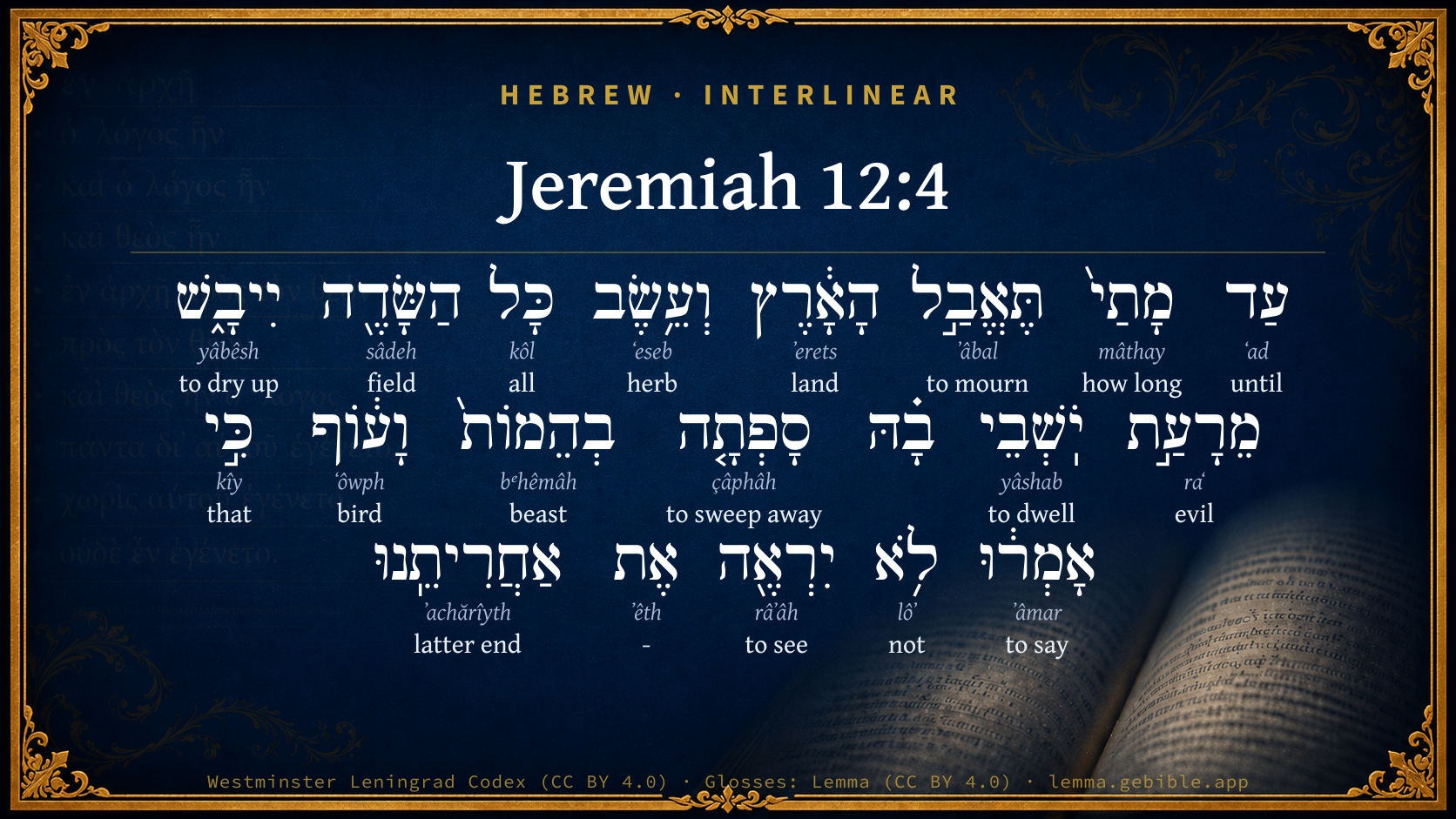
Hebrew (Westminster Leningrad Codex) Jeremiah 12:4 appears in the Hebrew Old Testament. The text above is from the Westminster Leningrad Codex. Each word links to its Strong’s number, a concise gloss, and parsing drawn from the Open Scriptures Hebrew Bible morphology. Click any word for its full Brown-Driver-Briggs (BDB) entry.
Download image
Cite this verse

Jeremiah 12:4 (World English Bible). Public Domain. Lemma interlinear Bible study tool, https://lemma.gebible.app/v/jeremiah/12/4.

Show BibTeX & RIS
BibTeX
RIS
English Translation
How long shall the land mourn, and the herbs of the whole country wither? for the wickedness of those who dwell therein, the animals are consumed, and the birds; because they said, He shall not see our latter end.
World English Bible · Public Domain
Download a study sheet

One document with this verse’s original text, its word-by-word gloss line, the meaning frame, cross-references with their text, attributed commentary, and full source and license credits — printable, and it pastes into notes with its structure intact.

This verse Autodidact and up

Study sheet (.html) Plain text (.txt)

A passage Seminary Student

Up to 50 verses in one chapter. A passage sheet keeps up to 6 commentary sources and 12 cross-references per verse, in the order this page ranks them, and says so on the sheet whenever that leaves anything out. Ask for a single verse and you get the Autodidact verse sheet above.

Everything on this page stays free to read, with no account — the sheet is a download of what is already on screen, not access to it.

Want to remove ads? Support Godless Engineer
Compare translations 3

The same verse in 3 English versions, stacked beneath the original-language interlinear above. Click any original word for its lexicon entry.

Each is an independent rendering of the whole verse — the interlinear is not word-aligned to these translations.

Highlighted words mark where these versions differ — a whole-verse word diff, not a word-by-word alignment.

  • World English Bible Public Domain
    How long shall the land mourn, and the herbs of the whole country wither? for the wickedness of those who dwell therein, the animals are consumed, and the birds; because they said, He shall not see our latter end.
  • King James Version Public Domain
    How long shall the land mourn, and the herbs of every field wither, for the wickedness of them that dwell therein? the beasts are consumed, and the birds; because they said, He shall not see our last end.
  • unfoldingWord Literal Text CC BY-SA 4.0
    Until when will the land dry up and the herbage of every field wither from the wickedness of those who dwell in it? The beasts and the birds dwindle away because they said, “He will not see our end.”

unfoldingWord Literal Text — © unfoldingWord, licensed CC BY-SA 4.0. Word-aligned USFM3 via Door43 (git.door43.org/unfoldingWord/en_ult).

Versions to compare (up to 4)

3 of 4 selected

Show all 18 translations

Every available English version of this verse, each an independent rendering of the whole verse.

  • World English Bible Public Domain
    How long shall the land mourn, and the herbs of the whole country wither? for the wickedness of those who dwell therein, the animals are consumed, and the birds; because they said, He shall not see our latter end.
  • Berean Standard Bible Public Domain
    How long will the land mourn and the grass of every field be withered? Because of the evil of its residents, the animals and birds have been swept away, for the people have said, “He cannot see what our end will be.”
  • Majority Standard Bible Public Domain
    How long will the land mourn and the grass of every field be withered? Because of the evil of its residents, the animals and birds have been swept away, for the people have said, “He cannot see what our end will be.”
  • King James Version Public Domain
    How long shall the land mourn, and the herbs of every field wither, for the wickedness of them that dwell therein? the beasts are consumed, and the birds; because they said, He shall not see our last end.
  • American Standard Version (1901) Public Domain
    How long shall the land mourn, and the herbs of the whole country wither? for the wickedness of them that dwell therein, the beasts are consumed, and the birds; because they said, He shall not see our latter end.
  • Revised Version (1885) Public Domain
    How long shall the land mourn, and the herbs of the whole country wither? for the wickedness of them that dwell therein, the beasts are consumed, and the birds; because they said, He shall not see our latter end.
  • Geneva Bible (1599) Public Domain
    Howe long shall the lande mourne, and the herbes of euery fielde wither, for the wickednesse of them that dwell therein? the beastes are consumed and the birdes, because they sayd, He wil not see our last ende.
  • Douay-Rheims (1899) Public Domain
    How long shall the land mourn, and the herb of every field wither for the wickedness of them that dwell therein? The beasts and the birds are consumed: because they have said: He shall not see our last end.
  • Young's Literal Translation Public Domain
    Till when doth the earth mourn, And the herb of the whole field wither? For the wickedness of those dwelling in it, Consumed have been beast and fowl, Because they said, `He doth not see our latter end.'
  • Literal Standard Version CC BY-SA 4.0
    Until when does the earth mourn, || And the herb of the whole field wither? For the wickedness of those dwelling in it, || Beast and bird have been consumed, || Because they said, “He does not see our latter end.”
  • Unlocked Literal Bible CC BY-SA 4.0
    How long will the land go on drying up, and the plants in every field wither because of the wickedness of its inhabitants? The animals and the birds have been taken away. Indeed, the people say, “God will not see what happens to us.”
  • unfoldingWord Literal Text CC BY-SA 4.0
    Until when will the land dry up and the herbage of every field wither from the wickedness of those who dwell in it? The beasts and the birds dwindle away because they said, “He will not see our end.”
  • Darby Bible Public Domain
    How long shall the land mourn, and the herbs of all the fields wither? Because of the wickedness of them that dwell therein, the beasts and the birds perish; for they say, He will not see our end.
  • World Messianic Bible Public Domain
    How long will the land mourn, and the herbs of the whole country wither? Because of the wickedness of those who dwell therein, the animals and birds are consumed; because they said, “He won’t see our latter end.”
  • Webster's Bible Public Domain
    How long shall the land mourn, and the herbs of every field wither, for the wickedness of them that dwell therein? the beasts are consumed, and the birds; because they said, He will not see our last end.
  • Free Bible Version CC BY-SA 4.0
    How long will the land have to mourn and the grass in every field be dried up because of the evil of the people who live there? The animals and birds have died out because the people have said, “He doesn't know what's going to happen to us.”
  • Bible in Basic English Public Domain
    How long will the land have grief, and the plants of all the land be dry? because of the sins of the people living in it, destruction has overtaken the beasts and the birds; because they said, God does not see our ways.
  • JPS Tanakh (1917) Public Domain
    How long shall the land mourn, and the herbs of the whole field wither? For the wickedness of them that dwell therein, the beasts are consumed, and the birds; because they said: 'He seeth not our end.'

Literal Standard Version (2020), Covenant Press — licensed CC BY-SA 4.0. Text via the HelloAO Bible API (eBible.org). Unlocked Literal Bible (unfoldingWord) — licensed CC BY-SA 4.0. Text via the HelloAO Bible API (eBible.org). unfoldingWord Literal Text — © unfoldingWord, licensed CC BY-SA 4.0. Word-aligned USFM3 via Door43 (git.door43.org/unfoldingWord/en_ult). Free Bible Version, Dr. Jonathan Gallagher — licensed CC BY-SA 4.0. Text via the HelloAO Bible API (eBible.org).

Word by word

More ways to search: Search by grammar → Find every occurrence → Compare this word →

Practice this passage: Drill this verse → Learn its vocabulary →

סָפְתָ֤ה
çâphâh
H5595
“to sweep away”
Verb, Qal, Perfect, 3rd Person, Feminine, Singular
Part of Speech
Verb
Stem
Qal
Form
Perfect
Person
3rd Person
Gender
Feminine
Number
Singular
Full BDB Definition

Origin: a primitive root

TWOT: 1531

to sweep or snatch away, catch up, destroy, consume - (Qal) - to be snatched away - to sweep or snatch away - (Niphal) - to be swept away, be destroyed - to be caught up, be captured - (Hiphil) to catch up, gather
  1. עַד ʻad H5704 “until” Preposition
  2. מָתַי֙ mâthay H4970 “how long” Particle, Interrogative
  3. תֶּאֱבַ֣ל ʼâbal H56 “to mourn” Verb, Qal, Imperfect, 3rd Person, Feminine, Singular
  4. הָאָ֔רֶץ ʼerets H776 “the · land” Particle, Definite Article + Noun, Common, Both, Singular, Absolute
  5. וְעֵ֥שֶׂב ʻeseb H6212 “and · herb of” Conjunction + Noun, Common, Masculine, Singular, Construct
  6. כָּל kôl H3605 “all of” Noun, Common, Masculine, Singular, Construct
  7. הַשָּׂדֶ֖ה sâdeh H7704 “the · field” Particle, Definite Article + Noun, Common, Masculine, Singular, Absolute
  8. יִיבָ֑שׁ yâbêsh H3001 “to dry up” Verb, Qal, Imperfect, 3rd Person, Masculine, Singular
  9. מֵרָעַ֣ת raʻ H7451 “from · evil of” Preposition + Noun, Common, Feminine, Singular, Construct
  10. יֹֽשְׁבֵי yâshab H3427 “dwelling” Verb, Qal, Participle Active, Masculine, Plural, Construct
  11. בְהֵמוֹת֙ bᵉhêmâh H929 “beasts” Noun, Common, Feminine, Plural, Absolute
  12. וָע֔וֹף ʻôwph H5775 “and · bird” Conjunction + Noun, Common, Masculine, Singular, Absolute
  13. כִּ֣י kîy H3588 “that” Conjunction
  14. אָמְר֔וּ ʼâmar H559 “to say” Verb, Qal, Perfect, 3rd Person, Common, Plural
  15. לֹ֥א lôʼ H3808 “not” Particle, Negative
  16. יִרְאֶ֖ה râʼâh H7200 “to see” Verb, Qal, Imperfect, 3rd Person, Masculine, Singular
  17. אֶת ʼêth H853 “-” Particle, Direct Object
  18. אַחֲרִיתֵֽנוּ ʼachărîyth H319 “latter end · our” Noun, Common, Feminine, Singular, Construct + Suffix, Personal, 1st Person, Common, Plural

About this verse

These counts appear in no published source. They are computed here, from the morphology-tagged text and Lemma’s own curated glosses. What Lemma adds →

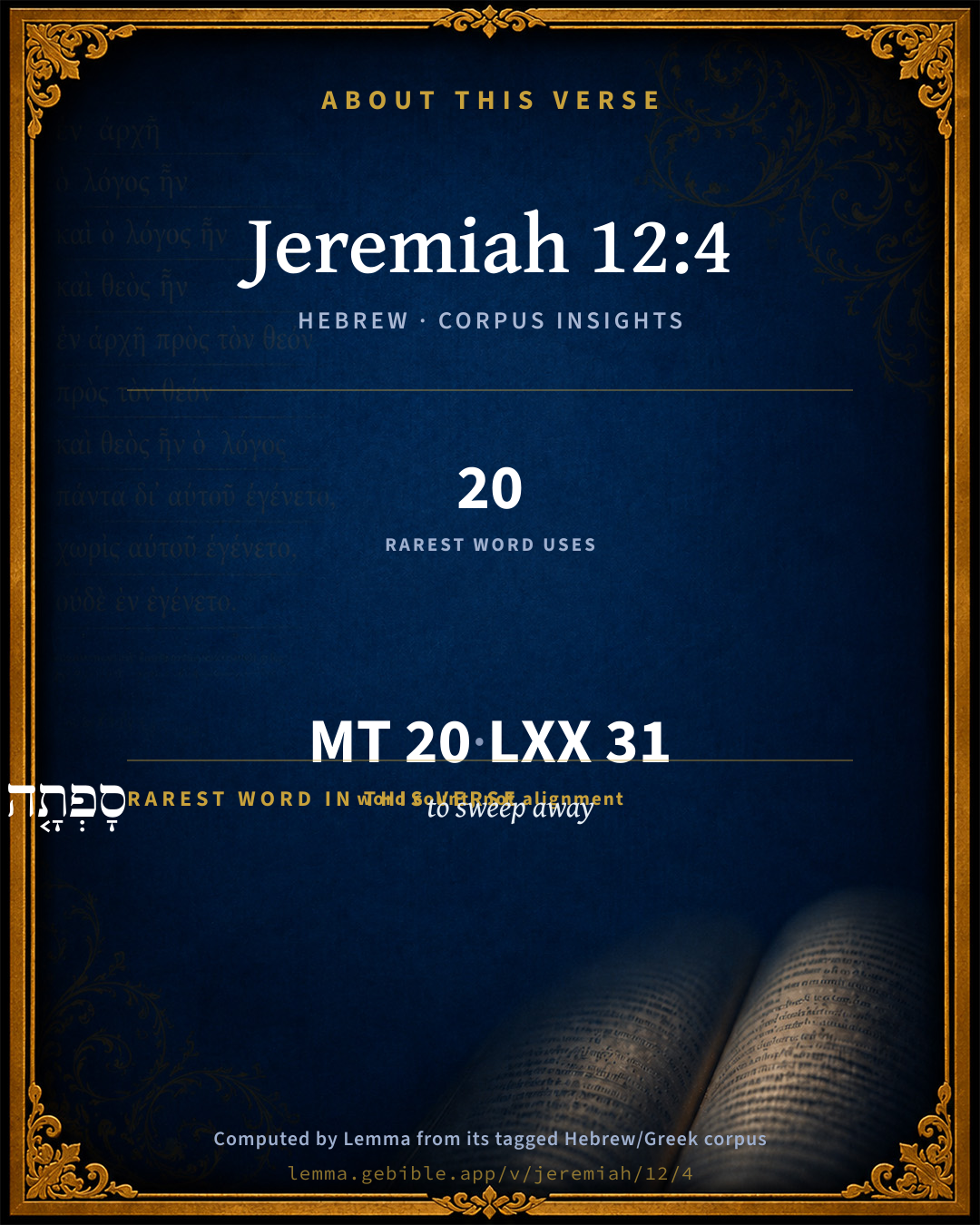
20
words
19
distinct lemmas
Prophets
section

Notable vocabulary

The rarest word here is סָפְתָ֤ה to sweep away H5595 — appearing just 20 times in the whole Hebrew Bible.

Shared distinctive vocabulary

סָפְתָ֤ה to sweep away H5595 occurs in 20 verses of the Hebrew Bible. Also found in:

Grammatical profile

  • 6 verbs
  • 8 nouns
  • 2 prepositions
  • 1 conjunction
  • 3 particles

Verb forms

  • תֶּאֱבַ֣ל Qal · Imperfect
  • יִיבָ֑שׁ Qal · Imperfect
  • יֹֽשְׁבֵי Qal · Participle Active
  • סָפְתָ֤ה Qal · Perfect
  • אָמְר֔וּ Qal · Perfect
  • יִרְאֶ֖ה Qal · Imperfect

Hebrew & Septuagint length

In the original languages it is 20 Hebrew tokens and 31 Greek tokens — but the two are counted differently (Hebrew bundles its prefixes and suffixes into one token; the Greek is in lemma form), so that isn’t a like-for-like length.

Cross-references

15

Topical passages linked to Jeremiah 12:4 in the Treasury of Scripture Knowledge — connected by theme and wording, ordered by reader-vote popularity; previews shown in the World English Bible.

  • Jeremiah 9:10 For the mountains will I take up a weeping and wailing, and for the pastures of the wilderness a lamentation, because they are burned up, so that none passes through; neither can men hear the voice of the cattle; both the birds of the sky and the animals are fled, they are gone.
  • Psalms 107:34 And a fruitful land into a salt waste, For the wickedness of those who dwell in it.
  • Jeremiah 4:25 I saw, and, behold, there was no man, and all the birds of the sky were fled.
  • Hosea 4:3 Therefore the land will mourn, And everyone who dwells therein will waste away. All living things in her, Even the animals of the field and the birds of the sky; Yes, the fish of the sea also die.
  • Jeremiah 5:31 the prophets prophesy falsely, and the priests bear rule by their means; and my people love to have it so: and what will you do in the end of it?
  • Jeremiah 7:20 Therefore thus says the Lord Yahweh: Behold, my anger and my wrath shall be poured out on this place, on man, and on animal, and on the trees of the field, and on the fruit of the ground; and it shall burn, and shall not be quenched.
  • Jeremiah 23:10 For the land is full of adulterers; for because of swearing the land mourns; the pastures of the wilderness are dried up. Their course is evil, and their might is not right;
  • Romans 8:22 For we know that the whole creation groans and travails in pain together until now.
  • Joel 1:10–17 The field is laid waste. The land mourns, for the grain is destroyed, The new wine has dried up, And the oil languishes.
  • Habakkuk 3:17 For though the fig tree doesn't flourish, Nor fruit be in the vines; The labor of the olive fails, The fields yield no food; The flocks are cut off from the fold, And there is no herd in the stalls:
  • Psalms 50:21 You have done these things, and I kept silent. You thought that the "I AM" was just like you. I will rebuke you, and accuse you in front of your eyes.
  • Jeremiah 4:28 For this shall the earth mourn, and the heavens above be black; because I have spoken it, I have purposed it, and I have not repented, neither will I turn back from it.
  • Jeremiah 5:13 and the prophets shall become wind, and the word is not in them: thus shall it be done to them.
  • Jeremiah 14:2 Judah mourns, and the gates of it languish, they sit in black on the ground; and the cry of Jerusalem is gone up.
  • Ezekiel 7:2–13 You, son of man, thus says the Lord Yahweh to the land of Israel, An end: the end is come on the four corners of the land.

Cross-references courtesy of OpenBible.info (CC BY 4.0).

Hebrew and Greek witnesses Masoretic Hebrew ↔ Greek Septuagint

The same verse in the two great witnesses to the Old Testament, shown verse-for-verse.

These are two independent witnesses, not word-aligned to each other, and the Septuagint is shown in lemma (dictionary) form.

Hebrew Jeremiah 12:4 Masoretic · Westminster Leningrad Codex

עַד מָתַי֙ תֶּאֱבַ֣ל הָאָ֔רֶץ וְעֵ֥שֶׂב כָּל הַשָּׂדֶ֖ה יִיבָ֑שׁ מֵרָעַ֣ת יֹֽשְׁבֵי בָ֗הּ סָפְתָ֤ה בְהֵמוֹת֙ וָע֔וֹף כִּ֣י אָמְר֔וּ לֹ֥א יִרְאֶ֖ה אֶת אַחֲרִיתֵֽנוּ

How long shall the land mourn, and the herbs of the whole country wither? for the wickedness of those who dwell therein, the animals are consumed, and the birds; because they said, He shall not see our latter end.

World English Bible · Public Domain

Greek LXX Structure differs

In the Septuagint, Jeremiah is about an eighth shorter than the Hebrew and arranges its material differently — the Oracles Against the Nations (Hebrew chapters 46–51) appear in the middle of the Greek book, after 25:13. Because the chapter and verse boundaries do not line up, a verse-for-verse comparison with the Hebrew is not shown.

A verse-for-verse comparison isn’t shown here because the chapters and verses don’t line up. Switch to the LXX edition with the MT / LXX toggle above to read the Greek directly.

On this verse, Jamieson, Fausset & Brown discusses the Septuagint’s reading. Read the note in Commentary ↓

Hebrew: Westminster Leningrad Codex (CC BY 4.0). Greek: Septuagint (public domain); English from a public-domain English Septuagint. How the Septuagint differs from the Hebrew →

Targum (Aramaic paraphrase)

1

The Targum is the ancient Jewish Aramaic paraphrase of the Hebrew Scriptures — an interpretive translation, not the Hebrew text itself. Onkelos (literal) and Pseudo-Jonathan (expansive) render the Torah, and Jonathan the Prophets. Coverage is partial: where no permissively-licensed English translation exists for a verse, only the Aramaic is shown. This is verse-level text, not a word-by-word alignment to the Hebrew.

  1. Targum Jonathan Prophets (Joshua–Malachi)
    עַד אֵימָתַי תֶּחֱרוֹב אַרְעָא וְעִשְׂבָּא דְכָל חַקְלָא יִיבַשׁ מֵחוֹבֵי רַשִׁיעַיָא דְיַתְבוּן בָּהּ סַף בְּעִירָא וְעוֹפָא אֲרֵי אֲמַרוּ לָא גְלֵי קֳדָמוֹהִי סוֹפָנָא:

    (no public-domain English translation for this verse)

    Targum Jonathan — Aramaic: “Mikraot Gedolot” (public domain). English: “Sefaria Community Translation” (CC0 1.0 (public-domain dedication)); “London "Chaldee Paraphrase," 1871” (public domain). Text via Sefaria.

Commentary

Notes on Jeremiah 12:4 from classic Christian and Jewish commentators (each source and its license shown beneath its notes). The classic Christian expositions comment on the surrounding passage and are grouped to its opening verse, so a note may address several verses; the Jewish commentaries on the Tanakh (Rashi and others) are per-verse, so they appear only where the commentator wrote on this verse.

Lemma curates 59 commentaries, every one of them public domain or Creative Commons licensed, each selected and text-cleaned for this edition rather than reprinted as found. About our sources →

Trapp's Complete Commentary

John Trapp

Jer 12:4 How long shall the land mourn, and the herbs of every field wither, for the wickedness of them that dwell therein? the beasts are consumed, and the birds; because they said, He shall not see our last end.

Ver. 4. How long shall the land mourn?] For the sake of those wicked wretches aforementioned.

The beasts are consumed, and the birds.] See Jer 4:25-26.

Because they said, He shall not see our last end.] God shall not, and so they deny his providence and prescience; or the prophet shall not, though now he thunder out our punishment with so great vehemence. Compare Jer 11:23.

John Trapp, A Commentary or Exposition upon All the Books of the Old and New Testament (1647–1656) — public domain. Text from a community e-Sword module.

Joseph Benson's Commentary

Jer 12:4. How long shall the land mourn? — As it doth under thy judgments inflicted upon it; for the wickedness of them that dwell therein — Lord, shall they themselves prosper, who ruin all about them? The wickedness of the people is here represented as having brought a great calamity upon the land, under which all living creatures, even the beasts of the earth, and the fowls of heaven, as well as the human race, were now suffering grievously. This calamity was a long drought, or want of rain, which happened, it seems, in the latter end of Josiah’s, and the beginning of Jehoiakim’s reign. It is mentioned Jer 3:3; and Jer 8:13; and Jer 9:10; Jer 9:12; and more fully afterward, chap. 14. Some of its effects are here noticed; namely, that the herbs of every field were withered, and the beasts and birds consumed. If they would have been brought to repentance by this lesser judgment, the greater would have been prevented. Because they — The wicked men; said, He shall not see our last end — Namely, Jeremiah, whom these abandoned Jews threatened to kill, as if they were not willing he should see the fulfilling of his prophecies concerning the calamities to come on Judea. Not that they believed what he predicted would really come to pass, but they spake thus in a sarcastical manner, as much as to say, Be it so, that the calamities which thou denouncest against us shall come upon us, yet we will take care that thou shalt not have the pleasure of seeing them fulfilled upon us.

Joseph Benson's Commentary on the Old and New Testaments (1811–1818) — public domain. Text from a community e-Sword module.

Tyndale Open Study Notes

Tyndale Open Resources

12:4 Jeremiah expressed feelings of helplessness; the Lord’s decree of desolation for the land seemed excessive. Jeremiah did recognize the evil of the people’s sneering claim that the Lord could not see the future (cp. Isa 46:10).

Tyndale Open Study Notes — © Tyndale Open Resources, licensed CC BY-SA 4.0. Text via the HelloAO Bible API.

Geneva Bible (1599)

Geneva Bible translators

Abusing God’s lenity and his promises, they flattered themselves as though God would ever be merciful, and not utterly destroy them: therefore they hardened themselves in sin, till at length the beasts and insensible creatures felt the punishment of their stubborn rebellion against God.

Geneva Bible (1599) marginal notes — public domain. Text via Bolls.life.

Jamieson, Fausset & Brown

Robert Jamieson, A. R. Fausset & David Brown

land mourn--personification (Jer 14:2; Jer 23:10).

for the wickedness-- (Psa 107:34).

beasts-- (Hos 4:3).

He shall not see our last end--Jehovah knows not what is about to happen to us (Jer 5:12) [ROSENMULLER]. So the Septuagint. (Psa 10:11; Eze 8:12; Eze 9:9). Rather, "The prophet (Jeremiah, to whom the whole context refers) shall not see our last end." We need not trouble ourselves about his boding predictions. We shall not be destroyed as he says (Jer 5:12-13).

Jamieson, Fausset & Brown — Commentary Critical and Explanatory on the Whole Bible (1871) — public domain (CC PDM 1.0). Text via the HelloAO Bible API.

Adam Clarke's Commentary

Verse 4. How long shall the land mourn] These hypocrites and open sinners are a curse to the country; pull them out, Lord, that the land may be delivered of that which is the cause of its desolation.

Adam Clarke's Commentary on the Bible (1810–1826) — public domain. Text from a community e-Sword/MySword module.

John Calvin's Commentaries

Jeremiah confirms the former sentence and more strongly reproves the Jews, who still continued obstinately to despise what he had said: “What do you mean, he says? for God’s judgment appears as to brute beasts and birds; and what have birds and sheep and oxen deserved? Ye know that there is no fault in miserable animals, and yet the curse of God is through them set before you; ye see that God is offended with brute animals, but the fault is doubtless in you. And will God spare you, when he has already begun, and long ago begun to inflict punishment on innocent animals? how can he hear with you to the end, who are full of so many and the most atrocious sins?” This then is a confirmation of his former doctrine.

And hence we also learn that he did not speak for his own sake, nor express his own private feelings, but that he defended the doctrine which he had announced, that the Jews might know that God was angry with them, and that they were not to expect that he would always conceal himself, though he for a time connived at them.

How long, he says, shall the land mourn? or, How long should the land mourn? for thus it ought to be rendered; and should every herb become dry? “What!” he says, “is not God’s judgment visible in herbs and flocks and beasts and birds? Since it is so, and the whole fault is in you, shall ye be spared? Will God pour forth his whole wrath on herbs, on sheep, and on cattle? and shall you be at the same time exempted from his judgment?”

And more clearly still does he express his meaning, when he says, Because they have said, He shall not see our end Here the Prophet briefly shews that the wrath of God was seen in herbs as well as in brute animals, because he was despised by the people. Since then evil proceeded from them, should it not return on their own heads? It could not surely be otherwise. But he speaks expressly of the end; for the Jews were so stupified by their prosperity, that they thought that God was no longer adverse to them: “Ha! what have we to do with God? we are already beyond the reach of danger.” As then they thus perversely rejected God, he upbraids them with the thought, that they were to give no account to God. It is not indeed probable that they openly, or with a full mouth, as they say, vomited forth such a blasphemy; but we know that Scripture often speaks in this manner, “God shall not see;” “God will not look on Jacob.” Though the ungodly did not speak so insolently, yet they no doubt thought thati they could set up many hinderances to prevent God’s hand from reaching them. Hence Jeremiah, according to the usual manner of Scripture, justly lays this to their charge, — that they thought that they were now as it were unknown to God and beyond the reach of his care, so that he would not see their end; in other words, that they had no concern with God, because they were on all sides so well fortified, that the hand of God could not reach them.

John Calvin's Commentaries (1540-1563) — public domain. Text from the Calvin Translation Society English edition (1840s-50s) via the Christian Classics Ethereal Library (ccel.org). Calvin's coverage is partial (roughly two-thirds of the Bible); uncommented books and verses are honest gaps, never fabricated. The 19th-century editor's footnotes and remarks are omitted so the notes are faithfully Calvin's own voice.

Ellicott's Commentary for English Readers

(4) How long shall the land mourn . . .—The Hebrew punctuation gives a different division, How long shall the land mourn, and the herbs of the whole field (i.e., all the open country) wither? For the wickedness of them that dwell therein, cattle and birds perish, for, say they, he (i.e., the prophet) will not see our latter end (i.e., we shall outlive him, though he prophesies our destruction). A slightly different reading, however, adopted by the LXX. and by some modern scholars, would give for the last clause, “He (God) seeth not our ways,” i.e., will leave us unpunished. The opening words point to a time of distress, probably of drought and famine. But out of this wretchedness, the men who were Jeremiah’s enemies—the forestallers, and monopolists, and usurers of the time—continued to enrich themselves, and scornfully defied all his warnings.

A Bible Commentary for English Readers, edited by Charles John Ellicott (1878–1897) — public domain. Text from a community e-Sword module.

The Cambridge Bible for Schools and Colleges

gen. ed. J. J. S. Perowne

4. This v., while suiting Jeremiah’s style, is quite out of harmony with the context. See further on Jer_12:13.

He shall not see our latter end] He will predecease us, not we him, as he pretends. But the LXX, assuming the pronoun to refer to Jehovah, and transposing two consonants in the last Hebrew word, translate, God shall not see our ways. In that case cp. Psa_73:11. Co. and so Gi. (Metrik) for metrical reasons omit the v.

The Cambridge Bible for Schools and Colleges (gen. ed. J. J. S. Perowne; Cambridge University Press, 1878–1918) — public domain. Text from a community e-Sword module.

John Gill's Exposition

How long shall the land mourn,.... The land of Judea, being desolate, and bringing forth no fruit, through the long drought that had been upon it:

and the herbs of every field wither; for want of rain to come upon it:

for the wickedness of them that dwell therein? this opens the cause, the reason of this dearth; it was the wickedness of the inhabitants of it: as the whole earth was originally cursed for the sins of men, so particular countries have had the marks of God's displeasure upon them, because of the sins of those that dwell in them. This clause, according to the accents, belongs to what follows, and may be read in connection with the next clause; either thus, "the herbs" of every field wither, I say, "because of the wickedness of the inhabitants of it, which consumes the beasts and the birds" (x); that is, which wickedness is the cause not only of the withering of the grass and herbs, but of the consumption of birds and beasts: or else, by repeating the interrogation in the preceding clause,

how long shall the earth mourn, &c.;

how long, for the malice of them that dwell in it, are the beasts and the birds consumed (y)? the one having no grass to eat; and the other no fruit to pick, or seeds to live upon; the barrenness being so very great and general.

Because they said; the Jews, the inhabitants of the land, the wicked part of them, and which was the greater:

he shall not see our last end; either the Prophet Jeremiah, who had foretold it; but they did not believe him, that such would be their end, and that he should live to see it; or such was their atheism and infidelity, that they said God himself should not see it; and so the Septuagint and Arabic versions read, "God shall not see".

(x) So Gussetius, Ebr. Comment. p. 564. (y) Thus Schmidt, after Luther.

John Gill's Exposition of the Whole Bible (1746–1763) — public domain (CC PDM 1.0). Text via the HelloAO Bible API.

Albert Barnes' Notes on the Bible

The Hebrew divides this verse differently. “How long shall the land mourn, and the herb of the whole field wither? Because of the wickedness of them that dwell therein cattle and fowl have ceased to be: for he will not see, say they, our latter end.” The people mock the prophet, saying, In spite of all his threatenings we shall outlive him.

Jeremiah complained that at a time of great general misery powerful men throve upon the ruin of others: even the innocent cattle and fowl suffered with the rest. To him it seemed that all this might have been cured by some signal display of divine justice. If God, instead of dealing with men by general and slow-working laws, would tear (out some of the worst offenders from among the rest, the land might yet be saved.

Albert Barnes' Notes on the Bible (1834–1885) — public domain. Text from a community e-Sword/MySword module.

Haydock's Catholic Bible Commentary

Mourn? Is not this a proof of my providence in chastising Juda? This famine is specified [in] chap. viii. 13., and xiv. 4. (Calmet) --- Last end. Two letters seem to be transposed in Hebrew, as the Septuagint read "ways." (Kennicott) --- The impious blaspheme as if all were ruled by chance. (Calmet)

George Leo Haydock (1774–1849), Haydock's Catholic Family Bible and Commentary, 1859 edition — public domain. Excludes Psalms (Douay-Rheims chapter numbering differs from Protestant) and Deuterocanonical books (Catholic canon only).

Matthew Poole's English Annotations

The prophet seems to give a reason of his former passion and prayer against those wicked men he before reflected on, because they were the cause of the nation’s ruin, which is also asserted by the psalmist, Psa 107:34. A land is said to mourn, metaphorically, when it is brought to an ill complexion, and looketh unpleasantly, the grass and green herbs in it being destroyed by enemies, or drought, or vermin. Nay, the effects of their wicked courses reached to the very beasts and birds, because they were so presumptuous as to conclude that they should do well enough, neither the prophet nor any other should see their last end.

Matthew Poole's English Annotations on the Holy Bible (1683–1685) — public domain. Text from a community e-Sword/MySword module.

Whedon's Commentary on the Bible

Daniel D. Whedon

4. How long shall the land mourn — In the second verse the prophet intimates his temptation growing out of the prosperity of the wicked. And yet here he speaks of the whole land as if lying under the shadow of a universal curse. But there is here no incongruity. An individual may be wicked and prosperous, but when wickedness and corruption prevail there is general misery. In the aggregate, the amount of practical righteousness in any community will accurately measure the amount of well-being in the same community.

Daniel D. Whedon (gen. ed.), Commentary on the Old and New Testaments (1874–1909) — public domain. Text from a community e-Sword module.

The Pulpit Commentary

How long, etc.? The verse is decided rather differently by the Hebrew accents. The question should end at wither, and the following words run on. Every field should be the whole field (i.e. open country). The connection has caused some difficulty. But drought is constantly described as a judgment, (Jer_3:3 Jer_5:24, 25 14:2-7 23:10) and it is a prophetic doctrine that the lower animals suffer for the fault of man. Because they said; rather, because they say. The speakers are the ungodly. The subject of the following verb is uncertain. Some think it is God; but when God is said to "see" (i.e. take notice of) anything, it is always something actually existing. The subject must, therefore, be the prophet, of whom the ungodly scoffingly declare, He shall not see our last end, because his predictions are mere delusions.

The Pulpit Commentary (1880–1919), ed. H.D.M. Spence-Jones & Joseph S. Exell — public domain. Text from a community e-Sword module.

John Wesley's Explanatory Notes

He - They were bold to say, neither the prophet nor any other should see their last end.

John Wesley, Explanatory Notes Upon the Whole Bible (1754–1765) — public domain. Text via the GEBible commentary corpus.

Rashi

Rabbi Shlomo Yitzchaki (Rashi)

How long will the land mourn and the grass of all the field dry out? Up to here are the prophet’s words, and the Holy Spirit replies to him, “Because of the evil of its inhabitants, beasts and fowl are ended.”

will...mourn Be waste.

ended (finira in French, will terminate).

for they said i.e., the inhabitants of this land have said.

“He will not see our end.” It is not revealed to Him what will be at our end.

Rashi on the Tanakh — English translations: “The Judaica Press complete Tanach with Rashi, translated by A. J. Rosenberg” (CC BY 4.0); “Pentateuch with Rashi's commentary by M. Rosenbaum and A.M. Silbermann, 1929-1934” (public domain); “The Metsudah Tanach series, Lakewood, N.J” (CC BY 4.0); and “The Book of Joshua, Metsudah Publications, 1997” (CC BY 4.0). Text via Sefaria.

Lesson kit

Teaching starters — assembled from the data on this page, not authored interpretation. Every prompt links to the verse data it draws on. Edit before teaching.

Jeremiah, in the Prophets, opens this verse with 20 words (19 distinct Hebrew lemmas). Its most distinctive word is çâphâh (“to sweep away”). A historical commentator’s framing appears above. Read the whole chapter for the surrounding context.

Discussion questions

  1. What does “to sweep away” (çâphâh) contribute to the verse as a whole?
  2. Genesis 18:23 shares the word «to sweep away» with this verse. How do the two illuminate each other?
  3. These translations render this verse differently. What is at stake in choosing one wording over another?
  4. The verb «תֶּאֱבַ֣ל» is Qal Imperfect. How does its form color the action?
  5. Reading how Trapp's Complete Commentary and Joseph Benson's Commentary read this verse, where do the two commentators agree and where do they part?

Things to notice

Reading settings

Reading text

Shown beneath each verse's original-language words.

Old Testament
Old Testament edition

Read the OT as the Masoretic Hebrew (MT) or the Greek Septuagint (LXX).

English shown for the Greek Septuagint (in the Hebrew ↔ Greek comparison).

Comparing translations? Open the Compare panel on any verse page to stack up to four side by side.