
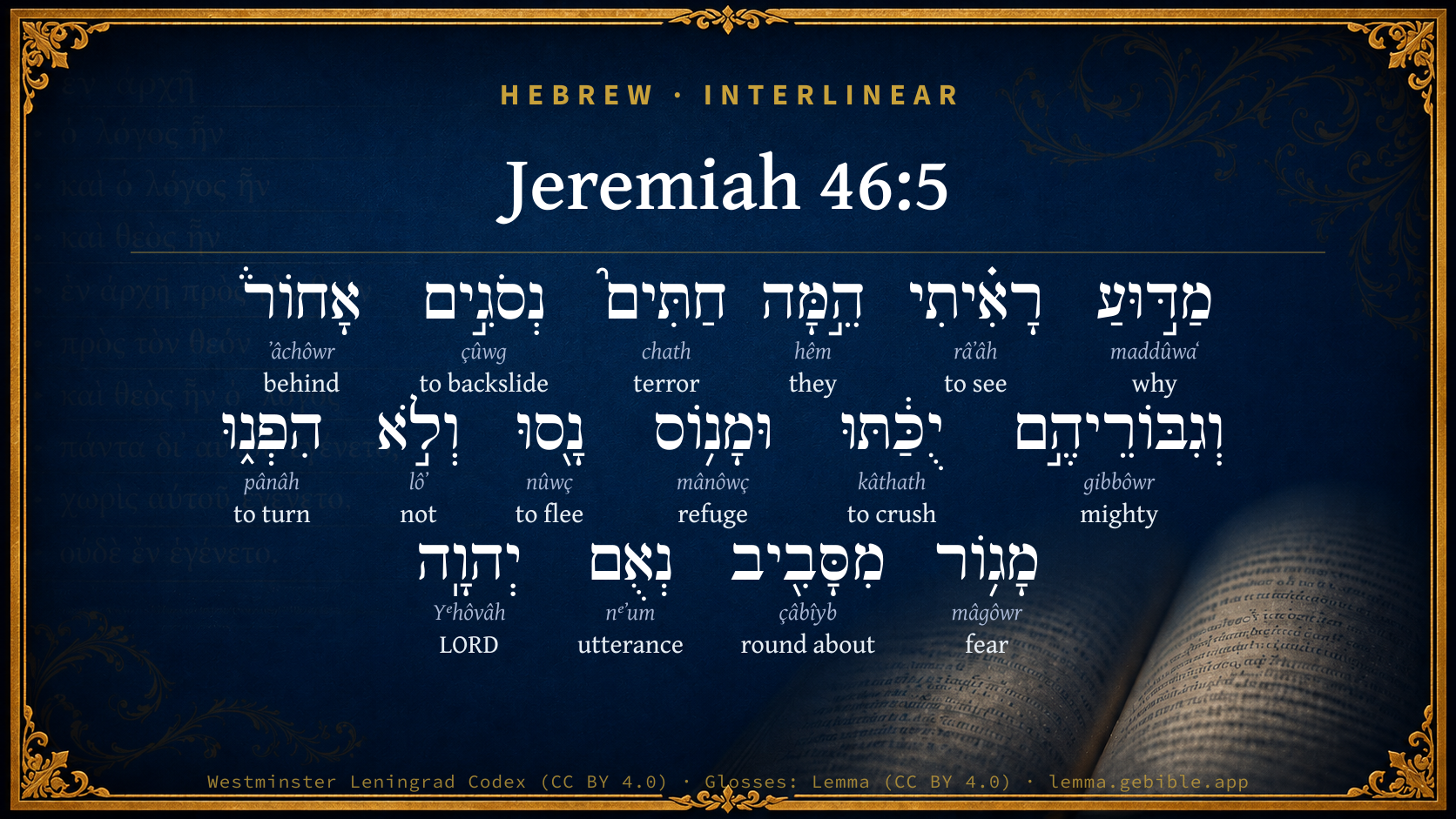
Jeremiah 46:5

Hebrew (Westminster Leningrad Codex) Jeremiah 46:5 appears in the Hebrew Old Testament. The text above is from the Westminster Leningrad Codex. Each word links to its Strong’s number, a concise gloss, and parsing drawn from the Open Scriptures Hebrew Bible morphology. Click any word for its full Brown-Driver-Briggs (BDB) entry.
Download image
Cite this verse

Jeremiah 46:5 (World English Bible). Public Domain. Lemma interlinear Bible study tool, https://lemma.gebible.app/v/jeremiah/46/5.

Show BibTeX & RIS
BibTeX
RIS
English Translation
Why have I seen it? they are dismayed and are turned backward; and their mighty ones are beaten down, and have fled apace, and don't look back: terror is on every side, says Yahweh.
World English Bible · Public Domain
Download a study sheet

One document with this verse’s original text, its word-by-word gloss line, the meaning frame, cross-references with their text, attributed commentary, and full source and license credits — printable, and it pastes into notes with its structure intact.

This verse Autodidact and up

Study sheet (.html) Plain text (.txt)

A passage Seminary Student

Up to 50 verses in one chapter. A passage sheet keeps up to 6 commentary sources and 12 cross-references per verse, in the order this page ranks them, and says so on the sheet whenever that leaves anything out. Ask for a single verse and you get the Autodidact verse sheet above.

Everything on this page stays free to read, with no account — the sheet is a download of what is already on screen, not access to it.

Want to remove ads? Support Godless Engineer
Compare translations 3

The same verse in 3 English versions, stacked beneath the original-language interlinear above. Click any original word for its lexicon entry.

Each is an independent rendering of the whole verse — the interlinear is not word-aligned to these translations.

Highlighted words mark where these versions differ — a whole-verse word diff, not a word-by-word alignment.

  • World English Bible Public Domain
    Why have I seen it? they are dismayed and are turned backward; and their mighty ones are beaten down, and have fled apace, and don't look back: terror is on every side, says Yahweh.
  • King James Version Public Domain
    Wherefore have I seen them dismayed and turned away back? and their mighty ones are beaten down, and are fled apace, and look not back: for fear was round about, saith the LORD.
  • unfoldingWord Literal Text CC BY-SA 4.0
    What am I seeing here? They are filled with terror and are running away, for their soldiers are defeated. They are running for safety and are not looking back. Terror is all around—this is Yahweh’s declaration—

unfoldingWord Literal Text — © unfoldingWord, licensed CC BY-SA 4.0. Word-aligned USFM3 via Door43 (git.door43.org/unfoldingWord/en_ult).

Versions to compare (up to 4)

3 of 4 selected

Show all 18 translations

Every available English version of this verse, each an independent rendering of the whole verse.

  • World English Bible Public Domain
    Why have I seen it? they are dismayed and are turned backward; and their mighty ones are beaten down, and have fled apace, and don't look back: terror is on every side, says Yahweh.
  • Berean Standard Bible Public Domain
    Why am I seeing this? They are terrified, they are retreating; their warriors are defeated, they flee in haste without looking back; terror is on every side!” declares the LORD.
  • Majority Standard Bible Public Domain
    Why am I seeing this? They are terrified, they are retreating; their warriors are defeated, they flee in haste without looking back; terror is on every side!” declares the LORD.
  • King James Version Public Domain
    Wherefore have I seen them dismayed and turned away back? and their mighty ones are beaten down, and are fled apace, and look not back: for fear was round about, saith the LORD.
  • American Standard Version (1901) Public Domain
    Wherefore have I seen it? they are dismayed and are turned backward; and their mighty ones are beaten down, and are fled apace, and look not back: terror is on every side, saith Jehovah.
  • Revised Version (1885) Public Domain
    Wherefore have I seen it? they are dismayed and are turned backward; and their mighty ones are beaten down, and are fled apace, and look not back: terror is on every side, saith the LORD.
  • Geneva Bible (1599) Public Domain
    Wherefore haue I seene them afraid, and driuen backe? for their mighty men are smitten, and are fled away, and looke not backe: for feare was rounde about, sayeth the Lord.
  • Douay-Rheims (1899) Public Domain
    What then? I have seen them dismayed, and turning their backs, their valiant ones slain: they fled apace, and they looked not back: terror was round about, saith the Lord.
  • Young's Literal Translation Public Domain
    Wherefore have I seen them dismayed -- They are turned backward, And their mighty ones are beaten down, And `to' a refuge they have fled, and not turned the face? Fear `is' round about -- an affirmation of Jehovah.
  • Literal Standard Version CC BY-SA 4.0
    Why have I seen them dismayed [and] turned backward? And their mighty ones are beaten down, || And they have fled [to] a refuge, || And did not turn their face, || Fear [is] all around—a declaration of YHWH.
  • Unlocked Literal Bible CC BY-SA 4.0
    What am I seeing here? They are filled with terror and are running away, for their soldiers are defeated. They are running for safety and are not looking back. Terror is all around—this is Yahweh's declaration—
  • unfoldingWord Literal Text CC BY-SA 4.0
    What am I seeing here? They are filled with terror and are running away, for their soldiers are defeated. They are running for safety and are not looking back. Terror is all around—this is Yahweh’s declaration—
  • Darby Bible Public Domain
    Why do I see them dismayed, turned away back? And their mighty ones are beaten down, and take to flight, and look not back? Terror [is] on every side, saith Jehovah.
  • World Messianic Bible Public Domain
    Why have I seen it? They are dismayed and are turned backward. Their mighty ones are beaten down, have fled in haste, and don’t look back. Terror is on every side,” says the LORD.
  • Webster's Bible Public Domain
    Why have I seen them dismayed and turned away back? and their mighty ones are beaten down, and have fled apace, and look not back: for fear was on all sides, saith the LORD.
  • Free Bible Version CC BY-SA 4.0
    Why do I see their lines broken and retreating? Their soldiers are defeated. They run away so quickly they don't even look back because they're so terrified by what's happening around them, declares the Lord.
  • Bible in Basic English Public Domain
    What have I seen? they are overcome with fear and turned back; their men of war are broken and have gone in flight, not looking back: fear is on every side, says the Lord.
  • JPS Tanakh (1917) Public Domain
    Wherefore do I see them dismayed and turned backward? and their mighty ones are beaten down, and they are fled apace, and look not back; terror is on every side, saith the LORD.

Literal Standard Version (2020), Covenant Press — licensed CC BY-SA 4.0. Text via the HelloAO Bible API (eBible.org). Unlocked Literal Bible (unfoldingWord) — licensed CC BY-SA 4.0. Text via the HelloAO Bible API (eBible.org). unfoldingWord Literal Text — © unfoldingWord, licensed CC BY-SA 4.0. Word-aligned USFM3 via Door43 (git.door43.org/unfoldingWord/en_ult). Free Bible Version, Dr. Jonathan Gallagher — licensed CC BY-SA 4.0. Text via the HelloAO Bible API (eBible.org).

Word by word

More ways to search: Search by grammar → Find every occurrence → Compare this word →

Practice this passage: Drill this verse → Learn its vocabulary →

חַתִּים֮
chath
H2844
“terror”
Adjective, Adjective, Masculine, Plural, Absolute
Part of Speech
Adjective
Type
Adjective
Gender
Masculine
Number
Plural
State
Absolute
Full BDB Definition

Origin: from H2865

TWOT: 784a

fear, terror - shattered, dismayed - shattered - dismayed
  1. מַדּ֣וּעַ maddûwaʻ H4069 “why” Particle, Interrogative
  2. רָאִ֗יתִי râʼâh H7200 “to see” Verb, Qal, Perfect, 1st Person, Common, Singular
  3. הֵ֣מָּה hêm H1992 “they” Pronoun, Personal, 3rd Person, Masculine, Plural
  4. נְסֹגִ֣ים çûwg H5472 “backsliding” Verb, Niphal, Participle Active, Masculine, Plural, Absolute
  5. אָחוֹר֒ ʼâchôwr H268 “behind” Noun, Common, Masculine, Singular, Absolute
  6. וְגִבּוֹרֵיהֶ֣ם gibbôwr H1368 “and · mighty · their” Conjunction + Adjective, Adjective, Masculine, Plural, Construct + Suffix, Personal, 3rd Person, Masculine, Plural
  7. יֻכַּ֔תּוּ kâthath H3807 “to crush” Verb, Hophal, Imperfect, 3rd Person, Masculine, Plural
  8. וּמָנ֥וֹס mânôwç H4498 “and · refuge” Conjunction + Noun, Common, Masculine, Singular, Absolute
  9. נָ֖סוּ nûwç H5127 “to flee” Verb, Qal, Perfect, 3rd Person, Common, Plural
  10. וְלֹ֣א lôʼ H3808 “and · not” Conjunction + Particle, Negative
  11. הִפְנ֑וּ pânâh H6437 “to turn” Verb, Hiphil, Perfect, 3rd Person, Common, Plural
  12. מָג֥וֹר mâgôwr H4032 “fear” Noun, Common, Masculine, Singular, Absolute
  13. מִסָּבִ֖יב çâbîyb H5439 “from · round about” Preposition + Noun, Common, Both, Singular, Absolute
  14. נְאֻם nᵉʼum H5002 “utterance of” Noun, Common, Masculine, Singular, Construct
  15. יְהוָֽה Yᵉhôvâh H3068 “LORD” Noun, Proper

About this verse

These counts appear in no published source. They are computed here, from the morphology-tagged text and Lemma’s own curated glosses. What Lemma adds →

16
words
16
distinct lemmas
Prophets
section

Notable vocabulary

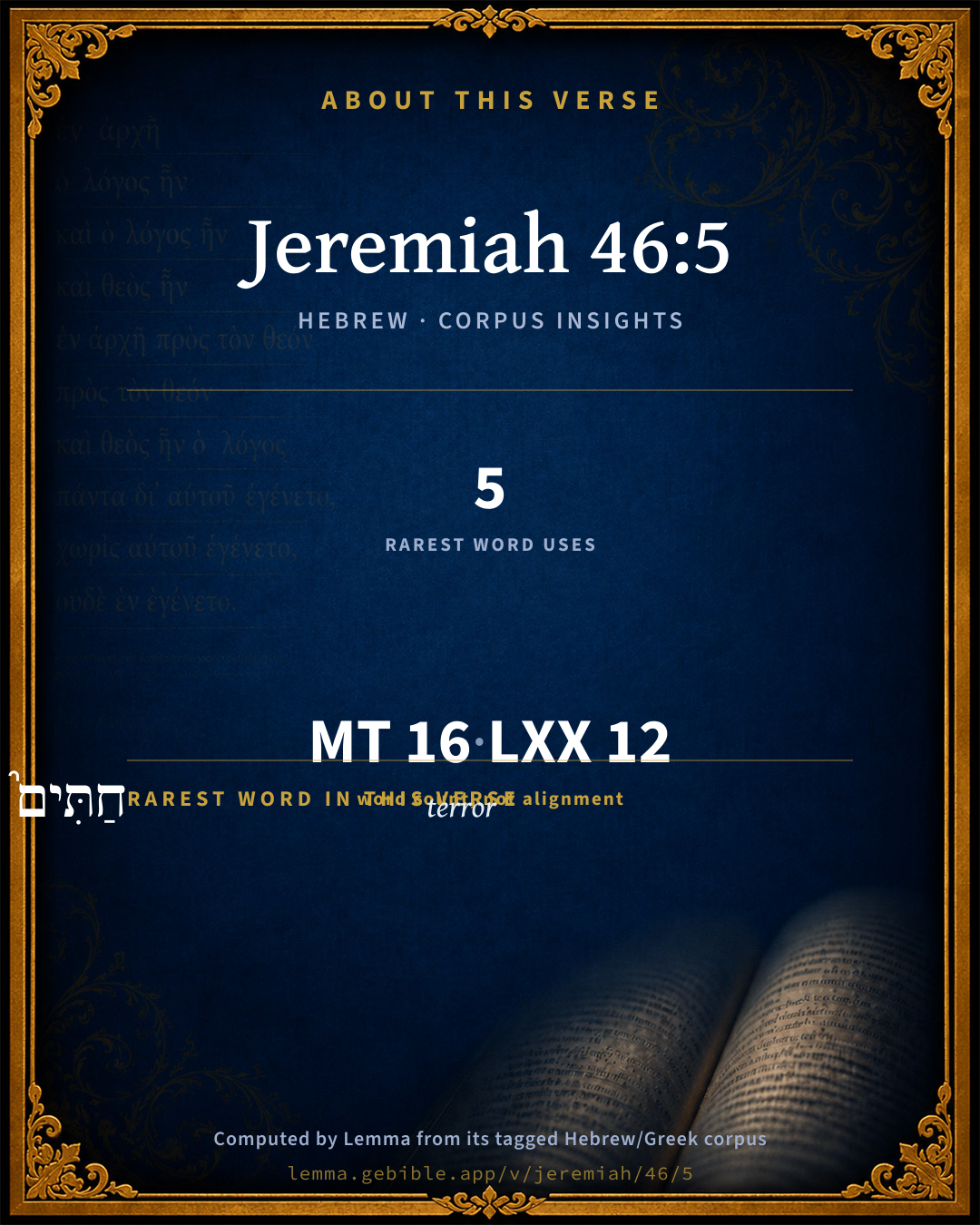
The rarest word here is חַתִּים֮ terror H2844 — appearing just 5 times in the whole Hebrew Bible.

Shared distinctive vocabulary

חַתִּים֮ terror H2844 occurs in 5 verses of the Hebrew Bible. Also found in:

Grammatical profile

  • 5 verbs
  • 6 nouns
  • 2 adjectives
  • 1 pronoun
  • 2 particles

Verb forms

  • רָאִ֗יתִי Qal · Perfect
  • נְסֹגִ֣ים Niphal · Participle Active
  • יֻכַּ֔תּוּ Hophal · Imperfect
  • נָ֖סוּ Qal · Perfect
  • הִפְנ֑וּ Hiphil · Perfect

Hebrew & Septuagint length

In the original languages it is 16 Hebrew tokens and 12 Greek tokens — but the two are counted differently (Hebrew bundles its prefixes and suffixes into one token; the Greek is in lemma form), so that isn’t a like-for-like length.

Cross-references

12

Topical passages linked to Jeremiah 46:5 in the Treasury of Scripture Knowledge — connected by theme and wording, ordered by reader-vote popularity; previews shown in the World English Bible.

  • Jeremiah 6:25 Don't go forth into the field, nor walk by the way; for the sword of the enemy, [and] terror, are on every side.
  • Jeremiah 49:29 Their tents and their flocks shall they take; they shall carry away for themselves their curtains, and all their vessels, and their camels; and they shall cry to them, Terror on every side!
  • Jeremiah 46:21 Also her hired men in the midst of her are like calves of the stall; for they also are turned back, they are fled away together, they didn't stand: for the day of their calamity is come on them, the time of their visitation.
  • Genesis 19:17 It came to pass, when they had taken them out, that he said, "Escape for your life! Don't look behind you, neither stay anywhere in the plain. Escape to the mountain, lest you be consumed!"
  • 2 Kings 7:6–7 For the Lord had made the host of the Syrians to hear a noise of chariots, and a noise of horses, even the noise of a great host: and they said one to another, Behold, the king of Israel has hired against us the kings of the Hittites, and the kings of the Egyptians, to come on us.
  • Isaiah 19:16 In that day shall the Egyptians be like women; and they shall tremble and fear because of the shaking of the hand of Yahweh of Hosts, which he shakes over them.
  • Jeremiah 20:3–4 It happened on the next day, that Pashhur brought forth Jeremiah out of the stocks. Then said Jeremiah to him, Yahweh has not called your name Pashhur, but Magormissabib.
  • Jeremiah 20:10 For I have heard the defaming of many, terror on every side. Denounce, and we will denounce him, [say] all my familiar friends, those who watch for my fall; peradventure he will be persuaded, and we shall prevail against him, and we shall take our revenge on him.
  • Jeremiah 46:15 Why are your strong ones swept away? they didn't stand, because Yahweh did drive them.
  • Ezekiel 32:10 Yes, I will make many peoples amazed at you, and their kings shall be horribly afraid for you, when I shall brandish my sword before them; and they shall tremble at every moment, every man for his own life, in the day of your fall.
  • Nahum 2:8 But Nineveh has been from of old like a pool of water, yet they flee away. "Stop! Stop!" they cry, but no one looks back.
  • Revelation 6:15–17 The kings of the earth, the princes, the commanding officers, the rich, the strong, and every slave and free person, hid themselves in the caves and in the rocks of the mountains.

Cross-references courtesy of OpenBible.info (CC BY 4.0).

Hebrew and Greek witnesses Masoretic Hebrew ↔ Greek Septuagint

The same verse in the two great witnesses to the Old Testament, shown verse-for-verse.

These are two independent witnesses, not word-aligned to each other, and the Septuagint is shown in lemma (dictionary) form.

Hebrew Jeremiah 46:5 Masoretic · Westminster Leningrad Codex

מַדּ֣וּעַ רָאִ֗יתִי הֵ֣מָּה חַתִּים֮ נְסֹגִ֣ים אָחוֹר֒ וְגִבּוֹרֵיהֶ֣ם יֻכַּ֔תּוּ וּמָנ֥וֹס נָ֖סוּ וְלֹ֣א הִפְנ֑וּ מָג֥וֹר מִסָּבִ֖יב נְאֻם יְהוָֽה

Why have I seen it? they are dismayed and are turned backward; and their mighty ones are beaten down, and have fled apace, and don't look back: terror is on every side, says Yahweh.

World English Bible · Public Domain

Greek LXX Structure differs

In the Septuagint, Jeremiah is about an eighth shorter than the Hebrew and arranges its material differently — the Oracles Against the Nations (Hebrew chapters 46–51) appear in the middle of the Greek book, after 25:13. Because the chapter and verse boundaries do not line up, a verse-for-verse comparison with the Hebrew is not shown.

A verse-for-verse comparison isn’t shown here because the chapters and verses don’t line up. Switch to the LXX edition with the MT / LXX toggle above to read the Greek directly.

On this verse, The Cambridge Bible for Schools and Colleges discusses the Septuagint’s reading. Read the note in Commentary ↓

Hebrew: Westminster Leningrad Codex (CC BY 4.0). Greek: Septuagint (public domain); English from a public-domain English Septuagint. How the Septuagint differs from the Hebrew →

Targum (Aramaic paraphrase)

1

The Targum is the ancient Jewish Aramaic paraphrase of the Hebrew Scriptures — an interpretive translation, not the Hebrew text itself. Onkelos (literal) and Pseudo-Jonathan (expansive) render the Torah, and Jonathan the Prophets. Coverage is partial: where no permissively-licensed English translation exists for a verse, only the Aramaic is shown. This is verse-level text, not a word-by-word alignment to the Hebrew.

  1. Targum Jonathan Prophets (Joshua–Malachi)
    מַה דֵין חֲזֵיתִי אִינוּן תְבִירִין מִסְתַּחֲרִין לַאֲחוֹרָא וְגִבָּרֵיהוֹן תְּבִירִין וּמֶעֱרַק עַרְקִין וְלָא מִתְפְּנָן לְמֵיקָם מִן קֳדָם דְקַטְלִין בְּחַרְבָּא דְמִתְכַּנְשִׁין עֲלֵיכוֹן מִסְחוֹר סְחוֹר אֲמַר יְיָ:

    (no public-domain English translation for this verse)

    Targum Jonathan — Aramaic: “Mikraot Gedolot” (public domain). English: “Sefaria Community Translation” (CC0 1.0 (public-domain dedication)); “London "Chaldee Paraphrase," 1871” (public domain). Text via Sefaria.

Commentary

Notes on Jeremiah 46:5 from classic Christian and Jewish commentators (each source and its license shown beneath its notes). The classic Christian expositions comment on the surrounding passage and are grouped to its opening verse, so a note may address several verses; the Jewish commentaries on the Tanakh (Rashi and others) are per-verse, so they appear only where the commentator wrote on this verse.

Lemma curates 59 commentaries, every one of them public domain or Creative Commons licensed, each selected and text-cleaned for this edition rather than reprinted as found. About our sources →

Trapp's Complete Commentary

John Trapp

Jer 46:5 Wherefore have I seen them dismayed [and] turned away back? and their mighty ones are beaten down, and are fled apace, and look not back: [for] fear [was] round about, saith the LORD.

Ver. 5. Wherefore have I seen them dismayed?] Surprised with a panic terror.

And are fled apace.] Heb., Fled to flight.

For fear was round about.] A proverbial form. {Jer 6:25}

John Trapp, A Commentary or Exposition upon All the Books of the Old and New Testament (1647–1656) — public domain. Text from a community e-Sword module.

Geneva Bible (1599)

Geneva Bible translators

The Prophet had this vision of the Egyptians, which should be put to flight by the Babylonians at Carchemish.

Geneva Bible (1599) marginal notes — public domain. Text via Bolls.life.

Jamieson, Fausset & Brown

Robert Jamieson, A. R. Fausset & David Brown

(See on Jer 46:3). The language of astonishment, that an army so well equipped should be driven back in "dismay." The prophet sees this in prophetic vision.

fled apace--literally, "fled a flight," that is, flee precipitately.

look not back--They do not even dare to look back at their pursuers.

Jamieson, Fausset & Brown — Commentary Critical and Explanatory on the Whole Bible (1871) — public domain (CC PDM 1.0). Text via the HelloAO Bible API.

Adam Clarke's Commentary

Verse 5. Wherefore have I seen them dismayed] What! such a numerous, formidable, and well-appointed army panic-struck? So that they have turned back-fled apace, and looked not round; while their mighty ones-their generals and commanders, striving to rally them, are beaten down.

Adam Clarke's Commentary on the Bible (1810–1826) — public domain. Text from a community e-Sword/MySword module.

John Calvin's Commentaries

For it immediately follows, Why, or how, have I seen them broken? Here the Prophet, on the other hand, disregards all the things which he before enumerated in such high terms, for he spoke, as it were, according to the common judgment of men. And, as I have said, he undertook the person of a herald, as though Pharaoh himself had commanded the Egyptians immediately to take up arms. This then was apparently very formidable. But the Prophet now speaks as though standing on an eminence, and says, How or what is this? for מדוע, meduo, is a particle of wonder, How! He then passes over from the common opinion of the flesh to the prophetic Spirit, as though he had said, “Were any one to judge of the Egyptians by their external splen-dour, he would say that they would be victorious over their enemies; but were any one to ascend higher and to form a judgment, not according to the flesh, but according to the spirit, he would see that all this is frail and evanescent.”

But the question, How? is to be taken as emphatical; for it could have been hardly believed that an army so well equipped could have become a prey to the Babylonians, and that it was hastening to its own ruin. As then this seemed incredible to any one attending to the subject, the Prophet asks, How have I seen them? He however says that he saw them, even because God had set him, as we have said, as it were on a watch-tower. This, however, may be applied to the body as well as to the mind. I saw them turned backward:, when yet they were rushing forward, as he says afterwards, like a flood. Their valiant men, he says, have been smitten, and by flight they have fled. He means, in short, that there would not be so much courage in the Egyptians as to withstand the onset of their enemies, because they would be broken down by the hidden power of God. He also adds, that their flight would be accompanied with so much dread, that they would not dare to look behind, so that their danger would increase their haste.

He at length adds in God’s name, Terror on every side, says Jehovah Here he changes the person the third time, for he declares as from God’s mouth that there would be terror on every side; and thus it is an answer to the question, How, or why? even because God, he says, executes his judgment on them. Whenever, therefore, we see that nothing is wanting to our enemies for victory even over the Church of God, let what the Prophet says here be remembered by us, that there is no reason why we should despond, though we may be filled with wonder and amazement; for God will so work as to break down, without the hand of man, those who shake the whole world with terror. It afterwards follows, —

John Calvin's Commentaries (1540-1563) — public domain. Text from the Calvin Translation Society English edition (1840s-50s) via the Christian Classics Ethereal Library (ccel.org). Calvin's coverage is partial (roughly two-thirds of the Bible); uncommented books and verses are honest gaps, never fabricated. The 19th-century editor's footnotes and remarks are omitted so the notes are faithfully Calvin's own voice.

Ellicott's Commentary for English Readers

(5) Wherefore have I seen them dismayed . . .?—The prophet speaks as seeing already in his mind’s eye the confusion of the defeated army, with no way to escape, driven back on the Euphrates. In the “fear round about” (Magor-missabib) we have one of his characteristic formulæ (Jer_6:25; Jer_20:3; Jer_20:10; Jer_49:29).

A Bible Commentary for English Readers, edited by Charles John Ellicott (1878–1897) — public domain. Text from a community e-Sword module.

The Cambridge Bible for Schools and Colleges

gen. ed. J. J. S. Perowne

5. Wherefore … dismayed] The LXX rightly omit the first Hebrew verb, and render, “Wherefore are they dismayed?”

terror is on every side] Jeremiah’s characteristic expression. See on ch. Jer_6:25.

The Cambridge Bible for Schools and Colleges (gen. ed. J. J. S. Perowne; Cambridge University Press, 1878–1918) — public domain. Text from a community e-Sword module.

John Gill's Exposition

Wherefore have I seen them dismayed and turned away back?.... The Egyptians, after all this preparation for war, and seeming ardent to engage in battle; and yet, when they came to it, were seized with a panic, and thrown into the utmost consternation, and turned their backs upon their enemy: these are either the words of the prophet, who had a view by a spirit of prophecy, of the consternation, confusion, and flight of the Egyptian army; or of the Lord, who foresaw all this, and represents it as if it was done because of the certainty of it; upbraiding the Egyptians with their pusillanimity and cowardice:

and their mighty ones are beaten down, and are fled apace, and look not back; or, "their mighty ones are broken" (s); their valiant soldiers and officers, their best troops were broken to pieces, their ranks and files, and thrown into the utmost disorder; and therefore made all the haste they could to escape the fury of the enemy, and fled with the utmost precipitation, and never stopped to look back upon their pursuers; so great their fear:

for fear was round about, saith the Lord; from whence it came; it was he that put it into them, took away their courage, and made them a "magormissabib", or "fear round about", the word here used; see Jer 20:3. The Targum is,

"they looked not back to resist them that slay with the sword, who are gathered against them round about, saith the Lord;''

their enemies surrounded them, and that was the reason fear was round about them, and both were from the Lord; or as he had said, determined, and foretold it should be.

(s) "et fortes corum contusi sunt, vel coutunduntur", Schmidt, Cocceius, Piscator; "contriti sunt", Vatablus.

John Gill's Exposition of the Whole Bible (1746–1763) — public domain (CC PDM 1.0). Text via the HelloAO Bible API.

Albert Barnes' Notes on the Bible

Literally, “Why have I seen? They are terror-stricken! they are giving way back!” The Egyptian host feels that the battle is lost, and overborne by the enemy loses heart, and in despair, yet not without a struggle, gives way. It is remarkable, that while Jeremiah in his warning addressed to Jerusalem uses the most simple and unadorned prose, his language concerning the Gentile nations is, on the contrary, full of brilliant poetry.

Look not back - turn not back. They make no halt, and no attempt to rally.

Fear was round about - The prophets watch-word, Magor-missabib (see Jer 6:25).

Albert Barnes' Notes on the Bible (1834–1885) — public domain. Text from a community e-Sword/MySword module.

Haydock's Catholic Bible Commentary

CHAPTER XLVI.

Seen. The prophets usually speak as if things were already past. (Worthington)

George Leo Haydock (1774–1849), Haydock's Catholic Family Bible and Commentary, 1859 edition — public domain. Excludes Psalms (Douay-Rheims chapter numbering differs from Protestant) and Deuterocanonical books (Catholic canon only).

Matthew Poole's English Annotations

God had either in a vision showed Jeremiah this army of the Egyptians flying, or else had revealed to him that they should be put to flight, which the prophet here publisheth. God made a fear to fall upon the Egyptians, so as when the king of Babylon came to join battle with them, they were not able at all to stand, but turned their backs, and their greatest commanders were either killed, or fled away as fast as they could.

Matthew Poole's English Annotations on the Holy Bible (1683–1685) — public domain. Text from a community e-Sword/MySword module.

Whedon's Commentary on the Bible

Daniel D. Whedon

5. Thus far the description of the embattled host. Now comes the picture of the defeat and discomfiture.

Wherefore have I seen them, etc. — The original is more expressive and poetical. Why have I seen? They are terror-stricken! They are giving away back. Their heroes are broken, and utterly fled, and turn not back. Terror is round about (on every side) saith Jehovah. The swift shall not flee and the hero shall not escape. Towards the north, by the side of the river Euphrates, they shall stumble and fall.

In graphic force this passage is masterly. However simple and unadorned may be the style of Jeremiah when treating of plain matters which were near to his own people, here we have a brilliancy and poetic beauty not often surpassed.

Daniel D. Whedon (gen. ed.), Commentary on the Old and New Testaments (1874–1909) — public domain. Text from a community e-Sword module.

The Pulpit Commentary

That so well equipped an army should flee seems incredible. Hence the astonished question, Wherefore have I seen, etc.? literally, Why do I see (that) they (are) dismayed, turning back? And look not back. With the object of rallying the scattered forces. For fear was round about. It is a pity that the Authorized Version has not kept one uniform rendering for this favourite expression of Jeremiah. In Jer_6:25 (see note) it is translated, "fear is on every side" (Hebrew, magor missabib).

The Pulpit Commentary (1880–1919), ed. H.D.M. Spence-Jones & Joseph S. Exell — public domain. Text from a community e-Sword module.

Keil & Delitzsch

C. F. Keil & F. Delitzsch

Thus well arrayed, the host advances to the fight; but suddenly the seer perceives the magnificent army terror-stricken, retreating, and breaking out into a disorderly flight. The question, "Why (wherefore) do I see?" points to the unexpected and incomprehensible turn in the progress of events. המּה חתּים is not an accus. dependent on ראיתי, but an independent clause: "What do I see? They are terror-stricken" (חתּים, terrified, broken-spirited through terror). יכּתּוּ, Hoph. from כּתת, to be broken, here and in Job 4:20 applied to persons. מנוס is added to the verb instead of the inf. abs., to give emphasis to the idea contained in the word; cf. Ewald, 281, a. מגור מסּביב .a , "horror, terror around" (cf. Jer 6:25), is taken by Ewald as the reply of Jahveh to the question, "Wherefore is this? On every side there is danger;" and this is appropriately followed by the imperatives in Jer 46:6, "Let no one, then, attempt to flee; not one shall escape to Egypt, but they must fall at the Euphrates." The perfects כּשׁלוּ ונפלוּ are prophetic; the stumbling and falling are as certain as if they had already happened. The second strophe commences at Jer 46:7. The description begins anew, and that with a question of astonishment at the mighty host advancing like the Nile when it bursts its banks and inundates the whole country. יאר is the name of the Nile, taken from the Egyptian into the Hebrew language; cf. Gen. 41ff., Exo 1:22, etc. התגּעשׁ, dash about (Jer 5:22), wave backwards and forwards: the Hithpa. is here interchanged with the Hithpo. without any difference of meaning.

Keil & Delitzsch — Biblical Commentary on the Old Testament (1861–1891) — public domain (CC PDM 1.0). Text via the HelloAO Bible API. (Old Testament only.)

unfoldingWord translationNotes

Door43 World Missions Community

General Information:

Jeremiah's vision for Egypt continues.

What am I seeing here?

The word "I" here refer to Yahweh. Yahweh uses a question to introduce the vision and to draw attention to what he says next. This question can be translated as a statement. AT: "Look at what is happening here" (See: Rhetorical Question)

They are filled with terror

The abstract noun "terror" can be stated as "terrified." AT: "The Egyptian soldiers are terrified" (See: Abstract Nouns)

Terror is all around

The abstract noun "terror" can be stated as "terrifying." AT: "Everything around them is terrifying" (See: Abstract Nouns)

this is Yahweh's declaration

Yahweh speaks of himself by name to express the certainty of what he is declaring. See how you translated this in Jeremiah 1:8. AT: "this is what Yahweh has declared" or "this is what I, Yahweh, have declared" (See: First, Second, or Third Person)

the swift cannot run away, and the soldiers cannot escape

These two phrases share similar meanings and emphasize that no one, not even the strongest and fastest, can escape. The nominal adjective "the swift" can be stated as an adjective. AT: "even the swiftest soldier cannot escape" (See: Doublet and Nominal Adjectives)

They stumble in the north and fall beside the Euphrates River

Both statements mean the same thing. Being and dying in battle is spoken of as if the soldiers stumble and fall. AT: "The Egyptian soldiers suffer defeat and die in the north by the Euphrates River" (See: Parallelism and Metaphor)

translationWords

terror

run

Yahweh

declare

stumble

Euphrates River

unfoldingWord translationNotes — © Distant Shores Media and the Door43 World Missions Community, licensed CC BY-SA 4.0. Source: git.door43.org/Door43/en_tn.

Rashi

Rabbi Shlomo Yitzchaki (Rashi)

them breaking The Egyptians.

and were not freed? [They were] no longer freed to stand in battle; they had no free time.

Rashi on the Tanakh — English translations: “The Judaica Press complete Tanach with Rashi, translated by A. J. Rosenberg” (CC BY 4.0); “Pentateuch with Rashi's commentary by M. Rosenbaum and A.M. Silbermann, 1929-1934” (public domain); “The Metsudah Tanach series, Lakewood, N.J” (CC BY 4.0); and “The Book of Joshua, Metsudah Publications, 1997” (CC BY 4.0). Text via Sefaria.

Lesson kit

Teaching starters — assembled from the data on this page, not authored interpretation. Every prompt links to the verse data it draws on. Edit before teaching.

Jeremiah, in the Prophets, opens this verse with 16 words (16 distinct Hebrew lemmas). Its most distinctive word is chath (“terror”). A historical commentator’s framing appears above. Read the whole chapter for the surrounding context.

Discussion questions

  1. The word chath carries the sense “terror.” How does it shape the verse?
  2. Genesis 9:2 shares the word «terror» with this verse. How do the two illuminate each other?
  3. These translations render this verse differently; the difference is in the English rendering, not the original. What questions does that raise?
  4. The verb «רָאִ֗יתִי» is Qal Perfect. How does its form color the action?
  5. Reading how Trapp's Complete Commentary and Geneva Bible (1599) read this verse, where do the two commentators agree and where do they part?

Things to notice

Reading settings

Reading text

Shown beneath each verse's original-language words.

Old Testament
Old Testament edition

Read the OT as the Masoretic Hebrew (MT) or the Greek Septuagint (LXX).

English shown for the Greek Septuagint (in the Hebrew ↔ Greek comparison).

Comparing translations? Open the Compare panel on any verse page to stack up to four side by side.