
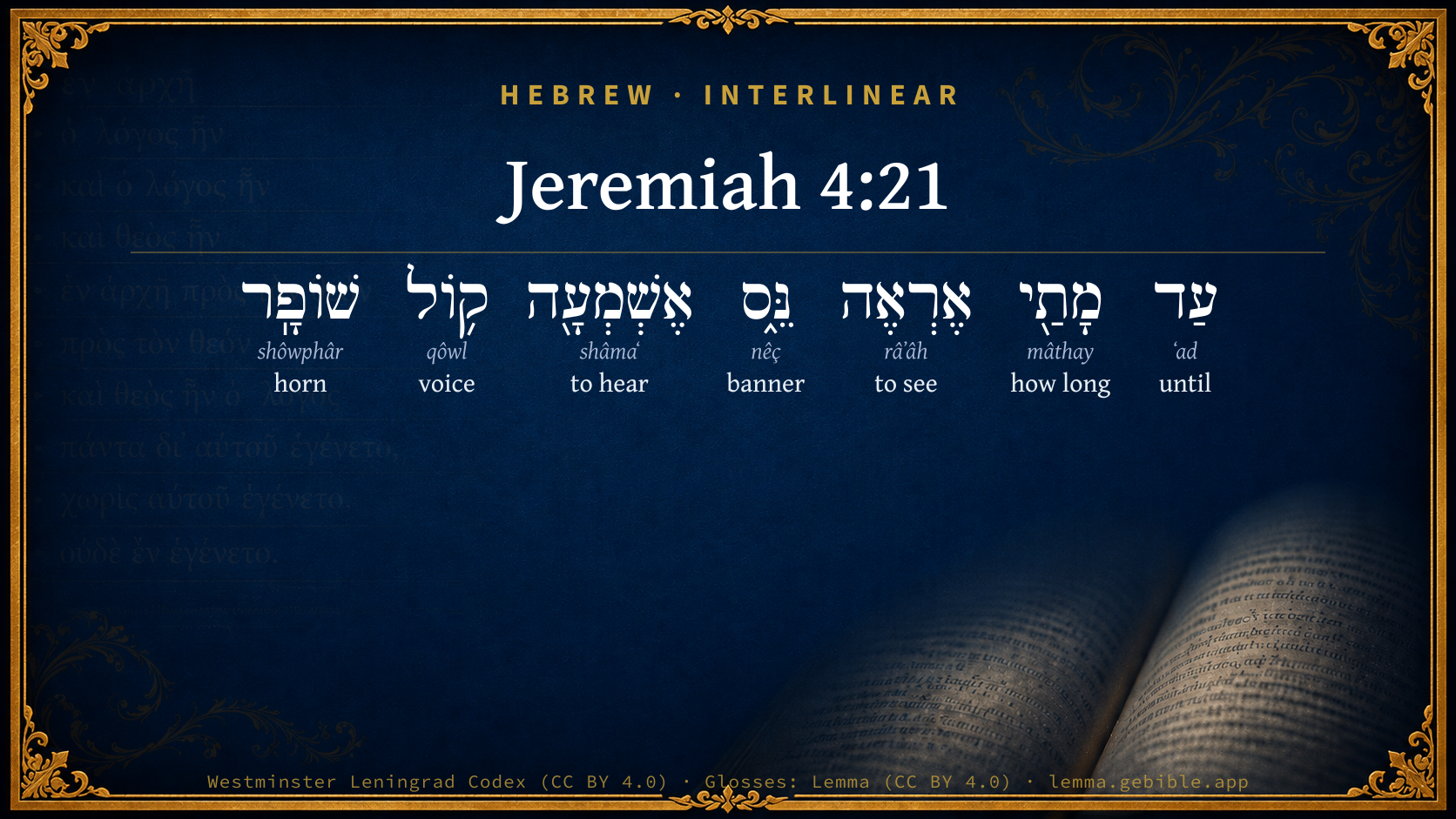
Jeremiah 4:21

Hebrew (Westminster Leningrad Codex) Jeremiah 4:21 appears in the Hebrew Old Testament. The text above is from the Westminster Leningrad Codex. Each word links to its Strong’s number, a concise gloss, and parsing drawn from the Open Scriptures Hebrew Bible morphology. Click any word for its full Brown-Driver-Briggs (BDB) entry.
Download image
Cite this verse

Jeremiah 4:21 (World English Bible). Public Domain. Lemma interlinear Bible study tool, https://lemma.gebible.app/v/jeremiah/4/21.

Show BibTeX & RIS
BibTeX
RIS
English Translation
How long shall I see the standard, and hear the sound of the trumpet?
World English Bible · Public Domain
Download a study sheet

One document with this verse’s original text, its word-by-word gloss line, the meaning frame, cross-references with their text, attributed commentary, and full source and license credits — printable, and it pastes into notes with its structure intact.

This verse Autodidact and up

Study sheet (.html) Plain text (.txt)

A passage Seminary Student

Up to 50 verses in one chapter. A passage sheet keeps up to 6 commentary sources and 12 cross-references per verse, in the order this page ranks them, and says so on the sheet whenever that leaves anything out. Ask for a single verse and you get the Autodidact verse sheet above.

Everything on this page stays free to read, with no account — the sheet is a download of what is already on screen, not access to it.

Want to remove ads? Support Godless Engineer
Compare translations 3

The same verse in 3 English versions, stacked beneath the original-language interlinear above. Click any original word for its lexicon entry.

Each is an independent rendering of the whole verse — the interlinear is not word-aligned to these translations.

Highlighted words mark where these versions differ — a whole-verse word diff, not a word-by-word alignment.

  • World English Bible Public Domain
    How long shall I see the standard, and hear the sound of the trumpet?
  • King James Version Public Domain
    How long shall I see the standard, and hear the sound of the trumpet?
  • unfoldingWord Literal Text CC BY-SA 4.0
    Until when will I see the banner, will I hear the sound of the horn? ts\*

unfoldingWord Literal Text — © unfoldingWord, licensed CC BY-SA 4.0. Word-aligned USFM3 via Door43 (git.door43.org/unfoldingWord/en_ult).

Versions to compare (up to 4)

3 of 4 selected

Show all 18 translations

Every available English version of this verse, each an independent rendering of the whole verse.

  • World English Bible Public Domain
    How long shall I see the standard, and hear the sound of the trumpet?
  • Berean Standard Bible Public Domain
    How long must I see the signal flag and hear the sound of the horn?
  • Majority Standard Bible Public Domain
    How long must I see the signal flag and hear the sound of the horn?
  • King James Version Public Domain
    How long shall I see the standard, and hear the sound of the trumpet?
  • American Standard Version (1901) Public Domain
    How long shall I see the standard, and hear the sound of the trumpet?
  • Revised Version (1885) Public Domain
    How long shall I see the standard, and hear the sound of the trumpet?
  • Geneva Bible (1599) Public Domain
    Howe long shall I see the standert, and heare the sounde of the trumpet?
  • Douay-Rheims (1899) Public Domain
    How long shall I see men fleeing away, how long shall I hear the sound of the trumpet?
  • Young's Literal Translation Public Domain
    Till when do I see an ensign? Do I hear the voice of a trumpet?
  • Literal Standard Version CC BY-SA 4.0
    Until when do I see an ensign? Do I hear the voice of a horn?
  • Unlocked Literal Bible CC BY-SA 4.0
    How long will I see the standard? Will I hear the sound of the horn?
  • unfoldingWord Literal Text CC BY-SA 4.0
    Until when will I see the banner, will I hear the sound of the horn? ts\*
  • Darby Bible Public Domain
    How long shall I see the standard, [and] hear the sound of the trumpet?
  • World Messianic Bible Public Domain
    How long will I see the standard and hear the sound of the shofar?
  • Webster's Bible Public Domain
    How long shall I see the standard, and hear the sound of the trumpet?
  • Free Bible Version CC BY-SA 4.0
    How long do I have to see the flags of war and hear the trumpets of battle?”
  • Bible in Basic English Public Domain
    How long will I go on seeing the flag and hearing the sound of the war-horn?
  • JPS Tanakh (1917) Public Domain
    How long shall I see the standard, shall I hear the sound of the horn?

Literal Standard Version (2020), Covenant Press — licensed CC BY-SA 4.0. Text via the HelloAO Bible API (eBible.org). Unlocked Literal Bible (unfoldingWord) — licensed CC BY-SA 4.0. Text via the HelloAO Bible API (eBible.org). unfoldingWord Literal Text — © unfoldingWord, licensed CC BY-SA 4.0. Word-aligned USFM3 via Door43 (git.door43.org/unfoldingWord/en_ult). Free Bible Version, Dr. Jonathan Gallagher — licensed CC BY-SA 4.0. Text via the HelloAO Bible API (eBible.org).

Word by word

More ways to search: Search by grammar → Find every occurrence → Compare this word →

Practice this passage: Drill this verse → Learn its vocabulary →

About this verse

These counts appear in no published source. They are computed here, from the morphology-tagged text and Lemma’s own curated glosses. What Lemma adds →

7
words
7
distinct lemmas
Prophets
section

Notable vocabulary

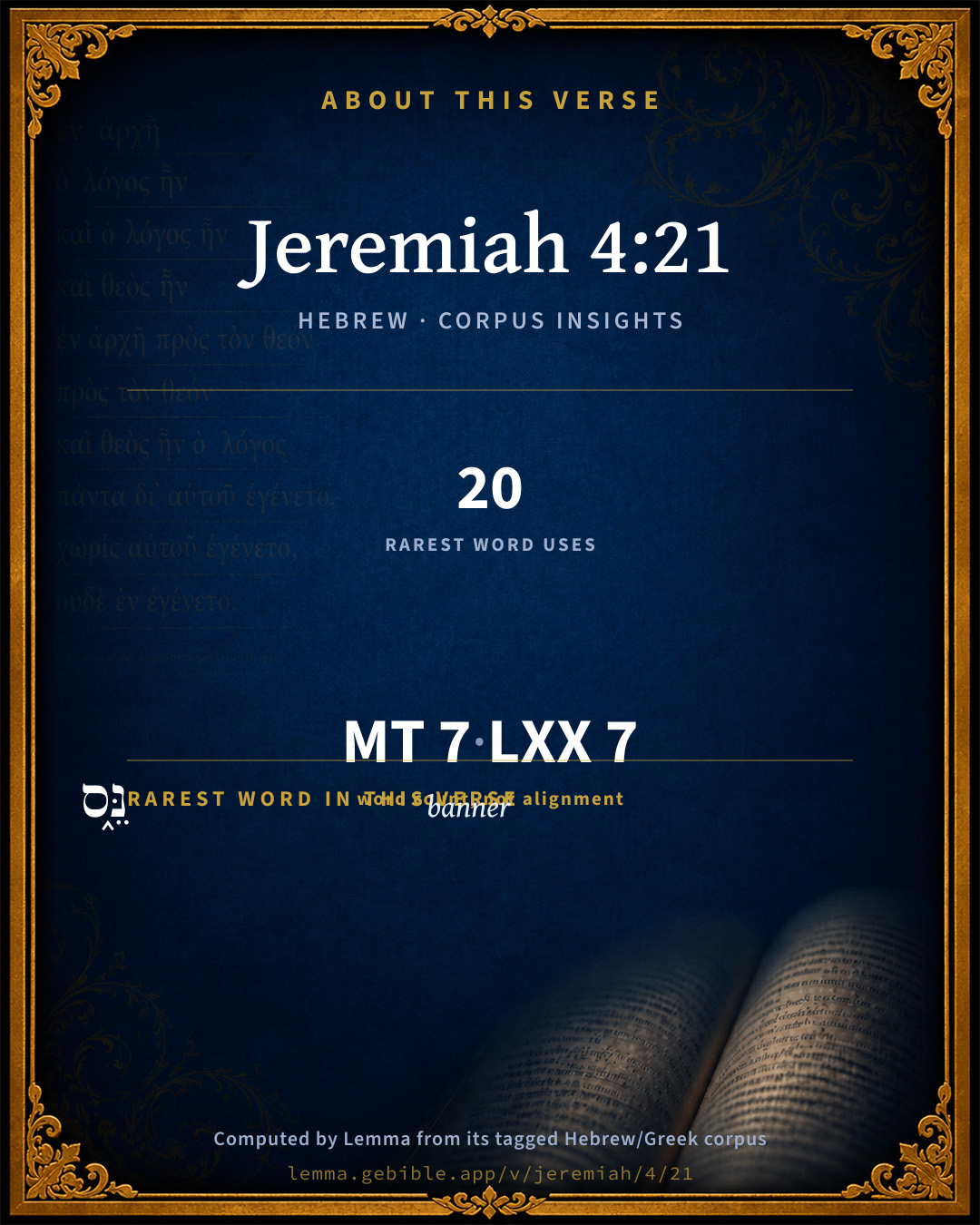
The rarest word here is נֵּ֑ס banner H5251 — appearing just 20 times in the whole Hebrew Bible.

Shared distinctive vocabulary

נֵּ֑ס banner H5251 occurs in 20 verses of the Hebrew Bible. Also found in:

Grammatical profile

  • 2 verbs
  • 3 nouns
  • 1 preposition
  • 1 particle

Verb forms

  • אֶרְאֶה Qal · Imperfect
  • אֶשְׁמְעָ֖ה Qal · Cohortative

Hebrew & Septuagint length

In the original languages it is 7 Hebrew tokens and 7 Greek tokens — but the two are counted differently (Hebrew bundles its prefixes and suffixes into one token; the Greek is in lemma form), so that isn’t a like-for-like length.

Cross-references

8

Topical passages linked to Jeremiah 4:21 in the Treasury of Scripture Knowledge — connected by theme and wording, ordered by reader-vote popularity; previews shown in the World English Bible.

  • 2 Chronicles 35:25 Jeremiah lamented for Josiah: and all the singing men and singing women spoke of Josiah in their lamentations to this day; and they made them an ordinance in Israel: and, behold, they are written in the lamentations.
  • 2 Chronicles 36:3 The king of Egypt deposed him at Jerusalem, and fined the land one hundred talents of silver and a talent of gold.
  • 2 Chronicles 36:6–7 Against him came up Nebuchadnezzar king of Babylon, and bound him in fetters, to carry him to Babylon.
  • 2 Chronicles 36:10 At the return of the year king Nebuchadnezzar sent, and brought him to Babylon, with the goodly vessels of the house of Yahweh, and made Zedekiah his brother king over Judah and Jerusalem.
  • 2 Chronicles 36:17 Therefore he brought on them the king of the Chaldeans, who killed their young men with the sword in the house of their sanctuary, and had no compassion on young man or virgin, old man or gray-headed: he gave them all into his hand.
  • Jeremiah 4:5–6 Declare you in Judah, and publish in Jerusalem; and say, Blow you the trumpet in the land: cry aloud and say, Assemble yourselves, and let us go into the fortified cities.
  • Jeremiah 6:1 Flee for safety, you children of Benjamin, out of the midst of Jerusalem, and blow the trumpet in Tekoa, and raise up a signal on Beth Haccherem; for evil looks forth from the north, and a great destruction.
  • Jeremiah 4:19 My anguish, my anguish! I am pained at my very heart; my heart is disquieted in me; I can't hold my peace; because you have heard, O my soul, the sound of the trumpet, the alarm of war.

Cross-references courtesy of OpenBible.info (CC BY 4.0).

Hebrew and Greek witnesses Masoretic Hebrew ↔ Greek Septuagint

The same verse in the two great witnesses to the Old Testament, shown verse-for-verse.

These are two independent witnesses, not word-aligned to each other, and the Septuagint is shown in lemma (dictionary) form.

Hebrew Jeremiah 4:21 Masoretic · Westminster Leningrad Codex

עַד מָתַ֖י אֶרְאֶה נֵּ֑ס אֶשְׁמְעָ֖ה ק֥וֹל שׁוֹפָֽר

How long shall I see the standard, and hear the sound of the trumpet?

World English Bible · Public Domain

Greek LXX Structure differs

In the Septuagint, Jeremiah is about an eighth shorter than the Hebrew and arranges its material differently — the Oracles Against the Nations (Hebrew chapters 46–51) appear in the middle of the Greek book, after 25:13. Because the chapter and verse boundaries do not line up, a verse-for-verse comparison with the Hebrew is not shown.

A verse-for-verse comparison isn’t shown here because the chapters and verses don’t line up. Switch to the LXX edition with the MT / LXX toggle above to read the Greek directly.

On this verse, Matthew Poole's English Annotations discusses the Septuagint’s reading. Read the note in Commentary ↓

Hebrew: Westminster Leningrad Codex (CC BY 4.0). Greek: Septuagint (public domain); English from a public-domain English Septuagint. How the Septuagint differs from the Hebrew →

Targum (Aramaic paraphrase)

1

The Targum is the ancient Jewish Aramaic paraphrase of the Hebrew Scriptures — an interpretive translation, not the Hebrew text itself. Onkelos (literal) and Pseudo-Jonathan (expansive) render the Torah, and Jonathan the Prophets. Coverage is partial: where no permissively-licensed English translation exists for a verse, only the Aramaic is shown. This is verse-level text, not a word-by-word alignment to the Hebrew.

  1. Targum Jonathan Prophets (Joshua–Malachi)
    עַד אֵימָתַי אֲנָא חָזֵי סִמְוָן אֶשְׁמַע קַל קַרְנָא:

    (no public-domain English translation for this verse)

    Targum Jonathan — Aramaic: “Mikraot Gedolot” (public domain). English: “Sefaria Community Translation” (CC0 1.0 (public-domain dedication)); “London "Chaldee Paraphrase," 1871” (public domain). Text via Sefaria.

Commentary

Notes on Jeremiah 4:21 from classic Christian and Jewish commentators (each source and its license shown beneath its notes). The classic Christian expositions comment on the surrounding passage and are grouped to its opening verse, so a note may address several verses; the Jewish commentaries on the Tanakh (Rashi and others) are per-verse, so they appear only where the commentator wrote on this verse.

Lemma curates 59 commentaries, every one of them public domain or Creative Commons licensed, each selected and text-cleaned for this edition rather than reprinted as found. About our sources →

Trapp's Complete Commentary

John Trapp

Jer 4:21 How long shall I see the standard, [and] hear the sound of the trumpet?

Ver. 21. How long shall I see the standard?] Sad sights and doleful ditties are common in times of war.

And hear the sound of the trumpet.] Tubam turbamque hostiurn.

John Trapp, A Commentary or Exposition upon All the Books of the Old and New Testament (1647–1656) — public domain. Text from a community e-Sword module.

Joseph Benson's Commentary

Jer 4:21-22. How long shall I see the standard, &c. — This dreadful war continued a great while, not in the borders, but in the bowels of the country; for the people were very obstinate, and would not submit to, but took all opportunities of rebelling against, the king of Babylon, which did but lengthen out and aggravate the calamity, as Jeremiah did not fail to warn them it would do. Had they taken his advice, and yielded sooner, their country would have escaped the utter destruction which came upon it. But God, as a punishment for their sins, suffered them to be infatuated. For my people is foolish — Some commentators have considered these words, as well as those preceding, as being spoken by God, in answer to the prophet’s complaints of his grievous vision, to show that such sad images were presented to him, because, on account of the people’s obstinacy and wickedness, it was necessary that they should feel the effects of his just anger, even until Jerusalem should be levelled with the ground. But the passage seems to suit the prophet much better, speaking here as one commissioned by the divine authority to preach to this people. They have not known me — Namely, they have not known the Lord, in whose name the prophet speaks. Those are foolish indeed, who, calling themselves God’s people, and having the advantage of becoming acquainted with him, yet have not known him. They are sottish children — Stupid and senseless; and have no understanding — They cannot distinguish between truth and falsehood, good and evil; cannot discern the mind of God, either in his word or in his providence; they do not understand what their true interest is, nor on which side it lies. They are wise to do evil — To plot mischief against the quiet of the land; wise to contrive the gratification of their lusts, and then to conceal or palliate their conduct; but to do good they have no knowledge — No contrivance, no application of mind; they know not how to make a good use either of the ordinances or providences of God, nor how to bring about any design for the good of their country. They are perfect strangers to the obligations of religion and virtue, and never show any quickness of thought but when they are contriving to bring about some mischief.

Joseph Benson's Commentary on the Old and New Testaments (1811–1818) — public domain. Text from a community e-Sword module.

Jamieson, Fausset & Brown

Robert Jamieson, A. R. Fausset & David Brown

Judah in perplexity asks, How long is this state of things to continue?

Jamieson, Fausset & Brown — Commentary Critical and Explanatory on the Whole Bible (1871) — public domain (CC PDM 1.0). Text via the HelloAO Bible API.

John Calvin's Commentaries

He concludes that part of his discourse, which, as we have said, he embellished with figurative terms, in order more fully to rouse slow and torpid minds: but he confirms what he said at the beginning of the last verse

(Jeremiah 4:20) “Distress has been summoned upon distress.”

He indeed repeats in other words the same thing, How long shall I see the standard, he says, and hear the sound of the trumpet? that is, “You are greatly deceived, if ye think that your enemies, after having for a short time marched through the land, will return home: for the evil of war will for a long time afflict you, and God will protract your calamities, so that the sound of trumpets will continue, and the standard will often, and even every day, be exhibited.”

We now then perceive the Prophet’s meaning: He first shews, that though their enemies were afar off, they would yet come suddenly, and that the horses of God would be, according to what he said yesterday, swifter than eagles. He afterwards refers to the continued progress of the war; for it was necessary to shew to the Jews, that as they had long heedlessly despised God, so his vengeance would not be momentary, but would lie on them, so as to be without end.

Now we ought to know that at this day there is no less dullness than among the Jews. It is therefore not enough to summon the ungodly and the wicked before God’s tribunal, but such metaphorical language ought to be employed as may strike terror, and constrain them to fear, though they may endeavor in every way to harden their own consciences and stupefy themselves, so as to be capable of easily despising God. It is then necessary, that at the present day the servants of God should also speak more strongly and vehemently, that they may rouse hypocrites and the obstinate from their torpor. It then follows —

John Calvin's Commentaries (1540-1563) — public domain. Text from the Calvin Translation Society English edition (1840s-50s) via the Christian Classics Ethereal Library (ccel.org). Calvin's coverage is partial (roughly two-thirds of the Bible); uncommented books and verses are honest gaps, never fabricated. The 19th-century editor's footnotes and remarks are omitted so the notes are faithfully Calvin's own voice.

Ellicott's Commentary for English Readers

(21) How long shall I see . . .—The “standard,” as in Jer_4:6, is the alarm signal given to the fugitives. The “trumpet” sounds to give the alarm, and quicken their flight to the defenced city. The prophet sees no end to the miseries of the coming war.

A Bible Commentary for English Readers, edited by Charles John Ellicott (1878–1897) — public domain. Text from a community e-Sword module.

John Gill's Exposition

How long shall I see the standard,.... "Ensign" or "banner" displayed; either by the watchmen placed on high hills or towers, who, when they see the enemy approaching, lift up their ensign or banner, and blow with their trumpets, to give the people warning and notice of it, and to call them to battle, and that they might prepare for the same, as Kimchi observes; or else by the Chaldean army, which came with colours flying, trumpets blowing, and set in array for battle, which was very terrible, as an army with banners is, Sol 6:4,

and hear the sound of the trumpet? either of the watchmen giving notice of danger, and summoning to battle, or of the enemy preparing to attack; see Co1 14:8.

John Gill's Exposition of the Whole Bible (1746–1763) — public domain (CC PDM 1.0). Text via the HelloAO Bible API.

Albert Barnes' Notes on the Bible

The standard - See Jer 4:6. The alarm caused by the invasion is graphically described. The people are dispersed over the land following their usual pursuits, when tidings come of the enemy’s approach. The only chance of escape is a hasty flight. Flags stream from the hills to mark the safest route, while the blasts of the trumpet quicken the steps of the wavering.

Albert Barnes' Notes on the Bible (1834–1885) — public domain. Text from a community e-Sword/MySword module.

Matthew Poole's English Annotations

He seems to have these concomitants of war, both of Judea preparing for defence, and especially these of the enemy preparing for ruin and destruction. always in his eye and ear, Jer 4:19, and bewailing the continuance of it in taking city after city, with the several sackings of Jerusalem under her three last kings. The LXX. read, How long shall I see them flying? reading nas, a refuge, for nes, a banner, differing only in the points.

Matthew Poole's English Annotations on the Holy Bible (1683–1685) — public domain. Text from a community e-Sword/MySword module.

The Pulpit Commentary

Shall I see the standard. (See on ver. 6)

The Pulpit Commentary (1880–1919), ed. H.D.M. Spence-Jones & Joseph S. Exell — public domain. Text from a community e-Sword module.

unfoldingWord translationNotes

Door43 World Missions Community

How long will I see the standard? Will I hear the sound of the horn?

Jeremiah uses these questions to show his distress about seeing the battle flag and hearing the sound of the horn for such a long time. He wishes that the battle would end soon. It can be stated as an exclamation. AT: "Oh, how I wish that the battle would end, and the flag would be lowered, and the sound of the army's horn would stop" (See: Rhetorical Question)

the standard

"the battle flag"

the sound of the horn

Someone would blow the horn as a signal for battle.

For the foolishness of my people ... do not know to do good.

It can be stated clearly that Yahweh says this. This is probably his reply to Jeremiah, telling why the battle is still happening. AT: "Yahweh replied, 'It is because of the foolishness of my people ... do not know to do good.'" (See: Assumed Knowledge and Implicit Information)

idiotic people

"stupid people"

translationWords

fool

understand

good

unfoldingWord translationNotes — © Distant Shores Media and the Door43 World Missions Community, licensed CC BY-SA 4.0. Source: git.door43.org/Door43/en_tn.

Rashi

Rabbi Shlomo Yitzchaki (Rashi)

How long will I see these groups carrying the standard to come to wage war.

Rashi on the Tanakh — English translations: “The Judaica Press complete Tanach with Rashi, translated by A. J. Rosenberg” (CC BY 4.0); “Pentateuch with Rashi's commentary by M. Rosenbaum and A.M. Silbermann, 1929-1934” (public domain); “The Metsudah Tanach series, Lakewood, N.J” (CC BY 4.0); and “The Book of Joshua, Metsudah Publications, 1997” (CC BY 4.0). Text via Sefaria.

Lesson kit

Teaching starters — assembled from the data on this page, not authored interpretation. Every prompt links to the verse data it draws on. Edit before teaching.

Jeremiah, in the Prophets, opens this verse with 7 words (7 distinct Hebrew lemmas). Its most distinctive word is nêç (“banner”). A historical commentator’s framing appears above. Read the whole chapter for the surrounding context.

Discussion questions

  1. The word nêç carries the sense “banner.” How does it shape the verse?
  2. Numbers 21:8 shares the word «banner» with this verse. How do the two illuminate each other?
  3. These translations render this verse differently. What is at stake in choosing one wording over another?
  4. The verb «אֶרְאֶה» is Qal Imperfect. How does its form color the action?
  5. Reading how Trapp's Complete Commentary and Joseph Benson's Commentary read this verse, where do the two commentators agree and where do they part?

Things to notice

Reading settings

Reading text

Shown beneath each verse's original-language words.

Old Testament
Old Testament edition

Read the OT as the Masoretic Hebrew (MT) or the Greek Septuagint (LXX).

English shown for the Greek Septuagint (in the Hebrew ↔ Greek comparison).

Comparing translations? Open the Compare panel on any verse page to stack up to four side by side.