
Jeremiah 44:2

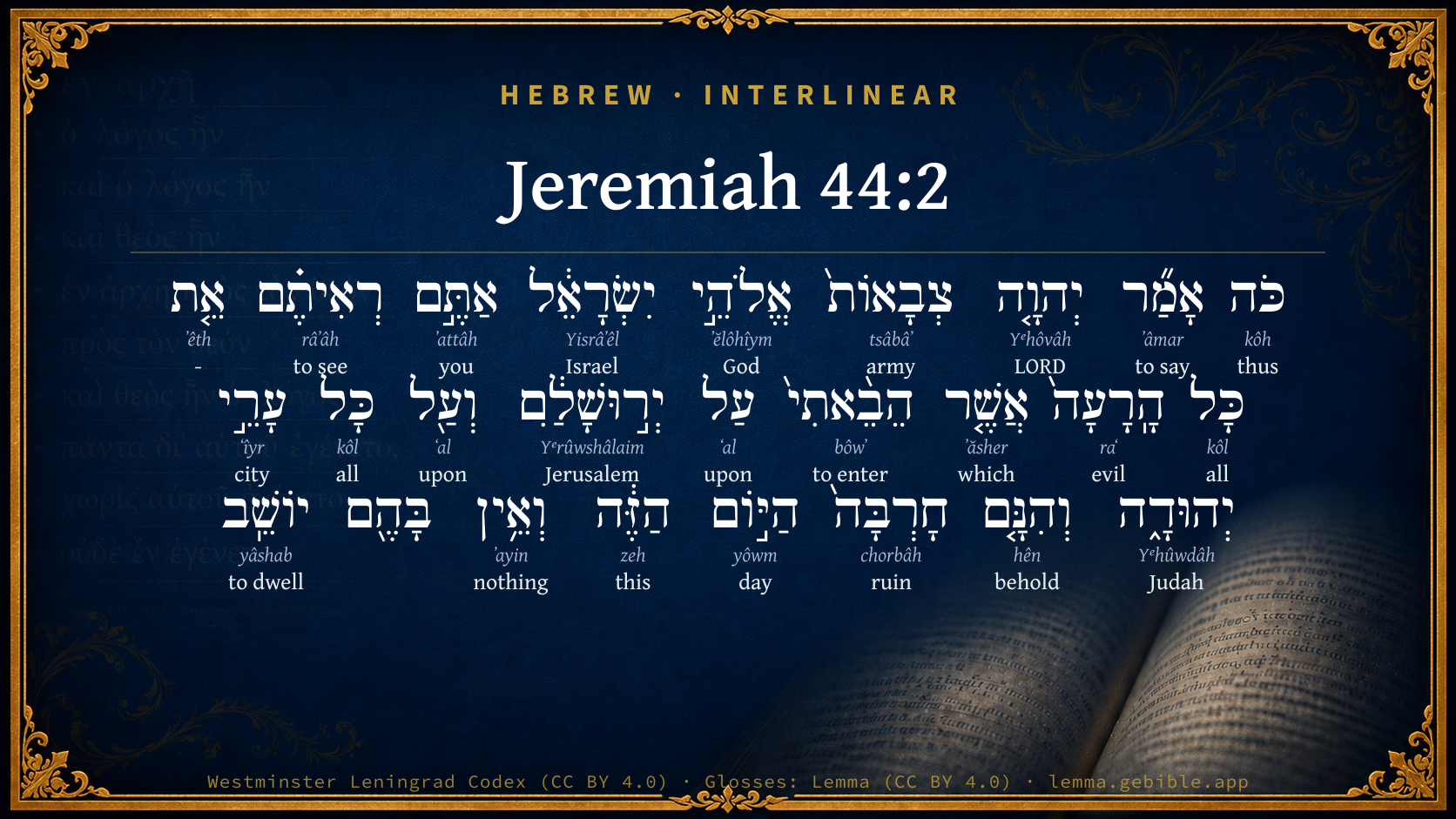
Hebrew (Westminster Leningrad Codex) Jeremiah 44:2 appears in the Hebrew Old Testament. The text above is from the Westminster Leningrad Codex. Each word links to its Strong’s number, a concise gloss, and parsing drawn from the Open Scriptures Hebrew Bible morphology. Click any word for its full Brown-Driver-Briggs (BDB) entry.
Download image
Cite this verse

Jeremiah 44:2 (World English Bible). Public Domain. Lemma interlinear Bible study tool, https://lemma.gebible.app/v/jeremiah/44/2.

Show BibTeX & RIS
BibTeX
RIS
English Translation
Thus says Yahweh of Hosts, the God of Israel: You have seen all the evil that I have brought on Jerusalem, and on all the cities of Judah; and, behold, this day they are a desolation, and no man dwells therein,
World English Bible · Public Domain
Download a study sheet

One document with this verse’s original text, its word-by-word gloss line, the meaning frame, cross-references with their text, attributed commentary, and full source and license credits — printable, and it pastes into notes with its structure intact.

This verse Autodidact and up

Study sheet (.html) Plain text (.txt)

A passage Seminary Student

Up to 50 verses in one chapter. A passage sheet keeps up to 6 commentary sources and 12 cross-references per verse, in the order this page ranks them, and says so on the sheet whenever that leaves anything out. Ask for a single verse and you get the Autodidact verse sheet above.

Everything on this page stays free to read, with no account — the sheet is a download of what is already on screen, not access to it.

Want to remove ads? Support Godless Engineer
Compare translations 3

The same verse in 3 English versions, stacked beneath the original-language interlinear above. Click any original word for its lexicon entry.

Each is an independent rendering of the whole verse — the interlinear is not word-aligned to these translations.

Highlighted words mark where these versions differ — a whole-verse word diff, not a word-by-word alignment.

  • World English Bible Public Domain
    Thus says Yahweh of Hosts, the God of Israel: You have seen all the evil that I have brought on Jerusalem, and on all the cities of Judah; and, behold, this day they are a desolation, and no man dwells therein,
  • King James Version Public Domain
    Thus saith the LORD of hosts, the God of Israel; Ye have seen all the evil that I have brought upon Jerusalem, and upon all the cities of Judah; and, behold, this day they are a desolation, and no man dwelleth therein,
  • unfoldingWord Literal Text CC BY-SA 4.0
    “Yahweh of hosts, God of Israel, says, ‘You yourselves have seen all the disasters that I brought on Jerusalem and all the cities of Judah. See, they are ruins today. There is no one to live in them.

unfoldingWord Literal Text — © unfoldingWord, licensed CC BY-SA 4.0. Word-aligned USFM3 via Door43 (git.door43.org/unfoldingWord/en_ult).

Versions to compare (up to 4)

3 of 4 selected

Show all 18 translations

Every available English version of this verse, each an independent rendering of the whole verse.

  • World English Bible Public Domain
    Thus says Yahweh of Hosts, the God of Israel: You have seen all the evil that I have brought on Jerusalem, and on all the cities of Judah; and, behold, this day they are a desolation, and no man dwells therein,
  • Berean Standard Bible Public Domain
    “This is what the LORD of Hosts, the God of Israel, says: You have seen all the disaster that I brought against Jerusalem and all the cities of Judah; and behold, they lie today in ruins and desolation
  • Majority Standard Bible Public Domain
    “This is what the LORD of Hosts, the God of Israel, says: You have seen all the disaster that I brought against Jerusalem and all the cities of Judah; and behold, they lie today in ruins and desolation
  • King James Version Public Domain
    Thus saith the LORD of hosts, the God of Israel; Ye have seen all the evil that I have brought upon Jerusalem, and upon all the cities of Judah; and, behold, this day they are a desolation, and no man dwelleth therein,
  • American Standard Version (1901) Public Domain
    Thus saith Jehovah of hosts, the God of Israel: Ye have seen all the evil that I have brought upon Jerusalem, and upon all the cities of Judah; and, behold, this day they are a desolation, and no man dwelleth therein,
  • Revised Version (1885) Public Domain
    Thus saith the LORD of hosts, the God of Israel: Ye have seen all the evil that I have brought upon Jerusalem, and upon all the cities of Judah; and, behold, this day they are a desolation, and no man dwelleth therein;
  • Geneva Bible (1599) Public Domain
    Thus sayeth the Lord of hostes the God of Israel, Yee haue seene all the euill that I haue brought vpon Ierusalem, and vpon all the cities of Iudah: and beholde, this day they are desolate, and no man dwelleth therein,
  • Douay-Rheims (1899) Public Domain
    Thus saith the Lord of hosts the God of Israel: You have seen all this evil that I have brought upon Jerusalem, and upon all the cities of Juda: and behold they are desolate this day, and there is not an inhabitant in them:
  • Young's Literal Translation Public Domain
    `Thus said Jehovah of Hosts, God of Israel: Ye -- ye have seen all the evil that I have brought in on Jerusalem, and on all the cities of Judah, and lo, they `are' a waste this day, and there is none dwelling in them,
  • Literal Standard Version CC BY-SA 4.0
    “Thus said YHWH of Hosts, God of Israel: You have seen all the calamity that I have brought in on Jerusalem, and on all the cities of Judah, and behold, they [are] a desolation to this day, and there is none dwelling in them,
  • Unlocked Literal Bible CC BY-SA 4.0
    “Yahweh of hosts, God of Israel, says, 'You yourselves have seen all the disasters that I brought on Jerusalem and all the cities of Judah. See, they are ruins today. There is no one to live in them.
  • unfoldingWord Literal Text CC BY-SA 4.0
    “Yahweh of hosts, God of Israel, says, ‘You yourselves have seen all the disasters that I brought on Jerusalem and all the cities of Judah. See, they are ruins today. There is no one to live in them.
  • Darby Bible Public Domain
    Thus saith Jehovah of hosts, the God of Israel: Ye have seen all the evil that I have brought upon Jerusalem, and upon all the cities of Judah; and behold they are, this day, a waste, and no man dwelleth therein,
  • World Messianic Bible Public Domain
    “The LORD of Hosts, the God of Israel, says: ‘You have seen all the evil that I have brought on Jerusalem, and on all the cities of Judah. Behold, today they are a desolation, and no man dwells in them,
  • Webster's Bible Public Domain
    Thus saith the LORD of hosts, the God of Israel; Ye have seen all the evil that I have brought upon Jerusalem, and upon all the cities of Judah; and behold, this day they are a desolation, and no man dwelleth in them.
  • Free Bible Version CC BY-SA 4.0
    This is what the Lord Almighty, the God of Israel, says: You saw the complete disaster that I brought down on Jerusalem and all the towns of Judah. You can see how today they're ruined and abandoned
  • Bible in Basic English Public Domain
    The Lord of armies, the God of Israel, has said: You have seen all the evil which I have sent on Jerusalem and on all the towns of Judah; and now, this day they are waste and unpeopled;
  • JPS Tanakh (1917) Public Domain
    'Thus saith the LORD of hosts, the God of Israel: Ye have seen all the evil that I have brought upon Jerusalem, and upon all the cities of Judah; and, behold, this day they are a desolation, and no man dwelleth therein;

Literal Standard Version (2020), Covenant Press — licensed CC BY-SA 4.0. Text via the HelloAO Bible API (eBible.org). Unlocked Literal Bible (unfoldingWord) — licensed CC BY-SA 4.0. Text via the HelloAO Bible API (eBible.org). unfoldingWord Literal Text — © unfoldingWord, licensed CC BY-SA 4.0. Word-aligned USFM3 via Door43 (git.door43.org/unfoldingWord/en_ult). Free Bible Version, Dr. Jonathan Gallagher — licensed CC BY-SA 4.0. Text via the HelloAO Bible API (eBible.org).

Word by word

More ways to search: Search by grammar → Find every occurrence → Compare this word →

Practice this passage: Drill this verse → Learn its vocabulary →

חָרְבָּה֙
chorbâh
H2723
“ruin”
Noun, Common, Feminine, Singular, Absolute
Part of Speech
Noun
Type
Common
Gender
Feminine
Number
Singular
State
Absolute
Full BDB Definition

Origin: from H2721

TWOT: 731d

a place laid waste, ruin, waste, desolation
  1. כֹּה kôh H3541 “thus” Adverb
  2. אָמַ֞ר ʼâmar H559 “to say” Verb, Qal, Perfect, 3rd Person, Masculine, Singular
  3. יְהוָ֤ה Yᵉhôvâh H3068 “LORD” Noun, Proper
  4. צְבָאוֹת֙ tsâbâʼ H6635 “armies” Noun, Common, Both, Plural, Absolute
  5. אֱלֹהֵ֣י ʼĕlôhîym H430 “God(s) of” Noun, Common, Masculine, Plural, Construct
  6. יִשְׂרָאֵ֔ל Yisrâʼêl H3478 “Israel” Noun, Proper
  7. אַתֶּ֣ם ʼattâh H859 “you” Pronoun, Personal, 2nd Person, Masculine, Plural
  8. רְאִיתֶ֗ם râʼâh H7200 “to see” Verb, Qal, Perfect, 2nd Person, Masculine, Plural
  9. אֵ֤ת ʼêth H853 “-” Particle, Direct Object
  10. כָּל kôl H3605 “all of” Noun, Common, Masculine, Singular, Construct
  11. הָֽרָעָה֙ raʻ H7451 “the · evil” Particle, Definite Article + Noun, Common, Feminine, Singular, Absolute
  12. אֲשֶׁ֤ר ʼăsher H834 “which” Particle, Relative
  13. הֵבֵ֨אתִי֙ bôwʼ H935 “to enter” Verb, Hiphil, Perfect, 1st Person, Common, Singular
  14. עַל ʻal H5921 “upon” Preposition
  15. יְר֣וּשָׁלִַ֔ם Yᵉrûwshâlaim H3389 “Jerusalem” Noun, Proper
  16. וְעַ֖ל ʻal H5921 “and · upon” Conjunction + Preposition
  17. כָּל kôl H3605 “all of” Noun, Common, Masculine, Singular, Construct
  18. עָרֵ֣י ʻîyr H5892 “cities of” Noun, Common, Feminine, Plural, Construct
  19. יְהוּדָ֑ה Yᵉhûwdâh H3063 “Judah” Noun, Proper
  20. וְהִנָּ֤ם hên H2005 “and · behold · them” Conjunction + Particle, Demonstrative + Suffix, Personal, 3rd Person, Masculine, Plural
  21. הַיּ֣וֹם yôwm H3117 “the · day” Particle, Definite Article + Noun, Common, Masculine, Singular, Absolute
  22. הַזֶּ֔ה zeh H2088 “the · this” Particle, Definite Article + Pronoun, Demonstrative, Masculine, Singular
  23. וְאֵ֥ין ʼayin H369 “and · nothing” Conjunction + Particle, Negative
  24. יוֹשֵֽׁב yâshab H3427 “dwelling” Verb, Qal, Participle Active, Masculine, Singular, Absolute

About this verse

These counts appear in no published source. They are computed here, from the morphology-tagged text and Lemma’s own curated glosses. What Lemma adds →

26
words
23
distinct lemmas
Prophets
section

Shared distinctive vocabulary

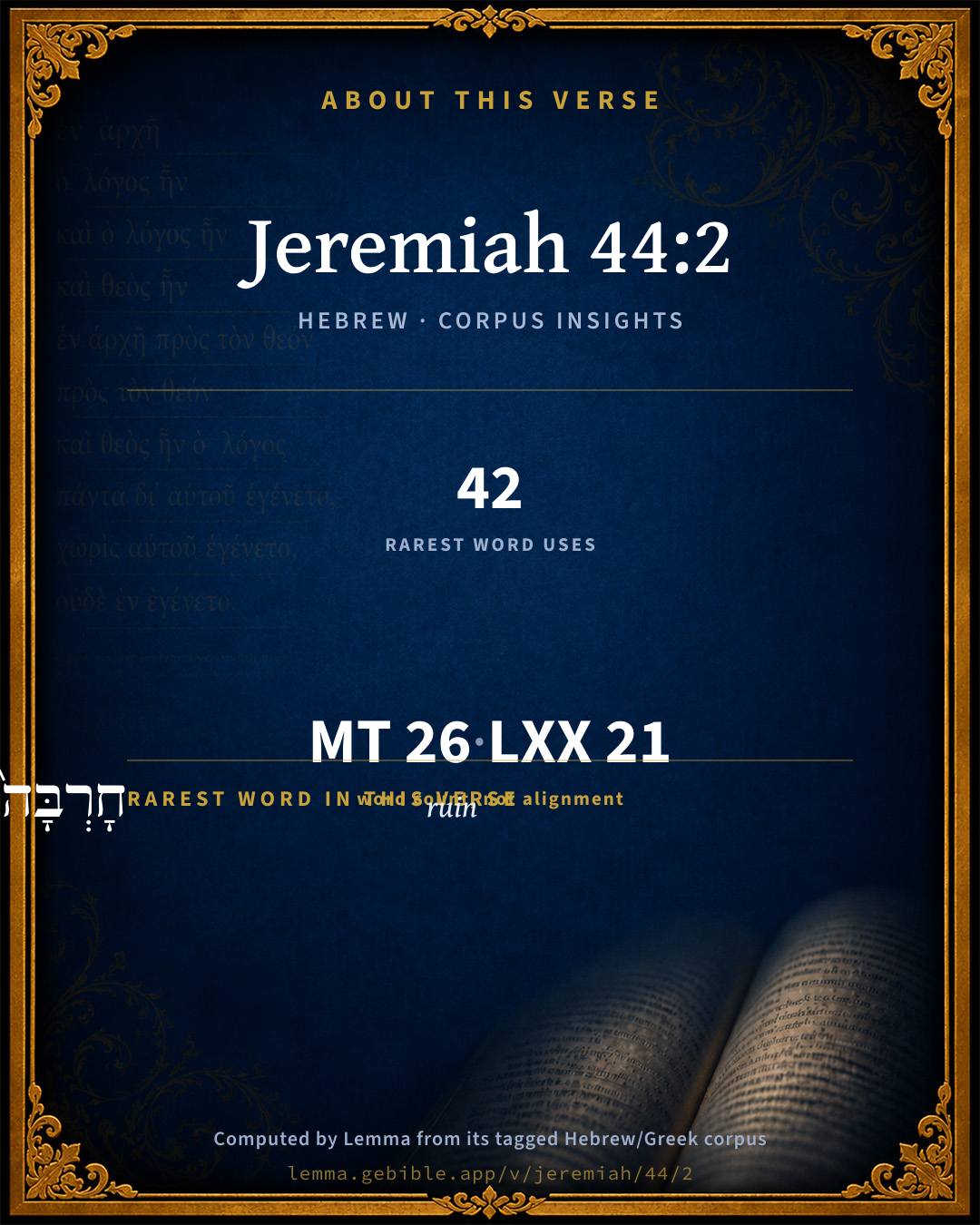
חָרְבָּה֙ ruin H2723 occurs in 42 verses of the Hebrew Bible. Also found in:

Grammatical profile

  • 4 verbs
  • 12 nouns
  • 2 pronouns
  • 3 prepositions
  • 1 adverb
  • 4 particles

Verb forms

  • אָמַ֞ר Qal · Perfect
  • רְאִיתֶ֗ם Qal · Perfect
  • הֵבֵ֨אתִי֙ Hiphil · Perfect
  • יוֹשֵֽׁב Qal · Participle Active

Repetition

Words recur within this verse — often emphatic in Hebrew:

Hebrew & Septuagint length

In the original languages it is 26 Hebrew tokens and 21 Greek tokens — but the two are counted differently (Hebrew bundles its prefixes and suffixes into one token; the Greek is in lemma form), so that isn’t a like-for-like length.

Cross-references

21

Topical passages linked to Jeremiah 44:2 in the Treasury of Scripture Knowledge — connected by theme and wording, ordered by reader-vote popularity; previews shown in the World English Bible.

  • Isaiah 6:11 Then I said, "Lord, how long?" He answered, "Until cities are waste without inhabitant, And houses without man, And the land becomes utterly waste,
  • Jeremiah 9:11 I will make Jerusalem heaps, a dwelling-place of jackals; and I will make the cities of Judah a desolation, without inhabitant.
  • Jeremiah 34:22 Behold, I will command, says Yahweh, and cause them to return to this city; and they shall fight against it, and take it, and burn it with fire: and I will make the cities of Judah a desolation, without inhabitant.
  • Jeremiah 4:7 A lion is gone up from his thicket, and a destroyer of nations; he is on his way, he is gone forth from his place, to make your land desolate, that your cities be laid waste, without inhabitant.
  • Micah 3:12 Therefore Zion for your sake will be plowed like a field, And Jerusalem will become heaps of rubble, And the mountain of the temple like the high places of a forest.
  • Exodus 19:4 'You have seen what I did to the Egyptians, and how I bore you on eagles' wings, and brought you to myself.
  • Leviticus 26:32–33 I will bring the land into desolation; and your enemies that dwell therein will be astonished at it.
  • Leviticus 26:43 The land also will be left by them, and will enjoy its sabbaths while it lies desolate without them: and they will accept the punishment of their iniquity; because, even because they rejected my ordinances, and their soul abhorred my statutes.
  • Deuteronomy 29:2 Moses called to all Israel, and said to them, You have seen all that Yahweh did before your eyes in the land of Egypt to Pharaoh, and to all his servants, and to all his land;
  • Joshua 23:3 and you have seen all that Yahweh your God has done to all these nations because of you; for Yahweh your God, he it is that has fought for you.
  • 2 Kings 21:13 I will stretch over Jerusalem the line of Samaria, and the plummet of the house of Ahab; and I will wipe Jerusalem as a man wipes a dish, wiping it and turning it upside down.
  • Isaiah 24:12 In the city is left desolation, and the gate is struck with destruction.
  • Isaiah 64:10–11 Your holy cities are become a wilderness, Zion is become a wilderness, Jerusalem a desolation.
  • Jeremiah 7:34 Then will I cause to cease from the cities of Judah, and from the streets of Jerusalem, the voice of mirth and the voice of gladness, the voice of the bridegroom and the voice of the bride; for the land shall become a waste.
  • Jeremiah 25:11 This whole land shall be a desolation, and an astonishment; and these nations shall serve the king of Babylon seventy years.
  • Jeremiah 39:1–8 It happened when Jerusalem was taken, (in the ninth year of Zedekiah king of Judah, in the tenth month, came Nebuchadrezzar king of Babylon and all his army against Jerusalem, and besieged it;
  • Jeremiah 44:22 so that Yahweh could no longer bear, because of the evil of your doings, and because of the abominations which you have committed; therefore is your land become a desolation, and an astonishment, and a curse, without inhabitant, as it is this day.
  • Lamentations 1:1 How does the city sit solitary, that was full of people! She has become as a widow, who was great among the nations! She who was a princess among the provinces is become tributary!
  • Lamentations 1:16 For these things I weep; my eye, my eye runs down with water; Because the comforter who should refresh my soul is far from me: My children are desolate, because the enemy has prevailed.
  • Lamentations 5:18 For the mountain of Zion, which is desolate: The foxes walk on it.
  • Zechariah 1:6 But my words and my decrees, which I commanded my servants the prophets, didn't they overtake your fathers? "Then they repented and said, 'Just as Yahweh of Hosts determined to do to us, according to our ways, and according to our practices, so he has dealt with us.'"

Cross-references courtesy of OpenBible.info (CC BY 4.0).

Hebrew and Greek witnesses Masoretic Hebrew ↔ Greek Septuagint

The same verse in the two great witnesses to the Old Testament, shown verse-for-verse.

These are two independent witnesses, not word-aligned to each other, and the Septuagint is shown in lemma (dictionary) form.

Hebrew Jeremiah 44:2 Masoretic · Westminster Leningrad Codex

כֹּה אָמַ֞ר יְהוָ֤ה צְבָאוֹת֙ אֱלֹהֵ֣י יִשְׂרָאֵ֔ל אַתֶּ֣ם רְאִיתֶ֗ם אֵ֤ת כָּל הָֽרָעָה֙ אֲשֶׁ֤ר הֵבֵ֨אתִי֙ עַל יְר֣וּשָׁלִַ֔ם וְעַ֖ל כָּל עָרֵ֣י יְהוּדָ֑ה וְהִנָּ֤ם חָרְבָּה֙ הַיּ֣וֹם הַזֶּ֔ה וְאֵ֥ין בָּהֶ֖ם יוֹשֵֽׁב

Thus says Yahweh of Hosts, the God of Israel: You have seen all the evil that I have brought on Jerusalem, and on all the cities of Judah; and, behold, this day they are a desolation, and no man dwells therein,

World English Bible · Public Domain

Greek LXX Structure differs

In the Septuagint, Jeremiah is about an eighth shorter than the Hebrew and arranges its material differently — the Oracles Against the Nations (Hebrew chapters 46–51) appear in the middle of the Greek book, after 25:13. Because the chapter and verse boundaries do not line up, a verse-for-verse comparison with the Hebrew is not shown.

A verse-for-verse comparison isn’t shown here because the chapters and verses don’t line up. Switch to the LXX edition with the MT / LXX toggle above to read the Greek directly.

On this verse, Keil & Delitzsch discusses the Septuagint’s reading. Read the note in Commentary ↓

Hebrew: Westminster Leningrad Codex (CC BY 4.0). Greek: Septuagint (public domain); English from a public-domain English Septuagint. How the Septuagint differs from the Hebrew →

Targum (Aramaic paraphrase)

1

The Targum is the ancient Jewish Aramaic paraphrase of the Hebrew Scriptures — an interpretive translation, not the Hebrew text itself. Onkelos (literal) and Pseudo-Jonathan (expansive) render the Torah, and Jonathan the Prophets. Coverage is partial: where no permissively-licensed English translation exists for a verse, only the Aramaic is shown. This is verse-level text, not a word-by-word alignment to the Hebrew.

  1. Targum Jonathan Prophets (Joshua–Malachi)
    כִּדְנַן אֲמַר יְיָ צְבָאוֹת אֱלָהָא דְיִשְׂרָאֵל אַתּוּן חֲזֵיתוּן יַת כָּל בִּישְׁתָא דְאַיְתֵיתִי עַל יְרוּשְׁלֵם וְעַל כָּל קִרְוַיָא דְבֵית יְהוּדָה וְאִינוּן חָרְבָּא יוֹמָא דֵין וְלֵית בְּהוֹן יָתֵיב:

    (no public-domain English translation for this verse)

    Targum Jonathan — Aramaic: “Mikraot Gedolot” (public domain). English: “Sefaria Community Translation” (CC0 1.0 (public-domain dedication)); “London "Chaldee Paraphrase," 1871” (public domain). Text via Sefaria.

Commentary

Notes on Jeremiah 44:2 from classic Christian and Jewish commentators (each source and its license shown beneath its notes). The classic Christian expositions comment on the surrounding passage and are grouped to its opening verse, so a note may address several verses; the Jewish commentaries on the Tanakh (Rashi and others) are per-verse, so they appear only where the commentator wrote on this verse.

Lemma curates 59 commentaries, every one of them public domain or Creative Commons licensed, each selected and text-cleaned for this edition rather than reprinted as found. About our sources →

Trapp's Complete Commentary

John Trapp

Jer 44:2 Thus saith the LORD of hosts, the God of Israel; Ye have seen all the evil that I have brought upon Jerusalem, and upon all the cities of Judah; and, behold, this day they [are] a desolation, and no man dwelleth therein,

Ver. 2. Ye have seen all the evils that I have brought upon Jerusalem.] And should have been warned by this exemplum terrificum, dreadful instance of mine indignation. They that will not take example, are worthily made examples.

John Trapp, A Commentary or Exposition upon All the Books of the Old and New Testament (1647–1656) — public domain. Text from a community e-Sword module.

Joseph Benson's Commentary

Jer 44:2-5. Ye have seen all the evil that I have brought on Jerusalem — He refers to the late destruction of it by the king of Babylon: this remnant of the people was a brand plucked out of the burning, and their eyes had been witnesses of the desolations which God had wrought. Because of their wickedness, &c. — As they were eye-witnesses of the effect, so nothing but their unbelief made them strangers to the cause of the divine wrath manifested against them; for God, by his prophets, had continually assured them that the grand cause was their departure from him, the one living and true God, and forsaking his worship for that of idols. To serve other gods, whom they knew not — The sin of their various idolatries was aggravated by this, that they were as much strangers to the idols as to the people with whom they joined in the worship of them, neither they nor any of their fathers having had any proof that these idols had ever done, or were able to do, any thing for their worshippers: compare Deu 13:6; Deu 32:17. These idols are opposed to the true God, called elsewhere the God of their fathers, who had made himself known to them by so many wonderful works and so many instances of his favour and benignity; and had promised to show the same favour to their posterity, if they continued steadfast in their obedience. I sent, &c., saying, O! do not this abominable thing that I hate — God had given them numberless admonitions and warnings by his prophets, that idolatry in all the species and instances of it was a sin which he hated above all others, and would very dreadfully punish, yet they would not hear so as to yield obedience to him; but still persisted in the commission of this most abominable and absurd iniquity. The Hebrew, אל נא תעשׂו, may be properly rendered, Do not, I pray you, this abominable thing which I hate. Thus the Vulgate, Nolite, oro, facere verbum abominationis hujuscemodi. Be unwilling, I beseech you, to practise a thing so abominable. The language is as pathetic as it is emphatical.

Joseph Benson's Commentary on the Old and New Testaments (1811–1818) — public domain. Text from a community e-Sword module.

Keil & Delitzsch

C. F. Keil & F. Delitzsch

The warning and threatening. - "Thus saith Jahveh of hosts, the God of Israel: Ye yourselves have been all the evil which I have brought on Jerusalem, and on all the cities of Judah; and, behold, they are a desolation this day, and there is no inhabitant in them; Jer 44:3. Because of their wickedness which they have done, by provoking me through going to burn incense, (and) to serve other gods whom they knew not, (neither) they (nor) ye, nor your fathers. Jer 44:4. And I sent unto you all my servants the prophets, rising early and sending (them), to say, Do not this abominable thing which I hate. Jer 44:5. But they did not hear, nor inclined their ear to turn from their wickedness, by not burning incense to other gods. Jer 44:6. Therefore my wrath and mine anger poured itself out, and burned up the cities of Judah and the streets of Jerusalem; so that they have become a desolation and a waste, as at this day. Jer 44:7. Now therefore thus saith Jahveh of hosts, the God of Israel: Why do ye great evil against your souls, by cutting off from yourselves man and women, child and suckling, out of the midst of Judah, so leaving no remnant for yourselves; Jer 44:8. Through provoking me by the works of your hands, burning incense to other gods in the land of Egypt, whither ye have gone to sojourn, that ye might bring destruction on yourselves, and that ye might become a curse and a reproach among all the nations of the earth? Jer 44:9. Have ye forgotten the evil deeds of your fathers, and the evil deeds of the kings of Judah, and the evil deeds of their wives, and your own evil deeds, and the evil deeds of your wives, which they committed in the land of Judah and on the streets of Jerusalem? Jer 44:10. They have not been contrite to this day, and are not afraid, nor do they walk in my law, and in my statutes, which I have set before you and before your fathers. Jer 44:11. Therefore thus saith Jahveh of hosts, the God of Israel: Behold, I will set my face against you for evil, and to cut off all Judah. Jer 44:12. And I will take the remnant of Judah, that have set their faces to go to the land of Egypt in order to sojourn there, and they shall all be consumed; in the land of Egypt shall they fall, by sword and famine shall they be consumed; small and great, by sword and famine shall they die, and they shall become an execration and an astonishment, and a curse and a reproach. Jer 44:13. And I will punish those who dwell in the land of Egypt, as I punished Jerusalem, by sword, and famine, and pestilence. Jer 44:14. There shall not be one escaped or left to the remnant of Judah that came to sojourn there in the land of Egypt, so as to return to the land of Judah, whither they long to return and dwell; for they shall not return except as escaped ones."

Jer 44:2-6

In order to make an impression on the people by his warning against idolatry, Jeremiah begins his address with a reference to the great calamity which the fathers have brought on the kingdom of Judah through their continued idolatry (Jer 44:2-6). "Ye have seen all the evil," etc.; all the cities are laid waste and depopulated, because their inhabitants have roused the anger of the Lord, and have not let themselves be dissuaded by the admonitions of the prophets whom God has sent. "This day," i.e., now, at present. On Jer 44:3, cf. Jer 11:17; Jer 19:4; Jer 32:32, etc.; and as to the meaning of קטּר, see on Jer 1:16. In Jer 44:3 the address becomes more direct, through the change into the second person, "ye;" the audience then present only continue these sins of their fathers. On Jer 44:4, cf. Jer 7:25; Jer 25:4, etc. דּבר התּעבה הזּאת, "the thing of this abomination," which is equivalent to "this abominable idolatry." דּבר serves to render the subject more prominent, as in Jdg 19:24. On Jer 44:6, cf. Jer 42:18; Jer 7:20. The wrath of God burned in the cities, for the fire of destruction was a manifestation of the divine wrath. As to כּיום הזּה, see on Jer 11:5.

Jer 44:7-14

In Jer 44:7-10 follows the application of what has been said to those present, who are asked how they come to continue in the old sins, to their own destruction, "doing evil in regard to your souls," i.e., for the injury, destruction of your souls, yourself; cf. Jer 26:19, where על־נ' stands for אל־נ'. This is immediately afterwards more exactly specified by 'להכרית וגו, to exterminate the whole of you, without an exception. As to the enumeration "man and woman," etc., cf. Sa1 15:3; Sa1 22:19. The infs. להכעיסני and לקטּר are used as gerundives: "inasmuch as (through this that) ye provoke me." For the expression "the works of your hands," see on Jer 1:16. In Jer 44:8, an object must be supplied from Jer 44:7 for the expression למען הכרית לכם; for, to take לכם (with Hitzig) in a reflexive sense is a very harsh construction. On 'לקללה וגו, cf. Jer 42:18; Jer 26:6. The answer to the question now asked follows in Jer 44:9 and Jer 44:10, in the form of the further question, whether they have forgotten those former sins, and that these sins have been the cause of the evil which has befallen the land. The interrogation expresses the reproach that they have been able to forget both, as is evidenced by their continuance in sin. In Jer 44:9, the expression "the evil deeds of his wives" (נשׁיו) is remarkable. Hitzig and Ngelsbach, following Kimchi, refer the suffix to the kings, since there was always but one king at a time. But this is an unnatural explanation; the suffix refers to Judah as a nation, and is used in order to comprehend the wives of the fathers and of the kings together. It is quite arbitrary in Ewald and Graf to change נשׁיו to שׂריו, following the lxx τῶν ἀρχόντων ὑμῶν; for these translators have mutilated the text by the omission of the following ואת רעתיכם. רעות נשׁיו is not merely conserved, but even required, by ואת רעת נשׁיכם. But the prophet gives special prominence to the evil deeds of the wives, since it was they who were most zealous in worshipping the queen of heaven; cf. Jer 44:15 and Jer 44:19. לא דכּאוּ, "they have not been crushed," viz., by repentance and sorrow for these sins. The transition to the third person is not merely accounted for by the fact that the subject treated of is the sins of the fathers and of the present generation, - for, as is shown by the expression "till this day," the prophet has chiefly his own contemporaries in view; but he speaks of these in the third person, to signify the indignation with which he turns away from men so difficult to reform. On the expression, "they had not walked in my law," cf. Jer 26:4; Jer 9:12. For this the Lord will punish them severely, Jer 44:11-14. All those who have fled to Egypt, with the intention of remaining there, will be quite exterminated. On "Behold, I will set my face," etc., cf. Jer 21:10. "For evil" is more exactly defined by "to cut off all Judah," i.e., those of Judah who are in Egypt, not those who are in Babylon. This limitation of the words "all Judah" is necessarily required by the context, and is plainly expressed in Jer 44:12, where "Judah" is specified as "the remnant of Judah that were determined to go to Egypt." לקחתּי has the meaning of taking away, as in Jer 15:15. ותמּוּ are to be taken by themselves; and בּארץ מצרים, as is shown by the accents, is to be attached to what follows, on which, too, the emphasis is placed; in like manner, 'בּחרב are to be attached to the succeeding verb. The arrangement of the words, like the accumulation of sentences all expressing the same meaning, reveals the spirit of the address in which God vents His wrath. On "they shall become an execration," etc., see Jer 42:18. In Jer 44:13, Jer 44:14, the threatened extermination is further set forth. Those who dwelling Egypt shall be punished with sword, famine, and plague, like Jerusalem. The inhabitants of Egypt generally are meant; and by the judgment which is to fall on that country, the remnant of Judah there shall be so completely destroyed, that none shall escape. The leading member of the sentence is continued by ולשׁוּב, "and that they should return to the land of Judah, after which their soul longs, that they may live there." A reason is further assigned, and with this the address, reduced within becoming limits, concludes: "for there shall return none except (כּי אם) fugitives," i.e., except a few individual fugitives who shall come back. This last clause shows that we are not to understand the declaration "none shall escape" in the strictest meaning of the words. Those who escape and return to Judah shall be so few, in comparison with those who shall perish in Egypt, as to be quite inconsiderable. Cf. the like instance of a seeming contradiction in Jer 44:27, Jer 44:28. On נשּׂא את־נפשׁם, cf. Jer 22:27.

Keil & Delitzsch — Biblical Commentary on the Old Testament (1861–1891) — public domain (CC PDM 1.0). Text via the HelloAO Bible API. (Old Testament only.)

Tyndale Open Study Notes

Tyndale Open Resources

44:2 Jeremiah’s message appealed to the common knowledge he and his audience shared about the calamity that had wiped out Judah and Jerusalem.

Tyndale Open Study Notes — © Tyndale Open Resources, licensed CC BY-SA 4.0. Text via the HelloAO Bible API.

Jamieson, Fausset & Brown

Robert Jamieson, A. R. Fausset & David Brown

evil . . . upon Jerusalem--If I spared not My own sacred city, much less shall ye be safe in Egypt, which I loathe.

Jamieson, Fausset & Brown — Commentary Critical and Explanatory on the Whole Bible (1871) — public domain (CC PDM 1.0). Text via the HelloAO Bible API.

Adam Clarke's Commentary

Verse 2. No man dwelleth therein] The desolation of the land of Judea must have been exceedingly great when this, in almost any sense, could be spoken of it.

Adam Clarke's Commentary on the Bible (1810–1826) — public domain. Text from a community e-Sword/MySword module.

John Calvin's Commentaries

He now begins with reproof, because they were so stupid as not to remember the vengeance which God had executed on themselves and on the whole nation. They had been left alive for this end, that they might acknowledge God’s judgment, and thus return to a right mind. Here, then, the Prophet upbraids them with their insensibility, that they had profited nothing under the scourges of God. They commonly say that fools, when they are beaten, become wise. As then the Jews had not repented, after having been so grievously chastised, it was a proof of extreme perverseness; for if the remnant had a grain of a sound mind, they would have been humbled at least by the final destruction of their nation, and when the city and the temple were demolished. Since then they followed the same wicked courses, for which God had inflicted so grievous a punishment, it was evident that they were wholly irreclaimable and destitute of reason and judgment. This is the import of all the words of the Prophet which we have read.

He says first, Ye have seen what great evils I brought on you and the land. “Then ye know that you have justly suffered all the evils which have happened to you; for ye have not sinned through want of knowledge, but when I had sedulously warned you by my Prophets, ye continued ever obstinate; ye have therefore fully deserved such punishments. Now when God spared you, and wished that a small number should remain, to preserve as it were a seed, how is it that these evils which are still as it were before your eyes, are not remembered by you?” We now then understand the design of the Prophet.

But it may be well to examine every part; Ye have seen, he says, all the evil which I have brought (evil here means calamity) on Jerusalem, and on all the cities of Judah; and, behold, they are now a waste, and no one dwells there. There is here an emphatical comparison between Jerusalem and Memphis, between the cities of Judah and Heliopolis and the whole country of Pathros. If then God had not. spared the holy city which he had chosen, if he had not spared the cities of Judah which were under his protection, how foolish it was for the Jews to think that they would be safe in the cities of Egypt? By what privilege could these be secure, since the cities of Judah had been reduced to a waste? We now then perceive why the Prophet mentioned Jerusalem and the cities of Judah; it was, that he might expose the stupidity of the Jews, because they thought, themselves safe in Egypt, a land which God had ever held in abomination.

John Calvin's Commentaries (1540-1563) — public domain. Text from the Calvin Translation Society English edition (1840s-50s) via the Christian Classics Ethereal Library (ccel.org). Calvin's coverage is partial (roughly two-thirds of the Bible); uncommented books and verses are honest gaps, never fabricated. The 19th-century editor's footnotes and remarks are omitted so the notes are faithfully Calvin's own voice.

Ellicott's Commentary for English Readers

(2) Ye have seen . . .—The prophet begins, naturally enough, with an appeal to the personal experience of his hearers. Was not that enough to show them that the source of all their evils had been their falling away from the faith or worship of their fathers?

A Bible Commentary for English Readers, edited by Charles John Ellicott (1878–1897) — public domain. Text from a community e-Sword module.

John Gill's Exposition

Thus saith the Lord of hosts, the God of Israel,.... In which manner the prophecies of this book are frequently prefaced; see Jer 42:15;

ye have seen all the evil that I have brought upon Jerusalem, and upon all the cities of Judah; they saw it with their bodily eyes; they could not but serve it in their minds; nay, had an experimental knowledge of it; they suffered it in part themselves, and must be convicted in their own consciences that it was from the hand of the Lord:

and, behold, this day they are a desolation, and no man dwelleth therein; lie waste, at this very time; the walls are broken down the houses are demolished; the goods in them carried off; no inhabitants left, or very few, to rebuild the cities, till the land, and dwell therein.

John Gill's Exposition of the Whole Bible (1746–1763) — public domain (CC PDM 1.0). Text via the HelloAO Bible API.

Haydock's Catholic Bible Commentary

Inhabitant: or the number is exceedingly small. (Calmet) --- All the Jews had retired. (Haydock) --- It would be well if people would reflect, how those who have given way to heresy and infidelity have been treated. (Worthington)

George Leo Haydock (1774–1849), Haydock's Catholic Family Bible and Commentary, 1859 edition — public domain. Excludes Psalms (Douay-Rheims chapter numbering differs from Protestant) and Deuterocanonical books (Catholic canon only).

Matthew Poole's English Annotations

He referreth to the late destruction of it by the king of Babylon; this remnant of the people was a brand plucked out of that fire, and their eyes had been witnesses to the desolations that God had wrought.

Matthew Poole's English Annotations on the Holy Bible (1683–1685) — public domain. Text from a community e-Sword/MySword module.

Whedon's Commentary on the Bible

Daniel D. Whedon

2. Evil… brought upon Jerusalem — “If I spared not my own sacred city, much less shall ye be safe in Egypt, which I loathe.”

Daniel D. Whedon (gen. ed.), Commentary on the Old and New Testaments (1874–1909) — public domain. Text from a community e-Sword module.

Lesson kit

Teaching starters — assembled from the data on this page, not authored interpretation. Every prompt links to the verse data it draws on. Edit before teaching.

Jeremiah, in the Prophets, opens this verse with 26 words (23 distinct Hebrew lemmas). Its most distinctive word is chorbâh (“ruin”). A historical commentator’s framing appears above. Read the whole chapter for the surrounding context.

Discussion questions

  1. The word chorbâh carries the sense “ruin.” How does it shape the verse?
  2. How does Leviticus 26:31, which shares the word «ruin», read alongside this verse?
  3. What does the repetition of “all” (2× in this one verse) do in this verse?
  4. The translations on this page render this verse differently — a whole-verse word diff, not a word-by-word alignment. What might account for the different wordings?
  5. «אָמַ֞ר» is a Qal Perfect verb. How does that grammatical form shape the action described?
  6. Compare how Trapp's Complete Commentary and Joseph Benson's Commentary read this verse. Where do they agree or differ?

Things to notice

Reading settings

Reading text

Shown beneath each verse's original-language words.

Old Testament
Old Testament edition

Read the OT as the Masoretic Hebrew (MT) or the Greek Septuagint (LXX).

English shown for the Greek Septuagint (in the Hebrew ↔ Greek comparison).

Comparing translations? Open the Compare panel on any verse page to stack up to four side by side.