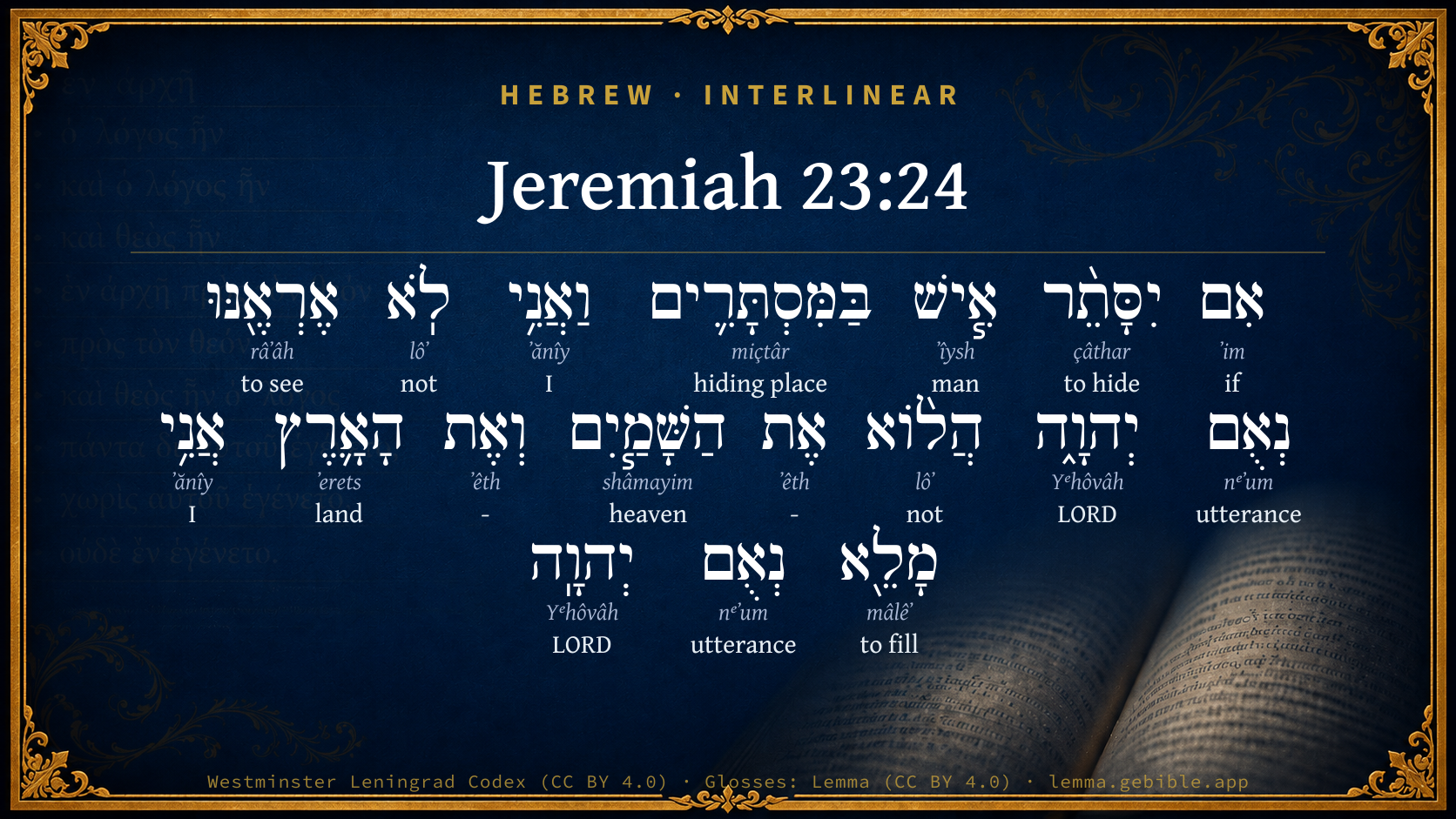
Jeremiah 23:24

Hebrew (Westminster Leningrad Codex) Jeremiah 23:24 appears in the Hebrew Old Testament. The text above is from the Westminster Leningrad Codex. Each word links to its Strong’s number, a concise gloss, and parsing drawn from the Open Scriptures Hebrew Bible morphology. Click any word for its full Brown-Driver-Briggs (BDB) entry.
Download image
Cite this verse

Jeremiah 23:24 (World English Bible). Public Domain. Lemma interlinear Bible study tool, https://lemma.gebible.app/v/jeremiah/23/24.

Show BibTeX & RIS
BibTeX
RIS
English Translation
Can any hide himself in secret places so that I shall not see him? says Yahweh. Don't I fill heaven and earth? says Yahweh.
World English Bible · Public Domain
Download a study sheet

One document with this verse’s original text, its word-by-word gloss line, the meaning frame, cross-references with their text, attributed commentary, and full source and license credits — printable, and it pastes into notes with its structure intact.

This verse Autodidact and up

Study sheet (.html) Plain text (.txt)

A passage Seminary Student

Up to 50 verses in one chapter. A passage sheet keeps up to 6 commentary sources and 12 cross-references per verse, in the order this page ranks them, and says so on the sheet whenever that leaves anything out. Ask for a single verse and you get the Autodidact verse sheet above.

Everything on this page stays free to read, with no account — the sheet is a download of what is already on screen, not access to it.

Want to remove ads? Support Godless Engineer
Compare translations 3

The same verse in 3 English versions, stacked beneath the original-language interlinear above. Click any original word for its lexicon entry.

Each is an independent rendering of the whole verse — the interlinear is not word-aligned to these translations.

Highlighted words mark where these versions differ — a whole-verse word diff, not a word-by-word alignment.

  • World English Bible Public Domain
    Can any hide himself in secret places so that I shall not see him? says Yahweh. Don't I fill heaven and earth? says Yahweh.
  • King James Version Public Domain
    Can any hide himself in secret places that I shall not see him? saith the LORD. Do not I fill heaven and earth? saith the LORD.
  • unfoldingWord Literal Text CC BY-SA 4.0
    Can a man hide himself in secret places, so I will not see him?”—the declaration of Yahweh— “Do I not fill the heavens and the earth?”—the declaration of Yahweh. p

unfoldingWord Literal Text — © unfoldingWord, licensed CC BY-SA 4.0. Word-aligned USFM3 via Door43 (git.door43.org/unfoldingWord/en_ult).

Versions to compare (up to 4)

3 of 4 selected

Show all 18 translations

Every available English version of this verse, each an independent rendering of the whole verse.

  • World English Bible Public Domain
    Can any hide himself in secret places so that I shall not see him? says Yahweh. Don't I fill heaven and earth? says Yahweh.
  • Berean Standard Bible Public Domain
    “Can a man hide in secret places where I cannot see him?” declares the LORD. “Do I not fill the heavens and the earth?” declares the LORD.
  • Majority Standard Bible Public Domain
    “Can a man hide in secret places where I cannot see him?” declares the LORD. “Do I not fill the heavens and the earth?” declares the LORD.
  • King James Version Public Domain
    Can any hide himself in secret places that I shall not see him? saith the LORD. Do not I fill heaven and earth? saith the LORD.
  • American Standard Version (1901) Public Domain
    Can any hide himself in secret places so that I shall not see him? saith Jehovah. Do not I fill heaven and earth? saith Jehovah.
  • Revised Version (1885) Public Domain
    Can any hide himself in secret places that I shall not see him? saith the LORD. Do not I fill heaven and earth? saith the LORD.
  • Geneva Bible (1599) Public Domain
    Can any hide him selfe in secrete places, that I shall not see him, sayth the Lord? Do not I fill heauen and earth, saieth the Lord?
  • Douay-Rheims (1899) Public Domain
    Shall a man be hid in secret places, and I not see him, saith the Lord? do not I fill heaven and earth, saith the Lord?
  • Young's Literal Translation Public Domain
    Is any one hidden in secret places, And I see him not? an affirmation of Jehovah, Do not I fill the heavens and the earth? An affirmation of Jehovah.
  • Literal Standard Version CC BY-SA 4.0
    Is anyone hidden in secret places, || And I do not see him?” A declaration of YHWH, “Do I not fill the heavens and the earth?” A declaration of YHWH.
  • Unlocked Literal Bible CC BY-SA 4.0
    Can anyone hide in a secret place so I cannot see him?—this is Yahweh's declaration— and do I not fill the heavens and the earth?—this is Yahweh's declaration.
  • unfoldingWord Literal Text CC BY-SA 4.0
    Can a man hide himself in secret places, so I will not see him?”—the declaration of Yahweh— “Do I not fill the heavens and the earth?”—the declaration of Yahweh. p
  • Darby Bible Public Domain
    Can any hide himself in secret places, that I shall not see him? saith Jehovah. Do not I fill the heavens and the earth? saith Jehovah.
  • World Messianic Bible Public Domain
    Can anyone hide himself in secret places so that I can’t see him?” says the LORD. “Don’t I fill heaven and earth?” says the LORD.
  • Webster's Bible Public Domain
    Can any hide himself in secret places that I shall not see him? saith the LORD. Do not I fill heaven and earth? saith the LORD.
  • Free Bible Version CC BY-SA 4.0
    Can people hide in secret places where I can't see them? asks the Lord. Don't I operate everywhere in heaven and on earth? asks the Lord.
  • Bible in Basic English Public Domain
    In what secret place may a man take cover without my seeing him? says the Lord. Is there any place in heaven or earth where I am not? says the Lord.
  • JPS Tanakh (1917) Public Domain
    Can any hide himself in secret places that I shall not see him? saith the LORD. Do not I fill heaven and earth? saith the LORD.

Literal Standard Version (2020), Covenant Press — licensed CC BY-SA 4.0. Text via the HelloAO Bible API (eBible.org). Unlocked Literal Bible (unfoldingWord) — licensed CC BY-SA 4.0. Text via the HelloAO Bible API (eBible.org). unfoldingWord Literal Text — © unfoldingWord, licensed CC BY-SA 4.0. Word-aligned USFM3 via Door43 (git.door43.org/unfoldingWord/en_ult). Free Bible Version, Dr. Jonathan Gallagher — licensed CC BY-SA 4.0. Text via the HelloAO Bible API (eBible.org).

Word by word

More ways to search: Search by grammar → Find every occurrence → Compare this word →

Practice this passage: Drill this verse → Learn its vocabulary →

בַּמִּסְתָּרִ֛ים
miçtâr
H4565
“in/at the · hiding places”
Preposition, Determined + Noun, Common, Masculine, Plural, Absolute
Part of Speech
Preposition + Noun
Type
Common
Gender
Masculine
Number
Plural
State
Absolute
Full BDB Definition

Origin: from H5641

TWOT: 1551d

secret place, hiding place - secret place - hiding place - for protection - for perpetration of crime
  1. אִם ʼim H518 “if” Conjunction
  2. יִסָּתֵ֨ר çâthar H5641 “to hide” Verb, Niphal, Imperfect, 3rd Person, Masculine, Singular
  3. אִ֧ישׁ ʼîysh H376 “man” Noun, Common, Masculine, Singular, Absolute
  4. וַאֲנִ֥י ʼănîy H589 “and · I” Conjunction + Pronoun, Personal, 1st Person, Common, Singular
  5. לֹֽא lôʼ H3808 “not” Particle, Negative
  6. אֶרְאֶ֖נּוּ râʼâh H7200 “to see · him” Verb, Qal, Imperfect, 1st Person, Common, Singular + Suffix, Personal, 3rd Person, Masculine, Singular
  7. נְאֻם nᵉʼum H5002 “utterance of” Noun, Common, Masculine, Singular, Construct
  8. יְהוָ֑ה Yᵉhôvâh H3068 “LORD” Noun, Proper
  9. הֲל֨וֹא lôʼ H3808 “not” Particle, Interrogative + Particle, Negative
  10. אֶת ʼêth H853 “-” Particle, Direct Object
  11. הַשָּׁמַ֧יִם shâmayim H8064 “the · heaven(s)” Particle, Definite Article + Noun, Common, Masculine, Plural, Absolute
  12. וְאֶת ʼêth H853 “and · -” Conjunction + Particle, Direct Object
  13. הָאָ֛רֶץ ʼerets H776 “the · land” Particle, Definite Article + Noun, Common, Both, Singular, Absolute
  14. אֲנִ֥י ʼănîy H589 “I” Pronoun, Personal, 1st Person, Common, Singular
  15. מָלֵ֖א mâlêʼ H4390 “filling” Verb, Qal, Participle Active, Masculine, Singular, Absolute
  16. נְאֻם nᵉʼum H5002 “utterance of” Noun, Common, Masculine, Singular, Construct
  17. יְהוָֽה Yᵉhôvâh H3068 “LORD” Noun, Proper

About this verse

These counts appear in no published source. They are computed here, from the morphology-tagged text and Lemma’s own curated glosses. What Lemma adds →

18
words
13
distinct lemmas
Prophets
section

Notable vocabulary

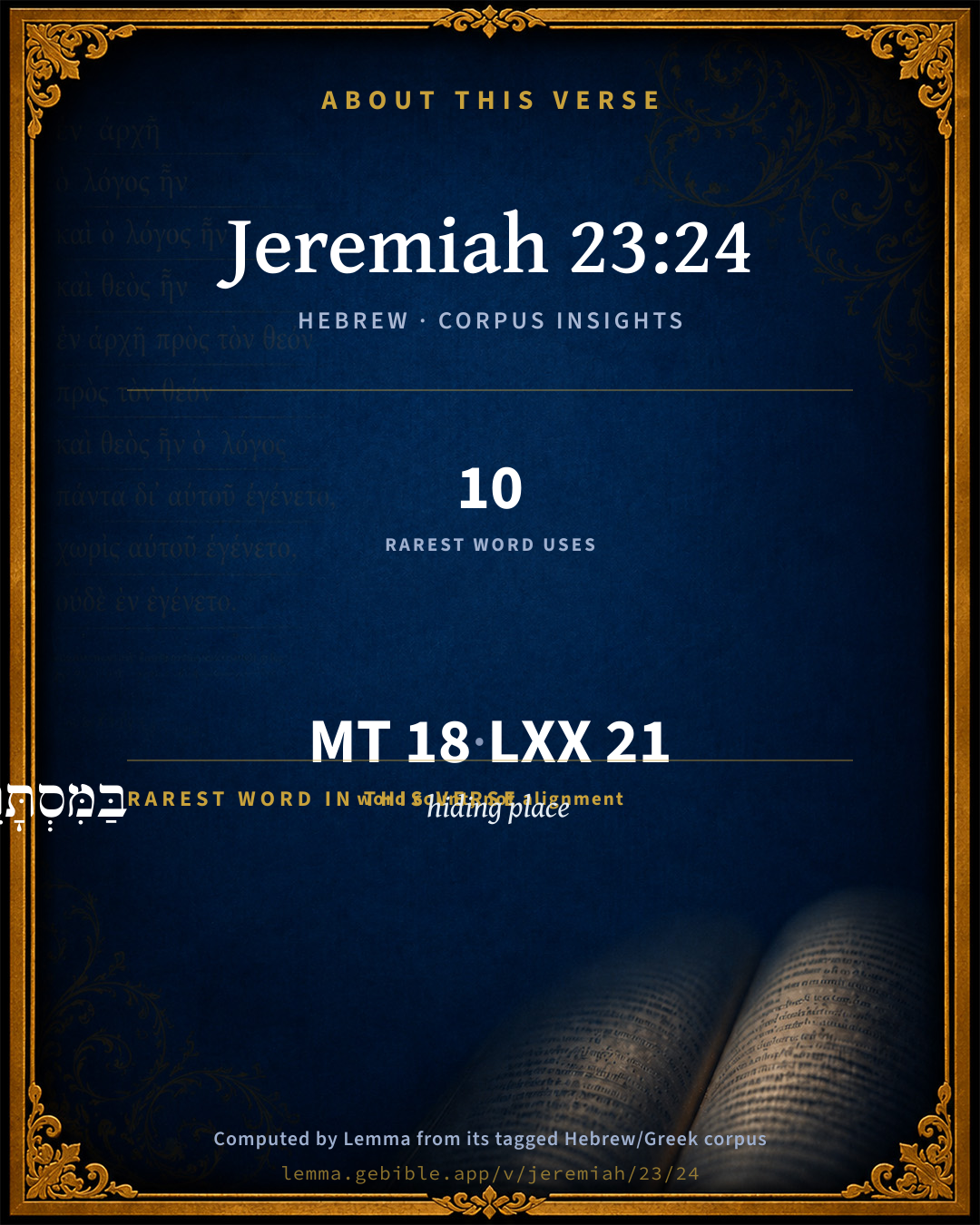
The rarest word here is בַּמִּסְתָּרִ֛ים hiding place H4565 — appearing just 10 times in the whole Hebrew Bible.

Shared distinctive vocabulary

בַּמִּסְתָּרִ֛ים hiding place H4565 occurs in 10 verses of the Hebrew Bible. Also found in:

Grammatical profile

  • 3 verbs
  • 8 nouns
  • 2 pronouns
  • 1 conjunction
  • 4 particles

Verb forms

  • יִסָּתֵ֨ר Niphal · Imperfect
  • אֶרְאֶ֖נּוּ Qal · Imperfect
  • מָלֵ֖א Qal · Participle Active

Repetition

Words recur within this verse — often emphatic in Hebrew:

  • נְאֻם utterance H5002 ×2
  • יְהוָ֑ה LORD H3068 ×2
  • וַאֲנִ֥י I H589 ×2
  • לֹֽא not H3808 ×2

Hebrew & Septuagint length

In the original languages it is 18 Hebrew tokens and 21 Greek tokens — but the two are counted differently (Hebrew bundles its prefixes and suffixes into one token; the Greek is in lemma form), so that isn’t a like-for-like length.

Cross-references

21

Topical passages linked to Jeremiah 23:24 in the Treasury of Scripture Knowledge — connected by theme and wording, ordered by reader-vote popularity; previews shown in the World English Bible.

  • Proverbs 15:3 Yahweh's eyes are everywhere, Keeping watch on the evil and the good.
  • Psalms 139:7 Where could I go from your Spirit? Or where could I flee from your presence?
  • Psalms 90:8 You have set our iniquities before you, Our secret sins in the light of your presence.
  • Isaiah 29:15 Woe to those who hide deep their counsel from Yahweh, and whose works are in the dark, and who say, Who sees us? and who knows us?
  • 1 Kings 8:27 But will God in very deed dwell on the earth? behold, heaven and the heaven of heavens can't contain you; how much less this house that I have built!
  • Psalms 139:11–16 If I say, "Surely the darkness will overwhelm me; The light around me will be night;"
  • Isaiah 57:15 For thus says the high and lofty One who inhabits eternity, whose name is Holy: I dwell in the high and holy place, with him also who is of a contrite and humble spirit, to revive the spirit of the humble, and to revive the heart of the contrite.
  • Amos 9:2–3 Though they dig into Sheol, there my hand will take them; and though they climb up to heaven, there I will bring them down.
  • Job 22:13–14 You say, 'What does God know? Can he judge through the thick darkness?
  • 2 Chronicles 6:18 But will God in very deed dwell with men on the earth? behold, heaven and the heaven of heavens can't contain you; how much less this house which I have built!
  • Psalms 10:11 He says in his heart, "God has forgotten. He hides his face. He will never see it."
  • Isaiah 66:1 Thus says Yahweh, heaven is my throne, and the earth is my footstool: what manner of house will you build to me? and what place shall be my rest?
  • 2 Chronicles 2:6 But who is able to build him a house, seeing heaven and the heaven of heavens can't contain him? who am I then, that I should build him a house, save only to burn incense before him?
  • Daniel 4:35 All the inhabitants of the earth are reputed as nothing; and he does according to his will in the army of heaven, and among the inhabitants of the earth; and none can stay his hand, or tell him, What do you?
  • Genesis 16:13 She called the name of Yahweh who spoke to her, "You are a God who sees," for she said, "Have I even stayed alive after seeing him?"
  • Job 24:13–16 "These are of those who rebel against the light; They don't know the ways of it, Nor abide in the paths of it.
  • Psalms 148:13 Let them praise the name of Yahweh, For his name alone is exalted. His glory is above the earth and the heavens.
  • Jeremiah 49:10 But I have made Esau bare, I have uncovered his secret places, and he shall not be able to hide himself: his seed is destroyed, and his brothers, and his neighbors; and he is no more.
  • Ezekiel 8:12 Then said he to me, Son of man, have you seen what the elders of the house of Israel do in the dark, every man in his chambers of imagery? for they say, Yahweh doesn't see us; Yahweh has forsaken the land.
  • Ezekiel 9:9 Then said he to me, The iniquity of the house of Israel and Judah is exceeding great, and the land is full of blood, and the city full of wrestling [of judgment]: for they say, Yahweh has forsaken the land, and Yahweh doesn't see.
  • Ephesians 1:23 which is his body, the fullness of him who fills all in all.

Cross-references courtesy of OpenBible.info (CC BY 4.0).

Hebrew and Greek witnesses Masoretic Hebrew ↔ Greek Septuagint

The same verse in the two great witnesses to the Old Testament, shown verse-for-verse.

These are two independent witnesses, not word-aligned to each other, and the Septuagint is shown in lemma (dictionary) form.

Hebrew Jeremiah 23:24 Masoretic · Westminster Leningrad Codex

אִם יִסָּתֵ֨ר אִ֧ישׁ בַּמִּסְתָּרִ֛ים וַאֲנִ֥י לֹֽא אֶרְאֶ֖נּוּ נְאֻם יְהוָ֑ה הֲל֨וֹא אֶת הַשָּׁמַ֧יִם וְאֶת הָאָ֛רֶץ אֲנִ֥י מָלֵ֖א נְאֻם יְהוָֽה

Can any hide himself in secret places so that I shall not see him? says Yahweh. Don't I fill heaven and earth? says Yahweh.

World English Bible · Public Domain

Greek LXX Structure differs

In the Septuagint, Jeremiah is about an eighth shorter than the Hebrew and arranges its material differently — the Oracles Against the Nations (Hebrew chapters 46–51) appear in the middle of the Greek book, after 25:13. Because the chapter and verse boundaries do not line up, a verse-for-verse comparison with the Hebrew is not shown.

A verse-for-verse comparison isn’t shown here because the chapters and verses don’t line up. Switch to the LXX edition with the MT / LXX toggle above to read the Greek directly.

Hebrew: Westminster Leningrad Codex (CC BY 4.0). Greek: Septuagint (public domain); English from a public-domain English Septuagint. How the Septuagint differs from the Hebrew →

Targum (Aramaic paraphrase)

1

The Targum is the ancient Jewish Aramaic paraphrase of the Hebrew Scriptures — an interpretive translation, not the Hebrew text itself. Onkelos (literal) and Pseudo-Jonathan (expansive) render the Torah, and Jonathan the Prophets. Coverage is partial: where no permissively-licensed English translation exists for a verse, only the Aramaic is shown. This is verse-level text, not a word-by-word alignment to the Hebrew.

  1. Targum Jonathan Prophets (Joshua–Malachi)
    אִם יְדַמֵי גְבַר לְאִטַמָרָה כַּד בְּסִתְרָא קָדָמֵי הֲלָא גְלֵי אֲמַר יְיָ הֲלָא יַת שְׁמַיָא וְיַת אַרְעָא יְקָרִי מְלֵי אֲמַר יְיָ:

    (no public-domain English translation for this verse)

    Targum Jonathan — Aramaic: “Mikraot Gedolot” (public domain). English: “Sefaria Community Translation” (CC0 1.0 (public-domain dedication)); “London "Chaldee Paraphrase," 1871” (public domain). Text via Sefaria.

Commentary

Notes on Jeremiah 23:24 from classic Christian and Jewish commentators (each source and its license shown beneath its notes). The classic Christian expositions comment on the surrounding passage and are grouped to its opening verse, so a note may address several verses; the Jewish commentaries on the Tanakh (Rashi and others) are per-verse, so they appear only where the commentator wrote on this verse.

Lemma curates 59 commentaries, every one of them public domain or Creative Commons licensed, each selected and text-cleaned for this edition rather than reprinted as found. About our sources →

Trapp's Complete Commentary

John Trapp

Jer 23:24 Can any hide himself in secret places that I shall not see him? saith the LORD. Do not I fill heaven and earth? saith the LORD.

Ver. 24. Can any man hide himself in secret places?] Hide he may God from himself, but not himself from God; though atheists are apt to think (as they say the struthiocamelus doth when he hath thrust his head in a hole) {a} that because they see none, therefore none seeth them.

Do I not fill heaven and earth?] See Psa 139:3; Psa 139:5; Psa 139:7; Psa 139:11 Isa 66:1. {See Trapp on "Psa 139:3"} {See Trapp on "Psa 139:5"} {See Trapp on "Psa 139:7"} {See Trapp on "Psa 139:11"} {See Trapp on "Isa 66:1"}

{a} Plin.

John Trapp, A Commentary or Exposition upon All the Books of the Old and New Testament (1647–1656) — public domain. Text from a community e-Sword module.

Jamieson, Fausset & Brown

Robert Jamieson, A. R. Fausset & David Brown

(Psa 139:7, &c.; Amo 9:2-3).

fill heaven and earth--with My omniscience providence, power, and essential being (Kg1 8:27).

Jamieson, Fausset & Brown — Commentary Critical and Explanatory on the Whole Bible (1871) — public domain (CC PDM 1.0). Text via the HelloAO Bible API.

John Calvin's Commentaries

And that this is the meaning appears more clearly from the next verse, which ought to be read in connection with this; Will a man hide himself in coverts, that I should not see him? This verse is added by way of explanation; there can therefore be no doubt respecting the words, far off and near, — that God is said to be a God afar off; because his eyes penetrate into the lowest depths, so that nothing can escape him.

It is a wonder that the Greek translators made so great a mistake; for they wholly changed the sense, — that God is God nigh at hand, but not afar off. In the first place, they did not consider the question, and then, as they did not see the drift of the passage, they contrived from their own brains what is wholly remote from the words of the Prophet. This sentiment, that God is nigh and not afar off, is indeed true; but what is meant here is quite another thing, — that God sees in a way very different from men, for he fully and perfectly sees what is farthest from him, according to the passage we have quoted from Psalm 102:19; and there is another in Psalm 139:7-12, where the Psalmist says,

“Where shall I flee from thy face? for if I ascend into heaven, thou art there; if I lie down in hell, there thou stretchest forth thine hand; if I take the wings of the dawn and fly to the clouds, even thine hand will lay hold of me there; if I seek coverts, even the night itself is before thee as the light, and darkness shines as the light.”

If, then, we join together these two passages, there will appear nothing ambiguous in the words of Jeremiah, — even that God penetrates with his eyes into the lowest depths, so that nothing is hid from him.

But Jeremiah not only explains the meaning of the last verse, but also makes a practical use of it; Will any one, he says, hide himself in coverts that I should not see him? The seeing of God has a reference to his judgment. Then all frivolous speculations ought to be cast aside, since Scripture says that God sees all things; but we ought especially to consider for what purpose it is that he sees all things; which is evidently this, — that he may at last call to judgment whatever is done by men. There is then an application of the doctrine to our case; for we hence learn, that whatsoever we do, think, and speak, is known to God.

By coverts, or hiding-places, he means all the secret frauds which men think they can cover; but by such an attempt they gain nothing but a heavier judgment. By coverts then we are to understand all those vain thoughts which hypocrites entertain; for they think that they can so hide themselves that God cannot see their purposes. Hence God laughs them to scorn, and says in effect, “Let them enter into their coverts, let them hide themselves as much as they please, I yet do see them in their coverts no less clearly than if they were quite close to me.”

To confirm this he adds, Do not I fill heaven and earth, saith Jehovah? This must not be refinedly explained of the infinite essence of God. It is indeed true, that his essence extends through heaven and earth, as it is interminable. But Scripture will not have us to feed on frivolous and unprofitable notions; it teaches only what avails to promote true religion. What therefore God declares here, that he fills heaven and earth, ought to be applied to his providence and his power; as though he had said, that he is not so taken up with things in heaven that he neglects the concerns of earth, as profane men dream; but he is said to fill heaven and earth, because he governs all things, because all things are noticed by him, because he is, in short, the judge of the world.

We now perceive what the Prophet means; and this passage is entitled to particular notice, because this error of imagining a God like ourselves is inbred almost in us all. Hence it is, that men allow themselves so much liberty; for they consider it a light thing to discharge their duty towards God, because they reflect not what sort of being he is, but they think of him according to their own understanding and character. As, then, we are thus gross in our ideas, it becomes us carefully to reflect on this passage, where God declares, that he is not only a God near at hand, that is, that he is not like us, who have only a limited power of seeing, but that he sees in the thickest darkness as well as in the clearest light; and that therefore it avails those nothing to deceive themselves who dig for themselves caverns, as it is said in Isaiah, and hide themselves in deep labyrinths. (Isaiah 2:21.) He thus denies that they gain anything, and gives this as the reason,

“Because he fills heaven and earth;”

that is, his providence, his power, and his justice are so diffused everywhere, that wherever men betake themselves, it is impossible for them to be concealed from him. It follows, —

John Calvin's Commentaries (1540-1563) — public domain. Text from the Calvin Translation Society English edition (1840s-50s) via the Christian Classics Ethereal Library (ccel.org). Calvin's coverage is partial (roughly two-thirds of the Bible); uncommented books and verses are honest gaps, never fabricated. The 19th-century editor's footnotes and remarks are omitted so the notes are faithfully Calvin's own voice.

John Gill's Exposition

Can any hide himself in secret places that I shall not see him? saith the Lord,.... If a man should hide himself in the most secret and hidden places of the earth, and do his works in the most private manner, so that no human eye can see him, he cannot hide himself or his actions from the Lord, who can see from heaven to earth, and through the darkest and thickest clouds, and into the very bowels of the earth, and the most hidden and secret recesses and caverns of it. The darkness and the light are both alike to him; and also near and distant, open and secret places:

do not I fill heaven and earth? saith the Lord; not only with inhabitants, and with other effects of his power and providence; but with his essence, which is everywhere, and is infinite and immense, and cannot be contained in either, or be limited and circumscribed by space and place; see Kg1 8:27. The Targum is,

"does not my glory fill heaven and earth? saith the Lord;''

both of them are full of his glory; and every person and thing in either must be seen and known by him; and so the false prophets and their lies; in order to convince of the truth of which, all this is said, as appears by the following words.

John Gill's Exposition of the Whole Bible (1746–1763) — public domain (CC PDM 1.0). Text via the HelloAO Bible API.

Matthew Poole's English Annotations

What do these atheistical priests, and prophets, and people think? Do they think that I, who am a God of purer eyes than to behold iniquity, see and take notice of what doctrine they preach, and what lives they live? If they did, surely they would not dare to do as they do. Do they think that I do not see or take notice of them? Can any hide themselves out of my sight? I fill heaven and earth, not only with my influence, but with my essence, with the immensity of my being; which, as it cannot be circumscribed by any, so it is shut out of no place.

Matthew Poole's English Annotations on the Holy Bible (1683–1685) — public domain. Text from a community e-Sword/MySword module.

Rashi

Rabbi Shlomo Yitzchaki (Rashi)

Can a man hide in secret places This is a repetition of the question, ‘Am I a God from near,’ according to the manner of all double questions.

Rashi on the Tanakh — English translations: “The Judaica Press complete Tanach with Rashi, translated by A. J. Rosenberg” (CC BY 4.0); “Pentateuch with Rashi's commentary by M. Rosenbaum and A.M. Silbermann, 1929-1934” (public domain); “The Metsudah Tanach series, Lakewood, N.J” (CC BY 4.0); and “The Book of Joshua, Metsudah Publications, 1997” (CC BY 4.0). Text via Sefaria.

Lesson kit

Teaching starters — assembled from the data on this page, not authored interpretation. Every prompt links to the verse data it draws on. Edit before teaching.

Jeremiah, in the Prophets, opens this verse with 18 words (13 distinct Hebrew lemmas). Its most distinctive word is miçtâr (“hiding place”). A historical commentator’s framing appears above. Read the whole chapter for the surrounding context.

Discussion questions

  1. How does “hiding place” (miçtâr) shape what this verse is saying?
  2. Psalms 10:8 shares the word «hiding place» with this verse. How do the two illuminate each other?
  3. “utterance” occurs 2× in this one verse. What is the effect of the repetition?
  4. These translations render this verse differently. What is at stake in choosing one wording over another?
  5. The verb «יִסָּתֵ֨ר» is Niphal Imperfect. How does its form color the action?
  6. Reading how Trapp's Complete Commentary and Jamieson, Fausset & Brown read this verse, where do the two commentators agree and where do they part?

Things to notice

Reading settings

Reading text

Shown beneath each verse's original-language words.

Old Testament
Old Testament edition

Read the OT as the Masoretic Hebrew (MT) or the Greek Septuagint (LXX).

English shown for the Greek Septuagint (in the Hebrew ↔ Greek comparison).

Comparing translations? Open the Compare panel on any verse page to stack up to four side by side.