
Jeremiah 34:3

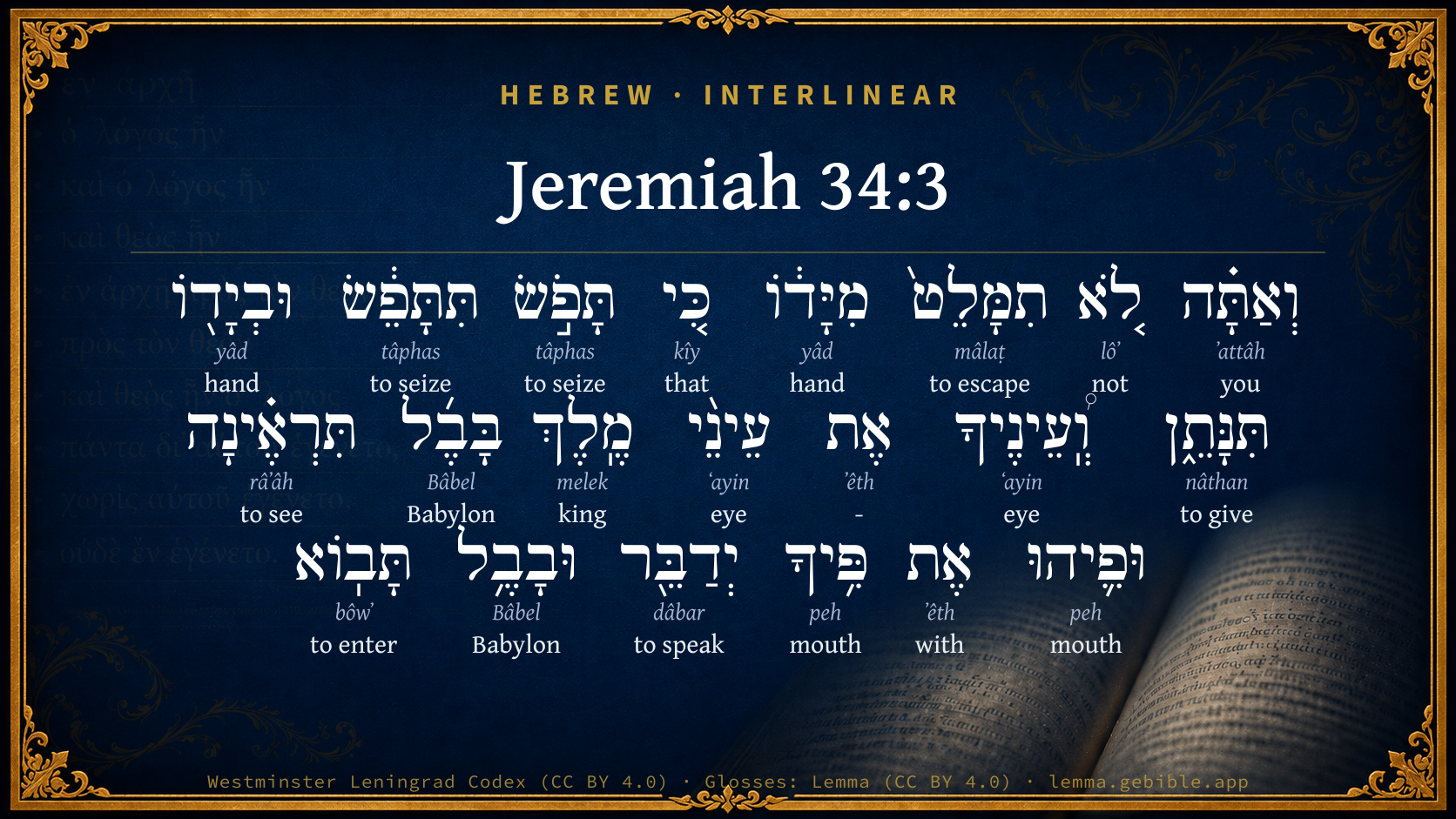
Hebrew (Westminster Leningrad Codex) Jeremiah 34:3 appears in the Hebrew Old Testament. The text above is from the Westminster Leningrad Codex. Each word links to its Strong’s number, a concise gloss, and parsing drawn from the Open Scriptures Hebrew Bible morphology. Click any word for its full Brown-Driver-Briggs (BDB) entry.
Download image
Cite this verse

Jeremiah 34:3 (World English Bible). Public Domain. Lemma interlinear Bible study tool, https://lemma.gebible.app/v/jeremiah/34/3.

Show BibTeX & RIS
BibTeX
RIS
English Translation
and you shall not escape out of his hand, but shall surely be taken, and delivered into his hand; and your eyes shall see the eyes of the king of Babylon, and he shall speak with you mouth to mouth, and you shall go to Babylon.
World English Bible · Public Domain
Download a study sheet

One document with this verse’s original text, its word-by-word gloss line, the meaning frame, cross-references with their text, attributed commentary, and full source and license credits — printable, and it pastes into notes with its structure intact.

This verse Autodidact and up

Study sheet (.html) Plain text (.txt)

A passage Seminary Student

Up to 50 verses in one chapter. A passage sheet keeps up to 6 commentary sources and 12 cross-references per verse, in the order this page ranks them, and says so on the sheet whenever that leaves anything out. Ask for a single verse and you get the Autodidact verse sheet above.

Everything on this page stays free to read, with no account — the sheet is a download of what is already on screen, not access to it.

Want to remove ads? Support Godless Engineer
Compare translations 3

The same verse in 3 English versions, stacked beneath the original-language interlinear above. Click any original word for its lexicon entry.

Each is an independent rendering of the whole verse — the interlinear is not word-aligned to these translations.

Highlighted words mark where these versions differ — a whole-verse word diff, not a word-by-word alignment.

  • World English Bible Public Domain
    and you shall not escape out of his hand, but shall surely be taken, and delivered into his hand; and your eyes shall see the eyes of the king of Babylon, and he shall speak with you mouth to mouth, and you shall go to Babylon.
  • King James Version Public Domain
    And thou shalt not escape out of his hand, but shalt surely be taken, and delivered into his hand; and thine eyes shall behold the eyes of the king of Babylon, and he shall speak with thee mouth to mouth, and thou shalt go to Babylon.
  • unfoldingWord Literal Text CC BY-SA 4.0
    You will not escape from his hand, for you will certainly be seized and given into his hand. Your eyes will look at the eyes of the king of Babylon; he will speak directly to you as you go to Babylon.’

unfoldingWord Literal Text — © unfoldingWord, licensed CC BY-SA 4.0. Word-aligned USFM3 via Door43 (git.door43.org/unfoldingWord/en_ult).

Versions to compare (up to 4)

3 of 4 selected

Show all 18 translations

Every available English version of this verse, each an independent rendering of the whole verse.

  • World English Bible Public Domain
    and you shall not escape out of his hand, but shall surely be taken, and delivered into his hand; and your eyes shall see the eyes of the king of Babylon, and he shall speak with you mouth to mouth, and you shall go to Babylon.
  • Berean Standard Bible Public Domain
    And you yourself will not escape his grasp, but will surely be captured and delivered into his hand. You will see the king of Babylon eye to eye and speak with him face to face; and you will go to Babylon.
  • Majority Standard Bible Public Domain
    And you yourself will not escape his grasp, but will surely be captured and delivered into his hand. You will see the king of Babylon eye to eye and speak with him face to face; and you will go to Babylon.
  • King James Version Public Domain
    And thou shalt not escape out of his hand, but shalt surely be taken, and delivered into his hand; and thine eyes shall behold the eyes of the king of Babylon, and he shall speak with thee mouth to mouth, and thou shalt go to Babylon.
  • American Standard Version (1901) Public Domain
    and thou shalt not escape out of his hand, but shalt surely be taken, and delivered into his hand; and thine eyes shall behold the eyes of the king of Babylon, and he shall speak with thee mouth to mouth, and thou shalt go to Babylon.
  • Revised Version (1885) Public Domain
    and thou shalt not escape out of his hand, but shalt surely be taken, and delivered into his hand; and thine eyes shall behold the eyes of the king of Babylon, and he shall speak with thee mouth to mouth, and thou shalt go to Babylon.
  • Geneva Bible (1599) Public Domain
    And thou shall not escape out of his hand, but shalt surely be taken, and deliuered into his hand, and thine eyes shall beholde the face of the King of Babel, and he shall speake with thee mouth to mouth, and thou shalt go to Babel.
  • Douay-Rheims (1899) Public Domain
    And thou shalt not escape out of his hand: but thou shalt surely be taken, and thou shalt be delivered into his hand: and thy eyes shall see the eyes of the king of Babylon, and his mouth shall speak with thy mouth, and thou shalt go to Babylon.
  • Young's Literal Translation Public Domain
    and thou, thou dost not escape out of his hand, for thou art certainly caught, and into his hand thou art given, and thine eyes see the eyes of the king of Babylon, and his mouth with thy mouth speaketh, and Babylon thou enterest.
  • Literal Standard Version CC BY-SA 4.0
    and you do not escape out of his hand, for you are certainly caught, and you are given into his hand, and your eyes see the eyes of the king of Babylon, and his mouth speaks with your mouth, and you enter Babylon.
  • Unlocked Literal Bible CC BY-SA 4.0
    You will not escape from his hand, for you will certainly be seized and given into his hand. Your eyes will look at the eyes of the king of Babylon; he will speak directly to you as you go to Babylon.'
  • unfoldingWord Literal Text CC BY-SA 4.0
    You will not escape from his hand, for you will certainly be seized and given into his hand. Your eyes will look at the eyes of the king of Babylon; he will speak directly to you as you go to Babylon.’
  • Darby Bible Public Domain
    And thou shalt not escape out of his hand, but shalt certainly be taken, and given into his hand; and thine eyes shall behold the eyes of the king of Babylon, and his mouth shall speak with thy mouth, and thou shalt go to Babylon.
  • World Messianic Bible Public Domain
    You won’t escape out of his hand, but will surely be taken and delivered into his hand. Your eyes will see the eyes of the king of Babylon, and he will speak with you mouth to mouth. You will go to Babylon.”’
  • Webster's Bible Public Domain
    And thou shalt not escape from his hand, but shalt surely be taken, and delivered into his hand; and thy eyes shall behold the eyes of the king of Babylon, and he shall speak with thee mouth to mouth, and thou shalt go to Babylon.
  • Free Bible Version CC BY-SA 4.0
    You yourself won't escape being captured by him. You will certainly be taken prisoner and brought before him to speak with him personally and see him face to face. You will be taken to Babylon.
  • Bible in Basic English Public Domain
    And you will not get away from him, but will certainly be taken and given up into his hands; and you will see the king of Babylon, eye to eye, and he will have talk with you, mouth to mouth, and you will go to Babylon.
  • JPS Tanakh (1917) Public Domain
    and thou shalt not escape out of his hand, but shalt surely be taken, and delivered into his hand; and thine eyes shall behold the eyes of the king of Babylon, and he shall speak with thee mouth to mouth, and thou shalt go to Babylon.

Literal Standard Version (2020), Covenant Press — licensed CC BY-SA 4.0. Text via the HelloAO Bible API (eBible.org). Unlocked Literal Bible (unfoldingWord) — licensed CC BY-SA 4.0. Text via the HelloAO Bible API (eBible.org). unfoldingWord Literal Text — © unfoldingWord, licensed CC BY-SA 4.0. Word-aligned USFM3 via Door43 (git.door43.org/unfoldingWord/en_ult). Free Bible Version, Dr. Jonathan Gallagher — licensed CC BY-SA 4.0. Text via the HelloAO Bible API (eBible.org).

Word by word

More ways to search: Search by grammar → Find every occurrence → Compare this word →

Practice this passage: Drill this verse → Learn its vocabulary →

תָּפֹ֣שׂ
tâphas
H8610
“to seize”
Verb, Qal, Infinitive Absolute
Part of Speech
Verb
Stem
Qal
Form
Infinitive Absolute
Full BDB Definition

Origin: a primitive root

TWOT: 2538

to catch, handle, lay hold, take hold of, seize, wield - (Qal) - to lay hold of, seize, arrest, catch - to grasp (in order to) wield, wield, use skilfully - (Niphal) to be seized, be arrested, be caught, be taken, captured - (Piel) to catch, grasp (with the hands)
  1. וְאַתָּ֗ה ʼattâh H859 “and · you” Conjunction + Pronoun, Personal, 2nd Person, Masculine, Singular
  2. לֹ֚א lôʼ H3808 “not” Particle, Negative
  3. תִמָּלֵט֙ mâlaṭ H4422 “to escape” Verb, Niphal, Imperfect, 2nd Person, Masculine, Singular
  4. מִיָּד֔וֹ yâd H3027 “from · hand · his” Preposition + Noun, Common, Both, Singular, Construct + Suffix, Personal, 3rd Person, Masculine, Singular
  5. כִּ֚י kîy H3588 “that” Conjunction
  6. תִּתָּפֵ֔שׂ tâphas H8610 “to seize” Verb, Niphal, Imperfect, 2nd Person, Masculine, Singular
  7. וּבְיָד֖וֹ yâd H3027 “and · in/at · hand · his” Conjunction + Preposition + Noun, Common, Both, Singular, Construct + Suffix, Personal, 3rd Person, Masculine, Singular
  8. תִּנָּתֵ֑ן nâthan H5414 “to give” Verb, Niphal, Imperfect, 2nd Person, Masculine, Singular
  9. וְֽ֠עֵינֶיךָ ʻayin H5869 “and · eyes · your” Conjunction + Noun, Common, Both, Dual, Construct + Suffix, Personal, 2nd Person, Masculine, Singular
  10. אֶת ʼêth H853 “-” Particle, Direct Object
  11. עֵינֵ֨י ʻayin H5869 “eyes of” Noun, Common, Both, Dual, Construct
  12. מֶֽלֶךְ melek H4428 “king of” Noun, Common, Masculine, Singular, Construct
  13. בָּבֶ֜ל Bâbel H894 “Babylon” Noun, Proper
  14. תִּרְאֶ֗ינָה râʼâh H7200 “to see” Verb, Qal, Imperfect, 3rd Person, Feminine, Plural
  15. וּפִ֛יהוּ peh H6310 “and · mouth · his” Conjunction + Noun, Common, Masculine, Singular, Construct + Suffix, Personal, 3rd Person, Masculine, Singular
  16. אֶת ʼêth H854 “with” Preposition
  17. פִּ֥יךָ peh H6310 “mouth · your” Noun, Common, Masculine, Singular, Construct + Suffix, Personal, 2nd Person, Masculine, Singular
  18. יְדַבֵּ֖ר dâbar H1696 “to speak” Verb, Piel, Imperfect, 3rd Person, Masculine, Singular
  19. וּבָבֶ֥ל Bâbel H894 “and · Babylon” Conjunction + Noun, Proper
  20. תָּבֽוֹא bôwʼ H935 “to enter” Verb, Qal, Imperfect, 2nd Person, Masculine, Singular

About this verse

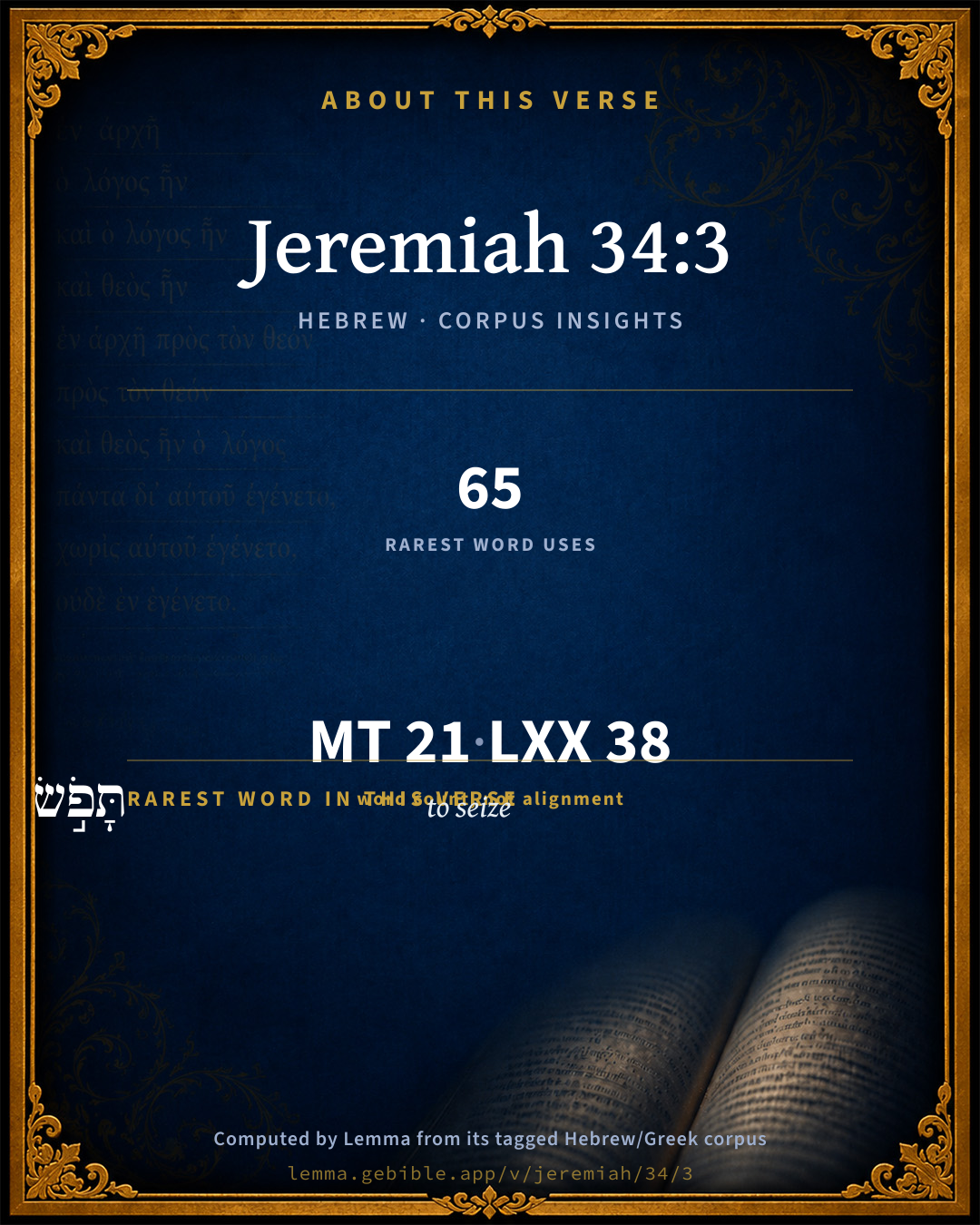
These counts appear in no published source. They are computed here, from the morphology-tagged text and Lemma’s own curated glosses. What Lemma adds →

21
words
16
distinct lemmas
Prophets
section

Grammatical profile

  • 7 verbs
  • 9 nouns
  • 1 pronoun
  • 1 preposition
  • 1 conjunction
  • 2 particles

Verb forms

  • תִמָּלֵט֙ Niphal · Imperfect
  • תָּפֹ֣שׂ Qal · Infinitive Absolute
  • תִּתָּפֵ֔שׂ Niphal · Imperfect
  • תִּנָּתֵ֑ן Niphal · Imperfect
  • תִּרְאֶ֗ינָה Qal · Imperfect
  • יְדַבֵּ֖ר Piel · Imperfect
  • תָּבֽוֹא Qal · Imperfect

Repetition

Words recur within this verse — often emphatic in Hebrew:

  • מִיָּד֔וֹ hand H3027 ×2
  • תָּפֹ֣שׂ to seize H8610 ×2
  • וְֽ֠עֵינֶיךָ eye H5869 ×2
  • בָּבֶ֜ל Babylon H894 ×2
  • וּפִ֛יהוּ mouth H6310 ×2

Hebrew & Septuagint length

In the original languages it is 21 Hebrew tokens and 38 Greek tokens — but the two are counted differently (Hebrew bundles its prefixes and suffixes into one token; the Greek is in lemma form), so that isn’t a like-for-like length.

Cross-references

11

Topical passages linked to Jeremiah 34:3 in the Treasury of Scripture Knowledge — connected by theme and wording, ordered by reader-vote popularity; previews shown in the World English Bible.

  • Jeremiah 32:4 and Zedekiah king of Judah shall not escape out of the hand of the Chaldeans, but shall surely be delivered into the hand of the king of Babylon, and shall speak with him mouth to mouth, and his eyes shall see his eyes;
  • Jeremiah 21:7 Afterward, says Yahweh, I will deliver Zedekiah king of Judah, and his servants, and the people, even such as are left in this city from the pestilence, from the sword, and from the famine, into the hand of Nebuchadrezzar king of Babylon, and into the hand of their enemies, and into the hand of those who seek their life: and he shall strike them with the edge of the sword; he shall not spare them, neither have pity, nor have mercy.
  • 2 Kings 25:4–7 Then a breach was made in the city, and all the men of war [fled] by night by the way of the gate between the two walls, which was by the king's garden (now the Chaldeans were against the city round about); and [the king] went by the way of the Arabah.
  • Jeremiah 34:21 Zedekiah king of Judah and his princes will I give into the hand of their enemies, and into the hand of those who seek their life, and into the hand of the king of Babylon's army, who have gone away from you.
  • Jeremiah 39:4–7 It happened that, when Zedekiah the king of Judah and all the men of war saw them, then they fled, and went forth out of the city by night, by the way of the king's garden, through the gate between the two walls; and he went out toward the Arabah.
  • Jeremiah 37:17 Then Zedekiah the king sent, and fetched him: and the king asked him secretly in his house, and said, Is there any word from Yahweh? Jeremiah said, There is. He said also, You shall be delivered into the hand of the king of Babylon.
  • Jeremiah 38:18 But if you will not go forth to the king of Babylon's princes, then shall this city be given into the hand of the Chaldeans, and they shall burn it with fire, and you shall not escape out of their hand.
  • Jeremiah 52:7–11 Then a breach was made in the city, and all the men of war fled, and went forth out of the city by night by the way of the gate between the two walls, which was by the king's garden; (now the Chaldeans were against the city round about;) and they went toward the Arabah.
  • Ezekiel 12:13 My net also will I spread on him, and he shall be taken in my snare; and I will bring him to Babylon to the land of the Chaldeans; yet shall he not see it, though he shall die there.
  • Ezekiel 17:18–20 For he has despised the oath by breaking the covenant; and behold, he had given his hand, and yet has done all these things; he shall not escape.
  • Ezekiel 21:25 You, deadly wounded wicked one, the prince of Israel, whose day is come, in the time of the iniquity of the end,

Cross-references courtesy of OpenBible.info (CC BY 4.0).

Hebrew and Greek witnesses Masoretic Hebrew ↔ Greek Septuagint

The same verse in the two great witnesses to the Old Testament, shown verse-for-verse.

These are two independent witnesses, not word-aligned to each other, and the Septuagint is shown in lemma (dictionary) form.

Hebrew Jeremiah 34:3 Masoretic · Westminster Leningrad Codex

וְאַתָּ֗ה לֹ֚א תִמָּלֵט֙ מִיָּד֔וֹ כִּ֚י תָּפֹ֣שׂ תִּתָּפֵ֔שׂ וּבְיָד֖וֹ תִּנָּתֵ֑ן וְֽ֠עֵינֶיךָ אֶת עֵינֵ֨י מֶֽלֶךְ בָּבֶ֜ל תִּרְאֶ֗ינָה וּפִ֛יהוּ אֶת פִּ֥יךָ יְדַבֵּ֖ר וּבָבֶ֥ל תָּבֽוֹא

and you shall not escape out of his hand, but shall surely be taken, and delivered into his hand; and your eyes shall see the eyes of the king of Babylon, and he shall speak with you mouth to mouth, and you shall go to Babylon.

World English Bible · Public Domain

Greek LXX Structure differs

In the Septuagint, Jeremiah is about an eighth shorter than the Hebrew and arranges its material differently — the Oracles Against the Nations (Hebrew chapters 46–51) appear in the middle of the Greek book, after 25:13. Because the chapter and verse boundaries do not line up, a verse-for-verse comparison with the Hebrew is not shown.

A verse-for-verse comparison isn’t shown here because the chapters and verses don’t line up. Switch to the LXX edition with the MT / LXX toggle above to read the Greek directly.

Hebrew: Westminster Leningrad Codex (CC BY 4.0). Greek: Septuagint (public domain); English from a public-domain English Septuagint. How the Septuagint differs from the Hebrew →

Targum (Aramaic paraphrase)

1

The Targum is the ancient Jewish Aramaic paraphrase of the Hebrew Scriptures — an interpretive translation, not the Hebrew text itself. Onkelos (literal) and Pseudo-Jonathan (expansive) render the Torah, and Jonathan the Prophets. Coverage is partial: where no permissively-licensed English translation exists for a verse, only the Aramaic is shown. This is verse-level text, not a word-by-word alignment to the Hebrew.

  1. Targum Jonathan Prophets (Joshua–Malachi)
    וְאַתְּ לָא תִשְׁתֵּיזֵיב מִן יְדֵיהּ אֲרֵי אִתְאֲחָדָא תִתְאַחֵד וּבִידֵיהּ תִּתְמְסַר וְעֵינָךְ יַת עֵינֵי מַלְכָּא דְבָבֶל יֶחֶזְיָן וּפוּמֵיהּ עִם פּוּמָךְ יְמַלֵל וּלְבָבֶל תִּתּוֹבָל:

    (no public-domain English translation for this verse)

    Targum Jonathan — Aramaic: “Mikraot Gedolot” (public domain). English: “Sefaria Community Translation” (CC0 1.0 (public-domain dedication)); “London "Chaldee Paraphrase," 1871” (public domain). Text via Sefaria.

Commentary

Notes on Jeremiah 34:3 from classic Christian and Jewish commentators (each source and its license shown beneath its notes). The classic Christian expositions comment on the surrounding passage and are grouped to its opening verse, so a note may address several verses; the Jewish commentaries on the Tanakh (Rashi and others) are per-verse, so they appear only where the commentator wrote on this verse.

Lemma curates 59 commentaries, every one of them public domain or Creative Commons licensed, each selected and text-cleaned for this edition rather than reprinted as found. About our sources →

Trapp's Complete Commentary

John Trapp

Jer 34:3 And thou shalt not escape out of his hand, but shalt surely be taken, and delivered into his hand; and thine eyes shall behold the eyes of the king of Babylon, and he shall speak with thee mouth to mouth, and thou shalt go to Babylon.

Ver. 3. And thou shalt not escape.] Whatever vain hopes thou mayest nourish, and although thou thinkest thou hast a stake in store, howsoever the world goes with the rest. See Jer 32:4-5.

John Trapp, A Commentary or Exposition upon All the Books of the Old and New Testament (1647–1656) — public domain. Text from a community e-Sword module.

Jamieson, Fausset & Brown

Robert Jamieson, A. R. Fausset & David Brown

(Jer 32:4).

Jamieson, Fausset & Brown — Commentary Critical and Explanatory on the Whole Bible (1871) — public domain (CC PDM 1.0). Text via the HelloAO Bible API.

Adam Clarke's Commentary

Verse 3. Thou shalt not escape] This, however, he had attempted, but was taken in his flight. See Jer 39:4; Jer 52:7, &c.

Adam Clarke's Commentary on the Bible (1810–1826) — public domain. Text from a community e-Sword/MySword module.

John Calvin's Commentaries

As Zedekiah saw the people still doing their duty he despised his enemy; for as the city was very strongly fortified, he hoped to be able to preserve it a little time longer. Hence was the false hope of deliverance; for he thought that the enemy being wearied would return into Chaldea. He was deceived by this expectation. But the Prophet forthwith assailed him, and declared that he would become a captive, which Zedekiah indeed deserved through his ingratitude: for Nebuchadnezzar had put hint in the place of his nephew, when Jeconiah was led away into Babylon and had made him king. He afterwards revolted from the king of Babylon, to whom he had pledged his faith, and to whom he became tributary. But the Prophet did not regard these intermediate causes, but the primary cause, the fountain, even because the people had not ceased to add sins to sins, because they had been wholly untameable and had rejected all promises, and had also closed their ears against all wise counsels. Then God, resolving to inflict extreme punishment on a people so perverse and desperate, blinded their king, as we have before said, so that he revolted from the king of Babylon, and thus brought destruction on himself, and the city, and the whole country. Thus God overruled the intermediate causes which are apparent to us; but he had his hidden purpose which he executed through external means.

He then says, Thou shalt not be freed from his hand, for thou shalt be taken; and then he adds, Thou shalt be delivered into his hand What he says in many words might have been expressed in one sentence: but it was necessary to rouse the king’s sottishness, by which he was inebriated, so that he might be awakened in order that he might dread the punishment which was at hand, which, however, was not the case; but he was thereby rendered more inexcusable. Thus the threatenings which God repeats by his servants are never useless; for if the ears of those who are reproved are deaf, yet what God declares will be a testimony against them, so that every excuse on the ground of ignorance is removed.

He says afterwards, Thine eyes shall see the eyes of the king of Babylon And this happened; but his eyes were afterwards pulled out. He met, indeed, with singular disgrace, for he was taken to Riblah and tried as a criminal. He was not treated as a king, nor did he retain any of his former dignity; but he was taken before the tribunal of the king of Babylon as a thief or a miscreant. Then after he was convicted of ingratitude and treachery, the Chaldean king ordered his children to be slain before his eyes, and also his chief men and counsellors, and himself to be bound with chains and his eyes to be pulled out; and he brought him to Babylon. It was, then, a most cruel punishment which the king of Babylon inflicted on Zedekiah. And the Prophet seems to have indirectly referred to what happened, Thine eyes, he says, shall see the eyes of the king of Babylon: he was forced to look with his eyes on the proud conqueror, and then his eyes were pulled out; but he had first seen his own children slain.

He adds, and his mouth shall speak to thy mouth, that is, “Thou shalt hear the dreadful sentence pronounced upon thee, after thou shalt be convicted of a capital offense; the king himself shall degrade thee with all possible disgrace.” Now, this was a harder fate than if Zedekiah had been secretly put to death. He was dragged into the light; he then underwent many terrible things when led into the presence of his enemy. This, then, the Prophet related, that Zedekiah might understand that he in vain defended the city, for its miserable end was near at hand. He afterwards adds, —

John Calvin's Commentaries (1540-1563) — public domain. Text from the Calvin Translation Society English edition (1840s-50s) via the Christian Classics Ethereal Library (ccel.org). Calvin's coverage is partial (roughly two-thirds of the Bible); uncommented books and verses are honest gaps, never fabricated. The 19th-century editor's footnotes and remarks are omitted so the notes are faithfully Calvin's own voice.

The Cambridge Bible for Schools and Colleges

gen. ed. J. J. S. Perowne

3. thine eyes shall behold the eyes of the king of Babylon] Cp. Jer_32:4. There is no reason to doubt, with Du., that the blinding of Zedekiah, as related in Jer_52:11; 2Ki_25:7, after his interview with Nebuchadnezzar at Riblah (Jer_39:6 f.), is historical. See Eze_12:13.

The Cambridge Bible for Schools and Colleges (gen. ed. J. J. S. Perowne; Cambridge University Press, 1878–1918) — public domain. Text from a community e-Sword module.

John Gill's Exposition

And thou shalt not escape out of his hand,.... Though he would, and did attempt to do it, Jer 52:8;

but shall surely be taken, and delivered into his hand; he was taken on the plains of Jericho, and delivered into the hands of the king of Babylon at Riblah; as may be seen in the place just referred to:

and thine eyes shall behold the eyes of the king of Babylon; and that was all; for they were quickly put out by him:

and he shall speak with thee mouth to mouth, and thou shalt go to Babylon; see Jer 32:3.

John Gill's Exposition of the Whole Bible (1746–1763) — public domain (CC PDM 1.0). Text via the HelloAO Bible API.

Haydock's Catholic Bible Commentary

Go to, yet shall not see Babylon, (Ezechiel xii. 13.) his eyes being put out, chap. xxxii. 4. (Calmet) See 4 Kings xxv. 7. (Worthington) --- Paine objects this as a false prophecy, though it was verified so terribly. Daniel, &c., would not neglect to bury the king. (Watson)

George Leo Haydock (1774–1849), Haydock's Catholic Family Bible and Commentary, 1859 edition — public domain. Excludes Psalms (Douay-Rheims chapter numbering differs from Protestant) and Deuterocanonical books (Catholic canon only).

Matthew Poole's English Annotations

We had all this Jer 32:3,4.

See Poole "Jer 32:3", See Poole "Jer 32:4".

Matthew Poole's English Annotations on the Holy Bible (1683–1685) — public domain. Text from a community e-Sword/MySword module.

Whedon's Commentary on the Bible

Daniel D. Whedon

3. Thou shalt not escape — Many, as, for instance, Hitzig, Graf, and Payne Smith, in the Speaker’s Commentary, understand this to express a conditional prophecy. The fate set forth in this and the following verses would be inevitable should he persist in resisting, but otherwise might be averted. But this interpretation is unwarranted and unnecessary.

Daniel D. Whedon (gen. ed.), Commentary on the Old and New Testaments (1874–1909) — public domain. Text from a community e-Sword module.

Lesson kit

Teaching starters — assembled from the data on this page, not authored interpretation. Every prompt links to the verse data it draws on. Edit before teaching.

Jeremiah, in the Prophets, opens this verse with 21 words (16 distinct Hebrew lemmas). Its most distinctive word is tâphas (“to seize”). A historical commentator’s framing appears above. Read the whole chapter for the surrounding context.

Discussion questions

  1. How does “to seize” (tâphas) shape what this verse is saying?
  2. How does Jeremiah 32:4, which shares this passage’s theme, read alongside this verse?
  3. What does the repetition of “hand” (2× in this one verse) do in this verse?
  4. These translations render this verse differently. What is at stake in choosing one wording over another?
  5. «תִמָּלֵט֙» is a Niphal Imperfect verb. How does that grammatical form shape the action described?
  6. Compare how Trapp's Complete Commentary and Jamieson, Fausset & Brown read this verse. Where do they agree or differ?

Things to notice

Reading settings

Reading text

Shown beneath each verse's original-language words.

Old Testament
Old Testament edition

Read the OT as the Masoretic Hebrew (MT) or the Greek Septuagint (LXX).

English shown for the Greek Septuagint (in the Hebrew ↔ Greek comparison).

Comparing translations? Open the Compare panel on any verse page to stack up to four side by side.