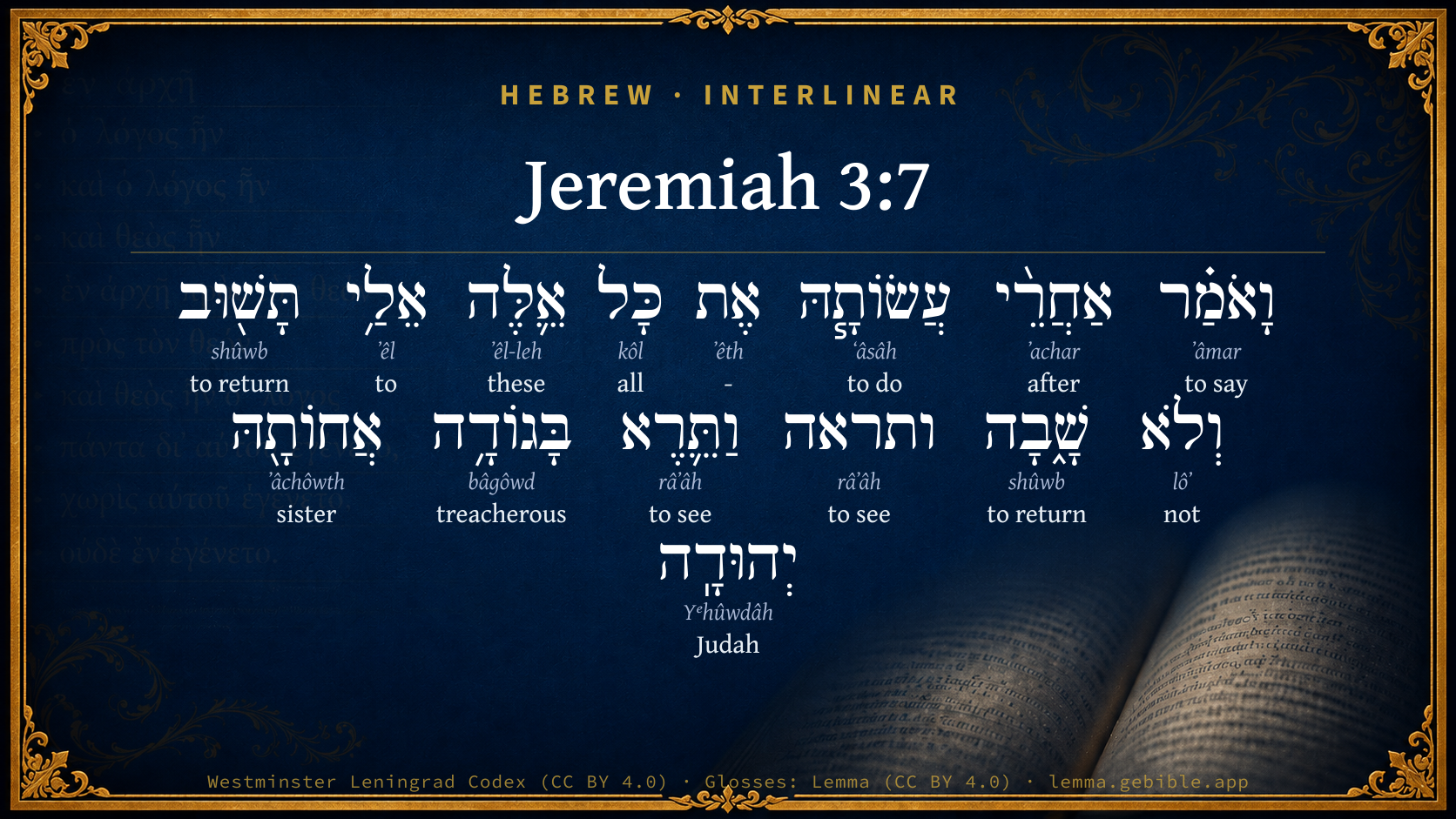
Jeremiah 3:7

Hebrew (Westminster Leningrad Codex) Jeremiah 3:7 appears in the Hebrew Old Testament. The text above is from the Westminster Leningrad Codex. Each word links to its Strong’s number, a concise gloss, and parsing drawn from the Open Scriptures Hebrew Bible morphology. Click any word for its full Brown-Driver-Briggs (BDB) entry.
Download image
Cite this verse

Jeremiah 3:7 (World English Bible). Public Domain. Lemma interlinear Bible study tool, https://lemma.gebible.app/v/jeremiah/3/7.

Show BibTeX & RIS
BibTeX
RIS
English Translation
I said after she had done all these things, She will return to me; but she didn't return: and her treacherous sister Judah saw it.
World English Bible · Public Domain
Highlights
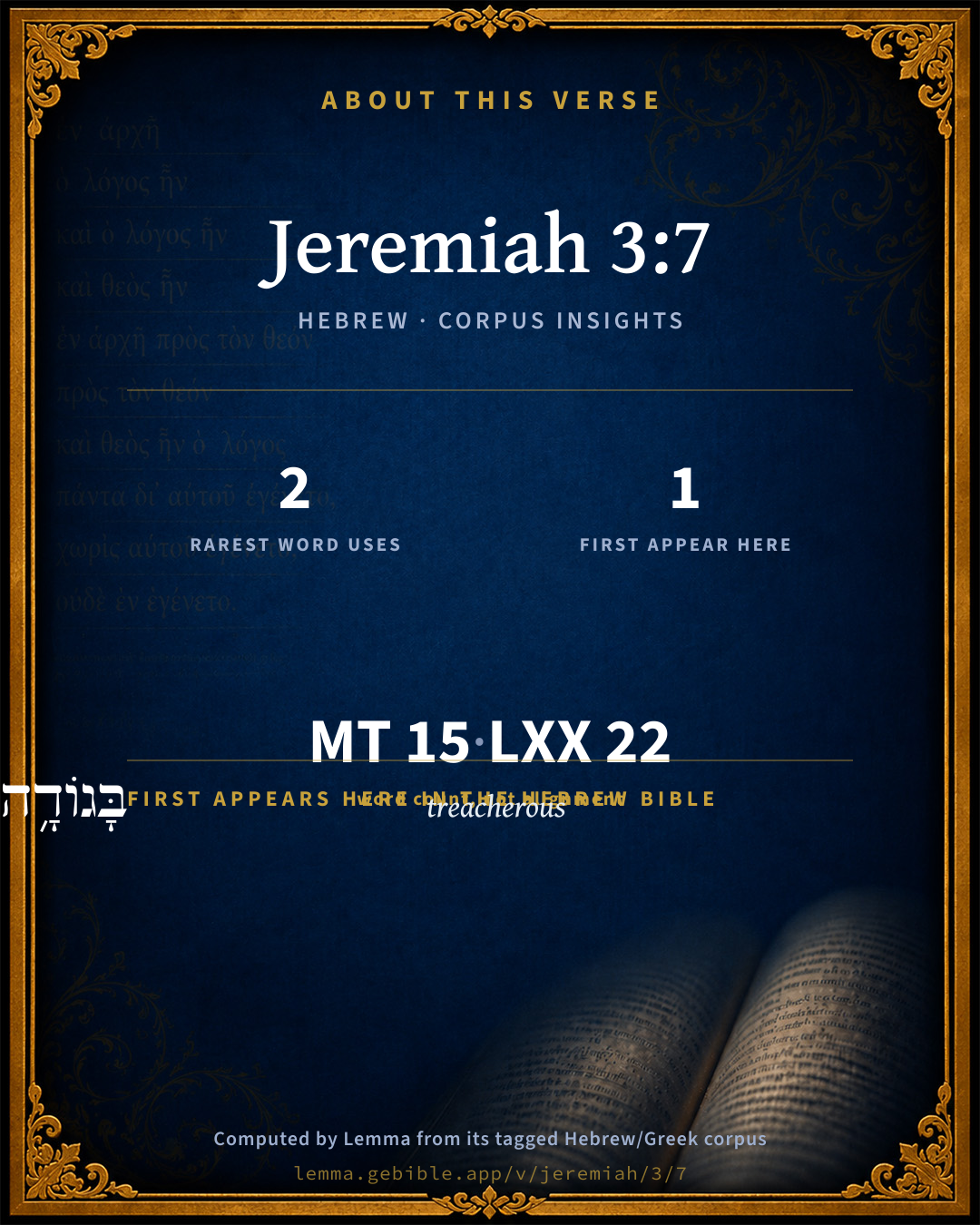
  • 1 first appearance in the Hebrew Bible
Full analysis ↓
Download a study sheet

One document with this verse’s original text, its word-by-word gloss line, the meaning frame, cross-references with their text, attributed commentary, and full source and license credits — printable, and it pastes into notes with its structure intact.

This verse Autodidact and up

Study sheet (.html) Plain text (.txt)

A passage Seminary Student

Up to 50 verses in one chapter. A passage sheet keeps up to 6 commentary sources and 12 cross-references per verse, in the order this page ranks them, and says so on the sheet whenever that leaves anything out. Ask for a single verse and you get the Autodidact verse sheet above.

Everything on this page stays free to read, with no account — the sheet is a download of what is already on screen, not access to it.

Want to remove ads? Support Godless Engineer
Compare translations 3

The same verse in 3 English versions, stacked beneath the original-language interlinear above. Click any original word for its lexicon entry.

Each is an independent rendering of the whole verse — the interlinear is not word-aligned to these translations.

Highlighted words mark where these versions differ — a whole-verse word diff, not a word-by-word alignment.

  • World English Bible Public Domain
    I said after she had done all these things, She will return to me; but she didn't return: and her treacherous sister Judah saw it.
  • King James Version Public Domain
    And I said after she had done all these things, Turn thou unto me. But she returned not. And her treacherous sister Judah saw it.
  • unfoldingWord Literal Text CC BY-SA 4.0
    And said, ‘After her doing all these, she will return to me,’ but she did not return. Then her treacherous sister Judah saw.

unfoldingWord Literal Text — © unfoldingWord, licensed CC BY-SA 4.0. Word-aligned USFM3 via Door43 (git.door43.org/unfoldingWord/en_ult).

Versions to compare (up to 4)

3 of 4 selected

Show all 18 translations

Every available English version of this verse, each an independent rendering of the whole verse.

  • World English Bible Public Domain
    I said after she had done all these things, She will return to me; but she didn't return: and her treacherous sister Judah saw it.
  • Berean Standard Bible Public Domain
    I thought that after she had done all these things, she would return to Me. But she did not return, and her unfaithful sister Judah saw it.
  • Majority Standard Bible Public Domain
    I thought that after she had done all these things, she would return to Me. But she did not return, and her unfaithful sister Judah saw it.
  • King James Version Public Domain
    And I said after she had done all these things, Turn thou unto me. But she returned not. And her treacherous sister Judah saw it.
  • American Standard Version (1901) Public Domain
    And I said after she had done all these things, She will return unto me; but she returned not: and her treacherous sister Judah saw it.
  • Revised Version (1885) Public Domain
    And I said after she had done all these things, She will return unto me; but she returned not: and her treacherous sister Judah saw it.
  • Geneva Bible (1599) Public Domain
    And I sayde, when shee had done all this, Turne thou vnto me: but she returned not, as her rebellious sister Iudah sawe.
  • Douay-Rheims (1899) Public Domain
    And when she had done all these things, I said: Return to me, and she did not return. And her treacherous sister Juda saw,
  • Young's Literal Translation Public Domain
    And I say, after her doing all these, Unto Me thou dost turn back, and she hath not turned back, and see `it' doth her treacherous sister Judah.
  • Literal Standard Version CC BY-SA 4.0
    And I say, after her doing all these, Return to Me, and she has not returned, and her treacherous sister Judah sees it.
  • Unlocked Literal Bible CC BY-SA 4.0
    I said, 'After she does all these things, she will return to me,' but she did not return. Then her faithless sister Judah saw these things.
  • unfoldingWord Literal Text CC BY-SA 4.0
    And said, ‘After her doing all these, she will return to me,’ but she did not return. Then her treacherous sister Judah saw.
  • Darby Bible Public Domain
    And I said, After she hath done all these [things], she will return unto me; but she returned not. And her sister Judah, the treacherous, saw [it].
  • World Messianic Bible Public Domain
    I said after she had done all these things, ‘She will return to me;’ but she didn’t return, and her treacherous sister Judah saw it.
  • Webster's Bible Public Domain
    And I said after she had done all these things, Turn thou to me. But she returned not. And her treacherous sister Judah saw it.
  • Free Bible Version CC BY-SA 4.0
    I hoped that after she'd done all this she'd come back to me. But she didn't come back, and her unfaithful sister Judah saw what happened.
  • Bible in Basic English Public Domain
    And I said, After she has done all these things she will come back to me; but she did not. And her false sister Judah saw it.
  • JPS Tanakh (1917) Public Domain
    And I said: After she hath done all these things, she will return unto me; but she returned not. And her treacherous sister Judah saw it.

Literal Standard Version (2020), Covenant Press — licensed CC BY-SA 4.0. Text via the HelloAO Bible API (eBible.org). Unlocked Literal Bible (unfoldingWord) — licensed CC BY-SA 4.0. Text via the HelloAO Bible API (eBible.org). unfoldingWord Literal Text — © unfoldingWord, licensed CC BY-SA 4.0. Word-aligned USFM3 via Door43 (git.door43.org/unfoldingWord/en_ult). Free Bible Version, Dr. Jonathan Gallagher — licensed CC BY-SA 4.0. Text via the HelloAO Bible API (eBible.org).

Word by word

More ways to search: Search by grammar → Find every occurrence → Compare this word →

Practice this passage: Drill this verse → Learn its vocabulary →

בָּגוֹדָ֥ה
bâgôwd
H901
“treacherous”
Adjective, Adjective, Feminine, Singular, Absolute
Part of Speech
Adjective
Type
Adjective
Gender
Feminine
Number
Singular
State
Absolute
Full BDB Definition

Origin: from H898

TWOT: 198c

treacherous, deceitful
  1. וָאֹמַ֗ר ʼâmar H559 “and · to say” Conjunction + Verb, Qal, Sequential Imperfect, 1st Person, Common, Singular
  2. אַחֲרֵ֨י ʼachar H310 “after” Preposition
  3. עֲשׂוֹתָ֧הּ ʻâsâh H6213 “to do · her” Verb, Qal, Infinitive Construct + Suffix, Personal, 3rd Person, Feminine, Singular
  4. אֶת ʼêth H853 “-” Particle, Direct Object
  5. כָּל kôl H3605 “all of” Noun, Common, Masculine, Singular, Construct
  6. אֵ֛לֶּה ʼêl-leh H428 “these” Pronoun, Demonstrative, Common, Plural
  7. אֵלַ֥י ʼêl H413 “to · me” Preposition + Suffix, Personal, 1st Person, Common, Singular
  8. תָּשׁ֖וּב shûwb H7725 “to return” Verb, Qal, Imperfect, 3rd Person, Feminine, Singular
  9. וְלֹא lôʼ H3808 “and · not” Conjunction + Particle, Negative
  10. שָׁ֑בָה shûwb H7725 “to return” Verb, Qal, Perfect, 3rd Person, Feminine, Singular
  11. ותראה râʼâh H7200 “and · to see” Conjunction + Verb, Qal, Sequential Imperfect, 3rd Person, Feminine, Singular
  12. וַתֵּ֛רֶא râʼâh H7200 “and · to see” Conjunction + Verb, Qal, Sequential Imperfect, 3rd Person, Feminine, Singular
  13. אֲחוֹתָ֖הּ ʼâchôwth H269 “sister · her” Noun, Common, Feminine, Singular, Construct + Suffix, Personal, 3rd Person, Feminine, Singular
  14. יְהוּדָֽה Yᵉhûwdâh H3063 “Judah” Noun, Proper

About this verse

These counts appear in no published source. They are computed here, from the morphology-tagged text and Lemma’s own curated glosses. What Lemma adds →

15
words
13
distinct lemmas
Prophets
section

Notable vocabulary

The rarest word here is בָּגוֹדָ֥ה treacherous H901 — appearing just 2 times in the whole Hebrew Bible.

First appearance in Scripture

This word makes its first canonical appearance in the Hebrew Bible here:

  • בָּגוֹדָ֥ה treacherous H901

Shared distinctive vocabulary

בָּגוֹדָ֥ה treacherous H901 occurs in 2 verses of the Hebrew Bible. Also found in:

Grammatical profile

  • 6 verbs
  • 3 nouns
  • 1 adjective
  • 1 pronoun
  • 2 prepositions
  • 2 particles

Verb forms

  • וָאֹמַ֗ר Qal · Sequential Imperfect
  • עֲשׂוֹתָ֧הּ Qal · Infinitive Construct
  • תָּשׁ֖וּב Qal · Imperfect
  • שָׁ֑בָה Qal · Perfect
  • ותראה Qal · Sequential Imperfect
  • וַתֵּ֛רֶא Qal · Sequential Imperfect

Repetition

Words recur within this verse — often emphatic in Hebrew:

  • תָּשׁ֖וּב to return H7725 ×2
  • ותראה to see H7200 ×2

Hebrew & Septuagint length

In the original languages it is 15 Hebrew tokens and 22 Greek tokens — but the two are counted differently (Hebrew bundles its prefixes and suffixes into one token; the Greek is in lemma form), so that isn’t a like-for-like length.

Cross-references

7

Topical passages linked to Jeremiah 3:7 in the Treasury of Scripture Knowledge — connected by theme and wording, ordered by reader-vote popularity; previews shown in the World English Bible.

  • Ezekiel 16:46 Your elder sister is Samaria, who dwells at your left hand, she and her daughters; and your younger sister, who dwells at your right hand, is Sodom and her daughters.
  • 2 Kings 17:13–14 Yet Yahweh testified to Israel, and to Judah, by every prophet, and every seer, saying, Turn you from your evil ways, and keep my commandments and my statutes, according to all the law which I commanded your fathers, and which I sent to you by my servants the prophets.
  • 2 Chronicles 30:6–12 So the posts went with the letters from the king and his princes throughout all Israel and Judah, and according to the commandment of the king, saying, You children of Israel, turn again to Yahweh, the God of Abraham, Isaac, and Israel, that he may return to the remnant that have escaped of you out of the hand of the kings of Assyria.
  • Jeremiah 3:8–11 I saw, when, for this very cause that backsliding Israel had committed adultery, I had put her away and given her a bill of divorce, yet treacherous Judah, her sister, didn't fear; but she also went and played the prostitute.
  • Ezekiel 23:2–4 Son of man, there were two women, the daughters of one mother:
  • Hosea 6:1–4 "Come, and let us return to Yahweh; For he has torn us to pieces, And he will heal us; He has injured us, And he will bind up our wounds.
  • Hosea 14:1 Israel, return to Yahweh your God; For you have fallen because of your sin.

Cross-references courtesy of OpenBible.info (CC BY 4.0).

Hebrew and Greek witnesses Masoretic Hebrew ↔ Greek Septuagint

The same verse in the two great witnesses to the Old Testament, shown verse-for-verse.

These are two independent witnesses, not word-aligned to each other, and the Septuagint is shown in lemma (dictionary) form.

Hebrew Jeremiah 3:7 Masoretic · Westminster Leningrad Codex

וָאֹמַ֗ר אַחֲרֵ֨י עֲשׂוֹתָ֧הּ אֶת כָּל אֵ֛לֶּה אֵלַ֥י תָּשׁ֖וּב וְלֹא שָׁ֑בָה ותראה וַתֵּ֛רֶא בָּגוֹדָ֥ה אֲחוֹתָ֖הּ יְהוּדָֽה

I said after she had done all these things, She will return to me; but she didn't return: and her treacherous sister Judah saw it.

World English Bible · Public Domain

Greek LXX Structure differs

In the Septuagint, Jeremiah is about an eighth shorter than the Hebrew and arranges its material differently — the Oracles Against the Nations (Hebrew chapters 46–51) appear in the middle of the Greek book, after 25:13. Because the chapter and verse boundaries do not line up, a verse-for-verse comparison with the Hebrew is not shown.

A verse-for-verse comparison isn’t shown here because the chapters and verses don’t line up. Switch to the LXX edition with the MT / LXX toggle above to read the Greek directly.

On this verse, John Gill's Exposition discusses the Septuagint’s reading. Read the note in Commentary ↓

Hebrew: Westminster Leningrad Codex (CC BY 4.0). Greek: Septuagint (public domain); English from a public-domain English Septuagint. How the Septuagint differs from the Hebrew →

Targum (Aramaic paraphrase)

1

The Targum is the ancient Jewish Aramaic paraphrase of the Hebrew Scriptures — an interpretive translation, not the Hebrew text itself. Onkelos (literal) and Pseudo-Jonathan (expansive) render the Torah, and Jonathan the Prophets. Coverage is partial: where no permissively-licensed English translation exists for a verse, only the Aramaic is shown. This is verse-level text, not a word-by-word alignment to the Hebrew.

  1. Targum Jonathan Prophets (Joshua–Malachi)
    וַאֲמָרֵית בָּתַר דַעֲבָדוּ יַת כָּל אִלֵין לְפוּלְחָנִי יְתוּבוּן וְלָא תָבוּ וַחֲזוֹ מְשַׁקְרַיָא אֲחֵיהוֹן דְבֵית יְהוּדָה:

    (no public-domain English translation for this verse)

    Targum Jonathan — Aramaic: “Mikraot Gedolot” (public domain). English: “Sefaria Community Translation” (CC0 1.0 (public-domain dedication)); “London "Chaldee Paraphrase," 1871” (public domain). Text via Sefaria.

Commentary

Notes on Jeremiah 3:7 from classic Christian and Jewish commentators (each source and its license shown beneath its notes). The classic Christian expositions comment on the surrounding passage and are grouped to its opening verse, so a note may address several verses; the Jewish commentaries on the Tanakh (Rashi and others) are per-verse, so they appear only where the commentator wrote on this verse.

Lemma curates 59 commentaries, every one of them public domain or Creative Commons licensed, each selected and text-cleaned for this edition rather than reprinted as found. About our sources →

Trapp's Complete Commentary

John Trapp

Jer 3:7 And I said after she had done all these [things], Turn thou unto me. But she returned not. And her treacherous sister Judah saw [it].

Ver. 7. And I said after she had done.] Or, Yet I said; but I lost my sweet words upon her.

John Trapp, A Commentary or Exposition upon All the Books of the Old and New Testament (1647–1656) — public domain. Text from a community e-Sword module.

Joseph Benson's Commentary

Jer 3:7. After she had done all these things — For which she might justly have been abandoned; I said, Turn thou unto me — Namely, and I will receive thee. Though they had forsaken both the house of David and the house of Aaron, who both had their authority from God without dispute, yet God sent his prophets among them to call them to return to him, that is, to the worship of him only, not insisting so much upon their return to the house of David as to that of Aaron. We do not read that Elijah, that great prophet, ever mentioned their returning to the former, but only to the faithful service of the true God. It is serious and genuine piety that God regards more than any ritual observances, whether with respect to matters civil or religious. But she returned not — Which God observed, and with which he was much displeased; and her treacherous sister Judah saw it — A sister, because descended from the same common stock, Abraham and Jacob; and as Israel had the character of a back-slider, so Judah is called treacherous, because, though she professed to keep close to God when Israel had backslidden, and adhered to the kings and priests that were of God’s own appointing, yet she proved treacherous, false, and unfaithful to her profession and promises, as is stated in the following verses.

Joseph Benson's Commentary on the Old and New Testaments (1811–1818) — public domain. Text from a community e-Sword module.

Keil & Delitzsch

C. F. Keil & F. Delitzsch

And I said, sc. to myself, i.e., I thought. A speaking by the prophets (Rashi) is not to be thought of; for it is no summons, turn again to me, but only the thought, they will return. It is true that God caused backsliding Israel to be ever called again to repentance by the prophets, yet without effect. Meantime, however, no reference is made to what God did in this connection, only Israel's behaviour towards the Lord being here kept in view. The Chet. ותּראה is the later usage; the Keri substitutes the regular contracted form ותּרא. The object, it (the whoredom of Israel), may be gathered from what precedes.

Jer 3:8

Many commentators have taken objection to the וארא, because the sentence, "I saw that I had therefore given Israel a bill of divorce," is as little intelligible as "and the faithless Judah saw it, and I saw it, for," etc. Thus e.g., Graf, who proposes with Ew. and Syr. to read ותּרא, "and she saw," or with Jerome to omit the word from the text. To this we may add, that either the change or the omission destroys the natural relation to one another of the clauses. In either case we would have this connection: "and the faithless one, her sister Judah, saw that, because the backslider Israel had committed adultery, I had put her away...yet the faithless one feared not." But thus the gist of the thing, what Judah saw, namely, the repudiation of Israel, would be related but cursorily in a subordinate clause, and the 7th verse would be shortened into a half verse; while, on the other hand, the 8th verse would be burdened with an unnaturally long protasis. Ros. is right in declaring any change to be unnecessary, provided the two halves of Jer 3:7 and Jer 3:8 are connected in this sense: vidi quod quum adulteram Israelitidem dimiseram, tamen non timeret ejus perfida soror Juda. If we compare Jer 3:7 and Jer 3:8 together, the correspondence between the two comes clearly out. In the first half of either verse Israel is spoken of, in the second Judah; while as to Israel, both verses state how God regarded the conduct of Israel, and as to Judah, how it observed and imitated Israel's conduct. וארא corresponds to ואמר in Jer 3:7. God thought the backsliding Israel will repent, and it did not, and this Judah saw. Thus, then, God saw that even the repudiation of the backsliding Israel for her adultery incited no fear in Judah, but Judah went and did whoredom like Israel. The true sense of Jer 3:8 is rendered obscure or difficult by the external co-ordination to one another of the two thoughts, that God has rejected Israel just because it has committed adultery, and, that Judah nevertheless feared not; the second thought being introduced by Vav. In reality, however, the first should be subordinated to the second thus: that although I had to reject Israel, Judah yet feared not. What God saw is not the adultery and rejection or divorce of Israel, but that Judah nevertheless had no fear in committing and persisting in the self-same sin. The כּי belongs properly to לא יראה, but this relation is obscured by the length of the prefixed grounding clause, and so לא יראה is introduced by ,על־כּל־אדות וגו' .ו yb decud literally: that for all the reasons, because the backslider had committed adultery, I put her away and gave her a bill of divorce; yet the faithless Judah feared not. In plain English: that, in spite of all my putting away the backsliding Israel, and my giving her...because she had committed adultery, yet the faithless Judah feared not. On ספר כּריתוּת, cf. Deu 24:1, Deu 24:3.

Jer 3:9

In Jer 3:9 Judah's fornication with the false gods is further described. Here מקּל זנוּתהּ ereH is rather stumbling, since ob vocem scortationis cannot well be simply tantamount to ob famosam scortationem; for קול, voice, tone, sound, din, noise, is distinct from שׁם or שׁמע, fame, rumour. All ancient translators have taken קל from קלל, as being formed analogously to עז ,תּם ,חם; and a Masoretic note finds in the defective spelling קל an indication of the meaning levitas. Yet we occasionally find קול, vox, written defectively, e.g., Exo 4:8; Gen 27:22; Gen 45:16. And the derivation from קלל gives no very suitable sense; neither lightness nor despisedness is a proper predicate for whoredom, by which the land is polluted; only shame or shameful would suit, as it is put by Ew. and Graf. But there is no evidence from the usage of the language that קל has the meaning of קלון. Yet more inadmissible is the conjecture of J. D. Mich., adopted by Hitz., that of reading מקּל gnidaer fo taht, stock, for מקּל, a stock being the object of her unchastity; in support of which, reference is unfairly made to Hos 4:12. For there the matter in hand is rhabdomancy, with which the present passage has evidently nothing to do. The case standing thus, we adhere to the usual meaning of קל: for the noise or din of her whoredom, not, for her crying whoredom (de Wette). Jeremiah makes use of this epithet to point out the open riotous orgies of idolatry. תּחנף is neither used in the active signification of desecrating, nor is it to be pointed ותּחנף (Hiph.). On the last clause cf. Jer 2:27.

Jer 3:10

But even with all this, i.e., in spite of this deep degradation in idolatry, Judah returned not to God sincerely, but in hypocritical wise. "And yet with all this," Ros., following Rashi, refers to the judgment that had fallen on Israel (Jer 3:8); but this is too remote. The words can bear reference only to that which immediately precedes: even in view of all these sinful horrors the returning was not "from the whole heart," i.e., did not proceed from a sincere heart, but in falsehood and hypocrisy. For (the returning being that which began with the abolition of idolatrous public worship in Josiah's reformation) the people had returned outwardly to the worship of Jahveh in the temple, but at heart they still calve to the idols. Although Josiah had put an end to the idol-worship, and though the people too, in the enthusiasm for the service of Jahveh, awakened by the solemn celebration of the passover, had broken in pieces the images and altars of the false gods throughout the land, yet there was imminent danger that the people, alienated in heart from the living God, should take the suppression of open idolatry for a true return to God, and, vainly admiring themselves, should look upon themselves as righteous and pious. Against this delusion the prophet takes his stand.

Keil & Delitzsch — Biblical Commentary on the Old Testament (1861–1891) — public domain (CC PDM 1.0). Text via the HelloAO Bible API. (Old Testament only.)

Tyndale Open Study Notes

Tyndale Open Resources

3:7-8 King Josiah’s reforms failed to reach many of the common people. The love of idol worship common in northern Israel also continued among the farmers and shepherds of Judah. They failed to learn from the fate of the northern tribes, and even surpassed their practice of adultery (see Ezek 16:47-48).

Tyndale Open Study Notes — © Tyndale Open Resources, licensed CC BY-SA 4.0. Text via the HelloAO Bible API.

Jamieson, Fausset & Brown

Robert Jamieson, A. R. Fausset & David Brown

I said-- (Kg2 17:13).

sister-- (Eze 16:46; Eze 23:2, Eze 23:4).

Jamieson, Fausset & Brown — Commentary Critical and Explanatory on the Whole Bible (1871) — public domain (CC PDM 1.0). Text via the HelloAO Bible API.

Adam Clarke's Commentary

Verse 7. And I said] By the prophets Elijah, Elisha, Hosea, Amos, c. for all these prophesied to that rebellious people, and exhorted them to return to the Lord.

Adam Clarke's Commentary on the Bible (1810–1826) — public domain. Text from a community e-Sword/MySword module.

John Calvin's Commentaries

He afterwards adds, Yet I said; God here states, that he had long suspended his judgment before he punished the people of Israel. He then extols here his patience, that he had not immediately visited the Israelites as they deserved, but bore with them and for a long time waited to see whether they could be reclaimed: I said, then, after she had done all these things, Return to me If we read in the third person, the sense will be the same, “I hoped indeed that they would return to the right way, though they had thus fallen away, yea though they had denied me by an impious defection, and had become alienated from the faith and from piety.” But I am more inclined to another view, — that God here records the fact, that he had recalled to himself the ten tribes by his servants the Prophets, though they had by their many crimes provoked his wrath. Here then God shews how perverse the Israelites had been; for he had tried to restore them, if possible, to himself, but had spent all his labor in vain. I thus explain, I said, of the prophetic instruction: “Though then the Israelites had plunged themselves into impieties, I yet ceased not to try whether they could be restored to me.” He intimates, in short, that he had been unlike those husbands, who will not be reconciled to their wives, burning with jealousy, because they see that they had been exposed to so much disgrace. God then shews that though the Israelites had departed from him, he yet sent his prophets, and of his own free will sought reconciliation with them, but that they had refused to return.

He then adds, See did she, that is, the whole kingdom of Judah, that, for al1 this, because the rebellious Israel had played the harlot, etc. We shall hereafter find the design of this comparison; for he amplifies the sin of the kingdom of Judah, inasmuch she had time enough to observe what he now relates, and was able to see it at a distance as it were from a watchtower; yet she saw it without any advantage. God then intended to shew how great was the hardness of the Jews, who had seen the defection of the ten tribes, and had seen how severely they had been reproved by the prophets.

John Calvin's Commentaries (1540-1563) — public domain. Text from the Calvin Translation Society English edition (1840s-50s) via the Christian Classics Ethereal Library (ccel.org). Calvin's coverage is partial (roughly two-thirds of the Bible); uncommented books and verses are honest gaps, never fabricated. The 19th-century editor's footnotes and remarks are omitted so the notes are faithfully Calvin's own voice.

Ellicott's Commentary for English Readers

(7) And I said . . .—The call to Israel to return had been slighted, and Judah, the traitress or faithless, “one with falsehood,” had not taken warning from the sin or its punishment.

Turn thou unto me.—The verb may be either the second or third person, I said, thou shalt return; or, I said, she will return, as expressing a hope rather than a direct return. The latter seems, on the whole, the preferable rendering.

A Bible Commentary for English Readers, edited by Charles John Ellicott (1878–1897) — public domain. Text from a community e-Sword module.

The Cambridge Bible for Schools and Colleges

gen. ed. J. J. S. Perowne

7. I said] to myself; I thought.

after she had done, etc.] mg. better, After she hath done all these things, she, etc.

The Cambridge Bible for Schools and Colleges (gen. ed. J. J. S. Perowne; Cambridge University Press, 1878–1918) — public domain. Text from a community e-Sword module.

John Gill's Exposition

And I said, after she had done these things,.... All these idolatries, in the several places mentioned, after she had repeated them over and over; the Lord sent to them by the Prophets Hosea, Amos, Micah, and others, who prophesied before the captivity of the ten tribes, and entreated them, saying,

turn unto me: to my worship, as the Targum; from their idols, to him the living God; they were not without admonitions, exhortations, and declarations of grace, and so were without excuse:

but she returned not; to fear and serve the Lord, but remained in idolatry, obstinate and inflexible:

and her treacherous sister Judah saw it; her treachery and breach of covenant, as the Septuagint, Syriac, and Arabic versions add, for explanation sake; Judah, or the two tribes of Judah and Benjamin, and who were allied to the ten tribes by birth and by religion, and equally treacherous to God, the husband of them both, saw all the idolatry of Israel, and the aggravations of it, and what followed upon it, namely, their captivity in Babylon, yet did not learn and take warning hereby.

John Gill's Exposition of the Whole Bible (1746–1763) — public domain (CC PDM 1.0). Text via the HelloAO Bible API.

Albert Barnes' Notes on the Bible

Or, “And I said (i. e., within myself), After she has done all these things, she will return to me.” But she did not return.

Treacherous - literally, “Falsehood,” i. e., false, faithless. The character of the two sisters is plainly marked. Samaria is apostate; she abandons Yahweh’s worship altogether. Judah maintains the form only; her secret desires are set upon the orgies of pagan worship.

Albert Barnes' Notes on the Bible (1834–1885) — public domain. Text from a community e-Sword/MySword module.

Matthew Poole's English Annotations

Turn thou unto me, viz. by repentance, Act 3:19. Although she had been so vile and abominable, yet the Lord waited in expectation of her return.

Her treacherous sister Judah: Benjamin is also here comprised, but Judah being the chief is only named, these two abiding together after the other ten revolted to Jeroboam; called Israel’s

sister, because they were all descended from the patriarch Jacob, Eze 16:46; compare Eze 23:2,4; and treacherous, or the treacherous one, because of her frequent revolts, 2Ch 21:6, &c.; 2Ch 24:17,18, and many other times, and after as frequent renewed covenants and promises, both in conjunction with the rest of the tribes, Deu 5:2,3,23, &c.; Deu 29:10-12, &c., and afterwards, 2Ch 13:9,10, &c.; 2Ch 15:12, &c.; 2Ch 23:16; 29:10. Saw it, i.e. they were not strangers to it, but knew it, as the word is, Psa 40:3. They could not but know how I had dealt with Israel.

Matthew Poole's English Annotations on the Holy Bible (1683–1685) — public domain. Text from a community e-Sword/MySword module.

Whedon's Commentary on the Bible

Daniel D. Whedon

7. And I said, etc. — The object of the verb “said” begins with after, and the verb turn is thought by most expositors to be in the third person. The reading then would be, And I said (namely, to myself = thought,) after she had done all… Turn thou unto me. But she returned not.

Treacherous — Better, faithless. See Ezekiel’s allegory in chapter xxiii for the character of these two sisters — apostate Israel and hypocritical Judah.

Daniel D. Whedon (gen. ed.), Commentary on the Old and New Testaments (1874–1909) — public domain. Text from a community e-Sword module.

The Pulpit Commentary

And I said after she had done, etc.; rather, and I said, After she hath done all these things, she will return unto me. And her treacherous sister. Observe the distinction between the two sisters. Israel had openly broken the political and religious connection with Jehovah; (Hos_8:4) Judah nominally retained both, but her heart was towards the false gods. (comp. the allegory in Eze 23, which is evidently founded upon our passage)

The Pulpit Commentary (1880–1919), ed. H.D.M. Spence-Jones & Joseph S. Exell — public domain. Text from a community e-Sword module.

Rashi

Rabbi Shlomo Yitzchaki (Rashi)

And I said through My prophets, Amos and Hosea son of Beeri and the other prophets, “You shall return to Me.”

And her treacherous sister Judah saw it i.e., saw all this. The appellation “treacherous” is harsher than “backsliding.” Israel, since they were the first to sin, and they did not see any retribution from which to learn and to repent, are called “backsliding.” Judah, who saw that these went in exile and did not receive correction, are called “treacherous.”

Rashi on the Tanakh — English translations: “The Judaica Press complete Tanach with Rashi, translated by A. J. Rosenberg” (CC BY 4.0); “Pentateuch with Rashi's commentary by M. Rosenbaum and A.M. Silbermann, 1929-1934” (public domain); “The Metsudah Tanach series, Lakewood, N.J” (CC BY 4.0); and “The Book of Joshua, Metsudah Publications, 1997” (CC BY 4.0). Text via Sefaria.

Lesson kit

Teaching starters — assembled from the data on this page, not authored interpretation. Every prompt links to the verse data it draws on. Edit before teaching.

Jeremiah, in the Prophets, opens this verse with 15 words (13 distinct Hebrew lemmas). Its most distinctive word is bâgôwd (“treacherous”). A historical commentator’s framing appears above. Read the whole chapter for the surrounding context.

Discussion questions

  1. What does “treacherous” (bâgôwd) contribute to the verse as a whole?
  2. This is the first place “treacherous” appears in Scripture (first appears here). What does its debut here establish?
  3. How does Jeremiah 3:10, which shares the word «treacherous», read alongside this verse?
  4. What does the repetition of “to return” (2× in this one verse) do in this verse?
  5. The translations on this page render this verse differently — a whole-verse word diff, not a word-by-word alignment. What might account for the different wordings?
  6. «וָאֹמַ֗ר» is a Qal Sequential Imperfect verb. How does that grammatical form shape the action described?
  7. Compare how Trapp's Complete Commentary and Joseph Benson's Commentary read this verse. Where do they agree or differ?

Things to notice

Reading settings

Reading text

Shown beneath each verse's original-language words.

Old Testament
Old Testament edition

Read the OT as the Masoretic Hebrew (MT) or the Greek Septuagint (LXX).

English shown for the Greek Septuagint (in the Hebrew ↔ Greek comparison).

Comparing translations? Open the Compare panel on any verse page to stack up to four side by side.