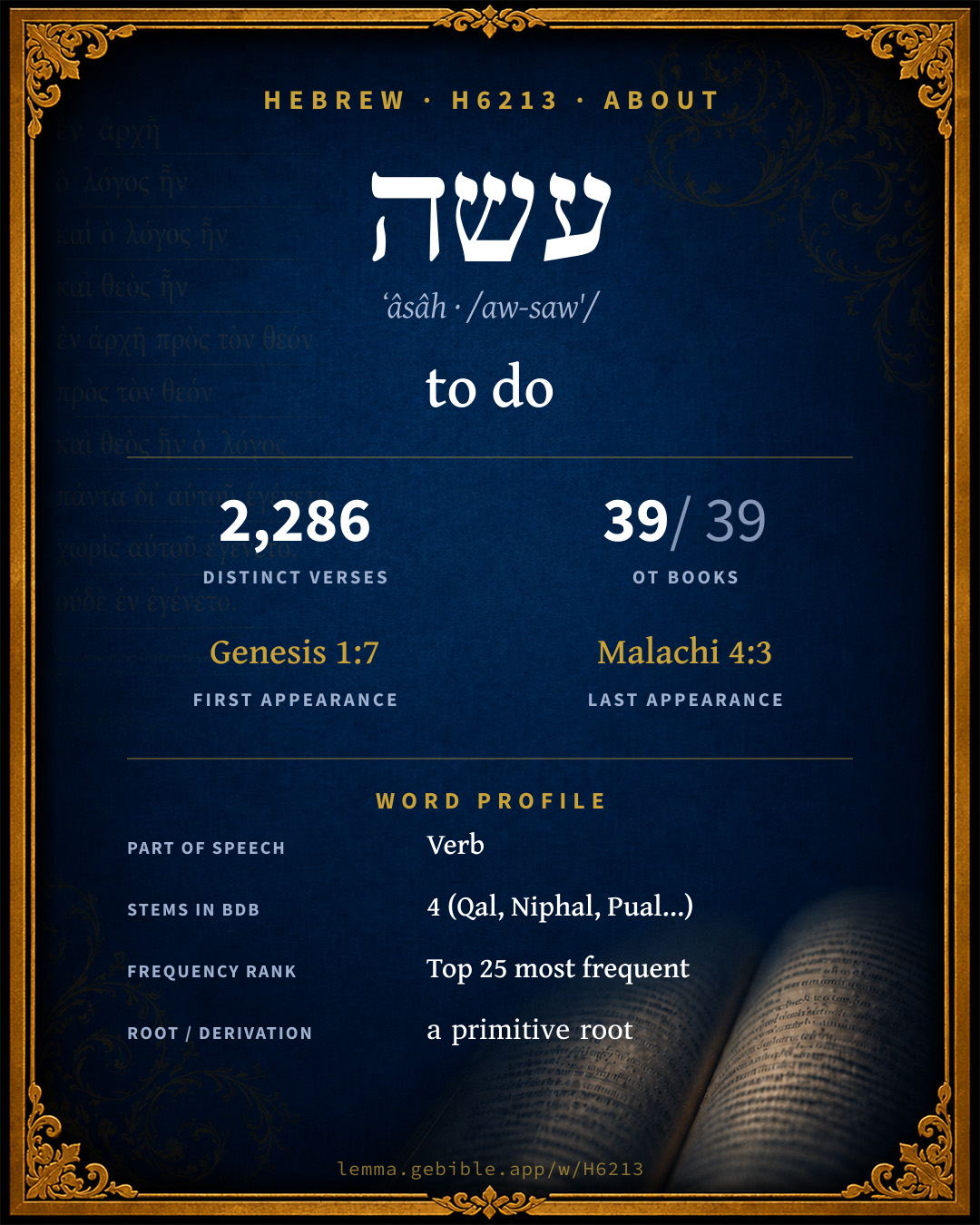
עָשָׂה
to do
also: fashion, accomplish, make fuller range ↓
Full lexicon entry — Brown-Driver-Briggs (BDB)
From Brown-Driver-Briggs (BDB)
Where this word appears
See every Qal verb in the Hebrew Bible →
Grammar key — what these labels mean
Part of speech
- Verb
- An action or state-of-being word.
Stem
- Qal
- The basic, simple active stem — the plain form of the verb (“he wrote”). Here: ‘do’
- Niphal
- Usually the simple passive or reflexive of the Qal (“he was written”). Here: ‘be done’
- Piel
- An intensive or resultative active stem. Here: ‘press’
- Pual
- The passive counterpart of the Piel.
Form
- Perfect
- A completed action or state — Hebrew marks aspect (completeness) more than strict tense (“he wrote”).
- Sequential Imperfect
- An imperfect with prefixed waw — the standard past-narrative form (waw-consecutive imperfect).
- Infinitive Construct
- A bound verbal noun, frequently with prepositions (“to write / in writing”).
- Imperfect
- An incomplete, ongoing, or future action (“he will / would write”).
- Sequential Perfect
- A perfect with prefixed waw continuing a preceding imperfect or command (waw-consecutive perfect).
- Participle Active
- A verbal adjective expressing ongoing or characteristic action (“writing / one who writes”).
- Imperative
- A direct command (“write!”).
- Jussive
- A third- or second-person volitional form expressing wish or command (“let him write”).
- Infinitive Absolute
- An unbound verbal noun, often intensifying or standing in for a finite verb.
- Participle Passive
- A verbal adjective expressing action received (“written”).
- Cohortative
- A first-person volitional form expressing wish or resolve (“let me / let us write”).
State
- Absolute
- The independent form of a noun, not bound to a following word.
- Construct
- A noun bound to a following noun in a possessive / “of” relationship (the construct chain).
Person
- 3rd Person
- The one spoken about (“he / she / it / they”).
- 2nd Person
- The one addressed (“you”).
- 1st Person
- The speaker (“I / we”).
Gender
- Masculine
- Grammatically masculine.
- Common
- Either gender — not distinguished for this form.
- Feminine
- Grammatically feminine.
Number
- Singular
- One.
- Plural
- More than one (in Hebrew, generally three or more).
73 verses where H6213 appears in the Qal stem in the Book of 2 Samuel. Filtered view — show all forms. Click any verse to open its interlinear word-by-word view. Verse text shown in the World English Bible for context — . Each verse’s Hebrew form is shown with its reference; the English is not keyword-highlighted, since the data carries no word-level English alignment. Use “Compare translations” on any verse to read it across multiple English versions. This concordance covers the Hebrew Bible; Septuagint (Greek Old Testament) occurrences are not indexed here.
2 Samuel
- 2 Samuel 2:5 עֲשִׂיתֶ֜ם Qal pf 2mp David sent messengers to the men of Jabesh Gilead, and said to them, Blessed be you of Yahweh, that you have shown this kindness to your lord, even to Saul, and have buried him.
- 2 Samuel 2:6 יַֽעַשׂ אֶעֱשֶׂ֤ה עֲשִׂיתֶ֖ם Qal juss 3ms Qal impf 1cs Qal pf 2mp Now Yahweh show loving kindness and truth to you: and I also will requite you this kindness, because you have done this thing.
- 2 Samuel 3:8 אֶֽעֱשֶׂה Qal impf 1cs Then was Abner very angry for the words of Ish-bosheth, and said, Am I a dog's head that belongs to Judah? This day do I show kindness to the house of Saul your father, to his brothers, and to his friends, and have not delivered you into the hand of David; and yet you charge me this day with a fault concerning this woman.
- 2 Samuel 3:9 יַעֲשֶׂ֤ה אֶֽעֱשֶׂה Qal juss 3ms Qal impf 1cs God do so to Abner, and more also, if, as Yahweh has sworn to David, I don't do even so to him;
- 2 Samuel 3:18 עֲשׂ֑וּ Qal impv 2mp now then do it; for Yahweh has spoken of David, saying, By the hand of my servant David I will save my people Israel out of the hand of the Philistines, and out of the hand of all their enemies.
- 2 Samuel 3:20 וַ/יַּ֨עַשׂ conj + Qal wimpf 3ms So Abner came to David to Hebron, and twenty men with him. David made Abner and the men who were with him a feast.
- 2 Samuel 3:24 עָשִׂ֑יתָה Qal pf 2ms Then Joab came to the king, and said, What have you done? behold, Abner came to you; why is it that you have sent him away, and he is quite gone?
- 2 Samuel 3:25 עֹשֶֽׂה Qal ptcp.act ms You know Abner the son of Ner, that he came to deceive you, and to know your going out and your coming in, and to know all that you do.
- 2 Samuel 3:35 יַעֲשֶׂה Qal juss 3ms All the people came to cause David to eat bread while it was yet day; but David swore, saying, God do so to me, and more also, if I taste bread, or anything else, until the sun be down.
- 2 Samuel 3:36 עָשָׂ֣ה Qal pf 3ms All the people took notice of it, and it pleased them; as whatever the king did pleased all the people.
- 2 Samuel 3:39 לְ/עֹשֵׂ֥ה prep + Qal ptcp.act ms cs I am this day weak, though anointed king; and these men the sons of Zeruiah are too hard for me. May Yahweh reward the evil-doer according to his wickedness."
- 2 Samuel 5:25 וַ/יַּ֤עַשׂ conj + Qal wimpf 3ms David did so, as Yahweh commanded him, and struck the Philistines from Geba until you come to Gezer.
- 2 Samuel 7:3 עֲשֵׂ֑ה Qal impv 2ms Nathan said to the king, Go, do all that is in your heart; for Yahweh is with you.
- 2 Samuel 7:9 וְ/עָשִׂ֤תִֽי conj + Qal wpf 1cs and I have been with you wherever you went, and have cut off all your enemies from before you; and I will make you a great name, like the name of the great ones who are in the earth.
- 2 Samuel 7:11 יַעֲשֶׂה Qal impf 3ms and [as] from the day that I commanded judges to be over my people Israel; and I will cause you to rest from all your enemies. Moreover Yahweh tells you that Yahweh will make you a house.
- 2 Samuel 7:21 עָשִׂ֕יתָ Qal pf 2ms For your word's sake, and according to your own heart, have you worked all this greatness, to make your servant know it.
- 2 Samuel 7:23 וְ/לַ/עֲשׂ֨וֹת conj + prep + Qal inf.cs What one nation in the earth is like your people, even like Israel, whom God went to redeem to himself for a people, and to make him a name, and to do great things for you, and awesome things for your land, before your people, whom you redeem to you out of Egypt, [from] the nations and their gods?
- 2 Samuel 7:25 וַ/עֲשֵׂ֖ה conj + Qal impv 2ms Now, Yahweh God, the word that you have spoken concerning your servant, and concerning his house, confirm you it forever, and do as you have spoken.
- 2 Samuel 8:13 וַ/יַּ֤עַשׂ conj + Qal wimpf 3ms David got him a name when he returned from smiting the Syrians in the Valley of Salt, even eighteen thousand men.
- 2 Samuel 8:15 עֹשֶׂ֛ה Qal ptcp.act ms David reigned over all Israel; and David executed justice and righteousness to all his people.
- 2 Samuel 9:1 וְ/אֶעֱשֶׂ֤ה conj + Qal impf 1cs David said, Is there yet any who is left of the house of Saul, that I may show him kindness for Jonathan's sake?
- 2 Samuel 9:3 וְ/אֶעֱשֶׂ֥ה conj + Qal impf 1cs The king said, Is there not yet any of the house of Saul, that I may show the kindness of God to him? Ziba said to the king, Jonathan has yet a son, who is lame of his feet.
- 2 Samuel 9:7 עָשֹׂה֩ אֶעֱשֶׂ֨ה Qal inf.abs Qal impf 1cs David said to him, "Don't be afraid of him; for I will surely show you kindness for Jonathan your father's sake, and will restore you all the land of Saul your father; and you shall eat bread at my table continually."
- 2 Samuel 9:11 יַעֲשֶׂ֣ה Qal impf 3ms Then said Ziba to the king, According to all that my lord the king commands his servant, so shall your servant do. As for Mephibosheth, [said the king], he shall eat at my table, as one of the king's sons.
- 2 Samuel 10:2 אֶעֱשֶׂה עָשָׂ֨ה Qal impf 1cs Qal pf 3ms David said, I will show kindness to Hanun the son of Nahash, as his father shown kindness to me. So David sent by his servants to comfort him concerning his father. David's servants came into the land of the children of Ammon.
- 2 Samuel 10:12 יַעֲשֶׂ֥ה Qal impf 3ms Be of good courage, and let us play the man for our people, and for the cities of our God: and Yahweh do that which seems him good.
- 2 Samuel 11:11 אֶעֱשֶׂ֖ה Qal impf 1cs Uriah said to David, The ark, and Israel, and Judah, abide in booths; and my lord Joab, and the servants of my lord, are encamped in the open field; shall I then go into my house, to eat and to drink, and to lie with my wife? as you live, and as your soul lives, I will not do this thing.
- 2 Samuel 11:27 עָשָׂ֥ה Qal pf 3ms When the mourning was past, David sent and took her home to his house, and she became his wife, and bore him a son. But the thing that David had done displeased Yahweh.
- 2 Samuel 12:4 לַ/עֲשׂ֕וֹת וַֽ/יַּעֲשֶׂ֔/הָ prep + Qal inf.cs conj + Qal wimpf 3ms + sfx pers 3fs A traveler came to the rich man, and he spared to take of his own flock and of his own herd, to dress for the wayfaring man who had come to him, but took the poor man's lamb, and dressed it for the man who had come to him."
- 2 Samuel 12:5 הָ/עֹשֶׂ֥ה ptcl def.art + Qal ptcp.act ms David's anger was greatly kindled against the man, and he said to Nathan, "As Yahweh lives, the man who has done this is worthy to die!
- 2 Samuel 12:6 עָשָׂה֙ Qal pf 3ms He shall restore the lamb fourfold, because he did this thing, and because he had no pity!"
- 2 Samuel 12:9 לַ/עֲשׂ֣וֹת prep + Qal inf.cs Why have you despised the word of Yahweh, to do that which is evil in his sight? You have struck Uriah the Hittite with the sword, and have taken his wife to be your wife, and have slain him with the sword of the children of Ammon.
- 2 Samuel 12:12 עָשִׂ֣יתָ אֶעֱשֶׂה֙ Qal pf 2ms Qal impf 1cs For you did it secretly, but I will do this thing before all Israel, and before the sun.'"
- 2 Samuel 12:18 וְ/עָשָׂ֥ה conj + Qal wpf 3ms It happened on the seventh day, that the child died. The servants of David feared to tell him that the child was dead; for they said, Behold, while the child was yet alive, we spoke to him, and he didn't listen to our voice: how will he then vex himself, if we tell him that the child is dead!
- 2 Samuel 12:21 עָשִׂ֑יתָה Qal pf 2ms Then said his servants to him, What thing is this that you have done? you did fast and weep for the child, while it was alive; but when the child was dead, you did rise and eat bread.
- 2 Samuel 12:31 יַעֲשֶׂ֔ה Qal impf 3ms He brought forth the people who were therein, and put them under saws, and under harrows of iron, and under axes of iron, and made them pass through the brick kiln: and thus did he to all the cities of the children of Ammon. David and all the people returned to Jerusalem.
- 2 Samuel 13:2 לַ/עֲשׂ֥וֹת prep + Qal inf.cs Amnon was so vexed that he fell sick because of his sister Tamar; for she was a virgin; and it seemed hard to Amnon to do anything to her.
- 2 Samuel 13:5 וְ/עָשְׂתָ֤ה conj + Qal wpf 3fs Jonadab said to him, Lay you down on your bed, and feign yourself sick: and when your father comes to see you, tell him, Please let my sister Tamar come and give me bread to eat, and dress the food in my sight, that I may see it, and eat it from her hand.
- 2 Samuel 13:7 וַ/עֲשִׂי conj + Qal impv 2fs Then David sent home to Tamar, saying, Go now to your brother Amnon's house, and dress him food.
- 2 Samuel 13:10 עָשָׂ֔תָה Qal pf 3fs Amnon said to Tamar, Bring the food into the chamber, that I may eat from your hand. Tamar took the cakes which she had made, and brought them into the chamber to Amnon her brother.
- 2 Samuel 13:12 יֵֽעָשֶׂ֥ה תַּעֲשֵׂ֖ה Niphal impf 3ms Qal juss 2ms She answered him, No, my brother, do not force me; for no such thing ought to be done in Israel. Don't you do this folly.
- 2 Samuel 13:16 עָשִׂ֥יתָ Qal pf 2ms She said to him, Not so, because this great wrong in putting me forth is [worse] than the other that you did to me. But he would not listen to her.
- 2 Samuel 13:29 וַֽ/יַּעֲשׂ֞וּ conj + Qal wimpf 3mp The servants of Absalom did to Amnon as Absalom had commanded. Then all the king's sons arose, and every man got him up on his mule, and fled.
- 2 Samuel 14:15 יַעֲשֶׂ֥ה Qal impf 3ms Now therefore seeing that I have come to speak this word to my lord the king, it is because the people have made me afraid: and your handmaid said, I will now speak to the king; it may be that the king will perform the request of his servant.
- 2 Samuel 14:20 עָשָׂ֛ה Qal pf 3ms to change the face of the matter has your servant Joab done this thing: and my lord is wise, according to the wisdom of an angel of God, to know all things that are in the earth.
- 2 Samuel 14:21 עָשִׂ֖יתִי Qal pf 1cs The king said to Joab, Behold now, I have done this thing: go therefore, bring the young man Absalom back.
- 2 Samuel 14:22 עָשָׂ֥ה Qal pf 3ms Joab fell to the ground on his face, and did obeisance, and blessed the king: and Joab said, Today your servant knows that I have found favor in your sight, my lord, king, in that the king has performed the request of his servant.
- 2 Samuel 15:1 וַ/יַּ֤עַשׂ conj + Qal wimpf 3ms It happened after this, that Absalom prepared him a chariot and horses, and fifty men to run before him.
- 2 Samuel 15:6 וַ/יַּ֨עַשׂ conj + Qal wimpf 3ms In this manner Absalom did to all Israel who came to the king for judgment: so Absalom stole the hearts of the men of Israel.
- 2 Samuel 15:26 יַֽעֲשֶׂה Qal juss 3ms but if he say thus, I have no delight in you; behold, here am I, let him do to me as seems good to him.
- 2 Samuel 16:10 עָשִׂ֥יתָה Qal pf 2ms The king said, What have I to do with you, you sons of Zeruiah? Because he curses, and because Yahweh has said to him, Curse David; who then shall say, Why have you done so?
- 2 Samuel 16:20 נַּעֲשֶֽׂה Qal impf 1cp Then said Absalom to Ahithophel, Give your counsel what we shall do.
- 2 Samuel 17:6 הֲ/נַעֲשֶׂ֖ה ptcl inter + Qal impf 1cp When Hushai was come to Absalom, Absalom spoke to him, saying, Ahithophel has spoken after this manner: shall we do [after] his saying? if not, speak up.
- 2 Samuel 18:4 אֶעֱשֶׂ֑ה Qal impf 1cs The king said to them, What seems you best I will do. The king stood by the gate-side, and all the people went out by hundreds and by thousands.
- 2 Samuel 18:13 עָשִׂ֤יתִי Qal pf 1cs Otherwise if I had dealt falsely against his life (and there is no matter hid from the king), then you yourself would have set yourself against [me].
- 2 Samuel 19:13 יַֽעֲשֶׂה Qal juss 3ms Say you to Amasa, Aren't you my bone and my flesh? God do so to me, and more also, if you aren't captain of the host before me continually in the room of Joab.
- 2 Samuel 19:18 וְ/לַ/עֲשׂ֥וֹת conj + prep + Qal inf.cs There went over a ferry-boat to bring over the king's household, and to do what he thought good. Shimei the son of Gera fell down before the king, when he was come over the Jordan.
- 2 Samuel 19:24 עָשָׂ֨ה עָשָׂ֣ה Qal pf 3ms Qal pf 3ms Mephibosheth the son of Saul came down to meet the king; and he had neither dressed his feet, nor trimmed his beard, nor washed his clothes, from the day the king departed until the day he came home in peace.
- 2 Samuel 19:27 וַ/עֲשֵׂ֥ה conj + Qal impv 2ms He has slandered your servant to my lord the king; but my lord the king is as an angel of God: do therefore what is good in your eyes.
- 2 Samuel 19:37 וַ/עֲשֵׂה conj + Qal impv 2ms Please let your servant turn back again, that I may die in my own city, by the grave of my father and my mother. But behold, your servant Chimham; let him go over with my lord the king; and do to him what shall seem good to you.
- 2 Samuel 19:38 אֶעֱשֶׂה אֶֽעֱשֶׂה Qal impf 1cs Qal impf 1cs The king answered, Chimham shall go over with me, and I will do to him that which shall seem good to you: and whatever you shall require of me, that will I do for you.
- 2 Samuel 21:3 אֶעֱשֶׂ֖ה Qal impf 1cs and David said to the Gibeonites, What shall I do for you? And with what shall I make atonement, that you may bless the inheritance of Yahweh?
- 2 Samuel 21:4 אֶעֱשֶׂ֥ה Qal impf 1cs The Gibeonites said to him, It is no matter of silver or gold between us and Saul, or his house; neither is it for us to put any man to death in Israel. He said, What you shall say, that will I do for you.
- 2 Samuel 21:11 עָשְׂתָ֛ה Qal pf 3fs It was told David what Rizpah the daughter of Aiah, the concubine of Saul, had done.
- 2 Samuel 21:14 וַֽ/יַּעֲשׂ֔וּ conj + Qal wimpf 3mp They buried the bones of Saul and Jonathan his son in the country of Benjamin in Zela, in the tomb of Kish his father: and they performed all that the king commanded. After that God was entreated for the land.
- 2 Samuel 22:51 וְ/עֹֽשֶׂה conj + Qal ptcp.act ms Great deliverance gives he to his king, Shows loving kindness to his anointed, To David and to his seed, forevermore.
- 2 Samuel 23:10 וַ/יַּ֧עַשׂ conj + Qal wimpf 3ms He arose, and struck the Philistines until his hand was weary, and his hand froze to the sword; and Yahweh worked a great victory that day; and the people returned after him only to take spoil.
- 2 Samuel 23:12 וַ/יַּ֥עַשׂ conj + Qal wimpf 3ms But he stood in the midst of the plot, and defended it, and killed the Philistines; and Yahweh worked a great victory.
- 2 Samuel 23:17 מֵ/עֲשֹׂ֣תִ/י עָשׂ֔וּ prep + Qal inf.cs + sfx pers 1cs Qal pf 3cp He said, Be it far from me, Yahweh, that I should do this: [shall I drink] the blood of the men who went in jeopardy of their lives? therefore he would not drink it. These things did the three mighty men.
- 2 Samuel 23:22 עָשָׂ֔ה Qal pf 3ms These things did Benaiah the son of Jehoiada, and had a name among the three mighty men.
- 2 Samuel 24:10 עָשִׂ֔יתִי Qal pf 1cs David's heart struck him after that he had numbered the people. David said to Yahweh, I have sinned greatly in that which I have done: but now, Yahweh, put away, I beg you, the iniquity of your servant; for I have done very foolishly.
- 2 Samuel 24:12 וְ/אֶֽעֱשֶׂה conj + Qal impf 1cs Go and speak to David, Thus says Yahweh, I offer you three things: choose you one of them, that I may do it to you.
- 2 Samuel 24:17 עָשׂ֑וּ Qal pf 3cp David spoke to Yahweh when he saw the angel who struck the people, and said, Behold, I have sinned, and I have done perversely; but these sheep, what have they done? Please let your hand be against me, and against my father's house.
About this entry
At a glance — auto-summarized from this page’s data, not written by a person. Every figure links to its source below. This summary describes the numbers; it doesn’t interpret them.
עשה — transliterated ʻâsâh — is a Hebrew verb carrying the sense “to do.” Read the stem: it spans 4 stems, including Qal and Niphal. Spanning 2,286 verses in 39 books, it ranks among the most common words of the Hebrew Bible. Its earliest occurrence is Genesis 1:7. Sharing its root, it stands alongside מעשה, בעשיה and יעשו. See the sense tree, 2,286-verse concordance, and the renderings breakdown below.
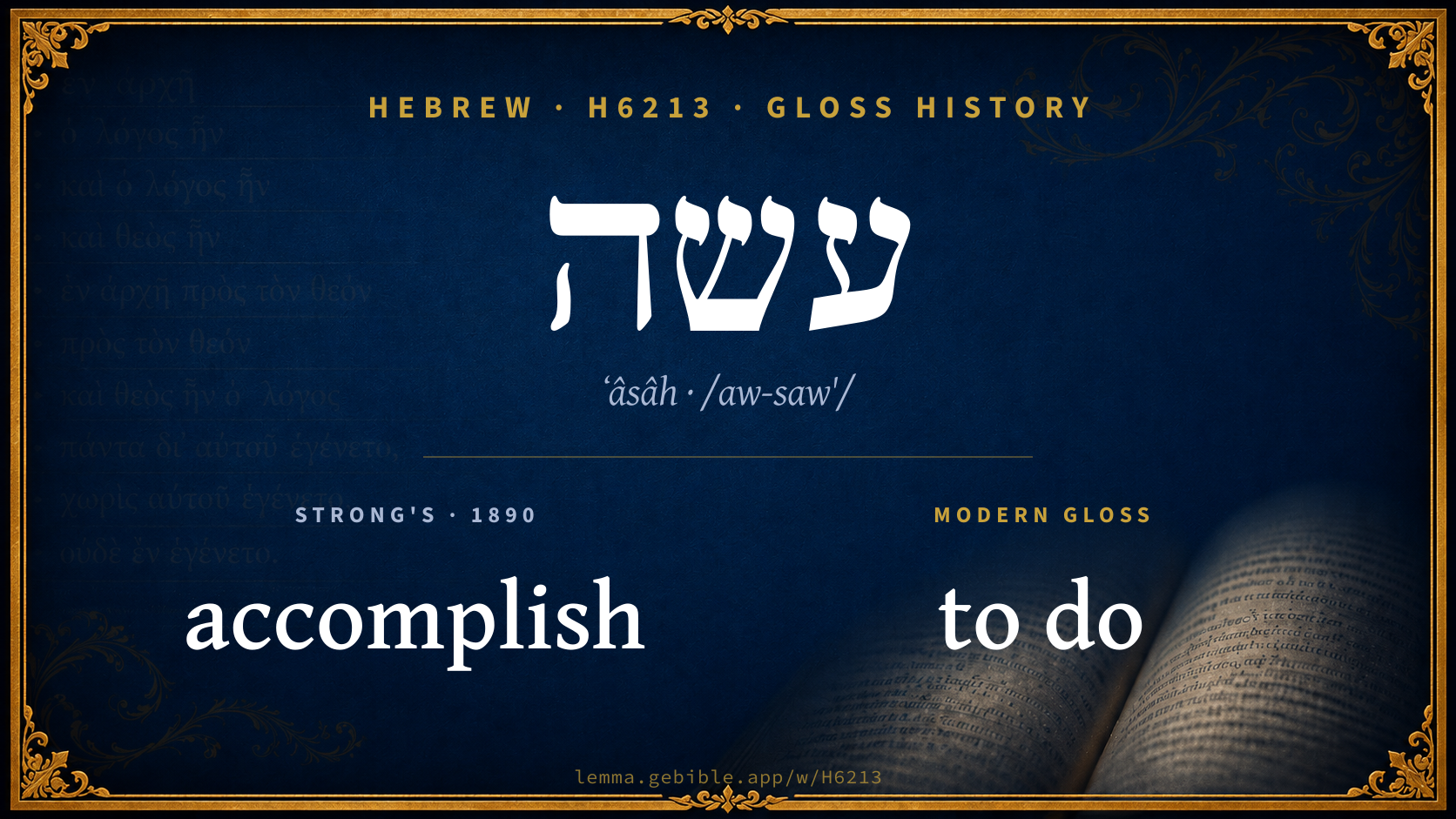
Gloss history
Strong's 1890 vs modern scholarship
About this word
Strong's H6213 catalogs a Hebrew word from the Hebrew Old Testament.
These counts are not copied from any lexicon or concordance. They are computed here, from the morphology-tagged Hebrew Old Testament. What Lemma adds →
- 2,286
- distinct verses
- The word appears in 2,286 distinct verses.
- 39 / 39
- OT books
- The word appears in 39 of 39 Old Testament books.
- #12
- by frequency
- Top 25 most frequent Hebrew words (rank 12 of 8,640 Hebrew words by occurrence).
View all 2,286 occurrences in the concordance →
Most concentrated in
- Exodus 270 verses 12%
- Ezekiel 180 verses 8%
- Deuteronomy 148 verses 6%
By section of the Old Testament
By traditional corpus
Conventional, traditional groupings — biblical authorship is debated, so this is a traditional corpus grouping, not an authorship claim. Each share is this word’s portion of its verses in that division of the Hebrew canon. Each figure is a share of the word’s 2,286 distinct verses.
- Prophets (Nevi'im) 1,012 verses · 44%
- Torah (Pentateuch) 744 verses · 33%
- Writings (Ketuvim) 530 verses · 23%
How translations render this word
Counts come from each version’s own published word-to-Strong’s tagging or interlinear alignment — an approximate guide to how each version renders this word, not a word-level alignment the data otherwise carries. Because each total is that version’s own tagged count, the per-version totals vary from one another and need not match the appearance or distinct-verse counts above. These counts may also differ from a printed concordance because Lemma counts each distinctly tagged rendering and does not collapse phrase taggings into a single head-word total. This is a fixed set of word-tagged versions (KJV, ASV, BSB, ULT) and does not change with the reading translation you choose elsewhere. Each version’s license is shown beside its name below (and on Sources).
BDB lists this Strong’s number as 2 distinct words (homographs). Each count above pools all of them and is not split by sense — see the Senses section below. A low-frequency rendering may belong to a different one of those words, not the primary meaning.
- King James Version†: Do 267×, Did 164×, Made 128×
- American Standard Version†: Do 197×, Did 145×, Made 116×
- Berean Standard Bible†: Do 191×, Did 141×, Make 83×
- unfoldingWord Literal Text†: Do 348×, Did 153×, He made 132×
King James Version Public Domain
Renders H6213 across 2,630† tagged occurrences — most commonly:
Plus other, less common renderings. Plus 600 renderings that appear only once — usually multi-word phrases or single function words the recovered tagging swept in, not distinct renderings. Not rendered by a distinct English word in 8 further occurrences.
American Standard Version Public Domain
Renders H6213 across 2,632† tagged occurrences — most commonly:
Plus other, less common renderings. Plus 674 renderings that appear only once — usually multi-word phrases or single function words the recovered tagging swept in, not distinct renderings.
Berean Standard Bible Public Domain
Renders H6213 across 2,471† tagged occurrences — most commonly:
Plus other, less common renderings. Plus 583 renderings that appear only once — usually multi-word phrases or single function words the recovered tagging swept in, not distinct renderings. Not rendered by a distinct English word in 149 further occurrences.
unfoldingWord Literal Text CC BY-SA 4.0
Renders H6213 across 2,938† tagged occurrences — most commonly:
Plus other, less common renderings. Plus 257 renderings that appear only once — usually multi-word phrases or single function words the recovered tagging swept in, not distinct renderings.
40 senses and sub-senses in the full BDB
Hebrew verbs can shift meaning by stem (binyan): Qal is the basic action, Niphal is often passive or reflexive, Piel often intensifies or makes it factitive, and Hiphil is typically causative. The senses below are grouped under the stem BDB assigns to each. This entry also uses Pual (the passive of Piel).
What do BDB’s symbols mean?
BDB uses these scholarly abbreviations:
| Symbol | Meaning |
|---|---|
| 𝔊 | the Septuagint (the ancient Greek translation, LXX) |
| 𝔙 | the Vulgate (the Latin translation) |
| 𝔖 | the Syriac version (the Peshitta) |
| 𝔗 | the Targum (the Aramaic translation) |
| ψ | the Psalms |
| √ | root (the underlying root or stem) |
| ‖ | parallel passage (a synonymous or contrasted parallel) |
| † | the dagger: every passage where the word occurs is cited |
The 40 senses and sub-senses the full Brown-Driver-Briggs lexicon distinguishes for this word, in lexicon order (not ranked by frequency), with BDB’s own verbatim wording and sub-sense lettering. Shown in Hebrew script with BDB’s own scholarly abbreviations. The condensed entry is in the Lexicon Entry tab. See also the Forms in the corpus table below.
עשה I I. עָשָׂה vb. do, make (NH = BH
Qal
- Pf. 3 ms. Gn 3:1 +, sf. עָשָׂהוּ Ho 8:6 +; 3 fs. עָֽשְׂתָה Dt 22:21 +, וְעָשָׂת consec. Lv 25:21; 2 ms. עָשִׂיתָ Gn 3:14 +, etc.; Impf. 3 ms. יַעֲשֶׂה Gn 18:25 +, וַיַּעֲשֶׂה 1 K 16:25 + 3 times, וַיַּעַשׂ Is 5:2 +; יַעֲשֵׂה Is 64:3, 2 ms. תַּעֲשֶׂה 1 S 10:8, תַּעֲשֵׂה Gn 26:29 Jos 7:9, juss. (c. אַל) תַּעַשׂ Gn 22:12 +, תַּעֲשֵׂה 2 S 13:12 Je 40:16 Qr (Kt תַּעַשׂ); 1 s. אֶעֱשֶׂה Gn 2:18 +, וָאֶעֱשֶׂה Ez 20:14 Dn 8:27, וָאַעַשׂ Dt 10:3 + 4 times Ez; etc.; Imv. ms. עֲשֵׂה Ju 10:15 +; fs. עֲשִׂי Je 6:26 +, etc.; Inf. abs. עָשׂה 44:17 +; עָשׂוֹ 7:5 + 2 times (4:18 van d. H. עָשׂוּ); cstr. עֲשׂוֹת Gn 2:4 +, עֲשֹׂה 50:20 + 2 times, עֲשׂוֹ 31:28, sf. עֲשׂתוֹ 41:32 +, עֲשׂהוּ †Ex 18:18, etc.; Pt. act. עֹשֶׂה Is 5:5 +, sf. הָעשֹׁוֹ Jb 40:19 (but v. infr.); pl. עֹשִׂים Gn 24:49 +; sf. עֹשָׂ֑י Jb 35:10 (yet v. Ges§ 124 k), etc.; pass. עָשׂוּי Ex 3:16 +, הֶעָשׂוּ Jb 41:25 (Ges§ 75 k); f. עֲשׂוּיָה Ez 21:20 +, etc.;— e.g. Genesis 3:1
- I.
- 1. do (1560 + times):
- a. (1) c. acc. act. Gn 3:14 (J) 20:10 (E) + often; do right in eyes of י׳ 2 K 12:3; 14:13 +, evil 8:18, 27 + (cf. i. עַיִן 3 c); do God’s commands, statutes, etc., Dt 16:12; 30:8, Nu 15:39 (P); ע׳ חַיִל 1 S 14:48 + do might, i.e. mightily, valiantly; Pr 31:29 do efficiency, i.e. efficiently; = commit (offence) Lv 20:13 (H), Dt 20:18; sq. מִן part., וְעָשָׂה מֵאַחַת מֵהֵנָּה Lv 4:2 and shall do a single one of them (things prohibited; v. מִן 3 b (d)), cf. וְעָשׂוּ אַחַת מִכָּל־מִצְוֹת י׳ v 13, 22; 5:17 (all P); do = perform a work, c. acc. cogn. מַעֲשֶׂה Ex 18:20; 23:12 (E), also (י׳ subj.) Dt 11:7 Dn 9:14 Ec 3:11; c. acc. מְלָאכָה Gn 2:2, 2 (J), Ex 20:9, 10 = Dt 9:13 (10 Words); c. acc. דְּרָכֶיךָ †Is 58:13; ע׳ מְלוּכָה עַל 1 K 21:7 = exercise sovereignty over; of י׳ performing signs (אֹתֹת) Jos 24:17 (E), Nu 14:11, 22 (JE), Dt 11:3, so Moses Ex 4:17 and (מֹפְתִים) v 21. (2) do something to one (ל pers.) Gn 20:9 (E), Ju 9:56 +; c. עַל reflex. Je 26:19 do evil against ourselves; especially י׳ subj., c. לְ, do good to Ex 18:9 (E), 1 K 8:66, or evil Gn 42:28 (E); in phr. so may God do to me, etc. 1 S 3:17 2 K 6:31 + (v. יסף Hiph. 1). (3) do something for one (ל pers.) Gn 30:31 1 K 11:8 +, dir. obj. om. 1 S 20:4; + ל rei Ju 21:7, 16 what shall we do for them, for wives? c. עַל pers. Ne 5:19; c. dat. eth. (ל) 1 S 10:7; c. לְ, of י׳ doing kindness for 1 S 22:3; executing vengeance for Ju 11:36 (+ מִן of enemy); י׳ doing a sign (אוֹת) for †Ju 6:17 (elsewhere נָתַן אוֹת לְ), cf. עֲשֵׂה־עִמִּי אוֹת לְטוֹבָה ψ 86:17. (4) do someth. (in relation or intercourse) with (עִם, אֵת pers.), י׳ subj. Ex 34:10 Dt 1:30 all that he did with you, 10:21 (cf. ψ 86:17 supr.), human subj. 2 Ch 24:24 (obj. שְׁפָטִים), Ru 2:11. (5) seldom c. ב, usually of executing judgment upon 1 S 28:18 Is 48:14, more gen. Est 1:15 what shall we do with the queen? also, subj. י׳, Ez 25:11; 28:26 ψ 149:7, 9 Nu 33:4 (on false gods); in good sense, ע׳ חֲסָדִים בּ׳ Ne 13:14. (6) of י׳ doing the justice (מִשְׁפַּט) of any one, i.e. maintaining his cause 1 K 8:45, 49 ψ 9:5. (7) c. adv. do thus, כֹּה, Jos 6:14 (JE), according to, כְּ, Gn 6:22 (P), 18:21 (J), 1 K 2:6; acc. as, כַּאֲשֶׁר Gn 27:19 (J); Ex 1:17 (E) +; c. בְּ of manner, Ju 9:16a, Ez 8:18; 25:15. e.g. Genesis 3:14
- b. work for (ל rei) Gn 30:30 (J); c. ל pers. 1 S 14:6 Ez 29:20 (for י׳); work in (ב) gold or other material 1 K 7:14 2 Ch 2:6, 13 Ex 31:4, 5; 35:32 (all P); c. בָּהּ (i.e. בָּעֲבֹדָח) Ex 5:9 (J) in toil Ne 4:10; work w. (עִם) God 1 S 14:45, so prob. of God’s working with (אֵת) Moses and Aaron 1 S 12:6 (usually appoint); c. עִם with (of pers. in whose company, in whose field) Ru 2:19(×2) (gleaning); work בְּחֵפֶץ כַּפֶּיהָ Pr 31:13; without prep. Ex 36:1 Ne 3:38. e.g. Genesis 30:30
- 2. deal with, c. עִם, 2 Ch 2:2 Dn 1:13 (כַּאֲשֶׁר acc. as); c. אֵת, Ez (17:17) 20:44 Mic 5:14 ψ 109:21; Ez 22:14 Zp 3:19 (Gr Now ins. כָּלָה, v. ii 1 g), + כְּ Je 21:2, + בְּ of manner Ez 23:25, 29; c. לְ pers. + בְּ 25:12; c. בְּ pers., Je 18:23 Dn 11:7, + כְּ according toNe 9:24 Est 3:11. e.g. 2 Chronicles 2:2
- 3. often in phr., do kindness (חֶסֶד) with: c. עִם, (עִמָּדִי) Gn 19:19; 24:12, 14 (J), Ju 1:24; 8:35 1 S 15:6 2 S 2:5; 10:2 = 1 Ch 19:2 +; c. עַל, 1 S 20:8 (but read עִם Vrss We Dr al.); abs., ψ 109:16; obj. חֶסֶד + אֱמֶת, c. עִם, Jos 2:14 (JE) Ju 9:19 2 S 2:6; c. אֵת with, Gn 24:49; 32:11; 47:29 (all J); c. לְ, Ex 20:6 = Dt 5:10, 2 S 22:51 = ψ 18:51; so ע׳ טוֹב, c. עִם, Gn 26:29 (J), cf. Ju 8:35; 9:16; c. אֵת with, 1 S 24:19 2 S 2:6. e.g. Genesis 19:19
- 4. abs. act, act with effect, especially of י׳, 1 K 8:32, 39 Je 14:7 Ez 20:9, 14, 22 ψ 22:32; 37:5; 52:11 Dn 9:19; of men 2 Ch 31:21 Dn 8:12, 24; 11:28, 30, 32; c. ל pers. Ez 31:11. e.g. 1 Kings 8:32
- 1. do (1560 + times):
- II.
- 1. make (670 + times):
- a. c. obj. concr., ark Gn 8:6, altar 13:4, idols Ju 18:24, 31 +, etc. e.g. Genesis 8:6
- b. often of God’s making (creating) Gn 3:1 (J), 1:7, 16, 25 (P), Ne 9:6 Jb 9:9 Pr 8:26 2 Ch 2:11 ψ 95:5 +; making man ψ 100:3; 119:73 (made by God’s hands), in the womb Jb 31:15(×2); making constituting, nation Dt 26:19; 32:6, 15; pt. sf. עֹשֵׂהוּ his Maker Is 17:7 Pr 14:31; 17:5 (הָעֹשׂוֹ Jb 40:19 is improb., most read הֶעָשָׂוּי, with various interpr. of foll. words); עֹשֶׂךָ Is 51:13, עֹשֵׂנִי Jb 32:22 (Ginsb; v 22 van d. H. Baer), עֹשֵׂנוּ ψ 95:6; so appar. pt. pl. עֹשָׂ֑י Jb 35:10, עֹשַׂיִךְ Is 54:5 (Ges§ 124 k expl. as sg.). e.g. Genesis 3:1
- c. make something, c. לְ reflex., make for thee Ex 20:4 Dt 9:12; 10:1 +, for (ל) another 1 S 2:19 2 S 7:11 1 K 2:24 +; obj. מִשְׁתֶּה banquet Gn 40:20 Est 5:4, also (no ל) Gn 29:22 (E) Ju 14:10 Est 5:5, 12 and (fig., י׳ subj.) Is 25:6; c. ל rei, Dt 22:8; c. ל of animal Gn 33:17 (J). e.g. Exodus 20:4
- d. make a name (שֵׁם) for oneself (ל) 2 S 7:9 1 Ch 17:8, also (no ל) 2 S 8:13; a new heart for oneself (ל) Ez 18:31. e.g. 2 Samuel 7:9
- e. make war with (אֶת) Gn 14:2 Jos 11:18 (D); c. עִם, Dt 20:12, 20 1 Ch 5:10, 19; abs. 1 Ch 22:8; c. ל reflex. Pr 24:6; pt. עֹשֵׂה מִלְחָמָה 2 Ch 11:1; 26:11, 13; make peace, c. ל pers. Jos 9:15 (J); ע׳ אִתִּי בְרָכָה 2 K 18:31 make an agreement with me. e.g. Genesis 14:2
- f. c. ב, ע׳ פֶּרֶץ בּ׳ Ju 21:15 י׳ brought a catastrophe upon (cf. פרץ). e.g. Judges 21:15
- g. c. 2 acc., make something out of (acc. mater.) Ex 25:18; 28:13; 37:17, 24 Ct 3:10 Dt 10:3 +; make something into something (Ges§ 117 ii) Ho 8:4 Gn 27:9 Ju 17:4 Nu 11:8; 17:3 ψ 104:4; make something כָּלָה, i.e. utterly destroy it Na 1:8 Zp 1:18 Ez 20:17 Ne 9:31; c. pt. pass. as 2nd acc. Ex 38:7 they made it נְבוּב לֻחֹת hollow with boards, 39:9; but also c. acc. + לְ, Ho 2:10 gold they made into (ל) the Baal, Ju 8:27 Ex 27:3 (P), Dt 9:14 Je 37:15 Ez 4:9 IS 44:17, 19; make something for (ל pers.), + מִן of material Ct 3:9. e.g. Exodus 25:18
- 2. produce, yield: of grain, yielding meal Ho 8:7(×2), vineyard, grapes Is 5:2(×2), 4(×2), 10, tree, fruit 2 K 19:30 = Is 37:31, Ho 9:16 Je 12:2; 17:8 Ez 17:23 (all fig.), Gn 1:11, 12 (P); branches Jb 14:9 and (fig.) Ez 17:8; land, fruit Lv 25:21 cf. Hb 3:17, abs. Gn 41:47; of seed Is 5:10, vine, shoots Ez 17:6 (fig.); of cows, yielding milk Is 7:22; hippop. producing fat Jb 15:27. e.g. Hosea 8:7
- 3. prepare, especially of dressing and cooking food, Gn 18:7, 8 Ju 6:19; 13:15 1 S 25:18 (pass.), 2 S 12:4(×2) Gn 27:14, 17, 31 2 S 13:5, 7 1 K 17:12 Ex 12:39 (+ ל reflex.) Ez 35:6; a bullock for sacrifice 1 K 18:23, 25, 26; כְּלֵי גוֹלָה Ez 12:3 (+ ל reflex.); a chamber Ne 13:7; prepare to build (+ ל pers. and inf.). e.g. Genesis 18:7
- 4. make offering, e.g. עוֹלָה Ju 13:16 Je 33:18 Lv 16:24, עוֹלָה וָזֶבַח 2 K 5:17 (+ ל dei), הַחַטָּאת Lv 14:19, אִשֶּׁה Nu 15:3, 14, various offerings 1 K 8:64 Lv 9:22 Ez 45:17; 46:2 +; + לי׳ to י׳ Lv 17:9 +; also c. acc. of thing sacrificed (perhaps orig. prepare or provide, v. supr.) Ez 43:25(×2); 46:15 Lv 14:30; 15:15, 30; 16:9 Nu 6:11, 17 ψ 66:15 (+ ל dei) +; abs. = offer sacrifice Ex 10:25 (E + לי׳), to (ל) heathen gods 2 K 17:32. e.g. Judges 13:16
- 5. attend to, put in order: pare (the nails) Dt 21:12; wash (feet) 2 S 19:25; trim (beard) v 25 (cf. Fr faire la barbe, Ger. die Haare machen). e.g. Deuteronomy 21:12
- 6. observe, celebrate, religious festival, e.g. pass-over Ex 12:47, 48; Nu 9:4, 6, 13; Jos 5:10, also (+ לי׳) Ex 12:48 Nu 9:10, 14 (all P), Dt 16:1 +; sabbath Ex 31:16; Dt 5:15; feast of weeks 16:10, booths 16:13, Purim Est 9:21, 27, etc. e.g. Exodus 12:47
- 7. acquire property of various kinds (cf. ‘make money’) Gn 12:5; 31:1 (J); Is 15:7; Je 17:11; 48:36; Dt 8:18; Ez 22:13; 28:4(×2); 38:12; 2 Ch 32:29; Ec 2:8; + ל reflex. Dt 8:17; 2 S 15:1; 1 K 1:5; of fruits from vineyards, etc. ψ 107:37. e.g. Genesis 12:5
- 8. appoint priests 1 K 12:31; 13:33; 2 Ch 2:17 (all + מִן source), a feast 1 K 12:32, 33 (+ ל pers.); ordain a sacrifice Nu 28:6, a festal day ψ 118:24; institute, אוֹב וְיִדְּעֹנִי ghost and familiar spirit 2 K 21:6 = 2 Ch 33:6 (cf. Dr Dt 18:11). e.g. 1 Kings 12:31
- 9. bring about, of י׳’s effecting a deliverance Ex 14:13 (לָכֶם), 1 S 11:13; 2 S 23:10 (ins. also ‖ 1 Ch 11:13 Dr), v 12; cause, sq. cl. c. שֶׁ Ec 3:14. e.g. Exodus 14:13
- 10. use, וְע׳ לִמְלַאכְתּוֹ 1 S 8:16; pass. Ex 38:24 e.g. 1 Samuel 8:16
- 11. spend, pass, days of life Ec 6:12. e.g. Ecclesiastes 6:12
- 1. make (670 + times):
Niphal
- Pf. 3 ms. נַעֲשָׂה Ju 16:11 +; 3 fs. נֶעֶשְׂתָה 2 S 17:23 +, etc.; Impf. 3 ms. יֵעָשֶׂה Gn 29:26 +, 3 fs. c. ו subord. וְתֵעָשׂ Est 5:6; 7:2; 9:12 (Ges§ 109 f), etc.; Inf. cstr. הֵעָשׂוֹת Est 9:1, 14, etc.; Pt. נַעֲשֶׂה Ne 5:18, etc.;— e.g. Judges 16:11
- 1. be done (pass. of Qal I 1):
- a. subj. מְלָאכָה Ju 16:11 (c. ב instr.), Ne 6:16 (c. מֵאֵת אֱלֹהִים), v 9 Ex 12:16 + 4 times; subj. om. Ez 44:14, indef. Est 4:1; c. כֵּן 9:14; be done, כַּתּוֹרָה Ezr 10:3; be committed, of offence, Dt 13:15; Nu 15:24; Ec 4:1 + 3 times; c. neg. not (yet) done, i.e. future Is 46:10; be accomplished, performed, fulfilled Ez 12:25, 28; Dn 11:36; Est 5:5; 7:2; 9:12; be executed, carried out, of sentence Ec 8:11, decree Est 9:1; be followed, of counsel 2 S 17:23; nearly = occur Ec 1:9(×2), 13; 9:3, 6, subj. מַעֲשֶׂה 1:14; 2:17; 4:3; 8:9, 17, subj. הֶבֶל v 14, עִנְיָן v 15. e.g. Judges 16:11
- b. Impf. c. neg., is (are) not done, not according to usage, of flagrant offences Gn 20:9 (E), 29:26 (c.כֵּן), 34:7 (both J), 2 S 13:12 (כֵּן); hence (P) not to be done, forbidden by י׳ Lv 4:2, 13, 22, 27; 5:17. e.g. Genesis 20:9
- c. be done to, c. ל of animal 1 S 11:7 (כֹּה); ל pers. Ex 2:4 (E) 21:31 (E; כַּמִּשְׁפָּט), Is 3:11; Je 5:13 (כֹּה), Lv 24:19 (H; כֵּן), Nu 15:34 (P) + 8 times; be done for, ל pers. Ju 11:37; Est 6:3, עִם pers v 3; ל rei Nu 15:11 (כָּכָה). e.g. 1 Samuel 11:7
- d. be done upon, against (ב) Dn 9:12. e.g. Daniel 9:12
- 2. (pass. of Qal II):
- a. be made, of concr. things 1 K 10:20 = 2 Ch 9:19 (throne), Je 3:16 (ark), 2 K 12:14; Ez 43:18; Ex 25:31; Nu 4:26 (P); c. acc. mat. Lv 2:7. e.g. 1 Kings 10:20
- b. be produced from (מִן) vine Nu 6:4. e.g. Numbers 6:4
- c. be prepared, of food Ex 12:16; Lv 6:14; 7:9 (all P), Ne 5:18(×2). e.g. Exodus 12:16
- d. be offered, מִנְחָה Lv 2:8, 11, kid Nu 28:15, 24. e.g. Leviticus 2:8
- e. be observed, passover 2 K 23:22, 23 (ל dei) = 2 Ch 35:18, 19; Purim Est 9:28. e.g. 2 Kings 23:22
- f. be used + ל rei Lv 7:24; 13:51 (P), Ez 15:5(×2); cf. Ex 38:24; 1 S 8:16. e.g. Leviticus 7:24
Pual
- Pf. 1 s. עֻשֵּׂיתִי ψ 139:15 I was made. e.g. Psalms 139:15
עשה II
Piel
- press, squeeze (NH עִשָּׂה Pi. compel; 𝔗 עַסִּי Pa. crush, gnash (teeth); cf. Arabic غَشِىَ compress a woman);—Pf. 3 pl. עִשּׂוּ דַּדֵּי בְּתוּלִים Ez 23:3, 8 (unchaste act); Inf. cstr. בַּעֲשׂוֹת … דַּדַּיִךְ v 21 read Pi. בְּעַשּׂוֹת (Ew Co Toy, al.). e.g. Ezekiel 23:3
Senses from the full Brown-Driver-Briggs lexicon (Brown, Driver, Briggs; Oxford 1906 — public domain), digitized via Sefaria, supplemented by the OpenScriptures HebrewLexicon (CC BY 4.0). Full attribution on Sources.
Word origin
I. עָשָׂה vb. do, make (NH = BH; MI23.26 עשתי, l.3.9 ואעש, l.24 Imv. עשו; OH n.pr. עשיו, אלעשה, מעשיהו; not Aramaic, and not certainly found in S. Sem. lang.; on Sab. v. especially DHMSB Berl. Akkadian 1886, 849);—
— Brown-Driver-Briggs (Oxford 1906, public domain), digitized via Sefaria, supplemented by the OpenScriptures HebrewLexicon (CC BY 4.0). See Sources.
Origin: a primitive root
Jastrow Dictionary
A second Hebrew/Aramaic lexicon for comparison, covering Aramaic and post-biblical (Talmudic, Targumic, Midrashic) usage that the biblical-Hebrew BDB does not. Matched by lemma rather than by Strong’s number, so a lemma may carry more than one Jastrow headword (shown separately below), and the entries cover usage well beyond the Bible.
עָשָׂה
- , v. עשי
A Dictionary of the Targumim, the Talmud Babli and Yerushalmi, and the Midrashic Literature (Marcus Jastrow; London, Luzac, 1903) — Public Domain. Digitized via Sefaria. Digitized via Sefaria. Full attribution on Sources.
Forms in the corpus
The 815 distinct written forms H6213 takes in the Hebrew Bible, most frequent first — each parse links to that stem’s occurrences in the concordance. Hebrew forms include their vowel points and cantillation, so a single lemma takes many written forms.
The 60 most common forms are shown; 755 rarer forms follow in the full concordance.
Same root — word family
Other BDB entries built from the same root as H6213, grouped by Strong’s listed origin. These share a root / origin per the lexicon — not necessarily a shared meaning. Each links to that word’s own entry.
Derived from this word
Proper names from this root
People and places named from this root — a name, not an additional meaning of the word.
- בעשיה Baʻăsêyâh H1202 Baaseiah
- יעשו Yaʻăsûw H3299 Jaasau
- יעשיאל Yaʻăsîyʼêl H3300 Jasiel
- מעשי Maʻăsay H4640 Maasiai
- עשהאל ʻĂsâhʼêl H6214 Asahel
- עשו ʻÊsâv H6215 Esau
- עשיאל ʻĂsîyʼêl H6221 Asiel
- עשיה ʻĂsâyâh H6222 Asaiah
Compare all same-root words → Showing 4 of 10 — not the complete family. 8 of the same-root words are proper names (people or places). They share a root, not necessarily a meaning.
Septuagint verse parallels
This word appears in 2,142 verses that also exist in the Greek Old Testament (Septuagint), out of the 2,286 Hebrew verses it occurs in. You can read those verses in Greek by switching the Old Testament edition to the Septuagint.
Read these verses in the Septuagint
- Genesis 1:7
- Exodus 1:17
- Leviticus 2:7
- Numbers 1:54
- Deuteronomy 1:14
- Joshua 1:7
- Judges 1:7
- Ruth 1:8
- 1 Samuel 1:7
- 2 Samuel 2:5
- 1 Kings 1:5
- 2 Kings 1:18
This is a verse-level parallel only — the same verses exist in both the Hebrew and Greek Old Testaments. No word-level Hebrew↔Greek correspondence is claimed: the data carries no such alignment, so no Greek word is shown as this Hebrew word’s translation. Coverage is not total — the Septuagint omits the deuterocanon and renumbers the Psalms, so some Hebrew verses have no direct Greek parallel.