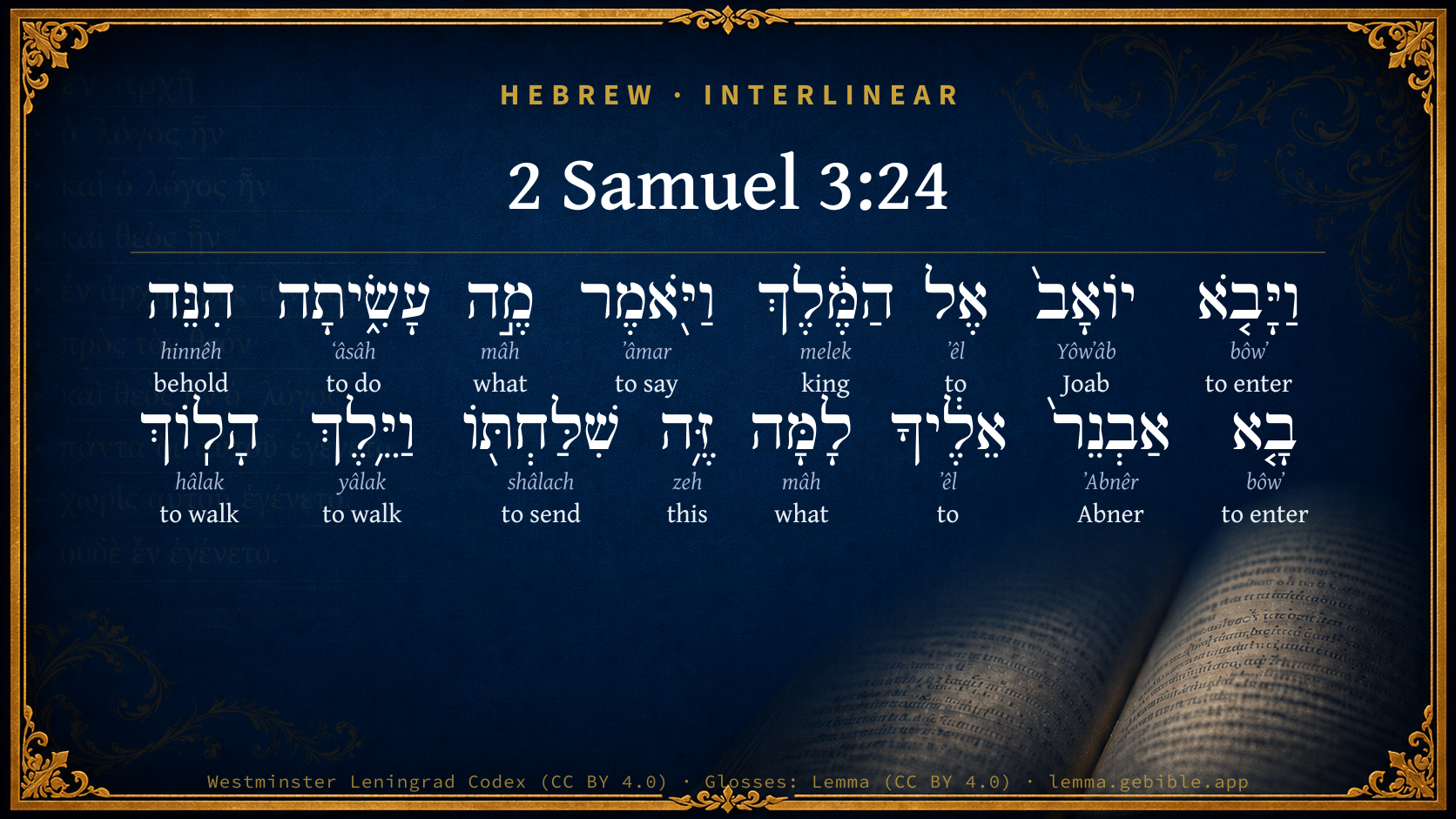
2 Samuel 3:24

Hebrew (Westminster Leningrad Codex) 2 Samuel 3:24 appears in the Hebrew Old Testament. The text above is from the Westminster Leningrad Codex. Each word links to its Strong’s number, a concise gloss, and parsing drawn from the Open Scriptures Hebrew Bible morphology. Click any word for its full Brown-Driver-Briggs (BDB) entry.
Download image
Cite this verse

2 Samuel 3:24 (World English Bible). Public Domain. Lemma interlinear Bible study tool, https://lemma.gebible.app/v/2-samuel/3/24.

Show BibTeX & RIS
BibTeX
RIS
English Translation
Then Joab came to the king, and said, What have you done? behold, Abner came to you; why is it that you have sent him away, and he is quite gone?
World English Bible · Public Domain
Download a study sheet

One document with this verse’s original text, its word-by-word gloss line, the meaning frame, cross-references with their text, attributed commentary, and full source and license credits — printable, and it pastes into notes with its structure intact.

This verse Autodidact and up

Study sheet (.html) Plain text (.txt)

A passage Seminary Student

Up to 50 verses in one chapter. A passage sheet keeps up to 6 commentary sources and 12 cross-references per verse, in the order this page ranks them, and says so on the sheet whenever that leaves anything out. Ask for a single verse and you get the Autodidact verse sheet above.

Everything on this page stays free to read, with no account — the sheet is a download of what is already on screen, not access to it.

Want to remove ads? Support Godless Engineer
Compare translations 3

The same verse in 3 English versions, stacked beneath the original-language interlinear above. Click any original word for its lexicon entry.

Each is an independent rendering of the whole verse — the interlinear is not word-aligned to these translations.

Highlighted words mark where these versions differ — a whole-verse word diff, not a word-by-word alignment.

  • World English Bible Public Domain
    Then Joab came to the king, and said, What have you done? behold, Abner came to you; why is it that you have sent him away, and he is quite gone?
  • King James Version Public Domain
    Then Joab came to the king, and said, What hast thou done? behold, Abner came unto thee; why is it that thou hast sent him away, and he is quite gone?
  • unfoldingWord Literal Text CC BY-SA 4.0
    And Joab came to the king, and he said, “What have you done? Behold, Abner came to you! Why this, you have sent him away, and going, he has gone?

unfoldingWord Literal Text — © unfoldingWord, licensed CC BY-SA 4.0. Word-aligned USFM3 via Door43 (git.door43.org/unfoldingWord/en_ult).

Versions to compare (up to 4)

3 of 4 selected

Show all 18 translations

Every available English version of this verse, each an independent rendering of the whole verse.

  • World English Bible Public Domain
    Then Joab came to the king, and said, What have you done? behold, Abner came to you; why is it that you have sent him away, and he is quite gone?
  • Berean Standard Bible Public Domain
    So Joab went to the king and said, “What have you done? Look, Abner came to you. Why did you dismiss him? Now he is getting away!
  • Majority Standard Bible Public Domain
    So Joab went to the king and said, “What have you done? Look, Abner came to you. Why did you dismiss him? Now he is getting away!
  • King James Version Public Domain
    Then Joab came to the king, and said, What hast thou done? behold, Abner came unto thee; why is it that thou hast sent him away, and he is quite gone?
  • American Standard Version (1901) Public Domain
    Then Joab came to the king, and said, What hast thou done? behold, Abner came unto thee; why is it that thou hast sent him away, and he is quite gone?
  • Revised Version (1885) Public Domain
    Then Joab came to the king, and said, What hast thou done? behold, Abner came unto thee; why is it that thou hast sent him away, and he is quite gone?
  • Geneva Bible (1599) Public Domain
    Then Ioab came to the King, and saide, What hast thou done? beholde, Abner came vnto thee, why hast thou sent him away, and he is departed?
  • Douay-Rheims (1899) Public Domain
    And Joab went in to the king, and said: What hast thou done? Behold Abner came to thee: Why didst thou send him away, and he is gone and departed?
  • Young's Literal Translation Public Domain
    And Joab cometh unto the king, and saith, `What hast thou done? lo, Abner hath come unto thee! why `is' this -- thou hast sent him away, and he is really gone?
  • Literal Standard Version CC BY-SA 4.0
    And Joab comes to the king and says, “What have you done? Behold, Abner has come to you! Why [is] this—you have sent him away, and he is really gone?
  • Unlocked Literal Bible CC BY-SA 4.0
    Then Joab came to the king and said, “What have you done? Look, Abner came to you! Why have you sent him away, and he is gone?
  • unfoldingWord Literal Text CC BY-SA 4.0
    And Joab came to the king, and he said, “What have you done? Behold, Abner came to you! Why this, you have sent him away, and going, he has gone?
  • Darby Bible Public Domain
    Then Joab came to the king, and said, What hast thou done? behold, Abner came to thee; why is it [that] thou hast sent him away, and he is gone?
  • World Messianic Bible Public Domain
    Then Joab came to the king and said, “What have you done? Behold, Abner came to you. Why is it that you have sent him away, and he is already gone?
  • Webster's Bible Public Domain
    Then Joab came to the king, and said, What hast thou done? behold, Abner came to thee; why is it that thou hast sent him away, and he is quite gone?
  • Free Bible Version CC BY-SA 4.0
    Joab went to the king and asked, “What do you think you're doing? Here's Abner, who came to see you. Why on earth did you send him on his way? Now he's got clean away!
  • Bible in Basic English Public Domain
    Then Joab came to the king, and said, What have you done? when Abner came to you why did you send him away and let him go?
  • JPS Tanakh (1917) Public Domain
    Then Joab came to the king, and said: 'What hast thou done? behold, Abner came unto thee; why is it that thou hast sent him away, and he is quite gone?

Literal Standard Version (2020), Covenant Press — licensed CC BY-SA 4.0. Text via the HelloAO Bible API (eBible.org). Unlocked Literal Bible (unfoldingWord) — licensed CC BY-SA 4.0. Text via the HelloAO Bible API (eBible.org). unfoldingWord Literal Text — © unfoldingWord, licensed CC BY-SA 4.0. Word-aligned USFM3 via Door43 (git.door43.org/unfoldingWord/en_ult). Free Bible Version, Dr. Jonathan Gallagher — licensed CC BY-SA 4.0. Text via the HelloAO Bible API (eBible.org).

Word by word

More ways to search: Search by grammar → Find every occurrence → Compare this word →

Practice this passage: Drill this verse → Learn its vocabulary →

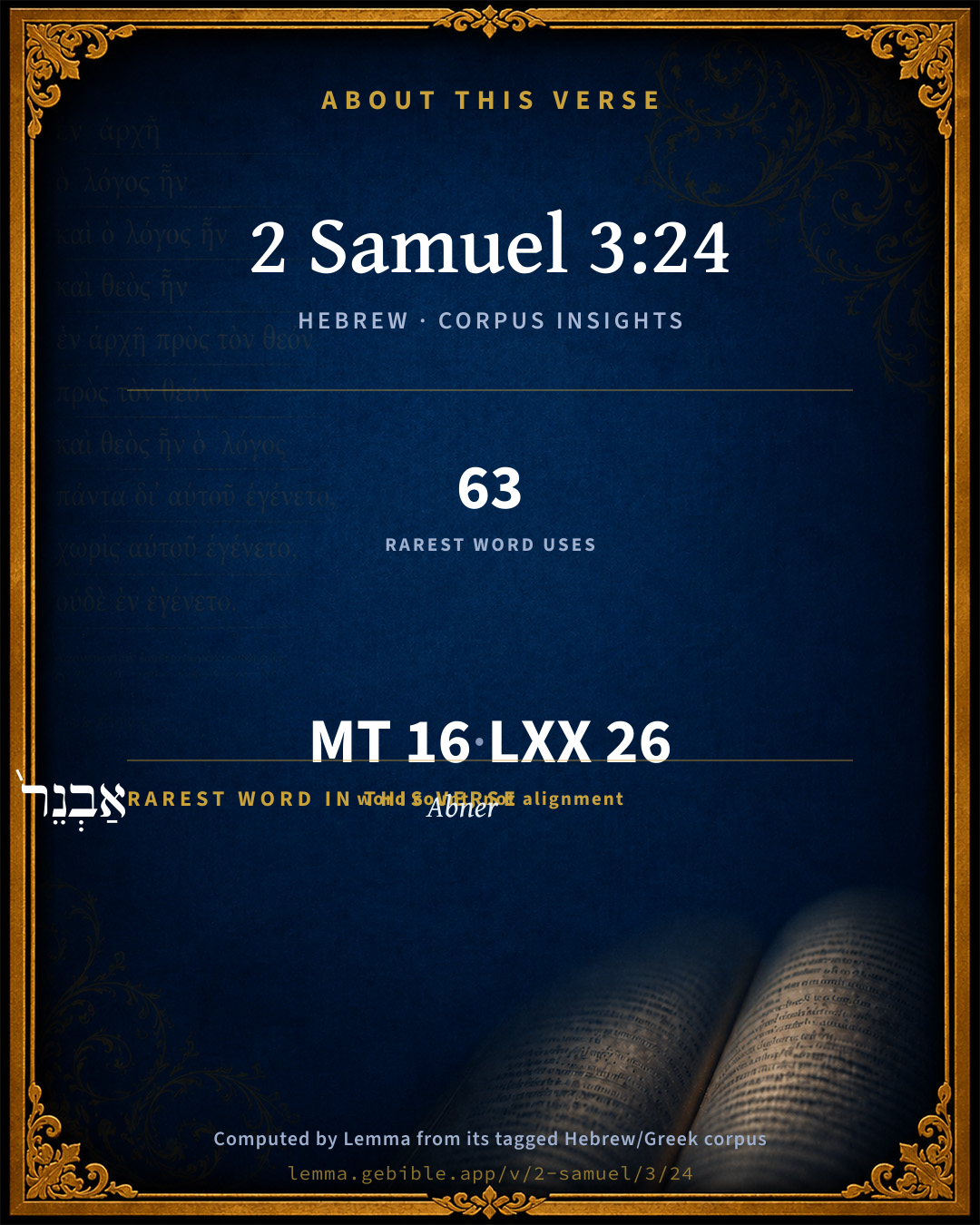
אַבְנֵר֙
ʼAbnêr
H74
“Abner”
Noun, Proper
Part of Speech
Noun
Type
Proper
Full BDB Definition

Origin: from H1 and H5216

TWOT: None

Abner = "my father is a lamp" - Saul's cousin and army captain, treacherously slain by Joab
  1. וַיָּבֹ֤א bôwʼ H935 “and · to enter” Conjunction + Verb, Qal, Sequential Imperfect, 3rd Person, Masculine, Singular
  2. יוֹאָב֙ Yôwʼâb H3097 “Joab” Noun, Proper
  3. אֶל ʼêl H413 “to” Preposition
  4. הַמֶּ֔לֶךְ melek H4428 “the · king” Particle, Definite Article + Noun, Common, Masculine, Singular, Absolute
  5. וַיֹּ֖אמֶר ʼâmar H559 “and · to say” Conjunction + Verb, Qal, Sequential Imperfect, 3rd Person, Masculine, Singular
  6. מֶ֣ה mâh H4100 “what” Particle, Interrogative
  7. עָשִׂ֑יתָה ʻâsâh H6213 “to do” Verb, Qal, Perfect, 2nd Person, Masculine, Singular
  8. הִנֵּה hinnêh H2009 “behold” Particle, Demonstrative
  9. בָ֤א bôwʼ H935 “to enter” Verb, Qal, Perfect, 3rd Person, Masculine, Singular
  10. אֵלֶ֔יךָ ʼêl H413 “to · you” Preposition + Suffix, Personal, 2nd Person, Masculine, Singular
  11. לָמָּה mâh H4100 “to/for · what” Preposition + Particle, Interrogative
  12. זֶּ֥ה zeh H2088 “this” Pronoun, Demonstrative, Masculine, Singular
  13. שִׁלַּחְתּ֖וֹ shâlach H7971 “to send · him” Verb, Piel, Perfect, 2nd Person, Masculine, Singular + Suffix, Personal, 3rd Person, Masculine, Singular
  14. וַיֵּ֥לֶךְ yâlak H3212 “and · to walk” Conjunction + Verb, Qal, Sequential Imperfect, 3rd Person, Masculine, Singular
  15. הָלֽוֹךְ hâlak H1980 “to walk” Verb, Qal, Infinitive Absolute

About this verse

These counts appear in no published source. They are computed here, from the morphology-tagged text and Lemma’s own curated glosses. What Lemma adds →

16
words
13
distinct lemmas
Historical
section

Grammatical profile

  • 7 verbs
  • 3 nouns
  • 1 pronoun
  • 2 prepositions
  • 3 particles

Verb forms

  • וַיָּבֹ֤א Qal · Sequential Imperfect
  • וַיֹּ֖אמֶר Qal · Sequential Imperfect
  • עָשִׂ֑יתָה Qal · Perfect
  • בָ֤א Qal · Perfect
  • שִׁלַּחְתּ֖וֹ Piel · Perfect
  • וַיֵּ֥לֶךְ Qal · Sequential Imperfect
  • הָלֽוֹךְ Qal · Infinitive Absolute

Repetition

Words recur within this verse — often emphatic in Hebrew:

  • וַיָּבֹ֤א to enter H935 ×2
  • אֶל to H413 ×2
  • מֶ֣ה what H4100 ×2

Hebrew & Septuagint length

In English translation the verse runs 31 words from the Hebrew and 34 from the Septuagint (LXX English) — closely comparable.

A rough comparison of the two English renderings, which tokenize alike — not a word-level alignment.

Word counts can differ between the Hebrew and the Greek without any difference in meaning — e.g. the Hebrew direct-object marker אֵת has no separate Greek word, and Greek often adds the article ὁ.

In the original languages it is 16 Hebrew tokens and 26 Greek tokens — but the two are counted differently (Hebrew bundles its prefixes and suffixes into one token; the Greek is in lemma form), so that isn’t a like-for-like length.

Cross-references

5

Topical passages linked to 2 Samuel 3:24 in the Treasury of Scripture Knowledge — connected by theme and wording, ordered by reader-vote popularity; previews shown in the World English Bible.

  • Numbers 23:11 Balak said to Balaam, What have you done to me? I took you to curse my enemies, and, behold, you have blessed them altogether.
  • 2 Samuel 3:8 Then was Abner very angry for the words of Ish-bosheth, and said, Am I a dog's head that belongs to Judah? This day do I show kindness to the house of Saul your father, to his brothers, and to his friends, and have not delivered you into the hand of David; and yet you charge me this day with a fault concerning this woman.
  • 2 Samuel 3:39 I am this day weak, though anointed king; and these men the sons of Zeruiah are too hard for me. May Yahweh reward the evil-doer according to his wickedness."
  • 2 Samuel 19:5–7 Joab came into the house to the king, and said, You have shamed this day the faces of all your servants, who this day have saved your life, and the lives of your sons and of your daughters, and the lives of your wives, and the lives of your concubines;
  • John 18:35 Pilate answered, "I'm not a Jew, am I? Your own nation and the chief priests delivered you to me. What have you done?"

Cross-references courtesy of OpenBible.info (CC BY 4.0).

Hebrew and Greek witnesses Masoretic Hebrew ↔ Greek Septuagint

The same verse in the two great witnesses to the Old Testament, shown verse-for-verse.

These are two independent witnesses, not word-aligned to each other, and the Septuagint is shown in lemma (dictionary) form.

Hebrew 2 Samuel 3:24 Masoretic · Westminster Leningrad Codex

וַיָּבֹ֤א יוֹאָב֙ אֶל הַמֶּ֔לֶךְ וַיֹּ֖אמֶר מֶ֣ה עָשִׂ֑יתָה הִנֵּה בָ֤א אַבְנֵר֙ אֵלֶ֔יךָ לָמָּה זֶּ֥ה שִׁלַּחְתּ֖וֹ וַיֵּ֥לֶךְ הָלֽוֹךְ

Then Joab came to the king, and said, What have you done? behold, Abner came to you; why is it that you have sent him away, and he is quite gone?

World English Bible · Public Domain

Greek LXX 2 Samuel 3:24 Septuagint · lemma form

καί εἰςἔρχομαι ιωαβ πρός ὁ βασιλεύς καί εἶπον τίς οὗτος ποιέω ἰδού ἔρχομαι αβεννηρ πρός σύ καί ἵνα τίς ἐκ ἀποστέλλω αὐτός καί ἀποἔρχομαι ἐν εἰρήνη

And Joab went in to the king, and said, What is this that you have done? behold, Abenner came to you; and why have you let him go, and he has departed in peace?

LXX2012 (modern English Septuagint) · Public Domain

Hebrew: Westminster Leningrad Codex (CC BY 4.0). Greek: Septuagint (public domain); English from LXX2012 (modern English Septuagint) (Public Domain). How the Septuagint differs from the Hebrew →

Targum (Aramaic paraphrase)

1

The Targum is the ancient Jewish Aramaic paraphrase of the Hebrew Scriptures — an interpretive translation, not the Hebrew text itself. Onkelos (literal) and Pseudo-Jonathan (expansive) render the Torah, and Jonathan the Prophets. Coverage is partial: where no permissively-licensed English translation exists for a verse, only the Aramaic is shown. This is verse-level text, not a word-by-word alignment to the Hebrew.

  1. Targum Jonathan Prophets (Joshua–Malachi)
    וַאֲתָא יוֹאָב לְוַת מַלְכָּא וַאֲמַר מָה עֲבַדְתָּא הָא אָתָא אַבְנֵר לְוָתָךְ לְמָא דְנַן שְׁלַחְתֵּיהּ וַאֲזַל מֵיזַל:

    (no public-domain English translation for this verse)

    Targum Jonathan — Aramaic: “Mikraot Gedolot” (public domain). English: “Sefaria Community Translation” (CC0 1.0 (public-domain dedication)); “London "Chaldee Paraphrase," 1871” (public domain). Text via Sefaria.

Commentary

Notes on 2 Samuel 3:24 from classic Christian and Jewish commentators (each source and its license shown beneath its notes). The classic Christian expositions comment on the surrounding passage and are grouped to its opening verse, so a note may address several verses; the Jewish commentaries on the Tanakh (Rashi and others) are per-verse, so they appear only where the commentator wrote on this verse.

Lemma curates 59 commentaries, every one of them public domain or Creative Commons licensed, each selected and text-cleaned for this edition rather than reprinted as found. About our sources →

Trapp's Complete Commentary

John Trapp

2Sa 3:24 Then Joab came to the king, and said, What hast thou done? behold, Abner came unto thee; why [is] it [that] thou hast sent him away, and he is quite gone?

Ver. 24. What hast thou done?] q.d., Thou hast done indiscreetly. Joab was ever too bold, blunt, and boisterous with David, which cost him at length the loss of his place. {2Sa 19:13}

John Trapp, A Commentary or Exposition upon All the Books of the Old and New Testament (1647–1656) — public domain. Text from a community e-Sword module.

Joseph Benson's Commentary

2Sa 3:24. Then Joab came to the king, and said, What hast thou done? — Upon hearing what had passed, he immediately went to David, in the pride of his success, and of the great spoil he had taken, to expostulate with him upon the folly of receiving Abner in the manner he had done, and placing any confidence in a man who, he signified, had come thither only to betray him. This presumption and insolence David was constrained to endure, because of Joab’s great power with the army and military men.

Joseph Benson's Commentary on the Old and New Testaments (1811–1818) — public domain. Text from a community e-Sword module.

Geneva Bible (1599)

Geneva Bible translators

Here appeareth the malicious mind of Joab, who would have had the King to slay Abner for his private grudge.

Geneva Bible (1599) marginal notes — public domain. Text via Bolls.life.

Jamieson, Fausset & Brown

Robert Jamieson, A. R. Fausset & David Brown

JOAB KILLS ABNER. (Sa2 3:22-30)

Joab came to the king, and said, What hast thou done?--Joab's knowledge of Abner's wily character might have led him to doubt the sincerity of that person's proposals and to disapprove the policy of relying on his fidelity. But undoubtedly there were other reasons of a private and personal nature which made Joab displeased and alarmed by the reception given to Abner. The military talents of that general, his popularity with the army, his influence throughout the nation, rendered him a formidable rival. In the event of his overtures being carried out, the important service of bringing over all the other tribes to the king of Judah would establish so strong a claim on the gratitude of David, that his accession would inevitably raise a serious obstacle to the ambition of Joab. To these considerations was added the remembrance of the blood feud that existed between them since the death of his brother Asahel (Sa2 2:23). Determined, therefore, to get Abner out of the way, Joab feigned some reason, probably in the king's name, for recalling him, and, going out to meet him, stabbed him unawares; not within Hebron, for it was a city of refuge, but at a noted well in the neighborhood.

Jamieson, Fausset & Brown — Commentary Critical and Explanatory on the Whole Bible (1871) — public domain (CC PDM 1.0). Text via the HelloAO Bible API.

Ellicott's Commentary for English Readers

(24) What hast thou done?—Joab’s somewhat rough remonstrance with David may have been supported by an honest suspicion of Abner, for which there was some ground in Abner’s long opposition to the known Divine will and his present revolt from Ish-bosheth; but there was also a personal enmity, due partly to the fear of being himself supplanted by an older and famous warrior, and partly to the desire to revenge the death of his brother Asahel. Joab seeks to poison David’s mind against Abner, that he may better carry out his revenge.

A Bible Commentary for English Readers, edited by Charles John Ellicott (1878–1897) — public domain. Text from a community e-Sword module.

The Cambridge Bible for Schools and Colleges

gen. ed. J. J. S. Perowne

24. he is quite gone] The Sept. reads “and he is gone in peace? Dost thou not know the wickedness of Abner,” &c.

The Cambridge Bible for Schools and Colleges (gen. ed. J. J. S. Perowne; Cambridge University Press, 1878–1918) — public domain. Text from a community e-Sword module.

John Gill's Exposition

Then Joab came to the king,.... To the apartment where he was; perhaps he was told the above at his first entering into the king's palace, by some in waiting, before he came to the king, which filled him with wrath, so that he came to him in a passion:

and said to him, what hast thou done? which was very insolent in a subject to say to his prince:

behold, Abner came unto thee; I have been credibly informed of it, and am assured it is a fact which cannot be denied; he represents it as if he had done a wrong thing to admit him to come to him; but perhaps the great fault was that he had let him go:

why is it that thou hast sent him away, and he is quite gone? or "going, is gone" (e); is clean gone off, when he ought to have been laid hold on as a traitor, and put in irons.

(e) "et abiit eundo", Pagninus, Montanus.

John Gill's Exposition of the Whole Bible (1746–1763) — public domain (CC PDM 1.0). Text via the HelloAO Bible API.

Albert Barnes' Notes on the Bible

Joab saw that if Abner was reconciled to David, his own post as second in the state would be forfeited; and then with characteristic unscrupulosity he proceeded to take Abner’s life.

Albert Barnes' Notes on the Bible (1834–1885) — public domain. Text from a community e-Sword/MySword module.

Matthew Poole's English Annotations

What hast thou done? thou hast committed a great oversight, to dismiss so dangerous and mischievous a person when he was in thy hands.

Matthew Poole's English Annotations on the Holy Bible (1683–1685) — public domain. Text from a community e-Sword/MySword module.

Whedon's Commentary on the Bible

Daniel D. Whedon

24. What hast thou done — Words of astonishment and rebuke that David should have lost from his grasp the man who had done so much against him.

Daniel D. Whedon (gen. ed.), Commentary on the Old and New Testaments (1874–1909) — public domain. Text from a community e-Sword module.

The Pulpit Commentary

Vers. 24, 25. What hast thou done? David"s secret dealing makes Joab see a personal wrong to himself in the negotiation with Abner. There could be no room, he feels, for both of them in David"s army, and David meant, he supposes, to sacrifice himself. In hot haste, therefore, he rushes into the king"s presence, and reproaches him for what he has done, but covers his personal feelings with professed zeal for his master"s interests. Abner is a mere spy, who has come on a false pretext, and with the real intention of learning David"s going out and coming in, that is, his present manner of life and undertakings. All that thou doest; literally, all that thou art doing; all that is now going on, and thy plans and purposes. Abner would not only judge by what he saw, but in his interview with David would lead him on to talk of his hopes and prospects. David had little time to explain the real object of Abner"s coming, nor was Joab in a mood to listen to anything he said. He had detected his master in secret negotiations, and would regard his excuses as tainted with deceit. And after giving vent to his auger in reproaches, he hurried away to thwart David"s plans by a deed of most base villainy. Had David acted openly, all would have been done with Joab"s consent and approval.

The Pulpit Commentary (1880–1919), ed. H.D.M. Spence-Jones & Joseph S. Exell — public domain. Text from a community e-Sword module.

unfoldingWord translationNotes

Door43 World Missions Community

What have you done?

Joab asks this question to rebuke David for letting Abner go in peace. AT: "You should not have done this!" (See: Rhetorical Question)

Why have you sent him away, and he is gone?

Joab asks this question to rebuke David for letting Abner escape. This can be translated as a statement. AT: "Abner was here and you let him leave!" (See: Rhetorical Question)

Do you not know ... everything you are doing?

Joab asks this question to convince David that Abner is plotting against David. AT: "Surely you know ... everything you are doing." (See: Rhetorical Question)

well of Sirah

"Sirah" is the name of a place where the well was located. (See: How to Translate Names)

translationWords

king

know

deceive

messenger

unfoldingWord translationNotes — © Distant Shores Media and the Door43 World Missions Community, licensed CC BY-SA 4.0. Source: git.door43.org/Door43/en_tn.

Lesson kit

Teaching starters — assembled from the data on this page, not authored interpretation. Every prompt links to the verse data it draws on. Edit before teaching.

2 Samuel, in the Historical, opens this verse with 16 words (13 distinct Hebrew lemmas). Its most distinctive word is ʼAbnêr (“Abner”). A historical commentator’s framing appears above. Read the whole chapter for the surrounding context.

Discussion questions

  1. How does “Abner” (ʼAbnêr) shape what this verse is saying?
  2. Numbers 23:11 shares this passage’s theme. How do the two illuminate each other?
  3. “to enter” occurs 2× in this one verse. What is the effect of the repetition?
  4. The translations on this page render this verse differently — a whole-verse word diff, not a word-by-word alignment. What might account for the different wordings?
  5. The verb «וַיָּבֹ֤א» is Qal Sequential Imperfect. How does its form color the action?
  6. Reading how Trapp's Complete Commentary and Joseph Benson's Commentary read this verse, where do the two commentators agree and where do they part?

Things to notice

Reading settings

Reading text

Shown beneath each verse's original-language words.

Old Testament
Old Testament edition

Read the OT as the Masoretic Hebrew (MT) or the Greek Septuagint (LXX).

English shown for the Greek Septuagint (in the Hebrew ↔ Greek comparison).

Comparing translations? Open the Compare panel on any verse page to stack up to four side by side.