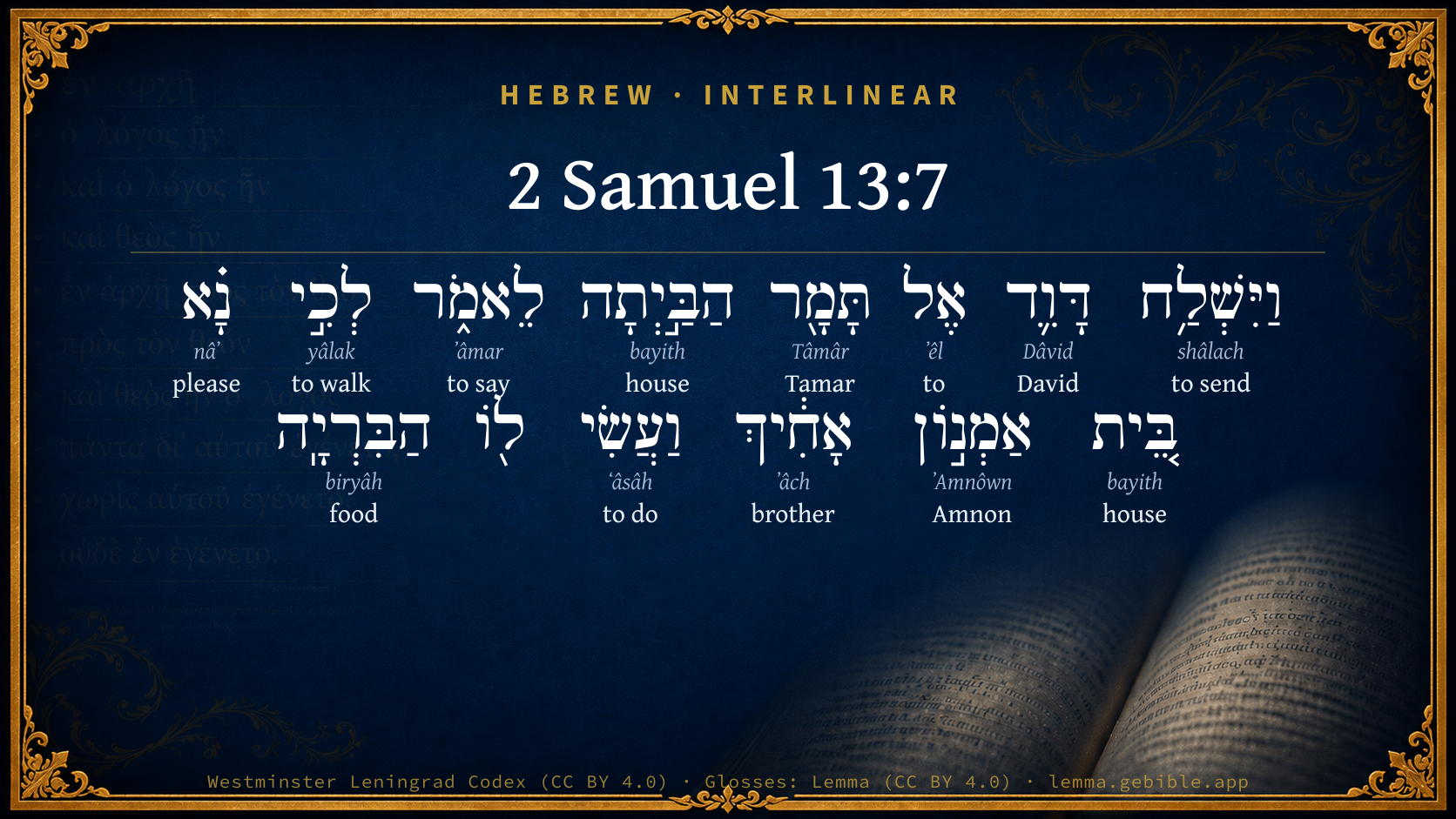
2 Samuel 13:7

Hebrew (Westminster Leningrad Codex) 2 Samuel 13:7 appears in the Hebrew Old Testament. The text above is from the Westminster Leningrad Codex. Each word links to its Strong’s number, a concise gloss, and parsing drawn from the Open Scriptures Hebrew Bible morphology. Click any word for its full Brown-Driver-Briggs (BDB) entry.
Download image
Cite this verse

2 Samuel 13:7 (World English Bible). Public Domain. Lemma interlinear Bible study tool, https://lemma.gebible.app/v/2-samuel/13/7.

Show BibTeX & RIS
BibTeX
RIS
English Translation
Then David sent home to Tamar, saying, Go now to your brother Amnon's house, and dress him food.
World English Bible · Public Domain
Download a study sheet

One document with this verse’s original text, its word-by-word gloss line, the meaning frame, cross-references with their text, attributed commentary, and full source and license credits — printable, and it pastes into notes with its structure intact.

This verse Autodidact and up

Study sheet (.html) Plain text (.txt)

A passage Seminary Student

Up to 50 verses in one chapter. A passage sheet keeps up to 6 commentary sources and 12 cross-references per verse, in the order this page ranks them, and says so on the sheet whenever that leaves anything out. Ask for a single verse and you get the Autodidact verse sheet above.

Everything on this page stays free to read, with no account — the sheet is a download of what is already on screen, not access to it.

Want to remove ads? Support Godless Engineer
Compare translations 3

The same verse in 3 English versions, stacked beneath the original-language interlinear above. Click any original word for its lexicon entry.

Each is an independent rendering of the whole verse — the interlinear is not word-aligned to these translations.

Highlighted words mark where these versions differ — a whole-verse word diff, not a word-by-word alignment.

  • World English Bible Public Domain
    Then David sent home to Tamar, saying, Go now to your brother Amnon's house, and dress him food.
  • King James Version Public Domain
    Then David sent home to Tamar, saying, Go now to thy brother Amnon's house, and dress him meat.
  • unfoldingWord Literal Text CC BY-SA 4.0
    So David sent to Tamar at the house, saying, “Please go the house of Amnon your brother and make food for him.”

unfoldingWord Literal Text — © unfoldingWord, licensed CC BY-SA 4.0. Word-aligned USFM3 via Door43 (git.door43.org/unfoldingWord/en_ult).

Versions to compare (up to 4)

3 of 4 selected

Show all 18 translations

Every available English version of this verse, each an independent rendering of the whole verse.

  • World English Bible Public Domain
    Then David sent home to Tamar, saying, Go now to your brother Amnon's house, and dress him food.
  • Berean Standard Bible Public Domain
    Then David sent word to Tamar at the palace: “Please go to the house of Amnon your brother and prepare a meal for him.”
  • Majority Standard Bible Public Domain
    Then David sent word to Tamar at the palace: “Please go to the house of Amnon your brother and prepare a meal for him.”
  • King James Version Public Domain
    Then David sent home to Tamar, saying, Go now to thy brother Amnon's house, and dress him meat.
  • American Standard Version (1901) Public Domain
    Then David sent home to Tamar, saying, Go now to thy brother Amnon's house, and dress him food.
  • Revised Version (1885) Public Domain
    Then David sent home to Tamar, saying, Go now to thy brother Amnon’s house, and dress him food.
  • Geneva Bible (1599) Public Domain
    Then Dauid sent home to Tamar, saying, Goe now to thy brother Amnons house, and dresse him meate.
  • Douay-Rheims (1899) Public Domain
    Then David sent home to Thamar, saying: Come to the house of thy brother Amnon, and make him a mess.
  • Young's Literal Translation Public Domain
    And David sendeth unto Tamar, to the house, saying, `Go, I pray thee, to the house of Amnon thy brother, and make for him food.'
  • Literal Standard Version CC BY-SA 4.0
    And David sends to Tamar, to the house, saying, “Now go to the house of your brother Amnon and make food for him.”
  • Unlocked Literal Bible CC BY-SA 4.0
    Then David sent word to Tamar at his palace, saying, “Go now to your brother Amnon's house and prepare food for him.”
  • unfoldingWord Literal Text CC BY-SA 4.0
    So David sent to Tamar at the house, saying, “Please go the house of Amnon your brother and make food for him.”
  • Darby Bible Public Domain
    And David sent home to Tamar, saying, Go, I pray thee, to thy brother Amnon's house, and dress him food.
  • World Messianic Bible Public Domain
    Then David sent home to Tamar, saying, “Go now to your brother Amnon’s house, and prepare food for him.”
  • Webster's Bible Public Domain
    Then David sent home to Tamar, saying, Go now to thy brother Amnon's house, and dress meat for him.
  • Free Bible Version CC BY-SA 4.0
    Then David sent a message to Tamar at the palace: “Please be so kind as to go to the house of your brother Amnon and make him some food.”
  • Bible in Basic English Public Domain
    Then David sent to the house for Tamar and said, Go now to your brother Amnon's house and get a meal for him.
  • JPS Tanakh (1917) Public Domain
    Then David sent home to Tamar, saying: 'Go now to thy brother Amnon's house, and dress him food.'

Literal Standard Version (2020), Covenant Press — licensed CC BY-SA 4.0. Text via the HelloAO Bible API (eBible.org). Unlocked Literal Bible (unfoldingWord) — licensed CC BY-SA 4.0. Text via the HelloAO Bible API (eBible.org). unfoldingWord Literal Text — © unfoldingWord, licensed CC BY-SA 4.0. Word-aligned USFM3 via Door43 (git.door43.org/unfoldingWord/en_ult). Free Bible Version, Dr. Jonathan Gallagher — licensed CC BY-SA 4.0. Text via the HelloAO Bible API (eBible.org).

Word by word

More ways to search: Search by grammar → Find every occurrence → Compare this word →

Practice this passage: Drill this verse → Learn its vocabulary →

הַבִּרְיָֽה
biryâh
H1279
“the · food”
Particle, Definite Article + Noun, Common, Feminine, Singular, Absolute
Part of Speech
Particle + Noun
Type
Common
Gender
Feminine
Number
Singular
State
Absolute
Full BDB Definition

Origin: from H1262

TWOT: 281a

food
  1. וַיִּשְׁלַ֥ח shâlach H7971 “and · to send” Conjunction + Verb, Qal, Sequential Imperfect, 3rd Person, Masculine, Singular
  2. דָּוִ֛ד Dâvid H1732 “David” Noun, Proper
  3. אֶל ʼêl H413 “to” Preposition
  4. תָּמָ֖ר Tâmâr H8559 “Tamar” Noun, Proper
  5. הַבַּ֣יְתָה bayith H1004 “the · house · toward” Particle, Definite Article + Noun, Common, Masculine, Singular, Absolute + Suffix, Demonstrative
  6. לֵאמֹ֑ר ʼâmar H559 “to say” Preposition + Verb, Qal, Infinitive Construct
  7. לְכִ֣י yâlak H3212 “walk” Verb, Qal, Imperative, 2nd Person, Feminine, Singular
  8. נָ֗א nâʼ H4994 “please” Particle, Exhortation
  9. בֵּ֚ית bayith H1004 “house of” Noun, Common, Masculine, Singular, Construct
  10. אַמְנ֣וֹן ʼAmnôwn H550 “Amnon” Noun, Proper
  11. אָחִ֔יךְ ʼâch H251 “brother · your” Noun, Common, Masculine, Singular, Construct + Suffix, Personal, 2nd Person, Feminine, Singular
  12. וַעֲשִׂי ʻâsâh H6213 “and · do” Conjunction + Verb, Qal, Imperative, 2nd Person, Feminine, Singular

About this verse

These counts appear in no published source. They are computed here, from the morphology-tagged text and Lemma’s own curated glosses. What Lemma adds →

14
words
12
distinct lemmas
Historical
section

Notable vocabulary

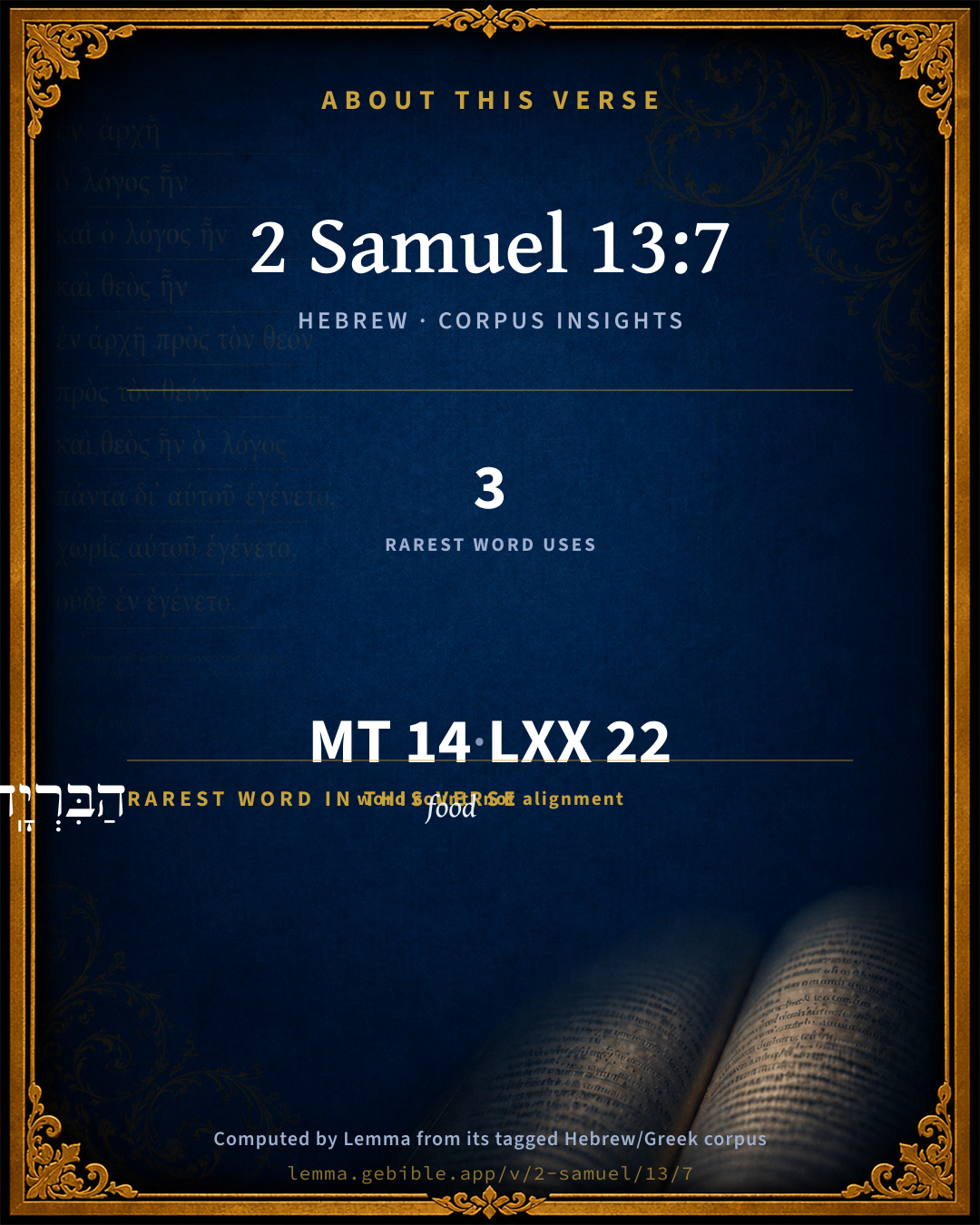
The rarest word here is הַבִּרְיָֽה food H1279 — appearing just 3 times in the whole Hebrew Bible.

Shared distinctive vocabulary

הַבִּרְיָֽה food H1279 occurs in 3 verses of the Hebrew Bible. Also found in:

Grammatical profile

  • 4 verbs
  • 7 nouns
  • 2 prepositions
  • 1 particle

Verb forms

  • וַיִּשְׁלַ֥ח Qal · Sequential Imperfect
  • לֵאמֹ֑ר Qal · Infinitive Construct
  • לְכִ֣י Qal · Imperative
  • וַעֲשִׂי Qal · Imperative

Repetition

A word recurs within this verse — often emphatic in Hebrew:

  • הַבַּ֣יְתָה house H1004 ×2

Hebrew & Septuagint length

In English translation the verse runs 18 words from the Hebrew and 19 from the Septuagint (LXX English) — closely comparable.

A rough comparison of the two English renderings, which tokenize alike — not a word-level alignment.

Word counts can differ between the Hebrew and the Greek without any difference in meaning — e.g. the Hebrew direct-object marker אֵת has no separate Greek word, and Greek often adds the article ὁ.

In the original languages it is 14 Hebrew tokens and 22 Greek tokens — but the two are counted differently (Hebrew bundles its prefixes and suffixes into one token; the Greek is in lemma form), so that isn’t a like-for-like length.

Hebrew and Greek witnesses Masoretic Hebrew ↔ Greek Septuagint

The same verse in the two great witnesses to the Old Testament, shown verse-for-verse.

These are two independent witnesses, not word-aligned to each other, and the Septuagint is shown in lemma (dictionary) form.

Hebrew 2 Samuel 13:7 Masoretic · Westminster Leningrad Codex

וַיִּשְׁלַ֥ח דָּוִ֛ד אֶל תָּמָ֖ר הַבַּ֣יְתָה לֵאמֹ֑ר לְכִ֣י נָ֗א בֵּ֚ית אַמְנ֣וֹן אָחִ֔יךְ וַעֲשִׂי ל֖וֹ הַבִּרְיָֽה

Then David sent home to Tamar, saying, Go now to your brother Amnon's house, and dress him food.

World English Bible · Public Domain

Greek LXX 2 Samuel 13:7 Septuagint · lemma form

καί ἀποστέλλω δαυίδ πρός θημαρ εἰς ὁ οἶκος λέγω πορεύομαι δή εἰς ὁ οἶκος αμνων ὁ ἀδελφός σύ καί ποιέω αὐτός βρῶμα

And David sent to Themar to the house, saying, Go now to your brother's house, and dress him food.

LXX2012 (modern English Septuagint) · Public Domain

Hebrew: Westminster Leningrad Codex (CC BY 4.0). Greek: Septuagint (public domain); English from LXX2012 (modern English Septuagint) (Public Domain). How the Septuagint differs from the Hebrew →

Targum (Aramaic paraphrase)

1

The Targum is the ancient Jewish Aramaic paraphrase of the Hebrew Scriptures — an interpretive translation, not the Hebrew text itself. Onkelos (literal) and Pseudo-Jonathan (expansive) render the Torah, and Jonathan the Prophets. Coverage is partial: where no permissively-licensed English translation exists for a verse, only the Aramaic is shown. This is verse-level text, not a word-by-word alignment to the Hebrew.

  1. Targum Jonathan Prophets (Joshua–Malachi)
    וּשְׁלַח דָוִד לְוַת תָּמָר לְבֵיתָא לְמֵימָר אֱזִילִי כְעַן לְבֵית אַמְנוֹן אֲחוּךְ וֶעֱבִידִי לֵיהּ סְעוּדְתָא:

    (no public-domain English translation for this verse)

    Targum Jonathan — Aramaic: “Mikraot Gedolot” (public domain). English: “Sefaria Community Translation” (CC0 1.0 (public-domain dedication)); “London "Chaldee Paraphrase," 1871” (public domain). Text via Sefaria.

Commentary

Notes on 2 Samuel 13:7 from classic Christian and Jewish commentators (each source and its license shown beneath its notes). The classic Christian expositions comment on the surrounding passage and are grouped to its opening verse, so a note may address several verses; the Jewish commentaries on the Tanakh (Rashi and others) are per-verse, so they appear only where the commentator wrote on this verse.

Lemma curates 59 commentaries, every one of them public domain or Creative Commons licensed, each selected and text-cleaned for this edition rather than reprinted as found. About our sources →

Trapp's Complete Commentary

John Trapp

2Sa 13:7 Then David sent home to Tamar, saying, Go now to thy brother Amnon’s house, and dress him meat.

Ver. 7. Go now to thy brother Amnon’s house.] David might have suspected that there was something more than ordinary in this request of Amnon, that there was vipera sub veprecula, an ill intention in this petition. But God had a purpose to chastise him, and therefore suffereth him to be led blindling to do that which he should shortly repent with every vein of his heart, as we say. Sometimes both grace and wit are asleep in the holiest and wariest breasts.

John Trapp, A Commentary or Exposition upon All the Books of the Old and New Testament (1647–1656) — public domain. Text from a community e-Sword module.

The Cambridge Bible for Schools and Colleges

gen. ed. J. J. S. Perowne

7. home] Into the house: the inner part of the palace, where the women’s apartments were.

to thy brother Amnon’s house] Cp. 2Sa_13:20. Each of the royal princes evidently had a separate house.

The Cambridge Bible for Schools and Colleges (gen. ed. J. J. S. Perowne; Cambridge University Press, 1878–1918) — public domain. Text from a community e-Sword module.

John Gill's Exposition

Then David sent home to Tamar,.... Who perhaps was not in the king's palace, but at her brother Absalom's house, Sa2 13:20,

saying, go now to thy brother Amnon's house; who also had a separate house and equipage, being the king's son, and his eldest son:

and dress him meat; such as he may desire, and his stomach will bear.

John Gill's Exposition of the Whole Bible (1746–1763) — public domain (CC PDM 1.0). Text via the HelloAO Bible API.

Matthew Poole's English Annotations

It is strange that so wise and sagacious a person as David did not see through so vain a pretence; but that must be ascribed partly to the instincts of nature, which generally preserve near relations from such monstrous actions; and partly to God’s providence, which blinded David’s mind, that he might bring upon him the designed and threatened judgments.

Matthew Poole's English Annotations on the Holy Bible (1683–1685) — public domain. Text from a community e-Sword/MySword module.

The Pulpit Commentary

Tamar.

A princess; the daughter of David and Maacah (of Geshur), and sister of Absalom; distinguished for her beauty, modesty, domesticity, obedience (ver. 8), tender heartedness, piety, and misfortunes. In her we see an illustration of (what has often occurred):

1. Purity pursued by licentious desire (ver. 2).

2. Simplicity beset by wily designs (ver. 5).

3. Kindness requited by selfish ingratitude (vers. 9, 10).

4. Confidence exposed to enticing persuasions and perilous temptation( ver. 11).

5. Virtue overpowered by brutal violence (ver. 14).

6. Innocence vilified by guilty aversion (ver. 17). "So fair had she goneforth on what seemed her errand of mercy, so foully had she been driven back" (Edersheim). "Let no one ever expect better treatment from those who are capable of attempting their seduction; but it is better to suffer the greatest wrong than to commit the least sin" (Matthew Henry).

7. Sorrow assuaged by brotherly sympathy (ver. 20).

8. Injury avenged with terrible severity (ver. 28). D.

The Pulpit Commentary (1880–1919), ed. H.D.M. Spence-Jones & Joseph S. Exell — public domain. Text from a community e-Sword module.

unfoldingWord translationNotes

Door43 World Missions Community

David sent word

This means that he sent a messenger to speak to Tamar. AT: "David sent a messenger" (See: Metonymy)

dough

a thick mixture of flour and liquid used for baking

kneaded

used her hands to mix the dough

in his sight

This means that Tamar made the bread in front of him. AT: "in front of him" or "in his presence" (See: Idiom)

So everyone went out from him

To "go out from someone" means to leave them. AT: "So everyone left him" (See: Idiom)

translationWords

David

word

Tamar

palace

Amnon

bread

unfoldingWord translationNotes — © Distant Shores Media and the Door43 World Missions Community, licensed CC BY-SA 4.0. Source: git.door43.org/Door43/en_tn.

Lesson kit

Teaching starters — assembled from the data on this page, not authored interpretation. Every prompt links to the verse data it draws on. Edit before teaching.

2 Samuel, in the Historical, opens this verse with 14 words (12 distinct Hebrew lemmas). Its most distinctive word is biryâh (“food”). A historical commentator’s framing appears above. Read the whole chapter for the surrounding context.

Discussion questions

  1. How does “food” (biryâh) shape what this verse is saying?
  2. 2 Samuel 13:5 shares the word «food» with this verse. How do the two illuminate each other?
  3. “house” occurs 2× in this one verse. What is the effect of the repetition?
  4. These translations render this verse differently; the difference is in the English rendering, not the original. What questions does that raise?
  5. The verb «וַיִּשְׁלַ֥ח» is Qal Sequential Imperfect. How does its form color the action?
  6. Reading how Trapp's Complete Commentary and The Cambridge Bible for Schools and Colleges read this verse, where do the two commentators agree and where do they part?

Things to notice

Reading settings

Reading text

Shown beneath each verse's original-language words.

Old Testament
Old Testament edition

Read the OT as the Masoretic Hebrew (MT) or the Greek Septuagint (LXX).

English shown for the Greek Septuagint (in the Hebrew ↔ Greek comparison).

Comparing translations? Open the Compare panel on any verse page to stack up to four side by side.