Numbers 6:4

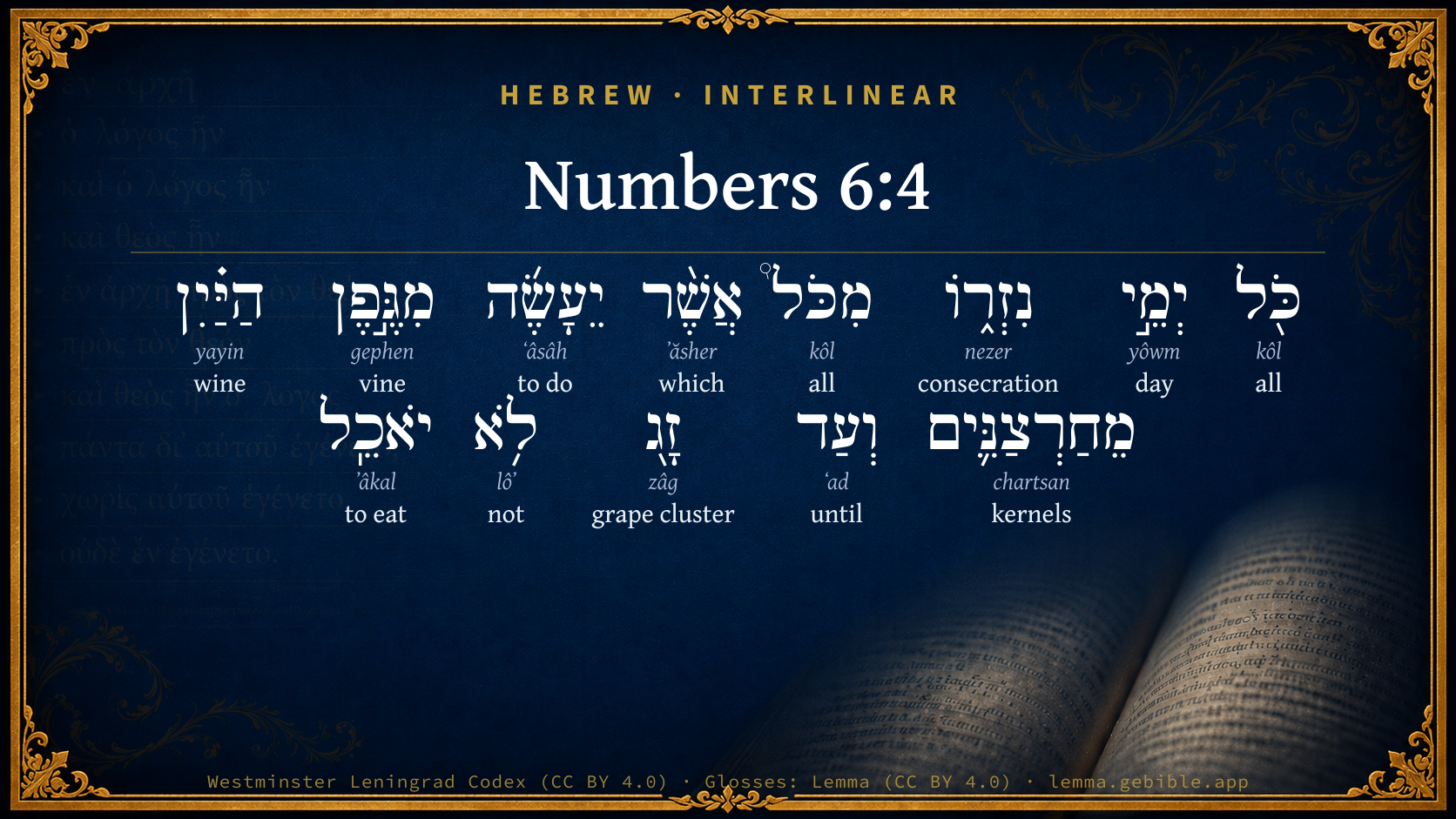
Hebrew (Westminster Leningrad Codex) Numbers 6:4 appears in the Hebrew Old Testament. The text above is from the Westminster Leningrad Codex. Each word links to its Strong’s number, a concise gloss, and parsing drawn from the Open Scriptures Hebrew Bible morphology. Click any word for its full Brown-Driver-Briggs (BDB) entry.
Download image
Cite this verse

Numbers 6:4 (World English Bible). Public Domain. Lemma interlinear Bible study tool, https://lemma.gebible.app/v/numbers/6/4.

Show BibTeX & RIS
BibTeX
RIS
English Translation
All the days of his separation he shall eat nothing that is made of the grapevine, from the seeds even to the skins.
World English Bible · Public Domain
Highlights
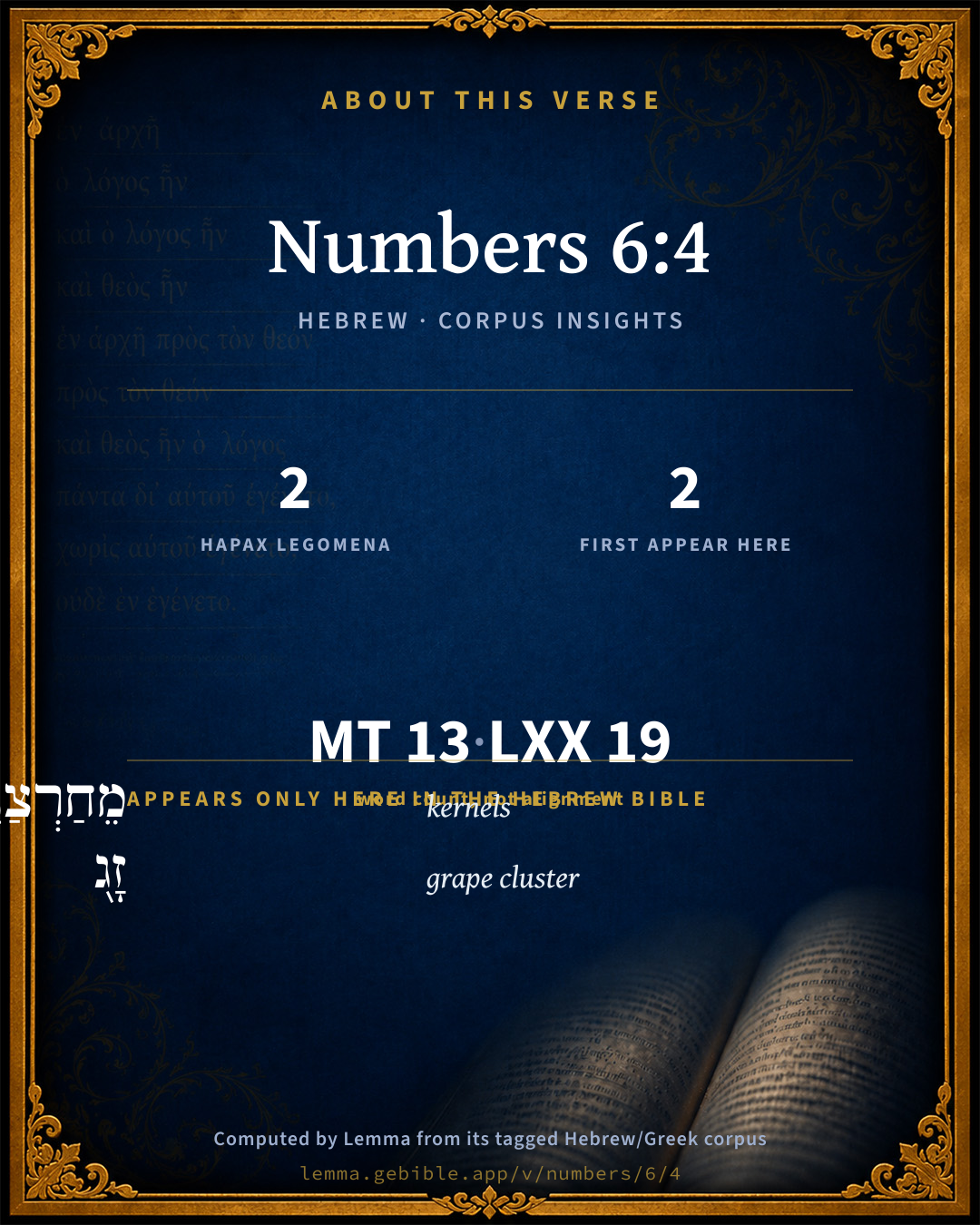
  • 2 hapax legomena — only here in the Hebrew Bible
  • 2 first appearances in the Hebrew Bible
Full analysis ↓
Download a study sheet

One document with this verse’s original text, its word-by-word gloss line, the meaning frame, cross-references with their text, attributed commentary, and full source and license credits — printable, and it pastes into notes with its structure intact.

This verse Autodidact and up

Study sheet (.html) Plain text (.txt)

A passage Seminary Student

Up to 50 verses in one chapter. A passage sheet keeps up to 6 commentary sources and 12 cross-references per verse, in the order this page ranks them, and says so on the sheet whenever that leaves anything out. Ask for a single verse and you get the Autodidact verse sheet above.

Everything on this page stays free to read, with no account — the sheet is a download of what is already on screen, not access to it.

Want to remove ads? Support Godless Engineer
Compare translations 3

The same verse in 3 English versions, stacked beneath the original-language interlinear above. Click any original word for its lexicon entry.

Each is an independent rendering of the whole verse — the interlinear is not word-aligned to these translations.

Highlighted words mark where these versions differ — a whole-verse word diff, not a word-by-word alignment.

  • World English Bible Public Domain
    All the days of his separation he shall eat nothing that is made of the grapevine, from the seeds even to the skins.
  • King James Version Public Domain
    All the days of his separation shall he eat nothing that is made of the vine tree, from the kernels even to the husk.
  • unfoldingWord Literal Text CC BY-SA 4.0
    All the days of his separation, he shall not eat from all that is made from the vine of the wine, from seeds and up to skin.

unfoldingWord Literal Text — © unfoldingWord, licensed CC BY-SA 4.0. Word-aligned USFM3 via Door43 (git.door43.org/unfoldingWord/en_ult).

Versions to compare (up to 4)

3 of 4 selected

Show all 18 translations

Every available English version of this verse, each an independent rendering of the whole verse.

  • World English Bible Public Domain
    All the days of his separation he shall eat nothing that is made of the grapevine, from the seeds even to the skins.
  • Berean Standard Bible Public Domain
    All the days of his separation, he is not to eat anything that comes from the grapevine, not even the seeds or skins.
  • Majority Standard Bible Public Domain
    All the days of his separation, he is not to eat anything that comes from the grapevine, not even the seeds or skins.
  • King James Version Public Domain
    All the days of his separation shall he eat nothing that is made of the vine tree, from the kernels even to the husk.
  • American Standard Version (1901) Public Domain
    All the days of his separation shall he eat nothing that is made of the grape-vine, from the kernels even to the husk.
  • Revised Version (1885) Public Domain
    All the days of his separation shall he eat nothing that is made of the grape-vine, from the kernels even to the husk.
  • Geneva Bible (1599) Public Domain
    As long as his abstinence endureth, shall hee eat nothing that is made of the wine of the vine, neither the kernels, nor the huske.
  • Douay-Rheims (1899) Public Domain
    All the days that they are consecrated to the Lord by vow: they shall eat nothing that cometh of the vineyard, from the raisin even to the kernel.
  • Young's Literal Translation Public Domain
    all days of his separation, of anything which is made of the wine-vine, from kernels even unto husk, he doth not eat.
  • Literal Standard Version CC BY-SA 4.0
    all [the] days of his separation he does not eat of anything which is made of the wine-vine, from kernels even to husk.
  • Unlocked Literal Bible CC BY-SA 4.0
    In all the days that he is separate to me, he must eat nothing that is made from grapes, including everything made from the seeds to their skins.
  • unfoldingWord Literal Text CC BY-SA 4.0
    All the days of his separation, he shall not eat from all that is made from the vine of the wine, from seeds and up to skin.
  • Darby Bible Public Domain
    All the days of his separation shall he eat nothing that is made of the vine, from the seed-stones, even to the skin.
  • World Messianic Bible Public Domain
    All the days of his separation he shall eat nothing that is made of the grapevine, from the seeds even to the skins.
  • Webster's Bible Public Domain
    All the days of his separation shall he eat nothing that is made of the vine-tree, from the kernels even to the husk.
  • Free Bible Version CC BY-SA 4.0
    The whole time they are dedicated to the Lord they must not eat anything from a grapevine, not even grape seeds or skins.
  • Bible in Basic English Public Domain
    All the time he is separate he may take nothing made from the grape-vine, from its seeds to its skin.
  • JPS Tanakh (1917) Public Domain
    All the days of his Naziriteship shall he eat nothing that is made of the grape-vine, from the pressed grapes even to the grapestone.

Literal Standard Version (2020), Covenant Press — licensed CC BY-SA 4.0. Text via the HelloAO Bible API (eBible.org). Unlocked Literal Bible (unfoldingWord) — licensed CC BY-SA 4.0. Text via the HelloAO Bible API (eBible.org). unfoldingWord Literal Text — © unfoldingWord, licensed CC BY-SA 4.0. Word-aligned USFM3 via Door43 (git.door43.org/unfoldingWord/en_ult). Free Bible Version, Dr. Jonathan Gallagher — licensed CC BY-SA 4.0. Text via the HelloAO Bible API (eBible.org).

Word by word

More ways to search: Search by grammar → Find every occurrence → Compare this word →

Practice this passage: Drill this verse → Learn its vocabulary →

מֵחַרְצַנִּ֛ים
chartsan
H2785
“from · kernels”
Preposition + Noun, Common, Masculine, Plural, Absolute
Part of Speech
Preposition + Noun
Type
Common
Gender
Masculine
Number
Plural
State
Absolute
Full BDB Definition

Origin: from H2782

TWOT: 752d

kernels, seeds, insignificant vine product, grape seeds?
  1. כֹּ֖ל kôl H3605 “all of” Noun, Common, Masculine, Singular, Construct
  2. יְמֵ֣י yôwm H3117 “days of” Noun, Common, Masculine, Plural, Construct
  3. נִזְר֑וֹ nezer H5145 “consecration · his” Noun, Common, Masculine, Singular, Construct + Suffix, Personal, 3rd Person, Masculine, Singular
  4. מִכֹּל֩ kôl H3605 “from · all” Preposition + Noun, Common, Masculine, Singular, Absolute
  5. אֲשֶׁ֨ר ʼăsher H834 “which” Particle, Relative
  6. יֵעָשֶׂ֜ה ʻâsâh H6213 “to do” Verb, Niphal, Imperfect, 3rd Person, Masculine, Singular
  7. מִגֶּ֣פֶן gephen H1612 “from · vine of” Preposition + Noun, Common, Both, Singular, Construct
  8. הַיַּ֗יִן yayin H3196 “the · wine” Particle, Definite Article + Noun, Common, Masculine, Singular, Absolute
  9. וְעַד ʻad H5704 “and · until” Conjunction + Preposition
  10. זָ֖ג zâg H2085 “grape cluster” Noun, Common, Masculine, Singular, Absolute
  11. לֹ֥א lôʼ H3808 “not” Particle, Negative
  12. יֹאכֵֽל ʼâkal H398 “to eat” Verb, Qal, Imperfect, 3rd Person, Masculine, Singular

About this verse

These counts appear in no published source. They are computed here, from the morphology-tagged text and Lemma’s own curated glosses. What Lemma adds →

13
words
12
distinct lemmas
Pentateuch
section

Notable vocabulary

2 hapax legomena — words that appear only here in the entire Hebrew Bible:

  • מֵחַרְצַנִּ֛ים kernels H2785
  • זָ֖ג grape cluster H2085

First appearance in Scripture

These words make their first canonical appearance in the Hebrew Bible here:

  • מֵחַרְצַנִּ֛ים kernels H2785
  • זָ֖ג grape cluster H2085

Shared distinctive vocabulary

נִזְר֑וֹ consecration H5145 occurs in 22 verses of the Hebrew Bible. Also found in:

Grammatical profile

  • 2 verbs
  • 8 nouns
  • 1 preposition
  • 2 particles

Verb forms

  • יֵעָשֶׂ֜ה Niphal · Imperfect
  • יֹאכֵֽל Qal · Imperfect

Repetition

A word recurs within this verse — often emphatic in Hebrew:

  • כֹּ֖ל all H3605 ×2

Hebrew & Septuagint length

In English translation the verse runs 23 words from the Hebrew and 27 from the Septuagint (LXX English) — closely comparable.

A rough comparison of the two English renderings, which tokenize alike — not a word-level alignment.

Word counts can differ between the Hebrew and the Greek without any difference in meaning — e.g. the Hebrew direct-object marker אֵת has no separate Greek word, and Greek often adds the article ὁ.

In the original languages it is 13 Hebrew tokens and 19 Greek tokens — but the two are counted differently (Hebrew bundles its prefixes and suffixes into one token; the Greek is in lemma form), so that isn’t a like-for-like length.

Cross-references

5

Topical passages linked to Numbers 6:4 in the Treasury of Scripture Knowledge — connected by theme and wording, ordered by reader-vote popularity; previews shown in the World English Bible.

  • Numbers 6:5 "All the days of his vow of separation there shall no razor come on his head, until the days are fulfilled, in which he separates himself to Yahweh. He shall be holy. He shall let the locks of the hair of his head grow long.
  • Numbers 6:8–9 All the days of his separation he is holy to Yahweh.
  • Numbers 6:12–13 He shall separate to Yahweh the days of his separation, and shall bring a male lamb a year old for a trespass offering; but the former days shall be void, because his separation was defiled.
  • Numbers 6:18–19 The Nazirite shall shave the head of his separation at the door of the Tent of Meeting, and shall take the hair of the head of his separation, and put it on the fire which is under the sacrifice of peace offerings.
  • Numbers 6:21 "This is the law of the Nazirite who vows, and of his offering to Yahweh for his separation, besides that which he is able to get. According to his vow which he vows, so he must do after the law of his separation."

Cross-references courtesy of OpenBible.info (CC BY 4.0).

Hebrew and Greek witnesses Masoretic Hebrew ↔ Greek Septuagint

The same verse in the two great witnesses to the Old Testament, shown verse-for-verse.

These are two independent witnesses, not word-aligned to each other, and the Septuagint is shown in lemma (dictionary) form.

Hebrew Numbers 6:4 Masoretic · Westminster Leningrad Codex

כֹּ֖ל יְמֵ֣י נִזְר֑וֹ מִכֹּל֩ אֲשֶׁ֨ר יֵעָשֶׂ֜ה מִגֶּ֣פֶן הַיַּ֗יִן מֵחַרְצַנִּ֛ים וְעַד זָ֖ג לֹ֥א יֹאכֵֽל

All the days of his separation he shall eat nothing that is made of the grapevine, from the seeds even to the skins.

World English Bible · Public Domain

Greek LXX Numbers 6:4 Septuagint · lemma form

πᾶς ὁ ἡμέρα ὁ εὐχή αὐτός ἀπό πᾶς ὅσος γίγνομαι ἐκ ἄμπελος οἶνος ἀπό στεμφυλόν ἕως γίγαρτον οὐ ἐσθίω

all the days of his vow: he shall eat no one of all the things that come from the vine, wine from the grape-stones to the husk,

LXX2012 (modern English Septuagint) · Public Domain

On this verse, The Pulpit Commentary discusses the Septuagint’s reading. Read the note in Commentary ↓

Hebrew: Westminster Leningrad Codex (CC BY 4.0). Greek: Septuagint (public domain); English from LXX2012 (modern English Septuagint) (Public Domain). How the Septuagint differs from the Hebrew →

Targum (Aramaic paraphrase)

2

The Targum is the ancient Jewish Aramaic paraphrase of the Hebrew Scriptures — an interpretive translation, not the Hebrew text itself. Onkelos (literal) and Pseudo-Jonathan (expansive) render the Torah, and Jonathan the Prophets. Coverage is partial: where no permissively-licensed English translation exists for a verse, only the Aramaic is shown. This is verse-level text, not a word-by-word alignment to the Hebrew.

  1. Targum Onkelos Torah (Genesis–Deuteronomy)
    כֹּל יוֹמֵי נִזְרֵהּ מִכֹּל דְיִתְעֲבֵד מִגֻפְנָא דְחַמְרָא מִפּוּרְצְנִין וְעַד עִצוּרִין לָא יֵיכוּל

    (no public-domain English translation for this verse)

    Targum Onkelos — Aramaic: “Onkelos Genesis” (public domain); “Onkelos Exodus” (public domain); “Onkelos Leviticus” (public domain); “Onkelos Numbers” (public domain); “Onkelos Deuteronomy” (public domain). English: “Sefaria Community Translation” (CC0 1.0 (public-domain dedication)); “J.W. Etheridge. The Targums of Onkelos and Jonathan Ben Uzziel on the Pentateuch. London: Longmans, Green, 1862” (public domain). Text via Sefaria.

  2. Targum Pseudo-Jonathan Torah (Genesis–Deuteronomy)
    כָּל יוֹמֵי נִזְרֵיהּ מִכָּל דְמִתְעֲבֵיד מִגוּפְנָא דְחַמְרָא מִגוּפְנִין מִקְלוּפִין וְעַד זַגִין גַיוָואִין דְעִנְבָא לָא יֵיכוֹל

    All the days of his vow he shall not eat of the tree which maketh wine, from the husks of grapes even to the kernels within them.

    Targum Pseudo-Jonathan — Aramaic: “Targum Jonathan on Genesis” (public domain); “Targum Jonathan on Exodus” (public domain); “Targum Jonathan on Leviticus” (public domain); “Targum Jonathan on Numbers” (public domain); “Targum Jonathan on Deuteronomy” (public domain). English: “The Targum of Jonathan ben Uzziel, trans. J. W. Etheridge, London, 1862” (public domain). Text via Sefaria.

Commentary

Notes on Numbers 6:4 from classic Christian and Jewish commentators (each source and its license shown beneath its notes). The classic Christian expositions comment on the surrounding passage and are grouped to its opening verse, so a note may address several verses; the Jewish commentaries on the Tanakh (Rashi and others) are per-verse, so they appear only where the commentator wrote on this verse.

Lemma curates 59 commentaries, every one of them public domain or Creative Commons licensed, each selected and text-cleaned for this edition rather than reprinted as found. About our sources →

Trapp's Complete Commentary

John Trapp

Num 6:4 All the days of his separation shall he eat nothing that is made of the vine tree, from the kernels even to the husk.

Ver. 4. From the kernels even to the tusk.] Nothing that might occasion, or tempt him to break his vow. All shadows and shows of evil must be shunned: Quicquid fuerit male coloratum, as Bernard hath it; whatsoever looks but ill-favoured. {1Th 5:22 Jdg 1:23} He that would not eat the meat, must not meddle with the broth. He that would not toll the bell, must not tuggle with the rope. He that would shun the blow, must keep aloof from the train.

John Trapp, A Commentary or Exposition upon All the Books of the Old and New Testament (1647–1656) — public domain. Text from a community e-Sword module.

Joseph Benson's Commentary

Num 6:4. All the days of his separation — Some were perpetual Nazarites, being peculiarly devoted to God from the womb, as Samson and John the Baptist. But Moses here speaks of such as made themselves Nazarites only for a time, which might be longer or shorter, as they thought fit to appoint.

Joseph Benson's Commentary on the Old and New Testaments (1811–1818) — public domain. Text from a community e-Sword module.

Ellicott's Commentary for English Readers

(4) From the kernels even to the husk.—The word which is rendered kenels is supposed by some to denote sour grapes, and by others the kernels of berries. The word zag denotes the shell or husk.

A Bible Commentary for English Readers, edited by Charles John Ellicott (1878–1897) — public domain. Text from a community e-Sword module.

The Cambridge Bible for Schools and Colleges

gen. ed. J. J. S. Perowne

4. nothing that is produced by the grape-vine] R.V. ‘made of the grape-vine,’ though a literal rendering of the Hebrew, is misleading. The meaning is evidently that of Jdg_13:14 ‘nothing that cometh forth (יצא) from the grape-vine.’ This meaning of עשה ‘to make,’ or ‘produce,’ in the course of nature is found with some frequency; e.g. Gen_1:11 f., Gen_41:47, Isa_5:2; Isa_5:4; Isa_5:10.

from the kernels even to the husk] The Heb. idiom ‘from … to …’ frequently represents the English ‘either … or …’ or ‘neither … nor …’ Cf. Gen_14:23, lit. ‘from a thread to a shoe-latchet’; Gen_31:24; Gen_31:29 ‘from good to bad.’

The words rendered ‘kernels’ (ḥarẓannîm) and ‘husk’ (zâg) are not found elsewhere in the O.T. and their meaning is uncertain.

It is not very natural to speak of the kernels (i.e. the stones or pips) and the husk (i.e. the skin) of the grape as produced by the vine. But no better rendering of the words has been proposed. The general sense, however, is clear. The eating of any sort of grape product is prohibited, even the most trifling or unpalatable parts of the produce of the vine.

The custom of abstaining from wine and intoxicants may have arisen in a remote past from a primitive belief that the spirit or numen of the vine entered into a man when he drank (see Frazer, Golden Bough, i. 359 f.); or, as Jer_35:6 f. suggests in the case of the Rechabites, it arose from a desire to conform closely to ancient nomadic habits after the nation as a whole had become an agricultural community (W. R. Smith, Prophets of Israel, 84 f.). Whatever the origin may have been, the Naziriteship had, in prophetic times, a valuable moral significance as a protest against luxury and sensuality. See Driver on Amo_2:11.

Again, the prohibition of wine is distinct from that of all intoxicants1 [Note: On intoxicants other than wine see Hastings’ DB. ii. 33b.] . The former is probably the more primitive. And the form of the regulations found here may very possibly have been the result of the fusion of ancient practices which were at one time unconnected, and not all observed by earlier Nazirites.

The Cambridge Bible for Schools and Colleges (gen. ed. J. J. S. Perowne; Cambridge University Press, 1878–1918) — public domain. Text from a community e-Sword module.

John Gill's Exposition

All the days of his separation shall he eat nothing that is made of the vine tree,.... Of its leaves, branches, and fruit, especially the latter, put into any sort of food, or infused into any liquor, or mixed with any sauce for food: the days or time of separation were according as the vow was made, for a shorter or longer time; though the Jews (t) say, where the vow is, absolutely expressed, it is always to be understood of thirty days, during which time the Nazarite was not to eat or drink of any composition that had anything the vine in it:

from the kernels even to the husk; the Jews (u) are divided about the two words here used, which of them signifies the outermost part of the grape, and which the innermost; Ben Gersom agrees with us, but it matters not much who are in the right, since both are forbidden: by this part of the law, the people of God, who are spiritual Nazarites, are taught to live temperately and soberly, and to abstain from all appearance of sin: it is pretty remarkable what the Jews (w) say, that when the son of David comes, it will be free for a Nazarite to drink wine on sabbath days and festivals, though not on week days; from whence it appears, they seem to be conscious of a change of the ceremonial law in his days.

(t) Misn. Nazir, c. 1. sect. 3. & c. 6. sect. 3. (u) Misn. Nazir, c. 6. sect. 2. Aben Ezra in loc. (w) T. Bab. Erubin, fol. 43. 1.

John Gill's Exposition of the Whole Bible (1746–1763) — public domain (CC PDM 1.0). Text via the HelloAO Bible API.

Haydock's Catholic Bible Commentary

Kernel, or stone. Neither the inside nor the outside must be eaten.

George Leo Haydock (1774–1849), Haydock's Catholic Family Bible and Commentary, 1859 edition — public domain. Excludes Psalms (Douay-Rheims chapter numbering differs from Protestant) and Deuterocanonical books (Catholic canon only).

Matthew Poole's English Annotations

The days were sometimes more, sometimes fewer, as he thought fit to appoint.

Matthew Poole's English Annotations on the Holy Bible (1683–1685) — public domain. Text from a community e-Sword/MySword module.

Whedon's Commentary on the Bible

Daniel D. Whedon

4. Kernels — Grape-stones.

Husk — The cuticle or skin.

Daniel D. Whedon (gen. ed.), Commentary on the Old and New Testaments (1874–1909) — public domain. Text from a community e-Sword module.

The Pulpit Commentary

From the kernels oven to the husk, or skin. Of grape-skins it is said that cakes were made which were considered a delicacy, (Hos_3:1, mistranslated "flagons of wine but this is doubtful. The Septuagint has oinon amo stemfolwn ewv gigartou , "wine of grape-skins (the liquor of grapes mentioned before) even to the kernel." The expression is best understood as including anything and everything, however unlikely to be used, connected with the grape. It is clear that the abstinence of the Nazirite extended beyond what might possibly intoxicate to what was simply pleasant to the taste, like raisins, or refreshing, like charnels. The vine represented, by an easy parable, the tree of carnal delights, which yields to the appetite of men such a variety of satisfactions. So among the Romans the Flamen Dialis might not even touch a vine.

The Pulpit Commentary (1880–1919), ed. H.D.M. Spence-Jones & Joseph S. Exell — public domain. Text from a community e-Sword module.

John Wesley's Explanatory Notes

All the days of his separation - Which were sometimes more, sometimes fewer, as he thought fit to appoint.

John Wesley, Explanatory Notes Upon the Whole Bible (1754–1765) — public domain. Text via the GEBible commentary corpus.

Rashi

Rabbi Shlomo Yitzchaki (Rashi)

חרצנים are THE KERNELS....

זג are THE HUSKS (skins) outside. They are called זג (a term also used for a bell) because the kernels are inside them as the clapper is in the bell (cf. Siphre; Nazir 34b; 39a).

Rashi on the Tanakh — English translations: “The Judaica Press complete Tanach with Rashi, translated by A. J. Rosenberg” (CC BY 4.0); “Pentateuch with Rashi's commentary by M. Rosenbaum and A.M. Silbermann, 1929-1934” (public domain); “The Metsudah Tanach series, Lakewood, N.J” (CC BY 4.0); and “The Book of Joshua, Metsudah Publications, 1997” (CC BY 4.0). Text via Sefaria.

Lesson kit

Teaching starters — assembled from the data on this page, not authored interpretation. Every prompt links to the verse data it draws on. Edit before teaching.

Numbers, in the Pentateuch, opens this verse with 13 words (12 distinct Hebrew lemmas). Its most distinctive word is chartsan (“kernels”). A historical commentator’s framing appears above. Read the whole chapter for the surrounding context.

Discussion questions

  1. How does “kernels” (chartsan) shape what this verse is saying?
  2. This verse holds 2 words here found nowhere else in the Hebrew Bible. What might the rare words draw attention to?
  3. 2 words here appear for the first time in Scripture. What is being introduced at this debut?
  4. Exodus 29:6 shares the word «consecration» with this verse. How do the two illuminate each other?
  5. “all” occurs 2× in this one verse. What is the effect of the repetition?
  6. These translations render this verse differently; the difference is in the English rendering, not the original. What questions does that raise?
  7. The verb «יֵעָשֶׂ֜ה» is Niphal Imperfect. How does its form color the action?
  8. Reading how Trapp's Complete Commentary and Joseph Benson's Commentary read this verse, where do the two commentators agree and where do they part?

Things to notice

  • 2 words in this verse appear nowhere else in the Hebrew Bible.
  • 2 words make their first canonical appearance in Scripture here.
  • This verse counts 13 Hebrew ↔ 19 Greek words.
  • These translations choose different wording for 12 words in this verse.
  • “all” occurs 2× in this single verse.

Reading settings

Reading text

Shown beneath each verse's original-language words.

Old Testament
Old Testament edition

Read the OT as the Masoretic Hebrew (MT) or the Greek Septuagint (LXX).

English shown for the Greek Septuagint (in the Hebrew ↔ Greek comparison).

Comparing translations? Open the Compare panel on any verse page to stack up to four side by side.