
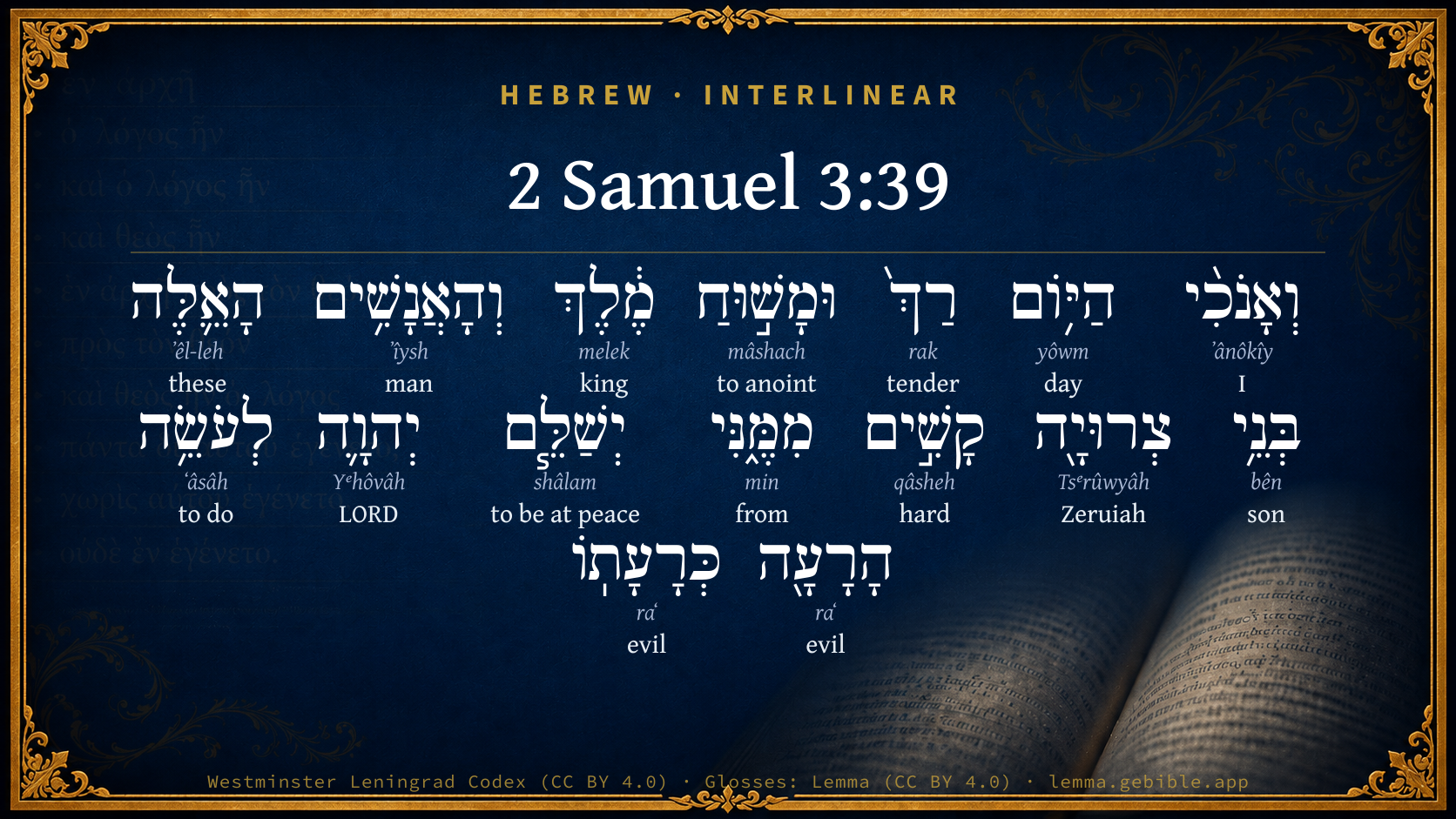
2 Samuel 3:39

Hebrew (Westminster Leningrad Codex) 2 Samuel 3:39 appears in the Hebrew Old Testament. The text above is from the Westminster Leningrad Codex. Each word links to its Strong’s number, a concise gloss, and parsing drawn from the Open Scriptures Hebrew Bible morphology. Click any word for its full Brown-Driver-Briggs (BDB) entry.
Download image
Cite this verse

2 Samuel 3:39 (World English Bible). Public Domain. Lemma interlinear Bible study tool, https://lemma.gebible.app/v/2-samuel/3/39.

Show BibTeX & RIS
BibTeX
RIS
English Translation
I am this day weak, though anointed king; and these men the sons of Zeruiah are too hard for me. May Yahweh reward the evil-doer according to his wickedness."
World English Bible · Public Domain
Download a study sheet

One document with this verse’s original text, its word-by-word gloss line, the meaning frame, cross-references with their text, attributed commentary, and full source and license credits — printable, and it pastes into notes with its structure intact.

This verse Autodidact and up

Study sheet (.html) Plain text (.txt)

A passage Seminary Student

Up to 50 verses in one chapter. A passage sheet keeps up to 6 commentary sources and 12 cross-references per verse, in the order this page ranks them, and says so on the sheet whenever that leaves anything out. Ask for a single verse and you get the Autodidact verse sheet above.

Everything on this page stays free to read, with no account — the sheet is a download of what is already on screen, not access to it.

Want to remove ads? Support Godless Engineer
Compare translations 3

The same verse in 3 English versions, stacked beneath the original-language interlinear above. Click any original word for its lexicon entry.

Each is an independent rendering of the whole verse — the interlinear is not word-aligned to these translations.

Highlighted words mark where these versions differ — a whole-verse word diff, not a word-by-word alignment.

  • World English Bible Public Domain
    I am this day weak, though anointed king; and these men the sons of Zeruiah are too hard for me. May Yahweh reward the evil-doer according to his wickedness."
  • King James Version Public Domain
    And I am this day weak, though anointed king; and these men the sons of Zeruiah be too hard for me: the LORD shall reward the doer of evil according to his wickedness.
  • unfoldingWord Literal Text CC BY-SA 4.0
    And I weak today, though anointed king. For these men, the sons of Zeruiah, more harsh than I. May Yahweh repay the one doing evil according to his evil.”

unfoldingWord Literal Text — © unfoldingWord, licensed CC BY-SA 4.0. Word-aligned USFM3 via Door43 (git.door43.org/unfoldingWord/en_ult).

Versions to compare (up to 4)

3 of 4 selected

Show all 18 translations

Every available English version of this verse, each an independent rendering of the whole verse.

  • World English Bible Public Domain
    I am this day weak, though anointed king; and these men the sons of Zeruiah are too hard for me. May Yahweh reward the evil-doer according to his wickedness."
  • Berean Standard Bible Public Domain
    And I am weak this day, though anointed as king, and these men, the sons of Zeruiah, are too fierce for me. May the LORD repay the evildoer according to his evil!”
  • Majority Standard Bible Public Domain
    And I am weak this day, though anointed as king, and these men, the sons of Zeruiah, are too fierce for me. May the LORD repay the evildoer according to his evil!”
  • King James Version Public Domain
    And I am this day weak, though anointed king; and these men the sons of Zeruiah be too hard for me: the LORD shall reward the doer of evil according to his wickedness.
  • American Standard Version (1901) Public Domain
    And I am this day weak, though anointed king; and these men the sons of Zeruiah are too hard for me: Jehovah reward the evil-doer according to his wickedness.
  • Revised Version (1885) Public Domain
    And I am this day weak, though anointed king; and these men the sons of Zeruiah be too hard for me: the LORD reward the wicked doer according to his wickedness.
  • Geneva Bible (1599) Public Domain
    And I am this day weake and newly anoynted King: and these men the sonnes of Zeruiah be too harde for me: the Lord rewarde the doer of euill according to his wickednesse.
  • Douay-Rheims (1899) Public Domain
    But I as yet am tender, though anointed king. And these men the sons of Sarvia are too hard for me: the Lord reward him that doth evil according to his wickedness.
  • Young's Literal Translation Public Domain
    and I to-day `am' tender, and an anointed king: and these men, sons of Zeruiah, `are' too hard for me; Jehovah doth recompense to the doer of the evil according to his evil.'
  • Literal Standard Version CC BY-SA 4.0
    And today I [am] tender, and an anointed king: and these men, sons of Zeruiah, [are] too hard for me; YHWH repays to the doer of the evil according to his evil.”
  • Unlocked Literal Bible CC BY-SA 4.0
    Now I am weak today, though I am an anointed king. These men, the sons of Zeruiah, are too brutal for me. May Yahweh repay the evildoer by punishing him for his wickedness, as he deserves.”
  • unfoldingWord Literal Text CC BY-SA 4.0
    And I weak today, though anointed king. For these men, the sons of Zeruiah, more harsh than I. May Yahweh repay the one doing evil according to his evil.”
  • Darby Bible Public Domain
    And I am this day weak, though anointed king; and these men, the sons of Zeruiah, are too hard for me: Jehovah reward the doer of evil according to his wickedness!
  • World Messianic Bible Public Domain
    I am weak today, though anointed king. These men, the sons of Zeruiah are too hard for me. May the LORD reward the evildoer according to his wickedness.”
  • Webster's Bible Public Domain
    And I am this day weak, though anointed king; and these men the sons of Zeruiah are too hard for me. The LORD shall reward the doer of evil according to his wickedness.
  • Free Bible Version CC BY-SA 4.0
    I am weak right now, even though I'm anointed as king and these men, the sons of Zeruiah, are too powerful for me. But may the Lord repay the evil man according to the evil he has done.”
  • Bible in Basic English Public Domain
    While I, though I am crowned king, have little strength, and these men, the sons of Zeruiah, are out of my control: may the Lord give to the evil-doer the reward of his evil-doing!
  • JPS Tanakh (1917) Public Domain
    And I am this day weak, and just anointed king; and these men the sons of Zeruiah are too hard for me; the LORD reward the evildoer according to his wickedness.'

Literal Standard Version (2020), Covenant Press — licensed CC BY-SA 4.0. Text via the HelloAO Bible API (eBible.org). Unlocked Literal Bible (unfoldingWord) — licensed CC BY-SA 4.0. Text via the HelloAO Bible API (eBible.org). unfoldingWord Literal Text — © unfoldingWord, licensed CC BY-SA 4.0. Word-aligned USFM3 via Door43 (git.door43.org/unfoldingWord/en_ult). Free Bible Version, Dr. Jonathan Gallagher — licensed CC BY-SA 4.0. Text via the HelloAO Bible API (eBible.org).

Word by word

More ways to search: Search by grammar → Find every occurrence → Compare this word →

Practice this passage: Drill this verse → Learn its vocabulary →

רַךְ֙
rak
H7390
“tender”
Adjective, Adjective, Masculine, Singular, Absolute
Part of Speech
Adjective
Type
Adjective
Gender
Masculine
Number
Singular
State
Absolute
Full BDB Definition

Origin: from H7401

TWOT: 2164a

tender, soft, delicate, weak - tender, delicate (of flesh) - weak of heart, timid - soft (of words) - gentle words (substantive)
  1. וְאָנֹכִ֨י ʼânôkîy H595 “and · I” Conjunction + Pronoun, Personal, 1st Person, Common, Singular
  2. הַיּ֥וֹם yôwm H3117 “the · day” Particle, Definite Article + Noun, Common, Masculine, Singular, Absolute
  3. וּמָשׁ֣וּחַ mâshach H4886 “and · anointed” Conjunction + Verb, Qal, Participle Passive, Masculine, Singular, Absolute
  4. מֶ֔לֶךְ melek H4428 “king” Noun, Common, Masculine, Singular, Absolute
  5. וְהָאֲנָשִׁ֥ים ʼîysh H376 “and · the · men” Conjunction + Particle, Definite Article + Noun, Common, Masculine, Plural, Absolute
  6. הָאֵ֛לֶּה ʼêl-leh H428 “the · these” Particle, Definite Article + Pronoun, Demonstrative, Common, Plural
  7. בְּנֵ֥י bên H1121 “sons of” Noun, Common, Masculine, Plural, Construct
  8. צְרוּיָ֖ה Tsᵉrûwyâh H6870 “Zeruiah” Noun, Proper
  9. קָשִׁ֣ים qâsheh H7186 “hard” Adjective, Adjective, Masculine, Plural, Absolute
  10. מִמֶּ֑נִּי min H4480 “from · me” Preposition + Suffix, Personal, 1st Person, Common, Singular
  11. יְשַׁלֵּ֧ם shâlam H7999 “to be at peace” Verb, Piel, Jussive, 3rd Person, Masculine, Singular
  12. יְהוָ֛ה Yᵉhôvâh H3068 “LORD” Noun, Proper
  13. לְעֹשֵׂ֥ה ʻâsâh H6213 “to/for · doing” Preposition + Verb, Qal, Participle Active, Masculine, Singular, Construct
  14. הָרָעָ֖ה raʻ H7451 “the · evil” Particle, Definite Article + Noun, Common, Feminine, Singular, Absolute
  15. כְּרָעָתֽוֹ raʻ H7451 “like/as · evil · his” Preposition + Noun, Common, Feminine, Singular, Construct + Suffix, Personal, 3rd Person, Masculine, Singular

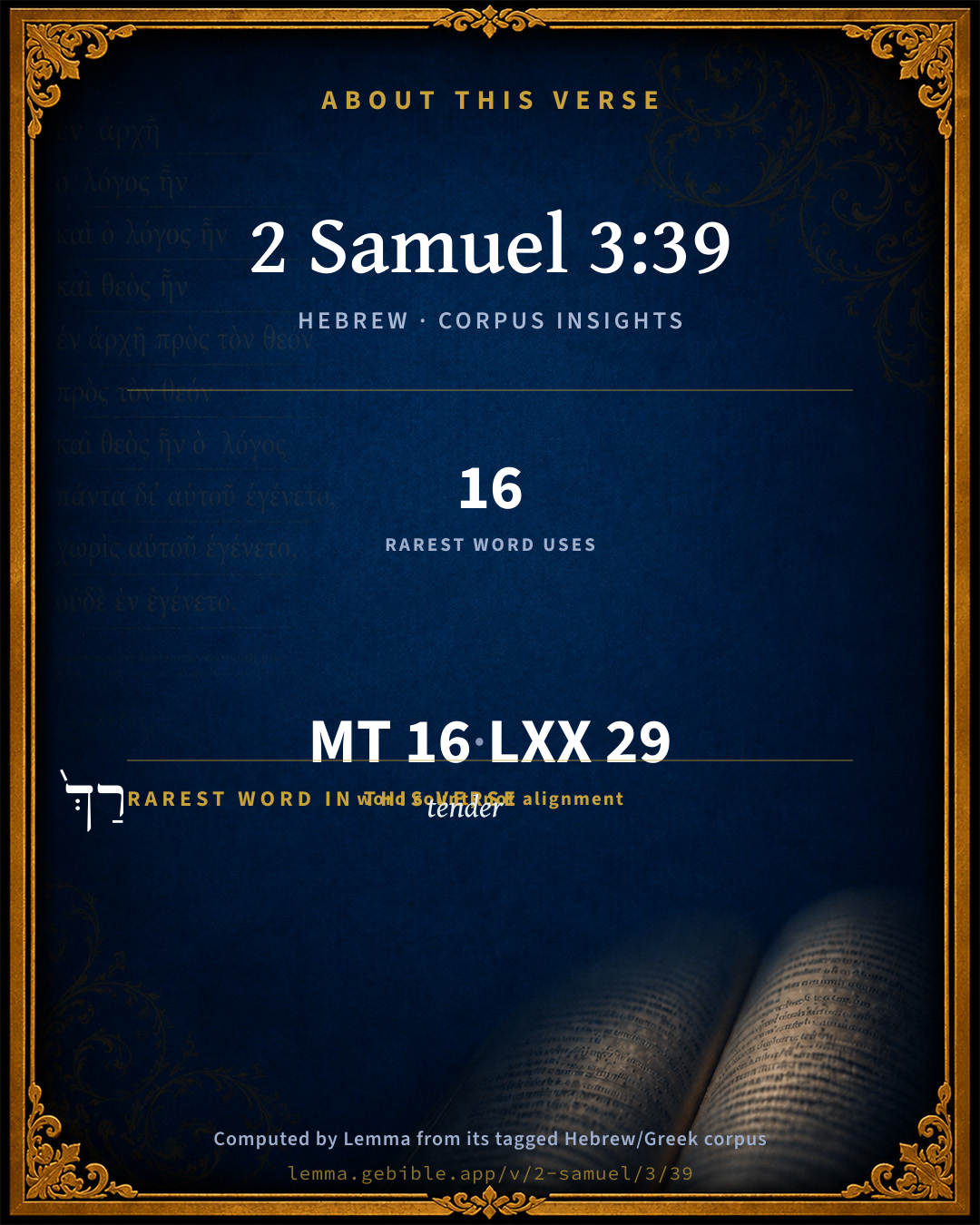
About this verse

These counts appear in no published source. They are computed here, from the morphology-tagged text and Lemma’s own curated glosses. What Lemma adds →

16
words
15
distinct lemmas
Historical
section

Notable vocabulary

The rarest word here is רַךְ֙ tender H7390 — appearing just 16 times in the whole Hebrew Bible.

Shared distinctive vocabulary

רַךְ֙ tender H7390 occurs in 16 verses of the Hebrew Bible. Also found in:

Grammatical profile

  • 3 verbs
  • 8 nouns
  • 2 adjectives
  • 2 pronouns
  • 1 preposition

Verb forms

  • וּמָשׁ֣וּחַ Qal · Participle Passive
  • יְשַׁלֵּ֧ם Piel · Jussive
  • לְעֹשֵׂ֥ה Qal · Participle Active

Repetition

A word recurs within this verse — often emphatic in Hebrew:

  • הָרָעָ֖ה evil H7451 ×2

Hebrew & Septuagint length

In English translation the verse runs 29 words from the Hebrew and 38 from the Septuagint (LXX English) — closely comparable.

A rough comparison of the two English renderings, which tokenize alike — not a word-level alignment.

Word counts can differ between the Hebrew and the Greek without any difference in meaning — e.g. the Hebrew direct-object marker אֵת has no separate Greek word, and Greek often adds the article ὁ.

In the original languages it is 16 Hebrew tokens and 29 Greek tokens — but the two are counted differently (Hebrew bundles its prefixes and suffixes into one token; the Greek is in lemma form), so that isn’t a like-for-like length.

Cross-references

18

Topical passages linked to 2 Samuel 3:39 in the Treasury of Scripture Knowledge — connected by theme and wording, ordered by reader-vote popularity; previews shown in the World English Bible.

  • Psalms 28:4 Give them according to their work, and according to the wickedness of their doings. Give them according to the operation of their hands. Bring back on them what they deserve.
  • Psalms 101:8 Morning by morning, I will destroy all the wicked of the land; To cut off all the workers of iniquity from Yahweh's city.
  • 1 Kings 2:33–34 So shall their blood return on the head of Joab, and on the head of his seed forever: but to David, and to his seed, and to his house, and to his throne, shall there be peace for ever from Yahweh.
  • Psalms 62:12 Also to you, Lord, belongs loving kindness, For you reward every man according to his work.
  • Proverbs 25:5 Take away the wicked from the king's presence, And his throne will be established in righteousness.
  • 1 Kings 2:5–6 Moreover you know also what Joab the son of Zeruiah did to me, even what he did to the two captains of the hosts of Israel, to Abner the son of Ner, and to Amasa the son of Jether, whom he killed, and shed the blood of war in peace, and put the blood of war on his sash that was about his loins, and in his shoes that were on his feet.
  • 2 Chronicles 19:6–7 and said to the judges, Consider what you do: for you don't judge for man, but for Yahweh; and [he is] with you in the judgment.
  • Romans 13:4 for he is a servant of God to you for good. But if you do that which is evil, be afraid, for he doesn't bear the sword in vain; for he is a minister of God, an avenger for wrath to him who does evil.
  • 2 Timothy 4:14 Alexander, the coppersmith, did much evil to me. The Lord will repay him according to his works,
  • Exodus 21:12 "One who strikes a man so that he dies shall surely be put to death,
  • 2 Samuel 19:5–7 Joab came into the house to the king, and said, You have shamed this day the faces of all your servants, who this day have saved your life, and the lives of your sons and of your daughters, and the lives of your wives, and the lives of your concubines;
  • 2 Samuel 19:13 Say you to Amasa, Aren't you my bone and my flesh? God do so to me, and more also, if you aren't captain of the host before me continually in the room of Joab.
  • 1 Chronicles 2:15–16 Ozem the sixth, David the seventh;
  • 1 Chronicles 22:5 David said, Solomon my son is young and tender, and the house that is to be built for Yahweh must be exceedingly magnificent, of fame and of glory throughout all countries: I will therefore make preparation for it. So David prepared abundantly before his death.
  • Psalms 7:16 The trouble he causes shall return to his own head. His violence shall come down on the crown of his own head.
  • Psalms 75:10 I will cut off all the horns of the wicked, But the horns of the righteous shall be lifted up.
  • Proverbs 20:8 A king who sits on the throne of judgment Scatters away all evil with his eyes.
  • Isaiah 7:4 Tell him, 'Be careful, and keep calm. Don't be afraid, neither let your heart be faint because of these two tails of smoking firebrands, for the fierce anger of Rezin and Syria, and of the son of Remaliah.

Cross-references courtesy of OpenBible.info (CC BY 4.0).

Hebrew and Greek witnesses Masoretic Hebrew ↔ Greek Septuagint

The same verse in the two great witnesses to the Old Testament, shown verse-for-verse.

These are two independent witnesses, not word-aligned to each other, and the Septuagint is shown in lemma (dictionary) form.

Hebrew 2 Samuel 3:39 Masoretic · Westminster Leningrad Codex

וְאָנֹכִ֨י הַיּ֥וֹם רַךְ֙ וּמָשׁ֣וּחַ מֶ֔לֶךְ וְהָאֲנָשִׁ֥ים הָאֵ֛לֶּה בְּנֵ֥י צְרוּיָ֖ה קָשִׁ֣ים מִמֶּ֑נִּי יְשַׁלֵּ֧ם יְהוָ֛ה לְעֹשֵׂ֥ה הָרָעָ֖ה כְּרָעָתֽוֹ

I am this day weak, though anointed king; and these men the sons of Zeruiah are too hard for me. May Yahweh reward the evil-doer according to his wickedness."

World English Bible · Public Domain

Greek LXX 2 Samuel 3:39 Septuagint · lemma form

καί ὅτι ἐγώ εἰμί σήμερον συγγενής καί καταἵστημι ὑπό βασιλεύς ὁ δέ ἀνήρ οὗτος υἱός σαρουιας σκληρός ἐγώ εἰμί ἀντι ἀποδίδωμι κύριος ὁ ποιέω πονηρός κατά ὁ κακία αὐτός

And that I am this day a mere kinsman of his, and as it were a subject; but these men the sons of Saruia are too hard for me: the Lord reward the evil-doer according to his wickedness.

LXX2012 (modern English Septuagint) · Public Domain

On this verse, Haydock's Catholic Bible Commentary discusses the Septuagint’s reading. Read the note in Commentary ↓

Hebrew: Westminster Leningrad Codex (CC BY 4.0). Greek: Septuagint (public domain); English from LXX2012 (modern English Septuagint) (Public Domain). How the Septuagint differs from the Hebrew →

Targum (Aramaic paraphrase)

1

The Targum is the ancient Jewish Aramaic paraphrase of the Hebrew Scriptures — an interpretive translation, not the Hebrew text itself. Onkelos (literal) and Pseudo-Jonathan (expansive) render the Torah, and Jonathan the Prophets. Coverage is partial: where no permissively-licensed English translation exists for a verse, only the Aramaic is shown. This is verse-level text, not a word-by-word alignment to the Hebrew.

  1. Targum Jonathan Prophets (Joshua–Malachi)
    וַאֲנָא יוֹמָא דֵין הֶדְיוֹט וּמְרַבֵּי לְמַלְכָּא וְגַבְרַיָא הָאִלֵין בְּנֵי צְרוּיָה קָשָׁן מִנִי יְשַׁלֵם יְיָ לְעַבְדֵי בִּישְׁתָא כְּבִישְׁתֵיהּ:

    (no public-domain English translation for this verse)

    Targum Jonathan — Aramaic: “Mikraot Gedolot” (public domain). English: “Sefaria Community Translation” (CC0 1.0 (public-domain dedication)); “London "Chaldee Paraphrase," 1871” (public domain). Text via Sefaria.

Commentary

Notes on 2 Samuel 3:39 from classic Christian and Jewish commentators (each source and its license shown beneath its notes). The classic Christian expositions comment on the surrounding passage and are grouped to its opening verse, so a note may address several verses; the Jewish commentaries on the Tanakh (Rashi and others) are per-verse, so they appear only where the commentator wrote on this verse.

Lemma curates 59 commentaries, every one of them public domain or Creative Commons licensed, each selected and text-cleaned for this edition rather than reprinted as found. About our sources →

Trapp's Complete Commentary

John Trapp

2Sa 3:39 And I [am] this day weak, though anointed king; and these men the sons of Zeruiah [be] too hard for me: the LORD shall reward the doer of evil according to his wickedness.

Ver. 39. And I am this day weak.] Heb., Tender; {a} weak he was in force, but weaker in faith, for he had God’s promise: and as Hezekiah afterwards trusted in God, and pulled down the brazen serpent, so should David have done justice upon Joab whatever had come of it. {Gen 9:6} Fiat iustitia, ruat caelum.

Be too hard for me.] If I provoke them, being so potent with the army, they may serve me as Abner did Ishbosheth in a displeasure, - thus carnal reason argued, {b} - I shall with the right hand cut off the left, as Honorius did when he destroyed Stillico: and as the Lord Protector did when he cut off his brother the admiral here in King Edward VI’s reign.

{a} Metaph. a puero tenero et imbelli: or from a young plant easily plucked up. - Jun.

{b} Mussitanda igitur ad tempus haec iniuria est. - Jun.

John Trapp, A Commentary or Exposition upon All the Books of the Old and New Testament (1647–1656) — public domain. Text from a community e-Sword module.

The Biblical Illustrator

Joseph S. Exell

2Sa_3:39

I am this day weak, though anointed king.

Balancings in life

David utters the words which hint at something concerning the balancings in life.

I. Some disappointment is sure to follow upon the attainment of our hopes and to intermingle with our joys. Men struggle for riches all life long, and when they have gained them, oft have no power of enjoyment left. The argosy of food is just coming into port, but somehow is caught by the tide, driven behind the pier, and wrecked on the rugged rocks outside. The topmost step of the throne is reached, the sceptre grasped, the crown placed on the head, when the thorn is felt pressing into the tender brow and the paean of joy is toned by the minor note of sorrow. This is not the invariable experience, but general. One might say that the exceptions establish the rule.

II. These balancings in life are intended by the author of all life. God has not promised that ease shall always follow on effort, nor full peace come immediately a victory is won. It is of the Divine appointment that those who have wealth, powers, or high position shall often have also strong jealousies, bitter annoyances, severe domestic troubles, great losses, unfulfilled expectations, and harsh regrets over unrealized ideas. That man of genteel manners and calm exterior has a very Vesuvius in his breast. You see not the throes that disturb his soul. So poverty and weakness, sickness and solitude, as well as strength and riches, have their balancings. Power can grow out of privation, and strength out of suffering, while ennui may be the offspring of pleasurable ease and satiety of constant satisfaction. All happiness has its alloy and all sorrow its surcease. This is by Divine arrangement. These thoughts should teach us--

1. To find all our joy and strength in God.

2. To be thankful for any balancings that may develop being and life.

3. To see to it that we so live that no painful counterbalancing may follow upon this life in the future; to be careful lest the very greatness of the glory and richness of the reward should only make us feel how meagre was our earth-life and unpardonable our spiritual coldness.

4. That we should never let despondency seize us, remembering these balancings in life.

5. Many are weak and know it not. They are anointed heirs of God, kings and priests, but through sin they are weak every day. David knew what he had lost when Abner was taken; but many so live that they ignore the loss they suffer by their wilful ignorance of Christ, through whom alone any can be really strong and kingly in spirit. (Frederick Hastinas.)

Mans weakness and Gods anointing

I. We hay be anointed, and yet weak. Every believer is an anointed king. He was really anointed in the covenant of election before the world was. When Jesus Christ was set up from everlasting, His people were really set up in Him. Every child of God also was actually anointed when Jesus Christ ascended up on high, and led captivity captive and received gifts for men. But in our souls, our anointing time comes in that hour when, being called by grace and washed from sin, we begin to reign over sin, self, the world, death, and hell, by virtue of our union with Christ. Every believer is a king to-day. And yet it is quite possible that he may be groaning out, I am weak; for weakness and Divine Anointing may stand together. Gods children are often very weak in faith: they stagger at the promise through unbelief. It is not always in their power to set to their seal that God is true. Christians have ebbs of faith as well as floods; they have winters as well as summers; they have times of drought, and years of famine. The weakness of a Christians faith may also affect all his other graces. It must do so; for when faith is strong, every other grace is strong; when that is weak, all things else decline. It may be to-day that your hope has become very dim; you are in bondage through fear of death, and see not the mansions in the skies. You have forgotten that you are in Christ, and now you no more look for His appearing. Your hope declines, and all your comfort dies.

1. Let me remark that David at this special time felt his weakness, more particularly because he was in a new position. He has come into a new place--nations are at his feet--men bow before him; it is a new position, and he says, I am this day weak, though anointed king. Whenever you make a change in life; whenever God calls you to another set of duties, you will surely find out what perhaps you do not now believe--that you are weak, though anointed king.

2. Here, too, David had come into new temptation. The arrows had been shot at him before, from one direction alone, now the storm caeses on one side, and begins on the other. If men knew that the storm would always ,come to one side of the house they would repair and strengthen it, and then they would not fear the blast; but if on a sudden it whirled round and took the other corner, how would they be prepared for that? Where there is the honey of royalty, there will surely be the wasps of temptations. High places and Gods praise do seldom well agree; a full cup is not easily carried without spilling, and he that stands on a pinnacle needs a clear head and much grace.

3. And then further, David had now come into new duties. It was his duty to have taken Joab and have made him suffer the full penalty of the law for having killed Abner. A king must defend the oppressed and avenge the murdered, but David fails to perform the new duty, for he feels that he is too weak.

II. It was but little wonderful that Davids kingdom was weak, for it was but newly gained; and it is but little marvel if we also are very weak in the beginning of our spiritual life. When a king has had time to set himself down upon his throne, and to sweep away before him this party and that, either by politics or by the power of the sword, and so to put down every rival, then his throne becomes confirmed. Young Christian, it is no wonder that you are weak, when the good work has only lately begun with you. See the lambs in the fold: it is well that they have been shorn in good weather, for what would become of the shorn lamb in the untempered wind? Shall we suppose that the young sapling shall stand as firmly as the oak with its gnarled roots and its hoary branches, which have been twisted together by many a storm? What! Shall a babe fight a battle? Shall a new-born infant go forth to war? Do you wonder because the new creature is weak? Wonder rather at its power, than at its weakness.

III. David was weak only in the flesh, and that the Christian truly is only weak there. Why was David weak? Because, said he, the sons of Zeruiah are too hard for me. I cannot subdue them; I cannot keep them under; I cannot manage any kingdom whilst such turbulent spirits as these interfere and intermeddle with everything.

IV. It is where the flesh is strong that we are weak. Why was not David strong? Why, because of the sons of Zeruiah, yet these sons of Zeruiah were his greatest strength. What could he have done without Joab and Abishai--Joab the man who smote the garrison of Jebus, and Abishai who slew three hundred men in single-handed fight. What could he do without these? These were Davids mighty men, those who always led the van, and with a tremendous shout dashed among the Philistines, and scattered the uncircumcised. So it is with us. Whatever is our strength in the flesh is sure to be our weakness in the spirit. Remember that your sons of Zeruiah will be hard to manage. I believe the strength of God, s ministers generally lies in the points where they are the weakest, and their weakness usually lies in their strength. That is to say, natural strength will be toned down by a spiritual weakness, and a natural weakness will be exalted and be made the vehicle and channel for spiritual strength. It has often been so. The very physical appearance of Paul, his personal presence which was said to be weak and contemptible, becomes to him the subject of glorying. He glories in his infirmity, for it is the means of giving honour to God. This is strange logic, says one. It is; Gods logic is strange. Gideon fears the Midianites because of the slender number of his soldiers, but the Lord says, the people are yet too many for me. The king of Judah on another occasion hires for himself with so many hundred thousand talents a number of mercenary troops from the king of Israel. Now, says he, I shall win the battle; but before the battle begins the prophet bids him send these men back. God can do better without means than he can with means that are audacious enough to think themselves necessary. The Lord will always throw the sword away from his hand when that sword begins to boast itself. Assyria is his axe to cut down the cedars, but if you set down any good thing you have ever done to yourself, God will bring you down.

V. Our weakness shall not prevent our reigning by-and-by. Davids kingdom did not shake, even when his heart failed him; and it would have stood just as fast if he had knocked away Joab and Abishai, who seemed to be the props that supported it. It was Davids business to believe that come what may Gods purpose must stand, and God will do all His pleasure. It is just the same with you, Christian, to-day. However weak you may be, and whatever means may have failed you, remember God hath said it--you shall be saved; He has promised that you shall be glorified with Christ; and so you must be, come fair, come foul. (C H. Spurgeon.)

Strong yet weak

I. Much of our weakness arises from want of faith in the lovingkindness of God. Now, many of us think that unless we have money and health and friends, God does not trouble about us. And this want of faith in His love and care makes us weak in every step of life. Instead of being cheerful, we are full of anxiety, and instead of being joyous as a lark we mope like a chained dog that has no dinner.

1. Let us have sincere faith in God.

2. Hold on to faith in another world. Let no man wrest that faith from you.

3. Hold on to this faith, and it will make you strong to bear burdens, to resist temptations, to endure sufferings, and to die in peace.

II. Another thing that weakens us is when we permit ourselves to be soured in temper because of defeat or opposition in life. We ought to feel ashamed of ourselves when we complain of our surroundings. Be cheerful in heart, trusting God. Dont be soured by the so-called evils of life; but sing joyfully as you go along.

III. Another cause of our weakness is that while some of us put off the devils regimentals, we omit to put on Christian armour. The Lord Jesus tells of a man who cleansed his house. He turned out the big devils and made his house beautiful. After awhile, one Of the devils returned, and seeing the house garnished but empty--not filled with angels in place of the devils--he entered and brought with him ten Other devils worse than himself. It is so, alas I with many professors. They turn out the big, ugly devils, but they forget to take in the angels. If your heart be empty of a great and powerful love for God and mankind, sin will enter in, and show itself very soon in your life. (W. Birch.)

Folly of being powerless

If an electric car stands motionless on the tracks, it is nothing against the power of electricity. If an invalid has no appetite, and cannot go out of doors at night, it is no argument against things good to eat and the joy of starlit air. If a man does not know a flower by name nor a poem by heart, it is no indictment of the beauty of a rose or the charm of some poem. If we bear the name of Christ, but give no other sign of Him, if we go through the forms of godliness but live powerless lives, it is a thousand reproaches to us. To be powerless when Christ has all power, and we can have all we want, is an arraignment to which we can make no answer that is not self-incriminating. (Christian Weekly.)

The limits of human supremacy

To his confidential servants David speaks his whole mind freely. He feels that some apology is needed for leaving the authors of this heinous crime unpunished. As an excuse for doing so he pleads his youth and weakness. Though he had been anointed king, his kingdom was as yet far from being securely established, he could not dispense with his warlike nephews help. He dared not order the execution of his best general. Probably the army would have interfered to prevent it. But he protests against their hardness and cruelty, and declares that Joab will not escape the Divine judgment for his crime. It was one of those movements in which a king, even with the best intentions, must feel to his own heavy cost the weakness of everything human and the limits of human supremacy. Ewalds Hist. of Israel. (A. F. Kirkpatrick, M. A.)

The assassin spared

It is worse than a crime, says an astute politician, it is a blunder. And though it was a clear enough crime in David to pass by Joabs murder of Abner, it came out afterwards to be a most terrible blunder. All Davids after life might well have been different but for that blunder. There might have been no matter of Uriah, and no rebellion of Absalom, and none of the other miseries that so desolated Davids house, had he not committed this fatal blunder of letting Joab live. David knew his duty quite well. The Lord shall reward the doer of evil according to his wickedness, David proclaimed over Abners mangled body. Yes; but David held the sword for no other purpose than to be the Lords right hand in rewarding all the evil that was done in Israel in his day. But, then, Joab was the most powerful and the most necessary man in Israel, and Abner had no friends, and David contented himself with pronouncing an eloquent requiem over Abner, and leaving his murderer to go free in all his offices and all his honours. Joab was deep enough to understand quite well why his life was spared. He knew quite well that it was fear and not love that had moved David to let him live. It was a diplomatic act of David to spare Joab, but David was playing with a far deeper diplomatist than himself. Very soon we shall see this respited assassin ordering David about and dictating to him till we shall pity David as well as blame him. Joabs impunity speedily shot up into an increased contempt for David, till secret contempt became open insolence, and open insolence open and unavenged rebellion. Was it not a blunder?

In the corrupted currents of this world,

Offences gilded hand may shove by justice,

And oft tis seen, the wicked prize itself

Buys out the law: but tis not so above;

There is no shuffling, there the action lies

In his true nature; and we ourselves compelld,

Even to the teeth and forehead of our faults,

To give in evidence.

(Alex. Whyte, D. D.)

.

The Biblical Illustrator, edited by Joseph S. Exell (c. 1880s–1900s) — public domain. Text from a community e-Sword module.

Joseph Benson's Commentary

2Sa 3:39. And I am this day weak — Hebrew, רךְ, rack, tender; that is, his kingdom was young, was in its infancy, as we speak, and not well settled and confirmed. The metaphor is taken from a young and tender plant. And these men — Joab and Abishai; the sons of my sister Zeruiah, be too hard for me — That is, too powerful. They have so great an interest in, and command over all the soldiers, and are in such great favour with the people, that I cannot punish them without apparent hazard to my person and kingdom; especially now, when all the tribes, except Judah, are in a state of opposition against me. But although this might give some colour to the delay of their punishment, yet it was a fault that he did not punish them in some reasonable time; both because his indulgence proceeded from a distrust of God’s power and faithfulness, as if God could not make good his promise to him against Joab and all his confederates; and because it was contrary to God’s law, which severely requires the punishment of wilful murderers, with which law David had no power to dispense. It was therefore carnal, wicked policy, yea, cruel pity, in him to spare them. He ought to have done his duty, and trusted God with the issue. If the law had had its course against Joab; it is probable the murder of Ish-bosheth, Ammon, and others, had been prevented. But in this instance, David, though anointed king, is kept in awe by his own subjects, and bears the sword in vain, contenting himself, as a private person, to leave the murderers to the judgment of God, saying, The Lord shall reward the evil- doer according to his wickedness — In the mean time, however, it must be acknowledged, he detested their actions, and was not so overawed by them but he had courage to show it.

Joseph Benson's Commentary on the Old and New Testaments (1811–1818) — public domain. Text from a community e-Sword module.

Tyndale Open Study Notes

Tyndale Open Resources

3:39 too strong for me to control: Just as Ishbosheth could not control Abner, David could not control Joab. However, David had faith that the Lord would repay Joab for murdering Abner.

Tyndale Open Study Notes — © Tyndale Open Resources, licensed CC BY-SA 4.0. Text via the HelloAO Bible API.

Geneva Bible (1599)

Geneva Bible translators

Or, cruel.

Geneva Bible (1599) marginal notes — public domain. Text via Bolls.life.

Adam Clarke's Commentary

Verse 39. I am this day weak] Had Abner lived, all the tribes of Israel would have been brought under my government.

Though anointed king] I have little else than the title: first, having only one tribe under my government; and secondly, the sons of Zeruiah, Joab and his brethren, having usurped all the power, and reduced me to the shadow of royalty.

The Lord shall reward the doer of evil] That is, Joab, whom he appears afraid to name.

WE talk much of ancient manners, their simplicity and ingenuousness; and say that the former days were better than these. But who says this who is a judge of the times? In those days of celebrated simplicity, c., there were not so many crimes as at present I grant: but what they wanted in number they made up in degree: deceit, cruelty, rapine, murder, and wrong of almost every kind, then flourished. We are refined in our vices they were gross and barbarous in theirs: they had neither so many ways nor so many means of sinning; but the sum of their moral turpitude was greater than ours. We have a sort of decency and good breeding, which lay a certain restraint on our passions, they were boorish and beastly, and their bad passions were ever in full play. Civilization prevents barbarity and atrocity; mental cultivation induces decency of manners: those primitive times were generally without these. Who that knows them would wish such ages to return?

Adam Clarke's Commentary on the Bible (1810–1826) — public domain. Text from a community e-Sword/MySword module.

Ellicott's Commentary for English Readers

(39) I am this day weak.—David’s high appreciation of the importance and value of Abner shows that Joab’s jealousy was not without ground, and there is a tone of deep sadness in his words, “these men the sons of Zeruiah be too hard for me.” He knew their ungoverned passions, their bold lawlessness, and at the same time their great power and popularity with the army, and he dared not punish them. He leaves their judgment to God.

A Bible Commentary for English Readers, edited by Charles John Ellicott (1878–1897) — public domain. Text from a community e-Sword module.

John Gill's Exposition

And I am this day weak, though anointed king,.... Which seems to be given as a reason, or for an excuse why he did not inflict just punishment upon the murderer, according to the law of God, because he was "weak"; not in body or mind, but with respect to the kingdom, that was like a tender branch, or in its infant state; and great care and caution were to be used that it was not overturned: he was a king by unction, not by birth; a son of the late king was yet up against him, and was possessed of the far greater part of the kingdom; he was indeed anointed by Samuel to be king over all Israel; but as yet he was not put into the possession of the kingdom he was anointed to; he was anointed and made king over Judah, and invested with the office of king there, and settled in it; and yet his power was not very great there, for as follows:

and these men, the sons of Zeruiah, be too hard for me; his sister's sons, Joab and Abishai, they were a check upon him; he could not do what he would, their influence was so great, both in the court and in the camp; the one was general of the army, and the other a considerable officer in it, and both variant men, and very respectable among the people, for their achievements in war, and the success they had; so that they were very much out of the reach of David to bring them to justice, without shaking his kingdom; and therefore in point of prudence he thought it best to connive at this fact until he was more established in the kingdom. Whatever may be said for this conduct, it is certain he was too dilatory, and which did not sit easy upon his mind, and therefore gave it in charge to Solomon before his death not to suffer Joab to go to his grave in peace, Kg1 2:5. Some take these words, "weak" and "hard", in a different sense, that David was weak or "tender" (x), as it may be rendered, tenderhearted, of a merciful disposition, and therefore spared Abner when he was in his hands, though he had done him so much harm, who was the Lord's anointed; but these men, his sister's sons, were of cruel tempers, more unmerciful than he, and therefore slew him; but the first sense seems best:

the Lord shall reward the doer of evil according to his wickedness; which may be considered either as an imprecation of evil on Joab, or a prediction, that sooner or later righteous judgment would be rendered to him by the Lord; with whom he leaves it to take vengeance on him, satisfying himself with this for the present, that though it was not in his power to do it, the Lord would in his own time and way: but after all that can be said in favour of David, he seems to have been too much in fear of men, and too distrustful of the power and promise of God to establish him in his kingdom, and was too negligent of public justice; which had it been exercised, might have prevented other sins, as the murder of Ishbosheth, to which the authors of it might be encouraged by this lenity.

(x) "tener", Pagninus, Montanus.

Next: 2 Samuel Chapter 4

John Gill's Exposition of the Whole Bible (1746–1763) — public domain (CC PDM 1.0). Text via the HelloAO Bible API.

Haydock's Catholic Bible Commentary

King. Septuagint, "and that I am to-day a relation, (by my wife) and appointed king by the king?" (Haydock) --- He seemed as yet to have little more than the title. His throne was not well established; (Calmet; Worthington) and to undertake to punish the offenders now, might have had so pernicious consequences as the attempt of Isboseth to correct his general. (Haydock) --- IT is better to temporize than to increase the distemper, (Calmet) by a fruitless zeal for justice. (Haydock) --- The punishment was only deferred, 3 Kings ii. 5. (Menochius) -- Hard. Powerful or insupportable. (Calmet) --- This year was memorable for the death of Codrus, king of Athens. (Salien, the year of the world 2985.)

George Leo Haydock (1774–1849), Haydock's Catholic Family Bible and Commentary, 1859 edition — public domain. Excludes Psalms (Douay-Rheims chapter numbering differs from Protestant) and Deuterocanonical books (Catholic canon only).

Matthew Poole's English Annotations

Weak, or tender, in the infancy of my kingdom, not well rooted and settled in it. The metaphor is taken from a young and tender child or plant.

The sons of Zeruiah; Joab and Abishai, the sons of my sister Zeruiah.

To hard for me, i.e. two powerful. They have so great a command over all the soldiers, and so great favour with the people, that I cannot punish them without apparent hazard to my person and kingdom; especially now when all the tribes, except Judah, are yet in a state of opposition against me. But this, although it might give some colour to the delay of their punishment for a season, yet it may seem to have been one of David’s infirmities, that he did not do it within some reasonable time, both because this indulgence proceeded from a distrust of God’s power and faithfulness; as if God could not, or would not, make good his promise of the kingdom to him, without and against Joab and all his confederates; and because it was contrary to God’s law, which severely requires the punishment of wilful murderers, Gen 9:6; Exo 21:14; Num 35:21, which David had no power to dispense with. And David might and should have remembered how dear Saul paid for this very thing, that he dispensed with God’s command, and spared these whom God commanded him to slay, 1Sa 15. And it seems David’s conscience oft smote him for this; which made him watch for a fit opportunity to remove, and then punish him, and having neglected it till death, he declareth his sorrow for that neglect, by giving Solomon a charge to execute it after his death, 1Ki 2:5,6,34.

Matthew Poole's English Annotations on the Holy Bible (1683–1685) — public domain. Text from a community e-Sword/MySword module.

Whedon's Commentary on the Bible

Daniel D. Whedon

39. Weak though anointed king — I needed the co-operation and influence of Abner to strengthen me in the kingdom.

Too hard for me — Rather, too strong for me; that is, too strong in authority and too well defended by the ancient law of blood-revenge. The murder of Asahel in battle, after repeated warnings, (2Sa_2:22,) was not a crime sufficient to justify Joab’s deliberate and dastardly revenge; but Abner’s words, “How then should I hold up my face to Joab?” show that he felt that the murder of Asahel would expose him to a bloody feud with his brother. Had the congregation judged between Abner and Joab according tothe Israelitish laws on murder, (Num_35:24,) they would doubtless have decided that Joab had not sufficient ground to take blood revenge on Abner. But the deed having been done without the gate of the city, and the sons of Zeruiah acknowledging it as their act of revenge for Asahel, David saw and felt his impotence to punish the assassins, and left the matter for a future judgment. 1Ki_2:5.

Daniel D. Whedon (gen. ed.), Commentary on the Old and New Testaments (1874–1909) — public domain. Text from a community e-Sword module.

The Pulpit Commentary

I am this clay weakthe sons of Zeruiah be too hard for me. David would gladly have had Abner as a counterpoise to Joab"s too-great power. As it was, though an anointed king, he had but one tribe loyal to him; the rest were the subjects of a rival; and the Philistines were oppressing all alike. Had Abner"s enterprise been carried out, all the tribes would have been united under his sway. He could thus have made head against the Philistines, and Abner, in command of the Benjamites and other tribes, would have curbed the fierce self-will of Joab. As it was, the sons of Zeruiah might be reprimanded, and could not treat David as Abner had treated Ishbosheth; but they were indispensable. David had a strange set of men around him in those outlaws; (1Sa_22:2) and Joab, brave, skilful, and unscrupulous, was a man after their own heart. They had just returned with great booty from a foray under his command; and it was a brave and manly thing in David to reprove him so openly, and dismiss him from his command. Had he attempted more, and Joab had stood upon the defence, there were plenty of "men of Belial" (1Sa_30:22) to side with him, and David might have met with the fate threatened him at Ziklag. (1Sa_30:6) As it was, he proved himself to be king, and Joab, in spite of everything, remained a most faithful officer, and the right hand man in his kingdom, and one even trusted with perilous and disgraceful secrets. (2Sa_11:14)

Ver. 39. (HEBRON.)

The sons of Zeruiah.

The mental and moral qualities of men are largely traceable to hereditary tendencies. If Joab and Abishai resembled their mother, she must have been a woman of strong mind, and of a suspicious, irascible, and intolerant temper, rather than noted for her simplicity, meekness, and forbearance. And so much may be inferred from the manner in which David associates the name of his sister with her sons (2Sa_16:10 2Sa_19:22; 1Ki_2:5) Their spirit and conduct were different from his, obnoxious to him, and constrained him to make this confession to his confidential servants on the evening of the day of Abner"s funeral. "It was one of those moments in which a king, even with the best intentions, must feel to his own heavy cost the weakness of everything human, and the limits of human supremacy" (Ewald).

I NO MAN, HOWEVER HIGHLY EXALTED, IS EXEMPT FROM WEAKNESS. "I am this day weak tender, infirm, and an anointed king." The most absolute monarch cannot do all he would. Truly good men, though anointed and endued with spiritual power, are by no means perfect, but are "compassed with infirmity." The weakness of a strong man is felt:

1. In contending against the evil that surrounds him and presses in upon him like "the proud waves.

2. In performing the duties that rest upon him, and attaining the ideal of character at which he aims. "I will walk within my house with a perfect heart," etc.. (Psa_101:2-8)

3. In effecting the purposes which he may have formed for the good of others.

II THE WEAKNESS OF A STRONG MAN IS OFTEN OCCASIONED BY HIS RELATIONSHIP WITH OTHER MEN. "And these men, sons of Zeruiah, are too hard rough, obstinate, powerful for me." His relationships with them (formed, it may be, independently of his choice, and conducive, in some respects, to his good) not unfrequently:

1. Enable them to acquire undue power, and incite them to pursue a presumptuous, obstinate, unjustifiable course. "A man"s foes are they of his own household" (Mat_10:36; Num_12:1)

2. Bring him into intimate association with those who have little sympathy with his noblest feelings, and expose him to the influence of their adverse principles (Luk_9:54; Mat_16:22, Mat_16:23)

3. Become an occasion of hindrance, temptation, and peril. For, unlike him in whom the prince of this world "had nothing", (Joh_14:30) every man possesses an inward, carnal propensity on which outward evil may take hold, and thereby cause him to stumble.

III THE CONSCIOUSNESS OF HIS CONDITION FILLS HIM WITH DEEP DISTRESS. "I am this day weak," etc., which is a complaint of:

1. Painful restraint imposed upon him with respect to conduct he cannot approve.

2. Necessary endurance of men whom he cannot punish, and with whom he may not, out of regard to his own position and the common good, enter into open conflict.

3. Partial and not altogether blameless failure in the fulfilment of the obligations of his high calling. David has been severely condemned for not punishing the sons of Zeruiah; but in order to justify such condemnation, we should have a better acquaintance with all the circumstances of the case. He was not without sinful infirmity. Yet whose conviction of what is absolutely right exactly corresponds with his consciousness of actual performance? "The spirit indeed is willing, but the flesh is weak.

IV THE CHIEF ALLEVIATION OF HIS TROUBLE IS CONFIDENCE IN THE RIGHTEOUS RETRIBUTION OF GOD. "Jehovah reward the doer of wickedness according to his wickedness." This is expressive of:

1. Dependence on the Divine power to accomplish what he himself cannot do.

2. Faith in the Divine permission of unrequited evil for a time, for wise and beneficent ends.

3. Desire for the maintenance, vindication, and triumph of eternal righteousness in the earth (vers. 22-30). "The Lord will render to him according to his works". (2Ti_4:14) "Jehovah shall reward," etc. This was the text to which Lady F. Cavendish directed attention on the occasion of the lamented death of her husband, Lord Frederic Cavendish; and which was so remarkably fulfilled in the fate that afterwards overtook his assassins. "It is the hope of the oppressed and the patience of the saints. D.

A weak king.

am this day weak, though anointed king." David, indignant and distressed on account of the murder of Abner, could not venture to attempt to punish the murderers. They were too powerful for even him. Hence this lamentation. It was hardly wise to express his feeling it would help to confirm the power of Joab and his brother. Many a monarch has been similarly weak, owing to the power of those who are nominally his servants. This is injurious when it prevents the execution of justice; but as to measures of government it is often best, the servant being wiser and abler than the sovereign. We may take the words as a picture of what has place in human nature. Man has over him rightful kings, which too often are not, in fact, his rulers.

I THE EVIL.

1. Objectively. Truth, the expressed will of God, is rightful sovereign of men, but it very partially rules. Many "sons of Zeruiah" are "too hard for" it, silence its utterances, oppose its power, prevent its sway. But it is king

2. notwithstanding, and, by the Divine judgments it expresses, will determine men"s destiny, though they may refuse to let its precepts regulate their conduct.

3. Subjectively. Conscience, enlightened by truth, is anointed by God as king. "Had it strength as it had right, had it power as it had manifest authority, it would absolutely govern the world" (Bishop Butler). But in actual government it is often "weak." The lower part of human nature is in rebellion against the higher. Appetite and passion and ill-regulated lawful affections, and all these hardened into habits, are "too hard" for it. Hence come degradation, ruin, misery, now and hereafter.

II THE REMEDY. The redemption effected by the death of our Lord, realized in the heart by faith through the power of the Holy Spirit, is the only effectual remedy. "Our old man is crucified with him, that the body of sin might be destroyed, that henceforth we should not serve sin." "Sin shall not have dominion over you; for ye are not under law, but under grace". (Rom_6:6, Rom_6:14) The revelation of God and man, of sin and holiness, in the cross of Christ; the deliverance from condemnation secured thereby; the new Divine power which is imparted to the believer; the love to his Redeemer which is planted in his heart; the filial relation into which he is brought to God; the new hopes by which he is inspired; these rescue him from slavery to sin, and give him freedom and will and power to serve God and righteousness (see Romans 6. and 7., and 8:1-4). The rightful Sovereign is replaced on the throne, strong to govern, not yet with absolutely universal and perfect sway, but with the assured prospect of it. Let, then, those who groan under the consciousness of their moral weakness accept the great Deliverer, and submit themselves to his methods of imparting strength to the soul.

III THE SEEMING RESEMBLANCE BETWEEN DAVID AND HIS DIVINE SON. It might seem as if our Lord Jesus, like David, might say, "I am weak, though anointed King." Long has he been exalted to his throne at the right hand of God, as Lord of all; "from henceforth expecting till his enemies be made his footstool". (Heb_10:13) Yet how small a portion of mankind is actually under his moral and spiritual sway! and these how imperfectly! How much power have his foes, even where he does really rule! And his open foes and false friends seem to speak and act as they please with impunity. It is not, however, that he is "weak," or that any are "too hard for" him. He is long suffering, and delays to execute judgment; but let his enemies continue impenitent and incorrigible, and they will learn by experience that he is strong to punish them. "Vengeance has leaden feet, but iron hands." "The mill of God grinds late, but it grinds to powder." Meanwhile he uses his foes as slaves to aid in working out his purposes. And as to the limits of his moral and spiritual rule, we must remember that, in extending and perfecting it, he pays respect to the freedom of men. It is not a matter of mere power, but of instruction and persuasion. He counsels, warns, invites, manifests his own yearning pity and love, stirs the conscience, moves the heart; but he does not compel cannot do so consistently with his own purpose or the nature of man and of the rule he would establish. But let us yield ourselves heartily to him, and we shall find that he is as strong as ever to save and make strong those who trust in him. G.W.

Sure retribution.

Lord shall reward the doer of evil according to his wickedness." In the Revised Version the words are rendered as a wish: "The Lord reward the wicked doer according to his wickedness." The substantial meaning is the same in both translations. "In his impotence to punish Joab himself, David remits him to the just judgment of God" ("Speaker"s Commentary"). The words may be taken in respect to all evil doers. None can escape the judgment of God, even if they escape punishment from men.

I THE CERTAINTY OF THE DIVINE PUNISHMENT OF EVIL DOERS. This follows from:

1. The relations of God to men. As Ruler, Lawgiver, Judge. He will certainly not fail in the exercise of the functions which belong to these relations. Even if we think of him as Father, we may be equally certain that impenitent sinners will not go unpunished. What would a father be worth who should allow a depraved son to defy himself, and seriously injure other children of the family, with impunity? If he can by any means, gentle or severe, reform him, well, this he will prefer; but if not, he must banish and abandon him. And to say that Omnipotent love need not and cannot resort to this extremity of punishment is to go beyond our knowledge, and contrary to the plain statements of Holy Writ, where the chastisement which reforms and the punishment which crushes are clearly distinguished. To make Gehenna a purgatory is certainly to add to the teaching of our Lord respecting it.

2. His threatenings. Those of conscience and those of Holy Writ. They abound throughout the Bible, and are nowhere more frequent and awful than in the teaching of the tender and loving Christ.

3. His character. As holy and just, loving righteousness and hating iniquity; truthful in regard to his threatenings as well as his promises.

4. His omniscience. Men often succeed in hiding their evil deeds or themselves from their fellow men; but it is impossible thus to escape Divine judgments. (see Job_34:21, Job_34:22)

5. His omnipotence. Criminals may in some states of society be, like Joab, too strong to be punished by those in authority; but God is mightier than the mightiest. There is, therefore, no possibility of resisting his judgments.

6. The teachings of experience. The penalties which follow violations of natural law. The results of wrong doing upon body, mind, circumstances. The penalties inflicted by society on those who practise certain forms of wickedness.

II THE SATISFACTION WITH WHICH THIS CERTAINTY IS SOMETIMES REGARDED BY THE RIGHTEOUS. According to the Revised Version the words are a wish, a prayer; but even according to the Authorized Version they are uttered with evident satisfaction. David desired that justice should be executed on Joab; and, feeling his own inability to execute it, was relieved by the assurance he felt that it would not therefore fail of execution. Would such a feeling be wrong in a Christian? St. Paul did not think so. "Alexander the coppersmith did me much evil: the Lord reward or, "will reward" him according to his works". (2Ti_4:14, where there are two readings, as here two renderings) In the case of powerful villains injuring and trampling down the weak, but who cannot be reached by human justice, can any one doubt that the feeling of confidence that the justice of God can and will reach them is a proper feeling to cherish, although it should be associated with the desire that they may, if possible, be converted? In the case of impenitent sinners in general, it is the known purpose of God to punish them according to their works. Shall his children disapprove his conduct, or only silently submit; or not rather acquiesce, approve, and, at times at least, cherish complacency? Does not the prayer divinely taught to them, "Thy will be done," apply to this part of his will? They bear the image of God"s righteousness as well as loving kindness. They have strong regard for his character and honour, as well as for the happiness of his creatures.

They cannot but desire that all rebellion against him should be put down by the power of his love on the hearts of the rebels, if it may be; if not, by the severe measures of his justice. In the case of serious wrong done to ourselves, we are doubtless to suppress all emotions of revenge, and to pray for and be ready to forgive the wrong doer; yet the above cited expression of St. Paul shows that, in certain circumstances, we may remit the offender to Divine justice; and in another place (Rom_12:19) he gives this as a reason for not avenging ourselves: "It is written, Vengeance is mine; I will repay, saith the Lord." The love which is so characteristic of Christianity is not, then, incompatible with hatred of sin and the desire that sin should be punished. The two are identical when the punishment is desired that the sinner may be led thereby to repentance. They are not incompatible, when, the persistence and impenitence of the sinner being supposed, love for others and zeal for the law and government of God produce at least acquiescence in his judgments. It should be observed, however, that such emotions as we have been speaking of are to form but a small part of the inner life of the Christian. Indignation against evil, and desire for its punishment, need rather to be restrained and guided, than inculcated and cherished. The sentiments towards others which should ordinarily predominate are those of pure and direct benevolence. Yet let sinners lay to heart that, unless they repent and seek salvation through Christ, God will certainly render to them according to their wickedness. "Be sure your sin will find you out." "Repent ye therefore, and be converted, that your sins may be blotted out. G.W.

The Pulpit Commentary (1880–1919), ed. H.D.M. Spence-Jones & Joseph S. Exell — public domain. Text from a community e-Sword module.

John Wesley's Explanatory Notes

Weak - In the infancy of my kingdom, not well settled in it. The metaphor is taken from a young and tender child or plant. These men - Joab and Abishai, the sons of thy sister Zeruiah. Too hard - That is, too powerful. They have so great a command over all the soldiers, and so great favour with the people, that I cannot punish them without apparent hazard to my person and kingdom; especially, now when all the tribes, except Judah, are in a state of opposition against me. But although this might give some colour to the delay of their punishment, yet it was a fault that he did not do it within some reasonable time, both because this indulgence proceeded from a distrust of God's power and faithfulness; as if God could not make good his promise to him, against Joab and all his confederates; and because it was contrary to God's law, which severally requires the punishment of willful murderers. It was therefore carnal wicked policy, yea cruel pity that spared him. If the law had had its course against Joab, it is probable the murder of Ishbosheth, Ammon, and others, had been prevented. So truly was he in these, and some other respects, a bloody man, which may be observed to the glory of the Divine grace, in his forgiveness and conversion.

John Wesley, Explanatory Notes Upon the Whole Bible (1754–1765) — public domain. Text via the GEBible commentary corpus.

Rashi

Rabbi Shlomo Yitzchaki (Rashi)

I am today weak [as a commoner] And I am, on this day, a commoner and a young king.

Rashi on the Tanakh — English translations: “The Judaica Press complete Tanach with Rashi, translated by A. J. Rosenberg” (CC BY 4.0); “Pentateuch with Rashi's commentary by M. Rosenbaum and A.M. Silbermann, 1929-1934” (public domain); “The Metsudah Tanach series, Lakewood, N.J” (CC BY 4.0); and “The Book of Joshua, Metsudah Publications, 1997” (CC BY 4.0). Text via Sefaria.

Lesson kit

Teaching starters — assembled from the data on this page, not authored interpretation. Every prompt links to the verse data it draws on. Edit before teaching.

2 Samuel, in the Historical, opens this verse with 16 words (15 distinct Hebrew lemmas). Its most distinctive word is rak (“tender”). A historical commentator’s framing appears above. Read the whole chapter for the surrounding context.

Discussion questions

  1. What does “tender” (rak) contribute to the verse as a whole?
  2. Genesis 18:7 shares the word «tender» with this verse. How do the two illuminate each other?
  3. “evil” occurs 2× in this one verse. What is the effect of the repetition?
  4. The translations on this page render this verse differently — a whole-verse word diff, not a word-by-word alignment. What might account for the different wordings?
  5. The verb «וּמָשׁ֣וּחַ» is Qal Participle Passive. How does its form color the action?
  6. Reading how Trapp's Complete Commentary and The Biblical Illustrator read this verse, where do the two commentators agree and where do they part?

Things to notice

Reading settings

Reading text

Shown beneath each verse's original-language words.

Old Testament
Old Testament edition

Read the OT as the Masoretic Hebrew (MT) or the Greek Septuagint (LXX).

English shown for the Greek Septuagint (in the Hebrew ↔ Greek comparison).

Comparing translations? Open the Compare panel on any verse page to stack up to four side by side.