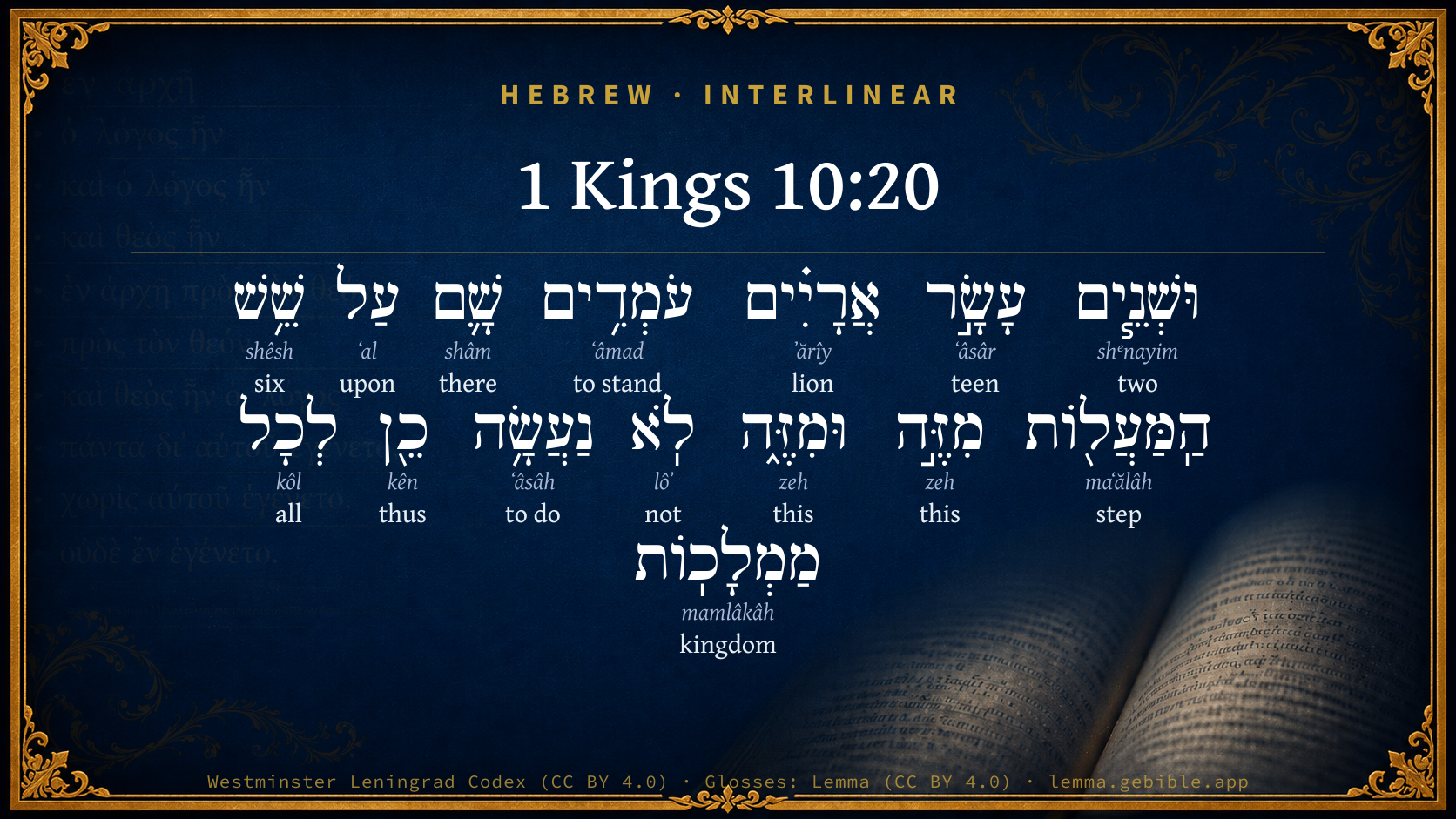
1 Kings 10:20

Hebrew (Westminster Leningrad Codex) 1 Kings 10:20 appears in the Hebrew Old Testament. The text above is from the Westminster Leningrad Codex. Each word links to its Strong’s number, a concise gloss, and parsing drawn from the Open Scriptures Hebrew Bible morphology. Click any word for its full Brown-Driver-Briggs (BDB) entry.
Download image
Cite this verse

1 Kings 10:20 (World English Bible). Public Domain. Lemma interlinear Bible study tool, https://lemma.gebible.app/v/1-kings/10/20.

Show BibTeX & RIS
BibTeX
RIS
English Translation
Twelve lions stood there on the one side and on the other on the six steps: there was nothing like it made in any kingdom.
World English Bible · Public Domain
Download a study sheet

One document with this verse’s original text, its word-by-word gloss line, the meaning frame, cross-references with their text, attributed commentary, and full source and license credits — printable, and it pastes into notes with its structure intact.

This verse Autodidact and up

Study sheet (.html) Plain text (.txt)

A passage Seminary Student

Up to 50 verses in one chapter. A passage sheet keeps up to 6 commentary sources and 12 cross-references per verse, in the order this page ranks them, and says so on the sheet whenever that leaves anything out. Ask for a single verse and you get the Autodidact verse sheet above.

Everything on this page stays free to read, with no account — the sheet is a download of what is already on screen, not access to it.

Want to remove ads? Support Godless Engineer
Compare translations 3

The same verse in 3 English versions, stacked beneath the original-language interlinear above. Click any original word for its lexicon entry.

Each is an independent rendering of the whole verse — the interlinear is not word-aligned to these translations.

Highlighted words mark where these versions differ — a whole-verse word diff, not a word-by-word alignment.

  • World English Bible Public Domain
    Twelve lions stood there on the one side and on the other on the six steps: there was nothing like it made in any kingdom.
  • King James Version Public Domain
    And twelve lions stood there on the one side and on the other upon the six steps: there was not the like made in any kingdom.
  • unfoldingWord Literal Text CC BY-SA 4.0
    And 12 lions were standing there on the six steps, from this side and from that side. It was not made thus for any of the kingdoms.

unfoldingWord Literal Text — © unfoldingWord, licensed CC BY-SA 4.0. Word-aligned USFM3 via Door43 (git.door43.org/unfoldingWord/en_ult).

Versions to compare (up to 4)

3 of 4 selected

Show all 18 translations

Every available English version of this verse, each an independent rendering of the whole verse.

  • World English Bible Public Domain
    Twelve lions stood there on the one side and on the other on the six steps: there was nothing like it made in any kingdom.
  • Berean Standard Bible Public Domain
    Twelve lions stood on the six steps, one at either end of each step. Nothing like this had ever been made for any kingdom.
  • Majority Standard Bible Public Domain
    Twelve lions stood on the six steps, one at either end of each step. Nothing like this had ever been made for any kingdom.
  • King James Version Public Domain
    And twelve lions stood there on the one side and on the other upon the six steps: there was not the like made in any kingdom.
  • American Standard Version (1901) Public Domain
    And twelve lions stood there on the one side and on the other upon the six steps: there was not the like made in any kingdom.
  • Revised Version (1885) Public Domain
    And twelve lions stood there on the one side and on the other upon the six steps: there was not the like made in any kingdom.
  • Geneva Bible (1599) Public Domain
    And there stoode twelue lions on the sixe steps on either side: there was not the like made in any kingdome.
  • Douay-Rheims (1899) Public Domain
    And twelve little lions stood upon the six steps on the one side and on the other: there was no such work made in any kingdom.
  • Young's Literal Translation Public Domain
    and twelve lions are standing there on the six steps, on this `side' and on that; it hath not been made so for any kingdom.
  • Literal Standard Version CC BY-SA 4.0
    and twelve lions are standing there on the six steps, on this [side] and on that; it has not been made so for any kingdom.
  • Unlocked Literal Bible CC BY-SA 4.0
    Twelve lions stood on the steps, one on each side of each of the six steps. There was no throne like it in any other kingdom.
  • unfoldingWord Literal Text CC BY-SA 4.0
    And 12 lions were standing there on the six steps, from this side and from that side. It was not made thus for any of the kingdoms.
  • Darby Bible Public Domain
    and twelve lions stood there on the one side and on the other upon the six steps: there was not the like made in any kingdom.
  • World Messianic Bible Public Domain
    Twelve lions stood there on the one side and on the other on the six steps. Nothing like it was made in any kingdom.
  • Webster's Bible Public Domain
    And twelve lions stood there on the one side and on the other upon the six steps: there was not the like made in any kingdom.
  • Free Bible Version CC BY-SA 4.0
    Twelve lions stood on the six steps, one on opposite ends of each step. Nothing like this had ever been made for any kingdom.
  • Bible in Basic English Public Domain
    And twelve lions were placed on the one side and on the other side on the six steps: there was nothing like it in any kingdom.
  • JPS Tanakh (1917) Public Domain
    And twelve lions stood there on the one side and on the other upon the six steps; there was not the like made in any kingdom.

Literal Standard Version (2020), Covenant Press — licensed CC BY-SA 4.0. Text via the HelloAO Bible API (eBible.org). Unlocked Literal Bible (unfoldingWord) — licensed CC BY-SA 4.0. Text via the HelloAO Bible API (eBible.org). unfoldingWord Literal Text — © unfoldingWord, licensed CC BY-SA 4.0. Word-aligned USFM3 via Door43 (git.door43.org/unfoldingWord/en_ult). Free Bible Version, Dr. Jonathan Gallagher — licensed CC BY-SA 4.0. Text via the HelloAO Bible API (eBible.org).

Word by word

More ways to search: Search by grammar → Find every occurrence → Compare this word →

Practice this passage: Drill this verse → Learn its vocabulary →

הַֽמַּעֲל֖וֹת
maʻălâh
H4609
“the · steps”
Particle, Definite Article + Noun, Common, Feminine, Plural, Absolute
Part of Speech
Particle + Noun
Type
Common
Gender
Feminine
Number
Plural
State
Absolute
Full BDB Definition

Origin: from H4608

TWOT: 1624 L, 1624m

what comes up, thoughts - step, stair - step, stair - steps (of sundial) - stories (of heaven) - ascent - song of ascent - to the three great pilgrim feasts (Psalm titles)
  1. וּשְׁנֵ֧ים shᵉnayim H8147 “and · two” Conjunction + Adjective, Cardinal number, Masculine, Dual, Absolute
  2. עָשָׂ֣ר ʻâsâr H6240 “teen” Adjective, Cardinal number, Masculine, Singular, Absolute
  3. אֲרָיִ֗ים ʼărîy H738 “lions” Noun, Common, Masculine, Plural, Absolute
  4. עֹמְדִ֥ים ʻâmad H5975 “standing” Verb, Qal, Participle Active, Masculine, Plural, Absolute
  5. שָׁ֛ם shâm H8033 “there” Adverb
  6. עַל ʻal H5921 “upon” Preposition
  7. שֵׁ֥שׁ shêsh H8337 “six” Adjective, Cardinal number, Feminine, Singular, Absolute
  8. מִזֶּ֣ה zeh H2088 “from · this” Preposition + Pronoun, Demonstrative, Masculine, Singular
  9. וּמִזֶּ֑ה zeh H2088 “and · from · this” Conjunction + Preposition + Pronoun, Demonstrative, Masculine, Singular
  10. לֹֽא lôʼ H3808 “not” Particle, Negative
  11. נַעֲשָׂ֥ה ʻâsâh H6213 “to do” Verb, Niphal, Perfect, 3rd Person, Masculine, Singular
  12. כֵ֖ן kên H3651 “thus” Adverb
  13. לְכָל kôl H3605 “to/for · all of” Preposition + Noun, Common, Masculine, Singular, Construct
  14. מַמְלָכֽוֹת mamlâkâh H4467 “kingdoms” Noun, Common, Feminine, Plural, Absolute

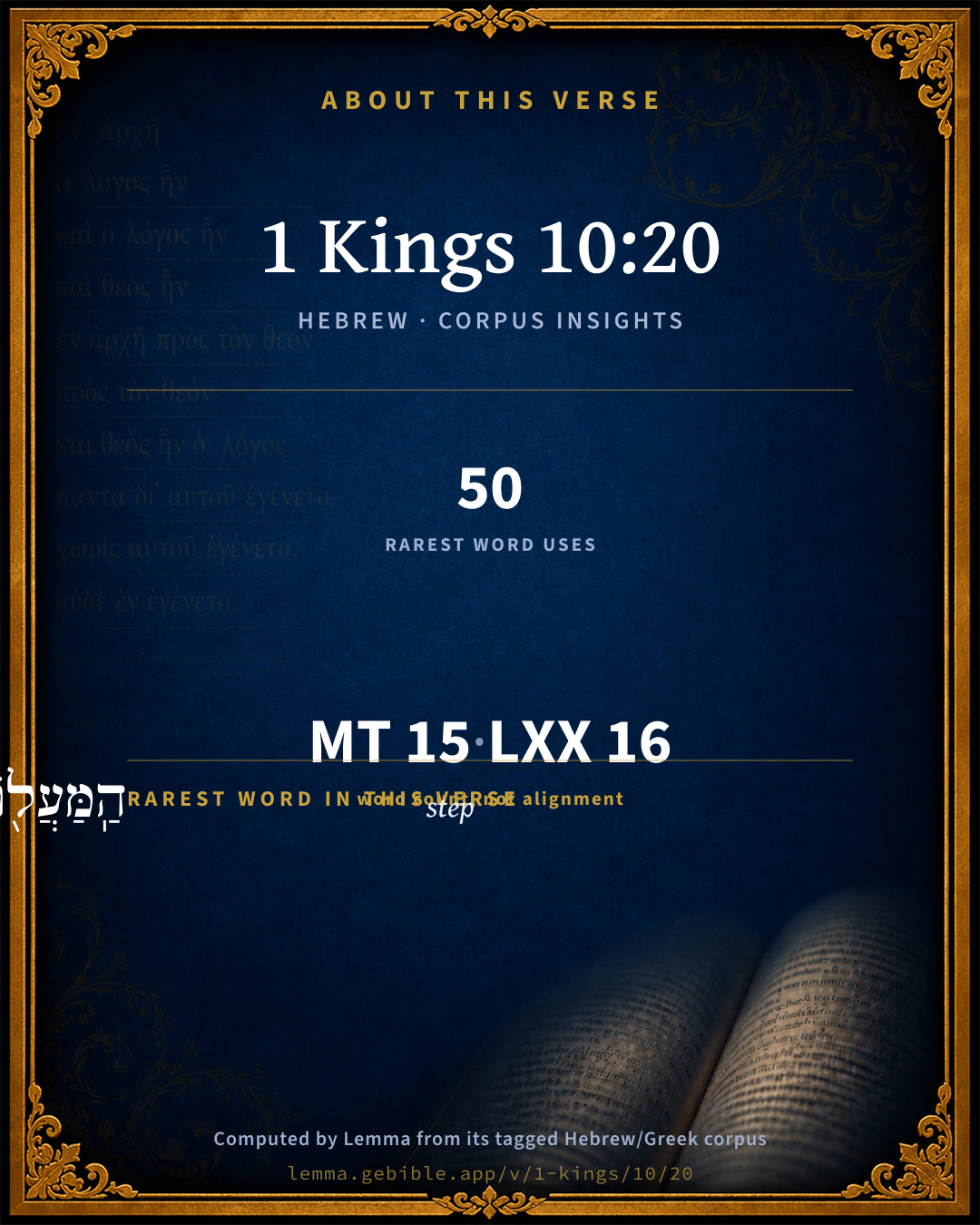
About this verse

These counts appear in no published source. They are computed here, from the morphology-tagged text and Lemma’s own curated glosses. What Lemma adds →

15
words
14
distinct lemmas
Historical
section

Shared distinctive vocabulary

הַֽמַּעֲל֖וֹת step H4609 occurs in 40 verses of the Hebrew Bible. Also found in:

Grammatical profile

  • 2 verbs
  • 4 nouns
  • 3 adjectives
  • 2 pronouns
  • 1 preposition
  • 2 adverbs
  • 1 particle

Verb forms

  • עֹמְדִ֥ים Qal · Participle Active
  • נַעֲשָׂ֥ה Niphal · Perfect

Repetition

A word recurs within this verse — often emphatic in Hebrew:

  • מִזֶּ֣ה this H2088 ×2

Hebrew & Septuagint length

In English translation the verse runs 25 words from the Hebrew and 21 from the Septuagint (LXX English) — closely comparable.

A rough comparison of the two English renderings, which tokenize alike — not a word-level alignment.

Word counts can differ between the Hebrew and the Greek without any difference in meaning — e.g. the Hebrew direct-object marker אֵת has no separate Greek word, and Greek often adds the article ὁ.

In the original languages it is 15 Hebrew tokens and 16 Greek tokens — but the two are counted differently (Hebrew bundles its prefixes and suffixes into one token; the Greek is in lemma form), so that isn’t a like-for-like length.

Cross-references

4

Topical passages linked to 1 Kings 10:20 in the Treasury of Scripture Knowledge — connected by theme and wording, ordered by reader-vote popularity; previews shown in the World English Bible.

  • Genesis 49:9 Judah is a lion's cub. From the prey, my son, you have gone up. He stooped down, he crouched as a lion, As a lioness. Who will rouse him up?
  • Numbers 24:9 He couched, he lay down as a lion, As a lioness; who shall rouse him up? Blessed be everyone who blesses you, Cursed be everyone who curses you.
  • Numbers 23:24 Behold, the people rises up as a lioness, As a lion does he lift himself up: He shall not lie down until he eat of the prey, Drink the blood of the slain.
  • Revelation 5:5 One of the elders said to me, "Don't weep. Behold, the Lion who is of the tribe of Judah, the Root of David, has overcome; he who opens the book and its seven seals."

Cross-references courtesy of OpenBible.info (CC BY 4.0).

Hebrew and Greek witnesses Masoretic Hebrew ↔ Greek Septuagint

The same verse in the two great witnesses to the Old Testament, shown verse-for-verse.

These are two independent witnesses, not word-aligned to each other, and the Septuagint is shown in lemma (dictionary) form.

Hebrew 1 Kings 10:20 Masoretic · Westminster Leningrad Codex

וּשְׁנֵ֧ים עָשָׂ֣ר אֲרָיִ֗ים עֹמְדִ֥ים שָׁ֛ם עַל שֵׁ֥שׁ הַֽמַּעֲל֖וֹת מִזֶּ֣ה וּמִזֶּ֑ה לֹֽא נַעֲשָׂ֥ה כֵ֖ן לְכָל מַמְלָכֽוֹת

Twelve lions stood there on the one side and on the other on the six steps: there was nothing like it made in any kingdom.

World English Bible · Public Domain

Greek LXX 1 Kings 10:20 Septuagint · lemma form

καί δώδεκα λέων ἵστημι ἐπί ὁ ἕξ ἀναβαθμός ἔνθεν καί ἔνθεν οὐ γίγνομαι οὕτως πᾶς βασιλεία

and twelve lions standing there on the six steps on either side: it was not so done in any other kingdom.

LXX2012 (modern English Septuagint) · Public Domain

Hebrew: Westminster Leningrad Codex (CC BY 4.0). Greek: Septuagint (public domain); English from LXX2012 (modern English Septuagint) (Public Domain). How the Septuagint differs from the Hebrew →

Targum (Aramaic paraphrase)

1

The Targum is the ancient Jewish Aramaic paraphrase of the Hebrew Scriptures — an interpretive translation, not the Hebrew text itself. Onkelos (literal) and Pseudo-Jonathan (expansive) render the Torah, and Jonathan the Prophets. Coverage is partial: where no permissively-licensed English translation exists for a verse, only the Aramaic is shown. This is verse-level text, not a word-by-word alignment to the Hebrew.

  1. Targum Jonathan Prophets (Joshua–Malachi)
    וּתְרֵי עֲשַׂר אַרְיְוָן קַיְמִין תַּמָן עַל שִׁתָּא דַרְגִין מִכָּא וּמִכָּא לָא אִתְעֲבַד כֵּן לְכָל מַלְכְּוָתָא:

    (no public-domain English translation for this verse)

    Targum Jonathan — Aramaic: “Mikraot Gedolot” (public domain). English: “Sefaria Community Translation” (CC0 1.0 (public-domain dedication)); “London "Chaldee Paraphrase," 1871” (public domain). Text via Sefaria.

Commentary

Notes on 1 Kings 10:20 from classic Christian and Jewish commentators (each source and its license shown beneath its notes). The classic Christian expositions comment on the surrounding passage and are grouped to its opening verse, so a note may address several verses; the Jewish commentaries on the Tanakh (Rashi and others) are per-verse, so they appear only where the commentator wrote on this verse.

Lemma curates 59 commentaries, every one of them public domain or Creative Commons licensed, each selected and text-cleaned for this edition rather than reprinted as found. About our sources →

Trapp's Complete Commentary

John Trapp

1Ki 10:20 And twelve lions stood there on the one side and on the other upon the six steps: there was not the like made in any kingdom.

Ver. 20. And twelve lions stood there, &c.] To show the vigilancy and valour that should be found in princes. Judah’s emblem, or scutcheon, was the lion couchant. The Athenian judges sat in Mars Street. Mention is also made of a footstool of gold, {2Ch 9:18} to teach the king to trample on the precious things of this world.

John Trapp, A Commentary or Exposition upon All the Books of the Old and New Testament (1647–1656) — public domain. Text from a community e-Sword module.

John Gill's Exposition

And twelve lions stood there on the one side and on the other upon the six steps,.... There was a lion on each side of every step, a symbol of royal power, as before observed; so the Egyptians placed lions under the throne of Orus (r):

there was not the like made in any kingdom; for the matter and form of it, for its grandeur and magnificence; there was none at least at that time, whatever has been since; for this is the first throne of ivory we read of.

(r) Hori Apoll. Hieroglyph, l. 1. c. 17.

John Gill's Exposition of the Whole Bible (1746–1763) — public domain (CC PDM 1.0). Text via the HelloAO Bible API.

Albert Barnes' Notes on the Bible

Solomon’s throne, as described, is certainly grander than any of which we have a representation, either in Assyria or Egypt. Much more, then, would it transcend the thrones in inferior kingdoms.

Albert Barnes' Notes on the Bible (1834–1885) — public domain. Text from a community e-Sword/MySword module.

Whedon's Commentary on the Bible

Daniel D. Whedon

20. Twelve lions — One lion at each end of each of the six steps by which the king ascended the throne. They were symbolic figures, and in that position might teach that resolute and determined courage and firmness should characterize all the actions of the king.

Daniel D. Whedon (gen. ed.), Commentary on the Old and New Testaments (1874–1909) — public domain. Text from a community e-Sword module.

The Pulpit Commentary

And twelve lions stood there on the one side and on the other, upon the six steps It is somewhat doubtful whether there were twelve or fourteen lions in all. Most commentators assume that there were fourteen, and the text will certainly bear that construction. But it is altogether more likely that there were twelve; that is to say, that the two lions on the topmost step are the two mentioned in the preceding verse as "standing beside the stays," otherwise there would have been four lions on that step. And we all know that twelve had a significance such as could not attach to any other number (Bahr, Symbolik, 1:201-205; 2:133, 423). It would signify that all the tribes had an interest in the royal house (cf. 1Ki_12:16; 2Sa_20:1) and a right of approach to the throne (cf. 1Ki_18:31) The lion, a familiar emblem of sovereignty among many nations, had an especial appropriateness in this case, as being the symbol of the tribe of Judah (Gen_49:9; cf. Num_23:24 Num_24:9) We are to see in them partly "symbols of the ruler"s authority" (Keil), and partly, perhaps, they represented the twelve tribes as guardians of the throne. "The king mounted between figures of lions to his seat on the throne, and sat between figures of lions upon it" (Wordsworth). Thrones somewhat similar to this in character, but much less magnificent, are represented on the Assyrian monuments. The historian might justly add: there was not the like made Heb. not made so in any kingdom.

The Pulpit Commentary (1880–1919), ed. H.D.M. Spence-Jones & Joseph S. Exell — public domain. Text from a community e-Sword module.

Lesson kit

Teaching starters — assembled from the data on this page, not authored interpretation. Every prompt links to the verse data it draws on. Edit before teaching.

1 Kings, in the Historical, opens this verse with 15 words (14 distinct Hebrew lemmas). Its most distinctive word is maʻălâh (“step”). A historical commentator’s framing appears above. Read the whole chapter for the surrounding context.

Discussion questions

  1. How does “step” (maʻălâh) shape what this verse is saying?
  2. Exodus 20:26 shares the word «step» with this verse. How do the two illuminate each other?
  3. “this” occurs 2× in this one verse. What is the effect of the repetition?
  4. The translations on this page render this verse differently — a whole-verse word diff, not a word-by-word alignment. What might account for the different wordings?
  5. The verb «עֹמְדִ֥ים» is Qal Participle Active. How does its form color the action?
  6. Reading how Trapp's Complete Commentary and John Gill's Exposition read this verse, where do the two commentators agree and where do they part?

Things to notice

Reading settings

Reading text

Shown beneath each verse's original-language words.

Old Testament
Old Testament edition

Read the OT as the Masoretic Hebrew (MT) or the Greek Septuagint (LXX).

English shown for the Greek Septuagint (in the Hebrew ↔ Greek comparison).

Comparing translations? Open the Compare panel on any verse page to stack up to four side by side.