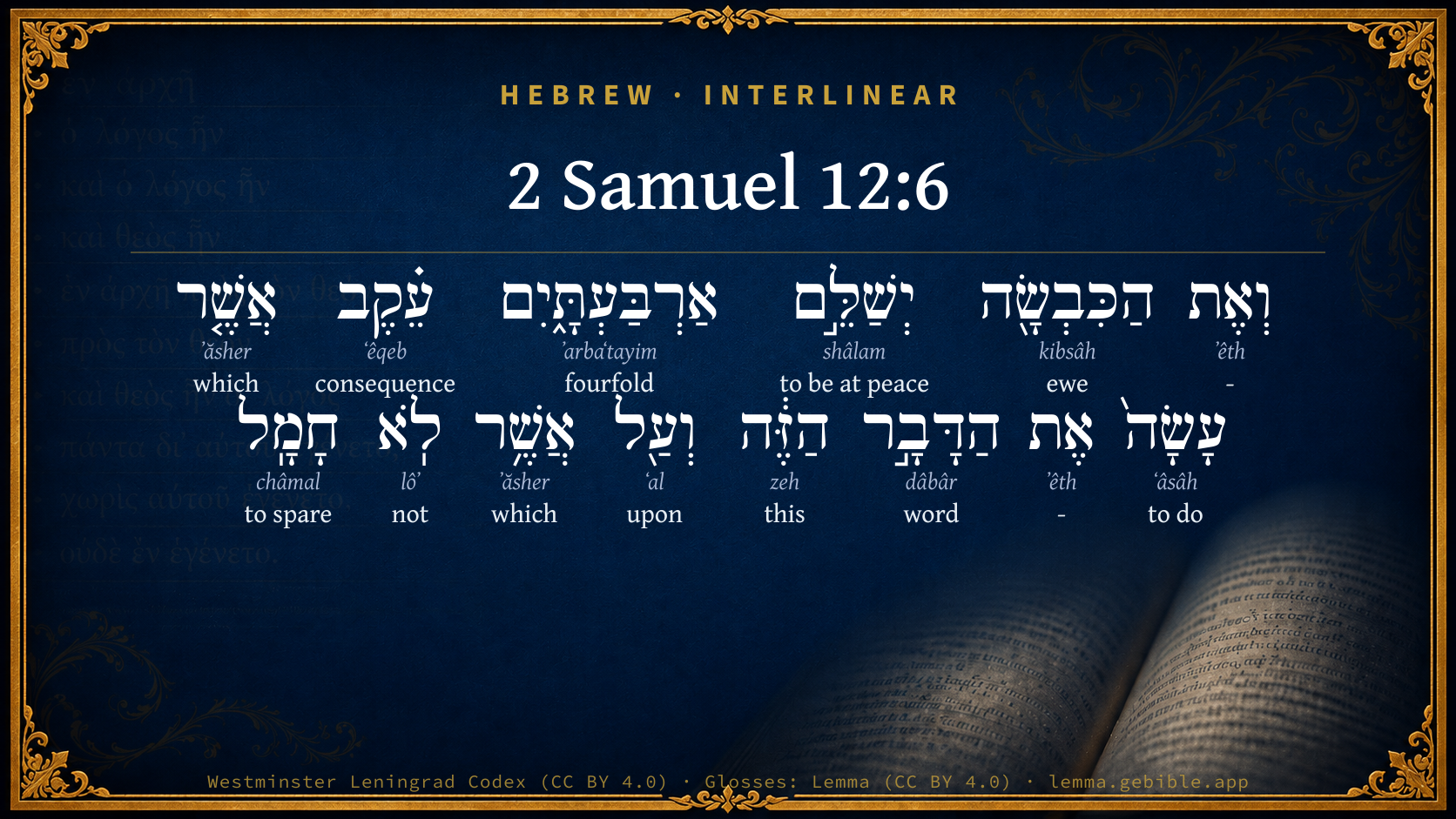
2 Samuel 12:6

Hebrew (Westminster Leningrad Codex) 2 Samuel 12:6 appears in the Hebrew Old Testament. The text above is from the Westminster Leningrad Codex. Each word links to its Strong’s number, a concise gloss, and parsing drawn from the Open Scriptures Hebrew Bible morphology. Click any word for its full Brown-Driver-Briggs (BDB) entry.
Download image
Cite this verse

2 Samuel 12:6 (World English Bible). Public Domain. Lemma interlinear Bible study tool, https://lemma.gebible.app/v/2-samuel/12/6.

Show BibTeX & RIS
BibTeX
RIS
English Translation
He shall restore the lamb fourfold, because he did this thing, and because he had no pity!"
World English Bible · Public Domain
Highlights Full analysis ↓
Download a study sheet

One document with this verse’s original text, its word-by-word gloss line, the meaning frame, cross-references with their text, attributed commentary, and full source and license credits — printable, and it pastes into notes with its structure intact.

This verse Autodidact and up

Study sheet (.html) Plain text (.txt)

A passage Seminary Student

Up to 50 verses in one chapter. A passage sheet keeps up to 6 commentary sources and 12 cross-references per verse, in the order this page ranks them, and says so on the sheet whenever that leaves anything out. Ask for a single verse and you get the Autodidact verse sheet above.

Everything on this page stays free to read, with no account — the sheet is a download of what is already on screen, not access to it.

Want to remove ads? Support Godless Engineer
Compare translations 3

The same verse in 3 English versions, stacked beneath the original-language interlinear above. Click any original word for its lexicon entry.

Each is an independent rendering of the whole verse — the interlinear is not word-aligned to these translations.

Highlighted words mark where these versions differ — a whole-verse word diff, not a word-by-word alignment.

  • World English Bible Public Domain
    He shall restore the lamb fourfold, because he did this thing, and because he had no pity!"
  • King James Version Public Domain
    And he shall restore the lamb fourfold, because he did this thing, and because he had no pity.
  • unfoldingWord Literal Text CC BY-SA 4.0
    Now he shall restore the ewe fourfold because he did this thing and because he did not spare.”

unfoldingWord Literal Text — © unfoldingWord, licensed CC BY-SA 4.0. Word-aligned USFM3 via Door43 (git.door43.org/unfoldingWord/en_ult).

Versions to compare (up to 4)

3 of 4 selected

Show all 18 translations

Every available English version of this verse, each an independent rendering of the whole verse.

  • World English Bible Public Domain
    He shall restore the lamb fourfold, because he did this thing, and because he had no pity!"
  • Berean Standard Bible Public Domain
    Because he has done this thing and has shown no pity, he must pay for the lamb four times over.”
  • Majority Standard Bible Public Domain
    Because he has done this thing and has shown no pity, he must pay for the lamb four times over.”
  • King James Version Public Domain
    And he shall restore the lamb fourfold, because he did this thing, and because he had no pity.
  • American Standard Version (1901) Public Domain
    and he shall restore the lamb fourfold, because he did this thing, and because he had no pity.
  • Revised Version (1885) Public Domain
    and he shall restore the lamb fourfold, because he did this thing, and because he had no pity.
  • Geneva Bible (1599) Public Domain
    And he shall restore the lambe foure folde, because he did this thing, and had no pitie thereof.
  • Douay-Rheims (1899) Public Domain
    He shall restore the ewe fourfold, because he did this thing, and had no pity.
  • Young's Literal Translation Public Domain
    and the ewe-lamb he doth repay fourfold, because that he hath done this thing, and because that he had no pity.'
  • Literal Standard Version CC BY-SA 4.0
    and [for] the ewe-lamb he repays fourfold, because that he has done this thing, and because that he had no pity.”
  • Unlocked Literal Bible CC BY-SA 4.0
    He must pay back the lamb four times over because he did such a thing, and because he had no pity on the poor man.”
  • unfoldingWord Literal Text CC BY-SA 4.0
    Now he shall restore the ewe fourfold because he did this thing and because he did not spare.”
  • Darby Bible Public Domain
    and he shall restore the lamb fourfold, because he did this thing, and because he had no pity.
  • World Messianic Bible Public Domain
    He must restore the lamb fourfold, because he did this thing and because he had no pity!”
  • Webster's Bible Public Domain
    And he shall restore the lamb four-fold, because he did this thing, and because he had no pity.
  • Free Bible Version CC BY-SA 4.0
    He must repay that lamb with four of his own for doing this, for being so heartless.”
  • Bible in Basic English Public Domain
    And he will have to give back four times the value of the lamb, because he has done this and because he had no pity.
  • JPS Tanakh (1917) Public Domain
    and he shall restore the lamb fourfold, because he did this thing, and because he had no pity.'

Literal Standard Version (2020), Covenant Press — licensed CC BY-SA 4.0. Text via the HelloAO Bible API (eBible.org). Unlocked Literal Bible (unfoldingWord) — licensed CC BY-SA 4.0. Text via the HelloAO Bible API (eBible.org). unfoldingWord Literal Text — © unfoldingWord, licensed CC BY-SA 4.0. Word-aligned USFM3 via Door43 (git.door43.org/unfoldingWord/en_ult). Free Bible Version, Dr. Jonathan Gallagher — licensed CC BY-SA 4.0. Text via the HelloAO Bible API (eBible.org).

Word by word

More ways to search: Search by grammar → Find every occurrence → Compare this word →

Practice this passage: Drill this verse → Learn its vocabulary →

אַרְבַּעְתָּ֑יִם
ʼarbaʻtayim
H706
“fourfold”
Adjective, Cardinal number, Feminine, Dual, Absolute
Part of Speech
Adjective
Type
Cardinal number
Gender
Feminine
Number
Dual
State
Absolute
Full BDB Definition

Origin: dual of H702

TWOT: 2106a

fourfold
  1. וְאֶת ʼêth H853 “and · -” Conjunction + Particle, Direct Object
  2. הַכִּבְשָׂ֖ה kibsâh H3535 “the · ewe” Particle, Definite Article + Noun, Common, Feminine, Singular, Absolute
  3. יְשַׁלֵּ֣ם shâlam H7999 “to be at peace” Verb, Piel, Imperfect, 3rd Person, Masculine, Singular
  4. עֵ֗קֶב ʻêqeb H6118 “consequence of” Noun, Common, Masculine, Singular, Construct
  5. אֲשֶׁ֤ר ʼăsher H834 “which” Particle, Relative
  6. עָשָׂה֙ ʻâsâh H6213 “to do” Verb, Qal, Perfect, 3rd Person, Masculine, Singular
  7. אֶת ʼêth H853 “-” Particle, Direct Object
  8. הַדָּבָ֣ר dâbâr H1697 “the · word” Particle, Definite Article + Noun, Common, Masculine, Singular, Absolute
  9. הַזֶּ֔ה zeh H2088 “the · this” Particle, Definite Article + Pronoun, Demonstrative, Masculine, Singular
  10. וְעַ֖ל ʻal H5921 “and · upon” Conjunction + Preposition
  11. אֲשֶׁ֥ר ʼăsher H834 “which” Particle, Relative
  12. לֹֽא lôʼ H3808 “not” Particle, Negative
  13. חָמָֽל châmal H2550 “to spare” Verb, Qal, Perfect, 3rd Person, Masculine, Singular

About this verse

These counts appear in no published source. They are computed here, from the morphology-tagged text and Lemma’s own curated glosses. What Lemma adds →

14
words
12
distinct lemmas
Historical
section

Notable vocabulary

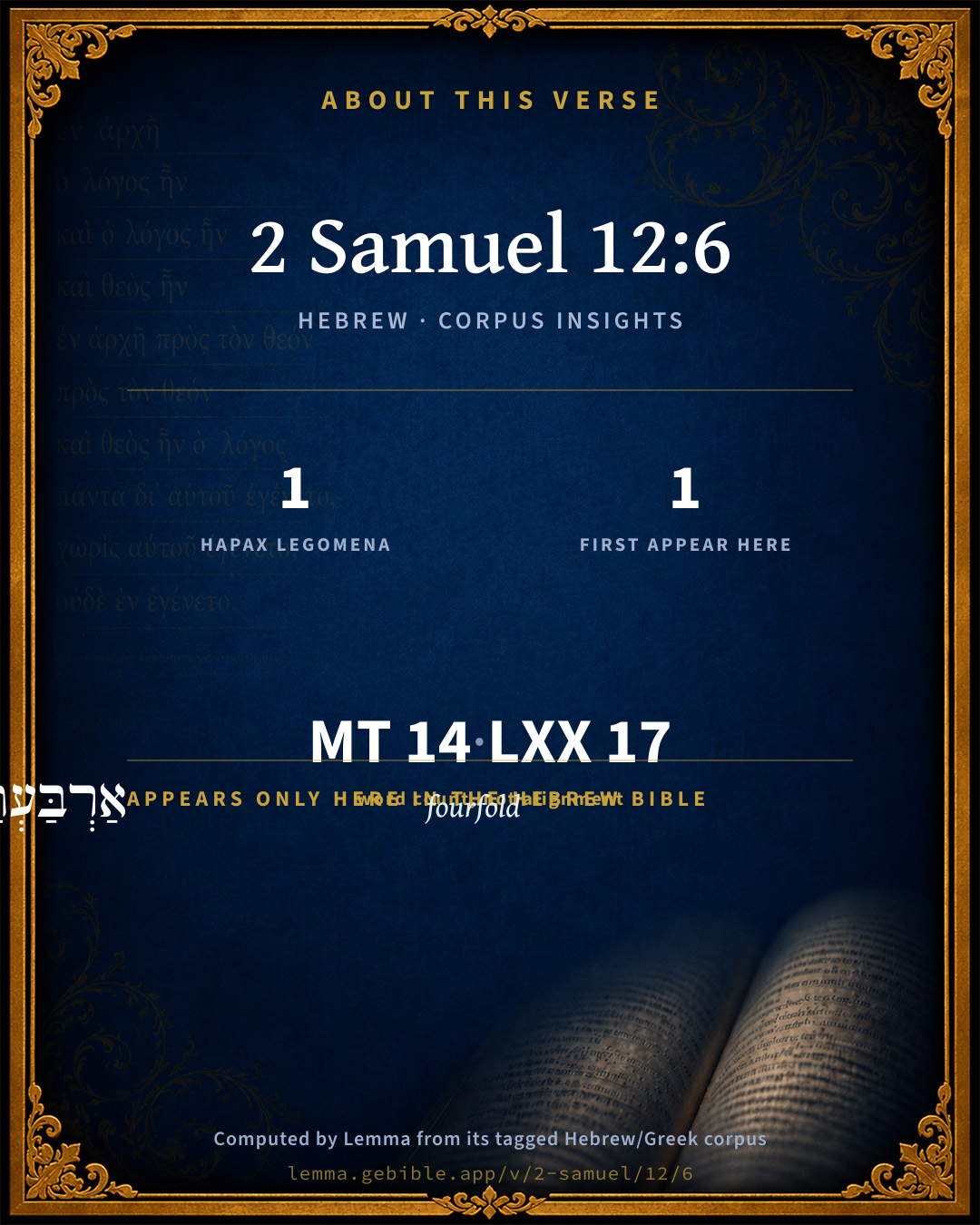
1 hapax legomenon — a word that appears only here in the entire Hebrew Bible:

  • אַרְבַּעְתָּ֑יִם fourfold H706

First appearance in Scripture

This word makes its first canonical appearance in the Hebrew Bible here:

  • אַרְבַּעְתָּ֑יִם fourfold H706

Shared distinctive vocabulary

הַכִּבְשָׂ֖ה ewe H3535 occurs in 8 verses of the Hebrew Bible. Also found in:

Grammatical profile

  • 3 verbs
  • 3 nouns
  • 1 adjective
  • 1 pronoun
  • 1 preposition
  • 5 particles

Verb forms

  • יְשַׁלֵּ֣ם Piel · Imperfect
  • עָשָׂה֙ Qal · Perfect
  • חָמָֽל Qal · Perfect

Repetition

A word recurs within this verse — often emphatic in Hebrew:

  • אֲשֶׁ֤ר which H834 ×2

Hebrew & Septuagint length

In English translation the verse runs 17 words from the Hebrew and 12 from the Septuagint (LXX English) — the Septuagint runs noticeably shorter here. See the side-by-side →

A rough comparison of the two English renderings, which tokenize alike — not a word-level alignment.

Word counts can differ between the Hebrew and the Greek without any difference in meaning — e.g. the Hebrew direct-object marker אֵת has no separate Greek word, and Greek often adds the article ὁ.

In the original languages it is 14 Hebrew tokens and 17 Greek tokens — but the two are counted differently (Hebrew bundles its prefixes and suffixes into one token; the Greek is in lemma form), so that isn’t a like-for-like length.

Cross-references

4

Topical passages linked to 2 Samuel 12:6 in the Treasury of Scripture Knowledge — connected by theme and wording, ordered by reader-vote popularity; previews shown in the World English Bible.

  • Exodus 22:1 "If a man steals an ox or a sheep, and kills it, or sells it; he shall pay five oxen for an ox, and four sheep for a sheep.
  • Proverbs 6:31 But if he is found, he shall restore seven times. He shall give all the wealth of his house.
  • Luke 19:8 Zacchaeus stood and said to the Lord, "Behold, Lord, half of my goods I give to the poor. If I have wrongfully exacted anything of anyone, I restore four times as much."
  • James 2:13 For judgment is without mercy to him who has shown no mercy. Mercy triumphs over judgment.

Cross-references courtesy of OpenBible.info (CC BY 4.0).

Hebrew and Greek witnesses Masoretic Hebrew ↔ Greek Septuagint

The same verse in the two great witnesses to the Old Testament, shown verse-for-verse.

Here the Septuagint runs noticeably shorter than the Hebrew — LXX2012 (modern English Septuagint) 12 words vs World English Bible 17. A rough length comparison of the two English translations, not a word-level alignment — read both below.

These are two independent witnesses, not word-aligned to each other, and the Septuagint is shown in lemma (dictionary) form.

Hebrew 2 Samuel 12:6 Masoretic · Westminster Leningrad Codex

וְאֶת הַכִּבְשָׂ֖ה יְשַׁלֵּ֣ם אַרְבַּעְתָּ֑יִם עֵ֗קֶב אֲשֶׁ֤ר עָשָׂה֙ אֶת הַדָּבָ֣ר הַזֶּ֔ה וְעַ֖ל אֲשֶׁ֥ר לֹֽא חָמָֽל

He shall restore the lamb fourfold, because he did this thing, and because he had no pity!"

World English Bible · Public Domain

Greek LXX 2 Samuel 12:6 Septuagint · lemma form

καί ὁ ἀμνάς ἀποτίνω ἑπταπλασίων ἀντί ὅς ὅτι ποιέω ὁ ῥῆμα οὗτος καί περί ὅς οὐ φείδομαι

And he shall restore the lamb sevenfold, because he has not spared.

LXX2012 (modern English Septuagint) · Public Domain

On this verse, Ellicott's Commentary for English Readers discusses the Septuagint’s reading. Read the note in Commentary ↓

Hebrew: Westminster Leningrad Codex (CC BY 4.0). Greek: Septuagint (public domain); English from LXX2012 (modern English Septuagint) (Public Domain). How the Septuagint differs from the Hebrew →

Targum (Aramaic paraphrase)

1

The Targum is the ancient Jewish Aramaic paraphrase of the Hebrew Scriptures — an interpretive translation, not the Hebrew text itself. Onkelos (literal) and Pseudo-Jonathan (expansive) render the Torah, and Jonathan the Prophets. Coverage is partial: where no permissively-licensed English translation exists for a verse, only the Aramaic is shown. This is verse-level text, not a word-by-word alignment to the Hebrew.

  1. Targum Jonathan Prophets (Joshua–Malachi)
    וְיַת אִמַרְתָּא יְשַׁלֵם עַל חַד אַרְבְּעָא חֲלַף דַעֲבַד יַת פִּתְגָמָא הָדֵין וְעַל דְלָא חָס:

    (no public-domain English translation for this verse)

    Targum Jonathan — Aramaic: “Mikraot Gedolot” (public domain). English: “Sefaria Community Translation” (CC0 1.0 (public-domain dedication)); “London "Chaldee Paraphrase," 1871” (public domain). Text via Sefaria.

Commentary

Notes on 2 Samuel 12:6 from classic Christian and Jewish commentators (each source and its license shown beneath its notes). The classic Christian expositions comment on the surrounding passage and are grouped to its opening verse, so a note may address several verses; the Jewish commentaries on the Tanakh (Rashi and others) are per-verse, so they appear only where the commentator wrote on this verse.

Lemma curates 59 commentaries, every one of them public domain or Creative Commons licensed, each selected and text-cleaned for this edition rather than reprinted as found. About our sources →

Trapp's Complete Commentary

John Trapp

2Sa 12:6 And he shall restore the lamb fourfold, because he did this thing, and because he had no pity.

Ver. 6. And he shall restore the lamb fourfold.] Nay, twice fourfold, as some sense it; because the word is of the dual number. But what! Must he do all this, and die too? This was hard law, better beseeming a Draco to pronounce, than a David: but he was transported and biassed, as above said. {a}

{a} Prompte et fervide sententiam pronunciat.

John Trapp, A Commentary or Exposition upon All the Books of the Old and New Testament (1647–1656) — public domain. Text from a community e-Sword module.

Ellicott's Commentary for English Readers

(6) Fourfold.—In exact accordance with the Law (Exo_22:1; comp. Luk_19:8). The LXX. (in most copies “sevenfold,” comp. Pro_6:31) and the Chaldee (“fortyfold”) have expressed more of human indignation; but David knew the Law too well to change its terms.

A Bible Commentary for English Readers, edited by Charles John Ellicott (1878–1897) — public domain. Text from a community e-Sword module.

The Cambridge Bible for Schools and Colleges

gen. ed. J. J. S. Perowne

6. fourfold] The legal compensation. See Exo_22:1; Luk_19:8. The Sept. reads sevenfold, and this may be the original reading. David in his indignation would be likely to prescribe a more liberal restitution than the usual fourfold. Cp. Pro_6:31.

The Cambridge Bible for Schools and Colleges (gen. ed. J. J. S. Perowne; Cambridge University Press, 1878–1918) — public domain. Text from a community e-Sword module.

John Gill's Exposition

And Nathan said to David, thou art the man,.... The rich man, or who is designed by him in the parable, and answers to him (t):

thus saith the Lord God of Israel, I anointed thee king over Israel; that is, ordered Samuel to anoint him, who did, Sa1 16:1; to which this chiefly refers; and after that he was anointed first by the tribe of Judah, and then by all the tribes of Israel, by the appointment and providence of God; and this was great dignity he designed for him, and raised him to:

and I delivered thee out of the hand of Saul; when he persecuted him, and sought to take away his life.

(t) "----- mutato nomine, de te Fabula narratur -----". Horat. Sermon. l. 1. Satyr. 1. ver. 69,70.

John Gill's Exposition of the Whole Bible (1746–1763) — public domain (CC PDM 1.0). Text via the HelloAO Bible API.

Albert Barnes' Notes on the Bible

Fourfold - The exact number prescribed by the Law (see the marginal references), and acted upon by Zaccheus. The Septuagint has “sevenfold,” as in Pro 6:31.

Albert Barnes' Notes on the Bible (1834–1885) — public domain. Text from a community e-Sword/MySword module.

Haydock's Catholic Bible Commentary

Fold. Septuagint, "seven-fold," which Grabe corrects by the Hebrew. (Haydock) --- David lost four of his sons; the first born of Bethsabee, Amnon, Absalon, and Adonias: and saw his daughter Thamar, (Calmet) and his ten inferior wives, dishonoured, in punishment of his crime. (Menochius)

George Leo Haydock (1774–1849), Haydock's Catholic Family Bible and Commentary, 1859 edition — public domain. Excludes Psalms (Douay-Rheims chapter numbering differs from Protestant) and Deuterocanonical books (Catholic canon only).

Whedon's Commentary on the Bible

Daniel D. Whedon

6. Fourfold — Compare Exo_22:1 : “If a man steal an ox, or a sheep, and kill it, or sell it, he shall restore five oxen for an ox, and four sheep for a sheep.”

Daniel D. Whedon (gen. ed.), Commentary on the Old and New Testaments (1874–1909) — public domain. Text from a community e-Sword module.

Rashi

Rabbi Shlomo Yitzchaki (Rashi)

Pay fourfold. This is what [eventually] happened, he was punished with [problems concerning] four children the child and Amnon Tomor and Avsholom.

Rashi on the Tanakh — English translations: “The Judaica Press complete Tanach with Rashi, translated by A. J. Rosenberg” (CC BY 4.0); “Pentateuch with Rashi's commentary by M. Rosenbaum and A.M. Silbermann, 1929-1934” (public domain); “The Metsudah Tanach series, Lakewood, N.J” (CC BY 4.0); and “The Book of Joshua, Metsudah Publications, 1997” (CC BY 4.0). Text via Sefaria.

Lesson kit

Teaching starters — assembled from the data on this page, not authored interpretation. Every prompt links to the verse data it draws on. Edit before teaching.

2 Samuel, in the Historical, opens this verse with 14 words (12 distinct Hebrew lemmas). Its most distinctive word is ʼarbaʻtayim (“fourfold”). The Greek Septuagint runs shorter here. A historical commentator’s framing appears above. Read the whole chapter for the surrounding context.

Discussion questions

  1. The word ʼarbaʻtayim carries the sense “fourfold.” How does it shape the verse?
  2. This verse holds 1 word here found nowhere else in the Hebrew Bible. What might the rare word draw attention to?
  3. The word “fourfold” first appears here in Scripture. What is being introduced at this debut?
  4. Genesis 21:28 shares the word «ewe» with this verse. How do the two illuminate each other?
  5. “which” occurs 2× in this one verse. What is the effect of the repetition?
  6. Compared with the Hebrew, the Septuagint runs shorter here. What questions does that raise?
  7. These translations render this verse differently; the difference is in the English rendering, not the original. What questions does that raise?
  8. The verb «יְשַׁלֵּ֣ם» is Piel Imperfect. How does its form color the action?

Things to notice

  • 1 word in this verse appears nowhere else in the Hebrew Bible.
  • 1 word makes its first canonical appearance in Scripture here.
  • This verse counts 14 Hebrew ↔ 17 Greek words.
  • These translations choose different wording for 6 words in this verse.
  • “which” occurs 2× in this single verse.

Reading settings

Reading text

Shown beneath each verse's original-language words.

Old Testament
Old Testament edition

Read the OT as the Masoretic Hebrew (MT) or the Greek Septuagint (LXX).

English shown for the Greek Septuagint (in the Hebrew ↔ Greek comparison).

Comparing translations? Open the Compare panel on any verse page to stack up to four side by side.