
Ecclesiastes 2:6

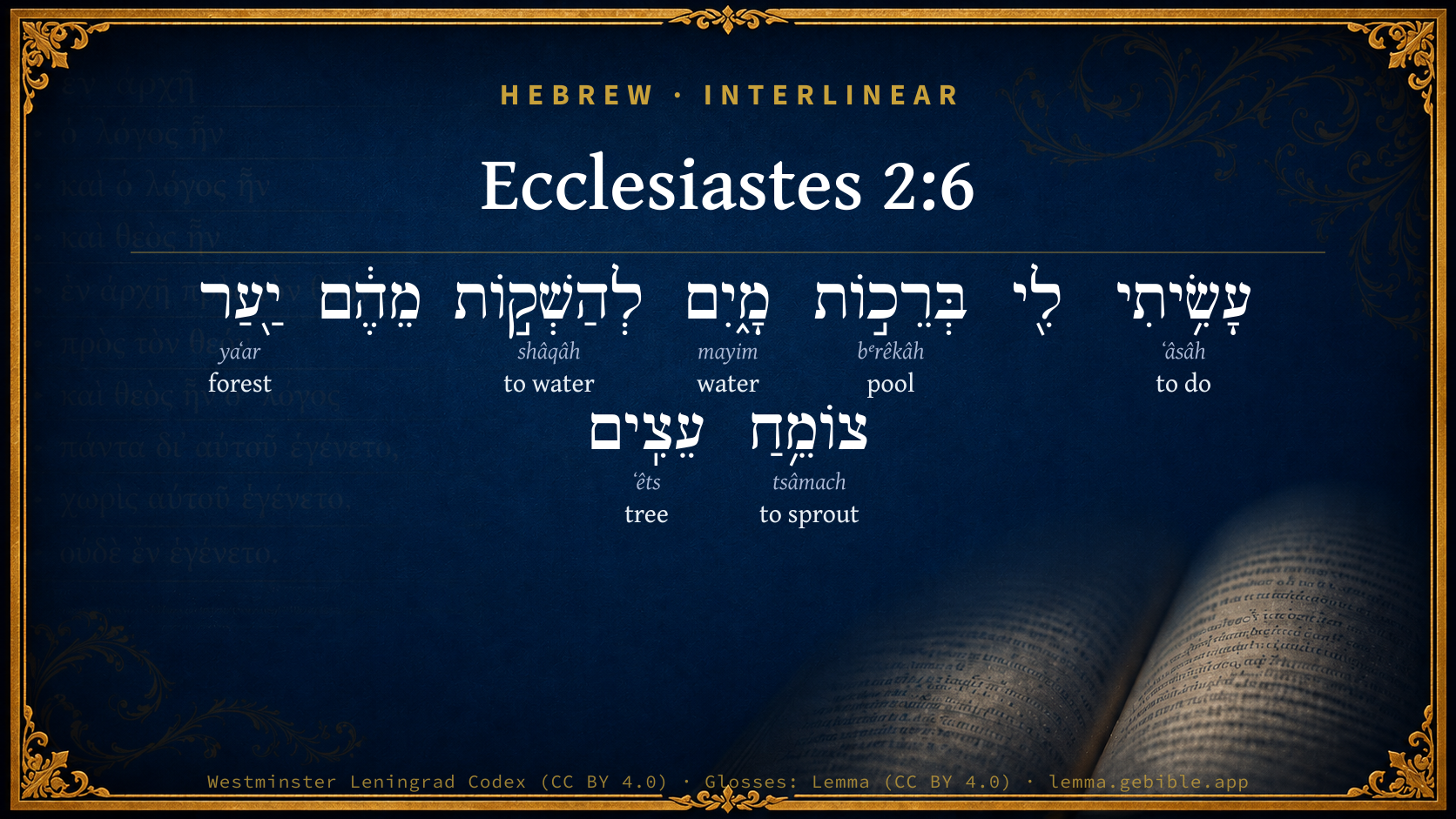
Hebrew (Westminster Leningrad Codex) Ecclesiastes 2:6 appears in the Hebrew Old Testament. The text above is from the Westminster Leningrad Codex. Each word links to its Strong’s number, a concise gloss, and parsing drawn from the Open Scriptures Hebrew Bible morphology. Click any word for its full Brown-Driver-Briggs (BDB) entry.
Download image
Cite this verse

Ecclesiastes 2:6 (World English Bible). Public Domain. Lemma interlinear Bible study tool, https://lemma.gebible.app/v/ecclesiastes/2/6.

Show BibTeX & RIS
BibTeX
RIS
English Translation
I made myself pools of water, to water from it the forest where trees were reared.
World English Bible · Public Domain
Download a study sheet

One document with this verse’s original text, its word-by-word gloss line, the meaning frame, cross-references with their text, attributed commentary, and full source and license credits — printable, and it pastes into notes with its structure intact.

This verse Autodidact and up

Study sheet (.html) Plain text (.txt)

A passage Seminary Student

Up to 50 verses in one chapter. A passage sheet keeps up to 6 commentary sources and 12 cross-references per verse, in the order this page ranks them, and says so on the sheet whenever that leaves anything out. Ask for a single verse and you get the Autodidact verse sheet above.

Everything on this page stays free to read, with no account — the sheet is a download of what is already on screen, not access to it.

Want to remove ads? Support Godless Engineer
Compare translations 3

The same verse in 3 English versions, stacked beneath the original-language interlinear above. Click any original word for its lexicon entry.

Each is an independent rendering of the whole verse — the interlinear is not word-aligned to these translations.

Highlighted words mark where these versions differ — a whole-verse word diff, not a word-by-word alignment.

  • World English Bible Public Domain
    I made myself pools of water, to water from it the forest where trees were reared.
  • King James Version Public Domain
    I made me pools of water, to water therewith the wood that bringeth forth trees:
  • unfoldingWord Literal Text CC BY-SA 4.0
    I made for myself pools of waters to cause to drink from them a forest of growing trees.

unfoldingWord Literal Text — © unfoldingWord, licensed CC BY-SA 4.0. Word-aligned USFM3 via Door43 (git.door43.org/unfoldingWord/en_ult).

Versions to compare (up to 4)

3 of 4 selected

Show all 18 translations

Every available English version of this verse, each an independent rendering of the whole verse.

  • World English Bible Public Domain
    I made myself pools of water, to water from it the forest where trees were reared.
  • Berean Standard Bible Public Domain
    I built reservoirs to water my groves of flourishing trees.
  • Majority Standard Bible Public Domain
    I built reservoirs to water my groves of flourishing trees.
  • King James Version Public Domain
    I made me pools of water, to water therewith the wood that bringeth forth trees:
  • American Standard Version (1901) Public Domain
    I made me pools of water, to water therefrom the forest where trees were reared;
  • Revised Version (1885) Public Domain
    I made me pools of water, to water therefrom the forest where trees were reared:
  • Geneva Bible (1599) Public Domain
    I haue made me cisternes of water, to water therewith the woods that growe with trees.
  • Douay-Rheims (1899) Public Domain
    And I made me ponds of water, to water therewith the wood of the young trees,
  • Young's Literal Translation Public Domain
    I made for me pools of water, to water from them a forest shooting forth trees.
  • Literal Standard Version CC BY-SA 4.0
    I made for myself pools of water, to water from them a forest shooting forth trees.
  • Unlocked Literal Bible CC BY-SA 4.0
    I created pools of water to water a forest where trees were grown.
  • unfoldingWord Literal Text CC BY-SA 4.0
    I made for myself pools of waters to cause to drink from them a forest of growing trees.
  • Darby Bible Public Domain
    I made me ponds of water, to water therewith the wood, where the trees are reared.
  • World Messianic Bible Public Domain
    I made myself pools of water, to water the forest where trees were grown.
  • Webster's Bible Public Domain
    I made me pools of water, to water with them the wood that bringeth forth trees:
  • Free Bible Version CC BY-SA 4.0
    I constructed for myself reservoirs to water all these growing trees.
  • Bible in Basic English Public Domain
    I made pools to give water for the woods with their young trees.
  • JPS Tanakh (1917) Public Domain
    I made me pools of water, to water therefrom the wood springing up with trees;

Literal Standard Version (2020), Covenant Press — licensed CC BY-SA 4.0. Text via the HelloAO Bible API (eBible.org). Unlocked Literal Bible (unfoldingWord) — licensed CC BY-SA 4.0. Text via the HelloAO Bible API (eBible.org). unfoldingWord Literal Text — © unfoldingWord, licensed CC BY-SA 4.0. Word-aligned USFM3 via Door43 (git.door43.org/unfoldingWord/en_ult). Free Bible Version, Dr. Jonathan Gallagher — licensed CC BY-SA 4.0. Text via the HelloAO Bible API (eBible.org).

Word by word

More ways to search: Search by grammar → Find every occurrence → Compare this word →

Practice this passage: Drill this verse → Learn its vocabulary →

About this verse

These counts appear in no published source. They are computed here, from the morphology-tagged text and Lemma’s own curated glosses. What Lemma adds →

9
words
7
distinct lemmas
Wisdom
section

Notable vocabulary

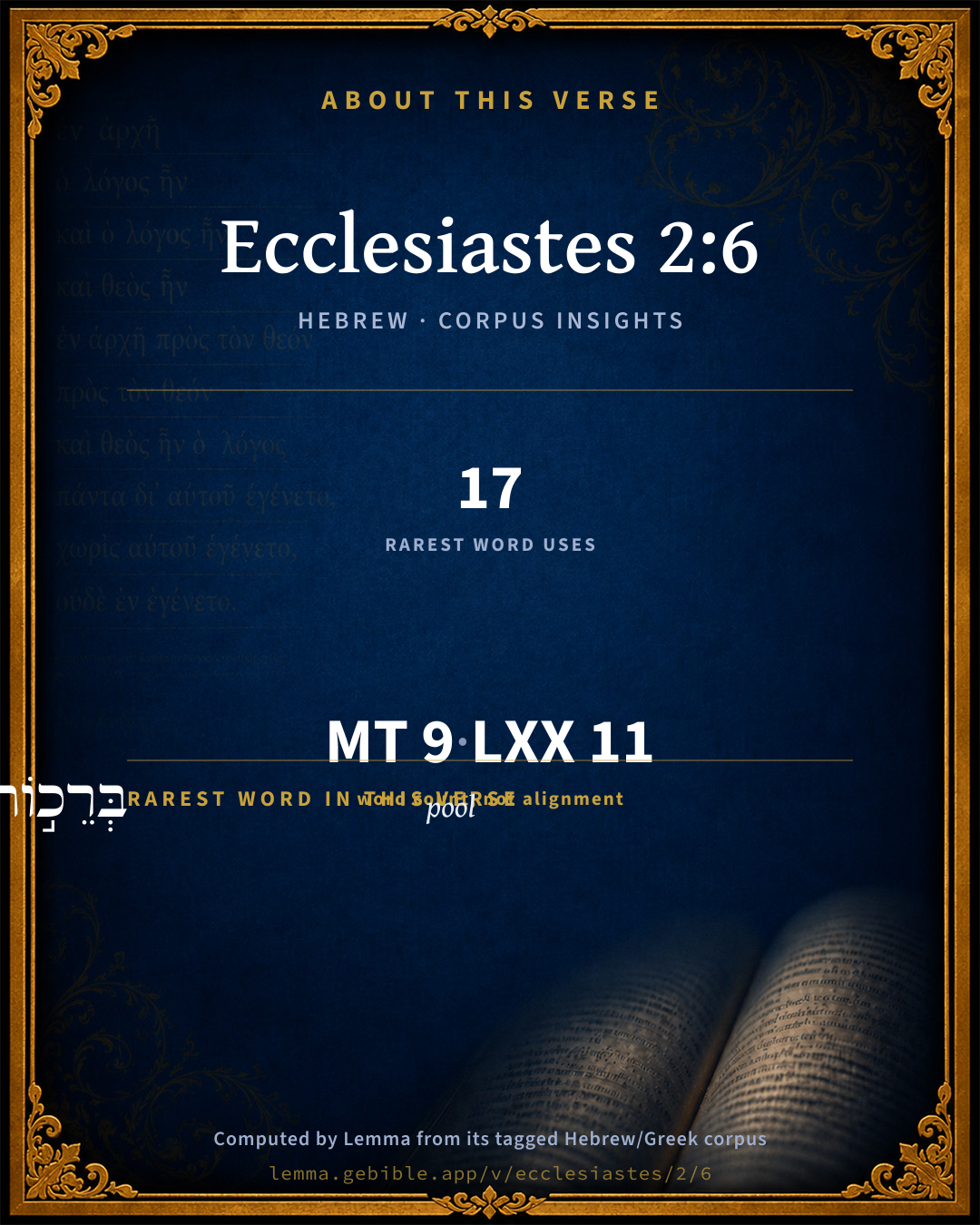
The rarest word here is בְּרֵכ֣וֹת pool H1295 — appearing just 17 times in the whole Hebrew Bible.

Shared distinctive vocabulary

בְּרֵכ֣וֹת pool H1295 occurs in 15 verses of the Hebrew Bible. Also found in:

Grammatical profile

  • 3 verbs
  • 4 nouns
  • 2 prepositions

Verb forms

  • עָשִׂ֥יתִי Qal · Perfect
  • לְהַשְׁק֣וֹת Hiphil · Infinitive Construct
  • צוֹמֵ֥חַ Qal · Participle Active

Hebrew & Septuagint length

In English translation the verse runs 16 words from the Hebrew and 13 from the Septuagint (LXX English) — closely comparable.

A rough comparison of the two English renderings, which tokenize alike — not a word-level alignment.

Word counts can differ between the Hebrew and the Greek without any difference in meaning — e.g. the Hebrew direct-object marker אֵת has no separate Greek word, and Greek often adds the article ὁ.

In the original languages it is 9 Hebrew tokens and 11 Greek tokens — but the two are counted differently (Hebrew bundles its prefixes and suffixes into one token; the Greek is in lemma form), so that isn’t a like-for-like length.

Cross-references

4

Topical passages linked to Ecclesiastes 2:6 in the Treasury of Scripture Knowledge — connected by theme and wording, ordered by reader-vote popularity; previews shown in the World English Bible.

  • Nehemiah 2:14 Then I went on to the spring gate and to the king's pool: but there was no place for the animal that was under me to pass.
  • Psalms 1:3 He will be like a tree planted by the streams of water, That brings forth its fruit in its season, Whose leaf also does not wither. Whatever he does shall prosper.
  • Song of Solomon 7:4 Your neck is like an ivory tower. Your eyes are like the pools in Heshbon by the gate of Bath-rabbim; Your nose is like the tower of Lebanon which looks toward Damascus.
  • Jeremiah 17:8 For he shall be as a tree planted by the waters, who spreads out its roots by the river, and shall not fear when heat comes, but its leaf shall be green; and shall not be careful in the year of drought, neither shall cease from yielding fruit.

Cross-references courtesy of OpenBible.info (CC BY 4.0).

Hebrew and Greek witnesses Masoretic Hebrew ↔ Greek Septuagint

The same verse in the two great witnesses to the Old Testament, shown verse-for-verse.

These are two independent witnesses, not word-aligned to each other, and the Septuagint is shown in lemma (dictionary) form.

Hebrew Ecclesiastes 2:6 Masoretic · Westminster Leningrad Codex

עָשִׂ֥יתִי לִ֖י בְּרֵכ֣וֹת מָ֑יִם לְהַשְׁק֣וֹת מֵהֶ֔ם יַ֖עַר צוֹמֵ֥חַ עֵצִֽים

I made myself pools of water, to water from it the forest where trees were reared.

World English Bible · Public Domain

Greek LXX Ecclesiastes 2:6 Septuagint · lemma form

ποιέω ἐγώ κολυμβήθρα ὕδωρ ὁ ποτίζω ἀπό αὐτός δρυμός βλαστάω ξύλον

I made me pools of water, to water from them the timber-bearing wood.

LXX2012 (modern English Septuagint) · Public Domain

Hebrew: Westminster Leningrad Codex (CC BY 4.0). Greek: Septuagint (public domain); English from LXX2012 (modern English Septuagint) (Public Domain). How the Septuagint differs from the Hebrew →

Commentary

Notes on Ecclesiastes 2:6 from classic Christian and Jewish commentators (each source and its license shown beneath its notes). The classic Christian expositions comment on the surrounding passage and are grouped to its opening verse, so a note may address several verses; the Jewish commentaries on the Tanakh (Rashi and others) are per-verse, so they appear only where the commentator wrote on this verse.

Lemma curates 59 commentaries, every one of them public domain or Creative Commons licensed, each selected and text-cleaned for this edition rather than reprinted as found. About our sources →

Trapp's Complete Commentary

John Trapp

Ecc 2:6 I made me pools of water, to water therewith the wood that bringeth forth trees:

Ver. 6. To water therewith the wood,] i.e., The gardens or hort yards, that were as large as little woods. Christ’s garden in the Canticles, as it hath a wall, {Son 4:15} so a well to water it, and make it fruitful.

John Trapp, A Commentary or Exposition upon All the Books of the Old and New Testament (1647–1656) — public domain. Text from a community e-Sword module.

Jamieson, Fausset & Brown

Robert Jamieson, A. R. Fausset & David Brown

pools--artificial, for irrigating the soil (Gen 2:10; Neh 2:14; Isa 1:30). Three such reservoirs are still found, called Solomon's cisterns, a mile and a half from Jerusalem.

wood that bringeth forth--rather, "the grove that flourisheth with trees" [LOWTH].

Jamieson, Fausset & Brown — Commentary Critical and Explanatory on the Whole Bible (1871) — public domain (CC PDM 1.0). Text via the HelloAO Bible API.

Adam Clarke's Commentary

Verse 6. Pools of water] Tanks and reservoirs.

To water therewith the wood] Aqueducts to lead the water from the tanks to different parts.

Adam Clarke's Commentary on the Bible (1810–1826) — public domain. Text from a community e-Sword/MySword module.

Ellicott's Commentary for English Readers

(6) Pools.—In a place south of Bethlehem are still pointed out three gigantic reservoirs, known as the Pools of Solomon (Stanley’s Jewish Church, 2:197). The place is probably the same as that called Etham by Josephus in his description of Solomon’s luxury (Ant. viii. 7. 3). Josephus speaks of another Pool of Solomon (Bell. Jud. v. 4. 2). Tanks are necessary for irrigation in a land where natural streams are few and are dried up in summer. The king’s pool is mentioned in Neh_2:14.

A Bible Commentary for English Readers, edited by Charles John Ellicott (1878–1897) — public domain. Text from a community e-Sword module.

The Cambridge Bible for Schools and Colleges

gen. ed. J. J. S. Perowne

6. I made me pools of water] Those at Etam have been mentioned above. Besides these we have the fish-pools of Heshbon (Song Son_7:4), the pool of the king (Neh_2:14), possibly also, the pools of Siloam (Joh_9:7), and Beth-esda (Joh_5:2). In Palestine, as in India, these large tanks or reservoirs of water, as meeting the necessities of the climate, were among the favourite works of kingly munificence. Stress is laid on the fact that they were not for beauty only, but for service in irrigating the extensive park.

the wood that bringeth forth trees] Better, “a grove making trees to bud,” i. e. in the language of modern gardening, a “nursery” for young trees.

The Cambridge Bible for Schools and Colleges (gen. ed. J. J. S. Perowne; Cambridge University Press, 1878–1918) — public domain. Text from a community e-Sword module.

John Gill's Exposition

I made me pools of water,.... For cascades and water works to play in, as well as to keep and produce fish of all kinds: mention is made of the king's pools, Neh 2:14; the fish pools at Heshbon, by the gate of Bathrabbim, perhaps belonged to Solomon, Sol 7:4; Little more than a league from Bethlehem are pools of water, which at this day are called the fish pools of Solomon; they are great reservatories cut in the rock, the one at the end of the other; the second being a little lower than the first, and the third than the second, and so communicate the water from one to another when they are full (c); and of which Mr. Maundrell (d) gives the following account:

"They are about an hour and a quarter distant from Bethlehem, southward; they are three in number, lying in a row above each other, being so disposed, that the waters of the uppermost may descend into the second, and those of the second into the third; their figure is quadrangular; the breadth is the same in all, amounting to above ninety paces; in their length there is some difference between them, the first being about an hundred sixty paces long; the second, two hundred; the third, two hundred twenty; they are all lined with a wall, and plastered, and contain a great depth of water.''

And to these, he observes, together with the gardens adjoining, Solomon is supposed to allude, Ecc 2:5. There are to be seen, he says (e), some remains of an old aqueduct, which anciently conveyed the waters from Solomon's pools to Jerusalem; this is said to be the genuine work of Solomon, and may well be allowed to be in reality what it is pretended for. So Rauwolff (f) says,

"beyond the tower of Ader, in another valley, not far from Bethlehem, they show still to this day a large orchard, full of citron, lemon, orange, pomegranate, and fig trees, and many others, which King Solomon did plant in his days; with ponds, canals, and other water works, very pleasantly prepared, as he saith himself, Ecc 2:5; this is still in our time full of good and fruitful trees, worthy to be seen for their sakes, and ditches there: wherefore I really believe it to be the same Josephus (g) makes mention of, called Ethan, about twelve mile from Jerusalem; where Solomon had pleasant gardens and water pools, to which he used to ride early in a morning.''

Mr. Maundrell (h) also makes mention of some cisterns, called Solomon's cisterns, at Roselayn, about an hour from the ruins of Tyre; of which there are three entire at this day; one about three hundred yards distant from the sea, the other two a little further up; and, according to tradition, they were made by that great king, in recompence to King Hiram, for supplying materials towards building the temple: but, as he observes, these, though ancient, could not be built before the time of Alexander; since the aqueduct, which conveys the water from hence to Tyre, is carried over the neck of land, by which he joined the city to the continent. Jarchi interprets these pools in this text of places to keep fish alive in, and so the Midrash understands by them fish pools; though they seem to be canals made in the gardens, orchards, and parks;

to water therewith the wood that bringeth forth trees; the young nurseries, which in time grew up to large fruit bearing trees; which, being numerous and thick, looked like a wood or forest, as the word is; and which canals and nurseries both added greatly to the delight and pleasure of those places. In this manner the Indians water their gardens; who commonly have in them a great pit, or kind of fish pool, which is full of rain water; and just by it there is a basin of brick, raised about two feet higher than the ground: when therefore they have a mind to water the garden, it is filled with water from the fish pool, or pit; which, through a hole that is at the bottom, falls into a canal, that is divided into many branches, proportionable in size to their distance from the basin, and carries the water to the foot of each tree, and to each plot of herbs; and when the gardeners think they are watered enough, they stop up, or turn aside, the canals with clods of earth (i). The beauty of a plant, or tree, is thus described by Aelianus (k);

"branches generous, leaves thick, stem or trunk firm and stable, roots deep; winds shaking it; a large shadow cast from it; changing with the seasons of the year; and water, partly brought through canals, and partly coming from heaven, to water and nourish it; and such beautiful, well watered, and flourishing trees, contribute much to the pleasure of gardens.''

(c) Thevenot's Travels, B. 2. ch. 47. p. 202. (d) Journey from Aleppo to Jerusalem, p. 88. edit. 7. (e) Ibid. p. 90. (f) Travels, part 3. ch. 22. p. 322. Vid. Egmont and Heyman's Travels, vol. 1. p. 367, 368. (g) Antiqu. l. 8. c. 7. s. 13. (h) Ut supra, p. 50, 51. (Journey from Aleppo to Jerusalem, edit. 7.) (i) Agreement of Customs between the East Indians and Jews, Art. 21. p. 78. (k) Var. Hist. l. 2. c. 14.

John Gill's Exposition of the Whole Bible (1746–1763) — public domain (CC PDM 1.0). Text via the HelloAO Bible API.

Albert Barnes' Notes on the Bible

Pools - A short distance south of Bethlehem, in a valley in the defile of Urtas, three “Pools of Solomon” are still shown and an adjoining hill still bears the name of the “Little Paradise.”

Albert Barnes' Notes on the Bible (1834–1885) — public domain. Text from a community e-Sword/MySword module.

Matthew Poole's English Annotations

I made me pools of water, because the rain there fell but seldom.

The wood that bringeth forth trees; the nurseries of young trees newly planted in the orchards, which for the multitude of them were like a wood or forest.

Matthew Poole's English Annotations on the Holy Bible (1683–1685) — public domain. Text from a community e-Sword/MySword module.

Whedon's Commentary on the Bible

Daniel D. Whedon

6. Pools of water — The making of cisterns and fixtures for watering gardens is in the dry East indispensable. For such purpose, in part, the now famous Pools of Solomon, south of Bethlehem, may have been constructed. The same occurs in our Colorado. A well-watered Eastern garden, enlivened by playing fountains and birds “that sing among the branches,” is a most charming object.

The wood — Better, groves, in which the trees were grown.

Daniel D. Whedon (gen. ed.), Commentary on the Old and New Testaments (1874–1909) — public domain. Text from a community e-Sword module.

The Pulpit Commentary

Pools of water. Great care was exercised by Solomon to provide his capital with water, and vast operations were undertaken for this purpose. "The king"s pool," mentioned in Neh_2:14, may have been constructed by him (Josephus, "Bell. Jud:," 5:4:2); but the most celebrated work ascribed to him is the water-supply at Etham, southwest of Bethlehem, and the aqueduct leading from thence to Jerusalem. Most modern travelers have described these pools. They are three in number, and, according to Robinson"s measurement, are of immense size. The first, to the east, is 582 feet long, 207 wide, and 50 deep; the second, 432 by 250, and 39 feet deep; the third, 380 by 236, and 25 feet deep. They are all, however, narrower at the upper end, and widen out gradually, flowing one into the other. There is a copious spring led into the uppermost pool from the north-east, but this supply is augmented by other sources now choked and ruined. The water from the pools was conveyed round the ridge on which Bethlehem stands in earthen pipes to Jerusalem. Dr. Thomson ("The Land and the Book," p. 326) says, "Near that city it was carried along the west side of the Valley of Gihon to the north-western end of the lower Pool of Gihon, where it crossed to the east side, and, winding round the southern declivity of Zion below Neby Daud, finally entered the southeastern corner of the temple area, where the water was employed in the various services of the sanctuary." Etham is, with good reason, identified with the beautiful valley of Urtas, which lies southwest of Bethlehem, in the immediate neighborhood of the pools of Solomon. The fountain near the present village watered the gardens and orchards which were planted here, the terraced hills around were covered with vines, figs, and olives, and the prospect must have been delightful and refreshing in that thirsty land. To water therewith the wood that bringeth forth trees; Revised Version, to water therefrom the forest where trees were reared; literally, in order to irrigate a wood sprouting forth trees; i.e. a nursery of saplings. So we read how the Garden of Eden was watered (Gen_2:10 Gen_13:10) a most necessary feature in Eastern countries, where streams and poolsare not constructed for picturesque reasons, but for material uses.

The Pulpit Commentary (1880–1919), ed. H.D.M. Spence-Jones & Joseph S. Exell — public domain. Text from a community e-Sword module.

John Wesley's Explanatory Notes

The wood - The nurseries of young trees, which for the multitude of them were like a wood or forest.

John Wesley, Explanatory Notes Upon the Whole Bible (1754–1765) — public domain. Text via the GEBible commentary corpus.

Rashi

Rabbi Shlomo Yitzchaki (Rashi)

pools of water Like a sort of vivaria for fish, which they dig in the ground.

Rashi on the Tanakh — English translations: “The Judaica Press complete Tanach with Rashi, translated by A. J. Rosenberg” (CC BY 4.0); “Pentateuch with Rashi's commentary by M. Rosenbaum and A.M. Silbermann, 1929-1934” (public domain); “The Metsudah Tanach series, Lakewood, N.J” (CC BY 4.0); and “The Book of Joshua, Metsudah Publications, 1997” (CC BY 4.0). Text via Sefaria.

Lesson kit

Teaching starters — assembled from the data on this page, not authored interpretation. Every prompt links to the verse data it draws on. Edit before teaching.

Ecclesiastes, in the Wisdom, opens this verse with 9 words (7 distinct Hebrew lemmas). Its most distinctive word is bᵉrêkâh (“pool”). A historical commentator’s framing appears above. Read the whole chapter for the surrounding context.

Discussion questions

  1. What does “pool” (bᵉrêkâh) contribute to the verse as a whole?
  2. 2 Samuel 2:13 shares the word «pool» with this verse. How do the two illuminate each other?
  3. These translations render this verse differently. What is at stake in choosing one wording over another?
  4. The verb «עָשִׂ֥יתִי» is Qal Perfect. How does its form color the action?
  5. Reading how Trapp's Complete Commentary and Jamieson, Fausset & Brown read this verse, where do the two commentators agree and where do they part?

Things to notice

Reading settings

Reading text

Shown beneath each verse's original-language words.

Old Testament
Old Testament edition

Read the OT as the Masoretic Hebrew (MT) or the Greek Septuagint (LXX).

English shown for the Greek Septuagint (in the Hebrew ↔ Greek comparison).

Comparing translations? Open the Compare panel on any verse page to stack up to four side by side.