
Hosea 8:7

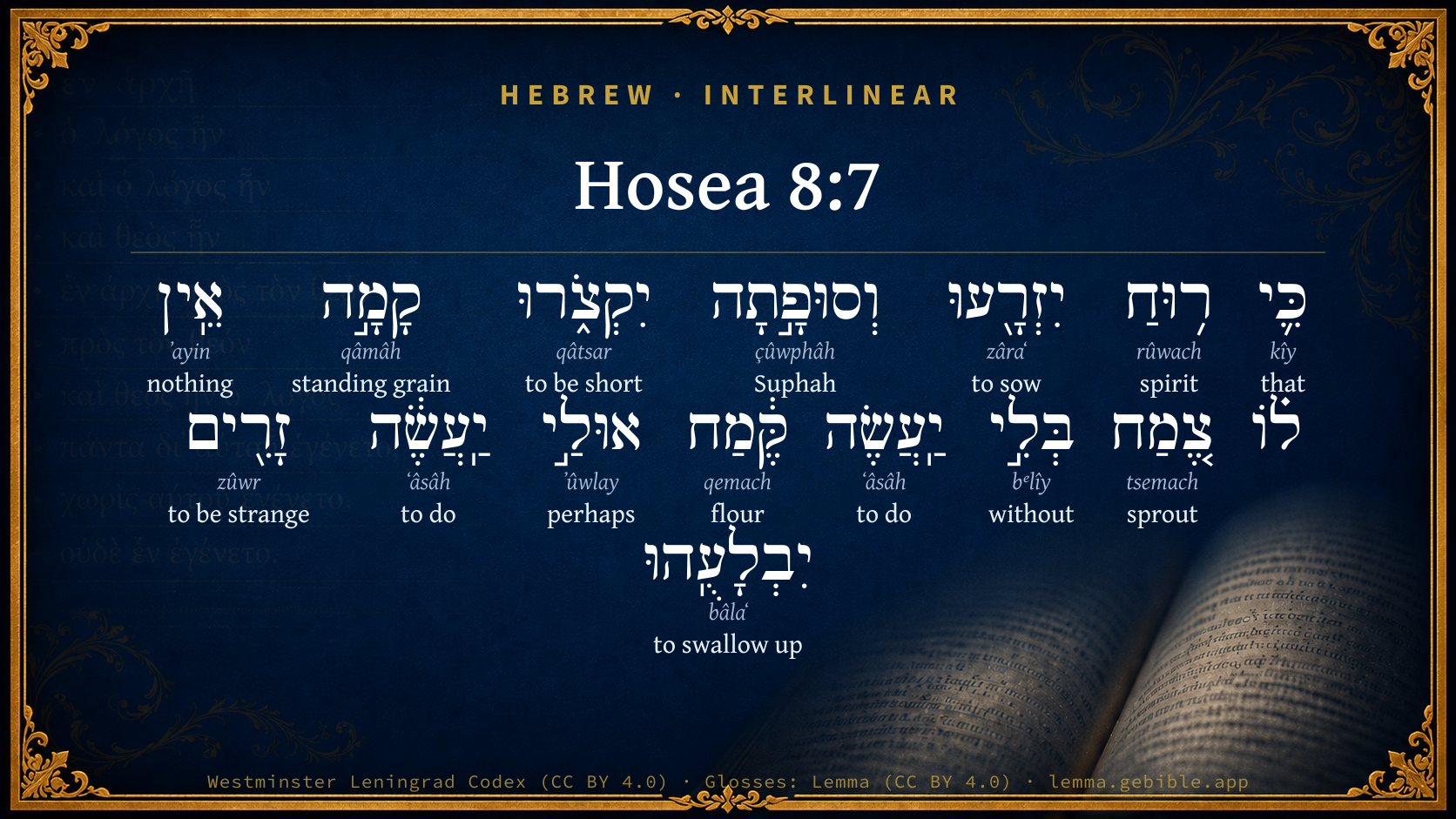
Hebrew (Westminster Leningrad Codex) Hosea 8:7 appears in the Hebrew Old Testament. The text above is from the Westminster Leningrad Codex. Each word links to its Strong’s number, a concise gloss, and parsing drawn from the Open Scriptures Hebrew Bible morphology. Click any word for its full Brown-Driver-Briggs (BDB) entry.
Download image
Cite this verse

Hosea 8:7 (World English Bible). Public Domain. Lemma interlinear Bible study tool, https://lemma.gebible.app/v/hosea/8/7.

Show BibTeX & RIS
BibTeX
RIS
English Translation
For they sow the wind, And they will reap the whirlwind. He has no standing grain. The stalk will yield no head. If it does yield, strangers will swallow it up.
World English Bible · Public Domain
Download a study sheet

One document with this verse’s original text, its word-by-word gloss line, the meaning frame, cross-references with their text, attributed commentary, and full source and license credits — printable, and it pastes into notes with its structure intact.

This verse Autodidact and up

Study sheet (.html) Plain text (.txt)

A passage Seminary Student

Up to 50 verses in one chapter. A passage sheet keeps up to 6 commentary sources and 12 cross-references per verse, in the order this page ranks them, and says so on the sheet whenever that leaves anything out. Ask for a single verse and you get the Autodidact verse sheet above.

Everything on this page stays free to read, with no account — the sheet is a download of what is already on screen, not access to it.

Want to remove ads? Support Godless Engineer
Compare translations 3

The same verse in 3 English versions, stacked beneath the original-language interlinear above. Click any original word for its lexicon entry.

Each is an independent rendering of the whole verse — the interlinear is not word-aligned to these translations.

Highlighted words mark where these versions differ — a whole-verse word diff, not a word-by-word alignment.

  • World English Bible Public Domain
    For they sow the wind, And they will reap the whirlwind. He has no standing grain. The stalk will yield no head. If it does yield, strangers will swallow it up.
  • King James Version Public Domain
    For they have sown the wind, and they shall reap the whirlwind: it hath no stalk; the bud shall yield no meal: if so be it yield, the strangers shall swallow it up.
  • unfoldingWord Literal Text CC BY-SA 4.0
    For they sow wind, and they will reap a whirlwind; standing grain on which there is no head. It will not yield flour. If perhaps it yields, strangers will swallow it up.

unfoldingWord Literal Text — © unfoldingWord, licensed CC BY-SA 4.0. Word-aligned USFM3 via Door43 (git.door43.org/unfoldingWord/en_ult).

Versions to compare (up to 4)

3 of 4 selected

Show all 18 translations

Every available English version of this verse, each an independent rendering of the whole verse.

  • World English Bible Public Domain
    For they sow the wind, And they will reap the whirlwind. He has no standing grain. The stalk will yield no head. If it does yield, strangers will swallow it up.
  • Berean Standard Bible Public Domain
    For they sow the wind, and they shall reap the whirlwind. There is no standing grain; what sprouts fails to yield flour. Even if it should produce, the foreigners would swallow it up.
  • Majority Standard Bible Public Domain
    For they sow the wind, and they shall reap the whirlwind. There is no standing grain; what sprouts fails to yield flour. Even if it should produce, the foreigners would swallow it up.
  • King James Version Public Domain
    For they have sown the wind, and they shall reap the whirlwind: it hath no stalk; the bud shall yield no meal: if so be it yield, the strangers shall swallow it up.
  • American Standard Version (1901) Public Domain
    For they sow the wind, and they shall reap the whirlwind: he hath no standing grain; the blade shall yield no meal; if so be it yield, strangers shall swallow it up.
  • Revised Version (1885) Public Domain
    For they sow the wind, and they shall reap the whirlwind: he hath no standing corn; the blade shall yield no meal; if so be it yield, strangers shall swallow it up.
  • Geneva Bible (1599) Public Domain
    For they haue sowne the winde, and they shall reape the whirlewind: it hath no stalke: the budde shall bring foorth no meale: if so be it bring forth, the strangers shall deuoure it.
  • Douay-Rheims (1899) Public Domain
    For they shall sow wind, and reap a whirlwind, there is no standing stalk in it, the bud shall yield no meal; end if it should yield, strangers shall eat it.
  • Young's Literal Translation Public Domain
    For wind they sow, and a hurricane they reap, Stalk it hath none -- a shoot not yielding grain, If so be it yield -- strangers do swallow it up.
  • Literal Standard Version CC BY-SA 4.0
    For wind they sow, and a windstorm they reap, || Stalk it has none—a shoot not yielding grain, || If so be it yield—strangers swallow it up.
  • Unlocked Literal Bible CC BY-SA 4.0
    For the people sow the wind and reap the whirlwind. The standing grain has no heads; it yields no flour. If it does come to maturity, foreigners will devour it.
  • unfoldingWord Literal Text CC BY-SA 4.0
    For they sow wind, and they will reap a whirlwind; standing grain on which there is no head. It will not yield flour. If perhaps it yields, strangers will swallow it up.
  • Darby Bible Public Domain
    For they have sown the wind, and they shall reap the whirlwind: it hath no stalk; should it sprout, it would yield no meal; if so be it yield, strangers shall swallow it up.
  • World Messianic Bible Public Domain
    For they sow the wind, and they will reap the whirlwind. He has no standing grain. The stalk will yield no head. If it does yield, strangers will swallow it up.
  • Webster's Bible Public Domain
    For they have sown the wind, and they shall reap the whirlwind: it hath no stalk: the bud shall yield no meal: if it shall yield, the strangers shall swallow it up.
  • Free Bible Version CC BY-SA 4.0
    Those who sow the wind will reap the whirlwind. The stalk has no head of grain; it will produce no flour. Even if it did produce grain, foreigners would swallow it all up.
  • Bible in Basic English Public Domain
    For they have been planting the wind, and their fruit will be the storm; his grain has no stem, it will give no meal, and if it does, a strange nation will take it.
  • JPS Tanakh (1917) Public Domain
    For they sow the wind, and they shall reap the whirlwind; it hath no stalk, the bud that shall yield no meal; if so be it yield, strangers shall swallow it up.

Literal Standard Version (2020), Covenant Press — licensed CC BY-SA 4.0. Text via the HelloAO Bible API (eBible.org). Unlocked Literal Bible (unfoldingWord) — licensed CC BY-SA 4.0. Text via the HelloAO Bible API (eBible.org). unfoldingWord Literal Text — © unfoldingWord, licensed CC BY-SA 4.0. Word-aligned USFM3 via Door43 (git.door43.org/unfoldingWord/en_ult). Free Bible Version, Dr. Jonathan Gallagher — licensed CC BY-SA 4.0. Text via the HelloAO Bible API (eBible.org).

Word by word

More ways to search: Search by grammar → Find every occurrence → Compare this word →

Practice this passage: Drill this verse → Learn its vocabulary →

קָמָ֣ה
qâmâh
H7054
“standing grain”
Noun, Common, Feminine, Singular, Absolute
Part of Speech
Noun
Type
Common
Gender
Feminine
Number
Singular
State
Absolute
Full BDB Definition

Origin: act part of H6965

TWOT: 1999b

standing grain
  1. כִּ֛י kîy H3588 “that” Conjunction
  2. ר֥וּחַ rûwach H7307 “spirit” Noun, Common, Both, Singular, Absolute
  3. יִזְרָ֖עוּ zâraʻ H2232 “to sow” Verb, Qal, Imperfect, 3rd Person, Masculine, Plural
  4. וְסוּפָ֣תָה çûwphâh H5492 “and · Suphah” Conjunction + Noun, Common, Feminine, Singular, Absolute + Suffix, h
  5. יִקְצֹ֑רוּ qâtsar H7114 “to be short” Verb, Qal, Imperfect, 3rd Person, Masculine, Plural
  6. אֵֽין ʼayin H369 “nothing” Particle, Negative
  7. צֶ֚מַח tsemach H6780 “sprout” Noun, Common, Masculine, Singular, Absolute
  8. בְּלִ֣י bᵉlîy H1097 “without” Particle, Negative
  9. יַֽעֲשֶׂה ʻâsâh H6213 “to do” Verb, Qal, Imperfect, 3rd Person, Masculine, Singular
  10. קֶּ֔מַח qemach H7058 “flour” Noun, Common, Masculine, Singular, Absolute
  11. אוּלַ֣י ʼûwlay H194 “perhaps” Adverb
  12. יַֽעֲשֶׂ֔ה ʻâsâh H6213 “to do” Verb, Qal, Imperfect, 3rd Person, Masculine, Singular
  13. זָרִ֖ים zûwr H2114 “strange” Adjective, Adjective, Masculine, Plural, Absolute
  14. יִבְלָעֻֽהוּ bâlaʻ H1104 “to swallow up · him” Verb, Qal, Imperfect, 3rd Person, Masculine, Plural + Suffix, Personal, 3rd Person, Masculine, Singular

About this verse

These counts appear in no published source. They are computed here, from the morphology-tagged text and Lemma’s own curated glosses. What Lemma adds →

16
words
14
distinct lemmas
Prophets
section

Notable vocabulary

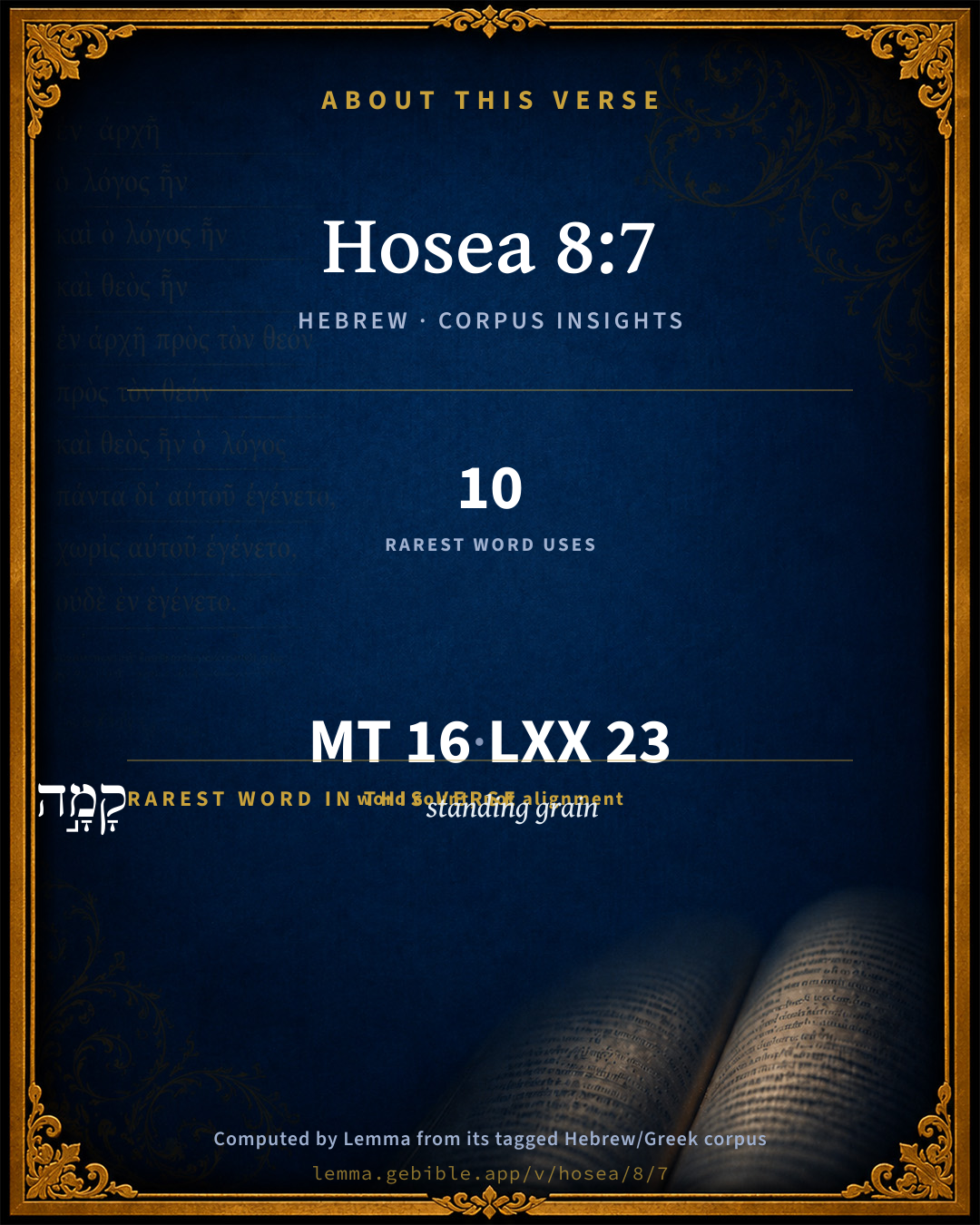
The rarest word here is קָמָ֣ה standing grain H7054 — appearing just 10 times in the whole Hebrew Bible.

Shared distinctive vocabulary

קָמָ֣ה standing grain H7054 occurs in 8 verses of the Hebrew Bible. Also found in:

Grammatical profile

  • 5 verbs
  • 5 nouns
  • 1 adjective
  • 1 preposition
  • 1 conjunction
  • 1 adverb
  • 2 particles

Verb forms

  • יִזְרָ֖עוּ Qal · Imperfect
  • יִקְצֹ֑רוּ Qal · Imperfect
  • יַֽעֲשֶׂה Qal · Imperfect
  • יַֽעֲשֶׂ֔ה Qal · Imperfect
  • יִבְלָעֻֽהוּ Qal · Imperfect

Repetition

A word recurs within this verse — often emphatic in Hebrew:

  • יַֽעֲשֶׂה to do H6213 ×2

Hebrew & Septuagint length

In English translation the verse runs 31 words from the Hebrew and 32 from the Septuagint (LXX English) — closely comparable.

A rough comparison of the two English renderings, which tokenize alike — not a word-level alignment.

Word counts can differ between the Hebrew and the Greek without any difference in meaning — e.g. the Hebrew direct-object marker אֵת has no separate Greek word, and Greek often adds the article ὁ.

In the original languages it is 16 Hebrew tokens and 23 Greek tokens — but the two are counted differently (Hebrew bundles its prefixes and suffixes into one token; the Greek is in lemma form), so that isn’t a like-for-like length.

Cross-references

16

Topical passages linked to Hosea 8:7 in the Treasury of Scripture Knowledge — connected by theme and wording, ordered by reader-vote popularity; previews shown in the World English Bible.

  • Proverbs 22:8 He who sows wickedness reaps trouble, And the rod of his fury will be destroyed.
  • Job 4:8 According to what I have seen, those who plow iniquity, And sow trouble, Reap the same.
  • Galatians 6:7 Don't be deceived. God is not mocked, for whatever a man sows, that will he also reap.
  • Nahum 1:3 Yahweh is slow to anger, and great in power, and will by no means leave the guilty unpunished. Yahweh has his way in the whirlwind and in the storm, and the clouds are the dust of his feet.
  • Judges 6:3–6 So it was, when Israel had sown, that the Midianites came up, and the Amalekites, and the children of the east; they came up against them;
  • Hosea 7:9 Strangers have devoured his strength, And he doesn't realize it. Indeed, gray hairs are here and there on him, And he doesn't realize it.
  • Hosea 10:12–13 Sow to yourselves in righteousness, Reap according to kindness. Break up your fallow ground; For it is time to seek Yahweh, Until he comes and rains righteousness on you.
  • Isaiah 66:15 For, behold, Yahweh will come with fire, and his chariots shall be like the whirlwind; to render his anger with fierceness, and his rebuke with flames of fire.
  • Jeremiah 12:13 They have sown wheat, and have reaped thorns; they have put themselves to pain, and profit nothing: and you shall be ashamed of your fruits, because of the fierce anger of Yahweh.
  • Hosea 2:9 Therefore I will take back my grain in its time, And my new wine in its season, And will pluck away my wool and my flax which should have covered her nakedness.
  • Deuteronomy 28:33 The fruit of your ground, and all your labors, shall a nation which you don't know eat up; and you shall be only oppressed and crushed always;
  • 2 Kings 13:3–7 The anger of Yahweh was kindled against Israel, and he delivered them into the hand of Hazael king of Syria, and into the hand of Benhadad the son of Hazael, continually.
  • 2 Kings 15:19 There came against the land Pul the king of Assyria; and Menahem gave Pul one thousand talents of silver, that his hand might be with him to confirm the kingdom in his hand.
  • 2 Kings 15:29 In the days of Pekah king of Israel came Tiglath Pileser king of Assyria, and took Ijon, and Abel Beth Maacah, and Janoah, and Kedesh, and Hazor, and Gilead, and Galilee, all the land of Naphtali; and he carried them captive to Assyria.
  • Ecclesiastes 5:16 This also is a grievous evil, that in all points as he came, so shall he go. And what profit does he have who labors for the wind?
  • Isaiah 17:11 In the day of your planting you hedge it in, and in the morning you make your seed to blossom; but the harvest flees away in the day of grief and of desperate sorrow.

Cross-references courtesy of OpenBible.info (CC BY 4.0).

Hebrew and Greek witnesses Masoretic Hebrew ↔ Greek Septuagint

The same verse in the two great witnesses to the Old Testament, shown verse-for-verse.

These are two independent witnesses, not word-aligned to each other, and the Septuagint is shown in lemma (dictionary) form.

Hebrew Hosea 8:7 Masoretic · Westminster Leningrad Codex

כִּ֛י ר֥וּחַ יִזְרָ֖עוּ וְסוּפָ֣תָה יִקְצֹ֑רוּ קָמָ֣ה אֵֽין ל֗וֹ צֶ֚מַח בְּלִ֣י יַֽעֲשֶׂה קֶּ֔מַח אוּלַ֣י יַֽעֲשֶׂ֔ה זָרִ֖ים יִבְלָעֻֽהוּ

For they sow the wind, And they will reap the whirlwind. He has no standing grain. The stalk will yield no head. If it does yield, strangers will swallow it up.

World English Bible · Public Domain

Greek LXX Hosea 8:7 Septuagint · lemma form

ὅτι ἀνεμόφθορος σπείρω καί ὁ καταστροφή αὐτός ἐκδέχομαι αὐτός δράγμα οὐ ἔχω ἰσχύς ὁ ποιέω ἄλευρον ἐάν δέ καί ποιέω ἀλλότριος καταἐσθίω αὐτός

for they sowed blighted seed, and their destruction shall await them, a sheaf of corn that avails not to make meal; and even if it should produce it, strangers shall devour it.

LXX2012 (modern English Septuagint) · Public Domain

On this verse, Trapp's Complete Commentary discusses the Septuagint’s reading. Read the note in Commentary ↓

Hebrew: Westminster Leningrad Codex (CC BY 4.0). Greek: Septuagint (public domain); English from LXX2012 (modern English Septuagint) (Public Domain). How the Septuagint differs from the Hebrew →

Targum (Aramaic paraphrase)

1

The Targum is the ancient Jewish Aramaic paraphrase of the Hebrew Scriptures — an interpretive translation, not the Hebrew text itself. Onkelos (literal) and Pseudo-Jonathan (expansive) render the Torah, and Jonathan the Prophets. Coverage is partial: where no permissively-licensed English translation exists for a verse, only the Aramaic is shown. This is verse-level text, not a word-by-word alignment to the Hebrew.

  1. Targum Jonathan Prophets (Joshua–Malachi)
    בֵּית יִשְׂרָאֵל דָמָן לִדְרוּחַ זֶרַע וְעַלְעוֹל חָצֵיד קָמָה לֵית לֵיהּ נוֹב לָא יַעְבֵּד מָאִים יִקְנוּן נִכְסִין עַמְמַיָא יִבְזוּנוּנוּן:

    (no public-domain English translation for this verse)

    Targum Jonathan — Aramaic: “Mikraot Gedolot” (public domain). English: “Sefaria Community Translation” (CC0 1.0 (public-domain dedication)); “London "Chaldee Paraphrase," 1871” (public domain). Text via Sefaria.

Commentary

Notes on Hosea 8:7 from classic Christian and Jewish commentators (each source and its license shown beneath its notes). The classic Christian expositions comment on the surrounding passage and are grouped to its opening verse, so a note may address several verses; the Jewish commentaries on the Tanakh (Rashi and others) are per-verse, so they appear only where the commentator wrote on this verse.

Lemma curates 59 commentaries, every one of them public domain or Creative Commons licensed, each selected and text-cleaned for this edition rather than reprinted as found. About our sources →

Trapp's Complete Commentary

John Trapp

Hos 8:7 For they have sown the wind, and they shall reap the whirlwind: it hath no stalk: the bud shall yield no meal: if so be it yield, the strangers shall swallow it up.

Ver. 7. For they have sown the wind, and shall reap the whirlwind] To sow the wind is to labour in vain, as Ecc 5:16, to labour for the wind, and Pro 11:29, to possess the wind, to feed on the wind, Hos 12:1, and to be eaten up of the wind, Jer 22:22. The Greeks express the same by hunting after and husbanding the wind, ανεμους γεωργειν. The wind, we know, maketh a mighty bustle, as if it were some great business, solid and stable; but presently it blows over, and comes to nothing. Or if it get, as seed, into the bosom of the earth, either it breeds an earthquake, or at least ariseth in a whirlwind, which blows dust into the eyes, and once at least buried a considerable army in the Libyan sands. Solomon saith, "He that soweth iniquity shall reap vanity," Pro 22:8. But our prophet here saith more. He that soweth the wind of iniquity shall reap the terrible tempest of inconceivable misery. By the "blast of God he shall perish, and by the breath of his nostrils he shall be consumed," Job 4:8-9. As the beginnings of idolatry, hypocrisy, vain glory, carnal policy, &c., are empty and unhappy (it is but the sowing of blasted grain, as the Septuagint here hath it, seed corrupted by the wind, ανεμοφθορα), so the end thereof is very sad and dismal. The word here rendered the whirlwind hath a syllable in it more than ordinary (Suphathah), to note (saith Tremellius) the fearfulness of the divine vengeance that will befall the forementioned; and especially at death, when they are entering upon eternity. Oh what a dreadful shriek gives the guilty soul at death, to see itself launching into an infinite ocean of scalding lead, and must swim naked in it for ever; not having the least cold blast of that wind it sowed all its life long to cool it; but rather to add to its torment! Then will God speak to such, as once he did to Job out of a whirlwind, but after another manner; Go to now, ye formalists, false worshippers, triflers, troublers of Israel; ye that have been mere mutes and ciphers, nullities in the world, superfluities in the earth, or worse than all this; go to now, I say, weep and howl for the miseries that are come upon you. "Ye have lived in pleasure on the earth, and been wanton; ye have nourished your hearts, as in a day of slaughter," Jas 5:5. But now an end is come, is come; an evil, an only evil, without mixture of mercy, sorrow without succour (help), mischief without measure, torments without hope of ever either mending or ending, are the portion of your cup; the dregs of that cup of mine must you now drink off, that hath eternity to the bottom. Oh lamentable! Oh did but men forethink what would be the end of sin, they dare not but be innocent. Oh let that terrible tempest at death be timely thought on and prevented: Job 27:20-21, &c., "Terrors take hold of him as waters, a tempest stealeth him away in the night. The east wind carrieth him away, and he departeth: and as a storm hurleth him out of his place. For God shall cast upon him, and not spare: he would fain flee out of his hand," &c.

It hath no stalk: the bud shall yield no meal] Nihil habet fertilitatis firmitatisque, as Ruffinus expoundeth it. It hath no firmness or fruitfulness; the wind of wickedness that thou hast sown, the blasted grain that thou hast committed to the earth, will yield thee nothing but loss and disappointment. A blade there may be, but not a stalk; or if a stalk, yet not a bud; or if a bud, yet it shall be nipped in the bud, it shall yield no meal, but only dust and chaff; or if it come to the meal, yet strangers shall swallow it up, so that you shall be never the better for it; but after that ye have sown the wind of iniquity, ye shall reap the wirlwind of misery, maledictionem omnimodam, curses of all kinds, which God hath hanged at the heels of your idolatry, a pernicious evil (whatever those superstitious she-sinners bragged to the contrary, Jer 44:17). Or if they flourish for a season, and have hopes of a large crop; yet God will curse their blessings, and frustrate their fair hopes, Psa 37:2, as he dealt by that rich wretch mentioned by Mr Burroughes in his comment on the second chapter of this prophecy. I had certain information, said he, from a reverend minister, that in his own town there was a worldling who had a large crop of grain. A good honest neighbour of his walking by his grain said, Neighbour, you have a very fine crop of grain, if God bless it. Yes, said he, I will have a good grain, speaking contemptuously. And before he could come to get it into the barn, it was blasted, that the grain of the whole crop was not worth sixpence.

John Trapp, A Commentary or Exposition upon All the Books of the Old and New Testament (1647–1656) — public domain. Text from a community e-Sword module.

The Biblical Illustrator

Joseph S. Exell

Hos_8:7

For they have sown the wind, and they shall reap the whirlwind.

The consequences of sin

Misery is attached to sin as its inevitable consequence; but the connection does not always appear to a superficial observer. Transgression sometimes appears to be productive of happiness, and obedience to be a source of much affliction and trouble. But the wicked are not really happy now, and they have no reasonable expectation of happiness in the eternal world.

I. Who may be said to sow the wind? To sow the wind is a proverbial expression for labouring in vain. It may be applied to all who seek happiness in the way of sin.

1. To sensualists, who yield themselves up to the gratifications of sense. See confession of Solomon (Ecc_2:1; Ecc_2:10-11).

2. To worldlings. The lovers of this present world hope to obtain, not a momentary gratification, but solid and lasting benefits. But riches are proverbially uncertain. Our cares are generally multiplied by means of them.

3. To formalists. The performance of religious duties seems more calculated to make us happy. No one can be happy who disregards them. But a mere round of services can never satisfy the conscience. Some delude themselves with an idea that it will secure the Divine favour. Under that delusion they may be filled with self-complacency. A sight of sin will speedily dissipate these self-righteous hopes.

4. To false professors. There are many who wish to be thought religious when they are destitute of spiritual life. They may be jealous about doctrines and their own particular form of Church government, but they are not solicitous to live nigh to God in holy duties.

II. What they may expect to reap. A whirlwind is a figure to represent extraordinary calamities. Their calamities will be--

1. Sudden. They receive warnings, but are taken by surprise at last.

2. Irresistible. Illustrate by a whirlwind.

3. Tremendous. See desolation wrought by a whirlwind. Infers

(1) How earnest should we be in redeeming time!

(2) How blessed are they who are living to God! (Sketches of Sermons.)

Reaping the whirlwind

Said Napoleon to La Place, I see no mention of God in your system of theology. No, sire, was the answer, we have no longer any need of that hypothesis. A half-century of anarchy and social disorder in unhappy France was the result--the awful reign of terror. How much wiser was Montesquieu, who said: God is as necessary as freedom to the welfare of France!

Sowing the wind

This is a proverbial speech, signifying the taking a great deal of pains to little purpose; as if a man should go abroad in the fields, and spread his hands about with effort and yet grasp nothing but air. The wind is an empty creature in respect of things solid, therefore the Scripture often makes use of it to signify the vanity of the hopes and laborious endeavours of wicked men.

1. Many do nothing all their lifetime but sow the wind; they labour and toil, but what comes of it? It is no good account to give to God of our time, to say that we have taken a great deal of pains; we may take pains and yet sow the wind. Who are those that sow the wind?

(1) Some students: men that spend their thoughts and strength about things in no way profitable to themselves or others, such sow the wind: with a great deal of earnestness they do just nothing.

(2) Idolaters. All those who take pains and are at great cost in superstitious worship, all their intentions that they have to honour God, come to nothing, it is but a sowing the wind.

(3) Formalists. Such as content themselves in the outward part of Gods worship, having no power nor life of godliness in the services they perform.

(4) The vainglorious. They who do all that they do out of vainglory, who, to set up themselves among others, spend a long time in prayer, and an ostentatiously scrupulous observance of all rites and ceremonies, a principle of vainglory actuating them throughout. Men of public gifts, who do abundance of good in the Church of God and in the commonwealth, but are moved thereto by a principle of self and vainglory, these lose all, they sow but to the wind.

(5) Such as serve themselves of sin; such as seek to shift for themselves by sinful means when they are in any straits, and forsake lawful courses to help themselves out of trouble. They reap the whirlwind. The Hebrew word has a syllable more than usual added to it to increase its signification. It is not only a whirlwind, but a most terrible whirlwind. There is more in the harvest than in the seed. Sow a little sinful pleasure, and a great deal of misery is the fruit. (Jeremiah Burroughs.)

The growth and power of habit

Notice the way in which the acts of daily life influence destiny.

I. We are continually forming habits.

II. The tendency of habits once formed is to increase in strength. Wind--whirlwind.

III. Habits increase in the direction of original tendency. Same in kind, though vastly different in intensity and force.

IV. The tendency of habits is to increase in strength till they pass beyond control. The whirlwind desolates the land and strews the sea with wrecks. Habit is something like appetite: we are led by it, just as a hungry man makes his way towards home. It cannot be explained how it is that actions become easier by being repeated, but that it is so everybody must admit. If we do anything a certain number of times, the doing has an effect upon us, and that effect we call habit. We should therefore be very careful what we accustom ourselves to do, lest we should acquire the appetite or habit of doing things that are hurtful and wrong. Habit is the result of repeated acts, and it is wonderful how soon a little child acquires a habit. The doing of a thing once or twice is sufficient to lead the child to do it again--

All habits gather, by unseen degrees,

As brooks make rivers, rivers run to seas.

(A. Hampden Lee.)

The Biblical Illustrator, edited by Joseph S. Exell (c. 1880s–1900s) — public domain. Text from a community e-Sword module.

Joseph Benson's Commentary

Hos 8:7. For they have sown the wind, and they shall reap the whirlwind, &c. — A proverbial expression, to signify, that as men’s works are, so must their reward be; that they who sow iniquity shall reap vanity, Pro 22:8. Their labour shall be fruitless, or shall turn to their hurt and damage: As if he had said, All the pains which the kings of Israel and their subjects had taken to enrich themselves, and to strengthen their kingdom, being built upon the foundation of apostacy and idolatry, shall turn to no better account, than countrymen expect from a blasted crop of corn; and whatever advantage they make, it shall at last be a prey to foreigners, to the kings of Syria and Assyria.

Joseph Benson's Commentary on the Old and New Testaments (1811–1818) — public domain. Text from a community e-Sword module.

The Preacher's Complete Homiletical Commentary

Joseph S. Exell (gen. ed.)

CRITICAL NOTES.—

Hos_8:8. Swallowed] up as devoured by beasts of prey. Vessel] worthless and dishonoured (2Ti_2:20); and broken (Psa_31:12; Jer_22:28; Jer_48:38).

HOMILETICS

A PICTURE OF UNGODLY LIFE.—Hos_8:7-8

Israel is still threatened. Their continual labour is all in vain. They reap no reward, will be grievously disappointed, and not only the harvest, but they themselves will be devoured. Such will be the result of their ungodly conduct.

I. Laborious in its efforts. “For they sow the wind.”

1. Effort is put forth by all men. They live and labour for good—seek to gain happiness and have a seed-time in life.

2. Painful are the efforts of the ungodly. They “plough iniquity,” and practice it day by day. “They sow the wind,” most earnestly and perseveringly, in hope of profit. Sinners are sore labourers. They put themselves to trouble and expense to make and worship their idols, to pursue their aims, but all in vain. They are labouring for the wind (Ecc_5:16); “embracing a shadow; grasping the air; wearying themselves for that which hath no substance nor true felicity in it.”

II. Disappointment in its results. “It hath no stalk: the bud shall yield no meal,” &c. First no ear, or if an ear, no yield, or if it advance thus far, the enemy will devour the produce.

1. Vanity is reaped. He that soweth iniquity shall reap vanity (Pro_22:8). There is a harvest in sin, and men reap what they sow (Gal_6:7-8). Vanity, emptiness, and vexation result from sin. Satan is a hard task-master. His service is slavery and the wages miserable. “Wherefore do ye spend money for that which is not bread? and your labour for that which satisfieth not?”

2. Divine retribution is reaped. “They shall reap the whirlwind.” The wind sown and penned up in ungodly life, will be reinforced in strength and burst forth into a mighty tempest. Men sow and cultivate what at last will make them the sport and mockery of its resistless violence. They will be carried away with their own folly like chaff before the wind. The whirlwind will overthrow their dwellings, wreck their hopes, and drive them away in their wickedness. Sennacherib in olden time reaped the whirlwind (Isa_10:5-12; Isa_10:24-25; Isa_30:31). Napoleon, robbed of empire, shorn of greatness, and driven into exile, reaped the harvest of his own sowing. Spain with its Inquisition, and France with its Black Bartholomew, countries remarkable for persecution, reaped the whirlwind in bloody revolutions and civil wars. The ungodly are consumed by Divine judgments in this life and by Divine wrath in that which is to come. “They that plow iniquity and sow wickedness, reap the same. By the blast of God they perish, and by the breath of his nostrils are they consumed.”

III. Destructive in its end. “Israel is swallowed up.” Not mere disappointment, but destruction will be the result of sin. Israel were carried away, the whole nation were swallowed up by foes. They lost their privileges and honour. Their land was devoured and eaten up by strangers. They were dishonoured by God, and despised by men as a broken vessel. Sin and idolatry in gross or refined forms will bring misery and degradation. They undermine the foundations of moral life, beget more place for vanity and more thirst for pleasure. Those who do not love and serve God will be given up by God. There will come, though long delayed, a terrible day of wrath, a harvest of whirlwinds to consume their glory and destroy their hopes. “Be not deceived: God is not mocked: for whatsoever a man soweth that shall he also reap.”

HOMILETIC HINTS AND OUTLINES

Hos_8:7. “They have sown.”

1. Human life a sowing time. “Behold a sower went forth to sow.” The relation of men one to another like that of seed and soil. Men are sowing by thoughts, words, and deeds. In each a permanent influence, a germ of imperishable life.

2. The kind of life—moral seed. Some sow good seed, others worthless seed. The pleasure-seeker and the man of the world, the hypocrite and the false professor, are sowing “the wind.”

3. The accompaniments of life—the harvest. The harvest is good or bad, the same in measure and quality as the sowing. Men reap to-day what they had sown yesterday, will reap in eternity what they sow in time. God’s laws are unchangeable and will never be reversed. “For he that soweth to his flesh shall of the flesh reap corruption; but he that soweth to the spirit shall of the spirit reap life everlasting.”

Not only may men expect to reap as they sow, but sinful and vain courses will bring further disadvantages, and raise violent tempests, either in the undertaker’s conscience, or outward condition, or both; for “they have sown the wind, and shall reap the whirlwind” [Hutcheson].

Hos_8:8. Sinful courses persisted in may consume the Church, deprive of religious ordinances, and gratify the wishes of the enemy, who greedily devour God’s people (Psa_14:4).

When professors decline in religion and despise God, then God will despise them before others. So long as Israel was consecrated to the Lord those who sought to injure her were injured themselves (Jer_2:3); but when they made leagues with idolaters they were swallowed up by them. “For them that honour me I will honour, and they that despise me shall be lightly esteemed.”

Dishonoured vessels.

1. A useless vessel. Empty of everything good, filled with everything bad, and taking the place of vessels more useful and worthy.

2. A broken vessel. Broken in credit and reputations, broken to pieces in hopes and fortunes; broken by their own conduct and by the judgments of God upon that conduct.

3. A vessel put to some vile purpose. Israel given to idolatry. Men dishonouring body and soul by sin, making them objects of loathing and disgust before others. “There are not only vessels of gold and silver, but also of wood and of earth: and some to honour, and some to dishonour” (2Ti_2:20). All men are vessels of mercy, or vessels of wrath fitted to destruction (Rom_9:22).

Such has been the history of the ten tribes ever since; swallowed up, not destroyed; among the nations, yet not of them; despised and mingled among them, yet not united with them; having an existence, yet among that large whole, the nations, in whom their natural existence has been at once preserved and lost; everywhere had in dishonour; the Heathen and the Mohammedan have alike despised, outraged, insulted them; avenging upon them, unconsciously, the dishonour which they did to God [Pusey].

The Preacher's Complete Homiletical Commentary (gen. ed. Joseph S. Exell; Funk & Wagnalls, c. 1892) — public domain (pre-1929). A full-Bible homiletical/sermon-outline anthology covering 65 of 66 books (2 John is absent from the source module). Text from a community e-Sword module.

Keil & Delitzsch

C. F. Keil & F. Delitzsch

This will Israel reap from its ungodly conduct. Hos 8:7. "For they sow wind, and reap tempest: it has no stalks; shoot brings no fruit; and even if it brought it, foreigners would devour it." With this figure, which is so frequently and so variously used (cf. Hos 10:13; Hos 12:2; Job 4:8; Pro 22:8), the threat is accounted for by a general thought taken from life. The harvest answers to the sowing (cf. Gal 6:7-8). Out of the wind comes tempest. Wind is a figurative representation of human exertions; the tempest, of destruction. Instead of rūăch we have און, עמל, עולה (nothingness, weariness, wickedness) in Hos 10:13; Job 4:8, and Pro 22:8. In the second hemistich the figure is carried out still further. קמה, "seed standing upon the stalk," is not to it (viz., that which has been sowed). Tsemach brings no qemach, - a play upon the words, answering to our shoot and fruit. Qemach: generally meal, here probably the grain-bearing ear, from which the meal is obtained. But even if the shoot, when grown, should yield some meal, strangers, i.e., foreigners, would consume it. In these words not only are the people threatened with failure of the crop; but the failure and worthlessness of all that they do are here predicted. Not only the corn of Israel, but Israel itself, will be swallowed up.

Keil & Delitzsch — Biblical Commentary on the Old Testament (1861–1891) — public domain (CC PDM 1.0). Text via the HelloAO Bible API. (Old Testament only.)

Tyndale Open Study Notes

Tyndale Open Resources

8:7 When Hosea proclaimed divine judgment, the punishment fit the crime (see study note on 4:10). Through their idolatry and political intrigue, the Israelites had planted the seeds of their own destruction (see Gal 6:7).

Tyndale Open Study Notes — © Tyndale Open Resources, licensed CC BY-SA 4.0. Text via the HelloAO Bible API.

Geneva Bible (1599)

Geneva Bible translators

Showing that their religion hath but a show, and in itself is but vanity.

Geneva Bible (1599) marginal notes — public domain. Text via Bolls.life.

Jamieson, Fausset & Brown

Robert Jamieson, A. R. Fausset & David Brown

sown . . . reap-- (Pro 22:8; Gal 6:7). "Sow . . . wind," that is, to make the vain show of worship, while faith and obedience are wanting [CALVIN]. Rather, to offer senseless supplications to the calves for good harvests (compare Hos 2:8); the result being that God will make them "reap no stalk," that is, "standing corn." Also, the phraseology proverbially means that all their undertakings shall be profitless (Pro 11:29; Ecc 5:16).

the bud--or, "growth."

strangers--foreigners (Hos 7:9).

Jamieson, Fausset & Brown — Commentary Critical and Explanatory on the Whole Bible (1871) — public domain (CC PDM 1.0). Text via the HelloAO Bible API.

Adam Clarke's Commentary

Verse 7. They have sown the wind, and they shall reap the whirlwind] As the husbandman reaps the same kind of grain which he has sown, but in far greater abundance, thirty, sixty, or one hundred fold; so he who sows the wind shall have a whirlwind to reap. The vental seed shall be multiplied into a tempest; so they who sow the seed of unrighteousness shall reap a harvest of judgment. This is a fine, bold, and energetic metaphor.

It hath no stalk] Nothing that can yield a blossom. If it have a blossom, that blossom shall not yield fruit; if there be fruit, the sower shall not enjoy it, for strangers shall eat it. The meaning is, the labours of this people shall be utterly unprofitable and vain.

Adam Clarke's Commentary on the Bible (1810–1826) — public domain. Text from a community e-Sword/MySword module.

John Calvin's Commentaries

The Prophet here shows by another figure how unprofitably the Israelites exercised themselves in their perverted worship, and then how vainly they excused their superstitions. And this reproof is very necessary also in the present day. For we see that hypocrites, a hundred times convicted, will not yet cease to clamour something: in short, they cannot bear to be conquered; even when their conscience reproves them, they will still dare to vomit forth their virulence against God. They will also dare to bring forward vain pretences: hence the Prophet says, that they have sown the wind, and that they shall reap the whirlwind. It is an appropriate metaphor; for they shall receive a harvest suitable to the sowing. The seed is cast on the earth, and afterwards the harvest is gathered: They have sown, he says, the wind, they shall then gather the whirlwind, or, the tempest. To sow the wind is nothing else than to put on some appearance to dazzle the eyes of the simple, and by craft and guise of words to cover their own impiety. When one then casts his hand, he seems to throw seed on the earth, but yet he sows the wind. So also hypocrites have their displays, and set themselves in order, that they may appear wholly like the pious worshipers of God.

We hence see that the design of the Prophet’s metaphor, when he says that they sow the wind, is to show this, that though they differ nothing from the true worshippers of God in outward appearance, they yet sow nothing but wind; for when the Israelites offered their sacrifices in the temple, they no doubt conformed to the rule of the law, but at the same time came short of obedience to God. There was no faith in their services: it was then wind; that is, they had nothing but a windy and an empty show, though the outward aspect of their service differed nothing from the true and legitimate worship of God. They then sow the wind and reap the whirlwind. But we cannot finish to-day.

John Calvin's Commentaries (1540-1563) — public domain. Text from the Calvin Translation Society English edition (1840s-50s) via the Christian Classics Ethereal Library (ccel.org). Calvin's coverage is partial (roughly two-thirds of the Bible); uncommented books and verses are honest gaps, never fabricated. The 19th-century editor's footnotes and remarks are omitted so the notes are faithfully Calvin's own voice.

Ellicott's Commentary for English Readers

(7) Wind . . . whirlwind.—The great law of Divine retribution, the punishment for sin being often a greater facility in sinning—indifference to God becoming enmity, forgetfulness of duty or truth becoming violent recoil from both. “Wind” expresses what is empty and fruitless, and the pronoun “it” refers, in accordance with the metaphor, to such unproductive seed.

It hath no stalk.—Not even incipient prosperity, as in the days of Jeroboam II. “The growth shall yield no grain,” as we might express the play of words in the Hebrew.

A Bible Commentary for English Readers, edited by Charles John Ellicott (1878–1897) — public domain. Text from a community e-Sword module.

The Cambridge Bible for Schools and Colleges

gen. ed. J. J. S. Perowne

7. The consequences of Israel’s evil conduct and policy are here represented under the figure of sowing and reaping. But the form of the figure is varied. First, Israel sows wind and reaps whirlwind, i.e. his present conduct is unprofitable to himself, and the requital of it shall be actual destruction. Next, though Israel sows a corn-plant, it never grows up to its full size (it, i.e. Israel, hath no standing corn); or if it does, it either yields the farmer no meal, or its meal is seized upon by the enemy, i.e. the worldly results of Israel’s policy are never good, and any wealth that it attains passes into the hands of the enemy.

the bud shall yield no meal] In the Hebrew there is a characteristic play upon sounds,—the çemakh yields no qemakh.

The Cambridge Bible for Schools and Colleges (gen. ed. J. J. S. Perowne; Cambridge University Press, 1878–1918) — public domain. Text from a community e-Sword module.

John Gill's Exposition

For they have sown the wind, and they shall reap the whirlwind,.... The sense is, the Israelites took a great deal of pains in the idolatrous worship of the calves, and made a great stir, bustle, and noise in it, like the wind; were very vainglorious and ostentatious, made a great show of religion and devotion, and promised themselves great things from it, peace and plenty, wealth and riches, all prosperity and happiness, enjoyed by Heathen nations; but this was lost labour, it was labouring for the wind, or sowing that; they got nothing by it, or what was worse than nothing; it proved not only useless, but hurtful, to them; for, for their idolatry, and continuance in it, the whirlwind of God's wrath would be raised up against them, and the Assyrian army, like a vehement storm of wind, would rush in upon them, and destroy them; so they that sow to the flesh, shall of the flesh reap corruption, Gal 6:8;

it hath no stalk; what they sowed did not rise up above ground; or, if it did, it did not spring up in a blade or stalk, which was promising of fruit; no real good, profit, and advantage, sprung from their idolatrous practices:

the bud shall yield no meal; yea, though it rise up into a stalk, and this stalk produced ears of corn, yet those so thin, that no meal or flour could be got out of them, and so of no worth and use:

and if so be it yield: any meal or flour:

the strangers shall swallow it up; the Israelites should not be the better for it; it should till come into the hands of foreigners, the Assyrian army. The meaning is, that if they did prosper and increase in riches, yet they should not long enjoy them themselves, but be pillaged and spoiled of them; as they were by the exactions of Pul, and by the depredations of Shalmaneser, kings of Assyria. So the Targum,

"if they got substance, the nations shall spoil them of it.''

John Gill's Exposition of the Whole Bible (1746–1763) — public domain (CC PDM 1.0). Text via the HelloAO Bible API.

Albert Barnes' Notes on the Bible

For they have sown the wind, and they shall reap the whirlwind - “They shall reap,” not merely as “they have sown,” but with an awful increase. They sowed folly and vanity, and shall reap, not merely emptiness and disappointment, but sudden, irresistible destruction. “They sowed the wind,” and, as one seed bringeth forth many, so the wind, “penn’d up,” as it were, in this destructive tillage, should “burst forth again, reinforced in strength, in mightier store and with great violence.” Thus they “reaped the whirlwind,” yea, (as the word means) “a mighty whirlwind”. But the whirlwind which they reap doth not belong to “them;” rather they belong to it, blown away by it, like chaff, the sport and mockery of its restless violence.

It hath no stalk - If their design should for the time seem to prosper, all should be but empty show, disappointing the more, the more it should seem to promise. He speaks of three stages of progress. First, the seed should not send forth the grain with the ear; “it hath no stalk or standing corn;” even if it advanced thus far, still the ear should yield no meat; or should it perchance yield this, the enemy should devour it. Since the yielding fruit denotes doing works, the fruit of God’s grace, the absence of the “standing corn” represents the absence of good works altogether; the absence of the “meal,” that nothing is brought to ripeness; the “devouring” by “the enemy,” that what would otherwise be good, is, through faulty intentions or want of purity of purpose, given to Satan and the world, not to God. : “When hypocrites make a shew of good works, they gratify therewith the longings of the evil spirits. For they who do not seek to please God therewith, minister not to the Lord of the field, but to “strangers.” The hypocrite, then, like a fruitful but neglected “ear,” cannot retain his fruit, because the “ear” of good works lieth on the ground. And yet he is fed by this very folly, because for his good works he is honored by all, eminent above the rest; people’s minds are subject to him; he is raised to high places; nurtured by favors. But “then” will he understand that he has done foolishly, when, for the delight of praise, he shall receive the sentence of the rebuke of God.”

Albert Barnes' Notes on the Bible (1834–1885) — public domain. Text from a community e-Sword/MySword module.

Haydock's Catholic Bible Commentary

Whirlwind. They shall be punished for their folly, nor shall they reap any advantage from idols. --- In it, or in Israel. The seed which I have sown yields no fruit. If any come up, the mildew destroys it. Yea, though any should come to perfection, which is impossible, it should be given to strangers. My people perform no acts of religion; or at least they render them useless, by adoring idols. (Calmet) --- He speaks in general terms, as few continued faithful. Yet even in the worst of times, seven thousand were found, 3 Kings xix. 18. (Haydock)

George Leo Haydock (1774–1849), Haydock's Catholic Family Bible and Commentary, 1859 edition — public domain. Excludes Psalms (Douay-Rheims chapter numbering differs from Protestant) and Deuterocanonical books (Catholic canon only).

Matthew Poole's English Annotations

For; since that; or, for so much as; or, verily; so the Hebrew particle is sometimes used, Isa 7:9.

They have sown the wind; a proverbial speech, to denote either lost labour, or, which is much worse, labour that will undo and tear to pieces him that laboureth: both these are in the verse. Man’s life and labour is a seed that will bring forth fruit; but when this life and labour is laid out on sin, as here Israel’s was, it will bring forth that fruit the sinner is unwilling to reap.

They shall reap the whirlwind; a violent, tearing, and dissipating tempest, which beareth down and destroyeth all that is in its way; an emblem of the wrath of God breaking out against these vain and sinful men: so Ephraim reaped in his civil wars, and much more in the Assyrian war, which ended in a whirlwind, that hath scattered them into unknown countries, and where they have lain buried in forgetfulness above two thousand four hundred years.

It hath no stalk; suppose this seed should have its harvest in no whirlwind, it will end in loss and disappointment, as seed that never springs up into a stalk, nor hath bud or ear: all your worship of and dependence on idols, and foreign assistance, will at best be as seed that yields neither stalk nor bud.

The bud shall yield no meal; or suppose it produced stalk and bud, yet it will be no profit, but all lost labour, for the bud shall be lank, shrivelled, and blasted, and never yield meal: so was the fruit Israel reaped, from Pul to Menahem, and from Egypt’s assistance to Hoshea against Shalmaneser.

If so be it yield, the strangers shall swallow it up; or, if yet meal be found in the bud, Israel shall be never the better, foreigners devour it: so did Pul and his, and Shalmaneser and his Assyrians, eat up all.

Matthew Poole's English Annotations on the Holy Bible (1683–1685) — public domain. Text from a community e-Sword/MySword module.

The Pulpit Commentary

For they have sown the wind, and they shall reap the whirlwind. The harvest corresponds to the seed-time; their foolish and vain idolatries shall have corresponding results. This proverbial expression imports more than merely labor in vain; it denotes labor that has an injurious and destructive result. It has more than a negative significancy of lost labor; it conveys the idea of positive detriment. "The prophet," says Kimchi, "means to say that they will weary themselves in vain in this service (of idols), just as if a man who sows the wind, in which there is nothing substantial, shall only reap the wind, or even still less; as if he had said, "Ye shall not obtain the least enjoyment, but only injury. If, then, the wind denote the vanity and nothingness of human effort, the whirlwind is the image of destruction and annihilation, viz. a storm or hurricane remorselessly tearing all away with it. Suphah itself intensifies the notion included in ruach, while the paragogic h intensifies still more, so as to denote a storm of greatest violence. The double feminine ending is regarded by most as strengthening the sense in this word suphathah, hhmyae htrz, etc. It hath no stalk (margin, standing corn): the bud shall yield no meal; better, shoot brings no fruit. This is a further development of the figure. When wind is the seed sown, destruction represented by tempest is the harvest reaped. The seed sown produces no stalk, or at least no stall= with grain in it no standing corn. If the seed shoot up at all, tile shoot has no fruit. Here the play on words, of which the Hebrews were so fond, is obvious the tse-roach has no yemach; the halm has no maim; the Spross no Schoss; the corn no kern. If so be it yield, the strangers shall swallow it up. When, or if, any fruit is attained, the invasion of rapacious foreigners swallows it up. First, then, when the wind of vain human efforts is the sowing, destruction is the harvest. If the seed spring up at all, the ear does not fill; or if the ear should fill, there is no substance in it; or if it fill and have substance, the rapacity of hostile invaders consumes it. Thus a blight falls on all they do. Kimchi explains the verse fully as follows: "Because the prophet compares their works to one who sows the wind, he adds further to the same image, and says, "It has no stalk, it reaches not the time when it shall be stalk" (or "standing corn"). Now hmq is the name of the corn when it stands ready for the harvest, from which the husbandmen (literally, "sowers") soon expect enjoyment, i.e. after harvest, when they shall make it into meal. Yea, even at the time they expect profit from their works, they shall have none. And he says further, "The shoot shall not produce fruit or meal," as if he said, "Even should the seed spring up after the sowing." He thus represents in a figure that should they prosper a little in their works after they have begun to do evil, yet that prosperity will not last, and it will not come to perfect enjoyment (beauty) like corn which comes to harvest and to grinding. And if it should yield, strangers devour it. Perhaps for a time it may produce so as to come to meal, as if he said that, should they prosper in their possessions so that a little enjoyment should be accorded to them at the first, then strangers shall come and devour it, and their enjoyment will not be complete.

Reaping the whirlwind.

The figure here is extremely striking; it is one of the most forcible and vivid of Hosea"s images. It suggests the folly and unprofitableness of a life of sin; those who live such a life "sow the wind." And it emphasizes the fact that while the harvest must be the same in kind as the seed sown, the increase will be tremendous, both in strength and volume. The whirlwind of the desert tears along with a roar like a cataract, and carries in its wings violent and sweeping destruction; it is, therefore, a fit metaphor for the issue of a career of sin Let us inquire who are some of those that thus reap.

I IDOLATERS. It is of such that the prophet is more immediately speaking. The people of the ten tribes were "sowing the wind" when they prayed to the golden calves for abundant harvests; and they would presently "reap the whirlwind" in the three years" siege of Samaria by Shalmaneser, in the successive deportations into exile, and in the final ruin of the nationality of Ephraim. The generation that came out of Egypt seven centuries before had reaped a sad harvest from the calf-worship at Horeb. "There fell of the people that day about three thousand men". (Exo_32:28) And ever since that time the idolatries of Israel had been a standing grief to Jehovah their Redeemer; (Psa_81:8-16) until at length there was nothing for it but the two hurricanes of captivity, which respectively swept the ten tribes into Assyria, and the remaining two into Babylon. All heathendom, moreover, "reaps the whirlwind" still as the fruit of its idolatries a harvest (as Paul tells us in Rom_1:18-32) of moral corruption and vileness, overhung by the storm-cloud of the Divine wrath.

II DESPOTS. The tyrant makes an idol of his own evil will, and "sows the wind" of ambition, and pride, and vain-glory, and disregard of the rights of others. Universal history teems with illustrations of the fact that those kings and grandees of the earth who will not give God the glory are doomed to reap a harvest of whirlwind. Take, e.g., from sacred history such cases as Pharaoh, Ahab and Jezebel, Sennacherib, Haman, Herod. Or, from profane history, such illustrations as the Stuart kings of England, the Bourbon kings of France, and the fate of the two Napoleons, Some tyrants have foreseen the harvest before it began to be gathered in; like Louis XV, when he said to his courtiers, "After me, the deluge.

III CARELESS PARENTS. All who neglect the godly upbringing of their children "sow the wind." There are well-meaning heads of households who fail to maintain a firm and resolute as well as kindly family government. They allow their young people to cherish self-will, or to follow pleasure as if it were the business of life, and neglect to exercise due restraint over them. This was the sin of Eli; (1Sa_3:13) and he soaped the tornado in the disgrace which was thus brought upon the priesthood, together with the destruction of his own house. There are parents, also, who in their own personal character fail to set a consistent godly example before their sons and daughters. David"s great sin entailed evil upon his family like a whirlwind; some of his sons became arrows in his heart, instead of "arrows in his hand." The historian shows us the poor king reaping his dismal harvest in the pathetic scene in which he bewailed the fate of Absalom. (2Sa_18:33)

IV Vicious MEN. The young man who wastes his substance with riotous living" has his career described in our text. In following the impulse of his wild hot passions he "sows the wind." The sensualist, the drunkard, the gambler, how profitless all their sowing "to their own flesh"! And what a harvest of torment and terror and shame they are compelled to reap! It has been so even with men of the most brilliant genius, as e.g. the poets Byron and Burns. A career of sinful pleasure produces the whirlwind as its natural harvest. It undermines the foundations of morality within the soul. (Hos_4:11) The appropriate epitaph for such a life is, on the one side of the tombstone, "Vanity of vanities;" and on the other, "Vexation of spirit.

V ALL UNBELIEVERS. For even the man of good moral character "sows the wind," if he neglects the salvation of Jesus Christ. Every one who lives without God is without hope. He who believes that the only real life is a life of sense, and who therefore shuts his eyes to the world of the unseen, shall one day be fully undeceived. Should no whirlwind arise within his conscience during the present life, he shall find himself, when he passes into eternity, at once involved in tremendous wreaths of storm. He "shall eat of the fruit of his own way," and his "destruction shall come as a whirlwind". (Pro_1:24-33) What a dreadful tempest is "the wrath of the Lamb". (Rev_6:12-17) Yet the ungodly shall be exposed to all its fury. They shall "reap the whirlwind;" or, rather, the whirlwind shall reap them; they are "like the chaff which the wind driveth away". (Psa_1:4)

LESSONS.

1. This life is the seed-time of eternity, and all are sowers.

2. The harvest depends upon the seed; hence the importance of sowing good seed.

3. To sow sin is a policy of wretched infatuation; it is like "sowing wind.

4. The harvest of sin is not only profitless, but terrific and destructive; it is the whirlwind.

5. All men have "sown the wind," for all are sinners; but there is "a Man" who is able to shelter us from the whirlwind. C.J. (Isa_32:2)

"What shall the harvest be?

In Scripture "the wind" is an emblem of vanity or folly, and "the whirlwind" of sudden and unexpected destruction. Here the latter is declared to be the product of the former. As a gentle "wind" may be the precursor of the "whirlwind," so the foolish policy of Israel would be followed by resistless disaster. By a change of figure in the following clause, Hosea announces that plans which at first seemed successful would bring no ultimate advantage. The clause may be thus paraphrased: "That which is sown produces no stalk, or even if it does the stalk will yield no grain; or if so be it does yield any, foreign armies shall swallow it up." The principle which underlies this teaching is sufficiently evident in the first clause, the consideration of which suggests the following truths:

I THAT MEN SHALL REAP AS THEY HAVE SOWN IS A DIVINE AND UNIVERSAL LAW.

1. This law is seen in nature. Sow wheat, and without further anxiety, you are confident that you will reap wheat, and not something else. And not in kind only, but in quantity, whether abundantly or sparsely, you will reap as you sowed. The child is surprised to see his own name appear written in living green; but he who sowed the seed in that form sees in it only what is natural and usual.

2. This law asserts itself in social life. If a nation allows its children to be brought up without regard to the sanctities of life, it finds its retribution in crowded jails and asylums, in political insecurity, in death-bringing pestilence, etc. Having sown the wind, it reaps the whirlwind. So it is with the methods adopted by despotic tyranny. History shows how often repressive measures, excessive and uncertain punishments, etc., have culminated in the whirlwind of revolution which has overwhelmed and wrecked orderly society.

3. this law is visible in the culture of the mind and the occupations of life.

Contrast the destiny of the indolent shifty schoolboy with that of the steady student who yearly grows in intellectual capacity.

4. This law never fails in the moral and religious sphere. Suppose a man resolves to do that which will pay in a financial sense. He deliberately abjures righteousness for expediency, resolving at all costs to win wealth. He does win it. He reaps according to the seed he has sown, but it is no wonder if in his moral being he is "given over to a reprobate mind." On the other hand, the religious man gives up a profitable practice because he believes it to be immoral. The result is that he fails to reap riches because he has not sown for them, but he does reap the bliss of having a conscience void of offense towards God and towards men.

II THAT THIS LAW SOMETIMES ASSERTS ITSELF IN THE SAD EXPERIENCE OF SINNERS EVEN IN THIS PRESENT LIFE. "Even as I have seen, they that plough inequity, and sow wickedness, reap the same". (Job_4:8) Retribution often comes (as it came to Israel) through the sin that at first brought nothing but success. The notorious life of James Fisk, of New York, was a remarkable illustration of the declaration, "The wicked shall fall by their own wickedness.

1. Examples from Scripture.

(1) Haman plotted against Mordecai to his own destruction. His was the vaulting ambition that overleaps itself.

(2) Daniel"s foes were themselves cast into the lion"s den.

(3) The Pharisees found that the cross to which they triumphantly nailed our Lord was at once the means of their confusion and of his victory over the world.

2. Examples from experience. Pope Alexander VI Tried to poison his friend Cardinal Adrian. Through the mistake of his cupbearer, he himself died by the cup which was meant to destroy another. The Regent Morton was another example. So was Thomas Cromwell, of whom Macaulay says, No one ever made a more unscrupulous use of the legislative power for the destruction of his foes;" and it was by these means he was himself destroyed.

3. Common proverbs illustrate the text. "Ashes always fly in the face of him who throws them." "Harm watch, harm catch," etc. Thus, even in outward circumstances, the words of the text have been fulfilled; but how much more terribly in that inward retribution which is veiled even from the victim"s dearest friends! The anxiety that fears detection, the loss of self-respect, the horror of being alone, the failure of hope, the growing dread of the future, have caused many a man, even on earth, to know what it is to "reap the whirlwind." But observe finally

III THAT THIS LAW WILL ULTIMATELY PROCLAIM ITSELF WITH UNMISTAKABLE DISTINCTNESS. Sin"s retribution is not always seen here. Human taws may be powerless to reach a recognized offender. Social morality may be too degraded to rebuke his sin. For these and other reasons much is necessarily left to the future, when crooked things will be made straight. Perhaps it is well that it should be so. It is for our profit that we should walk by faith, and not by sight. God does not append instant pain to every act of disobedience. He deals with us as men, not as children. To do right not because it pays, but because it is right, is the obedience of the wise man, not that of the petted child; and it is the higher God ever seeks. Hence he has contented himself with giving a few signs that his Law cannot be broken with impunity, and these point us on to the day when righteousness and truth shall be crowned, and wrong and falsehood cursed amidst the "Amens" of the universe. In such events as those to which we have referred, we see a few ripening ears which tell us what the harvest will be when those who have sown the wind shall reap the whirlwind. This experience, so far as it refers to the future retribution, denotes:

1. That it is sudden in its arrival. (See Mat_24:37-39 Pro_29:1 1Th_5:2)

2. That it is resistless in its approach. Who can arrest the whirlwind? (see Psa_1:4 Rev_6:15)

3. That it is terrible in its effects. Compare the destruction of men"s works by a whirlwind, with the desolation of the worldling"s hopes by death.

CONCLUSION.

1. Show how close is the connection between this life and the life to come. That is the reaping of this sowing. Therefore do not wait till harvest-time before beginning to sow in righteousness.

2. Show how possible it is, through God"s goodness, to reap a harvest. Both of Christian character and of Christian work the promise is true, "He that soweth and he that reapeth will rejoice together. A.R.

Sowing the wind and reaping the whirlwind.

Sowing and reaping in the natural world are processes of husbandry so closely and vitally connected, that they obviously suggest corresponding connections in the spiritual realm. "Whatsoever a man soweth, that shall he also reap." Such is the great moral law. Yet there is a characteristic of the working of this law which is very suggestive. Whilst the kind remains the same, the measure of what is reaped largely exceeds the measure of what is sown. This is the lesson of the text. What is sown is the wind; what is reaped is the whirlwind.

I IS WHAT SENSE SINNERS SOW THE WIND. The sins for which Israel was chiefly denounced by the prophet were idolatry and heathen alliances, in both of which the Lord"s honor was given to another, and the confidence due to him was unrighteously and foolishly transferred. Now, the wind is the emblem of emptiness and unsubstantial vanity. Accordingly, the language of the text teaches that the conduct of Israel was foolish and vain. And this may be asserted of all who, by vice, or crime, or irreligion, depart from God.

II IN WHAT SENSE SINNERS REAP THE WHIRLWIND. Under the government of a just and almighty Ruler, it could not be that Israel or any nation could forsake the true religion and abandon lofty principles, without suffering the consequences in the penalties attached to disobedience and rebellion. But the point of the text is to be found in the apparent disproportion between the offence and the penalty. Israel hoped for safety; instead of this, and as the result of apostasy, Israel went into captivity. The national life of the kingdom and people of Samaria was absolutely destroyed, never to be revived. Thus a mighty whirlwind, the messenger of Divine indignation, carried the people away in their sins. Thus is it with all high-handed and stiff-necked sinners. Their rebellion and apostasy has even to human eyes the appearance of a sowing to the wind; but in the order of the Divine government it is appointed that such shall reap the whirlwind. We read the lesson in the awful fate which has overtaken all nations which have been unfaithful to their calling, which have defied the righteous and Divine Governor. And in how many instances of individual life have we seen the operation of the same law! Moral ruin and utter overthrow have followed upon estrangement and rebellion. The very confidence which sinners repose in the idols they choose for themselves becomes the occasion of their more complete and irremediable confusion. Judgment is delayed; but the stores of retributive force accumulate, and in due time the tornado of Divine indignation sweeps down upon the sinner"s head with irresistible force, issuing in the catastrophe of temporal and spiritual ruin. T.

The Pulpit Commentary (1880–1919), ed. H.D.M. Spence-Jones & Joseph S. Exell — public domain. Text from a community e-Sword module.

John Wesley's Explanatory Notes

Sown the wind - A proverbial speech to denote lost labour. Whirlwind - A tempest, which destroyeth all that is in its way; an emblem of the wrath of God. No stalk - All your dependance on idols, and foreign assistance, will be as seed that bear neither stalk nor bud. No meal - Or suppose it produced stalk and bud, yet the bud shall be blasted, and never yield meal.

John Wesley, Explanatory Notes Upon the Whole Bible (1754–1765) — public domain. Text via the GEBible commentary corpus.

Rashi

Rabbi Shlomo Yitzchaki (Rashi)

it has no standing grain Their seed has no standing grain; i.e., they will not prosper with their deeds.

if it does produce Even if it produces flour.

strangers will swallow it Even if they prosper with their property, it will eventually fall into the hands of strangers.

Rashi on the Tanakh — English translations: “The Judaica Press complete Tanach with Rashi, translated by A. J. Rosenberg” (CC BY 4.0); “Pentateuch with Rashi's commentary by M. Rosenbaum and A.M. Silbermann, 1929-1934” (public domain); “The Metsudah Tanach series, Lakewood, N.J” (CC BY 4.0); and “The Book of Joshua, Metsudah Publications, 1997” (CC BY 4.0). Text via Sefaria.

Lesson kit

Teaching starters — assembled from the data on this page, not authored interpretation. Every prompt links to the verse data it draws on. Edit before teaching.

Hosea, in the Prophets, opens this verse with 16 words (14 distinct Hebrew lemmas). Its most distinctive word is qâmâh (“standing grain”). A historical commentator’s framing appears above. Read the whole chapter for the surrounding context.

Discussion questions

  1. What does “standing grain” (qâmâh) contribute to the verse as a whole?
  2. How does Exodus 22:6, which shares the word «standing grain», read alongside this verse?
  3. What does the repetition of “to do” (2× in this one verse) do in this verse?
  4. These translations render this verse differently. What is at stake in choosing one wording over another?
  5. «יִזְרָ֖עוּ» is a Qal Imperfect verb. How does that grammatical form shape the action described?
  6. Compare how Trapp's Complete Commentary and The Biblical Illustrator read this verse. Where do they agree or differ?

Things to notice

Reading settings

Reading text

Shown beneath each verse's original-language words.

Old Testament
Old Testament edition

Read the OT as the Masoretic Hebrew (MT) or the Greek Septuagint (LXX).

English shown for the Greek Septuagint (in the Hebrew ↔ Greek comparison).

Comparing translations? Open the Compare panel on any verse page to stack up to four side by side.