Ezekiel 5:9

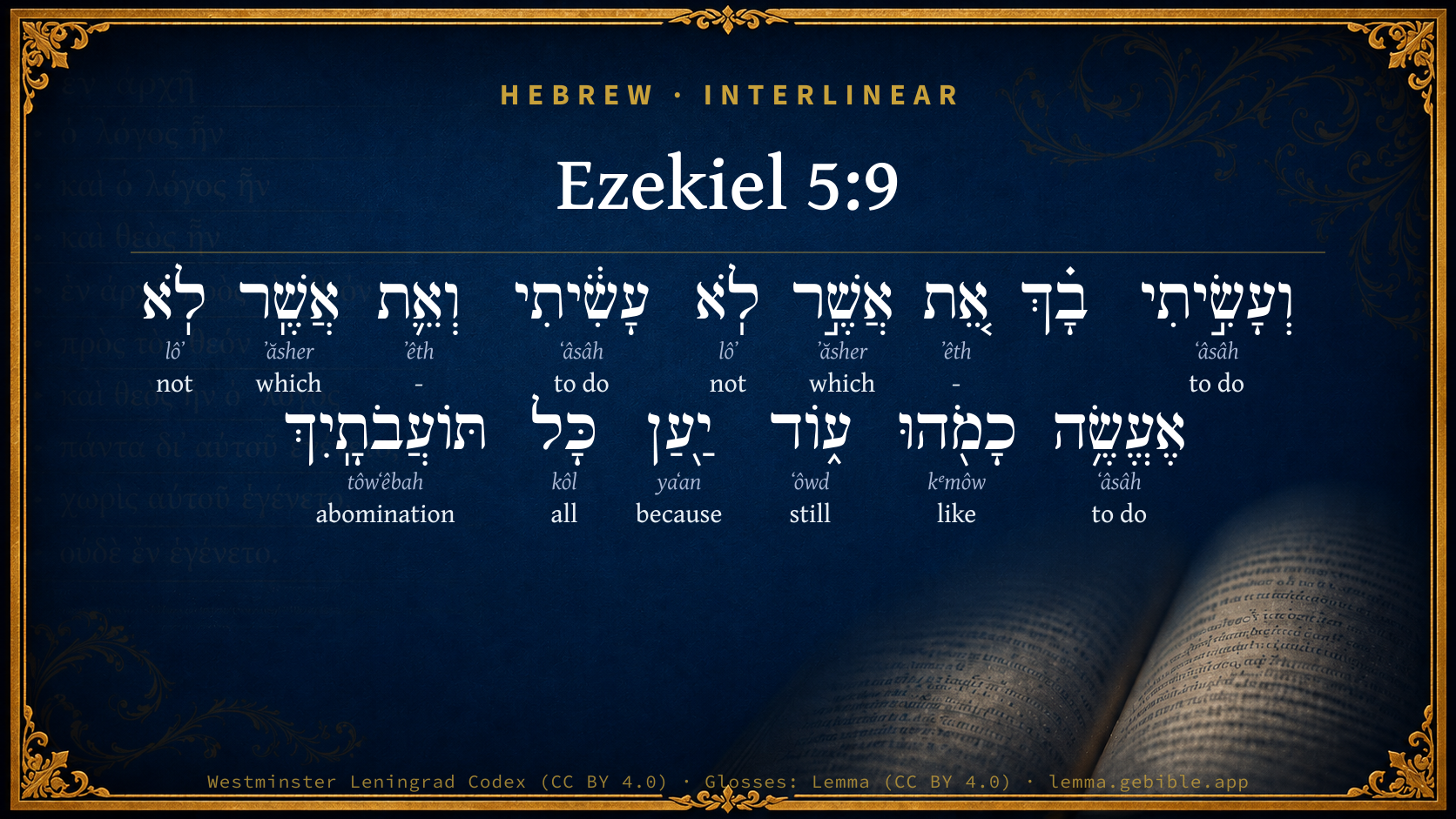
Hebrew (Westminster Leningrad Codex) Ezekiel 5:9 appears in the Hebrew Old Testament. The text above is from the Westminster Leningrad Codex. Each word links to its Strong’s number, a concise gloss, and parsing drawn from the Open Scriptures Hebrew Bible morphology. Click any word for its full Brown-Driver-Briggs (BDB) entry.
Download image
Cite this verse

Ezekiel 5:9 (World English Bible). Public Domain. Lemma interlinear Bible study tool, https://lemma.gebible.app/v/ezekiel/5/9.

Show BibTeX & RIS
BibTeX
RIS
English Translation
I will do in you that which I have not done, and whereunto I will not do any more the like, because of all your abominations.
World English Bible · Public Domain
Download a study sheet

One document with this verse’s original text, its word-by-word gloss line, the meaning frame, cross-references with their text, attributed commentary, and full source and license credits — printable, and it pastes into notes with its structure intact.

This verse Autodidact and up

Study sheet (.html) Plain text (.txt)

A passage Seminary Student

Up to 50 verses in one chapter. A passage sheet keeps up to 6 commentary sources and 12 cross-references per verse, in the order this page ranks them, and says so on the sheet whenever that leaves anything out. Ask for a single verse and you get the Autodidact verse sheet above.

Everything on this page stays free to read, with no account — the sheet is a download of what is already on screen, not access to it.

Want to remove ads? Support Godless Engineer
Compare translations 3

The same verse in 3 English versions, stacked beneath the original-language interlinear above. Click any original word for its lexicon entry.

Each is an independent rendering of the whole verse — the interlinear is not word-aligned to these translations.

Highlighted words mark where these versions differ — a whole-verse word diff, not a word-by-word alignment.

  • World English Bible Public Domain
    I will do in you that which I have not done, and whereunto I will not do any more the like, because of all your abominations.
  • King James Version Public Domain
    And I will do in thee that which I have not done, and whereunto I will not do any more the like, because of all thine abominations.
  • unfoldingWord Literal Text CC BY-SA 4.0
    I will do to you what I have not done and the like of which I will not do again, because of all your disgusting actions.

unfoldingWord Literal Text — © unfoldingWord, licensed CC BY-SA 4.0. Word-aligned USFM3 via Door43 (git.door43.org/unfoldingWord/en_ult).

Versions to compare (up to 4)

3 of 4 selected

Show all 18 translations

Every available English version of this verse, each an independent rendering of the whole verse.

  • World English Bible Public Domain
    I will do in you that which I have not done, and whereunto I will not do any more the like, because of all your abominations.
  • Berean Standard Bible Public Domain
    Because of all your abominations, I will do to you what I have never done before and will never do again.
  • Majority Standard Bible Public Domain
    Because of all your abominations, I will do to you what I have never done before and will never do again.
  • King James Version Public Domain
    And I will do in thee that which I have not done, and whereunto I will not do any more the like, because of all thine abominations.
  • American Standard Version (1901) Public Domain
    And I will do in thee that which I have not done, and whereunto I will not do any more the like, because of all thine abominations.
  • Revised Version (1885) Public Domain
    And I will do in thee that which I have not done, and whereunto I will not do any more the like, because of all thine abominations.
  • Geneva Bible (1599) Public Domain
    And I will doe in thee, that I neuer did before, neither will do any more the like, because of all thine abominations.
  • Douay-Rheims (1899) Public Domain
    And I will do in thee that which I have not done: and the like to which I will do no more, because of all thy abominations.
  • Young's Literal Translation Public Domain
    And I have done in thee that which I have not done, And that which I do not its like again, Because of all thine abominations.
  • Literal Standard Version CC BY-SA 4.0
    And I have done in you that which I have not done, || And the like of which I do not do again, || Because of all your abominations.
  • Unlocked Literal Bible CC BY-SA 4.0
    I will do to you what I have not done and the like of which I will not do again, because of all your disgusting actions.
  • unfoldingWord Literal Text CC BY-SA 4.0
    I will do to you what I have not done and the like of which I will not do again, because of all your disgusting actions.
  • Darby Bible Public Domain
    and I will do in thee that which I have not done, and whereunto I will not do any more the like, because of all thine abominations.
  • World Messianic Bible Public Domain
    I will do in you that which I have not done, and which I will not do anything like it any more, because of all your abominations.
  • Webster's Bible Public Domain
    And I will do in thee that which I have not done, and the like to which I will not do any more, because of all thy abominations.
  • Free Bible Version CC BY-SA 4.0
    Because of all the disgusting things you've done, I'm going to do to you what I've never done before—and I won't ever do again.
  • Bible in Basic English Public Domain
    And I will do in you what I have not done and will not do again, because of all your disgusting ways.
  • JPS Tanakh (1917) Public Domain
    And I will do in thee that which I have not done, and whereunto I will not do any more the like, because of all thine abominations.

Literal Standard Version (2020), Covenant Press — licensed CC BY-SA 4.0. Text via the HelloAO Bible API (eBible.org). Unlocked Literal Bible (unfoldingWord) — licensed CC BY-SA 4.0. Text via the HelloAO Bible API (eBible.org). unfoldingWord Literal Text — © unfoldingWord, licensed CC BY-SA 4.0. Word-aligned USFM3 via Door43 (git.door43.org/unfoldingWord/en_ult). Free Bible Version, Dr. Jonathan Gallagher — licensed CC BY-SA 4.0. Text via the HelloAO Bible API (eBible.org).

Word by word

More ways to search: Search by grammar → Find every occurrence → Compare this word →

Practice this passage: Drill this verse → Learn its vocabulary →

יַ֖עַן
yaʻan
H3282
“because”
Conjunction
Part of Speech
Conjunction
Full BDB Definition

Origin: from an unused root meaning to pay attention

TWOT: 1650e

because, therefore, because that, on account of (conjunction) - because of, on account of (preposition) - why (with interrogative pronoun) (preposition)
  1. וְעָשִׂ֣יתִי ʻâsâh H6213 “and · to do” Conjunction + Verb, Qal, Sequential Perfect, 1st Person, Common, Singular
  2. אֵ֚ת ʼêth H853 “-” Particle, Direct Object
  3. אֲשֶׁ֣ר ʼăsher H834 “which” Particle, Relative
  4. לֹֽא lôʼ H3808 “not” Particle, Negative
  5. עָשִׂ֔יתִי ʻâsâh H6213 “to do” Verb, Qal, Perfect, 1st Person, Common, Singular
  6. וְאֵ֛ת ʼêth H853 “and · -” Conjunction + Particle, Direct Object
  7. אֲשֶֽׁר ʼăsher H834 “which” Particle, Relative
  8. לֹֽא lôʼ H3808 “not” Particle, Negative
  9. אֶעֱשֶׂ֥ה ʻâsâh H6213 “to do” Verb, Qal, Imperfect, 1st Person, Common, Singular
  10. כָמֹ֖הוּ kᵉmôw H3644 “like · him” Preposition + Suffix, Personal, 3rd Person, Masculine, Singular
  11. ע֑וֹד ʻôwd H5750 “still” Adverb
  12. כָּל kôl H3605 “all of” Noun, Common, Masculine, Singular, Construct
  13. תּוֹעֲבֹתָֽיִךְ tôwʻêbah H8441 “abominations · your” Noun, Common, Feminine, Plural, Construct + Suffix, Personal, 2nd Person, Feminine, Singular

About this verse

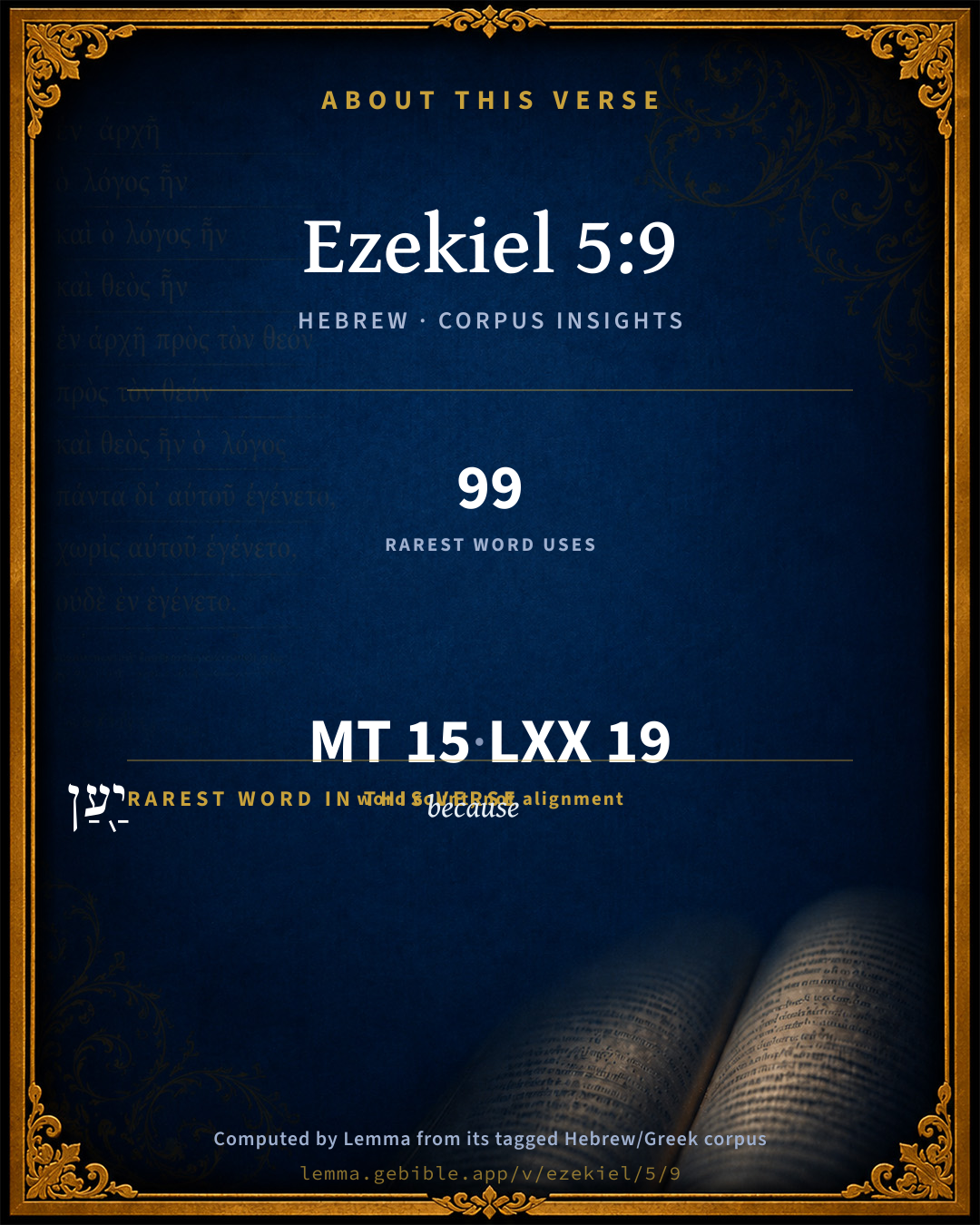
These counts appear in no published source. They are computed here, from the morphology-tagged text and Lemma’s own curated glosses. What Lemma adds →

15
words
9
distinct lemmas
Prophets
section

Grammatical profile

  • 3 verbs
  • 2 nouns
  • 2 prepositions
  • 1 conjunction
  • 1 adverb
  • 6 particles

Verb forms

  • וְעָשִׂ֣יתִי Qal · Sequential Perfect
  • עָשִׂ֔יתִי Qal · Perfect
  • אֶעֱשֶׂ֥ה Qal · Imperfect

Repetition

Words recur within this verse — often emphatic in Hebrew:

  • וְעָשִׂ֣יתִי to do H6213 ×3
  • אֲשֶׁ֣ר which H834 ×2
  • לֹֽא not H3808 ×2

Hebrew & Septuagint length

In English translation the verse runs 26 words from the Hebrew and 26 from the Septuagint (LXX English) — the same length.

A rough comparison of the two English renderings, which tokenize alike — not a word-level alignment.

Word counts can differ between the Hebrew and the Greek without any difference in meaning — e.g. the Hebrew direct-object marker אֵת has no separate Greek word, and Greek often adds the article ὁ.

In the original languages it is 15 Hebrew tokens and 19 Greek tokens — but the two are counted differently (Hebrew bundles its prefixes and suffixes into one token; the Greek is in lemma form), so that isn’t a like-for-like length.

Cross-references

5

Topical passages linked to Ezekiel 5:9 in the Treasury of Scripture Knowledge — connected by theme and wording, ordered by reader-vote popularity; previews shown in the World English Bible.

  • Daniel 9:12 He has confirmed his words, which he spoke against us, and against our judges who judged us, by bringing on us a great evil; for under the whole sky has not been done as has been done on Jerusalem.
  • Matthew 24:21 for then there will be great oppression, such as has not been from the beginning of the world until now, no, nor ever will be.
  • Amos 3:2 "You only have I chosen of all the families of the earth. Therefore I will punish you for all of your sins."
  • Lamentations 4:6 For the iniquity of the daughter of my people is greater than the sin of Sodom, That was overthrown as in a moment, and no hands were laid on her.
  • Lamentations 4:9 Those who are killed with the sword are better than those who are killed with hunger; For these pine away, stricken through, for want of the fruits of the field.

Cross-references courtesy of OpenBible.info (CC BY 4.0).

Hebrew and Greek witnesses Masoretic Hebrew ↔ Greek Septuagint

The same verse in the two great witnesses to the Old Testament, shown verse-for-verse.

These are two independent witnesses, not word-aligned to each other, and the Septuagint is shown in lemma (dictionary) form.

Hebrew Ezekiel 5:9 Masoretic · Westminster Leningrad Codex

וְעָשִׂ֣יתִי בָ֗ךְ אֵ֚ת אֲשֶׁ֣ר לֹֽא עָשִׂ֔יתִי וְאֵ֛ת אֲשֶֽׁר לֹֽא אֶעֱשֶׂ֥ה כָמֹ֖הוּ ע֑וֹד יַ֖עַן כָּל תּוֹעֲבֹתָֽיִךְ

I will do in you that which I have not done, and whereunto I will not do any more the like, because of all your abominations.

World English Bible · Public Domain

Greek LXX Ezekiel 5:9 Septuagint · lemma form

καί ποιέω ἐν σύ ὅς οὐ ποιέω καί ὅς οὐ ποιέω ὅμοιος αὐτός ἔτι κατά πᾶς ὁ βδέλυγμα σύ

And I will do in you things which I have not done, and the like of which I will not do again, for all your abominations.

LXX2012 (modern English Septuagint) · Public Domain

Hebrew: Westminster Leningrad Codex (CC BY 4.0). Greek: Septuagint (public domain); English from LXX2012 (modern English Septuagint) (Public Domain). How the Septuagint differs from the Hebrew →

Targum (Aramaic paraphrase)

1

The Targum is the ancient Jewish Aramaic paraphrase of the Hebrew Scriptures — an interpretive translation, not the Hebrew text itself. Onkelos (literal) and Pseudo-Jonathan (expansive) render the Torah, and Jonathan the Prophets. Coverage is partial: where no permissively-licensed English translation exists for a verse, only the Aramaic is shown. This is verse-level text, not a word-by-word alignment to the Hebrew.

  1. Targum Jonathan Prophets (Joshua–Malachi)
    וְאַעְבֵּיד בִּיךְ יַת דְלָא עֲבַדֵית וְיַת דְלָא אַעְבֵּיד דִכְוָתֵיהּ עוֹד חֲלַף כָּל תּוֹעֲבָתָיִךְ:

    (no public-domain English translation for this verse)

    Targum Jonathan — Aramaic: “Mikraot Gedolot” (public domain). English: “Sefaria Community Translation” (CC0 1.0 (public-domain dedication)); “London "Chaldee Paraphrase," 1871” (public domain). Text via Sefaria.

Commentary

Notes on Ezekiel 5:9 from classic Christian and Jewish commentators (each source and its license shown beneath its notes). The classic Christian expositions comment on the surrounding passage and are grouped to its opening verse, so a note may address several verses; the Jewish commentaries on the Tanakh (Rashi and others) are per-verse, so they appear only where the commentator wrote on this verse.

Lemma curates 59 commentaries, every one of them public domain or Creative Commons licensed, each selected and text-cleaned for this edition rather than reprinted as found. About our sources →

Trapp's Complete Commentary

John Trapp

Eze 5:9 And I will do in thee that which I have not done, and whereunto I will not do any more the like, because of all thine abominations.

Ver. 9. And I will do in thee that which I have not done.] None shall suffer so much here or sink so deep in hell, as a profane Jew, a carnal gospeller, who is therefore worse than others, because he ought to be better. Oh, the height and weight of those judgments that shall be heaped upon such! See Lam 4:6.

And whereunto I will not do any more the like.] For where ever read we that the fathers did eat their sons in an open visible way? and the sons the Fathers?

John Trapp, A Commentary or Exposition upon All the Books of the Old and New Testament (1647–1656) — public domain. Text from a community e-Sword module.

Jamieson, Fausset & Brown

Robert Jamieson, A. R. Fausset & David Brown

See on Eze 5:7.

that which I have not done--worse than any former judgments (Lam 4:6; Dan 9:12). The prophecy includes the destruction of Jerusalem by the Romans, and the final one by Antichrist (Zac 13:8-9; Zac 14:2), as well as that by Nebuchadnezzar. Their doom of evil was not exhausted by the Chaldean conquest. There was to be a germinating evil in their destiny, because there would be, as the Lord foresaw, a germinating evil in their character. As God connected Himself peculiarly with Israel, so there was to be a peculiar manifestation of God's wrath against sin in their case [FAIRBAIRN]. The higher the privileges the greater the punishment in the case of abuse of them. When God's greatest favor, the gospel, was given, and was abused by them, then "the wrath was to come on them to the uttermost" (Th1 2:16).

Jamieson, Fausset & Brown — Commentary Critical and Explanatory on the Whole Bible (1871) — public domain (CC PDM 1.0). Text via the HelloAO Bible API.

Adam Clarke's Commentary

Verse 9. I will do in thee that which I have not done] The destruction of Jerusalem by Nebuchadnezzar was one of the greatest calamities that ever fell on any nation or place before; and that by the Romans under Titus exceeded all that has taken place since. These two sackages of that city have no parallel in the history of mankind.

Adam Clarke's Commentary on the Bible (1810–1826) — public domain. Text from a community e-Sword/MySword module.

John Calvin's Commentaries

Now God subjoins, that their punishment should be so severe that no similar example could be found in the world — I will do what I have not done, nor intended to do, that is, I will avenge your contempt of my law in a striking and unexpected manner; for God sometimes so chastises men as not to exceed the ordinary method. But because punishments seem vile and contemptible when they are so common, God is compelled to surpass the ordinary measure, and to punish the wicked signally and portentously, as he says by Moses. (Deuteronomy 28:46.) When therefore he now says, that he would do what he had not done before, and what he would not do again, he signifies a horrible vengeance, which has no similar example. It means nothing else than what, we have quoted from Moses, that the vengeance would be signal and portentous. Interpreters take this metaphorically, but this view cannot be admitted, because in their opinion no history has recorded its fulfillment; hence they fly to allegory and metaphor. But first of all, we know what Josephus says, that mothers were so ravenous that they slew their children and fed upon them, although here a previous siege is referred to, in which God signifies that he would cause fathers to devour their children: I confess it; but even if we receive what they wish, it was not done then; hence Jeremiah is mistaken when he says, that miserable women cooked their children for food. (Lamentations 4:10.) Surely this is a sufficient witness; for to say that we never find that this actually happened is to reject the testimony of Jeremiah. Besides, God had threatened that very thing by Moses; nor can the passage be eluded, because there is weight in the words —

“Men delicate among you, and those accustomed to luxuries,” says he, “shall eat their own children; a man shall envy the wife of his bosom, so that he shall not suffer her to enjoy that nefarious food with him. Then by stealth shall he consume and devour the flesh of his son, so that he shall distribute no part of it to another.” (Deuteronomy 28:54, 55.)

When Moses uses this language he certainly does not mean that there shall be intestine dissensions, so that disciples shall rise up against their masters, and masters oppress their disciples, as Jerome fancies. But it is necessary to take the words as they sound, namely, that God would not be content with common and customary punishments when the Jews had arrived at the very last pitch of impiety and wickedness, since he blames them so severely. Hence Ezekiel now threatens this; nor is it surprising that the Prophets took such forms of expression from Moses, since they used the language of Moses rather than a new one, that the people might not despise their prophesyings. Now, therefore, we must decide, that the Prophet uses these threatenings against the Jews literally. But if any one now object that what God says will not happen does often happen, a solution must be sought for. For we said that when the Jews were besieged by Titus, such a ravenousness attacked certain women, that they fed by stealth on their own children. But God pronounces that he never would do this again I reply that this kind of vengeance is not to be restricted to one day, so that God should not often punish the Jews in a similar manner. But we do not read that this was done, except by the Jews, for although this cruelty is related in tragedies — that children were used as food by their parents, yet this barbarity nowhere existed, that a father knowingly and willingly ate his own son; hence this was peculiar to the Jews. And that God had once executed this vengeance on them by means of the Chaldeans, is no obstacle to his again inflicting the same punishment, when he wished to take vengeance on the extreme rebellion of the people. For although in Ezekiel’s time all things were very corrupt, yet we know that when the Son of God was rejected, the Jews cut off from themselves all hope of restoration to the mercy of God. It is not surprising, then, if again he had suffered sons to be devoured by their fathers, as he now threatens that fathers should be so rabid as not even to spare their own bowels.

I know not why Jerome invented this difference, which is altogether futile. For he says, that when a thing is honorable and becoming it should be ascribed to God, but when the thing itself is base, God averts the infamy from himself. For when this wonder is treated of here, God does not say I will cause the people to eat their sons, but he says, fathers shall eat their sons, and sons their fathers. But there is nothing solid in this comment, because the cruelty which the Chaldeans exercised towards the Jews certainly was not either honorable or becoming, and yet God ascribes to himself whatever the Chaldeans did. Again, what was baser than the incest of Absalom, in debauching his father’s wives? and even that was not sufficient, but he wished the whole people, at the sound of a trumpet, to be witnesses of his crime; and yet what does God say? “I will do this before the sun,” says he. (2 Samuel 12:12, and 2 Samuel 16:21, 22.) We see, then, that this man was not familiar with the Scriptures, and yet that he offered his comments too hastily. There was, indeed, no true religion in the man, and it is not without cause that I admonish you; for there is danger lest many be deceived, if they were not admonished that his genius was full of ostentation and arrogance.

John Calvin's Commentaries (1540-1563) — public domain. Text from the Calvin Translation Society English edition (1840s-50s) via the Christian Classics Ethereal Library (ccel.org). Calvin's coverage is partial (roughly two-thirds of the Bible); uncommented books and verses are honest gaps, never fabricated. The 19th-century editor's footnotes and remarks are omitted so the notes are faithfully Calvin's own voice.

Ellicott's Commentary for English Readers

(9) That which I have not done, and where-unto I will not do any more the like.—Our Lord uses similar language (Mat_24:21) in foretelling the final destruction of Jerusalem by the Romans. But all question whether Ezekiel here looks forward to that calamity, and all comparison between that and the destruction under Nebuchadnezzar, are out of place. What the prophet here intends is not a comparison between different judgments upon the Jews, but between God’s treatment of them and of others. As they had received at His hand higher opportunities and privileges than He had before given or would afterwards give to any other nation, so must the punishment for their sin be more severe and more conspicuous than He had inflicted or would inflict on any other. All the Divine judgments upon them through all time may therefore be considered as here coming into view. The present captivity and the impending destruction of the temple were but single features of a long series of judgments, in the course of which the terrible particulars mentioned in Eze_5:10 should have place, ending with what is the present condition of the people before our eyes, scattered “into all the winds.” Such evils had been foretold by their prophets all through their history as the consequence of disobedience (see Lev_26:29; Deu_28:53—the sons eating their fathers is a fearful addition here; Jer_19:9), and from time to time had in some degree come to pass (2Ki_6:28-29; Lam_2:20), although the culmination of the punishment, like the culmination of the sin, was still future.

A Bible Commentary for English Readers, edited by Charles John Ellicott (1878–1897) — public domain. Text from a community e-Sword module.

The Cambridge Bible for Schools and Colleges

gen. ed. J. J. S. Perowne

9. that which I have not done] This is no mere rhetorical threat. It is possible that the miseries of the siege and exile were no greater than those endured by other nations in those days, but the same miseries may be felt more acutely. Israel was a nation fervidly patriotic, and patriotism was inspired by the glow of religion; it was also for that time a nation highly cultured; and moreover its calamities were felt to come from the hand of its own God. The feelings of the godly Israelite after the fall of the city corresponded to the prophet’s words here before its fall: “Ho! all ye that pass by, behold and see if there be any sorrow like unto my sorrow which is done unto me, wherewith the Lord hath afflicted me in the day of his fierce anger” (Lam_1:12). “See O Lord and behold, To whom hast thou done thus?” (Lam_2:20). “For the punishment of the daughter of my people is greater than the punishment of Sodom, which was overthrown in a moment, and no hands were laid on her” (Lam_4:6).

The Cambridge Bible for Schools and Colleges (gen. ed. J. J. S. Perowne; Cambridge University Press, 1878–1918) — public domain. Text from a community e-Sword module.

John Gill's Exposition

And I will do in thee that which I have not done,.... In any other nation, or to any other people; not in the old world, when the flood was brought upon the world of the ungodly; not in Sodom and Gomorrah, when they were destroyed by fire from heaven; not in Egypt, when he inflicted his plagues on Pharaoh and his people; nor among the Canaanites, when they were drove out of their land for their abominations:

and whereunto I will not do any more the like; at least not of a long time; and, besides, this may not only refer to the siege of Jerusalem by the Chaldeans, but also by the Romans:

because of all thine abominations; the wickednesses of all sorts that were committed among them, which were abominable to the Lord, and particularly their idolatries; these were the causes why he would do, or suffer to be done, things that were never seen, known or heard of before; and are as follow:

John Gill's Exposition of the Whole Bible (1746–1763) — public domain (CC PDM 1.0). Text via the HelloAO Bible API.

Albert Barnes' Notes on the Bible

Compare Mat 24:21. The calamities of the Babylonian were surpassed by the Roman siege, and these again were but a foreshadowing of still more terrible destruction at the last day.

Albert Barnes' Notes on the Bible (1834–1885) — public domain. Text from a community e-Sword/MySword module.

Haydock's Catholic Bible Commentary

Like. The ruin of Jerusalem by the Chaldeans was terrible, (Calmet) but that by the Romans was more so. (St. Jerome) --- The reasons were different.

George Leo Haydock (1774–1849), Haydock's Catholic Family Bible and Commentary, 1859 edition — public domain. Excludes Psalms (Douay-Rheims chapter numbering differs from Protestant) and Deuterocanonical books (Catholic canon only).

Matthew Poole's English Annotations

Though the old world perished by water, and the judgment was greater in its extent, and Sodom was destroyed by fire, yet neither one or other was so lingering a death. These poor Jews were long dying, and felt themselves dying. Read the Lamentations as commentary on this text, or Josephus’s Wars of the Jews. Though in the siege of Samaria women ate their children, yet the city was not taken, sacked, and burnt as Jerusalem was after a long siege.

Whereunto I will not do any more the like: no doubt God keeps his word, though we should not be able to show how. And though the siege of Jerusalem under Vespasian was grievous, yet not in every thing equal with this, the Romans were not so cruel to the Jews.

Thine abominations; their sins were abominations, and God delivers them into the hands of men that did hate, loathe, and abhor the Jews, so much that they thought they could not be cruel enough against them.

Matthew Poole's English Annotations on the Holy Bible (1683–1685) — public domain. Text from a community e-Sword/MySword module.

Whedon's Commentary on the Bible

Daniel D. Whedon

9. I will do… that which I have not done — “This was no mere rhetorical threat. It is possible that the miseries of the siege and exile were no greater than those endured by other nations in those days, but the same miseries may be felt more acutely.” — Davidson. Israel was a “peculiar people” in its advantages and its possibilities. Sinning against light, its guilt was greater, and its former exaltation by the same Hand that struck it down made its fall unique and its degradation full of peculiar misery (Lam_1:12; Dan_9:12). “No other nation had a conscience so sensitive as Israel, or lost so much by its political annihilation.” — Skinner.

Daniel D. Whedon (gen. ed.), Commentary on the Old and New Testaments (1874–1909) — public domain. Text from a community e-Sword module.

The Pulpit Commentary

I will do in thee, etc. The like words were spoken by our Lord of the destruction of the city that was then future; (Mat_24:21) but the war, Is of Ezekiel manifestly refer to that which was within the horizon of his vision, and find their parallel in Dan_9:12; Lam_1:12 Lam_2:13.

A unique event.

No doubt the intention of this prophecy is to express the horror of a judgment that is so exceptionally dreadful that history may be searched in vain for a precedent, and futurity will never behold its equal. But the very possibility of such an event suggests truths of wider significance. There are principles involved. in this prediction which the modern reverence for the uniformity of law has led us to pass by too hastily.

I THERE ARE UNIQUE FACTS AND EVENTS. Many things happen but once. They appear as novelties to surprise us, and they perish without issue. The world is full of singularity, individuality, and consequent variety. There is but one Niagara, one "Iliad," one Shakespeare. Innocence can be lost but once; the soul"s fall is an event by itself, not to be compared with innumerable subsequent sins. Jesus said, "Ye must be born again not many times; for one act of regeneration suffices, though many experiences of forgiveness and purification may follow. "It is appointed unto men once to die." That dread Jordan has to be crossed but once. There is one Christ, and "none other Name under heaven given among men whereby we must be saved". (Act_4:12) "Christ was once offered to bear the sins of many". (Heb_9:28)

II THIS UNIQUENESS IS NOT CONTRARY TO THE UNIFORMITY OF LAW NOR TO THE IMMUTABILITY OF GOD.

1. Laws may converge to one result. It might be according to regular laws that slowly gathering fires should suddenly burst out into one great final conflagration, or that, after vast ages of slow approach, two worlds should at length rush into violent collision. Such awful occurrences would be unique, but would involve no breach of uniformity.

2. Varying circumstances will bring out new and singular, effects. With changeless laws we see changing events. The novel situation gives a new bearing to the old law.

3. Human wills lead to new conditions. We cannot abrogate any law of nature; but we can change the venu of the forces that surround us, as the steersman may alter the course of the ship by turning the rudder, although he cannot shift the direction of the wind by a point. If, then, God works through uniform laws and so proves to us his eternal constancy, he may yet send novel events without precedent and without following.

III THIS UNIQUENESS OF FACTS AND EVENTS SHOULD WIDEN OUR CONCEPTION OF THE DIVINE ACTIVITY.

1. It opens a door for miracles. We cannot explain the cause and process of a miracle, but we may see that the most tremendous and unparalleled events might happen by some novel Divine action without any breach of natural laws, perhaps even through the operation of them. It will then be no less of God, forevery act of nature and law is Divine. It will be above nature still, for the very conception of a miracle involves the thought of a specially purposed Divine action. Yet it may be in harmony with law and uniformity of method.

2. This uniqueness warns us against a slavish adherence to the inductive method in theology. It shows that here an induction can never be perfect. There may be facts left out of account. Therefore we cannot in all cases predict what God will do in the future by considering what he has done in the past. Assuredly he will be consistent with himself. But in entirely novel circumstances he may reveal entirely fresh forms of judgment or redemption.

3. This uniqueness should strengthen our faith in special providence. God does not feed his children on fixed rations. To some he may send exceptional chastisement, to others peculiar blessings. Justice does not imply equality; it means fairness. It would not be lair to give the same allowance to all. Here is scope for God"s discriminating action, and therefore room for our individual prayer, faith, and hope.

The Pulpit Commentary (1880–1919), ed. H.D.M. Spence-Jones & Joseph S. Exell — public domain. Text from a community e-Sword module.

John Wesley's Explanatory Notes

Not done - Though the old world perished by water, and Sodom by fire, yet neither one or other was so lingering a death.

John Wesley, Explanatory Notes Upon the Whole Bible (1754–1765) — public domain. Text via the GEBible commentary corpus.

unfoldingWord translationNotes

Door43 World Missions Community

General Information:

Yahweh continues speaking to the people of Israel and Jerusalem.

what I have not done and the like of which I will not do again

"as I have not done before and will not do in a similar way again" or "like I have never done before and will never do again" .

because of all your disgusting actions

"because of all the disgusting things you do." God was angry because the people were worshiping idols and false gods.

fathers will eat the children in your midst, and sons will eat their fathers

Ezekiel is probably telling what will really happen when the people have no food.

I will execute judgment on you

"I will judge you" or "I will punish you severely"

scatter to every direction all of you who are left

"I will force all of you who are left to go to different places."

translationWords

ancestor

children

son

unfoldingWord translationNotes — © Distant Shores Media and the Door43 World Missions Community, licensed CC BY-SA 4.0. Source: git.door43.org/Door43/en_tn.

Lesson kit

Teaching starters — assembled from the data on this page, not authored interpretation. Every prompt links to the verse data it draws on. Edit before teaching.

Ezekiel, in the Prophets, opens this verse with 15 words (9 distinct Hebrew lemmas). Its most distinctive word is yaʻan (“because”). A historical commentator’s framing appears above. Read the whole chapter for the surrounding context.

Discussion questions

  1. How does “because” (yaʻan) shape what this verse is saying?
  2. How does Daniel 9:12, which shares this passage’s theme, read alongside this verse?
  3. What does the repetition of “to do” (3× in this one verse) do in this verse?
  4. The translations on this page render this verse differently — a whole-verse word diff, not a word-by-word alignment. What might account for the different wordings?
  5. «וְעָשִׂ֣יתִי» is a Qal Sequential Perfect verb. How does that grammatical form shape the action described?
  6. Compare how Trapp's Complete Commentary and Jamieson, Fausset & Brown read this verse. Where do they agree or differ?

Things to notice

Reading settings

Reading text

Shown beneath each verse's original-language words.

Old Testament
Old Testament edition

Read the OT as the Masoretic Hebrew (MT) or the Greek Septuagint (LXX).

English shown for the Greek Septuagint (in the Hebrew ↔ Greek comparison).

Comparing translations? Open the Compare panel on any verse page to stack up to four side by side.