2 Samuel 3:36

Hebrew (Westminster Leningrad Codex) 2 Samuel 3:36 appears in the Hebrew Old Testament. The text above is from the Westminster Leningrad Codex. Each word links to its Strong’s number, a concise gloss, and parsing drawn from the Open Scriptures Hebrew Bible morphology. Click any word for its full Brown-Driver-Briggs (BDB) entry.
Download image
Cite this verse

2 Samuel 3:36 (World English Bible). Public Domain. Lemma interlinear Bible study tool, https://lemma.gebible.app/v/2-samuel/3/36.

Show BibTeX & RIS
BibTeX
RIS
English Translation
All the people took notice of it, and it pleased them; as whatever the king did pleased all the people.
World English Bible · Public Domain
Download a study sheet

One document with this verse’s original text, its word-by-word gloss line, the meaning frame, cross-references with their text, attributed commentary, and full source and license credits — printable, and it pastes into notes with its structure intact.

This verse Autodidact and up

Study sheet (.html) Plain text (.txt)

A passage Seminary Student

Up to 50 verses in one chapter. A passage sheet keeps up to 6 commentary sources and 12 cross-references per verse, in the order this page ranks them, and says so on the sheet whenever that leaves anything out. Ask for a single verse and you get the Autodidact verse sheet above.

Everything on this page stays free to read, with no account — the sheet is a download of what is already on screen, not access to it.

Want to remove ads? Support Godless Engineer
Compare translations 3

The same verse in 3 English versions, stacked beneath the original-language interlinear above. Click any original word for its lexicon entry.

Each is an independent rendering of the whole verse — the interlinear is not word-aligned to these translations.

Highlighted words mark where these versions differ — a whole-verse word diff, not a word-by-word alignment.

  • World English Bible Public Domain
    All the people took notice of it, and it pleased them; as whatever the king did pleased all the people.
  • King James Version Public Domain
    And all the people took notice of it, and it pleased them: as whatsoever the king did pleased all the people.
  • unfoldingWord Literal Text CC BY-SA 4.0
    And all of the people noticed, and it was good in their eyes, as everything that the king did was good in the eyes of all of the people.

unfoldingWord Literal Text — © unfoldingWord, licensed CC BY-SA 4.0. Word-aligned USFM3 via Door43 (git.door43.org/unfoldingWord/en_ult).

Versions to compare (up to 4)

3 of 4 selected

Show all 18 translations

Every available English version of this verse, each an independent rendering of the whole verse.

  • World English Bible Public Domain
    All the people took notice of it, and it pleased them; as whatever the king did pleased all the people.
  • Berean Standard Bible Public Domain
    All the people took note and were pleased. In fact, everything the king did pleased them.
  • Majority Standard Bible Public Domain
    All the people took note and were pleased. In fact, everything the king did pleased them.
  • King James Version Public Domain
    And all the people took notice of it, and it pleased them: as whatsoever the king did pleased all the people.
  • American Standard Version (1901) Public Domain
    And all the people took notice of it, and it pleased them; as whatsoever the king did pleased all the people.
  • Revised Version (1885) Public Domain
    And all the people took notice of it, and it pleased them: as whatsoever the king did pleased all the people.
  • Geneva Bible (1599) Public Domain
    And all the people knewe it, and it pleased them: as whatsoeuer the King did, pleased all the people.
  • Douay-Rheims (1899) Public Domain
    And all the people heard, and they were pleased, and all that the king did seemed good in the sight of all the people.
  • Young's Literal Translation Public Domain
    And all the people have discerned `it', and it is good in their eyes, as all that the king hath done is good in the eyes of all the people;
  • Literal Standard Version CC BY-SA 4.0
    And all the people have discerned [it], and it is good in their eyes, as all that the king has done is good in the eyes of all the people;
  • Unlocked Literal Bible CC BY-SA 4.0
    All the people took notice of David's grief, and it pleased them, as whatever the king did pleased them.
  • unfoldingWord Literal Text CC BY-SA 4.0
    And all of the people noticed, and it was good in their eyes, as everything that the king did was good in the eyes of all of the people.
  • Darby Bible Public Domain
    And all the people remarked it, and it pleased them; as whatever the king did pleased all the people.
  • World Messianic Bible Public Domain
    All the people took notice of it, and it pleased them, as whatever the king did pleased all the people.
  • Webster's Bible Public Domain
    And all the people took notice of it, and it pleased them: as what ever the king did pleased all the people.
  • Free Bible Version CC BY-SA 4.0
    Everyone saw this and thought it was the right thing to do, in the same way that they thought everything the king did was the right thing to do.
  • Bible in Basic English Public Domain
    And all the people took note of it and were pleased: like everything the king did, it was pleasing to the people.
  • JPS Tanakh (1917) Public Domain
    And all the people took notice of it, and it pleased them; whatsoever the king did, pleased all the people.

Literal Standard Version (2020), Covenant Press — licensed CC BY-SA 4.0. Text via the HelloAO Bible API (eBible.org). Unlocked Literal Bible (unfoldingWord) — licensed CC BY-SA 4.0. Text via the HelloAO Bible API (eBible.org). unfoldingWord Literal Text — © unfoldingWord, licensed CC BY-SA 4.0. Word-aligned USFM3 via Door43 (git.door43.org/unfoldingWord/en_ult). Free Bible Version, Dr. Jonathan Gallagher — licensed CC BY-SA 4.0. Text via the HelloAO Bible API (eBible.org).

Word by word

More ways to search: Search by grammar → Find every occurrence → Compare this word →

Practice this passage: Drill this verse → Learn its vocabulary →

הִכִּ֔ירוּ
nâkar
H5234
“to know”
Verb, Hiphil, Perfect, 3rd Person, Common, Plural
Part of Speech
Verb
Stem
Hiphil
Form
Perfect
Person
3rd Person
Gender
Common
Number
Plural
Full BDB Definition

Origin: a primitive root

TWOT: 1368

to recognise, acknowledge, know, respect, discern, regard - (Niphal) to be recognised - (Piel) to regard - (Hiphil) - to regard, observe, pay attention to, pay regard to, notice - to recognise (as formerly known), perceive - to be willing to recognise or acknowledge, acknowledge with honour - to be acquainted with - to distinguish, understand - (Hithpael) to make oneself known - to act or treat as foreign or strange, disguise, misconstrue - (Niphal) to disguise oneself - (Piel) - to treat as foreign (profane) - to misconstrue - (Hithpael) - to act as alien - to disguise oneself
  1. וְכָל kôl H3605 “and · all of” Conjunction + Noun, Common, Masculine, Singular, Construct
  2. הָעָ֣ם ʻam H5971 “the · people” Particle, Definite Article + Noun, Common, Masculine, Singular, Absolute
  3. וַיִּיטַ֖ב yâṭab H3190 “and · to be good” Conjunction + Verb, Qal, Sequential Imperfect, 3rd Person, Masculine, Singular
  4. בְּעֵֽינֵיהֶ֑ם ʻayin H5869 “in/at · eyes · their” Preposition + Noun, Common, Both, Dual, Construct + Suffix, Personal, 3rd Person, Masculine, Plural
  5. כְּכֹל֙ kôl H3605 “like/as · all” Preposition + Noun, Common, Masculine, Singular, Absolute
  6. אֲשֶׁ֣ר ʼăsher H834 “which” Particle, Relative
  7. עָשָׂ֣ה ʻâsâh H6213 “to do” Verb, Qal, Perfect, 3rd Person, Masculine, Singular
  8. הַמֶּ֔לֶךְ melek H4428 “the · king” Particle, Definite Article + Noun, Common, Masculine, Singular, Absolute
  9. בְּעֵינֵ֥י ʻayin H5869 “in/at · eyes of” Preposition + Noun, Common, Both, Dual, Construct
  10. כָל kôl H3605 “all of” Noun, Common, Masculine, Singular, Construct
  11. הָעָ֖ם ʻam H5971 “the · people” Particle, Definite Article + Noun, Common, Masculine, Singular, Absolute
  12. טֽוֹב ṭôwb H2896 “good” Verb, Qal, Perfect, 3rd Person, Masculine, Singular

About this verse

These counts appear in no published source. They are computed here, from the morphology-tagged text and Lemma’s own curated glosses. What Lemma adds →

13
words
9
distinct lemmas
Historical
section

Shared distinctive vocabulary

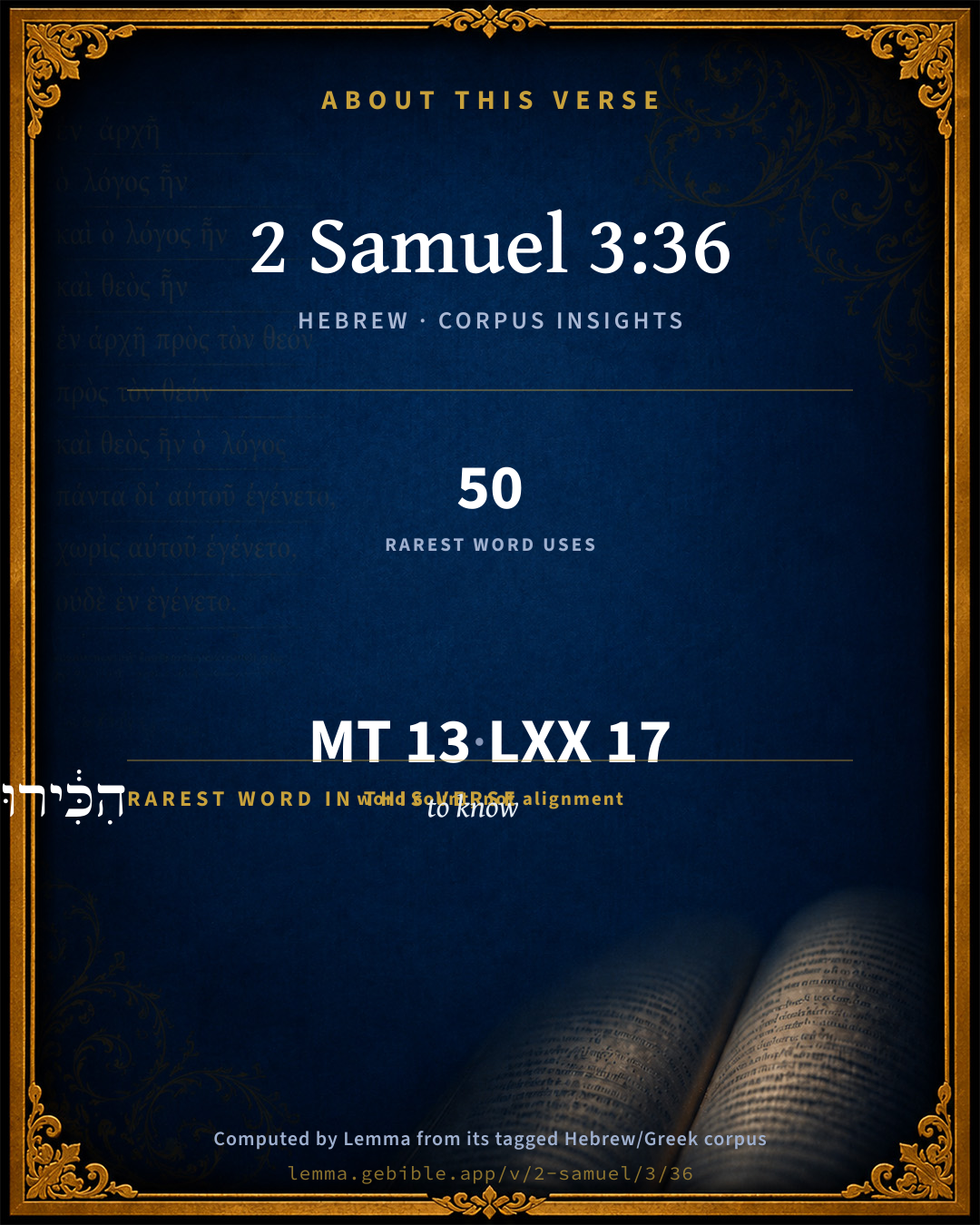
הִכִּ֔ירוּ to know H5234 occurs in 47 verses of the Hebrew Bible. Also found in:

Grammatical profile

  • 4 verbs
  • 8 nouns
  • 1 particle

Verb forms

  • הִכִּ֔ירוּ Hiphil · Perfect
  • וַיִּיטַ֖ב Qal · Sequential Imperfect
  • עָשָׂ֣ה Qal · Perfect
  • טֽוֹב Qal · Perfect

Repetition

Words recur within this verse — often emphatic in Hebrew:

  • וְכָל all H3605 ×3
  • הָעָ֣ם people H5971 ×2
  • בְּעֵֽינֵיהֶ֑ם eye H5869 ×2

Hebrew & Septuagint length

In English translation the verse runs 20 words from the Hebrew and 21 from the Septuagint (LXX English) — closely comparable.

A rough comparison of the two English renderings, which tokenize alike — not a word-level alignment.

Word counts can differ between the Hebrew and the Greek without any difference in meaning — e.g. the Hebrew direct-object marker אֵת has no separate Greek word, and Greek often adds the article ὁ.

In the original languages it is 13 Hebrew tokens and 17 Greek tokens — but the two are counted differently (Hebrew bundles its prefixes and suffixes into one token; the Greek is in lemma form), so that isn’t a like-for-like length.

Cross-references

5

Topical passages linked to 2 Samuel 3:36 in the Treasury of Scripture Knowledge — connected by theme and wording, ordered by reader-vote popularity; previews shown in the World English Bible.

  • Mark 7:37 They were astonished beyond measure, saying, "He has done all things well. He makes even the deaf hear, and the mute speak!"
  • 2 Samuel 15:6 In this manner Absalom did to all Israel who came to the king for judgment: so Absalom stole the hearts of the men of Israel.
  • Psalms 62:9 Surely men of low degree are just a breath, And men of high degree are a lie. In the balances they will go up. They are together lighter than a breath.
  • Mark 15:11–13 But the chief priests stirred up the multitude, that he should release Barabbas to them instead.
  • 2 Samuel 15:13 There came a messenger to David, saying, The hearts of the men of Israel are after Absalom.

Cross-references courtesy of OpenBible.info (CC BY 4.0).

Hebrew and Greek witnesses Masoretic Hebrew ↔ Greek Septuagint

The same verse in the two great witnesses to the Old Testament, shown verse-for-verse.

These are two independent witnesses, not word-aligned to each other, and the Septuagint is shown in lemma (dictionary) form.

Hebrew 2 Samuel 3:36 Masoretic · Westminster Leningrad Codex

וְכָל הָעָ֣ם הִכִּ֔ירוּ וַיִּיטַ֖ב בְּעֵֽינֵיהֶ֑ם כְּכֹל֙ אֲשֶׁ֣ר עָשָׂ֣ה הַמֶּ֔לֶךְ בְּעֵינֵ֥י כָל הָעָ֖ם טֽוֹב

All the people took notice of it, and it pleased them; as whatever the king did pleased all the people.

World English Bible · Public Domain

Greek LXX 2 Samuel 3:36 Septuagint · lemma form

καί γιγνώσκω πᾶς ὁ λαός καί ἀρέσκω ἐνώπιον αὐτός πᾶς ὅσος ποιέω ὁ βασιλεύς ἐνώπιον ὁ λαός

And all the people took notice, and all things that the king did before the people were pleasing in their sight.

LXX2012 (modern English Septuagint) · Public Domain

Hebrew: Westminster Leningrad Codex (CC BY 4.0). Greek: Septuagint (public domain); English from LXX2012 (modern English Septuagint) (Public Domain). How the Septuagint differs from the Hebrew →

Targum (Aramaic paraphrase)

1

The Targum is the ancient Jewish Aramaic paraphrase of the Hebrew Scriptures — an interpretive translation, not the Hebrew text itself. Onkelos (literal) and Pseudo-Jonathan (expansive) render the Torah, and Jonathan the Prophets. Coverage is partial: where no permissively-licensed English translation exists for a verse, only the Aramaic is shown. This is verse-level text, not a word-by-word alignment to the Hebrew.

  1. Targum Jonathan Prophets (Joshua–Malachi)
    וְכָל עַמָא אִשְׁתְּמוֹדָעוּ וּשְׁפַר בְּעֵינֵיהוֹן כְּכָל דַעֲבַד מַלְכָּא בְּעֵינֵי כָּל עַמָא טָב:

    (no public-domain English translation for this verse)

    Targum Jonathan — Aramaic: “Mikraot Gedolot” (public domain). English: “Sefaria Community Translation” (CC0 1.0 (public-domain dedication)); “London "Chaldee Paraphrase," 1871” (public domain). Text via Sefaria.

Commentary

Notes on 2 Samuel 3:36 from classic Christian and Jewish commentators (each source and its license shown beneath its notes). The classic Christian expositions comment on the surrounding passage and are grouped to its opening verse, so a note may address several verses; the Jewish commentaries on the Tanakh (Rashi and others) are per-verse, so they appear only where the commentator wrote on this verse.

Lemma curates 59 commentaries, every one of them public domain or Creative Commons licensed, each selected and text-cleaned for this edition rather than reprinted as found. About our sources →

Trapp's Complete Commentary

John Trapp

2Sa 3:36 And all the people took notice [of it], and it pleased them: as whatsoever the king did pleased all the people.

Ver. 36. Pleased all the people.] This was both hard and happy: a great contentment doubtless to good David.

“Eργμασιν εν μεγαλοις πασιν αδειν, χαλεπον.” - Theog.

John Trapp, A Commentary or Exposition upon All the Books of the Old and New Testament (1647–1656) — public domain. Text from a community e-Sword module.

The Biblical Illustrator

Joseph S. Exell

2Sa_3:36

Whatsoever the king did pleased all the people.

The king can do no wrong

I. First, then, wherever it is the case that whatsoever the king doeth pleases all the people, this is the outflow of love; and as it is the case with our King, that whatsoever He does pleases all His people, we can truly say that this is the outflow of our love to Him.

1. True love banishes suspicion. No dark suspicions come across the soul that is once enamoured of the Lord Jesus Christ.

2. It also inspires implicit confidence. We are willing to let His will be like the apocalyptic book, sealed with seven seals if necessary, and we unhesitatingly say, Let His will be done.

3. Love also suggests unquestioning reverence.

4. It creates sympathetic feeling. When our nature gets to be like His nature--oh, what a blessed consummation that is!--when our wishes and His wishes travel the same road, though not with equal footsteps; when that which He aims at is that which we aim at after our poor fashion; when we can say that it is more delight to us that He should be delighted than that we should be delighted ourselves, and that it is a greater honour to us to see Him honoured than it would be to be honoured ourselves; when we sink ourselves in Him, even as two divided streams at last dissolve into one--as I have seen a tiny silver brook come clown to Father Thames, and pour its whole self into him, so as to be no longer anything but part of the great river--so, when our soul yields itself up in perfect love to Christ, to think His thoughts, and live and move in Him so that it is no longer we who live but Christ Who liveth in us; oh, then it is that whatsoever the King doeth pleaseth all His people! When the believer comes to be what He should be in the fulness of his love, his will is lost in the will of Christ, his very life is hidden away with Christ in God, and then he realises how true it is that whatsoever the King doeth pleaseth all His people.

II. The love that manifests itself thus is the consequence of knowledge. Human love is blind; but the love which is wrought in us by the Spirit of God is as full of eyes as are the great wheels of Divine Providence. There is the best of reasons why everything that Jesus does should please all His people, because everything He does is right, and we shall feel this in proportion as we combine knowledge with love, or our love is based on knowledge.

1. We know the character of Christ.

2. We know something of His designs, and we know that He designs the glory of the Father through the salvation of those the Father gave him.

3. We know something of His modes of operation. We have learned that it is His habit often to disguise Himself; His way is in the sea, and His path in the great waters, and His footsteps are not known except to those who are familiar with Him.

4. We know something of our Lords rights, and therefore we can never venture to interfere with His actions.

III. This is the secret of rest: Whatsoever the king did pleased all the people. To know that the King has done it, and to see His Divine hand in anything, is more than half the battle which ends in sweet content. When you have seen Gods hand, then say, I would not have it otherwise than it is. I know several persons who are always in trouble and unhappy because there is a dispute between them and God. I remember one to whom I solemnly spoke, years ago, and not long after he passed away. I went to see his dying child, the only one he had left, and he said to me, Do not talk to my daughter about death, do not mention it to her. Well, then, I said, if I may not mention death, I will not go upstairs. The father said to me, God could not take that child away. He had lost several before, and he said that, if his daughter died, he should call God a tyrant, and I know not what. At last I stood before him, and I said, You are making for yourself a rod that is much heavier than God Himself lays upon you. I fear that you will yourself die if you act in this way. As he could not be brought to reason, and kicked and rebelled against Gods dealings with him, I was not surprised to learn that, soon after his child died, he himself also died. It does not do to quarrel with God; let the potsherds of the earth strive with other potsherds if they will, but woe to him who contendeth with his Maker! Instead of that, bow before him, not only because you must, but because you delight to acknowledge him as your Lord.

IV. Lastly, this will be a lesson in obedience.

1. Whatever service the King requires of you will please you.

2. Oftentimes, we are permitted to work hard, and yet to meet with great discouragement. It was a pretty remark I read, the other day, of a Christian man who said, I used to have many disappointments, until I changed one letter of the word, and chopped it into two, so that instead of disappointments, I read it His appointments. That was a wonderful change, for disappointments break your heart, but His appointments you accept right cheerily. (C. H. Spurgeon.)

The Biblical Illustrator, edited by Joseph S. Exell (c. 1880s–1900s) — public domain. Text from a community e-Sword module.

Joseph Benson's Commentary

2Sa 3:36-37. All the people took notice of it, and it pleased them — They were satisfied concerning David’s integrity, and the sincerity of his sorrow at the death of Abner, and pleased with the honour he had done that great man. Whatsoever the king did pleased the people — By this conduct he so ingratiated himself with them that they were disposed to put a kind construction upon all his actions, as wise and well becoming him. For all Israel understood that it was not of the king to slay Abner — That he neither ordered it, nor consented to it, nor in any way approved of it; but was heartily grieved for his death.

Joseph Benson's Commentary on the Old and New Testaments (1811–1818) — public domain. Text from a community e-Sword module.

Geneva Bible (1599)

Geneva Bible translators

It is expedient sometimes not only to conceive inward sorrow, but also that it may appear to others, to the intent that they may be satisfied.

Geneva Bible (1599) marginal notes — public domain. Text via Bolls.life.

Adam Clarke's Commentary

Verse 36. The people took notice] They saw that the king's grief was sincere, and that he had no part nor device in the murder of Abner: see 2Sa 3:37.

Adam Clarke's Commentary on the Bible (1810–1826) — public domain. Text from a community e-Sword/MySword module.

John Gill's Exposition

And all the people took notice of it,.... Not only of his oath, that he would not eat food till evening, but of his whole conduct at the funeral of Abner; the sorrow he expressed for his death, and the oration he made on account of it, in which he pretty severely reflected on his murderer:

and it pleased them; that he showed such a concern for his death, and that it was a clear case he had no hand in it:

as whatsoever the king did pleased all the people; what he did at this time, burying Abhor with so much pomp and ceremony; and indeed he had so much the hearts of the people, and such a share in their affections, and they had such an high opinion of him, that all that he did in public and private affairs they reckoned well done; they were highly approved of by them, such an interest had he in them.

John Gill's Exposition of the Whole Bible (1746–1763) — public domain (CC PDM 1.0). Text via the HelloAO Bible API.

Matthew Poole's English Annotations

Took notice of it; observed what the king said and did. It pleased them; they were satisfied concerning David’s integrity, and the method he used here for his own just vindication.

Whatsoever the king did; either in this matter; or rather, in all things following this action. The meaning is, by his carriage herein he gained so great an interest in the hearts of his people, that they judged most favourably of, and put the best construction upon, all his words and actions; as, on the contrary, when people have a prejudice against or an ill will towards their prince, they are apt to judge most harshly of all his counsels and doings.

Matthew Poole's English Annotations on the Holy Bible (1683–1685) — public domain. Text from a community e-Sword/MySword module.

The Pulpit Commentary

Whatsoever the king did pleased all the people. This is a tribute to the king"s conduct generally. The people would have been grieved and astonished if David had been guilty of this mean murder; but his indignant disavowal of it was in accordance with his usual justice and uprightness, and so it confirmed their high opinion of him. Thus while the more distant tribes condemned David, those who had the best opportunity for forming a judgment gave their verdict in his favour.

Vers. 36-38. (HEBRON.)

Acceptance with the people.

all the people took notice of it, and it pleased them," etc. (ver. 36). David"s conduct not only freed him from suspicion, but also won the confidence and affection of "all the people". (1Sa_12:3-5)

I THE CONDUCT OF ONE IN AUTHORITY IS CAREFULLY OBSERVED BY THE PEOPLE. Because of:

1. His elevated position, which (like a mountain peak) attracts their attention, and exposes him to their constant gaze.

2. His responsible position, which leads them to compare his actions with the principles according to which he ought to rule.

3. His influential position, which makes them watchful of his course, out of concern for their own interests.

II ACCEPTANCE WITH THE PEOPLE IS AN OBJECT WORTHY OF BEING DILIGENTLY SOUGHT. It is not the highest object, and ought not to be sought supremely. Truth and justice are of greater worth than popularity. The praise of God must be loved more than the praise of men. (Joh_12:43) But it should not be neglected or despised, because:

1. It conduces to his safety and happiness.

2. It renders his measures less likely to be suspected and opposed; enableshim to effect his purposes for their good; increases the measure of his usefulness.

3. It aids him in his endeavours to promote the glory of the supreme Ruler.

III THERE IS NO WAY TO SECURE IT MORE EFFECTUAL THAN THE EXHIBITION OF AN UPRIGHT AND GENEROUS SPIRIT.

1. Other ways are uncertain and variable, like the changing moods of thepeople.

2. This appeals to what is noblest and most permanent in them, and securesthe sympathies of the most reliable men.

3. It also obtains the favour and help of God, who disposes their hearts toapprove, submit, and obey.

IV ITS ATTAINMENT IS HONOURABLE AND BENEFICIAL TO THE PEOPLE THEMSELVES.

1. It shows a readiness to be pleased, and a disposition to admire genuineexcellence.

2. It confirms his devotion to their welfare, and encourages him topersevere in well doing.

3. It tends to their improvement in virtue, and thus contributes to theirpeace and unity, power and prosperity.

CONCLUSION. What has been said applies to other relations besides that of ruler and subject. "A good name is better than precious ointment" (Ecc_7:1) or "great riches"; (Pro_22:1) "Let every one of us please his neighbour for his good to edification" (Rom_15:2; 1Co_10:33; Tit_2:9) "Whatsoever things are of good report, think on these things". D. (Php_4:8)

The Pulpit Commentary (1880–1919), ed. H.D.M. Spence-Jones & Joseph S. Exell — public domain. Text from a community e-Sword module.

John Wesley's Explanatory Notes

Pleased them - They were satisfied concerning David's integrity.

John Wesley, Explanatory Notes Upon the Whole Bible (1754–1765) — public domain. Text via the GEBible commentary corpus.

Scofield Reference Notes

C. I. Scofield

pleased

was good in their eyes.

The Scofield Reference Bible (1917 edition), notes by C. I. Scofield — public domain. Text from a community e-Sword module.

Lesson kit

Teaching starters — assembled from the data on this page, not authored interpretation. Every prompt links to the verse data it draws on. Edit before teaching.

2 Samuel, in the Historical, opens this verse with 13 words (9 distinct Hebrew lemmas). Its most distinctive word is nâkar (“to know”). A historical commentator’s framing appears above. Read the whole chapter for the surrounding context.

Discussion questions

  1. How does “to know” (nâkar) shape what this verse is saying?
  2. How does Genesis 27:23, which shares the word «to know», read alongside this verse?
  3. What does the repetition of “all” (3× in this one verse) do in this verse?
  4. These translations render this verse differently. What is at stake in choosing one wording over another?
  5. «הִכִּ֔ירוּ» is a Hiphil Perfect verb. How does that grammatical form shape the action described?
  6. Compare how Trapp's Complete Commentary and The Biblical Illustrator read this verse. Where do they agree or differ?

Things to notice

Reading settings

Reading text

Shown beneath each verse's original-language words.

Old Testament
Old Testament edition

Read the OT as the Masoretic Hebrew (MT) or the Greek Septuagint (LXX).

English shown for the Greek Septuagint (in the Hebrew ↔ Greek comparison).

Comparing translations? Open the Compare panel on any verse page to stack up to four side by side.