2 Samuel 24:12

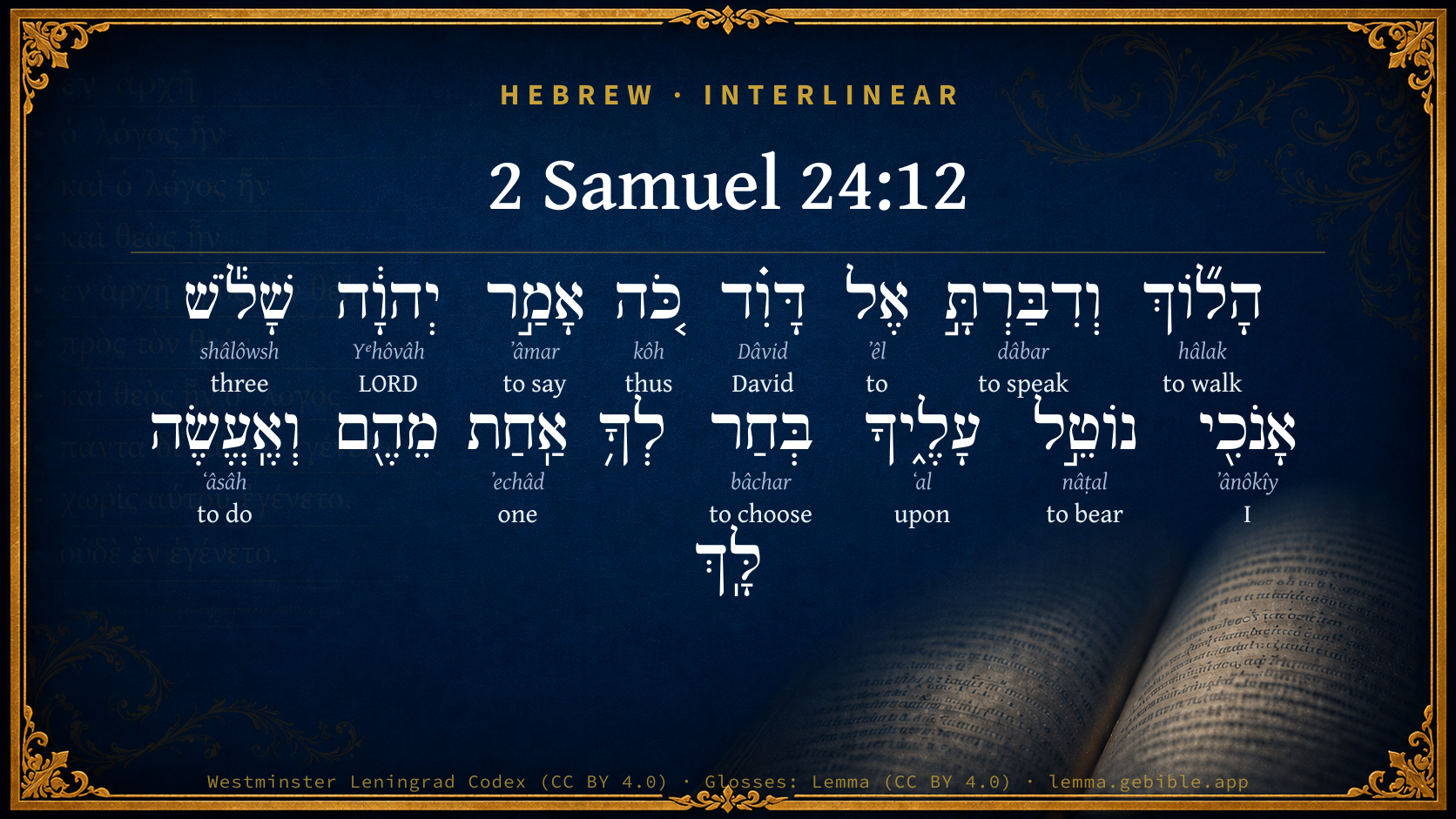
Hebrew (Westminster Leningrad Codex) 2 Samuel 24:12 appears in the Hebrew Old Testament. The text above is from the Westminster Leningrad Codex. Each word links to its Strong’s number, a concise gloss, and parsing drawn from the Open Scriptures Hebrew Bible morphology. Click any word for its full Brown-Driver-Briggs (BDB) entry.
Download image
Cite this verse

2 Samuel 24:12 (World English Bible). Public Domain. Lemma interlinear Bible study tool, https://lemma.gebible.app/v/2-samuel/24/12.

Show BibTeX & RIS
BibTeX
RIS
English Translation
Go and speak to David, Thus says Yahweh, I offer you three things: choose you one of them, that I may do it to you.
World English Bible · Public Domain
Highlights
  • 1 first appearance in the Hebrew Bible
Full analysis ↓
Download a study sheet

One document with this verse’s original text, its word-by-word gloss line, the meaning frame, cross-references with their text, attributed commentary, and full source and license credits — printable, and it pastes into notes with its structure intact.

This verse Autodidact and up

Study sheet (.html) Plain text (.txt)

A passage Seminary Student

Up to 50 verses in one chapter. A passage sheet keeps up to 6 commentary sources and 12 cross-references per verse, in the order this page ranks them, and says so on the sheet whenever that leaves anything out. Ask for a single verse and you get the Autodidact verse sheet above.

Everything on this page stays free to read, with no account — the sheet is a download of what is already on screen, not access to it.

Want to remove ads? Support Godless Engineer
Compare translations 3

The same verse in 3 English versions, stacked beneath the original-language interlinear above. Click any original word for its lexicon entry.

Each is an independent rendering of the whole verse — the interlinear is not word-aligned to these translations.

Highlighted words mark where these versions differ — a whole-verse word diff, not a word-by-word alignment.

  • World English Bible Public Domain
    Go and speak to David, Thus says Yahweh, I offer you three things: choose you one of them, that I may do it to you.
  • King James Version Public Domain
    Go and say unto David, Thus saith the LORD, I offer thee three things; choose thee one of them, that I may do it unto thee.
  • unfoldingWord Literal Text CC BY-SA 4.0
    “Go, and you shall say to David, ‘Thus says Yahweh, “Three I am lifting over you. Choose for yourself one from them, and I will do to you.”’”

unfoldingWord Literal Text — © unfoldingWord, licensed CC BY-SA 4.0. Word-aligned USFM3 via Door43 (git.door43.org/unfoldingWord/en_ult).

Versions to compare (up to 4)

3 of 4 selected

Show all 18 translations

Every available English version of this verse, each an independent rendering of the whole verse.

  • World English Bible Public Domain
    Go and speak to David, Thus says Yahweh, I offer you three things: choose you one of them, that I may do it to you.
  • Berean Standard Bible Public Domain
    “Go and tell David that this is what the LORD says: ‘I am offering you three options. Choose one of them, and I will carry it out against you.’”
  • Majority Standard Bible Public Domain
    “Go and tell David that this is what the LORD says: ‘I am offering you three options. Choose one of them, and I will carry it out against you.’”
  • King James Version Public Domain
    Go and say unto David, Thus saith the LORD, I offer thee three things; choose thee one of them, that I may do it unto thee.
  • American Standard Version (1901) Public Domain
    Go and speak unto David, Thus saith Jehovah, I offer thee three things: choose thee one of them, that I may do it unto thee.
  • Revised Version (1885) Public Domain
    Go and speak unto David, Thus saith the LORD, I offer thee three things; choose thee one of them, that I may do it unto thee.
  • Geneva Bible (1599) Public Domain
    Go, and say vnto Dauid, Thus saith ye Lord, I offer thee three thinges, chuse thee which of them I shall doe vnto thee.
  • Douay-Rheims (1899) Public Domain
    Go, and say to David: Thus saith the Lord: I give thee thy choice of three things, choose one of them which thou wilt, that I may do it to thee.
  • Young's Literal Translation Public Domain
    `Go, and thou hast spoken unto David, Thus said Jehovah: Three -- I am lifting up for thee, choose thee one of them, and I do `it' to thee.'
  • Literal Standard Version CC BY-SA 4.0
    “Go, and you have spoken to David, Thus said YHWH: I am lifting up three [choices] for you, choose one of them, and I do [it] to you.”
  • Unlocked Literal Bible CC BY-SA 4.0
    “Go say to David: 'This is what Yahweh says: “I am giving you three choices. Choose one of them.”'”
  • unfoldingWord Literal Text CC BY-SA 4.0
    “Go, and you shall say to David, ‘Thus says Yahweh, “Three I am lifting over you. Choose for yourself one from them, and I will do to you.”’”
  • Darby Bible Public Domain
    Go and say to David, Thus saith Jehovah: I impose on thee three [things]; choose one of them that I may do it unto thee.
  • World Messianic Bible Public Domain
    “Go and speak to David, ‘The LORD says, “I offer you three things. Choose one of them, that I may do it to you.”’”
  • Webster's Bible Public Domain
    Go and say to David, Thus saith the LORD, I offer thee three things; choose thee one of them, that I may do it to thee.
  • Free Bible Version CC BY-SA 4.0
    “Go and tell David that this is what the Lord says: ‘I'm giving you three options. Choose one of them, and that's what I'll do to you.’”
  • Bible in Basic English Public Domain
    Go and say to David, The Lord says, Three things are offered to you: say which of them you will have, and I will do it to you.
  • JPS Tanakh (1917) Public Domain
    'Go and speak unto David: Thus saith the LORD: I lay upon thee three things; choose thee one of them, that I may do it unto thee.'

Literal Standard Version (2020), Covenant Press — licensed CC BY-SA 4.0. Text via the HelloAO Bible API (eBible.org). Unlocked Literal Bible (unfoldingWord) — licensed CC BY-SA 4.0. Text via the HelloAO Bible API (eBible.org). unfoldingWord Literal Text — © unfoldingWord, licensed CC BY-SA 4.0. Word-aligned USFM3 via Door43 (git.door43.org/unfoldingWord/en_ult). Free Bible Version, Dr. Jonathan Gallagher — licensed CC BY-SA 4.0. Text via the HelloAO Bible API (eBible.org).

Word by word

More ways to search: Search by grammar → Find every occurrence → Compare this word →

Practice this passage: Drill this verse → Learn its vocabulary →

נוֹטֵ֣ל
nâṭal
H5190
“bearing”
Verb, Qal, Participle Active, Masculine, Singular, Absolute
Part of Speech
Verb
Stem
Qal
Form
Participle Active
Gender
Masculine
Number
Singular
State
Absolute
Full BDB Definition

Origin: a primary root

TWOT: 1353

to lift, bear, bear up - (Qal) to lift, lift over, lift upon, set up - (Piel) to bear up
  1. הָל֞וֹךְ hâlak H1980 “to walk” Verb, Qal, Infinitive Absolute
  2. וְדִבַּרְתָּ֣ dâbar H1696 “and · to speak” Conjunction + Verb, Piel, Sequential Perfect, 2nd Person, Masculine, Singular
  3. אֶל ʼêl H413 “to” Preposition
  4. דָּוִ֗ד Dâvid H1732 “David” Noun, Proper
  5. כֹּ֚ה kôh H3541 “thus” Adverb
  6. אָמַ֣ר ʼâmar H559 “to say” Verb, Qal, Perfect, 3rd Person, Masculine, Singular
  7. יְהוָ֔ה Yᵉhôvâh H3068 “LORD” Noun, Proper
  8. שָׁלֹ֕שׁ shâlôwsh H7969 “three” Adjective, Cardinal number, Feminine, Singular, Absolute
  9. אָנֹכִ֖י ʼânôkîy H595 “I” Pronoun, Personal, 1st Person, Common, Singular
  10. עָלֶ֑יךָ ʻal H5921 “upon · you” Preposition + Suffix, Personal, 2nd Person, Masculine, Singular
  11. בְּחַר bâchar H977 “choose” Verb, Qal, Imperative, 2nd Person, Masculine, Singular
  12. אַֽחַת ʼechâd H259 “one” Adjective, Cardinal number, Feminine, Singular, Absolute
  13. וְאֶֽעֱשֶׂה ʻâsâh H6213 “and · to do” Conjunction + Verb, Qal, Imperfect, 1st Person, Common, Singular

About this verse

These counts appear in no published source. They are computed here, from the morphology-tagged text and Lemma’s own curated glosses. What Lemma adds →

17
words
14
distinct lemmas
Historical
section

Notable vocabulary

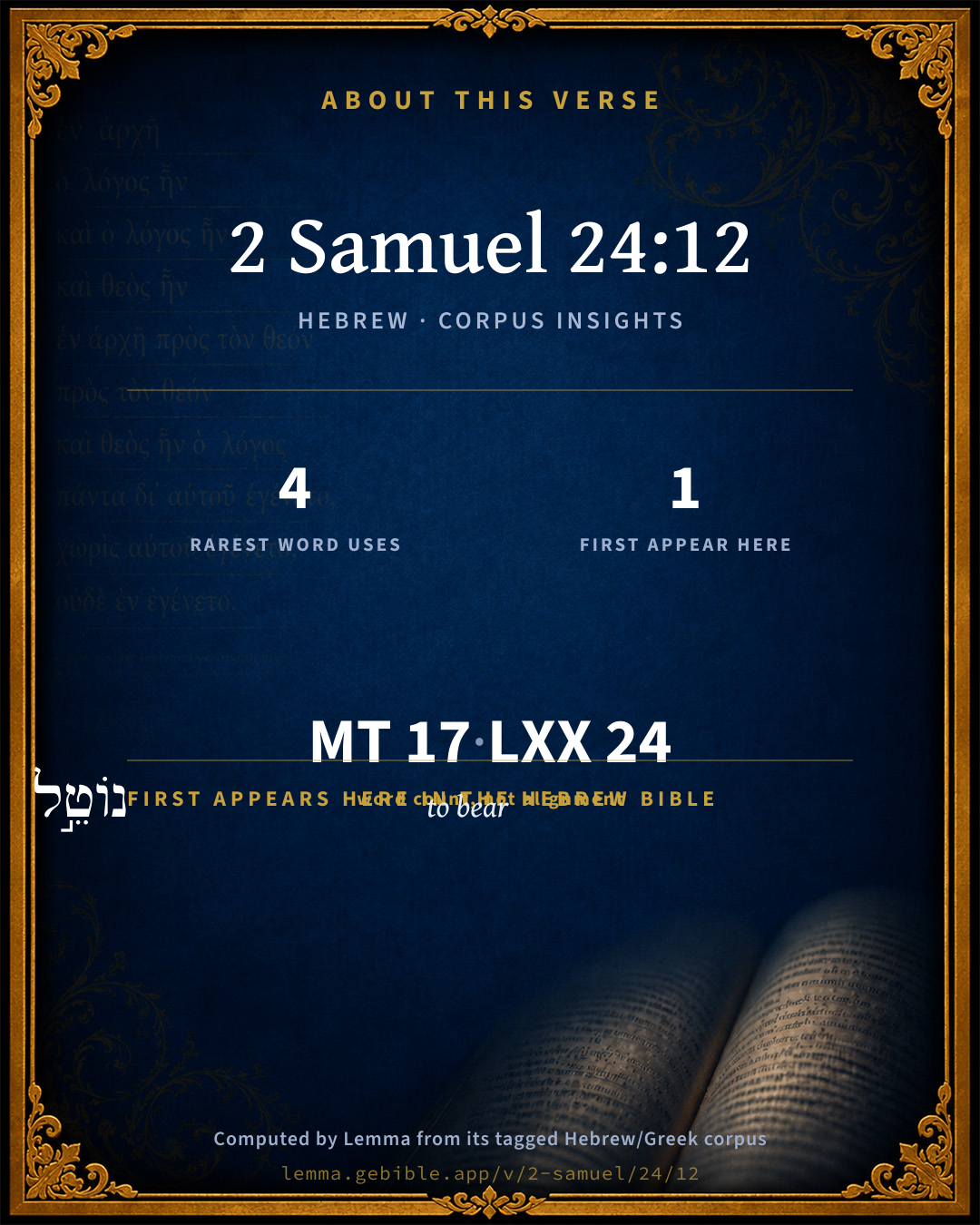
The rarest word here is נוֹטֵ֣ל to bear H5190 — appearing just 4 times in the whole Hebrew Bible.

First appearance in Scripture

This word makes its first canonical appearance in the Hebrew Bible here:

  • נוֹטֵ֣ל to bear H5190

Shared distinctive vocabulary

נוֹטֵ֣ל to bear H5190 occurs in 4 verses of the Hebrew Bible. Also found in:

Grammatical profile

  • 6 verbs
  • 2 nouns
  • 2 adjectives
  • 1 pronoun
  • 5 prepositions
  • 1 adverb

Verb forms

  • הָל֞וֹךְ Qal · Infinitive Absolute
  • וְדִבַּרְתָּ֣ Piel · Sequential Perfect
  • אָמַ֣ר Qal · Perfect
  • נוֹטֵ֣ל Qal · Participle Active
  • בְּחַר Qal · Imperative
  • וְאֶֽעֱשֶׂה Qal · Imperfect

Hebrew & Septuagint length

In English translation the verse runs 25 words from the Hebrew and 25 from the Septuagint (LXX English) — the same length.

A rough comparison of the two English renderings, which tokenize alike — not a word-level alignment.

Word counts can differ between the Hebrew and the Greek without any difference in meaning — e.g. the Hebrew direct-object marker אֵת has no separate Greek word, and Greek often adds the article ὁ.

In the original languages it is 17 Hebrew tokens and 24 Greek tokens — but the two are counted differently (Hebrew bundles its prefixes and suffixes into one token; the Greek is in lemma form), so that isn’t a like-for-like length.

Cross-references

9

Topical passages linked to 2 Samuel 24:12 in the Treasury of Scripture Knowledge — connected by theme and wording, ordered by reader-vote popularity; previews shown in the World English Bible.

  • Proverbs 3:12 For whom Yahweh loves, he reproves; Even as a father reproves the son in whom he delights.
  • Hebrews 12:6–10 For whom the Lord loves, he chastens, And scourges every son whom he receives."
  • Revelation 3:19 As many as I love, I reprove and chasten. Be zealous therefore, and repent.
  • Leviticus 26:41 I also walked contrary to them, and brought them into the land of their enemies: if then their uncircumcised heart is humbled, and they then accept the punishment of their iniquity;
  • Leviticus 26:43 The land also will be left by them, and will enjoy its sabbaths while it lies desolate without them: and they will accept the punishment of their iniquity; because, even because they rejected my ordinances, and their soul abhorred my statutes.
  • 2 Samuel 12:9–10 Why have you despised the word of Yahweh, to do that which is evil in his sight? You have struck Uriah the Hittite with the sword, and have taken his wife to be your wife, and have slain him with the sword of the children of Ammon.
  • 2 Samuel 12:14 However, because by this deed you have given great occasion to Yahweh's enemies to blaspheme, the child also who is born to you shall surely die."
  • 1 Chronicles 21:10–11 Go and speak to David, saying, Thus says Yahweh, I offer you three things: choose you one of them, that I may do it to you.
  • Job 5:17–18 "Behold, happy is the man whom God corrects: Therefore do not despise the chastening of the Almighty.

Cross-references courtesy of OpenBible.info (CC BY 4.0).

Hebrew and Greek witnesses Masoretic Hebrew ↔ Greek Septuagint

The same verse in the two great witnesses to the Old Testament, shown verse-for-verse.

These are two independent witnesses, not word-aligned to each other, and the Septuagint is shown in lemma (dictionary) form.

Hebrew 2 Samuel 24:12 Masoretic · Westminster Leningrad Codex

הָל֞וֹךְ וְדִבַּרְתָּ֣ אֶל דָּוִ֗ד כֹּ֚ה אָמַ֣ר יְהוָ֔ה שָׁלֹ֕שׁ אָנֹכִ֖י נוֹטֵ֣ל עָלֶ֑יךָ בְּחַר לְךָ֥ אַֽחַת מֵהֶ֖ם וְאֶֽעֱשֶׂה לָּֽךְ

Go and speak to David, Thus says Yahweh, I offer you three things: choose you one of them, that I may do it to you.

World English Bible · Public Domain

Greek LXX 2 Samuel 24:12 Septuagint · lemma form

πορεύομαι καί λαλέω πρός δαυίδ λέγω ὅδε λέγω κύριος τρεῖς ἐγώ εἰμί αἴρω ἐπί σύ καί ἐκλέγω σεαυτοῦ εἷς ἐκ αὐτός καί ποιέω σύ

Thus says the Lord, I bring one of three things upon you: now choose you one of them, and I will do it to you.

LXX2012 (modern English Septuagint) · Public Domain

Hebrew: Westminster Leningrad Codex (CC BY 4.0). Greek: Septuagint (public domain); English from LXX2012 (modern English Septuagint) (Public Domain). How the Septuagint differs from the Hebrew →

Targum (Aramaic paraphrase)

1

The Targum is the ancient Jewish Aramaic paraphrase of the Hebrew Scriptures — an interpretive translation, not the Hebrew text itself. Onkelos (literal) and Pseudo-Jonathan (expansive) render the Torah, and Jonathan the Prophets. Coverage is partial: where no permissively-licensed English translation exists for a verse, only the Aramaic is shown. This is verse-level text, not a word-by-word alignment to the Hebrew.

  1. Targum Jonathan Prophets (Joshua–Malachi)
    אֱזִיל וּתְמַלֵיל עִם דָוִד כִּדְנַן אֲמַר יְיָ חֲדָא מִתְּלַת אֲנָא רָמֵי עֲלָךְ בְּחַר לָךְ חַד מִנְהוֹן וְאַעְבֵּד לָךְ:

    (no public-domain English translation for this verse)

    Targum Jonathan — Aramaic: “Mikraot Gedolot” (public domain). English: “Sefaria Community Translation” (CC0 1.0 (public-domain dedication)); “London "Chaldee Paraphrase," 1871” (public domain). Text via Sefaria.

Commentary

Notes on 2 Samuel 24:12 from classic Christian and Jewish commentators (each source and its license shown beneath its notes). The classic Christian expositions comment on the surrounding passage and are grouped to its opening verse, so a note may address several verses; the Jewish commentaries on the Tanakh (Rashi and others) are per-verse, so they appear only where the commentator wrote on this verse.

Lemma curates 59 commentaries, every one of them public domain or Creative Commons licensed, each selected and text-cleaned for this edition rather than reprinted as found. About our sources →

Trapp's Complete Commentary

John Trapp

2Sa 24:12 Go and say unto David, Thus saith the LORD, I offer thee three [things]; choose thee one of them, that I may [do it] unto thee.

Ver. 12. Go and say unto David.] Plain David, now. Once it was, Go tell my servant David, {2Sa 7:5} but now the case is altered. So when Israel had set up an idol, then God owneth them no longer; but fathereth them upon Moses. {Exo 32:7}

I offer thee three things.] But such as whichsoever thou choosest, demet et demetet numerum hunc ingentem Israelis, itaque sternet tuam superbiam, {a} it shall pull a crow with thee, and bring down thy pride.

{a} Aug., lib. xxii., Cont. Faust., cap. 66.

John Trapp, A Commentary or Exposition upon All the Books of the Old and New Testament (1647–1656) — public domain. Text from a community e-Sword module.

John Gill's Exposition

Go, and say unto David,.... Not my servant David, as Nathan was bid to say to him when it was in his heart to build an house for him, Sa2 7:5; but now he had sinned and displeased the Lord, and therefore it is only plain David:

thus saith the Lord, I offer thee three things; or lay them before thee to consider of which thou wouldest have done; the Targum is,"one of three things I cast upon thee,''as a burden to bear; one of the three I will certainly inflict upon thee by way of chastisement:

choose thee one of them, that I may do it unto thee; here is mercy mixed with judgment; the Lord is angry, yet shows great condescension and goodness; a sovereign Being, who could have imposed what punishment he pleased, and even all the three after mentioned, yet resolves but on one, and leaves that to the option of David.

John Gill's Exposition of the Whole Bible (1746–1763) — public domain (CC PDM 1.0). Text via the HelloAO Bible API.

Rashi

Rabbi Shlomo Yitzchaki (Rashi)

I will afflict you with [one of] three [things]. One of three and so [we find], "With two [of my daughters] you will marry [into my family] today", i.e., with one of two. "I will take three from you" is retribution for the three [curses] you put on Shaul, "Either Adonoy will smite him or his day will come and he will die or he will go down to battle and perish."

Rashi on the Tanakh — English translations: “The Judaica Press complete Tanach with Rashi, translated by A. J. Rosenberg” (CC BY 4.0); “Pentateuch with Rashi's commentary by M. Rosenbaum and A.M. Silbermann, 1929-1934” (public domain); “The Metsudah Tanach series, Lakewood, N.J” (CC BY 4.0); and “The Book of Joshua, Metsudah Publications, 1997” (CC BY 4.0). Text via Sefaria.

Lesson kit

Teaching starters — assembled from the data on this page, not authored interpretation. Every prompt links to the verse data it draws on. Edit before teaching.

2 Samuel, in the Historical, opens this verse with 17 words (14 distinct Hebrew lemmas). Its most distinctive word is nâṭal (“to bear”). A historical commentator’s framing appears above. Read the whole chapter for the surrounding context.

Discussion questions

  1. How does “to bear” (nâṭal) shape what this verse is saying?
  2. The word “to bear” first appears here in Scripture. What is being introduced at this debut?
  3. Isaiah 40:15 shares the word «to bear» with this verse. How do the two illuminate each other?
  4. The translations on this page render this verse differently — a whole-verse word diff, not a word-by-word alignment. What might account for the different wordings?
  5. The verb «הָל֞וֹךְ» is Qal Infinitive Absolute. How does its form color the action?
  6. Reading how Trapp's Complete Commentary and John Gill's Exposition read this verse, where do the two commentators agree and where do they part?

Things to notice

Reading settings

Reading text

Shown beneath each verse's original-language words.

Old Testament
Old Testament edition

Read the OT as the Masoretic Hebrew (MT) or the Greek Septuagint (LXX).

English shown for the Greek Septuagint (in the Hebrew ↔ Greek comparison).

Comparing translations? Open the Compare panel on any verse page to stack up to four side by side.