1 Kings 12:31

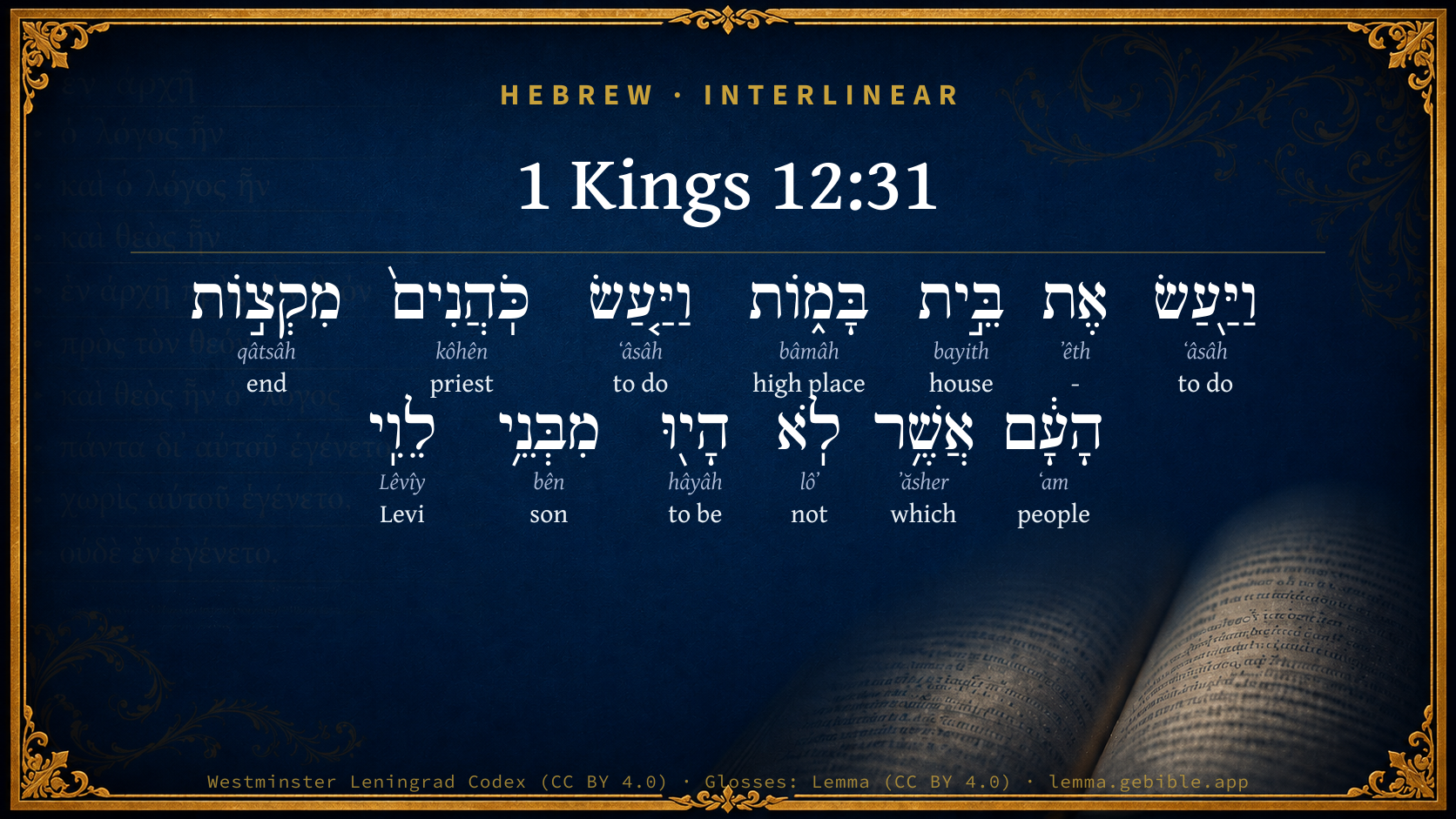
Hebrew (Westminster Leningrad Codex) 1 Kings 12:31 appears in the Hebrew Old Testament. The text above is from the Westminster Leningrad Codex. Each word links to its Strong’s number, a concise gloss, and parsing drawn from the Open Scriptures Hebrew Bible morphology. Click any word for its full Brown-Driver-Briggs (BDB) entry.
Download image
Cite this verse

1 Kings 12:31 (World English Bible). Public Domain. Lemma interlinear Bible study tool, https://lemma.gebible.app/v/1-kings/12/31.

Show BibTeX & RIS
BibTeX
RIS
English Translation
He made houses of high places, and made priests from among all the people, who were not of the sons of Levi.
World English Bible · Public Domain
Download a study sheet

One document with this verse’s original text, its word-by-word gloss line, the meaning frame, cross-references with their text, attributed commentary, and full source and license credits — printable, and it pastes into notes with its structure intact.

This verse Autodidact and up

Study sheet (.html) Plain text (.txt)

A passage Seminary Student

Up to 50 verses in one chapter. A passage sheet keeps up to 6 commentary sources and 12 cross-references per verse, in the order this page ranks them, and says so on the sheet whenever that leaves anything out. Ask for a single verse and you get the Autodidact verse sheet above.

Everything on this page stays free to read, with no account — the sheet is a download of what is already on screen, not access to it.

Want to remove ads? Support Godless Engineer
Compare translations 3

The same verse in 3 English versions, stacked beneath the original-language interlinear above. Click any original word for its lexicon entry.

Each is an independent rendering of the whole verse — the interlinear is not word-aligned to these translations.

Highlighted words mark where these versions differ — a whole-verse word diff, not a word-by-word alignment.

  • World English Bible Public Domain
    He made houses of high places, and made priests from among all the people, who were not of the sons of Levi.
  • King James Version Public Domain
    And he made an house of high places, and made priests of the lowest of the people, which were not of the sons of Levi.
  • unfoldingWord Literal Text CC BY-SA 4.0
    And he made a house of high places. And he made priests from the extremities of the people, who were not from the sons of Levi.

unfoldingWord Literal Text — © unfoldingWord, licensed CC BY-SA 4.0. Word-aligned USFM3 via Door43 (git.door43.org/unfoldingWord/en_ult).

Versions to compare (up to 4)

3 of 4 selected

Show all 18 translations

Every available English version of this verse, each an independent rendering of the whole verse.

  • World English Bible Public Domain
    He made houses of high places, and made priests from among all the people, who were not of the sons of Levi.
  • Berean Standard Bible Public Domain
    Jeroboam also built shrines on the high places and appointed from every class of people priests who were not Levites.
  • Majority Standard Bible Public Domain
    Jeroboam also built shrines on the high places and appointed from every class of people priests who were not Levites.
  • King James Version Public Domain
    And he made an house of high places, and made priests of the lowest of the people, which were not of the sons of Levi.
  • American Standard Version (1901) Public Domain
    And he made houses of high places, and made priests from among all the people, that were not of the sons of Levi.
  • Revised Version (1885) Public Domain
    And he made houses of high places, and made priests from among all the people, which were not of the sons of Levi.
  • Geneva Bible (1599) Public Domain
    Also he made an house of hie places, and made Priestes of the lowest of the people, which were not of the sonnes of Leui.
  • Douay-Rheims (1899) Public Domain
    And he made temples in the high places, and priests of the lowest of the people, who were not of the sons of Levi.
  • Young's Literal Translation Public Domain
    And he maketh the house of high places, and maketh priests of the extremities of the people, who were not of the sons of Levi;
  • Literal Standard Version CC BY-SA 4.0
    And he makes the house of high places, and makes priests from the extremities of the people, who were not of the sons of Levi;
  • Unlocked Literal Bible CC BY-SA 4.0
    Jeroboam made houses on high places and he also made priests from among all the people, who were not among the sons of Levi.
  • unfoldingWord Literal Text CC BY-SA 4.0
    And he made a house of high places. And he made priests from the extremities of the people, who were not from the sons of Levi.
  • Darby Bible Public Domain
    And he made a house of high places, and made priests from all classes of the people, who were not of the sons of Levi.
  • World Messianic Bible Public Domain
    He made houses of high places, and made priests from among all the people, who were not of the sons of Levi.
  • Webster's Bible Public Domain
    And he made a house of high places, and made priests of the lowest of the people, who were not of the sons of Levi.
  • Free Bible Version CC BY-SA 4.0
    In addition Jeroboam had shrines built on high places and appointed as priests all kinds of people who were not Levites.
  • Bible in Basic English Public Domain
    And he made places for worship at the high places, and made priests, who were not Levites, from among all the people.
  • JPS Tanakh (1917) Public Domain
    And he made houses of high places, and made priests from among all the people, that were not of the sons of Levi.

Literal Standard Version (2020), Covenant Press — licensed CC BY-SA 4.0. Text via the HelloAO Bible API (eBible.org). Unlocked Literal Bible (unfoldingWord) — licensed CC BY-SA 4.0. Text via the HelloAO Bible API (eBible.org). unfoldingWord Literal Text — © unfoldingWord, licensed CC BY-SA 4.0. Word-aligned USFM3 via Door43 (git.door43.org/unfoldingWord/en_ult). Free Bible Version, Dr. Jonathan Gallagher — licensed CC BY-SA 4.0. Text via the HelloAO Bible API (eBible.org).

Word by word

More ways to search: Search by grammar → Find every occurrence → Compare this word →

Practice this passage: Drill this verse → Learn its vocabulary →

מִקְצ֣וֹת
qâtsâh
H7098
“from · ends of”
Preposition + Noun, Common, Both, Plural, Construct
Part of Speech
Preposition + Noun
Type
Common
Gender
Both
Number
Plural
State
Construct
Full BDB Definition

Origin: fem. of H7097

TWOT: 2053b

end, extremity - end - from the whole of, from among (of what is included between extremities)
  1. וַיַּ֖עַשׂ ʻâsâh H6213 “and · to do” Conjunction + Verb, Qal, Sequential Imperfect, 3rd Person, Masculine, Singular
  2. אֶת ʼêth H853 “-” Particle, Direct Object
  3. בֵּ֣ית bayith H1004 “house of” Noun, Common, Masculine, Singular, Construct
  4. בָּמ֑וֹת bâmâh H1116 “high places” Noun, Common, Feminine, Plural, Absolute
  5. וַיַּ֤עַשׂ ʻâsâh H6213 “and · to do” Conjunction + Verb, Qal, Sequential Imperfect, 3rd Person, Masculine, Singular
  6. כֹּֽהֲנִים֙ kôhên H3548 “priests” Noun, Common, Masculine, Plural, Absolute
  7. הָעָ֔ם ʻam H5971 “the · people” Particle, Definite Article + Noun, Common, Masculine, Singular, Absolute
  8. אֲשֶׁ֥ר ʼăsher H834 “which” Particle, Relative
  9. לֹֽא lôʼ H3808 “not” Particle, Negative
  10. הָי֖וּ hâyâh H1961 “to be” Verb, Qal, Perfect, 3rd Person, Common, Plural
  11. מִבְּנֵ֥י bên H1121 “from · sons of” Preposition + Noun, Common, Masculine, Plural, Construct
  12. לֵוִֽי Lêvîy H3878 “Levi” Noun, Proper

About this verse

These counts appear in no published source. They are computed here, from the morphology-tagged text and Lemma’s own curated glosses. What Lemma adds →

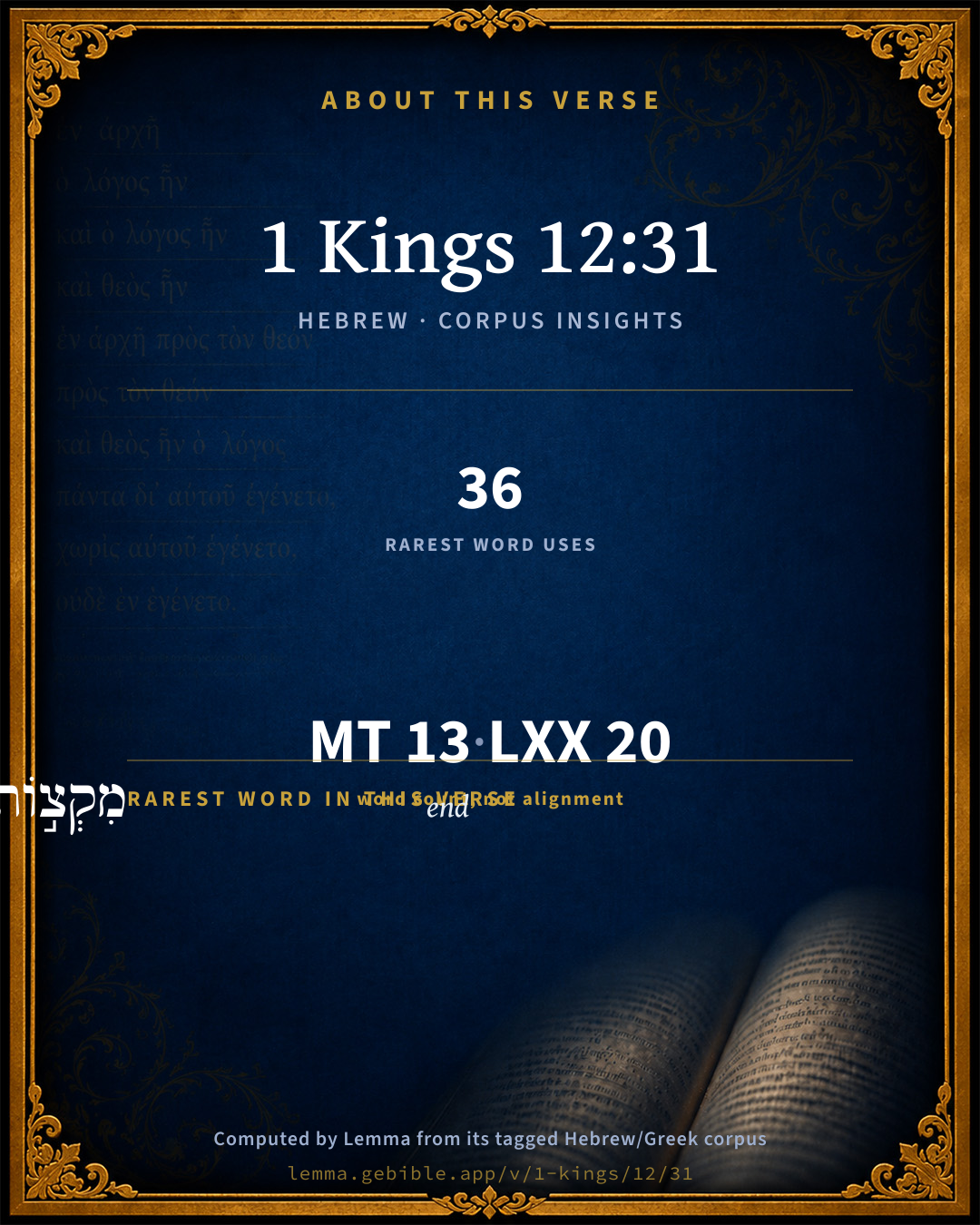
13
words
12
distinct lemmas
Historical
section

Shared distinctive vocabulary

מִקְצ֣וֹת end H7098 occurs in 31 verses of the Hebrew Bible. Also found in:

Grammatical profile

  • 3 verbs
  • 7 nouns
  • 3 particles

Verb forms

  • וַיַּ֖עַשׂ Qal · Sequential Imperfect
  • וַיַּ֤עַשׂ Qal · Sequential Imperfect
  • הָי֖וּ Qal · Perfect

Repetition

A word recurs within this verse — often emphatic in Hebrew:

  • וַיַּ֖עַשׂ to do H6213 ×2

Hebrew & Septuagint length

In English translation the verse runs 22 words from the Hebrew and 25 from the Septuagint (LXX English) — closely comparable.

A rough comparison of the two English renderings, which tokenize alike — not a word-level alignment.

Word counts can differ between the Hebrew and the Greek without any difference in meaning — e.g. the Hebrew direct-object marker אֵת has no separate Greek word, and Greek often adds the article ὁ.

In the original languages it is 13 Hebrew tokens and 20 Greek tokens — but the two are counted differently (Hebrew bundles its prefixes and suffixes into one token; the Greek is in lemma form), so that isn’t a like-for-like length.

Cross-references

10

Topical passages linked to 1 Kings 12:31 in the Treasury of Scripture Knowledge — connected by theme and wording, ordered by reader-vote popularity; previews shown in the World English Bible.

  • 1 Kings 13:32–33 For the saying which he cried by the word of Yahweh against the altar in Bethel, and against all the houses of the high places which are in the cities of Samaria, shall surely happen.
  • 2 Kings 17:32 So they feared Yahweh, and made to them from among themselves priests of the high places, who sacrificed for them in the houses of the high places.
  • 2 Chronicles 13:9 Haven't you driven out the priests of Yahweh, the sons of Aaron, and the Levites, and made you priests after the manner of the peoples of [other] lands? so that whoever comes to consecrate himself with a young bull and seven rams, the same may be a priest of [those who are] no gods.
  • Numbers 3:10 You shall appoint Aaron and his sons, and they shall keep their priesthood. The stranger who comes near shall be put to death."
  • 2 Chronicles 11:14–15 For the Levites left their suburbs and their possession, and came to Judah and Jerusalem: for Jeroboam and his sons cast them off, that they should not execute the priest's office to Yahweh;
  • Deuteronomy 24:15 in his day you shall give him his hire, neither shall the sun go down on it; for he is poor, and sets his heart on it: lest he cry against you to Yahweh, and it be sin to you.
  • 1 Kings 13:24 When he was gone, a lion met him by the way, and killed him: and his body was cast in the way, and the donkey stood by it; the lion also stood by the body.
  • Ezekiel 16:25 You have built your lofty place at the head of every way, and have made your beauty an abomination, and have opened your feet to everyone who passed by, and multiplied your prostitution.
  • Ezekiel 44:6–8 You shall tell the rebellious, even to the house of Israel, Thus says the Lord Yahweh: you house of Israel, let it suffice you of all your abominations,
  • Hosea 12:11 If Gilead is wicked, Surely they are worthless. In Gilgal they sacrifice bulls. Indeed, their altars are like heaps in the furrows of the field.

Cross-references courtesy of OpenBible.info (CC BY 4.0).

Hebrew and Greek witnesses Masoretic Hebrew ↔ Greek Septuagint

The same verse in the two great witnesses to the Old Testament, shown verse-for-verse.

These are two independent witnesses, not word-aligned to each other, and the Septuagint is shown in lemma (dictionary) form.

Hebrew 1 Kings 12:31 Masoretic · Westminster Leningrad Codex

וַיַּ֖עַשׂ אֶת בֵּ֣ית בָּמ֑וֹת וַיַּ֤עַשׂ כֹּֽהֲנִים֙ מִקְצ֣וֹת הָעָ֔ם אֲשֶׁ֥ר לֹֽא הָי֖וּ מִבְּנֵ֥י לֵוִֽי

He made houses of high places, and made priests from among all the people, who were not of the sons of Levi.

World English Bible · Public Domain

Greek LXX 1 Kings 12:31 Septuagint · lemma form

καί ποιέω οἶκος ἐπί ὑψηλός καί ποιέω ἱερεύς μέρος τις ἐκ ὁ λαός ὅς οὐ εἰμί ἐκ ὁ υἱός λευι

And he made houses on the high places, and made priests of any part of the people, who were not of the sons of Levi.

LXX2012 (modern English Septuagint) · Public Domain

Hebrew: Westminster Leningrad Codex (CC BY 4.0). Greek: Septuagint (public domain); English from LXX2012 (modern English Septuagint) (Public Domain). How the Septuagint differs from the Hebrew →

Targum (Aramaic paraphrase)

1

The Targum is the ancient Jewish Aramaic paraphrase of the Hebrew Scriptures — an interpretive translation, not the Hebrew text itself. Onkelos (literal) and Pseudo-Jonathan (expansive) render the Torah, and Jonathan the Prophets. Coverage is partial: where no permissively-licensed English translation exists for a verse, only the Aramaic is shown. This is verse-level text, not a word-by-word alignment to the Hebrew.

  1. Targum Jonathan Prophets (Joshua–Malachi)
    וַעֲבַד יַת בֵּית בָּמָתָא וַעֲבַד כּוּמָרַיָא קְצַת מִן עַמָא דְלָא הֲווֹ מִבְּנֵי לֵוִי:

    (no public-domain English translation for this verse)

    Targum Jonathan — Aramaic: “Mikraot Gedolot” (public domain). English: “Sefaria Community Translation” (CC0 1.0 (public-domain dedication)); “London "Chaldee Paraphrase," 1871” (public domain). Text via Sefaria.

Commentary

Notes on 1 Kings 12:31 from classic Christian and Jewish commentators (each source and its license shown beneath its notes). The classic Christian expositions comment on the surrounding passage and are grouped to its opening verse, so a note may address several verses; the Jewish commentaries on the Tanakh (Rashi and others) are per-verse, so they appear only where the commentator wrote on this verse.

Lemma curates 59 commentaries, every one of them public domain or Creative Commons licensed, each selected and text-cleaned for this edition rather than reprinted as found. About our sources →

Trapp's Complete Commentary

John Trapp

1Ki 12:31 And he made an house of high places, and made priests of the lowest of the people, which were not of the sons of Levi.

Ver. 31. And he made a house.] A mock temple, a pantheon, a place to hold his mawmets and monuments of idolatry.

And made priests, &c.] Leaden priests are well fitted to golden deities: such are those greasy hedge priests among the Papists.

Which were not of the sons of Levi.] The Levites he had turned out of their places, and enriched himself with their spoils. {2Ch 11:14}

John Trapp, A Commentary or Exposition upon All the Books of the Old and New Testament (1647–1656) — public domain. Text from a community e-Sword module.

Joseph Benson's Commentary

1Ki 12:31. And he made a house of high places — That is, saith Abarbinel, he made a house or temple at Dan, wherein there was not one altar only, as there was at Jerusalem, but a great many altars or high places, probably complaining of it as an inconvenience, that in the temple at Jerusalem there was but one. The multiplying of altars passed with some as a piece of devotion; but God, by the prophet, puts another construction upon it, Hos 8:11, Ephraim has made many altars to sin. And made priests of the lowest of the people — “And the lowest of the people,” says Henry, “were good enough, and too good, to be priests to his calves.” They who understand the words in this sense suppose he did this, either, 1st, Because the better sort refused the office as below their quality; or, 2d, Because such would be satisfied with mean allowances or small wages; and so he could put into his own purse a great part of the revenues of the Levites, which doubtless he seized upon when they forsook him and went to Jerusalem, (2Ch 11:13;) or, 3d, Because mean persons would depend upon his favour, and therefore be pliable to his humour and firm to his interest. But it must be observed here, that the words מקצות העם, meketsoth hagnam, properly signify, from the ends of the people, and may be rendered, out of all the people, that is, promiscuously out of every tribe: an exposition which Bochart hath justified by a great many examples, showing that the same words are used in this sense in divers other places. Indeed, this exposition seems to be confirmed by the following clause, added to explain these words, which were not of the sons of Levi —

Though they were not of the tribe of Levi, to whom the office of the priesthood was confined by God’s express command. So that Jeroboam’s sin, as to this particular, was not that he chose mean persons, for many of the Levites were such; and his sin would not have been the less if he had chosen the noblest and greatest persons; as we see in the example of Uzziah: but in that he chose men of other tribes, contrary to God’s appointment, which restrained that office to that tribe. Thus, as he transferred the kingdom from the house of David, so he transferred the priesthood from the family of Aaron; and left it open, that any body might be admitted to that honourable employment; which was a very popular thing, and ingratiated him, no doubt, with the people.

Joseph Benson's Commentary on the Old and New Testaments (1811–1818) — public domain. Text from a community e-Sword module.

Tyndale Open Study Notes

Tyndale Open Resources

12:31 Jeroboam directly violated the law of Moses, which prohibited worship at pagan shrines (Deut 12:2-7) and specified that priests were to come only from the tribe of Levi (Exod 40:13-15; Num 1:50-53).

Tyndale Open Study Notes — © Tyndale Open Resources, licensed CC BY-SA 4.0. Text via the HelloAO Bible API.

Geneva Bible (1599)

Geneva Bible translators

That is, a temple, where altars were built for idolatry.

Geneva Bible (1599) marginal notes — public domain. Text via Bolls.life.

Jamieson, Fausset & Brown

Robert Jamieson, A. R. Fausset & David Brown

made priests of the lowest of the people--literally, "out of all the people," the Levites refusing to act. He himself assumed to himself the functions of the high priest, at least, at the great festival, probably from seeing the king of Egypt conjoin the royal and sacred offices, and deeming the office of the high priest too great to be vested in a subject.

Next: 1 Kings Chapter 13

Jamieson, Fausset & Brown — Commentary Critical and Explanatory on the Whole Bible (1871) — public domain (CC PDM 1.0). Text via the HelloAO Bible API.

Adam Clarke's Commentary

Verse 31. A house of high places] A temple of temples; he had many high places in the land, and to imitate the temple at Jerusalem, he made one chief over all the rest, where he established a priesthood of his own ordination. Probably a place of separate appointment, where different idols were set up and worshipped; so it was a sort of pantheon.

Made priests of the lowest of the people] He took the people indifferently as they came, and made them priests, till he had enough, without troubling himself whether they were of the family of Aaron or the house of Levi, or not. Any priests would do well enough for such gods. But those whom he took seem to have been worthless, good-for-nothing fellows, who had neither piety nor good sense. Probably the sons of Levi had grace enough to refuse to sanction this new priesthood and idolatrous worship.

Adam Clarke's Commentary on the Bible (1810–1826) — public domain. Text from a community e-Sword/MySword module.

Ellicott's Commentary for English Readers

(31, 32) Of the lowest of the people.—This is universally recognised as a mistranslation, though a natural one, of the original, “the ends of the people.” The sense is “from the whole mass of the people,” without care for Levitical descent—the Levites having (see 2Ch_11:13-14) generally returned into the kingdom of Judah on the establishment of this idolatry. It is hardly likely that the king would have lacked because at Dan an unauthorised Levitical priesthood was (as has been said) forthcoming.

A Bible Commentary for English Readers, edited by Charles John Ellicott (1878–1897) — public domain. Text from a community e-Sword module.

The Cambridge Bible for Schools and Colleges

gen. ed. J. J. S. Perowne

31. An house of high places] The graven image must have its temple. So in Bethel and in Dan buildings were raised, and an eminence chosen for the site of each. Hence it is better to render the plural notion, as R.V., houses of high places.

and made priests of the lowest of the people] Better, as R.V. ‘and made priests from among all the people’. The noun properly means ‘an end’, ‘an extremity.’ Then in the plural, as it is here, ‘the extremities,’ which between them comprise the whole space of anything. Thus the word is rendered in Jdg_18:2 (R.V.) ‘five men from their whole number.’ Here the idea is that Jeroboam’s priests were taken from anywhere, and so the selection differed much from that of the southern kingdom, where one tribe alone held the priest’s office. The Levites who before the division of the kingdom had been scattered among all the tribes, now, in the main, withdrew to the southern tribes (2Ch_11:13-14).

The Cambridge Bible for Schools and Colleges (gen. ed. J. J. S. Perowne; Cambridge University Press, 1878–1918) — public domain. Text from a community e-Sword module.

John Gill's Exposition

So he offered upon the altar which he had made in Bethel the fifteenth day of the eighth month,.... As he had done in Dan:

even in the month which he had devised of his own heart; the feast of tabernacles was of God's appointing, but the time of keeping he had devised himself, changing it from the seventh month, or Tisri, which answers to our September and October, to the eighth month, or Marchesvan, which answers to part of October and part of November:

and ordained a feast unto the children of Israel; to be observed by them as the feast of tabernacles was by the priests of Judah and Benjamin:

and he offered upon the altar, and burnt incense; which none but the priests should do; perhaps the reason why the same resentment was not shown as to Uzziah was, because this was not at the altar of the Lord: whether he burnt incense after the manner of the Jewish priests, or as the priests of Egypt did to the sun, where he had been for some time, is not certain; the former burnt incense only twice a day, morning and evening, the latter three times; at sunrising they burnt rosin, about noon myrrh, and about sun setting "kuphi", which was a compound of sixteen sorts (w).

(w) Plutarch de lside & Osiride.

Next: 1 Kings Chapter 13

John Gill's Exposition of the Whole Bible (1746–1763) — public domain (CC PDM 1.0). Text via the HelloAO Bible API.

Albert Barnes' Notes on the Bible

He made an house of high places - i. e., “He built a temple, or sanctuary, at each of the two cities where the calves were set up.” The writer uses the expression “house of high places” in contempt, meaning that the buildings were not real temples, or houses of God, like that at Jerusalem, but only on a par with the temples upon high places which had long existed in various parts of the land.

Made priests of the lowest of the people - More correctly, “from all ranks of the people.” That the Levites did not accept Jeroboam’s innovations, and transfer their services to his two sanctuaries, must have been the consequence of their faithful attachment to the true worship of Yahweh. In all probability Jeroboam confiscated the Levitical lands within his dominions for the benefit of the new priestly order 2Ch 11:13-14.

Albert Barnes' Notes on the Bible (1834–1885) — public domain. Text from a community e-Sword/MySword module.

Haydock's Catholic Bible Commentary

Places, to other idols or devils, (2 Paralipomenon xi. 15.; Haydock) not merely at Bethel, chap. xiii. --- Lowest. Such places were fittest for him. (Worthington) --- Hebrew, "extremity:" others understand people of reputation: but it seems he took any whosoever would (chap. xiii. 33.) accept the office, without confining himself to the Levites. (Calmet) --- Indeed most of them were banished, as refractory; (2 Paralipomenon xi. 13.) though some were so weak as to take part with him; (Ezechiel lxiv. 10.) probably the descendants of Micha, Judges xviii. 31. (Haydock) --- They were not punished with instant death, like Core, though their crime seemed greater. (Salien)

George Leo Haydock (1774–1849), Haydock's Catholic Family Bible and Commentary, 1859 edition — public domain. Excludes Psalms (Douay-Rheims chapter numbering differs from Protestant) and Deuterocanonical books (Catholic canon only).

Matthew Poole's English Annotations

An house of high places, or, an house (i.e. houses, or chapels) in the high places. Besides the famous houses, or temples, which he built at Dan and Beth-el, he built also, for his people’s better accommodation, lesser temples upon divers high places, which were esteemed sacred and venerable, because their pious ancestors had served God in them; and thereby Jeroboam might not seem to bring in a new religion, but only to revive the old.

Made priests of the lowest of the people; which he might do, either,

1. Because the better sort refused it, as an office below their quality. Or,

2. Because such would be satisfied with mean allowances; and so he could put into his own purse a great part of the rich possessions and revenues of the Levites, which doubtless he seized upon when they forsook him, and went to Jerusalem, 2Ch 11:13,14, which also was very necessary for his present and pressing occasions; the rather, because he durst not yet lay grievous taxes upon that people, who had newly cast off Rehoboam for that very reason. Or,

3. Because mean persons would depend upon his favour, and therefore be very pliable to his humour, and firm to his interest, and zealous to promote the worship of the calves. But the words in the Hebrew properly signify from the ends of the people; which is and may be translated thus, out of all the people; promiscuously out of every tribe; which exposition seems to be confirmed by the following words, which are added to explain these,

which were not of the sons of Levi; though they were not of the tribe of Levi. And that indeed was Jeroboam’s sin; not that he chose mean persons, for some of the Levites were such; and his sin had not been less, if he had chosen the noblest and greatest persons, as we see in the example of Uzziah, 2Ch 26:18,19; but that he chose men of other tribes, contrary to God’s appointment, which restrained that office to that tribe.

Not of the sons of Levi; to whom that office was confined by God’s express command; but he gave the priesthood promiscuously to any person of any other tribe.

Matthew Poole's English Annotations on the Holy Bible (1683–1685) — public domain. Text from a community e-Sword/MySword module.

Whedon's Commentary on the Bible

Daniel D. Whedon

31. House of high places — That is, a house at the two high places just mentioned — Beth-el and Dan. At each of these high places he built houses suitable to the worship that was to be established at them. So the houses of high places (1Ki_13:32; 2Ki_17:29; 2Ki_17:32; 2Ki_23:19) are the temples for worship built at the high places.

Made priests of the lowest of the people — Rather, from the whole of the people; that is, the entire mass of the population without reference to tribes. The priesthood had hitherto been hereditary, and confined to the tribe of Levi; but Jeroboam annulled this Divine arrangement, probably because the Levites refused to give their sanction to the new forms of worship, and thus obliged him to do this or have no priests at all. מקצות העם, literally, from the ends of the people, never has reference to the moral character or social position of the people, but to their numerical or territorial extent. The sin of Jeroboam in this was not that he selected for priests persons of low birth or infamous character, but persons taken indiscriminately from the entire population.

Not of the sons of Levi — These probably opposed the king’s new devices and unauthorized innovations; and when he proceeded to make priests from the whole people, they “left their possessions,” and with “such as set their hearts to seek the Lord God of Israel, came to Jerusalem,” and by their piety and numbers they greatly “strengthened the kingdom of Judah.” See 2Ch_11:13-17.

Daniel D. Whedon (gen. ed.), Commentary on the Old and New Testaments (1874–1909) — public domain. Text from a community e-Sword module.

The Pulpit Commentary

And he made a house of high places See on 1Ki_3:2, and cf. 2Ki_17:29. It is often assumed (Keil, Rawlinson, al. after Josephus) that Jeroboam built two temples for his cherubim, and the statement of the text, that he built one, is explained on the ground that the historian contrasts the "house of high places" with the "house of the Lord." Ewald, too, after. 2Ki_17:29, 2Ki_17:32, understands the words as plural. But is it not more probable that a chapel or sanctuary already existed at Dan, where an irregular priesthood had ministered for more than four hundred years? This verse would then refer exclusively to Jeroboam"s procedure at Bethel (see next verse) There he built a temple and ordained a number of priests, but Dan had both already. We know that the Danite priests carried on the calf worship to the time of the captivity (Jdg_18:30). This "house of high places" has grown in Ewald"s pages into "a splendid temple in Canaanite style", and made priests of the lowest of the people Heb. twOxqmi from the ends," i.e., from all classes, ex universe populo (Gesen.), and not, as the writer explains presently, from the tribe of Levi alone. Gen_19:4, Jud_1:18:2, , 2Ch_11:13) The statement of ver. 14, that, "Jeroboam and his sons" had "cast them out," suggests that they had refused to take part in his new cult and that thereupon he banished them, and, no doubt, confiscated their possessions. The idea of Stanley, that "following the precedent of the deposition of Abiathar by Solomon, he removed from their places the whole of the sacerdotal order," is a wild conjecture for which Scripture affords not the slightest warrant.

The Pulpit Commentary (1880–1919), ed. H.D.M. Spence-Jones & Joseph S. Exell — public domain. Text from a community e-Sword module.

John Wesley's Explanatory Notes

An house - Houses, or chapels, besides the temples, which are built at Daniel and Beth-el; he built also for his peoples better accommodation, lesser temples upon divers high places. Of the lowest - Which he might do, either,

1. because the better sort refused it, or,

2. because such would be satisfied with mean allowances; and so he could put into his own purse a great part of the revenues of the Levites, which doubtless he seized upon when they forsook him, and went to Jerusalem, 2 Chron. xi, 13, 14, or,

3. because mean persons would depend upon his favour, and therefore be pliable to his humour, and firm to his interest, but the words in the Hebrew properly signify, from the ends of the people; which may be translated thus, out of all the people; promiscuously out of every tribe. Which exposition seems to be confirmed by the following words, added to explain these, which were not of the sons of Levi; though they were not of the tribe of Levi. And that indeed was Jeroboam's sin; not that he chose mean persons, for some of the Levites were such; and his sin had not been less, if he had chosen the noblest and greatest persons; as we see in the example of Uzziah. But that he chose men of other tribes, contrary to God's appointment, which restrained that office to that tribe. Levi - To whom that office was confined by God's express command.

John Wesley, Explanatory Notes Upon the Whole Bible (1754–1765) — public domain. Text via the GEBible commentary corpus.

unfoldingWord translationNotes

Door43 World Missions Community

Jeroboam made houses on high places

The workers who did this at Jeroboam's commands are represented by the metonym of the name of Jeroboam himself. AT: "Jeroboam's workers made houses on high places" (See: Metonymy)

houses on high places

The implied information is that these were houses of worship. The full meaning of this statement can be made explicit. AT: "houses of worship on high places" (See: Assumed Knowledge and Implicit Information)

made priests

"appointed men to be priests"

in the eighth month, on the fifteenth day of the month

This is the eighth month of the Hebrew calendar. The fifteenth day is near the beginning of November on Western calendars. AT: "on the fifteenth day of the eighth month" (See: Hebrew Months and Ordinal Numbers)

went up to the altar

"Went up" here is an idiom for going to a sacred place to worship since these altars were located on high places. AT: "offered sacrifices on the altar" (See: Idiom)

translationWords

high place

priest

son

Levi

ordain

feast

day

altar

unfoldingWord translationNotes — © Distant Shores Media and the Door43 World Missions Community, licensed CC BY-SA 4.0. Source: git.door43.org/Door43/en_tn.

Lesson kit

Teaching starters — assembled from the data on this page, not authored interpretation. Every prompt links to the verse data it draws on. Edit before teaching.

1 Kings, in the Historical, opens this verse with 13 words (12 distinct Hebrew lemmas). Its most distinctive word is qâtsâh (“end”). A historical commentator’s framing appears above. Read the whole chapter for the surrounding context.

Discussion questions

  1. The word qâtsâh carries the sense “end.” How does it shape the verse?
  2. Exodus 25:18 shares the word «end» with this verse. How do the two illuminate each other?
  3. “to do” occurs 2× in this one verse. What is the effect of the repetition?
  4. These translations render this verse differently. What is at stake in choosing one wording over another?
  5. The verb «וַיַּ֖עַשׂ» is Qal Sequential Imperfect. How does its form color the action?
  6. Reading how Trapp's Complete Commentary and Joseph Benson's Commentary read this verse, where do the two commentators agree and where do they part?

Things to notice

Reading settings

Reading text

Shown beneath each verse's original-language words.

Old Testament
Old Testament edition

Read the OT as the Masoretic Hebrew (MT) or the Greek Septuagint (LXX).

English shown for the Greek Septuagint (in the Hebrew ↔ Greek comparison).

Comparing translations? Open the Compare panel on any verse page to stack up to four side by side.