
2 Samuel 9:3

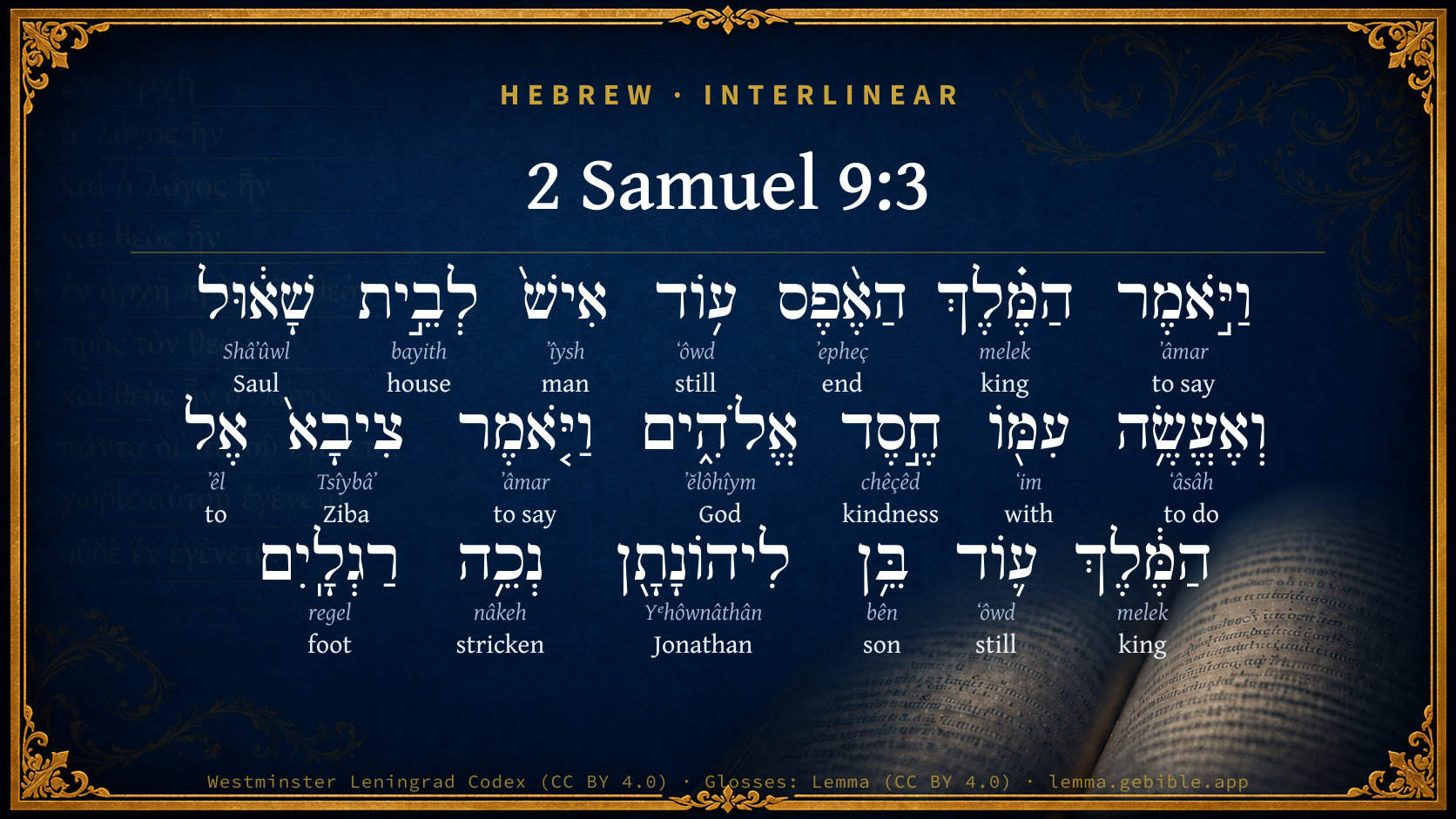
Hebrew (Westminster Leningrad Codex) 2 Samuel 9:3 appears in the Hebrew Old Testament. The text above is from the Westminster Leningrad Codex. Each word links to its Strong’s number, a concise gloss, and parsing drawn from the Open Scriptures Hebrew Bible morphology. Click any word for its full Brown-Driver-Briggs (BDB) entry.
Download image
Cite this verse

2 Samuel 9:3 (World English Bible). Public Domain. Lemma interlinear Bible study tool, https://lemma.gebible.app/v/2-samuel/9/3.

Show BibTeX & RIS
BibTeX
RIS
English Translation
The king said, Is there not yet any of the house of Saul, that I may show the kindness of God to him? Ziba said to the king, Jonathan has yet a son, who is lame of his feet.
World English Bible · Public Domain
Download a study sheet

One document with this verse’s original text, its word-by-word gloss line, the meaning frame, cross-references with their text, attributed commentary, and full source and license credits — printable, and it pastes into notes with its structure intact.

This verse Autodidact and up

Study sheet (.html) Plain text (.txt)

A passage Seminary Student

Up to 50 verses in one chapter. A passage sheet keeps up to 6 commentary sources and 12 cross-references per verse, in the order this page ranks them, and says so on the sheet whenever that leaves anything out. Ask for a single verse and you get the Autodidact verse sheet above.

Everything on this page stays free to read, with no account — the sheet is a download of what is already on screen, not access to it.

Want to remove ads? Support Godless Engineer
Compare translations 3

The same verse in 3 English versions, stacked beneath the original-language interlinear above. Click any original word for its lexicon entry.

Each is an independent rendering of the whole verse — the interlinear is not word-aligned to these translations.

Highlighted words mark where these versions differ — a whole-verse word diff, not a word-by-word alignment.

  • World English Bible Public Domain
    The king said, Is there not yet any of the house of Saul, that I may show the kindness of God to him? Ziba said to the king, Jonathan has yet a son, who is lame of his feet.
  • King James Version Public Domain
    And the king said, Is there not yet any of the house of Saul, that I may show the kindness of God unto him? And Ziba said unto the king, Jonathan hath yet a son, which is lame on his feet.
  • unfoldingWord Literal Text CC BY-SA 4.0
    And the king said, “ no longer a man to the house of Saul, that I may do with him the covenant faithfulness of God?” And Ziba said to the king, “A son still to Jonathan, lame of feet.”

unfoldingWord Literal Text — © unfoldingWord, licensed CC BY-SA 4.0. Word-aligned USFM3 via Door43 (git.door43.org/unfoldingWord/en_ult).

Versions to compare (up to 4)

3 of 4 selected

Show all 18 translations

Every available English version of this verse, each an independent rendering of the whole verse.

  • World English Bible Public Domain
    The king said, Is there not yet any of the house of Saul, that I may show the kindness of God to him? Ziba said to the king, Jonathan has yet a son, who is lame of his feet.
  • Berean Standard Bible Public Domain
    So the king asked, “Is there anyone left of Saul’s family to whom I can show the kindness of God?” Ziba answered, “There is still Jonathan’s son, who is lame in both feet.”
  • Majority Standard Bible Public Domain
    So the king asked, “Is there anyone left of the house of Saul to whom I can show the kindness of God?” Ziba answered, “There is still Jonathan’s son, who is lame in both feet.”
  • King James Version Public Domain
    And the king said, Is there not yet any of the house of Saul, that I may show the kindness of God unto him? And Ziba said unto the king, Jonathan hath yet a son, which is lame on his feet.
  • American Standard Version (1901) Public Domain
    And the king said, Is there not yet any of the house of Saul, that I may show the kindness of God unto him? And Ziba said unto the king, Jonathan hath yet a son, who is lame of his feet.
  • Revised Version (1885) Public Domain
    And the king said, Is there not yet any of the house of Saul, that I may shew the kindness of God unto him? And Ziba said unto the king, Jonathan hath yet a son, which is lame on his feet.
  • Geneva Bible (1599) Public Domain
    Then the King sayd, Remayneth there yet none of the house of Saul, on whome I may shewe the mercie of God? Ziba then answered the King, Ionathan hath yet a sonne lame of his feete.
  • Douay-Rheims (1899) Public Domain
    And the king said: Is there any one left of the house of Saul, that I may shew the mercy of God unto him? And Siba said to the king: There is a son of Jonathan left, who is lame of his feet.
  • Young's Literal Translation Public Domain
    And the king saith, `Is there not yet a man to the house of Saul, and I do with him the kindness of God?' And Ziba saith unto the king, `Jonathan hath yet a son -- lame.'
  • Literal Standard Version CC BY-SA 4.0
    And the king says, “Is there not yet a man of the house of Saul, and I do with him the kindness of God?” And Ziba says to the king, “Jonathan has yet a son—lame.”
  • Unlocked Literal Bible CC BY-SA 4.0
    So the king said, “Is there not anyone left of Saul's family to whom I may show the kindness of God?” Ziba replied to the king, “Jonathan still has a son, who is lame in his feet.”
  • unfoldingWord Literal Text CC BY-SA 4.0
    And the king said, “ no longer a man to the house of Saul, that I may do with him the covenant faithfulness of God?” And Ziba said to the king, “A son still to Jonathan, lame of feet.”
  • Darby Bible Public Domain
    And the king said, Is there not yet any of the house of Saul, that I may shew the kindness of God to him? And Ziba said to the king, Jonathan has yet a son, who is lame on [his] feet.
  • World Messianic Bible Public Domain
    The king said, “Is there not yet any of Saul’s house, that I may show the kindness of God to him?” Ziba said to the king, “Jonathan still has a son, who is lame in his feet.”
  • Webster's Bible Public Domain
    And the king said, Is there not yet any of the house of Saul, that I may show the kindness of God to him? and Ziba said to the king, Jonathan hath yet a son, who is lame in his feet.
  • Free Bible Version CC BY-SA 4.0
    The king asked him, “Is there anyone still left of Saul's family so I can be kind to him as I promised before God?” “There's still one of Jonathan's sons, who is lame in both feet,” Ziba replied.
  • Bible in Basic English Public Domain
    And the king said, Is there anyone of Saul's family still living, to whom I may be a friend in God's name? And Ziba said, There is a son of Jonathan, whose feet are damaged.
  • JPS Tanakh (1917) Public Domain
    And the king said: 'Is there not yet any of the house of Saul, that I may show the kindness of God unto him?' And Ziba said unto the king: 'Jonathan hath yet a son, who is lame on his feet.'

Literal Standard Version (2020), Covenant Press — licensed CC BY-SA 4.0. Text via the HelloAO Bible API (eBible.org). Unlocked Literal Bible (unfoldingWord) — licensed CC BY-SA 4.0. Text via the HelloAO Bible API (eBible.org). unfoldingWord Literal Text — © unfoldingWord, licensed CC BY-SA 4.0. Word-aligned USFM3 via Door43 (git.door43.org/unfoldingWord/en_ult). Free Bible Version, Dr. Jonathan Gallagher — licensed CC BY-SA 4.0. Text via the HelloAO Bible API (eBible.org).

Word by word

More ways to search: Search by grammar → Find every occurrence → Compare this word →

Practice this passage: Drill this verse → Learn its vocabulary →

נְכֵ֥ה
nâkeh
H5223
“stricken of”
Adjective, Adjective, Masculine, Singular, Construct
Part of Speech
Adjective
Type
Adjective
Gender
Masculine
Number
Singular
State
Construct
Full BDB Definition

Origin: TWOT - H1364 a

TWOT: adj

stricken, smitten
  1. וַיֹּ֣אמֶר ʼâmar H559 “and · to say” Conjunction + Verb, Qal, Sequential Imperfect, 3rd Person, Masculine, Singular
  2. הַמֶּ֗לֶךְ melek H4428 “the · king” Particle, Definite Article + Noun, Common, Masculine, Singular, Absolute
  3. הַאֶ֨פֶס ʼepheç H657 “end” Particle, Interrogative + Noun, Common, Masculine, Singular, Absolute
  4. ע֥וֹד ʻôwd H5750 “still” Adverb
  5. אִישׁ֙ ʼîysh H376 “man” Noun, Common, Masculine, Singular, Absolute
  6. לְבֵ֣ית bayith H1004 “to/for · house of” Preposition + Noun, Common, Masculine, Singular, Construct
  7. שָׁא֔וּל Shâʼûwl H7586 “Saul” Noun, Proper
  8. וְאֶעֱשֶׂ֥ה ʻâsâh H6213 “and · to do” Conjunction + Verb, Qal, Imperfect, 1st Person, Common, Singular
  9. עִמּ֖וֹ ʻim H5973 “with · him” Preposition + Suffix, Personal, 3rd Person, Masculine, Singular
  10. חֶ֣סֶד chêçêd H2617 “kindness of” Noun, Common, Masculine, Singular, Construct
  11. אֱלֹהִ֑ים ʼĕlôhîym H430 “God(s)” Noun, Common, Masculine, Plural, Absolute
  12. וַיֹּ֤אמֶר ʼâmar H559 “and · to say” Conjunction + Verb, Qal, Sequential Imperfect, 3rd Person, Masculine, Singular
  13. צִיבָא֙ Tsîybâʼ H6717 “Ziba” Noun, Proper
  14. אֶל ʼêl H413 “to” Preposition
  15. הַמֶּ֔לֶךְ melek H4428 “the · king” Particle, Definite Article + Noun, Common, Masculine, Singular, Absolute
  16. ע֛וֹד ʻôwd H5750 “still” Adverb
  17. בֵּ֥ן bên H1121 “son” Noun, Common, Masculine, Singular, Absolute
  18. לִיהוֹנָתָ֖ן Yᵉhôwnâthân H3083 “to/for · Jonathan” Preposition + Noun, Proper
  19. רַגְלָֽיִם regel H7272 “feet” Noun, Common, Feminine, Dual, Absolute

About this verse

These counts appear in no published source. They are computed here, from the morphology-tagged text and Lemma’s own curated glosses. What Lemma adds →

20
words
17
distinct lemmas
Historical
section

Notable vocabulary

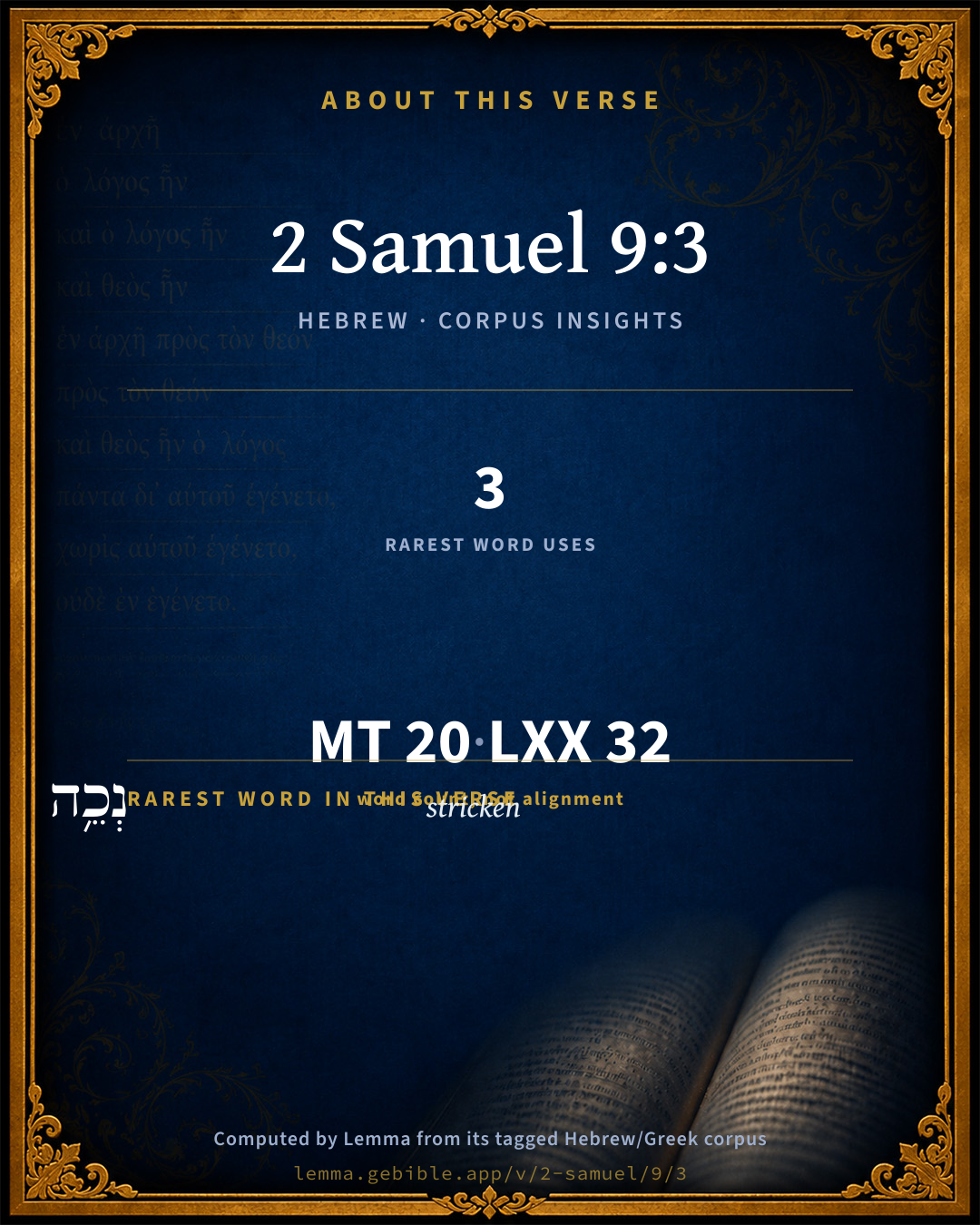
The rarest word here is נְכֵ֥ה stricken H5223 — appearing just 3 times in the whole Hebrew Bible.

Shared distinctive vocabulary

נְכֵ֥ה stricken H5223 occurs in 3 verses of the Hebrew Bible. Also found in:

Grammatical profile

  • 3 verbs
  • 12 nouns
  • 1 adjective
  • 2 prepositions
  • 2 adverbs

Verb forms

  • וַיֹּ֣אמֶר Qal · Sequential Imperfect
  • וְאֶעֱשֶׂ֥ה Qal · Imperfect
  • וַיֹּ֤אמֶר Qal · Sequential Imperfect

Repetition

Words recur within this verse — often emphatic in Hebrew:

  • וַיֹּ֣אמֶר to say H559 ×2
  • הַמֶּ֗לֶךְ king H4428 ×2
  • ע֥וֹד still H5750 ×2

Hebrew & Septuagint length

In English translation the verse runs 39 words from the Hebrew and 43 from the Septuagint (LXX English) — closely comparable.

A rough comparison of the two English renderings, which tokenize alike — not a word-level alignment.

Word counts can differ between the Hebrew and the Greek without any difference in meaning — e.g. the Hebrew direct-object marker אֵת has no separate Greek word, and Greek often adds the article ὁ.

In the original languages it is 20 Hebrew tokens and 32 Greek tokens — but the two are counted differently (Hebrew bundles its prefixes and suffixes into one token; the Greek is in lemma form), so that isn’t a like-for-like length.

Cross-references

8

Topical passages linked to 2 Samuel 9:3 in the Treasury of Scripture Knowledge — connected by theme and wording, ordered by reader-vote popularity; previews shown in the World English Bible.

  • 2 Samuel 4:4 Now Jonathan, Saul's son, had a son who was lame of his feet. He was five years old when the news came of Saul and Jonathan out of Jezreel; and his nurse took him up, and fled: and it happened, as she made haste to flee, that he fell, and became lame. His name was Mephibosheth.
  • Titus 3:3–4 For we were also once foolish, disobedient, deceived, serving various lusts and pleasures, living in malice and envy, hateful, and hating one another.
  • Deuteronomy 10:15 Only Yahweh had a delight in your fathers to love them, and he chose their seed after them, even you above all peoples, as at this day.
  • 1 Samuel 20:14–17 You shall not only while yet I live show me the loving kindness of Yahweh, that I not die;
  • Matthew 5:44–45 But I tell you, love your enemies, bless those who curse you, do good to those who hate you, and pray for those who mistreat you and persecute you,
  • Luke 6:36 Therefore be merciful, Even as your Father is also merciful.
  • Deuteronomy 4:37 Because he loved your fathers, therefore he chose their seed after them, and brought you out with his presence, with his great power, out of Egypt;
  • 2 Samuel 19:26 He answered, My lord, O king, my servant deceived me: for your servant said, I will saddle me a donkey, that I may ride thereon, and go with the king; because your servant is lame.

Cross-references courtesy of OpenBible.info (CC BY 4.0).

Hebrew and Greek witnesses Masoretic Hebrew ↔ Greek Septuagint

The same verse in the two great witnesses to the Old Testament, shown verse-for-verse.

These are two independent witnesses, not word-aligned to each other, and the Septuagint is shown in lemma (dictionary) form.

Hebrew 2 Samuel 9:3 Masoretic · Westminster Leningrad Codex

וַיֹּ֣אמֶר הַמֶּ֗לֶךְ הַאֶ֨פֶס ע֥וֹד אִישׁ֙ לְבֵ֣ית שָׁא֔וּל וְאֶעֱשֶׂ֥ה עִמּ֖וֹ חֶ֣סֶד אֱלֹהִ֑ים וַיֹּ֤אמֶר צִיבָא֙ אֶל הַמֶּ֔לֶךְ ע֛וֹד בֵּ֥ן לִיהוֹנָתָ֖ן נְכֵ֥ה רַגְלָֽיִם

The king said, Is there not yet any of the house of Saul, that I may show the kindness of God to him? Ziba said to the king, Jonathan has yet a son, who is lame of his feet.

World English Bible · Public Domain

Greek LXX 2 Samuel 9:3 Septuagint · lemma form

καί εἶπον ὁ βασιλεύς εἰ ὑπολείπω ἐκ ὁ οἶκος σαούλ ἔτι ἀνήρ καί ποιέω μετά αὐτός ἔλεος θεός καί εἶπον σιβα πρός ὁ βασιλεύς ἔτί εἰμί υἱός ὁ ιωναθαν πλήσσω ὁ πούς

And the king said, Is there yet a man left of the house of Saul, that I may act towards him with the mercy of God? and Siba said to the king, There is yet a son of Jonathan, lame of his feet.

LXX2012 (modern English Septuagint) · Public Domain

Hebrew: Westminster Leningrad Codex (CC BY 4.0). Greek: Septuagint (public domain); English from LXX2012 (modern English Septuagint) (Public Domain). How the Septuagint differs from the Hebrew →

Targum (Aramaic paraphrase)

1

The Targum is the ancient Jewish Aramaic paraphrase of the Hebrew Scriptures — an interpretive translation, not the Hebrew text itself. Onkelos (literal) and Pseudo-Jonathan (expansive) render the Torah, and Jonathan the Prophets. Coverage is partial: where no permissively-licensed English translation exists for a verse, only the Aramaic is shown. This is verse-level text, not a word-by-word alignment to the Hebrew.

  1. Targum Jonathan Prophets (Joshua–Malachi)
    וַאֲמַר מַלְכָּא הֲאִית עוֹד גַבְרָא לְבֵית שָׁאוּל וְאַעְבֵּיד עִמֵיהּ טִיבוּ מִן קֳדָם יְיָ וַאֲמַר צִיבָא לְמַלְכָּא עוֹד בְּרָא לִיהוֹנָתָן לָקֵי בְּתַרְתֵּין רַגְלוֹהִי:

    (no public-domain English translation for this verse)

    Targum Jonathan — Aramaic: “Mikraot Gedolot” (public domain). English: “Sefaria Community Translation” (CC0 1.0 (public-domain dedication)); “London "Chaldee Paraphrase," 1871” (public domain). Text via Sefaria.

Commentary

Notes on 2 Samuel 9:3 from classic Christian and Jewish commentators (each source and its license shown beneath its notes). The classic Christian expositions comment on the surrounding passage and are grouped to its opening verse, so a note may address several verses; the Jewish commentaries on the Tanakh (Rashi and others) are per-verse, so they appear only where the commentator wrote on this verse.

Lemma curates 59 commentaries, every one of them public domain or Creative Commons licensed, each selected and text-cleaned for this edition rather than reprinted as found. About our sources →

Trapp's Complete Commentary

John Trapp

2Sa 9:3 And the king said, [Is] there not yet any of the house of Saul, that I may shew the kindness of God unto him? And Ziba said unto the king, Jonathan hath yet a son, [which is] lame on [his] feet.

Ver. 3. The kindness of God.] A God-like kindness, - compare 3Jn 1:6, - or that which Jonathan bound me in the presence of God to show to him and his. {1Sa 20:14-15}

Which is lame on his feet.] But this broke no square; neither thought good David the worse of Mephibosheth, so long as he saw in him the features of his friend Jonathan: no more doth God of those weak but willing servants of his, whom he beholdeth in the face of his Son, whose image they bear.

John Trapp, A Commentary or Exposition upon All the Books of the Old and New Testament (1647–1656) — public domain. Text from a community e-Sword module.

Tyndale Open Study Notes

Tyndale Open Resources

9:3 Mephibosheth was crippled in both feet from a childhood accident (see 4:4).

Tyndale Open Study Notes — © Tyndale Open Resources, licensed CC BY-SA 4.0. Text via the HelloAO Bible API.

Geneva Bible (1599)

Geneva Bible translators

Such mercy as shall be acceptable to God.

Geneva Bible (1599) marginal notes — public domain. Text via Bolls.life.

Adam Clarke's Commentary

Verse 3. That I may show the kindness of God unto him?] That is, the utmost, the highest degrees of kindness; as the hail of God, is very great hail, the mountains of God, exceeding high mountains: besides, this kindness was according to the covenant of God made between him and the family of Jonathan.

Adam Clarke's Commentary on the Bible (1810–1826) — public domain. Text from a community e-Sword/MySword module.

The Cambridge Bible for Schools and Colleges

gen. ed. J. J. S. Perowne

3. the kindness of God] A reference to Jonathan’s words in 1Sa_20:14. “The kindness of God” means kindness or mercy such as God shews to men, unfailing, unsought, unlimited. Cp. Luk_6:36.

lame on his feet] See ch. 2Sa_4:4.

Machir the son of Ammiel] A man of wealth and position, to judge from the welcome which he gave David in his flight from Absalom (ch. 2Sa_17:27-29). He may have taken charge of Mephibosheth at Jonathan’s death. It may be inferred from his name that he belonged to the tribe of Manasseh (Num_32:39-40).

Lo-debar] A town on the E. of the Jordan in the neighbourhood of Mahanaim, possibly the same as the Debir of Jos_13:26. Its site is not determined.

The Cambridge Bible for Schools and Colleges (gen. ed. J. J. S. Perowne; Cambridge University Press, 1878–1918) — public domain. Text from a community e-Sword module.

John Gill's Exposition

And the king said, is there not yet any of the house of Saul; that is, remaining or living:

that I may show the kindness of God unto him? great kindness, some large favour or benefit; for the word God added to things, as to trees, mountains, &c. serves to set forth the excellency of them; and this kindness is in imitation of God, or such as he had sworn in the presence of God to show; and that is expressed in the same language, Sa1 20:14,

and Ziba said unto the king, Jonathan hath yet a son; a son still living:

which is lame on his feet; on both his feet, as the Targum; of which occasion; see Gill on Sa2 4:4.

John Gill's Exposition of the Whole Bible (1746–1763) — public domain (CC PDM 1.0). Text via the HelloAO Bible API.

Matthew Poole's English Annotations

The kindness of God; either, first, That kindness which I owe him for God’s sake, and by virtue of my oath given to him about it, 1Sa 20:14,15. But that oath seems only to oblige him to Jonathan’s posterity, and not to any other of Saul’s house. Or, secondly, Great and eminent kindness.

Matthew Poole's English Annotations on the Holy Bible (1683–1685) — public domain. Text from a community e-Sword/MySword module.

Whedon's Commentary on the Bible

Daniel D. Whedon

3. Lame — See 2Sa_4:4.

Daniel D. Whedon (gen. ed.), Commentary on the Old and New Testaments (1874–1909) — public domain. Text from a community e-Sword module.

The Pulpit Commentary

The kindness of God. That is, extraordinary kindness. The devout mind of the Orientals saw in everything that was more than common a manifestation of God, and thus the epithet "of God" came to be applied to anything that was very great. (comp. Gen_30:8, margin; Psa_65:9; Jon_3:3, margin) David would show Saul"s seed kindness as wonderful as are God"s dealings with man.

Ver. 3. (JERUSALEM.)

Showing the kindness of God.

David remembered the request of Jonathan to show him "the kindness of Jehovah"; (1Sa_20:14, 1Sa_20:15) felt the obligation of his former promises and covenants; (1Sa_24:21, 22 23:18) and now purposed, in accordance therewith, to "show the kindness of God," i.e. "love from religious motives, or as God shows it" (Thenius); "in God and for his sake" (Keil); "in the Lord"s sight, and according to the Lord"s example, pure, perpetual love, and not such love as arises from mere human respects and is shown in the eye of man" (Wordsworth); and not simply "great and eminent kindness" (Poole, Patrick). There are benevolent affections in our nature; but they must be imbued with religious motives and principles in order that their exercise may be of the highest kind. "The kindness of God" is such as is shown:

1. Out of reverence for his Name. Holy, just, and true; merciful and gracious; delighting in loving kindness. "God is love;" and the eternal Fountain of love in his creatures.

2. In obedience to his will, as expressed in numerous injunctions to the faithful performance of what has been promised; in the royal law; (Jam_2:8) and in manifold exhortations to compassionate love.

3. From gratitude for his benefits. These had been bestowed on David in abundant measure. (2Sa_7:18 2Sa_8:6) The acts of kindness which God performs toward men both enable and incite them to perform acts of kindness toward their fellow men. "What goodness the Lord shall do unto us, the same will we do unto thee". (Num_10:32) Freely ye have received, freely give.

4. In imitation of his example; of faithfulness, goodness, unsought, abounding, unfailing, and everlasting love. David was specially called, as king, to exhibit in his character and conduct an image of the moral excellences of the Divine King of Israel; and to this Christians are likewise celled. "Be ye therefore perfect," etc., (Mat_5:43-48) "merciful", (Luk_6:36) "imitators of God as beloved children," etc. (Eph_5:1)

1. Under the inspiration of his grace, his love, his Spirit; and, indeed, "it is the merciful love of God himself that dwells in the heart of the truly pious, and works therefrom; for he that lives in fellowship with God receives into his heart, through the Holy Ghost, the love that is in God, and lives and moves in that love" (Erdmann). "He that dwelleth in love dwelleth in God, and God in him". (1Jn_4:16) He not only reflects the Divine love on others, but is also the medium of its communication to them.

2. With the desire of his approval, of pleasing him rather than men, and of partaking more fully of his loving kindness, which "is better than life.

3. For the promotion of his glory; " that they may see your good works, and glorify your Father which is in heaven. D.

HOMILIES BY G. WOOD Ver. 3.

The kindness of God.

David, settled on the throne and in his new metropolis, recalls to mind the fallen house of Saul, not to destroy them, as was usual with Eastern monarchs, but to show them kindness for Jonathan"s sake. In his inquiry

after them he uses substantially the same phrase which Jonathan had used (1Sa_20:14) when he took an oath of him that he would be kind to himself and his family. "The kindness of the Lord," or "the kindness of God," is an expression descriptive of the highest and best kindness possible to man or angel. It is kindness which

I FLOWS FROM GOD. This is true of all the kindness which exists amongst men. "Love is of God." All the love of men towards each other streams forth from the fountain of Divine love, and should be thus regarded by those who are the objects of it, he being praised for all. But this is emphatically true of Christian kindness. It originates in, and is a manifestation of, the love of God in Christ. It is produced by the Holy Spirit as given to the disciples of Christ, and by means of the truth respecting him. (1Pe_1:22, 1Pe_1:23) It is a product of regeneration. It is God"s love dwelling in human hearts and revealing itself in human lives. It is an element of "the Divine nature" of which Christians are "partakers". (2Pe_1:4)

II IS EXERCISED FROM REGARD TO GOD.

1. It has its root, like all Christian graces, in faith towards God. (Gal_5:6)

1. It springs from gratitude and love to him for all his goodness, especiallyfor his redeeming love. (1Jn_4:11)

2. It. is practised in obedience to his commandments. (1Jn_4:21)

3. It aims at his approval

4. It imitates him (Luk_6:36; Eph_4:32) Hence it

III IS GOD-LIKE. As it is:

1. Disinterested. "Seeketh not her own". (1Co_13:5) Kindness which is exercised with a view to personal advantage is not kindness but policy and commercial subtlety.

2. Expansive. Ready to help all who need, as far as power permits. Not restricting itself to the good and worthy, but "kind unto the unthankful and the evil"; (Luk_6:35) nor yet to friends, but extending to enemies; (Mat_5:44, Mat_5:45, Mat_5:48) nor to one"s own sect in religion, but regarding with love all Christian brethren (1Jn_5:1; Eph_6:24) Yet it is:

3. Discriminating. The Divine love is united with righteousness, and seeks righteous ends. Hence it cannot be the same thing, and displayed in the same manner, towards the righteous and the unrighteous, the obedient and the disobedient; and it mainly seeks to promote righteousness and salvation in all, and varies its methods accordingly. Christian love and kindness will be exercised with similar discrimination as far as is possible to men; and will seek supremely the moral and spiritual benefit of its objects. Indiscriminate benevolence does more harm than good.

4. Unsparing. "He spared not his own Son", (Rom_8:32) and in him the love of God appears as self-sacrificing (1Jn_3:16) and bountiful. (Eph_1:3) Christian love possesses the same qualities of bountifulness, (2Co_8:2, 2Co_8:3, 2Co_8:9-11) self-denial, and self-sacrifice. It "endureth all things". (1Co_13:7)

5. Constant. The love of God is long suffering, persistent, and eternal, (Psa_103:17 Ps 136., passim) His children are like him in this respect. (1Co_13:4, 1Co_13:8, 1Co_13:13)

IV IS NOURISHED BY CONVERSE WITH GOD. The acts and habits of devotion reading, meditation, prayer, praise bring us into closer communion with God, secure us more of his Spirit, open our hearts to receive the impress of his character, promote in us all those sentiments and principles towards him which issue in hearty love and kindness towards our brethren. Let us draw nigh continually to him whose name is Love, and we shall find it ever more easy to be loving. G.W.

The Pulpit Commentary (1880–1919), ed. H.D.M. Spence-Jones & Joseph S. Exell — public domain. Text from a community e-Sword module.

unfoldingWord translationNotes

Door43 World Missions Community

I may show the kindness of God

The abstract noun "kindness" can be stated as "kind." AT: "I may be kind as I promised God I would be"

who is lame in his feet

"whose feet are damaged." The word "feet" here refers to the ability to walk. AT: "who is unable to walk" (See: Metonymy)

Machir ... Ammiel

These are names of men. (See: How to Translate Names)

Lo Debar

This is the name of a place. (See: How to Translate Names)

translationWords

God

Jonathan

son

house

unfoldingWord translationNotes — © Distant Shores Media and the Door43 World Missions Community, licensed CC BY-SA 4.0. Source: git.door43.org/Door43/en_tn.

Lesson kit

Teaching starters — assembled from the data on this page, not authored interpretation. Every prompt links to the verse data it draws on. Edit before teaching.

2 Samuel, in the Historical, opens this verse with 20 words (17 distinct Hebrew lemmas). Its most distinctive word is nâkeh (“stricken”). A historical commentator’s framing appears above. Read the whole chapter for the surrounding context.

Discussion questions

  1. The word nâkeh carries the sense “stricken.” How does it shape the verse?
  2. How does 2 Samuel 4:4, which shares the word «stricken», read alongside this verse?
  3. What does the repetition of “to say” (2× in this one verse) do in this verse?
  4. These translations render this verse differently. What is at stake in choosing one wording over another?
  5. «וַיֹּ֣אמֶר» is a Qal Sequential Imperfect verb. How does that grammatical form shape the action described?
  6. Compare how Trapp's Complete Commentary and Tyndale Open Study Notes read this verse. Where do they agree or differ?

Things to notice

Reading settings

Reading text

Shown beneath each verse's original-language words.

Old Testament
Old Testament edition

Read the OT as the Masoretic Hebrew (MT) or the Greek Septuagint (LXX).

English shown for the Greek Septuagint (in the Hebrew ↔ Greek comparison).

Comparing translations? Open the Compare panel on any verse page to stack up to four side by side.