
2 Samuel 7:3

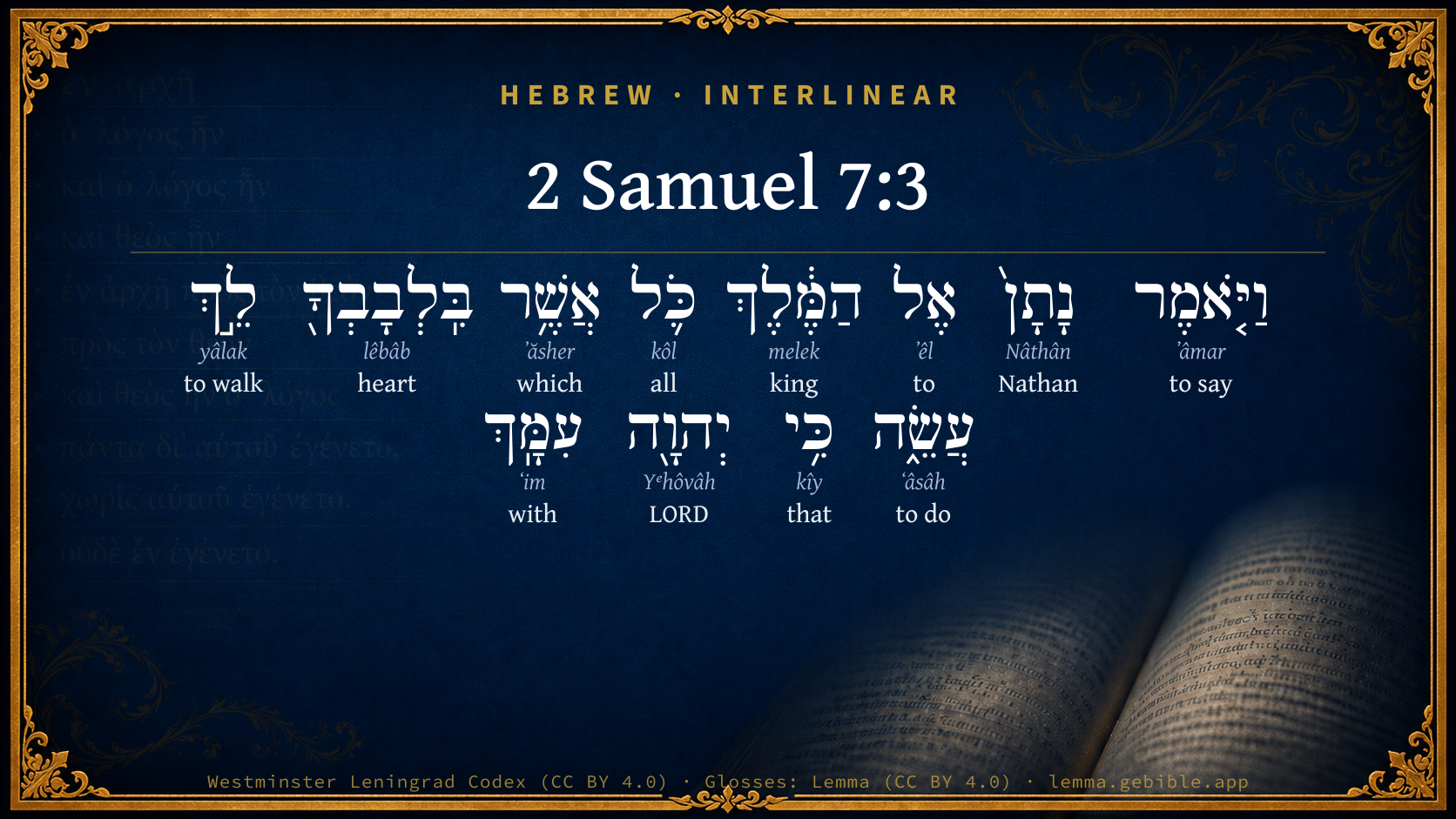
Hebrew (Westminster Leningrad Codex) 2 Samuel 7:3 appears in the Hebrew Old Testament. The text above is from the Westminster Leningrad Codex. Each word links to its Strong’s number, a concise gloss, and parsing drawn from the Open Scriptures Hebrew Bible morphology. Click any word for its full Brown-Driver-Briggs (BDB) entry.
Download image
Cite this verse

2 Samuel 7:3 (World English Bible). Public Domain. Lemma interlinear Bible study tool, https://lemma.gebible.app/v/2-samuel/7/3.

Show BibTeX & RIS
BibTeX
RIS
English Translation
Nathan said to the king, Go, do all that is in your heart; for Yahweh is with you.
World English Bible · Public Domain
Download a study sheet

One document with this verse’s original text, its word-by-word gloss line, the meaning frame, cross-references with their text, attributed commentary, and full source and license credits — printable, and it pastes into notes with its structure intact.

This verse Autodidact and up

Study sheet (.html) Plain text (.txt)

A passage Seminary Student

Up to 50 verses in one chapter. A passage sheet keeps up to 6 commentary sources and 12 cross-references per verse, in the order this page ranks them, and says so on the sheet whenever that leaves anything out. Ask for a single verse and you get the Autodidact verse sheet above.

Everything on this page stays free to read, with no account — the sheet is a download of what is already on screen, not access to it.

Want to remove ads? Support Godless Engineer
Compare translations 3

The same verse in 3 English versions, stacked beneath the original-language interlinear above. Click any original word for its lexicon entry.

Each is an independent rendering of the whole verse — the interlinear is not word-aligned to these translations.

Highlighted words mark where these versions differ — a whole-verse word diff, not a word-by-word alignment.

  • World English Bible Public Domain
    Nathan said to the king, Go, do all that is in your heart; for Yahweh is with you.
  • King James Version Public Domain
    And Nathan said to the king, Go, do all that is in thine heart; for the LORD is with thee.
  • unfoldingWord Literal Text CC BY-SA 4.0
    And Nathan said to the king, “All that in your heart, go, do, for Yahweh with you.”

unfoldingWord Literal Text — © unfoldingWord, licensed CC BY-SA 4.0. Word-aligned USFM3 via Door43 (git.door43.org/unfoldingWord/en_ult).

Versions to compare (up to 4)

3 of 4 selected

Show all 18 translations

Every available English version of this verse, each an independent rendering of the whole verse.

  • World English Bible Public Domain
    Nathan said to the king, Go, do all that is in your heart; for Yahweh is with you.
  • Berean Standard Bible Public Domain
    And Nathan replied to the king, “Go and do all that is in your heart, for the LORD is with you.”
  • Majority Standard Bible Public Domain
    And Nathan replied to the king, “Go and do all that is in your heart, for the LORD is with you.”
  • King James Version Public Domain
    And Nathan said to the king, Go, do all that is in thine heart; for the LORD is with thee.
  • American Standard Version (1901) Public Domain
    And Nathan said to the king, Go, do all that is in thy heart; for Jehovah is with thee.
  • Revised Version (1885) Public Domain
    And Nathan said to the king, Go, do all that is in thine heart; for the LORD is with thee.
  • Geneva Bible (1599) Public Domain
    Then Nathan sayde vnto the King, Go, and doe all that is in thine heart: for the Lord is with thee.
  • Douay-Rheims (1899) Public Domain
    And Nathan said to the king: Go, do all that is in thy heart: because the Lord is with thee.
  • Young's Literal Translation Public Domain
    And Nathan saith unto the king, `All that `is' in thine heart -- go, do, for Jehovah `is' with thee.'
  • Literal Standard Version CC BY-SA 4.0
    And Nathan says to the king, “All that [is] in your heart—go, do, for YHWH [is] with you.”
  • Unlocked Literal Bible CC BY-SA 4.0
    Then Nathan said to the king, “Go, do what is in your heart, for Yahweh is with you.”
  • unfoldingWord Literal Text CC BY-SA 4.0
    And Nathan said to the king, “All that in your heart, go, do, for Yahweh with you.”
  • Darby Bible Public Domain
    And Nathan said to the king, Go, do all that is in thy heart; for Jehovah is with thee.
  • World Messianic Bible Public Domain
    Nathan said to the king, “Go, do all that is in your heart, for the LORD is with you.”
  • Webster's Bible Public Domain
    And Nathan said to the king, Go, do all that is in thy heart: for the LORD is with thee.
  • Free Bible Version CC BY-SA 4.0
    “Go ahead, do whatever you want, for the Lord is with you,” Nathan told the king.
  • Bible in Basic English Public Domain
    And Nathan said to the king, Go and do whatever is in your heart; for the Lord is with you.
  • JPS Tanakh (1917) Public Domain
    And Nathan said to the king: 'Go, do all that is in thy heart; for the LORD is with thee.'

Literal Standard Version (2020), Covenant Press — licensed CC BY-SA 4.0. Text via the HelloAO Bible API (eBible.org). Unlocked Literal Bible (unfoldingWord) — licensed CC BY-SA 4.0. Text via the HelloAO Bible API (eBible.org). unfoldingWord Literal Text — © unfoldingWord, licensed CC BY-SA 4.0. Word-aligned USFM3 via Door43 (git.door43.org/unfoldingWord/en_ult). Free Bible Version, Dr. Jonathan Gallagher — licensed CC BY-SA 4.0. Text via the HelloAO Bible API (eBible.org).

Word by word

More ways to search: Search by grammar → Find every occurrence → Compare this word →

Practice this passage: Drill this verse → Learn its vocabulary →

נָתָן֙
Nâthân
H5416
“Nathan”
Noun, Proper
Part of Speech
Noun
Type
Proper
Full BDB Definition

Origin: from H5414

TWOT: None

Nathan = "giver" - a son of David by Bathsheba - the eminent prophet in the time of David and Solomon - a man of Zobah, father of one of David's mighty warriors - father of Azariah who was over the officers of Solomon - son of Attai and father of Zabad of the tribe of Judah - brother of Joel of the tribe of Judah - one of the head men who returned from Babylon with Ezra - a man with a foreign wife in the time of Ezra - head of a family of Israel who shall mourn when they look on Him whom they pierced
  1. וַיֹּ֤אמֶר ʼâmar H559 “and · to say” Conjunction + Verb, Qal, Sequential Imperfect, 3rd Person, Masculine, Singular
  2. אֶל ʼêl H413 “to” Preposition
  3. הַמֶּ֔לֶךְ melek H4428 “the · king” Particle, Definite Article + Noun, Common, Masculine, Singular, Absolute
  4. כֹּ֛ל kôl H3605 “all of” Noun, Common, Masculine, Singular, Construct
  5. אֲשֶׁ֥ר ʼăsher H834 “which” Particle, Relative
  6. בִּֽלְבָבְךָ֖ lêbâb H3824 “in/at · heart · your” Preposition + Noun, Common, Masculine, Singular, Construct + Suffix, Personal, 2nd Person, Masculine, Singular
  7. לֵ֣ךְ yâlak H3212 “walk” Verb, Qal, Imperative, 2nd Person, Masculine, Singular
  8. עֲשֵׂ֑ה ʻâsâh H6213 “do” Verb, Qal, Imperative, 2nd Person, Masculine, Singular
  9. כִּ֥י kîy H3588 “that” Conjunction
  10. יְהוָ֖ה Yᵉhôvâh H3068 “LORD” Noun, Proper
  11. עִמָּֽךְ ʻim H5973 “with · you” Preposition + Suffix, Personal, 2nd Person, Feminine, Singular

About this verse

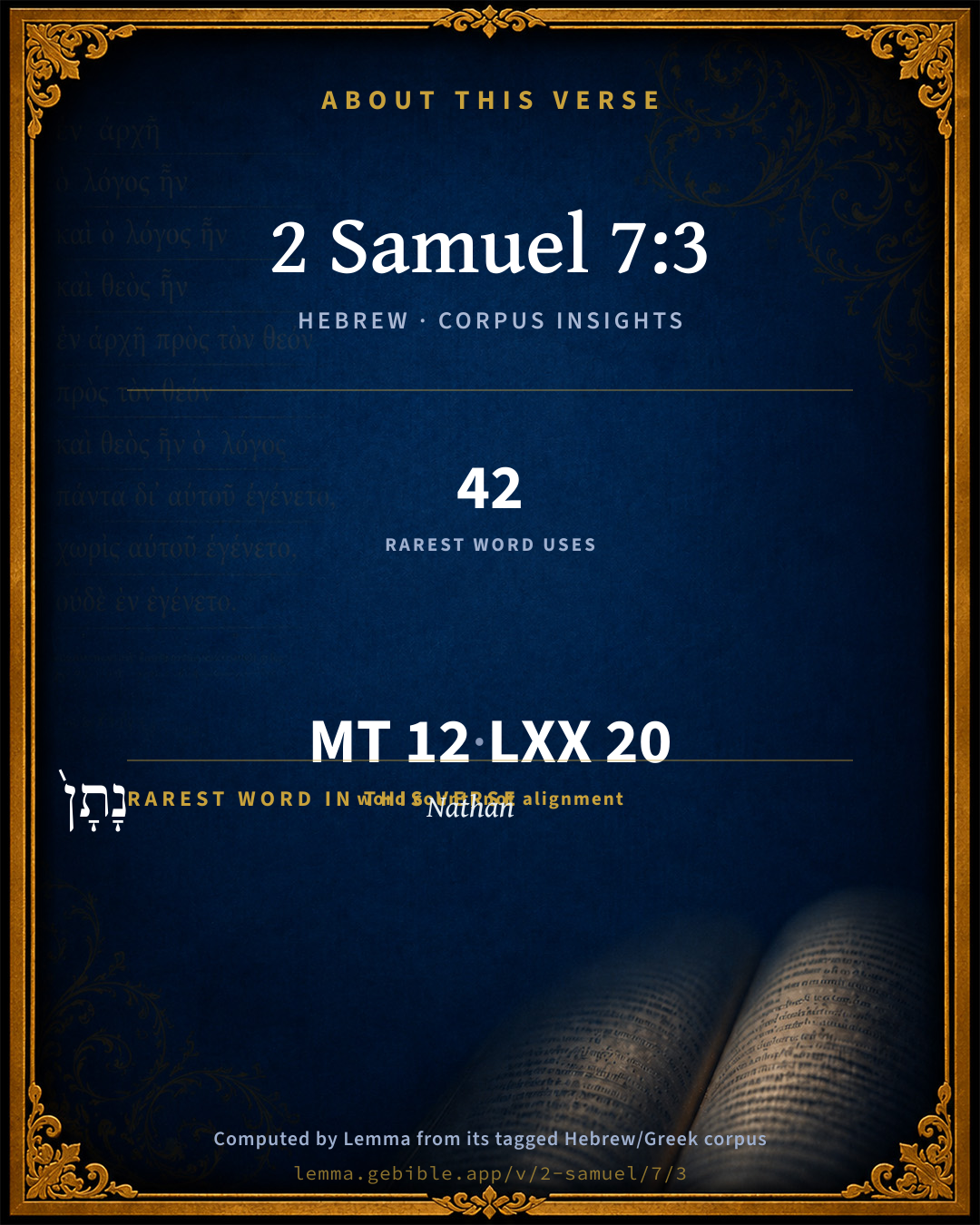
These counts appear in no published source. They are computed here, from the morphology-tagged text and Lemma’s own curated glosses. What Lemma adds →

12
words
12
distinct lemmas
Historical
section

Shared distinctive vocabulary

נָתָן֙ Nathan H5416 occurs in 39 verses of the Hebrew Bible. Also found in:

Grammatical profile

  • 3 verbs
  • 5 nouns
  • 2 prepositions
  • 1 conjunction
  • 1 particle

Verb forms

  • וַיֹּ֤אמֶר Qal · Sequential Imperfect
  • לֵ֣ךְ Qal · Imperative
  • עֲשֵׂ֑ה Qal · Imperative

Hebrew & Septuagint length

In English translation the verse runs 18 words from the Hebrew and 21 from the Septuagint (LXX English) — closely comparable.

A rough comparison of the two English renderings, which tokenize alike — not a word-level alignment.

Word counts can differ between the Hebrew and the Greek without any difference in meaning — e.g. the Hebrew direct-object marker אֵת has no separate Greek word, and Greek often adds the article ὁ.

In the original languages it is 12 Hebrew tokens and 20 Greek tokens — but the two are counted differently (Hebrew bundles its prefixes and suffixes into one token; the Greek is in lemma form), so that isn’t a like-for-like length.

Cross-references

9

Topical passages linked to 2 Samuel 7:3 in the Treasury of Scripture Knowledge — connected by theme and wording, ordered by reader-vote popularity; previews shown in the World English Bible.

  • 1 Chronicles 22:7 David said to Solomon his son, As for me, it was in my heart to build a house to the name of Yahweh my God.
  • 1 Kings 8:17–18 Now it was in the heart of David my father to build a house for the name of Yahweh, the God of Israel.
  • 1 Chronicles 28:2 Then David the king stood up on his feet, and said, Hear me, my brothers, and my people: as for me, it was in my heart to build a house of rest for the ark of the covenant of Yahweh, and for the footstool of our God; and I had made ready for the building.
  • 1 Samuel 16:7 But Yahweh said to Samuel, "Don't look on his face, or on the height of his stature; because I have rejected him: for [Yahweh sees] not as man sees; for man looks at the outward appearance, but Yahweh looks at the heart."
  • 2 Kings 4:27 When she came to the man of God to the hill, she caught hold of his feet. Gehazi came near to thrust her away; but the man of God said, Let her alone: for her soul is vexed within her; and Yahweh has hid it from me, and has not told me.
  • 1 Samuel 10:7 Let it be, when these signs are come to you, that you do as occasion shall serve you; for God is with you.
  • Psalms 20:4 May He grant you your heart's desire, And fulfill all your counsel.
  • Psalms 37:4 Also delight yourself in Yahweh, And he will give you the desires of your heart.
  • 1 John 2:27 As for you, the anointing which you received from him remains in you, and you don't need for anyone to teach you. But as his anointing teaches you concerning all things, and is true, and is no lie, and even as it taught you, you will remain in him.

Cross-references courtesy of OpenBible.info (CC BY 4.0).

Hebrew and Greek witnesses Masoretic Hebrew ↔ Greek Septuagint

The same verse in the two great witnesses to the Old Testament, shown verse-for-verse.

These are two independent witnesses, not word-aligned to each other, and the Septuagint is shown in lemma (dictionary) form.

Hebrew 2 Samuel 7:3 Masoretic · Westminster Leningrad Codex

וַיֹּ֤אמֶר נָתָן֙ אֶל הַמֶּ֔לֶךְ כֹּ֛ל אֲשֶׁ֥ר בִּֽלְבָבְךָ֖ לֵ֣ךְ עֲשֵׂ֑ה כִּ֥י יְהוָ֖ה עִמָּֽךְ

Nathan said to the king, Go, do all that is in your heart; for Yahweh is with you.

World English Bible · Public Domain

Greek LXX 2 Samuel 7:3 Septuagint · lemma form

καί εἶπον ναθαν πρός ὁ βασιλεύς πᾶς ὅσος ἄν ἐν ὁ καρδία σύ βαδίζω καί ποιέω ὅτι κύριος μετά σύ

And Nathan said to the king, Go and do all that is in your heart, for the Lord is with you.

LXX2012 (modern English Septuagint) · Public Domain

Hebrew: Westminster Leningrad Codex (CC BY 4.0). Greek: Septuagint (public domain); English from LXX2012 (modern English Septuagint) (Public Domain). How the Septuagint differs from the Hebrew →

Targum (Aramaic paraphrase)

1

The Targum is the ancient Jewish Aramaic paraphrase of the Hebrew Scriptures — an interpretive translation, not the Hebrew text itself. Onkelos (literal) and Pseudo-Jonathan (expansive) render the Torah, and Jonathan the Prophets. Coverage is partial: where no permissively-licensed English translation exists for a verse, only the Aramaic is shown. This is verse-level text, not a word-by-word alignment to the Hebrew.

  1. Targum Jonathan Prophets (Joshua–Malachi)
    וַאֲמַר נָתָן לְמַלְכָּא כָּל דִי בְלִבָּךְ אֱזֵיל עֲבֵיד אֲרֵי מֵימְרָא דַייָ בְּסַעֲדָךְ:

    (no public-domain English translation for this verse)

    Targum Jonathan — Aramaic: “Mikraot Gedolot” (public domain). English: “Sefaria Community Translation” (CC0 1.0 (public-domain dedication)); “London "Chaldee Paraphrase," 1871” (public domain). Text via Sefaria.

Commentary

Notes on 2 Samuel 7:3 from classic Christian and Jewish commentators (each source and its license shown beneath its notes). The classic Christian expositions comment on the surrounding passage and are grouped to its opening verse, so a note may address several verses; the Jewish commentaries on the Tanakh (Rashi and others) are per-verse, so they appear only where the commentator wrote on this verse.

Lemma curates 59 commentaries, every one of them public domain or Creative Commons licensed, each selected and text-cleaned for this edition rather than reprinted as found. About our sources →

Trapp's Complete Commentary

John Trapp

2Sa 7:3 And Nathan said to the king, Go, do all that [is] in thine heart; for the LORD [is] with thee.

Ver. 3. And Nathan said.] Ex proprio sensu, out of his private opinion, and not by divine revelation. Good men, then, may be out in matters of religion, as here both David and Nathan were; neither is it safe to pin our faith on another man’s sleeve - for who knoweth whither he may carry it? - but to "prove all things," and to "hold fast only that which is good." {1Th 5:21} Nathan himself was here too well persuaded of David, as if he had been infallible: and why? For the Lord is with thee. What? always, and in all things? No, nor with any man in this life, surely. Nimis augusta res est nuspiam errare. Nathan shall see and say ere long, that he was mistaken. It is with us while here, as it was once with Peter, we walk one step and sink another.

John Trapp, A Commentary or Exposition upon All the Books of the Old and New Testament (1647–1656) — public domain. Text from a community e-Sword module.

Joseph Benson's Commentary

2Sa 7:3. Nathan said, Go and do all that is in thy heart — Pursue thy intentions, and build a house for the ark. The design being pious, and the thing not forbidden by God, Nathan hastily approves it before he had consulted God about it, as both he and David ought to have done in a matter of so great moment. And therefore Nathan meets with this rebuke, that he is forced to acknowledge his error, and recant it. For the holy prophets did not speak all things by prophetic inspiration, but some things as religious men, by a human spirit.

Joseph Benson's Commentary on the Old and New Testaments (1811–1818) — public domain. Text from a community e-Sword module.

Tyndale Open Study Notes

Tyndale Open Resources

7:3 Go ahead and do whatever you have in mind: Nathan’s counsel to David was Nathan’s own idea. As it turned out, God disqualified David from building the Temple (see 1 Chr 22:8). Even true prophets are fallible when speaking on their own initiative rather than from God’s revelation.

Tyndale Open Study Notes — © Tyndale Open Resources, licensed CC BY-SA 4.0. Text via the HelloAO Bible API.

Jamieson, Fausset & Brown

Robert Jamieson, A. R. Fausset & David Brown

Nathan said to the king, Go, do all that is in thine heart--The piety of the design commended it to the prophet's mind, and he gave his hasty approval and encouragement to the royal plans. The prophets, when following the impulse of their own feelings, or forming conjectural opinions, fell into frequent mistakes. (See on Sa1 16:6; Kg2 4:27).

Jamieson, Fausset & Brown — Commentary Critical and Explanatory on the Whole Bible (1871) — public domain (CC PDM 1.0). Text via the HelloAO Bible API.

Adam Clarke's Commentary

Verse 3. Nathan said to the king] In this case he gave his judgment as a pious and prudent man, not as a prophet; for the prophets were not always under a Divine afflatus; it was only at select times they were thus honoured.

For the Lord is with thee.] Thou hast his blessing in all that thou doest, and this pious design of thine will most certainly meet with his approbation.

Adam Clarke's Commentary on the Bible (1810–1826) — public domain. Text from a community e-Sword/MySword module.

Ellicott's Commentary for English Readers

(3) Go, do all that is in thine heart.—Nathan naturally considered that it must be right for David to execute his pious purpose; but he spoke only according to his own sense of right, and not by Divine direction.

A Bible Commentary for English Readers, edited by Charles John Ellicott (1878–1897) — public domain. Text from a community e-Sword module.

John Gill's Exposition

And Nathan said to the king, go, do till that is in thine heart,.... He perceived it was in his heart to build an house for God; he knew an house was to be built at one time or another, by some person or another; he knew it was a good work, and fit for a king to do, and might think this was a proper time any, he being at leisure, and therefore encouraged him to it: but inasmuch as the time when and the person by whom this was to be built were not pointed out particularly in the word of God, David and he should have consulted the Lord about it; in this they erred, and for which they were tacitly reproved; for, as the event shows, this was not the time when, nor David the person by whom, it was to be built. Nathan said this as a pious and good man, in a private capacity, not as a prophet, or under a spirit of prophecy; for prophets did not always speak under such an influence, but, as private men, said some things ignorantly and through mistake; see Sa1 16:6,

for the Lord is with thee; prospering and succeeding him in all he undertook, giving him rest from all his enemies; and he might think that this motion he now made of building an house was from the Lord; the Targum is,"the Word of the Lord shall be for thine help,''

or thine helper, and shall assist thee in this work. David being thus encouraged by the prophet, his thoughts were more employed about it, and he was resolute and eager to perform it; and now it was he penned the hundred thirty second psalm, in which he expresses his oath and vow to find a place to build on, Psa 132:1.

John Gill's Exposition of the Whole Bible (1746–1763) — public domain (CC PDM 1.0). Text via the HelloAO Bible API.

Haydock's Catholic Bible Commentary

Thee. David did not, perhaps, consult him as a prophet; and Nathan thought that the proposal was so just, that it might be safely carried into effect. The prophets are not inspired in all their actions. Joseph was of a different opinion from his father, Genesis xlviii. 19. Samuel supposed that Eliab should have been king; (1 Kings xvi. 6,) and Eliseus confesses, that God had concealed from his the affliction of the woman with whom he lodged, 4 Kings iv. 24. (Calmet) --- God afterwards sent the same Nathan to rectify his former decision, that he might not pass sentence, in future, without consulting him. (Menochius)

George Leo Haydock (1774–1849), Haydock's Catholic Family Bible and Commentary, 1859 edition — public domain. Excludes Psalms (Douay-Rheims chapter numbering differs from Protestant) and Deuterocanonical books (Catholic canon only).

Matthew Poole's English Annotations

Pursue thy intentions, and build a house for the ark. The design being pious, and the thing not forbidden by God, Nathan hastily approves it, before he had either seriously considered it in his own mind, or consulted God about it, as both he and David certainly ought to have done in a matter of so great moment. And therefore Nathan meets with this rebuke, that he is forced to acknowledge his error, and recant it. For the holy prophets did not speak all things by prophetical inspiration, but some things by a human spirit, and prudent conjecture; and therefore they were ignorant and mistaken in some matters, as 1Sa 16:6; 2Ki 4:27.

Matthew Poole's English Annotations on the Holy Bible (1683–1685) — public domain. Text from a community e-Sword/MySword module.

Whedon's Commentary on the Bible

Daniel D. Whedon

3. Nathan said — The prophet gave this counsel from the apparent propriety and laudableness of David’s purpose, and not by divine revelation. Accordingly he was called upon that night to counsel the king differently. Here we learn that the prophets were not always under inspiration.

Daniel D. Whedon (gen. ed.), Commentary on the Old and New Testaments (1874–1909) — public domain. Text from a community e-Sword module.

The Pulpit Commentary

Go, do all that is in thine heart. Nathan rashly approves. The king"s purpose seems so pious that he does not doubt its acceptance by God.

The Prophet Nathan.

References: (2Sa_12:1, 2Sa_12:25; 1Ki_1:10, 22 4:5; 1Ch_17:1 1Ch_29:29; 2Ch_9:29 2Ch_29:25; Zec_12:12)

This is the first mention of his name. He may have been trained by Samuel at Naioth, and become acquainted with David there; was now the confidential friend and spiritual adviser of the king; subsequently reproved him for his sin; gave him counsel concerning the accession of Solomon; aided him in the reorganization of public worship; and wrote annals of his reign. It was his vocation to interpret and announce the Divine mind to others. (see 1Sa_4:1) "The calling of a prophet was that of a preacher or pastor with reference to the congregation as a whole and its individual members; but was distinct from our modern ideas with reference to the calling as thus explained in his drawing directly from Divine revelation. The prophets have been rightly called "the conscience of the Israelitish state."... They held intercourse with God by means of prayer. They questioned God, (Hab_2:1) and he answered; but they did not receive Divine disclosures until they had first occupied an attitude of waiting and praying" (Delitzsch; Oehler, "Theology of the Old Testament;" Riehm).

1. All men, and especially those who are in authority, have need of wise and faithful counsel. The king himself is only a man; his position is apt to blind his judgment and corrupt his heart; whilst his responsibilities and the consequences of his actions are very great.

2. Even the wisest of counsellors are liable to err in judgment. (Job_32:9) "All that is in thine heart go, do." But herein Nathan spoke "out of his own mind, and not by Divine revelation" (J.H. Michaelis). The prophet, like the king, was only a man, (Act_10:26) imperfect and fallible, and often mistaken, when giving counsel according to his natural judgment and first impressions, without seeking and obtaining the counsel of God. It is not said that he spoke by "the word of the Lord," as he did afterwards (ver. 4). "Ofttimes our thoughts, although springing from motives of real religion, are not God"s thoughts; and the lesson here conveyed is most important not taking our own impressions, however earnestly and piously derived, as necessarily in accordance with the will of God, but testing them by his revealed Word" (Edersheim).

3. The errors of human judgment are rectified by Divine communications.

Such communications have been actually made; and they are unspeakably precious. The prophet clearly distinguished them from his own thoughts, and had an inward assurance and overpowering conviction that he was the organ of God. It is the privilege of all Christians to be "taught of God," and "led by the Spirit;" but unless their convictions and impulses accord with the revealed Word, they must be rejected.

4. The Word of Divine revelation admits of no questioning or contradiction; but should be received "with meekness," uttered with simplicity and fidelity, (Deu_12:32) and obeyed humbly, cheerfully, and fully. The prophet hesitated not to acknowledge his mistake, nor the king to lay aside his purpose in obedience to the will of the Lord (vers. 17, 18). D.

The Lord is with thee.

This brief and significant language has often been addressed to good men. And what can be more encouraging!

1. It describes an invaluable privilege. "Jehovah," the Eternal, the Unchangeable, the Faithful, the Covenant God of Israel, "is with thee;" not simply in his special presence, but also in his effectual grace, approving, directing, protecting, qualifying, helping, prospering thee. "I am with thee" (Gen_26:24; Exo_20:24)

1. It expresses a personal assurance. "With thee. Such assurance is given by the word of the prophet, the covenant of God, the argument of experience; (ver. 9 1Sa 18:32-37) and the conviction of the heart in the way of faith and, obedience.

2. It furnishes a powerful incitement to thanksgiving, prayer, conflict, labour, perseverance, hope (Hag_2:4; 1Co_15:58) "Lo, I am with you always." The spiritual presence and fellowship of Christ are the secret of all spiritual strength and success. D.

The Pulpit Commentary (1880–1919), ed. H.D.M. Spence-Jones & Joseph S. Exell — public domain. Text from a community e-Sword module.

John Wesley's Explanatory Notes

Nathan said - Pursue thy intentions, and build an house for the ark. The design being pious and the thing not forbidden by God, Nathan hastily approves it, before he had consulted God about it, as both he and David ought to have done in a matter of so great moment. And therefore Nathan meets with this rebuke, that he is forced to acknowledge his error, and recant it. For the holy prophets did not speak all things by prophetic inspiration, but some things by an human spirit.

John Wesley, Explanatory Notes Upon the Whole Bible (1754–1765) — public domain. Text via the GEBible commentary corpus.

unfoldingWord translationNotes

Door43 World Missions Community

do what is in your heart

Here "heart" represents the mind. AT: "do what you think you should" (See: Metonymy)

for Yahweh is with you

Here "with you" means God is helping and blessing David. (See: Idiom)

the word of Yahweh came to Nathan, saying, "Go

The idiom "the word of Yahweh came to" is used to introduce a special message from God. AT: "Yahweh gave a message to Nathan. He said, 'Go" or "Yahweh spoke this message to Nathan: 'Go" (See: Idiom)

saying, "Go and tell David my servant, 'This is what Yahweh says: Will you build me a house in which to live?

This has quotations within quotations. It may be necessary to translate them as indirect quotation. AT: "saying, 'Go and ask David if he thinks that he will be the one to build a house in which I will live." (See: Quotes Within Quotes and Direct and Indirect Quotations)

Will you build me a house in which to live?

Yahweh uses a question to emphasize that David is not the one to build a house for Yahweh. This question can be translated as a statement. AT: "You will not build a house for me" (See: Rhetorical Question)

build me a house

Here "house" means a temple. In 2Sa 7:11 Yahweh will say that he will build a house for David. There "house" means a family. If your language has a word that can express both ideas, use it here and in 2Sa 7:11.

translationWords

heart

word of God

David

servant

house

unfoldingWord translationNotes — © Distant Shores Media and the Door43 World Missions Community, licensed CC BY-SA 4.0. Source: git.door43.org/Door43/en_tn.

Lesson kit

Teaching starters — assembled from the data on this page, not authored interpretation. Every prompt links to the verse data it draws on. Edit before teaching.

2 Samuel, in the Historical, opens this verse with 12 words (12 distinct Hebrew lemmas). Its most distinctive word is Nâthân (“Nathan”). A historical commentator’s framing appears above. Read the whole chapter for the surrounding context.

Discussion questions

  1. How does “Nathan” (Nâthân) shape what this verse is saying?
  2. How does 2 Samuel 5:14, which shares the word «Nathan», read alongside this verse?
  3. The translations on this page render this verse differently — a whole-verse word diff, not a word-by-word alignment. What might account for the different wordings?
  4. «וַיֹּ֤אמֶר» is a Qal Sequential Imperfect verb. How does that grammatical form shape the action described?
  5. Compare how Trapp's Complete Commentary and Joseph Benson's Commentary read this verse. Where do they agree or differ?

Things to notice

Reading settings

Reading text

Shown beneath each verse's original-language words.

Old Testament
Old Testament edition

Read the OT as the Masoretic Hebrew (MT) or the Greek Septuagint (LXX).

English shown for the Greek Septuagint (in the Hebrew ↔ Greek comparison).

Comparing translations? Open the Compare panel on any verse page to stack up to four side by side.