
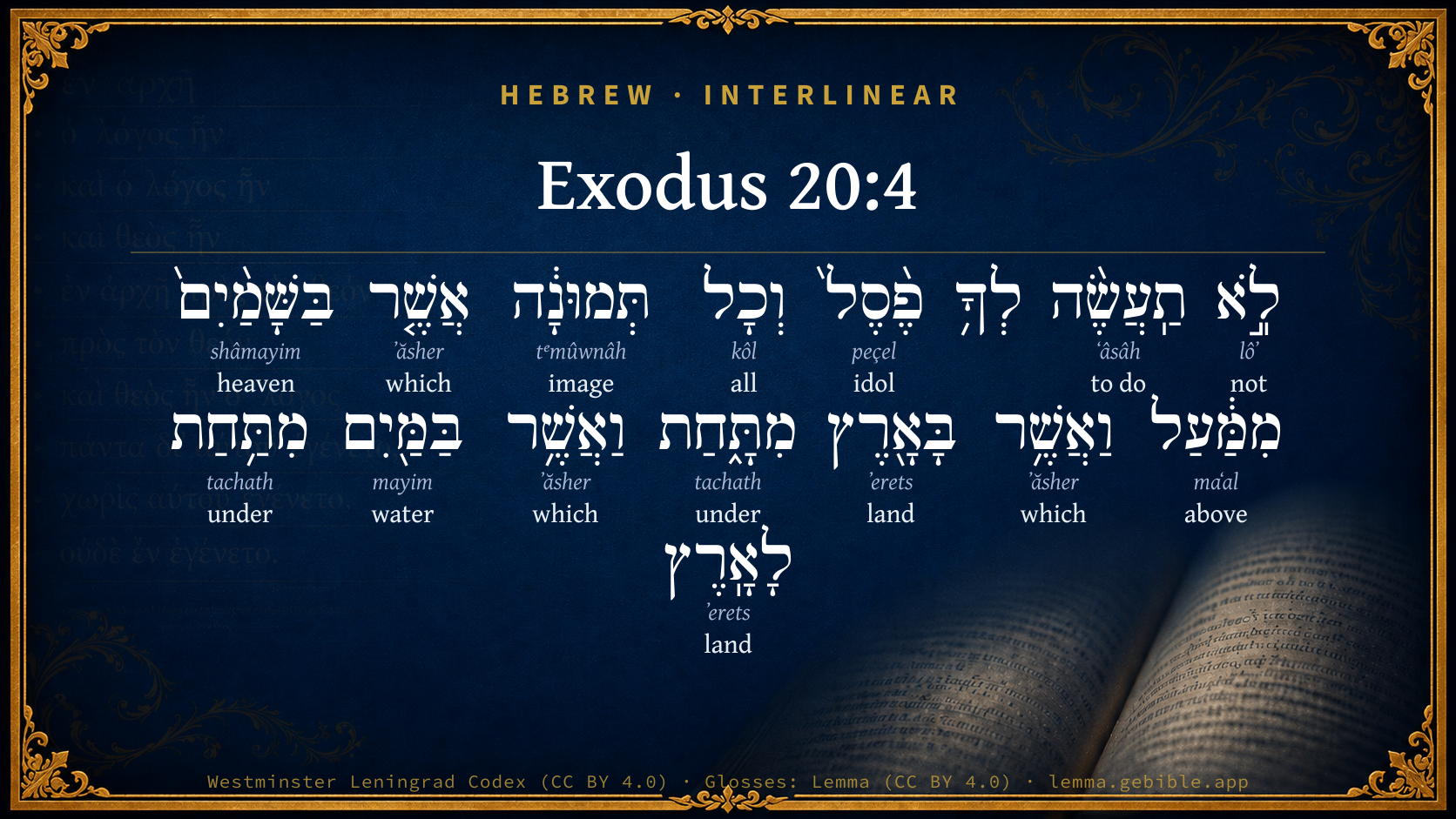
Exodus 20:4

Hebrew (Westminster Leningrad Codex) Exodus 20:4 appears in the Hebrew Old Testament. The text above is from the Westminster Leningrad Codex. Each word links to its Strong’s number, a concise gloss, and parsing drawn from the Open Scriptures Hebrew Bible morphology. Click any word for its full Brown-Driver-Briggs (BDB) entry.
Download image
Cite this verse

Exodus 20:4 (World English Bible). Public Domain. Lemma interlinear Bible study tool, https://lemma.gebible.app/v/exodus/20/4.

Show BibTeX & RIS
BibTeX
RIS
English Translation
"You shall not make for yourselves an idol, nor any image of anything that is in the heavens above, or that is in the earth beneath, or that is in the water under the earth:
World English Bible · Public Domain
Highlights
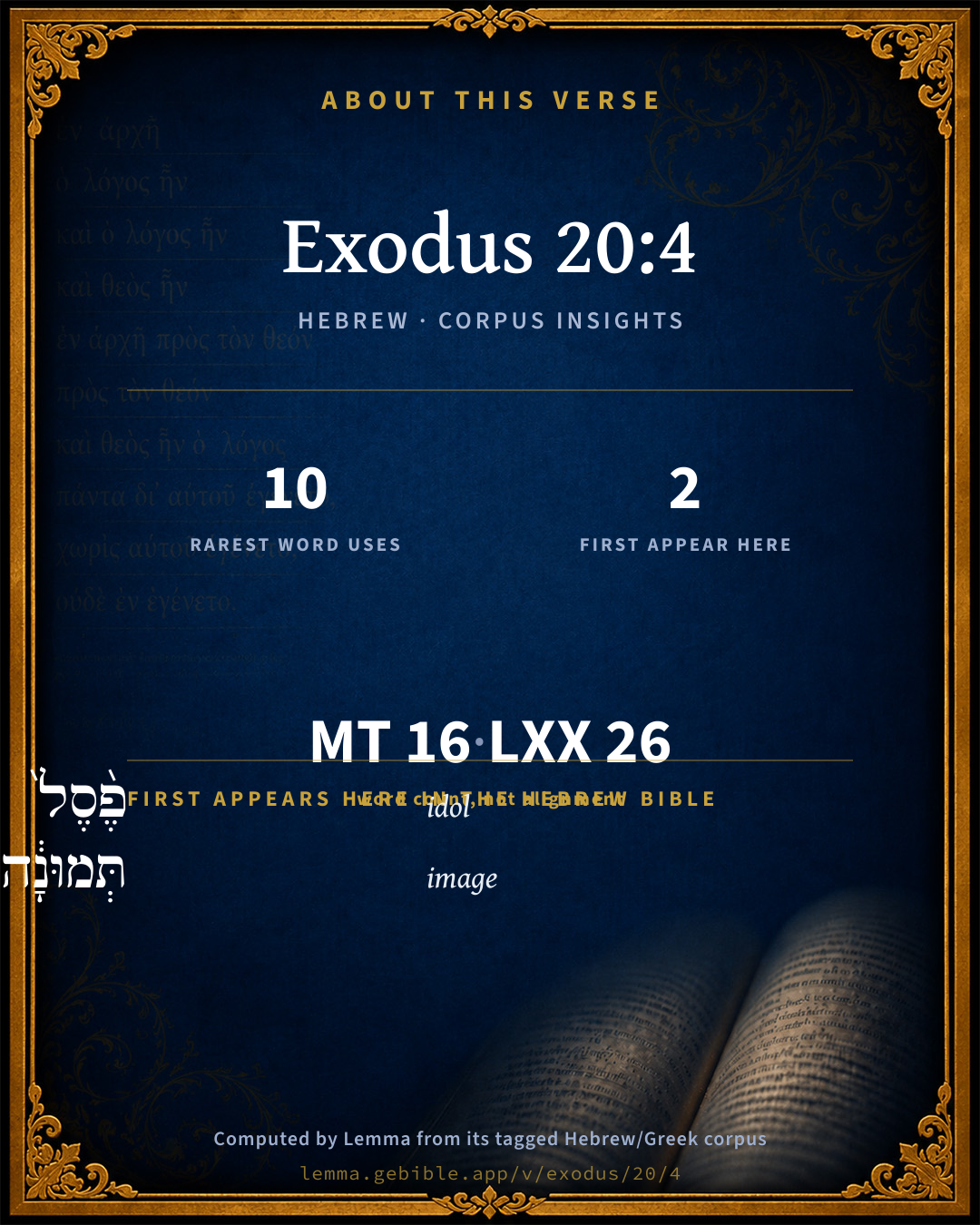
  • 2 first appearances in the Hebrew Bible
Full analysis ↓
Download a study sheet

One document with this verse’s original text, its word-by-word gloss line, the meaning frame, cross-references with their text, attributed commentary, and full source and license credits — printable, and it pastes into notes with its structure intact.

This verse Autodidact and up

Study sheet (.html) Plain text (.txt)

A passage Seminary Student

Up to 50 verses in one chapter. A passage sheet keeps up to 6 commentary sources and 12 cross-references per verse, in the order this page ranks them, and says so on the sheet whenever that leaves anything out. Ask for a single verse and you get the Autodidact verse sheet above.

Everything on this page stays free to read, with no account — the sheet is a download of what is already on screen, not access to it.

Want to remove ads? Support Godless Engineer
Compare translations 3

The same verse in 3 English versions, stacked beneath the original-language interlinear above. Click any original word for its lexicon entry.

Each is an independent rendering of the whole verse — the interlinear is not word-aligned to these translations.

Highlighted words mark where these versions differ — a whole-verse word diff, not a word-by-word alignment.

  • World English Bible Public Domain
    "You shall not make for yourselves an idol, nor any image of anything that is in the heavens above, or that is in the earth beneath, or that is in the water under the earth:
  • King James Version Public Domain
    Thou shalt not make unto thee any graven image, or any likeness of any thing that is in heaven above, or that is in the earth beneath, or that is in the water under the earth.
  • unfoldingWord Literal Text CC BY-SA 4.0
    You shall not make for yourself a carved figure or the likeness of anything that is in heaven above or that is in the earth beneath or that is in the water under the earth.

unfoldingWord Literal Text — © unfoldingWord, licensed CC BY-SA 4.0. Word-aligned USFM3 via Door43 (git.door43.org/unfoldingWord/en_ult).

Versions to compare (up to 4)

3 of 4 selected

Show all 18 translations

Every available English version of this verse, each an independent rendering of the whole verse.

  • World English Bible Public Domain
    "You shall not make for yourselves an idol, nor any image of anything that is in the heavens above, or that is in the earth beneath, or that is in the water under the earth:
  • Berean Standard Bible Public Domain
    You shall not make for yourself an idol in the form of anything in the heavens above, on the earth below, or in the waters beneath.
  • Majority Standard Bible Public Domain
    You shall not make for yourself an idol in the form of anything in the heavens above, on the earth below, or in the waters beneath.
  • King James Version Public Domain
    Thou shalt not make unto thee any graven image, or any likeness of any thing that is in heaven above, or that is in the earth beneath, or that is in the water under the earth.
  • American Standard Version (1901) Public Domain
    Thou shalt not make unto thee a graven image, nor any likeness `of any thing' that is in heaven above, or that is in the earth beneath, or that is in the water under the earth.
  • Revised Version (1885) Public Domain
    Thou shalt not make unto thee a graven image, nor the likeness of any form that is in heaven above, or that is in the earth beneath, or that is in the water under the earth:
  • Geneva Bible (1599) Public Domain
    Thou shalt make thee no grauen image, neither any similitude of things that are in heauen aboue, neither that are in the earth beneath, nor that are in the waters vnder the earth.
  • Douay-Rheims (1899) Public Domain
    Thou shalt not make to thyself a graven thing, nor the likeness of any thing that is in heaven above, or in the earth beneath, nor of those things that are in the waters under the earth.
  • Young's Literal Translation Public Domain
    `Thou dost not make to thyself a graven image, or any likeness which `is' in the heavens above, or which `is' in the earth beneath, or which `is' in the waters under the earth.
  • Literal Standard Version CC BY-SA 4.0
    You do not make a carved image for yourself, or any likeness which [is] in the heavens above, or which [is] in the earth beneath, or which [is] in the waters under the earth.
  • Unlocked Literal Bible CC BY-SA 4.0
    You must not make for yourself a carved figure nor the likeness of anything that is in heaven above, or that is in the earth beneath, or that is in the water below.
  • unfoldingWord Literal Text CC BY-SA 4.0
    You shall not make for yourself a carved figure or the likeness of anything that is in heaven above or that is in the earth beneath or that is in the water under the earth.
  • Darby Bible Public Domain
    Thou shalt not make thyself any graven image, or any form of what is in the heavens above, or what is in the earth beneath, or what is in the waters under the earth:
  • World Messianic Bible Public Domain
    “You shall not make for yourselves an idol, nor any image of anything that is in the heavens above, or that is in the earth beneath, or that is in the water under the earth:
  • Webster's Bible Public Domain
    Thou shalt not make to thee any graven image, or any likeness of any thing that is in heaven above, or that is in the earth beneath, or that is in the water under the earth:
  • Free Bible Version CC BY-SA 4.0
    You must not make for yourself any kind of idol, whether in the form of anything in the heavens above, or on the earth beneath, or in the waters below.
  • Bible in Basic English Public Domain
    You are not to make an image or picture of anything in heaven or on the earth or in the waters under the earth:
  • JPS Tanakh (1917) Public Domain
    Thou shalt not make unto thee a graven image, nor any manner of likeness, of any thing that is in heaven above, or that is in the earth beneath, or that is in the water under the earth;

Literal Standard Version (2020), Covenant Press — licensed CC BY-SA 4.0. Text via the HelloAO Bible API (eBible.org). Unlocked Literal Bible (unfoldingWord) — licensed CC BY-SA 4.0. Text via the HelloAO Bible API (eBible.org). unfoldingWord Literal Text — © unfoldingWord, licensed CC BY-SA 4.0. Word-aligned USFM3 via Door43 (git.door43.org/unfoldingWord/en_ult). Free Bible Version, Dr. Jonathan Gallagher — licensed CC BY-SA 4.0. Text via the HelloAO Bible API (eBible.org).

Word by word

More ways to search: Search by grammar → Find every occurrence → Compare this word →

Practice this passage: Drill this verse → Learn its vocabulary →

תְּמוּנָ֔ה
tᵉmûwnâh
H8544
“image”
Noun, Common, Feminine, Singular, Absolute
Part of Speech
Noun
Type
Common
Gender
Feminine
Number
Singular
State
Absolute
Full BDB Definition

Origin: from H4327

TWOT: 1191b

form, image, likeness, representation, semblance
  1. לֹֽ֣א lôʼ H3808 “not” Particle, Negative
  2. תַֽעֲשֶׂ֨ה ʻâsâh H6213 “to do” Verb, Qal, Imperfect, 2nd Person, Masculine, Singular
  3. פֶ֨סֶל֙ peçel H6459 “idol” Noun, Common, Masculine, Singular, Absolute
  4. וְכָל kôl H3605 “and · all of” Conjunction + Noun, Common, Masculine, Singular, Construct
  5. אֲשֶׁ֤ר ʼăsher H834 “which” Particle, Relative
  6. בַּשָּׁמַ֨יִם֙ shâmayim H8064 “in/at the · heaven(s)” Preposition, Determined + Noun, Common, Masculine, Plural, Absolute
  7. מִמַּ֔עַל maʻal H4605 “from · above” Preposition + Adverb
  8. וַאֲשֶׁ֥ר ʼăsher H834 “and · which” Conjunction + Particle, Relative
  9. בָּאָ֖רֶץ ʼerets H776 “in/at the · land” Preposition, Determined + Noun, Common, Both, Singular, Absolute
  10. מִתָּ֑חַת tachath H8478 “from · under” Preposition + Adverb
  11. וַאֲשֶׁ֥ר ʼăsher H834 “and · which” Conjunction + Particle, Relative
  12. בַּמַּ֖יִם mayim H4325 “in/at the · water(s)” Preposition, Determined + Noun, Common, Masculine, Plural, Absolute
  13. מִתַּ֥חַת tachath H8478 “from · under” Preposition + Preposition
  14. לָאָֽרֶץ ʼerets H776 “to/for the · land” Preposition, Determined + Noun, Common, Both, Singular, Absolute

About this verse

These counts appear in no published source. They are computed here, from the morphology-tagged text and Lemma’s own curated glosses. What Lemma adds →

16
words
11
distinct lemmas
Pentateuch
section

Notable vocabulary

The rarest word here is תְּמוּנָ֔ה image H8544 — appearing just 10 times in the whole Hebrew Bible.

First appearance in Scripture

These words make their first canonical appearance in the Hebrew Bible here:

  • פֶ֨סֶל֙ idol H6459
  • תְּמוּנָ֔ה image H8544

Shared distinctive vocabulary

תְּמוּנָ֔ה image H8544 occurs in 10 verses of the Hebrew Bible. Also found in:

Grammatical profile

  • 1 verb
  • 7 nouns
  • 2 prepositions
  • 2 adverbs
  • 4 particles

Verb forms

  • תַֽעֲשֶׂ֨ה Qal · Imperfect

Repetition

Words recur within this verse — often emphatic in Hebrew:

  • בָּאָ֖רֶץ land H776 ×2
  • מִתָּ֑חַת under H8478 ×2
  • אֲשֶׁ֤ר which H834 ×3

Hebrew & Septuagint length

In English translation the verse runs 35 words from the Hebrew and 35 from the Septuagint (LXX English) — the same length.

A rough comparison of the two English renderings, which tokenize alike — not a word-level alignment.

Word counts can differ between the Hebrew and the Greek without any difference in meaning — e.g. the Hebrew direct-object marker אֵת has no separate Greek word, and Greek often adds the article ὁ.

In the original languages it is 16 Hebrew tokens and 26 Greek tokens — but the two are counted differently (Hebrew bundles its prefixes and suffixes into one token; the Greek is in lemma form), so that isn’t a like-for-like length.

Cross-references

32

Topical passages linked to Exodus 20:4 in the Treasury of Scripture Knowledge — connected by theme and wording, ordered by reader-vote popularity; previews shown in the World English Bible.

  • Deuteronomy 5:8 "You shall not make an engraved image for yourself, [nor] any likeness [of anything] that is in heaven above, or that is in the earth beneath, or that is in the water under the earth:
  • Leviticus 26:1 "'You shall make for yourselves no idols, neither shall you raise up an engraved image or a pillar, neither shall you place any figured stone in your land, to bow down to it: for I am Yahweh your God.
  • Deuteronomy 4:15–19 Take therefore good heed to yourselves; for you saw no manner of form on the day that Yahweh spoke to you in Horeb out of the midst of the fire.
  • Psalms 97:7 Let all them be shamed who serve engraved images, Who boast in their idols. Worship him, all you gods!
  • Leviticus 19:4 "'Don't turn to idols, nor make molten gods for yourselves. I am Yahweh your God.
  • Deuteronomy 27:15 Cursed be the man who makes an engraved or molten image, an abomination to Yahweh, the work of the hands of the craftsman, and sets it up in secret. All the people shall answer and say, Amen.
  • Acts 17:29 Being then the offspring of God, we ought not to think that the Divine Nature is like gold, or silver, or stone, engraved by art and design of man.
  • Revelation 16:2 The first went, and poured out his bowl into the earth, and it became a harmful and evil sore on the people who had the mark of the beast, and who worshiped his image.
  • Psalms 115:4–8 Their idols are silver and gold, The work of men's hands.
  • Jeremiah 10:14–16 Every man is become brutish [and is] without knowledge; every goldsmith is disappointed by his engraved image; for his molten image is falsehood, and there is no breath in them.
  • Psalms 135:15–18 The idols of the nations are silver and gold, The work of men's hands.
  • Isaiah 42:8 I am Yahweh, that is my name; and my glory will I not give to another, neither my praise to engraved images.
  • Isaiah 45:16 They shall be disappointed, yes, confounded, all of them; they shall go into confusion together who are makers of idols.
  • Jeremiah 10:8–9 But they are together brutish and foolish: the instruction of idols! it is but a stock.
  • Romans 1:23 and traded the glory of the incorruptible God for the likeness of an image of corruptible man, and of birds, and four-footed animals, and creeping things.
  • Ezekiel 8:10 So I went in and saw; and see, every form of creeping things, and abominable animals, and all the idols of the house of Israel, portrayed on the wall round about.
  • Deuteronomy 4:23–25 Take heed to yourselves, lest you forget the covenant of Yahweh your God, which he made with you, and make you an engraved image in the form of anything which Yahweh your God has forbidden you.
  • Jeremiah 10:3–5 For the customs of the peoples are vanity; for one cuts a tree out of the forest, the work of the hands of the workman with the axe.
  • Acts 19:26–35 You see and hear, that not at Ephesus alone, but almost throughout all Asia, this Paul has persuaded and turned away many people, saying that they are no gods, that are made with hands.
  • Isaiah 44:9–20 Those who fashion an engraved image are all of them vanity; and the things that they delight in shall not profit; and their own witnesses don't see, nor know: that they may be disappointed.
  • Isaiah 46:5–8 To whom will you liken me, and make me equal, and compare me, that we may be like?
  • Revelation 9:20 The rest of mankind, who were not killed with these plagues, didn't repent of the works of their hands, that they wouldn't worship demons, and the idols of gold, and of silver, and of brass, and of stone, and of wood; which can neither see, nor hear, nor walk.
  • Revelation 14:9–11 Another angel, a third, followed them, saying with a great voice, "If anyone worships the beast and his image, and receives a mark on his forehead, or on his hand,
  • Exodus 32:1 When the people saw that Moses delayed to come down from the mountain, the people gathered themselves together to Aaron, and said to him, "Come, make us gods, which shall go before us; for as for this Moses, the man who brought us up out of the land of Egypt, we don't know what has become of him."
  • Exodus 34:17 You shall make no cast idols for yourselves.
  • 1 Kings 12:28 Whereupon the king took counsel, and made two calves of gold; and he said to them, It is too much for you to go up to Jerusalem: see your gods, Israel, which brought you up out of the land of Egypt.
  • 2 Chronicles 33:7 He set the engraved image of the idol, which he had made, in the house of God, of which God said to David and to Solomon his son, In this house, and in Jerusalem, which I have chosen out of all the tribes of Israel, will I put my name forever:
  • Isaiah 40:18–20 To whom then will you liken God? or what likeness will you compare to him?
  • Isaiah 42:17 They shall be turned back, they shall be utterly disappointed, who trust in engraved images, who tell molten images, You are our gods.
  • Revelation 13:14–15 He deceives my own people who dwell on the earth because of the signs he was granted to do in front of the beast; saying to those who dwell on the earth, that they should make an image to the beast who had the sword wound and lived.
  • Exodus 32:8 They have turned aside quickly out of the way which I commanded them. They have made themselves a molten calf, and have worshiped it, and have sacrificed to it, and said, 'These are your gods, Israel, which brought you up out of the land of Egypt.'"
  • Exodus 32:23 For they said to me, 'Make us gods, which shall go before us; for as for this Moses, the man who brought us up out of the land of Egypt, we don't know what has become of him.'

Cross-references courtesy of OpenBible.info (CC BY 4.0).

Hebrew and Greek witnesses Masoretic Hebrew ↔ Greek Septuagint

The same verse in the two great witnesses to the Old Testament, shown verse-for-verse.

These are two independent witnesses, not word-aligned to each other, and the Septuagint is shown in lemma (dictionary) form.

Hebrew Exodus 20:4 Masoretic · Westminster Leningrad Codex

לֹֽ֣א תַֽעֲשֶׂ֨ה לְךָ֥ פֶ֨סֶל֙ וְכָל תְּמוּנָ֔ה אֲשֶׁ֤ר בַּשָּׁמַ֨יִם֙ מִמַּ֔עַל וַאֲשֶׁ֥ר בָּאָ֖רֶץ מִתָּ֑חַת וַאֲשֶׁ֥ר בַּמַּ֖יִם מִתַּ֥חַת לָאָֽרֶץ

"You shall not make for yourselves an idol, nor any image of anything that is in the heavens above, or that is in the earth beneath, or that is in the water under the earth:

World English Bible · Public Domain

Greek LXX Exodus 20:4 Septuagint · lemma form

οὐ ποιέω σεαυτοῦ εἴδωλον οὐδέ πᾶς ὁμοίωμα ὅσος ἐν ὁ οὐρανός ἄνω καί ὅσος ἐν ὁ γῆ κάτω καί ὅσος ἐν ὁ ὕδωρ ὑποκάτω ὁ γῆ

You shall not make to yourself an idol, nor likeness of anything, whatever things are in the heaven above, and whatever are in the earth beneath, and whatever are in the waters under the earth.

LXX2012 (modern English Septuagint) · Public Domain

On this verse, Adam Clarke's Commentary discusses the Septuagint’s reading. Read the note in Commentary ↓

Hebrew: Westminster Leningrad Codex (CC BY 4.0). Greek: Septuagint (public domain); English from LXX2012 (modern English Septuagint) (Public Domain). How the Septuagint differs from the Hebrew →

Targum (Aramaic paraphrase)

2

The Targum is the ancient Jewish Aramaic paraphrase of the Hebrew Scriptures — an interpretive translation, not the Hebrew text itself. Onkelos (literal) and Pseudo-Jonathan (expansive) render the Torah, and Jonathan the Prophets. Coverage is partial: where no permissively-licensed English translation exists for a verse, only the Aramaic is shown. This is verse-level text, not a word-by-word alignment to the Hebrew.

  1. Targum Onkelos Torah (Genesis–Deuteronomy)
    לָא תַעְבֵּד לָךְ צֶלֶם וְכָל דְמוּת דִי בִשְׁמַיָא מִלְעֵלָא וְדִי בְאַרְעָא מִלְרָע וְדִי בְמַיָא מִלְרַע לְאַרְעָא:

    (no public-domain English translation for this verse)

    Targum Onkelos — Aramaic: “Onkelos Genesis” (public domain); “Onkelos Exodus” (public domain); “Onkelos Leviticus” (public domain); “Onkelos Numbers” (public domain); “Onkelos Deuteronomy” (public domain). English: “Sefaria Community Translation” (CC0 1.0 (public-domain dedication)); “J.W. Etheridge. The Targums of Onkelos and Jonathan Ben Uzziel on the Pentateuch. London: Longmans, Green, 1862” (public domain). Text via Sefaria.

  2. Targum Pseudo-Jonathan Torah (Genesis–Deuteronomy)
    לָא תַעַבְדוּן לְכוֹן צְלַם וְצוּרָא וְכָל דְּמוֹי דְּבִשְׁמַיָא מִלְּעֵיל וְדִי בְאַרְעָא מִלְּרַע וְדִי בְמַיָא מִלְּרַע לְאַרְעָא

    You shall not make to yourselves image or figure, or any similitude of what is in the heavens above, or on the earth beneath, or in the waters under the earth.

    Targum Pseudo-Jonathan — Aramaic: “Targum Jonathan on Genesis” (public domain); “Targum Jonathan on Exodus” (public domain); “Targum Jonathan on Leviticus” (public domain); “Targum Jonathan on Numbers” (public domain); “Targum Jonathan on Deuteronomy” (public domain). English: “The Targum of Jonathan ben Uzziel, trans. J. W. Etheridge, London, 1862” (public domain). Text via Sefaria.

Commentary

Notes on Exodus 20:4 from classic Christian and Jewish commentators (each source and its license shown beneath its notes). The classic Christian expositions comment on the surrounding passage and are grouped to its opening verse, so a note may address several verses; the Jewish commentaries on the Tanakh (Rashi and others) are per-verse, so they appear only where the commentator wrote on this verse.

Lemma curates 59 commentaries, every one of them public domain or Creative Commons licensed, each selected and text-cleaned for this edition rather than reprinted as found. About our sources →

Trapp's Complete Commentary

John Trapp

Exo 20:4 Thou shalt not make unto thee any graven image, or any likeness [of any thing] that [is] in heaven above, or that [is] in the earth beneath, or that [is] in the water under the earth:

Ver. 4. Thou shalt not make unto thee,] i.e., For religious use; for civil they may be made. {Mat 22:20} Howbeit the Turks will not endure any image, no not upon their coins, because of this second commandment. The Papists by their sacrilegious practices, have taken away this commandment out of their vulgar catechism. This is a great stumbling block to the Jews, and a let to their conversion: for ever since their return from Babylon, they do infinitely abhor idolatry. And for their coming to Christian sermons, they say, that as long as they shall see the preacher direct his speech and prayer to that little wooden crucifix that stands on the pulpit by him, to call it his Lord and Saviour to kneel to it, to embrace it, to kiss it, to weep upon it, as is the fashion of Italy, this is preaching sufficient for them, and persuades them more with the very sight of it, to hate Christian religion, than any reason that the world can allege to love it. {a} {See Trapp (for summary of Law) on "Exo 20:17"}

{a} Specul. Europ.

John Trapp, A Commentary or Exposition upon All the Books of the Old and New Testament (1647–1656) — public domain. Text from a community e-Sword module.

The Biblical Illustrator

Joseph S. Exell

Exo_20:4-6

Thou shalt not bow down thyself to them, nor serve them.

The law of worship

I. A revelation of the will of God.

1. What is forbidden is not the culture of the plastic arts, but their abuse in furnishing symbols for purposes of devotion. Statuary is lawful, and painting is lawful; but sculptor and artist are alike restricted from attempting to represent the Deity; and all men are prohibited from taking such representations as objects of worship.

2. There was a special reason for this prohibition as it affected the Hebrews. They had come away from Egypt--a country where the employment of beasts and images in religious symbolism had descended to the very nadir of human degradation. They were on their way to Canaan, a land given to them because its inhabitants had outraged all forbearance by the filthy and bloody rites of Baal and Astarte. Above all, the chief reason of their own election as the chosen nation was that they might become faithful witnesses of Jehovah.

3. The bearing of this law upon Christian duty is manifest. Material images are forbidden, but mental images may be framed, provided always that they be fashioned out of the Divine manifestations. Every historic act, in which God is seen by the individual or the community, is a revelation of God; and the sum of such revelations gives a mental image of the Divine Being which we can and may adore. Furthermore, the focus of all Gods self-revelation is the Lord Jesus Christ.

II. A revelation of the character of God.

1. God is jealous for the truth of His own nature. How could any graven image ever be an accurate or an adequate similitude of the infinite invisible Spirit?

2. God is jealous for the character of His people. By the act of homage men acknowledge themselves inferior to that which they adore; so that every degradation of the Object of worship involves a simultaneous abasement of the worshipper.

3. God is jealous for the influence of His people upon the world. Israel was appointed to be a guardian of truth, an apostle of the one God, a harbour-light for benighted nations upon the sea of time. It was peculiarly wounding to the King of Heaven that they should insult Him by representing Him as a calf of gold, and should degrade themselves by their debasing homage.

III. A revelation of the providence of God.

1. Hereditary penalties follow the breach of this law of spiritual worship. Sensuous worship leads to sensuous living; and the fruits of sensuous living may linger on in miseries untold which our children shall suffer when we who did the wrong lie forgotten in the grave.

2. On the other hand, hereditary blessings follow the keeping of this law. True spiritual life begets true spiritual life, and hands on a heritage of reward to succeeding generations.

3. And it is the fittest which survives the longest! Evil is for a time; good is for eternity. (W. J. Woods, B. A.)

The Second Commandment

I. The Divine prohibition.

1. Observe precisely what this second commandment forbids.

(1) And, first, negatively: It does not forbid all use of art in worship. For Jehovah Himself commanded Moses to adorn the tabernacle with figures of cherubim, and trees, and flowers, and pomegranates, and bells, and all manner of cunning workmanship. The imaging faculty, or faculty of making images--imagination in the primary sense of the term--is itself a Divine endowment, and must therefore be cultivated.

(2) What, then, does the second commandment forbid? It forbids all idolatrous representations of Deity (see Joh_4:24). We must worship God according to His nature; His nature is spiritual, and, therefore, we must worship Him spiritually--spirit-wise, not image-wise; for only what is spiritual in us can worship what is spiritual above us.

2. The prohibition, then, of the second commandment is a universal need.

(1) The Jew at the foot of Mount Sinai needed it. He had just emerged from idolatrous Egypt--that Egypt which was wholly given over to image-worship.

(2) Modern Christianity needs it. We need not go to the Roman Catholic Church for examples of image-worship. Behold our own Protestant Ecclesiolatry, or worship of the Church as an institution, bowing down before her ordinances as though they were ends instead of using them as means, worshipping her sacraments and creeds and traditions and ceremonies. Behold our Protestant Bibliolatry, or rabbinic worship of the Bible as a letter and even sacrament, These, and such as these, are, practically speaking, more or less revered as symbols of Deity.

II. The Divine reason for the prohibition.

1. Jehovah our God is a jealous God.

2. Law of heredity (see Gal_6:7).

(1) The merciless aspect of heredity. Everybody knows that there are hereditary diseases; for instance, leprosy, scrofula, consumption, insanity, and a nameless disease far more dreadful. And as there are hereditary diseases, so there are hereditary vices; for example, indolence, mendacity, avarice, intemperance, crime. Moral habit is as hereditable as bodily gait. As Dr. Oliver Wendell Holmes has somewhere stated: A man is an omnibus, in which all his ancestors are seated. Yes; the soul, not less than the body, has its physiology. This law it is which accounts for the sad fact of the universal sinfulness. But you interrupt me with an objection. This law of heredity, you tell me, tends to quench personal responsibility. Learn, then, I answer, a lesson from the analogy of the human body: although confessedly propagated, it is also confessedly a separate, independent individuality. Again: it is of the utmost importance in this discussion to keep clearly and steadily in mind the distinction between personal guilt and inherited disaster, or, as the philosophers phrase it, unfortunate environment. But I hear another objection: This law of heredity, you tell me, is unjust and cruel; it makes the innocent suffer for the guilty. How, then, will you reconcile the awful working of this law of heredity with the character of a holy and loving God? Answer: Man is mortal. How, then, shall the continuance of the race on earth be secured? I can conceive of but two ways. First, by the continuous creation of men, or a perpetual repetition of the miracle of Eden, the ceaseless bringing into the world, fresh from the Makers hand, of a succession of created Adams, or parentless Melchizedeks. But under such a condition of things there would be, in all probability, a repetition of Adams painful story. Secondly, the continuance of the race on earth can be secured in the way in which the Creator does actually secure it--namely, by the law of propagation. Heredity it is which renders this profound fact--Society--possible. There is such a thing as man-kind, because there is such a thing as men-kinned. It is almost impossible to overestimate the value of consanguinity as a curbing, uplifting, unifying force. Heredity! Why it is my real hope under God for humanity.

(2) Merciful aspect of heredity. This law is a real inspiration for foreign missions. Special pains must be taken to save the heathen children; for converted children are, according to Gods own law, the mighty hope of our worlds future. Lessons:

1. Heredity the key to social regeneration. Men, not less than animals, can be improved by stirpiculture, or selective breeding.

2. A summons to personal heroism. God judges us, not by our capacities, but by our efforts.

3. Worship the Divine Man Himself. He is the Image of the Invisible God, and we need no other. (G. D. Boardman.)

Idolatry

I. The nature of idolatry. A giving to something below God of that worship which is due to God alone. It may be outward, or inward; an act of the body, or an act of the mind.

II. The evil of idolatry.

1. It has a strange power to perpetuate and increase itself.

2. It ever engenders falsehood and deceit.

3. It is almost always accompanied with cruelty.

The dark places of the earth, says Scripture, are full of the habitations of cruelty, and all experience confirms the saying. Think of Mexico, as she was when first discovered, and of her fearful hecatombs of slaughtered men. Think of our country, and of other countries around it, in Druidical times. Follow Captain Cook in his voyages from island to island in the great Pacific. Wherever we find idols we find bloodshed, bloodshed for those idols. As for idolatrous Rome, I will not speak of her wholesale slaughters in years gone by.

4. There is one point more which I wished to notice, it is the licentiousness that accompanies idolatry, arising, beyond doubt, in part out of it. English minds cannot conceive the extent of this, nor the nature of it.

III. There is another thing, far more fearful than the idolatry of Rome, and far more difficult to keep ourselves from--the idolatry of the mind and heart. We may have idols within us, and, as for worshipping them, it may be the main business of our lives. (C. Bradley. M. A.)

Image-worship

To set up an image to represent God is a debasing of the Deity, it is below God. If one should make images of snakes or spiders, saying he did it to represent his prince, would not the prince take this in high disdain? What greater disparagement to God, than to represent the infinite God by that which is finite,--the living God, by that which is without life, and the Maker of all, by a thing which is made?

1. To make a true image of God is impossible. What is invisible cannot be portrayed.

2. To worship God by an image is both absurd and unlawful.

(1) It is absurd and irrational; for, the workman is better than the work: he who hath builded the house hath more honour than the house. If the workman be better than the work, and none bow to the workman, how absurd then is it to bow to the work of his hands! Is it not an absurd thing to bow down to the kings picture, when the king himself is present? more so to bow down to an image of God, when God Himself is everywhere present.

(2) It is unlawful to worship God by an image; for it is against the homily of the Church; the images of God, our Saviour, the Virgin Mary, are of all others the most dangerous; therefore the greatest care ought to be had that they stand not in temples and churches.

Use: Take heed of idolatry, namely, image-worship.

(1) Get good principles, that you may be able to oppose the gainsayer.

(2) Get love to God.

(3) Pray God to keep you. (T. Watson.)

The Second Commandment, and its influence upon the Jews

Some go so far as to say that it forbad the Jew to make any carved work at all. Certainly, judging by national results, it would almost seem as if Israel had so understood it. The Jews are a people famous for many things, for intellectual and administrative ability, and for a marvellous power of sustaining themselves in the midst of the most difficult circumstances. But whilst there have been Jewish warriors and poets, statesmen and financiers, musicians and singers of world-wide reputation, where are their artists and architects? The very temple of Solomon was a Phoenician structure. You may count easily a half-dozen distinguished musical Jewish composers--Mozart, Beethoven, Meyerbeer, Mendelssohn, and Rossini--but where is the distinguished Jewish sculptor or painter? Still, whilst all this is very suggestive as to the formative influence of the commandment, it seems most reasonable to decide that the sentence, Thou shalt not make, is qualified by the sentence, Thou shalt not bow down nor worship. The Jews were really only forbidden to make carved images as symbols of Deity, as objects of adoration. (W. Senior, B. A.)

The offence of symbolism

It becomes obvious that an imaged representation of the Invisible One must involve dishonour. Before the Infinite One can be bodied forth He must first of necessity be sensualized. Here is the deep insult. And the guilt of irreverance clings to the human mind in the very fact that it thinks itself capable of such an impossibility, and fails to perceive how it befouls what it touches. What difference then is there between the image of the artist and an intellectual conception of God? None in reality. What is the image? It is more than the carving of the sculptor; it is first his thought. The image is really thought embodied. Words may be used instead of marble, or wood, or colours, but essentially they are the same if they present to the imagination a shape, a form, or an intellectual conception. In this sense words are as finite as images or symbols, and therefore may be as guilty of degradation. Thus it follows that the reason of man has no more right to touch the Invisible Creator than the hands. God refuses also to be the subject of the human intellect. That the human mind should think itself capable of compassing the Infinite is to insult Him with deepest irreverence. Who by searching can find out God? God Himself must instruct us how to conceive of Him, and by what faculties of our nature we must draw near to Him. And this He has done. Through Abraham and through Moses, through David and the prophets, and, including all and perfecting all, through Jesus Christ the Divine Son, He has made Himself known to man. (W. Senior, B. A.)

A Jealous God.

I. Reverently, let us remember that the Lord is exceedingly jealous of His Deity. The whole history of the human race is a record of the wars of the Lord against idolatry. The right hand of the Lord hath dashed in pieces the enemy and cast the ancient idols to the ground. Behold the heaps of Nineveh! Search for the desolations of Babylon! Look upon the broken temples of Greece! See the ruins of Pagan Rome! Journey where you will, you behold the dilapidated temples of the gods and the ruined empires of their foolish votaries. The Lord hath made bare His arm and eased Him of His adversaries, for Jehovah, whose name is Jealous, is a jealous God. With what jealousy must the Lord regard the great mass of the people of this country, who have another god beside Himself! Even believers may be reproved on this subject. God is very jealous of His Deity in the hearts of His own people.

II. The Lord is jealous of His sovereignty. He that made heaven and earth has a right to rule His creatures as He wills.

1. This reminds us of the Lords hatred of sin. Every time we sin, we do as much as say, I do not acknowledge God to be my Sovereign; I will do as I please.

2. Surely if sin attacks the sovereignty of God, self-righteousness is equally guilty of treason: for as sin boasts, I will not keep Gods law, self-righteousness exclaims, I will not be saved in Gods way; I will make a new road to heaven.

III. The Lord is jealous of His glory. Gods glory is the result of His nature and acts.

1. How, careful, then, should we be when we do anything for God, and God is pleased to accept of our doings, that we never congratulate ourselves. The worms which ate Herod when he gave not God the glory are ready for another meal; beware of vain glory!

2. How careful ought we to be to walk humbly before the Lord. The moment we glorify ourselves, since there is room for one glory only in the universe, we set ourselves up as rivals to the Most High.

3. Let us see to it that we never misrepresent God, so as to rob Him of His honour. If any minister shall preach of God so as to dishonour Him, God will be jealous against that man.

IV. In the highest sense, the Lord is jealous over His own people.

1. The Lord Jesus Christ, of whom I now speak, is very jealous of your love, O believer.

2. He is very jealous of your trust. He will not permit you to trust in an arm of flesh.

3. He is also very jealous of our company. It were well if a Christian could see nothing but Christ. (C. H. Spurgeon.)

The jealousy of God

Jealousy is but the anger and pain of injured and insulted love. When God resents the illegitimate transfer to material symbols of the devotion inspired by His own acts, it is not because His greatness suffers any diminution or because His authority is impaired. It is His love which is wounded. He cannot endure to lose any of the affection, trust, or reverence by which He has stirred our souls. One of the fairest-looking falsehoods by which men excuse themselves for living a life in which God has no place, is the plea that the infinite God cannot care for the love and reverence of such creatures as we are. When will men understand that no father can ever be great enough to be indifferent to the affection, the obedience, and the confidence of his children? (R. W. Dale, D. D.)

Visiting the iniquity of the fathers upon the children.--

Visiting the sins of the fathers on the children

I. That the denunciation and sentence relate to the sin of idolatry in particular, if not to that alone.

II. That it relates to temporal, or, more properly speaking, to family prosperity and adversity.

III. That it relates to the Jewish economy, in that particular administration of a visible providence under which they lived.

IV. That at no rate does it affect (or was ever meant to affect) the acceptance or salvation of individuals in a future life. (Archdeacon Paley.)

The children bearing the fathers iniquities

I. As to the matter of fact--that God does visit on the children the iniquities of the fathers--the evidence is so broad and conclusive that, without a singular carelessness it cannot be overlooked. The sin of one man brought death into the world, and caused that, throughout the vast spreadings of humanity, wretchedness, both physical and moral, shall hold a kind of undisputed supremacy.

II. Whether such a visitation consists with the principles of justice and equity. In most mens minds, when this question is proposed, there is a feeling that the visitation is not thus consistent: we think it a righteous procedure that every man should bear his own burden; but we see no equity in the appointment that the innocent should suffer for the fault of the guilty. It is, however, worthy of observation, that the proceeding after all cannot be repugnant to our notions of justice, since its exact parallel occurs in human legislation. If the statute-book of the country enact the visiting on children the sin of the father, it will be hard to show that the visitation is counter to common sense and equity. In cases of treason, we all know that it is not the traitor alone who is punished: his estates are confiscated, his honours destroyed; so that, in place of transmitting rank and affluence to his son, he transmits him nothing but shame and beggary. We do not say that the thing must be just because enacted by human laws; we only say that there can be no felt and acknowledged contradiction between the proceeding and the principles of equity, since human laws involve the children in the doom of the parent. If you can show the child to be innocent, and therefore to deserve nothing of what it receives, you will have made good your point that the visitation is unjust; but to maintain the thorough innocence of the child would be to maintain the purity of human nature. Still, you will say, the child is confessedly worse off than it would have been had the parent not sinned; and though we may deserve all we endure for ourselves, we still practically suffer for the misdoings of another. We admit this; but at the same time we contend that you are shifting the argument. If the child endured no more than it has deserved you admit that the course of justice is unimpeached--and this is the main thing we are anxious to establish: but, if after conceding the strict justice of the measure, you profess to think it hard that the child should endure what, but for the parents offence, it would not have deserved, we are ready to follow you into the new field of debate, and to show you, as we think, the erroneousness of your opinion. The child, for example, is of a diseased constitution, of a dishonoured name, of a broken fortune; these constitute the visitation of whose hardship you complain; but who can prove to us that the child is really injured by the visitation? Nay, who can prove to us that the child is not really advantaged? If we were told that, because the parent died in unrighteousness, the child also must be shipwrecked for eternity, the wrought injury would be tremendous and overwhelming: but there is not the least ground for supposing that the threatened visitation extends to the next world; on the contrary, the whole tenor of Scripture--inasmuch as salvation is offered to all--requires us to believe, that the consequences to the children of the fathers transgressions lie confined within our present sphere of being. Why then is it certain that the child is dealt with injuriously, if sentenced for the parents iniquity to penury and affliction? Are penury and affliction never overruled for good? Is it necessarily an evil to have been born poor in place of rich--to be of weak health instead of strong--to struggle with adversity, in place of being lapped in prosperity? No man who feels himself immortal, who is conscious that this confined theatre of existence is but the school in which he is trained for a wider and nobler still, will contend for the necessary injuriousness of want and calamity: and yet unless this necessary injuriousness is supposed, it cannot be proved that the children who are visited for the fathers iniquity are on the whole worse off than they would have been had there been no visitation. Thus the argument against the goodness of the Almighty as much falls to the ground as that against His justice; for proceeding on the principle that physical evil is never subservient to moral good, we overthrow our position by assuming what we know to be false. (H. Melvill, B. D.)

Inherited character

An old man died a few years ago in the Massachusetts State Prison. He was seventy-six years old, and had spent the last eight years of his life in a cell in that gloomy gaol. His wife for years had been a prisoner there too, and so had his daughter, and seven of his sons. Were not the iniquities of the father visited upon the children? In that same State, seventy years ago, a good minister died, who for forty-one years had been a beloved pastor over the same church. He was the fourteenth eldest son of that same name and family who had been a preacher of the gospel. Since his death, one hundred of his descendants have been Christians, and eight of his sons and grandsons have also been ministers. Through that blessed family, for many long years, the Great Father of love has been showing mercy to thousands in them that love Him and keep His commandments.

Showing mercy unto thousands.--

The place of mercy in the government of God

Look carefully at a very important feature of the appeal which is not brought out clearly in our English translation. He visits iniquity unto the third and fourth, and shows mercy unto the thousandth, the commandment reads. Our translators have supplied the word generation in italics to the first numeral, and evidently they were right in doing so, but they should have supplied for the same reasons the same word to the second numeral: He visits iniquity unto the third and fourth generation, He shows mercy unto the thousandth generation. The third and fourth show an indefinite number, the thousandth is also an indefinite number, but it is a much larger number. The principle of the Divine government has a very decided leaning to the side of mercy. Now, perhaps you will say: I see that this feature of the Divine government works with absolute impartiality, with strict justice, but I can see no indication of its leaning to the side of mercy. Then look again, and more closely, at the race and the individual.

1. Look at the individual first. A child inherits an impaired constitution. Two features of the Divine government respond at once. First, the restorative forces within the child, the recuperative powers of mans nature; and second, the restorative forces without, the whole realm of remedies and skill awakened in others in their application. The child of ignorant parents is ignorant. Two features here also are on the side of mercy. The innate thirst of the mind for knowledge, present though weak in the child; and the intelligence of the community in which the child lives, the atmosphere of enlightenment which he must breathe while he lives. The child of irreligious parents is irreligious. Here, too, there are two principles on the side of mercy. However corrupt he may be, there is something in the soul of the child at unrest for God which may be touched into power; and the surrounding Christianity--the Christ who has loved and died to save--lives in many believing hearts through whom He seeks to save the child.

2. Now, concerning the race, it may be said that the limit of degradation seems to be fixed, but the limit of progress cannot be even imagined. How far man will advance in the control and use of the powers of nature, we who witness to-day the stupendous achievements of Christian civilization will not even dare to conjecture. And how far man will be lifted up, in the knowledge and fellowship of God, the Bible tells us that we cannot even imagine. In the whole race, also, the two principles we have seen working in individuals on the side of mercy exist. However corrupted in idolatry men may become, however great the ascendancy of the flesh over the spirit in man, the spirit still exists, and in its very nature cannot be satisfied until it finds and lays hold upon the living God. There is something within men that cannot be satisfied with idolatry, or with sensual corruption, something that may be touched into strong and glorious life. And there is something to touch it. God makes the appeal of His infinite love in Jesus Christ, who has at infinite cost taken away sin and brought in new life to all who receive Him. And we who receive Him, as He lives in us, will touch all the dark souls we can reach with His light and life. We have received from our fathers the elevation and happiness of our Christian land. Let us cherish and transmit to our children the glorious inheritance, and let us send the light into the whole earth. Let us, receiving forgiveness and new life in our Saviour, bring our whole being into a shape worthy of God in moral likeness. (F. S. Schenck.)

Gods mercies

I. What are the qualifications?

1. The spring of mercy which God shows is free and spontaneous. Say not then, I am unworthy; for mercy is free. If God should show mercy only to such as deserve it, He must show mercy to none at all.

2. The mercy God shows is powerful. How powerful is that mercy which softens a heart of stone! Of what sovereign power and efficacy is that mercy which subdues the pride and enmity of the heart, and beats off those chains of sin in which the soul is held!

3. The mercy which God shows is superabundant; abundant in goodness, keeping mercy for thousands. The vial of Gods wrath doth but drop; but the fountain of His mercy runs.

4. The mercy God shows is abiding (Psa_103:17).

II. How many ways is God said to show mercy?

1. We are all living monuments of Gods mercy. He shows mercy to us in daily supplying us.

2. God shows mercy in lengthening out our gospel liberties.

3. God shows mercy in preventing many evils from invading us.

4. God shows mercy in delivering us.

5. God shows mercy in restraining us from sin; lusts within, are worse than lions without.

6. God shows mercy in guiding and directing us.

7. God shows mercy in correcting us. God is angry in love; He smites that He may save. Every cross to a child of God is like Pauls cross wind, which though it broke the ship, it brought Paul to shore upon the broken pieces.

8. God shows mercy in pardoning us; who is a God like Thee, That pardonest iniquity? It is mercy to feed us, rich mercy to pardon us.

9. God shows His mercy in sanctifying us (Lev_20:8). This prepares for happiness, as the seed prepares for harvest.

10. God shows mercy in hearing our prayers. God may sometimes delay an answer, when He will not deny. You do not presently throw a musician money, because you love to hear his music: God loves the music of prayer, therefore doth not presently let us hear from Him, but in due season He will give an answer of peace.

11. God shows mercy in saving us: according to His mercy He saved us. This is the top-stone of mercy, and it is laid in heaven. Now mercy displays itself in all its orient colours; now mercy is mercy indeed, when God shall perfectly refine us from all the lees and dregs of corruption. As an argument against despair: see what a great encouragement here is to serve God,--He shows mercy to thousands.

(1) Hope in Gods mercies, the Lord takes pleasure in them that fear Him, and hope in His mercy.

(2) If God shows mercy to thousands, labour to know that His mercy is for you, He is the God of my mercy. A man that was ready to drown saw a rainbow; said he, What am I the better, though God will not drown the world, if I drown? so, what are we the better God is merciful, if we perish? Let us labour to know Gods special mercy is for us. (T. Watson.)

Them that love Me

I. How must our love to God be qualified?

1. Love to God must be pure and genuine; He must be loved chiefly for Himself. We must love God, not only for His benefits, but for those intrinsic excellencies wherewith He is crowned; we must love God not only for the good which flows from Him, but the good which is in Him.

2. Love to God must be with all the heart, thou shalt love the Lord thy God with all thy heart. We must not love God a little,--give God a drop or two of our love,--but the main stream of our love must run after Him; the mind must think of God, the will choose Him, the affections pant after Him.

3. Love to God must be flaming; to love coldly is all one as not to love.

II. How may we know whether we love God?

1. He that loves God desires His sweet presence; lovers cannot be long asunder, they have their fainting fits, they want a sight of the object of their love. A soul deeply in love with God desires the enjoyment of Him in His ordinances, in word, prayer, sacraments.

2. He who loves God doth not love sin; ye that love the Lord hate evil. The love of God and the love of sin can no more mix together than iron and clay; every sin loved strikes at the being of God, but he who loves God hath an antipathy against sin.

3. He who loves God is not much in love with anything else; his love is very cool to worldly things; his love to God moves as the sun in the firmament, swiftly; his love to the world moves as the sun on the dial, very slow.

4. He who loves God cannot live without Him.

5. He who loves God will be at any pains to get Him. Doth he love his friend that will not make a journey to see him?

6. He that loves God prefers Him before estate and life. Before estate: For whom I have suffered the loss of all things. Who that loves a rich jewel would not part with a flower for it? Before life: They loved not their lives to the death. Love to God carries the soul above the love of life and the fear of death.

7. He who loves God loves His favourites, namely, the saints (1Jn_5:1).

8. If we love God, as we cannot but be fearful of dishonouring Him (the more a child loves his father, the more he is afraid to displease him), so we weep and mourn when we have offended Him.

III. What are the incentives to provoke and inflame our love to God?

1. Gods benefits bestowed on us. Great is the love that is excited by love. Kindness works on a brute; the ox knows his owner.

2. Love to God would make duties of religion facile and pleasant.

3. It is advantageous (1Co_2:9).

4. By our loving God we may know that He loves us (1Jn_4:19). If the ice melts, it is because the sun has shined upon it; if the frozen heart melts in love, it is because the Sun of Righteousness hath shined upon it.

IV. What means may be used to excite our love to God?

1. Labour to know God aright.

2. Make the Scriptures familiar to you.

3. Meditate much of God, and this will be a means to love Him; while I was musing, the fire burned. Meditation is the bellows of the affections. Who can meditate on Gods love? who can tread on these hot coals, and his heart not burn in love to God? (T. Watson.)

And keep My commandments

Love and obedience, like two sisters, must go hand in hand. A good Christian is like the sun, which doth not only send forth light, but goes its circuit round the world: so he hath not only the light of knowledge, but goes his circuit too, and moves in the sphere of obedience. In what manner must we keep Gods commandments?

1. Our keeping the commandments must be fiducial. Our obedience to Gods commandments must spring from faith; therefore it is called the obedience of faith.

2. Our keeping the commandments must be uniform. We must make conscience of one commandment as well as another; then shall I not be ashamed, when I have respect to all Thy commandments. Physicians have a rule, when the body sweats in one part, but is cold in another, it is a sign of a distemper: so when men seem zealous in some duties of religion, but are cold and frozen in others, it is a sign of hypocrisy. We must have respect to all Gods commandments.

3. Our keeping Gods commandments must be willing; if ye be willing and obedient. A musician is not commended for playing long, but for playing well; it is obeying God willingly is accepted; the Lord hates that which is forced, it is rather paying a tax than an offering. If a willing mind be wanting, there wants that flower which should perfume our obedience, and make it a sweet smelling savour to God. That we may keep Gods commandments willingly, let these things be well weighed. Our willingness is more esteemed than our service; therefore David counsels Solomon not only to serve God, but with a willing mind. The will makes sin to be worse, and makes duty to be better. To obey willingly shows we do it with love; and this crowns all our services. There is that in the Lawgiver, which may make us willing to obey the commandments, namely, Gods indulgence to us.

There is that in Gods commandments which may make us willing; they are not burdensome.

1. For a Christian, so far as he is regenerate, consents to Gods commands--I consent to the law that it is good.

2. Gods commandments are sweetened with joy and peace. Cicero questions whether that can properly be called a burden which one carries with delight and pleasure. If a man carries a bag of money given him, it is heavy, but the delight takes off the burden; when God gives inward joy, that makes the commandments delightful.

3. Gods commandments are advantageous.

(1) Preventive of evil. Had He not set them as a hedge or bar in our way, we might have run to hell, and never stopped.

(2) Nothing in them but what is for our good. Not so much our duty as our privilege.

4. Gods commandments are ornamental. It is an honour to be employed in a kings service.

5. The commands of God are infinitely better than the commands of sin, these are intolerable. Many have gone with more pains to hell than others have to heaven. This may make us obey the commandments willingly.

6. Willingness in obedience makes us resemble the angels. Use: It reproves them who live in a wilful breach of Gods commandments,--in malice, uncleanness, intemperance,--they walk antipodes to the commandment.

To live in a wilful breach of the commandment is--

1. Against reason.

2. Against equity.

3. Against nature.

4. Against kindness. (T. Watson.)

Keeping the commandments

I. One condition, then, of obtaining Gods mercy is obedience. But what am I to obey? But I desire to ask whether, at heart, some of you do not:know sufficiently the answer that should be given? Can you say that you know no difference between right and wrong? Is the liar and the man of truth the same to you? May we go together, then, thus far, that we admit the difference between right and wrong? A second step will, I think, be then admitted--to right and wrong we must add the words ought and ought not. In other words, the distinction between right and wrong brings with it the words ought, ought not, responsibility, duty. Here it may be well further remind you that in this word duty lies hid an inexplicable treasure of infinite value--I mean our freedom. In the I ought is practically included the I can. But let me ask you, yet again, whence comes this power to distinguish right from wrong? Here we may differ in words, but in the existence of the power itself many will agree. We may call it moral feeling, moral sense, Divine reason, or use the word to which we have been accustomed--conscience. But, once more, why do we give to this mysterious power so much importance? Why, if this moral feeling, this conscience, is part of ourselves, why not deal with it as we please, and listen or not as it may serve our turn? The real answer, I believe (though all may not be able to give it), is because conscience does not speak as for herself, but as for another. She brings us to a bar of another, whom we fear and may resist, but One higher than ourselves, even God. Here is surely a point worthy of your most careful consideration. II, The text offers mercy for thousands, mercy for all, but on two conditions--obedience and love. Obedience of a kind we may practise to the moral law; but love requires personality. We must, by Gods help, rise above the contemplation of the law to the Person of the Lawgiver, and love the law for His sake--Lord, what love have I unto Thy law!--and then love Him because He is what He is.

1. The first test I would suggest to you is this--what use do you make of your Bible? The step from obedience to love, we said, implied the step from an impersonal law to the personal Lawgiver, and this, the belief in one Personal God, we said, required for its fulness the aid of Divine revelation. Here, then, is one test--our Bible. Let me say it as plainly as I can: if you neglect the study, the habitual devotional study, of the one Book that above all others makes known to you the one Personal God, you will be in danger of living a mere moral life--fulfilling, in a sense, the condition of obedience, but falling short of the higher condition of love, and a narrow, selfish, unloving, uninfluential humanity will be the result.

2. Let me offer you another test which each can easily make for himself. What is your relation to prayer? Prayer is the test of belief in a Personal God. The man who never prays, never rises above himself, may be moral, may be obedient to the moral law, but he has lost one proof of his belief in a Personal Lawgiver, to whom the law was intended to lead him; has lost one proof that he has a Personal Guide through the perils of his life; has lost one proof that he is preserving the condition of love. If we can pray, we have faith in a Personal God; we may deplore our coldness from time to time, we may even pray from a sense of duty many times, but we have not lost the great condition of love, and we know by experience how our hearts may become again as the rivers in the south--dry water-beds for a season, but in due time flowing like a flood.

3. Let me give you but one more test, by which you may know whether you are fulfilling this condition of love, the great condition on which Gods plentiful mercy may be obtained. It is the test of the love of our neighbour. (Bp. E. King.)

The Biblical Illustrator, edited by Joseph S. Exell (c. 1880s–1900s) — public domain. Text from a community e-Sword module.

Whedon's Commentary on the Bible

Daniel D. Whedon

THE SECOND COMMANDMENT, Exo_20:4-6.

4. Graven image — That this commandment was not designed to prohibit the productions of sculpture and painting is apparent from the fact that Moses was expressly ordered to construct cherubim for the most holy place of the tabernacle, and to make the brazen serpent in the wilderness. Only idolatrous images, representations of God and designed for worship, are contemplated. The golden calf, Exo_32:1-4, is an illustration of the kind of graven images intended. Such images were graven or carved out of metal, wood, or stone. Comp. Jdg_17:3; 2Ki_21:7. The word translated likeness (תמונה) is commonly used of attempted representations of God, or of the real form of God as seen or conceived by man. Comp. Num_12:8; Deu_4:12; Deu_4:15-16; Psa_17:15. Accordingly a likeness of something in heaven above would be a portraiture of a god under the form of a star, or sun, or moon, or fowl; that of what is in the earth beneath would be the formation of a god in the similitude of a man or a woman, of a beast or any creeping thing that moves on land: that of things in the water under the earth would be, like the Philistine fish-god Dagon, the image of something that lives and moves in the water. All these are enumerated in Deu_4:15-19, which passage is an inspired commentary on this second commandment. The words under the earth show us the Hebrew conception of the water as lying lower than the land. When the land was elevated above the waters the latter fell back into the lower level of the seas. Gen_1:9-10. We should here observe that the use of images in worship is not always idolatry. Hence this second commandment is not to be confounded with the first, for it was assumed in the worship of the golden calf that the true God, who brought Israel out of Egypt, was honoured by means of the image. It has been persistently claimed by many religious leaders that the use of images in worship may be very helpful; they serve to concentrate the mind, and so prevent distraction of thought in one’s devotions. They deepen impressions, and so intensify and enliven the forms of worship. But all history shows that such employment of images in worship begets superstition, and turns the thought of the average worshipper more upon the creature than the Creator. The narrative of chapter 32 sets forth the unquestionable fact that the image-worship there described brought down the penal wrath of God upon the people. Such a method of promoting religious devotions is therefore fraught with great danger, and a perfect law required this prohibition of the use of graven images in worship.

Daniel D. Whedon (gen. ed.), Commentary on the Old and New Testaments (1874–1909) — public domain. Text from a community e-Sword module.

The Preacher's Complete Homiletical Commentary

Joseph S. Exell (gen. ed.)

MAIN HOMILETICS OF THE PARAGRAPH.—Exo_20:4-6

THE SECOND COMMANDMENT

The Being and Spirituality of God seem to be among the most simple ideas of which the human mind is susceptible; and yet they have been perverted or entirely obliterated by the corruption of our nature. The Being of God is almost universally admitted. But the Spirituality of His essence has never entered into the conceptions of mankind under the dominion of sense. The deities of the heathen were all local—often in the form of deified heroes—it was therefore natural that they were made to assume a shape. Even the Israelites were guilty of this unholy worship.

I. Offer some general observations upon idolatry.

1. In the origin of idolatry we may find a lesson for our guidance with regard to the misuse of things in themselves lawful, and the perversion of ideas in themselves unobjectionable. The probable origin of idolatry was the perversion of simple and sublime sentiments. When mankind, in the infancy of their existence, opened their eyes upon creation, they beheld everything wonderful and splendid in the scene. What could be more calculated to awaken inspiring contemplations? The mind would then soon pass from admiration to reverence and worship. Thus homage was paid to the sun, moon, and stars, which was only due to the Creator. The reverence felt for men of genius gave them an ideal grandeur, and exalted them into the rank of deities. Thus the perversion of good ideas occasioned the growth of bad ones.

2. Nothing can be more painful than to record the extensive prevalence of idolatry. It would have been a melancholy fact had history stated its existence in only one town; how sad when all nations are under its influence. This proves the folly and depravity of man. The whole world has wandered from God.

3. The effects of idolatry. While, on the one hand, the depravity of the human heart has produced idolatrous worship, this has reacted upon man himself, to debase his character. The effects of idolatry are cruelty, the rendering sacred the worst vices, the contaminating the temples and homes of the land, and the corrupting of society.

4. The spirit of the command in the text must be considered as including all mental idolatry. There is a distinction to be made between idolatry and image worship. The former, which is the worship of false gods, is forbidden in the First Commandment; the latter, which is the worship more especially of images or representations of the true God, is interdicted in the Second. But as all out-ward figures or images of God are forbidden, so it must be considered that every substitute for God, as an object of adoration and love, is also forbidden, for God requires the supreme homage of the heart. We must not form an image in the mind of anything lovely which turns aside the mind from God. Covetousness is idolatry. What images of folly and abomination lurk in the secret recesses of the mind!

II. Notice the particular reasons here assigned for its interdiction. These reasons comprehend both the jealousy and mercy of Jehovah; both powerful considerations.

1. The Divine jealousy and its terrific manifestations. The term is frequently applied in the Old Testament to God, and is strikingly descriptive of His determination to maintain His high prerogatives. Jealousy is considered as one of the strongest passions of our nature. It is the feeling which an interference on the part of another with the object of tender affection inspires—a feeling of wounded love. We are not to suppose that God is susceptible of any painful emotion of the mind, in the strict sense of the word; but this passion is employed to illustrate the fact of that concern about His people which God is described as entertaining. The heathen gods had no jealousy; they were not capable of love.

2. Another reason for the interdiction of idol worship is taken from the mercy of God; and it is one, in its nature, most conciliative. The Jewish economy, as well as the Christian, was founded in mercy. Their formation into a distinct and chosen people was the outcome of mercy. Their system of worship was ordained by heaven in mercy. They had providential mercies. What motives are there in the mercies of God to urge us to keep the commandments.—(F. A. Cox, LL.D.)

SUGGESTIVE COMMENTS ON THE VERSES

Exo_20:4-6. There are few feelings stronger than those of the parent for his children, and it argues an extraordinary moral derangement where the father is careless and indifferent to the wellbeing of his offspring. The Supreme Legislator has taken advantage (so to speak) of these sentiments, and arranged them on the side of righteousness. He attacks men through the avenue of the domestic charities, and calls upon them to prove themselves not unnatural parents, by striving to lead a life of holiness and piety. If they care not for themselves, will they not for their children! If they are indifferent to the ruin which sin must procure for their own portion, can they consent to the sending down to those they best love an hereafter of woe and of shame? Yet this is precisely what they have a right to expect if they go on in a career of transgression. “I, the Lord thy God am a jealous God, visiting the iniquity of the fathers upon the children unto the third and fourth generations of them that hate Me.”

We shall assume that the announced visitation of the iniquities of the fathers upon the children is unrestricted and general, so that it constitutes a feature in the fixed economy of the Almighty. We must state, however, that when we speak of the fathers and of the children, we are not to confine our ideas to that single relationship which these terms would ordinarily define. It is clear that the alleged principle is, the dealings of God must be supposed to take a wider range. The principle is, that one set of men shall be made to suffer for the sins of another set of men. We should do evident violence to the spirit, and, we may almost say, to the letter of the precept, were we to suppose that the transmission of iniquity was only then to take place when the parties were associated by the close ties of blood.—H. Melvill, B.D.

Of course the case of the father and the child is one of those cases in which the principle is applicable; but whatever the connexion which binds together two sets of men—whether it be that which subsists between rulers and subjects, or that general one between the present generation and the following, or that between the members of a church and their successors—the same principle is brought into play, so that the punishment of sin may descend on those who have had no part whatever in the commission of that sin.—Ibid.

Now we can add other instances which, if less general, are not less decisive. You remember that when David sinned by numbering the people, the monarch himself was not stricken for the offence. A pestilence was sent, so that there died from Dan even to Beersheba seventy thousand men; and so evident was it, that the king cried out in the bitterness of his soul, “I have sinned, but these sheep, what have they done?” A still stronger instance is to be found in the history of the Gibeonites. Joshua had made a league with the Gibeonites, covenanting that they should not be destroyed with the rest of the inhabitants of Canaan. In contravention of this league, Saul sought to extirpate the Gibeonites, and in his zeal put many of them to death. This sin of Saul was not at once noticed by God; but in the days of David there was a famine, and God, on being enquired of, declared that it was a judgment on account of Saul’s sin in slaying the Gibeonites. And what was the vengeance He then took for that sin? Seven of the sons of Saul were delivered to the Gibeonites, and hung up to the Lord in Gibeah of Saul; and then was God entreated for the land. Who will say that in this instance God visited not on the children the iniquity of the father? In like manner David had fallen into the heinous sins of adultery and murder; on confessing his iniquity he was punished! Hear how the prophet Nathan speaks to the king—“Because by this deed thou hast given great occasion to the enemies of the Lord to blaspheme, the child also that is born unto thee shall surely die.” But our instances are not exhausted. We bid you next look at the Jews, strewed over the globe like the fragments of some mighty shipwreck. What have this people done that, through long centuries the weakest are strong enough to trample on them, the humblest lofty enough to despise them? Why should the countrymen of the Maccabees, those prodigies of valour, have been oppressed by every child, as though their arms were incapable of being strung by bravery? You can give no explanation of the history of the Jews since the destruction of Jerusalem, if you keep out of sight that they are under the ban of God’s displeasure for the iniquity of their forefathers. It is, however, worthy of observation that the proceeding after all cannot be repugnant to our notions of justice, since its exact parallel occurs in human legislation. If the statutebook of the country enact the visiting on children the sin of the father, it will be hard to show that the visitation is counter to common sense and equity. In cases of treason, we all know that it is not the traitor alone who is punished. His estates are confiscated, his honours destroyed; so that, in place of transmitting rank and affluence to his son, he transmits him nothing but shame and beggary. We do not say that the thing must be just because enacted by human laws; we only say that there can be no felt and acknowledged contradiction between the proceeding and the principles of equity, since human laws involve the children in the doom of the parent. He, who would have worn a ducal coronet and succeeded to a noble patrimony had his father kept unsullied his loyalty, loses both title and revenue if his father revolt against his king, though all the while he himself had no share in the treason; and the consequences go on from generation to generation; so that the highborn family is for ever degraded, and penury and ignominy make up the heritage which passes down to a remote posterity, who, except for the rebellion of a single ancestor, would have rolled in wealth and ranked with princes. We are clear that the gist of the question lies in this: Do the children when visited for the iniquities of the fathers lose anything to which they have a right, or receive anything which they have not deserved? It is certain, on all the principles of a sound theology, that sin involved the forfeiture of every blessing and exposure to every misery; it is just as certain, therefore, that no blessing can be obtained, and no misery averted, by right; and we think it, consequently, an inference not to be disputed, that whatever are God’s reasons for making adistinction between families, there cannot be injustice in visiting on children the iniquities of parents. The visitation cannot overpass what is due to the children themselves; and who then can pronounce the visitation unjust? Why, then, it is certain that the child is dealt with injuriously, if sentenced for the parents’ iniquity to penury and affliction. Are penury and affliction never overruled for good? It is necessarily an evil to have been born poor in place of rich; to be of weak health instead of strong; to struggle with adversity, in place of being lapped in prosperity. No man who feels himself immortal, who is conscious that this confined theatre of existence is but the school in which he is trained for a wider and nobler still, will contend for the necessary injuriousness of want and calamity; and yet, unless this necessary injuriousness is suffered, it cannot be proved that the children who are visited for the father’s iniquity are on the whole worse off than they would have been had there been no visitation. Thus the argument against as much falls to the ground as that against his justice; for, proceeding on the principle that physical evil is never subservient to moral good, we overthrow our position by assuming what we know to be false.—H. Melvill.

ILLUSTRATIONS

BY

THE REV. WILLIAM ADAMSON

Idol Inventions! Exo_20:4. The god Moloch was a fearful-looking monster, with a huge red mouth and grinning teeth, to show that he was fond of blood. The goddess Kalee, worshipped by many persons in India, is a fierce-looking female figure, with instruments of death in her hands, and a string of human skulls hanging round her neck as an ornament. Ganesa, another of the gods of the Hindus, is represented with the head of an elephant, and having four arms and hands. He always appears riding on the back of a great rat, having the figure of a serpent wreathed round his head. There are hundreds of uglier and more repulsive idols among the poor heathen in Africa and the South Seas; but it is not their hideousness that condemns them as objects of worship. Lovely idols are as loathsome in God’s sight. How lovely are the sun, moon, and stars, and how greatly the Psalmist appreciated their exceeding beauty! Yet men have made these beautiful creations of God loathsome. How! By making idols of them. The Brazen Serpent was no doubt a very bright and beautiful object; but it became repulsive when turned into an object of worship, and had to be destroyed. To admire a beautiful sculpture—whether stone, marble, brass, or silver—is not wrong; but to adore it, raises the Divine jealousy.

“Thou art a God who beareth

No rival near Thy throne;

Yet many a creature shareth

The love that is Thine own.”

The Preacher's Complete Homiletical Commentary (gen. ed. Joseph S. Exell; Funk & Wagnalls, c. 1892) — public domain (pre-1929). A full-Bible homiletical/sermon-outline anthology covering 65 of 66 books (2 John is absent from the source module). Text from a community e-Sword module.

Tyndale Open Study Notes

Tyndale Open Resources

20:4 Not making an image of God is the first step toward recognizing that he is transcendent—that he is the Creator of the universe and distinct from it. To represent God as something in creation was inevitably to end up worshiping the creation rather than the Creator, and this immorality had deadly consequences (Rom 1:18-25).

Tyndale Open Study Notes — © Tyndale Open Resources, licensed CC BY-SA 4.0. Text via the HelloAO Bible API.

Jamieson, Fausset & Brown

Robert Jamieson, A. R. Fausset & David Brown

Thou shalt not make . . . any graven image . . . thou shalt not bow down thyself to them--that is, "make in order to bow." Under the auspices of Moses himself, figures of cherubim, brazen serpents, oxen, and many other things in the earth beneath, were made and never condemned. The mere making was no sin--it was the making with the intent to give idolatrous worship.

Jamieson, Fausset & Brown — Commentary Critical and Explanatory on the Whole Bible (1871) — public domain (CC PDM 1.0). Text via the HelloAO Bible API.

Adam Clarke's Commentary

THE SECOND COMMANDMENT

Against making and worshipping images.

Verse 4. Thou shalt not make unto thee any graven image] As the word פסל pasal signifies to hew, carve, grave, c., פסל pesel may here signify any kind of image, either of wood, stone, or metal, on which the axe, the chisel, or the graving tool has been employed. This commandment includes in its prohibitions every species of idolatry known to have been practised among the Egyptians. The reader will see this the more plainly by consulting the notes on the ten plagues, particularly those on chap. xii.

Or any likeness, c.] To know the full spirit and extent of this commandment, this place must be collated with De 4:15, &c.: Take ye therefore good heed unto yourselves-lest ye corrupt yourselves - and make you a graven image, the similitude of any figure, the likeness of MALE or FEMALE. All who have even the slightest acquaintance with the ancient history of Egypt, know that Osiris and his wife Isis were supreme divinities among that people.

The likeness of any beast. - בהמה behemah, such as the ox and the heifer. Among the Egyptians the ox was not only sacred but adored, because they supposed that in one of these animals Osiris took up his residence: hence they always had a living ox, which they supposed to be the habitation of this deity and they imagined that on the death of one he entered into the body of another, and so on successively. This famous ox-god they called Apis and Mnevis.

The likeness of any winged fowl. - The ibis, or stork, or crane, and hawk, may be here intended, for all these were objects of Egyptian idolatry.

The likeness of any thing that CREEPETH. The crocodile, serpents, the scarabeus or beetle, were all objects of their adoration and Mr. Bryant has rendered it very probable that even the frog itself was a sacred animal, as from its inflation it was emblematic of the prophetic influence, for they supposed that the god inflated or distended the body of the person by whom he gave oracular answers.

The likeness of any FISH. - All fish were esteemed sacred animals among the Egyptians. One called Oxurunchus had, according to Strabo, lib. xvii., a temple, and divine honours paid to it. Another fish, called Phagrus, was worshipped at Syene, according to Clemens Alexandrinus in his Cohortatio. And the Lepidotus and eel were objects of their adoration, as we find from Herodotus, lib. ii., cap. 72. In short, oxen, heifers, sheep, goats, lions, dogs, monkeys, and cats; the ibis, the crane, and the hawk; the crocodile, serpents, frogs, flies, and the scarabeus or beetle; the Nile and its fish; the sun, moon, planets, and stars; fire, light, air, darkness, and night, were all objects of Egyptian idolatry, and all included in this very circumstantial prohibition as detailed in Deuteronomy, and very forcibly in the general terms of the text: Thou shalt not make unto thee any graven image, or any likeness of any thing that is in the HEAVENS above, or that is in the EARTH beneath, or that is in the WATER under the earth. And the reason of this becomes self-evident, when the various objects of Egyptian idolatry are considered.

To countenance its image worship, the Roman Catholic Church has left the whole of this second commandment out of the decalogue, and thus lost one whole commandment out of the ten; but to keep up the number they have divided the tenth into two. This is totally contrary to the faith of God's elect and to the acknowledgment of that truth which is according to godliness. The verse is found in every MS. of the Hebrew Pentateuch that has ever yet been discovered. It is in all the ancient versions, Samaritan, Chaldee, Syriac, Septuagint, Vulgate, Coptic, and Arabic; also in the Persian, and in all modern versions. There is not one word of the whole verse wanting in the many hundreds of MSS. collected by Kennicott and De Rossi. This corruption of the word of God by the Roman Catholic Church stamps it, as a false and heretical Church, with the deepest brand of ever-during infamy!

This commandment also prohibits every species of external idolatry, as the first does all idolatry that may be called internal or mental. All false worship may be considered of this kind, together with all image worship, and all other superstitious rites and ceremonies. See Clarke on Ex 20:23.

Adam Clarke's Commentary on the Bible (1810–1826) — public domain. Text from a community e-Sword/MySword module.

Ellicott's Commentary for English Readers

(4) Thou shalt not make unto thee any graven image.—The two main clauses of the second commandment are to be read together, so as to form one sentence: “Thou shalt not make to thee any graven image, &c., so as to worship it.” (See the explanation of Josephus, Ant. Jud., iii. 5, § 5: ‘Ο δεύτερος λóγος κελεύει μηδένος εἰκόνα ζώον ποιήσαντας προσκυνεῖν.) It was not until the days of Hebrew decline and degeneracy that a narrow literalism pressed the words into an absolute prohibition of the arts of painting and sculpture (Philo, De Oraculis, § 29). Moses himself sanctioned the cherubic forms above the mercy-seat, the brazen serpent, and the lilies and pomegranates of the golden candlestick. Solomon had lions on the steps of his throne, oxen under his “molten sea,” and palm-trees, flowers, and cherubim on the walls of the Temple, “within and without” (1Ki_6:29). What the second commandment forbade was the worship of God under a material form. It asserted the spirituality of Jehovah. While in the rest of the ancient world there was scarcely a single nation or tribe which did not “make to itself” images of the gods, and regard the images themselves with superstitious veneration, in Judaism alone was this seductive practice disallowed. God would have no likeness made of Him, no representation that might cloud the conception of His entire separation from matter, His purely spiritual essence.

In heaven above . . . in the earth beneath . . . in the water under the earth.—Comp. Gen_1:1-7. The triple division is regarded as embracing the whole material universe. In the Egyptian idolatry images of all three kinds were included.

A Bible Commentary for English Readers, edited by Charles John Ellicott (1878–1897) — public domain. Text from a community e-Sword module.

The Cambridge Bible for Schools and Colleges

gen. ed. J. J. S. Perowne

4. a graven image] an image of carved wood (sometimes enclosed in a metal casing, Isa_30:22) or stone, such as were common in antiquity, and are so, of course, still among heathen nations. Cf. Deu_4:16 f.

the likeness of any form, &c.] By an inexactness of language, the Heb. identifies the ‘form’ made with the ‘form’ (in heaven, &c.) upon which it is modelled: RV. eases the sentence by inserting ‘the likeness of.’

in heaven above] as birds (Deu_4:17).

heaven above … the earth beneath] The same combination (with reference to Jehovah being God in both), Deu_4:39, Jos_2:11, 1Ki_8:23 (both Deuteronomic).

the water under the earth] cf. Deu_4:18. The waters meant are the huge abyss of subterranean waters, on which the Hebrews imagined the flat surface of the earth to rest (Gen_49:25, Psa_24:2; Psa_136:6), and which they supposed to be the hidden source of seas and springs (see further the writer’s note on Gen_1:9-10). Fish, at least in certain places, or of certain kinds, were regarded as sacred, and forbidden to be eaten, in Egypt, Syria and elsewhere; and Xen. (Anab. i. 4. 9) says that the fish in the Chalus, near Aleppo, were looked upon as gods. See Rel. Sem.2[175] pp. 174–6, 292 f.; EB. ii. 1530 f.

[175] W. R. Smith, The Religion of the Semites, ed. 2, 1894.

4–6. The second commandment, against image-worship. The prohibition is general; and includes both images of Jehovah,—who, as a spiritual Being, cannot be represented by any material likeness (see the development of this thought in Deu_4:15-19),—and also those of other gods, or of deified creatures, or objects of nature. Images were widely used by worshippers of Jehovah till the times of the prophets: on the bearing of this upon the date of the Decalogue, see p. 415 f.

The Cambridge Bible for Schools and Colleges (gen. ed. J. J. S. Perowne; Cambridge University Press, 1878–1918) — public domain. Text from a community e-Sword module.

John Gill's Exposition

Thou shalt not make unto thee any graven image,.... An image of anything graven by art or man's device, cut out of wood of stone, and so anything that was molten, or cast into a mould or form, engraved by men, and this in order to be worshipped; for otherwise images of things might be made for other uses and purposes, as the cherubim over the mercy seat, and the brazen serpent, and images and impressions on coin, which we do not find the Jews themselves scrupled to make use of in Christ's time on that account; though they vehemently opposed the setting up any images of the Caesars or emperors in their temple, because they seemed to be placed there as deities, and had a show of religious worship: however, any image of God was not to be made at all, since no similitude was ever seen of him, or any likeness could be conceived; and it must be a gross piece of ignorance, madness, and impudence, to pretend to make one, and great impiety to make it in order to be the object of religious worship; on which account, not any image or the image of anything whatever was to be made:

or any likeness of anything that is in heaven above; any form, figure, portrait, or picture of anything or creature whatever, whether in the supreme, starry, or airy heaven; as of angels, which some have gone into the worship of; and of the sun, moon, and stars, the host of heaven; and of any of the birds of the air, as the hawk by the Egyptians, and the dove by the Assyrians:

or that is in the earth beneath; as oxen, sheep, goats, cats, dogs, &c. such as were the gods of Egypt:

or that is in the water under the earth: as of fishes, such as were the crocodile of Egypt, the Dagon of the Philistines, and the Derceto of the Syrians: this is the second command, as the Targum of Jonathan expressly calls it; that is, the first part of it, which forbids the making of graven images for worship; the other part follows, which is the worship of them itself: Clemens of Alexandria (d) observes, that Numa, king of the Romans, took this from Moses, and forbid the Romans to make any image of God, like to man or beast.

(d) Stromat. l. 1. p. 304.

John Gill's Exposition of the Whole Bible (1746–1763) — public domain (CC PDM 1.0). Text via the HelloAO Bible API.

Haydock's Catholic Bible Commentary

A graven thing, nor the likeness of any thing, &c. All such images or likenesses, are forbidden by this commandment, as are made to be adored and served; according to that which immediately follows, thou shalt not adore them, nor serve them. That is, all such as are designed for idols or image gods, or are worshipped with divine honour. But otherwise images, pictures, or representations, even in the house of God, and in the very sanctuary, so far from being forbidden are expressly authorized by the word of God. See Exodus xxv. 15, &c.; chap. xxxviii. 7; Numbers xxi. 8, 9; 1 Chronicles xxviii. 18, 19; 2 Chronicles iii. 10. (Challoner) --- Protestants insidiously translate "any graven image," though pesel, eidolon, glupton, and sculptile, in the Hebrew, Greek, and Latin, denote a graven thing or idol. They will, however, hardly condemn his majesty for having his representation stamped upon the coin of the nation, nor so many of our wealthy noblemen, who adorn their rooms with the choicest efforts of painting and of sculpture. They know that the object of prohibition is the making and adoring of idols. But they probably wish to keep the ignorant under the stupid delusion of supposing, that Catholics are idolaters, because they have images, and that they themselves are not, though they have them likewise at home; and even in their churches admit the absurd figures of the lion and the unicorn, stretching their paws over the tables of the law, instead of the pious representations of Jesus expiring on the cross, &c., which were set up by their Catholic ancestors. Let them read, and adopt herein just weights and measures, proposed to them by Thorndike, one of their most discerning and moderate teachers. In the mean time, we will assure them, that we abhor all idols; both those made with hands, and those which are formed by the head of heretics, who set up their own fancies and delusions, to be adored instead of the true God. Our general councils of Nice and of Trent define what we ought to believe on this head; and the matter is so fully explained in our catechisms and books of instruction, as well as from our pulpits, that no person can well remain in ignorance. If we perform various actions of respect before pictures, which are also done in honour of God, can any man of sense infer, that we look upon both with equal respect? Do we not read of the people falling down to shew respect to the king, and supreme worship to God, by the same act of the body? (Haydock) --- Altars and sacrifice we reserve solely for God, as St. Augustine (contra Faust. xx. 21) well observes. Other indifferent practices must be determined by the intention. --- Latria, or supreme worship, can be given to none but the Deity. But we shew our respect and veneration for his servants in glory, by an inferior service called Dulia, giving honour to whom honour is due. How profane and impious must the words of the first reformers appear, who, after saying most falsely, that "papists make the Virgin Mary a god, (Luther. postil.) and worship images in heathenish manner," (Melanct. Loc. com.) attribute various fictitious crimes to the blessed Virgin and other saints! (Centuriators of Magdeburg; Calvin, &c.) They knew that all the saints abhorred their impiety; and therefore, in revenge, they vilify the saints, and condemn all the doctors and fathers of the Church, since the death of the apostles, as guilty of superstition and idolatry. (Haydock) --- "By this occasion, dead creatures, and bloodless half worm-eaten bones, began to be honoured, invocated, and worshipped with divine honour. All which the doctors of the Church not only winked at, but also set forward." (Centuriators of Magdeburg, Chap. vi.) What is then become of the promises of God, to teach all the truth by the mouths of his pastors? (Matthew xxviii, &c.) Let others judge, whether we ought to pay greater deference to Saints Jerome, Augustine, Gregory, &c., or to Luther, Calvin, and the Centuriators of Magdeburg. But some will even admit that images were commanded by God, chap. xxv. 18, &c. Hence they lay great stress upon the words to thyself; as if all images were forbidden that man should make, without the express sanction of God. So Parkhurst Lexic. But those who are conversant in Hebrew, know that these words have no such import; and if things were inseparable from idolatry, they could not be sanctioned by God. (Haydock) --- No creature must be represented as a deity. But sovereign worship, both internal and external, must be given to the great Author of all good, while we abstain from every superstitious act, and from all dealings with the devil and false religions. (Calmet) --- Protestants, therefore, who only forbid images, diminish God’s law. Were not the idols of Chanaan, Chamos, &c., which represented nothing in nature, also condemned?

George Leo Haydock (1774–1849), Haydock's Catholic Family Bible and Commentary, 1859 edition — public domain. Excludes Psalms (Douay-Rheims chapter numbering differs from Protestant) and Deuterocanonical books (Catholic canon only).

Matthew Poole's English Annotations

Thou shalt not make, either in thy mind, or with thy hand, Act 17:29, or by thy command.

Unto thee, i.e. for thy use, or for thee to worship; for otherwise they were not absolutely forbidden to make any images, but only to make them for worship, as may appear by comparing this place with Lev 19:4; Deu 4:15 and Amo 5:26, with Act 7:43; and from Lev 26:1, where the setting up of a pillar, or stone, is as absolutely forbidden as the making of an image. And therefore as the former is not forbidden to be done simply and universally, as appears from Jos 24:20; 1Sa 7:12, but only to be done in order to worship, so also is the latter. Moreover there were cherubims and other images in the temple, and afterwards the brazen serpent, which because they were not made to be worshipped, neither were indeed, nor were ever esteemed to be, any contradictions to this law.

Any graven image, or molten, or any other image, as is most evident from the nature and reason of the precept. Nor is any thing more common than such synecdochical expressions, wherein under one kind named all other things of the like nature are contained. But for more abundant caution, and to put all out of doubt, he adds a more general word, nor any likeness.

Anything that is in heaven; as of God, Deu 4:15; Isa 44:9,20, angels, sun, moon, or stars, which the heathens worshipped, Deu 4:19; 17:3. Or in the earth; as of men, and beasts, and creeping things, which the Egyptians and other Gentiles worshipped as gods. See Deu 4:16,17; Isa 44:13; Eze 23:14.

Or in the water; as of fishes, such as Dagon was; or serpents, crocodiles, and such other Egyptian deities.

Under the earth: this is emphatically added, to note the singular care of Divine Providence in bringing the waters under the earth, which naturally are lighter and higher than it, and therefore might easily overwhelm it. Compare Psa 104:6.

Matthew Poole's English Annotations on the Holy Bible (1683–1685) — public domain. Text from a community e-Sword/MySword module.

The Pulpit Commentary

As the first commandment asserts the unity of God, and is a protest against polytheism, so the second asserts his spirituality, and is a protest against idolatry and materialism. Verses 4 and 5 are to be taken together, the prohibition being intended, not to forbid the arts of sculpture and painting, or even to condemn the religious use of them, but to disallow the worship of God under material forms. When the later Jews condemned all representations of natural objects (Philo, De Orac. 29; Joseph. Ant. Jud: 8:7, they not only enslaved themselves to a literalism, which is alien from the spirit of both covenants, but departed from the practice of more primitive times representations of such objects having had their place both in the tabernacle (Exo_25:31-34 Exo_28:33, Exo_28:34) and in the first temple. (1Ki_6:18, 1Ki_6:29, 1Ki_6:32, etc.) Indeed, Moses himself, when he erected the "brazen serpent" (Num_21:9) made it clear that representations of natural objects were not disallowed by the law. To moderns in civilized countries it seems almost incredible that there should ever have been anywhere a real worship of images. But acquaintance with ancient history or even with the present condition of man in savage or backward countries, renders it apparent that there is a subtle fascination in such material forms, and that imperfectly developed minds will rest in them not as mere emblems of divinity, but as actually possessed of Divine powers The protest raised by the second commandment is still as necessary as ever, not only in the world, but in the very Christian Church itself, where there exists even at the present day a superstitious regard for images and pictures, which is not only irrational, but which absorbs the religious feelings that should have been directed to higher objects. Any graven image. Perhaps it would be better to translate "any image," for the term used (pesel) is applied, not only to "graven" but also to "molten images" (Isa_40:19 Isa_44:10; Jer_10:14; etc.) since these last were in almost every instance finished by the graving tool. Or any likeness of anything that is in heaven abovei.e. , "any likeness of any winged fowl that flieth in the air." Compare Deu_4:17. The water under the earth. See Gen_1:6, Gen_1:7. The triple division here and elsewhere made, is intended to embrace the whole material universe. Much of the Egyptian religion consisted in the worship of animals and their images.

The Pulpit Commentary (1880–1919), ed. H.D.M. Spence-Jones & Joseph S. Exell — public domain. Text from a community e-Sword module.

Keil & Delitzsch

C. F. Keil & F. Delitzsch

The Second Word. - To the prohibition of idolatrous worship there is linked on, as a second word, the prohibition of the worship of images. "After declaring in the first commandment who was the true God, He commanded that He alone should be worshipped; and now He defines what is His lawful worship" (Calvin). "Thou shalt not make to thyself a likeness and any form of that which is in heaven above," etc. עשׂה is construed with a double accusative, so that the literal rendering would be "make, as a likeness and any form, that which is in heaven," etc. פּסל, from פּסל to carve wood or stone, is a figure made of wood or stone, and is used in Jdg 17:3. for a figure representing Jehovah, and in other places for figures of heathen deities - of Asherah, for example, in Kg2 21:7. תּמוּנה does not signify an image made by man, but a form which is seen by him (Num 12:8; Deu 4:12, Deu 4:15.; Job 4:16; Psa 17:15). In Deu 5:8 (cf. Exo 4:16) we find כּל־תּמוּנה פּסל "likeness of any form:" so that in this passage also וכל־תּמוּנה is to be taken as in apposition to פּסל, and the ו as vav explic.: "and indeed any form," viz., of Jehovah, not of heathen gods. That the words should be so understood, is demanded by Deu 4:15., where Moses lays stress upon the command, not to make to themselves an image (פסל) in the form of any sculpture (סמל), and gives this as the reason: "For ye saw no form in the day when Jehovah spake to you at Horeb." This authoritative exposition of the divine prohibition on the part of Moses himself proves undeniably, that פסל and תמונה are to be understood as referring to symbolical representations of Jehovah. And the words which follow also receive their authoritative exposition from Deu 4:17 and Deu 4:18. By "that which is in heaven" we are to understand the birds, not the angels, or at the most, according to Deu 4:19, the stars as well; by "that which is in earth," the cattle, reptiles, and the larger or smaller animals; and by "that which is in the water," fishes and water animals. "Under the earth" is appended to the "water," to express in a pictorial manner the idea of its being lower than the solid ground (cf. Deu 4:18). It is not only evident from the context that the allusion is not to the making of images generally, but to the construction of figures of God as objects of religious reverence or worship, but this is expressly stated in Exo 20:5; so that even Calvin observes, that "there is no necessity to refute what some have foolishly imagined, that sculpture and painting of every kind are condemned here." With the same aptness he has just before observed, that "although Moses only speaks of idols, there is no doubt that by implication he condemns all the forms of false worship, which men have invented for themselves."

Exo 20:5-6

"Thou shalt not pray to them and serve them." (On the form תּעבדם with the o-sound under the guttural, see Ewald, 251d.). השׁתּחוה signifies bending before God in prayer, and invoking His name; עבד, worship by means of sacrifice and religious ceremonies. The suffixes להם and - ם (to them, and them) refer to the things in heaven, etc., which are made into pesel, symbols of Jehovah, as being the principal object of the previous clause, and not to כּל־תּמוּנה פּסל, although פּסל עבד is applied in Psa 97:7 and Kg2 17:41 to a rude idolatrous worship, which identifies the image as the symbol of deity with the deity itself, Still less do they refer to אחרים אלהים in Exo 20:3.

The threat and promise, which follow in Exo 20:5 and Exo 20:6, relate to the first two commandments, and not to the second alone; because both of them, although forbidding two forms of idolatry, viz., idolo-latry and ikono-latry, are combined in a higher unity, by the fact, that whenever Jehovah, the God who cannot be copied because He reveals His spiritual nature in no visible form, is worshipped under some visible image, the glory of the invisible God is changed, or Jehovah changed into a different God from what He really is. Through either form of idolatry, therefore, Israel would break its covenant with Jehovah. For this reason God enforces the two commandments with the solemn declaration: "I, Jehovah thy God, am קנּא אל a jealous God;" i.e., not only ζηλωτής, a zealous avenger of sinners, but ζηλοτύπος, a jealous God, who will not transfer to another the honour that is due to Himself (Isa 42:8; Isa 48:11), nor tolerate the worship of any other god (Exo 34:14), but who directs the warmth of His anger against those who hate Him (Deu 6:15), with the same energy with which the warmth of His love (Sol 8:6) embraces those who love Him, except that love in the form of grace reaches much further than wrath. The sin of the fathers He visits (punishes) on the children to the third and fourth generation. שׁלּשׁים third (sc., children) are not grandchildren, but great-grandchildren, and רבּעים the fourth generation. On the other hand He shows mercy to the thousandths, i.e., to the thousandth generation (cf. Deu 7:9, where דּור לאלף stands for לאלפים). The cardinal number is used here for the ordinal, for which there was no special form in the case of אלף. The words לשׂנאי and לאהבי, in which the punishment and grace are traced to their ultimate foundation, are of great importance to a correct understanding of this utterance of God. The ל before שׂנאי does not take up the genitive with עון again, as Knobel supposes, for no such use of ל can be established from Gen 7:11; Gen 16:3; Gen 14:18; Gen 41:12, or in fact in any way whatever. In this instance ל signifies "at" or "in relation to;" and לשׂנאי, from its very position, cannot refer to the fathers alone, but to the fathers and children to the third and fourth generation. If it referred to the fathers alone, it would necessarily stand after אבת. וגו לאהבי is to be taken in the same way. God punishes the sin of the fathers in the children to the third and fourth generation in relation to those who hate Him, and shows mercy to the thousandth generation in relation to those who love Him. The human race is a living organism, in which not only sin and wickedness are transmitted, but evil as the curse of the sin and the punishment of the wickedness. As children receive their nature from their parents, or those who beget them, so they have also to bear and atone for their fathers' guilt. This truth forced itself upon the minds even of thoughtful heathen from their own varied experience (cf. Aeschyl. Sept. 744; Eurip. according to Plutarch de sera num. vind. 12, 21; Cicero de nat. deorum 3, 38; and Baumgarten-Crusius, bibl. Theol. p. 208). Yet there is no fate in the divine government of the world, no irresistible necessity in the continuous results of good and evil; but there reigns in the world a righteous and gracious God, who not only restrains the course of His penal judgments, as soon as the sinner is brought to reflection by the punishment and hearkens to the voice of God, but who also forgives the sin and iniquity of those who love Him, keeping mercy to the thousandth generation (Exo 34:7). The words neither affirm that sinning fathers remain unpunished, nor that the sins of fathers are punished in the children and grandchildren without any fault of their own: they simply say nothing about whether and how the fathers themselves are punished; and, in order to show the dreadful severity of the penal righteousness of God, give prominence to the fact, that punishment is not omitted-that even when, in the long-suffering of God, it is deferred, it is not therefore neglected, but that the children have to bear the sins of their fathers, whenever, for example (as naturally follows from the connection of children with their fathers, and, as Onkelos has added in his paraphrase of the words), "the children fill up the sins of their fathers," so that the descendants suffer punishment for both their own and their forefathers' misdeeds (Lev 26:39; Isa 65:7; Amo 7:17; Jer 16:11.; Dan 9:16). But when, on the other hand, the hating ceases, when the children forsake their fathers' evil ways, the warmth of the divine wrath is turned into the warmth of love, and God becomes חסד עשׂה ("showing mercy") to them; and this mercy endures not only to the third and fourth generation, but to the thousandth generation, though only in relation to those who love God, and manifest this love by keeping His commandments. "If God continues for a long time His visitation of sin, He continues to all eternity His manifestation of mercy, and we cannot have a better proof of this than in the history of Israel itself" (Schultz).

(Note: On the visitation of the sins of the fathers upon the children, see also Hengstenberg, Dissertations, vol. ii. p. 446ff.)

Keil & Delitzsch — Biblical Commentary on the Old Testament (1861–1891) — public domain (CC PDM 1.0). Text via the HelloAO Bible API. (Old Testament only.)

Scofield Reference Notes

C. I. Scofield

shalt not make

There is a threefold giving of the law. First, orally, in Exo 20:1-17. This was pure law, with no provision of priesthood and sacrifice for failure, and was accompanied by the "judgments"; Exo 21:1 to Exo 23:13; relating to the relations of Hebrew with Hebrew; to which were added Exo 23:14-19 directions for keeping three annual feasts, and Exo 23:20-33 instructions for the conquest of Canaan. These words Moses communicated to the people. Exo 24:3-8. Immediately, in the persons of their elders, they were admitted to the fellowship of God. Exo 24:9-11.

Second, Moses was then called up to receive the tables of stone. Exo 24:12-18. The story then divides. Moses, in the mount, receives the gracious instructions concerning the tabernacle, priesthood, and sacrifice (Exodus 25-31.) Meantime (Exodus 32.), the people, led by Aaron, break the first commandment. Moses, returning, breaks the tables "written with the finger of God."; Exo 31:18; Exo 32:16-19.

Third, the second tables were made by Moses, and the law again written by the hand of Jehovah Exo 34:1; Exo 34:28; Exo 34:29; Deu 10:4.

The Scofield Reference Bible (1917 edition), notes by C. I. Scofield — public domain. Text from a community e-Sword module.

unfoldingWord translationNotes

Door43 World Missions Community

nor the likeness

"and you must not make the likeness"

You must not bow down to them or worship them

The word "them" refers to carved figures or idols.

jealous

God wants his people to worship only him.

punish the ancestors' wickedness by bringing punishment on the descendants

God will punish people for the sin of their parents.

to the third and the fourth generation

"to generations 3 and 4." This refers to the grandchildren and great-grandchildren. AT: "even on the grandchildren and great-grandchildren (See: Ordinal Numbers)

I show covenant faithfulness to thousands of those who love me

The abstract noun "faithfulness" can be stated as "faithfully" or "faithful." AT: "I faithfully love thousands of those who love me" or "I am faithful to the covenant with thousands of those who love me" (See: Abstract Nouns)

to thousands of those who love me

The word "thousands" is a metonym for a number too many to count. AT: "forever to those who love me" (See: Assumed Knowledge and Implicit Information and Metonymy and Numbers)

translationWords

image

like

heaven

earth

water

bow

worship

jealous

punish

evil

descend

generation

covenant faithfulness

love

command

unfoldingWord translationNotes — © Distant Shores Media and the Door43 World Missions Community, licensed CC BY-SA 4.0. Source: git.door43.org/Door43/en_tn.

Rashi

Rabbi Shlomo Yitzchaki (Rashi)

פסל A GRAVEN IMAGE — it is so called because it is chiselled out (the root פסל has this meaning).

וכל תמונה lit., OR ANY LIKENESS i. e. the likeness of any thing אשר בשמים THAT IS IN THE HEAVENS.

Rashi on the Tanakh — English translations: “The Judaica Press complete Tanach with Rashi, translated by A. J. Rosenberg” (CC BY 4.0); “Pentateuch with Rashi's commentary by M. Rosenbaum and A.M. Silbermann, 1929-1934” (public domain); “The Metsudah Tanach series, Lakewood, N.J” (CC BY 4.0); and “The Book of Joshua, Metsudah Publications, 1997” (CC BY 4.0). Text via Sefaria.

Ramban (Nachmanides)

Rabbi Moshe ben Nachman (Ramban / Nachmanides)

ALL THAT IS IN THE WATER UNDER THE EARTH. This expression includes the demons beneath the waters and the inhabitants thereof. And so the Rabbis have said, “All that is in the water under the earth: this includes the reflected images [which appear in the water].” Of all of them He said, Thou shalt not bow down unto them, nor serve them in any manner of worship whatsoever, even if the worshipper’s intent is not to remove himself from the authority of the Holy One, blessed be He. Thus He has ordered all these services to be devoted to the Proper Name [of the Eternal], blessed be He.

Ramban (Nachmanides) on the Tanakh — English translation: “Commentary on the Torah by Ramban (Nachmanides). Translated and annotated by Charles B. Chavel. New York, Shilo Pub. House, 1971-1976” (CC BY 4.0). Text via Sefaria.

Lesson kit

Teaching starters — assembled from the data on this page, not authored interpretation. Every prompt links to the verse data it draws on. Edit before teaching.

Exodus, in the Pentateuch, opens this verse with 16 words (11 distinct Hebrew lemmas). Its most distinctive word is tᵉmûwnâh (“image”). A historical commentator’s framing appears above. Read the whole chapter for the surrounding context.

Discussion questions

  1. How does “image” (tᵉmûwnâh) shape what this verse is saying?
  2. 2 words here appear for the first time in Scripture. What is being introduced at this debut?
  3. Numbers 12:8 shares the word «image» with this verse. How do the two illuminate each other?
  4. “land” occurs 2× in this one verse. What is the effect of the repetition?
  5. These translations render this verse differently; the difference is in the English rendering, not the original. What questions does that raise?
  6. The verb «תַֽעֲשֶׂ֨ה» is Qal Imperfect. How does its form color the action?
  7. Reading how Trapp's Complete Commentary and The Biblical Illustrator read this verse, where do the two commentators agree and where do they part?

Things to notice

Reading settings

Reading text

Shown beneath each verse's original-language words.

Old Testament
Old Testament edition

Read the OT as the Masoretic Hebrew (MT) or the Greek Septuagint (LXX).

English shown for the Greek Septuagint (in the Hebrew ↔ Greek comparison).

Comparing translations? Open the Compare panel on any verse page to stack up to four side by side.