

Deuteronomy 7:12

Hebrew (Westminster Leningrad Codex) Deuteronomy 7:12 appears in the Hebrew Old Testament. The text above is from the Westminster Leningrad Codex. Each word links to its Strong’s number, a concise gloss, and parsing drawn from the Open Scriptures Hebrew Bible morphology. Click any word for its full Brown-Driver-Briggs (BDB) entry.
Download image
Cite this verse

Deuteronomy 7:12 (World English Bible). Public Domain. Lemma interlinear Bible study tool, https://lemma.gebible.app/v/deuteronomy/7/12.

Show BibTeX & RIS
BibTeX
RIS
English Translation
It shall happen, because you listen to these ordinances, and keep and do them, that Yahweh your God will keep with you the covenant and the loving kindness which he swore to your fathers:
World English Bible · Public Domain
Download a study sheet

One document with this verse’s original text, its word-by-word gloss line, the meaning frame, cross-references with their text, attributed commentary, and full source and license credits — printable, and it pastes into notes with its structure intact.

This verse Autodidact and up

Study sheet (.html) Plain text (.txt)

A passage Seminary Student

Up to 50 verses in one chapter. A passage sheet keeps up to 6 commentary sources and 12 cross-references per verse, in the order this page ranks them, and says so on the sheet whenever that leaves anything out. Ask for a single verse and you get the Autodidact verse sheet above.

Everything on this page stays free to read, with no account — the sheet is a download of what is already on screen, not access to it.

Want to remove ads? Support Godless Engineer
Compare translations 3

The same verse in 3 English versions, stacked beneath the original-language interlinear above. Click any original word for its lexicon entry.

Each is an independent rendering of the whole verse — the interlinear is not word-aligned to these translations.

Highlighted words mark where these versions differ — a whole-verse word diff, not a word-by-word alignment.

  • World English Bible Public Domain
    It shall happen, because you listen to these ordinances, and keep and do them, that Yahweh your God will keep with you the covenant and the loving kindness which he swore to your fathers:
  • King James Version Public Domain
    Wherefore it shall come to pass, if ye hearken to these judgments, and keep, and do them, that the LORD thy God shall keep unto thee the covenant and the mercy which he sware unto thy fathers:
  • unfoldingWord Literal Text CC BY-SA 4.0
    And it will be, on account of you listening to these ordinances and keeping and doing them, then Yahweh your God will keep for you the covenant and the faithfulness that he swore to your fathers.

unfoldingWord Literal Text — © unfoldingWord, licensed CC BY-SA 4.0. Word-aligned USFM3 via Door43 (git.door43.org/unfoldingWord/en_ult).

Versions to compare (up to 4)

3 of 4 selected

Show all 18 translations

Every available English version of this verse, each an independent rendering of the whole verse.

  • World English Bible Public Domain
    It shall happen, because you listen to these ordinances, and keep and do them, that Yahweh your God will keep with you the covenant and the loving kindness which he swore to your fathers:
  • Berean Standard Bible Public Domain
    If you listen to these ordinances and keep them carefully, then the LORD your God will keep His covenant and the loving devotion that He swore to your fathers.
  • Majority Standard Bible Public Domain
    If you listen to these ordinances and keep them carefully, then the LORD your God will keep His covenant and the loving devotion that He swore to your fathers.
  • King James Version Public Domain
    Wherefore it shall come to pass, if ye hearken to these judgments, and keep, and do them, that the LORD thy God shall keep unto thee the covenant and the mercy which he sware unto thy fathers:
  • American Standard Version (1901) Public Domain
    And it shall come to pass, because ye hearken to these ordinances, and keep and do them, that Jehovah thy God will keep with thee the covenant and the lovingkindness which he sware unto thy fathers:
  • Revised Version (1885) Public Domain
    And it shall come to pass, because ye hearken to these judgments, and keep, and do them, that the LORD thy God shall keep with thee the covenant and the mercy which he sware unto thy fathers:
  • Geneva Bible (1599) Public Domain
    For if ye hearken vnto these lawes, and obserue and doe them, then the Lord thy God shall keepe with thee the couenant, and the mercie which he sware vnto thy fathers.
  • Douay-Rheims (1899) Public Domain
    If after thou hast heard these judgments, thou keep and do them, the Lord thy God will also keep his covenant to thee, and the mercy which he swore to thy fathers:
  • Young's Literal Translation Public Domain
    `And it hath been, because ye hear these judgments, and have kept, and done them, that Jehovah thy God hath kept to thee the covenant and the kindness which He hath sworn to thy fathers,
  • Literal Standard Version CC BY-SA 4.0
    And it has been, because you hear these judgments, and have kept and done them, that your God YHWH has kept the covenant and the kindness with you which He has sworn to your fathers,
  • Unlocked Literal Bible CC BY-SA 4.0
    If you listen to these decrees, and keep and do them, it will happen that Yahweh your God will keep with you the covenant and the faithfulness that he swore to your fathers.
  • unfoldingWord Literal Text CC BY-SA 4.0
    And it will be, on account of you listening to these ordinances and keeping and doing them, then Yahweh your God will keep for you the covenant and the faithfulness that he swore to your fathers.
  • Darby Bible Public Domain
    And it shall come to pass, if ye hearken to these ordinances, and keep and do them, that Jehovah thy God will keep with thee the covenant and the mercy which he swore unto thy fathers;
  • World Messianic Bible Public Domain
    It shall happen, because you listen to these ordinances and keep and do them, that the LORD your God will keep with you the covenant and the loving kindness which he swore to your fathers.
  • Webster's Bible Public Domain
    Wherefore it shall come to pass, if ye hearken to these judgments, and keep, and do them, that the LORD thy God will keep to thee the covenant and the mercy which he swore to thy fathers:
  • Free Bible Version CC BY-SA 4.0
    If you listen to these regulations and are careful to observe them, then the Lord your God will keep his agreement and the trustworthy love that he promised to your forefathers.
  • Bible in Basic English Public Domain
    And it will be, that if you give attention to these decisions and keep and do them, then the Lord will keep his agreement with you and his mercy, as he said in his oath to your fathers.
  • JPS Tanakh (1917) Public Domain
    And it shall come to pass, because ye hearken to these ordinances, and keep, and do them, that the LORD thy God shall keep with thee the covenant and the mercy which He swore unto thy fathers,

Literal Standard Version (2020), Covenant Press — licensed CC BY-SA 4.0. Text via the HelloAO Bible API (eBible.org). Unlocked Literal Bible (unfoldingWord) — licensed CC BY-SA 4.0. Text via the HelloAO Bible API (eBible.org). unfoldingWord Literal Text — © unfoldingWord, licensed CC BY-SA 4.0. Word-aligned USFM3 via Door43 (git.door43.org/unfoldingWord/en_ult). Free Bible Version, Dr. Jonathan Gallagher — licensed CC BY-SA 4.0. Text via the HelloAO Bible API (eBible.org).

Word by word

More ways to search: Search by grammar → Find every occurrence → Compare this word →

Practice this passage: Drill this verse → Learn its vocabulary →

עֵ֣קֶב
ʻêqeb
H6118
“consequence of”
Noun, Common, Masculine, Singular, Construct
Part of Speech
Noun
Type
Common
Gender
Masculine
Number
Singular
State
Construct
Full BDB Definition

Origin: from H6117 in the sense of H6119

TWOT: 1676e

consequence (noun masculine) - consequence - consequence, gain, reward - end - as a consequence, because, consequently (adverb) - as a consequence of, that, because (conjunction)
  1. וְהָיָ֣ה hâyâh H1961 “and · to be” Conjunction + Verb, Qal, Sequential Perfect, 3rd Person, Masculine, Singular
  2. תִּשְׁמְע֗וּן shâmaʻ H8085 “to hear” Verb, Qal, Imperfect, 2nd Person, Masculine, Plural + Suffix, n
  3. אֵ֤ת ʼêth H853 “-” Particle, Direct Object
  4. הַמִּשְׁפָּטִים֙ mishpâṭ H4941 “the · judgments” Particle, Definite Article + Noun, Common, Masculine, Plural, Absolute
  5. הָאֵ֔לֶּה ʼêl-leh H428 “the · these” Particle, Definite Article + Pronoun, Demonstrative, Common, Plural
  6. וּשְׁמַרְתֶּ֥ם shâmar H8104 “and · to keep” Conjunction + Verb, Qal, Sequential Perfect, 2nd Person, Masculine, Plural
  7. וַעֲשִׂיתֶ֖ם ʻâsâh H6213 “and · to do” Conjunction + Verb, Qal, Sequential Perfect, 2nd Person, Masculine, Plural
  8. אֹתָ֑ם ʼêth H853 “- · them” Particle, Direct Object + Suffix, Personal, 3rd Person, Masculine, Plural
  9. וְשָׁמַר֩ shâmar H8104 “and · to keep” Conjunction + Verb, Qal, Sequential Perfect, 3rd Person, Masculine, Singular
  10. יְהוָ֨ה Yᵉhôvâh H3068 “LORD” Noun, Proper
  11. אֱלֹהֶ֜יךָ ʼĕlôhîym H430 “God(s) · your” Noun, Common, Masculine, Plural, Construct + Suffix, Personal, 2nd Person, Masculine, Singular
  12. אֶֽת ʼêth H853 “-” Particle, Direct Object
  13. הַבְּרִית֙ bᵉrîyth H1285 “the · covenant” Particle, Definite Article + Noun, Common, Feminine, Singular, Absolute
  14. וְאֶת ʼêth H853 “and · -” Conjunction + Particle, Direct Object
  15. הַחֶ֔סֶד chêçêd H2617 “the · kindness” Particle, Definite Article + Noun, Common, Masculine, Singular, Absolute
  16. אֲשֶׁ֥ר ʼăsher H834 “which” Particle, Relative
  17. נִשְׁבַּ֖ע shâbaʻ H7650 “to swear” Verb, Niphal, Perfect, 3rd Person, Masculine, Singular
  18. לַאֲבֹתֶֽיךָ ʼâb H1 “to/for · fathers · your” Preposition + Noun, Common, Masculine, Plural, Construct + Suffix, Personal, 2nd Person, Masculine, Singular

About this verse

These counts appear in no published source. They are computed here, from the morphology-tagged text and Lemma’s own curated glosses. What Lemma adds →

20
words
15
distinct lemmas
Pentateuch
section

Notable vocabulary

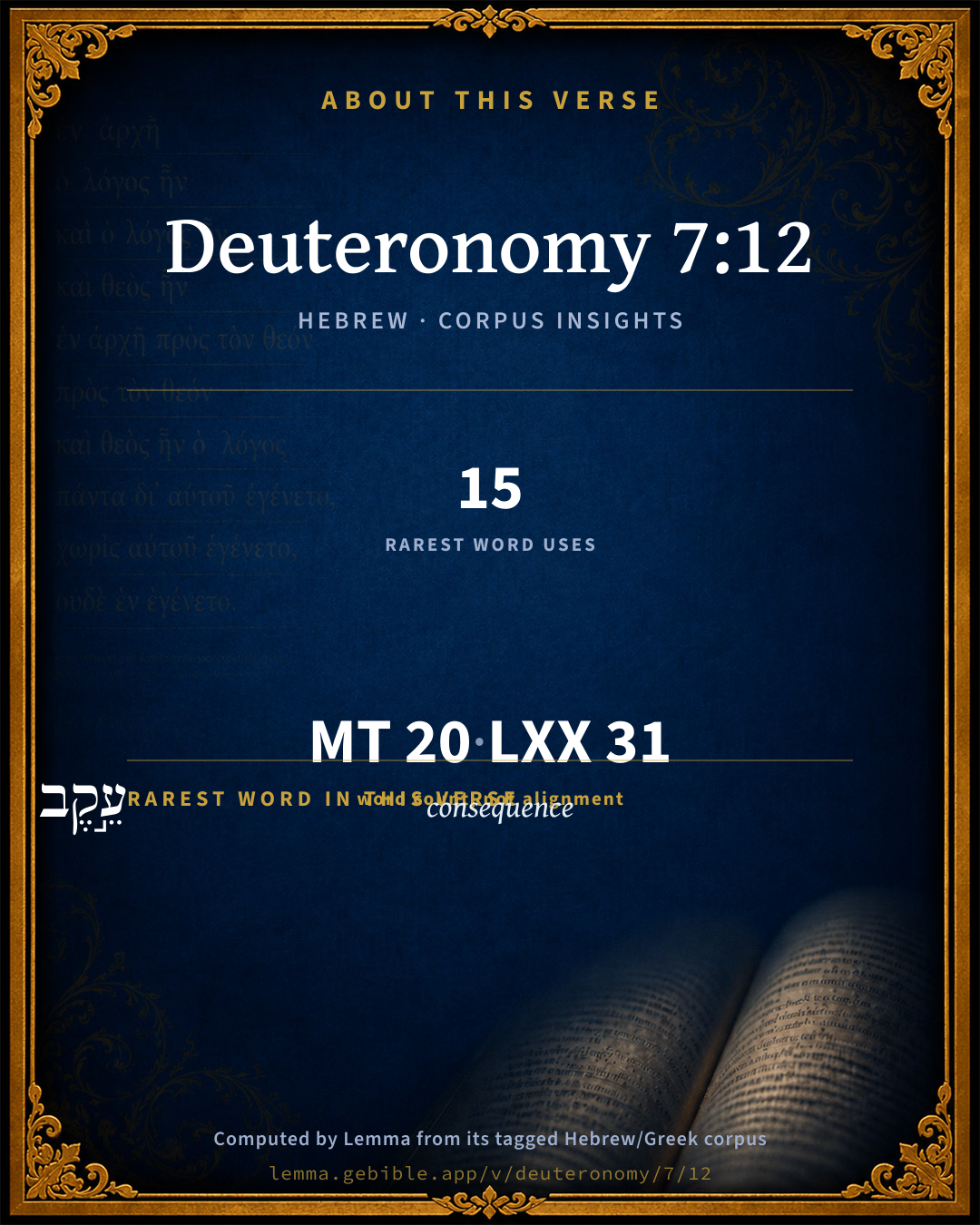
The rarest word here is עֵ֣קֶב consequence H6118 — appearing just 15 times in the whole Hebrew Bible.

Shared distinctive vocabulary

עֵ֣קֶב consequence H6118 occurs in 15 verses of the Hebrew Bible. Also found in:

Grammatical profile

  • 6 verbs
  • 7 nouns
  • 1 pronoun
  • 1 preposition
  • 5 particles

Verb forms

  • וְהָיָ֣ה Qal · Sequential Perfect
  • תִּשְׁמְע֗וּן Qal · Imperfect
  • וּשְׁמַרְתֶּ֥ם Qal · Sequential Perfect
  • וַעֲשִׂיתֶ֖ם Qal · Sequential Perfect
  • וְשָׁמַר֩ Qal · Sequential Perfect
  • נִשְׁבַּ֖ע Niphal · Perfect

Repetition

A word recurs within this verse — often emphatic in Hebrew:

  • וּשְׁמַרְתֶּ֥ם to keep H8104 ×2

Hebrew & Septuagint length

In English translation the verse runs 34 words from the Hebrew and 40 from the Septuagint (LXX English) — closely comparable.

A rough comparison of the two English renderings, which tokenize alike — not a word-level alignment.

Word counts can differ between the Hebrew and the Greek without any difference in meaning — e.g. the Hebrew direct-object marker אֵת has no separate Greek word, and Greek often adds the article ὁ.

In the original languages it is 20 Hebrew tokens and 31 Greek tokens — but the two are counted differently (Hebrew bundles its prefixes and suffixes into one token; the Greek is in lemma form), so that isn’t a like-for-like length.

Cross-references

7

Topical passages linked to Deuteronomy 7:12 in the Treasury of Scripture Knowledge — connected by theme and wording, ordered by reader-vote popularity; previews shown in the World English Bible.

  • Deuteronomy 28:1–14 It shall happen, if you shall listen diligently to the voice of Yahweh your God, to observe to do all his commandments which I command you this day, who Yahweh your God will set you on high above all the nations of the earth:
  • Deuteronomy 7:9 Know therefore that Yahweh your God, he is God, the faithful God, who keeps covenant and loving kindness with them who love him and keep his commandments to a thousand generations,
  • Leviticus 26:3–13 "'If you walk in my statutes, and keep my commandments, and do them;
  • Psalms 105:8–10 He has remembered his covenant forever, The word which he commanded to a thousand generations,
  • Luke 1:72–73 To show mercy towards our fathers, To remember his holy covenant,
  • Micah 7:20 You will give truth to Jacob, and mercy to Abraham, As you have sworn to our fathers from the days of old.
  • Luke 1:55 As he spoke to our fathers, To Abraham and his seed forever."

Cross-references courtesy of OpenBible.info (CC BY 4.0).

Hebrew and Greek witnesses Masoretic Hebrew ↔ Greek Septuagint

The same verse in the two great witnesses to the Old Testament, shown verse-for-verse.

These are two independent witnesses, not word-aligned to each other, and the Septuagint is shown in lemma (dictionary) form.

Hebrew Deuteronomy 7:12 Masoretic · Westminster Leningrad Codex

וְהָיָ֣ה עֵ֣קֶב תִּשְׁמְע֗וּן אֵ֤ת הַמִּשְׁפָּטִים֙ הָאֵ֔לֶּה וּשְׁמַרְתֶּ֥ם וַעֲשִׂיתֶ֖ם אֹתָ֑ם וְשָׁמַר֩ יְהוָ֨ה אֱלֹהֶ֜יךָ לְךָ֗ אֶֽת הַבְּרִית֙ וְאֶת הַחֶ֔סֶד אֲשֶׁ֥ר נִשְׁבַּ֖ע לַאֲבֹתֶֽיךָ

It shall happen, because you listen to these ordinances, and keep and do them, that Yahweh your God will keep with you the covenant and the loving kindness which he swore to your fathers:

World English Bible · Public Domain

Greek LXX Deuteronomy 7:12 Septuagint · lemma form

καί εἰμί ἡνίκα ἄν ἀκούω πᾶς ὁ δικαίωμα οὗτος καί φυλάσσω καί ποιέω αὐτός καί διαφυλάσσω κύριος ὁ θεός σύ σύ ὁ διαθήκη καί ὁ ἔλεος ὅς ὄμνυμι ὁ πατήρ σύ

And it shall come to pass when you⌃ shall have heard these ordinances, and shall have kept and done them, that the Lord your God shall keep for you the covenant and the mercy, which he swore to your fathers.

LXX2012 (modern English Septuagint) · Public Domain

Hebrew: Westminster Leningrad Codex (CC BY 4.0). Greek: Septuagint (public domain); English from LXX2012 (modern English Septuagint) (Public Domain). How the Septuagint differs from the Hebrew →

Targum (Aramaic paraphrase)

2

The Targum is the ancient Jewish Aramaic paraphrase of the Hebrew Scriptures — an interpretive translation, not the Hebrew text itself. Onkelos (literal) and Pseudo-Jonathan (expansive) render the Torah, and Jonathan the Prophets. Coverage is partial: where no permissively-licensed English translation exists for a verse, only the Aramaic is shown. This is verse-level text, not a word-by-word alignment to the Hebrew.

  1. Targum Onkelos Torah (Genesis–Deuteronomy)
    וִיהֵי חֳלַף דִי תְקַבְּלוּן יָת דִינַיָא הָאִלֵין וְתִטְרוּן וְתַעְבְּדוּן יָתְהוֹן וְיִטַר יְיָ אֱלָהָךְ לָךְ יָת קְיָמָא וְיָת חִסְדָא דִי קַיִים לַאֲבָהָתָךְ

    (no public-domain English translation for this verse)

    Targum Onkelos — Aramaic: “Onkelos Genesis” (public domain); “Onkelos Exodus” (public domain); “Onkelos Leviticus” (public domain); “Onkelos Numbers” (public domain); “Onkelos Deuteronomy” (public domain). English: “Sefaria Community Translation” (CC0 1.0 (public-domain dedication)); “J.W. Etheridge. The Targums of Onkelos and Jonathan Ben Uzziel on the Pentateuch. London: Longmans, Green, 1862” (public domain). Text via Sefaria.

  2. Targum Pseudo-Jonathan Torah (Genesis–Deuteronomy)
    והיה עקב וִיהֵי חוֹלַף דִּי תְקַבְּלוּן יַת דִּינַיָא הָאִילֵין וְתִנְטְרוּן וְתַעַבְדוּן יַתְהוֹן וְיִנְטַר יְיָ אֱלָהָכוֹן לְכוֹן יַת קְיָימַיָא וְיַת חִסְדָא דִי קַיֵּים לְאַבְהַתְכוֹן

    If you receive these judgments, and observe and perform them, then will the Lord your God keep with you the covenant and the lovingkindness which He sware to your fathers.

    Targum Pseudo-Jonathan — Aramaic: “Targum Jonathan on Genesis” (public domain); “Targum Jonathan on Exodus” (public domain); “Targum Jonathan on Leviticus” (public domain); “Targum Jonathan on Numbers” (public domain); “Targum Jonathan on Deuteronomy” (public domain). English: “The Targum of Jonathan ben Uzziel, trans. J. W. Etheridge, London, 1862” (public domain). Text via Sefaria.

Commentary

Notes on Deuteronomy 7:12 from classic Christian and Jewish commentators (each source and its license shown beneath its notes). The classic Christian expositions comment on the surrounding passage and are grouped to its opening verse, so a note may address several verses; the Jewish commentaries on the Tanakh (Rashi and others) are per-verse, so they appear only where the commentator wrote on this verse.

Lemma curates 59 commentaries, every one of them public domain or Creative Commons licensed, each selected and text-cleaned for this edition rather than reprinted as found. About our sources →

Matthew Henry's Commentary

Here, I. The caution against idolatry is repeated, and against communion with idolaters: "Thou shalt consume the people, and not serve their gods." Deu 7:16. We are in danger of having fellowship with the works of darkness if we take pleasure in fellowship with those that do those works. Here is also a repetition of the charge to destroy the images, Deu 7:25, Deu 7:26. The idols which the heathen had worshipped were an abomination to God, and therefore must be so to them: all that truly love God hat what he hates. Observe how this is urged upon them: Thou shalt utterly detest it, and thou shalt utterly abhor it; such a holy indignation as this must we conceive against sin, that abominable thing which the Lord hates. They must not retain the images to gratify their covetousness: Thou shalt not desire the silver nor gold that is on them, nor think it a pity to have that destroyed. Achan paid dearly for converting that to his own use which was an anathema. Nor must they retain them to gratify their curiosity: "Neither shalt thou bring it into thy house, to be hung up as an ornament, or preserved as a monument of antiquity. No, to the fire with it, that is the fittest place for it." Two reasons are given for this caution: - 1. Lest thou be snared therein (Deu 7:25), that is, "Lest thou be drawn, ere thou art aware, to like it and love it, to fancy it and pay respect to it" 2. Lest thou be a cursed thing like it, Deu 7:26. Those that make images are said to be like the, stupid and senseless; here they are said to be in a worse sense like them, accursed of God and devoted to destruction. Compare these two reasons together, and observe that whatever brings us into a snare brings us under a curse.

II. The promise of God's favour to them, if they would be obedient, is enlarged upon with a most affecting copiousness and fluency of expression, which intimates how much it is both God's desire and our own interest that we be religious. All possible assurance is here given them,

1. That, if they would sincerely endeavour to do their part of the covenant, God would certainly perform his part. He shall keep the mercy which he swore to thy fathers, Deu 7:12. Let us be constant in our duty, and we cannot question the constancy of God's mercy.

2. That if they would love God and serve him, and devote themselves and theirs to him, he would love them, and bless them, and multiply them greatly, Deu 7:13, Deu 7:14. What could they desire more to make them happy? (1.) "He will love thee." He began in love to us (Jo1 4:10), and, if we return his love in filial duty, then, and then only, we may expect the continuance of it, Joh 14:21. (2.) "He will bless thee with the tokens of his love above all people." If they would distinguish themselves from their neighbours by singular services, God would dignify them above their neighbours by singular blessings. (3.) "He will multiply thee." Increase was the ancient blessing for the peopling of the world, once and again (Gen 1:28; Gen 9:1), and here for the peopling of Canaan, that little world by itself. The increase both of their families and of their stock is promised: they should neither have estates without heirs nor heirs without estates, but should have the complete satisfaction of having many children and plentiful provisions and portions for them.

3. That, if they would keep themselves pure from the idolatries of Egypt, God would keep them clear form the diseases of Egypt, Deu 7:15. It seems to refer not only to those plagues of Egypt by the force of which they were delivered, but to some other epidemical country disease (as we call it), which they remembered the prevalency of among the Egyptians, and by which God had chastised them for their national sins. Diseases are God's servants; they go where he sends them, and do what he bids them. It is therefore good for the health of our bodies to mortify the sin of our souls.

4. That, if they would cut off the devoted nations, they should cut them off, and none should be able to stand before them. Their duty in this matter would itself be their advantage: Thou shalt consume all the people which the Lord thy God shall deliver thee - this is the precept (Deu 7:16); and the Lord thy God shall deliver them unto thee, and shall destroy them - this is the promise, Deu 7:23. Thus we are commanded not to let sin reign, not to indulge ourselves in it nor give countenance to it, but to hate it and strive against it; and then God has promised that sin shall not have dominion over us (Rom 6:12, Rom 6:14), but that we shall be more than conquerors over it. The difficulty and doubtfulness of the conquest of Canaan having been a stone of stumbling to their fathers, Moses here animates them against those things which were most likely to discourage them, bidding them not to be afraid of them, Deu 7:18, and again, Deu 7:21. (1.) Let them not be disheartened by the number and strength of their enemies: Say not, They are more than I, how can I dispossess them? Deu 7:17. We are apt to think that the most numerous must needs be victorious: but, to fortify Israel against this temptation, Moses reminds them of the destruction of Pharaoh and all the power of Egypt, Deu 7:18, Deu 7:19. They had seen the great temptations, or miracles (so the Chaldee reads it), the signs and wonders, wherewith God had brought them out of Egypt, in order to his bringing them into Canaan, and thence might easily infer that God could dispossess the Canaanites (who, though formidable enough, had not such advantages against Israel as the Egyptians had; he that had done the greater could do the less), and that he would dispossess them, otherwise his bringing Israel out of Egypt had been no kindness to them. He that begun would finish. Thou shalt therefore well remember this, Deu 7:18. The word and works of God are well remembered when they are improved as helps to our faith and obedience. That is well laid up which is ready to us when we have occasion to use it. (2.) Let them not be disheartened by the weakness and deficiency of their own forces; for God will send them in auxiliary troops of hornets, or wasps, as some read it (Deu 7:20), probably larger than ordinary, which would so terrify and molest their enemies (and perhaps be the death of many to them) that their most numerous armies would become an easy prey to Israel. God plagued the Egyptians with flies, but the Canaanites with hornets. Those who take not warning by less judgments on others may expect greater on themselves. But the great encouragement of Israel was that they had God among them, a mighty God and terrible, Deu 7:21. And if God be for us, if God be with us, we need not fear the power of any creature against us. (3.) Let them not be disheartened by the slow progress of their arms, nor think that the Canaanites would never be subdued if they were not expelled the first year; no, they must be put out by little and little, and not all at once, Deu 7:22. Note, We must not think that, because the deliverance of the church and the destruction of its enemies are not effected immediately, therefore they will never be effected. God will do his own work in his own method and time, and we may be sure that they are always the best. Thus corruption is driven out of the hearts of believers by little and little. The work of sanctification is carried on gradually; but that judgment will at length be brought forth into a complete victory. The reason here given (as before, Exo 23:29, Exo 23:30) is, Lest the beast of the field increase upon thee. The earth God has given to the children of men; and therefore there shall rather be a remainder of Canaanites to keep possession till Israel become numerous enough to replenish it than that it should be a habitation of dragons, and a court for the wild beasts of the desert, Isa 34:13, Isa 34:14. Yet God could have prevented this mischief from the beasts, Lev 26:6. But pride and security, and other sins that are the common effects of a settled prosperity, were enemies more dangerous than the beasts of the field, and these would be apt to increase upon them. See Jdg 3:1, Jdg 3:4.

Matthew Henry's Commentary on the Whole Bible (1708–1710) — public domain (CC PDM 1.0). Text via the HelloAO Bible API.

Joseph Benson's Commentary

Deu 7:12-13. The covenant and the mercy — That is, the covenant of mercy, which he, out of his own mere grace, made with them. He will love thee — He will continue to love thee, and to manifest his love to thee.

Joseph Benson's Commentary on the Old and New Testaments (1811–1818) — public domain. Text from a community e-Sword module.

Keil & Delitzsch

C. F. Keil & F. Delitzsch

The observance of these commandments would also bring great blessings (Deu 7:12-16). "If ye hearken to these demands of right" (mishpatim) of the covenant Lord upon His covenant people, and keep them and do them, "Jehovah will keep unto thee the covenant and the mercy which He hath sworn to thy fathers." In עקב, for אשׁר עקב (Gen 22:18), there is involved not only the idea of reciprocity, but everywhere also an allusion to reward or punishment (cf. Deu 8:20; Num 14:24). חסד was the favour displayed in the promises given to the patriarchs on oath (Gen 22:16).

Deu 7:13-16

This mercy flowed from the love of God to Israel, and the love was manifested in blessing and multiplying the people. The blessing is then particularized, by a further expansion of Exo 23:25-27, as a blessing upon the fruit of the body, the fruits of the field and soil, and the rearing of cattle. שׁגר, see Exo 13:12. צאן עשׁתּרת only occurs again in Deu 28:4, Deu 28:18, Deu 28:51, and certainly signifies the young increase of the flocks. It is probably a Canaanitish word, derived from Ashtoreth (Astharte), the female deity of the Canaanites, which was regarded as the conceiving and birth-giving principle of nature, literally Veneres, i.e., amores gregis, hence soboles (Ges.); just as the Latin poets employ the name Ceres to signify the corn, Venus for love and sexual intercourse, and Lucina for birth. On Deu 7:14 and Deu 7:15, see Exo 23:26. In Deu 7:15, the promise of the preservation of Israel from all diseases (Exo 15:26, and Exo 23:25) is strengthened by the addition of the clause, "all the evil diseases of Egypt," by which, according to Deu 28:27, we are probably to understand chiefly the malignant species of leprosy called elephantiasis, and possibly also the plague and other malignant forms of disease. In Egypt, diseases for the most part readily assume a very dangerous character. Pliny (h. n. xxvi. 1) calls Egypt the genitrix of contagious pestilence, and modern naturalists have confirmed this (see Hengstenberg, Egypt and the Books of Moses, p. 215; and Pruner, Krankheiten des Orients, pp. 460ff.). Diseases of this kind the Lord would rather bring upon the enemies of Israel. The Israelites, on the other hand, should be so strong and vigorous, that they would devour, i.e., exterminate, all the nations which their God would give into their hands (cf. Num 14:9). With this thought Moses reverts with emphasis to the command to root out the Canaanites without reserve, and not to serve their gods, because they would become a snare to them (see Exo 10:7); and then in Deu 7:17-26 he carries out still further the promise in Exo 23:27-30 of the successful subjugation of the Canaanites through the assistance of the Lord, and sweeps away all the objections that a weak faith might raise to the execution of the divine command.

Deu 7:17-19

To suppress the thought that was rising up in their heart, how could it be possible for them to destroy these nations which were more numerous than they, the Israelites were to remember what the Lord had done in Egypt and to Pharaoh, namely, the great temptations, signs, and wonders connected with their deliverance from Egypt (cf. Deu 4:34 and Deu 6:22). He would do just the same to the Canaanites.

Deu 7:20

He would also send hornets against them, as He had already promised in Exo 23:28 (see the passage), until all that were left and had hidden themselves should have utterly perished.

Deu 7:21-23

Israel had no need to be afraid of them, as Jehovah was in the midst of it a mighty God and terrible. He would drive out the nations, but only gradually, as He had already declared to Moses in Exo 23:30-31, and would smite them with great confusion, till they were destroyed, as was the case for example at Gibeon (Jos 10:10; cf. Exo 23:27, where the form המם is used instead of הוּם), and would also deliver their kings into the hand of Israel, so that their names should vanish under the heaven (cf. Deu 9:14; Deu 25:19; and for the fulfilment, Jos 10:22., Deu 11:12; 12:7-24). No one would be able to stand before Israel.

Deu 7:24

"To stand before thee:" lit., to put oneself in the face of a person, so as to withstand him. השׁמיד for השׁמיד, as in Lev 14:43, etc.

Deu 7:25-26

Trusting to this promise, the Israelites were to burn up the idols of the Canaanites, and not to desire the silver and gold upon them (with which the statues were overlaid), or take it to themselves, lest they should be snared in it, i.e., lest the silver and gold should become a snare to them. It would become so, not from any danger lest they should practise idolatry with it, but because silver and gold which had been used in connection with idolatrous worship was an abomination to Jehovah, which the Israelites were not to bring into their houses, lest they themselves should fall under the ban, to which all the objects connected with idolatry were devoted, as the history of Achan in Josh 7 clearly proves. For this reason, any such abomination was to be abhorred, and destroyed by burning or grinding to powder (cf. Exo 32:20; Kg2 23:4-5; Ch2 15:16).

Keil & Delitzsch — Biblical Commentary on the Old Testament (1861–1891) — public domain (CC PDM 1.0). Text via the HelloAO Bible API. (Old Testament only.)

Tyndale Open Study Notes

Tyndale Open Resources

7:12 promised with an oath (literally swore): In a covenant or treaty, the parties to the covenant had to swear to keep its terms in order for it to be valid. God’s promises are always guaranteed by his character (7:9; 32:4; Heb 6:18; Jas 1:17). He fulfilled the requirements of the covenant with Israel by swearing to keep its terms (see Gen 22:16).

Tyndale Open Study Notes — © Tyndale Open Resources, licensed CC BY-SA 4.0. Text via the HelloAO Bible API.

Geneva Bible (1599)

Geneva Bible translators

This covenant is grounded upon his free grace: therefore in recompensing their obedience, he hath respect to his mercy and not to their merits.

Geneva Bible (1599) marginal notes — public domain. Text via Bolls.life.

Adam Clarke's Commentary

Verse 12. The Lord - shall keep unto thee the covenant] So we find their continuance in the state of favour was to depend on their faithfulness to the grace of God. If they should rebel, though God had chosen them through his love, yet he would cast them off in his justice. The elect, we see, may become unfaithful, and so become reprobates. So it happened to 24,000 of them, whose carcasses fell in the wilderness because they had sinned; yet these were of the elect that came out of Egypt. Let him that standeth take heed lest he fall.

Adam Clarke's Commentary on the Bible (1810–1826) — public domain. Text from a community e-Sword/MySword module.

Ellicott's Commentary for English Readers

(12) At this point begins the third of the Hebrew divisions of the book.

If ye hearken.—Literally, as a return for your hearkening. (See Note on Deu_8:19.)

A Bible Commentary for English Readers, edited by Charles John Ellicott (1878–1897) — public domain. Text from a community e-Sword module.

The Cambridge Bible for Schools and Colleges

gen. ed. J. J. S. Perowne

12. And it shall come to pass] Cp. Deu_6:10.

because] better than A.V. if; Heb. means in consequence of, or as a reward for.

ye hearken … and do them] Another Pl. clause and superfluous. The next clause resuming the Sg. follows suitably Deu_7:11.

Jehovah thy God shall keep with thee the covenant, etc.] Expansion of Deu_7:9, q.v.

The Cambridge Bible for Schools and Colleges (gen. ed. J. J. S. Perowne; Cambridge University Press, 1878–1918) — public domain. Text from a community e-Sword module.

John Gill's Exposition

Wherefore it shall come to pass, if ye hearken to these judgments, and keep and do them,.... Attentively listen to the declaration made of them, and be careful to observe them:

that the Lord thy God shall keep unto thee the covenant and the mercy which he sware unto thy fathers; to bring them into the land of Canaan, and continue them in it; yea, to send the Messiah to them, and bring him the salvation of Israel out of Zion; see Luk 1:68.

John Gill's Exposition of the Whole Bible (1746–1763) — public domain (CC PDM 1.0). Text via the HelloAO Bible API.

Haydock's Catholic Bible Commentary

If. The promises of God to the Hebrews were conditional. (Worthington)

George Leo Haydock (1774–1849), Haydock's Catholic Family Bible and Commentary, 1859 edition — public domain. Excludes Psalms (Douay-Rheims chapter numbering differs from Protestant) and Deuterocanonical books (Catholic canon only).

Matthew Poole's English Annotations

i.e. The covenant of mercy or grace, which he out of his own mere grace made with them. A figure called hendiaduo.

Matthew Poole's English Annotations on the Holy Bible (1683–1685) — public domain. Text from a community e-Sword/MySword module.

Whedon's Commentary on the Bible

Daniel D. Whedon

12-15. Here is the promise of great blessings if the people will keep the commandments of Jehovah.

The flocks of thy sheep — The Hebrew expression only occurs again in Deu_28:4; Deu_28:18; Deu_28:51. It probably means the ewes of thy flock.

Evil diseases of Egypt — Comp. Exo_15:26, and Deu_28:27. Pliny, in his Natural History, calls Egypt the mother of contagious pestilences. Wagner calls it “a great focus of the diseases of all history.” — Natural History of Man, vol. ii, p. 270.

Daniel D. Whedon (gen. ed.), Commentary on the Old and New Testaments (1874–1909) — public domain. Text from a community e-Sword module.

The Pulpit Commentary

On the other hand, obedience would bring blessing. Wherefore it shall come to pass, if ye hearken. The Hebrew conveys the idea of a reward as consequent on their hearkening; as there would be retribution for transgression, so would there be recompense for obedience. The Hebrew word represented by "wherefore" in the Authorized Version (bqe, from bqe the heel) denotes that which comes after, the end or last of anything, (Psa_119:33, Psa_119:112) hence recompense, reward, wages, as the end or result of acting (Psa_19:11 Psa_40:15; Isa_5:23, etc.) The clause might, therefore, be translated, As a consequence or recompense of hearkening... it shall be that, &c. ;Judgments, i.e. rights, rightful claims ( God, as the Great King, has his rights, and these are to be rendered to him by his subjects and servants. The mercy, i.e. the kindness, the favor (dsj), showed in the promises which God gave to their fathers, and engaged by covenant to fulfill.

Vers. 12-15. Temporal prosperity a result of obedience to Divine Law.

The aged lawgiver in this paragraph shows the people how largely their well-being depends on obedience to God, and also to what an extent that welt-being would be manifest even in temporal matters; in the healthfulness of body which would be enjoyed by them, and in the success with which they should tend their flocks and herds. They should be free from the sicknesses and diseases with which Egypt abounded; and should, in the enjoyment of such immunity, have the sign and token of the blessing of Heaven on an obedient people. Now, it has long been regarded as one mark of the old covenant, that, in condescension to the people, God spake so much of temporal blessings as the reward of obedience in the early messages which were delivered to our fathers. It is also looked on as one specific mark of New Testament teaching, that the promises of God now lie mainly in the direction of spiritual good; and so much has this aspect of things come in our days to be looked at, that it is by no means unlikely that we may be in danger of carrying our views thereon to such an extreme as to regard temporal comforts as no mark at all of Divine approval. It is well worth our while, therefore, to look into this matter, to see if we can so formulate the teaching of God"s Word thereon as to show the harmony between it and the actual facts of life on this question: How far may abundance of temporal good and freedom from sickness be looked at as a proof of Divine favor? We shall regard the actual history before our eye as at once a basis for, and an illustration of, our remarks.

I GOD HAD IN GREAT MERCY REMOVED ISRAEL FROM EGYPT, WHICH WAS NOT ONLY THE SEAT OF POLITICAL OPPRESSION, AND A REGION OF FOUL IDOLATRY, BUT ALSO A LOCUS AND FOCUS OF MANY PESTILENTIAL DISEASES. (See Mr. Lane"s "Modern Egyptians;" the art. "Egypt " in "Encyc. Brit.;" and in Smith and Kitto"s Dictionaries of the Bible.) Probably the land of Goshen might be a healthier district than the region of the city itself; still it is extremely questionable whether such a race as Israel was designed to be, could, even physically, have been with any certainty developed in Egypt itself. It is no mean mercy to have our earthly lot cast in a healthy locality. It is not possible, indeed, to escape temptations from without or from within, go where we may, but it is certain that (coot. par.) it is much easier to resist evil and to cultivate virtue where climate and atmosphere tend to promote bodily vigor. The history of the world affords proof enough that climatic influences will not do everything for man; but that is no reason for underrating their value, nor for losing sight of the mercy where "the lines are fallen to us in" healthful and health-giving places.

II THOUGH FREE FROM LIABILITY TO EGYPTIAN DISEASE, ISRAEL"S HEALTHFULNESS AND WEALTH WOULD DEPEND ON OBEDIENCE TO GOD"S LAW. No land can give us any immunity from the consequences of breaking law, however life-giving its breezes. God"s physical and moral laws are interlaced and intertwined. Obedience or disobedience to either may have its full effect in its own direction. Obedience or disobedience to both will have its complicated effects in both directions. Many speak of law as if it acted without God; and, maybe, some think of God as if he acted without law. We need not commit either mistake. Let us carefully avoid both. Let us reverence every law of God, physical or moral, because it is his; and let it be our study to understand them in every department in which they are presented to us. Mr. Binney once made the startling statement, that, "barring accidents, a man can live pretty much as long as he pleases!" By which he meant, of course, that there are certain Divine laws and rules, obedience to which tends to the preservation of health, and consequently to the prolongation of life. And, if these laws are neglected, we may create disease, affliction, and trouble for ourselves, and breed even death, however healthful the locality in which we dwell. Hence it is not surprising to find in this paragraph another principle indicated.

III SUPPOSING THE PEOPLE TO BE OBEDIENT TO GOD"S LAW, HEALTH AND WEALTH WOULD FOLLOW BY WAY OF NATURAL CONSEQUENCE. The original (ver. 12), by a peculiar Hebrew idiom, shows this. "And (it) shall be (the) heel," i.e. the end, and so the consequence. Whatever may be the kind of weal desired, the laws of God in that direction should be studied, understood, and followed. Whether in the regulation of the production or sustentation of life; in agricultural pursuits; in the spheres of capital and labor, and their mutual relations; in the creation, distribution, increase, and expenditure of wealth; in the higher region of the cultivation of the national and social virtues of truth and goodness; in the still higher region of family piety; or in the highest region of all, even that of personal love and devotion to God, the old words will be proved true, "Them that honor me, I will honor." No doubt we are often meeting with cases which seem anomalous; they accord with no known rule whatever. But we shall find that we do not know the whole of such cases, nor even enough of them to enable us to judge concerning them. Till we know more we must suspend judgment. No perplexities of this sort give any warrant for disturbing first principles. In any region in which God has laws we may have duties; and it is a very partial and unhealthy piety which would underrate intelligent action in any department. In whatever department there is neglect, in such we may expect failure. And where there is obedience, there will be the reward.

IV THOUGH THE REWARD MAY COME IN THE WAY OF NATURAL CONSEQUENCE, YET NONE THE LESS IS IT GOD"S BLESSING. The result is from him, because the Law is from him. Nor is it one whit the less from God, if we are able to trace every step of the coming of a blessing. A man"s work is not less his because he does it somehow. Nor is it attributed the less to him because it is known how he did it. Why should men be less reasonable in recognizing God"s work, when the laws of the working are manifest to us? "The hand of the diligent maketh rich," is one truth; "the blessing of the Lord, it maketh rich," is another. We may ignore neither, but should reverently admit and act on both.

V ON WHAT A FRAIL CONDITION, HOWEVER, WAS ISRAEL"S NATIONAL WEALTH SUSPENDED! "If ye hearken to these judgments," etc. The laws were right, kind, benevolent. The land was beautiful, fertile, healthful All that was wanted was obedient people. Israel needed as much to be delivered from themselves as to be rescued from the Egyptians. And, in fact, there was among them a redeeming anti sanctifying work, carried on through God"s Spirit, though it is not named in this paragraph; nor was it as fully revealed as now, how, in his infinite grace, our God created in his people the obedience which, in his Law, he commands. "The righteousness of the Law is fulfilled in those who walk not after the flesh, but after the Spirit." The Law given to Israel was a child-guide with a view to Christ. The first covenant proved brittle in their hands, and so they learned the need of another, which should be forever safe in God"s hands. The first says, "Do this, and live." The second, "Live, and you will do this." And even now, putting the matter generally, we may say God governs nations, as nations, by the first covenant. He governs his own believing people by the second. Hence, in dealing with men and nations, the Christian preacher has ever to expound and enforce the everlasting laws of righteousness, and by revealing men"s failure therein to convict of sin; while in building up the Church he has to show the glory of the Holy Ghost as the Creator and Sustainer of spiritual power.

Vers. 12-26. Reward in proportion to arduous service.

The enterprise upon which the Jews were entering was one of prodigious difficulty. They had to contend at the same time with stalwart human foes, and with the internal foes of evil lust. Here was a splendid field for eternal renown. In proportion to the difficulty of the enterprise would be the glory of success.

I OBSERVE THE DISCOURAGING ASPECTS OF THE UNDERTAKING.

1. Their adversaries were more numerous than they. The adhesion of numbers to a particular side naturally excites enthusiasm. Yet, in war, unless order and discipline be maintained, mere numbers have contributed to defeat.

2. The Canaanites were actually in possession. They could, therefore, choose their military positions, and felt that they were fighting for their altars and their homes.

3. The Hebrews were the subjects of internal fears. Their fathers had actually refused to fight with the giant races of Canaan, and had turned back again into the desert. The habit of fearless courage was not suddenly engendered: it was a growth.

4. The Hebrews had also a lingering lust for the costly things devoted to idolatry. To suppress their own concupiscence was as arduous as to withstand the Amorites. Hence, on many occasions, their hearts counseled compromise and alliance.

5. They could anticipate only tardy results. If there had been the prospect of swift progress of triumph the rapid march from victory to victory they could have braced themselves up for a brief campaign. But they knew that slow processes of siege, with its privations and exposures, were essential. God had forewarned them that he would not drive out the heathen suddenly, lest other evils should ensue. They had to contend with their own impatience.

6. The necessity for extermination added to the difficulty of the war. If, when the Canaanites had suffered defeat in two or three pitched battles, the Hebrews had been permitted to accept a surrender and make them tributaries, their task had been comparatively easy. But the command of Jehovah was unmistakable: Israel was bound to destroy their foes, "with a mighty destruction," till they were consumed. So neither can we have peace until every sin within us is completely annihilated.

II OBSERVE THE ENCOURAGING ASPECTS OF THEIR WORK.

1. Gods immeasurable might. The visible features of the undertaking were depressing enough; but faith could discover an invisible Ally, who was more than a match for all opposition. If we can only realize that God is on our side, we shall be confident of victory.

2. Gods past deliverances should assure us for the future. What an unchanging God has done for us, he can and will do again. Omnipotence is never exhausted. It is impossible for God to be inconsistent with himself.

3. Gods plain promises of help. If we can only be absolutely sure of a promise from God, we may set at defiance every fear, and calmly face every foe. "He is not a man, that he should lie.

4. Proofs that God is even now present. The Lord thy God is among you." If we would only rub off from our eyes the drowsiness of unbelief, we might see the tokens of God"s presence on every side the footprints of his feet, as he leads our way. The Good Shepherd always goes before his sheep.

5. In God"s service the meaner forms of life often become efficient allies. The locusts have been commissioned to do service for God. In Egypt, flies and lice formed a brigade in his army. So now also wasps and hornets were sent out as sappers and miners to prepare Jehovah"s way. Let no insignificant helper be despised!

III THE LARGE REWARDS OF FAITHFUL SERVICE.

1. The rewards were based on Divine equity. If we keep his precepts, he will keep his covenant. A singular thread of equity runs through all God"s dealings. History supplies a thousand examples. We may find fresh ones daily in our own observation.

2. The rewards are various and ample. They embrace the present and the future. To be the conscious object of God"s love is a rich reward; and the smile of God will make all our ways to prosper. Large and rapid increase has been, from the Creation, a mark of Jehovah"s favor. "Be fruitful, and multiply, and replenish the earth.

3. The rewards are distinctive. Not only do they impart a large measure of personal enjoyment, but they are known and recognized by others as the rewards conferred by God. They make men conspicuous among their fellows. "A thousand shall fall at thy side, and ten thousand at thy right hand; but it shall not come nigh thee." As our work and warfare are spiritual, so are our rewards spiritual also. Our reward, as conquerors over sin, is manifold, generous, enduring, satisfying. God will surely distinguish between the righteous and the wicked between him that serveth him well, and him that serveth him not. In honor, they shall be as the antipodes asunder. D.

Vers. 12-16. The rewards of obedience.

If Israel fulfilled its vocation, in keeping itself separate from the idolatries of the heathen, and in destroying them from the land; if further, in possession of the land, it adhered to God"s commands, God would make his blessing rest on it in every sphere and department of existence.

I TEMPORAL PROSPERITY IS A LEGITIMATE OBJECT OF DESIRE. Otherwise it could not be named as part of the blessing, nor could the hope of it be held out as an encouragement to the obedient. We naturally desire to see our affairs prospering. We justly rejoice in the prosperity of our nation. We are glad when trade is brisk, wages good, the comforts of life diffused through the different orders of society. But:

1. Prosperity is to be desired only in subordination to higher ends. (Mat_5:33)

1. Only in so far as it is good for us. (3Jn_1:2)

2. Not in excess. (Pro_30:8, Pro_30:9) If God, in the exercise of his higher wisdom, withhold prosperity from us, the loss will be compensated by better blessings. (Mar_10:29, 30)

II TEMPORAL PROSPERITY, IN SUCH MODES AND DEGREES AS GOD SEES BEST, IS AN EFFECT OF THE DIVINE BLESSING. Godliness has promise of the life that now is and of that which is to come. (1Ti_4:10) It naturally tends to prosperity. Religion teaches men to be sober, righteous, and godly. (Tit_2:12) It condemns idleness, waste, dishonesty, and the whole series of vices which wreck health, squander property, and destroy confidence. Where religion prevails, men will be industrious, conscientious, orderly, and reliable. But, in addition to this natural tendency of religion to prosperity, there rests on the good man"s lot what is distinctively spoken of as the Divine blessing. This will mingle itself with all he has and with all he does. It gives him favor in the eyes of men. (Gen_39:21) It opens up his way for him. (Psa_37:5) It protects him from injury. (Psa_37:33, Psa_37:39) It overrules all events and influences, so that they work for his good. This is forcibly illustrated in the text, where blessing is represented as descending on the home, on the products of the land, on flocks and herds, on the bodily life, etc. The counterpart of the blessing is the curse (ver. 15). The wicked often prosper, but it is prosperity unblessed and unenduring. J.O.

The Pulpit Commentary (1880–1919), ed. H.D.M. Spence-Jones & Joseph S. Exell — public domain. Text from a community e-Sword module.

John Wesley's Explanatory Notes

The covenant and the mercy - That is, the covenant of mercy, which he out of his own mere grace made with them.

John Wesley, Explanatory Notes Upon the Whole Bible (1754–1765) — public domain. Text via the GEBible commentary corpus.

Kretzmann's Popular Commentary

Paul E. Kretzmann

The Extermination of the Heathen Nations Enjoined

v. 12. Wherefore it shall come to pass, if ye hearken to these judgments, and keep and do them, that the Lord, thy God, shall keep unto thee the covenant and the mercy which Ha sware unto thy fathers. He would fulfill all the promises of mercy given to the patriarchs, and He would carry out the terms of the covenant with respect to both rewards and punishments.

v. 13. And he will love thee, and bless thee, and multiply thee, as manifestations of His love; he will also bless the fruit of thy womb, in granting a numerous posterity, and the fruit of thy land, thy corn, and thy wine, and thine oil, the increase of thy kine, and the flocks of thy sheep, in the land which he sware unto thy fathers to give thee.

v. 14. Thou shalt be blessed above all people; there shall not be male or female barren among you or among your cattle, for barrenness was considered almost a curse among the Israelites.

v. 15. And the Lord will take away from thee all sickness, especially in the form of epidemics, and will put none of the evil diseases of Egypt which thou knowest upon thee, but will lay them upon all them that hate thee. In spite of the great advance of the last half century, medical science to this day is unable to account for the virulence of many epidemics except on the basis of divine interference and punishment. Cf Exo 23:26.

v. 16. And thou shalt consume all the people which the Lord, thy God, shall deliver thee, giving them into the hands of Israel; thine eye shall have no pity upon them, all false sympathy, which might enter the heart through the eye as it witnesses the plight of the enemy must be banished; neither shalt thou serve their gods, for that will be a snare unto thee, which would plunge them, too, into destruction.

v. 17. If thou shalt say in thine heart, These nations are more than I, how can I dispossess them, get into possession of the country now occupied by them? Little faith on the part of the believers has won many victories for the forces of darkness.

v. 18. Thou shalt not be afraid of them, but shalt well remember what the Lord, thy God, did unto Pharaoh and unto all Egypt;

v. 19. the great temptations which thine eyes saw, and the signs, and the wonders, and the mighty hand, and the stretched-out arm whereby the Lord, thy God, brought thee out, Deu 4:34; so shall the Lord, thy God, do unto all the people of whom thou art afraid. The memory of benefits received in the past was to strengthen their faith in God’s help also in the future.

v. 20. Moreover, the Lord, thy God, will send the hornet among them, Exo 23:28, a special terror intended to make them lose heart, until they that are left and hide themselves from thee be destroyed; for Israel was to be as active in the work of extermination as the instrument which God used.

v. 21. Thou shalt not be affrighted at them, filled with the terror of little faith; for the Lord, thy God, is among you, a mighty God and terrible, whose judgments made Him an object of dread among all nations.

v. 22. And the Lord, thy God, will put out those nations before thee little by little, Exo 23:29-30; thou mayest not consume them at once, lest the beasts of the field increase upon thee, for they were at that time not yet numerous enough to occupy the entire land at once.

v. 23. But the Lord, thy God, shall deliver them unto thee, while they themselves would look on in surprised wonder, and shall destroy, overthrow, them with a mighty destruction until they be destroyed.

v. 24. And He shall deliver their kings into thine hand, Jos 10:24-25, and thou shalt destroy their name from under heaven; there shall no man be able to stand before thee until thou have destroyed them.

v. 25. The graven images of their gods shall ye burn with fire; thou shalt not desire the silver or gold that is on them, with which they were overlaid, or take it unto thee, lest thou be snared therein, they would become contaminated by the mere fact of having it in their possession; for it is an abomination to the Lord, thy God, as were all objects that were used for idolatrous purposes, Joshua 7.

v. 26. Neither shalt thou bring an abomination into thine house, lest thou be a cursed thing like it, having been defiled by contact with it; but thou shalt utterly detest it, look upon it only with the utmost horror and loathing, and thou shalt utterly abhor it, regard it with loathing; for it is a cursed thing. In Christians this attitude will keep them from all defilement of unbelief and of the lust of the flesh.

Paul E. Kretzmann, Popular Commentary of the Bible (1921–1924) — public domain. Text from a community e-Sword module.

unfoldingWord translationNotes

Door43 World Missions Community

General Information:

Moses continues to tell the people of Israel Yahweh's words. He speaks as if the Israelites are one person in verse 12 and to all of them as a group in verse 13. (See: Forms of You)

multiply you

"increase the number of your people"

the fruit of your body

This is an idiom for "your children." (See: Idiom)

the fruit of your ground

This is an idiom for "your crops." (See: Idiom)

the multiplication of your cattle

"your cattle so they will become many"

translationWords

decree

Yahweh

God

covenant

faithful

oath

ancestor

love

bless

fruit

grain

wine

oil

cow

flocks

unfoldingWord translationNotes — © Distant Shores Media and the Door43 World Missions Community, licensed CC BY-SA 4.0. Source: git.door43.org/Door43/en_tn.

Rashi

Rabbi Shlomo Yitzchaki (Rashi)

והיה עקב תשמעון AND THE CONSEQUENCE WILL BE, IF YE HEARKEN (The Hebrew text may be taken to signify if you will hear the heel, עקב) — If, even the lighter commands which a person usually treads on with his heels (i.e. which a person is inclined to treat lightly), ye will hearken to,

ושמר ה׳ וגו׳ THEN THE LORD [THY GOD] WILL KEEP FOR THEE His promise (Midrash Tanchuma, Eikev 1).

Rashi on the Tanakh — English translations: “The Judaica Press complete Tanach with Rashi, translated by A. J. Rosenberg” (CC BY 4.0); “Pentateuch with Rashi's commentary by M. Rosenbaum and A.M. Silbermann, 1929-1934” (public domain); “The Metsudah Tanach series, Lakewood, N.J” (CC BY 4.0); and “The Book of Joshua, Metsudah Publications, 1997” (CC BY 4.0). Text via Sefaria.

Ramban (Nachmanides)

Rabbi Moshe ben Nachman (Ramban / Nachmanides)

AND IT SHALL COME TO PASS ‘EIKEV’ YE HEARKEN. Eikev means “because.” So also, ‘eikev’ (because) that Abraham hearkened to My voice. And Rashi wrote: “If you will hearken even to the lighter commandments which a person usually treads upon with his ‘heels’ [i.e., those commandments which a person is inclined to treat lightly] then G-d will keep His promise to you.” as meaning “heel, footprint.” — The term “lighter commandments” thus means “lighter” in the sense that people regard them lightly because they think that the reward for their observance is of minor significance, and therefore, “they tread upon them with their heels,” so to say. But, as Scripture continues, these people are mistaken, since the reward for even these commandments is boundless. Now Scripture mentions the ordinances [And it shall come to pass ‘eikev’ ye hearken to these ‘ordinances’] mentioned here? It must be that the sense of the verse is as follows: “If you will hearken to those commandments which a person is inclined to treat lightly, such as the ordinances about monetary matters — then etc.” Thus, the reason ordinances are singled out more than statutes and testimonies is that Scripture wants to teach us that we should not hold them in disdain despite the fact that they deal merely with monetary matters. perhaps because he admonishes them not to be disdainful of the lightly-esteemed ordinances such as the laws pertaining to monetary matters.And the commentators have said that the meaning of the word eikev is that “in the end” there will be reward. Similarly, in keeping them [the ordinances of G-d] ‘eikev rav’ (there is [in the end] great reward). The verse here is thus stating: “and the end [the ultimate consequence] of your hearkening to the ordinances and your observing them is that G-d shall keep the covenant and the mercy, and He will love thee. ” This is correct, for in the Sacred Language the beginning of anything is called rosh [literally: “head”], as it is said, ‘rosh’ (the beginning of) Thy word is truth. So also is the leader of the generation called “the head of the people,” and the best of spices is called rosh. (‘the chief’ spices). Similarly, the conclusion of any matter is called akeiv (heel) as the Sacred Language adopts these figurative expressions from the human body; and thus “the head” is the beginning while “the heel” is the conclusion and end of the body. Scripture also speaks of the head and the tail. [with reference to people], figuratively using the body of the animal.And Onkelos rendered the word eikev as chalaf (“in exchange for”), like ‘cheilef’ (in return for) your service. Onkelos thus made it an expression of “roundabout” [the end result of a series of events], derived from the verse, and ‘he’akov (the crooked) shall be made straight — that is, the circuitous road which goes roundabout [will become a straight, level path]. So also ‘akubah’ of blood means “it is surrounded and encircled” [with blood]. The verse here is thus stating [according to Onkelos]: “and it shall come to pass that the effect caused by your hearkening to the ordinances and your performing them will be that G-d will keep His covenant with you.” He has explained it well. A similar expression is ‘biglal’ (for the sake of) this thing which means “on account of,” from the word ‘v’gal’lu’ (and they roll) the stone. Similarly it is my opinion that every expression of akeivah is a term denoting “circle” or “circuit.” Thus: ‘akov haleiv’ (the heart is deceitful); ‘vaya’akveini’ (and he hath gotten the better of me) these two times; but Jehu did it ‘b’akbah’ (in subtlety) — all these being expressions of “rolling” and “circling.” Therefore they called Jacob “Jeshurun” [from the root yashar (straight and upright)] because the opposite of “the deceitful one” is he who is “upright” [as indicated by the name “Jeshurun”]. Similarly, the end-part of the foot, called akeiv — as it is said, and his hand seizing ‘ba’akeiv (the heel) of Esau — is so called because of its roundness, just as the [Sacred] Language calls the middle part [palm and sole] of the hand and foot kapoth, 4:11: And I gave the cup into ‘kaph’ (the hand of) Pharaoh. Ezekiel 1:7: ‘v’kaph’ (and the sole) of their feet. because of their being shaped like golden kapoth (spoons). This usage [of the term akeiv] is common in the [Sacred] Language, just as the Rabbis have said in the Sifre: 343. “At His right hand was a fiery law unto them. When the word came forth from the mouth of the Holy One, blessed be He, it would go by way of the right hand of the Holy One to the left of Israel, v’okeiv (and it encircled) the camp of Israel twelve miles by twelve miles.” So also is the expression: “they come upon him ba’akifin,” meaning “with circuitous and subtle arguments,” like the word akeivin as these two letters [the veth and the fei] were considered by the Sages to be interchangeable, as I have already explained. He mentioned these ordinances suggests “the lighter commandments” [as explained above] we understand why the verse singles out only these ordinances [and not the statutes etc.] because the ordinances, applying as they do to monetary matters, are often treated lightly by people; hence the need by Scripture to warn against it. But according to the interpretation of Onkelos and Ramban that eikev means “in return for,” and the verse refers to the reward for observing the commandments, the question arises why did Scripture single out only the ordinances? Ramban proceeds to answer this question: “He mentioned these ordinances in order etc.” in order to warn exceedingly concerning the ordinances [i.e., judgments], for it is impossible that of a large nation, everyone be heedful of all commandments so as not to transgress any of them, and it is only through the judgments [of the court] that they establish [the firm authority of] the Torah, just as it says of them, and all Israel shall hear, and fear. Moreover, many people will have pity [and refrain from] stoning a man or burning him after the transgression had been committed, as it is said, Thine eye shall not pity him., 19:13. Then also they might fear the mighty ones as well as those who lead astray, as it is said, ye shall not be afraid of the face of any man, for the judgment is G-d’s, and in the case of the false prophet it says, thou shalt not be afraid of him. He mentioned all these in the case of an inciter [to worship idols] saying, thou shalt not consent unto him, nor hearken unto him; neither shalt thine eye pity him, neither shalt thou spare, neither shalt thou conceal him, 13:9. warning nor hearken unto him, 13:9. because of his misleading [you], neither shalt thine eye pity him, 13:9. because of the pity that compassionate people show towards the condemned, and neither shalt thou conceal him, 13:9. by remaining silent [and not presenting testimony against him] because of his might and fear of members of his family.

Ramban (Nachmanides) on the Tanakh — English translation: “Commentary on the Torah by Ramban (Nachmanides). Translated and annotated by Charles B. Chavel. New York, Shilo Pub. House, 1971-1976” (CC BY 4.0). Text via Sefaria.

Lesson kit

Teaching starters — assembled from the data on this page, not authored interpretation. Every prompt links to the verse data it draws on. Edit before teaching.

Deuteronomy, in the Pentateuch, opens this verse with 20 words (15 distinct Hebrew lemmas). Its most distinctive word is ʻêqeb (“consequence”). A historical commentator’s framing appears above. Read the whole chapter for the surrounding context.

Discussion questions

  1. What does “consequence” (ʻêqeb) contribute to the verse as a whole?
  2. How does Genesis 22:18, which shares the word «consequence», read alongside this verse?
  3. What does the repetition of “to keep” (2× in this one verse) do in this verse?
  4. The translations on this page render this verse differently — a whole-verse word diff, not a word-by-word alignment. What might account for the different wordings?
  5. «וְהָיָ֣ה» is a Qal Sequential Perfect verb. How does that grammatical form shape the action described?
  6. Compare how Matthew Henry's Commentary and Joseph Benson's Commentary read this verse. Where do they agree or differ?

Things to notice

Reading settings

Reading text

Shown beneath each verse's original-language words.

Old Testament
Old Testament edition

Read the OT as the Masoretic Hebrew (MT) or the Greek Septuagint (LXX).

English shown for the Greek Septuagint (in the Hebrew ↔ Greek comparison).

Comparing translations? Open the Compare panel on any verse page to stack up to four side by side.