
Ecclesiastes 2:5

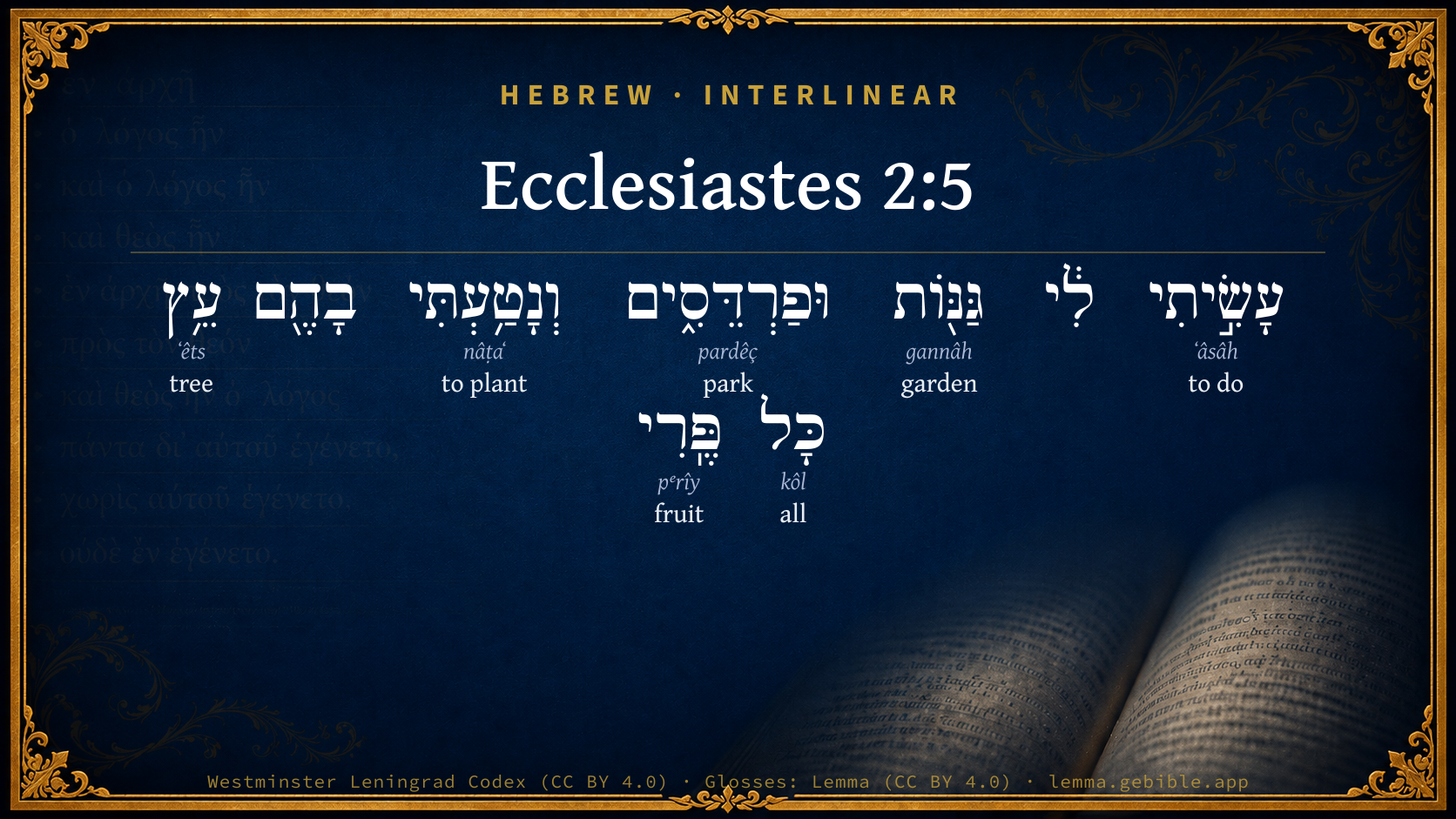
Hebrew (Westminster Leningrad Codex) Ecclesiastes 2:5 appears in the Hebrew Old Testament. The text above is from the Westminster Leningrad Codex. Each word links to its Strong’s number, a concise gloss, and parsing drawn from the Open Scriptures Hebrew Bible morphology. Click any word for its full Brown-Driver-Briggs (BDB) entry.
Download image
Cite this verse

Ecclesiastes 2:5 (World English Bible). Public Domain. Lemma interlinear Bible study tool, https://lemma.gebible.app/v/ecclesiastes/2/5.

Show BibTeX & RIS
BibTeX
RIS
English Translation
I made myself gardens and parks, and I planted trees in them of all kinds of fruit.
World English Bible · Public Domain
Download a study sheet

One document with this verse’s original text, its word-by-word gloss line, the meaning frame, cross-references with their text, attributed commentary, and full source and license credits — printable, and it pastes into notes with its structure intact.

This verse Autodidact and up

Study sheet (.html) Plain text (.txt)

A passage Seminary Student

Up to 50 verses in one chapter. A passage sheet keeps up to 6 commentary sources and 12 cross-references per verse, in the order this page ranks them, and says so on the sheet whenever that leaves anything out. Ask for a single verse and you get the Autodidact verse sheet above.

Everything on this page stays free to read, with no account — the sheet is a download of what is already on screen, not access to it.

Want to remove ads? Support Godless Engineer
Compare translations 3

The same verse in 3 English versions, stacked beneath the original-language interlinear above. Click any original word for its lexicon entry.

Each is an independent rendering of the whole verse — the interlinear is not word-aligned to these translations.

Highlighted words mark where these versions differ — a whole-verse word diff, not a word-by-word alignment.

  • World English Bible Public Domain
    I made myself gardens and parks, and I planted trees in them of all kinds of fruit.
  • King James Version Public Domain
    I made me gardens and orchards, and I planted trees in them of all kind of fruits:
  • unfoldingWord Literal Text CC BY-SA 4.0
    I made for myself orchards and royal parks, and I planted in them a tree of each fruit.

unfoldingWord Literal Text — © unfoldingWord, licensed CC BY-SA 4.0. Word-aligned USFM3 via Door43 (git.door43.org/unfoldingWord/en_ult).

Versions to compare (up to 4)

3 of 4 selected

Show all 18 translations

Every available English version of this verse, each an independent rendering of the whole verse.

  • World English Bible Public Domain
    I made myself gardens and parks, and I planted trees in them of all kinds of fruit.
  • Berean Standard Bible Public Domain
    I made gardens and parks for myself, where I planted all kinds of fruit trees.
  • Majority Standard Bible Public Domain
    I made gardens and parks for myself, where I planted all kinds of fruit trees.
  • King James Version Public Domain
    I made me gardens and orchards, and I planted trees in them of all kind of fruits:
  • American Standard Version (1901) Public Domain
    I made me gardens and parks, and I planted trees in them of all kinds of fruit;
  • Revised Version (1885) Public Domain
    I made me gardens and parks, and I planted trees in them of all kinds of fruit:
  • Geneva Bible (1599) Public Domain
    I haue made me gardens and orchards, and planted in them trees of all fruite.
  • Douay-Rheims (1899) Public Domain
    I made gardens, and orchards, and set them with trees of all kinds,
  • Young's Literal Translation Public Domain
    I made for me gardens and paradises, and I planted in them trees of every fruit.
  • Literal Standard Version CC BY-SA 4.0
    I made for myself gardens and paradises, and I planted in them trees of every fruit.
  • Unlocked Literal Bible CC BY-SA 4.0
    I built for myself gardens and parks; I planted all kinds of fruit trees in them.
  • unfoldingWord Literal Text CC BY-SA 4.0
    I made for myself orchards and royal parks, and I planted in them a tree of each fruit.
  • Darby Bible Public Domain
    I made me gardens and parks, and I planted trees in them of every kind of fruit;
  • World Messianic Bible Public Domain
    I made myself gardens and parks, and I planted trees in them of all kinds of fruit.
  • Webster's Bible Public Domain
    I made me gardens and orchards, and I planted trees in them of all kind of fruits:
  • Free Bible Version CC BY-SA 4.0
    I made for myself gardens and parks, planting them with all kinds of fruit trees.
  • Bible in Basic English Public Domain
    I made myself gardens and fruit gardens, planting in them fruit-trees of all sorts.
  • JPS Tanakh (1917) Public Domain
    I made me gardens and parks, and I planted trees in them of all kinds of fruit;

Literal Standard Version (2020), Covenant Press — licensed CC BY-SA 4.0. Text via the HelloAO Bible API (eBible.org). Unlocked Literal Bible (unfoldingWord) — licensed CC BY-SA 4.0. Text via the HelloAO Bible API (eBible.org). unfoldingWord Literal Text — © unfoldingWord, licensed CC BY-SA 4.0. Word-aligned USFM3 via Door43 (git.door43.org/unfoldingWord/en_ult). Free Bible Version, Dr. Jonathan Gallagher — licensed CC BY-SA 4.0. Text via the HelloAO Bible API (eBible.org).

Word by word

More ways to search: Search by grammar → Find every occurrence → Compare this word →

Practice this passage: Drill this verse → Learn its vocabulary →

About this verse

These counts appear in no published source. They are computed here, from the morphology-tagged text and Lemma’s own curated glosses. What Lemma adds →

9
words
7
distinct lemmas
Wisdom
section

Notable vocabulary

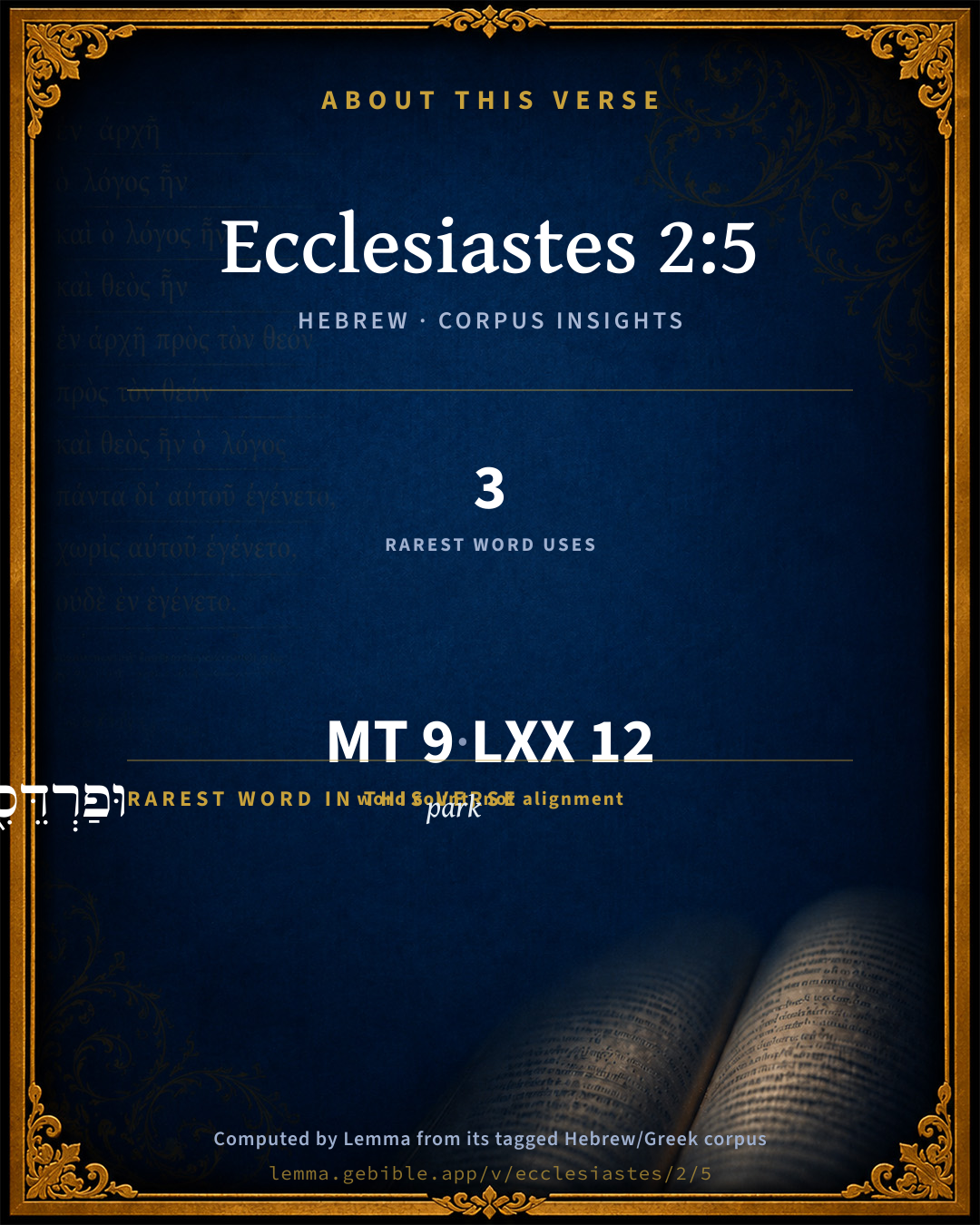
The rarest word here is וּפַרְדֵּסִ֑ים park H6508 — appearing just 3 times in the whole Hebrew Bible.

Shared distinctive vocabulary

וּפַרְדֵּסִ֑ים park H6508 occurs in 3 verses of the Hebrew Bible. Also found in:

Grammatical profile

  • 2 verbs
  • 5 nouns
  • 2 prepositions

Verb forms

  • עָשִׂ֣יתִי Qal · Perfect
  • וְנָטַ֥עְתִּי Qal · Perfect

Hebrew & Septuagint length

In English translation the verse runs 17 words from the Hebrew and 15 from the Septuagint (LXX English) — closely comparable.

A rough comparison of the two English renderings, which tokenize alike — not a word-level alignment.

Word counts can differ between the Hebrew and the Greek without any difference in meaning — e.g. the Hebrew direct-object marker אֵת has no separate Greek word, and Greek often adds the article ὁ.

In the original languages it is 9 Hebrew tokens and 12 Greek tokens — but the two are counted differently (Hebrew bundles its prefixes and suffixes into one token; the Greek is in lemma form), so that isn’t a like-for-like length.

Cross-references

5

Topical passages linked to Ecclesiastes 2:5 in the Treasury of Scripture Knowledge — connected by theme and wording, ordered by reader-vote popularity; previews shown in the World English Bible.

  • Genesis 2:8–9 Yahweh God planted a garden eastward, in Eden, and there he put the man whom he had formed.
  • Song of Solomon 4:12–5:1 A locked up garden is my sister, my bride; A locked up spring, A sealed fountain.
  • Song of Solomon 6:2 My beloved has gone down to his garden, To the beds of spices, To feed in the gardens, and to gather lilies.
  • Jeremiah 39:4 It happened that, when Zedekiah the king of Judah and all the men of war saw them, then they fled, and went forth out of the city by night, by the way of the king's garden, through the gate between the two walls; and he went out toward the Arabah.
  • Luke 17:27–29 They ate, they drank, they married, they were given in marriage, until the day that Noah entered into the ark, and the flood came, and destroyed them all.

Cross-references courtesy of OpenBible.info (CC BY 4.0).

Hebrew and Greek witnesses Masoretic Hebrew ↔ Greek Septuagint

The same verse in the two great witnesses to the Old Testament, shown verse-for-verse.

These are two independent witnesses, not word-aligned to each other, and the Septuagint is shown in lemma (dictionary) form.

Hebrew Ecclesiastes 2:5 Masoretic · Westminster Leningrad Codex

עָשִׂ֣יתִי לִ֔י גַּנּ֖וֹת וּפַרְדֵּסִ֑ים וְנָטַ֥עְתִּי בָהֶ֖ם עֵ֥ץ כָּל פֶּֽרִי

I made myself gardens and parks, and I planted trees in them of all kinds of fruit.

World English Bible · Public Domain

Greek LXX Ecclesiastes 2:5 Septuagint · lemma form

ποιέω ἐγώ κῆπος καί παράδεισος καί φυτεύω ἐν αὐτός ξύλον πᾶς καρπός

I made me gardens and orchards, and planted in them every kind of fruit tree.

LXX2012 (modern English Septuagint) · Public Domain

On this verse, Ellicott's Commentary for English Readers discusses the Septuagint’s reading. Read the note in Commentary ↓

Hebrew: Westminster Leningrad Codex (CC BY 4.0). Greek: Septuagint (public domain); English from LXX2012 (modern English Septuagint) (Public Domain). How the Septuagint differs from the Hebrew →

Commentary

Notes on Ecclesiastes 2:5 from classic Christian and Jewish commentators (each source and its license shown beneath its notes). The classic Christian expositions comment on the surrounding passage and are grouped to its opening verse, so a note may address several verses; the Jewish commentaries on the Tanakh (Rashi and others) are per-verse, so they appear only where the commentator wrote on this verse.

Lemma curates 59 commentaries, every one of them public domain or Creative Commons licensed, each selected and text-cleaned for this edition rather than reprinted as found. About our sources →

Trapp's Complete Commentary

John Trapp

Ecc 2:5 I made me gardens and orchards, and I planted trees in them of all [kind of] fruits:

Ver. 5. I made me gardens.] So called, because guarded and enclosed with a wall, {Son 4:12} like as we call garments quasi guardments, in an active acception of the word, because they guard our bodies from the injury of wind and weather. The Hebrew word גן, Gan, comes likewise from a word that signifieth to protect or guard; and there are those who give this for a reason why the Lord forbade the Jews to keep swine, because they are such enemies to gardens, whereof that country is very full.

And orchards.] Heb., Paradises; famous for curious variety and excellence of all sorts of trees and foreign fruits, resembling even the garden of God for amenity and delight. And herein perhaps he gratified Pharaoh’s daughter - the Egyptians took great pleasure in gardens - like as that king of Assyria did his wife horto pensili, with a garden that hung in the air, to his incredible cost. {a}

{a} Athenaeus, Diod., lib. ii. cap. 4. Q. Curt., lib. v.

John Trapp, A Commentary or Exposition upon All the Books of the Old and New Testament (1647–1656) — public domain. Text from a community e-Sword module.

Geneva Bible (1599)

Geneva Bible translators

Hebrew, paradises.

Geneva Bible (1599) marginal notes — public domain. Text via Bolls.life.

Jamieson, Fausset & Brown

Robert Jamieson, A. R. Fausset & David Brown

gardens--Hebrew, "paradises," a foreign word; Sanskrit, "a place enclosed with a wall"; Armenian and Arabic, "a pleasure ground with flowers and shrubs near the king's house, or castle." An earthly paradise can never make up for the want of the heavenly (Rev 2:7).

Jamieson, Fausset & Brown — Commentary Critical and Explanatory on the Whole Bible (1871) — public domain (CC PDM 1.0). Text via the HelloAO Bible API.

Adam Clarke's Commentary

Verse 5. I made me gardens and orchards] פרדסים pardesim, "paradises." I doubt much whether this be an original Hebrew word. [Arabic] ferdoos, is found in the Persian and Arabic; and signifies a pleasant garden, a vineyard. Hence our word paradise, a place full of delights. How well Solomon was qualified to form gardens, orchards, vineyards, conservatories, c., may be at once conceived when we recollect his knowledge of natural history and that he wrote treatises on vegetables and their properties, from the cedar to the hyssop.

Adam Clarke's Commentary on the Bible (1810–1826) — public domain. Text from a community e-Sword/MySword module.

Ellicott's Commentary for English Readers

(5) Orchards.—Rather, parks. The word, which occurs also in Son_4:3, Neh_2:8, is originally Persian, and passed into the Greek and into modern languages in the form of “paradise” (Luk_23:43; 2Co_12:4; and in LXX., Gen_2:10; Gen_13:10; Num_24:6; Isa_1:30; Sir_24:30; Susan. 5:4). Parks and trees giving, not only fruit, but shade from the hot Eastern sun, were an almost necessary part of kingly luxury. The king’s garden is spoken of in 1Ki_21:2; 2Ki_21:18; 2Ki_25:4; Neh_3:15.

A Bible Commentary for English Readers, edited by Charles John Ellicott (1878–1897) — public domain. Text from a community e-Sword module.

The Cambridge Bible for Schools and Colleges

gen. ed. J. J. S. Perowne

5. I made me gardens and orchards] The latter word, originally Persian, and found only in the O. T. in this book, in Song Son_4:13, and Neh_2:8, is the “paradise” of Xenophon, of later Rabbinic writings and of the New Testament (Luk_23:43; 2Co_12:4). It indicates what we call a park, with flowing streams and shady groves and fruit trees, and deer feeding on the fresh green grass, and doves flitting through the trees, such as seemed to the Eastern imagination the fittest type of the highest blessedness. The whole scenery of the Song of Solomon is such a garden, planted with pomegranates and pleasant fruits, spikenards and camphire, calamus and cinnamon, and trees of frankincense, and lilies (Song Son_4:13-15; Son_6:2). The pools of Solomon at Etam, on the south-west of Bethlehem, described by Josephus (Ant. viii. 7. 3) still preserve the memory of such a “paradise.” Other traces of these surroundings of the palaces of Jewish kings are found in the history of Naboth’s vineyard, where the “garden of herbs” can hardly be thought of as merely a “kitchen garden” (1Ki_21:2) and in the garden of Zedekiah (Jer_52:7).

all kind of fruits] The horticulture of Palestine included the apple, the fig, the pomegranate, the date, the caper-tree, nuts, almonds, raisins and mandrakes. The account is in strict keeping with the character of the king who spake of trees “from the cedar that is in Lebanon to the hyssop on the wall” (1Ki_4:33).

The Cambridge Bible for Schools and Colleges (gen. ed. J. J. S. Perowne; Cambridge University Press, 1878–1918) — public domain. Text from a community e-Sword module.

John Gill's Exposition

I made me gardens and orchards,.... Of the king's garden, we read Jer 39:4. Adrichomius (b) makes mention of a royal garden in the suburbs of Jerusalem, fenced with walls; and was a paradise of fruit trees, herbs, spices, and flowers; abounded with all kind of fruit, exceeding pleasant and delightful to the senses: and, as Solomon was so great a botanist, and knew the nature and use of all kinds of trees and herbs, Kg1 4:33; no doubt but he has a herbal garden, well stocked with everything of that kind, curious and useful; see Kg1 21:2. Gardens are made for pleasure as well as profit; Adam, as soon as created, was put into a garden, to add to his natural pleasure and felicity, as well as for his employment, Gen 2:8; and the pleasure of walking in a garden, and partaking of the fruits of it, are alluded to by Solomon, Sol 4:12;

and I planted trees in them of all kind of fruits; which, as before observed, he had thorough knowledge of, and many of which were brought him from foreign parts; and all served to make his gardens, orchards, parks, forests, and enclosures, very pleasant and delectable. The Targum adds,

"some for food, others for drink, and others for medicine.''

(b) Theatrum Terrae Sanctae, p. 170.

John Gill's Exposition of the Whole Bible (1746–1763) — public domain (CC PDM 1.0). Text via the HelloAO Bible API.

Albert Barnes' Notes on the Bible

Orchards - literally, “paradises,” i. e., parks or pleasure-grounds (compare Neh 2:8 note). Indications of at least three of these have been pointed out; one at Jerusalem near the pool of Siloam, called “the king’s garden” Neh 3:15; Jer 52:7; a second near Bethlehem (compare Ecc 2:6); and a third in the remote north, on the heights of Hermon Son 4:8; Son 8:11.

Albert Barnes' Notes on the Bible (1834–1885) — public domain. Text from a community e-Sword/MySword module.

Haydock's Catholic Bible Commentary

Orchards. Hebrew, "paradises," in which fruit-trees were planted. (Calmet)

George Leo Haydock (1774–1849), Haydock's Catholic Family Bible and Commentary, 1859 edition — public domain. Excludes Psalms (Douay-Rheims chapter numbering differs from Protestant) and Deuterocanonical books (Catholic canon only).

Matthew Poole's English Annotations

I made me gardens, Heb. paradises, or gardens of pleasure.

I planted trees in them of all kind of fruits, mixing pleasure and profit together.

Matthew Poole's English Annotations on the Holy Bible (1683–1685) — public domain. Text from a community e-Sword/MySword module.

Whedon's Commentary on the Bible

Daniel D. Whedon

5. Orchards — Hebrew, paradises. Paradise is a Sanscrit word for “enclosure,” but, as borrowed into other languages, means, “park,” “pleasure grounds.” See note on Luk_23:42.

Daniel D. Whedon (gen. ed.), Commentary on the Old and New Testaments (1874–1909) — public domain. Text from a community e-Sword module.

The Pulpit Commentary

I made me gardens and orchards. Solomon"s love of gardens appears throughout the Canticles. (Son_6:2, etc.) He had a king"s garden on the slope of the hills south of the city; (2Ki_25:4) and Beth-hacchemm, "the House of the Vine," at Ain Karim, about six miles east of Jerusalem; (Jer_6:1) and at Baal-hamon another extensive vineyard. (Son_8:11) The word rendered "orchard" (parder) occurs also in Son_4:13 and deiov Neh_2:8. It is a Persian word, and passed into the Greek form para (Xenophon, "Anab.," 1:2.7), meaning "a park" planted with forest and fruit trees, and containing herds of animals. It is probably derived from the Zend oairidaeza," an enclosure." (For the trees in such parks, see Son_4:13, Son_4:14; and for an estimate of Solomon"s works, Josephus, "Ant.," 8:7. 3.)

The Pulpit Commentary (1880–1919), ed. H.D.M. Spence-Jones & Joseph S. Exell — public domain. Text from a community e-Sword module.

Rashi

Rabbi Shlomo Yitzchaki (Rashi)

all sorts of fruit trees for Solomon recognized with his wisdom the veins of the earth: which vein leads to Cush, and there he planted peppers; which one goes to a land of carob fruits, and there he planted carob trees. For all the veins of the lands come to Zion, from where the world was founded, as it is said (Ps. 50:2): “From Zion, the all-inclusive beauty.” Therefore, it is said: “all sorts of fruit trees.” Midrash Tanhuma (Kedoshim 10).

Rashi on the Tanakh — English translations: “The Judaica Press complete Tanach with Rashi, translated by A. J. Rosenberg” (CC BY 4.0); “Pentateuch with Rashi's commentary by M. Rosenbaum and A.M. Silbermann, 1929-1934” (public domain); “The Metsudah Tanach series, Lakewood, N.J” (CC BY 4.0); and “The Book of Joshua, Metsudah Publications, 1997” (CC BY 4.0). Text via Sefaria.

Lesson kit

Teaching starters — assembled from the data on this page, not authored interpretation. Every prompt links to the verse data it draws on. Edit before teaching.

Ecclesiastes, in the Wisdom, opens this verse with 9 words (7 distinct Hebrew lemmas). Its most distinctive word is pardêç (“park”). A historical commentator’s framing appears above. Read the whole chapter for the surrounding context.

Discussion questions

  1. The word pardêç carries the sense “park.” How does it shape the verse?
  2. How does Nehemiah 2:8, which shares the word «park», read alongside this verse?
  3. These translations render this verse differently. What is at stake in choosing one wording over another?
  4. «עָשִׂ֣יתִי» is a Qal Perfect verb. How does that grammatical form shape the action described?
  5. Compare how Trapp's Complete Commentary and Geneva Bible (1599) read this verse. Where do they agree or differ?

Things to notice

Reading settings

Reading text

Shown beneath each verse's original-language words.

Old Testament
Old Testament edition

Read the OT as the Masoretic Hebrew (MT) or the Greek Septuagint (LXX).

English shown for the Greek Septuagint (in the Hebrew ↔ Greek comparison).

Comparing translations? Open the Compare panel on any verse page to stack up to four side by side.