
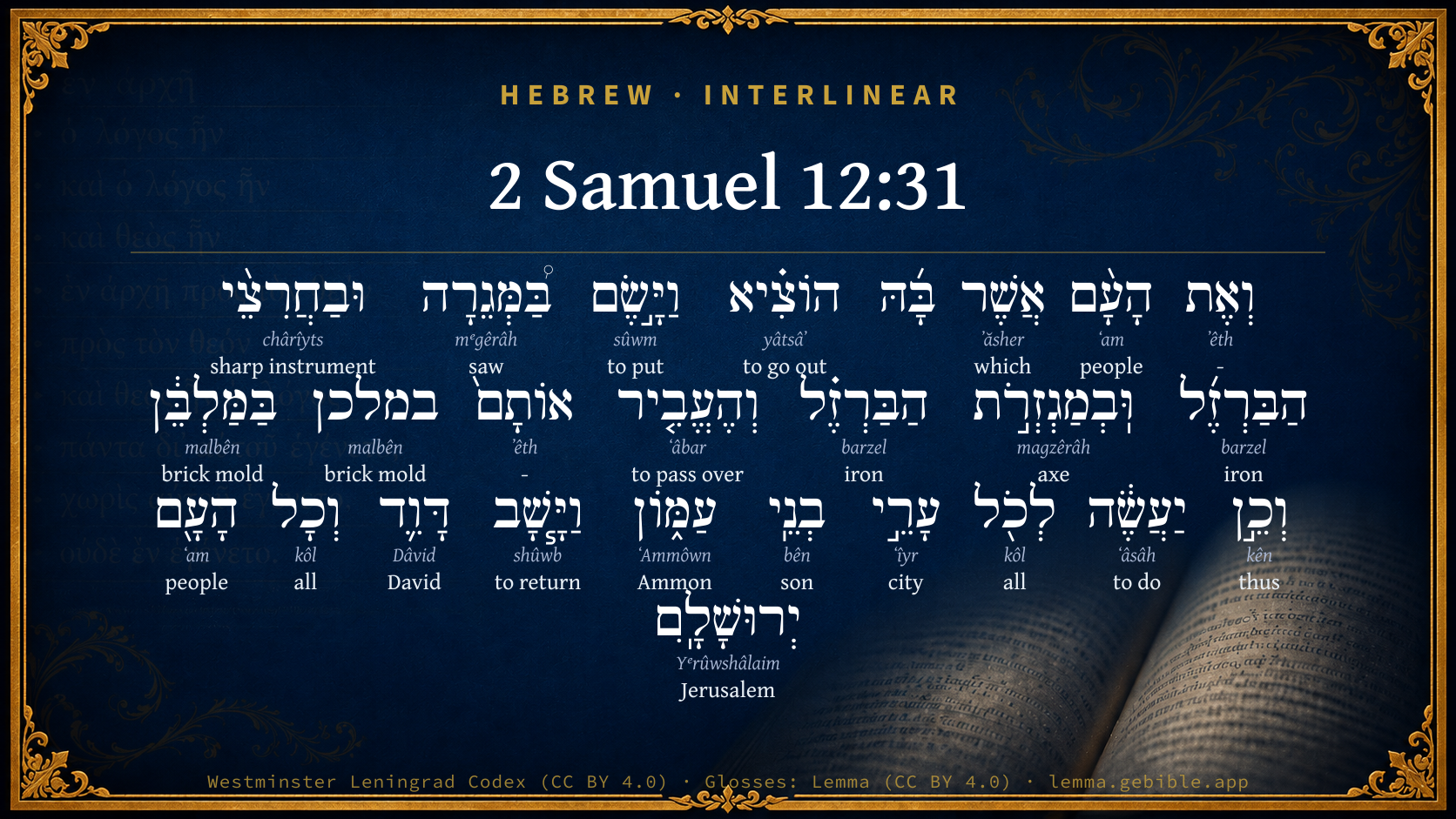
2 Samuel 12:31

Hebrew (Westminster Leningrad Codex) 2 Samuel 12:31 appears in the Hebrew Old Testament. The text above is from the Westminster Leningrad Codex. Each word links to its Strong’s number, a concise gloss, and parsing drawn from the Open Scriptures Hebrew Bible morphology. Click any word for its full Brown-Driver-Briggs (BDB) entry.
Download image
Cite this verse

2 Samuel 12:31 (World English Bible). Public Domain. Lemma interlinear Bible study tool, https://lemma.gebible.app/v/2-samuel/12/31.

Show BibTeX & RIS
BibTeX
RIS
English Translation
He brought forth the people who were therein, and put them under saws, and under harrows of iron, and under axes of iron, and made them pass through the brick kiln: and thus did he to all the cities of the children of Ammon. David and all the people returned to Jerusalem.
World English Bible · Public Domain
Highlights
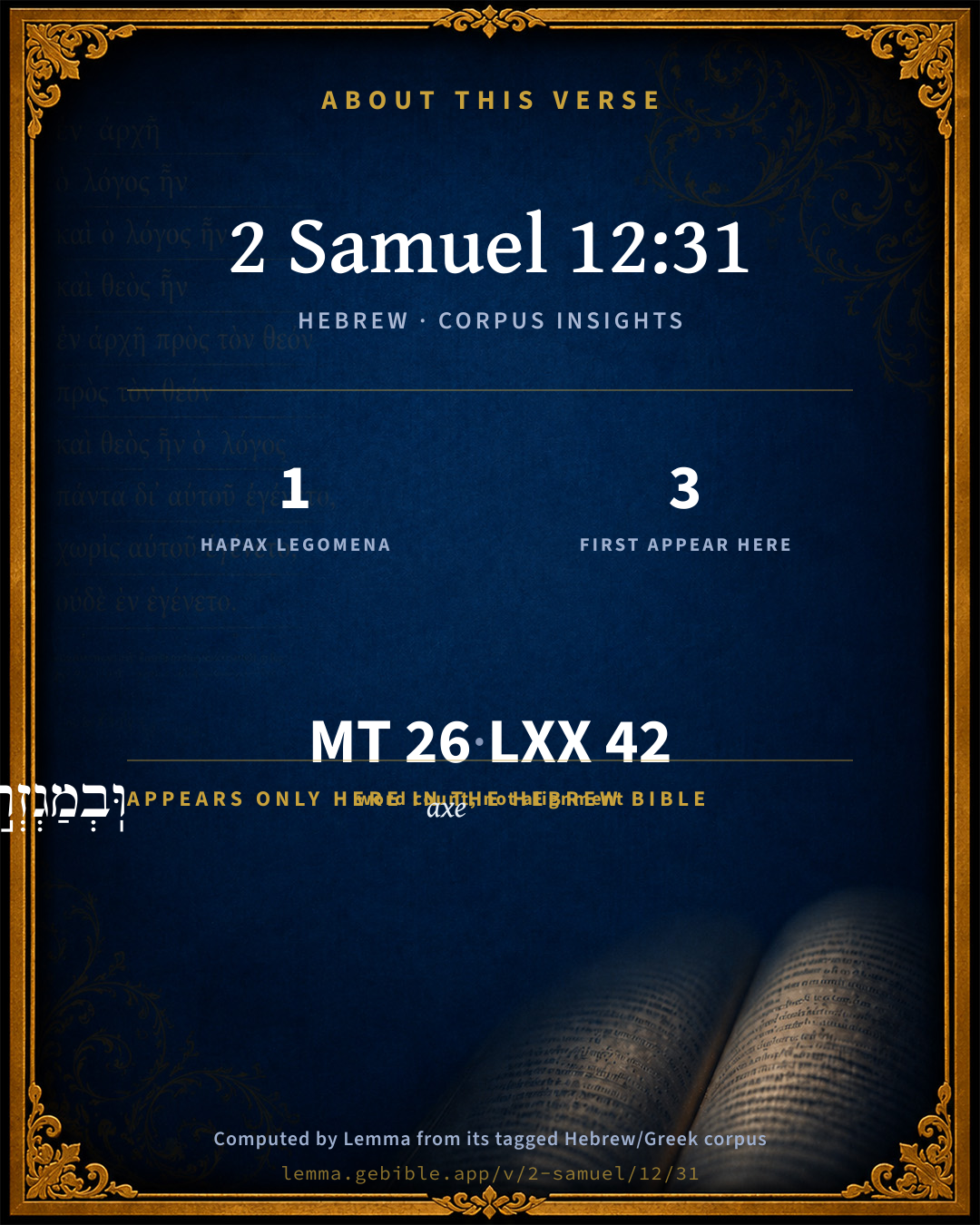
  • 1 hapax legomenon — only here in the Hebrew Bible
  • 3 first appearances in the Hebrew Bible
Full analysis ↓
Download a study sheet

One document with this verse’s original text, its word-by-word gloss line, the meaning frame, cross-references with their text, attributed commentary, and full source and license credits — printable, and it pastes into notes with its structure intact.

This verse Autodidact and up

Study sheet (.html) Plain text (.txt)

A passage Seminary Student

Up to 50 verses in one chapter. A passage sheet keeps up to 6 commentary sources and 12 cross-references per verse, in the order this page ranks them, and says so on the sheet whenever that leaves anything out. Ask for a single verse and you get the Autodidact verse sheet above.

Everything on this page stays free to read, with no account — the sheet is a download of what is already on screen, not access to it.

Want to remove ads? Support Godless Engineer
Compare translations 3

The same verse in 3 English versions, stacked beneath the original-language interlinear above. Click any original word for its lexicon entry.

Each is an independent rendering of the whole verse — the interlinear is not word-aligned to these translations.

Highlighted words mark where these versions differ — a whole-verse word diff, not a word-by-word alignment.

  • World English Bible Public Domain
    He brought forth the people who were therein, and put them under saws, and under harrows of iron, and under axes of iron, and made them pass through the brick kiln: and thus did he to all the cities of the children of Ammon. David and all the people returned to Jerusalem.
  • King James Version Public Domain
    And he brought forth the people that were therein, and put them under saws, and under harrows of iron, and under axes of iron, and made them pass through the brick-kiln: and thus did he unto all the cities of the children of Ammon. So David and all the people returned unto Jerusalem.
  • unfoldingWord Literal Text CC BY-SA 4.0
    But the people who in it, he brought out, and he set with the saw and with picks of iron and with axes of iron, and he made them pass through at the brick kiln. And thus he did to all of the cities of the sons of Ammon. And David and all of the people returned Jerusalem.

unfoldingWord Literal Text — © unfoldingWord, licensed CC BY-SA 4.0. Word-aligned USFM3 via Door43 (git.door43.org/unfoldingWord/en_ult).

Versions to compare (up to 4)

3 of 4 selected

Show all 18 translations

Every available English version of this verse, each an independent rendering of the whole verse.

  • World English Bible Public Domain
    He brought forth the people who were therein, and put them under saws, and under harrows of iron, and under axes of iron, and made them pass through the brick kiln: and thus did he to all the cities of the children of Ammon. David and all the people returned to Jerusalem.
  • Berean Standard Bible Public Domain
    David brought out the people who were there and put them to work with saws, iron picks, and axes, and he made them work at the brick kilns. He did the same to all the Ammonite cities. Then David and all his troops returned to Jerusalem.
  • Majority Standard Bible Public Domain
    David brought out the people who were there and put them to work with saws, iron picks, and axes, and he made them work at the brick kilns. He did the same to all the Ammonite cities. Then David and all his troops returned to Jerusalem.
  • King James Version Public Domain
    And he brought forth the people that were therein, and put them under saws, and under harrows of iron, and under axes of iron, and made them pass through the brick-kiln: and thus did he unto all the cities of the children of Ammon. So David and all the people returned unto Jerusalem.
  • American Standard Version (1901) Public Domain
    And he brought forth the people that were therein, and put them under saws, and under harrows of iron, and under axes of iron, and made them pass through the brickkiln: and thus did he unto all the cities of the children of Ammon. And David and all the people returned unto Jerusalem.
  • Revised Version (1885) Public Domain
    And he brought forth the people that were therein, and put them under saws, and under harrows of iron, and under axes of iron, and made them pass through the brickkiln: and thus did he unto all the cities of the children of Ammon. And David and all the people returned unto Jerusalem.
  • Geneva Bible (1599) Public Domain
    And he carryed away the people that was therein, and put them vnder sawes, and vnder yron harowes, and vnder axes of yron, and cast them into the tyle kylne: euen thus did he with all the cities of the children of Ammon. Then Dauid and all the people returned vnto Ierusalem.
  • Douay-Rheims (1899) Public Domain
    And bringing forth the people thereof he sawed them, and drove over them chariots armed with iron: and divided them with knives, and made them pass through brickkilns: so did he to all the cities of the children of Ammon: and David returned, with all the army to Jerusalem.
  • Young's Literal Translation Public Domain
    and the people who `are' in it he hath brought out, and setteth to the saw, and to cutting instruments of iron, and to axes of iron, and hath caused them to pass over into the brick-kiln; and so he doth to all the cities of the Bene-Ammon; and David turneth back, and all the people, to Jerusalem.
  • Literal Standard Version CC BY-SA 4.0
    and he has brought out the people who [are] in it, and sets [them] to the saw, and to cutting instruments of iron, and to axes of iron, and has caused them to pass over into the brick-kiln; and so he does to all the cities of the sons of Ammon; and David turns back, and all the people, to Jerusalem.
  • Unlocked Literal Bible CC BY-SA 4.0
    He brought out the people who were in the city and forced them to work with saws, iron picks, and axes; he also made them work at brick kilns. David required all the cities of the people of Ammon to do this labor. Then David and all the army returned to Jerusalem.
  • unfoldingWord Literal Text CC BY-SA 4.0
    But the people who in it, he brought out, and he set with the saw and with picks of iron and with axes of iron, and he made them pass through at the brick kiln. And thus he did to all of the cities of the sons of Ammon. And David and all of the people returned Jerusalem.
  • Darby Bible Public Domain
    And he brought out the people that were in it, and put them under the saw, and under harrows of iron, and under axes of iron, and made them pass through the brickkilns. And so did he to all the cities of the children of Ammon. And David and all the people returned to Jerusalem.
  • World Messianic Bible Public Domain
    He brought out the people who were in it, and put them to work under saws, under iron picks, under axes of iron, and made them go to the brick kiln; and he did so to all the cities of the children of Ammon. Then David and all the people returned to Jerusalem.
  • Webster's Bible Public Domain
    And he brought forth the people that were in it, and put them under saws, and under harrows of iron, and under axes of iron, and made them pass through the brick-kiln: and thus he did to all the cities of the children of Ammon. So David and all the people returned to Jerusalem.
  • Free Bible Version CC BY-SA 4.0
    David took the inhabitants and forced them to work with saws, iron picks, and axes, and he also made them work making bricks. He did the same in all the Ammonite towns. Then David and the whole Israelite army returned to Jerusalem.
  • Bible in Basic English Public Domain
    And he took the people out of the town and put them to work with wood-cutting instruments, and iron grain-crushers, and iron axes, and at brick-making: this he did to all the towns of the children of Ammon. Then David and all the people went back to Jerusalem.
  • JPS Tanakh (1917) Public Domain
    And he brought forth the people that were therein, and put them under saws, and under harrows of iron, and under axes of iron, and made them pass through the brickkiln; and thus did he unto all the cities of the children of Ammon. And David and all the people returned unto Jerusalem.

Literal Standard Version (2020), Covenant Press — licensed CC BY-SA 4.0. Text via the HelloAO Bible API (eBible.org). Unlocked Literal Bible (unfoldingWord) — licensed CC BY-SA 4.0. Text via the HelloAO Bible API (eBible.org). unfoldingWord Literal Text — © unfoldingWord, licensed CC BY-SA 4.0. Word-aligned USFM3 via Door43 (git.door43.org/unfoldingWord/en_ult). Free Bible Version, Dr. Jonathan Gallagher — licensed CC BY-SA 4.0. Text via the HelloAO Bible API (eBible.org).

Word by word

More ways to search: Search by grammar → Find every occurrence → Compare this word →

Practice this passage: Drill this verse → Learn its vocabulary →

וּֽבְמַגְזְרֹ֣ת
magzêrâh
H4037
“and · in/at · axes of”
Conjunction + Preposition + Noun, Common, Feminine, Plural, Construct
Part of Speech
Conjunction + Preposition + Noun
Type
Common
Gender
Feminine
Number
Plural
State
Construct
Full BDB Definition

Origin: from H1504

TWOT: 340d

axe, cutting instrument
  1. וְאֶת ʼêth H853 “and · -” Conjunction + Particle, Direct Object
  2. הָעָ֨ם ʻam H5971 “the · people” Particle, Definite Article + Noun, Common, Masculine, Singular, Absolute
  3. אֲשֶׁר ʼăsher H834 “which” Particle, Relative
  4. הוֹצִ֗יא yâtsâʼ H3318 “to go out” Verb, Hiphil, Perfect, 3rd Person, Masculine, Singular
  5. וַיָּ֣שֶׂם sûwm H7760 “and · to put” Conjunction + Verb, Qal, Sequential Imperfect, 3rd Person, Masculine, Singular
  6. בַּ֠מְּגֵרָה mᵉgêrâh H4050 “in/at the · saw” Preposition, Determined + Noun, Common, Feminine, Singular, Absolute
  7. וּבַחֲרִצֵ֨י chârîyts H2757 “and · in/at · sharp instruments of” Conjunction + Preposition + Noun, Common, Masculine, Plural, Construct
  8. הַבַּרְזֶ֜ל barzel H1270 “the · iron” Particle, Definite Article + Noun, Common, Masculine, Singular, Absolute
  9. הַבַּרְזֶ֗ל barzel H1270 “the · iron” Particle, Definite Article + Noun, Common, Masculine, Singular, Absolute
  10. וְהֶעֱבִ֤יר ʻâbar H5674 “and · to pass over” Conjunction + Verb, Hiphil, Perfect, 3rd Person, Masculine, Singular
  11. אוֹתָם֙ ʼêth H853 “- · them” Particle, Direct Object + Suffix, Personal, 3rd Person, Masculine, Plural
  12. במלכן malbên H4404 “in/at the · brick mold” Preposition, Determined + Noun, Common, Masculine, Singular, Absolute
  13. בַּמַּלְבֵּ֔ן malbên H4404 “in/at the · brick mold” Preposition, Determined + Noun, Common, Masculine, Singular, Absolute
  14. וְכֵ֣ן kên H3651 “and · thus” Conjunction + Particle, Demonstrative
  15. יַעֲשֶׂ֔ה ʻâsâh H6213 “to do” Verb, Qal, Imperfect, 3rd Person, Masculine, Singular
  16. לְכֹ֖ל kôl H3605 “to/for · all of” Preposition + Noun, Common, Masculine, Singular, Construct
  17. עָרֵ֣י ʻîyr H5892 “cities of” Noun, Common, Feminine, Plural, Construct
  18. בְנֵֽי bên H1121 “sons of” Noun, Common, Masculine, Plural, Construct
  19. עַמּ֑וֹן ʻAmmôwn H5983 “Ammon” Noun, Proper
  20. וַיָּ֧שָׁב shûwb H7725 “and · to return” Conjunction + Verb, Qal, Sequential Imperfect, 3rd Person, Masculine, Singular
  21. דָּוִ֛ד Dâvid H1732 “David” Noun, Proper
  22. וְכָל kôl H3605 “and · all of” Conjunction + Noun, Common, Masculine, Singular, Construct
  23. הָעָ֖ם ʻam H5971 “the · people” Particle, Definite Article + Noun, Common, Masculine, Singular, Absolute
  24. יְרוּשָׁלִָֽם Yᵉrûwshâlaim H3389 “Jerusalem” Noun, Proper

About this verse

These counts appear in no published source. They are computed here, from the morphology-tagged text and Lemma’s own curated glosses. What Lemma adds →

26
words
20
distinct lemmas
Historical
section

Notable vocabulary

1 hapax legomenon — a word that appears only here in the entire Hebrew Bible:

  • וּֽבְמַגְזְרֹ֣ת axe H4037

First appearance in Scripture

These words make their first canonical appearance in the Hebrew Bible here:

  • בַּ֠מְּגֵרָה saw H4050
  • וּֽבְמַגְזְרֹ֣ת axe H4037
  • במלכן brick mold H4404

Shared distinctive vocabulary

וּבַחֲרִצֵ֨י sharp instrument H2757 occurs in 3 verses of the Hebrew Bible. Also found in:

Grammatical profile

  • 5 verbs
  • 16 nouns
  • 1 preposition
  • 4 particles

Verb forms

  • הוֹצִ֗יא Hiphil · Perfect
  • וַיָּ֣שֶׂם Qal · Sequential Imperfect
  • וְהֶעֱבִ֤יר Hiphil · Perfect
  • יַעֲשֶׂ֔ה Qal · Imperfect
  • וַיָּ֧שָׁב Qal · Sequential Imperfect

Repetition

Words recur within this verse — often emphatic in Hebrew:

  • הָעָ֨ם people H5971 ×2
  • הַבַּרְזֶ֜ל iron H1270 ×2
  • במלכן brick mold H4404 ×2
  • לְכֹ֖ל all H3605 ×2

Hebrew & Septuagint length

In English translation the verse runs 52 words from the Hebrew and 53 from the Septuagint (LXX English) — closely comparable.

A rough comparison of the two English renderings, which tokenize alike — not a word-level alignment.

Word counts can differ between the Hebrew and the Greek without any difference in meaning — e.g. the Hebrew direct-object marker אֵת has no separate Greek word, and Greek often adds the article ὁ.

In the original languages it is 26 Hebrew tokens and 42 Greek tokens — but the two are counted differently (Hebrew bundles its prefixes and suffixes into one token; the Greek is in lemma form), so that isn’t a like-for-like length.

Cross-references

4

Topical passages linked to 2 Samuel 12:31 in the Treasury of Scripture Knowledge — connected by theme and wording, ordered by reader-vote popularity; previews shown in the World English Bible.

  • 1 Chronicles 20:3 He brought forth the people who were therein, and cut [them] with saws, and with harrows of iron, and with axes. Thus did David to all the cities of the children of Ammon. David and all the people returned to Jerusalem.
  • 2 Samuel 8:2 He struck Moab, and measured them with the line, making them to lie down on the ground; and he measured two lines to put to death, and one full line to keep alive. The Moabites became servants to David, and brought tribute.
  • Psalms 21:8–9 Your hand will find out all of your enemies. Your right hand will find out those who hate you.
  • Amos 1:3 Thus says Yahweh: "For three transgressions of Damascus, yes, for four, I will not turn away its punishment; Because they have threshed Gilead with threshing instruments of iron;

Cross-references courtesy of OpenBible.info (CC BY 4.0).

Hebrew and Greek witnesses Masoretic Hebrew ↔ Greek Septuagint

The same verse in the two great witnesses to the Old Testament, shown verse-for-verse.

These are two independent witnesses, not word-aligned to each other, and the Septuagint is shown in lemma (dictionary) form.

Hebrew 2 Samuel 12:31 Masoretic · Westminster Leningrad Codex

וְאֶת הָעָ֨ם אֲשֶׁר בָּ֜הּ הוֹצִ֗יא וַיָּ֣שֶׂם בַּ֠מְּגֵרָה וּבַחֲרִצֵ֨י הַבַּרְזֶ֜ל וּֽבְמַגְזְרֹ֣ת הַבַּרְזֶ֗ל וְהֶעֱבִ֤יר אוֹתָם֙ במלכן בַּמַּלְבֵּ֔ן וְכֵ֣ן יַעֲשֶׂ֔ה לְכֹ֖ל עָרֵ֣י בְנֵֽי עַמּ֑וֹן וַיָּ֧שָׁב דָּוִ֛ד וְכָל הָעָ֖ם יְרוּשָׁלִָֽם

He brought forth the people who were therein, and put them under saws, and under harrows of iron, and under axes of iron, and made them pass through the brick kiln: and thus did he to all the cities of the children of Ammon. David and all the people returned to Jerusalem.

World English Bible · Public Domain

Greek LXX 2 Samuel 12:31 Septuagint · lemma form

καί ὁ λαός ὁ εἰμί ἐν αὐτός ἐκἄγω καί τίθημι ἐν ὁ πρίων καί ἐν ὁ τρίβολος ὁ σιδηροῦς καί διαἄγω αὐτός διά ὁ πλινθεῖον καί οὕτως ποιέω πᾶς ὁ πόλις υἱός αμμων καί ἐπιστρέφω δαυίδ καί πᾶς ὁ λαός εἰς ἰερουσαλήμ

And he brought forth the people that were in it, and put them under the saw, and under iron harrows, and axes of iron, and made them pass through the brick-kiln: and thus he did to all the cities of the children of Ammon. And David and all the people returned to Jerusalem.

LXX2012 (modern English Septuagint) · Public Domain

On this verse, The Pulpit Commentary discusses the Septuagint’s reading. Read the note in Commentary ↓

Hebrew: Westminster Leningrad Codex (CC BY 4.0). Greek: Septuagint (public domain); English from LXX2012 (modern English Septuagint) (Public Domain). How the Septuagint differs from the Hebrew →

Targum (Aramaic paraphrase)

1

The Targum is the ancient Jewish Aramaic paraphrase of the Hebrew Scriptures — an interpretive translation, not the Hebrew text itself. Onkelos (literal) and Pseudo-Jonathan (expansive) render the Torah, and Jonathan the Prophets. Coverage is partial: where no permissively-licensed English translation exists for a verse, only the Aramaic is shown. This is verse-level text, not a word-by-word alignment to the Hebrew.

  1. Targum Jonathan Prophets (Joshua–Malachi)
    וְיַת עַמָא דְבָהּ אַפֵּיק וּמְסַר יַתְהוֹן בִּמְסָרִין וּבְמוֹרִיגֵי פַרְזְלָא וּבְמִגְזְרֵי פַרְזְלָא וּגְרַר יַתְהוֹן בְּשׁוּקַיָא וְכֵן עֲבַד לְכָל קִירְוֵי בְנֵי עַמוֹן וְתַב דָוִד וְכָל עַמָא לִירוּשְׁלֵם:

    (no public-domain English translation for this verse)

    Targum Jonathan — Aramaic: “Mikraot Gedolot” (public domain). English: “Sefaria Community Translation” (CC0 1.0 (public-domain dedication)); “London "Chaldee Paraphrase," 1871” (public domain). Text via Sefaria.

Commentary

Notes on 2 Samuel 12:31 from classic Christian and Jewish commentators (each source and its license shown beneath its notes). The classic Christian expositions comment on the surrounding passage and are grouped to its opening verse, so a note may address several verses; the Jewish commentaries on the Tanakh (Rashi and others) are per-verse, so they appear only where the commentator wrote on this verse.

Lemma curates 59 commentaries, every one of them public domain or Creative Commons licensed, each selected and text-cleaned for this edition rather than reprinted as found. About our sources →

Trapp's Complete Commentary

John Trapp

2Sa 12:31 And he brought forth the people that [were] therein, and put [them] under saws, and under harrows of iron, and under axes of iron, and made them pass through the brickkiln: and thus did he unto all the cities of the children of Ammon. So David and all the people returned unto Jerusalem.

Ver. 31. And he brought forth the people that were therein.] The ring leaders especially, who had been chief in abusing David’s messengers. The Corinthians abused certain Roman ambassadors, and were therefore burnt to the ground by L. Mummius: {a} for irasci populo Romano nemo sapienter possit, saith Livy. No wise man will wrong the people of Rome: much less the people of God: and least of all the ambassadors of Christ. Hath any one ever waxed fierce against him and prospered? {Job 9:4} I think not.

And put them under saws, and under harrows of iron.] This was a kind of most terrible torture, {Amo 1:3 Heb 11:37} when

"Tribulaeque, trahaeque et iniquo pondere rastri," - Virg. Georg. i.

saws, harrows, axes were used in this sort, for punishment of offenders. Whether David did not herein overdo, the doctors are divided. Certain it is, that what miseries soever impenitent sinners suffer here, they are but a typical hell, a praeludium to the wrath to come, a beginning of sorrows, a foretaste of torments without end and past imagination.

And made them pass through the brickkiln.] Per fornacem Moleci, through Molech’s furnace; where they made their children to pass through the fire, as Junius judgeth.

{a} Cic. pro lege Manil.

John Trapp, A Commentary or Exposition upon All the Books of the Old and New Testament (1647–1656) — public domain. Text from a community e-Sword module.

Joseph Benson's Commentary

2Sa 12:31. He brought forth the people — The words are indefinite, and therefore not necessarily to be understood of all the people, but of the men of war, and especially of those who had been the chief actors of that villanous action against David’s ambassadors, and of the dreadful war ensuing upon it; for which they deserved severe punishments. Indeed, since David left Shobi in the government of Rabbah, (2Sa 17:27,) it must be presumed that he left some besides female subjects under his dominion; and it is most likely that the bulk of the people were received to mercy, and only the king, and the accomplices and instruments of his tyranny, suffered the chastisements due to their guilt. And put them under saws, &c. — The Hebrew, וישׂם במגרה, vajasem bammegeerah, &c., may be literally and properly rendered, and he put them to the saw, and to iron harrows, or mines, and to axes of iron, and made them pass by, or to, the brick-kilns; that is, he made them slaves, and put them to the most servile employments, namely, sawing, harrowing, or making iron harrows, or mining, hewing of wood, and making brick. The version of the Seventy, though not very clear, may be interpreted to the same purpose. The Syriac and Arabic versions render the passage, He brought them out, and threw them into chains, and iron shackles, and made them pass before him in a proper measure, or by companies at a time. If the parallel place, 1Ch 20:3, which our version renders, He cut them with saws, and with harrows of iron, and with axes, be objected, it must be observed, the Hebrew,וישׂר, vajasser, may be rendered, He separated to the saw, &c.; or, He ruled or governed by the saw, harrows, mines, and axes; made them slaves, and condemned them to these servile employments. Thus the words are rendered by Schmidius. And “this interpretation,” says Dr. Dodd, “is far from being forced, is agreeable to the proper sense and construction of the words, and will vindicate David from any inhumanity that can be charged upon the man after God’s own heart. The Syriac version is, He bound them with iron chains, &c.; and thus he bound them all. And the Arabic, He bound them all with chains, killing none of the Ammonites, This interpretation may be further confirmed by the next clause: Thus did he unto all the children of Ammon — For had he destroyed all the inhabitants by these, or any methods of severity, it would have been an almost total extirpation of them; and yet we read of them as united with the Moabites, and the inhabitants of Seir, and forming a very large army to invade the dominions of Jehoshaphat. It may be added, that if the punishments inflicted on this people were as severe as our version represents them, they were undoubtedly inflicted by way of reprisals. Nahash, the father of Hanun, in the wantonness of cruelty, would admit the inhabitants of Jabesh-Gilead to surrender themselves to him upon no other condition than their every one consenting to have their right eye thrust out, that he might lay it as a reproach upon all Israel. If these severities of David were now exercised by way of retaliation for former cruelties of this nature, it will greatly lessen the horror that may be conceived upon account of them, and, in some measure, justify David’s using them; and as the sacred writers, who have transmitted this history to us, do not pass any censure on David for having exceeded the bounds of humanity in this punishment of the Ammonites, we may reasonably conclude, either that the punishment was not so severe as our version represents it, or that there was some peculiar reason that demanded this exemplary vengeance, and which, if we were acquainted with it, would induce us to pass a more favourable judgment concerning it; or that the law of nations, then subsisting, admitted such kind of executions upon very extraordinary provocations, though there are scarce any that can justify them.” See Delaney and Chandler, p. 178. But in whatever light we view these severities exercised upon the Ammonites, they ought, in no manner, to be proposed as an example to Christians, nor be pleaded as a precedent for any people to do the like. For the divine laws are the rules of our conduct, and not the actions of any men whomsoever.

Joseph Benson's Commentary on the Old and New Testaments (1811–1818) — public domain. Text from a community e-Sword module.

Tyndale Open Study Notes

Tyndale Open Resources

12:31 He also made slaves of the people of Rabbah and forced them to labor with: Enslaving defeated peoples was in accord with Deut 20:11. Solomon later did the same with the Canaanites (1 Kgs 9:20-22; see also Judg 1:30, 33). The alternate reading might indicate torture inflicted on the defeated Ammonites (cp. textual note on 1 Chr 20:3).

Tyndale Open Study Notes — © Tyndale Open Resources, licensed CC BY-SA 4.0. Text via the HelloAO Bible API.

Geneva Bible (1599)

Geneva Bible translators

Signifying that as they were malicious enemies of God, so he put them to cruel death.

Geneva Bible (1599) marginal notes — public domain. Text via Bolls.life.

Jamieson, Fausset & Brown

Robert Jamieson, A. R. Fausset & David Brown

he brought forth the people . . . and put them under saws, &c.--This excessive severity and employment of tortures, which the Hebrews on no other occasion are recorded to have practised, was an act of retributive justice on a people who were infamous for their cruelties (Sa1 11:2; Amo 1:13).

Next: 2 Samuel Chapter 13

Jamieson, Fausset & Brown — Commentary Critical and Explanatory on the Whole Bible (1871) — public domain (CC PDM 1.0). Text via the HelloAO Bible API.

Adam Clarke's Commentary

Verse 31. He brought forth the people] And put them under saws. From this representation a great cry has been raised against "David's unparalleled, if not diabolic, cruelty." I believe this interpretation was chiefly taken from the parallel place, 1Ch 20:3, where it is said, he cut them with saws, and with axes, c. Instead of וישר vaiyasar, he sawed, we have here (in Samuel) וישם vaiyasem, he put them and these two words differ from each other only in a part of a single letter, ר resh for ם mem. And it is worthy of remark, that instead of וישר vaiyasar, he sawed, in 1Ch 20:3, six or seven MSS. collated by Dr. Kennicott have וישם vaiyasem, he put them; nor is there found any various reading in all the MSS. yet collated for the text in this chapter, that favours the common reading in Chronicles. The meaning therefore is, He made the people slaves, and employed them in sawing, making iron harrows, or mining, (for the word means both,) and in hewing of wood, and making of brick. Sawing asunder, hacking, chopping, and hewing human beings, have no place in this text, no more than they had in David's conduct towards the Ammonites.

It is surprising, and a thing to be deplored, that in this and similar cases our translators had not been more careful to sift the sense of the original words by which they would have avoided a profusion of exceptionable meanings with which they have clothed many passages of the sacred writings. Though I believe our translation to be by far the best in any language, ancient or modern, yet I am satisfied it stands much in need of revision. Most of the advantages which our unbelievers have appeared to have over certain passages of Scripture, have arisen from an inaccurate or false translation of the terms in the original; and an appeal to this has generally silenced the gainsayers. But in the time in which our translation was made, Biblical criticism was in its infancy, if indeed it did exist; and we may rather wonder that we find things so well, than be surprised that they are no better.

Adam Clarke's Commentary on the Bible (1810–1826) — public domain. Text from a community e-Sword/MySword module.

Ellicott's Commentary for English Readers

(31) Put them under saws.—The literal translation of the Hebrew (put them with, or into, the saw) does not give any good sense, and no doubt a single letter of the text should be changed, bringing it into agreement with 1Ch_20:3, “cut them with saws.” (Comp. Heb_11:37.)

Harrows of iron.—These are the heavy iron tools, often armed with sharp points on the lower side, which were used for the purposes of threshing the grain and breaking up the straw.

The brick-kiln.—This is the reading of the Hebrew text, and there is no sufficient reason to call it in question. The Hebrew margin, however, has “through Malchan; “and hence some have supposed that David made the Ammonites pass through the same fire by which they were accustomed to consecrate their children to Molech.

In the infliction of these cruelties on his enemies David acted in accordance with the customs and the knowledge of his time. Abhorrent as they may be to the spirit of Christianity, David and his contemporaries took them as matters of course, without a suspicion that they were not in accordance with God’s will.

A Bible Commentary for English Readers, edited by Charles John Ellicott (1878–1897) — public domain. Text from a community e-Sword module.

The Cambridge Bible for Schools and Colleges

gen. ed. J. J. S. Perowne

31. put them under saws] Put them upon saws: or perhaps we should read as in Chron., sawed them with saws. Cp. Heb_11:37. This barbarous practice was not unknown at Rome. “[Caligula] medios serra dissecuit.” (Sueton. Calig. 27.)

harrows of iron] Threshing-sledges of iron: sledges or frames armed on the underside with rollers or sharp spikes, used for the purpose of bruising the ears of corn, and extracting the grain, and at the same time breaking up the straw into small pieces for use as fodder. See Wilkinson’s Ancient Egyptians, i. 408, ii. 423.

made them pass through the brick-kiln] Burned them in brick-kilns. The phrase is chosen with reference to the idolatrous rite practised by the Ammonites, of “making their children pass through the fire” in honour of Moloch (2Ki_23:10). This is the meaning of the Qrî or read text (see Introd. p. 15), which is probably correct. The Kthîbh or written text however has “made them pass through the Malchan,” which is explained to mean the place where they burnt their children in honour of Moloch. But the word occurs nowhere else, and is of doubtful authority.

These cruel punishments must be judged according to the standard of the age in which they were inflicted, not by the light of Christian civilisation. The Ammonites were evidently a savage and brutal nation (1Sa_11:1-2; 2Sa_10:1-5; Amo_1:13), and in all probability they were treated no worse than they were accustomed to treat others. It was the age of retaliation, when the law of like for like—the lextalionis—prevailed (Jdg_1:7; Lev_24:19-20). They had foully insulted David, and it is not to be wondered at if he was provoked into making a signal example of them by this severity. In this respect he did not rise above the level of his own age. Modern history has its parallels, not only in the barbarities perpetrated at Alençon by a ruthless soldier like William the Conqueror, but in the merciless massacre by which the Black Prince sullied his fair fame on the capture of Limoges. Green’s History, pp. 72, 226.

The Cambridge Bible for Schools and Colleges (gen. ed. J. J. S. Perowne; Cambridge University Press, 1878–1918) — public domain. Text from a community e-Sword module.

Albert Barnes' Notes on the Bible

For the saw as an implement of torture compare Heb 11:37.

Harrows of iron - Or rather thrashing-machines (Isa 28:27; Isa 41:15, etc.).

Axes - The word so rendered occurs only here and in 1Ch 20:3. It evidently means some cutting instrument.

Made them pass through the brick-kiln - The phrase is that always used of the cruel process of making their children pass through the fire to Moloch, and it is likely that David punished this idolatrous practice by inflicting something similar upon the worshippers of Moloch. The cruelty of these executions belongs to the barbarous manners of the age, and was provoked by the conduct of the Ammonites 2Sa 10:1-4; 1Sa 11:1-2, but is utterly indefensible under the light of the Gospel. If Rabbah was taken before David’s penitence, he may have been in an unusually harsh and severe frame of mind. The unpleasant recollection of Uriah’s death would be likely to sour and irritate him to the utmost.

Albert Barnes' Notes on the Bible (1834–1885) — public domain. Text from a community e-Sword/MySword module.

Haydock's Catholic Bible Commentary

Sawed. Hebrew, "he put them under saws, and under rollers of iron, and under knives," &c. (Haydock) --- The Jews say that Isaias was killed by being sawed asunder; to which punishment St. Paul alludes, Hebrews xi. 37. (Menochius) --- Brick-kilns, or furnaces, Psalm xx. 10. (Muis) --- David and his companions were thrown into the fiery furnace, Daniel iii. 6, 11., and Esther xiii. 7. (Calmet) --- Some condemn David of excessive cruelty on this occasion. (Tirinus; Sanctius) --- But the Scripture represents his conduct as irreproachable, except in the affair of Urias; (3 Kings xv. 5,) and at this distance of time, we know not the motives which might have actuated him to treat his enemy with such severity. The Ammonites had probably exercised similar cruelties on his subjects. See 1 Kings xi. 2., and Amos i. 13. (Calmet) --- They had shamefully violated the law of nations, and had stirred up various kings against David. (Menochius) --- Salien blames Joab for what may seem too cruel. But, though he was barbarous and vindictive, we need not condemn him on this occasion, no more than his master; as we are not to judge of former times by our own manners. (Haydock) --- War was then carried on with great cruelty. (Calmet)

George Leo Haydock (1774–1849), Haydock's Catholic Family Bible and Commentary, 1859 edition — public domain. Excludes Psalms (Douay-Rheims chapter numbering differs from Protestant) and Deuterocanonical books (Catholic canon only).

Matthew Poole's English Annotations

The people that were therein: the words are indefinite, and therefore not necessarily to be understood of all the people; for it had been barbarous to use women and children thus; but of the men of war, and especially of those who had been the chief actors or abettors of that villainous action against David’s ambassadors, (which was contrary to the law of nature, and of nations, and of all humanity,) and of the dreadful war ensuing upon it; for which they might seem to deserve the severest punishments. Although indeed there seems to have been too much rigour used; especially, because these dreadful deaths were inflicted not only upon those great counsellors, who were the only authors of that vile usage of the ambassadors; but upon a great number of the people, who were innocent from that crime. And therefore it is probably conceived that David exercised this cruelty whilst his heart was hardened and impenitent, and when he was bereaved of that free and good Spirit of God which would have taught him more mercy and moderation.

Put them under saws: he sawed them to death; of which punishment we have examples, both in Scripture, Heb 11:37, and in other authors. Under harrows of iron, and under axes of iron; he caused them to be laid down upon the ground, and torn by sharp iron harrows drawn over them, and hewed in pieces by keen axes. Made them pass through the brick-kiln, i.e. to be burnt in brickkilns. Or, made them to pass through the furnace of Malchen, i.e. of Moloch, called also Milchom, and here Malchen; punishing them with their own sin, and with the same kind of punishment which they inflicted upon their own children: see 2Ki 16:3; 23:10; Lev 18:21; 20:2; Deu 18:10.

Matthew Poole's English Annotations on the Holy Bible (1683–1685) — public domain. Text from a community e-Sword/MySword module.

Whedon's Commentary on the Bible

Daniel D. Whedon

31. Put them under saws — That is, as 1Ch_20:3 explains it, cut them with saws. They were sawn asunder, as Isaiah is said to have been tortured. Heb_11:37. Shaw, in his Travels, describes a case of sawing asunder by placing the criminal between boards, and then beginning at the head. The above cut of ancient saws is from paintings found at Herculaneum.

Harrows of iron — Rather, as the cognate Hebrew word is rendered in Amo_1:3, Threshing instruments of iron. The victims were probably made to lie down on the ground, as were the Moabites when David measured them with a line, (2Sa_8:2,) and a heavy threshing instrument, with jagged iron rollers underneath, was drawn over them.

Axes of iron — For cut of ancient axes see on 1Sa_13:21. But it is not clear that the word מגזרות, which occurs here only, means axes. Keil renders it simply iron cutting tools, and we incline to believe with him that “the meaning cannot be more precisely determined.”

Made them pass through the brick-kiln — Burned to death vast numbers of them by forcing them into the fires of brick-kilns. By these various instruments and methods of torture did David execute the captive Ammonites, thus retaliating upon them cruelties equivalent to what they themselves were accustomed to impose upon their captives. Many have cried out against these terrible cruelties, and thought it impossible that David could have been barbarous enough to authorize them. Hence has arisen another interpretation, which makes the text mean that David enslaved the people, and set them at sawing and hewing wood, making or using iron instruments, and burning brick. But this interpretation accords not well with the words, has the text in Chronicles decidedly against it, and is also open to the objection that the Hebrew people had little or no need of these kinds of labour. Their houses were of stone, or else simply tents, their iron instruments were comparatively few, and they certainly made no such use of wood as required so many sawyers and hewers as all these cities of the Ammonites afforded. But if we consider the customs of that age, and the barbarous character of these Ammonites, we will see the ground and reason of David’s severity. They were wont to rip up women with child, (Amo_1:13;) they would not covenant with the men of Jabesh except that they might thrust out all their right eyes, (1Sa_11:2,) and they had provoked this war by their most shameful treatment of David’s friendly ambassadors. 2Sa_10:4. If, then, it was proper barbarously to mutilate Adoni-bezek because he had thus mutilated other kings, (Jdg_1:6-7,) and to hew Agag in pieces because his sword had made women childless, (1Sa_15:33,) and utterly destroy the idolatrous nations of Canaan, (Deu_7:2; Jos_6:21; Jos_8:25-26; 1Sa_15:3,) it is surely a strange inconsistency to cry out against this retaliatory severity of David, as if it were unparalleled and diabolical. The measure was strictly in accordance with the military customs of the age.

Daniel D. Whedon (gen. ed.), Commentary on the Old and New Testaments (1874–1909) — public domain. Text from a community e-Sword module.

The Pulpit Commentary

The people that were therein. The cruel treatment described in this verse was inflicted, first of all, upon those who had defended Rabbah, now reduced to a small number by the long siege; but David next proceeded through all the cities, that is, the fortified towns of the Ammonites, inflicting similar barbarities. They were confined probably to the fighting men, and most of these would make their escape as soon as resistance became hopeless. The general population would, of course, scatter themselves in every direction, but the misery caused by such a breaking up of civil life, as well as by the cruel bloodshed, must have been terrible. Instead of "he put them in a saw," we find, in 1Ch_20:3, "he sawed them with a saw." This reading differs from what we have here only in one letter, and is plainly right, as the translation, "under saws," "under harrows of iron," etc., found both in the Authorized and Revised Versions, is simply an expedient, tendered necessary by the corruption of the text. If we restore the passage by the help of the parallel place, it runs on thus: "He sawed with a saw, and with threshing sledges of iron, and with cutting instruments of iron." What exactly the second were we do not know, as the word does not occur elsewhere. The Vulgate renders it "wains shod with iron," meaning, apparently, those driven over the corn for threshing purposes, and now driven over these unfortunate people. The barbarity is not more horrible than that of sawing prisoners asunder. He made them pass through the brick kiln. Both the Septuagint and Vulgate have "brick kiln," Hebrew, malban, which the Massorites have adopted, but the Hebrew text has malchan. No commentator has given any satisfactory explanation of what can be meant by making the Ammonites pass through a brick kiln; but Kimchi gives a very probable interpretation of the word really found in the Hebrew, and which, not being intelligible, has been corrupted. For the Malchan was, he says, the place where the Ammonites made their children pass through the fire to Moloch. He thinks, therefore, that David put some of the people to death in this way. We cannot defend these cruelties, but they unhappily were the rule in Oriental warfare, and would have been inflicted on their enemies by the Ammonites. We have proof in 1Sa_11:2 and Amo_1:13 that they were a barbarous race; but this did not justify barbarous retaliation.

The Pulpit Commentary (1880–1919), ed. H.D.M. Spence-Jones & Joseph S. Exell — public domain. Text from a community e-Sword module.

John Wesley's Explanatory Notes

The people - The words are indefinite, and therefore not necessarily to be understood of all the people; but of the men of war, and especially of those who had been the chief actors of that villainous action against David's ambassadors, and of the dreadful war ensuing upon it; for which, they deserved severe punishments. Altho' indeed there seems to have been too much rigor used; especially, because these deaths were inflicted not only upon those counsellors, who were the only authors of that vile usage of the ambassadors; but upon some number of the people. And therefore it is probable, David exercised this cruelty whilst his heart was hardened, and impenitent; and when he was bereaved of that good spirit of God, which would have taught him more mercy. Saws - He sawed them to death of which punishment, we have examples both in scripture, and in other authors. Brick-kiln - Or, made them to pass through the furnace of Malchen: that is, of Moloch; punishing them with their own sin, and with the same kind of punishment which they had inflicted upon their own children.

John Wesley, Explanatory Notes Upon the Whole Bible (1754–1765) — public domain. Text via the GEBible commentary corpus.

Keil & Delitzsch

C. F. Keil & F. Delitzsch

He also had the inhabitants executed, and that with cruel tortures. "He sawed them in pieces with the saw and with iron harrows." בּמּגרה ויּשׂם, "he put them into the saw," does not give any appropriate sense; and there can be no doubt, that instead of וישׂם we should read ויּשׂר (from שׂוּר): "he cut (sawed) them in pieces." הבּרזל וּבמגזרות, "and with iron cutting tools." The meaning of the ἁπ. λεγ. מגזרות cannot be more precisely determined. The current rendering, "axes or hatchets," is simply founded upon the circumstance that גּזר, to cut, is applied in Kg2 6:4 to the felling of trees. The reading in the Chronicles, וּבמּגרות, is evidently a copyist's error, as we have already had בּמּגרה, "with the saw." The meaning of the next clause is a disputed point, as the reading itself varies, and the Masoretes read בּמּלבּן instead of the Chethibh במלכן, "he made them go through brick-kilns," i.e., burnt them in brick-kilns, as the lxx and Vulgate render it. On the other hand, Thenius takes the Chethibh under his protection, and adopts Kimchi's explanation: "he led them through Malchan, i.e., through the place where the Ammonites burned their children in honour of their idol." Thenius would therefore alter בּמלכּם into בּמלכּם or בּמּלכּם: "he offered them as sacrifices in their image of Moloch. " But this explanation cannot be even grammatically sustained, to say nothing of the arbitrary character of the alteration proposed; for the technical expression למּלך בּאשׁ חעביר, "to cause to go through the fire for Moloch" (Lev 18:21), is essentially different from בּמּלך חעביר, to cause to pass through Moloch, an expression that we never meet with. Moreover, it is impossible to see how burning the Ammonites in the image of Moloch could possibly be "an obvious mode of punishing idolatry," since the idolatry itself consisted in the fact that the Ammonites burned their children to Moloch. So far as the circumstances themselves are concerned, the cruelties inflicted upon the prisoners are not to be softened down, as Daaz and others propose, by an arbitrary perversion of the words into a mere sentence to hard labour, such as sawing wood, burning bricks, etc. At the same time, the words of the text do not affirm that all the inhabitants of Rabbah were put to death in this cruel manner. בּהּ אשׁר העם (without כּל) refers no doubt simply to the fighting men that were taken prisoners, or at the most to the male population of the acropolis of Rabbah, who probably consisted of fighting men only. In doing this, David merely retaliated upon the Ammonites the cruelties with which they had treated their foes; since according to Amo 1:13 they ripped up women who were with child, and according to Sa1 11:2 their king Nahash would only make peace with the inhabitants of Jabesh upon the condition that the right eye of every one of them should be put out. It is sufficiently evident from this, that the Ammonites had aimed at the most shameful extermination of the Israelites. "Thus did he unto all the cities of the Ammonites," i.e., to all the fortified cities that resisted the Israelites. After the close of this war, David returned to Jerusalem with all the men of war. The war with the Syrians and Ammonites, including as it did the Edomitish war as well, was the fiercest in which David was ever engaged, and was also the last great war of his life.

Keil & Delitzsch — Biblical Commentary on the Old Testament (1861–1891) — public domain (CC PDM 1.0). Text via the HelloAO Bible API. (Old Testament only.)

unfoldingWord translationNotes

Door43 World Missions Community

He brought out the people

David did not bring out the people himself; he commanded his soldiers to bring them out. AT: "David commanded his soldiers to bring out the people" (See: Metonymy)

saws, iron picks, and axes

These are tools to cut wood or break up the ground.

brick kilns

ovens where bricks are dried and hardened

all the cities of the people of Ammon

This refers to the people in the cities. AT: "all the people of the cites of Ammon" (See: Metonymy)

translationWords

ax

people group

Ammon

labor

Jerusalem

unfoldingWord translationNotes — © Distant Shores Media and the Door43 World Missions Community, licensed CC BY-SA 4.0. Source: git.door43.org/Door43/en_tn.

Rashi

Rabbi Shlomo Yitzchaki (Rashi)

Saw-like utensils, iron threshing utensils and iron axes. They are types of tortures.

Saw-like utensils. A knife serrated with many [sharp] edges bent towards each other.

Threshing utensils. This is a hacked saw full of cuts like "many sharp edges" that is called laime (O.F.).

The streets. In the mud of the streets and so Yonason [also] translated: "He dragged them in the streets."

Rashi on the Tanakh — English translations: “The Judaica Press complete Tanach with Rashi, translated by A. J. Rosenberg” (CC BY 4.0); “Pentateuch with Rashi's commentary by M. Rosenbaum and A.M. Silbermann, 1929-1934” (public domain); “The Metsudah Tanach series, Lakewood, N.J” (CC BY 4.0); and “The Book of Joshua, Metsudah Publications, 1997” (CC BY 4.0). Text via Sefaria.

Lesson kit

Teaching starters — assembled from the data on this page, not authored interpretation. Every prompt links to the verse data it draws on. Edit before teaching.

2 Samuel, in the Historical, opens this verse with 26 words (20 distinct Hebrew lemmas). Its most distinctive word is magzêrâh (“axe”). A historical commentator’s framing appears above. Read the whole chapter for the surrounding context.

Discussion questions

  1. The word magzêrâh carries the sense “axe.” How does it shape the verse?
  2. This verse holds 1 word here found nowhere else in the Hebrew Bible. What might the rare word draw attention to?
  3. 3 words here appear for the first time in Scripture. What is being introduced at this debut?
  4. 1 Samuel 17:18 shares the word «sharp instrument» with this verse. How do the two illuminate each other?
  5. “people” occurs 2× in this one verse. What is the effect of the repetition?
  6. These translations render this verse differently. What is at stake in choosing one wording over another?
  7. The verb «הוֹצִ֗יא» is Hiphil Perfect. How does its form color the action?
  8. Reading how Trapp's Complete Commentary and Joseph Benson's Commentary read this verse, where do the two commentators agree and where do they part?

Things to notice

  • 1 word in this verse appears nowhere else in the Hebrew Bible.
  • 3 words make their first canonical appearance in Scripture here.
  • This verse counts 26 Hebrew ↔ 42 Greek words.
  • These translations choose different wording for 16 words in this verse.
  • “people” occurs 2× in this single verse.

Reading settings

Reading text

Shown beneath each verse's original-language words.

Old Testament
Old Testament edition

Read the OT as the Masoretic Hebrew (MT) or the Greek Septuagint (LXX).

English shown for the Greek Septuagint (in the Hebrew ↔ Greek comparison).

Comparing translations? Open the Compare panel on any verse page to stack up to four side by side.