Genesis 24:12

Hebrew (Westminster Leningrad Codex) Genesis 24:12 appears in the Hebrew Old Testament. The text above is from the Westminster Leningrad Codex. Each word links to its Strong’s number, a concise gloss, and parsing drawn from the Open Scriptures Hebrew Bible morphology. Click any word for its full Brown-Driver-Briggs (BDB) entry.
Download image
Cite this verse

Genesis 24:12 (World English Bible). Public Domain. Lemma interlinear Bible study tool, https://lemma.gebible.app/v/genesis/24/12.

Show BibTeX & RIS
BibTeX
RIS
English Translation
He said, "Yahweh, the God of my master Abraham, please give me success this day, and show kindness to my master Abraham.
World English Bible · Public Domain
Highlights
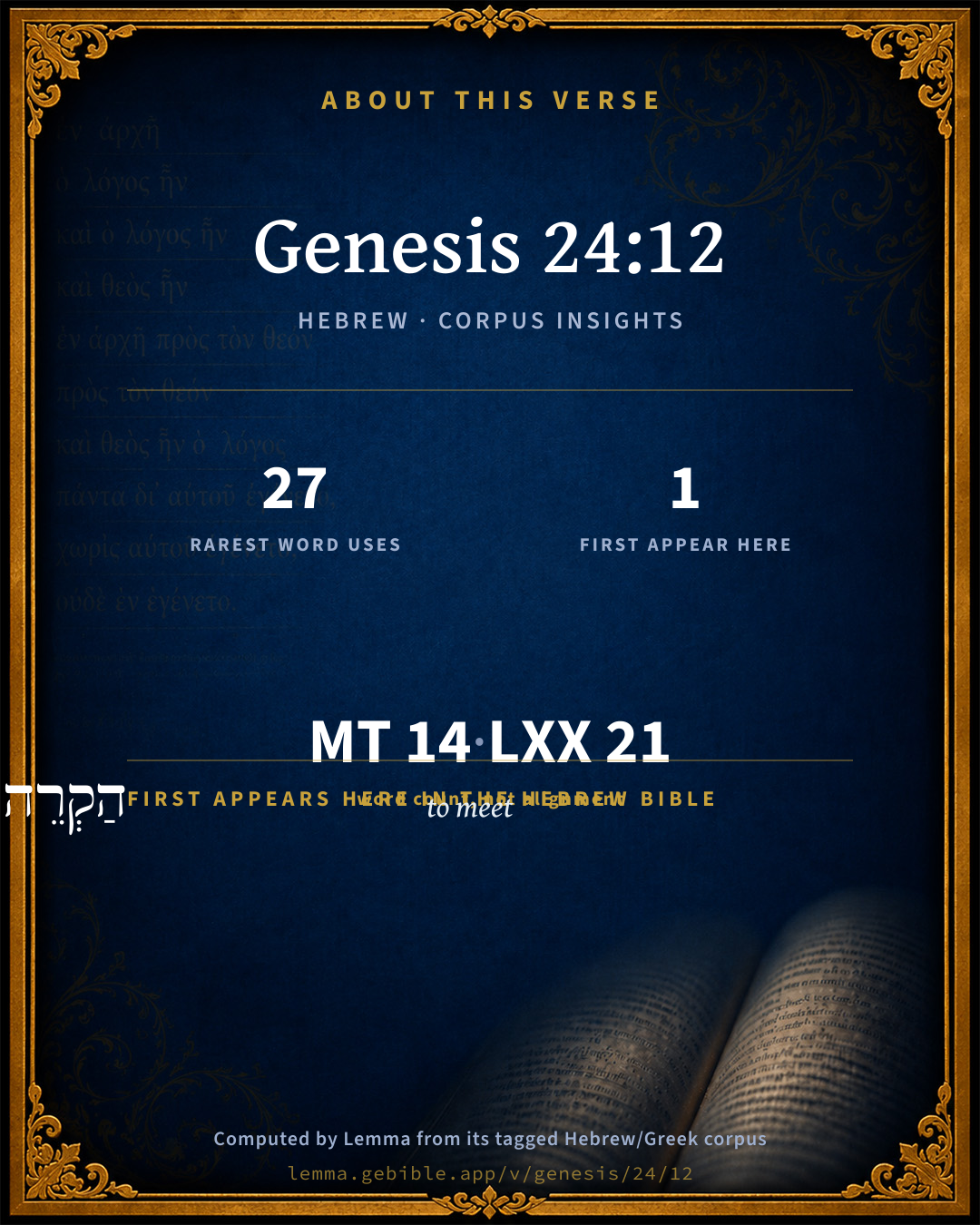
  • 1 first appearance in the Hebrew Bible
Full analysis ↓
Download a study sheet

One document with this verse’s original text, its word-by-word gloss line, the meaning frame, cross-references with their text, attributed commentary, and full source and license credits — printable, and it pastes into notes with its structure intact.

This verse Autodidact and up

Study sheet (.html) Plain text (.txt)

A passage Seminary Student

Up to 50 verses in one chapter. A passage sheet keeps up to 6 commentary sources and 12 cross-references per verse, in the order this page ranks them, and says so on the sheet whenever that leaves anything out. Ask for a single verse and you get the Autodidact verse sheet above.

Everything on this page stays free to read, with no account — the sheet is a download of what is already on screen, not access to it.

Want to remove ads? Support Godless Engineer
Compare translations 3

The same verse in 3 English versions, stacked beneath the original-language interlinear above. Click any original word for its lexicon entry.

Each is an independent rendering of the whole verse — the interlinear is not word-aligned to these translations.

Highlighted words mark where these versions differ — a whole-verse word diff, not a word-by-word alignment.

  • World English Bible Public Domain
    He said, "Yahweh, the God of my master Abraham, please give me success this day, and show kindness to my master Abraham.
  • King James Version Public Domain
    And he said O LORD God of my master Abraham, I pray thee, send me good speed this day, and show kindness unto my master Abraham.
  • unfoldingWord Literal Text CC BY-SA 4.0
    Then he said, “Yahweh, God of my master Abraham, please cause it to happen before me today that you show kindness toward my master Abraham.

unfoldingWord Literal Text — © unfoldingWord, licensed CC BY-SA 4.0. Word-aligned USFM3 via Door43 (git.door43.org/unfoldingWord/en_ult).

Versions to compare (up to 4)

3 of 4 selected

Show all 18 translations

Every available English version of this verse, each an independent rendering of the whole verse.

  • World English Bible Public Domain
    He said, "Yahweh, the God of my master Abraham, please give me success this day, and show kindness to my master Abraham.
  • Berean Standard Bible Public Domain
    “O LORD, God of my master Abraham,” he prayed, “please grant me success today, and show kindness to my master Abraham.
  • Majority Standard Bible Public Domain
    “O LORD, God of my master Abraham,” he prayed, “please grant me success today, and show kindness to my master Abraham.
  • King James Version Public Domain
    And he said O LORD God of my master Abraham, I pray thee, send me good speed this day, and show kindness unto my master Abraham.
  • American Standard Version (1901) Public Domain
    And he said, O Jehovah, the God of my master Abraham, send me, I pray thee, good speed this day, and show kindness unto my master Abraham.
  • Revised Version (1885) Public Domain
    And he said, O LORD, the God of my master Abraham, send me, I pray thee, good speed this day, and shew kindness unto my master Abraham.
  • Geneva Bible (1599) Public Domain
    And he said, O Lord God of my master Abraham, I beseech thee, send me good speede this day, and shew mercy vnto my master Abraham.
  • Douay-Rheims (1899) Public Domain
    O Lord the God of my master Abraham, meet me today, I beseech thee, and show kindness to my master Abraham.
  • Young's Literal Translation Public Domain
    And he saith, `Jehovah, God of my lord Abraham, cause to meet, I pray Thee, before me this day -- (and do kindness with my lord Abraham;
  • Literal Standard Version CC BY-SA 4.0
    And he says, “YHWH, God of my lord Abraham, please cause to meet before me this day—(and do kindness with my lord Abraham;
  • Unlocked Literal Bible CC BY-SA 4.0
    Then he said, “Yahweh, God of my master Abraham, grant me success today and show covenant faithfulness to my master Abraham.
  • unfoldingWord Literal Text CC BY-SA 4.0
    Then he said, “Yahweh, God of my master Abraham, please cause it to happen before me today that you show kindness toward my master Abraham.
  • Darby Bible Public Domain
    And he said, Jehovah, God of my master Abraham, meet me, I pray thee, [with thy blessing] this day, and deal kindly with my master Abraham.
  • World Messianic Bible Public Domain
    He said, “LORD, the God of my master Abraham, please give me success today, and show kindness to my master Abraham.
  • Webster's Bible Public Domain
    And he said, O LORD God of my master Abraham, I pray thee, prosper me this day, and show kindness to my master Abraham.
  • Free Bible Version CC BY-SA 4.0
    He prayed, “Lord, the God of my master Abraham, please let me be successful today, and please show your faithfulness to my master Abraham.
  • Bible in Basic English Public Domain
    And he said, O Lord, the God of my master Abraham, let me do well in what I have undertaken this day, and give your mercy to my master Abraham.
  • JPS Tanakh (1917) Public Domain
    And he said: 'O LORD, the God of my master Abraham, send me, I pray Thee, good speed this day, and show kindness unto my master Abraham.

Literal Standard Version (2020), Covenant Press — licensed CC BY-SA 4.0. Text via the HelloAO Bible API (eBible.org). Unlocked Literal Bible (unfoldingWord) — licensed CC BY-SA 4.0. Text via the HelloAO Bible API (eBible.org). unfoldingWord Literal Text — © unfoldingWord, licensed CC BY-SA 4.0. Word-aligned USFM3 via Door43 (git.door43.org/unfoldingWord/en_ult). Free Bible Version, Dr. Jonathan Gallagher — licensed CC BY-SA 4.0. Text via the HelloAO Bible API (eBible.org).

Word by word

More ways to search: Search by grammar → Find every occurrence → Compare this word →

Practice this passage: Drill this verse → Learn its vocabulary →

הַקְרֵה
qârâh
H7136
“meet”
Verb, Hiphil, Imperative, 2nd Person, Masculine, Singular
Part of Speech
Verb
Stem
Hiphil
Form
Imperative
Person
2nd Person
Gender
Masculine
Number
Singular
Full BDB Definition

Origin: a primitive root

TWOT: 2068 , 2068e

to encounter, meet, befall, happen, come to meet - (Qal) - to encounter, meet - to befall - (Niphal) - to encounter, meet (without pre-arrangement) - to chance to be present - to come to meet - (Hiphil) to cause to meet, appoint - to build with beams - (Piel) to lay the beams of, furnish with beams
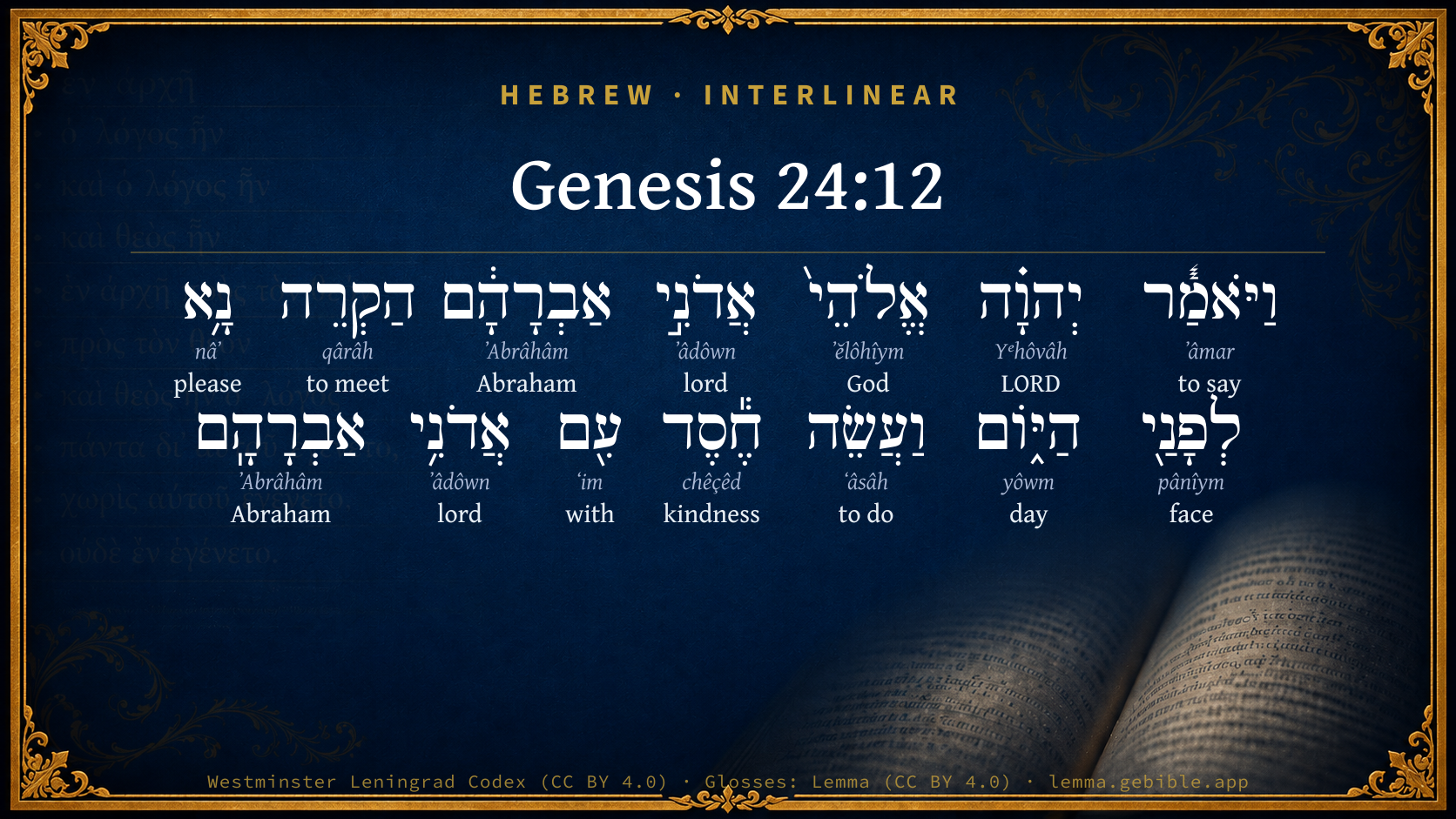
  1. וַיֹּאמַ֓ר ʼâmar H559 “and · to say” Conjunction + Verb, Qal, Sequential Imperfect, 3rd Person, Masculine, Singular
  2. יְהוָ֗ה Yᵉhôvâh H3068 “LORD” Noun, Proper
  3. אֱלֹהֵי֙ ʼĕlôhîym H430 “God(s) of” Noun, Common, Masculine, Plural, Construct
  4. אֲדֹנִ֣י ʼâdôwn H113 “lord · my” Noun, Common, Masculine, Singular, Construct + Suffix, Personal, 1st Person, Common, Singular
  5. אַבְרָהָ֔ם ʼAbrâhâm H85 “Abraham” Noun, Proper
  6. נָ֥א nâʼ H4994 “please” Particle, Exhortation
  7. לְפָנַ֖י pânîym H6440 “to/for · face(s) · my” Preposition + Noun, Common, Both, Plural, Construct + Suffix, Personal, 1st Person, Common, Singular
  8. הַיּ֑וֹם yôwm H3117 “the · day” Particle, Definite Article + Noun, Common, Masculine, Singular, Absolute
  9. וַעֲשֵׂה ʻâsâh H6213 “and · do” Conjunction + Verb, Qal, Imperative, 2nd Person, Masculine, Singular
  10. חֶ֕סֶד chêçêd H2617 “kindness” Noun, Common, Masculine, Singular, Absolute
  11. עִ֖ם ʻim H5973 “with” Preposition
  12. אֲדֹנִ֥י ʼâdôwn H113 “lord · my” Noun, Common, Masculine, Singular, Construct + Suffix, Personal, 1st Person, Common, Singular
  13. אַבְרָהָֽם ʼAbrâhâm H85 “Abraham” Noun, Proper

About this verse

These counts appear in no published source. They are computed here, from the morphology-tagged text and Lemma’s own curated glosses. What Lemma adds →

14
words
12
distinct lemmas
Pentateuch
section

First appearance in Scripture

This word makes its first canonical appearance in the Hebrew Bible here:

  • הַקְרֵה to meet H7136

Shared distinctive vocabulary

הַקְרֵה to meet H7136 occurs in 27 verses of the Hebrew Bible. Also found in:

Grammatical profile

  • 3 verbs
  • 9 nouns
  • 1 preposition
  • 1 particle

Verb forms

  • וַיֹּאמַ֓ר Qal · Sequential Imperfect
  • הַקְרֵה Hiphil · Imperative
  • וַעֲשֵׂה Qal · Imperative

Repetition

Words recur within this verse — often emphatic in Hebrew:

  • אֲדֹנִ֣י lord H113 ×2
  • אַבְרָהָ֔ם Abraham H85 ×2

Hebrew & Septuagint length

In English translation the verse runs 22 words from the Hebrew and 24 from the Septuagint (LXX English) — closely comparable.

A rough comparison of the two English renderings, which tokenize alike — not a word-level alignment.

Word counts can differ between the Hebrew and the Greek without any difference in meaning — e.g. the Hebrew direct-object marker אֵת has no separate Greek word, and Greek often adds the article ὁ.

In the original languages it is 14 Hebrew tokens and 21 Greek tokens — but the two are counted differently (Hebrew bundles its prefixes and suffixes into one token; the Greek is in lemma form), so that isn’t a like-for-like length.

Cross-references

27

Topical passages linked to Genesis 24:12 in the Treasury of Scripture Knowledge — connected by theme and wording, ordered by reader-vote popularity; previews shown in the World English Bible.

  • Genesis 24:27 He said, "Blessed be Yahweh, the God of my master Abraham, who has not forsaken his loving kindness and his truth toward my master. As for me, Yahweh has led me in the way to the house of my master's relatives."
  • Exodus 3:6 Moreover he said, "I am the God of your father, the God of Abraham, the God of Isaac, and the God of Jacob." Moses hid his face; for he was afraid to look at God.
  • Genesis 26:24 Yahweh appeared to him the same night, and said, "I am the God of Abraham your father. Don't be afraid, for I am with you, and will bless you, and multiply your seed for my servant Abraham's sake."
  • Genesis 24:42 I came this day to the spring, and said, 'Yahweh, the God of my master Abraham, if now you do prosper my way which I go.
  • Genesis 24:48 I bowed my head, and worshiped Yahweh, and blessed Yahweh, the God of my master Abraham, who had led me in the right way to take my master's brother's daughter for his son.
  • Exodus 3:15 God said moreover to Moses, "You shall tell the children of Israel this, 'Yahweh, the God of your fathers, the God of Abraham, the God of Isaac, and the God of Jacob, has sent me to you.' This is my name forever, and this is my memorial to all generations.
  • 2 Kings 2:14 He took the mantle of Elijah that fell from him, and struck the waters, and said, Where is Yahweh, the God of Elijah? and when he also had struck the waters, they were divided here and there; and Elisha went over.
  • Psalms 122:6 Pray for the peace of Jerusalem. Those who love you will prosper.
  • Genesis 15:1 After these things the word of Yahweh came to Abram in a vision, saying, "Don't be afraid, Abram. I am your shield, your exceedingly great reward."
  • Genesis 17:7–8 I will establish my covenant between me and you and your seed after you throughout their generations for an everlasting covenant, to be a God to you and to your seed after you.
  • Genesis 27:10 You shall bring it to your father, that he may eat, so that he may bless you before his death."
  • Genesis 27:20 Isaac said to his son, "How is it that you have found it so quickly, my son?" He said, "Because Yahweh your God gave me success."
  • Genesis 28:13 Behold, Yahweh stood above it, and said, "I am Yahweh, the God of Abraham your father, and the God of Isaac. The land whereon you lie, to you will I give it, and to your seed.
  • Genesis 31:42 Unless the God of my father, the God of Abraham, and the fear of Isaac, had been with me, surely now you would have sent me away empty. God has seen my affliction and the labor of my hands, and rebuked you last night."
  • Genesis 32:9 Jacob said, "God of my father Abraham, and God of my father Isaac, Yahweh, who said to me, 'Return to your country, and to your relatives, and I will do you good.'
  • Genesis 43:14 May God Almighty give you mercy before the man, that he may release to you your other brother and Benjamin. If I am bereaved of my children, I am bereaved."
  • 1 Kings 18:36 It happened at the time of the offering of the [evening] offering, that Elijah the prophet came near, and said, Yahweh, the God of Abraham, of Isaac, and of Israel, let it be known this day that you are God in Israel, and that I am your servant, and that I have done all these things at your word.
  • Nehemiah 1:11 Lord, I beg you, let now your ear be attentive to the prayer of your servant, and to the prayer of your servants, who delight to fear your name; and please prosper your servant this day, and grant him mercy in the sight of this man. Now I was cup bearer to the king.
  • Nehemiah 2:4 Then the king said to me, For what do you make request? So I prayed to the God of heaven.
  • Psalms 37:5 Commit your way to Yahweh. Trust also in him, and he will do this:
  • Psalms 90:16–17 Let your work appear to your servants; Your glory to their children.
  • Psalms 118:25 Save us now, we beg you, Yahweh; Yahweh, we beg you, now send prosperity.
  • Psalms 127:1 Unless Yahweh builds the house, They labor in vain who build it. Unless Yahweh watches over the city, The watchman guards it in vain.
  • Proverbs 3:6 In all your ways acknowledge him, And he will direct your paths.
  • Matthew 22:32 'I am the God of Abraham, and the God of Isaac, and the God of Jacob?' God is not the God of the dead, but of the living."
  • Philippians 4:6 In nothing be anxious, but in everything, by prayer and petition with thanksgiving, let your requests be made known to God.
  • 1 Thessalonians 3:10–11 night and day praying exceedingly that we may see your face, and may perfect that which is lacking in your faith?

Cross-references courtesy of OpenBible.info (CC BY 4.0).

Hebrew and Greek witnesses Masoretic Hebrew ↔ Greek Septuagint

The same verse in the two great witnesses to the Old Testament, shown verse-for-verse.

These are two independent witnesses, not word-aligned to each other, and the Septuagint is shown in lemma (dictionary) form.

Hebrew Genesis 24:12 Masoretic · Westminster Leningrad Codex

וַיֹּאמַ֓ר יְהוָ֗ה אֱלֹהֵי֙ אֲדֹנִ֣י אַבְרָהָ֔ם הַקְרֵה נָ֥א לְפָנַ֖י הַיּ֑וֹם וַעֲשֵׂה חֶ֕סֶד עִ֖ם אֲדֹנִ֥י אַבְרָהָֽם

He said, "Yahweh, the God of my master Abraham, please give me success this day, and show kindness to my master Abraham.

World English Bible · Public Domain

Greek LXX Genesis 24:12 Septuagint · lemma form

καί εἶπον κύριος ὁ θεός ὁ κύριος ἐγώ αβρααμ εὐοδόω ἐναντίον ἐγώ σήμερον καί ποιέω ἔλεος μετά ὁ κύριος ἐγώ αβρααμ

And he said, O Lord God of my master Abraam, prosper my way before me to day, and deal mercifully with my master Abraam.

LXX2012 (modern English Septuagint) · Public Domain

On this verse, The Pulpit Commentary discusses the Septuagint’s reading. Read the note in Commentary ↓

Hebrew: Westminster Leningrad Codex (CC BY 4.0). Greek: Septuagint (public domain); English from LXX2012 (modern English Septuagint) (Public Domain). How the Septuagint differs from the Hebrew →

Targum (Aramaic paraphrase)

2

The Targum is the ancient Jewish Aramaic paraphrase of the Hebrew Scriptures — an interpretive translation, not the Hebrew text itself. Onkelos (literal) and Pseudo-Jonathan (expansive) render the Torah, and Jonathan the Prophets. Coverage is partial: where no permissively-licensed English translation exists for a verse, only the Aramaic is shown. This is verse-level text, not a word-by-word alignment to the Hebrew.

  1. Targum Onkelos Torah (Genesis–Deuteronomy)
    וַאֲמַר יְיָ אֱלָהֵהּ דְּרִבּוֹנִי אַבְרָהָם זַמִּין כְּעַן קֳדָמַי יוֹמָא דֵּין וְעִבַד טִיבוּ עִם רִבּוֹנִי אַבְרָהָם

    (no public-domain English translation for this verse)

    Targum Onkelos — Aramaic: “Onkelos Genesis” (public domain); “Onkelos Exodus” (public domain); “Onkelos Leviticus” (public domain); “Onkelos Numbers” (public domain); “Onkelos Deuteronomy” (public domain). English: “Sefaria Community Translation” (CC0 1.0 (public-domain dedication)); “J.W. Etheridge. The Targums of Onkelos and Jonathan Ben Uzziel on the Pentateuch. London: Longmans, Green, 1862” (public domain). Text via Sefaria.

  2. Targum Pseudo-Jonathan Torah (Genesis–Deuteronomy)
    וַאֲמַר יְיָ אֱלָהָא דְרִיבּוֹנִי אַבְרָהָם זַמִין כְּעַן אִיתָא מְהַגְנָא קוּמִי יוֹמָנָא וְעִיבַד טִיבוֹי עִם רִבּוֹנִי אַבְרָהָם

    And he said, Lord God of my master Abraham, prepare thou a proper woman before me today, and deal graciously with my master Abraham.

    Targum Pseudo-Jonathan — Aramaic: “Targum Jonathan on Genesis” (public domain); “Targum Jonathan on Exodus” (public domain); “Targum Jonathan on Leviticus” (public domain); “Targum Jonathan on Numbers” (public domain); “Targum Jonathan on Deuteronomy” (public domain). English: “The Targum of Jonathan ben Uzziel, trans. J. W. Etheridge, London, 1862” (public domain). Text via Sefaria.

Commentary

Notes on Genesis 24:12 from classic Christian and Jewish commentators (each source and its license shown beneath its notes). The classic Christian expositions comment on the surrounding passage and are grouped to its opening verse, so a note may address several verses; the Jewish commentaries on the Tanakh (Rashi and others) are per-verse, so they appear only where the commentator wrote on this verse.

Lemma curates 59 commentaries, every one of them public domain or Creative Commons licensed, each selected and text-cleaned for this edition rather than reprinted as found. About our sources →

Trapp's Complete Commentary

John Trapp

Gen 24:12 And he said, O LORD God of my master Abraham, I pray thee, send me good speed this day, and shew kindness unto my master Abraham.

Ver. 12. And he said, O Lord God.] Begin we all our enterprizes with prayer. God may give good success without, but it will be nothing so sweet. See therefore that,

“Hoc primum repetas opus, hoc postremus omittas.” - Hor., epis. 6. l. 48.

John Trapp, A Commentary or Exposition upon All the Books of the Old and New Testament (1647–1656) — public domain. Text from a community e-Sword module.

Joseph Benson's Commentary

Gen 24:12. Send me good speed — What a noble example is here for all servants to imitate their masters in all goodness! Abraham’s servant, we find, had not lived in his master’s house without profiting by his example; he shows the like faith and dependance upon God as his master manifested; and this being a business of great consequence about which he is sent, he does not rest upon his own prudence and wisdom, but begs the blessing and direction of God in it. And what can be more desirable in our undertakings than to be under the guidance of infinite wisdom? And we have leave to be particular in recommending our affairs to the care of Divine Providence. Those that would have good speed must pray for it this day, in this affair. Thus we must, in all our ways, acknowledge God, and then he will direct our paths.

Joseph Benson's Commentary on the Old and New Testaments (1811–1818) — public domain. Text from a community e-Sword module.

Geneva Bible (1599)

Geneva Bible translators

He groundeth his prayer upon God’s promise made to his master.

Or, cause me to meet.

Geneva Bible (1599) marginal notes — public domain. Text via Bolls.life.

Jamieson, Fausset & Brown

Robert Jamieson, A. R. Fausset & David Brown

And he said, O Lord God of my master--The servant appears worthy of the master he served. He resolves to follow the leading of Providence; and while he shows good sense in the tokens he fixes upon of ascertaining the temper and character of the future bride, he never doubts but that in such a case God will direct him.

Jamieson, Fausset & Brown — Commentary Critical and Explanatory on the Whole Bible (1871) — public domain (CC PDM 1.0). Text via the HelloAO Bible API.

Adam Clarke's Commentary

Verse 12. And he said, O Lord God, c.] "The conduct of this servant," says Dr. Dodd, "appears no less pious than rational. By supplicating for a sign, he acknowledges God to be the great superintendent and director of the universe, and of that event in particular and at the same time, by asking a natural sign, such as betokened humanity, condescension, and other qualities which promised a discreet and virtuous wife, he puts his prayer upon such a discreet, rational footing, as to be a proper example for all to imitate who would not tempt the providence of God, by expecting extraordinary signs to be given them for the determination of cases which they are capable of deciding by a proper use of their rational faculties." This is all very good; but certainly the case referred to here is such a one as required especial direction from God; a case which no use of the rational faculties, without Divine influence, could be sufficient to determine. It is easy to run into extremes, and it is very natural so to do. In all things the assistance and blessing of God are necessary, even where human strength and wisdom have the fullest and freest sphere of action; but there are numberless cases, of infinite consequence to man, where his strength and prudence can be of little or no avail, and where the God of all grace must work all things according to the counsel of his own will. To expect the accomplishment of any good end, without a proper use of the means, is the most reprehensible enthusiasm; and to suppose that any good can be done or procured without the blessing and mercy of God, merely because proper means are used, is not less reprehensible. Plan, scheme, and labour like Eliezer, and then, by earnest faith and prayer, commit the whole to the direction and blessing of God.

Adam Clarke's Commentary on the Bible (1810–1826) — public domain. Text from a community e-Sword/MySword module.

John Calvin's Commentaries

12. O lord God of my master Abraham. The servant, being destitute of counsel, retakes himself to prayers. Yet he does not simply ask counsel of the Lord; but he also prays that the maid appointed to be the wife of Isaac should be brought to him with a certain sign, from which he might gather that she was divinely presented to him. It is an evidence of his piety and faith, that in a matter of such perplexity he is not bewildered, as one astonished; but breaks forth into prayer with a collected mind. But the method which he uses seems scarcely consistent with the true rule of prayer. For, first, we know that no one prays aright unless he subjects his own wishes to God. Wherefore there is nothing more unsuitable than to prescribe anything, at our own will, to God. Where, then, it may be asked, is the religion of the servant, who, according to his own pleasure, imposes a law upon God? Secondly, there ought to be nothing ambiguous in our prayers; and absolute certainty is to be sought for only in the Word of God. Now, since the servant prescribes to God what answer shall be given, he appears culpably to depart from the suitable modesty of prayer; for although no promise had been given him, he nevertheless desires to be made fully certain respecting the whole affair. God, however, in hearkening to his wish, proves, by the event, that it was acceptable to himself. Therefore we must know, that although a special promise had not been made at the moment, yet the servant was not praying rashly, nor according to the lust of the flesh, but by the secret impulse of the Spirit. Moreover, the general law, by which all the pious are bound, does not prevent the Lord, when he determines to give something extraordinary, from directing the minds of his servants towards it; not that he would lead them away from his word, but only that he makes some peculiar concession to them in their mode of praying. The sum of the prayer before us is this: “O Lord, if a damsel shall present herself who, being asked to give me drink, shall also kindly and courteously offer it to my camels, I will seek after her as a wife for my master Isaac, just as if she were delivered into my hand by thee.” He seems, indeed, to be laying hold on some dubious conjecture; but since he reposes on the Providence of God, he is certainly persuaded that this token shall be to him equivalent to an oracle; because God, who is the guardian of his enterprise, will not suffer him to err. Meanwhile this is worthy of remark, that he does not fetch the sign of recognition from afar, but takes it from something present; for she who shall be thus humane to an unknown guest, will, by that very act, give proof of an excellent disposition. This observation may be of use to prevent inquisitive men from adducing this example as a precedent for vain prognostications. In the words themselves the following particulars are to be noticed: first, that he addresses himself to the God of his master Abraham; not as being himself a stranger to the worship of God, but because the affair in question depends upon the promise given to Abraham. And truly he had no confidence in prayer, from any other source than from the covenant into which God had entered with the house of Abraham. The expression “cause to meet me this day,” Jerome renders, “meet me, I pray, this day.” But the verb is transitive, and the servant of Abraham intimates by the use of it, that the affairs of men were so ordered by the counsel and the hand of God, that the issue of them was not fortuitous; as if he would say, O Lord, in vain shall I look on this side and on that; in vain shall I catch at success by my own labor, industry and various contrivances, unless thou direct the work. And when he immediately afterwards subjoins, show kindness to my master, he implies that in this undertaking he rests upon nothing but the grace which God had promised to Abraham.

John Calvin's Commentaries (1540-1563) — public domain. Text from the Calvin Translation Society English edition (1840s-50s) via the Christian Classics Ethereal Library (ccel.org). Calvin's coverage is partial (roughly two-thirds of the Bible); uncommented books and verses are honest gaps, never fabricated. The 19th-century editor's footnotes and remarks are omitted so the notes are faithfully Calvin's own voice.

Ellicott's Commentary for English Readers

(12-14) O Lord God . . . —Heb., Jehovah, God of my lord Abraham. The word translated “master” throughout this chapter is ‘donai, the ordinary word for lord, and it is so rendered in Gen_24:18. As a circumcised member of Abraham’s household, the servant prays to Jehovah, Abraham’s God; and though in Gen_24:5 he had suggested a difficulty, apparently it was from no want of faith, but that he might know whether under any circumstances Isaac might return to Aram-Naharaim. He now leaves the success of his mission to Jehovah; and while he would use his own discernment in selecting from the troop of advancing maidens one whose countenance gave promise of goodness of heart, the fulfilment of the appointed signal which was to mark God’s approval would also show that she was no churlish woman, but one active, generous, and kind.

Send me good speed this day.—Heb., cause it to meet me this day.

I stand.—This word here, and in Gen_24:43, is not the same as that used in Gen_24:30, but one that means I post myself, or I take my station.

Thereby.—Rather, by her: by her giving the appointed sign I shall know that thou hast showed kindness to my lord.

The damsel.—This word (Heb., Na’ar) is of the common gender in the Pentateuch, except in Deu_22:19, where it has the feminine termination. It is used of Abraham’s young men in Gen_14:24; Gen_18:7, &c., but no less than twenty-two times of women. In the rest of the Bible the gender is always marked, and even here it is read in the feminine in the Jewish synagogues. We have herein another of the many linguistic proofs of the extreme antiquity of the Pentateuch, and it is the more interesting because found in a Jehovistic section. The same word is used again in Gen_24:16; Gen_24:28. (See Note on Gen_43:8.)

A Bible Commentary for English Readers, edited by Charles John Ellicott (1878–1897) — public domain. Text from a community e-Sword module.

The Cambridge Bible for Schools and Colleges

gen. ed. J. J. S. Perowne

12. O Lord, the God of my master] Referring to Gen_24:7. The servant, though possibly (Gen_15:2) a native of Damascus, worships the God of Abraham; cf. Gen_24:26.

The Cambridge Bible for Schools and Colleges (gen. ed. J. J. S. Perowne; Cambridge University Press, 1878–1918) — public domain. Text from a community e-Sword module.

John Gill's Exposition

And he said, O Lord God of my master Abraham,.... He does not call the Lord his God, though no doubt he was, since he appears throughout the whole to be a good man; but the God of Abraham, because God had often manifested and renewed his covenant with Abraham in an eminent manner, and had bestowed many favours upon him, and admitted him to much nearness and communion with him; and it was not on his own account, but on his master's business he now was:

I pray thee, send me good speed this day; or "cause something to happen before me this day" (u); some extraordinary event, which depends not upon the will, or skill, or contrivance of men, but upon the pleasure of God; and which, with respect to second causes, men call hap or chance, but with respect to God, is according to his determinate counsel and will. The Targum of Jonathan is,"prepare now a decent wife before me this day.''But the servant's meaning is, that something might turn up in providence that would lead on to such an event:

and shew kindness unto my master Abraham; which he would be ready to acknowledge as a favour, an instance of kindness and mercy, and not merit.

(u) "occurere fae nune coram me", Pagninus, Montanus, Vatablus; so Junius & Tremellius, Schmidt, Ainsworth.

John Gill's Exposition of the Whole Bible (1746–1763) — public domain (CC PDM 1.0). Text via the HelloAO Bible API.

Matthew Poole's English Annotations

Or, mercy. He makes no mention of himself, nor of the merits of his master, but he ascribes even temporal blessings, and much more eternal salvation, merely to God’s mercy.

Matthew Poole's English Annotations on the Holy Bible (1683–1685) — public domain. Text from a community e-Sword/MySword module.

Whedon's Commentary on the Bible

Daniel D. Whedon

12. Lord… send me good speed — Or, cause it to happen before me today. This prayer is one of remarkable simplicity and directness, but in it note the following: 1) The use of the name Jehovah. 2) The appeal to Abraham’s God. 3) The urging of the case as Abraham’s interest. 4) The implied faith that all his success in this undertaking must come from God.

5) The request for a special sign. 6) The child-like simplicity which designates the very form and language in which the sign shall be given. 7) The consequent knowledge of God’s favour with which he will be blessed.

Daniel D. Whedon (gen. ed.), Commentary on the Old and New Testaments (1874–1909) — public domain. Text from a community e-Sword module.

The Pulpit Commentary

Vers. 12-14. And he said, commencing his search for the maiden by prayer, as he closes it with thanksgiving (ver. 26) a beautiful example of piety and of the fruits of Abraham"s care for the souls of his household, (Gen_18:19) (Wordsworth) O Lord God of my master Abraham, I pray thee, send me good speed this day. Literally, cause to meet (or come before) me, i.e. what I wish, the maiden of whom I am in quest; hence eujodeson ejnantion ejmou, make the way prosperous before me (LXX); less accurately, occurre obsecro mihi (Vulgate). And show kindness unto my master Abraham. The personal humility and fidelity displayed by this aged servant are only less remarkable than the fervent piety and childlike faith which discover themselves in the method he adopts for finding the bride. Having cast the matter upon God by prayer, as a concern which specially belonged to him, he fixes upon a sign by which God should enable him to detect the bride designed for Isaac. Behold, I stand here by the well of water; literally, Behold me standing (cf. ver. 43)and the daughters of the men of the city come out to draw water (vide on ver. 11, and cf. Gen_29:9; Exo_2:16) and let it come to pass that the damsel r; Gh, with the vowels of the Keri; the word used for Abraham"s young men (cf. Gen_14:24 Gen_18:7; q.v.) In the Pentateuch it occurs twenty-two times, without the feminine termination, meaning a girl (vide Gen_24:16, Gen_24:28, 55 34:3, 12; Deu_20:15, &c.) a proof of the antiquity of the Pentateuch, and of this so-called Jehovistic section in particular, since in the latter books the distinction of sex is indicated by the affix h being appended when a girl is intended ("Speaker"s Commentary"); but this happens at least once in the Pentateuch (Deu_22:19) to whom I shall say, Let down thy pitcher, I pray thee, that I may drink; and she shall say, Drink, and I will give thy camels drink also: the sign fixed upon was the kindly disposition of the maiden, which was to be evinced in a particular way, viz., by her not only acceding with promptitude to, but generously exceeding, his request It is probable that the servant was led to choose this sign not by his own natural tact and prudence, but by that Divine inspiration and guidance of which he had been assured (ver. 7) before setting out on his important mission let the same be she that thou hast appointed for thy servant Isaac. "The three qualifications in the mind of this venerable domestic for a bride for his master"s son are a pleasing exterior, a kindly disposition, And the approval of God" (Murphy). And thereby ejn toutw (LXX), per hoc (Vulgate); but rather, by her, i.e . the damselshall I know that thou hast showed kindness unto my master.

The Pulpit Commentary (1880–1919), ed. H.D.M. Spence-Jones & Joseph S. Exell — public domain. Text from a community e-Sword module.

John Wesley's Explanatory Notes

Send me good speed this day - We have leave to be particular in recommending our affairs to the care of Divine providence. Those that would have good speed must pray for it this day, in this affair. Thus we must, in all our ways acknowledge God.

John Wesley, Explanatory Notes Upon the Whole Bible (1754–1765) — public domain. Text via the GEBible commentary corpus.

unfoldingWord translationNotes

Door43 World Missions Community

Then he said

"Then the servant said"

grant me success today and show covenant faithfulness to my master Abraham

You can state this with the connecting word "by." This makes clear how the servant wants God to show covenant faithfulness. AT: "Show covenant faithfulness to my master Abraham by granting me success today" (See: Connecting Words)

grant me success

"give me success." The servant wanted to find a good wife for Abraham's son. The abstract noun "success" can be stated as a verb. AT: "help me to succeed" or "make me able to do what I have come here to do" (See: Abstract Nouns)

show covenant faithfulness to my master Abraham

The abstract noun "faithfulness" can be stated as "faithful." AT: "be faithful to the covenant you have with my master Abraham" or "be faithful to my master Abraham" (See: Abstract Nouns)

Look, here I am standing

"You can see me standing here"

the spring of water

"the spring" or "the well"

the daughters of the men of the city

"the young women of the city"

Let it happen like this

"Let it happen this way" or "Make this happen"

When I say to a young woman, 'Please lower your pitcher so that I may drink,'

This is a quotation within a quotation. This can be expressed with an indirect quote. AT: "When I ask a young woman to let me have a drink of water from her jar" (See: Quotes Within Quotes and Direct and Indirect Quotations)

Please lower your pitcher

The women carried the pitchers on their shoulder. She would have to lower it to give the man a drink.

pitcher

a medium-size jar made of clay used for holding and pouring liquids

that you have shown covenant faithfulness to my master

The abstract noun "faithfulness" can be stated as "been faithful." AT: "that you have been faithful to the covenant you have with my master Abraham" or "you have been faithful to my master Abraham" (See: Abstract Nouns)

translationWords

Yahweh

God

lord

covenant faithfulness

Abraham

fountain

appoint

servant

camel

Isaac

unfoldingWord translationNotes — © Distant Shores Media and the Door43 World Missions Community, licensed CC BY-SA 4.0. Source: git.door43.org/Door43/en_tn.

Radak

Rabbi David Kimhi (Radak)

ויאמר...הקרה נא לפני, “arrange for me,” as had been predicted by Avraham. This is what he meant when he added ועשית חסד עם אדני אברהם, “perform an act of loving kindness for my master Avraham.”

Radak on the Tanakh — English translations: “Sefaria Community Translation” (CC0 1.0 (public-domain dedication)); “Eliyahu Munk, HaChut Hameshulash” (CC BY 4.0); “Rabbi Mike Feuer, Jerusalem Anthology” (CC BY 4.0); and “R. David Kimhi on the first book of Psalms, Translated by R.G. Finch, London, 1919” (public domain). Text via Sefaria.

Lesson kit

Teaching starters — assembled from the data on this page, not authored interpretation. Every prompt links to the verse data it draws on. Edit before teaching.

Genesis, in the Pentateuch, opens this verse with 14 words (12 distinct Hebrew lemmas). Its most distinctive word is qârâh (“to meet”). A historical commentator’s framing appears above. Read the whole chapter for the surrounding context.

Discussion questions

  1. What does “to meet” (qârâh) contribute to the verse as a whole?
  2. This is the first place “to meet” appears in Scripture (first appears here). What does its debut here establish?
  3. How does Genesis 27:20, which shares the word «to meet», read alongside this verse?
  4. What does the repetition of “lord” (2× in this one verse) do in this verse?
  5. These translations render this verse differently; the difference is in the English rendering, not the original. What questions does that raise?
  6. «וַיֹּאמַ֓ר» is a Qal Sequential Imperfect verb. How does that grammatical form shape the action described?
  7. Compare how Trapp's Complete Commentary and Joseph Benson's Commentary read this verse. Where do they agree or differ?

Things to notice

Reading settings

Reading text

Shown beneath each verse's original-language words.

Old Testament
Old Testament edition

Read the OT as the Masoretic Hebrew (MT) or the Greek Septuagint (LXX).

English shown for the Greek Septuagint (in the Hebrew ↔ Greek comparison).

Comparing translations? Open the Compare panel on any verse page to stack up to four side by side.