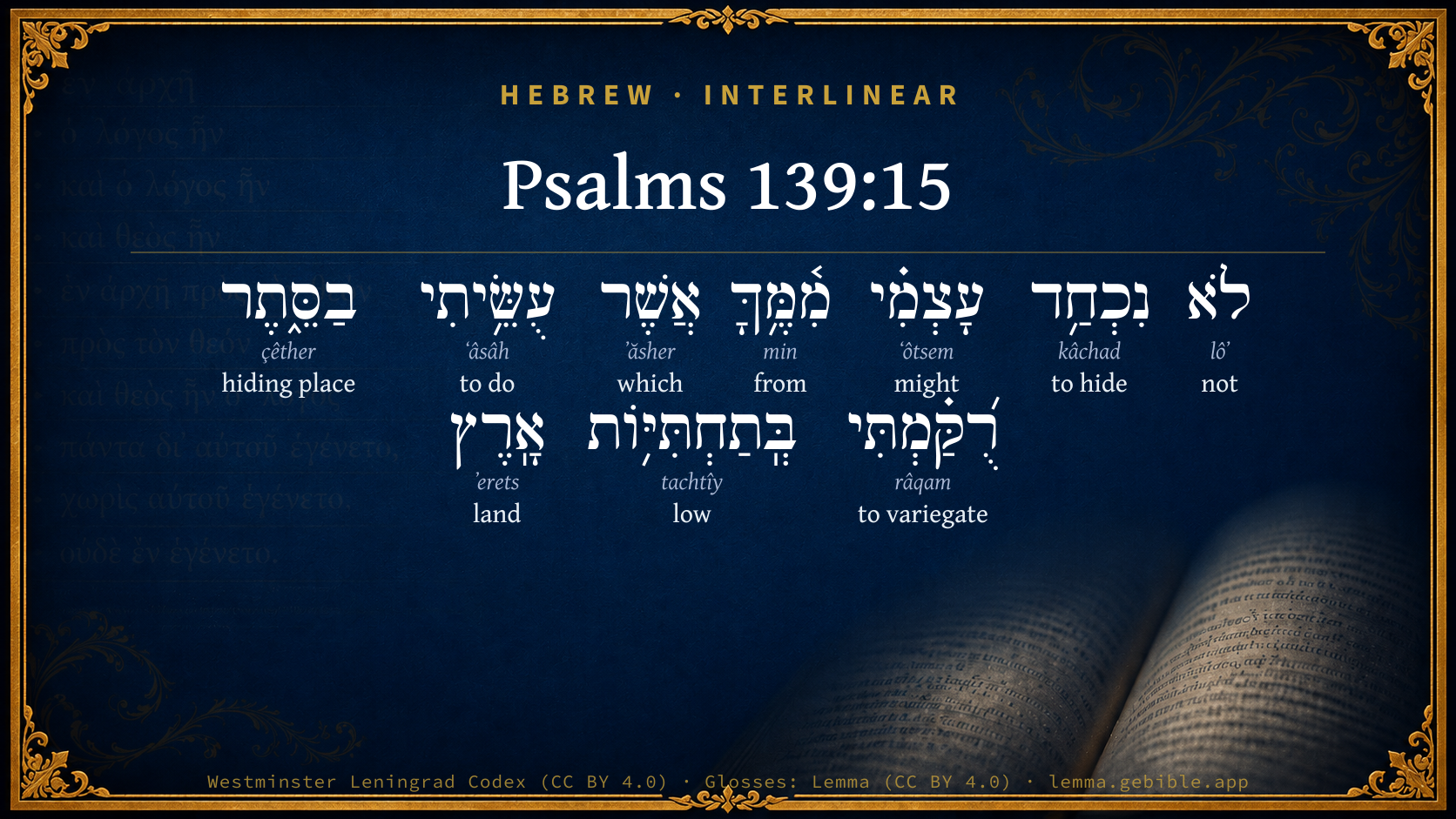
Psalms 139:15

Hebrew (Westminster Leningrad Codex) Psalms 139:15 appears in the Hebrew Old Testament. The text above is from the Westminster Leningrad Codex. Each word links to its Strong’s number, a concise gloss, and parsing drawn from the Open Scriptures Hebrew Bible morphology. Click any word for its full Brown-Driver-Briggs (BDB) entry.
Download image
Cite this verse

Psalms 139:15 (World English Bible). Public Domain. Lemma interlinear Bible study tool, https://lemma.gebible.app/v/psalms/139/15.

Show BibTeX & RIS
BibTeX
RIS
English Translation
My frame wasn't hidden from you, When I was made in secret, Woven together in the depths of the earth.
World English Bible · Public Domain
Download a study sheet

One document with this verse’s original text, its word-by-word gloss line, the meaning frame, cross-references with their text, attributed commentary, and full source and license credits — printable, and it pastes into notes with its structure intact.

This verse Autodidact and up

Study sheet (.html) Plain text (.txt)

A passage Seminary Student

Up to 50 verses in one chapter. A passage sheet keeps up to 6 commentary sources and 12 cross-references per verse, in the order this page ranks them, and says so on the sheet whenever that leaves anything out. Ask for a single verse and you get the Autodidact verse sheet above.

Everything on this page stays free to read, with no account — the sheet is a download of what is already on screen, not access to it.

Want to remove ads? Support Godless Engineer
Compare translations 3

The same verse in 3 English versions, stacked beneath the original-language interlinear above. Click any original word for its lexicon entry.

Each is an independent rendering of the whole verse — the interlinear is not word-aligned to these translations.

Highlighted words mark where these versions differ — a whole-verse word diff, not a word-by-word alignment.

  • World English Bible Public Domain
    My frame wasn't hidden from you, When I was made in secret, Woven together in the depths of the earth.
  • King James Version Public Domain
    My substance was not hid from thee, when I was made in secret, and curiously wrought in the lowest parts of the earth.
  • unfoldingWord Literal Text CC BY-SA 4.0
    My frame was not hidden from you when I was made in the secret place, I was woven in the depths of the earth,

unfoldingWord Literal Text — © unfoldingWord, licensed CC BY-SA 4.0. Word-aligned USFM3 via Door43 (git.door43.org/unfoldingWord/en_ult).

Versions to compare (up to 4)

3 of 4 selected

Show all 17 translations

Every available English version of this verse, each an independent rendering of the whole verse.

  • World English Bible Public Domain
    My frame wasn't hidden from you, When I was made in secret, Woven together in the depths of the earth.
  • Berean Standard Bible Public Domain
    My frame was not hidden from You when I was made in secret, when I was woven together in the depths of the earth.
  • Majority Standard Bible Public Domain
    My frame was not hidden from You when I was made in secret, when I was woven together in the depths of the earth.
  • King James Version Public Domain
    My substance was not hid from thee, when I was made in secret, and curiously wrought in the lowest parts of the earth.
  • American Standard Version (1901) Public Domain
    My frame was not hidden from thee, When I was made in secret, `And' curiously wrought in the lowest parts of the earth.
  • Revised Version (1885) Public Domain
    My frame was not hidden from thee, when I was made in secret, and curiously wrought in the lowest parts of the earth.
  • Geneva Bible (1599) Public Domain
    My bones are not hid from thee, though I was made in a secret place, and facioned beneath in the earth.
  • Young's Literal Translation Public Domain
    My substance was not hid from Thee, When I was made in secret, Curiously wrought in the lower part of earth.
  • Literal Standard Version CC BY-SA 4.0
    My substance was not hid from You, || When I was made in secret, || Curiously worked in the lower part of earth.
  • Unlocked Literal Bible CC BY-SA 4.0
    My bones were not hidden from you when I was made in private, when I was intricately made in the depths of the earth.
  • unfoldingWord Literal Text CC BY-SA 4.0
    My frame was not hidden from you when I was made in the secret place, I was woven in the depths of the earth,
  • Darby Bible Public Domain
    My bones were not hidden from thee when I was made in secret, curiously wrought in the lower parts of the earth.
  • World Messianic Bible Public Domain
    My frame wasn’t hidden from you, when I was made in secret, woven together in the depths of the earth.
  • Webster's Bible Public Domain
    My substance was not hid from thee when I was made in secret, and curiously formed in the lowest parts of the earth.
  • Free Bible Version CC BY-SA 4.0
    My growing body was not hidden from you as I was formed in secret, as I was intricately put together “in the depths of the earth.”
  • Bible in Basic English Public Domain
    My frame was not unseen by you when I was made secretly, and strangely formed in the lowest parts of the earth.
  • JPS Tanakh (1917) Public Domain
    My frame was not hidden from Thee, when I was made in secret, and curiously wrought in the lowest parts of the earth.

Literal Standard Version (2020), Covenant Press — licensed CC BY-SA 4.0. Text via the HelloAO Bible API (eBible.org). Unlocked Literal Bible (unfoldingWord) — licensed CC BY-SA 4.0. Text via the HelloAO Bible API (eBible.org). unfoldingWord Literal Text — © unfoldingWord, licensed CC BY-SA 4.0. Word-aligned USFM3 via Door43 (git.door43.org/unfoldingWord/en_ult). Free Bible Version, Dr. Jonathan Gallagher — licensed CC BY-SA 4.0. Text via the HelloAO Bible API (eBible.org).

Word by word

More ways to search: Search by grammar → Find every occurrence → Compare this word →

Practice this passage: Drill this verse → Learn its vocabulary →

עָצְמִ֗י
ʻôtsem
H6108
“might · my”
Noun, Common, Masculine, Singular, Construct + Suffix, Personal, 1st Person, Common, Singular
Part of Speech
Noun
Type
Common
Gender
Masculine
Number
Singular
State
Construct
Full BDB Definition

Origin: from H6105

TWOT: 1673a

power, bones, might - might - bones
  1. לֹא lôʼ H3808 “not” Particle, Negative
  2. נִכְחַ֥ד kâchad H3582 “to hide” Verb, Niphal, Perfect, 3rd Person, Masculine, Singular
  3. מִ֫מֶּ֥ךָּ min H4480 “from · you” Preposition + Suffix, Personal, 2nd Person, Masculine, Singular
  4. אֲשֶׁר ʼăsher H834 “which” Particle, Relative
  5. עֻשֵּׂ֥יתִי ʻâsâh H6213 “to do” Verb, Pual, Perfect, 1st Person, Common, Singular
  6. בַסֵּ֑תֶר çêther H5643 “in/at the · hiding place” Preposition, Determined + Noun, Common, Masculine, Singular, Absolute
  7. רֻ֝קַּ֗מְתִּי râqam H7551 “to variegate” Verb, Pual, Perfect, 1st Person, Common, Singular
  8. בְּֽתַחְתִּיּ֥וֹת tachtîy H8482 “in/at · low of” Preposition + Adjective, Adjective, Feminine, Plural, Construct
  9. אָֽרֶץ ʼerets H776 “land” Noun, Common, Both, Singular, Absolute

About this verse

These counts appear in no published source. They are computed here, from the morphology-tagged text and Lemma’s own curated glosses. What Lemma adds →

10
words
10
distinct lemmas
Wisdom
section

Notable vocabulary

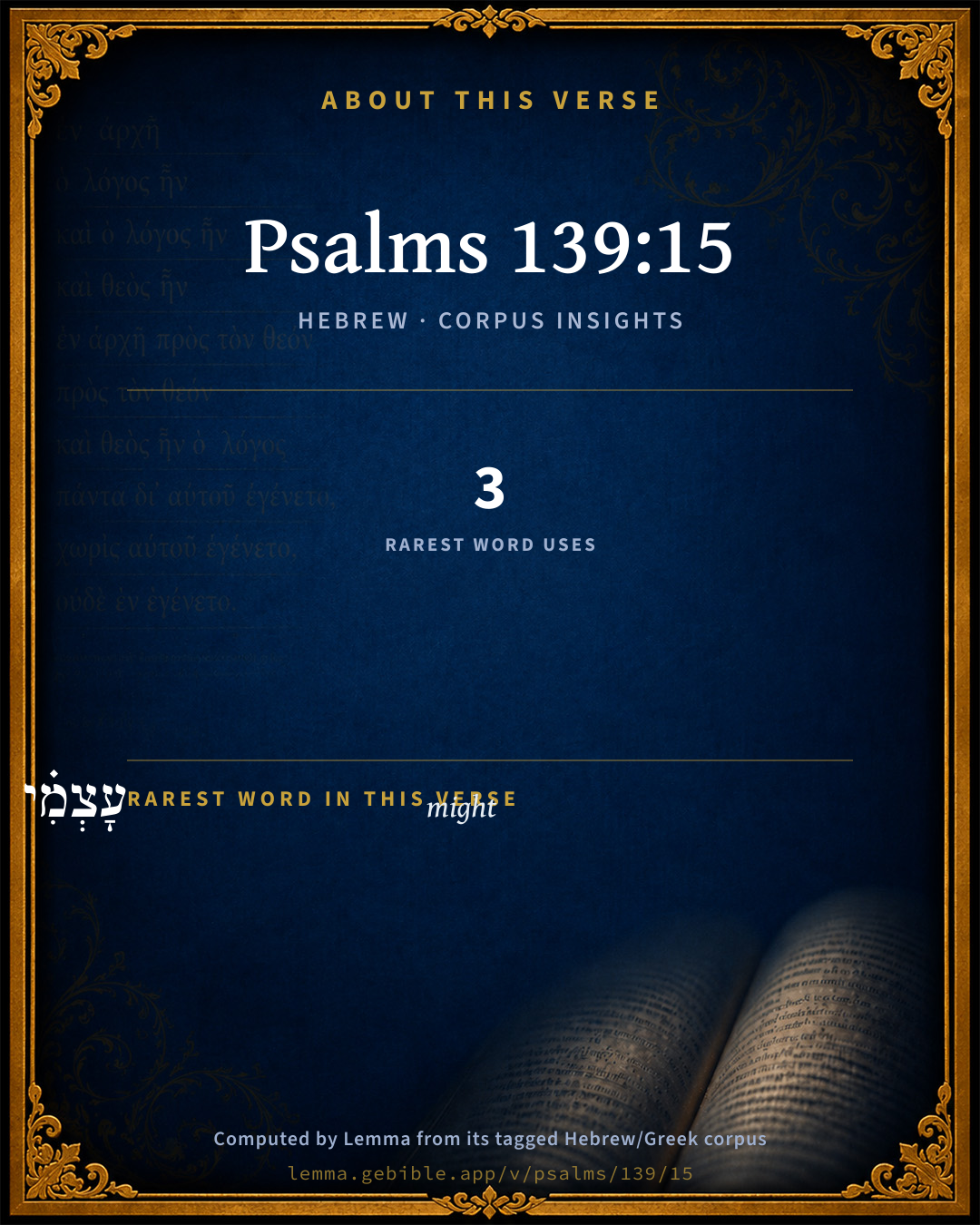
The rarest word here is עָצְמִ֗י might H6108 — appearing just 3 times in the whole Hebrew Bible.

Shared distinctive vocabulary

עָצְמִ֗י might H6108 occurs in 3 verses of the Hebrew Bible. Also found in:

Grammatical profile

  • 3 verbs
  • 3 nouns
  • 1 adjective
  • 1 preposition
  • 2 particles

Verb forms

  • נִכְחַ֥ד Niphal · Perfect
  • עֻשֵּׂ֥יתִי Pual · Perfect
  • רֻ֝קַּ֗מְתִּי Pual · Perfect

Hebrew & Septuagint length

In English translation the verse runs 20 words from the Hebrew and 22 from the Septuagint (LXX English) — closely comparable.

A rough comparison of the two English renderings, which tokenize alike — not a word-level alignment.

Word counts can differ between the Hebrew and the Greek without any difference in meaning — e.g. the Hebrew direct-object marker אֵת has no separate Greek word, and Greek often adds the article ὁ.

Cross-references

4

Topical passages linked to Psalms 139:15 in the Treasury of Scripture Knowledge — connected by theme and wording, ordered by reader-vote popularity; previews shown in the World English Bible.

  • Ecclesiastes 11:5 As you don't know what is the way of the wind, Nor how the bones grow in the womb of her who is with child; Even so you don't know the work of God who does all.
  • Psalms 139:13 For you formed my inmost being. You knit me together in my mother's womb.
  • Job 10:8–11 'Your hands have framed me and fashioned me altogether; Yet you destroy me.
  • Psalms 63:9 But those who seek my soul, to destroy it, Shall go into the lower parts of the earth.

Cross-references courtesy of OpenBible.info (CC BY 4.0).

Hebrew and Greek witnesses Masoretic Hebrew ↔ Greek Septuagint

The same verse in the two great witnesses to the Old Testament, shown verse-for-verse.

You’re reading Greek Psalm 138 (Hebrew Psalm 139). The Septuagint counts the superscription, so verse numbers can differ from the Hebrew — chapter-level alignment, not verse-by-verse. Numbering follows Rahlfs.

These are two independent witnesses, not word-aligned to each other, and the Septuagint is shown in lemma (dictionary) form.

Hebrew Psalms 139:15 Masoretic · Westminster Leningrad Codex

לֹא נִכְחַ֥ד עָצְמִ֗י מִ֫מֶּ֥ךָּ אֲשֶׁר עֻשֵּׂ֥יתִי בַסֵּ֑תֶר רֻ֝קַּ֗מְתִּי בְּֽתַחְתִּיּ֥וֹת אָֽרֶץ

My frame wasn't hidden from you, When I was made in secret, Woven together in the depths of the earth.

World English Bible · Public Domain

Greek LXX Greek Psalm 138:15 Septuagint · lemma form

οὐ κρύπτω ὁ ὀστέον ἐγώ ἀπό σύ ὅς ποιέω ἐν κρυφῇ καί ὁ ὑπόστασις ἐγώ ἐν ὁ κατώτατος ὁ γῆ

My bones, which you made in secret were not hidden from you, nor my substance, in the lowest parts of the earth.

LXX2012 (modern English Septuagint) · Public Domain

On this verse, Joseph Benson's Commentary discusses the Septuagint’s reading. Read the note in Commentary ↓

Hebrew: Westminster Leningrad Codex (CC BY 4.0). Greek: Septuagint (public domain); English from LXX2012 (modern English Septuagint) (Public Domain). How the Septuagint differs from the Hebrew →

Commentary

Notes on Psalms 139:15 from classic Christian and Jewish commentators (each source and its license shown beneath its notes). The classic Christian expositions comment on the surrounding passage and are grouped to its opening verse, so a note may address several verses; the Jewish commentaries on the Tanakh (Rashi and others) are per-verse, so they appear only where the commentator wrote on this verse.

Lemma curates 59 commentaries, every one of them public domain or Creative Commons licensed, each selected and text-cleaned for this edition rather than reprinted as found. About our sources →

Trapp's Complete Commentary

John Trapp

Psa 139:15 My substance was not hid from thee, when I was made in secret, [and] curiously wrought in the lowest parts of the earth.

Ver. 15. My substance was not hid from thee] Ossatio mea, id est, ossium et artuum compages, the structure of my bones and joints. But was not he a wise man (and yet wise enough otherwise) who, being asked upon his death bed what his soul was? seriously answered, that he knew not well; but he thought it was a great bone in the middle of his body? (Pemble’s Mischief of Ignorance).

Was not hid from thee] For thou hast both the names and number of every part, to a nerve or an artery. Aquinas saith that at the resurrection the bodies of the saints shall be so clear and transparent that all the veins, humours, nerves, and bowels shall be seen, as in a glass. It is sure that they are so to God when first formed in the womb.

When I was made in secret] That is, in the womb of my mother. As curious workmen, when they have some choice piece in hand, they perfect it in private, and then bring it forth to light for men to gaze at; so here.

And curiously wrought] Variegatus, et quasi acu pictus, Embroidered and wrought as with the needle; whence man is called a microcosm, or little world. Bodine observeth that there are three regions within man’s body (besides all that is seen without), answerable to those three regions of the world: elementary, ethereal, and celestial (Vide Lactant. de Dei Opificio; Galen. de Usa Part.; Cic. 2, de Nat. Deor.). His entrails and whatsoever is under his heart resemble the elementary region, wherein only there is generation and corruption; the heart and vitals, that are divided from those entrails by the diaphragm, resemble the ethereal region; as the brain doth the heavenly, which consisteth of intelligible creatures.

In the lowest parts of the earth] That is, in my mother’s womb, as before. See Eph 4:9. The Syriac interpreteth it (but not so well), when I shall die, and be buried, and my bones turned to ashes, yet thou shalt know them.

John Trapp, A Commentary or Exposition upon All the Books of the Old and New Testament (1647–1656) — public domain. Text from a community e-Sword module.

The Biblical Illustrator

Joseph S. Exell

Psa_139:15-16

My substance was not hid from Thee, when I was made in secret.

Daily growth

God, being one, the author of nature as of grace, worketh harmoniously in both His kingdoms. And as in other ways, so in this: in both He createth and hath created by a single act; in both He carrieth on His work, silently yet in majesty. God created us, gave us life once, and then preserves it. Men grow in stature (blessed are they if in wisdom, too), they know not how; they eat, they drink, they sleep, are nourished, they know not how; and so day by day, and year by year, pass through the stages of life, through childhood, youth, to manhood, and mature years. So should it be in our re-creation. In Holy Baptism He re-creates us in His own image; passes His hand upon us, puts the first germ of spiritual life within us, to grow, be nourished, expand, flower, bear fruit, until it take into itself all our old nature, and we become wholly new. Fearfully indeed and wonderfully are we made; a marvel to the blessed angels and to ourselves. Strange, through what variety of accidents, griefs, joys, terrors, fears, death, life, His encircling providence girding us round shall have fenced in our way; and He who has all creation at His command shall have made all creation, good and bad, great and small, natural and moral, the holiness of angels and men and the malice of Satan, work together to the salvation of His elect. And this amazing everlasting work is going on continually. Which day by day were fashioned. It is the very marvellousness of Gods works in nature, in the Church, in each single soul, that they go on so noiselessly. Axe and hammer are not heard, but the house of the Lord is raised without hands. Day by day we rise, and night by night tie down, and see not, except rarely, the growth of others or our own. Did we make ourselves, we might well be concerned that we see not what we are becoming; now we may trust that, although in secret, still we are being fashioned into a vessel fit for the Masters use. Still, although we know not where we are, how much has been, or is being, wrought in us; what our progress, we must know that something is being wrought. We may not be conscious that we are growing in grace, but we must be that we are acting under grace. We may not see how direr our path is (that we shall see as it becomes straighter), but if we are moving upward we must make efforts, and feel them. Pray we for the grace of God to do each single act, as He shall will, to His glory, and He will lead us whither as yet we know not. But although God forms us day by day, yet are there, from time to time, seasons of larger growth, as in nature so in grace. God, in His mercy, gives us fresh starting points in our Christian race. Some such most of us perhaps have passed; too many, it is to be feared, have wasted. Such are childhoods earliest trials. The bitter fruits we have felt in ourselves from some one sin of childhood, some neglect of Gods loud warning or His call, may make us sorrowfully estimate the deep value of such calls, had we obeyed. Such periods, again, when used aright, are Holy Confirmation and the first Communion. Yea, so full is this of the richness of Gods treasure, that thoughtful persons have said that none ever went far astray whose first Communion was diligently prepared for, and received and treasured holily. And when these and other seasons have been wasted, God in His mercy visits us anew, but mostly in an austere form. A mighty and strong wind must rend the rock of our stony heart before the Lord ere He can speak to us in the still small voice. (E. B. Pusey, D. D.)

The Biblical Illustrator, edited by Joseph S. Exell (c. 1880s–1900s) — public domain. Text from a community e-Sword module.

The Treasury of David

Charles H. Spurgeon

Ver. 15. My substance was not hid from thee. The substantial part of my being was before thine all seeing eye; the bones which make my frame were put together by thine hand. The essential materials of my being before they were arranged were all within the range of thine eye. I was hidden from all human knowledge, but not from thee: thou hast ever been intimately acquainted with me.

When I was made in secret. Most chastely and beautifully is here described the formation of our being before the time of our birth. A great artist will often labour alone in his studio, and not suffer his work to be seen until it is finished; even so did the Lord fashion us where no eye beheld as, and the veil was not lifted till every member was complete. Much of the formation of our inner man still proceeds in secret: hence the more of solitude the better for us. The true church also is being fashioned in secret, so that none may cry, "Lo, here!" or "Lo, there!" as if that which is visible could ever be identical with the invisibly growing body of Christ.

And curiously wrought in the lowest parts of the earth. "Embroidered with great skill", is an accurate poetical description of the creation of veins, sinews, muscles, nerves, etc. What tapestry can equal the human fabric? This work is wrought as much in private as if it had been accomplished in the grave, or in the darkness of the abyss. The expressions are poetical, beautifully veiling, though not absolutely concealing, the real meaning. God's intimate knowledge of us from our beginning, and even before it, is here most charmingly set forth. Cannot he who made us thus wondrously when we were not, still carry on his work of power till he has perfected us, though we feel unable to aid in the process, and are lying in great sorrow and self loathing, as though cast into the lowest parts of the earth?

Ver. 15. My substance was not hid from thee, etc. What deeper solitude, what state of concealment more complete, than that of the babe as yet unborn Yet the Psalmist represents the Almighty as present even there. "My substance was not hid from thee, when I was made in secret, and curiously wrought in the lowest parts of the earth." The whole image and train of thought is one of striking beauty. We see the wonderful work of the human body, with all its complex tissue of bones, and joints, and nerves, and veins, and arteries growing up, and fashioned, as it had been a piece of rich and curious embroidery under the hand of the manufacturer. But it is not the work itself that we are now called on to admire. The contexture is indeed fearful and wonderful; but how much more when we reflect that the divine Artificer wrought within the dark and narrow confines of the womb. Surely the darkness is no darkness with him who could thus work. Surely the blackest night, the closest and most artificial recess, the most subtle disguises and hypocrisies are all seen through, are all naked and bare before him whose "eyes did see our substance yet being imperfect." The night is as clear as the day; and secret sins are set in the light of his countenance, no less than those which are open and scandalous, committed before the sun or on the house top. And if "in his book all our members are written, which day by day were fashioned, when as yet there was none of them", surely the actions of these members, now that they are grown, or growing, to maturity, and called upon to fulfil the functions for which they were created, shall be all noted down; and none be contrived so secretly, but that when the books are opened at the last day, it shall be found written therein to justify or to condemn us. Such is the main lesson which David himself would teach us in this Psalm, the omnipresence and omniscience of Almighty God. My brethren, let us reflect for a little upon this deep mystery; that he, "the High and Lofty One that inhabiteth eternity" is about our path and about our bed, and spies out all our ways; that go whither we will he is there; that say what we will, there is not a word on our tongue but he knoweth it altogether. The reflection is, indeed, mysterious, but it is also most profitable. Charles Wordsworth, in "Christian Boyhood", 1846.

Ver. 15. My substance was not hid from thee. Should an artisan intend commencing a work in some dark cave where there was no light to assist him, how would he set his hand to it? in what way would he proceed? and what kind of workmanship would it prove? But God makes the most perfect work of all in the dark, for he fashions man in the mother's womb. John Calvin.

Ver. 15. When I was made in secret, etc. The author uses a metaphor derived from the most subtle art of the Phrygian workman:

"When I was formed in the secret place,

When I was wrought with a needle in the depths of the

earth."

Whoever observes this (in truth he will not be able to observe it in the common translations), and at the same time reflects upon the wonderful mechanism of the human body; the various implications of the veins, arteries, fibres, and membranes; the "undescribable texture" of the whole fabricmay, indeed, feel the beauty and gracefulness of this well adapted metaphor, but will miss much of its force and sublimity, unless he be apprised that the art of designing in needlework was wholly dedicated to the use of the sanctuary, and, by a direct precept of the divine law, chiefly employed in furnishing a part of the sacerdotal habit, and the vails for the entrance of the Tabernacle. Ex 28:39 26:36 27:16. Thus the poet compares the wisdom of the divine Artificer with the most estimable of human arts that art which was dignified by being consecrated altogether to the use of religion; and the workmanship of which was so exquisite, that even the sacred writings seem to attribute it to a supernatural guidance. See Ex 35:30-35. Robert Lowth (1710-1787), in "Lectures on the Sacred Poetry of the Hebrews."

Ver. 15. Curiously wrought in the lowest part, of the earth, that is, in the womb: as curious workmen, when they have some choice piece in hand, they perfect it in private, and then bring it forth to light for men to gaze at. What a wonderful piece of work is man's head (God's masterpiece in this little world), the chief seat of the soul, that cura Divini ingenii, as Favorinus calls it. Many locks and keys argue the value of the jewel that they keep, and many papers wrapping the token within them, the price of the token. The tables of the testament, first laid up in the ark, secondly, the ark bound about with pure gold; thirdly, overshadowed with cherubim's wings; fourthly, enclosed within the vail of the Tabernacle; fifthly, with the compass of the Tabernacle; sixthly, with a court about all; seventhly, with a treble covering of goats', rams', and badgers' skins above all; they must needs be precious tables. So when the Almighty made man's head (the seat of the reasonable soul), and overlaid it with hair, skin, and flesh, like the threefold covering of the Tabernacle, and encompassed it with a skull and bones like boards of cedar, and afterwards with divers skins like silken curtains; and lastly, enclosed it with the yellow skin that covers the brain (like the purple veil), he would doubtless have us to know it was made for some great treasure to be put therein. How and when the reasonable soul is put into this curious cabinet philosophers dispute many things, but can affirm nothing of certainty. Abraham Wright.

Ver. 15. In the lowest parts of the earth. From this remarkable expression, which, in the original, and as elsewhere used, denotes the region of the deadSheol, or Hades it would appear that it is not only his formation in the womb the Psalmist here contemplates, but alsoregarding the region of the dead as the womb of resurrection lifethe refashioning of the body hereafter, and its new birth to the life immortal, which will be no less "marvellous" a work, but rather more so, than the first fashioning of man's "substance." Confirmed by the words of Ps 139:18 "When I awake, I am still with thee" the same language before employed to express the resurrection hope, Ps 17:15; when there shall be purposes and "precious counsels" with respect to his redeemed, in anticipation of which they may repeat this Psalm with renewed feelings of wonder and admiration. William De Burgh.

Ver. 15-16. The word substance represents different words in these verses. In Ps 139:15 it is "my strength", or "my bones"; in Ps 139:16 the word is usually rendered "embryo": but "clew" (life a ball yet to be unwound) finds favour with great scholars.

In the lowest parts of the earth denotes no subterranean limbo or workshop; but is a poetical parallel to "in secret."

Which in continuance were fashioned is wrong. The margin, though also wrong, indicates the right way: "my days were determined before one of them was." David M`laren, in "The Book of Psalms in Metre", 1883.

Psalms 139:16*

Charles H. Spurgeon's The Treasury of David (1869–1885) — public domain. Psalms only. Text from a community e-Sword/MySword module.

Joseph Benson's Commentary

Psa 139:15. My substance was not hid from thee — Hebrews עצמי, my bone. So the LXX. το οστουν μου. Bone may be here taken collectively for bones, or, rather for the whole fabric of the bones: or may be put synecdochically for the whole body, as being the most substantial part of it, as in Psa 35:10. When I was made in secret — In the womb; termed, in the next clause, in the lowest parts of the earth, in a place as remote from human eyes as the lowest parts of the earth are. He seems to allude to plants and flowers, the roots and first rudiments of which are formed under ground. And curiously wrought — Exquisitely composed of bones, muscles, sinews, arteries, veins, nerves, and other parts, all framed with such wonderful skill, that even heathen, upon the contemplation of the human body in all its parts, and observing how admirably they were formed for beauty and use, have broken forth into admiration and adoration of the Creator. The word רקמתי, here rendered, curiously wrought, signifies, embroidered, or, wrought with a needle. “The process,” says Dr. Horne, “whereby the fœtus is gradually formed and matured for the birth, is compared to that of a piece of work wrought with a needle, or fashioned in the loom; which, with its beautiful variety of colour, and proportion of figure, ariseth, by degrees, to perfection, under the hand of the artist.”

Thus also Bishop Lowth, speaking of metaphors in the Hebrew poetry, taken from things sacred, observes, “In that most perfect hymn, where the immensity of the Omnipresent Deity, and the admirable wisdom of the Divine Artificer, in framing the human body, are celebrated, the poet uses a remarkable metaphor drawn from the nicest tapestry work; When I was wrought as with a needle, &c. He who remarks this, and at the same time reflects on the wonderful composition of the human body, the various implication of veins, arteries, fibres, membranes, and the inexplicable texture of the whole frame, will immediately understand the beauty and elegance of this most apt expression. But he will not attain the whole force and dignity of it, unless he also considers that the most artful embroidery with the needle was dedicated, by the Hebrews, to the service of the sanctuary; and that the proper and singular use of this work was, by the immediate prescript of the divine law, applied in a certain part of the high- priest’s dress, and in the curtains of the tabernacle. So that the psalmist may well be supposed to have compared the wisdom of the Divine Artificer particularly with that specimen of human art, whose dignity was, through religion, the highest, and whose elegance was so exquisite, that the sacred writer seems to attribute it to a divine inspiration.” — Lowth’s Eighth Prelection.

Joseph Benson's Commentary on the Old and New Testaments (1811–1818) — public domain. Text from a community e-Sword module.

J. A. Alexander on Psalms

Joseph Addison Alexander

15. (Psa 139:15) Not hid was my frame from thee, when I was made in secret, embroidered in depths of the earth. The not hid is a meiosis, implying that God saw it clearly, and fully understood it, inasmuch as he himself created it. Frame, literally strength, as in Deu 8:17, but applied to the bones and sinews as the strength and framework of the body. See above, on Psa 6:2, and compare Job 10:11. The common Hebrew word for bone differs only in the pointing. The word translated when is the relative pronoun, and may here retain its proper meaning, although then not easily translated, as its antecedent is latent in the phrase my frame, which may be thus resolved, the frame of me who was made, etc. In secret, i.e. in the womb. Embroidered, which is the invariable meaning of the Hebrew verb, is a bold but beautiful expression for the complicated tissue of the human frame, in which so many and such various threads are curiously interwoven. Depths of the earth can only be explained as a comparative expression, corresponding to in secret and denoting the same thing, which it describes as no less dark and hidden from the view of men than subterraneous caverns, or as some suppose Sheol, the invisible world. See above on Psa 63:9, and compare Job 1:21, where the figure is inverted, and the grave is confounded with the womb.

Joseph Addison Alexander, The Psalms Translated and Explained (1850) — public domain. Text from a community e-Sword module.

Geneva Bible (1599)

Geneva Bible translators

That is, in my mother’s womb: which he compareth to the inward parts of the earth.

Geneva Bible (1599) marginal notes — public domain. Text via Bolls.life.

Adam Clarke's Commentary

Verse 15. My substance was not hid from thee] עצמי atsmi, my bones or skeleton.

Curiously wrought] רקמתי rukkamti, embroidered, made of needlework. These two words, says Bishop Horsley, describe the two principal parts of which the human body is composed; the bony skeleton, the foundation of the whole; and the external covering of muscular flesh, tendons, veins, arteries, nerves, and skin; a curious web of fibres. On this passage Bishop Lowth has some excellent observations: "In that most perfect hymn, where the immensity of the omnipresent Deity, and the admirable wisdom of the Divine Artificer in framing the human body, are celebrated, the poet uses a remarkable metaphor, drawn from the nicest tapestry work: -

When I was formed in secret;

When I was wrought, as with a needle,

in the lowest parts of the earth.

"He who remarks this, (but the man who consults Versions only will hardly remark it,) and at the same time reflects upon the wonderful composition of the human body, the various implication of veins, arteries, fibres, membranes, and the 'inexplicable texture' of the whole frame; will immediately understand the beauty and elegance of this most apt translation. But he will not attain the whole force and dignity, unless he also considers that the most artful embroidery with the needle was dedicated by the Hebrews to the service of the sanctuary; and that the proper and singular use of their work was, by the immediate prescript of the Divine law, applied in a certain part of the high priest's dress, and in the curtains of the tabernacle, Ex 28:39; Ex 26:36; Ex 27:16; and compare Eze 16:10; Eze 13:18. So that the psalmist may well be supposed to have compared the wisdom of the Divine Artificer particularly with that specimen of human art, whose dignity was through religion the highest, and whose elegance (Ex 35:30-35) was so exquisite, that the sacred writer seems to attribute it to a Divine inspiration."

In the lowest parts of the earth.] The womb of the mother, thus expressed by way of delicacy.

Adam Clarke's Commentary on the Bible (1810–1826) — public domain. Text from a community e-Sword/MySword module.

John Calvin's Commentaries

15. My strength was not hid from thee That nothing is hid from God David now begins to prove from the way in which man is at first formed, and points out God’s superiority to other artificers in this, that while they must have their work set before their eyes before they can form it, he fashioned us in our mother’s womb. It is of little importance whether we read my strength or my bone, though I prefer the latter reading. He next likens the womb of the mother to the lowest caverns or recesses of the earth. Should an artizan intend commencing a work in some dark cave where there was no light to assist him, how would he set his hand to it? in what way would he proceed? and what kind of workmanship would it prove? “The figure,” says Walford, “is derived from the darkness and obscurity of caverns and other recesses of the earth.”

“רקם is ‘to embroider.’” — Phillips. Mant translates the verse thus: —

“By all, but not by thee unknown, My substance grew, and, o’er it thrown, The fine-wrought web from nature’s loom, All wove in secret and in gloom.”

And after observing that the foetus is gradually formed and matured for the birth, like plants and flowers under ground, he adds — “The process is compared to that in a piece of work wrought with a needle, or fashioned in the loom: which, with all its beautiful variety of color, and proportion of figure, ariseth by degrees to perfection, under the hand of the artist, framed according to a pattern lying before him, from a rude mass of silk, or other materials. Thus, by the power and wisdom of God, and after a plan delineated in his book, is a shapeless mass wrought up into the most curious texture of nerves, veins, arteries, bones, muscles, membranes, and skin, most skilfully interwoven and connected with each other, until it becometh a body harmoniously diversified with all the limbs and lineaments of a man, not one of which at first appeared, any more than the figures were to be seen in the ball of silk. But then, which is the chief thing here insisted on by the Psalmist, whereas the human artificer must have the clearest light whereby to accomplish his task, the divine work-master seeth in secret, and effecteth all his wonders within the dark and narrow confines of the womb.” Bishop Lowth supposes that the full force and beauty of the metaphor in this passage will not be understood, unless it is perceived that the Psalmist alludes to the art of embroidery as consecrated by the Jews to sacred purposes, in decorating the garments of the priests and the curtains at the entrance of the tabernacle. “In that most perfect ode, Psalm 139,” says he, “which celebrates the immensity of the omnipresent Deity, and the wisdom of the divine artificer in forming the human body, the author uses a metaphor derived from the most subtle art of Phrygian workmen:

‘When I was formed in the secret place, When I was wrought with a needle in the depths of the earth.

Whoever observes this, (in truth he will not be able to observe it in the common translations,)and at the same time reflects upon the wonderful mechanism of the human body, the various amplifications of the veins, arteries, fibres, and membranes; the ‘indescribable texture’ of the whole fabric; may indeed feel the beauty and gracefulness of this well-adapted metaphor, but will miss much of its force and sublimity, unless he be apprised that the art of designing in needle-work was wholly dedicated to the use of the sanctuary, and by a direct precept of the divine law, chiefly employed in furnishing’ a part of the sacerdotal habits, and the veils for the entrance of the tabernacle. (Exodus 28:39; Exodus 26:36; Exodus 27:16; compare Ezekiel 16:10, 13, 18.) Thus the poet compares the wisdom of the divine artificer with the most estimable of human arts — that art which was dignified by being consecrated altogether to the use of religion; and the workmanship of which was so exquisite, that even the sacred writings seem to attribute it to a supernatural guidance. See Exodus 35:30-35 ” — Lowth’s Lectures on the Sacred Poetry of the Hebrews, volume 1.

“Que sera-ce donc quand on viendra a contempler par le menu chacune partie?” — Fr.

John Calvin's Commentaries (1540-1563) — public domain. Text from the Calvin Translation Society English edition (1840s-50s) via the Christian Classics Ethereal Library (ccel.org). Calvin's coverage is partial (roughly two-thirds of the Bible); uncommented books and verses are honest gaps, never fabricated. The 19th-century editor's footnotes and remarks are omitted so the notes are faithfully Calvin's own voice.

Ellicott's Commentary for English Readers

(15) Substance.—Aquila “bones,” LXX. and Vulg. “bone,” Symmachus “strength.” Perhaps, generally, body. But the common Hebrew word for bone differs only in the pointing.

In secret.—Comp. Æsch. Eum. 665.

Curiously wrought.—From the use of the verb in Exo_26:36; Exo_27:16, it plainly refers to some kind of tapestry work, but whether of the nature of weaving or embroidery is matter of controversy. The English sufficiently suggests the figure.

In the lowest parts of the earth.—This figurative allusion to the womb is intended no doubt to heighten the feeling of mystery attaching to birth. There may also be a covert allusion to the creation from dust as Sir_40:1, “From the day that they go out of their mother’s womb, till the day that they return to the mother of all things.” This allusion falls in with the view which meets us in other parts of the Old Testament, that the creation of Adam is repeated at every birth (Job_33:6, and see above, Psa_139:13).

Others, since the expression “lowest places of the earth” is used of the unseen world (Psa_63:9; comp. Psa_86:13), see here a confirmation of the view that the state before birth and after death are in this poem regarded as the dark void of night, with all the recesses of which, however, God is acquainted. (Comp. the expressions “Womb of Sheôl,” “Belly of hell,” Jon_2:2; Sir_51:5.)

A Bible Commentary for English Readers, edited by Charles John Ellicott (1878–1897) — public domain. Text from a community e-Sword module.

The Cambridge Bible for Schools and Colleges

gen. ed. J. J. S. Perowne

15. my substance] R.V. my frame, lit. my bones or skeleton.

in secret] i.e. in the womb (Psa_139:13).

curiously wrought] i.e. fashioned with skill and care. (Curious = Lat. curiosus, ‘wrought with care.’ Cp. Exo_28:8, “the curious girdle of the ephod,” R.V. “the cunningly woven band.”) The word which means literally woven or embroidered with threads of different colours, is applied by a natural metaphor to the complex and intricate formation of the body.

in the lowest parts of the earth] In the womb, as dark and mysterious as the nether world. The formation of the body is meant, and there is no reference to the doctrine of the pre-existence of souls, which is found in Wis_8:20; cp. Verg. Aen. vi. 713 ff., 884. See Schultz, O.T. Theology, Vol. ii. p. 251, E.T.

The Cambridge Bible for Schools and Colleges (gen. ed. J. J. S. Perowne; Cambridge University Press, 1878–1918) — public domain. Text from a community e-Sword module.

John Gill's Exposition

Thine eyes did see my substance, yet being unperfect,.... The word (q) for "substance" signifies a bottom of yarn wound up, or any rude or unformed lump; and designs that conglomerated mass of matter separated in the womb, containing all the essentials of the human frame, but not yet distinguished or reduced into any form or order; yet, even when in this state, the eyes of the Lord see it and all its parts distinctly;

and in thy book all my members were written: which in continuance were fashioned, when as yet there was none of them; in the book of God's eternal mind, and designs, the plan of the human body was drawn, all the parts of it described, and their form, places, and uses fixed, even when as yet not one of them was in actual being; but in due time they are all exactly formed and fashioned according to the model of them in the mind of God; who has as perfect knowledge of them beforehand as if they were written down in a book before him, Or "in thy book are written all of them, what days they should be fashioned"; not only each of the members of the body were put down in this book, but each of the days in which they should be formed and come into order: "when" as yet there was "none of them"; none of those days, before they took place, even before all time; the Targum is,

"in the book of thy memory all my days are written, in the day the world was created, from the beginning that all creatures were created.''

(q) "informe meum", Montanus; "glomus meam", Michaelis.

John Gill's Exposition of the Whole Bible (1746–1763) — public domain (CC PDM 1.0). Text via the HelloAO Bible API.

Albert Barnes' Notes on the Bible

My substance was not hid from thee - Thou didst see it; thou didst understand it altogether, when it was hidden from the eyes of man. The word “substance” is rendered in the margin, “strength” or “body.” The Septuagint, the Latin Vulgate, the Syriac, the Arabic, and Luther render it, “my bone,” or “my bones.” The word properly means strength, and then anything strong. Another form of the word, with different pointing in the Hebrew, means a bone, so called from its strength. The allusion here is to the bodily frame, considered as strong, or as that which has strength. Whatever there was that entered into and constituted the vigor of his frame, the psalmist says, was seen and known by God, even in its commencement, and when most feeble. Its capability to become strong - feeble as it then was - could not even at that time be concealed or hidden from the view of God.

When I was made in secret - In the womb; or, hidden from the eye of man. Even then thine eye saw me, and saw the wondrous process by which my members were formed.

And curiously wrought. - Literally, “embroidered.” The Hebrew word - רקם râqam - means to deck with color, to variegate. Hence, it means to variegate a garment; to weave with threads of various colors. With us the idea of embroidering is that of working various colors on a cloth by a needle. The Hebrew word, however, properly refers to the act of “weaving in” various threads - as now in weaving carpets. The reference here is to the various and complicated tissues of the human frame - the tendons, nerves, veins, arteries, muscles, “as if” they had been woven, or as they appear to be curiously interweaved. No work of tapestry can be compared with this; no art of man could “weave” together such a variety of most tender and delicate fibres and tissues as those which go to make up the human frame, even if they were made ready to his hand: and who but God could “make” them? The comparison is a most beautiful one; and it will be admired the more, the more man understands the structure of his own frame.

In the lowest parts of the earth - Wrought in a place as dark, as obscure, and as much beyond the power of human observation as though it had been done low down beneath the ground where no eye of man can penetrate. Compare the notes at Job 28:7-8.

Albert Barnes' Notes on the Bible (1834–1885) — public domain. Text from a community e-Sword/MySword module.

Matthew Poole's English Annotations

My substance; or, My bone, as the LXX. and others render the word. And bone may be here taken collectively for bones, as is usual in such words, or for the whole fabric of the bones And the bones may be very fitly mentioned here, because they are inward and invisible, as being covered with skin, and flesh, and sinews. Or the bones may be put synecdochically for the whole body, as being the most substantial part of it, as they are Psa 35:10.

In secret; in the dark vault of my mother’s womb.

Curiously wrought, Heb. embroidered; exquisitely composed of bones, and muscles, and sinews, and veins, and arteries, and other parts, all framed with such wonderful skill, that even heathens, upon the contemplation of all the parts of man’s body, and how excellently they were framed, both for beauty and use, have broken forth into pangs of admiration and adoration of the Creator of man, as Galen particularly did.

In the lowest parts of the earth; or, as it were in the lowest parts of the earth. So there is only an ellipsis of the note of similitude, which is very frequent in Scripture, as hath been often said and proved. In a place as secret and remote from human eyes as the lowest parts of the earth are, to wit, in my mother’s womb. And so what is said in the former clause is repeated in this in other words.

Matthew Poole's English Annotations on the Holy Bible (1683–1685) — public domain. Text from a community e-Sword/MySword module.

Whedon's Commentary on the Bible

Daniel D. Whedon

15, 16. Substance—Literally, My strength; referring to the bones, or osseous system, as the solid basis of muscular strength. Their growth is a mystery. Ecc_11:5.

Made in secret— “Made” is the same word here as in Gen_1:26, and the mediate making here is no less a mystery and the work of God than the immediate creative making there.

Curiously wrought—Literally, embroidered. Here is the variegated network of the human frame referred to.

Lowest parts of the earth—A delicate description corresponding to the “in secret,” just mentioned. The idea, not the word, is that of a sheol of darkness. Psa_63:9. Perhaps it has also a pointing to “the dust of the ground,” Gen_2:7.

My substance—The word denotes something rolled up, as a ball, literally, my infolded, or undeveloped substance.

Thy book—A figure conveying the minute accuracy of divine knowledge.

All my members—Hebrew, all of them. There is no better way of explaining this obscure passage than by referring the suffix pronoun them, (in כלם, kullam,) to the parts of that “substance,” or threads of that rolled up ball, just mentioned. Our version has it “members,” which is the idea, though not a translation.

Which in continuance were fashioned—Literally, During the days when they were fashioned.

When as yet there was none of them—Hebrew, And not one of them, or, not one amongst them. That is, not one member of the complicated arrangement failed, or was omitted. All was accomplished as it had been written in God’s book. The descriptions of Psa_139:13-16 belong to a region of thought on human existence the most mysterious and difficult, whether viewed in the light of physiology or theology. The student in church history will at once recall the controversy on “traducianism” and “creationism,” and will observe the leaning of the psalmist toward the latter. The statements are as delicately and beautifully given in poetry as they are true to science. While the laws of antenatal physiology, as guarding the species, are admirably recognised, the presiding forethought of the Divine Creator, stamping individuality and adjusting it to a graciously proposed destiny, is equally confessed. The subject belongs to the abstrusest domain of theological anthropology, and the passage stands as a perpetual rebuke of the shameless atheism of modern evolutionists. See Lecture vii of Bishop Alexander, Bampton Lectures, 1876

Daniel D. Whedon (gen. ed.), Commentary on the Old and New Testaments (1874–1909) — public domain. Text from a community e-Sword module.

The Pulpit Commentary

My substance was not hid from thee, when I was made in secret. The formation of the embryo in the womb seems to be intended. This remains as much a mystery as ever, notwithstanding all the pryings of modern science. And curiously wrought; literally, and embroidered, or woven with threads of divers colors (comp. ver. 13b; and note that modern science speaks of the various "tissues" of the human frame, and calls a portion of medical knowledge "histology"). In the lowest parts of the earth. This is scarcely to be taken literally. It is perhaps only a variant for the "secretly" of the preceding clause.

Vers. 15, 16. What a man can be and do God knows.

The latter clause of ver. 15 has been well rendered, "When I was wrought with a needle in the depths of the earth." There is an evidence of allusion to the sacerdotal robes, and the undescribable texture of the human system is compared to the exquisite needlework of the high priest"s garments. Every man is a bundle of possibilities; but no man has precisely the same possibilities as any other man. Each man can be what nobody else can be; each man can do what nobody else can do. This does not mean that any man can transcend the sphere and limitations of man, only that there is a very wide variety within the limitations. There are, indeed, general powers and faculties, and general elements of character and disposition, so that men can be classified; bat within the classes there is what may be called an infinite individuality remarkable varieties of ability, and even more remarkable combinations of ability and disposition and sphere. Nothing oppresses so much as to think what we should do if it were laid on us to find their right places for every man and every woman.

I GOD KNOWS EVERY MAN"S INDIVIDUALITY. Science may trace that individuality to heredity, to the bodily and mental condition of parents, to food and atmospheres, or anything else; it remains the fact that the estimate of the individuality is possible only with God. Man must have the actual story of another man"s life and experience ere he can discern his individuality. God alone can know it anticipatively from the beginning. A man"s individuality is not shown in any one thing; it is the stamp on the life, and the life must be lived before it can be seen. God knows the end from the beginning, because he knows what man essentially is. Of Christ it is said, "He knew what was in man.

II GOD CAN PRESIDE OVER THE ADJUSTMENT OF MAN"S PLACE AND WORK TO HIS INDIVIDUALITY. Oftentimes the surprise of life is the place in which God puts men, and the work he gives them to do. Men always err when they force themselves to do what they think they would like to do. We are only on safe lines when we do what God gives us to do. He knows us; he knows all places, all work, all circumstances; so he can fit things and people together, and make both work together for good. "My times are in thy hands. R.T.

The Pulpit Commentary (1880–1919), ed. H.D.M. Spence-Jones & Joseph S. Exell — public domain. Text from a community e-Sword module.

unfoldingWord translationNotes

Door43 World Missions Community

intricately made

"made with great complexity"

the depths of the earth

This is probably a way of speaking about a mother's womb (See: Metaphor)

all the days assigned to me were recorded in your book even before the first one happened

This expression implies that ancient Israelites imagined that God wrote down his plans in a book.

unfoldingWord translationNotes — © Distant Shores Media and the Door43 World Missions Community, licensed CC BY-SA 4.0. Source: git.door43.org/Door43/en_tn.

Rashi

Rabbi Shlomo Yitzchaki (Rashi)

I was made in secret In sexual intercourse.

in the lowest parts of the earth In the lowest compartment in my mother’s womb.

Rashi on the Tanakh — English translations: “The Judaica Press complete Tanach with Rashi, translated by A. J. Rosenberg” (CC BY 4.0); “Pentateuch with Rashi's commentary by M. Rosenbaum and A.M. Silbermann, 1929-1934” (public domain); “The Metsudah Tanach series, Lakewood, N.J” (CC BY 4.0); and “The Book of Joshua, Metsudah Publications, 1997” (CC BY 4.0). Text via Sefaria.

Lesson kit

Teaching starters — assembled from the data on this page, not authored interpretation. Every prompt links to the verse data it draws on. Edit before teaching.

Psalms, in the Wisdom, opens this verse with 10 words (10 distinct Hebrew lemmas). Its most distinctive word is ʻôtsem (“might”). A historical commentator’s framing appears above. Read the whole chapter for the surrounding context.

Discussion questions

  1. How does “might” (ʻôtsem) shape what this verse is saying?
  2. How does Deuteronomy 8:17, which shares the word «might», read alongside this verse?
  3. These translations render this verse differently. What is at stake in choosing one wording over another?
  4. «נִכְחַ֥ד» is a Niphal Perfect verb. How does that grammatical form shape the action described?
  5. Compare how Trapp's Complete Commentary and The Biblical Illustrator read this verse. Where do they agree or differ?

Things to notice

Reading settings

Reading text

Shown beneath each verse's original-language words.

Old Testament
Old Testament edition

Read the OT as the Masoretic Hebrew (MT) or the Greek Septuagint (LXX).

English shown for the Greek Septuagint (in the Hebrew ↔ Greek comparison).

Comparing translations? Open the Compare panel on any verse page to stack up to four side by side.