
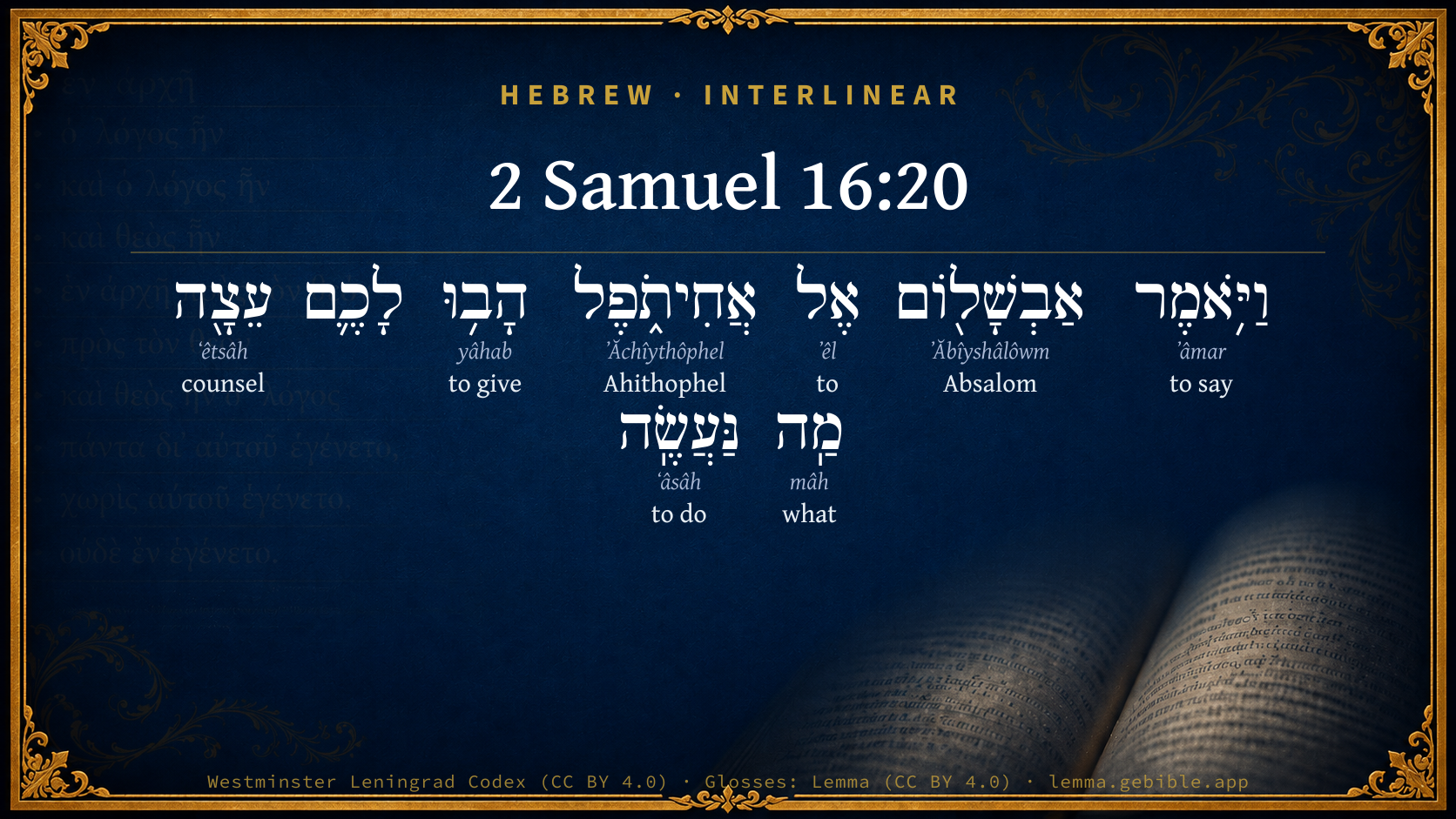
2 Samuel 16:20

Hebrew (Westminster Leningrad Codex) 2 Samuel 16:20 appears in the Hebrew Old Testament. The text above is from the Westminster Leningrad Codex. Each word links to its Strong’s number, a concise gloss, and parsing drawn from the Open Scriptures Hebrew Bible morphology. Click any word for its full Brown-Driver-Briggs (BDB) entry.
Download image
Cite this verse

2 Samuel 16:20 (World English Bible). Public Domain. Lemma interlinear Bible study tool, https://lemma.gebible.app/v/2-samuel/16/20.

Show BibTeX & RIS
BibTeX
RIS
English Translation
Then said Absalom to Ahithophel, Give your counsel what we shall do.
World English Bible · Public Domain
Download a study sheet

One document with this verse’s original text, its word-by-word gloss line, the meaning frame, cross-references with their text, attributed commentary, and full source and license credits — printable, and it pastes into notes with its structure intact.

This verse Autodidact and up

Study sheet (.html) Plain text (.txt)

A passage Seminary Student

Up to 50 verses in one chapter. A passage sheet keeps up to 6 commentary sources and 12 cross-references per verse, in the order this page ranks them, and says so on the sheet whenever that leaves anything out. Ask for a single verse and you get the Autodidact verse sheet above.

Everything on this page stays free to read, with no account — the sheet is a download of what is already on screen, not access to it.

Want to remove ads? Support Godless Engineer
Compare translations 3

The same verse in 3 English versions, stacked beneath the original-language interlinear above. Click any original word for its lexicon entry.

Each is an independent rendering of the whole verse — the interlinear is not word-aligned to these translations.

Highlighted words mark where these versions differ — a whole-verse word diff, not a word-by-word alignment.

  • World English Bible Public Domain
    Then said Absalom to Ahithophel, Give your counsel what we shall do.
  • King James Version Public Domain
    Then said Absalom to Ahithophel, Give counsel among you what we shall do.
  • unfoldingWord Literal Text CC BY-SA 4.0
    And Absalom said to Ahithophel, “Give counsel for yourselves. What shall we do?”

unfoldingWord Literal Text — © unfoldingWord, licensed CC BY-SA 4.0. Word-aligned USFM3 via Door43 (git.door43.org/unfoldingWord/en_ult).

Versions to compare (up to 4)

3 of 4 selected

Show all 18 translations

Every available English version of this verse, each an independent rendering of the whole verse.

  • World English Bible Public Domain
    Then said Absalom to Ahithophel, Give your counsel what we shall do.
  • Berean Standard Bible Public Domain
    Then Absalom said to Ahithophel, “Give me counsel. What should we do?”
  • Majority Standard Bible Public Domain
    Then Absalom said to Ahithophel, “Give me counsel. What should we do?”
  • King James Version Public Domain
    Then said Absalom to Ahithophel, Give counsel among you what we shall do.
  • American Standard Version (1901) Public Domain
    Then said Absalom to Ahithophel, Give your counsel what we shall do.
  • Revised Version (1885) Public Domain
    Then said Absalom to Ahithophel, Give your counsel what we shall do.
  • Geneva Bible (1599) Public Domain
    Then spake Absalom to Ahithophel, Giue counsell what we shall doe.
  • Douay-Rheims (1899) Public Domain
    And Absalom said to Achitophel: Consult what we are to do.
  • Young's Literal Translation Public Domain
    And Absalom saith unto Ahithophel, `Give for you counsel what we do.'
  • Literal Standard Version CC BY-SA 4.0
    And Absalom says to Ahithophel, “Give counsel for yourself [for] what we do.”
  • Unlocked Literal Bible CC BY-SA 4.0
    Then Absalom said to Ahithophel, “Give us your advice about what we should do.”
  • unfoldingWord Literal Text CC BY-SA 4.0
    And Absalom said to Ahithophel, “Give counsel for yourselves. What shall we do?”
  • Darby Bible Public Domain
    And Absalom said to Ahithophel, Give counsel among you what we shall do.
  • World Messianic Bible Public Domain
    Then Absalom said to Ahithophel, “Give your counsel what we shall do.”
  • Webster's Bible Public Domain
    Then said Absalom to Ahithophel, Give counsel among you what we shall do.
  • Free Bible Version CC BY-SA 4.0
    Then Absalom asked Ahithophel, “Give me your advice. What shall we do?”
  • Bible in Basic English Public Domain
    Then Absalom said to Ahithophel, Give your opinion now, what are we to do?
  • JPS Tanakh (1917) Public Domain
    Then said Absalom to Ahithophel: 'Give your counsel what we shall do.'

Literal Standard Version (2020), Covenant Press — licensed CC BY-SA 4.0. Text via the HelloAO Bible API (eBible.org). Unlocked Literal Bible (unfoldingWord) — licensed CC BY-SA 4.0. Text via the HelloAO Bible API (eBible.org). unfoldingWord Literal Text — © unfoldingWord, licensed CC BY-SA 4.0. Word-aligned USFM3 via Door43 (git.door43.org/unfoldingWord/en_ult). Free Bible Version, Dr. Jonathan Gallagher — licensed CC BY-SA 4.0. Text via the HelloAO Bible API (eBible.org).

Word by word

More ways to search: Search by grammar → Find every occurrence → Compare this word →

Practice this passage: Drill this verse → Learn its vocabulary →

About this verse

These counts appear in no published source. They are computed here, from the morphology-tagged text and Lemma’s own curated glosses. What Lemma adds →

9
words
8
distinct lemmas
Historical
section

Notable vocabulary

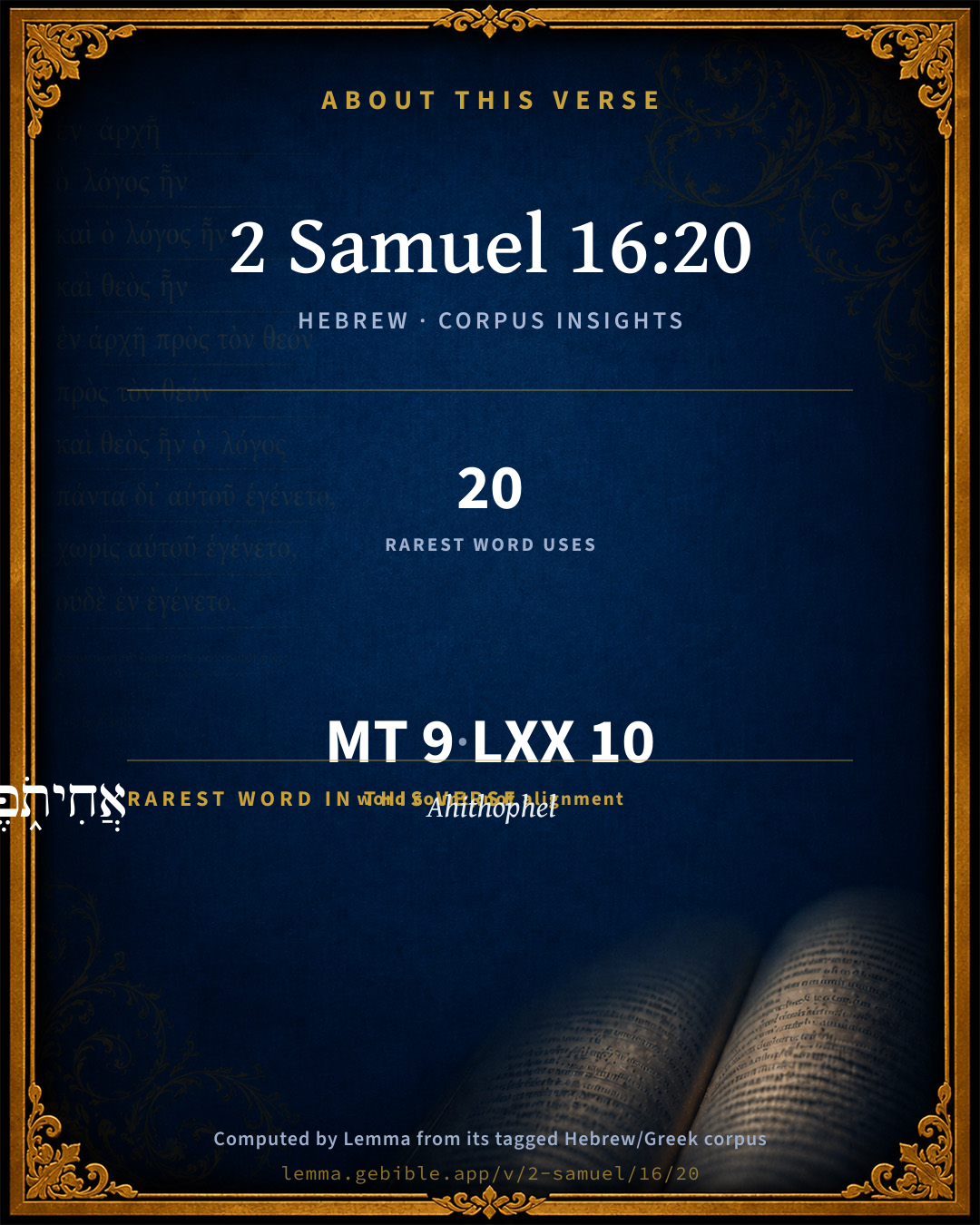
The rarest word here is אֲחִיתֹ֑פֶל Ahithophel H302 — appearing just 20 times in the whole Hebrew Bible.

Shared distinctive vocabulary

אֲחִיתֹ֑פֶל Ahithophel H302 occurs in 17 verses of the Hebrew Bible. Also found in:

Grammatical profile

  • 3 verbs
  • 3 nouns
  • 2 prepositions
  • 1 particle

Verb forms

  • וַיֹּ֥אמֶר Qal · Sequential Imperfect
  • הָב֥וּ Qal · Imperative
  • נַּעֲשֶֽׂה Qal · Imperfect

Hebrew & Septuagint length

In English translation the verse runs 12 words from the Hebrew and 13 from the Septuagint (LXX English) — closely comparable.

A rough comparison of the two English renderings, which tokenize alike — not a word-level alignment.

Word counts can differ between the Hebrew and the Greek without any difference in meaning — e.g. the Hebrew direct-object marker אֵת has no separate Greek word, and Greek often adds the article ὁ.

In the original languages it is 9 Hebrew tokens and 10 Greek tokens — but the two are counted differently (Hebrew bundles its prefixes and suffixes into one token; the Greek is in lemma form), so that isn’t a like-for-like length.

Cross-references

8

Topical passages linked to 2 Samuel 16:20 in the Treasury of Scripture Knowledge — connected by theme and wording, ordered by reader-vote popularity; previews shown in the World English Bible.

  • Exodus 1:10 Come, let us deal wisely with them, lest they multiply, and it happen that when any war breaks out, they also join themselves to our enemies, and fight against us, and escape out of the land."
  • Psalms 2:2 The kings of the earth take a stand, And the rulers take counsel together, Against Yahweh, and against his anointed, saying,
  • Psalms 37:12–13 The wicked plots against the just, And gnashes at him with his teeth.
  • Proverbs 21:30 There is no wisdom nor understanding Nor counsel against Yahweh.
  • Isaiah 8:10 Take counsel together, and it shall be brought to nothing; speak the word, and it shall not stand: for God is with us.
  • Isaiah 29:15 Woe to those who hide deep their counsel from Yahweh, and whose works are in the dark, and who say, Who sees us? and who knows us?
  • Matthew 27:1 Now when morning had come, all the chief priests and the elders of the people took counsel against Jesus to put him to death:
  • Acts 4:23–28 Being let go, they came to their own company, and reported all that the chief priests and the elders had said to them.

Cross-references courtesy of OpenBible.info (CC BY 4.0).

Hebrew and Greek witnesses Masoretic Hebrew ↔ Greek Septuagint

The same verse in the two great witnesses to the Old Testament, shown verse-for-verse.

These are two independent witnesses, not word-aligned to each other, and the Septuagint is shown in lemma (dictionary) form.

Hebrew 2 Samuel 16:20 Masoretic · Westminster Leningrad Codex

וַיֹּ֥אמֶר אַבְשָׁל֖וֹם אֶל אֲחִיתֹ֑פֶל הָב֥וּ לָכֶ֛ם עֵצָ֖ה מַֽה נַּעֲשֶֽׂה

Then said Absalom to Ahithophel, Give your counsel what we shall do.

World English Bible · Public Domain

Greek LXX 2 Samuel 16:20 Septuagint · lemma form

καί εἶπον αβεσσαλωμ πρός αχιτοφελ φέρω ἑαυτοῦ βουλή τίς ποιέω

And Abessalom said to Achitophel, Deliberate among yourselves concerning what we should do.

LXX2012 (modern English Septuagint) · Public Domain

Hebrew: Westminster Leningrad Codex (CC BY 4.0). Greek: Septuagint (public domain); English from LXX2012 (modern English Septuagint) (Public Domain). How the Septuagint differs from the Hebrew →

Targum (Aramaic paraphrase)

1

The Targum is the ancient Jewish Aramaic paraphrase of the Hebrew Scriptures — an interpretive translation, not the Hebrew text itself. Onkelos (literal) and Pseudo-Jonathan (expansive) render the Torah, and Jonathan the Prophets. Coverage is partial: where no permissively-licensed English translation exists for a verse, only the Aramaic is shown. This is verse-level text, not a word-by-word alignment to the Hebrew.

  1. Targum Jonathan Prophets (Joshua–Malachi)
    וַאֲמַר אַבְשָׁלוֹם לַאֲחִיתוֹפֶל הֲבוּ לְכוֹן מִלְכָּא מַה נַעְבֵּיד:

    (no public-domain English translation for this verse)

    Targum Jonathan — Aramaic: “Mikraot Gedolot” (public domain). English: “Sefaria Community Translation” (CC0 1.0 (public-domain dedication)); “London "Chaldee Paraphrase," 1871” (public domain). Text via Sefaria.

Commentary

Notes on 2 Samuel 16:20 from classic Christian and Jewish commentators (each source and its license shown beneath its notes). The classic Christian expositions comment on the surrounding passage and are grouped to its opening verse, so a note may address several verses; the Jewish commentaries on the Tanakh (Rashi and others) are per-verse, so they appear only where the commentator wrote on this verse.

Lemma curates 59 commentaries, every one of them public domain or Creative Commons licensed, each selected and text-cleaned for this edition rather than reprinted as found. About our sources →

Jamieson, Fausset & Brown

Robert Jamieson, A. R. Fausset & David Brown

AHITHOPHEL'S COUNSEL. (Sa2 16:20-23)

Give counsel among you what we shall do--This is the first cabinet council on record, although the deference paid to Ahithophel gave him the entire direction of the proceedings.

Jamieson, Fausset & Brown — Commentary Critical and Explanatory on the Whole Bible (1871) — public domain (CC PDM 1.0). Text via the HelloAO Bible API.

Trapp's Complete Commentary

John Trapp

2Sa 16:20 Then said Absalom to Ahithophel, Give counsel among you what we shall do.

Ver. 20. Then said, Absalom to Ahithophel.] As president of his council: Hushai was present, but forced to dissemble at that time. {a}

{a} Mentitur impiissimo tyranno. - Mart.

John Trapp, A Commentary or Exposition upon All the Books of the Old and New Testament (1647–1656) — public domain. Text from a community e-Sword module.

The Preacher's Complete Homiletical Commentary

Joseph S. Exell (gen. ed.)

CRITICAL AND EXPOSITORY NOTES.—

2Sa_16:20. “Give counsel,” etc. This is the first cabinet council on record.” (Jamieson).

2Sa_16:21. “Go in unto,” etc. “This advice was sagacious enough. Lying with the king’s concubines was an appropriation of the royal harem, and, as such, a complete usurpation of the throne (see at 2Sa_3:7) which would render any reconciliation between Absalom and his father utterly impossible, and therefore would of necessity instigate the followers of Absalom with all the greater firmness. This was what Ahithophel hoped to attain by his advice. For unless the breach was too great to be healed, with the affection of David towards his sons, which might in reality be called weakness, it was always a possible thing that he should forgive Absalom, and in this case Ahithophel would be the one to suffer. But under the superintendence of God this advice was to effect the fulfilment of the threat held over David in 2Sa_12:8.” (Keil.) Perhaps Ahithophel was also avenging the wrong done to Bathsheba. (See note on 2Sa_11:3.)

2Sa_16:22. “The top of the house.” The same roof where David’s look at Bathsheba led him into the path of sin.

2Sa_16:23. “The oracle of God.” That is, the counsel of Ahithophel had almost the weight of a Divine command with both father and son.

MAIN HOMILETICS OF THE PARAGRAPH.—2Sa_16:20-23

AHITHOPHEL’S COUNSEL

I. When all the plans of the wicked have been worked out, God’s counsel will be found to prevail. Sometimes a man may permit a thief to escape from his grasp and run away from him because he knows that in front of him is a precipice, and that every step he takes brings him nearer to his final fall. He has only to let him pursue his own course and he will be the author of his own ruin. So, when men break away from God, and seem to think they can leave Him out of their calculations, He sometimes leaves them entirely to their own devices, and they become their own destroyers, and at the same time fulfil the Divine purposes. At this crisis in the history of the people of Israel it might have seemed to some good men that God had entirely withdrawn from the nation, and that these bad men were having their own way in everything. The last assumption was true, but not the first—Ahithophel and Absalom met with no hindrance as yet in the execution of their designs, but God was looking on and seeing in them the instruments of His will, as they unconsciously executed a part of the sentence against David. (2Sa_12:11).

II. The sin which the parent commits in secret will probably be committed openly by the child. Children show themselves apt pupils in the school of vice, and often go far beyond their teachers in the wrong direction. None of David’s virtues were reproduced in Absalom, but his deed of sin was not only closely imitated but far exceeded, and what the father did in secret the son did not blush to do in the sight of all Israel. Let no parent or any man deceive himself by thinking that those under his influence will stop in the path of sin just where he stopped—it is a downward road and they who set out upon it neither know where they will stop themselves, nor can they stay the course of those who may follow in their steps. Let the father or mother who breaks God’s law and blushes for the sin, think how likely it is that their child may make a boast of the same deed of shame.

OUTLINES AND SUGGESTIVE COMMENTS

It is not improbable that Ahithophel remembered God’s denunciation against David by the prophet Nathan, and therefore considered it a deep stroke of policy thus to take advantage of existing circumstances, to establish the Divine purposes. He might hope perhaps, thus to encourage a belief, that Absalom was a chosen instrument in the hands of God for the execution of His judgments, and consequently, that all opposition to him was both wicked and fruitless. But Ahithophel with all his wisdom, was not wise enough to know that the rule of man’s conduct is not the secret purposes, but the revealed precepts of God; that a man may be fulfilling the former, yet incurring God’s severe displeasure by transgressing the latter.—Lindsay.

2Sa_16:23. David’s chief counsellors were God’s testimonies (Psa_119:24) to these as to the test he brought all counsel given him, whether by Ahithophel or any other … Absalom and his adherents followed Ahithophel’s counsel, howsoever, as infallible, because it was for their purpose.—Trapp.

The Preacher's Complete Homiletical Commentary (gen. ed. Joseph S. Exell; Funk & Wagnalls, c. 1892) — public domain (pre-1929). A full-Bible homiletical/sermon-outline anthology covering 65 of 66 books (2 John is absent from the source module). Text from a community e-Sword module.

The Cambridge Bible for Schools and Colleges

gen. ed. J. J. S. Perowne

20–23. Ahithophel’s counsel

21. And Ahithophel said, &c.] Ahithophel advised Absalom to make a decisive assumption of royal authority by publicly taking possession of the royal harem. This act was a claim of heirship and succession[101], and was not regarded with abhorrence by the Israelites, whose feelings on such matters were blunted by the practice of polygamy. See note on ch. 2Sa_3:7. Its object was to make the breach between Absalom and his father irreparable, and to strengthen the resolution of his followers, by proving that the rebellion was not to end in his securing a pardon from his father and leaving them to their fate, but that he was determined to run all risks.

[101] A similar custom existed among the heathen Saxons. See Green’s Making of England, p. 246.

The Cambridge Bible for Schools and Colleges (gen. ed. J. J. S. Perowne; Cambridge University Press, 1878–1918) — public domain. Text from a community e-Sword module.

John Gill's Exposition

Then said Absalom to Ahithophel,.... Having two such able counsellors as he and Hushai, he directs his speech to Ahithophel, as being his first and chief counsellor:

give counsel among you what we shall do; he orders them to form a counsel, consult among themselves what was proper to be now done at Jerusalem, whether it was right to stay here or pursue after David and his men. Absalom did not send to the high priest to ask counsel of God, by Urim and Thummim before the ark, but wholly confided in his privy council.

John Gill's Exposition of the Whole Bible (1746–1763) — public domain (CC PDM 1.0). Text via the HelloAO Bible API.

The Pulpit Commentary

Give counsel among you; Hebrew, for you; but we have no way in English of expressing the force of this phrase. In Greek it is called the ethic dative, and is supposed to give character to the address, and indicate that those to whom the words are spoken have also an interest in the matter.

The Pulpit Commentary (1880–1919), ed. H.D.M. Spence-Jones & Joseph S. Exell — public domain. Text from a community e-Sword module.

Keil & Delitzsch

C. F. Keil & F. Delitzsch

After taking possession of the capital of the kingdom, the next thing to do was to form the resolution to take and keep the throne. Absalom therefore turned to Ahithophel, and said, "Give ye counsel what we are to do." The plural הבוּ (give ye) may be explained on the supposition that the other persons present were addressed as well as Ahithophel, as being capable of giving advice.

Keil & Delitzsch — Biblical Commentary on the Old Testament (1861–1891) — public domain (CC PDM 1.0). Text via the HelloAO Bible API. (Old Testament only.)

unfoldingWord translationNotes

Door43 World Missions Community

Ahithophel

See how you translated this man's name in 2 Samuel 15:12. (See: How to Translate Names)

to keep the palace

The phrase "to keep" means to take care of. AT: "to take care of the palace" (See: Idiom)

become a stench to your father

Ahithophel speaks of Absalom offending his father as if he would become something that had a strong and offensive odor. AT: "become offensive to your father" or "greatly insulted father" (See: Metaphor)

Then the hands of all who are with you will be strong

Here the people who followed Absalom are referred to by their hands. The news will strengthen the peoples' loyalty to Absalom and encourage them. This can be stated clearly. AT: "The news of this will strengthen the loyalty of all who follow you" (See: Synecdoche and Assumed Knowledge and Implicit Information)

translationWords

advice

had relations with

concubine

palace

hand

unfoldingWord translationNotes — © Distant Shores Media and the Door43 World Missions Community, licensed CC BY-SA 4.0. Source: git.door43.org/Door43/en_tn.

Lesson kit

Teaching starters — assembled from the data on this page, not authored interpretation. Every prompt links to the verse data it draws on. Edit before teaching.

2 Samuel, in the Historical, opens this verse with 9 words (8 distinct Hebrew lemmas). Its most distinctive word is ʼĂchîythôphel (“Ahithophel”). A historical commentator’s framing appears above. Read the whole chapter for the surrounding context.

Discussion questions

  1. How does “Ahithophel” (ʼĂchîythôphel) shape what this verse is saying?
  2. 2 Samuel 15:12 shares the word «Ahithophel» with this verse. How do the two illuminate each other?
  3. These translations render this verse differently; the difference is in the English rendering, not the original. What questions does that raise?
  4. The verb «וַיֹּ֥אמֶר» is Qal Sequential Imperfect. How does its form color the action?
  5. Reading how Jamieson, Fausset & Brown and Trapp's Complete Commentary read this verse, where do the two commentators agree and where do they part?

Things to notice

Reading settings

Reading text

Shown beneath each verse's original-language words.

Old Testament
Old Testament edition

Read the OT as the Masoretic Hebrew (MT) or the Greek Septuagint (LXX).

English shown for the Greek Septuagint (in the Hebrew ↔ Greek comparison).

Comparing translations? Open the Compare panel on any verse page to stack up to four side by side.