1 Corinthians 13:10

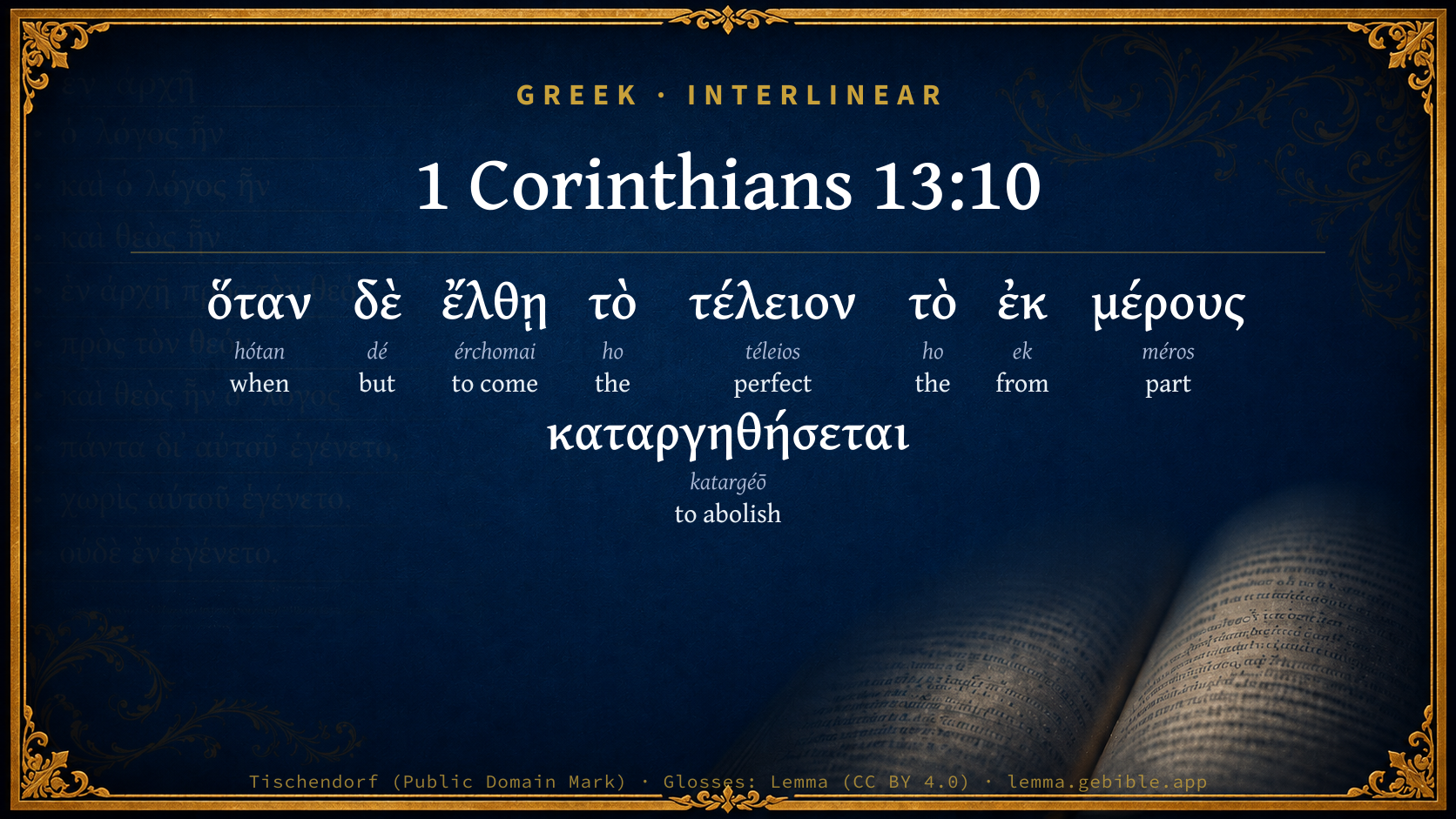
Greek (Tischendorf 8th ed.) 1 Corinthians 13:10 appears in the Greek New Testament. The text above is from the Tischendorf 8th edition. Each word links to its Strong’s number and a concise gloss. Click any word for its full Thayer’s Greek Lexicon entry.
Download image
Cite this verse

1 Corinthians 13:10 (World English Bible). Public Domain. Lemma interlinear Bible study tool, https://lemma.gebible.app/v/1-corinthians/13/10.

Show BibTeX & RIS
BibTeX
RIS
English Translation
but when that which is complete has come, then that which is partial will be done away with.
World English Bible · Public Domain
Download a study sheet

One document with this verse’s original text, its word-by-word gloss line, the meaning frame, cross-references with their text, attributed commentary, and full source and license credits — printable, and it pastes into notes with its structure intact.

This verse Autodidact and up

Study sheet (.html) Plain text (.txt)

A passage Seminary Student

Up to 50 verses in one chapter. A passage sheet keeps up to 6 commentary sources and 12 cross-references per verse, in the order this page ranks them, and says so on the sheet whenever that leaves anything out. Ask for a single verse and you get the Autodidact verse sheet above.

Everything on this page stays free to read, with no account — the sheet is a download of what is already on screen, not access to it.

Want to remove ads? Support Godless Engineer
Compare translations 3

The same verse in 3 English versions, stacked beneath the original-language interlinear above. Click any original word for its lexicon entry.

Each is an independent rendering of the whole verse — the interlinear is not word-aligned to these translations.

Highlighted words mark where these versions differ — a whole-verse word diff, not a word-by-word alignment.

  • World English Bible Public Domain
    but when that which is complete has come, then that which is partial will be done away with.
  • King James Version Public Domain
    But when that which is perfect is come, then that which is in part shall be done away.
  • unfoldingWord Literal Text CC BY-SA 4.0
    But when the perfect comes, partial will pass away.

unfoldingWord Literal Text — © unfoldingWord, licensed CC BY-SA 4.0. Word-aligned USFM3 via Door43 (git.door43.org/unfoldingWord/en_ult).

Versions to compare (up to 4)

3 of 4 selected

Show all 19 translations

Every available English version of this verse, each an independent rendering of the whole verse.

  • World English Bible Public Domain
    but when that which is complete has come, then that which is partial will be done away with.
  • Berean Standard Bible Public Domain
    but when the perfect comes, the partial passes away.
  • Majority Standard Bible Public Domain
    but when the perfect comes, the partial passes away.
  • King James Version Public Domain
    But when that which is perfect is come, then that which is in part shall be done away.
  • American Standard Version (1901) Public Domain
    but when that which is perfect is come, that which is in part shall be done away.
  • Revised Version (1885) Public Domain
    but when that which is perfect is come, that which is in part shall be done away.
  • Geneva Bible (1599) Public Domain
    But when that which is perfect, is come, then that which is in part, shalbe abolished.
  • Douay-Rheims (1899) Public Domain
    But when that which is perfect is come, that which is in part shall be done away.
  • Young's Literal Translation Public Domain
    and when that which is perfect may come, then that which `is' in part shall become useless.
  • Literal Standard Version CC BY-SA 4.0
    and when that which is perfect may come, then that which [is] in part will become useless.
  • Unlocked Literal Bible CC BY-SA 4.0
    But when the perfect comes, that which is incomplete will pass away.
  • unfoldingWord Literal Text CC BY-SA 4.0
    But when the perfect comes, partial will pass away.
  • Darby Bible Public Domain
    but when that which is perfect has come, that which is in part shall be done away.
  • World Messianic Bible Public Domain
    but when that which is complete has come, then that which is partial will be done away with.
  • Webster's Bible Public Domain
    But when that which is perfect is come, then that which is in part shall be done away.
  • Free Bible Version CC BY-SA 4.0
    But when completeness comes, then what is incomplete disappears.
  • Bible in Basic English Public Domain
    But when that which is complete is come, then that which is in part will be no longer necessary.
  • Text-Critical English NT CC BY 4.0
    Yet when the perfect comes, the partial will come to an end.
  • Tyndale New Testament (1534) Public Domain
    But when that which is parfect is come then that which is vnparfet shall be done awaye.

Literal Standard Version (2020), Covenant Press — licensed CC BY-SA 4.0. Text via the HelloAO Bible API (eBible.org). Unlocked Literal Bible (unfoldingWord) — licensed CC BY-SA 4.0. Text via the HelloAO Bible API (eBible.org). unfoldingWord Literal Text — © unfoldingWord, licensed CC BY-SA 4.0. Word-aligned USFM3 via Door43 (git.door43.org/unfoldingWord/en_ult). Free Bible Version, Dr. Jonathan Gallagher — licensed CC BY-SA 4.0. Text via the HelloAO Bible API (eBible.org).

Word by word

More ways to search: Search by grammar → Find every occurrence → Compare this word →

Practice this passage: Drill this verse → Learn its vocabulary →

About this verse

These counts appear in no published source. They are computed here, from the morphology-tagged text and Lemma’s own curated glosses. What Lemma adds →

9
words
8
distinct lemmas
Pauline Epistles
section

Notable vocabulary

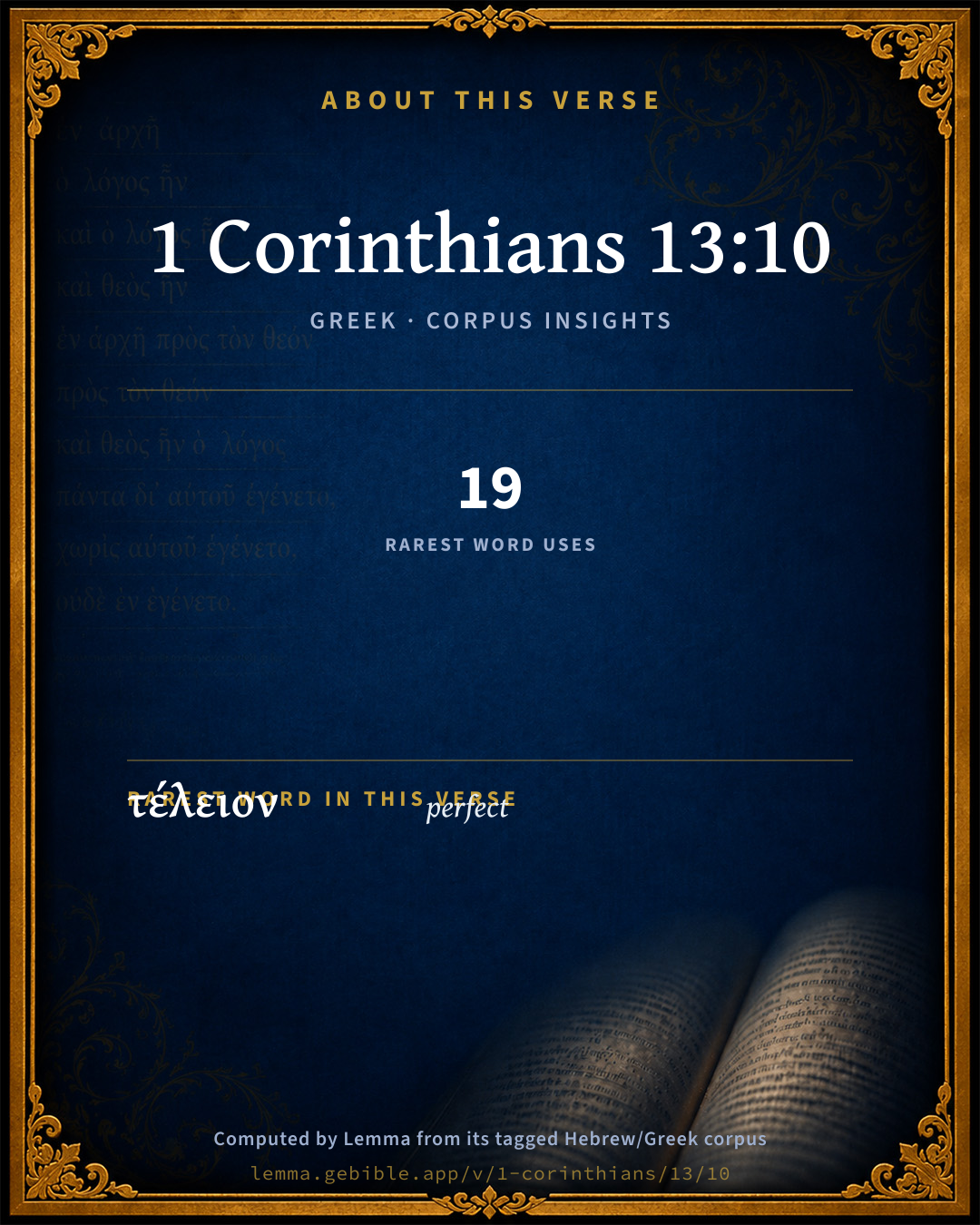
The rarest word here is τέλειον perfect G5046 — appearing just 19 times in the whole Greek New Testament.

Shared distinctive vocabulary

τέλειον perfect G5046 occurs in 17 verses of the Greek New Testament. Also found in:

Repetition

A word recurs within this verse:

Cross-references

6

Topical passages linked to 1 Corinthians 13:10 in the Treasury of Scripture Knowledge — connected by theme and wording, ordered by reader-vote popularity; previews shown in the World English Bible.

  • Isaiah 60:19–20 The sun shall be no more your light by day; neither for brightness shall the moon give light to you: but Yahweh will be to you an everlasting light, and your God your glory.
  • 1 Corinthians 13:12 For now we see in a mirror, dimly, but then face to face. Now I know in part, but then I will know fully, even as I was also fully known.
  • 2 Corinthians 5:7–8 for we walk by faith, not by sight.
  • Isaiah 24:23 Then the moon shall be confounded, and the sun ashamed; for Yahweh of Hosts will reign on Mount Zion, and in Jerusalem; and before his elders shall be glory.
  • Revelation 22:4–5 They will see his face, and his name will be on their foreheads.
  • Revelation 21:22–23 I saw no temple in it, for the Lord God, the Almighty, and the Lamb, are its temple.

Cross-references courtesy of OpenBible.info (CC BY 4.0).

Where the printed editions differ

1 variant

Places in this verse where the major printed Greek editions disagree on the wording in a way that affects the translation — a comparison of editions, not a manuscript-by-manuscript collation. The editions are the modern critical texts (Nestlé-Aland 28/27, SBL, Westcott-Hort, Tregelles, Tyndale House) and the traditional texts behind the KJV (the Textus Receptus and the Byzantine/Majority text). It is not a claim about which reading is original.

  1. Extra text
    τότε

    “then”

    In TRByz Not in NA28NA27TynSBLWHTreg

    τότε (tote) 'then' is only in traditional manuscripts (TR+Byz)

Textual data: Translators Amalgamated Greek New Testament (STEPBible TAGNT) · CC BY 4.0.

Commentary

Notes on 1 Corinthians 13:10 from classic Christian and Jewish commentators (each source and its license shown beneath its notes). The classic Christian expositions comment on the surrounding passage and are grouped to its opening verse, so a note may address several verses; the Jewish commentaries on the Tanakh (Rashi and others) are per-verse, so they appear only where the commentator wrote on this verse.

Lemma curates 59 commentaries, every one of them public domain or Creative Commons licensed, each selected and text-cleaned for this edition rather than reprinted as found. About our sources →

The Biblical Illustrator

Joseph S. Exell

1Co_13:10

But when that which is perfect is come, then that which is in part shall be done away.

The perfect state

I. What hope have we of it?

1. Founded on human instinct.

2. Confirmed by revelation.

3. Secured by faith.

II. What relief will it bring?

1. The removal of all defect.

2. Consequently of all sorrow.

III. What happiness does it promise? The perfection of our condition.

1. Physical.

2. Intellectual.

3. Moral.

4. Social. (J. Lyth, D.D.)

The Christian doctrine of the perfectibility of man

I. Futurity is the greatness of man, and hereafter is the grand scene for the attainment of the fulness of his existence.

1. When depressed by conscious littleness of being, yet feeling that he should not be little, man may look to futurity and exclaim, I shall be great yonder! the immense futurity is mine! I may be content to be poor awhile in the prospect of that!

2. It is most gratifying to see the Divine revelation connecting the condition of perfection, on any terms, in any sense, at any future period, with human nature. Looking at man, we seem to see a vast collection of little beginnings, attempts, failures--so that the perfectibility of man is ridiculed as one of the follies of philosophic romance. Then how delightful is it to see revelation itself, pronouncing it as possible!

3. This prediction of something perfect to come, relates to knowledge. This is somewhat surprising. It seems much more easy to conceive of perfection in holiness. But knowledge is not a state of the dispositions, but an intellectual relation with anything which can come within the sphere of its apprehension. All things in the stupendous totality of existence are subjects for knowledge. To hear, then, of perfection in knowledge, in any, the most limited, accommodated sense, is very marvellous.

II. Let us attempt to realise to our imagination such a state.

1. The lowest point we can take is the exclusion of error. So that if the manner of apprehending be intuition, the objects will be made clearly self-evident; if by reasoning, the evidence will be explicit and the reasoning process infallible. It could not but be in the heavenly state a painful thing for the spirit, after exulting in the reception of a portion of knowledge, to find out that it had been imposed on.

2. It will be perfectly adequate to the infallible direction of all the activities of the superior state. Those activities we may well believe to be of vast extent and endless variety, and an infallible knowledge--what to do, and when, and by what means--will be vouchsafed.

3. Knowledge will doubtless be perfect in that we shall possess as much of it as is indispensable to our happiness, and be sensible that we do so. We shall not be in the condition of John, who looked on the sealed book and wept because there was none to open it.

4. We shall possess always as much knowledge as for the time our faculties are actually capable of. Here there are a vast number of things kept in the dark from us, which we could understand if they were but declared; and there is sometimes a most restless wish to know them. Imagine then a continual enlargement of the intellectual capacity, and as it enlarges, a continual influx of new knowledge to fill it.

III. We should take some advantage of the apostles contrast between that which is in part, and that perfect which is to come. Note--

1. The imperfect, partial nature of our means of knowledge. The senses, the grand inlets of our knowledge, must and do convey it in a most imperfect manner. Through them the spirit can receive only reports and images of the things. How it wishes to come at the things themselves! Language, again, is a most imperfect medium for the conveyance of knowledge, being framed upon our imperfect knowledge and partaking of all its defects. But when that which is perfect is come, the mode, the medium, the instruments of our receiving and conveying knowledge must be something immensely different, whether or not in analogy with the present means. If there are to be senses and any artificial instruments of knowledge analogous to the present, let them be but as much superior to these as a spiritual body, made like the glorified body of Christ, will be superior to this earthy, mortal one, and it will suffice. But whatever shall be the means and manner of apprehending--the apprehension must be incomparably more intimate than in this world to satisfy the exalted intelligence. And that it will be so, the apostle intimates, I shall know even as also I am known.

2. How emphatically our present knowledge is but in part as to the number and extent of the things known! Just think how many can be answered of all the questions we can ask. When that which is perfect is come, it will not bring an answer to all possible inquiries; but it will be amazing and delightful to see what a multitude of things, of which we had but the faintest glimpses before, are brought into perfect manifestation. What a revelation there may be--

(1) In the vast enlargement of the minds own proper power of knowing, while it looks from a higher eminence over a wider field.

(2) In the direct disclosures and communications which the Divine Being may beneficently make.

3. But all these anticipations remind us but the more forcibly how we here know but in part.

(1) So in part, that just the part which we want to attain is divided off from our reach. It seems as if a dissevering principle or a dark veil fell down exactly at the point where we think we are near upon the knowledge we are pursuing.

(2) So in part, that we sometimes feel as if a disproportionate weight is thrown upon our faith. In our partial view, appearances may seem against what we nevertheless are required most firmly to believe. It is difficult to maintain this faith, but is happily aided by the Divine assurance that one day we shall know when that which is perfect is come.

(3) So in part, that in many things we see far more of the evil than of the good. But we are sure that there must be a decided predominance of good in the empire of Him who is infinite in wisdom, power, and goodness. And the anticipation of clearly seeing it so is a delightful radiance from heaven on our present dark abode.

(4) So in part, that we cannot agree one with another. The part itself contains those shades and perplexities among which men must greatly differ. But when the perfect comes, the grand illumination of each spirit will be rendered inconceivably delightful by coincidence of judgment. (J. Foster.)

The Biblical Illustrator, edited by Joseph S. Exell (c. 1880s–1900s) — public domain. Text from a community e-Sword module.

Bengel's Gnomon

Johann Albrecht Bengel

1Co 13:10. Ἔλθῃ, is come) in its own time, by degrees, not by a sudden bound. In spiritual things, those of weaker age ought not too eagerly to aim at what belongs to those, who have reached greater maturity. That, which is perfect, comes at death; 2Co 5:7: and at the last day.—τότε, then) not before. Therefore prophecy and knowledge never entirely pass away in this life.

Bengel's Gnomon of the New Testament — English translation (T&T Clark, Edinburgh, 1860) — public domain. Text from a community e-Sword module.

Hodge's Commentary on Romans, Ephesians & First Corinthians

Charles Hodge

1Co_13:9, 1Co_13:10

For we know in part, and we prophesy in part. But when that which is perfect is come, then that which is in part shall be done away.

This is the reason why knowledge and prophecy are to cease. They are partial or imperfect, and therefore suited only to an imperfect state of existence. The revelations granted to the prophets imparted there glimpses of the mysteries of God; when those mysteries stand disclosed in the full light of heaven, what need men of those glimpses? A skillful teacher may by idiagrams and models give us some knowledge of the mechanism of the universe; but if the eye be strengthened to take in the whole at a glance, what need men of a planetarium or of a teacher? The apostle employs two illustrations to teach us the difference between the present and the future. The one is derived from the difference between childhood and maturity; the other from the difference between seeing a thing by imperfect reflection, or through an obscure medium, and seeing it directly.

Charles Hodge — Commentary on Romans (1835), First Corinthians (1857), and Ephesians (1856) — public domain. Text from a community e-Sword module.

Jamieson, Fausset & Brown

Robert Jamieson, A. R. Fausset & David Brown

that which is in part--fragmentary and isolated.

Jamieson, Fausset & Brown — Commentary Critical and Explanatory on the Whole Bible (1871) — public domain (CC PDM 1.0). Text via the HelloAO Bible API.

Adam Clarke's Commentary

Verse 10. But when that which is perfect] The state of eternal blessedness; then that which is in part-that which is imperfect, shall be done away; the imperfect as well as the probationary state shall cease for ever.

Adam Clarke's Commentary on the Bible (1810–1826) — public domain. Text from a community e-Sword/MySword module.

John Calvin's Commentaries

10. When that which is perfect is come “When the goal has been reached, then the helps in the race will be done away.” He retains, however, the form of expression that he had already made use of, when he contrasts perfection with what is in part “Perfection,” says he, “when it will arrive, will put an end to everything that aids imperfection.” But when will that perfection come? It begins, indeed, at death, for then we put off, along with the body, many infirmities; but it will not be completely manifested until the day of judgment, as we shall hear presently. Hence we infer, that the whole of this discussion is ignorantly applied to the time that is intermediate.

John Calvin's Commentaries (1540-1563) — public domain. Text from the Calvin Translation Society English edition (1840s-50s) via the Christian Classics Ethereal Library (ccel.org). Calvin's coverage is partial (roughly two-thirds of the Bible); uncommented books and verses are honest gaps, never fabricated. The 19th-century editor's footnotes and remarks are omitted so the notes are faithfully Calvin's own voice.

Ellicott's Commentary for English Readers

(10) That which is perfect.—This verse shows, by the emphatic “then,” that the time when the gifts shall cease is the end of this dispensation. The imperfect shall not cease until the perfect is brought in. (See Eph_4:11-13.)

A Bible Commentary for English Readers, edited by Charles John Ellicott (1878–1897) — public domain. Text from a community e-Sword module.

The Cambridge Bible for Schools and Colleges

gen. ed. J. J. S. Perowne

10. done away] See note on 1Co_5:8.

The Cambridge Bible for Schools and Colleges (gen. ed. J. J. S. Perowne; Cambridge University Press, 1878–1918) — public domain. Text from a community e-Sword module.

John Gill's Exposition

When I was a child I spake as a child,.... That cannot speak plain, aims at words rather than expresses them, delivers them in a lisping or stammering manner: hereby the apostle illustrates the then present gift of speaking with divers tongues, which was an extraordinary gift of the Spirit, was peculiar to some persons, and what many were very fond of; and yet this, in its highest degree and exercise, was but like the lisping of a child, in comparison of what will be known and expressed by saints, when they come to be perfect men in heaven:

I understood as a child; and so does he that understands all mysteries, in comparison of the enlightened and enlarged understandings of glorified saints; the people of God, who are in the highest form and class of understanding, in the present state of things, are but children in understanding; it is in the other world, when they are arrived to the measure of the stature of the fulness of Christ, that they will in understanding be men:

I thought, or "reasoned",

as a child; whose thoughts are low and mean, and reasonings very weak; and so are the thoughts and reasonings of such as have all knowledge here below, in comparison of that perfect knowledge, those clear ideas, and strong reasonings of the spirits of just men above:

but when I became a man, I put away childish things; childish talk, childish affections, and childish thoughts and reasonings; so when the saints shall be grown to the full age of Christ, and are become perfect men in him, tongues shall cease, prophecies shall fail, and knowledge vanish away; and in the room thereof, such conversation, understanding, and knowledge take place, as will be entirely suited to the manly state in glory.

John Gill's Exposition of the Whole Bible (1746–1763) — public domain (CC PDM 1.0). Text via the HelloAO Bible API.

Trapp's Complete Commentary

John Trapp

10 But when that which is perfect is come, then that which is in part shall be done away.

Ver. 10. Then that which is in part] As the old slough falls off when the new skin comes on. As a man returns no more to the free school that hath proceeded in the university.

John Trapp, A Commentary or Exposition upon All the Books of the Old and New Testament (1647–1656) — public domain. Text from a community e-Sword module.

Albert Barnes' Notes on the Bible

But when that which is perfect is come - Does come; or shall come. This proposition is couched in a general form. It means that when anything which is perfect is seen or enjoyed, then that which is imperfect is forgotten, laid aside, or vanishes. Thus, in the full and perfect light of day, the imperfect and feeble light of the stars vanishes. The sense here is, that “in heaven” - a state of absolute perfection - that which is “in part,” or which is imperfect, shall be lost in superior brightness. All imperfection will vanish. And all that we here possess that is obscure shall be lost in the superior and perfect glory of that eternal world. All our present unsatisfactory modes of obtaining knowledge shall be unknown. All shall be clear, bright, and eternal.

Albert Barnes' Notes on the Bible (1834–1885) — public domain. Text from a community e-Sword/MySword module.

Haydock's Catholic Bible Commentary

St. Augustine proves from this text, that the saints in heaven have a more perfect knowledge of what passes here below, than when they sojourned on earth. (De Civit. Dei. lib. xxii. chap. 29.)

George Leo Haydock (1774–1849), Haydock's Catholic Family Bible and Commentary, 1859 edition — public domain. Excludes Psalms (Douay-Rheims chapter numbering differs from Protestant) and Deuterocanonical books (Catholic canon only).

Matthew Poole's English Annotations

But when we come to heaven, we shall be in such a state, as nothing shall or can be added to us; then our partial and imperfect knowledge shall be swallowed up in a knowledge perfect and complete.

Matthew Poole's English Annotations on the Holy Bible (1683–1685) — public domain. Text from a community e-Sword/MySword module.

Whedon's Commentary on the Bible

Daniel D. Whedon

10. The perfect will in due time supersede these partial gifts and performances. This does not mean that the gifts shall cease in the Church on earth in process of time, though that may be implied; but that they will be outgrown in eternity. Nor does it mean that our knowledge as a faculty will disappear; or that we shall cease to know any thing we now know in the future; but that our knowledge as a special gift, supernaturally bestowed over others, of which some Corinthians were so proud, should disappear. These, like glittering but needless ornaments, would drop off in our advancing stages of existence.

Daniel D. Whedon (gen. ed.), Commentary on the Old and New Testaments (1874–1909) — public domain. Text from a community e-Sword module.

The Pulpit Commentary

That which is in part shall be done away. It will be lost in perfectness when we have at last attained to "the measure of the stature of the fulness of Christ". (Eph_3:14)

The Pulpit Commentary (1880–1919), ed. H.D.M. Spence-Jones & Joseph S. Exell — public domain. Text from a community e-Sword module.

John Wesley's Explanatory Notes

But when that which is perfect is come - At death and in the last day. That which is in part shall vanish away - Both that poor, low, imperfect, glimmering light, which is all the knowledge we now can attain to; and these slow and unsatisfactory methods of attaining, as well as of imparting it to others.

John Wesley, Explanatory Notes Upon the Whole Bible (1754–1765) — public domain. Text via the GEBible commentary corpus.

Burkitt's Expository Notes on the New Testament

William Burkitt

As the imperfect twilight is done away by the opening of the perfect day; so at death, when that which is perfect takes place, then that which was imperfect shall be done away.

Blessed be God for the hopes of that blessed place and state, where all imperfections shall cease, especially the imperfection of our knowledge.

Alas! here all that we know, either of the word or works of God, is but a part, a little part; and blessed be God that this perfect state doth not succeed the imperfect one after a long interval, (at the resurrection and re-union of the body,) but the imperfect state of the soul immediately is done away by the coming of the perfect one; the glass is laid by as useless, when we come to see face to face, and eye to eye.

O happy and vast difference between the Christian’s present and future state!

True, he now begins to know; he knows in part here; but verily what he here knows is little of what he should know, little of that he might know, little of that others know, little of that he desires to know, and little of that he shall know, when he comes to heaven; then all imperfections shall be done away, when that which is perfect is come.

William Burkitt's Expository Notes on the New Testament (1700–1703) — public domain. Text from a community e-Sword module.

Godbey's Commentary on the New Testament

William B. Godbey

10. “When that which is perfect may come, then that which is in part shall be done away.” Many sanctified preachers proclaim this as Christian perfection, which is a mistake and calculated to do harm by putting the standard so high that none can reach it, and thus discouraging the honest aspirants after that reflection without which no one shall see the Lord. Divine perfection belongs to God only, and is absolute. The perfection belongs to the glorified state, including the unfallen angels, and glorified humanity. The soul is glorified by the Holy Ghost simultaneously with its evacuation of the body. the mind being glorified at the same time. The body has two ways to enter the glorified state:

(a) Translation like Enoch and Elijah, and all of the saints on the earth at the Rapture, and doubtless many in the Millennial ages; and

(b) the resurrection.

In Php 3:12 Paul is speaking of the glorified perfection which he had not yet attained, and in Php 3:15 the Christian perfection, which he that time enjoyed. As you see, he claims the latter, but disclaims the former. When our Savior was interviewed in reference to the woman who had survived her seventh husband, whose wife she should be in the resurrection, he answered “They will be as the angels of God,” — Greek, isio aggeloi. Isoi means “like” and it means “equal,” involving the conclusion that we will be like the angels and equal to them in the glorified state. Hence, while sanctification confers on us Christian perfection, glorification imparts angelic perfection. Justification takes away our guilt. sanctification our depravity, and glorification our infirmities. Critics are hard on sanctification, because they sometimes see their infirmities, which carnal people think sanctification takes away. In this they are mistaken. Glorification must do this work. These infirmities are not sin, but the effects of sin, through the collateral influence of the mind and body. Consequently we are in constant liability to do wrong aiming to do right, thus committing sins of ignorance, which do not bring condemnation, though they need the atonement, which reaches them in its normal efficacy like infants; God, in His great mercy, frequently not revealing them to us at the time lest they make us blue, and somewhat disqualify us to do the work He has given us. It is very afflictive to the cause of Christian holiness to include all of these Scriptures on the perfection of glory in sanctification.

John Wesley said: “Putting the standard too high is the greatest of all errors, as it is calculated to drive the experience out of the world” by putting it so high that none can reach it. The Holiness people much need instruction on the perfection of glory and the spiritual gifts, as they are so likely to include them both in sanctification, not only discouraging themselves, but others, and, as Wesley says, “grieving those whom God has not grieved, and perhaps sending them to Hell.” Christian living, i. e., purity of heart and life, is indispensable to admission into Heaven, but glorified perfection and the spiritual gifts are not. The spiritual gifts are not necessary to qualify you for Heaven, but for usefulness in this world, that you may be instrumental in saving others. Glorified perfection you can not rely on this mortal body. If you are truly sanctified, i. e., your heart cleansed, you are sure to be the body. So you actually go to Heaven in the enjoyment of glorified perfection, all of your infirmities swept away forever. Here you see the survival of all the spiritual gifts when “that which is perfect is come.” The connection shows that this is perfect love which is described constantly in the preceding part of the chapter, the seventh verse showing conclusively that the Divine love, incessantly emphasized, is in the superlative degree, i. e., perfect love. Again, these spiritual gifts are the constituted concomitants of Christian perfection, in order to the greatest possible efficiency of the saints in the salvation of the world.

William B. Godbey, Commentary on the New Testament (1896–1900) — public domain. Text from a community e-Sword module.

McGarvey & Pendleton's Commentaries

J. W. McGarvey

but when that which is perfect is come, that which is in part shall be done away .

J. W. McGarvey (with Philip Y. Pendleton), Commentaries on the New Testament (The Fourfold Gospel, 1914; Acts; and the epistles) — public domain. Text from a community e-Sword/MySword module.

The People's New Testament

B. W. Johnson

10. When that which is perfect is come, then the partial knowledge and prophecy will be done away. The imperfect will give way to the perfect; the perishable to the enduring. “The perfect” was expected at the coming of Christ. Some think that it came when the church was fully matured, since the special gifts then ceased. If there is a reference to this, the final and complete reference is to the glorified church.

B. W. Johnson's The People's New Testament with Notes (1889–1891) — public domain. Electronic text from the Christian Classics Ethereal Library (CCEL) ThML edition.

Cambridge Greek Testament for Schools and Colleges

10. [τότε] after τέλειον rec. with Peshito. Text אABDFG Vetus Lat. Vulg.

10. καταργηθήσεται. See note on 1Co 13:8.

Cambridge Greek Testament for Schools and Colleges (Cambridge University Press, 1896; 21 vols, various authors incl. Carr, Maclear, Plummer, Farrar, Lumby, Moule, M. R. James, Simcox) — public domain. Text from a community e-Sword module.

Alford’s Greek Testament

Henry Alford

10.] Reason given;—that our knowledge, and our prophesying (utterance of divine things) are but partial, embracing but a part: but when that which is perfect (entire—universal) shall have come, this partial shall be abolished—superseded. See Eph 4:11-13, where the same idea is otherwise expressed.

Henry Alford, The Greek Testament (1849–1861) — public domain. Text from a community e-Sword module.

International Critical Commentary

10. ‘But when there shall have come that which is complete, that which is from a part will be done away’; chiasmus again. Ubi perventum ad metam fuerit, tunc cessabunt adjumenta cursus (Calv.). We might have expected St Paul to put it in this way, yet he does not. He does not say, ‘But when we shall have come to the perfection of the other world,’ etc. He is so full of the thought of the Second Advent, that he represents the perfection as coming to us. ‘When it shall have come’; then, but not till then. The Apostle is saying nothing about the cessation of χαρίσματα in this life: prophesyings and knowledge might always be useful. All that he asserts is, that these things will have no use when completeness is revealed; and therefore they are inferior to Love. Luther renders τὸ ἐκ μέρους, das Stückwerk.

In order to make the ‘then and not till then’ clearer, K L, Syrr. Chrys. and some other witnesses insert τότε before τὸ ἐκ μέρους: om. א A B D* F G P, Latt. Arm. Aeth. Goth., etc. Chrys. points out that it is only the partial, fragmentary knowledge that will be done away.

International Critical Commentary — older volumes (1896–1929), various authors — public domain. Text from a community e-Sword module.

Godet's Commentaries

Frédéric Louis Godet

Vv. 10. But far from being an impoverishment of the Church, this loss of gifts, on the contrary, will coincide with her rising to the possession of perfect fulness; it will be the imperfect melting into the perfect. In contrast to the term ἐκ μέρους, in part, one would expect τὸ πᾶν, the whole, the entire. But it is not without reason that the apostle says τὸ τέλειον, the perfect, substituting the idea of perfection in quality for that of completeness in quantity. For the future knowledge will differ from that which we have here in mode, still more than in extent. Our view will not only embrace the totality of Divine things; but it will contemplate them from the centre, and consequently in their real essence. At present not only do we know only fragments, but even these we discern but indistinctly.

The aor. ἔλθῃ, shall have come, alludes to a fixed and positively expected moment, which can be no other than that of the Advent.

The apostle uses a comparison to illustrate the necessity of this substitution of the perfect for the imperfect.

Frédéric Louis Godet — Commentaries on Luke, John, Romans, and 1 Corinthians — English translation (T&T Clark, Edinburgh, 1870s–1890s) — public domain. Text from a community e-Sword module.

Lesson kit

Teaching starters — assembled from the data on this page, not authored interpretation. Every prompt links to the verse data it draws on. Edit before teaching.

1 Corinthians, in the Pauline Epistles, opens this verse with 9 words (8 distinct Greek lemmas). Its most distinctive word is téleios (“perfect”). A historical commentator’s framing appears above. Read the whole chapter for the surrounding context.

Discussion questions

  1. How does “perfect” (téleios) shape what this verse is saying?
  2. Matthew 5:48 shares the word «perfect» with this verse. How do the two illuminate each other?
  3. “the” occurs 2× in this one verse. What is the effect of the repetition?
  4. The translations on this page render this verse differently — a whole-verse word diff, not a word-by-word alignment. What might account for the different wordings?
  5. Reading how The Biblical Illustrator and Bengel's Gnomon read this verse, where do the two commentators agree and where do they part?

Things to notice

Reading settings

Reading text

Shown beneath each verse's original-language words.

Old Testament
Old Testament edition

Read the OT as the Masoretic Hebrew (MT) or the Greek Septuagint (LXX).

English shown for the Greek Septuagint (in the Hebrew ↔ Greek comparison).

Comparing translations? Open the Compare panel on any verse page to stack up to four side by side.