1 Corinthians 7:6

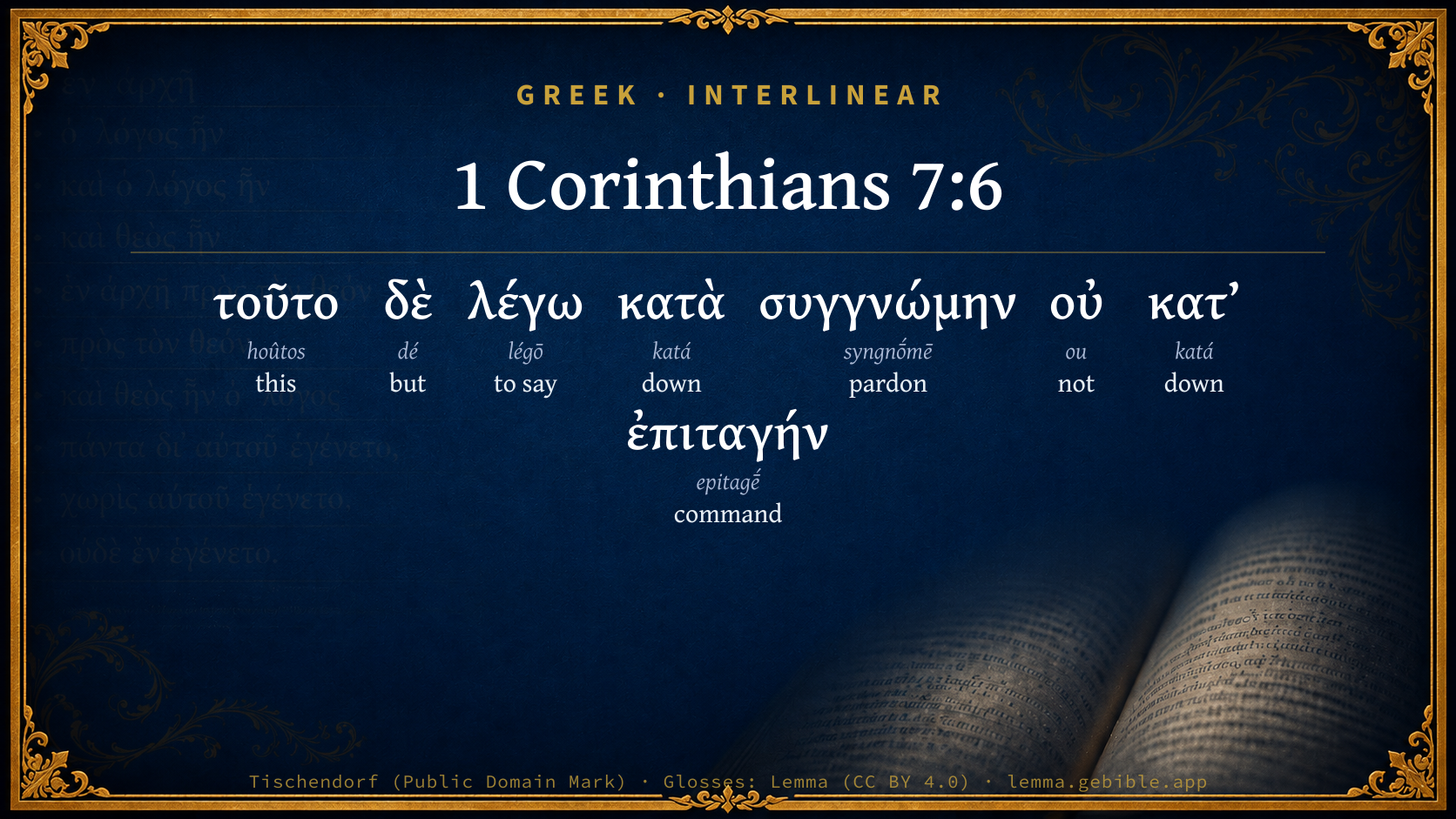
Greek (Tischendorf 8th ed.) 1 Corinthians 7:6 appears in the Greek New Testament. The text above is from the Tischendorf 8th edition. Each word links to its Strong’s number and a concise gloss. Click any word for its full Thayer’s Greek Lexicon entry.
Download image
Cite this verse

1 Corinthians 7:6 (World English Bible). Public Domain. Lemma interlinear Bible study tool, https://lemma.gebible.app/v/1-corinthians/7/6.

Show BibTeX & RIS
BibTeX
RIS
English Translation
But this I say by way of concession, not of commandment.
World English Bible · Public Domain
Highlights
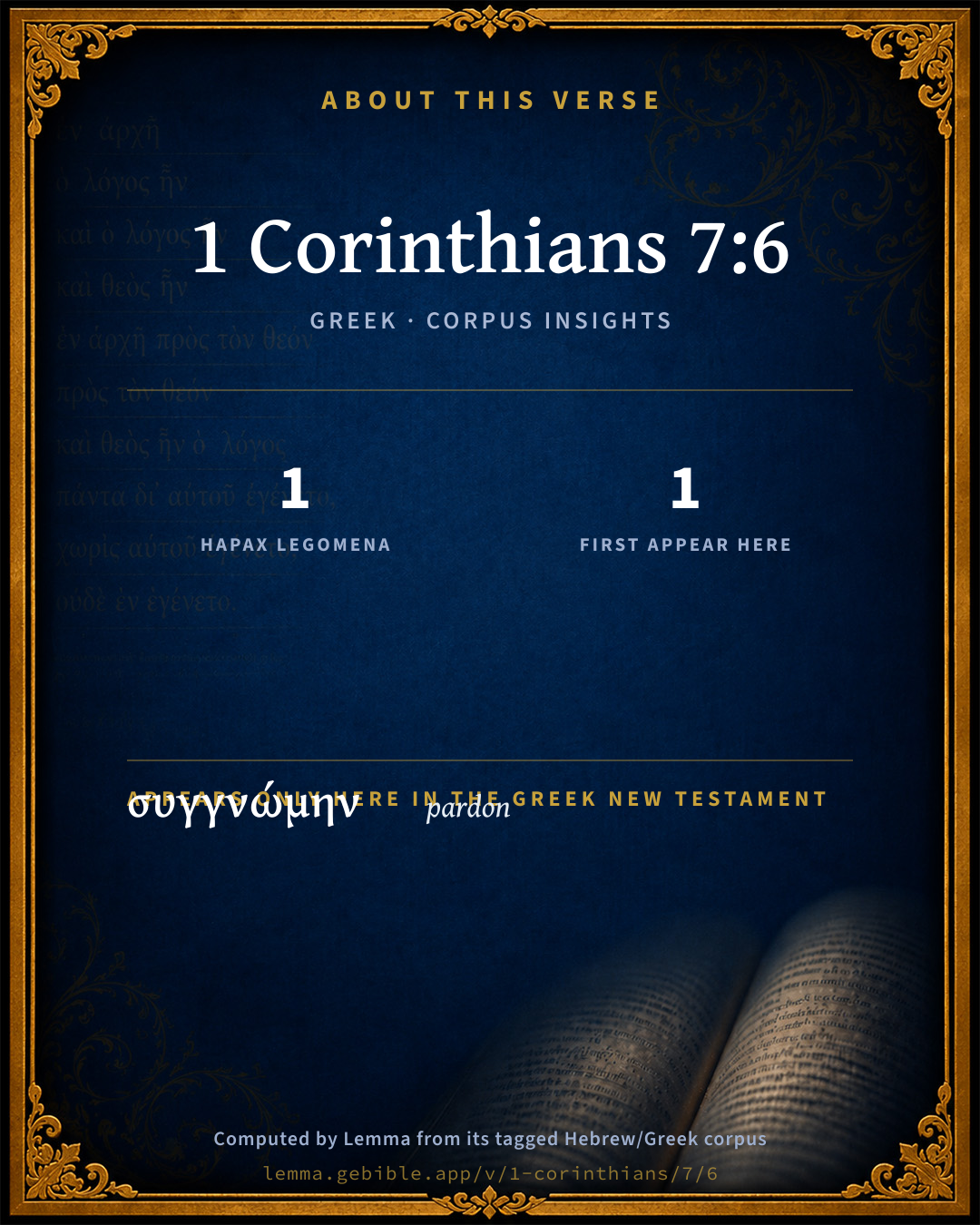
  • 1 hapax legomenon — only here in the Greek New Testament
  • 1 first appearance in the Greek New Testament
Full analysis ↓
Download a study sheet

One document with this verse’s original text, its word-by-word gloss line, the meaning frame, cross-references with their text, attributed commentary, and full source and license credits — printable, and it pastes into notes with its structure intact.

This verse Autodidact and up

Study sheet (.html) Plain text (.txt)

A passage Seminary Student

Up to 50 verses in one chapter. A passage sheet keeps up to 6 commentary sources and 12 cross-references per verse, in the order this page ranks them, and says so on the sheet whenever that leaves anything out. Ask for a single verse and you get the Autodidact verse sheet above.

Everything on this page stays free to read, with no account — the sheet is a download of what is already on screen, not access to it.

Want to remove ads? Support Godless Engineer
Compare translations 3

The same verse in 3 English versions, stacked beneath the original-language interlinear above. Click any original word for its lexicon entry.

Each is an independent rendering of the whole verse — the interlinear is not word-aligned to these translations.

Highlighted words mark where these versions differ — a whole-verse word diff, not a word-by-word alignment.

  • World English Bible Public Domain
    But this I say by way of concession, not of commandment.
  • King James Version Public Domain
    But I speak this by permission, and not of commandment.
  • unfoldingWord Literal Text CC BY-SA 4.0
    But I say this as a concession, not as a command.

unfoldingWord Literal Text — © unfoldingWord, licensed CC BY-SA 4.0. Word-aligned USFM3 via Door43 (git.door43.org/unfoldingWord/en_ult).

Versions to compare (up to 4)

3 of 4 selected

Show all 19 translations

Every available English version of this verse, each an independent rendering of the whole verse.

  • World English Bible Public Domain
    But this I say by way of concession, not of commandment.
  • Berean Standard Bible Public Domain
    I say this as a concession, not as a command.
  • Majority Standard Bible Public Domain
    I say this as a concession, not as a command.
  • King James Version Public Domain
    But I speak this by permission, and not of commandment.
  • American Standard Version (1901) Public Domain
    But this I say by way of concession, not of commandment.
  • Revised Version (1885) Public Domain
    But this I say by way of permission, not of commandment.
  • Geneva Bible (1599) Public Domain
    But I speake this by permission, not by commandement.
  • Douay-Rheims (1899) Public Domain
    But I speak this by indulgence, not by commandment.
  • Young's Literal Translation Public Domain
    and this I say by way of concurrence -- not of command,
  • Literal Standard Version CC BY-SA 4.0
    and this I say by way of concurrence—not of command,
  • Unlocked Literal Bible CC BY-SA 4.0
    But I say these things to you as a concession and not as a command.
  • unfoldingWord Literal Text CC BY-SA 4.0
    But I say this as a concession, not as a command.
  • Darby Bible Public Domain
    But this I say, as consenting [to], not as commanding [it].
  • World Messianic Bible Public Domain
    But this I say by way of concession, not of commandment.
  • Webster's Bible Public Domain
    But I speak this by permission, and not as a commandment.
  • Free Bible Version CC BY-SA 4.0
    I'm telling you this not as a command, but as a concession.
  • Bible in Basic English Public Domain
    But this I say as my opinion, and not as an order of the Lord.
  • Text-Critical English NT CC BY 4.0
    Now I say this as a concession, not as a command.
  • Tyndale New Testament (1534) Public Domain
    This I saye of faveour not of commaundement.

Literal Standard Version (2020), Covenant Press — licensed CC BY-SA 4.0. Text via the HelloAO Bible API (eBible.org). Unlocked Literal Bible (unfoldingWord) — licensed CC BY-SA 4.0. Text via the HelloAO Bible API (eBible.org). unfoldingWord Literal Text — © unfoldingWord, licensed CC BY-SA 4.0. Word-aligned USFM3 via Door43 (git.door43.org/unfoldingWord/en_ult). Free Bible Version, Dr. Jonathan Gallagher — licensed CC BY-SA 4.0. Text via the HelloAO Bible API (eBible.org).

Word by word

More ways to search: Search by grammar → Find every occurrence → Compare this word →

Practice this passage: Drill this verse → Learn its vocabulary →

About this verse

These counts appear in no published source. They are computed here, from the morphology-tagged text and Lemma’s own curated glosses. What Lemma adds →

8
words
7
distinct lemmas
Pauline Epistles
section

Notable vocabulary

1 hapax legomenon — a word that appears only here in the entire Greek New Testament:

  • συγγνώμην pardon G4774

First appearance in Scripture

This word makes its first canonical appearance in the Greek New Testament here:

  • συγγνώμην pardon G4774

Shared distinctive vocabulary

ἐπιταγήν command G2003 occurs in 7 verses of the Greek New Testament. Also found in:

Repetition

A word recurs within this verse:

  • κατὰ down G2596 ×2

Cross-references

4

Topical passages linked to 1 Corinthians 7:6 in the Treasury of Scripture Knowledge — connected by theme and wording, ordered by reader-vote popularity; previews shown in the World English Bible.

  • 2 Corinthians 8:8 I speak not by way of commandment, but as proving through the earnestness of others the sincerity also of your love.
  • 1 Corinthians 7:25 Now concerning virgins, I have no commandment from the Lord, but I give my judgment as one who has obtained mercy from the Lord to be trustworthy.
  • 1 Corinthians 7:12 But to the rest I--not the Lord--say, if any brother has an unbelieving wife, and she is content to live with him, let him not leave her.
  • 2 Corinthians 11:17 That which I speak, I don't speak according to the Lord, but as in foolishness, in this confidence of boasting.

Cross-references courtesy of OpenBible.info (CC BY 4.0).

Commentary

Notes on 1 Corinthians 7:6 from classic Christian and Jewish commentators (each source and its license shown beneath its notes). The classic Christian expositions comment on the surrounding passage and are grouped to its opening verse, so a note may address several verses; the Jewish commentaries on the Tanakh (Rashi and others) are per-verse, so they appear only where the commentator wrote on this verse.

Lemma curates 59 commentaries, every one of them public domain or Creative Commons licensed, each selected and text-cleaned for this edition rather than reprinted as found. About our sources →

The Biblical Illustrator

Joseph S. Exell

1Co_7:6-9

I speak this by permission, and not of commandment.

Revelation

I. By permission.

1. Is still Divine and therefore authoritative.

2. Respects matters of expediency and private application.

II. By commandment.

1. Is absolute.

2. Of immeasurable importance.

3. Universally binding. (J. Lyth, D. D.)

For I would that all men were even as myself.--

The happiness of single life

I. Exemplified by paul.

1. Freedom from earthly care.

2. Entire devotedness to the service of God.

II. Depends on special gift.

1. The gift of continence.

2. Not conferred upon all.

3. Associated generally with special grace.

III. Must not be inculcated upon all.

1. Would violate the ordination of Providence.

2. Breed mischief and immorality. (J. Lyth, D. D.)

But every man hath his proper gift from God, one after this manner, and another after that.--

Distinct gifts

Paul had peculiar natural powers, adapting him for a life of consecration and service. But it was a beautiful feature in his character that he did not expect or wish all Christians to resemble himself in all things. In fellow-labourers he recognised adaptation for usefulness.

I. Human endowments are Divine gifts. The devout mind naturally looks up to the source of all. If to God we are to attribute providential favours, shall we attribute higher gifts to an inferior source?

II. Divine gifts are bestowed upon men in great variety.

1. It is so in bodily constitution. One has muscular strength, another manual dexterity, &c.

2. It is so in temperament. One is calm and wise, another tender and sympathetic, a third impulsive and commanding.

3. It is so in intellectual character. One reasons with force, another persuades with fervour, a third speaks with eloquence. Where are two leaves, two faces alike? So in the Church--one has the gift to rule, another to teach, or to console, &c. One is fitted for a pastor, another for an evangelist. One is called to a public, another to a private position.

III. These gifts are complementary and co-operate to the general good. None can be spared. There is generosity, but not waste in the Divine benefactions. Pray for the qualified workman, and the work shall not be undone for the want of him. Because all things are Christs, all things are ours. One supplies anothers lack, and mutual sympathy and ministrations subserve the general good. Conclusion:

1. Gratitude should be cultivated as due to Him who is the Giver of all.

2. Pride should be repressed; for if one has his gift he has to remember that it is a gift bestowed in grace.

3. Forbearance and toleration are requisite. It is vain to expect all gifts to centre in the same person, to look for what God has not bestowed, to complain because a man has his proper gift and that only. (Prof. J. R. Thomson.)

The Biblical Illustrator, edited by Joseph S. Exell (c. 1880s–1900s) — public domain. Text from a community e-Sword module.

Tyndale Open Study Notes

Tyndale Open Resources

7:6-7 Paul’s preference is singleness, but he recognizes that both marriage and the single life are among the gifts that God gives to various people.

Tyndale Open Study Notes — © Tyndale Open Resources, licensed CC BY-SA 4.0. Text via the HelloAO Bible API.

Bengel's Gnomon

Johann Albrecht Bengel

1Co 7:6. Τοῦτο, this) what has been mentioned all along from 1Co 7:2.—κατὰ συγγνώμην οὐ κατʼ ἐπιταγὴν) See 1Co 7:25, note.

Bengel's Gnomon of the New Testament — English translation (T&T Clark, Edinburgh, 1860) — public domain. Text from a community e-Sword module.

Meyer's Critical & Exegetical Commentary

Heinrich August Wilhelm Meyer

1Co_7:6. Τοῦτο] does not refer to what follows (J. Cappellus, Rosenmüller), which it does not suit; nor to 1Co_7:2 (Beza, Grotius, de Wette, Gratama, Baur, Hofmann); nor to all that has been said from 1Co_7:2 onwards (Bengel, Pott, Flatt, Billroth, Rückert, Osiander), for 1Co_7:2-4 contain precepts actually obligatory; nor to κ. πάλιν ἐπὶ τὸ αὐτὸ ἦτε (Origen, Tertullian, Jerome, Cornelius a Lapide, al[1083]), which is but a subordinate portion of the preceding utterance. It is to this utterance: μὴ ἀποστερεῖτε … ἀκρ. ὑμῶν, which directly precedes the ΤΟῦΤΟ, that it can alone be made to refer without arbitrariness,an utterance which might have the appearance of an ἘΠΙΤΑΓΉ, but is not intended to be such. What Paul means is this: Although I say that ye should withhold yourselves from each other by mutual agreement only perhaps for the season of prayer, and then come together again, so as to escape the temptations of Satan; yet that is not to be understood by way of command, as if you might not be abstinent at other times or for a longer period ἐκ συμφώνου, but by way of indulgence (secundum indulgentiam, Vulgate), so that thereby concession is made to your lack of continency, it is allowed for. Theophylact puts it well: συγκαταβαίνων τῇ ἀσθενείᾳ ὑμῶν, and Erasmus: consulo vestris periculis.

ΣΥΓΓΝΏΜΗ occurs here only in the N. T. (Ecclus., pref. 1 and 1Co_3:13), but very often in Greek writers,not, however, in the LXX. It means invariably either forgiveness, or, as here, forbearance, indulgence, γνώμη κριτικὴ τοῦ ἐπιεικοῦς ὀρθή, Aristotle, Eth. vi. 11. Hammond and Pott transgress the laws of the language by making it the same as κατὰ τὴν ἐμὴν γνώμην. So even Valckenaer; comp Calovius, Flatt, Heydenreich, al[1085] Ewald, too, renders without any support from the usage of the language: with the best conscience.

[1083] l. and others; and other passages; and other editions.

[1085] l. and others; and other passages; and other editions.

Meyer — Critical and Exegetical Commentary on the New Testament — English translation by Peter Christie, edited by Frederick Crombie (T&T Clark, 1880) — public domain. Text from a community e-Sword module.

Expositor's Greek Testament

ed. W. Robertson Nicoll

1Co 7:6-7 . τοῦτο δὲ λέγω points to the leading direction given in 1Co 7:2 , from which 1Co 7:3-5 digressed: “I advise you to be married (though I think celibacy good, 1), κατὰ συνγνώμην ,” secundum indulgentiam (Vg [1021] ) i.e. , συγκαταβαίνων τ . ἀσθενείᾳ ὑμῶν (Thp [1022] ); οὐ κατʼ ἐπιταγήν , ex concessione, non ex imperio (Bz [1023] ). The rendering “permission” is somewhat misleading; συνγνώμη is quite distinct from the γνώμη opposed to ἐπιταγὴ in 1Co 7:25 ; it signifies either pardon ( venia , excuse for a fault), or, as here, allowance , regard for circumstances and temperament. In θέλω δὲ κ . τ . λ . the Ap. states his personal bent, which he had set aside in the recommendation just given: “But I would have all men to be as indeed myself,” sc. cœlibem and contentedly so ( cf. Act 26:29 ). ὡς καὶ ἐμαυτόν , paratactic acc [1024] (attracted to πάντας ἀν θρώπους ) = ὡς καὶ αὐτός εἰμι ; καὶ emphasises the assertion that the writer is what he would like others to be. It is manifest (see also 1Co 9:5 ) that the Ap. was unmarried, although Clem. Alex. and some moderns have inferred otherwise from Phi 4:3 . That he had never been married is by no means certain. Two things, however, are clear: that if P. had known the married state, it was before his apostleship “wife and children are never hinted at, he goes about entirely free from such ties” (Lt [1025] ); further, that if in early life he had entered this state, it was not διʼ ἀκρασίαν ; he possessed the “grace-gift” ( χάρισμα ) of undisquieted continence (opposed to πυροῦσθαι , 1Co 7:9 ; cf. Mat 19:12 ), which was in his case an adjunct of his χάρις ἀποστολῆς . “However (= I cannot have every one like myself, but ) each has a charism of his own from God, the one in this shape and the other in that.” ὁ δὲ οὕτως does not refer to the married Christian, as though his state were in itself a charism, but to any special endowment for service in Christ’s kingdom other than that stated. On χάρισμα see 1Co 1:7 ; and cf. 1Co 12:4-11 .

[1021] Latin Vulgate Translation.

[1022] Theophylact, Greek Commentator.

[1023] Beza’s Nov. Testamentum: Interpretatio et Annotationes (Cantab., 1642).

[1024] accusative case.

[1025] J. B. Lightfoot’s (posthumous) Notes on Epp. of St. Paul (1895).

The Expositor's Greek Testament, edited by W. Robertson Nicoll (1897–1910) — public domain. Text from a community e-Sword module.

Godet's Commentaries

Frédéric Louis Godet

Vv. 6, 7. “Now I speak this by permission, not of commandment. 7. But I wish that all men were even as I myself; yet every man hath his proper gift of God, one after this manner, and another after that.”

The remark which the apostle makes in 1Co 7:6 might be applied to the foregoing prohibition: “Defraud not...;” or, as is done by Tertullian, Origen, Jerome, Calvin, to the precept: “that ye come together again.” But this precept had been given only accidentally, and the ground for it had been too strongly stated to admit of its being afterwards presented as a simple counsel, and not as a positive rule. Meyer and Beet make this remark bear on the restriction: “Except it be for a time.” Meyer paraphrases thus: “If I recommend you to keep apart only for a time, it is not an absolute command I give on the subject, it is a simple counsel. But you may, if you think good, remain in this state of separation, provided it be with common consent.” But, in the first place, this meaning is overturned by the same reasons as the preceding, from which it is not essentially different. Then what right have we to separate one of the three conditions (common consent) from the other two? Are they not put on exactly the same footing in 1Co 7:5? Far from wishing by 1Co 7:6 to attenuate the importance of the limits traced in 1Co 7:5, the apostle aims, on the contrary, throughout this whole passage to combat a too pronounced ascetic tendency which threatened to prevent marriage, or to turn it aside from the end for which the apostle claims it as a general rule. If it is so, the remark of 1Co 7:6 can only refer, as has been clearly seen by Beza, Grotius, de Wette, Hofmann, to the essential idea of the passage, as stated in 1Co 7:2, and as it is to be restated in a new form in 1Co 7:7 : the general duty of marriage. 1Co 7:3-5 have only been a digression intended to maintain in the normal state the practice of marriage. The apostle now returns to the principal idea (1Co 7:2): “In speaking as I do, I do not for a moment mean to give you an apostolical command to marry. I give you a simple counsel, founded on the knowledge I have of your weakness.”

The verb συγγινώσκειν, to know with, denotes the sympathetic feeling with which one appropriates the thought or state of another, condescension, accommodation, and even pardon. The substantive συγγνώμη consequently expresses an advice in which one takes account of circumstances. It was precisely in this sense that the apostle had laid down as a rule the married state.

Vv. 7. The received reading γάρ, for, rests on the Vatic., the Peschito, etc. Its meaning is easy: “I certainly did not mean to enjoin you to marry; for my desire is rather...” But all the other Mjj., the Itala, and several Fathers read δέ, but, which is more difficult, and for that very reason more probable, and which can also be justified: “I commit you in general to marriage, but that is not my wish, absolutely speaking; on the contrary...” It seems as if instead of the indic. θέλω, I wish, the optative would have been required. But this would only have expressed a contingent wish, whereas the indicative expresses a real wish of the apostle, though he gives up its fulfilment for reasons independent of his wish. As Osiander observes, the form θέλω has in it something subjective.

Is the phrase, all men, which does not signify merely all Christians, as Osiander still thinks, determined by the near prospect of the end of the world? This is unnecessary. Absolutely speaking, Paul can only desire for every man what he has found best for himself; but no doubt on the condition that there be no essential difference between him and others.

From the words, as I myself, it may be inferred with certainty that Paul was not married, and quite as certainly that he was not a widower. For how could he have expressed the desire that all men were widowers! See on 1Co 7:8.

The καί, also, after as, strengthens the idea of the resemblance which he would like to see existing between him and other men (Rom 1:13; Act 26:29).

But the preference which Paul gives to celibacy meets with an obstacle in practice. There is a difference among men of which account must be taken. Jesus had already pointed it out (Mat 19:10-12), and He had Himself drawn from the fact the practical consequences relating to the subject before us. There are men whom their natural temperament, in the first place, and then a spiritual grace which takes possession of this particular disposition, render capable of living in the state of celibacy without struggle and without inward pollution. Agreeably to this saying of Jesus, Paul desires that when one has the privilege of possessing the glorious faculty of consecrating himself without encumbrances to the service of God and men, he should not sacrifice it.

The expressions, one after this manner, and another after that, denote respectively, aptitude for life in celibacy, and aptitude for married life. It should be observed that these two aptitudes bear, both alike, the name of gift, χάρισμα. And we can thus put our finger on the error into which Reuss falls, when he says: “If abstention, life in celibacy, is a particular gift of God’s grace, it is evident that something is wanting to the man who does not possess it.” The apostle is innocent of this erroneous conclusion. For he declares that there is not one single gift, but two different gifts. If the one is the gift of celibacy for the kingdom of God, the other is that of marriage, also for the kingdom of God. Meyer, it is true, alleges that the apostle is here expressing an abstract maxim, and that the two οὕτως, thus, do not properly apply either to celibacy or marriage specially. But what matters? If it is a general maxim, it is in any case stated here only with a view to its application to the two positions compared in the passage. Hence it follows that there is no less need of a gift of grace to use marriage Christianly than to live Christianly in celibacy.

In 1Co 7:1-7 Paul laid down two principles: the intrinsic honourableness of celibacy (1Co 7:1; 1Co 7:7 a), and the preference which must as a rule be given to marriage (1Co 7:2; 1Co 7:7 b). He now draws, 1Co 7:8-9, the consequences of these two principles; and first, 1Co 7:8, the consequence from the first; then, 1Co 7:9, that from the second.

Frédéric Louis Godet — Commentaries on Luke, John, Romans, and 1 Corinthians — English translation (T&T Clark, Edinburgh, 1870s–1890s) — public domain. Text from a community e-Sword module.

Hodge's Commentary on Romans, Ephesians & First Corinthians

Charles Hodge

1Co_7:6, 1Co_7:7

But I speak this by permission, (and) not of commandment. For I would that all men were even as I myself. But every man hath his proper gift of God, one after this manner, and another after that.

The reference of the word this in 1Co_7:6, is a matter of doubt. Some refer it to the immediately preceding clause, Your coming together again I speak of as permitted, not as commanded. But that clause is an entirely subordinate one; and the sense thus given to the passage is not consistent with the context. It was not a matter permitted, but commanded that husbands and wives should live together. Others refer it to the whole of 1Co_7:5. Your separating yourselves only by consent and for a limited time for the purpose of devotion, is a matter of permission, not of command; you may separate for other purposes and for an unlimited time. But to this also it is an obvious objection, that it conflicts with the mandatory character of 1Co_7:3, 1Co_7:4, and with the meaning of 1Co_7:5 itself; for that verse has not the form of a command. The reference to the 5th verse may be made under a different aspect. What I have said of your separating by consent for a season, is a matter of permission, not of command. But this is not consistent with the reason assigned in the next verse. The most natural reference is to 1Co_7:2, and to what follows. His saying, Let every man have his own wife and every woman her own husband, and let them remember their mutual obligations, was permissive and not a matter of command. Marriage, in other words, is permitted, not commanded. For I would that all were as I am. The sense is not materially different, if with many editors we read θέλω δέ instead of θέλω γάρ. Marriage is not commanded, but I would, etc. The Apostle did not take sides with the extreme Jewish party, who regarded marriage as obligatory. He admitted the expediency of all remaining single in those times of persecution to whom God had given the requisite grace.

Charles Hodge — Commentary on Romans (1835), First Corinthians (1857), and Ephesians (1856) — public domain. Text from a community e-Sword module.

Geneva Bible (1599)

Geneva Bible translators

Fifthly, he teacheth that marriage is not simply necessary for all men, but for them which have not the gift of continency, and this gift is by a peculiar grace of God.

Geneva Bible (1599) marginal notes — public domain. Text via Bolls.life.

Jamieson, Fausset & Brown

Robert Jamieson, A. R. Fausset & David Brown

by permission . . . not of commandment--not by God's permission to me to say it: but, "by way of permission to you, not as a commandment." "This" refers to the directions, Co1 7:2-5.

Jamieson, Fausset & Brown — Commentary Critical and Explanatory on the Whole Bible (1871) — public domain (CC PDM 1.0). Text via the HelloAO Bible API.

Adam Clarke's Commentary

Verse 6. I speak this by permission, c.] It was a constant custom of the more conscientious rabbins, to make a difference between the things which they enjoined on their own judgment, and those which they built on the authority of the law. Thus Rabbi Tancum: "The washing of hands before meat is in our own power washing after meat is commanded." In relation to this point Dr. Lightfoot produces some examples from the Jewish writers: "The man is commanded concerning begetting and multiplying, but not the woman. And when does the man come under this command? From the age of sixteen or seventeen years; but, if he exceeds twenty years without marrying, behold he violates and renders an affirmative precept vain. The Gemara says: It is forbidden a man to be without a wife; because it is written, It is not good for man to be alone. And whosoever gives not himself to generation and multiplying is all one with a murderer: he is as though he diminished from the image of God, c." We may understand the apostle here as saying that the directions already given were from his own judgment, and not from any Divine inspiration and we may take it for granted that where he does not make this observation he is writing under the immediate afflatus of the Holy Spirit.

Adam Clarke's Commentary on the Bible (1810–1826) — public domain. Text from a community e-Sword/MySword module.

John Calvin's Commentaries

6. By permission That they might not, by taking their stand upon a precept of the kind that he had prescribed, loosen unduly the restraints of lust, he adds a limitation — that he had written these things on account of their infirmity — that they may bear in mind that marriage is a remedy for unchastity, lest they should inordinately abuse the advantage of it, so as to gratify their desire by every means; nay more, without measure or modesty. He has it also in view to meet the cavils of the wicked, that no one might have it in his power to object in this way: “What! are you afraid that husbands and wives will not of their own accord be sufficiently inclined to carnal delight that you prompt them to it?” For even the Papists, those little saints, are offended with this doctrine, and would gladly have a contest with Paul, on the ground of his keeping married persons in mutual cohabitation, and not allowing them to turn aside to a life of celibacy. He assigns, then, a reason for his doctrine, and declares, that he had not recommended connubial intercourse to married persons with the view of alluring them to delight, or as though he took pleasure in commanding it, but had considered what was required by the infirmity of those that he is addressing.

Foolish zealots for celibacy make a wrong use of both clauses of this verse; for as Paul says that he speaks by permission, they infer from this, that there is therefore something wrong in conjugal intercourse, for where there is need of pardon, there must be sin. Farther, from his saying that he speaks not by commandment, they infer, that it is, therefore, a holier thing to leave off the use of marriage and turn to celibacy. To the former, I answer, that as there is, I acknowledge, an inordinate excess in all human affections, I do not deny that there is as to this matter an irregularity, (ἀταξία,) which, I allow, is vicious. Nay more, this affection, I allow, is beyond others violent, and next to brutish. But, on the other hand, I also maintain, that whatever there is of vice or baseness, is so covered over by the honorableness of marriage, that it ceases to be a vice, or at least is not reckoned a fault by God, as Augustine elegantly discourses in his book “On the advantage of Marriage,” and frequently in other places. You may then take it briefly thus: conjugal intercourse is a thing that is pure, honorable and holy, because it is a pure institution of God: the immoderate desire with which persons burn is a fault arising from the corruption of nature; but in the case of believers marriage is a veil, by which that fault is covered over, so that it no longer appears in the sight of God. To the second I answer: as the term commandment is properly applied to those things which relate to the duties of righteousness, and things in themselves pleasing to God, Paul on this account says that he does not speak by commandment He has, however, sufficiently shown previously, that the remedy, which he had enjoined, must necessarily be made use of.

John Calvin's Commentaries (1540-1563) — public domain. Text from the Calvin Translation Society English edition (1840s-50s) via the Christian Classics Ethereal Library (ccel.org). Calvin's coverage is partial (roughly two-thirds of the Bible); uncommented books and verses are honest gaps, never fabricated. The 19th-century editor's footnotes and remarks are omitted so the notes are faithfully Calvin's own voice.

Ellicott's Commentary for English Readers

(6) But I speak this by permission.—Better, Now I say this as a permission, and not as a command. As the passage is given in our English version, it might seem as if the Apostle implied that he had no actual command, but only a permission to write this, which is not at all his meaning. What he does say is, that the foregoing instructions are not to be considered as absolute commands from him, but as general permissive instruction, to be applied by each individual according to circumstances.

It has been much discussed as to what part of the previous passage the word “this” refers. It is perhaps best to take it as referring to the leading thought of the whole passage, which is that marriage is allowable, expressed especially in 1Co_7:2.

A Bible Commentary for English Readers, edited by Charles John Ellicott (1878–1897) — public domain. Text from a community e-Sword module.

The Cambridge Bible for Schools and Colleges

gen. ed. J. J. S. Perowne

6. by permission] i.e. by way of permission on the Apostle’s part to the Corinthian Church, not of God to him, as it is sometimes misunderstood. The original signification of the word thus rendered is agreement. Thence it comes to mean permission, indulgence, concession. Vulgate, indulgentia; Calvin (and Estius), venia; Beza, concessio; Wiclif, well, giving leave; Tyndale, of faveour.

The Cambridge Bible for Schools and Colleges (gen. ed. J. J. S. Perowne; Cambridge University Press, 1878–1918) — public domain. Text from a community e-Sword module.

John Gill's Exposition

But I speak this by permission,.... Referring either to what he had said before, though not to all; not to Co1 7:2 that for the avoiding of fornication, every man should make use of his own wife, and every woman of her own husband; since this is not by permission, but by command, Gen 2:24 that carnal copulation should be between one man and one woman in a married state; nor to Co1 7:3 for that married persons ought to render due benevolence to, and not defraud each other, having a power over each other's bodies, is a precept, and not a permission, Exo 21:10 but to Co1 7:5 their parting for a time, and coming together again: it is not an absolute command of God that they should separate for a time, on account of fasting and prayer, but if they thought fit to do so by agreement, they might; nor was there any positive precept for their coming together again directly, after such service was over. The apostle said this,

not of commandment; but, consulting their good, gives this advice, lest Satan should be busy with them, and draw them into sin; but if they had the gift of continence, they might continue apart longer; there was no precise time fixed by God, nor did the apostle pretend to fix any: or it may refer to what follows after, that he would have all men be as he was; though he laid no injunction, but left them to their liberty; unless it can be thought to regard marriage in general, and to be said in opposition to a Jewish notion, which makes marriage a "command";

"a man, they say (f), is bound to this command at seventeen years of age, and if he passes twenty and does not marry, he transgresses, and makes void an affirmative precept;''

but the apostle puts it as a matter of choice, and not of obligation.

(f) Maimon. Hilch, Isbot, c. 15. sect. 2.

John Gill's Exposition of the Whole Bible (1746–1763) — public domain (CC PDM 1.0). Text via the HelloAO Bible API.

Trapp's Complete Commentary

John Trapp

6 But I speak this by permission, and not of commandment.

Ver. 6. And not of commandment] Among the Jews marriage was not held a thing indifferent, or at their own liberty to choose or refuse, but a binding command. (Targum on Gen 1:28) Hereto Paul seems in this verse to allude. In this day every Jew is bound to marry about 18 years of age, or before 20; else he is accounted as one that liveth in sin.

John Trapp, A Commentary or Exposition upon All the Books of the Old and New Testament (1647–1656) — public domain. Text from a community e-Sword module.

Albert Barnes' Notes on the Bible

But I speak this by permission ... - It is not quite certain whether the word “this” (τοῦτο touto), in this verse, refers to what precedes, or to what follows. On this commentators are divided. The more natural and obvious interpretation would be to refer it to the preceding statement. I am inclined to think that the mare natural construction is the true one. and that Paul refers to what he had said in 1Co 7:5. Most recent commentators, as Macknight and Rosenmuller, however, suppose it refers to what follows, and appeal to similar places in Joe 1:2; Psa 49:2; 1Co 10:23. Calvin supposes it refers to what was said in 1Co 7:1.

By permission - συγγνώμην sungnōmēn. This word means “indulgence,” or “permission,” and stands opposed to that which is expressly enjoined; compare 1Co 7:25. “I am ‘allowed’ to say this; I have no express command on the subject; I give it as my opinion; I do not speak it directly under the influence of divine inspiration;” see 1Co 7:10, 1Co 7:25, 1Co 7:40. Paul here does not claim to be under inspiration in these directions which he specifics. But this is no argument against his inspiration in general, but rather the contrary. For:

(1) It shows that he was an honest man, and was disposed to state the exact truth. An impostor, pretending to inspiration, would have claimed to have been always inspired. Who ever heard of a pretender to divine inspiration admitting that in any thing he was not under divine guidance? Did Mahomet ever do this? Do impostors now ever do it?

(2) It shows that in other cases, where no exception is made, he claimed to be inspired. These few exceptions, which he expressly makes, prove that in everywhere else he claimed to be under the influence of inspiration.

(3) We are to suppose, therefore, that in all his writings where he makes no express exceptions, (and the exceptions are very few in number,) Paul claimed to be inspired. Macknight, however, and some others, understand this as mere adVice, as an inspired man, though not as a command,

Not of commandment - Not by express instruction from the Lord; see 1Co 7:25. I do not claim in this to be under the influence of inspiration; and my counsel here may be regarded, or not, as you may be able to receive it.

Albert Barnes' Notes on the Bible (1834–1885) — public domain. Text from a community e-Sword/MySword module.

Haydock's Catholic Bible Commentary

By indulgence. That is, by a condescension to your weakness. (Challoner)

George Leo Haydock (1774–1849), Haydock's Catholic Family Bible and Commentary, 1859 edition — public domain. Excludes Psalms (Douay-Rheims chapter numbering differs from Protestant) and Deuterocanonical books (Catholic canon only).

Matthew Poole's English Annotations

Some refer these words to all that had gone before in this chapter; but the best interpreters rather refer them to what went immediately before in the preceding verse, declaring, that he had no express command from God, as to those things of abstaining for a time for fasting and prayer, and then coming together again, but he spake what he judged equitable and reasonable; but as to particular persons, they ought to judge and govern themselves according to their particular circumstances.

Matthew Poole's English Annotations on the Holy Bible (1683–1685) — public domain. Text from a community e-Sword/MySword module.

Whedon's Commentary on the Bible

Daniel D. Whedon

6. But—Although this is often a proper course.

This—The temporary abstinence prescribed in 1Co_7:5.

By permission—It is a divinely allowable but not commanded suspension of the command in 1Co_7:3-4.

Daniel D. Whedon (gen. ed.), Commentary on the Old and New Testaments (1874–1909) — public domain. Text from a community e-Sword module.

The Pulpit Commentary

I speak this. The "this" applies to his advice in general, but especially to the last verse. By permission. This phrase is generally misunderstood. It does not mean that St. Paul was permitted though not commanded to give this advice, but that his gentle advice was given "by way of permission" to Christians, not "by way of injunction." He means to say that he leaves the details of their lives, whether celibate or married, to their individual consciences, though with large hearted wisdom and charity he would emancipate them from human and unauthorized restrictions. The clause is not, therefore, a parallel to the restrictions on the authority of his utterances, such as we find in vers. 12, 29, 40, and in 2Co_8:10 2Co_11:17.

The Pulpit Commentary (1880–1919), ed. H.D.M. Spence-Jones & Joseph S. Exell — public domain. Text from a community e-Sword module.

John Wesley's Explanatory Notes

But I say this - Concerning your separating for a time and coming together again. Perhaps he refers also to ver. 2.

John Wesley, Explanatory Notes Upon the Whole Bible (1754–1765) — public domain. Text via the GEBible commentary corpus.

Kretzmann's Popular Commentary

Paul E. Kretzmann

Marriage an obligation under circumstances:

v. 6. But I speak this by permission and not of commandment.

v. 7. For I would that all men were even as I myself. But every man hath his proper gift of God, one after this manner and another after that.

v. 8. I say, therefore, to the unmarried and widows, It is good for them if they abide even as I

v. 9. But if they cannot contain, let them marry; for it is better to marry than to burn.

v. 10. And unto the married I command, yet not I, but the Lord, Let not the wife depart from her husband;

v. 11. but and if she depart, let her remain unmarried, or be reconciled to her husband; and let not the husband put away his wife.

The apostle here refers to the leading sentence of the chapter, according to which he made marriage the rule, although he thought celibacy good. This he speaks according to allowance. The Lord, who inspired Paul to write this letter, has allowed him to take regard for circumstances and temperament, to apply general principles to conditions as they existed at that time. But that does not change the commandment and institution of the Lord. Wherever Paul speaks in matters of Christian liberty, giving his opinion and counsel, v. 25, he is conscious of speaking as a man that has the Spirit of God, v. 40. In this sense also he writes: But I would have all men to be as also myself. God had given him the special gift of continence, and in view of the near approach of Christ’s second advent, when all marrying and giving in marriage would cease, his wish was that this gift might be possessed more generally. "He desired that everybody might have the extraordinary grace of continence, in order that he might be spared the cares and the anxiety of marriage, and in perfect freedom be concerned only with God and with His Word. " But he is no fanatic, he knows that everyone has received his own gift of grace from God, one in this way, another in that. The Lord distributes His gifts for the service of His kingdom as He chooses, endowing each of His servants according to the work that He expects from them. In most cases the fitness of a Christian for the marriage state is in itself a special gift of God, for the care and government of a family is an excellent training for the larger duties in the Church, 1Ti 3:4-5.

The apostle proceeds in his statements with great care: But I say to the unmarried men and to the widows, It is good for them if they remain as I; he knows the celibate state to be altogether honorable. But his advice, in view of his own extraordinary gift, is conditional: If, however, they cannot exercise control over themselves, if they have not the gift of continence, let them marry; for it is better to marry than to feel burning, to be consumed by continual sexual desire, since the unsatisfied craving is a ceaseless temptation. It is not that they should choose the lesser of two evils, but they should do that which is no sin in order to avoid that which is sin; for the burning in sexual excitement is not permissible outside of marriage, and the rule here uttered cannot be suspended by any vows of enforced celibacy. It may happen, of course, that owing to circumstances over which they have no control an unmarried man or a widow may not find it possible to get married. In such cases every Christian may trust in the Lord to receive from Him the necessary power to keep his body in subjection and to overcome the lust of the flesh, just as that is the case where either husband or wife are incapacitated for the specific duties of marriage.

For the married people one rule holds once and for all times: To the married I command, yet not I, but the Lord, that the wife does not separate herself from the husband; but if indeed she has separated, let her remain unmarried or be reconciled to her husband, and that the husband do not dismiss his wife. According to the rule of Christ the marriage-tie is indissoluble, the exceptional cause of divorce mentioned by Him not finding its application in the case of wedded Christians. Paul is here most emphatically stating the will, the law of God as it is valid under all circumstances. The case of the woman is probably mentioned first on account of the position she had occupied in the heathen world, or because the number of women exceeded that of the men in the Corinthian congregation. The woman is not to leave her husband; neither incompatibility of temper nor ascetic aversion can be alleged before the tribunal of God. But if there should be such a case in which the law of God has been set aside by a wife, she should remain unmarried or be reconciled to her husband. This is not equivalent to giving the woman permission to get a divorce, but conveys the very opposite idea. If she has separated herself without valid reason, she is to be left severely alone in her petulance and in her bad conscience, only one alternative being given her, that of returning to her husband, of being reconciled to him; and he may not dismiss her under the circumstances, just as he has no right at any time to give her a letter of divorcement according to Jewish custom. The intimacy of the marriage-tie is such as to render all efforts tending to its dissolution sinful.

Paul E. Kretzmann, Popular Commentary of the Bible (1921–1924) — public domain. Text from a community e-Sword module.

Burkitt's Expository Notes on the New Testament

William Burkitt

As if the apostle had said, "Mistake me not, as if I imposed marriage upon all persons as a duty: no, but I declare it is permitted to all as a remedy against fornication; for so far am I from that, that I could wish all men were unmarried, even as I myself am, and that they had the gift of continence with myself; but God, who will have the world yet farther continued and increased, hath not given this gift to all, nor to all alike in the same measure.

Therefore to the unmarried I say, that so many are the advantages of a single life, that if they can abide chaste and single, as I do, it will be many ways for their advantage: but if they cannot, let them use God’s remedy, which is marriage; for it is better to marry, than to burn in lust, to be perpetually assaulted with unclean desires, and subject to the ravings and insults of lust."

Learn hence, 1. That marrying or not marrying is according to several circumstances, matter of advice and counsel, but neither of them absolutely of precept.

2. That second marriages are not only lawful, but an incumbent duty, if persons cannot contain themselves within the bounds and rules of chastity: To the widows I say, if they cannot contain, let them marry.

William Burkitt's Expository Notes on the New Testament (1700–1703) — public domain. Text from a community e-Sword module.

McGarvey & Pendleton's Commentaries

J. W. McGarvey

But this I say by way of concession, not of commandment . [That his readers may understand his counsel, Paul discusses the marriage state, and shows that the reciprocal rights of the parties thereto forbid abstinence to either husband or wife, save in cases where one wishes to devote a season to prayer; but even here the abstinence must be by mutual consent, and the apostle does not enjoin it, but merely concedes or permits it at such times, because the higher duty of prayer may for a season suspend conjugal duty. But here again caution must be observed, lest too prolonged abstinence might work temptation to either party, especially the prayerless one.]

J. W. McGarvey (with Philip Y. Pendleton), Commentaries on the New Testament (The Fourfold Gospel, 1914; Acts; and the epistles) — public domain. Text from a community e-Sword/MySword module.

The People's New Testament

B. W. Johnson

6. But this I say by permission, etc. What is just stated (verse 5) is permissible in the married state, not commanded.

B. W. Johnson's The People's New Testament with Notes (1889–1891) — public domain. Electronic text from the Christian Classics Ethereal Library (CCEL) ThML edition.

Cambridge Greek Testament for Schools and Colleges

6. κατὰ συνγνώμην. A.V. by permission. Other commentators translate, by way of indulgence. But συνγνώμη properly means pardon, or excuse. So Calvin and Estius here. See Plato Phaed. 88 C νὴ τοὺς θεούς, ὦ Φαίδων, συγγνώμην γε ἔχω ὑμῖν. And Herod. I. 39 συγγνώμη μέν, ὦ πάτερ, τοι. See also Aristotle Eth. Nic. III. 1, IV. 5, 1Co 7:8. In VI. 11 he defines συγγνώμη as γνώμη κριτικὴ τοῦ ἐπιεικοῦς ὀρθή. Therefore we may paraphrase the passage thus: ‘I say this as a fair and reasonable concession to your circumstances. But it is not to be regarded as a positive command.’

Cambridge Greek Testament for Schools and Colleges (Cambridge University Press, 1896; 21 vols, various authors incl. Carr, Maclear, Plummer, Farrar, Lumby, Moule, M. R. James, Simcox) — public domain. Text from a community e-Sword module.

Alford’s Greek Testament

Henry Alford

6.] But this I say by way of allowance (for you), not by way of command.

τοῦτο refers, not to ver. 2, as Beza, Grot., and De Wette, because the precept there given depends on a reason also given, διὰ τὰς πορνείας, from the nature of which reason it must be κατʼ ἐπιταγήν: nor to the whole since ver. 2, as Billroth, Rückert, al.,—because the precept in ver. 3 depends on the general truth in ver. 4, and is also a command: nor to πρὸς καιρόν, as Theophyl.:—nor as the ascetics, , , Jerome, Estius (also Calvin), to ἐπὶ τὸ αὐτὸ ἦτε, because both these are but subordinate members of the preceding sentence:—still less to what follows, as Rosenm., al.:—but, as the context (ver. 7) shews, to the whole recommendation given in ver. 5. This recommendation all depended on the possibility of their being tempted by incontinence: he gives it not then as a command in all cases, but as an allowance for those to whom he was writing, whom he knew, and assumes, to be thus tempted. The meaning ‘by permission,’ E. V., is ambiguous, appearing as if it meant by permission of the Lord (to say it): that given by Hammond, al., κατὰ τὴν ἐμὴν γνώμην, is philologically inadmissible.

Henry Alford, The Greek Testament (1849–1861) — public domain. Text from a community e-Sword module.

International Critical Commentary

6. τοῦτο δὲ λέγω. It is not clear how much the το͂νο covers; probably the whole of vv. 1-5. The least probable suggestion is that it refers solely to the resumption of married life, καὶ πάλιν κ.τ.λ.

συνγνώμην. ‘Concession,’ or ‘indulgence,’ or ‘allowance.’* The word occurs nowhere else in N.T. and is very rare in LXX.

οὐ κατʼ ἐπιταγήν. ‘Not by way of command’ (2Co 8:8).

International Critical Commentary — older volumes (1896–1929), various authors — public domain. Text from a community e-Sword module.

Lesson kit

Teaching starters — assembled from the data on this page, not authored interpretation. Every prompt links to the verse data it draws on. Edit before teaching.

1 Corinthians, in the Pauline Epistles, opens this verse with 8 words (7 distinct Greek lemmas). Its most distinctive word is syngnṓmē (“pardon”). A historical commentator’s framing appears above. Read the whole chapter for the surrounding context.

Discussion questions

  1. The word syngnṓmē carries the sense “pardon.” How does it shape the verse?
  2. This verse holds 1 word here found nowhere else in the Greek New Testament. What might the rare word draw attention to?
  3. The word “pardon” first appears here in Scripture. What is being introduced at this debut?
  4. Romans 16:26 shares the word «command» with this verse. How do the two illuminate each other?
  5. “down” occurs 2× in this one verse. What is the effect of the repetition?
  6. These translations render this verse differently. What is at stake in choosing one wording over another?
  7. Reading how The Biblical Illustrator and Tyndale Open Study Notes read this verse, where do the two commentators agree and where do they part?

Things to notice

  • 1 word in this verse appears nowhere else in the Greek New Testament.
  • 1 word makes its first canonical appearance in Scripture here.
  • These translations choose different wording for 7 words in this verse.
  • “down” occurs 2× in this single verse.
  • 7 distinct Greek lemmas span 8 words in this verse.

Reading settings

Reading text

Shown beneath each verse's original-language words.

Old Testament
Old Testament edition

Read the OT as the Masoretic Hebrew (MT) or the Greek Septuagint (LXX).

English shown for the Greek Septuagint (in the Hebrew ↔ Greek comparison).

Comparing translations? Open the Compare panel on any verse page to stack up to four side by side.