
1 Corinthians 12:9

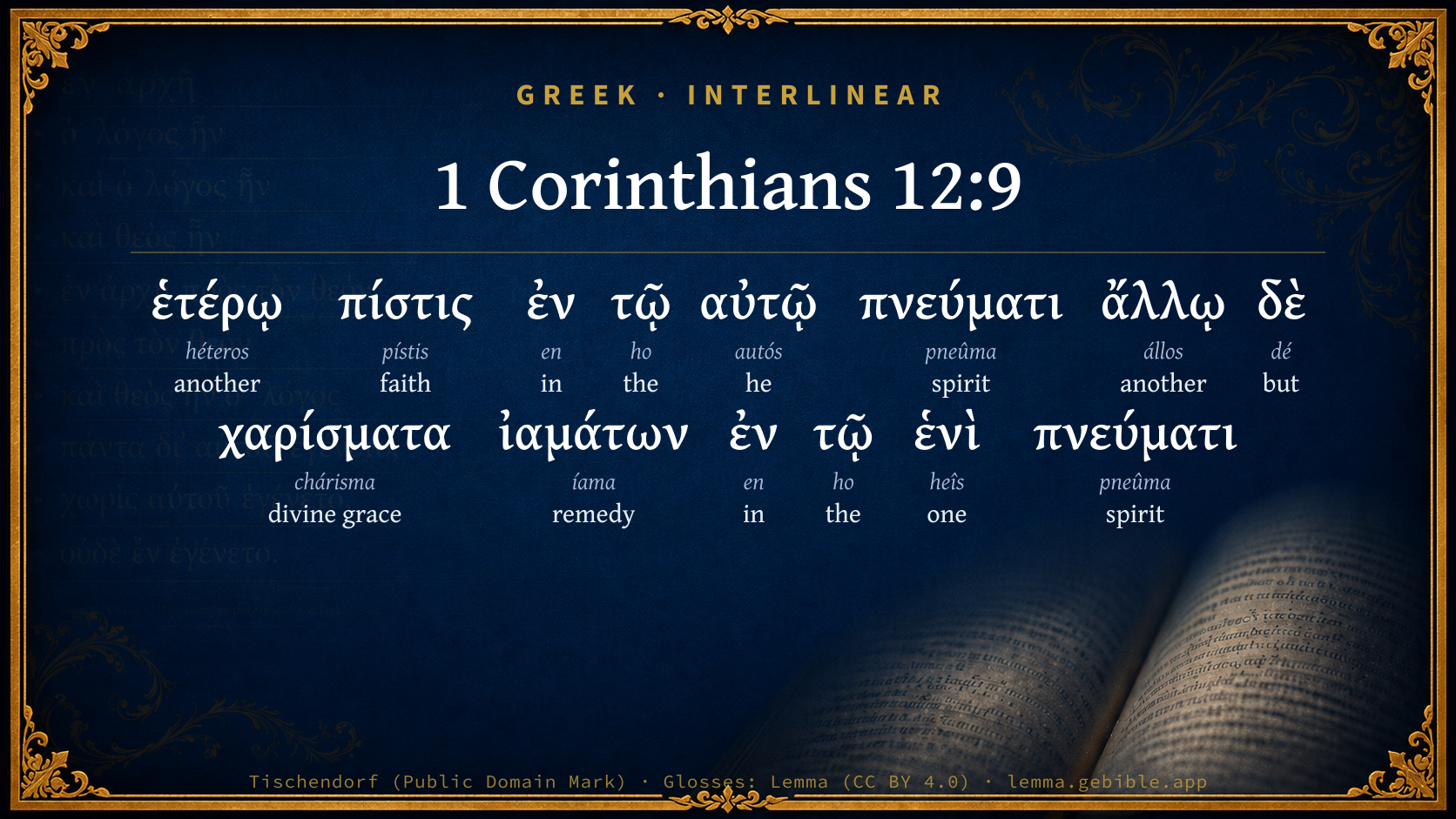
Greek (Tischendorf 8th ed.) 1 Corinthians 12:9 appears in the Greek New Testament. The text above is from the Tischendorf 8th edition. Each word links to its Strong’s number and a concise gloss. Click any word for its full Thayer’s Greek Lexicon entry.
Download image
Cite this verse

1 Corinthians 12:9 (World English Bible). Public Domain. Lemma interlinear Bible study tool, https://lemma.gebible.app/v/1-corinthians/12/9.

Show BibTeX & RIS
BibTeX
RIS
English Translation
to another faith, by the same Spirit; and to another gifts of healings, by the same Spirit;
World English Bible · Public Domain
Highlights
  • 1 first appearance in the Greek New Testament
Full analysis ↓
Download a study sheet

One document with this verse’s original text, its word-by-word gloss line, the meaning frame, cross-references with their text, attributed commentary, and full source and license credits — printable, and it pastes into notes with its structure intact.

This verse Autodidact and up

Study sheet (.html) Plain text (.txt)

A passage Seminary Student

Up to 50 verses in one chapter. A passage sheet keeps up to 6 commentary sources and 12 cross-references per verse, in the order this page ranks them, and says so on the sheet whenever that leaves anything out. Ask for a single verse and you get the Autodidact verse sheet above.

Everything on this page stays free to read, with no account — the sheet is a download of what is already on screen, not access to it.

Want to remove ads? Support Godless Engineer
Compare translations 3

The same verse in 3 English versions, stacked beneath the original-language interlinear above. Click any original word for its lexicon entry.

Each is an independent rendering of the whole verse — the interlinear is not word-aligned to these translations.

Highlighted words mark where these versions differ — a whole-verse word diff, not a word-by-word alignment.

  • World English Bible Public Domain
    to another faith, by the same Spirit; and to another gifts of healings, by the same Spirit;
  • King James Version Public Domain
    To another faith by the same Spirit; to another the gifts of healing by the same Spirit;
  • unfoldingWord Literal Text CC BY-SA 4.0
    to another, faith by the same Spirit; and to another, gifts of healing by the one Spirit;

unfoldingWord Literal Text — © unfoldingWord, licensed CC BY-SA 4.0. Word-aligned USFM3 via Door43 (git.door43.org/unfoldingWord/en_ult).

Versions to compare (up to 4)

3 of 4 selected

Show all 19 translations

Every available English version of this verse, each an independent rendering of the whole verse.

  • World English Bible Public Domain
    to another faith, by the same Spirit; and to another gifts of healings, by the same Spirit;
  • Berean Standard Bible Public Domain
    to another faith by the same Spirit, to another gifts of healing by that one Spirit,
  • Majority Standard Bible Public Domain
    to another faith by the same Spirit, to another gifts of healing by that same Spirit,
  • King James Version Public Domain
    To another faith by the same Spirit; to another the gifts of healing by the same Spirit;
  • American Standard Version (1901) Public Domain
    to another faith, in the same Spirit; and to another gifts of healings, in the one Spirit;
  • Revised Version (1885) Public Domain
    to another faith, in the same Spirit; and to another gifts of healings, in the one Spirit;
  • Geneva Bible (1599) Public Domain
    And to another is giuen faith by the same Spirit: and to another the giftes of healing, by the same Spirit:
  • Douay-Rheims (1899) Public Domain
    To another, faith in the same spirit; to another, the grace of healing in one Spirit;
  • Young's Literal Translation Public Domain
    and to another faith in the same Spirit, and to another gifts of healings in the same Spirit;
  • Literal Standard Version CC BY-SA 4.0
    and to another faith in the same Spirit, and to another gifts of healings in the same Spirit;
  • Unlocked Literal Bible CC BY-SA 4.0
    To another is given faith by the same Spirit, and to another gifts of healing by the one Spirit.
  • unfoldingWord Literal Text CC BY-SA 4.0
    to another, faith by the same Spirit; and to another, gifts of healing by the one Spirit;
  • Darby Bible Public Domain
    and to a different one faith, in [the power of] the same Spirit; and to another gifts of healing in [the power of] the same Spirit;
  • World Messianic Bible Public Domain
    to another faith by the same Spirit, and to another gifts of healings by the same Spirit,
  • Webster's Bible Public Domain
    To another, faith by the same Spirit; to another, the gifts of healing by the same Spirit;
  • Free Bible Version CC BY-SA 4.0
    Another receives the gift of strongly trusting in God by the same Spirit. Another receives gifts of healing from that one Spirit.
  • Bible in Basic English Public Domain
    To another faith in the same Spirit; and to another the power of taking away disease, by the one Spirit;
  • Text-Critical English NT CC BY 4.0
    to another faith by the same Spirit, to another gifts of healing by the same Spirit,
  • Tyndale New Testament (1534) Public Domain
    To another is geuen fayth by the same sprete. To another the gyftes of healynge by the same sprete.

Literal Standard Version (2020), Covenant Press — licensed CC BY-SA 4.0. Text via the HelloAO Bible API (eBible.org). Unlocked Literal Bible (unfoldingWord) — licensed CC BY-SA 4.0. Text via the HelloAO Bible API (eBible.org). unfoldingWord Literal Text — © unfoldingWord, licensed CC BY-SA 4.0. Word-aligned USFM3 via Door43 (git.door43.org/unfoldingWord/en_ult). Free Bible Version, Dr. Jonathan Gallagher — licensed CC BY-SA 4.0. Text via the HelloAO Bible API (eBible.org).

Word by word

More ways to search: Search by grammar → Find every occurrence → Compare this word →

Practice this passage: Drill this verse → Learn its vocabulary →

About this verse

These counts appear in no published source. They are computed here, from the morphology-tagged text and Lemma’s own curated glosses. What Lemma adds →

14
words
11
distinct lemmas
Pauline Epistles
section

Notable vocabulary

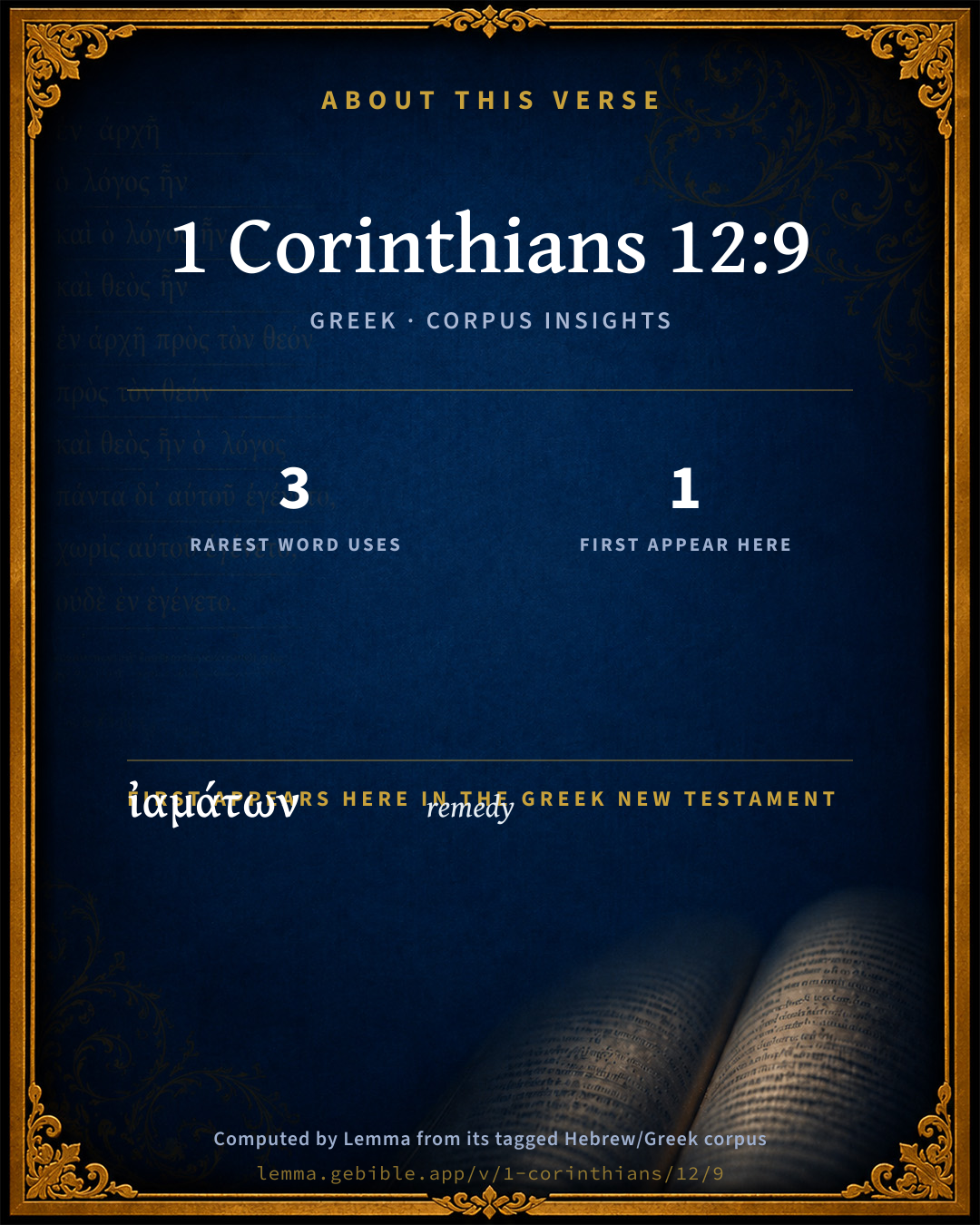
The rarest word here is ἰαμάτων remedy G2386 — appearing just 3 times in the whole Greek New Testament.

First appearance in Scripture

This word makes its first canonical appearance in the Greek New Testament here:

  • ἰαμάτων remedy G2386

Shared distinctive vocabulary

ἰαμάτων remedy G2386 occurs in 3 verses of the Greek New Testament. Also found in:
Repetition

Words recur within this verse:

Cross-references

21

Topical passages linked to 1 Corinthians 12:9 in the Treasury of Scripture Knowledge — connected by theme and wording, ordered by reader-vote popularity; previews shown in the World English Bible.

  • James 5:14–15 Is any among you sick? Let him call for the elders of the assembly, and let them pray over him, anointing him with oil in the name of the Lord,
  • 2 Corinthians 4:13 But having the same spirit of faith, according to that which is written, "I believed, and therefore I spoke." We also believe, and therefore also we speak;
  • Ephesians 2:8 for by grace you have been saved through faith, and that not of yourselves; it is the gift of God,
  • Hebrews 11:33 who, through faith subdued kingdoms, worked out righteousness, obtained promises, stopped the mouths of lions,
  • Matthew 17:19–20 Then the disciples came to Jesus privately, and said, "Why weren't we able to cast it out?"
  • 1 Corinthians 13:2 If I have the gift of prophecy, and know all mysteries and all knowledge; and if I have all faith, so as to remove mountains, but don't have love, I am nothing.
  • 1 Corinthians 12:28 God has set some in the assembly: first apostles, second prophets, third teachers, then miracle workers, then gifts of healings, helps, governments, and various kinds of languages.
  • Matthew 21:21 Jesus answered them, "Most assuredly I tell you, if you have faith, and don't doubt, you will not only do what is done to the fig tree, but even if you told this mountain, 'Be taken up and cast into the sea,' it would be done.
  • Mark 11:22–23 Jesus answered them, "Have faith in God.
  • Mark 16:18 they will take up serpents; and if they drink any deadly thing, it will in no way hurt them; they will lay hands on the sick, and they will recover."
  • Luke 17:5–6 The apostles said to the Lord, "Increase our faith."
  • Acts 4:29–31 Now, Lord, look at their threats, and grant to your servants to speak your word with all boldness,
  • 1 Corinthians 12:30 Do all have gifts of healings? Do all speak with various languages? Do all interpret?
  • Matthew 10:8 Heal the sick, cleanse the lepers, and cast out demons. Freely you received, so freely give.
  • Mark 6:13 They cast out many demons, and anointed many with oil who were sick, and healed them.
  • Luke 9:2 He sent them forth to preach the Kingdom of God, and to heal the sick.
  • Luke 10:9 Heal the sick who are therein, and tell them, 'The Kingdom of God has come near to you.'
  • Acts 3:6–8 But Peter said, "Silver and gold have I none, but what I have, that I give you. In the name of Jesus Christ of Nazareth, get up and walk!"
  • Acts 5:15 They even carried out the sick into the streets, and laid them on cots and mattresses, so that as Peter came by, at the least his shadow might overshadow some of them.
  • Acts 10:38 even Jesus of Nazareth, how God anointed him with the Holy Spirit and with power, who went about doing good and healing all who were oppressed by the devil, for God was with him.
  • Acts 19:11–12 God worked special miracles by the hands of Paul,

Cross-references courtesy of OpenBible.info (CC BY 4.0).

Where the printed editions differ

1 variant

Places in this verse where the major printed Greek editions disagree on the wording in a way that affects the translation — a comparison of editions, not a manuscript-by-manuscript collation. The editions are the modern critical texts (Nestlé-Aland 28/27, SBL, Westcott-Hort, Tregelles, Tyndale House) and the traditional texts behind the KJV (the Textus Receptus and the Byzantine/Majority text). It is not a claim about which reading is original.

  1. Different wording
    ἑνὶ

    “one”

    In NA28NA27TynSBLWHTreg Not in TRByz

    αὐτῷ (autō) 'the same' occurs in traditional manuscripts (TR+Byz) instead of ἑνὶ (heni) 'one' in older manuscripts (NA28+NA27+Tyn+SBL+WH+Treg)

Textual data: Translators Amalgamated Greek New Testament (STEPBible TAGNT) · CC BY 4.0.

Commentary

Notes on 1 Corinthians 12:9 from classic Christian and Jewish commentators (each source and its license shown beneath its notes). The classic Christian expositions comment on the surrounding passage and are grouped to its opening verse, so a note may address several verses; the Jewish commentaries on the Tanakh (Rashi and others) are per-verse, so they appear only where the commentator wrote on this verse.

Lemma curates 59 commentaries, every one of them public domain or Creative Commons licensed, each selected and text-cleaned for this edition rather than reprinted as found. About our sources →

Tyndale Open Study Notes

Tyndale Open Resources

12:9 The spiritual gift of great faith is not the faith required for salvation but an unusual ability to trust God for special needs (see 13:2; Matt 17:19-20; cp. Acts 6:5; 11:24).

Tyndale Open Study Notes — © Tyndale Open Resources, licensed CC BY-SA 4.0. Text via the HelloAO Bible API.

Bengel's Gnomon

Johann Albrecht Bengel

1Co 12:9. Πίστις, faith) The faith here spoken of is not that, which is common to all the saints, but it is a peculiar gift, and distinguished too from the four species, which immediately follow; and yet it is joined more with them, than with that first and third genus of gifts, 1Co 12:8, and 1Co 12:10 at the end. This faith then is a very earnest and vividly-present apprehension of God, chiefly in regard to His will, as to the effects, that are particularly conspicuous either in the kingdom of nature or of grace; therefore it is connected with the operation of the miraculous powers, ch. 1Co 13:2 (of which the principal, because the most useful to others, was the power of curing diseases), and with prophecy (to which the discerning of spirits was closely related, ch. 1Co 14:37); Rom 12:6. And from this description, which we have now given, it is evident, how common or saving faith, and miraculous faith, which is a peculiar gift, may either agree or differ, how the one may, or may not be, without the other, and either of them may, or may not be, without love. Men even without righteousness and love may have an intelligent perception of the omnipotent will of God in Christ, Mat 7:22: but none but holy men can apprehend the will of God reconciled to us in Christ: and in these things [as respects this apprehension] there is not one faith working miracles, another saving faith, but one and the same faith. In its first act it always has a miraculous power; for it is something entirely supernatural, Eph 1:19, although not always in such a degree, or on such a particular occasion, as that it should exert itself conspicuously; see Note on Chrys. de Sacerd., § 416.—χαρίσματα ἰαμάτων, gifts of healing) “Not only miraculous cures are meant, Act 5:15; Act 19:12; Act 28:8, but also the gracious blessing on the cure of the sick, by natural remedies; as it cannot be denied, that some physicians are more fortunate than others, which should be attributed not merely to their skill, but especially to Divine grace;” E. Schmidius. This remark may also be applied to other gifts; for as the king of Judah substituted shields of brass for those of gold, which had been lost; so after the Church lost what were purely gifts, grace still lends its aid more secretly beneath the guise of human efforts and instrumentalities, and that too the more abundantly, in proportion as the more opportunity is given to it.

Bengel's Gnomon of the New Testament — English translation (T&T Clark, Edinburgh, 1860) — public domain. Text from a community e-Sword module.

Meyer's Critical & Exegetical Commentary

Heinrich August Wilhelm Meyer

1Co_12:9. Ἑτέρῳ] not ἄλλῳ again, because introducing another class which differs in kind from the preceding one. Comp on Gal_1:6; 2Co_11:4; Mat_16:14.

ΠΊΣΤΙς] cannot be the fides salvifica in general, seeing that this is a possession common to all and required of every Christian, not a peculiar charisma of certain individuals. Hence it has been understood by most commentators, following the Fathers (see in Suicer, Thes. II. p. 727), to refer to the fides miraculosa, Mat_17:20. But this is clearly too narrow a meaning, since not only the ἰάματα and ΔΥΝΆΜΕΙς are ranked under this head, but also the ΠΡΟΦΗΤΕΊΑ and the ΔΙΑΚΡΊΣΕΙς ΠΝΕΥΜ. What is intended, therefore, must be a high degree of faith in Christ produced by the Holy Spirit, a heroism of faith,[1949] the effects of which manifested themselves in one in healings, in another in wonders, in a third in prophecy (Rom_12:6), in a fourth in discernment of spirits.

ἘΝ Τῷ ΑὐΤῷ ΠΝ.] in the same Spirit, so that, contained in this Spirit, the χάρισμα is given, and the Spirit thus includes in Himself the gift.

ΧΑΡΊΣΜ. ἸΆΜ.] gifts, through means of which healings are effected. The instances in the Acts of the Apostles show that this does not mean natural skill, but cures wrought by spiritual power upon bodily maladies (miraculous cures). Comp Mar_16:18; Act_4:30. It does not, however, exclude the application of natural means in connection with the power that wrought the cure (Mar_7:33; Mar_8:23; Joh_9:6, al[1951]; Jam_5:14). The plural χαρίσματα points to the different kinds of sickness, for the healing of which different gifts were needful.[1952]

[1949] Ardentissima et praesentissima apprehensio Dei in ipsius potissimum voluntate, ad effectus vel in naturae vel in gratiae regno singulariter conspicuos.BENGEL.

[1951] l. and others; and other passages; and other editions.

[1952] As Baur rationalizes all these charismata: πίστις being, according to him, a peculiarly strong faith in Divine Providence; the χάρισμα ἰαμάτων being the gift of praying with special power and fervency for the sick, with more or less confident promise of recovery, if it please God; and the ἐνεργήμ. δυνάμ. being proofs of extraordinary mental fortitude and energy in the interests of Christianity.

Meyer — Critical and Exegetical Commentary on the New Testament — English translation by Peter Christie, edited by Frederick Crombie (T&T Clark, 1880) — public domain. Text from a community e-Sword module.

Hodge's Commentary on Romans, Ephesians & First Corinthians

Charles Hodge

1Co_12:9

To another faith by the same Spirit; to another the gifts of healing by the same Spirit;

There is a distinction indicated in the Greek which is not expressed in our version. The main divisions in this enumeration seem to be indicated by ἕτερος, and the subordinate ones by ἄλλος, though both words are translated by another; the former, however, is a stronger expression of difference. Here, therefore, where ἑτέρῳ is used, a new class seems to be introduced. To the first class belong the word of wisdom and the word of knowledge; to the second, all that follow except the last two. To another faith. As faith is here mentioned as a gift peculiar to some Christians, it cannot mean saving faith, which is common to all. It is generally supposed to mean the faith of miracles to which our Lord refers, Mat_17:19, Mat_17:20, and also the apostle in the following chapter, Though I have all faith, so that I could remove mountains, 1Co_13:2. But to this it is objected, that the gift of miracles is mentioned immediately afterwards as something different from the gift of faith. Others say it is that faith which manifests itself in all the forms enumerated under this class, that is, in miracles, in healing, in prophecy, and in discerning of spirits. But then it is nothing peculiar; it is a gift common to all under this head, whereas it is as much distinguished from them, as they are from each other. Besides, no degree of faith involves inspiration which is supposed in prophecy. In the absence of distinct data for determining the nature of the faith here intended, it is safest, perhaps, to adhere to the simple meaning of the word, and assume that the gift meant is a higher measure of the ordinary grace of faith. Such a faith as enabled men to become confessors and martyrs, and which is so fully illustrated in Heb_11:33-40. This is something as truly wonderful as the gift of miracles. To another the gifts of healing, i.e. gifts by which healing of the sick was effected, Act_4:30. This evidently refers to the miraculous healing of diseases.

Charles Hodge — Commentary on Romans (1835), First Corinthians (1857), and Ephesians (1856) — public domain. Text from a community e-Sword module.

Jamieson, Fausset & Brown

Robert Jamieson, A. R. Fausset & David Brown

faith--not of doctrines, but of miracles: confidence in God, by the impulse of His Spirit, that He would enable them to perform any required miracle (compare Co1 13:2; Mar 11:23; Jam 5:15). Its nature, or principle, is the same as that of saving faith, namely, reliance on God; the producing cause, also, in the same,' namely, a power altogether supernatural (Eph 1:19-20). But the objects of faith differ respectively. Hence, we see, saving faith does not save by its instrinsic merit, but by the merits of Him who is the object of it.

healing--Greek plural, "healings"; referring to different kinds of disease which need different kinds of healing (Mat 10:1).

Jamieson, Fausset & Brown — Commentary Critical and Explanatory on the Whole Bible (1871) — public domain (CC PDM 1.0). Text via the HelloAO Bible API.

Ellicott's Commentary for English Readers

(9) Faith.—This cannot mean the faith which is necessary to salvation, for that belongs to all Christians; but such faith as is mentioned in Mat_17:20, Luk_17:6, the results of such a faith being here enlarged, and not embracing miracles alone, but prophecy and the discerning of spirits. In the Greek “the word of wisdom” is said to be given by the Spirit; “the word of knowledge “according to the Spirit; and “the faith and gift of healing” in the Spirit. By the use of this variety of expression the Apostle probably means to indicate the variety of methods of operation of the Spirit, as well as the diversity of the gifts which He lavishes.

A Bible Commentary for English Readers, edited by Charles John Ellicott (1878–1897) — public domain. Text from a community e-Sword module.

The Cambridge Bible for Schools and Colleges

gen. ed. J. J. S. Perowne

9. faith] Not the rudimentary principle which was the essential condition of all Christian life, but that higher realization of things Divine which enables a man to remove mountains (St Mat_17:20; ch. 1Co_13:2).

the gifts of healing] As in St Mar_16:18; Act_3:7-8; Act_5:15-16; Act_9:34; Act_19:11-12; St Jas_5:14-15.

The Cambridge Bible for Schools and Colleges (gen. ed. J. J. S. Perowne; Cambridge University Press, 1878–1918) — public domain. Text from a community e-Sword module.

John Gill's Exposition

To another faith by the same Spirit,.... Not the grace of faith, which is common to all believers, though given by the same Spirit: but rather the doctrine of faith, and ability to preach it, and boldness and intrepidity of spirit to assert and defend it in the face of all opposition; all which are from the Spirit of God, and are more or less given to pastors and teachers, the third office in the church. Though generally this is understood of a faith of working miracles, as in Co1 13:2 but the working of miracles is mentioned afterwards as distinct, unless it can be thought that this is the general name for miracles, and the rest that follow the particulars of them.

To another the gifts of healing by the same Spirit; of healing all manner of sicknesses and diseases: this power Christ gave his disciples, when he first sent them out to preach the Gospel, and which he repeated when he renewed and enlarged their commission after his resurrection; and which was exercised with effect, sometimes only by overshadowing the sick with their shadows, as by Peter, Act 5:15 sometimes by, laying hands on them, as the father of Publius, and others, were healed by Paul, Act 28:8 and sometimes by anointing with oil, Jam 5:14. Now these gifts were bestowed in common, by the Spirit, on apostles, prophets, and pastors, or elders of the church, in those early times: the Alexandrian copy, and the Vulgate Latin version, read, "by one Spirit".

John Gill's Exposition of the Whole Bible (1746–1763) — public domain (CC PDM 1.0). Text via the HelloAO Bible API.

Trapp's Complete Commentary

John Trapp

9 To another faith by the same Spirit; to another the gifts of healing by the same Spirit;

Ver. 9. To another faith] The faith of miracles, which a man may have, and yet miscarry, 1Co 13:2. So doth not any one that hath the faith of God’s elect; that fails not, Luk 22:32. Some say the apostle here meaneth historical faith; and this seems the more probable, because he speaketh of the working of miracles, 1Co 12:10.

John Trapp, A Commentary or Exposition upon All the Books of the Old and New Testament (1647–1656) — public domain. Text from a community e-Sword module.

Albert Barnes' Notes on the Bible

To another faith - Another shall he distinguished for simple confidence in God; and his endowment is also given by the same Spirit. Many of the most useful people in the church are distinguished mainly for their simple confidence in the promises of God; and often accomplish more by prayer and by their faith in God than others do who are distinguished for their wisdom and learning. Humble piety and reliance in the divine promises, and that measure of ardor, fearlessness, and zeal which result from such confidence; that belief that all obstacles must be and will be overcome that oppose the gospel; and that God will secure the advancement of his cause, will often do infinitely more in the promotion of his kingdom than the most splendid endowments of learning and talent. Indeed, if a man were disposed to do good on the widest scale possible, to do the utmost that he possibly could in saving people, he would best accomplish it by seeking simple “faith” in God’s aid and promises, and then under the influence of this, engage with ardor in doing what he could. Faith is one of the highest endowments of the Christian life; and yet, though all may obtain it, it is one of the rarest endowments. Perhaps by many it is despised, because it may be obtained by all; because it is a grace in which the poor and the humble may be as much distinguished as the man of splendid talents and profound learning.

To another the gifts of healing - See Mar 16:18. This was promised to the disciples of the Saviour; and in the early church was conferred on many; compare Act 5:12, Act 5:15-16; Act 19:12. It would seem from this passage that the gift of healing was conferred on some in a more eminent degree than on others.

Albert Barnes' Notes on the Bible (1834–1885) — public domain. Text from a community e-Sword/MySword module.

Haydock's Catholic Bible Commentary

===============================

[BIBLIOGRAPHY]

Fides, Greek: pistis, upon which word St. John Chrysostom, Greek: om. kth. p. 433. Greek: pistin ou tauten legon, ten ton dogmaton, alla ten semeion.

George Leo Haydock (1774–1849), Haydock's Catholic Family Bible and Commentary, 1859 edition — public domain. Excludes Psalms (Douay-Rheims chapter numbering differs from Protestant) and Deuterocanonical books (Catholic canon only).

Matthew Poole's English Annotations

To another, he saith, is given faith: by which cannot be understood that faith which is common to all Christians, for he is speaking of such gifts as were given to some Christians, not to all; he must therefore mean, either a faith of miracles, that is, a persuasion that God would work a miracle in this or that case, or a great knowledge in the matters of faith, or a great confidence and boldness in the discharge of their office.

To another the gifts of healing, of healing diseases miraculously, without the application of ordinary rational medicines.

Matthew Poole's English Annotations on the Holy Bible (1683–1685) — public domain. Text from a community e-Sword/MySword module.

Whedon's Commentary on the Bible

Daniel D. Whedon

9. Faith—Chrysostom and the current of modern commentators understand the faith of miracles, which can remove mountains. 1Co_13:2. But that is included in the working of miracles itself, in 1Co_12:10. Hodge comes nearest to the truth: “Such a faith as enabled men to become confessors and martyrs, and which is so fully illustrated in Heb_11:33-40. This is something as truly wonderful as the gift of miracles.” Or, as we should express it, that realization of divine realities by which a powerful and heroic Christian character is formed, shown in maintaining truth resistlessly, and suffering for it unshrinkingly. St. Stephen, both in his contests with gainsayers and his martyrdom, was a striking specimen. Thus there is the faith of miracles and the faith of heroism.

Healing—See note Act_3:4. Healing, though usually included under miracles, is placed by itself, inasmuch as there were those endowed with the power for this only.

Daniel D. Whedon (gen. ed.), Commentary on the Old and New Testaments (1874–1909) — public domain. Text from a community e-Sword module.

The Pulpit Commentary

To another. Various attempts have been made to classify the gifts thus enumerated, as:

1. Intellectual.

1. The word of wisdom;

2. the word of knowledge.

1. Pertaining to exalted faith (tides miraculosa).

1. Healings;

2. miracles;

3. preaching;

4. discrimination of spirits.

1. Tongues; and

2. their interpretation.

These attempts are not very successful. St. Paul probably uses the phrases "to one" and "to another" (a de eJterw de) merely for variety of style, (as in Heb_11:35, Heb_11:36) with no very definite classification in view, as he does not mention all the charisma (see ver. 28). Faith. Faith in its highest energy, as a supernatural power; the faith that removes mountains. (Mat_17:19, Mat_17:20) The gifts of healing. Not, that is, by medical knowledge, but by supernatural power (Mar_16:18; Act_5:15, Act_5:16; Jam_5:14, Jam_5:15)

The Pulpit Commentary (1880–1919), ed. H.D.M. Spence-Jones & Joseph S. Exell — public domain. Text from a community e-Sword module.

John Wesley's Explanatory Notes

Faith may here mean an extraordinary trust in God under the most difficult or dangerous circumstances. The gift of healing need not be wholly confined to the healing diseases with a word or a touch. It may exert itself also, though in a lower degree, where natural remedies are applied; and it may often be this, not superior skill, which makes some physicians more successful than others. And thus it may be with regard to other gifts likewise. As, after the golden shields were lost, the king of Judah put brazen in their place, so, after the pure gifts were lost, the power of God exerts itself in a more covert manner, under human studies and helps; and that the more plentifully, according as there is the more room given for it.

John Wesley, Explanatory Notes Upon the Whole Bible (1754–1765) — public domain. Text via the GEBible commentary corpus.

Godbey's Commentary on the New Testament

William B. Godbey

FAITH

9. This is not the gift of faith by which we are converted and sanctified, but the gift of faith which is entirely different. You are saved by grace (Eph 2:8), but you become instruments in the salvation of others by the gifts. Hence faith here has nothing to do with your personal justification or sanctification. But what a wonderful Archimedean lever in the salvation of others! “As your faith is, so be it unto you,” is as true of the gift as of the grace. Hence faith is omnipotent, as it takes hold on Omnipotent God. This is the secret of George Muller’s feeding three thousand orphans year after year without a dollar of capital. In this way the present Holiness Movement, without financial resources, has more missionaries in the heathen field than all of the churches in Christendom, with their bushels of gold. A woman in Indiana received this gift for her wicked husband, a steamboat captain running from Cairo, IL, to New Orleans, LA. The morning following her midnight victory brought her a telegram stating that her husband’s boat was burnt and he was lost. She read it, rolled it up and handed it to the boy, stating that it was a mistake; that her husband was alive, and coming home to get religion and go with her to Heaven. Sure enough, in three days her husband arrived. Meeting him at the door, she told him of the answer to her prayer, the telegram and her answer to it. Conviction struck him like a thunderbolt. Falling on the floor, he cried for mercy. Gathering in a few saints, they spend the day and night in prayer, the heavenly daybreak coming into his soul with the morning dawn. William Carvosso, the great Methodist class leader, long prayed for his giddy, impenitent daughter. Returning from meeting one night, he received the gift of faith for her. On arrival at his house he found her in awful agony, as if she would die. She died to live again, and live forever. Dr. Finney, in his “Lectures,” gives an account of an old consumptive who spent the last five years of his life confined to his room, but using his time praying for revivals in the churches within the boundary of his acquaintance, frequently sending for the preachers and stating to them: “I have been enabled, by the grace of God, to pray the prevailing prayer for a revival in — church. Go, and you will have it. Invariably the revival came as he said. After he was dead, his diary was examined, and found to give different dates when he was enabled to pray the prayer of faith for a revival in various churches scattered far and wide over the country. His diary was followed with protracted meetings, the revivals coming in every case as specified. I have much enjoyed this gift since the Lord sanctified me, and have seen it verified constantly in my ministry. When working at the altar, I have frequently labored with a penitent until I received the gift of faith for him, and then left him, feeling certain that he would be saved, often desisting and waiting to see him rise with a shout. I am an old revivalist, now working as a teacher of God’s Word, my physical ability somewhat inadequate to the stalwart campaign. I used to make it a rule to hold on to God till He gave me the gift of faith for a revival before I entered upon the work. This is the secret of prevailing prayer. Are the members of your family going to ruin? Go to God for this gift in their behalf. If you truly have faith for them, they will be saved according to your faith. Do not make the mistake of praying for their conversion instead of their conviction. God can not save them against their will, without dehumanizing them, but He can convict them nolens volens You can go to God until He imparts to you this gift. So you can pray such a conviction on them that they will think they are going to die, and refuse to eat or sleep until they get saved. The power of this gift is simply illimitable, because it actually appropriates the omnipotence of God. Oh, that the Church could only wake up to her power to save a world fast sinking into Hell! If she would only get in position to receive and utilize this gift, she could speedily girdle the globe with salvation, with holiness to the Lord; brink back her Divine Spouse and flood the world with Millennial glory. As the grace of faith is the measuring line of your personal experience and enjoyment, so the gift of faith is the measuring line of your real efficiency in the salvation of others.

GIFTS OF HEALINGS

9. Both of these nouns are in the plural numbers because there is a diversity of gifts, as well as an infinite multiplicity of diseases to be healed; some gifted in the healing of one disease, and some in another. Of course, the body is not perfectly healed until this mortal puts on immortality, and we enter the glorified state either by translation or the resurrection. Therefore all bodily healing in this life is but the earnest of the glorious complete healing which is to come, mortality itself being the very quintessence of disease, final and perfect healing utterly and eternally eliminating it. Neither is our failure to get healed an argument against our spirituality, as we are healed by the gift, and saved by grace. It is our glorious privilege, as a Christian duty, to appreciate and utilize the gifts of healings in order that we may be a blessing to the suffering thousands on all sides. As the apostles and primitive saints went from house to house, preaching the gospel and healing the sick, let us remember that we are in the succession, and the gospel has lost none of its power. It is one of the glories of the present Holiness Movement to restore the great Bible truth of Divine healing for the body, which was so prominent in the apostolic age, and, like the other great cardinal truths, went into eclipse during the dark ages, following the great Constantinian apostasy. God used Martin Luther to rescue from the rubbish of Romanism the great fundamental Bible doctrine of justification by the free grace of God in Christ, received and appropriated by faith without works. He used John Wesley to restore the great and glorious doctrine of entire sanctification, wrought by the Holy Ghost, through the cleansing blood, instantaneously received by simple faith for that mighty work. In a similar manner the present Holiness Movement has restored to the Church the great and inspiring truth of the Lord’s return on the throne of the glorious Theocracy, also the beautiful and encouraging doctrine of bodily healing and woman’s ministry. As the present age is flooded with illustrative examples of Divine healing innumerable everywhere, I presume the reader of these pages is a believer in this precious truth. Twenty-six year’s ago I was given up by physicians to die of pulmonary congestion. I had even reached a point where all pulsation had ceased, and so remained eight hour’s, physicians standing over me, having desisted from all remedies and simply waiting my departure, which they said was bound to come, liable every minute and could not tarry. I had then been a citizen of Beulah land fourteen year’s, having a little light on Divine healing, which was then scarcely heard of. Though my beloved wife had not yet entered the sanctified experience, God in His great mercy bestowed on her this gift for the healing of her husband. When the physicians took hands off and refused to administer any more remedies, certifying that death was certain and very nigh, the report having gone abroad that I was already dead, she, though naturally timid and unaccustomed to any public exercise, immediately superseded the physicians, taking command of the situation as bold as Julius Caesar, and announced to the audience of about fifty saintly sympathizers standing round: “Though these doctors have given up my husband to die, the Great Physician has not given him up; he has yet much work to do for God. All down on your knees; take hold of the Omnipotent Healer.” At that time all pulsation had ceased six hours, the physicians observing that no case of survival had ever exceeded the eighth hour; consequently, though liable to die every minute, I was bound to die at the expiration of the two hours.

Such was the rhapsody which my spirit had enjoyed, already several hours, in a heavenly vision in which it seemed that I was looking into the New Jerusalem flying round on the outside while tied to my body, which I could see lying down there on the bed, every moment expecting the string to break, when I would sweep into Heaven; consequently, though vividly conscious of everything and perfectly free from delirium, I was simply too happy to realize a thing. Therefore the two hours told by the clock on the mantle seemed to me not more than two minutes, but I remember my good wife kept all those people on their knees all that time. When the moment arrived predicted by the physicians as the last minute I could possibly stay in the body, having survived pulsation eight hours, suddenly the healing came. My lungs were relieved from the inundations of blood accumulated in my chest, and circulation was restored in its vigor, the blood coursing out through my arteries to the extremities of my members and back through my veins, as distinctly realized as water flowing on the exterior of my body. I said to our family physician: “Doctor, I am healed.” Leaping, he seized my arm, and said: “Pulsation is not only restored, but is regular and all right. Truly the crisis of the disease is passed, and you are a well man.” I left the bed, and have been on my feet ever since, in three days going away from home and engaging in a protracted meeting in which I did all the preaching day and night. I have consulted many physicians with reference to my ailment at that time, i. e., congestion of the lungs. They all tell me that while it is seldom and with difficulty cured, it is nearly certain to come back. I seriously doubt whether another man in all the world has spoken as much as your humble servant since that time, and I have never had the slightest symptom of lung trouble. To God be the glory! He healed me and did a thorough work. Since that time I have had other ailments frequently, and the Lord healed them ever and anon. I am now sixty-five year’s old, and have been a hard worker’ all my life. Hence I have reached a period when bodily organs are wearing out and failing; yet the Great Physician most wonderfully keeps my failing organs in good repair. Rom 8:11 : “If the Spirit of Him who raised up Jesus from the dead dwelleth in you, He that raised up Jesus from the dead will quicken your mortal bodies by His Spirit dwelling in you.” The true economy of Divine healing is by the overflow of the spiritual life, filling the human spirit and flowing out inundating the body. When the Holy Spirit has made your body His temple, and is dwelling in you, it follows as a legitimate sequence that the normal condition of your body will be that of health and vigor adequate to the work He has for you to do. We watch the houses in which we live, diligently repairing the breaches and keeping the house in condition to repel the storms and render us comfortable. Yet the time comes when we no longer spend money and labor repairing the house, from the simple fact that it is not worth repairing. Then, however, we soon evacuate it and take it down, preparatory to building a new one on the spot. At present, glory to God! The Holy Ghost is dwelling in my body and keeping it in good repair. Some of these days He will cease to repair it, from the simple fact that it will not be worth repairing. When that time comes I will shout louder than ever, knowing that Heaven is nigh. Bear in mind, all bodily healing is subordinated to the spiritual interest. If the poor wicked people in this fallen world were not alarmed and humbled by aches and pains, admonishing them that death and judgment are close on their track, they would live in hilarity and improvidence, until they dropped suddenly into Hell. I never pray for the healing of wicked, impenitent persons, as perhaps their sickness is the only hope of their awakening and salvation. When the soul is saved all right and filled with the Holy Ghost, it is normal for Him to flow out into the body, restoring ailments and imparting life and vigor. In all my travels since the Lord gave me light on Divine healing, I have witnessed His mighty works healing diseases of all sorts, even the most formidable, where all the physicians had abandoned the patient to die. While holding a protracted meeting in Georgia, and preaching sanctification, I was having serious trouble, the pastor publicly and in the meetings antagonizing me. I realize his absence and make inquiry. They tell me he is sick in the parsonage and unable to be present. I hold the afternoon Bible reading and go to see him, finding him attacked by a terrible fever not uncommon in the South. I tell him about the wonderful Healer. He said he believed in Divine healing, and wanted me to pray for him. So, kneeling by his bedside, with my hand on his burning brow, I turn him over to the Great Physician, impleading His immediate rebuke of the fever and its dismissal from his tortured body. In less than two hours he was with us in the evening meeting, testifying that every symptom of the fever was gone and a healthful perspiration soothed his body. Suffice it to say he gave me no more trouble opposing sanctification, but, tumbling down at the altar, earnestly sought and entered in. On another occasion, when preaching in a very wicked community, amid awful opposition, my life threatened and believed to be in jeopardy, the healing of a young man in the immediate vicinity turned the tide in my favor, giving me more friends than I knew what to do with, and an immediate impetus to the revival. You must not depreciate the gifts of healings, as you will find them a powerful auxiliary to your soul-saving work, to which they are always subordinated. When you pray for the sick, you have a right to believe that God will either heal the body or give the person something better. Spiritual blessings in this life are better than bodily healing, and Heaven better than all. Hence there is no reason why your faith should fail in any case. Millions of poor sufferers all around you open wide the door of infinitesimal usefulness in the interest of body and soul. When God makes you a blessing to the body, the door is wide open for you to be a blessing to the soul. The Church has lost millions of victories by her depreciation of Divine healing as an auxiliary of soul- saving.

William B. Godbey, Commentary on the New Testament (1896–1900) — public domain. Text from a community e-Sword module.

McGarvey & Pendleton's Commentaries

J. W. McGarvey

to another faith, in the same Spirit; and to another gifts of healings, in the one Spirit ;

J. W. McGarvey (with Philip Y. Pendleton), Commentaries on the New Testament (The Fourfold Gospel, 1914; Acts; and the epistles) — public domain. Text from a community e-Sword/MySword module.

The People's New Testament

B. W. Johnson

9. To another, faith. Not that faith which comes by hearing, but that faith which carried miraculous power. See 13:2; Matt. 17:20.

B. W. Johnson's The People's New Testament with Notes (1889–1891) — public domain. Electronic text from the Christian Classics Ethereal Library (CCEL) ThML edition.

unfoldingWord translationNotes

Door43 World Missions Community

is given

This can be stated in active form. See how this is translated in 1 Corinthians 12:8. AT: "God gives" (See: Active or Passive)

to another gifts of healing by the one Spirit

The words "are given" are understood from the previous phrase. AT: "to another gifts of healing by the one Spirit are given" (See: Ellipsis)

to another prophecy

The phrase "is given by the same Spirit" is understood from the previous phrases. AT: "to another prophecy is given by the same Spirit" (See: Ellipsis)

to another various kinds of tongues

The phrase "are given by the same Spirit" is understood from the previous phrases. AT: "to another various kinds of tongues are given by the same Spirit" (See: Ellipsis)

various kinds of tongues

Here "tongues" represents languages. AT: "the ability to speak different languages" (See: Metonymy)

to another the interpretation of tongues

The phrase "is given by the same Spirit" is understood from the previous phrases. AT: "to another the interpretation of tongues is given by the same Spirit" (See: Ellipsis)

the interpretation of tongues

This is the ability to listen to what someone says in one language and use another language to tell people what that person is saying. AT: "the ability to interpret what is said in other languages"

one and the same Spirit

God gives the gifts through the work of the one and only Holy Spirit. See how this is translated in 1 Corinthians 12:8.

translationWords

faith

Holy Spirit

gift

cure

prophet

spirit

interpret

tongue

unfoldingWord translationNotes — © Distant Shores Media and the Door43 World Missions Community, licensed CC BY-SA 4.0. Source: git.door43.org/Door43/en_tn.

Cambridge Greek Testament for Schools and Colleges

9. ἑνί AB Vetus Lat. Vulg. αὐτῷ אDEFG.

9. πίστις. Not the rudimentary principle which was the essential condition of all Christian life, but that higher realization of things Divine which enables a man to remove mountains (Mat 17:20; ch. 1Co 13:2).

ἐν τῷ αὐτῷ πνεύματι. The meaning of these three prepositions, διά, κατά ἐν, applied to the Spirit’s work, is as follows. Διά refers to His instrumentality, κατά to His will (see 1Co 12:11), and ἐν to the fact of His inward union with those in whom He works. See Winer, Gr. Gram. § 50, Horsley’s Sermons, p. 170.

ἰαμάτων. As in Mar 16:18; Act 3:7-8; Act 5:15-16; Act 9:18; Act 9:34; Act 19:11-12; Jas 5:14-15.

Cambridge Greek Testament for Schools and Colleges (Cambridge University Press, 1896; 21 vols, various authors incl. Carr, Maclear, Plummer, Farrar, Lumby, Moule, M. R. James, Simcox) — public domain. Text from a community e-Sword module.

Alford’s Greek Testament

Henry Alford

9.] πίστις, as Chrys.: πίστιν οὐ ταύτην λέγων τὴν τῶν δογμάτων, ἀλλὰ τὴν τῶν σημείων, περὶ ἧς φησιν Ἐὰν ἔχητε πίστιν ὡς κόκκον σιν. κ.τ.λ. (Mat 17:20). καὶ οἱ ἀπόστολοι δὲ περὶ αὐτῆς ἠξίουν λέγοντες Πρόσθες ἡμῖν πίστιν (Luk 17:5). αὕτη γὰρ μήτηρ τῶν σημείων ἐστίν. Hom. xxix. p. 263. This seems to be the meaning here; a faith, enabling a man to place himself beyond the region of mere moral certainty, in the actual realization of things believed, in a high and unusual manner.

ἐν τ. αὐτ. πν.] in, i.e. by and through, as the effective cause and the medium.

χαρίσματα ἰαμάτων] gifts of (miraculous) healings; plur., to indicate the different kinds of diseases, requiring different sorts of healing.

ἐν, see above.

Henry Alford, The Greek Testament (1849–1861) — public domain. Text from a community e-Sword module.

International Critical Commentary

9. ἑτέρῳ πίστις. ‘To a third, faith.’ This cannot mean the first faith of a convert’s self-surrender to the truth, nor the saving faith which is permanently possessed by every sincere Christian, but the wonder-working faith (13:2; Mat 17:20) which manifests itself in ἔργα rather than in λόγος; potent faith; ardentissima et praesentissima apprehensio Dei in ipsius potissimum voluntate (Beng.); πίστιν οὐ τὴν τῶν δογμάτων, ἀλλὰ τὴν τῶν σημείων (Chrys.); the faith which produces, not only miracles, but martyrs. We are perhaps to understand the next four gifts, or at any rate the next two, as grouped under πίστις. If πίστις is thus regarded as generic, and as including some of the gifts which follow, then the six gifts which follow πίστις, like the two which precede it, fall into pairs; λόγος ς. and λόγος γν., χαρίσματα ἰαμάτων and ἐνεργήματα δυνάμεων, προφητεία and διακρίσεις πνευμάτων, γένη γλωσσῶν and ἑρμηνεία γλωσσῶν.

χαρίσματα ἰαμάτων. ‘Gifts of healings,’ ‘gifts which result in healings’ : ἴαμα in this chap. only, in the N.T., and always in this phrase (vv. 28, 30), but frequent in the LXX. Cf. Act 4:30. The plur. seems to imply that different persons each had a disease or group of diseases that they could cure: that any one could cure πᾶσαν νόσον καὶ πᾶσαν μαλακίαν (Theophyl.) is not stated. The means may have been supernatural, or an exceptionally successful use of natural powers, such as ‘suggestion’: see Jas 5:14. *

It is remarkable that although there are allusions to signs and woners in the Apostolic age (2Co 12:12; Gal 3:5; Rom 15:19; Heb 2:4),there is no allusion to miracles wrought by Christ. It connot be said that in the age in which the Gospels were being framed there was a tendency to glorify Christ by attributing miracles to Him. See L. Ragg, The Book of Books, p. 221.

ἐνεργήματα δυνάμεων. This may be added to cover wonderful works which are not healings, such as the exorcizing of demons; and such chastisements as were inflicted on Elymas the sorcerer, or on Hymenaeus and Philetus may be included. Cf. Gal 3:5; Heb 2:4.

9. ἐρμ. γλωσσῶν 9. 9. διερμηνεύειν

Rom 12:6-8. Eph 4:11.

International Critical Commentary — older volumes (1896–1929), various authors — public domain. Text from a community e-Sword module.

Vincent's Word Studies in the New Testament

Marvin R. Vincent

Faith. Not saving faith in general, which is the common endowment of all Christians, but wonder - working faith.

Marvin R. Vincent, Word Studies in the New Testament (1887–1900) — public domain. Text from a community e-Sword/MySword module.

Godet's Commentaries

Frédéric Louis Godet

Vv. 9. If we hold that the substitution of ἑτέρῳ for ἄλλῳ is not accidental, the gifts which follow should have a different character from the two preceding, and this new character ought to reappear identically in the five gifts enumerated down to the following ἑτέρῳ (end of 1Co 12:10). Now it is easy to prove that it is so. The two preceding gifts were exercised in virtue of a communication of light; the following five proceed from a communication of force, in other words, from an influence of the spirit, no longer specially on the understanding, but on the will. By faith the apostle certainly does not understand saving faith in general; for this is not a special gift, it is the portion of all Christians. Faith is the root of the Christian life, not one of its fruits. We see clearly from the passage 1Co 13:2 that the apostle distinguishes between faith in general and faith as a particular gift. As such, it is the possession of salvation taking the character of assurance in God, of heroic daring, resolutely attacking and surmounting all the obstacles which are opposed to the work of God in a given situation. “Father, I know that Thou hearest me always!” Such is the cry of this faith which removes mountains, and of which the history of the Church affords so many examples; witness a Francke, a Wilberforce, a George Müller, and so many others. It is to this gift the saying of Jesus, Mat 17:20-21 refers. The preposition ἐν, in or by, indicates that the force of this confidence rests on the Holy Spirit’s indwelling in the soul.

There follow the gifts of healings, which are closely connected with faith thus understood, for they have as their basis confidence in the power of God applied to disease. here there is not only a confident prayer; there is a command given in the consciousness of complete harmony with the will of God, such as the: “Rise, and walk,” of St. Peter (Act 3:6). The substantives gifts and healings are put in the plural as relating to the different classes of sicknesses to be healed.

Frédéric Louis Godet — Commentaries on Luke, John, Romans, and 1 Corinthians — English translation (T&T Clark, Edinburgh, 1870s–1890s) — public domain. Text from a community e-Sword module.

Lesson kit

Teaching starters — assembled from the data on this page, not authored interpretation. Every prompt links to the verse data it draws on. Edit before teaching.

1 Corinthians, in the Pauline Epistles, opens this verse with 14 words (11 distinct Greek lemmas). Its most distinctive word is íama (“remedy”). A historical commentator’s framing appears above. Read the whole chapter for the surrounding context.

Discussion questions

  1. How does “remedy” (íama) shape what this verse is saying?
  2. This is the first place “remedy” appears in Scripture (first appears here). What does its debut here establish?
  3. How does 1 Corinthians 12:28, which shares the word «remedy», read alongside this verse?
  4. What does the repetition of “spirit” (2× in this one verse) do in this verse?
  5. The translations on this page render this verse differently — a whole-verse word diff, not a word-by-word alignment. What might account for the different wordings?
  6. Compare how Tyndale Open Study Notes and Bengel's Gnomon read this verse. Where do they agree or differ?

Things to notice

  • 1 word makes its first canonical appearance in Scripture here.
  • These translations choose different wording for 3 words in this verse.
  • “spirit” occurs 2× in this single verse.
  • 11 distinct Greek lemmas span 14 words in this verse.

Reading settings

Reading text

Shown beneath each verse's original-language words.

Old Testament
Old Testament edition

Read the OT as the Masoretic Hebrew (MT) or the Greek Septuagint (LXX).

English shown for the Greek Septuagint (in the Hebrew ↔ Greek comparison).

Comparing translations? Open the Compare panel on any verse page to stack up to four side by side.