
1 Corinthians 12:10

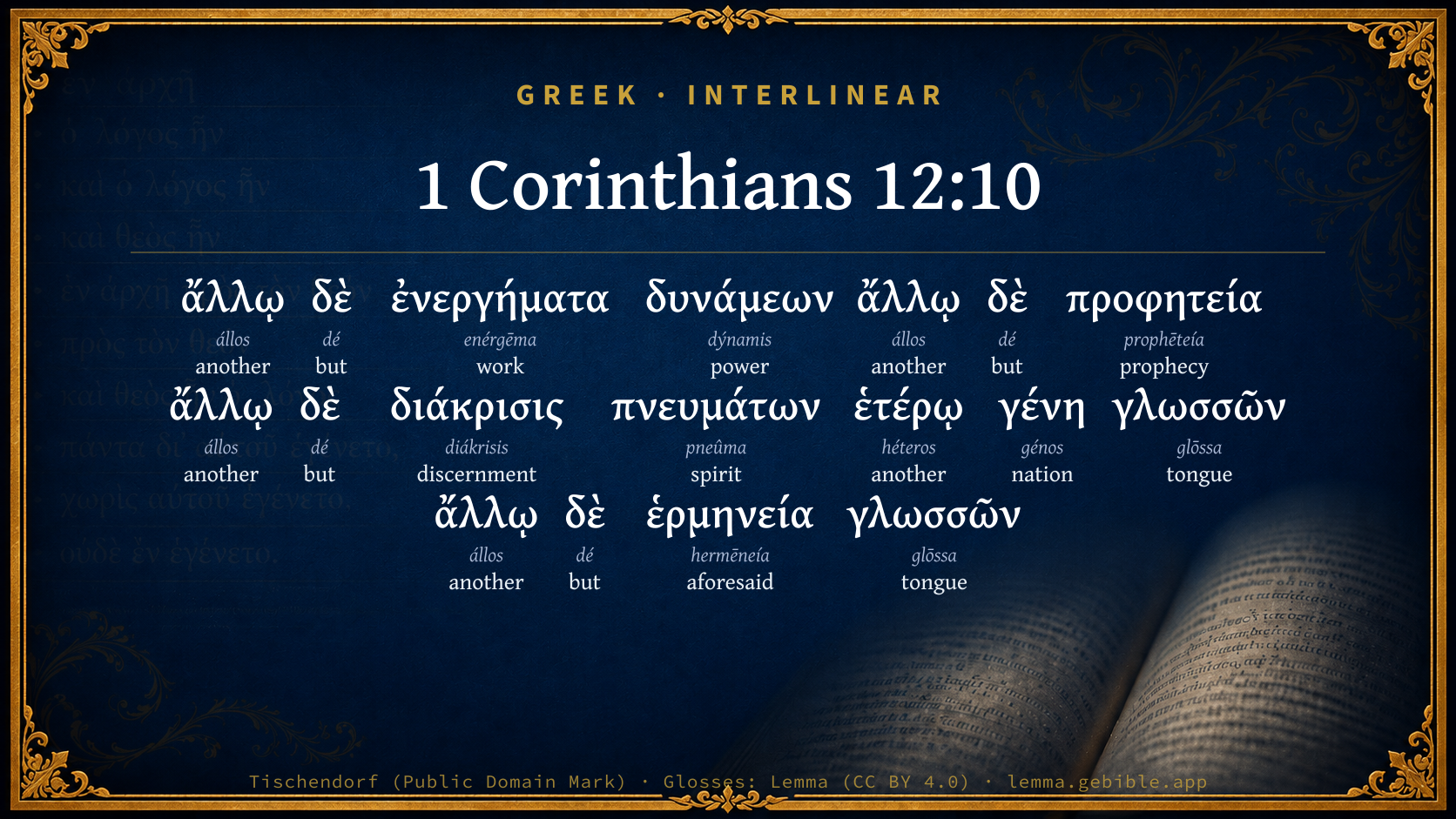
Greek (Tischendorf 8th ed.) 1 Corinthians 12:10 appears in the Greek New Testament. The text above is from the Tischendorf 8th edition. Each word links to its Strong’s number and a concise gloss. Click any word for its full Thayer’s Greek Lexicon entry.
Download image
Cite this verse

1 Corinthians 12:10 (World English Bible). Public Domain. Lemma interlinear Bible study tool, https://lemma.gebible.app/v/1-corinthians/12/10.

Show BibTeX & RIS
BibTeX
RIS
English Translation
and to another workings of miracles; and to another prophecy; and to another discerning of spirits; to another different kinds of languages; and to another the interpretation of languages.
World English Bible · Public Domain
Highlights
  • 1 first appearance in the Greek New Testament
Full analysis ↓
Download a study sheet

One document with this verse’s original text, its word-by-word gloss line, the meaning frame, cross-references with their text, attributed commentary, and full source and license credits — printable, and it pastes into notes with its structure intact.

This verse Autodidact and up

Study sheet (.html) Plain text (.txt)

A passage Seminary Student

Up to 50 verses in one chapter. A passage sheet keeps up to 6 commentary sources and 12 cross-references per verse, in the order this page ranks them, and says so on the sheet whenever that leaves anything out. Ask for a single verse and you get the Autodidact verse sheet above.

Everything on this page stays free to read, with no account — the sheet is a download of what is already on screen, not access to it.

Want to remove ads? Support Godless Engineer
Compare translations 3

The same verse in 3 English versions, stacked beneath the original-language interlinear above. Click any original word for its lexicon entry.

Each is an independent rendering of the whole verse — the interlinear is not word-aligned to these translations.

Highlighted words mark where these versions differ — a whole-verse word diff, not a word-by-word alignment.

  • World English Bible Public Domain
    and to another workings of miracles; and to another prophecy; and to another discerning of spirits; to another different kinds of languages; and to another the interpretation of languages.
  • King James Version Public Domain
    To another the working of miracles; to another prophecy; to another discerning of spirits; to another divers kinds of tongues; to another the interpretation of tongues:
  • unfoldingWord Literal Text CC BY-SA 4.0
    and to another, workings of power; to another, prophecy; to another, discernments of spirits; to another, kinds of tongues; and to another, interpretation of tongues.

unfoldingWord Literal Text — © unfoldingWord, licensed CC BY-SA 4.0. Word-aligned USFM3 via Door43 (git.door43.org/unfoldingWord/en_ult).

Versions to compare (up to 4)

3 of 4 selected

Show all 19 translations

Every available English version of this verse, each an independent rendering of the whole verse.

  • World English Bible Public Domain
    and to another workings of miracles; and to another prophecy; and to another discerning of spirits; to another different kinds of languages; and to another the interpretation of languages.
  • Berean Standard Bible Public Domain
    to another the working of miracles, to another prophecy, to another distinguishing between spirits, to another speaking in various tongues, and to still another the interpretation of tongues.
  • Majority Standard Bible Public Domain
    to another the working of miracles, to another prophecy, to another distinguishing between spirits, to another speaking in various tongues, and to still another the interpretation of tongues.
  • King James Version Public Domain
    To another the working of miracles; to another prophecy; to another discerning of spirits; to another divers kinds of tongues; to another the interpretation of tongues:
  • American Standard Version (1901) Public Domain
    and to another workings of miracles; and to another prophecy; and to another discernings of spirits; to another `divers' kinds of tongues; and to another the interpretation of tongues:
  • Revised Version (1885) Public Domain
    and to another workings of miracles; and to another prophecy; and to another discernings of spirits: to another divers kinds of tongues; and to another the interpretation of tongues:
  • Geneva Bible (1599) Public Domain
    And to another the operations of great workes: and to another, prophecie: and to another, the discerning of spirits: and to another, diuersities of tongues: and to another, the interpretation of tongues.
  • Douay-Rheims (1899) Public Domain
    To another, the working of miracles; to another, prophecy; to another, the discerning of spirits; to another, diverse kinds of tongues; to another, interpretation of speeches.
  • Young's Literal Translation Public Domain
    and to another in-workings of mighty deeds; and to another prophecy; and to another discernings of spirits; and to another `divers' kinds of tongues; and to another interpretation of tongues:
  • Literal Standard Version CC BY-SA 4.0
    and to another in-workings of mighty deeds; and to another prophecy; and to another discernings of spirits; and to another [various] kinds of tongues; and to another interpretation of tongues:
  • Unlocked Literal Bible CC BY-SA 4.0
    To another is given deeds of power, and to another prophecy. To another is given the ability to distinguish between spirits, to another various kinds of tongues, and to another the interpretation of tongues.
  • unfoldingWord Literal Text CC BY-SA 4.0
    and to another, workings of power; to another, prophecy; to another, discernments of spirits; to another, kinds of tongues; and to another, interpretation of tongues.
  • Darby Bible Public Domain
    and to another operations of miracles; and to another prophecy; and to another discerning of spirits; and to a different one kinds of tongues; and to another interpretation of tongues.
  • World Messianic Bible Public Domain
    and to another workings of miracles, and to another prophecy, and to another discerning of spirits, to another different kinds of languages, and to another the interpretation of languages.
  • Webster's Bible Public Domain
    To another, the working of miracles; to another, prophecy; to another, discerning of spirits; to another, divers kinds of languages; to another, the interpretation of languages:
  • Free Bible Version CC BY-SA 4.0
    Another is given the ability to perform miracles. Another receives the gift of prophecy. Another is given the gift of spiritual discernment. Another receives the ability to speak different languages, while another is given the gift of interpreting languages.
  • Bible in Basic English Public Domain
    And to another the power of working wonders; and to another the prophet's word; and to another the power of testing spirits; to another different sorts of tongues; and to another the power of making clear the sense of the tongues:
  • Text-Critical English NT CC BY 4.0
    to another the working of miracles, to another prophecy, to another the discernment of spirits, to another various kinds of tongues, and to another the interpretation of tongues.
  • Tyndale New Testament (1534) Public Domain
    To another power to do myracles. To another prophesie? To another iudgement of spretes. To another divers tonges. To another the interpretacion of toges.

Literal Standard Version (2020), Covenant Press — licensed CC BY-SA 4.0. Text via the HelloAO Bible API (eBible.org). Unlocked Literal Bible (unfoldingWord) — licensed CC BY-SA 4.0. Text via the HelloAO Bible API (eBible.org). unfoldingWord Literal Text — © unfoldingWord, licensed CC BY-SA 4.0. Word-aligned USFM3 via Door43 (git.door43.org/unfoldingWord/en_ult). Free Bible Version, Dr. Jonathan Gallagher — licensed CC BY-SA 4.0. Text via the HelloAO Bible API (eBible.org).

Word by word

More ways to search: Search by grammar → Find every occurrence → Compare this word →

Practice this passage: Drill this verse → Learn its vocabulary →

ἐνεργήματα
enérgēma
G1755
“work”
Noun, Nominative, Plural, Neuter
Part of Speech
Noun
Case
Nominative
Number
Plural
Gender
Neuter
Full Thayer's Definition

Origin: from G1754

TDNT: 12:52,3

1. thing wrought 2. effect operation
  1. ἄλλῳ állos G243 “another” Adjective, Dative, Singular, Masculine
  2. δὲ dé G1161 “but” Conjunction
  3. δυνάμεων dýnamis G1411 “power” Noun, Genitive, Plural, Feminine
  4. ἄλλῳ állos G243 “another” Adjective, Dative, Singular, Masculine
  5. δὲ dé G1161 “but” Conjunction
  6. προφητεία prophēteía G4394 “prophecy” Noun, Nominative, Singular, Feminine
  7. ἄλλῳ állos G243 “another” Adjective, Dative, Singular, Masculine
  8. δὲ dé G1161 “but” Conjunction
  9. διάκρισις diákrisis G1253 “discernment” Noun, Nominative, Singular, Feminine
  10. πνευμάτων pneûma G4151 “spirit” Noun, Genitive, Plural, Neuter
  11. ἑτέρῳ héteros G2087 “another” Adjective, Dative, Singular, Masculine
  12. γένη génos G1085 “nation” Noun, Nominative, Plural, Neuter
  13. γλωσσῶν glōssa G1100 “tongue” Noun, Genitive, Plural, Feminine
  14. ἄλλῳ állos G243 “another” Adjective, Dative, Singular, Masculine
  15. δὲ dé G1161 “but” Conjunction
  16. ἑρμηνεία hermēneía G2058 “aforesaid” Noun, Nominative, Singular, Feminine
  17. γλωσσῶν glōssa G1100 “tongue” Noun, Genitive, Plural, Feminine

About this verse

These counts appear in no published source. They are computed here, from the morphology-tagged text and Lemma’s own curated glosses. What Lemma adds →

18
words
11
distinct lemmas
Pauline Epistles
section

Notable vocabulary

The rarest word here is ἐνεργήματα work G1755 — appearing just 2 times in the whole Greek New Testament.

First appearance in Scripture

This word makes its first canonical appearance in the Greek New Testament here:

  • ἑρμηνεία aforesaid G2058

Shared distinctive vocabulary

ἐνεργήματα work G1755 occurs in 2 verses of the Greek New Testament. Also found in:
Repetition

Words recur within this verse:

  • ἄλλῳ another G243 ×4
  • γλωσσῶν tongue G1100 ×2
  • δὲ but G1161 ×4

Cross-references

35

Topical passages linked to 1 Corinthians 12:10 in the Treasury of Scripture Knowledge — connected by theme and wording, ordered by reader-vote popularity; previews shown in the World English Bible.

  • 1 Corinthians 14:39 Therefore, brothers, desire earnestly to prophesy, and don't forbid speaking with other languages.
  • 1 John 4:1 Beloved, don't believe every spirit, but test the spirits, whether they are of God, because many false prophets have gone out into the world.
  • Mark 16:17 These signs will accompany those who believe: in my name they will cast out demons; they will speak with new languages;
  • 1 Corinthians 12:28–30 God has set some in the assembly: first apostles, second prophets, third teachers, then miracle workers, then gifts of healings, helps, governments, and various kinds of languages.
  • Joel 2:28 "It will happen afterward, that I will pour out my Spirit on all flesh; And your sons and your daughters will prophesy. Your old men will dream dreams. Your young men will see visions.
  • 1 Corinthians 14:31–32 For you all can prophesy one by one, that all may learn, and all may be exhorted.
  • Mark 16:20 They went out, and preached everywhere, the Lord working with them, and confirming the word by the signs that followed. Amen.
  • 1 Corinthians 14:26–29 What is it then, brothers? When you come together, each one of you has a psalm, has a teaching, has a revelation, has another language, has an interpretation. Let all things be done to build each other up.
  • Galatians 3:5 He therefore who supplies the Spirit to you, and works miracles among you, does he do it by the works of the law, or by hearing of faith?
  • 1 Corinthians 14:1–5 Follow after love, and earnestly desire spiritual gifts, but especially that you may prophesy.
  • 1 Corinthians 14:23–24 If therefore the whole assembly is assembled together and all speak with other languages, and unlearned or unbelieving people come in, won't they say that you are crazy?
  • 2 Peter 1:20–21 knowing this first, that no prophecy of Scripture is of private interpretation.
  • Revelation 2:2 "I know your works, and your toil and perseverance, and that you can't tolerate evil men, and have tested those who call themselves apostles, and they are not, and found them false.
  • Numbers 11:25–29 Yahweh came down in the cloud, and spoke to him, and took of the Spirit that was on him, and put it on the seventy elders: and it happened that when the Spirit rested on them, they prophesied, but they did so no more.
  • 1 Samuel 10:10–13 When they came there to the hill, behold, a band of prophets met him; and the Spirit of God came mightily on him, and he prophesied among them.
  • 1 Samuel 19:20–24 Saul sent messengers to take David: and when they saw the company of the prophets prophesying, and Samuel standing as head over them, the Spirit of God came on the messengers of Saul, and they also prophesied.
  • 2 Samuel 23:1–2 Now these are the last words of David. David the son of Jesse says, The man who was raised on high says, The anointed of the God of Jacob, The sweet psalmist of Israel:
  • Luke 24:49 Behold, I send forth the promise of my Father on you. But wait in the city of Jerusalem until you are clothed with power from on high."
  • John 14:12 Most assuredly I tell you, he who believes in me, the works that I do, he will do also; and greater works than these will he do; because I am going to my Father.
  • John 16:13 However when he, the Spirit of truth, has come, he will guide you into all truth, for he will not speak from himself; but whatever he hears, he will speak. He will declare to you things that are coming.
  • Acts 1:8 But you will receive power when the Holy Spirit has come upon you. You will be witnesses to me in Jerusalem, in all Judea and Samaria, and to the uttermost parts of the earth."
  • Acts 2:17–18 'It will be in the last days, says God, That I will pour out my Spirit on all flesh. Your sons and your daughters will prophesy. Your young men will see visions. Your old men will dream dreams.
  • Acts 2:29–30 "Brothers, I may tell you freely of the patriarch David, that he both died and was buried, and his tomb is with us to this day.
  • Acts 5:3 But Peter said, "Ananias, why has Satan filled your heart to lie to the Holy Spirit, and to keep back part of the price of the land?
  • Acts 11:28 One of them named Agabus stood up, and indicated by the Spirit that there should be a great famine all over the world, which also happened in the days of Claudius.
  • Acts 19:6 When Paul had laid his hands on them, the Holy Spirit came on them, and they spoke with other languages and prophesied.
  • Acts 21:9–10 Now this man had four virgin daughters who prophesied.
  • Romans 12:6 Having gifts differing according to the grace that was given to us, if prophecy, let us prophesy according to the proportion of our faith;
  • Romans 15:19 in the power of signs and wonders, in the power of God's Spirit; so that from Jerusalem, and around as far as to Illyricum, I have fully preached the Gospel of Christ;
  • 1 Corinthians 13:1–2 If I speak with the languages of men and of angels, but don't have love, I have become sounding brass, or a clanging cymbal.
  • 1 Corinthians 13:8 Love never fails. But where there are prophecies, they will be done away with. Where there are various languages, they will cease. Where there is knowledge, it will be done away with.
  • 1 Thessalonians 5:20 Don't despise prophesies.
  • Acts 2:4–12 They were all filled with the Holy Spirit, and began to speak with other languages, as the Spirit gave them the ability to speak.
  • Acts 10:46–47 For they heard them speaking in other languages and magnifying God. Then Peter answered,
  • Hebrews 2:4 God also bearing witness with them, both by signs and wonders, and by various works of power, and by gifts of the Holy Spirit, according to his own will?

Cross-references courtesy of OpenBible.info (CC BY 4.0).

Commentary

Notes on 1 Corinthians 12:10 from classic Christian and Jewish commentators (each source and its license shown beneath its notes). The classic Christian expositions comment on the surrounding passage and are grouped to its opening verse, so a note may address several verses; the Jewish commentaries on the Tanakh (Rashi and others) are per-verse, so they appear only where the commentator wrote on this verse.

Lemma curates 59 commentaries, every one of them public domain or Creative Commons licensed, each selected and text-cleaned for this edition rather than reprinted as found. About our sources →

Joseph Benson's Commentary

1Co 12:10-11. To another, the working of miracles — That is, miracles of a different kind; such as taking up serpents, drinking any deadly draught without hurt, and especially casting out devils. But it may not be improper to observe here, that the original expression, ενεργηματα δυναμεων, here rendered the working of miracles, is translated by Dr. Macknight, the inworkings of powers, the former word being derived from ενεργεω, signifying not to work simply, but to work in another. And he thinks it is here intended to express the power which the apostles had of conferring the miraculous gifts of the Holy Ghost on those on whom they laid their hands: a power which was peculiar to the apostles, by which they were raised above all the other spiritual men, and by which they spread the gospel everywhere with the greatest success. To another, prophecy — The foretelling of things to come. To another, the discerning of spirits — That is, ability to discern whether professors of Christianity were of an upright spirit, or not; whether they had natural or supernatural gifts for offices in the church; and whether they who professed to speak by inspiration spoke from a divine, a natural, or diabolical spirit; and consequently to distinguish, with certainty, true doctrine from false. For, as there appeared very early among the professed disciples of Christ, false teachers, who, to gain credit to their errors, pretended to deliver them by inspiration, a gift of this kind was very necessary for preventing the faithful from being led away by them, especially in the first age, before the writings of the apostles and evangelists were generally spread abroad. Hence the caution, 1Jn 4:1, Believe not every spirit, but try the spirits, whether they are from God, because many false prophets are gone forth into the world. Again, the gift of discerning spirits was bestowed on some, to enable them, on certain occasions, to discover what passed in the minds of their enemies, that they might make it known for the benefit of the church; 1Co 14:25. Thus Peter knew the fraudulent purpose of Ananias and Sapphira, and Paul the malice of Elymas. But here it is to be observed, that neither the knowledge of what passed in the minds of enemies, nor the knowledge of the characters of private Christians, or of the qualifications of those who aspired after sacred offices, was bestowed as a habit. On most occasions, it seems, the rulers were left in these matters to guide themselves by their own sagacity, or by that ordinary illumination which they received from the Spirit of wisdom.

To another, divers kinds of tongues — Ability to speak languages which they had not learned. This gift was one of the primary causes of the rapid growth of Christianity. For by it the preachers of the gospel were able, immediately on their coming into any country, to declare the wonderful things of God, without waiting till, in the ordinary course, they learned the language of the country. The persons who were endowed with this faculty, had not the knowledge of all languages communicated to them, but of such only as they had occasion for. This appears from 1Co 14:18, where the apostle told the Corinthians that he spake more foreign tongues than they all did. And even the languages which were given them, may not have been communicated to them all at once, but only as they had occasion for them. To another, the interpretation of tongues — Ability to interpret into a language known, suppose into the common language of the place, that which others, suppose foreigners, or those to whom a language was given by inspiration, delivered in a tongue with which the hearers were not acquainted. From this being mentioned as a distinct gift from that of speaking foreign languages, Macknight infers, that not every one who understood the foreign language, in which an inspired teacher spake, was allowed to interpret what he spake. The only person, he thinks, permitted to do this, was the interpreter, endowed with an especial inspiration for that end. Because, “the doctrines of the gospel, being entirely different from all the ideas which the heathen had been accustomed to entertain on religious subjects, any interpretation of what was delivered by the Spirit in a foreign language, made without a supernatural direction, might have led the church into errror. Further, the faculty of interpreting foreign languages by inspiration was, in another respect, a gift very necessary in the first age; for the books of the Old Testament being written in Hebrew, a language not then understood by the vulgar, even in Judea, and the writings of the apostles and evangelists being all in the Greek tongue, on account of its emphasis and precision; and that tongue being nowhere spoken by the common people, except in Greece and some cities of the Lesser Asia, if there had not been in every church inspired interpreters, who could translate these divinely-inspired writings into the common language, they would have been, in a great measure, useless; especially at the beginning, when the knowledge of them was most wanted. Whereas every church having inspired interpreters of foreign languages commonly present in their religious assemblies, to translate the Hebrew and Greek Scriptures into the language of the country, the common people, everywhere, had an opportunity of deriving from these writings all the knowledge and comfort they are fitted to yield. Such were the supernatural gifts with which the first preachers and ministers of the gospel were endowed; and by which they effectually and speedily established the gospel in the most populous and civilized provinces of the Roman empire.” And all these — Diversities of gifts, the apostle adds, worketh that one and the self-same Spirit — They all flow from one and the same fountain; dividing to every man severally, καθως βουλεται, as he willeth — An expression which does not so much imply arbitrary pleasure, as a determination founded on wise counsel.

Joseph Benson's Commentary on the Old and New Testaments (1811–1818) — public domain. Text from a community e-Sword module.

Tyndale Open Study Notes

Tyndale Open Resources

12:10 The ability to prophesy does not refer primarily to predicting the future, but to speaking a special message directly from God (see 11:4-5; 13:2, 8; 14:1-25, 29-33; 1 Thes 5:20; cp. Acts 13:1-2; 21:4, 10-11). • The ability to discern whether a message is from the Spirit of God or from another spirit is a necessary gift for any Christian community that is open to hearing a word directly from God (see 1 Cor 14:29; 1 Thes 5:19-21; cp. Acts 16:16-18; 1 Jn 4:1-3). • For Paul, the ability to speak in unknown languages here refers to spiritual language that requires the spiritual gift of interpretation in order to be understood. By placing this gift near the bottom of the list (both here and in 1 Cor 12:28), Paul shows the lesser priority to be attached to the gift of tongues, with which the Corinthian church had become over-enamored (cp. 13:1, 8; 14:1-25, 27). • The ability to interpret does not refer to natural intellectual ability to translate, but to a spiritual ability to understand the meaning of the Spirit’s message communicated through the gift of tongues (see 14:5, 13, 26-28).

Tyndale Open Study Notes — © Tyndale Open Resources, licensed CC BY-SA 4.0. Text via the HelloAO Bible API.

Bengel's Gnomon

Johann Albrecht Bengel

1Co 12:10. Προφητεία, prophecy) See at Rom 12:6.—διακρίσεις πνευμάτων, discerning of spirits) so that he can show to others, what sort of a spirit each prophet possesses, ch. 1Co 14:29.—γένη γλωσσῶν—ἑρμηνεία, kinds of tongues—interpretation) 1Co 12:30; 1Co 14:5; 1Co 14:26-27.

Bengel's Gnomon of the New Testament — English translation (T&T Clark, Edinburgh, 1860) — public domain. Text from a community e-Sword module.

Meyer's Critical & Exegetical Commentary

Heinrich August Wilhelm Meyer

1Co_12:10. Ἐνεργήματα δυνάμ.] workings (1Co_12:6) which consist in acts of power. It is a purely arbitrary assumption that by this is meant merely the potestas puniendi sontes, qualis exercita in Ananiam, etc. (Grotius, following Chrysostom and Theophylact, comp also David Schulz). They are in generalexcluding, however, the cures already assigned to a special giftmiraculous works (comp Act_4:30), which, as the effects of a will endowed with miraculous power, may be very various according to the different occasions which determined its action (2Co_12:12; Heb_2:4; also Rom_15:19). Instances of raising the dead belonged likewise to this division.[1955]

ΠΡΟΦΗΤΕΊΑ] prophetic speech, i.e. address flowing from revelation and impulse of the Holy Spirit, which, without being bound for that matter to a specific office, suddenly (1Co_14:30) unveils the depths of the human heart (1Co_14:25) and of the divine counsels (1Co_3:10; Eph_3:5), and thereby works with peculiar power for the enlightenment, admonition, and comforting of the faithful (1Co_14:3), and so as to win over the unbelieving (1Co_14:24). As respects the substance of what he utters, the prophet is distinguished from the speaker with tongues by this, that the latter utters prayers only (see below); and as respects form, by the fact that the prophet speaks intelligibly, not in an ecstatic way, consequently not without the exercise of reflective thought; he differs from the διδάσκαλος thus: Ὁ ΜῈΝ ΠΡΟΦΗΤΕΎΩΝ ΠΆΝΤΑ ἈΠῸ ΤΟῦ ΠΝΕΎΜΑΤΟς ΦΘΈΓΓΕΤΑΙ· Ὁ ΔῈ ΔΙΔΆΣΚΩΝ ἘΣΤῚΝ ὍΠΟΥ ΚΑῚ ἘΞ ΟἸΚΕΊΑς ΔΙΑΝΟΊΑς ΔΙΑΛΈΓΕΤΑΙ, Chrysostom on 1Co_12:28. Comp generally on Act_11:27. Lücke, Einl. in d. Offenb. Joh. p. 29. Güder in Herzogs Encyklop. XII. p. 210 f.

διακρίσεις πνευμ.] judgments of spirits, i.e. judgments which avail, and that immediately on hearing the utterances, for the preservation of the church from misleading influences, by informing it from what spirits the utterances proceeded, and by whom they were carried on in the different cases (hence the plural διακρίσεις), whether consequently the Holy Spirit, or the human spirit merely, or even demoniac spirits (1Ti_4:1; 1Jn_4:1) were at work; ΚΑῚ ΓᾺΡ ΠΟΛΛῊ ΤΌΤΕ ΤῶΝ ΨΕΥΔΟΠΡΟΦΗΤῶΝ Ἦ ΔΙΑΦΟΡᾺ, ΤΟῦ ΔΙΑΒΌΛΟΥ ΦΙΛΟΝΕΙΚΟῦΝΤΟς ΠΑΡΥΠΟΣΤῆΣΑΙ Τῇ ἈΛΗΘΕΊᾼ ΤῸ ΨΕῦΔΟς, Chrysostom. Respecting ΔΙΆΚΡΙΣΙς, comp on Rom_14:1.

ΓΈΝΗ ΓΛΩΣΣῶΝ] The ΓΛΏΣΣΑΙς ΛΑΛΕῖΝ in Corinth was identical with that mentioned in Act_10:46; Act_19:6, identical also with the speaking at Pentecost, Acts 2, according to its historical substance (see on Acts, loc. cit.), although not according to the form preserved by tradition in Lukes account, which had made it a speaking in foreign languages, and so a miracle of a quite peculiar kind. Most commentators, indeed, following Origen and the Fathers generally (with exceptions, however, as early as Irenaeus and Tertullian), have taken γλῶσσαι in this passage also as meaning foreign languages (so Storr, Flatt, Heydenreich, Schulthess, Schrader, Rückert, Ch. F. Fritzsche, Maier), and that, too, in the view of the majority, unacquired languages;[1958] only a few (among the most recent of whom are Schulthess, de charismatib. Sp. St., Lips. 1818, and Schrader, also Ch. F. Fritzsche in his Nov. Opusc. p. 302 ff.) regarding them as acquired by learning.[1959] The former view is held also by Rückert (the faculty, in isolated moments of high inspiration, of praising God in languages which they had not previously learned) and Bäumlein in the Stud. d. evangelischen Geistlichkeit Würtemb. VI. 2, 1834, pp. 30123; Osiander; Kling in the Stud. u. Krit. 1839, p. 487 ff.; to some extent Olshausen and Bauer in the Stud. u. Krit. 1843, p. 658 ff.; 1844, p. 708 ff. See, in opposition to it, especially Bleek in the Stud. u. Krit. 1829, p. 17 f.; Bauer in the Tübing. Zeitschr. 1830, 2, p. 104 ff.; Schulz, Geistesgaben, p. 57 ff.; Zeller, Apostelgesch. p. 89 ff.; van Hengel, de Gave der talen, Leiden 1864, p. 90 ff. Even putting out of account the singular expression γλώσσῃ λαλεῖν, which is supposed to refer to a foreign language, and the psychological impossibility[1960] of speaking languages which had not been learned, the following considerations tell decidedly against the view of foreign languages: (1) It would make 1Co_14:2 untrue in all cases in which persons were found among the audience who understood the languages spoken. (2) In 1Co_14:10-11 we have the γένη φωνῶν (languages) expressly distinguished from γένη γλωσσῶν (see unfounded objections to this in Bäumlein, p. 92, and in Hofmann), and the former adduced as an analogue of the latter. (3) What is contrasted with the glossolalia is not speaking in ones native tongue, but speaking with employment of the understanding (1Co_14:15); and the glossolalia itself is characterized as λαλεῖν πνεύματι. (4) In 1Co_14:6 there is contrasted with the γλῶσσ. λαλεῖν the speaking ἐν ἀποκαλύψει, ἐν γνώσει κ.τ.λ[1961], which could all, of course, be done in any language; hence the unintelligibleness of the glossolalia is not to be sought in the idiom, but in the fact that what was spoken contained neither ἀποκάλυψις nor ΓΝῶΣΙς, etc. (5) Upon this theory, the case supposed in 1Co_14:28 could not have occurred at all, since every speaker would have been able also to interpret. (6) In 1Co_14:18 Paul states that he himself possessed the glossolalia in a high degree, but adds that he did not exercise it in the church,from which it would follow that Paul was in the habit of praying in private, before God, in foreign languages! (7) In 1Co_14:9, διὰ τῆς γλώσσης plainly means by the tongue, which, however, would be a quite superfluous addition if the point were not one concerning speaking with tongues (not with languages). (8) Paul would have discussed the whole subject of the χάρισμα in question from quite another point of view, namely, according to the presence or non-presence of those who understood foreign languages. Billroth therefore is right in opposing, as we do, the hypothesis of foreign languages; but he still holds fast the signification language, and maintains that the glossolalia was the speaking of a mixed language, which comprised the elements or rudiments of actual historic languages of the most widely different kinds, and was the type of the universal character of Christianity. But to say nothing of the Quixotic arbitrariness of the conception of such a medley, to say nothing also of the fact that the first rudiments of languages must have been only very imperfect, unadapted for supersensuous themes, and wholly unsuitable as a means of expression for ecstatic inspirationthis view is opposed by almost all the considerations adduced against the hypothesis of foreign languages applied with the requisite modifications, and in addition by the phrase γλώσσῃ λαλεῖν without the article; for the mixed language would surely not have been indefinitely a language, but the language κατʼ ἐξοχήν, the primeval speech. Rossteuscher, too (Gabe d. Sprachen im apost. Zeitalter, 1850), explains it as languages, and infers from 1Co_13:1 that the glossolalia in 1 Cor. was the speaking in angelic languages (Acts 2 : in human languages), the designation being formed with reference to the characteristic of this mysterious language, that it betokened a converse alone with God, such as the angels have. So also, in substance, Thiersch, Kirche im apost. Zeitalt. p. 67 f. But this whole conception is shown to be erroneous when we consider that, if the specific characteristic of the phenomenon had been its angelic nature, the latter would have found its expression in the very name of the thing, and would also have been made mention of by Paul in his certainly pretty minute discussion of the subject; whereas, on the contrary, in 1Co_13:1 a speaking ταῖς γλώσσαις τῶν ἀγγέλων is only supposed as an imaginary case to heighten the contrast. Generally, however, the explanations which make it a speaking in a language or languages, are incompatible with the whole account of it which follows, even if we try to represent to ourselves the phenomenon and the designation as Hofmann does. According to him, the question is regarding languages spoken by the speaker only in virtue of his being carried away by the Holy Spirit, the distinctions between which, however, were not to be considered as differences between the language of one nation and another, but arose out of this, that the Holy Spirit gave impulse and power to the speaker to make his language for himself for what he had to utter at that very moment, so that the language moulded itself specially in the mouth of each individual respectively for that which had to be uttered. Those expositors who departed from the signification language entered on the right path.[1962] But that by itself was not enough to bring them to what was positively the right meaning. For Bleek in the Stud. u. Krit. 1829, pp. 379, 1830, p. 43 ff., explains it as glosses, i.e. antique, highly poetic words and formulae, to some extent consisting of provincialisms. This view is equally opposed by most of the considerations which tell against the foreign languages, as well as by 1Co_13:1; and further, it has against it the fact that γλ. in the above sense is a terminus technicus which occurs, indeed, after Aristotle, although for the most part in grammarians, but which the New Testament writers probably did not so much as know; and also the consideration that the singular γλώσσῃ λαλεῖν, γλώσσαν ἔχειν, γλῶσσῃ προσεύχεσθαι, as well as the expression ΓΛῶΣΣΑΙ ἈΓΓΈΛΩΝ, would be quite absurd. See further, Baur, loc. cit. p. 85 ff. (who, however, in the Stud. u. Krit. 1838, p. 618 ff., has come over in substance to Bleeks view); Schulz, loc. cit. p. 20 ff., and in the Stud. u. Krit. 1839, p. 752 ff.; Wieseler in the Stud. u. Krit. 1838, p. 723 ff.; Hilgenfeld, Glossolalie, 1850, p. 28 ff. The result of all this is, that there is only the signification tongue remaining for γλῶσσα, so that ΓΛῶΣΣΑΙς ΛΑΛΕῖΝ expresses an uttering oneself with tongues. This is not, however, to be taken as justifying the extreme view of Bardili (significatus primitiv. vocis προφητ., etc., Gott. 1786) and Eichhorn (Biblioth. I. pp. 91 ff., 775 ff.; II. p. 755 ff.; III. p. 322 ff.), according to which what is meant is a lisping of inarticulate tones;[1963] for such a strange form of expression for inspiration, for which Paul would hardly have given thanks to God,such a play of spiritual utterance as would hardly have made any certain charismatic exposition possible,must have been clearly presented by the text, in order, despite these considerations, to warrant its assumption. Comp on Acts 2. But the text characterizes the speaking in tongues as utterance of prayer (1Co_14:13-17) in which the ΝΟῦς falls into the background, and therefore unintelligible without interpretation. There must thus, certainly, have been a want of connection, since the reflective faculty was absent which regulates and presents clearly the conceptions; there may even have been inarticulateness in it, sometimes in a greater, sometimes in a less degree; but must it on this account have been a mere babbling? May it not have been a speaking in ecstatic ejaculations, abrupt ascriptions of praise to God, and other mysterious outbursts in prayer of the highest strain of inspiration? Baur, too, loc. cit., agrees in substance with this;[1965] as also Steudel in the Tüb. Zeitschr. 1830, 2, p. 135 ff.; Neander; Kuntze in the theol. Mitarb. 1840, p. 119 ff.; Olshausen (who, however, takes γλ. as languages, and holds himself obliged, on the ground of Acts 2, to include also the use of foreign languages); de Wette; Delitzsch, Psychol. p. 362 f.; Zeller in the theol. Jahrb. 1849, 1, p. 43, and Apostelgesch. p. 111. Comp too, Ewald, Jahrb. III. p. 270 ff., who, however, derives from the speaking with tongues the ἀββὰ ὁ πατήρ, which is in itself so intelligible, and which does not presuppose any high inspiration, and the unutterable sighings, Rom_8:26, which do not belong to the sphere of the ΛΑΛΕῖΝ. Similarly van Hengel, p. 105, who, again, conceives the original glossolalia (open-hearted and loud speaking to the glorifying of God in Christ, see on Acts 2) to have become so degenerate and abused by the Corinthians, that it was now a spiritless counterfeit, a product of pride and vanity, and so no longer to the glory of God in Christ,an assumption which leaves it unexplained why Paul should not have denounced an abuse of this kind in the severest way, and how he could even place his own speaking with tongues upon the same level with that of the Corinthians. Hilgenfeld, who understands it to mean language of immediate divine suggestion (divine tongues, spirit-voices from a higher world), is not disposed to keep distinct from each other the two meanings of γλῶσσα, tongue and language (so also Zeller, Delitzsch, and others), although Paul himself keeps them distinct in 1Co_14:10 f. Schulz limits the conception too narrowly to ascriptions of praise to God,[1967] since, in fact, 1Co_14:13-17 shows that it included prayer, praise, and thanksgiving. We are accordingly to understand by ΓΛΏΣΣΑΙς ΛΑΛΕῖΝ such an outburst of prayer in petition, praise, and thanksgiving, as was so ecstatic that in connection with it the speakers own conscious intellectual activity was suspended, while the tongue did not serve as the instrument for the utterance of self-active reflection, but, independently of it, was involuntarily set in motion by the Holy Spirit, by whom the man in his deepest nature was seized and borne away.[1968] As regards this matter, it is conceivable(1) that the abeyance of the νοῦς made this λαλεῖν so disconnected and mysterious for hearers who were bound to the conditions of the νοῦς, that it could not be understood by them without ἑρμηνεία. Incomprehensible sounds, partly sighing, partly jubilant cries, broken words, expressions new in their form and connection, in which the deepest emotion struggled to express itself, and in whatever other ways the tongue might give utterance to the highest surgings and heavings of the Spirit,it remained unfruitful for others, if no interpretation was added, like a foreign language not understood. Equally conceivable is it (2) that in such utterances of prayer, the tongue, because speaking independently of the νοῦς, apparently spoke of itself,[1969] although it was in reality the organ of the Holy Spirit. It was not the I of the man that spoke, but the tongue,so the case seemed to be, and so arose its designation. But (3) because that ecstatic kind of prayer showed itself under very different characteristic modifications (which we doubtless, from want of experience of them, are not in a position to establish), and the same speaker with tongues must, according to the varying degrees, impulses, and tendencies of his ecstasy, have expressed himself in manifold ways which could be easily distinguished from each other, so that he appeared to speak with different tongues, there arose both the plural expression γλώσσαις λαλεῖν and the mode of view which led men to distinguish ΓΈΝΗ ΓΛΩΣΣῶΝ.[1970]

ἑρμηνεία γλωσσ.] Interpretation of tongues, i.e. a making of tongues intelligible in speaking, a presentation of the sense of what they say.[1971] The condition for this was the capacity of the νοῦς, produced by the Spirit, to receive what was prayed for in glossolalia. The man speaking with tongues might himself (1Co_14:5-13) have the χάρισμα of the interpreter (comp the classical ὑποφήτης), but did not always have it himself alone, as Wieseler also now admits (Stud. u. Krit. 1860, p. 117) in opposition to his own earlier view.

[1955] But not instances of the casting out of demons (Weiss, bibl. Theol. p. 410), which are to be placed under the category of the ἰάματα (comp. Mat_15:28; Luk_6:17; Luk_9:42; Act_10:38).

[1958] So, too, Zinsler, de charism. τοῦ γλ. λαλεῖν, Aug. Vind. 1847,a Roman Catholic prize-essay which obtained the prize, but is destitute of all scientific worth. Of a much more thorough description is another successful prize-essay (also Roman Catholic), by Englmann, von den Charismen, etc., Mainz 1848, who explains it in the same way of foreign languages; as also Froschammer, Charismen, 1850; and Maier, Die Glossolalie des apost. Zeitalt. 1855.

[1959] Ch. F. Fritzsches view is: At Corinth, as in seaport towns generally, there were labourers, fishers, etc., who, from their intercourse with foreign sailors, had become so far acquainted with different languages as to be able to converse about matters of ordinary life. Many of these people had become Christians, and having now learned that it had been predicted by the prophets that in the Messianic times the Holy Spirit would bring about a speaking concerning divine things in strange tongues (Isa_28:11 f.; Joel 3), they had accordingly applied this oracle to themselves, quos pro sua, licet tenui, exterarum linguarum peritia prae ceteris idoneos putassent, quos Spiritus s. barbaris linguis de rebus divinis disserere juberet. Since, however, most of the Christians did not understand this speaking in strange tongues, there had to be an interpretation into Greek, and the interpreters in their turn, not less than the speakers, regarded their ability as flowing from the Holy Spirit. So it all resolves itself into naive self-deception and imagination!

[1960] This is made only the more evident, if we suppose (comp. e.g. Kling) that one speaking with tongues could perhaps even take elements from very different languages and join them creatively together in a harmonious combination.

[1961] .τ.λ. καὶ τὰ λοιπά.

[1962] Luther too, up to 1528, had tongues, but from that date onwards has languages. In chap. 14, however, he has still tongues in 1545.

[1963] Wieseler approached nearest to this view, understanding an ecstatic speaking in unintelligible expressions, i.e. in soft, scarcely audible, inarticulate words, tones, and sounds, in which inspired pious feeling found vent (Stud. u. Krit. 1838, p. 738). The same writer, however, has more recently (see Stud. u. Krit. 1860, p. 113 ff.) modified his view to this extent, that he now explains the ecstatic soft praying as being only one special γένος γλωσσῶν, no longer making it the universal form of all speaking with tongues, and in other respects agreeing in substance with our interpretation. But there is nothing in the whole section to lead to the idea of even a soft kind of glossolalia; on the contrary, the comparisons, in particular, with the flute, lyre, trumpet, and cymbal, as well as with foreign languages, are decidedly against this. A soft lisping might run along with it, but was assuredly no special γένος γλωσσῶν.

[1965] Comp. also Weiss, bibl. Theol. p. 410.

[1967] The result of his investigation is presented by Schulz, p. 160, as follows: The extraordinary excitement of mind, which at times possessed believers in Christ in the primitive church at the thought of the salvation now manifested in Christ, of the blessedness of Gods chosen children now realized after the fulfilment of his earlier promises, and which, under certain circumstances, rose even to ecstasy, was itself regarded as a special gracious gift of the Godhead, and since no nearer means of explanation offered itself, as an immediate operation of the Holy Spirit. Every one therefore willingly yielded himself to such an exaltation of spirit, and had no scruple in giving vent to his joy of soul by joyous and jubilant tones, shouting aloud the praises of God in song, partly in old and familiar strains, partly in newly formed ones, without any concern for the fact that in this way he might easily fall into boundless extravagances, improprieties, and troubles. This singing of praise to God, arising in and from that condition of ecstasy,these triumphant, loud-sounding strains of jubilation (not the condition of ecstasy itself), are in our judgment what is denoted by the formulas γλώσσῃ and γλώσσαις λαλεῖν.

[1968] In the ancient church we have, as analogies to the glossolalia, to some extent (Ritschl, altkath. K. p. 473 ff.) the Montanistic ecstasies (see Schwegler, Montanism. p. 83 ff.; Hilgenfeld, Glossolalie, p. 115 ff.; comp. Lücke, Einl. in d. Apokal. I. p. 324, ed. 2); in modern times, the ecstatic discourses of the French and German inspired ones (Goebel in the Zeitschr. f. histor. Theol. 1854, p. 287 ff.), as well as the Irvingite speaking with tongues (Hohl, Bruchstücke aus d. Leben Irv., St. Gallen 1839, evangel. Kirchenzeit. 1839, No. 54 f.; 1839, No. 88 f.; Reich in the Stud. u. Krit. 1849, p. 195 ff.), and ecstatic incidents at Revivals and among the American Methodists (Fabri, d. neuesten Erweckungen in America, etc., 1860); as likewisc glossolalie phenomena, which are narrated of clairvoyants (Delitzsch, Psychol. p. 364 f.). But earlier still we have another analogue in Philos conception of the divinely inspired speaking of the prophets; the prophet only seems to speak himself, καταχρῆται δὲ ἕτερος αὐτοῦ τοῖς φωνητηρίοις ὀργάνοις, στόματι καὶ γλώττῃ πρὸς μήνυσιν ὧν ἂν θέλῃ (quis rer. div. haer. I. p. 510, Mang.).Regarding the essential difference of somnambulist phenomena, which may be compared with the speaking with tongues, see Delitzsch, Psychol. loc. cit.There is not the remotest ground for thinking of an ecclesiastical secret language (Redslob, Apokal. I. 1859).

[1969] The tongue was not γλῶσσα ὑπήκοος τῷ λογισμῷ, Plut. Mor. p. 90 B.

[1970] Baur, in the Stud. u. Krit. 1838, p. 628 ff., professes himself, so far as the plural expression γλώσσαις λαλεῖν is concerned, an adherent of Bleeks theory, which in other respects he impugns, with two limitations, however (see p. 636): (1) that we are not to connect with γλῶσσαι the conception of a poetic, inspired mode of speech; and (2) that Bleeks explanation is not to be applied to the passages in the Acts. According to Baur, it is a speaking in strange, unusual phrases which deviate from the prevailing usage of the language. The pressure of the overpowering feeling, which strove for expression, called to its aid these forms of speech, which were partly borrowed from foreign languages, partly at least not in use in the ordinary language of common life. These forms of speech were, according to him, the γλῶσσαι, and the γλώσσαις λαλεῖν was an intensified γλώσσῃ λαλ. But if γλῶσσα, both in its singular and plural form, is to mean tongue (see p. 622), then γλῶσσαι (the plural) cannot at the same time mean utterances of the tongue, peculiarities of language (see p. 634 f.).The different explanations of γένη γλ. may be easily known from the different views of the nature of the χάρισμα in itself. Those interpreters, e.g., who understand γλῶσσαι of foreign languages, think of the variety of languages (Chrysostom on ver. 1 : ὁ μὲν τῇ Περσῶν, ὁ δὲ τῶν Ῥωμαίων, ὁ δὲ τῇ Ἰνδῶν, ὁ δὲ τῇ ἑτέρᾳ τινι τοιαύτῃ εὐθέως ἐφθέγγετο γλώσσῃ); Eichhorn: all sorts of unintelligible tones; Schulz: many various strains of divinely inspired songs of praise; Wieseler (1838): the inarticulate lisping itself, with and without its interpretation; Rossteuscher: human and angelic languages, 1Co_13:1; Hilgenfeld: different kinds of divinely suggested speech; Hofmann: all the different sorts of peculiar forms of the language in the mouth of each individual.

[1971] How the ancient interpreters conceived of this χάρισμα, may be seen, e.g., in Theodoret: ἀνὴρ γὰρ πολλάκις τὴν Ἑλλάδα γλῶτταν μόνην εἰδὼς, ἑτέρου τὴν Σκυθῶν καὶ Θρακῶν διαλεγομένου, τὴν ἑρμηνείαν προσέφερε τοῖς ἀκούουσι.

Meyer — Critical and Exegetical Commentary on the New Testament — English translation by Peter Christie, edited by Frederick Crombie (T&T Clark, 1880) — public domain. Text from a community e-Sword module.

Vincent's Word Studies in the New Testament

Marvin R. Vincent

Prophecy. Not mere foretelling of the future. Quite probably very little of this element is contemplated; but utterance under immediate divine inspiration : delivering inspired exhortations, instructions, or warnings. See on prophet, Luk 7:26. The fact of direct inspiration distinguished prophecy from "teaching."

Discerning of spirits. Rev., correctly, discernings. Distinguishing between the different prophetic utterances, whether they proceed from true or false spirits. See 1Ti 4:1; 1Jo 4:1, 2.

Divers kinds of tongues [γενη γλωσσων] .

PASSAGES RELATING TO THE GIFT OF TONGUES. Mr 16:17; Act 2:3 - 21; Act 10:46; Act 19:6; 1Co 12:10, 28; 1Co 13:1; 14. Possibly Eph 5:18; 1Pe 4:11.

TERMS EMPLOYED. New tongues (Mr 16:17) : other or different tongues (eterai, Act 2:4) : kinds [γενη] of tongues (1Co 12:10) : simply tongues or tongue (glwssai glwssa, 1 Corinthians

1Co 12:14to speak with tongues or a tongue (glwssaiv or glwssh lalein, Act 2:4; Act 10:46; Act 19:6; 1Co 14:2, 4, 13, 14, 19, 27) : to pray in a tongue (proseucesqai glwssh, 1Co 14:14, 15), equivalent to praying in the spirit as distinguished from praying with the understanding : tongues of men and angels (1Co 13:1).

III. RECORDED FACTS IN THE NEW TESTAMENT.

(1.) The first recorded bestowment of the gift was at Pentecost (Acts 2.). The question arises whether the speakers were miraculously endowed to speak with other tongues, or whether the Spirit interpreted the apostle 's words to each in his own tongue.

Probably the latter was the case, since there is no subsequent notice of the apostles preaching in foreign tongues; there is no allusion to foreign tongues by Peter, nor by Joel, whom he quotes. This fact, moreover, would go to explain the opposite effects on the hearers.

(2.) Under the power of the Spirit, the company addressed by Peter in the house of Cornelius at Caesarea spake with tongues. Act 10:44 - 46.

(3.) Certain disciples at Ephesus, who received the Holy Spirit in the laying on of Paul 's hands, spake with tongues and prophesied, Act 19:6.

MEANING OF THE TERM "TONGUE." The various explanations are : the tongue alone, inarticulately : rare, provincial, poetic, or archaic words : language or dialect. The last is the correct definition. It does not necessarily mean any of the known languages of men, but may mean the speaker's own tongue, shaped in a peculiar manner by the Spirit's influence; or an entirely new spiritual language.

NATURE OF THE GIFT IN THE CORINTHIAN CHURCH.

(1.) The gift itself was identical with that at Pentecost, at Caesarea, and at Ephesus, but differed in its manifestations, in that it required an interpreter. 1Co 12:10, 30; 1Co 14:5, 13, 26, 27. (2.) It was closely connected with prophesying : 1Co 14:1 - 6, 22, 25; Act 2:16 - 18; Act 19:6. Compare 1Th 5:19, 20. It was distinguished from prophesying as an inferior gift, 1Co 14:4, 5; and as consisting in expressions of praise or devotion rather than of exhortation, warning, or prediction, 1Co 14:14 - 16.

(3.) It was an ecstatic utterance, unintelligible to the hearers, and requiring interpretation, or a corresponding ecstatic condition on the part of the hearer in order to understand it. It was not for the edification of the hearer but of the speaker, and even the speaker did not always understand it, 1Co 14:2, 19. It therefore impressed unchristian bystanders as a barbarous utterance, the effect of madness or drunkenness, Act 2:13, 15; 1Co 14:11, 23. Hence it is distinguished from the utterance of the understanding, 1Co 14:4, 14 - 16, 19, 27.

PAUL?ESTIMATE OF THE GIFT. He himself was a master of the gift (1Co 14:18), but he assigned it an inferior position (1Co 14:4, 5), and distinctly gave prophesying and speaking with the understanding the preference (1Co 14:2, 3, 5, 19, 22). VII. RESULTS AND PERMANENCE. Being recognized distinctly as a gift of the Spirit, it must be inferred that it contributed in some way to the edification of the Church; but it led to occasional disorderly outbreaks (1Co 14:9, 11, 17, 20 - 23, 26 - 28, 3 3, 40). As a fact it soon passed away from the Church. It is not mentioned in the Catholic or Pastoral Epistles. A few allusions to it occur in the writings of the fathers of the second century. Ecstatic conditions and manifestations marked the Montanists at the close of the second century, and an account of such a case, in which a woman was the subject, is given by Tertullian. Similar phenomena have emerged at intervals in various sects, at times of great religious excitement, as among the Camisards in France, the early Quakers and Methodists, and especially the Irvingites. 121

Marvin R. Vincent, Word Studies in the New Testament (1887–1900) — public domain. Text from a community e-Sword/MySword module.

Hodge's Commentary on Romans, Ephesians & First Corinthians

Charles Hodge

1Co_12:10

To another the working of miracles; to another prophecy; to another discerning of spirits; to another (divers) kinds of tongues; to another the interpretation of tongues:

Working of miracles, literally, effects which are miraculous, or which consist in miracles. This is more comprehensive than the preceding gift. Some had merely the gift of healing the sick, while others had the general power of working miracles. This was exemplified in the death of Ananias, in raising Dorcas, in smiting Elymas with blindness, and in many other cases.

To another prophecy. The nature of this gift is clearly exhibited in the 14th chapter. It consisted in occasional inspiration and revelations, not merely or generally relating to the future, as in the case of Agabus, Act_11:28, but either in some new communications relating to faith or duty, or simply an immediate impulse and aid from the Holy Spirit, in presenting truth already known, so that conviction and repentance were the effects aimed at and produced; comp. 1Co_14:25. The difference, as before stated, between the apostles and prophets, was, that the former were permanently inspired, so that their teaching was at all times infallible, whereas the prophets were infallible only occasionally. The ordinary teachers were uninspired, speaking from the resources of their own knowledge and experience.

To another discerning of spirits. It appears, especially from the epistles of the apostle John, that pretenders to inspiration were numerous in the apostolic age. He therefore exhorts his readers, to try the spirits, whether they be of God; for many false prophets are gone out into the world, 1Jo_4:1. It was therefore of importance to have a class of men with the gift of discernment, who could determine whether a man was really inspired, or spoke only from the impulse of his own mind, or from the dictation of some evil spirit. In 14:29, reference is made to the exercise of this gift. Compare also 1Th_5:20, 1Th_5:21.

To another divers kinds of tongues. That is, the ability to speak in languages previously unknown to the speakers. The nature of this gift is determined by the account given in Act_2:4-11, where it is said, the apostles spoke with other tongues as the Spirit gave them utterance; and people of all the neighboring nations asked with astonishment, Are not all these that speak Galileans? And how hear we every man in our own tongue wherein we were born? It is impossible to deny that the miracle recorded in Acts consisted in enabling the apostles to speak in languages which they had never learnt. Unless, therefore, it be assumed that the gift of which Paul here speaks was something of an entirely different nature, its character is put beyond dispute. The identity of the two, however, is proved from the sameness of the terms by which they are described. In Mar_16:17, it was promised that the disciples should speak with new tongues. In Act_2:4, it is said they spoke with other tongues. In Act_10:46, and Act_19:6, it is said of those on whom the Holy Ghost came, that they spake with tongues. It can hardly be doubted that all these forms of expression are to be understood in the same sense; that to speak with tongues in Act_10:46, means the same thing as speaking with other tongues, in Act_2:4, and that this again means the same as speaking with new tongues, as promised in Mar_16:17. If the meaning of the phrase is thus historically and philologically determined for Acts and Mark, it must also be determined for the Epistle to the Corinthians. If tongues means languages in the former, it must have the same meaning in the latter. We have thus two arguments in favor of the old interpretation of this passage. First, that the facts narrated in Acts necessitate the interpretation of the phrase to speak with other tongues to mean to speak with foreign languages. Second, that the interchange of the expressions, new tongues, other tongues, and tongues, in reference to the same event, shows that the last mentioned (to speak with tongues) must have the same sense with the two former expressions, which can only mean to speak in new languages. A third argument is, that the common interpretation satisfies all the facts of the case. Those facts are,

1. That what was spoken with tongues was intelligible to those who understood foreign languages, as appears from Act_2:11. Therefore the speaking was not an incoherent, unintelligible rhapsody.

2. What was uttered were articulate sounds, the vehicle of prayer, praise, and thanksgiving, 1Co_14:14-17.

3. They were edifying, and therefore intelligible to him who uttered them, 1Co_14:4, 1Co_14:16.

4. They admitted of being interpreted, which supposes them to be intelligible.

5. Though intelligible in themselves, and to the speaker, they were unintelligible to others, that is, to those not acquainted with the language used; and consequently unsuited for an ordinary Christian assembly. The folly which Paul rebuked was, speaking in Arabic to men who understood only Greek. The speaker might understand what he said, but others were not profited, 1Co_14:2, 1Co_14:19.

6. The illustration employed in 1Co_14:7, 1Co_14:11 from musical instruments, and from the case of foreigners, requires the common interpretation. Paul admits that the sounds uttered were not without signification, 1Co_14:10. His complaint is, that a man who speaks in an unknown tongue is to him a foreigner, 1Co_14:11. This illustration supposes the sounds uttered to be intelligible in themselves, but not understood by those to whom they were addressed.

7. The common interpretation is suited even to those passages which present the only real difficulty in the case; viz., those in which the apostle speaks of the understanding as being unfruitful in the exercise of the gift of tongues, and those in which he contrasts praying with the spirit and praying with the understanding, 1Co_14:14, 1Co_14:15. Although these passages, taken by themselves, might seem to indicate that the speaker himself did not understand what he said, and even that his intellect was in abeyance, yet they may naturally mean only that the understanding of the speaker was unprofitable to others; and speaking with the understanding may mean speaking intelligibly. It is not necessary, therefore, to infer from these passages, that to speak with tongues was to speak in a state of ecstasy, in a manner unintelligible to any human being.

8. The common interpretation is also consistent with the fact that the gift of interpretation was distinct from that of speaking with tongues. If a man could speak a foreign language, why could he not interpret it? Simply, because it was not his gift.

What he said in that foreign language, he said under the guidance of the Spirit; had he attempted to interpret it without the gift of interpretation, he would be speaking of himself, and not as the Spirit gave him utterance. In the one case he was the organ of the Holy Ghost, in the other he was not.

Fourth argument. Those who depart from the common interpretation of the gift of tongues, differ indefinitely among themselves as to its true nature. Some assume that the word tongues (γλῶσσαι) does not here mean languages, but idioms or peculiar and unusual forms of expression. To speak with tongues, according to this view, is to speak in an exalted poetic strain, beyond the comprehension of common people. But it has been proved from the expressions new and other tongues, and from the facts recorded in Acts, that the word γλῶσσαι (tongues) must here mean languages. Besides, to speak in exalted language is not to speak unintelligibly. The Grecian people understood the loftiest strains of their orators and poets. This interpretation also gives to the word γλῶσσαι a technical sense foreign to all scriptural usage, and one which is entirely inadmissible, at least in those cases where the singular is used. A man might be said to speak in phrases, but not in a phrase. Others say that the word means the tongue as the physical organ of utterance; and to speak with the tongue is to speak in a state of excitement in which the understanding and will do not control the tongue, which is moved by the Spirit to utter sounds which are as unintelligible to the speaker as to others. But this interpretation does not suit the expressions other tongues and new tongues, and is irreconcilable with the account in Acts. Besides it degrades the gift into a mere frenzy. It is out of analogy with all Scriptural facts. The spirits of the prophets are subject to the prophets. The Old Testament seers were not beside themselves, and the apostles in the use of the gift of tongues were calm and rational, speaking the wonderful works of God in a way which the foreigners gathered in Jerusalem easily understood. Others, again, admit that the word tongues means languages, but deny that they were languages foreign to the speaker. To speak with tongues, they say, was to speak in an incoherent, unintelligible manner, in a state of ecstasy, when the mind is entirely abstracted from the external world, and unconscious of things about it, as in a dream or trance. This, however, is liable to the objections already adduced against the other theories. Besides, it is evident from the whole discussion, that those who spake with tongues were self-controlled. They could speak or not as they pleased. Paul censures them for speaking when there was no occasion for it, and in such a manner as to produce confusion and disorder. They were, therefore, not in a state of uncontrollable excitement, unconscious of what they said or did. It is unnecessary to continue this enumeration of conjectures; what has already been said would be out of place if the opinions referred to had not found favor in England and in our own country.

The arguments against the common view of the nature of the gift of tongues, (apart from the exegetical difficulties with which it is thought to be encumbered,) are not such as to make much impression upon minds accustomed to reverence the Scriptures.

1. It is said the miracle was unnecessary, as Greek was understood wherever the apostles preached. This, no doubt, is in a great degree true. Greek was the language of educated persons throughout the Roman empire, but it had not superseded the national languages in common life; neither was the preaching of the apostles confined to the limits of the Roman empire. Besides, this supposes that the only design of the gift was to facilitate the propagation of the gospel. This was doubtless one of the purposes which it was intended to answer; but it had other important uses. It served to prove the presence of the Spirit of God; and it symbolized the calling of the Gentiles and the common interest of all nations in the gospel. See the remarks on Act_2:4.

2. It is said God is not wont by miracles to remove difficulties out of the way of his people, which they can surmount by labor.

3. Others pronounce it impossible that a man should speak in a language which he had never learnt. But does it thence follow that God cannot give him the ability?

4. It appears that Paul and Barnabas did not understand the speech of Lycaonia, Act_14:11-14. The gift of tongues, however, was not the ability to speak all languages. Probably most of those who received the gift, could speak only in one or two. Paul thanked God that he had the gift in richer measure than any of the Corinthians.

5. The gift does not appear to have been made subservient to the missionary work. It certainly was in the first instance, as recorded in Acts, and may have been afterwards.

6. Paul, in 1Co_14:14-19, does not place speaking with tongues and speaking in ones own language in opposition; but speaking with the understanding and speaking with the spirit; and therefore to speak with tongues, is to speak without understanding, or in a state of ecstasy. This is a possible interpretation of this one passage considered in itself, but it is in direct contradiction to all those passages which prove that speaking with tongues was not an involuntary, incoherent, ecstatic mode of speaking.

The passage referred to, therefore, must be understood in consistency with the other passages referring to the same subject. Though there are difficulties attending any view of the gift in question, arising from our ignorance, those connected with the common interpretation are incomparably less than those which beset any of the modern conjectures.

To another, the interpretation of tongues. The nature of this gift depends on the view taken of the preceding. Commonly, at least, the man using a foreign language was able to understand it, see 1Co_14:2, 1Co_14:4, 1Co_14:16, and may have had the gift of interpretation in connection with the gift of tongues. It is possible, however, that in some cases he did not himself understand the language which he spoke, and then of course he would need an interpreter. But even when he did understand the language which he used, he needed a distinct gift to make him the organ of the Spirit in its interpretation. If speaking with tongues was speaking incoherently in ecstasy, it is hard to see how what was said could admit of interpretation. Unless coherent it was irrational, and if irrational, it could not be translated.

Charles Hodge — Commentary on Romans (1835), First Corinthians (1857), and Ephesians (1856) — public domain. Text from a community e-Sword module.

Geneva Bible (1599)

Geneva Bible translators

Foretelling of things to come.

Whereby false prophets are known from true, wherein Peter passed Philip in discovering Simon Magus, Acts 8:20.

By operation he meaneth those great workings of God’s mighty power, which pass and excel amongst his miracles, as the delivery of his people Israel by the hand of Moses: that which he did by Elijah against the Priests of Baal, in sending down fire from heaven to consume his sacrifice: and that which he did by Peter in the matter of Ananias and Sapphira.

Geneva Bible (1599) marginal notes — public domain. Text via Bolls.life.

Jamieson, Fausset & Brown

Robert Jamieson, A. R. Fausset & David Brown

working of miracles--As "healings" are miracles, those here meant must refer to miracles of special and extraordinary POWER (so the Greek for "miracles" means); for example, healings might be effected by human skill in course of time; but the raising of the dead, the infliction of death by a word, the innocuous use of poisons, &c., are miracles of special power. Compare Mar 6:5; Act 19:11.

prophecy--Here, probably, not in the wider sense of public teaching by the Spirit (Co1 11:4-5; Co1 14:1-5, 1Co. 14:22-39); but, as its position between "miracles" and a "discerning of spirits" implies, the inspired disclosure of the future (Act 11:27-28; Act 21:11; Ti1 1:18), [HENDERSON]. It depends on "faith" (Co1 12:9; Rom 12:6). The prophets ranked next to the apostles (Co1 12:28; Eph 3:5; Eph 4:11). As prophecy is part of the whole scheme of redemption, an inspired insight into the obscurer parts of the existing Scriptures, was the necessary preparation for the miraculous foresight of the future.

discerning of spirits--discerning between the operation of God's Spirit, and the evil spirit, or unaided human spirit (Co1 14:29; compare Ti1 4:1; Jo1 4:1).

kinds of tongues--the power of speaking various languages: also a spiritual language unknown to man, uttered in ecstasy (Co1 14:2-12). This is marked as a distinct genus in the Greek, "To another and a different class."

interpretation of tongues-- (Co1 14:13, Co1 14:26-27).

Jamieson, Fausset & Brown — Commentary Critical and Explanatory on the Whole Bible (1871) — public domain (CC PDM 1.0). Text via the HelloAO Bible API.

Ellicott's Commentary for English Readers

(10) Prophecy.—Not in its modern and limited sense of foretelling the future, but forthtelling truth generally.

Discerning of spirits—i.e., the power to distinguish between the workings of the Holy Spirit and of evil and misleading spirits (see 1Ti_4:1; 1Jn_4:1). On the gifts of tongues and interpretations of tongues, see 1 Corinthians 14.

A Bible Commentary for English Readers, edited by Charles John Ellicott (1878–1897) — public domain. Text from a community e-Sword module.

The Cambridge Bible for Schools and Colleges

gen. ed. J. J. S. Perowne

10. the working of miracles] Literally, effects produced by the active exercise of powers, as in Act_5:1-11; Act_9:40; Act_13:11; Act_16:18.

prophecy] See note on ch. 1Co_14:1.

discerning of spirits] Wiclif, knowynge. Tyndale, judgement. This word is derived from the verb translated discern in ch. 1Co_11:29, where see note. Here it signifies the faculty of forming a correct judgment on the utterances of spirits. Cf. 1Jn_4:1. The word only occurs here and in Rom_14:1 and Heb_5:14. In the former place, it is rendered by an adjective, ‘doubtful’; literally, discerning of disputations; in the latter by a verb.

divers kinds of tongues] These were either (1) outpourings of prayer and praise in a language unknown to the speaker or (2) (as Dean Alford in loc.) in a language not ordinarily intelligible to any man. The gift of tongues may possibly have included both (see notes on ch. 14). But it is impossible—with Act_2:9-11 before us, and bearing in mind the fact adduced by Bishop Wordsworth in his commentary on that passage, that we never hear of any one of the Apostles sitting down to learn a foreign language, whereas with all other missionaries this is generally the first thing of which we are told—to exclude the idea of foreign languages here. “Qui multis gentibus annunciaturus erat, multarum linguarum acceperat gratiam.”—Jerome.

to another the interpretation of tongues] See ch. 1Co_14:5; 1Co_14:13; 1Co_14:26-27.

The Cambridge Bible for Schools and Colleges (gen. ed. J. J. S. Perowne; Cambridge University Press, 1878–1918) — public domain. Text from a community e-Sword module.

John Gill's Exposition

To another the working of miracles,.... Or "powers": mighty deeds, wonderful works, such as are apparently above, and out of the reach of nature, and beyond the compass of human power and skill; such as raising the dead, causing the blind to see, the deaf to hear, the dumb to speak, the lame to walk, and the like; of which, see some instances in Act 3:6. Though others understand by these the extraordinary powers the apostles had of punishing offenders; of which the striking Ananias and Sapphira dead, by Peter, the smiting Elymas the sorcerer with blindness, by Paul, and the delivering the incestuous person, and Hymenaeus, and Alexander, to Satan, by the same apostle, are instances.

To another prophecy: either foretelling of future events, as was given to Agabus, and the four daughters of Philip, and others, Act 11:27 or a gift of understanding the prophecies of the Old Testament, and of preaching the Gospel, which is in this epistle frequently called "prophesying", particularly in the two following chapters; and those endowed with it are called prophets, Act 13:1.

To another discerning of spirits; by which gift such that were possessed of it could, in some measure, discern the hearts of men, their thoughts, purposes, and designs, their secret dissimulation and hypocrisy; as Peter, by this gift, discerned the dissimulation and lying of Ananias and Sapphira; and by it they could also tell whether a man that made a profession of religion had the truth of grace in him, or not; so Peter knew hereby that Simon Magus was in the gall of bitterness, and bond of iniquity, notwithstanding his specious pretences to faith and holiness, whereby he imposed upon Philip the evangelist, who might not have this gift of discerning spirits; by which also they could distinguish the Spirit of God from the lying spirits in men; of which there is an instance, Act 15:17.

To another divers kinds of tongues; whereby such could speak all manner of languages, which they had never learned, understood, and been used to: this Christ promised his disciples, when he sent them into all the world to preach the Gospel, Mar 16:16 and so anticipates an objection they otherwise might have made, how they should be able to preach it to all, so as to be understood, when they were not acquainted with the languages of all nations; an instance of which we have in the apostles on the day of Pentecost, Act 2:4 and which continued many years after with them, and other persons in the churches; see Co1 13:2.

To another the interpretation of tongues; one that had this gift, when a discourse was delivered in an unknown tongue, used to stand up and interpret it to the people, without which it could be of no use to them; and sometimes a person was gifted to speak in an unknown tongue, and yet was not capable of interpreting his discourse truly and distinctly in that the people understood: see Co1 14:13. The rules to be observed in such cases, and by such persons, see in Co1 14:27.

John Gill's Exposition of the Whole Bible (1746–1763) — public domain (CC PDM 1.0). Text via the HelloAO Bible API.

Trapp's Complete Commentary

John Trapp

10 To another the working of miracles; to another prophecy; to another discerning of spirits; to another divers kinds of tongues; to another the interpretation of tongues:

Ver. 10. Discerning of spirits] They discerned not men’s hearts of themselves (for to God only), but by a special work of God’s Spirit discovering them to their eyes, as Peter discerned Ananias, and afterwards Simon Magus, whom Philip mistook and baptized. (Rolloc. de Vocatione.)

John Trapp, A Commentary or Exposition upon All the Books of the Old and New Testament (1647–1656) — public domain. Text from a community e-Sword module.

Albert Barnes' Notes on the Bible

To another the working of miracles - Commentators have felt some perplexity in distinguishing this from what is mentioned in 1Co 12:9, of the gift of healing. it is evident that the apostle there refers to the power of working miracles in healing inveterate and violent diseases. The expression used here, “working of miracles” (ἐνεργήματα δυναμέων energēmata dunameōn) refers probably to the more “extraordinary” and “unusual” kinds of miracles; to those which were regarded as in advance of the power of healing diseases. It is possible that it may denote what the Saviour had reference to in Mar 16:18, where he said they should take up serpents, and if they drank any deadly thing it should not hurt them; and possibly also to the power of raising up the dead. That this power was possessed by the apostles is well known; and it is possible that it was possessed by others also of the early Christians. It is clear from all this that there was a difference even among those who had the power of working miracles, and that this power was conferred in a more eminent degree on some than on others. Indeed, the “extraordinary” endowments conferred on the apostles and the early Christians, seem to have been regulated to a remarkable degree in accordance with the rule by which “ordinary” endowments are conferred upon people. Though all people have understanding, memory, imagination, bodily strength, etc., yet one has these in a more eminent degree than others; and one is characterized for the possession of one of those qualities more than for another. Yet all are bestowed by the same God. So it was in regard to the extraordinary endowments conferred on the early Christians; compare 1 Cor. 14, especially 1Co 14:32.

To another prophecy; - See the note at Rom 12:6.

To another discerning of spirits - compare 1Jo 4:1. This must refer to some power of searching into the secrets of the heart; of knowing what were a man’s purposes. views, and feelings. It may relate either to the power of determining by what spirit a man spoke who pretended to be inspired, whether he was truly inspired or whether he was an impostor; or it may refer to the power of seeing whether a man was sincere or not in his Christian profession That the apostles had this power, is apparent from the case of Ananias and Sapphira, Act 5:1-10, and from the case of Elymas, Act 13:9-11. It is evident that where the gift of prophecy and inspiration was possessed, and where it would confer such advantages on those who possessed it, there would be many pretenders to it; and that it would be of vast importance to the infant church, in order to prevent imposition, that there should be a power in the church of detecting the imposture.

To another divers kinds of tongues - The power of speaking various languages; see Act 2:4, Act 2:7-11. This passage also seems to imply that the extraordinary endowments of the Holy Spirit were not conferred on all alike.

To another the interpretation of tongues - The power of interpreting foreign languages; or of interpreting the language which might be used by the “prophets” in their communications; see the note at 1Co 14:27. This was evidently a faculty different from the power of speaking a foreign language; and yet it might be equally useful. It would appear possible that some might have had the power of speaking foreign languages who were not themselves apprized of the meaning, and that interpreters were needful in order to express the sense to the hearers. Or it may have been that in a promiscuous assembly, or in an assembly made up of those who spoke different languages, a part might have understood what was uttered, and it was needful that an interpreter should explain it to the other portion; see the notes on 1Co 14:28.

Albert Barnes' Notes on the Bible (1834–1885) — public domain. Text from a community e-Sword/MySword module.

Matthew Poole's English Annotations

To another the working of miracles, of other sorts, such as the inflicting punishments on sinners, casting out devils, &c.

To another prophecy, which in the general signifieth the revelation of the will of God, whether by the foretelling future contingencies, or opening the Scriptures by preaching or teaching.

To another discerning of spirits; a power wherein God, for the further authority and credit of his gospel in the primitive times, communicated to some men something of his own prerogative to discern men’s inward thoughts and hearts, and to make up a judgment of their truth and sincerity, or contrariwise of their falsehood and hypocrisy.

To another divers kinds of tongues, that is, a power to discourse with men in their several languages, as we read in Act 2:8.

To another the interpretation of tongues: this is made a diverse gift from an ability to speak with divers tongues; possibly some of those that spake with divers tongues could not interpret what they said.

Matthew Poole's English Annotations on the Holy Bible (1683–1685) — public domain. Text from a community e-Sword/MySword module.

Whedon's Commentary on the Bible

Daniel D. Whedon

10. Working of miracles—Literally, the in-working (by God in the man) of powers, that is, supernatural or miraculous powers.

Prophecy—Inspired preaching; either predicting the future, unfolding mysterious truth, or searching the secrets of men’s hearts and characters, 1Co_14:24-25.

Discerning of spirits—The power of detecting the hypocrite, as Peter did Ananias; of distinguishing true and false gifts; of recognising genuine inspiration. Traces of this power, more or less active, by spiritual sympathy with true inspiration pervading the body of the Church, enabled it to select the right books for the New Testament canon. The pretensions of modern criticism to decide whether one or another book belongs to the canon are often arrogant. On the original pentecostal miracle of tongues, see our note Act_2:4. In that primal miracle we suppose every individual heard the self-same word each in his own language. But later, as indicated in that note, by decline, only those understanding the one language miraculously spoken took the meaning; later still, a specially inspired interpreter was necessary; and finally, perhaps, the utterance lost all language form, was unintelligible to the utterer himself, being only the emotional vocal outflow of fervent religious emotion. See notes on 1Co_14:1-19. Thus there were various kinds of tongues.

Interpretation of tongues. See notes 1Co_14:27.

Daniel D. Whedon (gen. ed.), Commentary on the Old and New Testaments (1874–1909) — public domain. Text from a community e-Sword module.

The Pulpit Commentary

The working of miracles; literally, active, efficacy of powers; such as "the signs of an apostle," to which St. Paul himself appealed in 2Co_12:12, which included "wonders and mighty powers". (Rom_15:18) Prophecy. Not "prediction," but elevated and inspired discourse; the power of preaching to edification. Discerning of spirits; rather, discernings, or powers to discriminate between true and false spirits. It was necessary in those days of intense enthusiasm and spiritual awakenment to "test the spirits, whether they be of God". (1Jn_4:1) There were such things as "deceitful spirits" which spoke "doctrines of devils". ((1Ti_4:1; Rev_2:1, Rev_2:2; see 1Co_14:29) Divers kinds of tongues. There is no need for the word "divers." The particular variety of the ecstatic, and often entirely unintelligible, utterance known as "the tongue" differed with the individuality or temperament of the speaker. Recent lines of research, by that historical method which can alone furnish correct results, have led to the conclusion that, whatever may be thought of the "tongues" on the day of Pentecost (which is a separate question), the "tongue" spoken of (for the most part with relative disparagement) by St. Paul as a charism of the Spirit was closely analogous to that wild, rapt, unconscious, uncontrollable utterance which, with varying details, has always occurred in the religious movements which stir the human soul to its utmost depths. The attempts to explain the word "tongues" as meaning "foreign languages," or "the primeval language," or "poetic and unusual phraseology," etc., are baseless and exploded. The notion that by this gift the early Christians knew languages which they had never acquired, is not only opposed to the entire analogy of God"s dealings, but to every allusion in the New Testament (except a prima facie but untenable view of the meaning of Act_2:4) and to every tradition and statement of early Christian history. The apostles (so far as we have any record of their missionary work in the New Testament) had not the slightest need to acquire foreign languages. Since Palestine was at this epoch bilingual, they could all speak Aramaic and Greek, and therefore could address Jews and Gentiles throughout the civilized world. Every single allusion which St. Paul makes to this subject excludes the possibility of the supposition of a miracle so utterly useless and meaningless, so subversive of every psychological consideration, and so alien from the analogy of all God"s methods, as the talking in unacquired foreign languages by persons who did not understand them. The interpretation of tongues. Sometimes, but not always, (1Co_14:13) the speaker, on relapsing from his ecstasy, was able to express his outburst of unintelligible soliloquy in the form of reasoned thought When he was unable to do so, St. Paul ordains that another should convey in ordinary language the impressions left by the inspired rhapsody. (1Co_14:27-29)

The Pulpit Commentary (1880–1919), ed. H.D.M. Spence-Jones & Joseph S. Exell — public domain. Text from a community e-Sword module.

John Wesley's Explanatory Notes

The working of other miracles. Prophecy - Foretelling things to come. The discerning - Whether men be of an upright spirit or no; whether they have natural or supernatural gifts for offices in the church; and whether they who profess to speak by inspiration speak from a divine, a natural, or a diabolical spirit.

John Wesley, Explanatory Notes Upon the Whole Bible (1754–1765) — public domain. Text via the GEBible commentary corpus.

Scofield Reference Notes

C. I. Scofield

prophecy

The N.T. prophet is not ordinarily a foreteller, but rather a forth-teller, one whose gift enabled him to speak "to edification, and exhortation, and comfort" 1Co 14:3.

The Scofield Reference Bible (1917 edition), notes by C. I. Scofield — public domain. Text from a community e-Sword module.

Godbey's Commentary on the New Testament

William B. Godbey

THE OPERATIONS OF DYNAMITES

10. This gift, in E.V. translated “the working of miracles,” is energeemata, which means “inward workings,” i. e., the mighty works of God in the human spirit, hidden from mortal vision by the fleshy veil. Hence it means the inward workings, operations, manipulations, wrought by the Holy Ghost in the invisible human spirit. The word translated “miracles” in E.V. is dunameoon, the genitive plural of dunamis, “dynamite,” so frequently used by the Holy Ghost in the New Testament. It is the definition of “gospel” (Rom 1:16). Hence instead of meaning the working of physical miracles, as one might think, it means the inward operations of the real gospel work wrought by the Holy Ghost alone. Then in what sense can I have this wonderful gift? Why, it means that I can be in such attitude toward the Holy Ghost that He will use me as an efficient instrument in His own mighty works. Both of these nouns are in the plural number, i. e., the inward “workings of dynamites,” setting forth the fact that there is a diversity of these operations according to the end in view, and a corresponding diversity of execution. Dynamite is in the plural number because there is a dynamite of conviction, exploding the impenitent sinner and filling him with intolerable agony; and a dynamite of regeneration, blowing away from the heart-broken penitent all the mountains of guilt which are dragging him into Hell, and giving him a cloudless sky; also a dynamite of sanctification, disrupting all the deep old strata of inbred sin, and blowing them out of the heart, giving you complete victory in Jesus and glorious triumph in God. Now, of course, there is a diversity of these inward workings, e. g., using the gospel drills to perforate the deep interior of the heart, and put down the dynamite of conviction in the impenitent, regeneration in the penitent, and sanctification in the believer. Oh, the infinite value of this truth of spiritual gift! It is what you need to give you power of melting exhortation, calculated to reach the impenitent and bring them down at the altar. It is the very thing you need to make you a red-hot altar worker, and give you real efficiency in leading souls to the Savior, whether for pardon or unity. It is God’s glorious remedy for indifferentism in all lines and in all environments. It puts you where the Holy Ghost can use you efficiently in His mighty works. This gift abounded in the apostolic age and the following centuries so long as martyr’s blood and fire kept the Church true. But when the accession of Constantine suddenly promoted the poor persecuted Church from the lion’s mouth and the burning stake to Caesar’s palace, this wonderful gift, with the other members of the immortal Nine, evanesced away, and was relegated to the age of miracles. Praise the Lord! We live in the age of miracles, for Jesus is the miracle worker, and He says: “Lo, I am with you always, even unto the end of the world” (Mat 28:20). However, this gift has not been without its exemplars in all the bygone centuries. Doctor Finney was a wonderful exemplar of this gift. This was the secret of whole congregations falling under his preaching, and losing the power to stand on their feet or walk away. On one occasion, going into a cotton mill, entering the loom-room, the dynamite flashing from his countenance before he said a word, so confused the spinning girls that losing the threads they got into such a confusion that the boss had to be called in. Behold! He got his eyes on the face of God’s prophet, the lightning of conviction darting through him like a thunderbolt, and rendering him like the girls incompetent to regulate the confusion in the looms. Then he ordered the engineer to shut off the steam and all the machinery to stop, and all the mill hands to come, saying outright: “It is no time to run a cotton mill, but it is time for salvation, and I must have it.” So there the. man of God found himself surrounded by an audience of seven hundred, already convicted and crying for mercy before he had spoken a word. The memory of the wonderful Cain Ridge revivals in Bourbon County, Kentucky, in 1800 and 1801 is still rife in all that country, memorable for the people having the jerks, falling, losing their power to get away, and really most miraculous physical phenomena. I give you a brief sketch by memory from the life of James B. Finley, a celebrated pioneer preacher in Ohio. The news of these wonders having pervaded the Ohio Valley far and wide, startling the people by the paradoxical reports of God’s mighty works in the Cain Ridge camp-meeting, this man, a stalwart youth, awfully wicked, boasting of his bullyhood, swore that they couldn’t knock him down. Mounting his horse, he rides a hundred miles defying the power of God, of which he had so many startling reports. Reaching the ground, he looks out upon an audience of five thousand people, the pioneers, like himself, moved by curiosity, having gathered from every point of the compass; the little auditorium originally prepared for the camp- meeting overrun and lost sight of. He sees twenty preachers at the same time standing in different parts of the vast multitude, on rocks, stumps and logs, preaching with a power and demonstration such as he had never seen before; people falling on all sides, lying like they were dead; others leaping into the air with tremendous shouts; many jerking as if they would be torn to pieces; women with long, disheveled hair cracking like wagon whips amid the contortions. A strange trembling takes hold of the Satanic champion; realizing that he is bound to fall, he runs away. Then he soliloquizes: “I have boasted to all my comrades that I am more than a match for that knock-down power; I will go back, and, by the help of the devil, will show them there is one man they can’t knock down.” He returns to the paradoxical scene. Behold! The power has increased, and it is wonderfully intensified. The multitudes are moved as by the mighty and irresistible waves of the sea. The same strange feeling comes on him more potently than the first time. His knees are already knocking together; he realizes that he will fall immediately if he does not get away from there. So he runs again, this time going away a mile to a tavern, and getting some brandy, which he thought would help his trembling nerves. Again he assumes the defiant: “I will show all the people that there is one young man they can’t knock down.” So the third time he returns to the scene of conflict, only to see the tide ostensibly much higher and stronger than ever.

Looking out, he sees a group of five hundred people fall simultaneously, as suddenly as if a battery of a thousand cannons had been turned upon them at once; meanwhile on all sides he sees the fallen lying prostrate as if they were dead, jerking with terrific contortions, and others leaping into the air like angels. On all sides cries, shrieks, groans and moans commingle with uproarious shouts of victory. The same paralyzing power comes on him; he trembles from head to foot, his teeth chattering and his knees knocking together; he feels that he can not possibly stand on his feet; so he runs away once more. With difficulty mounting his horse and holding on to keep from falling, he rides a dozen miles homeward bound, and falls from his horse like a dead man. The neighbors gather around him, afraid to draw nigh lest he may have some dangerous disease. An old Dutchman, who had been to the camp-meeting and understood the phenomena, taking command of the scene, reconciling his neighbors, prevails on them to help him carry him to his house, where he spends the night praying for him and instructing him, the morning light proving the glorious dawn of Heaven’s daybreak into his soul. So he mounts his horse, and goes on his way rejoicing to tell the glorious news to his home folks and neighbors that he is wonderfully saved and called to preach. So he became one of the mighty men whom God honored in pioneer Methodism. We have grand manifestations of this spiritual gift in many instances at the present day. I have repeatedly attended meetings in the great South which were like Heaven in the fact that “congregations ne’er break up.” Numbers of people were physically unable to get away, hence they remained all night, some of the saints staying with them for their comfort. I have seen this in my own ministry on hundreds of occasions. We have it now in certain localities. We need not relegate this paradoxical work of the Spirit to the apostolic age. Our Lord is still with us, moving Heaven, earth and Hell by His mighty works. Oh, what a glorious privilege thus to be armed with Heaven’s dynamite I do praise the Lord for permitting me in my pilgrimage to witness so many of His mighty works.

PROPHECY

10. We read (Ch. 1Co 14:3) God’s infallible definition of this gift, “He that prophesieth, speaketh unto new edification, exhortation and comfort.” The world is to be saved through the instrumentality of human speech, as the wicked will not read the Bible, and when they read it they do not understand it. The Bible is not addressed to the wicked in a single book, but always to God’s people, while it is incumbent on us to proclaim it to the lost. Prophecy, which means to bubble up and boil over like an artesian well, is God’s gift to qualify us to preach to an audience of one or one thousand. Among the sad phenomena of the great apostasy, precedent to the Tribulation, is the departure of the churches from God’s plan, i. e., “to preach the gospel with the Holy Ghost sent down from heaven.” To depend on a collegiate education is all right if sanctified by the Holy Ghost, but an actual hindrance if not. Our fathers in all of these evangelical churches, who had no collegiate learning, were more mighty than we because they depended on the Holy Ghost. This spiritual gift, i. e., prophecy, as you will see in the Pauline elaboration, is actually put at the top of all the immortal Nine, from the very fact of its signification, as it is the qualification of preaching the Word, which is God’s method of saving the world. The New Testament says little about preacher’s, but much about prophets. No one is a preacher, in the New Testament sense, without the gift of prophecy.

Consequently the great masses of our pulpit contemporaries are not preachers at all in the New Testament sense, as they are strangers to the gift of prophecy, which alone can qualify any person to preach the gospel, the grandest achievements of collegiate learning notwithstanding. Many an old colored woman ignorant of her alphabet has enjoyed this gift, and God has used her humble instrumentality. You must remember that one of our Savior’s greatest sermons was preached to lonely Nicodemus, and it has been ringing around the world ever since, bringing millions to God.

Another was preached to a lonely fallen woman at the city of Sychar, Samaria. She got saved and became a mighty preacher, stirring the whole city with a cyclone revival. Note well, God cares infinitely more for quality than quantity. Many an one utterly unknown in the clerical catalogues will wear a starry crown in glory, for bringing dozens, scores and hundreds to God. The effect of this gift, i. e., “prophecy,” is to make you an everlasting talker for Jesus, at home, abroad, on land, on sea; indiscriminately your tongue is loose at both ends, split in twain, both prongs on fire, the one to preach Hell fire to sinners to keep them out of it, and the other to preach Heavenly fire to Christians to sanctify them for Heaven, while all the other gifts are invaluable and indispensable, and many of them much more demonstrative than this. I do not wonder that Paul gives it the preeminence which he does so emphatically, from the fact that this world is to be saved by “speaking to them edification, exhortation and comfort.” So you see this is the summary of our life-work, i. e., to preach unto people The way of the Lord, exhort them to walk in it, and comfort those who are walking in the highways of justification and the holy way of sanctification. I do hope that you will especially appreciate Paul’s tremendous emphasis on this gift, and be sure that you appropriate it. You need not doubt. The case is beyond the defalcation and absolutely indubitable. God wants all of this poor lost world saved. He has not only certified over and over, but augmented His affirmations by the tremendous solemnity of His oath:

“As I live, saith the Lord, I have no pleasure in the death of the wicked, but that the wicked turn from his evil way and live; turn you, O turn you, for why will you die?” (Eze 33:11).

Could you only look through the pearly gates as they stand ajar awaiting your coming, and see the crowns, diadems, scepters and harps awaiting soul-winner’s, you would all go for this gift with burning enthusiasm, crying to God night and day to put on you the spirit of prophecy, which He is certain to do responsive to humiliation, consecration, faith and obedience. O reader, does not your heart burn to be a prophet of the Lord? The door is wide open; walk in, a thousand blessings on you.

DISCERNMENTS OF SPIRITS

10. Our Savior commands us not to cast our pearls before swine. The Holiness people have wasted car loads of ammunition, preaching sanctification in the dead churches, where in many instances not a person in the audience was on sanctifiable ground. The few who had been converted had backslidden, the pastor (as I have known in many instances) being one of the latter. The result is an awful hubbub. Preachers and members are mad, and the sanctified evangelist locked out of the house. A prominent Bible word for sanctification, Hebrew tamaim, and Latin sine cera, means “strained honey.” In regeneration you find a beehive; in sanctification all the wax, trash and dead bees are strained out, leaving nothing but the pure, delicious honey of Canaan. But hornets, yellow-jackets and wasps do not love honey. Give it to them, and they will get mad and sting you. If you offer the honey of sanctification to the Lord’s bees, they devour it with delight; if to the devil’s hornets, you are very apt to get stung, while they will not eat your honey. Oh! how indispensable this gift of spiritual discernment, to impart the illumination requisite to discriminate the character of your audience, whether one or a multitude, and to enable you to determine whether to preach the Sinai gospel for the conviction of the impenitent, the Calvary gospel for the confession of the broken-hearted, or the Pentecost gospel for the sanctification of the regenerated, who have been so illuminated by the Holy Ghost as to see their inbred depravity, truly loathe it and get in position to have it sanctified away. You need this gift to qualify you to read people like you read books. I praise the Lord for the wonderful manner in which He has permitted me to enjoy that gift!

Enabling me these thirty years to look an audience in the face, take my sermon from them and give it back to them. Oh! how I wasted my ammunition the first fifteen years of my ministry, overshooting my congregation and putting the fodder too high for the sheep! This gift has been exceedingly vivid in my experience and prominent in my ministry since the Lord sanctified me. Frequently rising before an audience and looking them in the face, I see that the sermon under contemplation does not suit them; under the leadership of the Spirit I change and proceed at once. I once arrived at a camp-meeting on Saturday, the encampment pitching about Wednesday. I hear my first sermon Saturday night, a good, sanctified preacher having arrived at the opening and preached constantly on Christian Perfection. The crowd was very large, but the real interest quite meager. Responsive to the invitation of the preacher to say a word in conclusion, rising, I introspect the congregation. That very moment I am flooded with spiritual discernment, reading them as I read this Greek, the Spirit so potently possessing my mind and spirit as to constrain me to proceed as I did, lest I might grieve Him. I say to them: “You people are not prepared to seek sanctification, as that grace is for Christians only. The people who are hanging over Hell by the brittle thread of life need salvation first of all.” I proceeded, in a terrifically plain and burning exhortation to repent in sackcloth and ashes and flee the wrath to come. Of course, in the subsequent work, I expounded the Scriptures to God’s people during the day, but soon all of the night preaching devolving on me, taking Mt. Sinai for my pulpit, the Holy Ghost furnishing plenty of thunderbolts and earthquakes, I preached constantly and directly to impenitent sinners, whether dead church members or outsiders. I immediately found an awful state of opposition to Holiness among the churches in the neighborhood, the Methodist pastor even sending all of the Methodist preachers in the campground an order to depart without delay. I received a letter signed “Ku Kluck,” ordering me to leave at once or my neck would be stretched before another day. Curiosity, perhaps, brought us large audiences, a few sincere people getting saved and sanctified. Still that vivid illumination was on me, in which I read those people without hope and without God in the world, as doubtless nearly all who had known the Lord had backslidden by resisting the Holy Sanctifier, after the coming of the Holiness Movement into the community. On the second Sunday I preached morning and afternoon to a great crowd, feeling all day that a cyclone had left Heaven and was traveling toward that camp. At night the audience is tremendous, it being the last meeting of the program; beginning before sunset, we have spent about an hour and a half in prayer and testimony. I stand up to preach, feeling that a wonderful crisis is on us. I had perhaps announced my text, when that heavenly cyclone struck the multitude. Hitherto the altar attendance had been meager and tardy. Instantly cries and moans were heard on all sides, and the people, uninvited, as I had not spoken a minute, rushed in to the altar, piling it to overflowing. Multitudes, making for the altar, fall in the aisles and in all parts of the tabernacle; a scene of two solid hours follows which no mortal tongue can describe. Human order was impossible, yet the order was perfect, i. e., that of the Holy Ghost. Every sanctified person moved out as on the day of Pentecost, exhorting, preaching, praying, working with all their might; groups in all directions down on their knees and prostrate crying to God, the saints doing their utmost to help them. While they are singing in one place they are praying in another, shouting in another, and crying in another, and to human eyes the most heterogeneous confusion; meanwhile souls are leaping into life, fording the Jordan, and shouting down the walls of Jericho, with a brilliancy and demonstration reminding us of Heaven. I saw a large, stout man about the age of forty, amid the first great landslide, rush down the aisle toward the altar, which by that time was overcrowded. Falling in the aisle, he roared aloud; I sought to help him, but my voice was drowned and he seemed to recognize no one, but his eyes appeared as if he was looking at something a million of miles beyond the blue sky. The agony continues about a half-hour, when he leaped into the air shouting vociferously. Soon recognizing me, he grabbed me, tossing me like an infant, and slightly alarming me lest he throw me up and let me fall and break my neck. Meanwhile he exclaimed: “Last Sunday I cursed you, calling you a stumbling-block in this meeting, telling the people that some good might have been done if you had stayed away, but you had spoiled it all. Sure enough, you proved the stumbling-block to me, over which I stumbled in my Hellward-bound career, and I am so glad of it, for, glory to God! I am saved.” Though the meeting was to close that night, the tide was too high to stop; it ran on another week. It is really imperative that you have this gift of spiritual discernment.

TO ANOTHER, KINDS OF TONGUES

10. The Greek word for tongues is simply “languages.” Since the confusion of Babel the people on the earth have spoken a vast diversity of languages. The Holy Ghost in the apostolic age often conferred on his saints the power to speak in the foreign language used by the nationality to whom He sent them; e. g., on the day of Pentecost. Bishop Taylor certifies that his missionaries nowadays frequently receive this gift. Brother Leonard, an ex-missionary of the Baptist Church from Sweden, told me that he received the gift of the Swedish language. The present age is by no means without witnesses to the gift of tongues. I have it in the Greek and a number of other foreign languages. “But did you not study these languages in college?” Certainly, and so did thousands of others who can not now read them on sight and use them to profit. It is because they have not honored the Holy Ghost. While others have to study out the Greek with their dictionaries, I read it readily at a glance. Glory to God for His unspeakable gifts! When Paul said that he spoke many languages he did not mean to supersede his education. God had sanctified that as well as the languages. “But I never expect to be a foreign missionary.” If you live and die in America, where you need nothing but English, that is not a reason why you do not need the “gift of language.” The English language, the most voluminous in the world, which I verily believe God is preparing for universal utterance during the Millennium, contains a hundred and fifty thousand words. Great scholars only use eight to ten thousand, and the ordinary people only three or four hundred. You need a copious flow of your own language to preach with, whether privately or publicly. Hence the importance that you receive this “gift of tongues,” so you will have plenty of words and never run out. Praise the Lord! I have it not only in Greek, but in English, so that I never run out of words. The more I speak the more I have on hand. Do you not realize a deficiency in language necessary to speak the word of the Lord to every one you meet, as the Spirit may lead and give you opportunity? So, go to the Holy Ghost for needed language. He will supply you with an ample vocabulary for the work He has given you to do.

INTERPRETATION OF TONGUES

10. This gift is the necessary counterpart of the preceding. You need it to enable you to understand the Bible and the good books which explain the Bible, and everything you hear as well as read. You need the “gift of interpretation” to enable you to comprehend the spiritual meaning; e. g., I have that gift in the Greek language so that in my daily teaching I use not only the language, but the interpretation. I look at it, and, instead of speaking it to people who would not understand it, I translate it, serving them as an interpreter. The reason why it is so difficult to interest the wicked in a gospel sermon is because, in the first place, they do not understand the language of Canaan, and, in the second place, they are incompetent to interpret it. Consequently the glorious gospel is a bore to them, affecting them as if you were speaking to them in a foreign language. That is the great reason why the preacher’s yield to the temptation to fill up their little sermons with temporal matter’s so they may reach and edify the unspiritual; but suppose they do reach them, they will never get them saved in that way. The true spiritual gospel is a riddle to worldly people, which they can not understand. Hence we are to convict them by prayer and convert them by exhortation:

“And the church was multiplied by the exhortation of the Holy Ghost” (Act 9:31).

The word of God is for His people, to feed, arm and equip them. Then we pray a knockdown conviction on the wicked, and exhort them in a plain, simple way till we get them converted. If you would intelligently take in the Bible and good books and the edifying utterances of God’s people, you must have this gift of interpretation. It is perfectly wonderful how illiterate Ethiopians and other poor people, when filled with the Holy Ghost, can understand God’s truth. In 1849 Bishop Kavanaugh, preaching in the first camp-meeting in California, as related by Bishop Fitzgerald, an eye- witness, got off one of the happiest efforts of his life; for two solid hours his impressive countenance literally illuminated with the Holy Ghost, the multitude spellbound on all sides, the silence only broken by weeping and shouting. Meanwhile an old Indian chief, who did not know a word the preacher said, but knew the Lord, became a conspicuous figure in the congregation, his eyes sparkling, his face radiating with supernatural brilliancy, while he leaped and shouted aloud. When the people asked the Bishop to explain it, as the Indian did not know a word he said, he observed: “The Holy Ghost revealed it to him.” This I verily believe; and so will He, to your happy astonishment, become the Revelator of His own precious truth.

William B. Godbey, Commentary on the New Testament (1896–1900) — public domain. Text from a community e-Sword module.

McGarvey & Pendleton's Commentaries

J. W. McGarvey

and to another workings of miracles; and to another prophecy; and to another discernings of spirits: to another divers kinds of tongues; and to another the interpretation of tongues:

J. W. McGarvey (with Philip Y. Pendleton), Commentaries on the New Testament (The Fourfold Gospel, 1914; Acts; and the epistles) — public domain. Text from a community e-Sword/MySword module.

The People's New Testament

B. W. Johnson

10. To another, prophecy. The prophet was one who, under divine impulse, spoke words given by the Holy Spirit. To another, discerning of spirits. The power of reading hearts and determining whether men spoke by the divine spirit, or some other impulse. To another, divers kinds of tongues. He who spoke with tongues, spoke languages that he had never learned. See Acts 2:6–8. Sometimes their utterances were not understood by the audience. Hence another gift was the interpretation of tongues, the ability to explain the meaning of those who spoke with tongues. There are named here nine gifts, all supernatural, imparted by the same spirit, which distributes them according to its own will.

B. W. Johnson's The People's New Testament with Notes (1889–1891) — public domain. Electronic text from the Christian Classics Ethereal Library (CCEL) ThML edition.

Cambridge Greek Testament for Schools and Colleges

10. ἐνεργήματα δυνάμεων. Literally, results produced by the active exercise of supernatural powers, as in Act 5:1-11; Act 9:40; Act 13:11; Act 16:18. For δύναμις in the sense of miracle, i.e. mighty work, see Mat 7:22; Mat 11:20.

προφητεία. See note on ch. 1Co 14:1.

διακρίσεις. See note on 1Co 11:29. Here it signifies the faculty of forming a correct judgment on the nature of spiritual utterances. Cf. 1Jn 4:1. The word only occurs here and in Rom 14:1 and Heb 5:14. In the former place, it is rendered in A.V. by an adjective, ‘doubtful’; literally, discerning of disputations; in the latter by a verb.

γένη γλωσσῶν. These were either (1) outpourings of prayer and praise in a language unknown to the speaker or (2) (as Dean Alford in loc.) in a language not ordinarily intelligible to any man. The gift of tongues may possibly have included both (see notes on ch. 14). But it is impossible—with Act 2:9-11 before us, and bearing in mind the fact adduced by Bishop Wordsworth in his commentary on that passage, that we never hear of any one of the Apostles sitting down to learn a foreign language, whereas with all other missionaries this is generally the first thing of which we are told—to exclude the idea of foreign languages here. ‘Qui multis gentibus annunciaturus erat, multarum linguarum acceperat gratiam.’ Jerome.

ἑρμηνεία γλωσσῶν. See ch. 1Co 14:5; 1Co 14:13; 1Co 14:26-27. Thus men receive the gift of intellect, the gift of acquaintance with facts and the thoughts of men, the gift of strong reliance on God, the gift of supernatural powers, the gift of eloquence, the gift of sound judgment, the gift of language either as a speaker or an interpreter—all gifts most useful to the Church. In the list of offices in 1Co 12:28 sqq. the same order is followed. See Appendix to Horsley’s Sermons, Vol. I. Serm. XIV.

Cambridge Greek Testament for Schools and Colleges (Cambridge University Press, 1896; 21 vols, various authors incl. Carr, Maclear, Plummer, Farrar, Lumby, Moule, M. R. James, Simcox) — public domain. Text from a community e-Sword module.

Alford’s Greek Testament

Henry Alford

10. ἐνεργ. δυν.] operations of miraculous powers (in general).

προφητεία] speaking in the Spirit. Meyer gives an excellent definition of it: “discourse flowing from the revelation and impulse of the Holy Spirit, which, not being attached to any particular office in the church, but improvised,—disclosed the depths of the human heart and of the divine counsel, and thus was exceedingly effectual for the enlightening, exhortation, and consolation of believers, and the winning of unbelievers. The prophet differs from the speaker with tongues.… in that he speaks with the understanding, not ecstatically: from the διδάσκαλος, thus:—ὁ μέν προφητεύων πάντα ἀπὸ τοῦ πνεύματος φθέγγεται· ὁ δὲ διδάσκων ἐστὶν ὅπου καὶ ἐξ οἰκείας διαλέγεται, as Chrys. on ver. 28.” (Hom. xxxii. p. 286.)

διακρίσεις πν.] discernings of spirits: i.e. the power of distinguishing between the operation of the Spirit of God and the evil spirit, or the unassisted human spirit: see 1Jn 4:1, and compare προσέχοντες πνεύμασιν πλάνοις, 1Ti 4:1. The exercise of this power is alluded to ch. 14:29.

γένη γλωσσῶν] kinds of tongues, i.e. the power of uttering, in ecstasy, as the mouthpiece of the Spirit, prayer and praise in languages unknown to the utterer,—or even in a spiritual language unknown to man. See this subject dealt with in the note on Act 2:4, and ch. 14:2 ff.

ἑρμηνεία γλωσσῶν] the power of giving a meaning to what was thus ecstatically spoken. This was not always resident in the speaker himself: see ch. 14:13.

Henry Alford, The Greek Testament (1849–1861) — public domain. Text from a community e-Sword module.

International Critical Commentary

10. προφητεία. Not necessarily predicting the future, but preaching the word with power (14:3, 24, 30): comp. Didache 11. This gift implies special insight into revealed truths and a great faculty for making them and their consequences known to others. It was about the two pairs of gifts mentioned in this verse that the Corinthians were specially excited. See Ency. Bibl. III. 3886, IV. 4760.

διακρίσεις πνευμάτων. ‘The gift of discerning in various cases (hence the plur.) whether extraordinary spiritual manifestations were from above or not’; they might be purely natural, though strange, or they might be diabolical. An intuitive discernment is implied, without the application of tests. Perhaps the expression chiefly refers to the prophetic gift, which might easily be claimed by vainglorious persons or by those who made a trade of religion. The Didache (xi. 8) says that “not every one that speaks in the spirit is a prophet, but only if he has the ways of the Lord. By their ways therefore the false prophet and the true shall be known”. The whole chapter should be read in this connexion: but the Didache gives certain external tests, about which St Paul says nothing either here or 1Th 5:19-21. He implies that the discrimination between true and false manifestations of power is a purely spiritual act (2:15). Döllinger (First Age of the Church, p. 312) remarks; “How St Paul distinguished the gift of wisdom, which he claimed for himself also, from the gift of knowledge, must remain doubtful. The special gift of faith which he mentions can only have consisted in the energetic power and heroic confidence of unlimited trust in God. The gift of discerning spirits enabled its possessor to discriminate true prophets from false, and judge whether what was announced came from God or was an illusion. Such a gift was indispensable to the Church at a time when false prophets abounded, forced their way into congregations, and increased every year in numbers and audacity. There were false teachers, as St John intimates (1Jn 4:1 f.), who preached their own doctrine as a revelation imparted to them from above”

γένη γλωσσῶν. St Paul places last the gifts on which the Corinthians specially prided themselves, and which they were most eager to possess, because they made most display. Their enthusiasm for the gift of Tongues was exaggerated. The undisciplined spirit which had turned even the name of Christ into a party-cry (1:12), and the Lord’s Supper into a drunken revel, turned spiritual gifts into food for selfish vanity, instead of means for the good of all. And here again they would not ‘wait for one another,’ but each was eager to take his turn first, and numbers were speaking all at once (14:27). The γένη indicates that the manifestations of this gift varied much; comp. γέη φωνῶν (14:10): but it seems to be clear that in all cases persons who possessed this gift spoke in ecstasy a language which was intelligible to themselves, but not to their hearers, unless some one was present who had the gift of interpretation. The soul was undergoing experiences which ordinary language could not express, but the Spirit which caused the experiences supplied also a language in which to express them. This ecstatic language was a blissful outlet of blissful emotions, but was of no service to any one but the speaker and those who had the gift of interpretation. The gift of interpreting these ecstatic utterances might be possessed by the person who uttered them (14:5, 13); but this seems to have been exceptional: comp. Act 10:46, Act 10:19:6; [Mark] 16:17. From 14:27, 28 it seems to be clear that this ecstatic utterance was not uncontrollable: it was very different from the frenzy of some heathen rites, in which the worshipper parted with both reason and power of will. And whatever may be the relation of this gift to the Tongues at Pentecost, the two are alike in being exceptional and transitory (see below on 14).

The conjuctions in these two verses (9, 10) are somewhat uncertain. In v 9 there should probably be no δέ after ἑτέρῳ : א B D* E F G Latt. Arm,. omit. In v 10 there should perhaps be no δέ until the last clause, ἄλλῳ δὲ ἑρμ. γλ. But there is considerable authority for a δέ after the first and the second ἄλλῳ: yet B DE F G, Latt. omit.

In v 9, ἐν τῷ ἑνί (A B cursives, Latt.) is to be prefered to ἐν τῷ αὐτῷ which comes from the previous clause. The temptation to alter ἐνι to αὐτῷ would be great; and v. 11 confirms the ἑνί. In v. 10 διάκρισις (A B K L) is to be preferred to διάκρισς (א C D* F G P). The Plur. would be changed to the sing. to harmonize with προθητεία and ἑρμηνία Ἐρμηνία occurs again 14:26, and nowhere else in N.T.

International Critical Commentary — older volumes (1896–1929), various authors — public domain. Text from a community e-Sword module.

Godet's Commentaries

Frédéric Louis Godet

Vv. 10. The miraculous operations, ἐνεργήματα δυνάμεων, have a very natural connection with the two previous gifts. Paul has in view the power of working all sorts of miracles other than simple cures, corresponding to the wants of the different situations in which the servant of Christ may be placed: resurrections from the dead, the driving out of demons, judgments inflicted on unfaithful Christians or adversaries, such as Ananias or Elymas, deliverances like that of Paul at Malta.

The reading δυνάμεως, of power, has no probability.

The MSS. A B read ἐν τῷ ἑνί, in the one Spirit, instead of ἐν τῷ αὐτῷ, in the same Spirit; this reading more forcibly contrasts the unity of the power with the diversity of the effects. But in French we cannot say the one without adding the same.

The place here occupied by the gift of prophecy seems at the first glance somewhat strange. As a gift of speech, it seems as if it should rather be joined to the first group (1Co 12:8); but it is only so in appearance. The prophet, according to 1Co 14:3, effects by his utterances “edification, comfort, consolation.” This gift therefore belongs to the group of gifts which have the will as their agent, and make use of it to put forth a power. It is miracle in the form of speech. As Hofmann says, “Prophecy does not proceed from a resolution or reflection of the prophet’s own, but from a power independent of him, which masters his mind and makes him speak in order to act on others.” It proceeds from a revelation regarding the present state, course, and future of the kingdom of God. In transmitting this revelation to the Church, the prophet endeavours to stimulate it and to raise it to the height of his theme. It is in the spiritual domain an effect analogous to that which is produced on the sick man by the: “Rise and walk,” pronounced by him who has the gift of healing.

But vanity may easily become master of the exercise of this gift, and the prophet allow himself to mingle elements drawn from his own stock with the contents of the revelation received; he may even, without suspecting it, yield to an inspiration of diabolic origin. Hence the exercise of this gift ought to be subjected to control, and to come under the judgment of other persons capable of distinguishing, if need be, the human from the Divine. This judgment, which the apostle calls διάκρισις πνευμάτων, discernment of spirits, seems to have been usually exercised, according to 1Co 14:29, by other prophets. It is attributed, 1Jn 4:1, to the Church in general. St. Paul has given the fundamental direction to guide this judgment in 1Co 12:3. The criterion which John gives, 1Co 12:2-3, is at bottom identical with that of Paul.

The plural διακρίσεις, discernments, in five Mjj., may be accepted; it is the most difficult reading. It is to be regarded as referring to all the particular cases. By the plural πνευμάτων, of spirits, Paul would indicate the breathings of the Spirit, which take effect suddenly on the prophets of the Church.

Vv. 10b. It is certainly not without reason that the pronoun ἑτέρῳ reappears here. The gift of tongues and that of their interpretation form, in the apostle’s eyes, a new category. And the character of this third group is easily distinguished. If in the first we find the influence of the Spirit on the powers of the understanding, in the second on the forces of the will, it is very clear that in the third we have the influence of the same Spirit on the feelings. The passage 1Co 14:14-16 proves that he who speaks in tongues addresses God under the overpowering influence of profound emotion, which causes him to pray, sing, or give thanks in an ecstatic language unintelligible to every one who does not share the same emotion, and to which his own understanding, his νοῦς, remains a stranger. It is then his feelings, and his feelings only, which are in activity, to the exclusion of his understanding and will, which are inactive. The man who speaks thus has indeed no intention whatever of acting on those who hear him. The sounds he gives forth are the immediate expression of what he feels: “He speaks to God, and not to men” (chap. 1Co 14:2).

From the third century down to modern times, the prevalent idea in the Church has been that the gift of tongues was the power of preaching the gospel to different peoples, to each in its own tongue, without having learned it. This gift, it was thought, explained the rapid propagation of the gospel. Irenaeus, who, in the second century, speaks of this gift, and speaks of it as a phenomenon still existing in his time, does not express himself very clearly about its nature. He says (Adv. Hoer. 5:6. 1), “that he has heard many brethren in the churches possessing prophetical gifts and speaking in tongues of all sorts by the Spirit (παντοδαπαῖς λαλούντων διὰ τοῦ πνεύματος γλώσσαις), bringing to the light the hidden things of men, and expounding the mysteries of God.” This expression: tongues of all sorts, does not enlighten us sufficiently as to his view. But the opinion of Origen (ad Rom 1:13) and his school is evident. The following, for example, is how Chrysostom, giving himself up to his imagination, describes the fact: “Immediately one made his voice be heard in the language of the Persians, another in that of the Romans; another in that of the Indians; another in some other tongue.” Similarly Theodoret: “Often a man who knew only the Greek tongue, after another had spoken in the language of the Scythians or Thracians, gave the hearers the translation of his discourse” (see Meyer). The narrative of Pentecost (Acts 2) seemed to point in this direction. Certainly we are not sufficiently acquainted with the hidden powers of the human soul, nor the mysterious relation of external language to inward speaking, to affirm the impossibility of such a phenomenon arising from the influence of the Holy Spirit in the depths of the soul. But with what view would a gift so extraordinary have been bestowed? With Greek and Latin, two languages which it was not so difficult to learn, one could make himself understood everywhere. And supposing the gift were intended to help mission work, of what use could it be in a Church like that of Corinth? Is it possible to conceive behaviour more strange on the part of a Greek of this Church than his setting himself to speak all at once in Arabic, or Chinese, or Hindustani, to express the lively emotions with which the gospel filled his heart? In Mar 16:9-20, a passage which, though unauthentic, undoubtedly contains authentic materials, we find the oldest name of this gift uttered by Jesus Himself, and the simplicity of which seems to guarantee its exactness. It is the expression: to speak in new tongues (γλώσσαις καιναῖς λαλεῖν). This expression does not suit the nature of the gift, as it was afterwards understood in the Church. Tongues really existing among other peoples would not be new tongues: instead of καιναῖς we ought to have had ξέναις or ἀλλοτρίαις. Finally, in this sense, how is it possible to explain the term γένη γλωσσῶν, kinds or species of tongues? It is impossible to suppose that the apostle is thinking of the distinction of human tongues into Semitic, Turanian, Indo-Germanic families! Besides, this interpretation is now generally abandoned. As to the account of the second chapter of the Acts which gave rise to it, it seems to me that 1Co 12:11 allows another explanation of the mysterious phenomenon related in that chapter.

After Ernesti, Bleek substituted the following for the old interpretation. The term γλῶσσα, tongue, is frequently employed by Greek grammarians to denote certain expressions rarely or anciently used, archaisms or provincial idioms. Accordingly, Bleek thinks that speaking in a tongue denotes discourses mixed with expressions of this kind. He also compares the relation between the Christian who spoke in a tongue and his interpreter to the relation of the προφήτης to the μάντις, in consulting the oracles. The prophet was the translator of the enigmatical answer (lingua secreta) which the god put into the mouth of the latter (the inspired). Heinrici appropriates this explanation, and supports it by new and important examples, taken not only from the literary, but also from the religious language of the Greeks. He mentions, in particular, that according to Diodorus, the act of rendering oracles in an obscure and Sibylline style was called ἐνθεάζειν κατὰ γλῶσσαν, to speak inspiredly in a tongue.

But it is impossible to imagine why, in a community composed of traders, artisans, sailors, etc., the most profound emotions of the saved soul should have found expression either in ancient and unusual words, or by means of compositions formed of wholly new terms. It is still less intelligible how this labour of reminiscence or creation could have taken place in a state wherein the influence of feeling controlled that of the understanding (1Co 14:14).

A third explanation takes the word tongue in the phrase γλώσσαις λαλεῖν in its literal sense: to speak while moving the tongue so as to utter sounds of which the speaker is neither master, nor conscious. Such, with certain shades of difference, is the meaning adopted by Eichhorn, Baur, Meyer. With the term tongue thus understood there have been compared the expressions of St. Paul in the Romans; “the Spirit who prays in us with unutterable groanings,” or who cries by the mouth of the child of God: “Abba, Father!” (Rom 8:26; Rom 8:15). Some sentences of chap. 14 of our Epistle might suit this meaning. But others are absolutely opposed to it. How in this sense are we to explain the plural γλώσσαις λαλεῖν, to speak in tongues, especially when only one person is in question, as in 1Co 12:6? Even in our passage the term γένη γλωσσῶν, kinds of tongues, cannot be so explained naturally. A speaking by a motion of the tongue divided into several categories! And can it be supposed that the apostle himself rejoiced and thanked God because he possessed such a faculty more than any of the Corinthians (1Co 14:18-19)?

The gift of speaking in tongues must therefore have been something more elevated. Paul seems to compare it, 1Co 13:1, to the language of angels. As the bird by its song expresses the full joy of life in the absolute freedom of existence, so the transport to which the new experiences of the Christian life, of the peace of salvation, of the contemplation of the God of love, of the hope of glory, at times lifted the hearts of believers, was sometimes manifested of a sudden in an extraordinary language of which we can no longer form an idea. Sometimes it was an ardent supplication (the unutterable groanings of the Spirit), asking of God the full realization of His purposes of love (Rom 8:26); sometimes it was the cry of the spirit of adoption: “Abba, Father!” (Rom 8:14), finding vent in the form of joyful thanksgiving; sometimes it was a Psalmsinging, celebrating the ineffable gift of salvation in tones inspired with heavenly sweetness, music rather than language properly so called (1Co 14:7). To explain such a phenomenon it is not necessary to have recourse, as Holsten has, to the contrast between the gospel and the miseries of the time, the tyranny of the emperors, the avarice of the proconsuls, the chains of slavery, the despair of poverty, the satiety of wealth. The contrast which thus created new tongues within the Church was more of a spiritual and moral nature; it was the contrast between peace and remorse, holiness and impurity, the hope of perfect life and the fear of annihilation, the possession of God and life without God.

Such emotions, expressed in this mysterious language, the immediate creation of the Spirit, could only be understood by the man whom the Spirit put in communion with those who experienced them. And as such a man, while sharing those emotions, was nevertheless not wholly controlled by them, he preserved the power of giving account of the Divine object which gave rise to them, and so of expounding the same feelings in distinct words. This is what the apostle calls interpretation, ἑρμηνεία, which also depended on a special gift. Is there here an allusion to the technical use made of the word ἑρμηνεία in religious language, to denote the interpretation of the oracles of the Pythia (comp. Heinrici)? This is neither impossible nor necessary. As prophecy had for its auxiliary διάκρισις, discernment, because its contents fell into the category of the true or the false, so speaking in a tongue was accompanied by interpretation, which simply made its contents intelligible to the Church, the danger of error not existing, so to speak, in a form of utterance which was only the unreflecting manifestation of a feeling.

It cannot be by accident that the apostle here gives the last place to the gifts of tongues and of interpretation. Throughout this whole passage he speaks from the standpoint of the common advantage (1Co 12:7). If therefore he puts first the word of wisdom and of knowledge, it is because he regards them as the best fitted to impart to the Church solid and lasting edification. If he places after them gifts capable of producing a powerful effect, whether in the way of healing or comfort, it is because after the former they are the most useful; finally, in the last rank comes the gift which is only a matter of emotion without positive result.

On the relation between the gift of tongues as it existed at Corinth, and its first manifestation on the day of Pentecost, we shall not be able to pronounce till after the study of chap. 14; see at the end of that chapter.

Such was the wealth of gifts which the Holy Spirit had produced in the Church of Corinth in the days of its first love. But what Paul wished to bring out here was their unity controlling all this diversity; he had mentioned it after each gift; and now once again he enunciates it more expressly at the close of the complete enumeration, 1Co 12:11.

Frédéric Louis Godet — Commentaries on Luke, John, Romans, and 1 Corinthians — English translation (T&T Clark, Edinburgh, 1870s–1890s) — public domain. Text from a community e-Sword module.

Lesson kit

Teaching starters — assembled from the data on this page, not authored interpretation. Every prompt links to the verse data it draws on. Edit before teaching.

1 Corinthians, in the Pauline Epistles, opens this verse with 18 words (11 distinct Greek lemmas). Its most distinctive word is enérgēma (“work”). A historical commentator’s framing appears above. Read the whole chapter for the surrounding context.

Discussion questions

  1. The word enérgēma carries the sense “work.” How does it shape the verse?
  2. This is the first place “aforesaid” appears in Scripture (first appears here). What does its debut here establish?
  3. How does 1 Corinthians 12:6, which shares the word «work», read alongside this verse?
  4. What does the repetition of “another” (4× in this one verse) do in this verse?
  5. These translations render this verse differently; the difference is in the English rendering, not the original. What questions does that raise?
  6. Compare how Joseph Benson's Commentary and Tyndale Open Study Notes read this verse. Where do they agree or differ?

Things to notice

  • 1 word makes its first canonical appearance in Scripture here.
  • These translations choose different wording for 10 words in this verse.
  • “another” occurs 4× in this single verse.
  • 11 distinct Greek lemmas span 18 words in this verse.

Reading settings

Reading text

Shown beneath each verse's original-language words.

Old Testament
Old Testament edition

Read the OT as the Masoretic Hebrew (MT) or the Greek Septuagint (LXX).

English shown for the Greek Septuagint (in the Hebrew ↔ Greek comparison).

Comparing translations? Open the Compare panel on any verse page to stack up to four side by side.