
1 Corinthians 15:8

Greek (Tischendorf 8th ed.) 1 Corinthians 15:8 appears in the Greek New Testament. The text above is from the Tischendorf 8th edition. Each word links to its Strong’s number and a concise gloss. Click any word for its full Thayer’s Greek Lexicon entry.
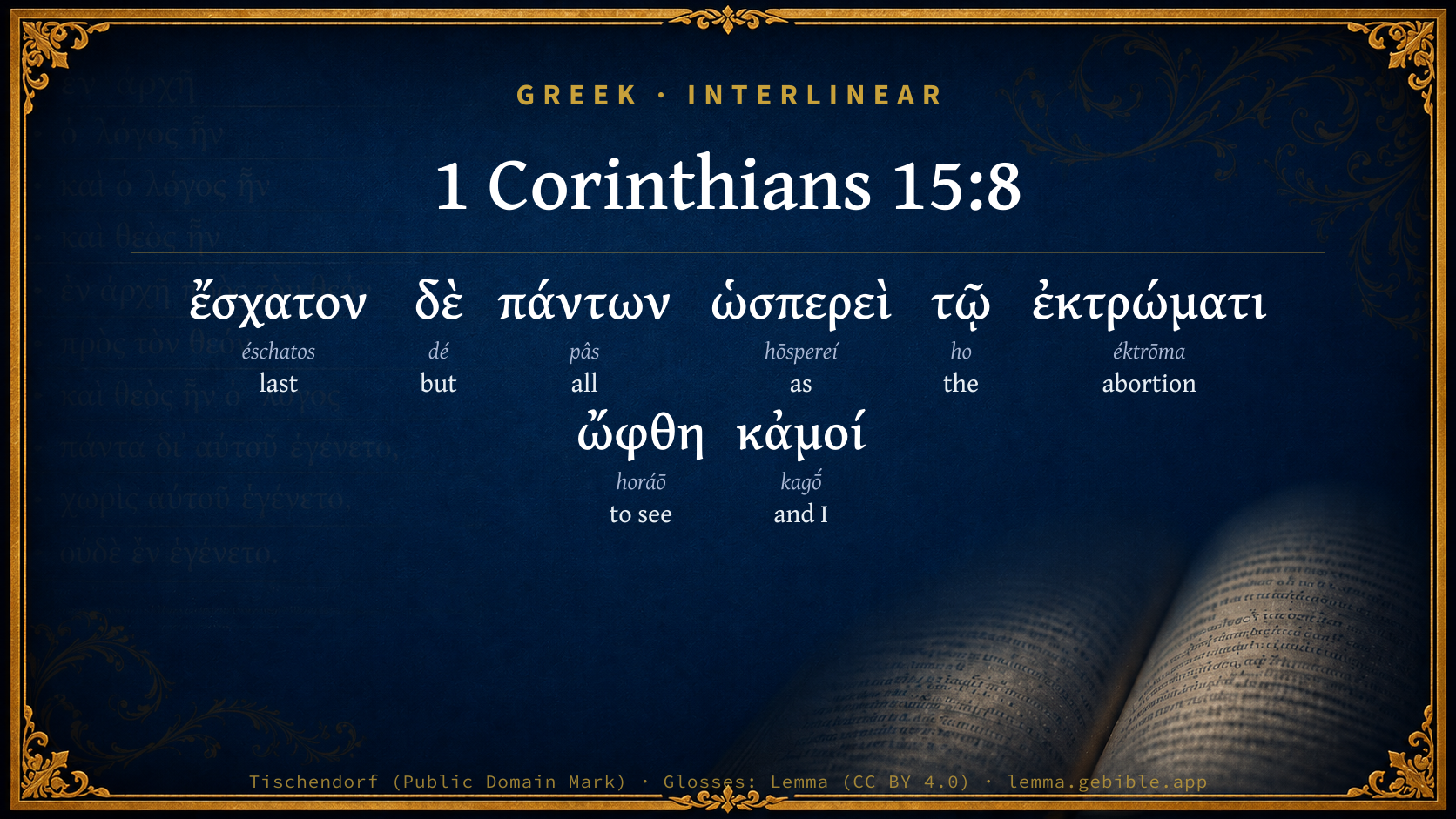
Download image
Cite this verse

1 Corinthians 15:8 (World English Bible). Public Domain. Lemma interlinear Bible study tool, https://lemma.gebible.app/v/1-corinthians/15/8.

Show BibTeX & RIS
BibTeX
RIS
English Translation
and last of all, as to the child born at the wrong time, he appeared to me also.
World English Bible · Public Domain
Highlights
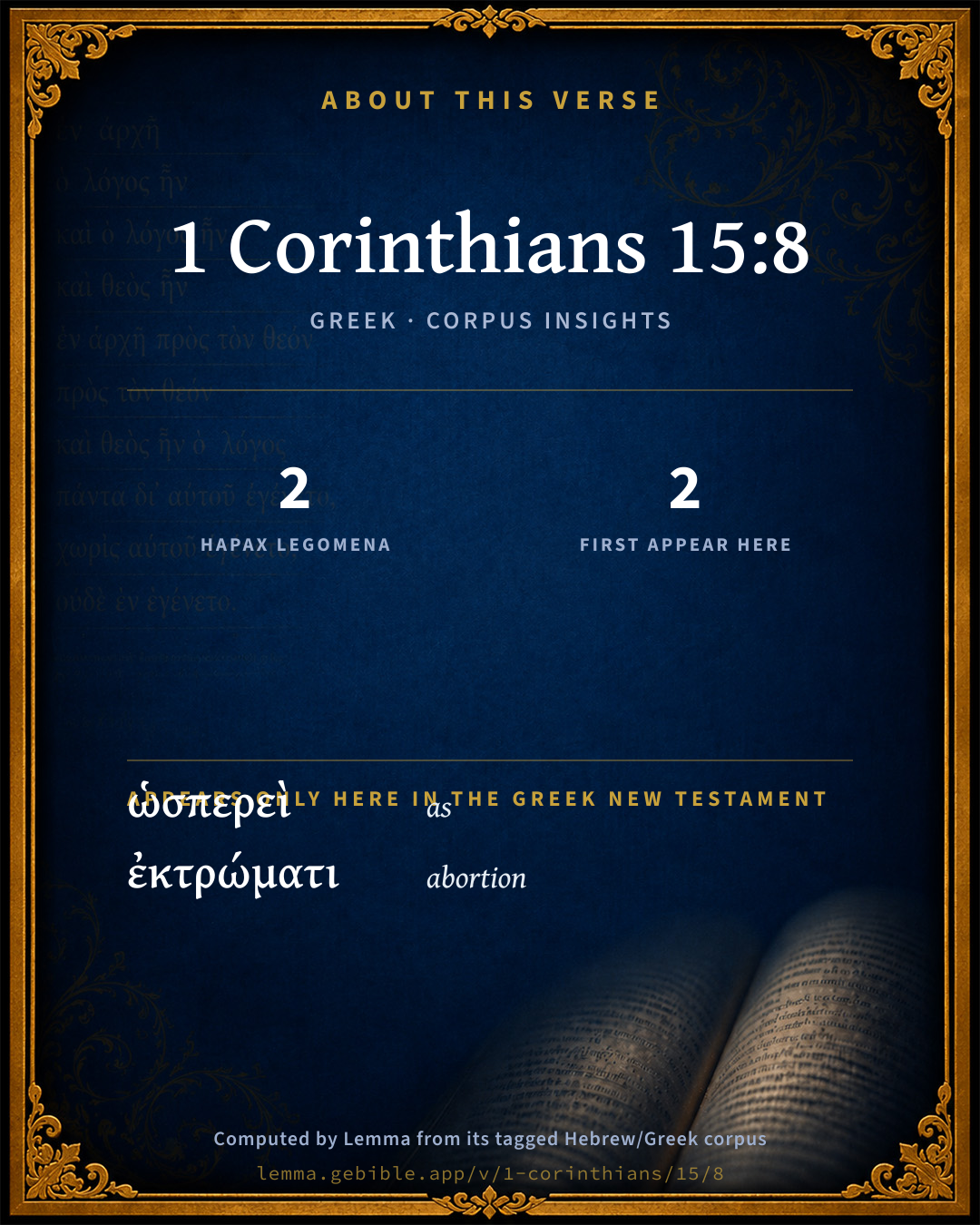
  • 2 hapax legomena — only here in the Greek New Testament
  • 2 first appearances in the Greek New Testament
Full analysis ↓
Download a study sheet

One document with this verse’s original text, its word-by-word gloss line, the meaning frame, cross-references with their text, attributed commentary, and full source and license credits — printable, and it pastes into notes with its structure intact.

This verse Autodidact and up

Study sheet (.html) Plain text (.txt)

A passage Seminary Student

Up to 50 verses in one chapter. A passage sheet keeps up to 6 commentary sources and 12 cross-references per verse, in the order this page ranks them, and says so on the sheet whenever that leaves anything out. Ask for a single verse and you get the Autodidact verse sheet above.

Everything on this page stays free to read, with no account — the sheet is a download of what is already on screen, not access to it.

Want to remove ads? Support Godless Engineer
Compare translations 3

The same verse in 3 English versions, stacked beneath the original-language interlinear above. Click any original word for its lexicon entry.

Each is an independent rendering of the whole verse — the interlinear is not word-aligned to these translations.

Highlighted words mark where these versions differ — a whole-verse word diff, not a word-by-word alignment.

  • World English Bible Public Domain
    and last of all, as to the child born at the wrong time, he appeared to me also.
  • King James Version Public Domain
    And last of all he was seen of me also, as of one born out of due time.
  • unfoldingWord Literal Text CC BY-SA 4.0
    Now last of all, he was seen by me also, as if to a child born at the wrong time.

unfoldingWord Literal Text — © unfoldingWord, licensed CC BY-SA 4.0. Word-aligned USFM3 via Door43 (git.door43.org/unfoldingWord/en_ult).

Versions to compare (up to 4)

3 of 4 selected

Show all 19 translations

Every available English version of this verse, each an independent rendering of the whole verse.

  • World English Bible Public Domain
    and last of all, as to the child born at the wrong time, he appeared to me also.
  • Berean Standard Bible Public Domain
    And last of all He appeared to me also, as to one of untimely birth.
  • Majority Standard Bible Public Domain
    And last of all He appeared to me also, as to one of untimely birth.
  • King James Version Public Domain
    And last of all he was seen of me also, as of one born out of due time.
  • American Standard Version (1901) Public Domain
    and last of all, as to the `child' untimely born, he appeared to me also.
  • Revised Version (1885) Public Domain
    and last of all, as unto one born out of due time, he appeared to me also.
  • Geneva Bible (1599) Public Domain
    And last of all he was seene also of me, as of one borne out of due time.
  • Douay-Rheims (1899) Public Domain
    And last of all, he was seen also by me, as by one born out of due time.
  • Young's Literal Translation Public Domain
    And last of all -- as to the untimely birth -- he appeared also to me,
  • Literal Standard Version CC BY-SA 4.0
    And last of all—as to the untimely birth—He also appeared to me,
  • Unlocked Literal Bible CC BY-SA 4.0
    Last of all, he appeared to me, as if to a child born at the wrong time.
  • unfoldingWord Literal Text CC BY-SA 4.0
    Now last of all, he was seen by me also, as if to a child born at the wrong time.
  • Darby Bible Public Domain
    and last of all, as to an abortion, he appeared to *me* also.
  • World Messianic Bible Public Domain
    and last of all, as to the child born at the wrong time, he appeared to me also.
  • Webster's Bible Public Domain
    And last of all he was seen by me also, as by one born out of due time.
  • Free Bible Version CC BY-SA 4.0
    Last of all, he also appeared to me, someone born as it were at the wrong time.
  • Bible in Basic English Public Domain
    And last of all, as by one whose birth was out of the right time, he was seen by me.
  • Text-Critical English NT CC BY 4.0
    Last of all, as to one born at the wrong time, he appeared to me as well.
  • Tyndale New Testament (1534) Public Domain
    And last of all he was sene of me as of one that was borne out of due tyme.

Literal Standard Version (2020), Covenant Press — licensed CC BY-SA 4.0. Text via the HelloAO Bible API (eBible.org). Unlocked Literal Bible (unfoldingWord) — licensed CC BY-SA 4.0. Text via the HelloAO Bible API (eBible.org). unfoldingWord Literal Text — © unfoldingWord, licensed CC BY-SA 4.0. Word-aligned USFM3 via Door43 (git.door43.org/unfoldingWord/en_ult). Free Bible Version, Dr. Jonathan Gallagher — licensed CC BY-SA 4.0. Text via the HelloAO Bible API (eBible.org).

Word by word

More ways to search: Search by grammar → Find every occurrence → Compare this word →

Practice this passage: Drill this verse → Learn its vocabulary →

About this verse

These counts appear in no published source. They are computed here, from the morphology-tagged text and Lemma’s own curated glosses. What Lemma adds →

8
words
8
distinct lemmas
Pauline Epistles
section

Notable vocabulary

2 hapax legomena — words that appear only here in the entire Greek New Testament:

  • ὡσπερεὶ as G5619
  • ἐκτρώματι abortion G1626

First appearance in Scripture

These words make their first canonical appearance in the Greek New Testament here:

  • ὡσπερεὶ as G5619
  • ἐκτρώματι abortion G1626

Shared distinctive vocabulary

ἔσχατον last G2078 occurs in 48 verses of the Greek New Testament. Also found in:
Cross-references

8

Topical passages linked to 1 Corinthians 15:8 in the Treasury of Scripture Knowledge — connected by theme and wording, ordered by reader-vote popularity; previews shown in the World English Bible.

  • 1 Corinthians 9:1 Am I not free? Am I not an apostle? Haven't I seen Jesus Christ, our Lord? Aren't you my work in the Lord?
  • Acts 26:16 But arise, and stand on your feet, for I have appeared to you for this purpose: to appoint you a servant and a witness both of the things which you have seen, and of the things which I will reveal to you;
  • Acts 18:9 The Lord said to Paul in the night by a vision, "Don't be afraid, but speak and don't be silent;
  • Acts 22:18 and saw him saying to me, 'Hurry and get out of Jerusalem quickly, because they will not receive testimony concerning me from you.'
  • Acts 9:17 Ananias departed, and entered into the house. Laying his hands on him, he said, "Brother Saul, the Lord, who appeared to you on the road by which you came, has sent me, that you may receive your sight, and be filled with the Holy Spirit."
  • Acts 9:3–6 As he traveled, it happened that he got close to Damascus, and suddenly a light from the sky shone around him.
  • Acts 22:14 He said, 'The God of our fathers has appointed you to know his will, and to see the Righteous One, and to hear a voice from his mouth.
  • 2 Corinthians 12:1–6 It is doubtless not profitable for me to boast. For I will come to visions and revelations of the Lord.

Cross-references courtesy of OpenBible.info (CC BY 4.0).

Commentary

Notes on 1 Corinthians 15:8 from classic Christian and Jewish commentators (each source and its license shown beneath its notes). The classic Christian expositions comment on the surrounding passage and are grouped to its opening verse, so a note may address several verses; the Jewish commentaries on the Tanakh (Rashi and others) are per-verse, so they appear only where the commentator wrote on this verse.

Lemma curates 59 commentaries, every one of them public domain or Creative Commons licensed, each selected and text-cleaned for this edition rather than reprinted as found. About our sources →

The Biblical Illustrator

Joseph S. Exell

1Co_15:8-11

And last of all He was seen of me also.

Me also

Who?

1. The self-righteous Pharisee (Php_3:1-21).

2. The bloodthirsty persecutor (Act_7:58; Act_8:1; Act_9:1; Act_22:4; Act_26:10-11).

3. The inveterate unbeliever (Act_26:14; 1Ti_1:13).

Conclusion:

1. Who then can despair of any one?

2. Who then need despair? (1Ti_1:14-16). (J. Lyth, D.D.)

Christs last appearance

I. Granted to paul.

1. It was real.

2. Necessary as a seal of apostleship.

3. Supplies additional and valuable evidence of the resurrection.

II. Granted under special circumstances.

1. As to one born out of due time, after the other apostles.

2. Under unexpected circumstances.

3. Before his religious character was fully developed.

III. Granted for our instruction.

1. As an example of special grace.

2. Requiring special gratitude and humility. (J. Lyth, D.D.)

The Epiphany to Saul of Tarsus

This was the occasion of his conversion. The apostle has left on record a statement of the magnitude of the revolution (Php_3:1-21). How shall we account for it? The answers may all be reduced to three. That Pauls assertion that he had seen the risen Lord was--

I. A falsehood. This was the position taken by the Deists of the last century. But what motive could Paul have for asserting it? For even men of the feeblest intellects do not act without motives. But here is a man of powerful intellect persisting for thirty years in maintaining what he knew all the time to be an absolute lie. What was his motive then?

1. Was it hope of advancement? But to confess the Nazarene was the surest way to be defeated in every worldly ambition.

2. Was it love of rank, or wealth, or power, or ease? But to be a follower of the Galilean was to make morally certain toil, poverty, persecution, and death (1Co_4:9-13; 2Co_11:23-27). Thus on this theory of imposture we see a man of marvellous mental breadth and moral height deliberately inventing a useless, monstrous lie, and persistently adhering to it for a quarter of a century, conscious that his only reward was pauperism, disgrace, torture, martyrdom, everlasting damnation.

II. An hallucination. This is the position of the modern philosophical sceptic, driven from the theory of imposture by its unspeakable absurdity. Paul, it is said, was a man of nervous, excitable organisation, and conscientious to the last degree. Coming into contact with the Christians, their arguments, their self-sacrifice, their patient behaviour under persecution, made a profound impression on his susceptible nature. Doubts began to arise, and being a Pharisee, he would have no difficulty with the doctrine of the resurrection. Then the thrilling question came, May not Jesus really have risen? The more he pondered it, the more it distressed him: the very conscientiousness which had made him a persecutor began to torture him with the thought that he might be fighting against God. Agonised by the possibility, in his inflamed imagination he fancied he saw in the heavens the form of the risen Jesus, etc. But survey the character of Paul. Susceptible, imaginative, impetuous, he certainly was, yet the man never lived who had his faculties more completely under control or used them with more sagacity. Mark the characteristics of a fanatic.

1. Looseness of reasoning and wildness of statement. But the man never lived who reasoned more accurately than Paul (Romans; Galatians, e.g.).

2. Utopian dreaming. But no man ever took broader, deeper, more sensible views of the problems of society, or discussed them with finer acumen than Paul: witness his exposition of the great law of edification (Rom_12:1-21; Rom_13:1-14; Rom_14:1-23; Rom_15:1-33), and his discussion of cases of conscience (chaps. 6-14).

3. Impatience, intolerance, obstinacy, recklessness. Paul was the antithesis of all this--witness his gentleness, patience, tolerance, magnanimity, humility, dignity, courtesy, deference to authority, repudiation of outward form, self-forgetfulness in his devotion to others.

4. Destructiveness. But the man never lived who was more absolutely a constructor of society than Paul. Next his Divine Master Himself, the apostle is the most controlling force of Christendom. If hallucination is capable of producing such characters as St. Paul, would God all men were flighty, all earth a Bedlam.

III. A fact. This is the position of the Christian Church, and explains everything. It explains--

1. His sudden, radical revolution of character; the risen Lord had appeared to him and beckoned him up to a diviner life.

2. His cosmopolitan ministration (Act_26:16-18).

3. His claim to be an apostle (chap. 9:1).

4. His passionate sense of fellowship with the slain and risen Lord (Gal_2:20).

5. His career of self-sacrifice (2Co_4:5; 2Co_4:10).

6. His being persecuted in turn by those who had been his fellow-persecutors. Deny that Epiphany, and you have in the career of Paul the most inexplicable of character-problems. Admit that Epiphany, and all is clear. (W. E. Boardman, D.D.)

St. Paul

Combining this opinion of himself with the story of his conversion (Act_9:1-43.) we may learn--

I. Not to be astonished if we have to change our opinions as we grow older. When we are young we are very positive about this thing and that, and ready to quarrel with any who differs from us, as St. Paul was. But let ten, twenty years roll over us, and we may find our opinions utterly changed, and look back on ourselves with astonishment and shame as St. Paul did.

II. Not to be ashamed of changing our minds: but if we find ourselves to be in the wrong, to confess it honestly, as St. Paul did. What a fearful wrench and humiliation to have to change his mind on all matters in heaven and earth! What must it not have cost him to throw up all his friends and to feel that henceforth they must look upon him as a madman, an infidel, an enemy! But he faced the struggle and conquered, and the consequence was that he had, in time, many Christian friends for each Jewish friend that he had lost.

III. That God will not impute to us our early follies and mistakes, if only there be in us, as there was in St. Paul, the heart which longs to know what is true and right, and bravely acts up to what it knows. In all things, whether right or wrong, St. Paul was an honest, earnest seeker after truth and righteousness. He had not yet the grace of Christ, which is love to his fellow-men; and therefore his works were not pleasing to God. His empty forms and ceremonies could not please God. His persecuting the Church had plainly the nature of sin. But there was something which God had put in him, and that was, the honest and good heart. In that Christ sowed the word of God, and, behold, it sprang up and bore fruit over all Christian nations to this day. Keep, therefore, if you have it, the honest and good heart. If you have it not, pray for it earnestly.

IV. That though God has forgiven a man, that is no reason that he should forgive himself.

1. The common teaching now is, that if a man finds, or fancies, that God has forgiven him, he may forgive himself at once, and go boasting about the world as if he had never sinned at all. That is one extreme.

2. The opposite extreme is that of many old saints who could not forgive themselves at all, but passed their whole lives in misery, bewailing their sins till their dying day. That was a mistake.

3. Run into neither extreme. Look at your past lives as St. Paul looked at his. There is no sentimental melancholy in him. He is saved, and he knows it. He is hopeful, joyful; but whenever he speaks of his past life it is with noble shame and sorrow. So let us do. Let us thank God cheerfully for the present. Let us look on hopefully to the future; let us not look back too much at the past, or rake up old follies which have been pardoned and done away. But let us thank God whenever He thinks fit to show us the past, and bring our sin to our remembrance; and learn as St. Paul learnt, to be charitable to all who have not yet learnt the wisdom which God has taught to us. (C. Kingsley, M.A.)

For I am the least of the apostles, … I persecuted the Church of God.--

Paul an example

I. Of special grace. A persecutor--

1. Saved by extraordinary interposition.

2. Called to be an apostle.

3. Specially privileged.

II. Of special gratitude.

1. He attributes all to the grace of God.

2. Labours more abundantly.

3. Maintains a spirit of profound humility before God and his brethren. (J. Lyth, D.D.)

The conversion of Paul viewed in reference to his office

I. It was a triumph over the enemy. When God would convert the world, opening the door of faith to the Gentiles, who was the chosen instrument? Not one of Christs first followers. He put forth His hand into the very midst of the persecutors of His Son, and seized upon the most strenuous among them.

II. It was a suitable introduction to his office. It was an expressive emblem of the nature of Gods general dealings with the race of man. What are we all but rebels against God and enemies of the truth? (Col_1:21). Who then could so appropriately fulfil the purpose of Him who came to call sinners to repentance as one who had persecuted the Church of God? (1Ti_1:16).

III. His previous course of life rendered him, perhaps, after his conversion, more fit an instrument of Gods purposes towards the Gentiles, as well as a more striking specimen of it. We know that St. Pauls successes were not his, but through the grace of God which was with him. Still, God makes use of human means, and it is allowable to inquire what these were, and why St. Paul was employed to convert the heathen world rather than St. James or St. John. Doubtless his intellectual endowments and acquirements fitted him for his office. Yet there was something in his previous religious history which especially disciplined him to be all things to all men. His awful rashness and blindness, his rage against the worshippers of Christ, then his strange conversion, then the three years during which he was left to meditate in private on all that had happened, and to anticipate the future--all this constituted a peculiar preparation for the office of preaching to a lost world dead in sin. It gave him an extended insight, on the one hand, into the ways and designs of Providence, and, on the other, into the workings of sin in the human heart, and the various modes of thinking in which the mind is actually trained. It taught him not to despair of the worst sinners, and to enter into the various temptations to which human nature is exposed. It wrought in him a profound humility, which disposed him to bear meekly the abundance of the revelations given him; and it imparted to him a practical wisdom how to apply them to the conversion of others, so as to be the comforter, help, and guide of his brethren.

1. Now I do not allege that St. Pauls previous sins made him a more spiritual Christian afterwards, but rendered him more fitted, when converted, to reclaim others, just as a knowledge of languages fits a man for the office of missionary, without tending in any degree to make him a better man. If we take two men equally advanced in grace, one of the two would preach to a variety of men with the greater success who had the greater experience of temptation, the war of flesh and spirit, sin, and victory over sin.

2. But St. Pauls conversion is very far from holding out any encouragement to those who live in sin, or any self-satisfaction to those who have lived in it; as if their present or former disobedience could be a gain to them. Why was mercy shown to Saul? Because he did it ignorantly in unbelief. And why was he enabled to preach the gospel? Because Christ counted him faithful. He differed from other enemies of Christ in this, that he kept a clear conscience, and habitually obeyed God according to his knowledge. Hear his own account of himself (Act_26:1; Act_23:19; Act_26:5). Here is no ease, no self-indulgent habits, no wilful sin against the light. The Holy Spirit is quenched by open transgressions of conscience and by contempt of His authority. But, when men err in ignorance, they are not left by the God of all grace. God leads them on to the light, in spite of their errors in faith, if they continue strictly to obey what they believe to be His will. (J. H. Newman, D.D.)

Self depreciation must not hinder duty

There are people who appreciate themselves intellectually who are constantly depreciating themselves religiously. I am not worthy to be a Church member--a Christian disciple. What pastor does not have to encounter that again and again ad nauseam? What preacher who does not at times, and sincerely, say within himself, I am only an abortion of a man, I am not worthy to be called a preacher. But as Paul had to be an apostle, notwithstanding his self-depreciation, so you and I have to be that to which we are called, or deny the Christ of God as an all-sufficient Saviour. It would be an act of deliberate disobedience if I, feeling my utter unworthiness to be a preacher of the gospel, should yet refuse to do it when I am called, inasmuch as I believe, intellectually and heartily, that Jesus is Gods Christ, and came to be mans Redeemer and Saviour. But is it not equally an act of deliberate disobedience on the part of some of you to refuse to confess Christ before men, simply because you feel that you are not worthy to do it? (Reuen Thomas, D.D.)

The Biblical Illustrator, edited by Joseph S. Exell (c. 1880s–1900s) — public domain. Text from a community e-Sword module.

Joseph Benson's Commentary

1Co 15:8. Last of all — This evidently implies that our Lord appeared to none of the disciples after his ascension, except to Paul; he was seen of me also — He here no doubt speaks of Christ’s appearing to him on the way to Damascus, but he does not exclude his other appearances to him. See 1Co 9:1. As of one born out of due time — An untimely birth. It was impossible to abase himself more than he does by this single appellation. As an abortion is not worthy the name of a man, so he affirms himself to be not worthy the name of an apostle. It must be observed, however, it was not on account of his being sensible of any imperfection in his commission, or of any weakness in his qualifications as an apostle, that he gave himself this name; for he affirms (2Co 11:5) that he was in nothing behind the very chief of the apostles: but he called himself an untimely birth, for the reason mentioned in the next verse, “and because he was made an apostle without that previous course of instruction and preparation which the other apostles enjoyed, who had attended Jesus during his ministry on earth; so that, in the proper sense of the word, he was εκτρομα, one born before he was brought to maturity. That want, however, was abundantly supplied by the many revelations which his Master gave him, after he had made him an apostle.” — Macknight.

Joseph Benson's Commentary on the Old and New Testaments (1811–1818) — public domain. Text from a community e-Sword module.

Tyndale Open Study Notes

Tyndale Open Resources

15:8-9 as though I had been born at the wrong time (or as though I were stillborn): This phrase can refer to a miscarriage or stillbirth. Here it might express the unusual manner of Paul’s conversion, or the derogatory view some opponents held of his apostleship, or his own sense of unworthiness to be an apostle. The overall emphasis is on the extraordinary grace of God to Paul as a former persecutor of Christ’s people (see Gal 1:13; Phil 3:6; cp. Acts 8:3; 9:1-2). • I also saw him: Paul came face to face with the risen Christ at his conversion (see 1 Cor 9:1; Acts 9:3-6; Gal 1:15-16).

Tyndale Open Study Notes — © Tyndale Open Resources, licensed CC BY-SA 4.0. Text via the HelloAO Bible API.

Bengel's Gnomon

Johann Albrecht Bengel

1Co 15:8. Ἒσχατον δὲ πάντων) and last of all, or rather, after them all, in order to exclude himself. Also after Stephen, Deu 31:27; Deu 31:29.—ἔσχατον τοῦ θανάτου μου, κ.τ.λ. after my death. [The appearances, that afterwards followed are not excluded by this expression, Act 23:11.—V. g.]—ὡσπερεὶ τῷ ἐκτρώματι, as by the abortion [one born out of due time]) The LXX., ἐκτρώμα, Num 12:12. The article is emphatic. Paul applies to himself alone this denomination in reference to the circumstances of the appearance, and in reference to the present time of writing. What ἐκτρώμα, an abortion, is among children, he says, I am among the apostles; and by this one word he sinks himself lower than in any other way. As an abortion is not worthy of the name of man, so the apostle declares that he is not worthy of the name of apostle. The metaphor, is drawn from the same idea from which the term regeneration is used, 1Pe 1:3 [Begotten again—by the resurrection of Jesus, etc.]; εἰ in ὡσπερεὶ somewhat softens the phrase: as if; he shows that this ought not to be pressed too far.—κᾀμόι, by me also) This word is elegantly placed at the end of the period.

Bengel's Gnomon of the New Testament — English translation (T&T Clark, Edinburgh, 1860) — public domain. Text from a community e-Sword module.

Meyer's Critical & Exegetical Commentary

Heinrich August Wilhelm Meyer

1Co_15:8. Appearance at Damascus. Comp. 1Co_9:1.

Regarding the adverbial ἔσχατον, comp. Plato, Gorg. p. 473 C; Soph. Oed. Col. 1547; Mar_12:22 (Lachm.). It concludes the series of bodily appearances, and thereby separates these from later appearances in visions (Act_18:9), or some other apocalyptic wa.

πάντων] is not to be understood, as has been usually done, of all those in general to whom Christ appeared after His resurrection, but of all apostles, as is the most natural interpretation from the very foregoing τοῖς ἀποστ. πᾶσι, and is rendered certain by the τῷ ἐκτρώμ. with the article, which, according to 1Co_15:9, denotes κατʼ ἐξοχήν the apostolic abortion.[31]

The apostles sense of the high privilege of being counted worthy to see the Risen One awakens in him his deep humility, which was always fostered by the painful consciousness of having once persecuted the church; he therefore expresses his strong sense of unworthiness by saying that he is, as it were (ὡσπερεί, quasi, only here in the N. T., often in classic writers), τὸ ἔκτρωμα, the untimely foetus, Arist. Gener. An. iv. 5; LXX. Num_12:12; Job_3:16; Ecc_6:3; Aq. Psa_57:9. See the passages in Wetstein, Fritzsche, Diss. I. p. 60 f.; and as regards the standing of the word as Greek (for which the older Attic writers have ἄμβλωμα), Lobeck, ad Phryn. p. 209. In opposition to Heydenreich and Schulthess (most recently in Keil and Tzschirners Anal. I. 4, p. 212 f.), who interpret in a way which is linguistically erroneous (adopted, however, as early as by τινές in Theophylact), lateborn, born afterwards in old age, see Fritzsche, l.c. The idea of being late-born, i.e. late in becoming an apostle, is conveyed in ἔσχατον πάντων, not in ἔκτρωμα. What Paul meant to indicate in a figurative way by τ. ἐκτρ. is clearly manifest from 1Co_15:9, namely, that he was inferior to, and less worthy than, the rest of the apostles, in the proportion in which the abortive child stands behind that born mature.[32] Comp. Bengel: Ut abortus non est dignus humano nomine, sic apostolus negat se dignum apostoli appellatione. See also Ignatius, ad Romans 9. The distinct explanation which he gives himself in 1Co_15:9 excludes all the othersome of them very oddinterpretations which have been given,[33] along with that of Hofmann: Paul designates himself so in contrast to those who, when Jesus appeared to them, were brethren (James too?) or apostles, and consequently had been born as children of God into the life of the faith of Christ; whereas with him the matter had not yet come to a full formation of Christ (Gal_4:19), as was the case with the rest. This artificial interpretation is all the more erroneous, seeing that Paul, when Christ appeared to him, had not yet made even the first approach to being a Christian embryo, but was the most determined opponent of the Lord, and was closely engaged in persecuting Him (Act_9:4); ὡσπ. τ. ἐκτρ. does not describe what Paul was then, when Christ appeared to him, but what he is since that tim.

κἀμοί] at the end, with the unaffected stamp of humility after the expressions of self-abasement put before.

Observe, further, that Paul places the appearance of the Risen One made to himself in the same series with the others, without mentioning the ascension which lay between. Certainly, therefore, he did not regard the latter as the striking, epoch-making event, which it first appears in the narrative of the Book of Acts, forty days after the resurrection. See generally on Luk_24:51, Remark. But observe also what stress Paul lays here and 1Co_9:1 upon the outwardly manifested bodily appearance of the Lord, with which Gal_1:15 does not in any way conflict.[34] 2Co_12:2 ff. is of a different tenor.

[31] The abortion in the series of the apostles. Hofmann is wrong in making πάντων extend to the whole of the cases previously adduced. That would surely be a thing quite self-evident, namely, that in a series of cases following after each other, the last mentioned is just the last of all. No, πάντων is correlative to the preceding πᾶσιν, and the progress of thought is: to the apostles all, last of all, however, to me also. Thereby Paul gives adequate expression to the deep humility with which he sees himself added to the circle of the apostles. Comp. ver. 9 : ἀποστόλων, ἀπόστολος, and then the retrospective τῶν πάντων, ver. 10, also the ἐκεῖνοι, ver. 11.Hofmann seems to take the ὡσπερεί in the sense of ut decet; for he cites Klausen, ad Aesch. Agam. 1140, who treats specially of this meaning of the word, p. 244.

[32] The whole passage is entirely misunderstood by Kienlen in the Jahrb. f. d. Theol. 1868, p. 316 ff.

[33] Among these must be placed Calvins opinion (comp. Osiander): Se comparat abortivo … subitae suae conversionis respectu, shared by Grotius and others, including Schrader. So, too, with the view of Baronius, Estius, Cornelius a Lapide, and others, that Paul describes himself as a supernumerary. And Wetstein even suggests: Pseudapostoli videntur Paulo staturam exiguam objecisse, 2Co_10:10.

[34] See Paret in the Jahrb. f. deutsche Theol. 1859, p. 243 ff.; Beyschlag in the Stud. u. Krit. 1864, p. 219 f.

Meyer — Critical and Exegetical Commentary on the New Testament — English translation by Peter Christie, edited by Frederick Crombie (T&T Clark, 1880) — public domain. Text from a community e-Sword module.

Expositor's Greek Testament

ed. W. Robertson Nicoll

1Co 15:8 . ἔσχατον δὲ πάντων , ὡσπερεὶ τῷ ἐκτρώματι : “But last of all, as it were to the abortion (a creature so unfit and so repulsive), He appeared also to me ”. ἔσχατον (adv [2277] ) πάντων marks the conclusion of a long series; cf. 1Co 4:9 , also Mar 12:22 . ὡσπερεί , a frequent cl [2278] conjunction, “nonnihil mitigat ut si [or quasi ]: docet non debere hoc nimium premi, … Articulus vim habet ( τῷ ἐκτρώματι ). Quod inter liberos est abortus, inquit, id ego sum in apostolis.… Ut abortus non est dignus humano nomine, sic apostolus negat se dignum apostoli appellatione” (Bg [2279] ; similarly Est., Mr [2280] , Al [2281] , Ed [2282] , Sm [2283] ); ἔκτρωμα need not be pressed beyond this figurative and descriptive meaning. However, Cv [2284] , Gr [2285] , Bt [2286] , Gd [2287] , and many find in the phrase an indication of the suddenness and violence of Paul’s birth into Christ; Hn [2288] and El [2289] see pictured in it, more appropriately, the unripe birth of one who was changed at a stroke from the persecutor into the Apostle, instead of maturing normally for his work, “P. describes himself thus in contrast with those who, when Jesus appeared to them, were already brothers or apostles, already born as God’s children into the life of faith in Christ” (Hf [2290] ). Sm [2291] aptly suggests that τὸ ἔκτρωμα was one of the insulting epithets flung at Paul by the Judaists; in their eyes he was a wirklich Missgeburt . He adopts the title “the abortion, as they call me” and gives it a deeper meaning. His low stature may have suggested the taunt: cf. 2Co 10:10 , and Acta Pauli et Theclae , 3. An abortion is a living, genuine offspring.

[2277] adverb

[2278] classical.

[2279] Bengel’s Gnomon Novi Testamenti.

[2280] Meyer’s Critical and Exegetical Commentary (Eng. Trans.).

[2281] Alford’s Greek Testament .

[2282] T. C. Edwards’ Commentary on the First Ep. to the Corinthians . 2

[2283] P. Schmiedel, in Handcommentar zum N.T. (1893).

[2284] Calvin’s In Nov. Testamentum Commentarii .

[2285] Greek, or Grotius’ Annotationes in N.T.

[2286] J. A. Beet’s St. Paul’s Epp. to the Corinthians (1882).

[2287] F. Godet’s Commentaire sur la prem. Ép. aux Corinthiens (Eng. Trans.).

[2288] C. F. G. Heinrici’s Erklärung der Korintherbriefe (1880), or 1 Korinther in Meyer’s krit.-exegetisches Kommentar (1896).

[2289] C. J. Ellicott’s St. Paul’s First Epistle to the Corinthians .

[2290] J. C. K. von Hofmann’s Die heilige Schrift N.T. untersucht , ii. 2 (2te Auflage, 1874).

[2291] P. Schmiedel, in Handcommentar zum N.T. (1893).

The Expositor's Greek Testament, edited by W. Robertson Nicoll (1897–1910) — public domain. Text from a community e-Sword module.

Hodge's Commentary on Romans, Ephesians & First Corinthians

Charles Hodge

1Co_15:8

And last of all he was seen of me also, as of one born out of due time.

Last of all may mean last of all the apostles; or, as is more probable, last of all means the very last. As to an abortion, he appeared to me. Such is Pauls language concerning himself. Thus true is it, that unmerited favors produce self-abasement. Paul could never think of the distinction conferred on him by Christ, without adverting to his own unworthiness.

Charles Hodge — Commentary on Romans (1835), First Corinthians (1857), and Ephesians (1856) — public domain. Text from a community e-Sword module.

Geneva Bible (1599)

Geneva Bible translators

He maintaineth by the way, the authority of his Apostleship, which was requisite to be in good credit among the Corinthians, that this Epistle might be of force and weight amongst them. In the mean season he compareth himself to such sort after a certain divine art with certain others, that he maketh himself inferior to them all.

Geneva Bible (1599) marginal notes — public domain. Text via Bolls.life.

Jamieson, Fausset & Brown

Robert Jamieson, A. R. Fausset & David Brown

One born out of due time--Greek, "the one abortively born": the abortion in the family of the apostles. As a child born before the due time is puny, and though born alive, yet not of the proper size, and scarcely worthy of the name of man, so "I am the least of the apostles," scarcely "meet to be called an apostle"; a supernumerary taken into the college of apostles out of regular course, not led to Christ by long instruction, like a natural birth, but by a sudden power, as those prematurely born [GROTIUS]. Compare the similar image from childbirth, and by the same spiritual power, the resurrection of Christ (Pe1 1:3). "Begotten again by the resurrection of Jesus." Jesus' appearance to Paul, on the way to Damascus, is the one here referred to.

Jamieson, Fausset & Brown — Commentary Critical and Explanatory on the Whole Bible (1871) — public domain (CC PDM 1.0). Text via the HelloAO Bible API.

Adam Clarke's Commentary

Verse 8. And last of all - of me also] It seems that it was essential to the character of a primitive apostle that he had seen and conversed with Christ; and it is evident, from the history of Saul's conversion, Ac 9:4-7, where see the notes, that Jesus Christ did appear to him; and he pleaded this ever after as a proof of his call to the apostleship. And it does not appear that, after this time, Jesus ever did make any personal discovery of himself to any one.

As of one born out of due time.] The apostle considers himself as coming after the time in which Jesus Christ personally conversed with his disciples; and that, therefore, to see him at all, he must see him in this extraordinary way. Some have entered into a very disgusting detail on the figure used here by the apostle. The words, ωσπερει τω εκτρωματι, signify not merely one born out of due time, but one born before his time; and consequently, not bidding fair for vigour, usefulness, or long life. But it is likely that the apostle had a different meaning; and that he refers to the original institution of the twelve apostles, in the rank of whom he never stood, being appointed not to fill up a place among the twelve, but as an extra and additional apostle. Rosenmuller says that those who were beyond the number of twelve senators were termed abortivi, abortives; and refers to Suetonius in Octavio, cap. 35. I have examined the place, but find no such epithet. According to Suetonius, in that place, they were called orcini-persons who had assumed the senatorial dignity after the death of Julius Caesar, pretending that they had derived that honour from him.

Adam Clarke's Commentary on the Bible (1810–1826) — public domain. Text from a community e-Sword/MySword module.

Ellicott's Commentary for English Readers

(8) Was seen of me also, as of one born out of due time.—Better, Last of all, as to an untimely born one he appeared also to me. The Apostle here distinctly states that he saw the Lord at the time of his conversion as really as St. Peter and others had seen him, though with touching pathos and strongly marked emphasis he adds that it was not at the same time as the “firstborn” had seen Him, but only as an “untimely born” one.

A Bible Commentary for English Readers, edited by Charles John Ellicott (1878–1897) — public domain. Text from a community e-Sword module.

The Cambridge Bible for Schools and Colleges

gen. ed. J. J. S. Perowne

8. of me also, as of one born out of due time] Deed borun, Wiclif. The word here (after Tyndale) translated born out of due time refers to a birth out of the usual course of nature (cf. Psa_58:8), about which there is therefore, (1) something violent and strange. Such was the nature of St Paul’s conversion, an event unparalleled in Scripture. Moreover, (2) such children are usually small and weakly, an idea which the next verse shews St Paul also had in mind. St Paul saw the Lord on more than one occasion. See note on ch. 1Co_9:1.

The Cambridge Bible for Schools and Colleges (gen. ed. J. J. S. Perowne; Cambridge University Press, 1878–1918) — public domain. Text from a community e-Sword module.

John Gill's Exposition

And last of all he was seen of me also,.... Either when the apostle was caught up into the third heaven; or when he was in a trance in the temple at Jerusalem; or rather at the time of his conversion, when he not only heard the voice of Christ, but saw him in the human nature; for he expressly says, that he appeared unto him, and he calls it the heavenly vision, Act 26:16. This was a sight of Christ in heaven, not on earth, such an one as Stephen had, and was a corporeal one; otherwise it would have been impertinent to have mentioned it, with the rest of the ocular testimonies of Christ's resurrection. Not that this was the last time that Christ was seen, or to be seen, for he was seen after this by the Apostle John in a visionary way, and will be corporeally seen by all the saints at the last day; but Paul was the last of the apostles and brethren before named, and he had his vision of Christ after them all; and perhaps it might be a more clear, full, and distinct one than any of the rest, as the last things are sometimes the most excellent. The apostle adds, as of

one born out of due time: or "as an abortive"; not that he was really one, but like one: several learned interpreters think the apostle refers to a proverbial way of speaking among the common people at Rome, who used to call such supernumerary senators in the times of Augustus Caesar, who got into the senate house by favour or bribery, "abortives" (i), they being generally very unworthy persons; and therefore calls himself by this name, as being in his own opinion a supernumerary apostle, and very unworthy of that office: though others rather think that he refers to a "posthumous" birth, to one that is born after the death of his father; because that the rest of the apostles were all chosen, and called, and sent forth, whilst Christ, their everlasting Father, was living on earth, but he not till after his death, resurrection from the dead, and ascension to heaven: but it seems best to understand him of an abortion, a miscarriage, or birth before its time; and may respect either the manner of his conversion, which was done both suddenly, immediately, and at once, by a sudden light from heaven, when he little thought of it, and had no expectation of it, which is commonly the case of abortions; and also powerfully and irresistibly, being effected by mighty and efficacious grace, as births before the full time are often occasioned by blows or outward force, and are violent extrusions of the foetus; or else the state and condition in which he was when Christ was first seen by him: as to his bodily state, as soon as ever he saw the light about him, and the object by it, he was struck blind, and continued so some days, like an hidden untimely birth, and like an infant that never saw light, Job 3:16. And as to his spiritual estate, his soul was like an unshapen foetus, Christ being not yet formed in him, his image stamped on him, and his grace implanted in him; yea, it may be applied to the present apprehensions he had of himself, and which he expresses without a figure in the next verse, though in a beautiful manner, with a view to what he here says, when he observes that he was "the least of the apostles, and not meet to be called" one; as an abortive, or one born before its time, is imperfect in one respect or another, is not come to its proper size and shape, and scarcely is to be reckoned in the class and number of men.

(i) Vid. Sueton. in Vita August. c. 35.

John Gill's Exposition of the Whole Bible (1746–1763) — public domain (CC PDM 1.0). Text via the HelloAO Bible API.

Trapp's Complete Commentary

John Trapp

8 And last of all he was seen of me also, as of one born out of due time.

Ver. 8. One born out of due time] Quasi malo astro abortus, et adversante natura coactus. One that deserved to be rejected, as that forlorn infant, Eze 16:4-5.

John Trapp, A Commentary or Exposition upon All the Books of the Old and New Testament (1647–1656) — public domain. Text from a community e-Sword module.

Albert Barnes' Notes on the Bible

And last of all - After all the other times in which he appeared to people; after he had ascended to heaven. This passage proves that the apostle Paul saw the same Lord Jesus, the same “body” which had been seen by the others, or else his assertion would be no proof that he was risen from the dead. It was not a fancy, therefore, that he had seen him; it was not the work of imagination; it was not even a “revelation” that he had risen; it was a real vision of the ascended Redeemer.

He was seen of me also - On the way to Damascus, see Act 9:3-6, Act 9:17.

As of one born out of due time - Margin, Or, “an abortive.” Our translation, to most readers, probably, would not convey the real meaning of this place. The expression, “as of one born out of due time,” would seem to imply that Paul meant to say that there was some unfitness “as to the time” when he saw the Lord Jesus; or that it was “too late” to have as clear and satisfactory a view of him as those had who saw him before his ascension. But this is by no means the idea in the passage. The word used here (ἔκτρωμα ektrōma) properly means an abortion, one born prematurely. It is found no where else in the New Testament; and here it means, as the following verse shows, one that was “exceedingly unworthy;” that was not worth regard; that was unfit to be employed in the service of the Lord Jesus; that had the same relation to that which was worthy of the apostolic office which an abortion has to a living child. The word occurs (in the Septuagint) in Job 3:16; Ecc 6:3, as the translation of נפל nephel, an abortion, or untimely birth. The expression seems to be proverbial, and to denote anything that is vile, offensive, loathsome, unworthy; see Num 12:11. The word, I think, has no reference to the mode of “training” of the apostle, as if he had not had the same opportunity as the others had, and was therefore, compared with their advantages, like an untimely child compared with one that had come to maturity before its birth, as Bloomfield supposes; nor does it refer to his diminutive stature, as Wetstein supposes; but it means that he felt himself “vile,” guilty, unworthy, abominable as a persecutor, and as unworthy to be an apostle. The verse following shows that this is the sense in which the word is used.

Albert Barnes' Notes on the Bible (1834–1885) — public domain. Text from a community e-Sword/MySword module.

Haydock's Catholic Bible Commentary

As by one born out of due time; not born at the ordinary term, meaning after Christ’s ascension. He calls himself so out of humility, abortives being commonly imperfect and less than others. (Witham)

George Leo Haydock (1774–1849), Haydock's Catholic Family Bible and Commentary, 1859 edition — public domain. Excludes Psalms (Douay-Rheims chapter numbering differs from Protestant) and Deuterocanonical books (Catholic canon only).

Matthew Poole's English Annotations

Last of all the apostles, or, it may be, last of all persons; for after Stephen we read of none but St. Paul who saw Christ. Stephen, as they were stoning him, cried out: Behold, I see the heavens opened, and the Son of man standing on the right hand of God, Act 7:56. We read of Paul’s hearing a voice from him, Act 9:4, and no doubt but he had a bodily sight of him, for he here reckoneth himself amongst those that were eye witnesses. Nor is it any objection against it, that he was struck blind, for that was after his sight of Christ, not before. He calls himself an abortive, or

one born out of due time, either because he was added to the number of the twelve; or in respect to his new birth, he being converted (as he tells us afterward) after that he had been a persecutor of the church of Christ, after the descending of the Holy Ghost; or, it may be, because his conversion was sudden, like the abortive birth of a woman.

Matthew Poole's English Annotations on the Holy Bible (1683–1685) — public domain. Text from a community e-Sword/MySword module.

Whedon's Commentary on the Bible

Daniel D. Whedon

8. One born out of due time—Born, not after, but before, the time; and consequently immature and unshapely.

Daniel D. Whedon (gen. ed.), Commentary on the Old and New Testaments (1874–1909) — public domain. Text from a community e-Sword module.

The Pulpit Commentary

He was seen of me also. The reference undoubtedly is to the vision on the road to Damascus. (Act_9:5 Act_22:14 Act_26:16) As of one born out of due time; literally, as to the abortive born. The word means "the untimely fruit of a woman," a child born out of the due time or natural course; and hence "diminutive" and "weakly." The Greek ektroma is represented by the Latin abortivus. St. Paul, when he remembered the lateness of his conversion, and his past persecution of the saints, regards himself as standing in this relation to the twelve.

The Pulpit Commentary (1880–1919), ed. H.D.M. Spence-Jones & Joseph S. Exell — public domain. Text from a community e-Sword module.

John Wesley's Explanatory Notes

An untimely birth - It was impossible to abase himself more than he does by this single appellation. As an abortion is not worthy the name of a man, so he affirms himself to be not worthy the name of an apostle.

John Wesley, Explanatory Notes Upon the Whole Bible (1754–1765) — public domain. Text via the GEBible commentary corpus.

Scofield Reference Notes

C. I. Scofield

born out of due time

(Greek - ἀγαπητός, "before the due time)." Paul thinks of himself here as an Israelite whose time to be born again had not come, nationally (cf) Mat 23:39 so that his conversion by the appearing of the Lord in glory Act 9:3-6 was an illustration, or instance before the time, of the future national conversion of Israel. See; Eze 20:34-38; Hos 2:14-17; Zec 12:10 to Zec 13:6; Rom 11:25-27.

The Scofield Reference Bible (1917 edition), notes by C. I. Scofield — public domain. Text from a community e-Sword module.

Burkitt's Expository Notes on the New Testament

William Burkitt

As Christ was seen of St. Paul last of all the apostles, so it is probable he was seen last by him, of all persons. We read not of any that saw Christ after St. Stephen and St. Paul, who here reckons himself among those who were eye-witnesses of the risen Jesus: Last of all he was seen of me also.

Observe farther, the great humility of St. Paul, in styling himself an untimely birth, or a person born out of due time.

But in what sense doth he mean that he was born out of due time?

Answer, 1. Negatively; not that he was, as to his spiritual birth, born too soon, but rather too late. Alas! he had been too long a proud Pharisee, a formal professor, a fiery persecutor. In this sense he was no abortive, or born out of due time, or rather born too late than too soon.

But positively, he calls himself an abortive, or untimely birth,

1. Because he was the last of the apostles that was called; the rest were called by Christ whilst here on earth. Paul was called by Christ from heaven, after his departure from earth to heaven.

2. Because of the suddenness and violence of his conversion; an abortion is occasioned by some sudden surprise, some strain, or violent motion. St. Paul’s conversion was a wonderful violent conversion, out of the ordinary way and course; he was smitten from his horse to the ground, and lay as one dead in his passage to his new life.

3. Because abortive children are lesser, weaker, and more imperfect children, than those of full growth. As an abortive child is the least of children, so he reckons himself the least of the apostles, and styles himself so in the next verse, where he thus speaks, I was as one born out of due time.

William Burkitt's Expository Notes on the New Testament (1700–1703) — public domain. Text from a community e-Sword module.

Godbey's Commentary on the New Testament

William B. Godbey

8. “I seem unto myself the last of the apostles, as one born out of due time.” This is a reference to the fact that Paul was not one of the original Twelve, but came in afterward, not recognized as an apostle in his early ministry, and, as is generally thought, not till the “prophets and teachers” at Antioch consecrated him and Barnabas to the work by fasting, prayer and the imposition of hands. This very Pauline epistle also recognizes Apollos as an apostle, who, I verily believe, with Dean Alford and other critics, wrote the epistle to the Hebrews. James and Jude, the brothers of our Lord, became eminent apostles, though not belonging to the original Twelve, both of them honored with the epistles which bear their names, and the former even with the pastorate of the mother church at Jerusalem. Hence we must recognize an elasticity in the apostolic office, similar to that of prophet, evangelist, pastor and other offices.

William B. Godbey, Commentary on the New Testament (1896–1900) — public domain. Text from a community e-Sword module.

McGarvey & Pendleton's Commentaries

J. W. McGarvey

and last of all, as to the child untimely born, he appeared to me also . [ Act_9:5 ; Act_22:14 ; Act_26:16 . The abortive child is usually weak, puny and undersized. Paul speaks of himself as such a child in the brotherhood of the apostles, and does this without mock modesty (comp. 2Co_12:11 ; Eph_3:8 ). For comment on this catalogue of appearances, see "Fourfold Gospel," pp. 751, 753, 761, 764, 766. The other apostles had three years and a half filled with instruction, and so were fully developed in their office; while Paul became a disciple in an instant, and received his instructions briefly by revelation.]

J. W. McGarvey (with Philip Y. Pendleton), Commentaries on the New Testament (The Fourfold Gospel, 1914; Acts; and the epistles) — public domain. Text from a community e-Sword/MySword module.

The People's New Testament

B. W. Johnson

8. Last of all he was seen by me. See Acts 9:4.

B. W. Johnson's The People's New Testament with Notes (1889–1891) — public domain. Electronic text from the Christian Classics Ethereal Library (CCEL) ThML edition.

unfoldingWord translationNotes

Door43 World Missions Community

Last of all

"Finally, after he had appeared to the others"

a child born at the wrong time

This is an idiom by which Paul may mean that he became a Christian much later than the other apostles. Or perhaps he means that, unlike the other apostles, he did not witness Jesus' three-year-long ministry. AT: "someone who missed the experiences of the others" (See: Idiom)

translationWords

children

apostle

worthy

persecute

church

God

unfoldingWord translationNotes — © Distant Shores Media and the Door43 World Missions Community, licensed CC BY-SA 4.0. Source: git.door43.org/Door43/en_tn.

Cambridge Greek Testament for Schools and Colleges

8. τῷ ἐκτρώματι. The word refers to a birth out of the usual course of nature, about which there is therefore (1) something violent and strange. Such was the nature of St Paul’s conversion, an event unparalleled in Scripture. Moreover, (2) such children are usually small and weakly, an idea which the next verse shews St Paul also had in mind. St Paul saw the Lord on more than one occasion. See note on ch. 1Co 9:1. The τῷ points out St Paul as the only member of the Apostolic band of whom this could be said. So Winer, Gr. Gram. § 18. Yet τῷ ἁμαρτωλῷ (Luk 18:13) signifies the sinner κατ ̓ ἐξοχήν.

Cambridge Greek Testament for Schools and Colleges (Cambridge University Press, 1896; 21 vols, various authors incl. Carr, Maclear, Plummer, Farrar, Lumby, Moule, M. R. James, Simcox) — public domain. Text from a community e-Sword module.

Alford’s Greek Testament

Henry Alford

8.] But last of all (not masc., as Meyer, who refers it to τῶν ἀποστόλων,—for others than the Apostles have already been mentioned,—but neut., as in ref. and in the expression πάντων μάλιστα (Plato, Protag. p. 330)), as to the abortively born (τῷ pointing out the Apostles as a family, and himself as the abortion among them,—the one whose relation to the rest in point of worthiness, was as that of the immature and deformed child to the rest of the family. That this is the meaning is evident from ver. 9, which drops the figure. On ἔκτρωμα, see examples in Wetstein. It is not, as τινες in Theophyl., τὸ ὕστερον γέννημα, ‘a weakling child of old age.’ The grammarians find fault with the term, and prefer ἄμβλωμα or ἐξάμβλωμα: but it occurs in Aristotle, de generatione animalium, iv. 5,—οὐ δύναται τελειοῦν, ἀλλὰ κυήματʼ ἐκπίπτει παραπλήσια τοῖς καλουμένοις ἐκτρώμασιν.

The suggestion of Valcknaer, al., that τῷ is τῳ for τινι, is equally inconsistent with usage and the sense of the passage), He appeared to me also: viz. on the road to Damascus. This, and this only, can here be meant; as he is speaking, not of a succession of visions, but of some one definite apparition.

9,

Henry Alford, The Greek Testament (1849–1861) — public domain. Text from a community e-Sword module.

International Critical Commentary

8. ἔσχατον δὲ πάντων ὡσπερεὶ τῷ ἐκτρώματι ὤφθη κἀμοί. ‘But last of all, as if to the abortion (of the Apostolic family), He appeared also to me.’ As in Mar 12:22, there is a doubt whether πάντων is masc. or neut. After a series of persons (5-7) the masc. is more probable; and ἔσχατον is used adverbially, like ὕστερον. Nowhere else in N.T. or LXX does ὡσπερεί occur: in a few texts it is a v.l. in 4:13. In calling himself the ἔκτρωμα among the Apostles, he refers to the suddenness and violence of the transition (ἐκτιτρώσκω), while he was still in a state of immaturity. * The Twelve were disciples of Jesus before He called them to be Apostles, and He trained them for promotion: Saul was suddenly torn from opposition to Jesus to become His Apostle. Theirs was a gradual and normal progress; his was a swift and abnormal change. Possibly his Jewish adversaries had called him an abortion, an insult to which his small stature may have given a handle; but no such hypothesis is needed to account for the use of the expression here. It indicates his intense feeling respecting the errors of his career previous to his conversion. For the word, comp. Num 12:12; Job 3:16; Ecc 6:3; and see Suicer, 1. p. 1073; Lightfoot on Ign. Rom_9.

St Paul uses the same word, ὤγθη, of the appearances to himself as he uses of the appearances of the others. He regards it as the same in kind. He saw the Risen Lord as really as they did. The Lord appeared to him at other times (Act 22:18; comp. 18:9, 27:23; 2Co 12:2-4), but doubtless it is the appearance on the way to Damascus that is meant here. “There is no greater life in history than that which S. Paul spent in the service of Christ, and it was what it was because S. Paul believed from the bottom of his heart that Jesus had appeared to him from heaven and sent Him to do His work” (Swete, Appearances, p. 126). On this unique occasion God chose him ‘to see the Righteous one, and to hear a voice from His mouth’ (Act 22:14), and his whole work as an Apostle was built upon that.* See Thorburn, pp. 83, 85.

The κἀμοί comes at the end with deep humility: ‘to me also.’ This appearance to the Apostle of the Gentiles completed the official evidence. He evidently knew of no later manifestation, and that to St John in Patmos was after St Paul’s death. The fact that the manifestations had ended with the one to St Paul is against the theory of hallucinations. If all the appearances had been hallucinations, they would probably have continued, for such things are infectious, because people see what they expect to see. But neither the Twelve nor St Paul expected to see the Risen Lord, and some of them for a time doubted, not only the statements of others, but the evidence of their own eyes, for it seemed to be far too good to be true.

It is important to notice that two of the witnesses cited in this list, St James and St Paul himself, had previously been unbelievers. Indeed, St Paul had not only refused to believe that Jesus was the Messiah, but had strenuously persecuted those who accepted Him as such. Afterwards, the intensity of his conviction that he ‘had seen the Lord’ became “the determining factor in St Paul’s theology.” See Inge, in Cambridge Biblical Essays, p. 267. It is also remarkable that he does not mention the appearance to St Stephen (Act 7:55, Act 7:56). It was not “official.”

International Critical Commentary — older volumes (1896–1929), various authors — public domain. Text from a community e-Sword module.

Vincent's Word Studies in the New Testament

Marvin R. Vincent

One born out of due time [τω εκτρωματι] . Only here in the New Testament. It occurs, Num 12:12; Job 3:16; Ecc 6:3. The Hebrew nephel, which it is used to translate, occurs in the same sense in Psa 58:8, where the Septuagint follows another reading of the Hebrew text. In every case the word means an abortion, a still - born embryo. In the same sense it is found frequently in Greek medical writers, as Galen and Hippocrates, and in the writings of Aristotle on physical science. This is the rendering of the Rheims Version : an abortive. Wyc., a dead - born child. The rendering of the A. V. and Rev. is unsatisfactory, since it introduces the notion of time which is not in the original word, and fails to express the abortive character of the product; leaving it to be inferred that it is merely premature, but living and not dead. The word does not mean an untimely living birth, but a dead abortion, and suggests no notion of lateness of birth, but rather of being born before the time. The words as unto the abortion are not to be connected with last of all - last of all as to the abortion - because there is no congruity nor analogy between the figure of an abortion and the fact that Christ appeared to him last. Connect rather with He appeared : last of all He appeared unto me as unto the abortion. Paul means that when Christ appeared to him and called him, he was - as compared with the disciples who had known and followed Him from the first, and whom he had been persecuting - no better than an unperfected foetus among living men. The comparison emphasizes his condition at the time of his call. The attempt to explain by a reference to Paul 's insignificant appearance, from which he was nicknamed "The Abortion" by his enemies, requires no refutation. 126

Marvin R. Vincent, Word Studies in the New Testament (1887–1900) — public domain. Text from a community e-Sword/MySword module.

Godet's Commentaries

Frédéric Louis Godet

Vv. 8. “And lastly, after all, He was seen of me also, as of one born out of due time [the untimely birth]”

By the first words the apostle seems to indicate not only that the appearance to him came after the others, but that it was the close of the appearances of the risen One in general. He is not speaking in this passage of visions, like those he himself had afterwards, or like that of the Apocalypse.

The adverb ἔσχατον, in the last place, is used before the gen. πάντων, all, as a preposition. The word all may relate to all the individuals mentioned in the foregoing enumeration, or, with Meyer, to the apostles only, because of the term τὸ ἔκτρωμα which follows; or finally, we may apply it, as Edwards does, to all Christians in general, in the sense that no one after Paul was to see, and no one really saw, the risen Christ. I doubt whether the apostle had these three shades distinctly present to his mind. He certainly thought of all the persons enumerated above, among whom the apostles ranked first, and judged that with this appearance granted to him, the list of such facts was closed.

The strange word ἔκτρωμα, abortion, untimely birth, from τιτρώσκω, pierce, tear, denotes a child born in a violent and premature way. And as such children are generally inferior in strength to those who are born in a normal way, the expression has been taken as denoting nothing more than a feeling of infirmity: “As a helpless babe scarcely deserves the name of man, I dare hardly regard myself as an apostle;” so Theodoret, Bengel, de Wette, Meyer, Edwards. But Paul himself affirms in 1Co 15:10 : “that he laboured more than they all.” This is no admission of weakness. And why not abide by the explanation indicated by the etymological and uniform meaning of the word used? Why not take it to denote the violent and unnatural mode of his call to the apostleship, especially at the moment when he is recalling the appearance of the Lord on the way to Damascus? So Calvin, Grotius, Billroth, Heinrici. The other apostles were called when they were already believers; they are like ripe fruits which fell, so to speak, of themselves from the tree of Judaism, and which the Lord’s hand gathered without effort, whereas he, Paul, was torn, as by a violent operation, from that Judaism to which he was yet clinging with all the fibres of his heart and will. Ambrosiaster understands the word in this sense: born out of time (too late), when Christ had already returned to heaven. But this circumstance would rather imply something honourable (Gal 1:1).

The article the (τῷ) designates Paul as the only one so named, and probably alludes to the fact, that in a numerous family there is often a child ill-born. It is obvious that when he recalls the boundless grace which was shown him in that striking act of mercy, the apostle feels the need of casting himself in the dust.

The form ὡσπερεί occurs nowhere else in the whole New Testament except in a variant (1Co 4:13); but it is frequent in the classics, especially in Plato. The final ει is properly a conjunction belonging to a verb understood (“as if it were”).

These two sides of his ministry, the facts which humble him and the height to which grace has raised him, are developed in the following verses:

Frédéric Louis Godet — Commentaries on Luke, John, Romans, and 1 Corinthians — English translation (T&T Clark, Edinburgh, 1870s–1890s) — public domain. Text from a community e-Sword module.

Lesson kit

Teaching starters — assembled from the data on this page, not authored interpretation. Every prompt links to the verse data it draws on. Edit before teaching.

1 Corinthians, in the Pauline Epistles, opens this verse with 8 words (8 distinct Greek lemmas). Its most distinctive word is hōspereí (“as”). A historical commentator’s framing appears above. Read the whole chapter for the surrounding context.

Discussion questions

  1. The word hōspereí carries the sense “as.” How does it shape the verse?
  2. 2 words here appear nowhere else in the Greek New Testament. Why might the author reach for such rare wording?
  3. 2 words make their first appearance in Scripture here. What does this debut establish?
  4. How does Matthew 5:26, which shares the word «last», read alongside this verse?
  5. The translations on this page render this verse differently — a whole-verse word diff, not a word-by-word alignment. What might account for the different wordings?
  6. Compare how The Biblical Illustrator and Joseph Benson's Commentary read this verse. Where do they agree or differ?

Things to notice

  • 2 words in this verse appear nowhere else in the Greek New Testament.
  • 2 words make their first canonical appearance in Scripture here.
  • These translations choose different wording for 8 words in this verse.
  • 8 distinct Greek lemmas span 8 words in this verse.

Reading settings

Reading text

Shown beneath each verse's original-language words.

Old Testament
Old Testament edition

Read the OT as the Masoretic Hebrew (MT) or the Greek Septuagint (LXX).

English shown for the Greek Septuagint (in the Hebrew ↔ Greek comparison).

Comparing translations? Open the Compare panel on any verse page to stack up to four side by side.