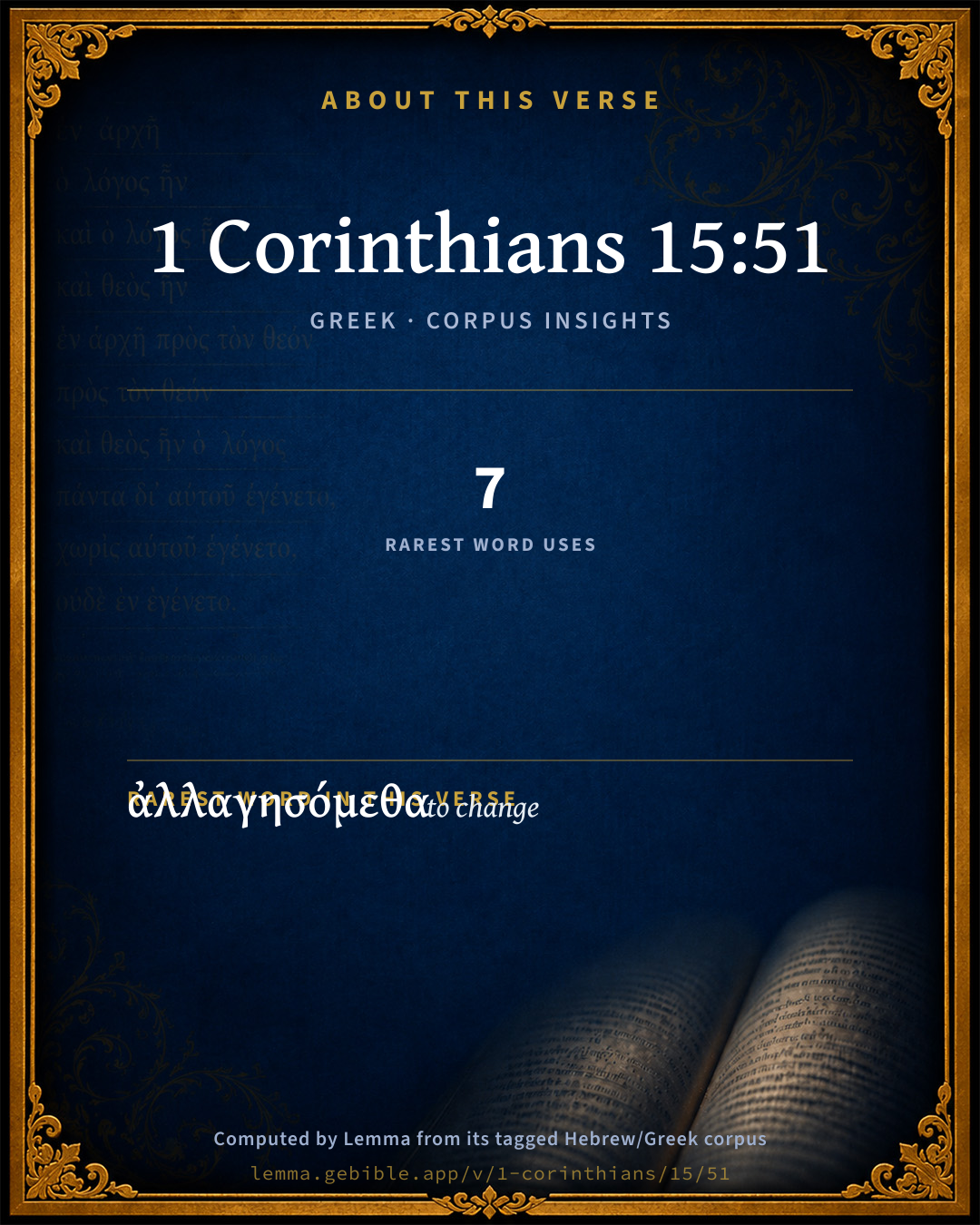
1 Corinthians 15:51

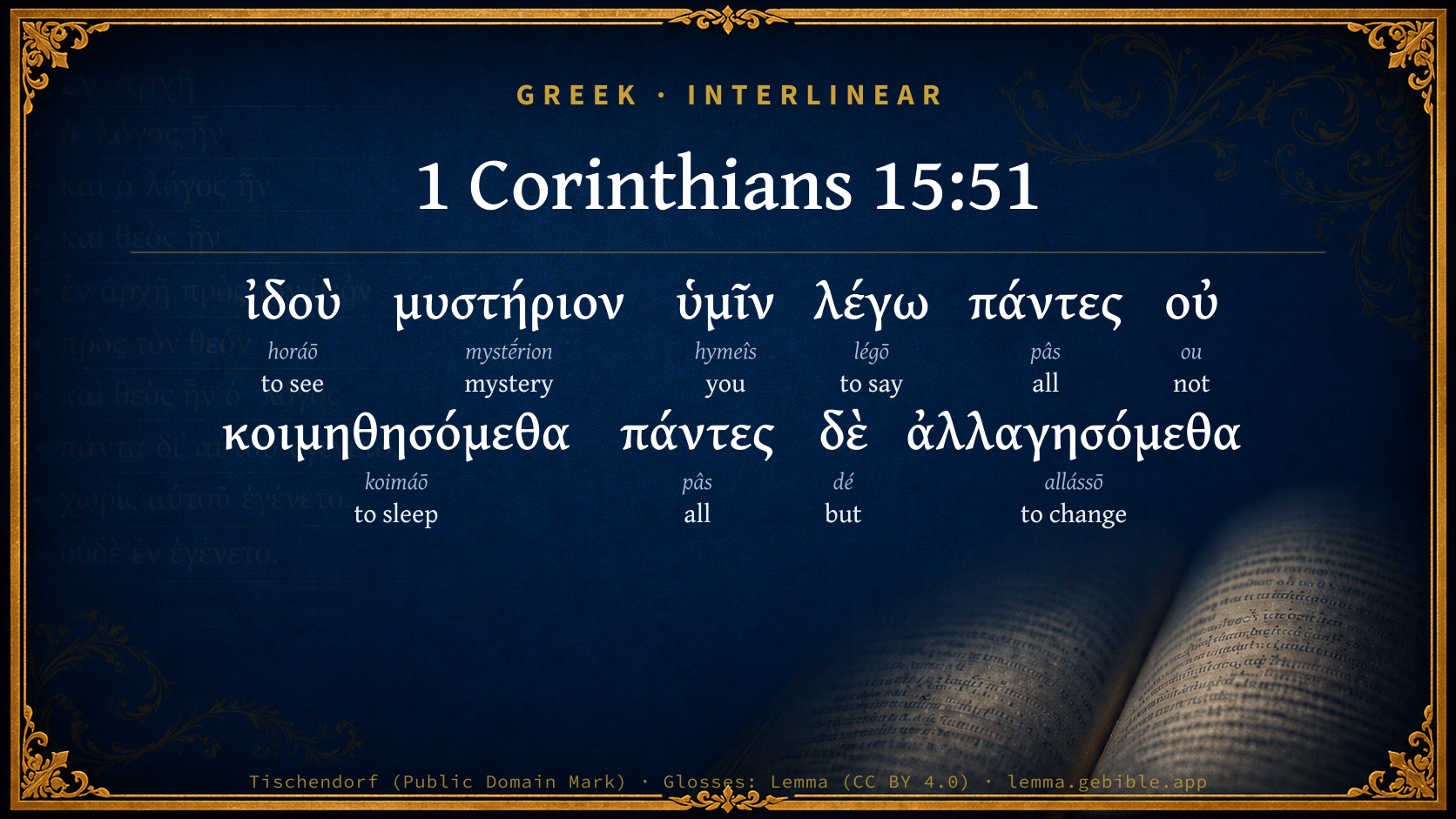
Greek (Tischendorf 8th ed.) 1 Corinthians 15:51 appears in the Greek New Testament. The text above is from the Tischendorf 8th edition. Each word links to its Strong’s number and a concise gloss. Click any word for its full Thayer’s Greek Lexicon entry.
Download image
Cite this verse

1 Corinthians 15:51 (World English Bible). Public Domain. Lemma interlinear Bible study tool, https://lemma.gebible.app/v/1-corinthians/15/51.

Show BibTeX & RIS
BibTeX
RIS
English Translation
Behold, I tell you a mystery. We will not all sleep, but we will all be changed,
World English Bible · Public Domain
Download a study sheet

One document with this verse’s original text, its word-by-word gloss line, the meaning frame, cross-references with their text, attributed commentary, and full source and license credits — printable, and it pastes into notes with its structure intact.

This verse Autodidact and up

Study sheet (.html) Plain text (.txt)

A passage Seminary Student

Up to 50 verses in one chapter. A passage sheet keeps up to 6 commentary sources and 12 cross-references per verse, in the order this page ranks them, and says so on the sheet whenever that leaves anything out. Ask for a single verse and you get the Autodidact verse sheet above.

Everything on this page stays free to read, with no account — the sheet is a download of what is already on screen, not access to it.

Want to remove ads? Support Godless Engineer
Compare translations 3

The same verse in 3 English versions, stacked beneath the original-language interlinear above. Click any original word for its lexicon entry.

Each is an independent rendering of the whole verse — the interlinear is not word-aligned to these translations.

Highlighted words mark where these versions differ — a whole-verse word diff, not a word-by-word alignment.

  • World English Bible Public Domain
    Behold, I tell you a mystery. We will not all sleep, but we will all be changed,
  • King James Version Public Domain
    Behold, I shew you a mystery; We shall not all sleep, but we shall all be changed,
  • unfoldingWord Literal Text CC BY-SA 4.0
    Behold! I tell you a mystery: We will not all fall asleep, but we will all be changed—

unfoldingWord Literal Text — © unfoldingWord, licensed CC BY-SA 4.0. Word-aligned USFM3 via Door43 (git.door43.org/unfoldingWord/en_ult).

Versions to compare (up to 4)

3 of 4 selected

Show all 19 translations

Every available English version of this verse, each an independent rendering of the whole verse.

  • World English Bible Public Domain
    Behold, I tell you a mystery. We will not all sleep, but we will all be changed,
  • Berean Standard Bible Public Domain
    Listen, I tell you a mystery: We will not all sleep, but we will all be changed—
  • Majority Standard Bible Public Domain
    Listen, I tell you a mystery: We will not all sleep, but we will all be changed—
  • King James Version Public Domain
    Behold, I shew you a mystery; We shall not all sleep, but we shall all be changed,
  • American Standard Version (1901) Public Domain
    Behold, I tell you a mystery: We all shall not sleep, but we shall all be changed,
  • Revised Version (1885) Public Domain
    Behold, I tell you a mystery: We shall not all sleep, but we shall all be changed,
  • Geneva Bible (1599) Public Domain
    Behold, I shewe you a secret thing, We shall not all sleepe, but we shall all be changed,
  • Douay-Rheims (1899) Public Domain
    Behold, I tell you a mystery. We shall all indeed rise again: but we shall not all be changed.
  • Young's Literal Translation Public Domain
    lo, I tell you a secret; we indeed shall not all sleep, and we all shall be changed;
  • Literal Standard Version CC BY-SA 4.0
    Behold, I tell you a secret: we indeed will not all sleep, but we will all be changed;
  • Unlocked Literal Bible CC BY-SA 4.0
    Look! I tell you a secret truth: We will not all die, but we will all be changed.
  • unfoldingWord Literal Text CC BY-SA 4.0
    Behold! I tell you a mystery: We will not all fall asleep, but we will all be changed—
  • Darby Bible Public Domain
    Behold, I tell you a mystery: We shall not all fall asleep, but we shall all be changed,
  • World Messianic Bible Public Domain
    Behold, I tell you a mystery. We will not all sleep, but we will all be changed,
  • Webster's Bible Public Domain
    Behold, I show you a mystery; We shall not all sleep, but we shall all be changed,
  • Free Bible Version CC BY-SA 4.0
    Listen, I'm going to reveal a mystery! Not all of us will die—but we will all be changed,
  • Bible in Basic English Public Domain
    See, I am giving you the revelation of a secret: we will not all come to the sleep of death, but we will all be changed.
  • Text-Critical English NT CC BY 4.0
    Behold, I tell you a mystery: We will not all sleep, but we will all be changed,
  • Tyndale New Testament (1534) Public Domain
    Beholde I shewe you a mystery. We shall not all slepe: but we shall all be chaunged

Literal Standard Version (2020), Covenant Press — licensed CC BY-SA 4.0. Text via the HelloAO Bible API (eBible.org). Unlocked Literal Bible (unfoldingWord) — licensed CC BY-SA 4.0. Text via the HelloAO Bible API (eBible.org). unfoldingWord Literal Text — © unfoldingWord, licensed CC BY-SA 4.0. Word-aligned USFM3 via Door43 (git.door43.org/unfoldingWord/en_ult). Free Bible Version, Dr. Jonathan Gallagher — licensed CC BY-SA 4.0. Text via the HelloAO Bible API (eBible.org).

Word by word

More ways to search: Search by grammar → Find every occurrence → Compare this word →

Practice this passage: Drill this verse → Learn its vocabulary →

About this verse

These counts appear in no published source. They are computed here, from the morphology-tagged text and Lemma’s own curated glosses. What Lemma adds →

10
words
9
distinct lemmas
Pauline Epistles
section

Notable vocabulary

The rarest word here is ἀλλαγησόμεθα to change G236 — appearing just 7 times in the whole Greek New Testament.

Shared distinctive vocabulary

ἀλλαγησόμεθα to change G236 occurs in 6 verses of the Greek New Testament. Also found in:

Repetition

A word recurs within this verse:

  • πάντες all G3956 ×2

Cross-references

7

Topical passages linked to 1 Corinthians 15:51 in the Treasury of Scripture Knowledge — connected by theme and wording, ordered by reader-vote popularity; previews shown in the World English Bible.

  • 1 Thessalonians 4:14–17 For if we believe that Jesus died and rose again, even so those who have fallen asleep in Jesus will God bring with him.
  • Philippians 3:21 who will change the body of our humiliation to be conformed to the body of his glory, according to the working by which he is able even to subject all things to himself.
  • 1 Corinthians 15:20 But now Christ has been raised from the dead. He became the first fruits of those who are asleep.
  • Ephesians 1:9 making known to us the mystery of his will, according to his good pleasure which he purposed in him
  • 1 Corinthians 4:1 So let a man think of us as Christ's servants, and stewards of God's mysteries.
  • 1 Corinthians 2:7 But we speak God's wisdom in a mystery, the wisdom that has been hidden, which God foreordained before the worlds for our glory,
  • 1 Corinthians 15:6 Then he appeared to over five hundred brothers at once, most of whom remain until now, but some have also fallen asleep.

Cross-references courtesy of OpenBible.info (CC BY 4.0).

Commentary

Notes on 1 Corinthians 15:51 from classic Christian and Jewish commentators (each source and its license shown beneath its notes). The classic Christian expositions comment on the surrounding passage and are grouped to its opening verse, so a note may address several verses; the Jewish commentaries on the Tanakh (Rashi and others) are per-verse, so they appear only where the commentator wrote on this verse.

Lemma curates 59 commentaries, every one of them public domain or Creative Commons licensed, each selected and text-cleaned for this edition rather than reprinted as found. About our sources →

Whedon's Commentary on the Bible

Daniel D. Whedon

7. Apocalyptic picture of the glorious resurrection, 1Co_15:51-53; triumphal pean, 1Co_15:54-57; and admonitory inference, 1Co_15:58.

51. Behold—Lift up your eyes upon the glorious picture I present.

Show—Utter. The showing was in language.

A mystery—A truth hitherto concealed in the eternal counsels, now revealed to men by me. We—Who are this we? Alford, and other commentators who are earnest to make out that Paul firmly expected the resurrection to occur in his own generation, say that it means Paul and his Corinthian brethren. We think it as comprehensive, at least, as the we of 1Co_15:49, including all the candidates for the glorious resurrection—all who have borne the image of the earthy. And this seems to be a complete reply to all argument drawn from both this we and that in 1Th_4:15. For it shows that St. Paul’s we may cover a whole class—a class in which he may eventually fail to be one.

All—And this all we consider as comprehensive as the all of 1Co_15:22. St. Paul is here meeting the question, How will it be with those alive when Christ descends in judgment?

Be changed—On this change we may note, 1. That it is a change that comes upon and is of the very body then being; the very same matter and substance: 2. That a change does not mean the bringing in any new material: 3. That 1Co_15:53 shows that it consists in the assuming of immortality, with the modifications included therein, upon that very mortal body and no other. We may add that this change illustrates the transition through which man, without sin, would have entered on his full immortality. Death, hades, and the intermediate state, would for him have had no existence. Nay, the “everlasting fire prepared for the devil and his angels,” would have been suffered by devils alone. Man’s great mistake of falling into Satan’s proper inheritance would have been avoided.

Daniel D. Whedon (gen. ed.), Commentary on the Old and New Testaments (1874–1909) — public domain. Text from a community e-Sword module.

Lange's Commentary on the Holy Scriptures

D. Conclusion in reference to those who survive at the advent. Final exhortations

1Co_15:51-58

51Behold, I shew [tell, λέγω] you a mystery; We shall not all sleep [We all shall not sleep, πἀντες οὺ κοιμηθ.44], but we shall all be changed. 1 52In a moment [an atom, ὰτόμω̣], in the twinkling of an eye, at the last trump: for the trumpet shall sound, and the dead shall be raised45 incorruptible, and we shall be changed. 53For this corruptible 54must put on incorruption, and this mortal must put on immortality. So [But, δὲ], when this corruptible shall have put on incorruption,46 and this mortal shall have put on immortality,3 then shall be brought to pass the saying that is written, Death is [was, κατεπόθη] swallowed up in victory. 55O death, where is thy sting?47 O grave [death, 56θάνατε], where is thy victory?4 [But, δὲ] The sting of death is sin; and the strength 57of sin is the law. But thanks be to God, which giveth us the victory4 through our Lord Jesus Christ. 58Therefore, my beloved brethren, be ye steadfast, unmoveable, always abounding in the work of the Lord, forasmuch as ye know [knowing, εἰδότες] that your labour is not in vain in the Lord.

EXEGETICAL AND CRITICAL

1Co_15:51. He now proceeds to reveal to them something of the process of the resurrection. And what he has to say is introduced in a manner solemn, and calculated to awaken attention.—Behold,—The word points to an object presented for inward contemplation, and at the same time extraordinary, q. d, ‘behold, look my words full in the face—they contain a truth which we are slow to recognize, but which is true notwithstanding.’ The thing to be announced he calls—a mystery—not simply something hitherto unknown to the reader, but something ascertained only through a divine revelation, or the illumination of the Spirit (1Co_4:1; 1Co_13:2).—tell I unto you:—This mystery was, that those who are alive at the coming of the Lord will experience a change that shall fit them for participating in the kingdom of God, just as those would who arose from the dead; hence, that that which was said in 1Co_15:49 was applicable also to them. The same truth is set forth in 1Th_5:1-17, save that the idea of a change, which, in the latter text, is only presupposed, is, in our passage, definitely brought to view. In both places he gives his readers to understand that the disclosure made rested upon revelation (1Th_4:15, “by the word of the Lord”).—The received text of our passage has, from the earliest time, created difficulty. 48 It seems to assert that the Apostle expected, not death, but a sudden change both for himself and for all his cotemporaries—a thing not reconcilable with actual events. Hence, οὐ has been put after κοιμηθησόμεθα, connecting it with the following verb; [so Stanley, who renders: “we shall all sleep, but we shall not all be changed”] (besides, some put οὖν before κοιμηθ, which is, perhaps, only a trace of the original position of οὐ); but this reading would be unsuitable by reason of the more exactly defining statement of time, immediately following in 1Co_15:52, which could only be joined to a positive clause. [It would hardly do to say, ‘ we shall not all be changed in a moment, in the twinkling of an eye,’ etc. It was perhaps with a view of obviating this difficulty that the reading ἀναστησόμεθα, we shall arise, [found in D., and adopted by the vulgate], was introduced; but which even in this way betrays its non-authenticity, and, besides, is less sustained. In the case of the received text, πάντες μὲν οὐ κοιμηθησόμεθα, πάντες δὲ ἀλλαχησόμεθα,—there still arises, however, the objection, that the apostle could not assert concerning himself and all his readers, or all Christians of his time that they would not “sleep,” but would rather all “be changed,” [as is implied here by the position of the negative οὐ, which bears directly upon the verb, and not upon the adjective πἀντες all—making it mean, ‘all of us shall not sleep’]. Hence, a trajection of the negative is here assumed, πάντες ον̓, standing for ον̓ πάντες, and the clause taken to be equivalent, to οὐ πάντες κοιμηθ., meaning not all of us shall sleep;’ and ἀλλαγησόμεθα is interpreted in a broader sense, as including the idea of rising from the dead, which is opposed by the stricter signification of the term, and by the more exact intimation given in 1Co_15:52, where it is said that the dead also shall rise. Nor yet can the above-mentioned trajection of the negative be justified on the ground of giving the word πάντες, all, a more emphatic position, or from Num_23:13; Jos_11:13 or Sir_17:30 (where it does not occur); and, besides, the assumption of a various range of meaning for ἀλλαγησόμεθα in such close succession has something arbitrary in it. The same is true also of the expedient of putting οὐ κοιμηθ. not sleep, in a parenthesis, q. d., ‘ we all (shall, indeed, not die, but yet) all shall be changed. [So Hodge, who, as above, broadens the scope of the verb rendered ‘changed,’ so as to denote not simply the transformation of the living, but also the reinvestiture of the dead, thus making it apply to all Christians generally. Stanley is singularly confused here, following Lachmann in his text, and rendering “we shall all sleep; but we shall not all be changed;’ yet, in his note, giving a decided preference for the Rec. Text, and rendering it, “We shall, all of us, not die, but be changed.” In the latter he follows Meyer and Winer (Gr. Gram. Pt. 3 § 61, 4 f.) who insist that the only translation consistent with Greek is as Kling gives it in his version—We shall all not sleep, but we shall be changed,—The intention of the apostle is to answer a question, which would naturally occur to some in view of the declaration that “flesh and blood could not inherit the kingdom of God.” If this were so, it might be asked, what would become of the living? While the dead would rise with new bodies, what would become of them who were expecting to survive till the advent. These are the parties whom he now has solely in his eye, and since the great crisis was supposed to be near at hand, he speaks here in the first person, and says ‘ we.’]. The difficulty in regard to πάντες, all, is relieved by the supposition that he had in mind the sum total of the survivors (among whom, he also reckoned himself), to whom alone the whole context relates. But that the words μὲν δὲ should stand in connection with the same emphatically repeated word πάντες, all, when they appear to relate to the contrast between ‘not sleeping’ and ‘being changed,’ is entirely in accordance with Greek usage (comp. Passow upon the words 1:176, b, above). They had better remain untranslated.—By ‘being changed’ he indicates the immediate transition from the earthly into the heavenly body, without the intervening process of death and the resurrection. This is to take place—In a moment, in the twinkling of an eye,—Both these expressions indicate the same thing, and set forth, in a most striking manner, the instantaneousness of the transition, excluding the possibility of death coming in between, ἄτομον, an indivisible point of time. In this change a prevenient qualification, a preparation for this glorification, by the operation of the Spirit of Christ, is indeed not excluded; it is only asserted that this glorification would take place suddenly.—A second particular relating to the time of this change, is expressed by the words—at the last trump:—ἐν τῇ ἐσχ. σάλπ.ἐν; is used as expressive of the time in which the last trumpet sounds, as in 1Th_4:16, where it is said of the Lord that He will descend from Heaven ἐν σαλπιγγι θεοῦ; “in the trumpet of God;” whereupon the dead will rise. [For this use of ἐν, see Jelf. Gr. Gram. § 622, 2. fin.]. The word σαλπίζειν is used to denote the trumpet blast accompanying the Theophanies, and resounding over the whole region of their manifestation, arousing and shaking all things there (comp. Exo_19:16; Isa_27:13; Zec_9:14). The last trumpet refers to that great Theophany, or Christophany, by which all the revelations of God in this dispensation will be brought to their close. That this will coincide with the seventh trumpet (Rev_11:15), is, by no means, improbable; because, there also John is speaking of the end of the world-power, and the coming in of the kingdom of God and of Christ—an event with which that here mentioned must synchronize. From this, however, we are not to conclude that Paul had in mind the seven trumpets of the Apocalypse, of which he supposed this to be the last; “for it is hardly proper to ascribe the peculiarity of John’s vision to the apostle Paul, as though the doctrine of the latter were moulded by the former.” Burger.—But in no case are we to suppose any allusion here to the seven trumpets, according to which the Rabbis were wont to exhibit the seven stages of the resurrection—the last announcing the instant when the dead were to stand upon their feet—since the apostle furnishes not the remotest hint of the kind. Moreover, to interpret the trumpet sound of those commotions and revolutions which were to introduce and accompany the judgment; or, as Olshausen does, of a powerful all-shaking operation of the Spirit; or, of an all-agitating κέλευσμα, command, or νεῦμα, nod, of God (Theoph.); or indefinitely of some sign that the judgment is to be held, is arbitrary. The trumpet blast, elsewhere spoken of as the signal for battle, (comp. 1Co_14:7), or for assembling, or for judgment, here comes as the signal for the great act of the all-victorious king, who will call his people out from among the quick and the dead into the glory of His heavenly life, and so shall gather them about himself. But Neander says: “We shall not be able to take the statement of the trumpet literally. It denotes the call to the last act of Divine omnipotence.”—for the trumpet shall sound,—σαλπισει is impersonal, it shall sound, like ὕιει, it rains, and the like. It is unnecessary to suppose any definite subject here, whether God, or Christ (comp. “the trump of God,” 1Th_4:16; and “the Lord God shall blow the trumpet,” Zec_9:14), or an angel (comp. Rev_8:2).—The events following upon the sound of the trumpet are introduced by καὶ; first, the resurrection of the dead according to 1Th_4:16, “the dead in Christ shall rise first” (comp. above 1Co_15:23), and that, too, in a state of incorruption (comp. 1Co_15:42).—and the dead shall be raised incorruptible;—then, the change of the living, which, as is shown from what follows, is also a transition into a state of incorruption. [This is in exact accordance with 1Th_4:15. “Those who are alive when Christ comes shall not prevent,” i. e., take the precedence of, “them which are asleep”]. But to take the term “we” as a sort of generalization, by which he did not intend literally to denote himself and his cotemporaries, but only those living at the time of the Advent, and who belonged to an entirely different period, and so, as equivalent to ‘we Christians,’ i. e., those who shall then be alive [as Hodge and others], is entirely arbitrary. It is unquestionable that the apostle, although opposed to all fanciful expectations and designations of time (2 Thes. 11), regarded the second Advent as near, and hoped to survive to it; nor does what is said in 1Co_6:14, at all conflict with this (see above).—The event thus predicted is confirmed by a reference to the necessity of this change, pointing back to 1Co_15:50.—For this corruptible must put on incorruption, and this mortal must put on immortality.—The epithets “corruptible” and “mortal” relate to the human body in its present state; but they are not to be distinguished, as though the former applied to the dead and the latter to the living (Bengel); for that which he designates as a mystery and has just made known, and that whereupon, therefore, the emphasis lies, is, that “we shall be changed.” Hence, he is speaking mainly of the living. To “put on” (ἐνδύσασθαι) a figure borrowed from clothing (comp. 1Co_15:49; 2Co_5:3, “not for that we would be unclothed, but clothed upon”). The maintenance of a personal identity, with a change in the quality of the vesture, is here unmistakably implied; according to de Wette, the figure is one of an inward purification (Luke 26:49; Rom_13:14; Eph_4:24; Col_3:10); according to Osiander of adornment and manifestation of the change—both doubtful. The aorist infinitive indicates the instantaneousness of the process. The repetition of the verb gives emphasis, and preserves the symmetry of the sentence.

1Co_15:54-57. He here announces in a solemn manner, enhanced by the literal repetition of what he has just said, that this event will consummate the victory over the last enemy, and in it will be fulfilled the prophecy which predicts the cessation of all death at that time. [“The argument closes in a burst of almost poetical fervor, (as in the corresponding passage, Rom_8:31).” Stanley].—And when this corruptible shall have put on incorruption, and this mortal shall have put on immortality,—[“a repetition in a triumphant spirit, of the description of the glorious change.” Alford].—then shall come to pass—γενήσεται here expresses the thought elsewhere conveyed by πληροῦσθαι, τελεῖσθαι.—the saying that is written,—The declaration is found in Isa_25:8, in a passage announcing the final consummation of God’s kingdom, and is cited, not according to the LXX., but according to the original Hebrew, except that בִּלַע הַפָּוֶת, he will destroy death, is turned into the passive “is swallowed up;” and לָנֶצַּח is translated as elsewhere in several passages in the LXX., e. g., Amo_1:11; Amo_8:8, εἰς νῖκος, into victory; while it properly means entirely, altogether (comp. Hupfeld on Psa_13:2), which also suits the passage in Isa. (others: “altogether”)—Death is swallowed up into victory.—κατεπόθη the same idea that is expressed in καταργεῖται (1Co_15:26). “It is a remarkable expression, denoting the swallowing up of the all-swallower.” (Vitringa).—Εἰς νῖκος can here be interpreted neither as equivalent to ‘forever,’ nor yet to ‘entirely;’ nor can we take it as an adverb, ‘victoriously’ (Flacius); but it indicates the result of being swallowed up—“into victory,” i. e., so that victory is gained, and the enemy is overcome. To this the following triumphal song is well appended. An argument may be urged against Osiander’s local interpretation of εἰς, (by which victory is personified and represented as a ravenous beast, as though the expression meant ‘swallowed up in the jaws of victory’), from the want of the article, as also from to τὸ νῖκος of 1Co_15:55. Inasmuch as in this whole context death must mean physical death, the doctrine of the restoration of all things, as suggested by Olshausen, has here no support.—The reference to the prophecy fulfilled at the resurrection culminates in a triumphal song, in uttering which, the Apostle seems transported in spirit to the moment of that grand consummation.—Where,—ποῦ, 1Co_1:20; Rom_3:27.—thy sting,—By κέντρον we are not to understand a goad, which death may be supposed to use in tilling his field, since without sin he could have no power over us [Billr. and Scholt.]; nor yet as something which calls out the power of death over us, awakes its slumbering might to tyrannize over us (Olsh.); but death is here figured as a venomous beast, armed with a poisonous, deadly sting—a scorpion, for example, [or a serpent like a viper in allusion to Genesis 3, and Numbers , 21]—O Death!—In this direct address the personification of death comes out more forcibly than in 1Co_15:54.—Where thy victory, O Death?—In this clause the Rec. Text has ἅφη, Hades, the kingdom of the dead, instead of θάνατε repeated. By “victory,” in this case, we would understand the detention in Hades of those who had departed to it; and this would be destroyed if Hades were compelled to give up the dead in a resurrection. But the reading ᾅδη is perhaps a correction made in accordance with the LXX version of Hos_13:14. This passage undoubtedly floated before the mind of the Apostle, and apparently in the form in which it appears in the LXX in so far as we translate the passage, “From the power of Sheol will I ransom them; from death will I deliver them,” thus: “O death, I will be thy plagues; O Grave, I will be thy destruction.” But אֱהִי [translated I in our version] may be also=אַיֵּה, as in Hos_13:10, [where it occurs in the sense of ποῦ, where,] (comp. Fürst, Handwörterbuch, s. v., אֱהִי 1Co_1:30). But instead of דְבָרֶיךָ thy plagues (plural of דֶּבֶר=the mille viæ leti, the thousand ways of death), others appear to have read דָּרְבָנְךָthy sting, (Fürst, s. v., דֶּבֶר); and קָטָבְךָ may be translated thy overthrow, viz., that which thou workest; in which case it is=τὸ νῖκος σου, thy victory, (comp. Schmieder on Hos_13:14). This prophecy opens for us a bright view into the last glorious epoch, like as Isa_25:8; and the thought mounts from the state of not dying, implied in the loss of death’s sting, to that of resurrection from the dead (Meyer Ed. 3). If we now unite this passage in Isa. to the citation from Hosea, which is not inadmissible, then we have here a combination of texts as in Rom_11:8, and eleswhere. [Hodge says the Apostle does not quote Hosea, but expresses an analogous idea in analogous terms].—To this triumphal song there is appended, first, a short explanation respecting the sting of death, which serves to confirm the statement that death is swallowed up (1Co_15:56). “It affords,” says Meyer, “a firm doctrinal basis for the certainty of victory over death, furnished in the Gospel system.”—The sting of death is sin;—The parallel here between κέντρον and δύναμις. might seem to indicate the propriety of taking the former in the sense above given, viz., that of a goad, implying that that which set death in motion, and rendered it active, is sin. But there is no necessity for this; and the connection with 1Co_15:55, where “sting” being parallel with “victory,” cannot denote that by which death is goaded, does not allow of it. The meaning is, rather, that death, like a scorpion, has a sting, a fatal power imparted to it by means of sin (comp. 1Co 6:23; 1Co_5:12). But in relation to sin he adds—and the strength of Sin is the law.—This has been understood, either of the sin-awakening, and the sin-strengthening power of the law in the sense of Rom_7:7 if.; or of its condemning power (2Co_3:6 ff.; chap. 9); or both ideas have here been combined (Osiander). The first interpretation is the correct one. As death has no sting, no fatal power, when sin is done away, and therefore is destroyed, as death; so sin has no power, is become weak and nullified, when the law is removed. The law is indeed the revelation of the Divine will in the form of a command or prohibition, which both presupposes, and calls out the opposition of man against God. So long as this stands in authority, sin, and accordingly death, has power. And here the question arises, Does the Apostle intend to infer from the nullification of the power of death at that period, that then sin and the law are done away? Or does he presuppose this as a matter evident of itself, and from it draw a conclusion in support of the destruction of death, and for the resurrection? Or does he mean to indicate that sin and the law stand in the way of this consummation? The following verse most readily connects itself with the last supposition; since here God is praised as the one who, through Jesus Christ, ensures a victory over every thing which obstructs the grand consummation; or, more exactly, the victory over death, of which mention has been before made; since in communion with Him we are delivered from the law, and, together with this, from the power of sin, and hence also from death (Rom_8:1). Thus is this complete victory exhibited to us in connection with the redemption secured by Christ, which is nothing less than a deliverance from law and sin; and the whole is referred back to God, the Author of our redemption, with ascriptions of thanksgiving.—But thanks be to God which giveth us the victory through our Lord Jesus Christ.—The present participle τῷ διδόντι, he giving us, may be taken as a vivid representation of the future in the form of the present, showing the absolute certainty of the thing; or it may denote the simple fact considered by itself apart from all idea of time; or, finally, it may represent God to us as the One who continually gives us the victory by taking away the condemnation of the law, and so destroying the power of sin in a life of faith, which is nothing less than a fellowship with Christ, who is the end of the law, and the destroyer of sin’s power. [“This He is: 1. Because He has fulfilled the demands of the law. It has no power to condemn those who are clothed in His righteousness. “There is no condemnation to those who are in Christ Jesus.” (Rom_8:1). Christ, by His death, hath “destroyed him that had the power of death, that is, the devil, and delivered them who, through fear of death, were all their lifetime subject to bondage” (Heb_2:14-15). That is, in virtue of the death of Christ, by which the demands of justice are satisfied, Satan, the great executioner of divine justice, has no longer the right or power to detain. If, therefore, it be the law which gives sin its reality and strength, and if sin gives death its sting, He who satisfies the law destroys the strength of sin, and consequently the sting of death. It is thus that Christ deprives death of all its power to injure His people. It is for them disarmed and rendered as harmless as an infant. 2. But Christ not only gives us this victory through His justifying righteousness, but also by His almighty power, He new creates the soul after the image of God; and, what is here principally intended, He repairs all the evils which death had inflicted. He rescues our bodies from the grave, and fashions them like unto His glorious body, even by that “power whereby He is able to subdue all things unto Himself” (Php_3:21). Hodge].

1Co_15:58. He concludes with an earnest exhortation to stedfastness and to advancement in Christian activity. And this which he introduces with an endearing epithet—My beloved brethren,—he joins first to a thankful allusion to the God who gives us the victory through Jesus Christ; and thus the whole exposition comes at last to its close. This is evident also from the corroborative clause.—wherefore—since God gives us the victory through our Lord Jesus Christ.—be ye stedfast unmovable,—suffer not yourselves to be shaken from the foundation of your faith and hope by any person or thing. “Ἐδραῖοι, stedfast,—‘do not turn yourselves from the faith of resurrection;’ ἀμετακίνητοι, unmovable,—‘be not led away by others.’ Bengel.—To this still another quality is annexed.—always abounding in the work of the Lord,—This is not to be taken as subordinating what precedes, as Meyer, who interprets: “so that ye distinguish yourselves in furthering the work of the Lord by your stedfastness in the Christian faith and life;” but it is still another feature of good conduct resulting from the conviction spoken of in 1Co_15:57, viz., excelling in activity for the cause of Christ. By ἔργοντοῦκυρίου we are not to understand, either Christ’s work in a preëminent sense, i.e., the church (as the Romanists); nor yet a divine and blessed life (de Wette); but the work which Christ Himself undertook in obedience to the Father’s commission, and which He has commanded His followers to carry forward. In this are comprised both the proclamation and spread of the Gospel and the furtherance of the common weal by the reformation of individuals and of society. “It is something in which every Christian should coöperate through word and work in his own sphere.” Burger. To such activity he encourages them by a general assurance of success.—knowing that your labor is not in vain in the Lord.—By κόπος he means an activity full of effort, involving burdens and self-denials for the advancement of the Redeemer’s kingdom. All this were vain and fruitless if our salvation were not to be consummated in triumph, if no victory over death and no resurrection were to be hoped for. But since this hope is sure, we know that our efforts will not fail of their goal,—that the glorious end will be reached at last which will compensate us for all our toil. The phrase “in the Lord” belongs, not to the subject (Meyer), but to the predicate, or rather to the whole clause. The profitableness of our labor is established in Christ. In fellowship with Him is its objects surely attained.

[Obs. 1. In order to appreciate the force of the Apostle’s reasoning throughout this whole chapter, it will be necessary to connect it with that general scheme of historical development in which his great argument moves. In speaking of the “other world,” or “the world to come,” it is common to understand by these expressions some mysterious realm existing outside of, or apart from the material world into which we are introduced by death, and where departed spirits are supposed to be now living. Not unfrequently are these terms used interchangeably with “eternity.” On such an interpretation, it is not easy to see why the Apostle should make a future happy existence so contingent upon the resurrection; or, indeed, what necessity there is for a new body, if in our disembodied state we are so completely introduced into fellowship with Christ, and the glories of heaven. Nor can we discover a reason why the resurrection should not take place with every individual immediately after death, according to the theory of Bush and the Swedenborgians. To keep the soul, that would “not be unclothed but clothed upon,” waiting for centuries before it can assume its new vesture, seems almost like an arbritrary and needless appointment. But the difficulty here presented is all removed when we come to reflect that the term translated “world” (αἴων) is not a designation of space, denoting any particular realm in which people live, but of time. It properly means an age—a distinct cycle of years through which certain great transactions similar in kind are carried on to their consummation, and which is to be followed by another of a different kind. Now it is through a series of these ages, or aeons, that Paul considers the work of the world’s redemption to be progressively carried on, all separated by certain great crises. The “present age” is that period which dating from the Fall is to last until the second coming of Christ. At this point the “future age” will begin to date, and this will be the age of redemption completed—the age of the Messiah’s Kingdom and Glory. And the expression for ‘eternity’ is generally in the plural—‘ages’, or ‘ages upon ages,’ to signify the ceaseless procession of time, under which conception eternity was ordinarily represented.

From this exposition will be seen the impropriety of speaking of souls at death passing at once into “the other” or “future world” or age. That future world or age has not yet come in; and no one can be said to enter it until Christ appears to set up His Kingdom. It is then only that the earth will be in readiness for the reception of the risen saints. And inasmuch as the glory which they are waiting for is to be found here, it will be seen why a resurrection is necessary,—why they want a body at all, and a glorified body, since it is in this as their organ that they will be fitted to dwell in a glorified earth and enjoy the felicity of that age. According to Paul’s theory, man is not to be separated from this lower creation of which he forms a part and of which he is the lord. The world was viewed by him as one complete whole, termed in Romans 8 “the creature” (κτίσις) which as it had been involved in the curse of the Fall was also to be restored in its completeness as the theatre of the Redeemer’s glory. But the time of its restoration could not occur, until all the redeemed of earth were brought in and the number of the elect completed. It is then that the Redeemer will appear to set up His Kingdom and around Him the whole church will be glorified together, none “preventing,” i.e., anticipating the other in the fruition of future glory.

On such a scheme we discover a foundation for the Apostle’s argument which identifies a blessed immortality, with the fact of a future resurrection, and seemingly ignores the possibility of an existence in some purely spiritual state, such as Pagan philosophy dreams of. The process of redemption underlying this scheme of history has been well represented by Fairbairn (Hermeneutical Manual, p. 367) under four successive stages and developments indicated by four fundamental gospel terms. “We see it beginning in the region of the inner man—in the awakening of a sense of guilt and danger, with earnest strivings after amendment (μετάνοια, repentance); then, through the operation of the grace of God, it discovers itself in a regenerated frame of spirit, the possession of an essentially new spiritual condition (παλιγγενεσία, regeneration) this once found, proceeds by continual advances, and fresh efforts to higher and higher degrees of spiritual renovation (ἀνακαίνωσις, renewing), while according to the gracious plan and wise disposal of God, the internal links itself to the external, the renovation of soul paves the way for the purification of nature, until, the work of grace being finished, and the number of the elect completed, the bodies also of the saints shall be transformed, and the whole material creation shall become a fit habitation for redeemed and glorified saints (αποκατάστασις, restoration). What a large and divine-like grasp in this regenerative scheme! How unlike the littleness and superficiality of man! How clearly be-speaking the profound insight and far-reaching wisdom of God! And this not merely in its ultimate results, but in the method also and order of its procedure! In beginning with the inner man, and laying the chief stress on a regenerated heart, it takes possession of the fountain head of evil, and rectifies that which most of all requires the operation of renewing agency. As in the moral sphere, the evil had its commencement, so in the same sphere are the roots planted of all the renovation, that is to develop itself in the history of the Kingdom. And the spiritual work once properly accomplished, all that remains to be done shall follow in due time; Satan shall be finally cast out; and on the

ruins of his usurped dominion, the glories of the new creation shall shine forth in their eternal lustre.”

For a list of works on this whole subject of the nature and destiny of the soul, the reader may consult the appendix to the History of the Doctrine of a Future Life, by Alger, where nearly five thousand works on this engrossing theme are enumerated and described by Ezra Abbot. Among the best of the moderns are Delitzsch, Psychologie, 2. Ed.; Bleek, Seelenlehre; Heard, on the Tripartite nature of man. Consult also articles in Bib. Sacra, 17:303; 13 p. 159].

DOCTRINAL AND ETHICAL

The risen saint’s retrospect and triumph. From the heights of a salvation completed the spirit looks back, in thought, on the dangers and difficulties through which it is to pass, and then, in contrast, to the deliverance provided for it in its several essential particulars; and such a review awakens it anew to the praise of God’s grace which through the power of Christ removed all obstacles, and gave it that victory in which it is to obtain the fulfilment of all the divine promises. But from this also there springs the earnest determination to remain stedfast in the maintenance of the grace conferred, and constantly to excel in furthering the great word of salvation in the joyful confidence that every sincere effort will result in securing at last a perfect communion with Christ who in His own person has overcome all obstacles and invites His followers to share in His victory.

The attainment of our salvation proceeds through three inseparably connected stages—the doing away: 1. of the law; 2. of sin; 3. of death. The law is done away (so far as it calls out and intensifies an opposition to God), through the revelation of the perfect love of God, who sent His only-begotten Son, the holy and righteous One, to take upon himself and endure the curse of the law, or to become sin and a curse for us, and so to redeem us from curse and from judgment, and to secure our justification. Thus, sin is forgiven; we are accepted in the beloved; and a loving child-like communion is established which involves a participation in the divine glory. Through the manifestation of this love, the law is changed from being a summary of stringent exactions and prohibitions enforced by fearful threatenings, into a proclamation of the will of a Father now reconciled to us in Christ, and who is thus recognized as meaning kindness in every requirement, who forbids nothing but what is injurious, enjoins nothing but what is necessary and beneficial, obliges us to suffer nothing but what is subservient to our best good, and disciplines us because He loves us.—By this means, also, the power of sin is broken, and instead thereof a disposition to love awakened, which grows ever stronger and stronger, masters more and more perfectly all opposing tendencies and impulses, and brings the whole life with all its organs and powers more resolutely and undividedly, more willingly and joyfully, into the service of God’s holy love, and thus promotes the sanctification of the whole man.—By this same means also death is robbed of its sting. For believers who pursue after holiness, death appears no longer as an extinction of life causing pain and fear, and making us dreary and desolate; but as an entrance into the rest of Christ, which leads to a glorious renewal of life (comp. Joh_8:51; Joh_11:25 ff.; Rom_6:8 ff; Rom_8:11; Rom_8:38 ff.), in which our perfect victory over death, and, together with this, the consummation of our redemption, is made gloriously manifest.

HOMILETICAL AND PRACTICAL

Starke:

1Co_15:51. Hed.: Who then will fear the last great day! To become whole at once, is this a plague? In an instant mortal will be swallowed up of life.—At the resurrection men will have indeed new, yet not other bodies; their own, only changed.

1Co_15:53. What after all is beauty of body, and the finest garments; all must molder;—the resurrection will, for the first time, clothe us in beautiful and lasting array.

1Co_15:54 f. There are three it is finished: 1. at the creation,—for then all was very good; 2. at the redemption—achieved through the blood of Christ; and that was better; 3. at our sanctification and the eternal joy and glory which follow thereupon; which is the best of all. Then our mouth will be full of laughter and our tongue full of praise.—Death lies prostrate, and has now no more power. Life leaps aloft and exclaims: ‘Thus subdued, where, O Death, art thou now? and where that sting wherewith thou didst give men their deadly wound?’—Believers are now delivered from all dying.’ Wondrous triumph!

1Co_15:57. Through His perfect obedience and atoning work Christ has rendered satisfaction for our sins, and conquered death. Of this fact His victorious resurrection is a witness. This victory becomes ours through faith, and gives us the power to overcome sin and death likewise. This will be made manifest when Christ has raised our bodies to glory.—No one can confidently expect this victory but he who can say, ‘my faith also has overcome the world both within and without me’ (1Jn_5:4 f.).—What can be more comforting to a Christian than that there should be granted him such a victory over physical death through Christ—that from being the punishment of sin it should become to him a blessing, a happy exit from all misery, and a joyful entrance into glory, and so, a triumph?

1Co_15:58. So long as we do not seek to become steadfast in Christianity, to be well grounded in faith, upon the Rock Christ, and to be immoveable against all the storms of temptation, so long will all labor in the practice of Christianity be, for the most part, useless. Indeed, not so much as earnest labor, as idleness and sleepy existence.

Berlenb. Bibel:—If we do not put on Jesus Christ and the new man from day to day, then the corruptible and the new incorruptible humanity of the glorified Saviour will not be so speedily fused together. He who would share in this much wished for change must have his heart changed here.—The art of transformation God alone understands. What happens now is only preparatory. Hence, no one must regard such divine operations and purifications as a burden.

1Co_15:54. The victory of Christ will then first be fulfilled in us when the corruptible shall have put on incorruption (regeneration in a complete sense Mat_19:28). This victory has already taken place; but it must be fulfilled in all for whom it has been achieved separately and actually, both in this world and in the next. It will be actually begun in each one, when, in his soul, sin and its wages, death, have been subdued in victory over sin, through Christ’s new resurrection power, and, on the other hand, an innocent divine life has been begotten in us.

1Co_15:55. A consolation which is now concealed from our eyes, in order that we may walk by faith. Death must be disarmed of its means of hurt if we can appropriate this language.

1Co_15:56. This he introduces after his song of triumph in order that we may not jubilate after too wild a sort. If the sting of death is to be entirely renounced, sin itself must be once for all entirely annihilated.—The power of sin shows itself in the torments of conscience and in its urging men against their will and better resolutions to do what they know to be wrong. This power, especially that of accusation and condemnation, which every penitent experiences at his conversion is given to sin by the law, when it shows to him what he has merited from God, in all his thoughts, and words, and deeds. And although now such a person earnestly resolve to deliver himself from sin and begin to guard himself against his old habits, and to strive against his evil inclinations, he will nevertheless not often succeed. The law of sin in the members strives against the spirit, so that we do not that which we gladly would.

1Co_15:57. God gives us victory, one after the other. If we at any time have already overcome any lust, this happened not from any power of nature, but of grace which has been secured through our Lord Jesus Christ. He who has this grace strong in him may boast in the Lord and in the power of His might.—What boots it, though we daily console ourselves with all these sayings respecting Christ’s victory, and are yet not daily obedient to him?—Our enemies are not overcome for us in any such way that they need not also be overcome in us through the power of Christ.

1Co_15:58. Firm and immoveable shall we become, if we earnestly hold to the centre.—Striving, watching, praying, the work of faith and the labor of love—this is what will preserve God to us. Let us only be found diligent therein.—The work is ours in respect to its exercises; it is not ours in respect to its origin.

Rieger:

1Co_15:51 ff. Every divine truth furnishes its own contribution to faith, partly, in preparing the heart for it; partly, in actually awakening it; partly, in promoting its growth; partly, in furthering its activity and fruitfulness; and partly, in leading it on to its glorious end.

1Co_15:54 ff. God’s work cannot remain unfinished. The patient waiting of believers, and the sighing of God’s creatures will not remain unheard. But for this, we must give God time.—The power of hope brought to light we have to enjoy in the extremities of death; but the song of victory: O, Death, where is thy sting? will chiefly be sung amid the joys of the resurrection. There is no encouragement in the scriptures for a haughty contempt of death. Even in the New Testament, all comfort in reference to it, is derived from communion with Christ, and from that fellowship in love, in which death can effect no break nor separation.

1Co_15:56. Faith bows itself beneath the judgment of God; seizes the shield of the hope of salvation; and every where shows that it has more to do with God, and His honor, and the sanctification of His name and the fulfilment of His work, and that it is enough for us that with all this, God has intimately in woven our salvation also. The sting, by which Death can do us the most hurt, is sin, or the sentence, that death through sin has come into this world, and is now its wages. And the law on its awakening in the conscience, first shows this enemy in its full strength. Do not, however, try to avoid it on this account. He who shrinks from entering into the pain and anguish occasioned by the law, will be deficient in consolation and joyful thanksgiving to God. To become free from the fear of death at a bound, would to many a one seem right; but the victory given us through Christ, has its stages. We are called out of sin into grace, die unto the law in its power, come into subjection to Christ Jesus and the rule of His Spirit, learn thereby how there is no condemnation for those who are in Christ, and also what is revealed to our hope even for this mortal body. Therefore (1Co_15:58), he who has so learned to know sin and grace, death and life, and discovers in himself the germ of eternal life through the knowledge of our Lord Jesus Christ, can stand fast against all inward fickleness, be immovable against external temptations, and avoid all weariness, and instead, rather abound more and more in the work of the Lord, faith in whom is the spring of every thing else.

Heubner:

1Co_15:54 f. The Christian experiences indeed the natural dread of death, but not its inward terrors. Through Christ he becomes stronger than nature. Death has for him no more terror, because it brings to him no destruction of being, no judgment, no pain and punishment. Such a song of triumph no wisdom of this world can strike up. Only the fact of redemption tunes us to such peans.

1Co_15:56. That which makes death so fearful is the consciousness of sin, and the fear of damnation. But sin is terrible on account of the holy law of God. This law shows us at once its guilt and its curse.

1Co_15:57. With this song of praise the Christian celebrates the victory over these great enemies, Death, Sin and Satan. These enemies Christ has already overcome, and celebrated His triumph in the unseen world (Col_2:15). Without his aid, no one could overcome these mighty enemies. This victory is not our merit, but a grace given us by God through Christ. The atonement, and the hope of eternal life are closely connected. Everything which Christ has is ours, and this should be our daily medicine.

1Co_15:58. The work of our Lord is, a. what works in us; b. what we bring to pass in His strength. No pure, humble work is ever in vain. The Lord’s work succeeds, and he does not suffer his followers’ work to fail.

W. F. Besser:

1Co_15:55. For him whom hell no more frights with its torments there is a victory over hell also at the last day, when Christ will be revealed as the Man who has the keys of death and of hell. Whence now have we the right, and derive we the courage to sing such a song of triumph as we feel welling up even in this our mortal body? It stands not in our power to avoid the sting of death; but what is impossible with us has been made possible by God in Christ.

1Co_15:58. In order to become stedfast through faith in the hope of the Gospel, and to stand immovable in the citadel of Apostolic doctrine we should seek the aid of the Holy Ghost. But in the Christian life there is no firm endurance without constant watchfulness. If we would abound in the work of the Lord, we must allow the work of His great love to operate in us, and stand in faithful co-operation with that love, in order that every one according to his gift and office, may devote himself to the edification of the Church, with the word of truth and with the labor of love (1Co_12:14). He who works in the Lord, and directs his eye to the day of harvest say’s with Paul: “I die daily,” and quiets his heart in patience, being joyful in hope.

Gerock:—Faith’s song of triumph at the grave of the risen: “O, Death, where is thy sting?” Thy sting whereby thou, a. robbest me me of my dearest (1Co_15:52); b. and threatenest my own body (1Co_15:51); c. and frightenest my poor soul (1Co_15:56); d. and destroyest the work of my hands (1Co_15:58).

Luther:—“Thanks be unto God,” etc. This may we also sing, and so keep perpetual Easter, that we may extol and praise God for such a victory, which was not achieved through us, nor won in fight (for it is too high and great), but has been graciously given to us of God—who pitieth our sorrows out of which none could help us, and sent unto us His son, and let Him undertake the conflict. Sin, Death and Hell has He overcome, and given unto us the victory, so that we may say: ‘It is our victory,’ so that we may accept it with earnestness, and not give God the lie, neither be found ungrateful for it, but maintain it with firm faith in our hearts, and strengthen ourselves therein, and always sing of this victory in Christ, and go on, joyful therein until we see Him also in our own body. To this, may God help us through His own dear Son, and to Him be all glory and praise forever and ever. Amen!”

[Sermons.—Manning:

1Co_15:51. The Commemoration of the faithful departed.—Newton: 1Co_15:51. The general resurrection. I. The mystery. 1. Beyond the reach of fallen man to discover without a revelation from God. 2. Still unintelligible without a further revelation through the influence of the Spirit. II. What to be expected—universal changes. III. Suddenness of event—in a moment. IV. The grand preceding signal—the trumpet sound. Improvement. 1. A joyful day to believe 2. In view of it what manner of men ought we to be.

1Co_15:54. Death swallowed up in victory. How predicable of Christians. I. They were once dead in law—but forgiven. II. Once dead in sin—but quickened. III. Once under the tyranny of Satan—but made conquerors over him. IV. Once subject to woes and sufferings—but sorrow and sighing are turned to joy and gladness. V. Once reaped the bitter fruits of sin—but grace triumphs over every evil.—1Co_15:55-57.—Triumph over death and the grave. I. Death armed with a powerful sting. 1. What the sting Isaiah 2. How sharpened by the law. II. Death disarmed by the death of Christ. III. The doxology—emphatic in every word. 1. Thanks to God—His work. 2. Who giveth us the victory—a victory indeed. 3. Through Jesus Christ. This song best sung when the whole redeemed are collected together.—Howe:

1Co_15:54. The Christian’s triumph over death. I. The explication of its rational import. 1. The import—God’s general determination to put a perpetual end to death. a. Death as here spoken of supposes a certain limited subject, viz.: such as are Christ’s. b. It extends to the whole of that subject—the inner and the outward man. c. Presupposes a war. d. Where this war ends not in victory on the one side, it ends in victory on the other. 2. The reasonableness of the import. a. God’s glory requires it. b. The felicity of the redeemed requires it. II. The use of the doctrine. 1. If asserted to be believed. 2. Full of comfort; a. in reference to departed friends; b. in reference to our own death. III. A monition to us since spoken only of some and not of all. IV. This doctrine should cause us to abstain from rash censures of providence that God lets death reign over so great a part of His creation for so long a time. John Logan:—1Co_15:55-57. The Christian’s victory over death. Christ sets us free: I. From the doubts and fears that are apt to perplex the mind from the uncertainty in which a future state is involved. II. From the apprehensions of wrath proceeding from the consciousness of sin. III. From the fears that arise in the mind upon the awful transition from this world to the next. Spurgeon:—1Co_15:56-57. Thoughts on the last battle. I. The sting of death—Sin. 1. Because it brought death into the world. 2. Because it is that which shall make death most terrible. 3. If sin in the retrospect be the sting of death, what must sin in the prospect be? II. The strength of sin—the Law. 1. In this respect that the law being spiritual it is quite impossible for us to be without sin. 2. It will not abate one tittle of its stern demands. 3. For every transgression it will exact a punishment. III. The victory of faith. 1. Christ has taken away the strength of sin in that He has removed the law. 2. In that, He has completely satisfied it by His perfect obedience. 3. By having brought life and immortality to light through the resurrection.

Footnotes:

[44]1Co_15:51.—The Rec. is satisfactorily authenticated, [πάντες μέν οὐ κοιμθησόμεθα, πάντες δὲ ἀλλαγησόμεθα]. The origin of the other readings is easily explained from the apparent difficulty of this. Lachmann [and Stanley] have πάντες [μὲν] κοιμηθησόμεθα, οὐ πάντες δὲ ἀλλαγ. Others have πάντες μὲν ἀναστησόμεθα, οὐ πάντες δὲ ἀλλαγ. [The μὲν has in its favor A. C. (2d. hand), D. (2d and 3d hand), E. F. G. K. L. Sinait., Vulg., later Syr., Copt., and a few eccles. writers, hut against it B. C. (1st hand), D. (1st hand), the Syr. (Pesch.), Aeth., and Orig. Jerome testifies that in his day all the Latins had omnes quidem resurgemus, but that the Greeks were divided between omnes dormiemus, and non omnes dormiemus. Augustine also mentions that both Greeks and Latins were divided about it. It was very likely to have originated in an attempted conformity with the subsequent δὲ. For placing the οὐ before κοιμηθ., so that it may qualify that word, and not after, with the comma before it, so that it may quality ἀλλαγ., we have B. D. (2d and 3d hand), E. K. L., almost all the cursives, with the Goth., Syr., (both), Copt., Aeth., Arab. versions, and many of the best Greek and Latin writers. Among the other MSS. there is an almost inextricable confusion, suggesting that they are not reliable. They appear to have sprung from the idea that otherwise Paul would assert (contrary to fact) that he, and those to whom he wrote, were not to die. See all the readings discussed elaborately in Reiche and Tischendorf.—C. P. W.]

[45]1Co_15:52.—Lachmann has ἀναστήσονται, but the evidence for that reading is not quite convincing. [It is sustained by A. D. E. F. G., 2 cursives, Orig. (one ms.), Chrys. (one ms.), Damasc., Theophyl. (marg.); but B. C. K. L. M., Sinait., several copies of the Latin, Vulg. (resurgunt), Orig. (5 times). Dialog., Chrys. (one ms.), Cyr., Theodt., have ἐγερθήσονται.—C. P. W.]

[46]1Co_15:54.—The whole sentence τὸ φθαρτὸν τ. ἐνδύσ. αφθαρσ. και is omitted in C. (1st hand), Sinait., (1st hand), 2 cursives, the Vulg., Goth., Copt., Aeth. (both), Marcion (in Epiph.), Athan., Iren. (Lat.), Hilar., Aug. (once), Ambrst., Fulg., Oros., Bede. By A., the Arm., version, and some unimportant MSS., it is inserted after τὸ θνητ. τ. ἐνδύς. ἀθαν.; D. (1st hand, not in the Lat. 1st hand), entirely omits this latter sentence. Doubtless by homœoteleuton.—C. P. W.]

[47]1Co_15:55.—The κέντρον and νῖκος are arranged in the reverse order by a number of good MSS. [B. C. J. M. Sinait. (1st hand), Vulg., Copt. Aeth., Arm., Slav., Eus., Athan., Didym., Cyr., Damasc, Iren. (Lat.), Tert., Jer., Ambr.] This was done probably, to make the sentence conform to the Septuagint. Such, too, was doubtless the origin of the substitution of ᾀδη for the second θάνατε [in A. (2d hand), K. L. M. Sinait., (3d hand), several cursives, the Goth., Syr. (both), Orig., Athan. (once), Cyr., Epiph. For θάνατε twice we have B. C. D. E. F. G. I., 2 cursives, the Ital., Vulg., Copt., Aeth., Arm., Euseb., Athan. (once), Nyss., Iren. (Lat.), Tertul., Cypr., Ambr., August. Wordsworth, gives as a reason for the change of ᾅδη into θάνατε, that the primitive Christians, who would not be surprised at a personification of θάνατος, would have been shocked at such a bold apostrophe as the Apostle here derived from his Hebrew Scriptures to Hades, on the ground that it would countenance the heathen notion of a personal deity so named.—C. P. W.]

[48][Calvin remarks: “There is here no difference in the Greek MSS. [which is true, so far as those he had to deal with went], but in the Latin versions there are three different readings. The first is, We shall, indeed, all die, but we shall not all be changed. The second is, We shall, indeed, all rise again, but we shall not all be changed. [This is the reading of the Vulgate followed by Wickliffe and the Rheim’s version.] The third is, We shall not, indeed, all sleep, but we shall all be changed.” This diversity he ascribes to the fact, “that some readers, who are not the most discerning, dissatisfied with the true reading, ventured to conjecture a reading which was more approved by them”].

Lange's Commentary on the Holy Scriptures (Critical, Doctrinal, and Homiletical), ed. John Peter Lange, English translation edited by Philip Schaff (1864–1880) — public domain. Text from a community e-Sword module.

Tyndale Open Study Notes

Tyndale Open Resources

15:51 The Good News reveals the previously unknown secret of resurrection. • We will not all die: Paul might have expected the future resurrection in his own lifetime (cp. 15:52; 1 Thes 4:15, 17).

Tyndale Open Study Notes — © Tyndale Open Resources, licensed CC BY-SA 4.0. Text via the HelloAO Bible API.

Bengel's Gnomon

Johann Albrecht Bengel

1Co 15:51. Ὑμῖν, you) Do not suppose, that you know all things.—λέγω, I say) prophetically: 1Co 13:2: 1Th 4:15.—πάντες μἐν οὐ κοιμηθησόμεθα, πάντες δὲ ἀλλαγημσόμεθα, we shall not all sleep, but we shall all be changed) The Latins read with general consent; “Omnes quidem resurgemus, sed non omnes immutabimur,” We shall indeed all rise, but we shall not all be changed, and Tertullian and Rufinus and others besides follow this reading. And yet the Latin translator does not seem to have read the Greek different from our Greek copies, but to have expressed the sense, as he indeed understood it, rather than the words. For this is his common practice in this epistle, as when 1Co 12:10; 1Co 12:28, he translated γλωσσῶν, words, and on the other hand 1Co 14:10 φωνῶν, tongues, he seems therefore to have translated οὐ κοιμηθησόμεθα, as if it had been οὐ μενοῦμεν κοιμηθέντες, that is, we shall rise again. Hence it followed, that he presently after supplied not, for the sake of the antithesis, as he had suppressed not, chap. 1Co 9:6: and here also Tertullian follows his footsteps. Moreover from the Latin the word ἀναβιώσομεν has been fabricated in the Veles. and ἀναστησόμεθα (a word which Paul does not use in this whole chapter) is a correction by the first interpolator of the Clar. MS. Some of the Greeks have πάντες μὲν οὖν κοιμηθησόμεθα, ἀλλʼ οὐ πάντες ἀλλαγησόμεθα; whence from μὲν οὐ, μὲν οὖν was easily produced. Indeed in this verse the apostle wished to deny nothing whatever concerning the change, but to affirm it, and to bring forward the mystery. The reading of the text remains, which is not unknown even to the Latin copies, quoted by Jerome from Didymus.[149] Moreover each of the two clauses is universal. All indeed, namely we, from whom the dead are presently after contradistinguished, shall not sleep; but all, even we the same persons, shall be changed; the subject of each of the two enunciations is the same: comp. πᾶς οὐκ, taken universally, 1Co 16:12; Rom 9:33; Eph 5:5; Rev 22:3; Act 11:8. The expression does not so much refer to the very persons, who were then alive, and were waiting for the consummation of the world, but to those, who are to be then alive in their place, 1Co 15:52 at the end, 1Th 4:15, note.—ἈΛΛΑΓΗΣΌΜΕΘΑ, we shall be changed) While the soul remains in the body, the body from being animal [natural] will become spiritual.

[149] Tisch. reads πἀντες οὐ κοιμηθησόμεθα, πάντες δὲ ἀλλαγησομεθα, with B (from its silence), some Greek MSS. mentioned in Jerome 1,794c, 810c, also MSS. of Acacius and Didymus in Jerome 1,795e, 799b, both Syr. and Memph. Versions, Orig. 1,589f, and quoted in Jerome 1,804c. Lachm. reads πάντες [μὲν] κοιμηθησόμεθα, οὐ πάντες δὲ ἀλλαγησόμεθα, with CGg, Orig. 2,552bc, also Greek MSS. mentioned in Jerome 1,794c, 810c, also Didymus mentioned in Jerome 1,795d, and in 1,798b, Acacius, bishop of Cæsarea, who mentions it as the reading of very many MSS. A reads οἱ πάντες μὲν κοιμηθ. οἱ πάντες δὲ ἀλλαγ.—ED.

Bengel's Gnomon of the New Testament — English translation (T&T Clark, Edinburgh, 1860) — public domain. Text from a community e-Sword module.

Meyer's Critical & Exegetical Commentary

Heinrich August Wilhelm Meyer

1Co_15:51. After Paul has with the weighty axiom in 1Co_15:50 disposed of the question ποίῳ δὲ σώματι ἔρχονται, which he has been discussing since 1Co_15:35, a new point, which has likewise a right withal not to be left untouched in this connection, however mysterious it is, now presents itself for elucidation, namely, what shall happen in the case of those who shall be yet alive at the Parousia. This last, as it were, appended part of his discussion begins without transition in a direct and lively way (ἰδού), designated too as μυστήριον, as dogma reconditum, the knowledge of which Paul is conscious that he possesses by ἀποκάλυψις.[90] See on Rom_11:25.

ΠΆΝΤΕς ΜῈΝ Οὐ ΚΟΙΜ. Κ.Τ.Λ.] is held by the commentators to mean: we shall indeed not all die, but all shall be changed. They either assume a transposition of the negation (so the majority of the older expositors, following Chrysostom, also Heydenreich, Flatt, Osiander, Reiche, and van Hengel); or they hold that Paul had ἀλλαγ., upon which all the emphasis lies, already in his mind in connection with the first ΠΆΝΤΕς: We allshall not indeed die until then, but notwithstandingall shall be changed, Billroth, whom Olshausen, de Wette, Maier, follow; or (so Rückert) the meaning is: die indeed we shall not all, etc., so that, according to this view, in pure Greek it would be said: κοιμηθησόμεθα πάντες μὲν οὐ.[91] Three makeshifts, contrary to the construction, and without proof or precedent, in order to bring out a meaning assumed beforehand to be necessary, but which is incorrect, for Paul after 1Co_15:52 can only have applied ἀλλαγησόμεθα to those still living at the Parousia, and not, as according to that assumed meaning must be the case, to those already dead. The result of this is, at the same time, that the subject of οὐ κοιμ. and ἀλλαγ. must be Paul himself, and the whole of those who, like him, shall yet witness the Parousia (comp. 1Th_4:17 : ἡμεῖς οἱ ξῶντες), as could not but be clear to the reader from ἀλλαγ. Hence we must interpret strictly according to the order of the words: we shall indeed all not sleep (i.e. shall not have to go through the experience of dying at the Parousia, in order to become sharers in the resurrection body, but shall remain alive then), but shall, doubtless, all be changed.[92] Regarding the subject-matter, comp. 1Co_15:53; 1Th_4:15; 1Th_4:17. This interpretation alone, according to which Οὐ, in conformity with the quite ordinary use of it (comp. immediately Οὐ ΔΎΝΑΤΑΙ, 1Co_15:50), changes the conception of the word before which it stands into its opposite (Baeumlein, Partik. p. 278), is not merely verbally correct, but also in keeping with the character of a μυστήριον; while, according to the usual way of taking it, the first half at least contains nothing at all mysterious, but something superfluous and self-evident. Our interpretation is adopted and defended by Winer since his fifth edition (p. 517, ed. 7 [E. T. 695]), comp. Ewald and Kling;[93] but it is contested by Fritzsche, de conform. Lachm. p. 38; Reiche, Commentar. crit.; de Wette, van Hengel, Hofmann, Hoelemann, neue Bibelstud. p. 276 ff., who, it may be added, looks upon the passage as regards text and interpretation as a still uncertain one, but decidedly denies that there is here or in 1 Thessalonians 4 an expectation of the Parousia as nigh at hand. The objections raised against our view are insufficient; for (a) something absurd would result from it only on the supposition of the subject being all Christians or Paul and all his readers; (b) to make πάντες refer to the whole category of those among whom Paul reckoned himself, that is, to all who should still live to see the Parousia, of whom the apostle says that they shall not attain to the new body by the path of death, is not only not inadmissible, but is established in accordance with the context by the predicate ἀλλαγησ., which does not include the process of the resurrection (1Co_15:52); (c) the LXX. Num_23:13 cannot be used to support the reference of οὐ to ΠΆΝΤΕς, for in the words of that passage: ΠΆΝΤΑς ΔῈ Οὐ ΜῊ ἼΔῌς, the wellknown use of Οὐ ΜΉ testifies irrefragably in favour of the connection of the negation, not with ΠΆΝΤΑς, but directly with the verb. Equally unavailable is the LXX. Jos_11:13, where by ΠΆΣΑς ΤᾺς ΠΌΛΕΙς ΤᾺς ΚΕΧΩΜΑΤΙΣΜΈΝΑς ΟὐΚ ἘΝΈΠΡΗΣΕΝ it is declared of the whole of the hill-cities that Israel left them unburnt, so that the negation thus belongs to the verb alongside of which it stands. In Sir_17:30 also the words οὐ δύναται (it is impossible) belong to each other; in Joh_3:16; Joh_6:29, again, the mode of expression is quite of another kind (in opposition to Buttmann, neut. Gr. p. 106 [E. T. 121]). In our text the repetition of πάντες ought to have sufficed of itself to prevent misapprehension of the plain meaning: all we shall at the return of the Lord, in order to our entering glorified into His kingdom, not need first to fall asleep, but shall all be changed living (1Co_15:52), so that our ΨΥΧΙΚῸΝ ΣῶΜΑ shall become a ΠΝΕΥΜΑΤΙΚΌΝ.

[90] Not a half confession that now there comes a private opinion (Krauss, p. 169), which he only with reluctance gives to the public. Comp. also, as against this view, 1Th_5:15 : ἐν λόγῳ κυρίου.

[91] Comp. Hofmanns earlier interpretation (in the Schriftbew. II. 2, p. 654): Collectively we shall not sleep, but we shall be changed collectively. Now (heil. Schr. d. N. T.) the same writer follows Lachmanns reading, which, however, he punctuates thus: πάντες μὲν κοιμηθησόμεθα οὔ, πάντες δὲ ἀλλαγ., whereby, on the one hand, the universality of the dying is denied, whereas on the other the universality of the change is affirmed. Against this interpretation, apart from the critical objections, it may be urged, as regards the sense, that ἀλλαγ. cannot be predicated of the dead along with the rest (see ver. 52), and as regards linguistic usage again, that to place the οὐ after the conceptions negatived by it (Baeumlein, Partik. p. 307 f.) is foreign throughout to the New Testament, often as there was opportunity for placing it so.

[92] εἰς ἀφθαρσίαν μεταπεσεῑ͂ν, Chrysostom.

[93] Comp. also Holtzmann, Judenth. u. Christenth. p. 565.

Meyer — Critical and Exegetical Commentary on the New Testament — English translation by Peter Christie, edited by Frederick Crombie (T&T Clark, 1880) — public domain. Text from a community e-Sword module.

Expositor's Greek Testament

ed. W. Robertson Nicoll

1Co 15:51-52 . This bodily change, indispensable in view of the incompatibility just affirmed, is the object of a momentous revelation communicated to P., to which he calls our earnest attention: “Lo, I tell you a mystery!” On μυστήριον , see note to 1Co 2:1 . P. began by demonstrating the historical fact of Christ’s resurrection (1Co 15:1-11 ); he then reasoned upon it, in its bearings on religion and nature (1Co 15:12-49 ); now he adds a new specific revelation to crown his teaching. In doing so, P. challenges his opponents in the right of his inspiration and authority, hitherto in the background in this chap. 1Co 15:15 only vindicated his honesty .

In 1Co 15:51 b ἀλλαγησόμεθα (required by 50 and repeated in 52) bears the stress; to it the first πάντες (reiterated with emphasis) looks forward; οὐ κοιμηθησόμεθα is parenthetical: “We shall all not sleep, but we shall all be changed”. ἀλλάσσω is interpreted by ἐνδύομαι of 1Co 15:53 and μετασχηματίζω of Phi 3:21 . As much as to say: “Our perishable flesh and blood, whether through death or not, must undergo a change”. That such a change is impending for the dead in Christ is evident from the foregoing argument (see esp. 22 f., 36, 42 f.); P. adds to this the declaration that the change will be universal, that it will extend to those living when the Last Trumpet sounds (1Co 15:52 ), amongst whom he then hoped that many of the present generation would be found: cf. 1Co 1:7 ; also 1Th 4:15 ff., where the like is affirmed ἐν λόγῳ Κυρίου . This hope dictates the interjected οὐ κοιμηθησόμεθα , which disturbs the grammar of the sentence and necessitates the contrastive δὲ attached to the repeated πάντες (see txtl. note; Wr [2564] , p. 695; also El [2565] ad loc [2566] ). There is no need to suppose a trajection of οὐ (as if for οὐ πάντες , or οὐ μὲν πάντες κοιμηθησ .), nor any diff [2567] between the sense of ἀλλαγησ . in 1Co 15:51-52 : the certainty of change in all who shall “inherit incorruption” is declared (1Co 15:51 ), and the assurance is given that while this change takes place in “the dead” who are “raised incorruptible,” at the same time “we” (the assumed living) shall undergo a corresponding change (52; cf. 2Co 5:2 ff.). Thus in “all” believers, whether sleeping or waking when Christ’s trumpet sounds, the necessary development will be effected (1Co 15:53 f.). The critical moment is defined by three vivid phrases: ἐν ἀτόμῳ (cl [2568] Gr [2569] , ἐν ἀκαρεῖ ), ἐν ῥιπῇ ὀφθαλμοῦ ( in ictu oculi , Vg [2570] ; in a twinkling ), ἐν τῇ ἐσχάτῃ σάλπιγγι the first two describing the instantaneousness , and the last (with allusion perhaps to the saying of Mat 24:31 : cf. 1Th 4:16 ) the solemn finality of the transformation. The former idea is emphasized, possibly, to preclude the fear of a slow painful process. The σάλπιγξ was the wartrumpet, used for signals and commands ( cf. ἐν κελεύσματι , 1Th 4:16 ); and σαλπίσει ( sc . ὁ σαλπιγκτής ) is indef. in subject, according to military idiom ( cf. Xen., Anab ., I., ii., 17). 1 Thess. iv. identifies the “trumpet” with the “archangel’s voice”: any such description is of course figurative.

[2564] Winer-Moulton’s Grammar of N.T. Greek (8th ed., 1877).

[2565] C. J. Ellicott’s St. Paul’s First Epistle to the Corinthians .

[2566] ad locum , on this passage.

[2567] difference, different, differently.

[2568] classical.

[2569] Greek, or Grotius’ Annotationes in N.T.

[2570] Latin Vulgate Translation.

The Expositor's Greek Testament, edited by W. Robertson Nicoll (1897–1910) — public domain. Text from a community e-Sword module.

Godet's Commentaries

Frédéric Louis Godet

Vv. 51, 52. “Behold, I show you a mystery; we shall not all sleep, but we shall all be changed, 52. in a moment, in the twinkling of an eye, at the last trump: for the trumpet shall sound, and the dead shall be raised incorruptible, and we shall be changed.”

The word ἰδού, behold, is a call to attention, and the term μυστήριον, mystery, justifies the call. It here denotes a special point in God’s plan, which the apostle could only know by revelation; comp. the ἐν λόγῳ κυρίου, by the word of the Lord, 1Th 4:15.

Of the three readings presented by the documents in the second part of 1Co 15:51, the reading of the Sinaïticus and the Alexandrinus would signify, that “we shall all die until Christ come again, but then we shall not all participate in the glorious resurrection granted to believers.” This idea is absolutely away from the line of the apostle’s present thought. It is a mistake to introduce here the distinction between those who are saved and those who are not. Perhaps it is the error made in φορέσωμεν which continues here, as if the matter in question were a practical exhortation. The one thing Paul wishes to explain is what will take place in believers who shall be alive at that time. The same holds of the Western reading in the Cantabrigiensis, and the Itala: “We shall all be raised, but we shall not all be changed.” Paul would thus remind his readers that along with the resurrection of the righteous, there is also that of the wicked, which however will not be a change, that is to say, a glorious transformation. This thought is still more wide of the context than the preceding. Moreover, the two readings and the two ideas are both condemned by 1Co 15:52; for in this verse it is not the saved and the condemned who are contrasted, but the living transformed and the dead who shall be raised. Hofmann has attempted to make this last reading admissible by connecting the negative οὐ with the first proposition. The meaning would be: “Undoubtedly we shall not all be raised (those who have not passed through death), but we shall all be changed, either by resurrection or by transformation.” But in this case the end of 1Co 15:52 would be merely a superfluous repetition; then the position of the negative οὐ at the end of the first proposition (πάντες μὲν ἀναστησόμεθα οὐ) is a form without example in the New Testament.

There remains the reading of the T. R., which has on its side the Vaticanus, the Peschito, and the Byz., according to which the apostle says: “We shall not all die, — there will be living Christians when the Lord comes again,—but we shall all require to be changed: living believers by transformation, the dead by resurrection. For it is impossible to enter into the kingdom of glory with this earthly body, composed of materials subject to corruption” (1Co 15:50). This idea is obviously connected in the closest possible way with that of 1Co 15:50, and leads directly to that of 1Co 15:52. There is therefore no room for doubt as to the correctness of this reading. Moreover, Reiche has clearly proved that it was the prevailing reading down to Origen, and that variants do not begin to appear till about the end of the 3rd century (see Heinrici). — Meyer has raised two difficulties, not to the reading in itself, but to the meaning it gives. According to him: (1) this meaning would have required the negative οὐ to be placed before πάντες, all, and not before the verb; for, strictly speaking, the clause means, not: “Some only shall die, not all,” but: not a single Christian shall die; (2) the verb ἀλλαγησόμεθα, we shall be changed, cannot, according to 1Co 15:52, contain the two notions of resurrection and transformation; it denotes only the second. Meyer therefore thinks that the meaning is this: “All of us (whether myself, Paul, or the other believers presently alive) shall not have to pass through death; there is not one of us who shall die; but yet we must all be changed (by transformation).” If we are resolved to make Paul guilty of an absurdity, it is enough indeed thus to press the form of the phrase. But it is amply proved that in the New Testament, as in the translation of the LXX., the position of the οὐ is not so rigorously observed as in the classic style, a fact arising from the well-known Hebrew usage of connecting with the person the negative relating to the verb; comp. Rom 3:20. Thus Num 23:13, Balak, meaning to say to Balaam: “Thou shalt see part of the Israelites, but thou shalt not see them all,” expresses himself in these terms: μέρος τι ὄψει, πάντας δὲ οὐ μὴ ἴδῃς, which, taken strictly, would mean: “All of them thou shalt not see,” that is to say: Thou shalt see none of them; a sense evidently contrary to Balak’s thought. On the other hand, Jos 11:13 and Rom 12:4, which are sometimes quoted, seem to me to prove nothing at all. For the meaning of the verb ἀλλάσσεσθαι, to be changed, see on 1Co 15:52.

Vv. 52. Paul here describes the change which must infallibly be wrought: he distinguishes the two forms in which it will take place. The two expressions ἄτομος, an indivisible moment, and ῥιπὴ ὀφθαλμοῦ, literally: a movement of the eyelid, denote the suddenness with which the event will happen. Then the apostle indicates the signal by which it will be proclaimed: the last trump. It has been alleged that he had in mind a real trumpet; as if the apostle could have imagined that the sound of a metal instrument could penetrate to the ears of the dead reduced to dust! He thereby understands a Divine signal, the nature of which is incomprehensible, and which he describes by a figure taken from Israelitish usages. It was enjoined on the sons of Aaron, Num 10:2-10, to sound the trumpet in order to call the people together, to strike their tents, or to announce the feast. Now the Advent is the time of the most solemn reunion, of the last departure, of the most glorious feast. This signal is called in 1Th 4:16: “an archangel’s voice, a trump of God.” On Sinai the presence of the Lord and of His angels was manifested by noises similar to the sound of the horn. Jesus Himself made use of the figure of the trumpet to indicate the signal which shall gather together His elect from the four corners of the earth. By calling this trumpet the last, Paul does not refer either to the seven trumpets of Jericho, or to the seven of the Apocalypse, or to the seven which the Rabbins have imagined, and which, according to them, must give the signal for each of the seven phases of the act of resurrection. Neither does the term signify, as has been thought, the trumpet which brings in the last phase of the earthly economy. The term last necessarily supposes trumpets anterior to this. I think the apostle means by it the manifestations of the Divine will given to the beings of the invisible world, and on which depend the decisive crises of the kingdom of God on the earth; comp. Zec 9:14. The trumpets of the Apocalypse come under this category, but they do not exhaust it.

The apostle adds σαλπίσει γάρ, for the trumpet shall sound, and it has been thought that he does so to materialize the signal. It has not been perceived that the words are closely connected with what follows, and that they serve to indicate how completely simultaneous shall be the signal with its double effect mentioned in the two following propositions: the resurrection of dead believers and the transformation of believers still in life.

There is no difficulty in taking the word shall be changed here in a more restricted sense than in 1Co 15:51; for here it is no longer contrasted with sleeping, but with being raised. Resurrection and transformation being the two forms of the renewal of the body, the verb ἀλλαγῆναι, to be changed, may either comprehend both of them, or specially denote the second, when it requires a particular term.

By the pronoun we, the apostle understands all believers who shall be alive at the time of Christ’s return, and he ranks himself with them contingently; for as he does not know its precise date, it is natural for him, being among the living, to put himself rather among them than in the other class. To rank himself with the dead would have been to say that the Advent would not happen till after his death, and consequently so far to fix its date. In the parallel passage of Thessalonians (1Co 4:15) he explains himself more clearly: “We,” says he, “that are alive, are left unto the coming of the Lord.” These last words are remarkable. If they are not altogether superfluous, they must serve to define the preceding expression: “We that live,” in the sense: “Those of us believers that are alive, that remain, not then, but at the time of the Advent.” That Paul was not sure of being one of these appears from 1Co 15:30-31; then from 1Co 6:14, where he ranks himself among the raised; and from Php 1:20-21; Php 2:17, where he speaks of his death as an impending possibility. Paul knew that, but not when, Christ should return; and he also knew that, according to Christ’s own precept, every believer should live in the attitude of a servant waiting for his master, and be ever ready to receive him (Luk 12:36). Here we see the servant: nothing could be more in keeping with this direction of the Lord than the position taken by the apostle in our passage.

Thus has been demonstrated the possibility of the resurrection, and, as an appendix and confirmation, the necessity of a transformation even for those who shall not have had to pass through the dissolution of death. Now the apostle places the reader face to face with this great hope in its entirety, and closes his dissertation on the subject by celebrating the hope, uttering, as it were, a discourse in a tongue, with himself for an interpreter.

Frédéric Louis Godet — Commentaries on Luke, John, Romans, and 1 Corinthians — English translation (T&T Clark, Edinburgh, 1870s–1890s) — public domain. Text from a community e-Sword module.

Hodge's Commentary on Romans, Ephesians & First Corinthians

Charles Hodge

1Co_15:51

Behold, I shew you a mystery; We shall not all sleep, but we shall all be changed,

A mystery; something revealed, and which could not otherwise be known, Mat_13:11; 1Co_4:1, and often elsewhere. What is here expressed by saying, I show you a mystery, is in 1Th_4:15 expressed by saying, This I say unto you by the word of the Lord, i.e. by divine revelation. The revelation which Paul now declares, and to which he calls special attention by the word, Behold! is, that all are not to die, but all are to be changed, i.e. so changed that their corruptible body shall be rendered incorruptible. The common text is, πάντες μὲν οὐ κοιμηθησόμεθα, the negative being connected with the verb, so that the literal sense would be, all are not to die. This is said of all whom Paul addressed. The apostle tells them all that they are not to die. To avoid this impossible sense, for Paul certainly did not mean to assure the Corinthians that it had been revealed to him that none of them should die, most of the older commentators assume in common with our translators a not unusual trajection of the negative particle, πάντες οὐ standing for οὐ πάντες. Others explain the verse thus: We all shall indeed not die (before the resurrection) but we shall all be changed. It is said this is contrary to the context, inasmuch as being changed is something peculiar to those who should be alive at the coming of Christ, and is not affirmed of the dead. This, however, is contrary to the fact. Paul had said, v. 50, that flesh and blood could not inherit the kingdom of God. All, therefore, who enter that kingdom, whether they die before the second advent or survive the coming of Christ, must be changed. And that is the fact which Paul says had been revealed to him. Those who died before the advent would not fail of the blessings of Christs kingdom, and those who should be alive when he came, would not be left in their corruptible bodies. Both should be changed, and thus prepared for the heavenly state.‹28› Comp. 1Th_4:15-17. The modern commentators, both German and English, understand the apostle as expressing the confident expectation that he and others of that generation should survive the coming of Christ. Though we (who are now alive) shall not all die, we shall all be changed. But

1. This is altogether unnecessary. The we all includes all believers who had lived, were living, or ever should live. There is nothing either in the form of expression or in the context to limit it to the men of that generation. In the same way Paul says in 1Th_4:15, We that are alive at the coming of the Lord shall not prevent them that are asleep. This does not imply that he expected to be alive when Christ came. In his second Epistle to the Thessalonians he warns them against the expectation of the speedy advent of Christ, telling them that a great apostasy and the revelation of the Man of Sin were to occur before that event.

2. The plenary inspiration of the sacred writers rendered them infallible in all they taught; but it did not render them omniscient. They could not err in what they communicated, but they might err, and doubtless did err, as to things not included in the communications of the Spirit. The time of the second advent was not revealed to them. They profess their ignorance on that point. They were, therefore, as to that matter, on a level with other men, and may have differed in regard to their private conjectures on the subject just as others differ. It would not, in the least, therefore, encroach on their authority as infallible teachers, if it should be apparent that they cherished erroneous expectations with regard to that about which they professed to know nothing. Knowing that Christ was to come, and not knowing when he was to come, it was perfectly natural that they should look on his advent as constantly imminent, until it was revealed that certain events not yet accomplished, were to occur before Christ came.

But all this is very different from any didactic statement that he was to come within a certain period. Paul might exhort Christians to wait and long for the coming of the Lord; but he could not tell them by the word of the Lord that he and others then living would be alive when he came. This would not only be teaching error, but it would be claiming divine authority, or a special revelation, for that error. It is, therefore, only at the expense of all confidence in the inspiration of the apostle that the exposition above mentioned can be adopted.

Charles Hodge — Commentary on Romans (1835), First Corinthians (1857), and Ephesians (1856) — public domain. Text from a community e-Sword module.

Geneva Bible (1599)

Geneva Bible translators

He goeth further, declaring that it shall come to pass that they which shall be found alive in the latterday, shall not descend into that corruption of the grave, but shall be renewed with a sudden change, which change is very requisite: and that the certain enjoying of the benefit and victory of Christ, is deferred unto that latter time.

A thing that hath been hid, and never known hitherto, and therefore worthy that you give good care unto it.

Geneva Bible (1599) marginal notes — public domain. Text via Bolls.life.

Matthew Henry's Commentary

To confirm what he had said of this change,

I. He here tells them what had been concealed from or unknown to them till then - that all the saints would not die, but all would be changed. Those that are alive at our Lord's coming will be caught up into the clouds, without dying, Th1 4:11. But it is plain from this passage that it will not be without changing from corruption to incorruption. The frame of their living bodies shall be thus altered, as well as those that are dead; and this in a moment, in the twinkling of an eye, Co1 15:52. What cannot almighty power effect? That power that calls the dead into life can surely thus soon and suddenly change the living; for changed they must be as well as the dead, because flesh and blood cannot inherit the kingdom of God. This is the mystery which the apostle shows the Corinthians: Behold, I show you a mystery; or bring into open light a truth dark and unknown before. Note, There are many mysteries shown to us in the gospel; many truths that before were utterly unknown are there made known; many truths that were but dark and obscure before are there brought into open day, and plainly revealed; and many things are in part revealed that will never be fully known, nor perhaps clearly understood. The apostle here makes known a truth unknown before, which is that the saints living at our Lord's second coming will not die, but be changed, that this change will be made in a moment, in the twinkling of an eye, and at the sound of the last trump; for, as he tells us elsewhere, the Lord himself shall descend with a shout, with a voice of the archangel, and with the trump of God (Th1 4:16), so here, the trumpet must sound. It is the loud summons of all the living and all the dead, to come and appear at the tribunal of Christ. At this summons the graves shall open, the dead saints shall rise incorruptible, and the living saints be changed to the same incorruptible state, Co1 15:52.

II. He assigns the reason of this change (Co1 15:53): For this corruptible must put on incorruption, and this mortal must put on immortality. How otherwise could the man be a fit inhabitant of the incorruptible regions, or be fitted to possess the eternal inheritance? How can that which is corruptible and mortal enjoy what is incorruptible, permanent, and immortal? This corruptible body must be made incorruptible, this mortal body must be changed into immortal, that the man may be capable of enjoying the happiness designed for him. Note, It is this corruptible that must put on incorruption; the demolished fabric that must be reared again. What is sown must be quickened. Saints will come in their own bodies (Co1 15:38), not in other bodies.

III. He lets us know what will follow upon this change of the living and dead in Christ: Then shall be brought to pass that saying, Death is swallowed up in victory; or, He will swallow up death in victory. Isa 25:8. For mortality shall be then swallowed up of life (Co2 5:4), and death perfectly subdued and conquered, and saints for ever delivered from its power. Such a conquest shall be obtained over it that it shall for ever disappear in those regions to which our Lord will bear his risen saints. And therefore will the saints hereupon sing their epinikion, their song of triumph. Then, when this mortal shall have put on immortality, will death be swallowed up, for ever swallowed up, eis nikos. Christ hinders it from swallowing his saints when they die; but, when they rise again, death shall, as to them, be swallowed for ever. And upon this destruction of death will they break out into a song of triumph.

1. They will glory over death as a vanquished enemy, and insult this great and terrible destroyer: "O death! where is thy sting? Where is now thy sting, thy power to hurt? What mischief hast thou done us? We are dead; but behold we live again, and shall die no more. Thou art vanquished and disarmed, and we are out of the reach of thy deadly dart. Where now is thy fatal artillery? Where are thy stores of death? We fear no further mischiefs from thee, nor heed thy weapons, but defy thy power, and despise thy wrath. And, O grave! where is thy victory? Where now is thy victory? What has become of it? Where are the spoils and trophies of it? Once we were thy prisoners, but the prison-doors are burst open, the locks and bolts have been forced to give way, our shackles are knocked off, and we are for ever released. Captivity is taken captive. The imaginary victor is conquered, and forced to resign his conquest and release his captives. Thy triumphs, grave, are at an end. The bonds of death are loosed, and we are at liberty, and are never more to be hurt by death, nor imprisoned in the grave." In a moment, the power of death, and the conquests and spoils of the grave, are gone; and, as to the saints, the very signs of them will not remain. Where are they? Thus will they raise themselves, when they become immortal, to the honour of their Saviour and the praise of divine grace: they shall glory over vanquished death.

2. The foundation for this triumph is here intimated, (1.) In the account given whence death had its power to hurt: The sting of death is sin. This gives venom to his dart: this alone puts it into the power of death to hurt and kill. Sin unpardoned, and nothing else, can keep any under his power. And the strength of sin is the law; it is the divine threatening against the transgressors of the law, the curse there denounced, that gives power to sin. Note, Sin is the parent of death, and gives it all its hurtful power. By one man sin entered into the world, and death by sin, Rom 5:12. It is its cursed progeny and offspring. (2.) In the account given of the victory saints obtain over it through Jesus Christ, Co1 15:56. The sting of death is sin; but Christ, by dying, has taken out this sting. He has made atonement for sin; he has obtained remission of it. It may hiss therefore, but it cannot hurt. The strength of sin is the law; but the curse of the law is removed by our Redeemer's becoming a curse for us. So that sin is deprived of its strength and sting, through Christ, that is, by his incarnation, suffering, and death. Death may seize a believer, but cannot sting him, cannot hold him in his power. There is a day coming when the grave shall open, the bands of death be loosed, the dead saints revive, and become incorruptible and immortal, and put out of the reach of death for ever. And then will it plainly appear that, as to them, death will have lost its strength and sting; and all by the mediation of Christ, by his dying in their room. By dying, he conquered death, and spoiled the grave; and, through faith in him, believers become sharers in his conquests. They often rejoice beforehand, in the hope of this victory; and, when they arise glorious from the grave, they will boldly triumph over death. Note, It is altogether owing to the grace of God in Christ that sin is pardoned and death disarmed. The law puts arms into the hand of death, to destroy the sinner; but pardon of sin takes away this power from the law, and deprives death of its strength and sting. It is by the grace of God, through the redemption which is in Christ Jesus, that we are freely justified, Rom 3:24. It is no wonder, therefore, (3.) If this triumph of the saints over death should issue in thanksgiving to God: Thanks be to God, who giveth us the victory through Christ Jesus, our Lord, Co1 15:57. The way to sanctify all our joy is to make it tributary to the praise of God. Then only do we enjoy our blessings and honours in a holy manner when God has his revenue of glory out of it, and we are free to pay it to him. And this really improves and exalts our satisfaction. We are conscious at once of having done our duty and enjoyed our pleasure. And what can be more joyous in itself than the saints' triumph over death, when they shall rise again? And shall they not then rejoice in the Lord, and be glad in the God of their salvation? Shall not their souls magnify the Lord? When he shows such wonders to the dead, shall they not arise and praise him? Psa 88:10. Those who remain under the power of death can have no heart to praise; but such conquests and triumphs will certainly tune the tongues of the saints to thankfulness and praise - praise for the victory (it is great and glorious in itself), and for the means whereby it is obtained (it is given of God through Christ Jesus), a victory obtained not by our power, but the power of God; not given because we are worthy, but because Christ is so, and has by dying obtained this conquest for us. Must not this circumstance endear the victory to us, and heighten our praise to God? Note, How many springs of joy to the saints and thanksgiving to God are opened by the death and resurrection, the sufferings and conquests, of our Redeemer! With what acclamations will saints rising from the dead applaud him! How will the heaven of heavens resound his praises for ever! Thanks be to God will be the burden of their song; and angels will join the chorus, and declare their consent with a loud Amen, Hallelujah.

Matthew Henry's Commentary on the Whole Bible (1708–1710) — public domain (CC PDM 1.0). Text via the HelloAO Bible API.

Jamieson, Fausset & Brown

Robert Jamieson, A. R. Fausset & David Brown

Behold--Calling attention to the "mystery" heretofore hidden in God's purposes, but now revealed.

you--emphatical in the Greek; I show (Greek, "tell," namely, by the word of the Lord, Th1 4:15) YOU, who think you have so much knowledge, "a mystery" (compare Rom 11:25) which your reason could never have discovered. Many of the old manuscripts and Fathers read, "We shall all sleep, but we shall not all be changed"; but this is plainly a corrupt reading, inconsistent with Th1 4:15, Th1 4:17, and with the apostle's argument here, which is that a change is necessary (Co1 15:53). English Version is supported by some of the oldest manuscripts and Fathers. The Greek is literally "We all shall not sleep, but," &c. The putting off of the corruptible body for an incorruptible by an instantaneous change will, in the case of "the quick," stand as equivalent to death, appointed to all men (Heb 9:27); of this Enoch and Elijah are types and forerunners. The "we" implies that Christians in that age and every successive age since and hereafter were designed to stand waiting, as if Christ might come again in their time, and as if they might be found among "the quick."

Jamieson, Fausset & Brown — Commentary Critical and Explanatory on the Whole Bible (1871) — public domain (CC PDM 1.0). Text via the HelloAO Bible API.

Adam Clarke's Commentary

Verse 51. I show you a mystery] That is, a thing which you have never known before. But what is this mystery? Why, that we shall not all sleep; we shall not all die; but we shall all be changed: of this the Jews had not distinct notions. For, as flesh and blood cannot inherit glory, and all shall not be found dead at the day of judgment, then all must be changed-undergo such a change that their bodies may become spiritual, like the bodies of those who shall be raised from the dead.

Adam Clarke's Commentary on the Bible (1810–1826) — public domain. Text from a community e-Sword/MySword module.

Ellicott's Commentary for English Readers

(51) Behold, I shew you a mystery.—It is better to take these words as referring to what follows rather than (as some have done) to the preceding statement. A mystery means something which up to this time has been kept concealed, but is now made manifest (Rom_11:25; Eph_3:3-5).

We shall not all sleep, but we shall all be Changed.—There are here a considerable variety of readings in the Greek, but the text from which our English version is taken is probably correct. The Apostle believed that the end of the world might come in the lifetime of some then living. We shall not all, he says, necessarily sleep, but we shall all be changed. The change from the earthly to the spiritual body is absolutely necessary. To some it will come through the ordinary process of death; to those who are alive at Christ’s advent it will come suddenly, and in a moment. The dead shall be raised, but we (the living) shall be changed.

A Bible Commentary for English Readers, edited by Charles John Ellicott (1878–1897) — public domain. Text from a community e-Sword module.

The Cambridge Bible for Schools and Colleges

gen. ed. J. J. S. Perowne

51. Behold, I shew you a mystery] See note on ch. 1Co_2:7, 1Co_4:1. Human reason unaided is of course incapable of arriving at the truth on a point like this.

We shall not all sleep] There are two other very important readings of this passage. The first, that of the Vulgate and of Tertullian, is omnes quidem resurgemus, sed non omnes immutabimur (alle we schulen rise aghen, but not alle we schullen be chaungid. Wiclif). The other is, we shall all sleep, but we shall not all be changed, which is found in some important MSS. and versions. There seems little reason to doubt that the reading of our version is the true one. The others have probably arisen from the fact that St Paul and his contemporaries did sleep. But he was obviously under the impression (see 1Th_4:17)—an impression in no way surprising, even in an inspired Apostle, when we remember St Mar_13:33—that the coming of Christ would take place during his life-time, or that of some at least of those whom he addressed. Estius gives six reasons against the received reading of the Vulgate, of which two appear by themselves to be conclusive. First, that the reading ‘we shall not all be changed,’ is not suited to the words ‘in a moment, in the twinkling of an eye’ which follow; and next, that this reading is in direct contradiction to the words ‘we shall be changed’ in the next verse.

but we shall all be changed] “For we who have gone to rest in faith towards Christ, and have received the earnest of the Spirit in the time of our corporeal life, shall receive the most perfect favour and shall be changed into the glory which is of God.” Cyril of Alexandria (on St Joh_10:10). The Apostle explains that this change shall also take place in those who ‘are alive and remain’ until the coming of the Lord. See Php_3:21.

The Cambridge Bible for Schools and Colleges (gen. ed. J. J. S. Perowne; Cambridge University Press, 1878–1918) — public domain. Text from a community e-Sword module.

John Gill's Exposition

So when this corruptible shall have put on incorruption,.... As at the coming of Christ, both the bodies of living saints, and of dead ones being raised, will: and this

mortal shall have put on immortality; which will be the case, in the resurrection morn:

then shall be brought to pass that saying that is written; then that passage will have its full accomplishment, which stands in Isa 25:8 where it is read,

he will swallow up death in victory, or "for ever". That is, the Messiah shall by his death, and resurrection from the dead, obtain such an entire victory over death, not only for himself, but for all his people, that in the resurrection morn, when they will be all raised from the dead, death will be so swallowed up, that it will be no more: the Jews acknowledge that this prophecy belongs to the times of the Messiah; so they say (p), that

"the Messiah shall descend from Pharez, and in his day the holy blessed God will cause death to be swallowed up, as it is said, Isa 25:8 "he shall swallow up death in victory":''

and again (q),

"when the King Messiah comes, the holy blessed God will raise up those that sleep in the dust, as it is written, he shall swallow up death in victory:''

they also say (r), that this passage refers to future time, and to the world to come. The prophet expresses it actively, it being a prediction of what was to be done by the Messiah; the apostle cites it passively, as being accomplished by him after the resurrection, and considered as a part of the song sung by the risen saints; to which is added,

(p) Shemot Rabba, sect. 20. fol. 131. 4. (q) Zohar in Gen. fol. 73. 1. (r) Zohar in, Exod. fol. 108. 1, 2, 4. Misn. Moed Katon. c. 3. sect. 9. Zohar iu Lev. fol. 46. 3. Yade Mose in Shirhashirim Rabba, fol. 20. 1. Echa Rabbati, fol. 48. 2.

John Gill's Exposition of the Whole Bible (1746–1763) — public domain (CC PDM 1.0). Text via the HelloAO Bible API.

Trapp's Complete Commentary

John Trapp

51 Behold, I shew you a mystery; We shall not all sleep, but we shall all be changed,

Ver. 51. I show you a mystery] Not known till now to any man living. This, likely, was one of those wordless words, ρηματα αρρητα, that Paul heard in his rapture, 2Co 12:4.

John Trapp, A Commentary or Exposition upon All the Books of the Old and New Testament (1647–1656) — public domain. Text from a community e-Sword module.

Albert Barnes' Notes on the Bible

Behold I show you - This commences the third subject of inquiry in the chapter, the question, what will become of those who are alive when the Lord Jesus shall return to raise the dead? This was an obvious inquiry, and the answer was, perhaps, supposed to be difficult. Paul answers it directly, and says that they will undergo an instantaneous change, which will make them like the dead that shall be raised.

A mystery - On the meaning of this word, see the note on 1Co 2:7. The word here does not mean anything which was in its nature unintelligible, but that which to them had been hitherto unknown. “I now communicate to you a truth which has not been brought into the discussion, and in regard to which no communication has been made to you.” On this subject there had been no revelation. Though the Pharisees held that the dead would rise, yet they do not seem to have made any statement in regard to the living who should remain when the dead should rise. Nor, perhaps, had the subject occupied the attention of the apostles; nor had there been any direct communication on it from the Lord Jesus himself. Paul then here says, that he was about to communicate a great truth which till then had been unknown, and to resolve a great inquiry on which there had as yet been no revelation.

We shall not all sleep - We Christians; grouping all together who then lived and should live afterward, for his discussion has relation to them all. The following remarks may, perhaps, remove some of the difficulty which attends the interpretation of this passage. The objection which is made to it is, that Paul expected to live until the Lord Jesus should return; that he, therefore, expected that the world would soon end, and that in this he was mistaken, and could not be inspired. To this, we may reply:

(1) He is speaking of Christians as such - of the whole church that had been redeemed - of the entire mass that should enter heaven; and he groups them all together, and connects himself with them, and says, “We shall not die; we Christians, including the whole church, shall not all die,” etc. That he did not refer only to those whom he was then addressing, is apparent from the whole discussion. The argument relates to Christians - to the church at large; and the affirmation here has reference to that church considered as one church that was to be raised up on the last Day.

(2) That Paul did not expect that the Lord Jesus would soon come, and that the world would soon come to an end, is apparent from a similar place in the Epistle to the Thessalonians. In 1Th 4:15, he uses language remarkably similar to that which is used here: “We which are alive, and remain unto the coming of the Lord,” etc. This language was interpreted by the Thessalonians as teaching that the world would soon come to an end, and the effect had been to produce a state of alarm. Paul was, therefore, at special pains to show in his Second Epistle to them, that he did not mean any such thing. He showed them 2 Thes. 2 that the end of the world was not near; that very important events were to occur before the world would come to an end; and that his language did not imply any expectation on his part that the world would soon terminate, or that the Lord Jesus would soon come.

(3) Parallel expressions occur in the other writers of the New Testament, and with a similar signification. Thus, John 1Jo 2:18 says, “It is the last time;” compare Heb 1:2. But the meaning of this is not that the world would soon come to an end. The prophets spoke of a period which they called “the last days” (Isa 2:2; Mic 4:1; in Hebrew, “the after days”), as the period in which the Messiah would live and reign. By it they meant the dispensation which should be the last; that under which the world would close; the reign of the Messiah, which would be the last economy of human things. But it did not follow that this was to be a short period; or that it might not be longer than any one of the former, or than all the former put together. This was that which John spoke of as the last time.

(4) I do not know that the proper doctrine of inspiration suffers, if we admit that the apostles were ignorant of the exact time when the world would close; or even that in regard to the precise period when that would take place, they might be in error. The following considerations may be suggested on this subject, showing that the claim to inspiration did not extend to the knowledge of this fact:

(a) That they were not omniscient, and there is no more absurdity in supposing that they were ignorant on this subject than in regard to any other.

(b) Inspiration extended to the order of future events, and not to the thees. There is in the Scriptures no statement of the time when the world would close. Future events were made to pass before the minds of the prophets, as in a landscape. The order of the images may be distinctly marked, but the times may not be designated. And even events which may occur in fact at distant periods, may in vision appear to be near each other; as in a landscape, objects which are in fact separated by distant intervals, like the ridges of a mountain, may appeal to lie close to each other.

(c) The Saviour expressly said, that it was not designed that they should know when future events would occur. Thus, after his ascension, in answer to an inquiry whether he then would restore the kingdom to Israel, he said Act 1:7, “It is not for you to know the times or the seasons which the Father hath put in his own power.” See the note on that verse.

(d) The Saviour said that even he himself, as man, was ignorant in regard to the exact time in which future events would occur. “But of that day, and that hour, knoweth no man, no, not the angels which are in heaven, neither the Son, but the Father;” Mar 13:32.

(e) The apostles were in fact ignorant, and mistaken in regard to, at least, the time of the occurrence of one future event, the death of John; Joh 21:23. There is, therefore, no departure from the proper doctrine of inspiration, in supposing that the apostles were not inspired on these subjects, and that they might be ignorant like others. The proper order of events they state truly and exactly; the exact time God did not, for wise reasons, intend to make known.

Shall not all sleep - Shall not all die; see the note at 1Co 11:30.

But we shall all be changed - There is considerable variety in the reading of this passage. The Vulgate reads it, “We shall all indeed rise, but we shall not all be changed.” Some Greek manuscripts read it, “We shall all sleep, but we shall not all be changed.” Others, as the Vulgate, “We shall all rise, but we shall not all be changed.” But the present Greek text contains, doubtless, the true reading; and the sense is, that all who are alive at the coming of the Lord Jesus shall undergo such a change as to fit them for their new abode in heaven; or such as shall make them like those who shall be raised from the dead. This change will be instantaneous 1Co 15:52, for it is evident that God can as easily change the living as he can raise the dead; and as the affairs of the world will then have come to an end, there will be no necessity that those who are then alive should be removed by death; nor would it be proper that they should go down to lie any time in the grave. The ordinary laws, therefore, by which people are removed to eternity, will not operate in regard to them, and they will be removed at once to their new abode.

Albert Barnes' Notes on the Bible (1834–1885) — public domain. Text from a community e-Sword/MySword module.

Haydock's Catholic Bible Commentary

We shall all indeed rise again, but we shall not all be changed.[3] This is the reading of the Latin Vulgate, and of some Greek manuscripts, and the sense is, that all both good and bad shall rise, but only the elect to the happy change or a glorified body. The reading in most Greek copies at present is, we shall not all sleep, (i.e. die) be we shall be all changed: so also read St. John Chrysostom: and St. Jerome found it in many manuscripts from which divers, especially of the Greek interpreters, thought that such as should be found living at the day of judgment should not die, but the bodies of the elect (of whom St. Paul here speaks) should be changed to a happy state of immortality. This opinion, if it deserve not to be censured, is at least against the common persuasion of the faithful, who look upon it certain that all shall die before they come to judgment. Some expound the Greek only to signify, that all shall not sleep, i.e. shall not remain for any time in the grave, as others who die are accustomed to do. (Witham)

===============================

[BIBLIOGRAPHY]

Omnes quidem resurgemus, sed non omnes immutabimur; and so some Greek manuscripts have, Greek: pantes anastesomen, but in most Greek copies we find, Greek: pantes men ou koimethesometha, pantes de allagesometha. See St. Jerome (Ep. ad Minervium Alexandrium, tom. iv. p. 207. et seq. Ed. Ben.) where he gives at large the different opinions and readings. See also his Epist. to Marcella, (tom. iv. p. 166) where he says: Deprehensi in corpore in iisdem corporibus occurent ci (Christo).

====================

George Leo Haydock (1774–1849), Haydock's Catholic Family Bible and Commentary, 1859 edition — public domain. Excludes Psalms (Douay-Rheims chapter numbering differs from Protestant) and Deuterocanonical books (Catholic canon only).

Matthew Poole's English Annotations

They might object: How can this be? There will be many saints alive in the world at the day when Christ shall come to judge the world, they will have natural bodies, such as they were born with, and grew up with in the world until that time. Saith the apostle: I now tell you a secret thing; for so the term mystery signifieth, Rom 11:25; 16:25, and in many other texts.

We shall not all sleep any long sleep: some think all shall die, but some for a very short time, and then they shall revive.

But we shall all be changed, either dying for time, or by some other work of God, their natural, corruptible bodies shall be turned into spiritual bodies, not capable of corruption.

Matthew Poole's English Annotations on the Holy Bible (1683–1685) — public domain. Text from a community e-Sword/MySword module.

The Pulpit Commentary

I show you a mystery. I make known to you a truth now made known to me by revelation. We shall not all sleep, but we shall all be changed. There is a great diversity of readings in this verse, noticed even by St. Jerome and St. Augustine. St. Jerome says that all the Latin manuscripts had "we shall all rise," and that the Greek manuscripts wavered between "we shall all sleep" and "we shall not all sleep." Some Greek manuscripts had "we shall all rise, but we shall not all be changed." This reading cannot be right, for it contradicts the next verse. There is little doubt that the reading of the Authorized version is right. It accounts for all the variations. They arose from a desire to shelter St. Paul from an apparent mistake, since he and his readers did all sleep. But

(1) St. Paul may have written under that conception of the imminence of Christ"s personal return which he expresses in 1Th_4:15-17, where he evidently imagines that the majority of those to whom he was writing would be of those who would be "alive, and remain unto the coming of the Lord;" or

(2) even if he no longer entertained that expectation, the "we" may naturally apply to the continuity of the Christian Church. For in 2Co_4:14 he uses "us" of those who shall die and be raised. The universal expectation of the immediate return of Christ in the first century rose

(1) from their non apprehension of the truth that the close of the old dispensation was the "coming" to which our Lord had primarily referred in his great eschatological discourse, (Mat_24:34) and

(2) from the fact that watchfulness was intended to be the attitude of the Church, and the day and hour of Christ"s coming were kept absolutely unrevealed. (Mat_24:36 Mat_25:13)

Vers. 51-58.

Concluding argument and exhortation

If "flesh and blood" is "corruption," and cannot inherit "incorruption," what then? Educate the present body to the offices of the mind; let every function do its legitimate work, and every organ be faithful to the organism; refine, beautify, ennoble it by all natural and providential agencies; it is, nevertheless, "flesh and blood," and inherits "corruption." No such corporeal structure could go to heaven unchanged. The earthly body of Jesus Christ, which was fully adequate to the pro-resurrection state of humiliation, sorrow, death, and fitted him to show forth the Father, bad yet to be changed by the resurrection before he, though "holy, harmless, undefiled," could ascend to the dominion of the universe. If, then, our "flesh and blood" be so debased by its mortality, by its animal connections, by its habits and functions, "Behold, I show you a mystery," a truth once concealed but now revealed by the Spirit, that those who are alive when Christ comes at the last day "shall all be changed." No graves shall open to receive and then restore them. Land and sea shall give up their dead, and, simultaneously therewith, the living shall be instantly transformed, rising out of their mortality and corruption into immortality and incorruption. What a scene here for picturesque description! But the apostle was too wise and reverent to indulge his imagination. The sublimity gathered no images about itself. Words for its splendid conceptions were not asked, nor were poetic transports suffered to obtrude on the awful glory of the hour. Yet there was speech, yet there was rapture, and the utterance and the feeling partook in full measure of the grandeur of the occasion. It was not the voice of imagination and its emotions, but the voice of pure and devout passion that exclaimed, "O death, where is thy sting? O grave, where is thy victory?" The battle has been fought, the victory won; and the victory is most glorious in this, that it is the gift to God to us, and a gift "through our Lord Jesus Christ." For what would a deliverance from mortality and debasement be to a Christian if won by his own arm, and what would heaven be if it were an outgrowth and final efflorescence of earthly culture and progress? "Through our Lord Jesus Christ:" this is the joy of the triumph, and this the heart of heaven. And "therefore" follows with the exhortation to his beloved brethren to be constant, enduring, abundant in the Lord"s work, since they were well assured that their devotion to this labour, with its burdens, cares, and sacrifices, could not be "in vain in the Lord." It is a "therefore," indeed, and such a one as he had never bad an opportunity to use before, nor would ever find just such an occasion to repeat. The thanksgiving, the tender appeal, the entire outburst, stands alone among all those effusions with which his grandest hours are imperishably associated. It has happened again and again that in some grave crisis of a nation, or when the fortunes of the human family seemed to be touching an epochal period, there has been some Demosthenes or Burke to plead for the hope of a better future for the state; or some Savonarola, Luther, Knox, Hilton, to lift up a prophetic voice in behalf of the Church. But it fell to the lot of St. Paul to write the fifteenth chapter of the First Corinthians, to make an argument proof against every assault, to set forth the argument with such force and in such amplitude as to bring nature from the vegetable and animal kingdoms about us and from the remote heights of the firmament, so as to put her testimony in alliance with his logic in favour of the most precious of all truths, the doctrine of a perfected and immortal humanity in the Lord Jesus Christ. Nor can it be irreverent in us to borrow the language of his own exultant faith and say, "Thanks be to God, which giveth" to Christianity the "victory" over materialism and false spiritualism. Body is the meeting ground of matter and mind; they have met, they have united; they separate to meet again in a nearer and holier fellowship, and they meet to be together forever. Soul is spirit in its rudimentary life, in the childhood of thought and beauty and affection, in a state of trial and discipline, but its instincts, greater incomparably than its abilities, show their prophetic outreachings towards the infinite and eternal. So far as our dim reason can perceive, a fully developed spirit could not exist in a mortal body, nor a soul exist in an immortal body. Soul and body, each "natural" for this life; spirit and a "spiritual body" for the "kingdom of God." "Thanks be to God. L.

The Pulpit Commentary (1880–1919), ed. H.D.M. Spence-Jones & Joseph S. Exell — public domain. Text from a community e-Sword module.

John Wesley's Explanatory Notes

A mystery - A truth hitherto unknown; and not yet fully known to any of the sons of men. We - Christians. The Apostle considers them all as one, in their succeeding generations. Shall not all die - Suffer a separation of soul and body. But we shall all - Who do not die, be changed - So that this animal body shall become spiritual.

John Wesley, Explanatory Notes Upon the Whole Bible (1754–1765) — public domain. Text via the GEBible commentary corpus.

Scofield Reference Notes

C. I. Scofield

mystery

(See Scofield "Mat 13:11").

The Scofield Reference Bible (1917 edition), notes by C. I. Scofield — public domain. Text from a community e-Sword module.

Burkitt's Expository Notes on the New Testament

William Burkitt

Here the apostle answers a third objection: some might say, What shall become of those who shall be found alive at Christ’s coming?

He answers, they shall not die or sleep, but yet shall undergo a change as well as those that rise from the dead, these shall have flesh and blood changed into spiritual bodies, as well as they, and of mortal be made immortal, of corruptible become incorruptible, and all this in a moment of time. Christ’s powerful voice will be like a trumpet, calling men together; and the dead shall be raised, and living saints changed into an incorruptible state.

William Burkitt's Expository Notes on the New Testament (1700–1703) — public domain. Text from a community e-Sword module.

Godbey's Commentary on the New Testament

William B. Godbey

GLORIFICATION ENTERED BY TRANSLATION AND RESURRECTION

51. “Behold, I speak to you a mystery: we shall not all sleep,” i. e., not all die, because the Bible says sleep where we say die. Hence the glorious consolation that some of us will enjoy the honor of translation like Enoch and Elijah. “But we shall all be changed.

William B. Godbey, Commentary on the New Testament (1896–1900) — public domain. Text from a community e-Sword module.

McGarvey & Pendleton's Commentaries

J. W. McGarvey

Behold, I tell you a mystery [a secret not previously revealed]: We all shall not sleep [die], but we shall all be changed ,

J. W. McGarvey (with Philip Y. Pendleton), Commentaries on the New Testament (The Fourfold Gospel, 1914; Acts; and the epistles) — public domain. Text from a community e-Sword/MySword module.

The People's New Testament

B. W. Johnson

51–58. Behold, I tell you a mystery. I disclose to you a secret of which you have had, hitherto, no knowledge. We shall not all sleep. There will be some on the earth who shall be alive when Christ comes. But we shall all be changed. The living who meet Christ, as well as the dead who are raised up. All shall be made immortal and incorruptible.

B. W. Johnson's The People's New Testament with Notes (1889–1891) — public domain. Electronic text from the Christian Classics Ethereal Library (CCEL) ThML edition.

Cambridge Greek Testament for Schools and Colleges

51. [μὲν] after πάντες אAEFG Vulg. Text BCD.

πάντες οὐ κοιμηθησόμεθα, πάντες δὲ ἀλλαγησόμεθα BE Peshito. A reads πάντες κοιμηθησόμεθα, οἱ πάντες δὲ κ.τ.λ. אCFG read πάντες κοιμηθησόμεθα, οὐ πάντες δὲ ἀλλαγησόμεθα. D, Vulg. and most copies of Vetus Lat. substitute ἀναστησόμεθα for the κοιμηθησόμεθα of the last reading. The text is not only in the utmost confusion, but has been so from a very early period. The text of Tertullian De Res. Carnis has probably been tampered with, for it contradicts his arguments, which divide men into two classes, those who die and those who do not. See Sabatier’s note in loc. See also note below.

51. μυστήριον. See note on ch. 1Co 2:7, 1Co 4:1. Human reason unaided is of course incapable of arriving at the truth on a point like this.

πάντες οὐ κοιμηθησόμεθα. There seems little reason to doubt that the reading of our version is the true one. The others have probably arisen from the fact that St Paul and his contemporaries did sleep. But he was obviously under the impression (see 1Th 4:17)—an impression in no way surprising, even in an inspired Apostle, when we remember Mar 13:32—that the coming of Christ would take place during his life-time, or that of some at least of those whom he addressed. Estius gives six reasons against the received reading of the Vulgate, of which two appear by themselves to be conclusive. First, that the reading ‘we shall not all be changed,’ is not suited to the words ‘in a moment, in the twinkling of an eye’ which follow; and next, that this reading is in direct contradiction to the words ‘we shall be changed’ in the next verse. To these, however, a third may be added, namely, that to read ‘we shall not be changed’ is to contradict the whole drift of the argument.

πάντες δὲ ἀλλαγησόμεθα. ‘For we who have gone to rest in faith towards Christ, and have received the earnest of the Spirit in the time of our corporeal life, shall receive the most perfect favour and shall be changed into the glory which is of God.’ Cyril of Alexandria (on Joh 10:10). See Php 3:21.

Cambridge Greek Testament for Schools and Colleges (Cambridge University Press, 1896; 21 vols, various authors incl. Carr, Maclear, Plummer, Farrar, Lumby, Moule, M. R. James, Simcox) — public domain. Text from a community e-Sword module.

Alford’s Greek Testament

Henry Alford

51.] He proceeds to reveal to them something of the process of the change at the resurrection-day. This he does under the name of a μυστήριον, a hidden doctrine (see reff., especially Rom.).

πάντες οὐ κοιμ.] See var. readd.

Meyer maintains that the only rendering of the words which is philologically allowable (the ordinary one, regarding πάντες (μὲν) οὐ as = οὐ πάντες (μέν),—we shall not all sleep, being inadmissible, here and in other instances where it has been attempted, see Winer, edn. 6, § 26. 1), is this, ‘we all (viz. as in 1Th 4:15, ἡμεῖς οἱ ζῶντες οἱ περιλειπόμενοι εἰς τὴν παρουσίαν τοῦ κυρίου,—in which number the Apostle firmly believed that he himself should be, see 2Co 5:1 ff. and notes) shall not sleep, but shall all be changed.’ But we may observe that this would commit the Apostle to the extent of believing that not one Christian would die before the παρουσία;—and that it is besides not necessary, for the emphasis is both times on πάντες—‘(All of us) shall not sleep, but (all of us) shall be changed:’ i.e. ‘the sleep of death cannot be predicated of (all of us), but the resurrection-change can.’ See also Winer, § 61. 5 f, and Moulton’s note, p. 695.

Henry Alford, The Greek Testament (1849–1861) — public domain. Text from a community e-Sword module.

International Critical Commentary

51. ἰδοὺ μυστήριον ὑμῖν λέγω. Emphatic introduction of information of great moment. This mystery of the sudden transformation of the living has been revealed to him: comp. Rom 11:25. For μυστήριον comp. 2:1, 7, 4:1, 13:2, 14:2: see Beet on 2:1:7, pp. 60 f. ‘Behold, it is a mystery that I am telling you: all of us will not sleep, but all of us will be changed.’ The desired antithesis requires that both clauses should begin with πάντες: hence πάντες οὐ in the first clause, not οὐ πάντες. Two things have to be stated regarding ‘all of us.’ That all of us will undergo death is not true; that all will undergo the great transformation is true. Of course St Paul does not mean that all will escape death, any more than πάντας δὲ οὐ μὴ ἴδῃς (Num 23:13) means ‘Thou shalt not see any of them.’ The first person plural does not necessarily imply that St Paul felt confident of living till the Second Advent; but it does imply expectation of doing so in company with most of those whom he is addressing. Those who die before the Advent are regarded as exceptions. This expectation is more strongly expressed in the earlier letter to the Thessalonians (4:15); ἡμεῖς οἱ ζῶντες οἱ περιλειπόμενοι εἰς τὴν παρουσίαν. In the later letter (2Co 5:4 f.) the expectation seems to be less strong. But the belief that the Advent is near would seem to have been constant (16:22; Php 4:5; comp. 1Pe 4:7; Jas 5:8; Barnabas 21). Evidently the Apostle had no idea of centuries of interval before the Advent. Perhaps the fact that he and all his readers did fall asleep before the Advent had something to do with the confusion of the text of this verse. Knowling, p. 309.

The οἱ before πάντες (A) may safely be rejected. The μέν after the first πάντες (א A E F G K L P, Vulg. Copt.) is probably not genuine: B C* D*, e Arm. Aeth. omit. The other variations are more improtant: οὐ κοιμηθη, σόμεθα, πάντες δὲ ἀλλαγησόμεθα (B E K L P and MSS. known to Jerome, Syrr. Copt. Aeth. Goth., Chrys,) is to be preferred to κοιμησόμεθα, οὐ πάντες δὲ ἀλλαγησόμεθα (א C F G 17 and MSS. known to Jerome, Arm.), and to ἀναστησόμεθα, οὐ πάντες δὲ ἀλλαγησόμεθα (D, Latt., Hil.). See WH. ii. 118.

International Critical Commentary — older volumes (1896–1929), various authors — public domain. Text from a community e-Sword module.

Vincent's Word Studies in the New Testament

Marvin R. Vincent

We shall not all sleep [παντες ου κοιμηθησομεθα] . Not, there is not one of us now living who shall die before the Lord 's coming, but, we shall not all die. There will be some of us Christians living when the Lord comes, but we shall be changed. The other rendering would commit the apostle to the extent of believing that not one Christian would die before the coming of Christ.

Marvin R. Vincent, Word Studies in the New Testament (1887–1900) — public domain. Text from a community e-Sword/MySword module.

Lesson kit

Teaching starters — assembled from the data on this page, not authored interpretation. Every prompt links to the verse data it draws on. Edit before teaching.

1 Corinthians, in the Pauline Epistles, opens this verse with 10 words (9 distinct Greek lemmas). Its most distinctive word is allássō (“to change”). A historical commentator’s framing appears above. Read the whole chapter for the surrounding context.

Discussion questions

  1. What does “to change” (allássō) contribute to the verse as a whole?
  2. How does Acts 6:14, which shares the word «to change», read alongside this verse?
  3. What does the repetition of “all” (2× in this one verse) do in this verse?
  4. The translations on this page render this verse differently — a whole-verse word diff, not a word-by-word alignment. What might account for the different wordings?
  5. Compare how Whedon's Commentary on the Bible and Lange's Commentary on the Holy Scriptures read this verse. Where do they agree or differ?

Things to notice

  • These translations choose different wording for 7 words in this verse.
  • “all” occurs 2× in this single verse.
  • 9 distinct Greek lemmas span 10 words in this verse.

Reading settings

Reading text

Shown beneath each verse's original-language words.

Old Testament
Old Testament edition

Read the OT as the Masoretic Hebrew (MT) or the Greek Septuagint (LXX).

English shown for the Greek Septuagint (in the Hebrew ↔ Greek comparison).

Comparing translations? Open the Compare panel on any verse page to stack up to four side by side.