1 Corinthians 10:29

Greek (Tischendorf 8th ed.) 1 Corinthians 10:29 appears in the Greek New Testament. The text above is from the Tischendorf 8th edition. Each word links to its Strong’s number and a concise gloss. Click any word for its full Thayer’s Greek Lexicon entry.
Download image
Cite this verse

1 Corinthians 10:29 (World English Bible). Public Domain. Lemma interlinear Bible study tool, https://lemma.gebible.app/v/1-corinthians/10/29.

Show BibTeX & RIS
BibTeX
RIS
English Translation
Conscience, I say, not your own, but the other's conscience. For why is my liberty judged by another conscience?
World English Bible · Public Domain
Download a study sheet

One document with this verse’s original text, its word-by-word gloss line, the meaning frame, cross-references with their text, attributed commentary, and full source and license credits — printable, and it pastes into notes with its structure intact.

This verse Autodidact and up

Study sheet (.html) Plain text (.txt)

A passage Seminary Student

Up to 50 verses in one chapter. A passage sheet keeps up to 6 commentary sources and 12 cross-references per verse, in the order this page ranks them, and says so on the sheet whenever that leaves anything out. Ask for a single verse and you get the Autodidact verse sheet above.

Everything on this page stays free to read, with no account — the sheet is a download of what is already on screen, not access to it.

Want to remove ads? Support Godless Engineer
Compare translations 3

The same verse in 3 English versions, stacked beneath the original-language interlinear above. Click any original word for its lexicon entry.

Each is an independent rendering of the whole verse — the interlinear is not word-aligned to these translations.

Highlighted words mark where these versions differ — a whole-verse word diff, not a word-by-word alignment.

  • World English Bible Public Domain
    Conscience, I say, not your own, but the other's conscience. For why is my liberty judged by another conscience?
  • King James Version Public Domain
    Conscience, I say, not thine own, but of the other: for why is my liberty judged of another man's conscience?
  • unfoldingWord Literal Text CC BY-SA 4.0
    now I say the conscience, not your own, but that of the other. For why my freedom judged by another’s conscience?

unfoldingWord Literal Text — © unfoldingWord, licensed CC BY-SA 4.0. Word-aligned USFM3 via Door43 (git.door43.org/unfoldingWord/en_ult).

Versions to compare (up to 4)

3 of 4 selected

Show all 19 translations

Every available English version of this verse, each an independent rendering of the whole verse.

  • World English Bible Public Domain
    Conscience, I say, not your own, but the other's conscience. For why is my liberty judged by another conscience?
  • Berean Standard Bible Public Domain
    the other one’s conscience, I mean, not your own. For why should my freedom be determined by someone else’s conscience?
  • Majority Standard Bible Public Domain
    the other one’s conscience, I mean, not your own. For why should my freedom be determined by someone else’s conscience?
  • King James Version Public Domain
    Conscience, I say, not thine own, but of the other: for why is my liberty judged of another man's conscience?
  • American Standard Version (1901) Public Domain
    conscience, I say, not thine own, but the other's; for why is my liberty judged by another conscience?
  • Revised Version (1885) Public Domain
    conscience, I say, not thine own, but the other’s; for why is my liberty judged by another conscience?
  • Geneva Bible (1599) Public Domain
    And the conscience, I say, not thine, but of that other: for why should my libertie be condemned of another mans conscience?
  • Douay-Rheims (1899) Public Domain
    Conscience, I say, not thy own, but the other's. For why is my liberty judged by another man's conscience?
  • Young's Literal Translation Public Domain
    and conscience, I say, not of thyself, but of the other, for why `is it' that my liberty is judged by another's conscience?
  • Literal Standard Version CC BY-SA 4.0
    and conscience, I say, not of yourself, but of the other, for why [is it] that my liberty is judged by another’s conscience?
  • Unlocked Literal Bible CC BY-SA 4.0
    the conscience of the other man, I mean, and not yours. For why should my freedom be judged by another's conscience?
  • unfoldingWord Literal Text CC BY-SA 4.0
    now I say the conscience, not your own, but that of the other. For why my freedom judged by another’s conscience?
  • Darby Bible Public Domain
    but conscience, I mean, not thine own, but that of the other: for why is my liberty judged by another conscience?
  • World Messianic Bible Public Domain
    Conscience, I say, not your own, but the other’s conscience. For why is my liberty judged by another conscience?
  • Webster's Bible Public Domain
    Conscience, I say, not thy own, but of the other: for why is my liberty judged by another man's conscience?
  • Free Bible Version CC BY-SA 4.0
    His conscience I mean, not yours. For why should my freedom be determined by someone else's conscience?
  • Bible in Basic English Public Domain
    Right and wrong, I say, not for you, but for the other man; for the fact that I am free is not dependent on another man's sense of right or wrong.
  • Text-Critical English NT CC BY 4.0
    But when I say “conscience,” I am not speaking about yoʋr own conscience, but the other person's conscience. For why is my freedom judged by another's conscience?
  • Tyndale New Testament (1534) Public Domain
    Conscience I saye not thyne: but the conscience of that other. For why shuld my liberte be iudged of another manes conscience:

Literal Standard Version (2020), Covenant Press — licensed CC BY-SA 4.0. Text via the HelloAO Bible API (eBible.org). Unlocked Literal Bible (unfoldingWord) — licensed CC BY-SA 4.0. Text via the HelloAO Bible API (eBible.org). unfoldingWord Literal Text — © unfoldingWord, licensed CC BY-SA 4.0. Word-aligned USFM3 via Door43 (git.door43.org/unfoldingWord/en_ult). Free Bible Version, Dr. Jonathan Gallagher — licensed CC BY-SA 4.0. Text via the HelloAO Bible API (eBible.org).

Word by word

More ways to search: Search by grammar → Find every occurrence → Compare this word →

Practice this passage: Drill this verse → Learn its vocabulary →

ἱνατί
hinatí
G2444
“why”
Adverb, Interrogative
Part of Speech
Adverb
Degree
Interrogative
Full Thayer's Definition

Origin: from G2443 and G5101

TDNT: None

1. for what purpose, wherefore, why
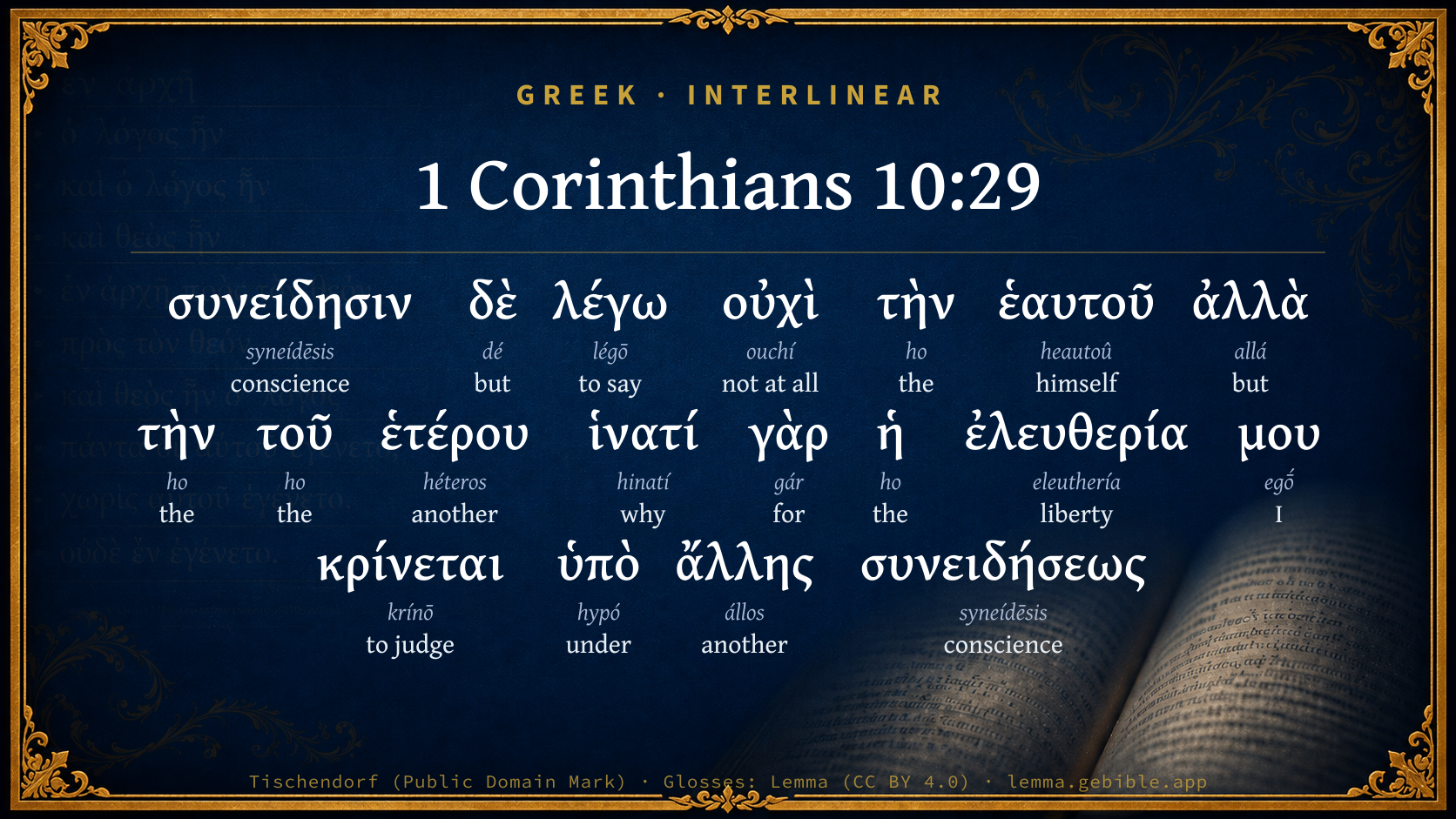
  1. συνείδησιν syneídēsis G4893 “conscience” Noun, Accusative, Singular, Feminine
  2. δὲ dé G1161 “but” Conjunction
  3. λέγω légō G3004 “to say” Verb, Present, Active, Indicative, 1st person, Singular
  4. οὐχὶ ouchí G3780 “not at all” Particle, Negative
  5. τὴν ho G3588 “the” Article, Accusative, Singular, Feminine
  6. ἑαυτοῦ heautoû G1438 “himself” Reflexive pronoun, 2nd person, Genitive, Singular, Masculine
  7. ἀλλὰ allá G235 “but” Conjunction
  8. τὴν ho G3588 “the” Article, Accusative, Singular, Feminine
  9. τοῦ ho G3588 “the” Article, Genitive, Singular, Masculine
  10. ἑτέρου héteros G2087 “another” Adjective, Genitive, Singular, Masculine
  11. γὰρ gár G1063 “for” Conjunction
  12. ἡ ho G3588 “the” Article, Nominative, Singular, Feminine
  13. ἐλευθερία eleuthería G1657 “liberty” Noun, Nominative, Singular, Feminine
  14. μου egṓ G1473 “I” Personal pronoun, 1st person, Genitive, Singular
  15. κρίνεται krínō G2919 “to judge” Verb, Present, Passive, Indicative, 3rd person, Singular
  16. ὑπὸ hypó G5259 “under” Preposition
  17. ἄλλης állos G243 “another” Adjective, Genitive, Singular, Feminine
  18. συνειδήσεως syneídēsis G4893 “conscience” Noun, Genitive, Singular, Feminine

About this verse

These counts appear in no published source. They are computed here, from the morphology-tagged text and Lemma’s own curated glosses. What Lemma adds →

19
words
15
distinct lemmas
Pauline Epistles
section

Notable vocabulary

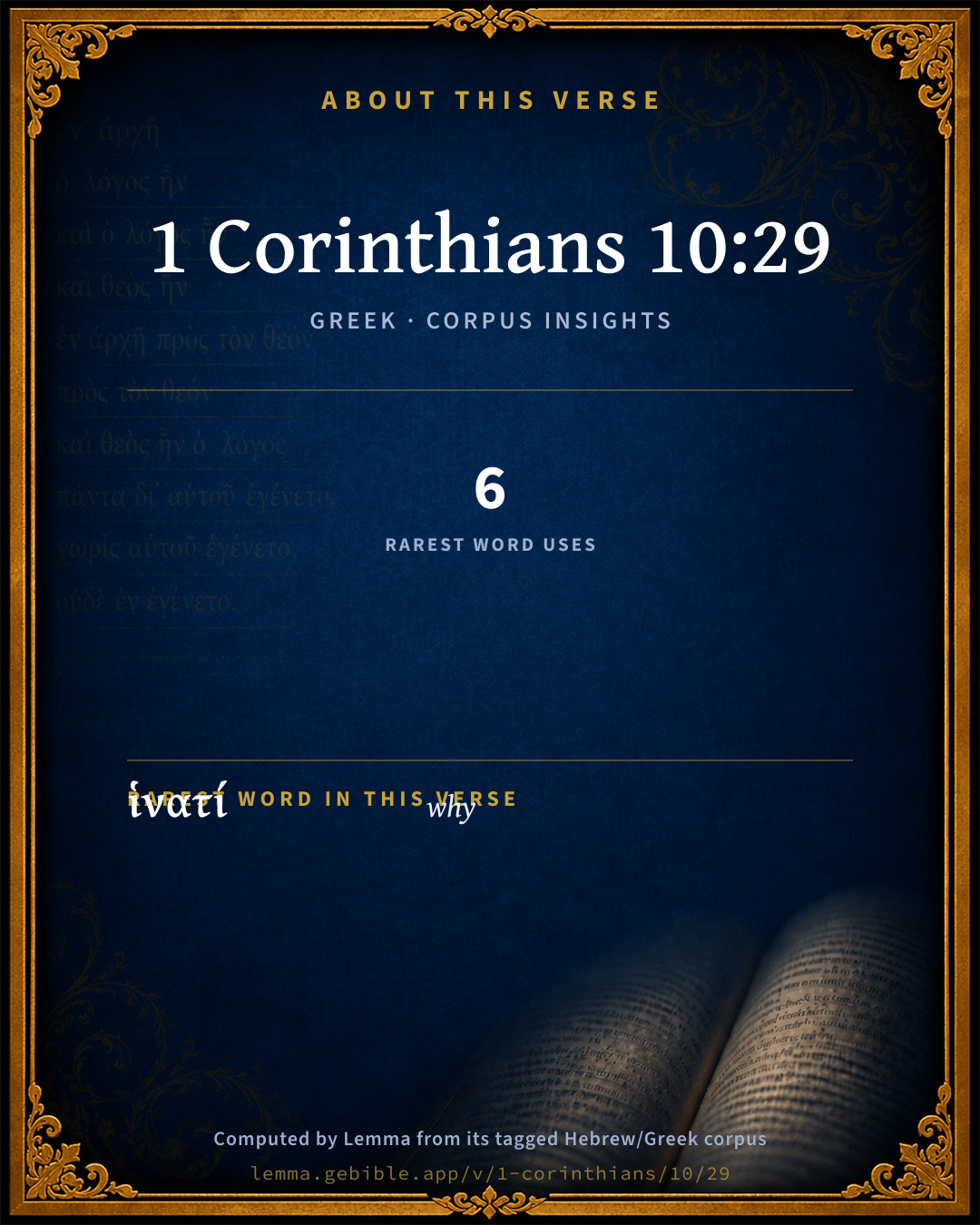
The rarest word here is ἱνατί why G2444 — appearing just 6 times in the whole Greek New Testament.

Shared distinctive vocabulary

ἱνατί why G2444 occurs in 6 verses of the Greek New Testament. Also found in:

Repetition

Words recur within this verse:

  • συνείδησιν conscience G4893 ×2
  • τὴν the G3588 ×4

Cross-references

6

Topical passages linked to 1 Corinthians 10:29 in the Treasury of Scripture Knowledge — connected by theme and wording, ordered by reader-vote popularity; previews shown in the World English Bible.

  • 1 Corinthians 9:19 For though I was free from all, I brought myself under bondage to all, that I might gain the more.
  • Romans 14:15–21 Yet if because of food your brother is grieved, you walk no longer in love. Don't destroy with your food him for whom Christ died.
  • 1 Corinthians 8:9–13 But be careful that by no means does this liberty of yours become a stumbling block to the weak.
  • 1 Corinthians 10:32 Give no occasions for stumbling, either to Jews, or to Greeks, or to the assembly of God;
  • 2 Corinthians 8:21 Having regard for honorable things, not only in the sight of the Lord, but also in the sight of men.
  • 1 Thessalonians 5:22 Abstain from every form of evil.

Cross-references courtesy of OpenBible.info (CC BY 4.0).

Commentary

Notes on 1 Corinthians 10:29 from classic Christian and Jewish commentators (each source and its license shown beneath its notes). The classic Christian expositions comment on the surrounding passage and are grouped to its opening verse, so a note may address several verses; the Jewish commentaries on the Tanakh (Rashi and others) are per-verse, so they appear only where the commentator wrote on this verse.

Lemma curates 59 commentaries, every one of them public domain or Creative Commons licensed, each selected and text-cleaned for this edition rather than reprinted as found. About our sources →

Tyndale Open Study Notes

Tyndale Open Resources

10:29-30 These two questions are difficult to understand in light of 10:28-29a. By placing 10:28-29a in parentheses, the NLT has interpreted these questions as expressing Paul’s own convictions, following on from 10:27.

Tyndale Open Study Notes — © Tyndale Open Resources, licensed CC BY-SA 4.0. Text via the HelloAO Bible API.

Bengel's Gnomon

Johann Albrecht Bengel

1Co 10:29. Τὴν ἑαυτοῦ, thy own) comp. the preceding verse; or rather, because he is there speaking in the plural, my own; comp. this with what immediately follows.—ἑτέρου, of another) of whom, 1Co 10:28.—ἡ ἐλευθερία μου, my liberty) i.e. [Why am] I, along with the liberty of my conscience [judged]; so immediately after, by the conscience of another, i.e. by another along with his conscience which is encumbered with scruples.—κρίνεται, is judged) i.e., his weak conscience cannot deprive my conscience of its liberty.—ἄλλης, another) This word has greater force, than if it had been said, of another [judged by ANOTHER conscience; not as Engl. V. another man’s conscience].

Bengel's Gnomon of the New Testament — English translation (T&T Clark, Edinburgh, 1860) — public domain. Text from a community e-Sword module.

Meyer's Critical & Exegetical Commentary

Heinrich August Wilhelm Meyer

1Co_10:29 f. Lest now any one should understand this last διὰ τ. συνείδ. as meaning ones own conscience, as in 1Co_10:25; 1Co_10:27, and so misunderstand Paul with his high views of Christian freedom, he adds here this emphatic explanation, and the reason on which it rests (ἱνατί γάρ … 1Co_10:30).

τὴν ἑαυτοῦ] his own individual conscience, his, namely, who was warned.

τοῦ ἑτέρου] of the other in the case, points back to the τὸν μηνύσαντα, whose conscience, too, is afterwards included under ἄλλης συνειδήσεως.

ἱνατί γὰρ κ.τ.λ[1720]] For why is my liberty, etc., that is: for it is absurd that another mans conscience should pronounce sentence (of condemnation) upon my liberty (my moral freedom from obligation as regards such things, indifferent as they are in themselves). This is the reason, why Paul does not mean ones own conscience when he says that to spare conscience one should abstain from eating in the case supposed (1Co_10:28), but the conscience of the other. Ones own conscience, the distinctive moral element in ones own self-consciousness, does not need such consideration; for it remains unaffected by the judgment passed and slander uttered, seeing that both are without foundation. The only motive for the abstinence, therefore, is the sparing of the conscience of others, not the danger to ones own. Similarly Bengel; comp de Wette. The ordinary interpretationadopted by Heydenreich, Flatt, Billroth, Rückert, Olshausen, Neander, Maier, Ewald, Hofmann; Osiander is undecidedis that of Chrysostom, taking the words as the reason for the rule in 1Co_10:28, in the sense of: For why should I give occasion to others to pass judgment upon me and to speak evil? or, There is no reason for letting it come to such a pass, that a Christians liberty should be subjected to that tribunal of the moral consciousness of others, Hofmann. But even apart from the fact that the text says nothing about giving occasion, or letting it come to such a pass, it is a very arbitrary proceeding to take a clause standing in such a marked way in the course of the argument as συνείδησιν … ἑτέρου, and to thrust it aside as something only incidentally appended. The connection, too, of the conditional protasis with the interrogative ΤΊ in the apodosis in 1Co_10:30, makes it clear enough that Paul wishes to bring out the absurdity of the relation between the two conceptions. Comp Rom_3:7, al[1723] Vatablus, Schulz, and Pott find here and in 1Co_10:30 the objection of an opponent ad infirmitatem fratrum suorum se conformare nolentis. The ΓΆΡ is not inconsistent with this (see Fritzsche, a[1724] Matth. p. 807), but the ΟὖΝ is (1Co_10:31).

Observe the difference between ΤΟῦ ἙΤΈΡΟΥ (alterius) and ἄλλης (alius, i.e. alienae), by which any other conscience whatever is meant.

χάριτι] Dative of the manner: gratefully, with thanks. Comp Eph_2:5, where, however, the context shows that the meaning is by grace; see in general, Bernhardy, p. 100 f. It refers to the grace at meat. By understanding it as beneficio Dei (Beza, Grotius, Heydenreich, Hofmann), we bring in Dei entirely without warrant, and overlook the parallel εὐχαριστῶ, the idea of which is the same with that of ΧΆΡΙΤΙ.

The twice-used ἘΓΏ is emphatic: I for my part.

μετέχω] The object of the verb is self-evident: food and drink. Comp ὙΠῈΡ ΟὟ.

ΕὐΧΑΡΙΣΤῶ] Gratiarum actio cibum omnem sanctificat, auctoritatem idolorum negat, Dei asserit; 1Ti_4:3 f.; Rom_14:6, Bengel.

[1720] .τ.λ. καὶ τὰ λοιπά.

[1723] l. and others; and other passages; and other editions.

[1724] d refers to the note of the commentator or editor named on the particular passage.

Meyer — Critical and Exegetical Commentary on the New Testament — English translation by Peter Christie, edited by Frederick Crombie (T&T Clark, 1880) — public domain. Text from a community e-Sword module.

Hodge's Commentary on Romans, Ephesians & First Corinthians

Charles Hodge

1Co_10:29, 1Co_10:30

Conscience, I say, not thine own, but of the other: for why is my liberty judged of another (mans) conscience? For it I by grace be a partaker, why am I evil spoken of for that for which I give thanks?

As in the preceding 1Co_10:25, 1Co_10:27 the word conscience refers to ones own conscience, to prevent its being so understood in 1Co_10:28, Paul adds the explanation, Conscience, I say, not thine own, but of the others. That is, I do not mean your conscience, but the conscience of the man who warned you not to eat. For why is my liberty judged of another mans conscience? These and the words following admit of three interpretations.

1. If connected with the preceding clause, they must give the reason why Paul meant the conscience of the other. Conscience I say, not ones own, but of the other; for why is my liberty (or conscience) to be judged by another mans conscience? if I eat with thanksgiving (and with a good conscience, why am I blamed?) The obvious objection to this interpretation is, that it exalts a subordinate clause into the principal matter. It was plain enough that Paul did not mean the mans own conscience, and therefore it is unnecessary to take up two verses to prove that he did not. Besides, this interpretation makes the apostle change sides. He has from the beginning been speaking in behalf of the weak. This interpretation makes him here speak almost in terms of indignation in behalf of the strong, who certainly need no advocate. They did not require to be told that their liberty was not to be restricted by the scruples of the weak.

2. A much better sense is obtained by connecting this passage with the 28th verse. Do not eat out of regard to the conscience of your brother; for why should my (your) liberty be judged (i.e. condemned) by another conscience; why should I be blamed for what I receive with thanksgiving? That is, why should I make such a use of my liberty as to give offense? This brings the passage into harmony with the whole context, and connects it with the main idea of the preceding verse, and not with an intermediate and subordinate clause. The very thing the apostle has in view is to induce the strong to respect the scruples of the weak. They might eat of sacrificial meat at private tables with freedom, so far as they themselves were concerned; but why, he asks, should they do it so as to give offense, and cause the weak to condemn and speak evil of them.

3. This passage is by some commentators regarded as the language of an objector, and not as that of the apostle. The strong, when told not to eat on account of the conscience of a weak brother, might ask, Why is my liberty judged by anothers conscience why should I be blamed for what I receive with thanksgiving? (The γάρ, according to this view, is not for, but intensive, ἱνατί γάρ, why then.) This gives a very good sense, but it is not consistent with the following verse (which is connected with 1Co_10:30 by οὖν, and not by δέ). Paul does not go on to answer that objection, but considers the whole matter settled. The second interpretation is the only one consistent alike with what precedes and with what follows. Do not eat when cautioned not to do so; for why should you so use your liberty as to incur censure? Whether therefore you eat or drink, do all for the glory of God. Why is my liberty judged (κρίνεται), i.e. judged unfavorably or condemned. If I by grace am a partaker; literally, if I partake with thanksgiving. The word χάρις, grace, is here used in the sense of gratia, thanks, as in the common phrase to say grace. See Luk_6:32, 1Ti_1:12, etc.

Charles Hodge — Commentary on Romans (1835), First Corinthians (1857), and Ephesians (1856) — public domain. Text from a community e-Sword module.

Geneva Bible (1599)

Geneva Bible translators

A reason: for we must take heed that our liberty be not evil spoken of, and that the benefit of God which we ought to use with thanksgiving be not changed into impiety, and that through our fault, if we choose rather to offend the conscience of the weak, than to yield a little of our liberty in a matter of no importance, and so give occasion to the weak to judge in such sort of us, and of Christian liberty. And the Apostle taketh these things upon his own person, that the Corinthians may have so much the less occasion to oppose anything against him.

Geneva Bible (1599) marginal notes — public domain. Text via Bolls.life.

Jamieson, Fausset & Brown

Robert Jamieson, A. R. Fausset & David Brown

Conscience . . . of the other--the weak brother introduced in Co1 10:28.

for why is my liberty judged off another man's conscience?--Paul passes to the first person, to teach his converts by putting himself as it were in their position. The Greek terms for "the other" and "another" are distinct. "The other" is the one with whom Paul's and his Corinthian converts' concern is; "another" is any other with whom he and they have no concern. If a guest know the meat to be idol meat while I know it not, I have "liberty" to eat without being condemned by his "conscience" [GROTIUS]. Thus the "for," &c., is an argument for Co1 10:27, "Eat, asking no questions." Or, Why should I give occasion by the rash use of my liberty that another should condemn it [ESTIUS], or that my liberty should cause the destruction of my weak brother?" [MENOCHIUS]. Or, the words are those of the Corinthian objector (perhaps used in their letter, and so quoted by Paul), "Why is my liberty judged by another's conscience?" Why should not I be judged only by my own, and have liberty to do whatever it sanctions? Paul replies in Co1 10:31, Your doing so ought always to be limited by regard to what most tends "to the glory of God" [VATABLUS, CONYBEARE and HOWSON]. The first explanation is simplest; the "for," &c., in it refers to "not thine own" (that is, "not my own," in Paul's change to the first person); I am to abstain only in the case of liability to offend another's conscience; in cases where my own has no scruple, I am not bound, in God's judgment, by any other conscience than my own.

Jamieson, Fausset & Brown — Commentary Critical and Explanatory on the Whole Bible (1871) — public domain (CC PDM 1.0). Text via the HelloAO Bible API.

Adam Clarke's Commentary

Verse 29. 30. For why is my liberty judged of another man's conscience? c.] Though in the case of flesh offered to idols, and other matters connected with idolatry, (on which it appears there was much of a tender conscience among some of the Corinthians,) it was necessary to sacrifice something to an over-scrupulous conscience, yet the Gospel of Christ did not lay any man under this general burthen, that he must do nothing at which any weak brother might feel hurt or be stumbled for the liberty of the Gospel must not take for its rule the scrupulosity of any conscience for if a man, by grace-by the allowance or authority of the Gospel, partake of any thing that God's bounty has sent, and which the Gospel has not forbidden, and give thanks to God for the blessing, no man has right or authority to condemn such a person. This seems to be the meaning of these two verses; and they read a lesson of caution to rash judges, and to those who are apt to take offence.

Adam Clarke's Commentary on the Bible (1810–1826) — public domain. Text from a community e-Sword/MySword module.

John Calvin's Commentaries

29. Conscience, I say, not thine own He always carefully takes heed not to diminish liberty, or to appear to take from it in any degree. “Thou oughtest to bear with the weak conscience of thy brother, that thou mayest not abuse thy right, so as to give occasion of offense to him; but in the meantime thy conscience remains, nevertheless, free, because it is exempted from that subjection. Let not, therefore, the restraint which I impose upon thee as to outward use, become by any means a snare to entangle thy conscience.”

It must be observed here, that the term conscience is taken here in its strict acceptation; for in Romans 13:5, and 1 Timothy 1:5, it is taken in a larger sense. “We ought, says Paul, to obey princes, not merely for the sake of wrath, but also for that of conscience” — that is, not merely from fear of punishment, but because the Lord orders it so, and it is our duty. Is it not reasonable, too, that we should for the same reason accommodate ourselves to weak brethren — that is, because we are to this extent subject to them in the sight of God? Farther, the end of the commandment is love out of a good conscience Is not the affection of love included in a good conscience? Hence its meaning here is, as I have already stated, more restricted, inasmuch as the soul of a pious man looks exclusively to the tribunal of God, has no regard to men, is satisfied with the blessing of liberty procured for it by Christ, and is bound to no individuals, and to no circumstances of time or place.

Some manuscripts repeat the statement — The earth is the Lord’s. But the probability is, that some reader having put it on the margin, it had crept into the text. It is not, however, a matter of great importance.

For why is my liberty It is doubtful, whether Paul speaks in this way of himself, or whether he makes this objection in the name of the Corinthians. If we take it as spoken in his own name, it will be a confirmation of the preceding statement. “In restricting yourself, for the sake of another man’s conscience, your liberty is not thereby made subject to him.” If in the name of the Corinthians, the meaning will be this: “You impose upon us an unjust law, in requiring that our liberty should stand or fall at the caprice of others.” I am of opinion, that Paul says this of himself, but explains it in another way, for hitherto I have been stating the views of others. To be judged, then, I explain here as meaning — to be condemned, agreeably to the common acceptation of the word in Scripture. Paul warns us of the danger that must ensue, if we make use of our liberty unreservedly, so as to give occasion of offense to our neighbors — that they will condemn it. Thus, through our fault, and our unreasonableness, the consequence will be, that this special benefit from God will be condemned If we do not guard against this danger, we corrupt our liberty by our abuse of it. This consideration, then, tends very much to confirm Paul’s exhortation.

John Calvin's Commentaries (1540-1563) — public domain. Text from the Calvin Translation Society English edition (1840s-50s) via the Christian Classics Ethereal Library (ccel.org). Calvin's coverage is partial (roughly two-thirds of the Bible); uncommented books and verses are honest gaps, never fabricated. The 19th-century editor's footnotes and remarks are omitted so the notes are faithfully Calvin's own voice.

Ellicott's Commentary for English Readers

(29) Conscience, I say, not thine own, but of the other.—In the previous verse there is nothing to indicate that the obligation not to eat the meat under such circumstances arises from a consideration of the tenderness of the other’s conscience. Here any danger of mistake as to whose conscience is meant is removed. Of course (says St. Paul) I mean his conscience, not yours. For no other man’s scruples are to bind my conscience. While the opinion or weakness of another is never to make my conscience waver from what it knows to be true, it may often be a reason for our sacrificing in act some personal indulgence.

A Bible Commentary for English Readers, edited by Charles John Ellicott (1878–1897) — public domain. Text from a community e-Sword module.

The Cambridge Bible for Schools and Colleges

gen. ed. J. J. S. Perowne

29. why is my liberty judged of another man’s conscience?] This and the following verse are a little obscure, but the sense appears to be that no man has a right to interfere with the liberty enjoyed by another, save so far as his own conduct and conscientious convictions are likely to be affected thereby. In fact the Apostle’s words in 1Co_10:28-30 may be thus paraphrased. “For conscience sake. Not that you are to feel conscience-stricken, as though you had yourself been doing something wrong, and given your neighbours a right to blame you. No man has any such right You were doing no harm. You had a perfect right to eat what was set before you with gratitude to God for what He had given. No, it is not of your own, but of your neighbour’s conscience, that I was speaking. To him you would be doing harm incalculable, if you allowed him to suppose that there was no sin in worshipping idols.”

The Cambridge Bible for Schools and Colleges (gen. ed. J. J. S. Perowne; Cambridge University Press, 1878–1918) — public domain. Text from a community e-Sword module.

John Gill's Exposition

For if I by grace be a partaker,.... Either of Christian liberty, through the grace of God; or of the creatures God has given men to eat of through his goodness, and which are enjoyed by the saints with thankfulness:

why am I evil spoken of for that for which I give thanks? that is, why should I expose myself to evil tongues, the blasphemies and reproaches of men, by eating things of this kind, under this circumstance, when there are so many creatures I can use without offence, and be thankful for? or why should my liberty be reproached through an imprudent use of it, for which I have the utmost reason to be thankful? wherefore upon the whole it is best to deny one's self in such a case, rather than risk one's character, the glory of God, and the honour of religion.

John Gill's Exposition of the Whole Bible (1746–1763) — public domain (CC PDM 1.0). Text via the HelloAO Bible API.

Trapp's Complete Commentary

John Trapp

29 Conscience, I say, not thine own, but of the other: for why is my liberty judged of another man’s conscience?

Ver. 29. Why is my liberty judged] As a profane licence. We should be shy of the very shows and shadows of sin, Quicquid fuerit male coloratum, as Bernard hath it; if a thing look but ill-favoured, abstain from it.

John Trapp, A Commentary or Exposition upon All the Books of the Old and New Testament (1647–1656) — public domain. Text from a community e-Sword module.

Albert Barnes' Notes on the Bible

Conscience, I say, not thine own - I know that you may have no scruples on the subject. I do not mean that with you this need be a matter of conscience. I do not put it on that; ground, as if an idol were anything, or as if it were in itself wrong, or as if the quality of the meat so offered had been changed; but I put it on the ground of not wounding the feelings of those who are scrupulous, or of leading them into sin.

For why is my liberty ... - There is much difficulty in this clause; for as it now stands, it seems to be entirely contradictory to what the apostle had been saying. He had been urging them to have respect to other people’s consciences, and in some sense to give up their liberty to their opinions and feelings. Macknight and some others understand it as an objection: “Perhaps you will say, But why is my liberty to be ruled by another man’s conscience?” Doddridge supposes that this and 1Co 10:30 come in as a kind of parenthesis, to prevent their extending his former caution beyond what he designed. “I speak only of acts obvious to human observation: for as to what immediately lies between God and my own soul, why is my liberty to be judged, arraigned, condemned at the bar of another man’s conscience?” But it is probable that this is not an objection. The sense may be thus expressed: “I am free; I have “liberty” to partake of that food, if I please; there is no law against it, and it is not morally wrong: but if I do, when it is pointed out to me as having been sacrificed to idols, my liberty - the right which I exercise - will be “misconstrued, misjudged, condemned” (for so the word κρίνεται krinetai seems to be used here) by others. The weak and scrupulous believer will censure, judge, condemn me as regardless of what is proper, and as disposed to fall in with the customs of idolaters; and will suppose that I cannot have a good conscience. Under these circumstances, why should I act so as to expose myself to this censure and condemnation? It is better for me to abstain, and not to use this liberty in the case, but to deny myself for the sake of others.”

Albert Barnes' Notes on the Bible (1834–1885) — public domain. Text from a community e-Sword/MySword module.

Haydock's Catholic Bible Commentary

For why is my liberty? The meaning of this passage is, that though we ought, on some occasions, to abstain from things in themselves lawful, yet, that on other occasions we are by no means obliged to it, particularly when our brother is not thoroughly instructed on that head. (Theophylactus)

George Leo Haydock (1774–1849), Haydock's Catholic Family Bible and Commentary, 1859 edition — public domain. Excludes Psalms (Douay-Rheims chapter numbering differs from Protestant) and Deuterocanonical books (Catholic canon only).

Matthew Poole's English Annotations

By reason of what we had, 1Co 10:28, (where the apostle forbade eating these meats, in case any at the feast told them they had been offered to idols, both for his sake that told him so, and also for conscience sake), it is most reasonable to interpret those words not thine own in this verse, not thine own only, there being frequent instances in Scripture where the negative particle must be so restrained, as Joh 4:42; 6:27,38.

For why is my liberty judged of another man’s conscience? For why should my practice in a thing wherein I have a liberty, be censured or condemned by the conscience of another, he being persuaded that what I do, and judge that I have a liberty to do, and may do lawfully, is done by me sinfully, and I by him accounted a transgressor for it; so as though I do a thing that is honest, yet it is not honest in the sight of all men, or of good report; whereas Christians are obliged, Rom 12:17, to provide things honest in the sight of all men, not in their own sight merely, end to do those things that are lovely and of good report, Phi 3:8.

Matthew Poole's English Annotations on the Holy Bible (1683–1685) — public domain. Text from a community e-Sword/MySword module.

Whedon's Commentary on the Bible

Daniel D. Whedon

29. Of the other—St. Paul is here particular to reiterate that it is not his conscience that weakly objects, but the inquirer’s; and that it is by his conscience you must avoid being condemned.

Judged—Condemned. The meaning, then, is: For why incur by my license a condemnation from my fellow-Christian’s conscience? It must be a doubtful, perhaps a reckless, use of my liberty, which is indulged in disregard of his judgment. Better offend against a man’s tastes, or his wishes, or even his temporal interests, than so transgress against his conscience as to endanger his soul.

Not thine own—When you yield external compliance you do not yield also the secret convictions of your own conscience. The conscientious principle you still hold in your own heart, that the eating is not unlawful, in the expectation that when superstition and prejudice have passed away the truth will predominate.

Of the other—Externally, you spare his conscience; internally, you retain your own.

My liberty—Which is judged and approved by my own conscience.

Judged—So as to displace my own decision.

Of another man’s conscience—The unalienable rights of the individual conscience, the private judgment of every man, is here conclusively maintained against all usurpers, whether priests, popes, or potentates. No other man’s conscience can be for me a substitute for my own. St. Paul would have, in delicate regard for his neighbour’s conscience, avoided eating meat in his presence, but nothing could have compelled him to declare that the eating of it was intrinsically a sin.

Daniel D. Whedon (gen. ed.), Commentary on the Old and New Testaments (1874–1909) — public domain. Text from a community e-Sword module.

The Pulpit Commentary

Conscience, I say, not thine own, but of the other. You may be well aware that you intend no sanction of idolatry, but if the other supposes that you do, you wound his conscience, which you have no right to do. Your own conscience has already decided for itself. For why is my liberty judged of another man"s conscience? These words explain why he said "conscience not thine own." The mere fact that another person thinks that we are doing wrong does not furnish the smallest proof that we are doing wrong. We stand or fall only to our own Master, and our consciences are free to form their own independent conclusion. Perhaps in this clause and the next verse we have an echo of the arguments used by the Corinthian "liberals," who objected to sacrifice themselves to the scruples of the weak. The independence of conscience is powerfully maintained in Rom_14:2-5.

The Pulpit Commentary (1880–1919), ed. H.D.M. Spence-Jones & Joseph S. Exell — public domain. Text from a community e-Sword module.

John Wesley's Explanatory Notes

Conscience I say, not thy own - I speak of his conscience, not thine. For why is my liberty judged by another's conscience - Another's conscience is not the standard of mine, nor is another's persuasion the measure of my liberty.

John Wesley, Explanatory Notes Upon the Whole Bible (1754–1765) — public domain. Text via the GEBible commentary corpus.

Burkitt's Expository Notes on the New Testament

William Burkitt

Here the apostle tells them that they ought to abstain from that which is lawful and indifferent in itself, for the sake of another man’s conscience. This meat had not been unlawful to them, though offered to idols, had they not been told that it was so offered; but being made acquainted therewith, for the sake of him that showed thee it was offered to idols, forbear eating; for why should our liberty be so used by us as to be judged of and condemned by another man’s conscience? It is not enough that we do what is just and right in our own sight, but we must provide things honest in the sight of all men. Whatsoever things are pure, whatsoever things are lovely, whatsoever things are of good report; these we must practise, and none but these.

And observable is the apostle’s reason, why we should, for the sake of another, abstain from eating that meat which was lawful in itself, 1Co 10:30 : namely, to prevent being evil spoken of: Why am I evil spoken of? That is, why should I cause another to speak evil of me, for eating that meat which I might without any prejudice forbear? For in so doing I shall certainly abuse my liberty, grieve God, and offend the weak.

William Burkitt's Expository Notes on the New Testament (1700–1703) — public domain. Text from a community e-Sword module.

Godbey's Commentary on the New Testament

William B. Godbey

29. “I say not the conscience of yourself, but of the other one. Hence you see from this that you are bound in all the transactions of life to keep a constant outlook for the interest of others, watching, praying and asking God to keep you from becoming a stumbling-block to any, and make you a constant inspiration for good to all who come within your influence.

29-31. “Therefore, whether you eat, or drink, or whatsoever you do, do all things to the glory of God.” Obedience to this simple and beautiful commandment of God becomes easy and natural when we have Christ crowned within, because He keeps His arms about us, and His almighty hand beneath us and His heavenly wing over us, so that we rest like a tired child in its mother’s arms, free from all solicitude, knowing that it is perfectly safe.

William B. Godbey, Commentary on the New Testament (1896–1900) — public domain. Text from a community e-Sword module.

McGarvey & Pendleton's Commentaries

J. W. McGarvey

conscience, I say, not thine own, but the other's; for why is my liberty judged by another conscience? [Christianity did not forbid a man to retain his friendships among pagans, nor did it prohibit fellowship with them. If such a friend should ask a Christian to a meal in a private house and not to a sacrificial feast in an idol temple, the Christian need not trouble himself to ask whether the meat that was served was part of all idol sacrifice, for such a dining was in no sense an act of worship. If, however, some scrupulous Christian or half-converted person should point out that the meat was idolatrous, then it was not to be eaten, for the sake of the man who regarded it as idolatrous. But so far as the real question of liberty was concerned, each man's liberty is finally judged by his own conscience and not by that of another. Liberty may be waived for the sake of another's conscience, but it is never thus surrendered. Paul's teaching, therefore, is that food is not tainted, and so it is always right to eat it as food, but all the rites of idolatry are tainted, and the Christian must do nothing which gives countenance to those rites, and for the sake of others he must abstain from seeming to countenance them even when his own conscience acquits him of so doing.]

J. W. McGarvey (with Philip Y. Pendleton), Commentaries on the New Testament (The Fourfold Gospel, 1914; Acts; and the epistles) — public domain. Text from a community e-Sword/MySword module.

The People's New Testament

B. W. Johnson

29. Conscience … not thine own, but of the other. When one eats what he knows to be simply wholesome food, his own conscience is not offended, but that of another man. His liberty of conscience is not abridged by another man's want of knowledge.

B. W. Johnson's The People's New Testament with Notes (1889–1891) — public domain. Electronic text from the Christian Classics Ethereal Library (CCEL) ThML edition.

Cambridge Greek Testament for Schools and Colleges

29. ἑαυτοῦ. For the usual σεαυτοῦ. Winer, Gr. Gram. § 22, refers to Joh 18:34. But B (followed by Westcott and Hort) reads σεαυτοῦ there. Winer gives some instances of this unusual construction from classical authors.

ἱνατί γάρ. The connection is as follows. ‘I don’t say your conscience, but the other man’s. For what right has he to judge you, or to interfere with your Christian liberty? No, he has nothing to do with your conscience. But yon may have a good deal to do with his. If you should inflict an injury on that, you would be greatly to blame.’ In other words no man has any right to pronounce ab extra on another man’s conduct on such matters. Each is free to act, as far as he himself is concerned, according to his own sense of what is fitting and proper. But a man’s right to think for himself is limited by the effect of his action on others. If his conduct be the means of inducing others less enlightened than himself to act contrary to their conscience, and to do what they believe to be wrong, he is doing harm by the exercise of a liberty which in any other case he undoubtedly enjoys.

Cambridge Greek Testament for Schools and Colleges (Cambridge University Press, 1896; 21 vols, various authors incl. Carr, Maclear, Plummer, Farrar, Lumby, Moule, M. R. James, Simcox) — public domain. Text from a community e-Sword module.

Alford’s Greek Testament

Henry Alford

29.] Explanation of the last διὰ τὴν συνείδησιν, as meaning not your own, but that of the informer. True to his interpretation (see above), De W. supposes τοῦ ἑτέρου not to refer to τὸν μηνύσαντα, but to ‘your weak Christian brother;’ but then how very harsh and clumsy are the various references to understood persons;—and how simple, on the other interpretation, is the reference in each case of τὴν συν. to the subject of the clause.

ἵνα τί γάρ] For why is my freedom judged by a conscience not mine own?—i.e. ‘Why should I be to treated (hazard by my actions such treatment) that the exercise of my Christian freedom, eating as I do and giving thanks, should become matter of condemnation to another, who conscientiously disapproves of it?’ If (no copula) I partake thankfully ([not, as E. V., ‘by grace’] dat. of the manner, cf. Soph. Antig. 616, σοφίᾳ γὰρ ἔκ του κλεινὸν ἔπος πέφανται,—and Bernhardy, Syntax, p.101), why am I to be spoken ill of for that for which I give thanks? These words have been misunderstood. It has been generally supposed that the Apostle is impressing a duty, not to give occasion for the condemnation of their liberty by another’s conscience. But the ground on which he is here arguing, is the unfitness, absurdity, injustice to oneself and the cause of God, ver. 31, of so acting as to be condemned for that in which a man not only allows himself, but for which he gives thanks to God. The sentiment is the same as in Rom 14:16, μὴ βλασφημείσθω ὑμῶν τὸ ἀλαθόν.

The emphasis is each time on ἐγώ.

Henry Alford, The Greek Testament (1849–1861) — public domain. Text from a community e-Sword module.

International Critical Commentary

29. συνείδησιν δὲ λέγω. ‘Now by conscience I mean, not one’s own, but the other’s,’ not the guest’s who received the information, but the fellow-guest’s who gave it. There is no need to regard ἑαυτοῦ as second person (‘thine own,’ AV., RV.) for σεαυτοῦ: it may be indefinite, ‘one’s own.’ In the plural, ἑαυτῶν, etc. is regularly used in N.T. for ἡμῶν αὐτῶν and ὑμῶν αὐτῶν, etc. (11:31; Php 2:12, etc.); but, in the singular, there is not one decisive example of this use. In Rom 13:9; Gal 5:14; Mat 22:39, σεαυτόν is the better reading; in Joh 18:34, σεαυτοῦ. Here, ἑαυτοῦ is the right reading.

ἵνα τί γὰρ ἡ ἐλευθερία μου; The Apostle graphically puts himself in the place of the Christian guest who has been placed in a difficulty by the officiousness of his scrupulous informant; ex sua persona docet. ἵνα τί γάρ: the force of the ἵνα is lost in most explanations of this clause (except Godet). ἵνα τί (see small print) never means ‘by what right,’ but rather ‘for what object’? St Paul’s main point in the context is μὴ ἐσθίετε, for which γάρ introduces a reason: ‘Eat not. … for what good will you gain?’ (cf. 8:8). What follows is really a characterization of the act of eating. The clue to the tense is in Rom 14:16, where the same verb, βλασφημεῖσθω, is used in a very similar connexion, ‘What good shall I gain by (eating, i.e.) by suffering my liberty to incur judgment (as 11:31; Rom 2:12; Act 13:27) at the hands of another’s conscience? Why incur blame for food for which I give thanks, if I “say grace” for it?’ In the last clause, the point is in the incongruity of ‘saying grace’ for what places me in a false position; the structure exhibits a slight logical inversion closely similar to that in Rom 7:16 (see Introd. § on Style).

For ἑαυτοῦ (א A B C D2 E, etc.), D*, Latt (tuam) have σεαυτοῦ, and H has ἐμαυτοῦ, which are manifest corrections. For ἄλλης, F, d g Goth., Ambr. have ἀπίστου, which is wrong both as reading and as interpretation.

The interrogative ἵνα τί (with γένηται or γένοιτο understood) is found in several places, both in N.T. (Mat 9:4, Mat 9:27:46; Luk 13:7; Act 4:25, Act 7:25) and in LXX (Rth 1:11, Rth 1:21; Ecclus. 14:3; 1 Mal 2:7); also in Plato and Aristophances. Cf. ut quid? and in quid? and ad quid?

International Critical Commentary — older volumes (1896–1929), various authors — public domain. Text from a community e-Sword module.

Lesson kit

Teaching starters — assembled from the data on this page, not authored interpretation. Every prompt links to the verse data it draws on. Edit before teaching.

1 Corinthians, in the Pauline Epistles, opens this verse with 19 words (15 distinct Greek lemmas). Its most distinctive word is hinatí (“why”). A historical commentator’s framing appears above. Read the whole chapter for the surrounding context.

Discussion questions

  1. The word hinatí carries the sense “why.” How does it shape the verse?
  2. How does Matthew 9:4, which shares the word «why», read alongside this verse?
  3. What does the repetition of “conscience” (2× in this one verse) do in this verse?
  4. These translations render this verse differently; the difference is in the English rendering, not the original. What questions does that raise?
  5. Compare how Tyndale Open Study Notes and Bengel's Gnomon read this verse. Where do they agree or differ?

Things to notice

  • These translations choose different wording for 8 words in this verse.
  • “conscience” occurs 2× in this single verse.
  • 15 distinct Greek lemmas span 19 words in this verse.

Reading settings

Reading text

Shown beneath each verse's original-language words.

Old Testament
Old Testament edition

Read the OT as the Masoretic Hebrew (MT) or the Greek Septuagint (LXX).

English shown for the Greek Septuagint (in the Hebrew ↔ Greek comparison).

Comparing translations? Open the Compare panel on any verse page to stack up to four side by side.